ADHESIVES AND
SEALANTS
A market survey on :
SUBJECT : BTM VI
CLASS : T.Y BARCH DIV : D
GROUP : 2
MENTOR : AR. SANKET JAIN
GROUP
MEMBERS :
AISHWARYA ZARKAR
ASMA PATNE
AYUSHI TORASKAR
DIVYA DAHAD
MADHURA MALU
RAKHI LUNAWAT
RUCHITA DONGRE
SNEHAL KINIKAR
SURBHI CHAVAN
VAISHALI AKELLA
SR. NO TOPIC SLIDE NO.
1 Introduction to Adhesives and Sealants
2 Types and classification of Adhesives and Sealants
3 Composition of Adhesives and Sealants
4 Properties of Adhesives and Sealants
5 Manufacturing process of Adhesives and Sealants
6 Factors influencing selection of Adhesives or Sealants
7 Uses of adhesives and Sealants
8 Application process of Adhesives and Sealants
9 Difference between Adhesives and Sealants
10 Advantages & Disadvantages of Adhesives and Sealants
11 Materials and Ideal Adhesives
12 Material bonding and Ideal Adhesives
13 Production Companies of Adhesives and Sealants
14 Cost and Cost Comparison of Adhesives and Sealants
I N D E X
INTRODUCTION TO ADHESIVES AND SEALANTS
01
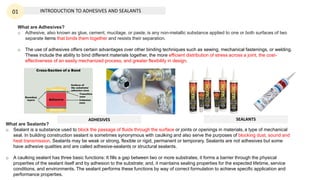
What are Adhesives?
o Adhesive, also known as glue, cement, mucilage, or paste, is any non-metallic substance applied to one or both surfaces of two
separate items that binds them together and resists their separation.
o The use of adhesives offers certain advantages over other binding techniques such as sewing, mechanical fastenings, or welding.
These include the ability to bind different materials together, the more efficient distribution of stress across a joint, the cost-
effectiveness of an easily mechanized process, and greater flexibility in design.
What are Sealants?
o Sealant is a substance used to block the passage of fluids through the surface or joints or openings in materials, a type of mechanical
seal. In building construction sealant is sometimes synonymous with caulking and also serve the purposes of blocking dust, sound and
heat transmission. Sealants may be weak or strong, flexible or rigid, permanent or temporary. Sealants are not adhesives but some
have adhesive qualities and are called adhesive-sealants or structural sealants.
o A caulking sealant has three basic functions: It fills a gap between two or more substrates; it forms a barrier through the physical
properties of the sealant itself and by adhesion to the substrate; and, it maintains sealing properties for the expected lifetime, service
conditions, and environments. The sealant performs these functions by way of correct formulation to achieve specific application and
performance properties.
ADHESIVES SEALANTS
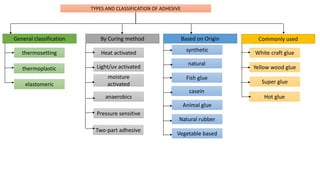
TYPES AND CLASSIFICATION OF ADHESIVE
General classification
thermosetting
thermoplastic
elastomeric
By Curing method
synthetic
Light/uv activated
moisture
activated
anaerobics
Pressure sensitive
Two-part adhesive
Based on Origin
Heat activated
natural
Animal glue
casein
Fish glue
Vegetable based
Natural rubber
Commonly used
White craft glue
Yellow wood glue
Super glue
Hot glue
TYPES AND CLASSIFICATION OF ADHESIVE AND SEALANTS
02
• CLASSIFICATION OF ADHESIVE -
• GENERAL CLASSIFICATION OF ADHESIVES (CLASSIFICATION BY STRUCTURE)
• CLASSIFICATION OF ADHESIVES BY CURING METHOD
• CLASSIFICATION OF ADHESIVES BY ORIGIN
GENERAL CLASSIFICATION OF ADHESIVES
THERMOSETTING ADHESIVES
THERMOSETS MOLECULES ARE CROSS-LINKED BY STRONG COVALENT INTERMOLECULAR BONDS, FORMING ONE GIANT
MOLECULE. CROSS-LINKING IS IRREVERSIBLE THEREFORE THERMOSETS CAN NOT BE REPROCESSED (RE-MELT). CROSS-LINKING
IS ACHIEVED IN CURING PROCESS. CURING RESULTS IN SHARP INCREASE OF STRENGTH, ELASTICITY AND STABILITY OF
THERMOSETS.
MOST OF THERMOSETTING ADHESIVES ARE BASED ON EPOXIES, POLYESTERS, POLYIMIDES AND PHENOLICS.
THERMOPLASTIC ADHESIVES
THERMOPLASTICS ARE POLYMERS, WHICH SOFTEN (BECOME PLIABLE AND PLASTIC) AND MELT WHEN HEATED. NO NEW
CROSS-LINKS FORM (NO CHEMICAL CURING) WHEN A THERMOPLASTIC COOLS AND HARDEN. THERMOPLASTICS MAY BE
REPROCESSED MANY TIMES BY HEATING OR APPLYING A SOLVENT.
POLYAMIDES, CYANOACRYLATES, POLYACRYLATES, POLYVINYL ACETATE (PVA) ARE TYPICAL THERMOPLASTIC ADHESIVES.
ELASTOMERIC ADHESIVES
ELASTOMERS ARE POLYMERS POSSESSING HIGH ELASTICITY - MAY BE REVERSIBLY STRETCHED AT HIGH DEGREE. ELASTOMERS
CONSISTS OF LONG LIGHTLY CROSS-LINKED MOLECULES. TYPICAL ELASTOMERIC ADHESIVES ARE BASED ON NATURAL RUBBERS,
SILICONES, ACRYLONITRIDE BUTADIENE (NITRILE), NEOPRENE, BUTYL, POLYURETHANE, STYRENE-BUTADIENE.
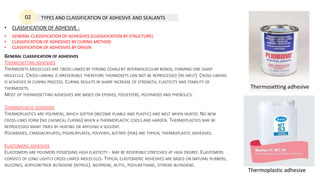
Thermosetting adhesive
Thermoplastic adhesive
CLASSIFICATION OF ADHESIVES BY CURING METHOD
• ONE-PART ADHESIVES
HEAT ACTIVATED CURING ADHESIVES. ADHESIVES OF THIS TYPE (EPOXIES, URETHANES, POLYIMIDES) CONSIST OF A READY
MIXTURE OF TWO COMPONENTS.
LIGHT/UV ACTIVATED CURING ADHESIVES (ACRYLICS, CYANOACRYLATES, URETHANES). LIGHT ACTIVATED ADHESIVES ARE
CURED UNDER A VISIBLE OR UV LIGHT OF APPROPRIATE WAVE LENGTH. ADHESIVES OF THIS TYPE USUALLY CONTAIN
PHOTOINITIATORS ENHANCING CURING REACTION.
MOISTURE ACTIVATED CURING ADHESIVES (RTV SILICONES, CYANOACRYLATES, URETHANES). THESE ADHESIVES ARE CURED
WHEN REACT WITH A MOISTURE PRESENT ON THE SUBSTRATE SURFACE OR IN THE AIR.
ANAEROBICS - ACRYLIC-BASED ADHESIVES CURED BETWEEN METALLIC SUBSTRATES, SURFACES OF WHICH ARE DEPRIVED OF
OXYGEN.
PRESSURE SENSITIVE ADHESIVES (PSA). ADHESIVES OF THIS TYPE DO NOT CURE. ADHESIVE BONDING FORMS AS A RESULT
OF A PRESSURE APPLIED TO THE SUBSTRATES. THE ADHESION STRENGTH IS DETERMINED BY THE PRESSURE APPLIED TO THE
SUBSTRATES. TYPICAL EXAMPLE OF PRESSURE SENSITIVE ADHESIVE IS SELF-STICK TAPE.
TWO-PART ADHESIVES (EPOXIES, URETHANE, ACRYLICS, SILICONES). A TWO-PART ADHESIVE IS CURED WHEN ITS TWO (OR
MORE) COMPONENTS ARE MIXED. THE COMPONENTS REACT CHEMICALLY FORMING CROSS-LINKS OF THE POLYMER
MOLECULES.
CLASSIFICATION OF ADHESIVES BY ORIGIN
SYNTHETIC ADHESIVES. TYPICAL SYNTHETIC ADHESIVES ARE EPOXIES, POLYURETHANES, CYANOACRYLATES, POLYIMIDES,
SILICONES, ACRYLICS, POLYAMIDES, CYANOACRYLATES, POLYACRYLATES, POLYVINYL ACETATE (PVA), NITRILE, NEOPRENE.
NATURAL ADHESIVES (GLUES)
ANIMAL GLUE. ANIMAL GLUE IS PREPARED BY BOILING ANIMAL BONES AND CONNECTIVE TISSUES CONTAINING PROTEIN.
CASEIN. CASEIN IS MADE OF SKIMMED MILK. THE MAIN COMPONENT OF CASEIN IS PROTEIN CONTAINED IN COW MILK.
FISH GLUE. FISH GLUE IS MADE OF FISH SKIN CONTAINING PROTEIN (COLLAGEN).
VEGETABLE-BASED GLUES (TAPIOCA PASTE, SOYBEAN GLUE, STARCH GLUE) - AQUEOUS DEXTRINE-BASED GLUES.
NATURAL RUBBER (LATEX) GLUE. NATURAL RUBBER GLUES ARE PREPARED FROM WATER-BASED LATEX EMULSION OF PLANT
ORIGIN.
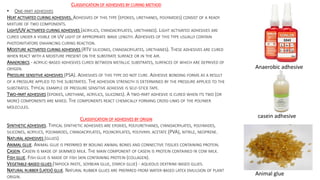
Anaerobic adhesive
casein adhesive
Animal glue
TYPES OF ADHESIVES-
WHITE CRAFT GLUE:
THIS IS THE MOST COMMON CRAFT GLUE FOR POROUS LIGHTWEIGHT MATERIALS SUCH AS PAPER,
CARDBOARD, CLOTH, AND KIDS’ CRAFTS.
WATER IS THE CARRIER; THIS MEANS EASY CLEAN UP AND LOW TOXICITY. KEEP IN MIND THAT THE
GLUE MUST DRY BEFORE STRENGTH IS SIGNIFICANT AND THE PROJECT OFTEN REQUIRES CLAMPING TO
HOLD IT IN PLACE UNTIL THE GLUE IS COMPLETELY SET AND DRY. THIS ALSO MEANS THAT WHITE CRAFT
GLUE SHOULD NOT BE USED IN APPLICATIONS THAT REQUIRE WATER RESISTANCE.
WHITE CRAFT GLUE DRIES CLEAR AND IS SOMEWHAT FLEXIBLE. GET CREATIVE AND ADD FILLERS, LIKE
FINE GLITTER, PIGMENT, OR WATER-BASED FOOD COLORING FOR DECORATIVE EFFECTS.
~1 HOUR SET TIME, WITH FINAL CURE IN 24 HOURS.
YELLOW WOOD GLUE:
YELLOW WOOD GLUE IS ALSO WATER BASED – AND IS MADE OF THE SAME VINYL ACETATE POLYMERS AS
CRAFT GLUE. IT IS DESIGNED TO WORK WITH WOOD AND IS IMMEDIATELY TACKY FOR BETTER HOLD IN
THE UNCURED STATE. IT IS ALSO GENERALLY MORE RIGID, HENCE IT IS EASIER TO SAND. SOME WOOD
GLUE CAN ALSO BE WHITE AND DRY CLEAR. AGAIN, YOU CAN ADD SAWDUST OR ANOTHER POWDERED
FILLER FOR SPECIAL EFFECTS.
WOOD GLUES SET IN ~LESS THAN 1 HR. THAT SAID, IT COULD TAKE AS LONG AS 24 HOURS TO REACH
FULL STRENGTH.
THREE TYPES OF WOOD ADHESIVES ARE AVAILABLE:
1.TYPE-I EXHIBITS SOME WATERPROOF PROPERTIES.
2.TYPE-II WILL PERFORM BETTER IN EXTERIOR CONDITIONS. THESE ADHESIVES GENERALLY HAVE A
LONGER OPEN TIME AND CAN BOND AT COLDER TEMPERATURES. BOTH TYPES I AND II CAN BE USED
FOR EXTERIOR APPLICATIONS, SUCH AS OUTDOOR FURNITURE AND TRIM.
3.TYPE-III IS NOT WATER RESISTANT AND IS DESIGNED FOR INTERIOR USE ONLY. TYPE-III IS GOOD FOR
INTERIOR WOODWORK AND TRIM PROJECTS.
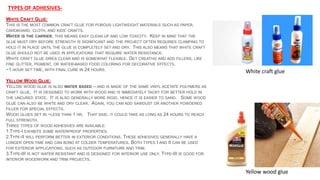
White craft glue
Yellow wood glue
SUPER GLUE (ALSO KNOWN AS CYANOACRYLATE ADHESIVES):
CYANOACRYLATE ADHESIVES BOND VERY QUICKLY AND TO A RANGE OF SUBSTRATES. THEY FORM A VERY STRONG BOND
AND DRY CLEAR. THE SURFACES TO BE MATED MUST FIT TOGETHER WELL TO ACHIEVE GOOD BONDING. YOU CAN BUY
SUPER GLUE IN A VARIETY OF VISCOSITIES WHICH ENABLE SOME LEEWAY IN GAP FILLING PERFORMANCE. IN GENERAL,
SUPER GLUES ARE NOT GOOD FOR FOAMED PLASTIC, UNLESS SPECIFIED ON THE BOTTLE.
CYANOACRYLATES WORK BEST IN TENSILE APPLICATIONS THAT HAVE LOW IMPACT STRENGTH REQUIREMENTS. HOWEVER,
ONCE CURED, SOLVENTS CAN NO LONGER DISSOLVE THE ADHESIVE.
CYANOACRYLATES WORK PARTICULARLY WELL FOR BALSA WOOD PROJECTS. CARPENTERS OFTEN USE A TWO PART
CYANOACRYLATE TO QUICKLY BOND MITERED WOOD TRIM.
CYANOACRYLATES CAN SET IN SECONDS TO MINUTES, DEPENDING ON FORMULATION. IT DRIES CLEAR AND IS WATERPROOF.
HOT GLUE:
THE MELTING AND COOLING OF POLYMERS PROVIDES THE METHODS OF DELIVERY AND ADHESION FOR HOT MELT
ADHESIVES. HOT GLUE IS MOST COMMONLY APPLIED USING A GLUE GUN AND COMES IN LOW (250°F) AND HIGH (380°F)
MELTING OPTIONS. MANY VARIETIES AND PERFORMANCES ARE AVAILABLE DEPENDING ON THE POLYMER TYPE. HOT GLUE
CAN BE USED ON POROUS AND NON-POROUS SURFACES. BECAUSE OF ITS HIGH VISCOSITY, IT CAN BOND UNEVEN SURFACES
TOGETHER AND IS GREAT AT FILLING GAPS.
HOT GLUE IS NOT TYPICALLY USED IN HIGH STRENGTH APPLICATIONS. AND, IT WILL NOT SURVIVE ELEVATED TEMPERATURES
NEAR THE APPLICATION TEMPERATURE. HOWEVER, IT PROVIDES A VERY QUICK SETTING OPTION FOR A VARIETY OF CRAFTS
AND SUBSTRATES. IT’S A GREAT ALL-PURPOSE CRAFT GLUE FOR QUICK SET UP AND EXECUTION, BUT IT’S NOT FOR USE BY
CHILDREN.
PRESSURE SENSITIVE ADHESIVES (PSA):
PSAS ARE AVAILABLE IN SHEETS AND DOTS AND CAN BE USED IN A MULTITUDE OF CRAFT PROJECTS TO INCLUDE SUBSTRATES
SUCH AS LIGHTWEIGHT PAPER, PLASTIC, METAL, AND GLASS.
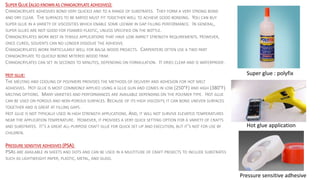
Super glue : polyfix
Hot glue application
Pressure sensitive adhesive
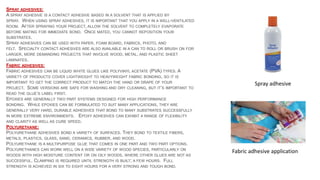
SPRAY ADHESIVES:
A SPRAY ADHESIVE IS A CONTACT ADHESIVE BASED IN A SOLVENT THAT IS APPLIED BY
SPRAY. WHEN USING SPRAY ADHESIVES, IT IS IMPORTANT THAT YOU APPLY IN A WELL-VENTILATED
ROOM. AFTER SPRAYING YOUR PROJECT, ALLOW THE SOLVENT TO COMPLETELY EVAPORATE
BEFORE MATING FOR IMMEDIATE BOND. ONCE MATED, YOU CANNOT REPOSITION YOUR
SUBSTRATES.
SPRAY ADHESIVES CAN BE USED WITH PAPER, FOAM BOARD, FABRICS, PHOTO, AND
FELT. SPECIALTY CONTACT ADHESIVES ARE ALSO AVAILABLE IN A CAN TO ROLL OR BRUSH ON FOR
LARGER, MORE DEMANDING PROJECTS THAT INVOLVE WOOD, METAL, AND PLASTIC SHEET
LAMINATES.
FABRIC ADHESIVES:
FABRIC ADHESIVES CAN BE LIQUID WHITE GLUES LIKE POLYVINYL ACETATE (PVA) TYPES. A
VARIETY OF PRODUCTS COVER LIGHTWEIGHT TO HEAVYWEIGHT FABRIC BONDING, SO IT IS
IMPORTANT TO GET THE CORRECT PRODUCT TO MATCH THE HAND OR DRAPE OF YOUR
PROJECT. SOME VERSIONS ARE SAFE FOR WASHING AND DRY CLEANING, BUT IT’S IMPORTANT TO
READ THE GLUE’S LABEL FIRST.
EPOXIES ARE GENERALLY TWO PART SYSTEMS DESIGNED FOR HIGH PERFORMANCE
BONDING. WHILE EPOXIES CAN BE FORMULATED TO SUIT MANY APPLICATIONS, THEY ARE
GENERALLY VERY HARD, DURABLE ADHESIVES THAT BOND TO MANY SUBSTRATES SUCCESSFULLY
IN MORE EXTREME ENVIRONMENTS. EPOXY ADHESIVES CAN EXHIBIT A RANGE OF FLEXIBILITY
AND CLARITY AS WELL AS CURE SPEED.
POLYURETHANE:
POLYURETHANE ADHESIVES BOND A VARIETY OF SURFACES. THEY BOND TO TEXTILE FIBERS,
METALS, PLASTICS, GLASS, SAND, CERAMICS, RUBBER, AND WOOD.
POLYURETHANE IS A MULTIPURPOSE GLUE THAT COMES IN ONE PART AND TWO PART OPTIONS.
POLYURETHANES CAN WORK WELL ON A WIDE VARIETY OF WOOD SPECIES, PARTICULARLY ON
WOODS WITH HIGH MOISTURE CONTENT OR ON OILY WOODS, WHERE OTHER GLUES ARE NOT AS
SUCCESSFUL. CLAMPING IS REQUIRED UNTIL STRENGTH IS BUILT; A FEW HOURS. FULL
STRENGTH IS ACHIEVED IN SIX TO EIGHT HOURS FOR A VERY STRONG AND TOUGH BOND.
Fabric adhesive application
Spray adhesive
TYPES OF SEALANTS-
•WATER BASED LATEX
POPULAR FOR RESIDENTIAL USE BECAUSE OF THE EASE OF APPLICATION AND ABILITY TO ADHERE TO MOST SUBSTRATES. THESE CAN BE PAINTED ON AND
ARE SUITABLE FOR SITUATIONS WHERE GAPS / VOIDS ARE VERY SMALL AND MOVEMENT IS MINIMAL. LATEX IS CAN BE PRONE TO SHRINKAGE AND CAN
PULL AWAY FROM THE SUBSTRATE CREATING GAPS, ALLOWING WATER TO PENETRATE.
•ACRYLIC
THESE ARE UV STABLE MAKING THEM SUITABLE FOR EXTERIOR APPLICATIONS, AND ARE NOT PRONE TO SHRINKAGE. ACRYLICS CAN BE DIFFICULT TO
APPLY AND CANNOT ACCOMMODATE SIGNIFICANT MOVEMENT.
•BUTYL
ADHERES WELL TO A BROAD VARIETY OF SUBSTRATES BUT CAN BE HARD TO APPLY DUE TO THEIR STRINGIER CONSISTENCY. THEY HAVE POOR
RESISTANCE TO ABRASION AND STRUGGLE TO ACCOMMODATE MOVEMENTS THAT INTRODUCE SHEARING FORCES. THEY ARE NOT SUITABLE FOR
DEMANDING BUILDING APPLICATIONS.
•POLYSULFIDE
EXCELLENT FLEXIBILITY EVEN AT LOW TEMPERATURES WITH LITTLE SHRINKAGE OR UV DEGRADATION, AND CAN BE USED FOR UNDERWATER
APPLICATIONS. POLYSULFIDES ARE MORE EXPENSIVE THAN SIMILAR SEALANTS AND HAVE A TENDENCY TO HAVE HIGHER LEVELS OF VOLATILE ORGANIC
COMPOUNDS (VOCS). THOUGH, A LIFE EXPECTANCY OF 10 TO 20 YEARS DOES COMPENSATE FOR THE PRICE SOMEWHAT.
•SILICONE
HAS EXCELLENT THERMAL RESISTANCE, GOOD DYNAMIC MOVEMENT CAPABILITY AND GOOD ADHESION. THEY CAN BE EASILY VANDALISED AND TEND TO
COLLECT DIRT. FOR CERTAIN SUBSTRATES (SUCH AS STONE), STAINING MAY ALSO BE AN ISSUE, IN SOME CASES MAKING THE USE OF PRIMERS A
NECESSITY.
AS WEATHER PROOFING AND AIR SEALING APPLICATIONS SILICONES CAN BE USED STRUCTURALLY E.G. FOR BONDING GLASS OR METAL TO FRAMES.
SILICONES ARE GENERALLY THE MOST EXPENSIVE BUT QUALITY SILICONES HAVE VERY GOOD DURABILITY PERFORMANCE.
•POLYISOBUTYLENES
HAVE SIMILAR PROPERTIES TO NATURAL RUBBER BUT WITH IMPROVED DURABILITY, GOOD RESISTANCE TO CHEMICAL ATTACK, AND HAVE VERY LOW
PERMEABILITY. THESE ARE COMMONLY USED AS THE PRIMARY SEAL FOR INSULATING GLAZING UNITS (IGU) AS THEY ARE CAPABLE OF RESISTING THE
TRANSMISSION OF VAPOUR AND GASES. THE PRODUCTS ARE NORMALLY FACTORY APPLIED, RATHER THAN SITE APPLIED.
•POLYURETHANE
ADHERE WELL TO THE MAJORITY OF DIFFERENT SURFACES WITH LITTLE SUBSTRATE PREPARATION, AND ARE GENERALLY THE GO-TO CHOICE FOR
CONTRACTORS. THEY HAVE EXCELLENT RESILIENCE TO ABRASION AND SHEAR FORCES AS WELL AS HAVING STRONG ADHESION AND MOVEMENT
CAPABILITY.
PROPERTIES OF ADHESIVES AND SEALANTS
04
Adhesives should have high tensile strength. The important physical properties of adhesives are cohesive strength, adherence,
fluidity and wet ability of the substrate.
• Cohesive strength : adhesive should have more cohesive strength than either of the surfaces being held together. Usually the
adhesive becomes more brittle as its cohesive strength is increased.
• Adherence : for an adhesive to hold two surfaces together the former should form a strong bond at each of the interfaces
between the surface and the adhesive, and the adhesive failure occurs in the weakest bond. Failure can occur at either interface,
as also for cohesive failure. Failure may also occur inside the adhesive it self. In practice the bond failure at the interface is rare.
Regardless of the quality of the adhesive clean surfaces are necessary to get the best result.
• Fluidity : when the liquids are stirred, they become temporarily more fluid because of alignment of their tiny crystals. The fluids
thickens as soon as stirring is stopped. This property, called thixotropic of adhesive and paints helps to prevent a sag or run
when these coatings are applied on vertical surfaces. If the viscosity of a liquid increases with increase in temperature, an
adhesive should be applied while hot.
• Wettability: adhesive must wet the surface thoroughly as it spreads. It must be able to flow into the surface crevices displacing
dirt, moisture and trapped air. For this purpose the surface tension of adhesive can be lowered by adding a surfactant wetting
agent.
ď‚§ ADHESIVE
• A good sealant must be able to be overpainted.
• It should be chemically inert, non-corrosive in nature and provide protection to the underlying surface from environmental and
biological effects.
• A good joint sealant should be durable and long-lasting.
• Its co efficient of volumetric expansion must be less so that it does not expand a lot when exposed to heat.
• A good sealant should have a very good adhesion to most construction materials.
• It should provide air tightness and sound insulation.
• Must be flexible, elastic and softer grade and not stiff.
• Good wetting behavior.
• Must be able to absorb thermal as well as vibrational stresses
PROPERTIES OF A GOOD SEALANT
ď‚§ SEALANT
Important mechanical properties of sealants include elongation, compressibility, tensile strength, modulus of elasticity, tear
resistance and fatigue resistance. Depending on the nature of the application, a sealant may require very little strength or great
strength
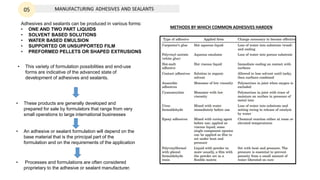
Adhesives and sealants can be produced in various forms:
• ONE AND TWO PART LIQUIDS
• SOLVENT BASED SOLUTIONS
• WATER BASED EMULSION
• SUPPORTED OR UNSUPPORTED FILM
• PREFORMED PELLETS OR SHAPED EXTRUSIONS
• This variety of formulation possibilities and end-use
forms are indicative of the advanced state of
development of adhesives and sealants.
• These products are generally developed and
prepared for sale by formulators that range from very
small operations to large international businesses
• An adhesive or sealant formulation will depend on the
base material that is the principal part of the
formulation and on the requirements of the application
• Processes and formulations are often considered
proprietary to the adhesive or sealant manufacturer.
METHODS BY WHICH COMMON ADHESIVES HARDEN
05
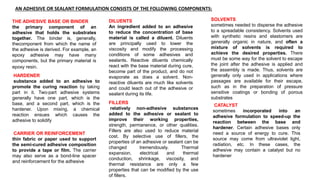
AN ADHESIVE OR SEALANT FORMULATION CONSISTS OF THE FOLLOWING COMPONENTS:
THE ADHESIVE BASE OR BINDER
the primary component of an
adhesive that holds the substrates
together. The binder is, generally,
thecomponent from which the name of
the adhesive is derived. For example, an
epoxy adhesive may have many
components, but the primary material is
epoxy resin.
HARDENER
substance added to an adhesive to
promote the curing reaction by taking
part in it. Two-part adhesive systems
generally have one part, which is the
base, and a second part, which is the
hardener. Upon mixing, a chemical
reaction ensues which causes the
adhesive to solidify
CATALYST
sometimes incorporated into an
adhesive formulation to speed-up the
reaction between the base and
hardener. Certain adhesive bases only
need a source of energy to cure. This
source may come from ultraviolet light,
radiation, etc. In these cases, the
adhesive may contain a catalyst but no
hardener
SOLVENTS
sometimes needed to disperse the adhesive
to a spreadable consistency. Solvents used
with synthetic resins and elastomers are
generally organic in nature, and often a
mixture of solvents is required to
achieve the desired properties. There
must be some way for the solvent to escape
the joint after the adhesive is applied and
the assembly is made. Thus, solvents are
generally only used in applications where
passages are available for their escape,
such as in the preparation of pressure
sensitive coatings or bonding of porous
substrates
DILUENTS
An ingredient added to an adhesive
to reduce the concentration of base
material is called a diluent. Diluents
are principally used to lower the
viscosity and modify the processing
conditions of some adhesives and
sealants. Reactive diluents chemically
react with the base material during cure,
become part of the product, and do not
evaporate as does a solvent. Non-
reactive diluents are much like solvents
and could leach out of the adhesive or
sealant during its life.
FILLERS
relatively non-adhesive substances
added to the adhesive or sealant to
improve their working properties,
strength, permanence, or other qualities.
Fillers are also used to reduce material
cost. By selective use of fillers, the
properties of an adhesive or sealant can be
changed tremendously. Thermal
expansion, electrical and thermal
conduction, shrinkage, viscosity, and
thermal resistance are only a few
properties that can be modified by the use
of fillers.
CARRIER OR REINFORCEMENT
thin fabric or paper used to support
the semi-cured adhesive composition
to provide a tape or film. The carrier
may also serve as a bond-line spacer
and reinforcement for the adhesive
FACTORS INFLUENCING SELECTION OF ADHESIVES
06
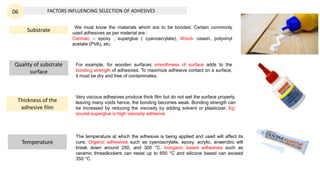
We must know the materials which are to be bonded. Certain commonly
used adhesives as per material are :
Cermaic – epoxy , superglue ( cyanoacrylate), Wood- casein, polyvinyl
acetate (PVA), etc.
Substrate
Quality of substrate
surface
For example, for wooden surfaces smoothness of surface adds to the
bonding strength of adhesives. To maximize adhesive contact on a surface,
it must be dry and free of contaminates.
Thickness of the
adhesive film
Very viscous adhesives produce thick film but do not wet the surface properly,
leaving many voids hence, the bonding becomes weak. Bonding strength can
be increased by reducing the viscosity by adding solvent or plasticizer. Eg:
soudal superglue is high viscosity adhesive.
Temperature
The temperature at which the adhesive is being applied and used will affect its
cure. Organic adhesives such as cyanoacrylate, epoxy, acrylic, anaerobic will
break down around 250, and 300 °C. Inorganic based adhesives such as
ceramic threadlockers can resist up to 650 °C and silicone based can exceed
350 °C.
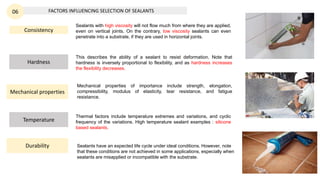
FACTORS INFLUENCING SELECTION OF SEALANTS
06
Consistency
Hardness
This describes the ability of a sealant to resist deformation. Note that
hardness is inversely proportional to flexibility, and as hardness increases
the flexibility decreases.
Mechanical properties
Temperature
Thermal factors include temperature extremes and variations, and cyclic
frequency of the variations. High temperature sealant examples : silicone
based sealants.
Mechanical properties of importance include strength, elongation,
compressibility, modulus of elasticity, tear resistance, and fatigue
resistance.
Sealants with high viscosity will not flow much from where they are applied,
even on vertical joints. On the contrary, low viscosity sealants can even
penetrate into a substrate, if they are used in horizontal joints.
Durability Sealants have an expected life cycle under ideal conditions. However, note
that these conditions are not achieved in some applications, especially when
sealants are misapplied or incompatible with the substrate.
USES OF ADHESIVES AND SEALANTS
07
USES OF ADHESIVES
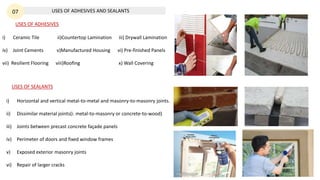
i) Ceramic Tile ii)Countertop Lamination iii) Drywall Lamination
iv) Joint Cements v)Manufactured Housing vi) Pre-finished Panels
vii) Resilient Flooring viii)Roofing x) Wall Covering
i) Horizontal and vertical metal-to-metal and masonry-to-masonry joints.
ii) Dissimilar material joints(i. metal-to-masonry or concrete-to-wood)
iii) Joints between precast concrete façade panels
iv) Perimeter of doors and fixed window frames
v) Exposed exterior masonry joints
vi) Repair of larger cracks
USES OF SEALANTS
APPLICATION PROCESS OF ADHESIVES AND SEALANTS
08
APPLICATION PROCESS OF ADHESIVES-
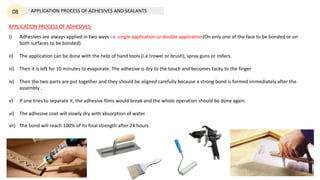
i) Adhesives are always applied in two ways i.e single application or double application(On only one of the face to be bonded or on
both surfaces to be bonded).
ii) The application can be done with the help of hand tools (i.e trowel or brush), spray guns or rollers.
iii) Then it is left for 10 minutes to evaporate. The adhesive is dry to the touch and becomes tacky to the finger
iv) Then the two parts are put together and they should be aligned carefully because a strong bond is formed immediately after the
assembly .
v) If one tries to separate it, the adhesive films would break and the whole operation should be done again.
vi) The adhesive coat will slowly dry with absorption of water.
vii) The bond will reach 100% of its final strength after 24 hours.
APPLICATION PROCESS OF ADHESIVES AND SEALANTS
08
APPLICATION PROCESS OF SEALANTS-
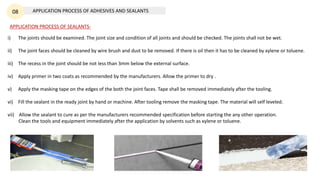
i) The joints should be examined. The joint size and condition of all joints and should be checked. The joints shall not be wet.
ii) The joint faces should be cleaned by wire brush and dust to be removed. If there is oil then it has to be cleaned by xylene or toluene.
iii) The recess in the joint should be not less than 3mm below the external surface.
iv) Apply primer in two coats as recommended by the manufacturers. Allow the primer to dry .
v) Apply the masking tape on the edges of the both the joint faces. Tape shall be removed immediately after the tooling.
vi) Fill the sealant in the ready joint by hand or machine. After tooling remove the masking tape. The material will self leveled.
vii) Allow the sealant to cure as per the manufacturers recommended specification before starting the any other operation.
Clean the tools and equipment immediately after the application by solvents such as xylene or toluene.
DIFFERENCE BETWEEN ADHESIVES & SELANTS
09
ADHESIVES SELANTS
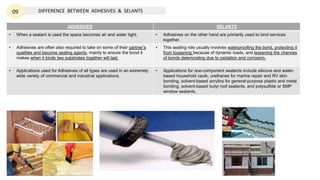
• An adhesive is used particularly for its ability to bond two surfaces
together for an indefinite length of time and varying amounts of
stress.
• Sealants are often used to fill gaps and resist relative movement
of the surfaces to which they are applied.
• Adhesives have strong shear and tensile strength, making them
viable bonding materials for high-pressure situations.
• A sealant is generally lower in strength compared to an adhesive.
• Sealants have a paste like consistency which allows filling of gaps
between substrates and has low shrinkage after application.
• Adhesives are in liquid form which become solid after application
and then used to bind materials together.
• Adhesive will offer a more rigid and durable feel and look. • sealants are more malleable.
• Adhesives are usually divided into three basic types: physically
hardened, chemically cured, and pressure-sensitive.
• Sealants are usually divided into three types: one-component,
two-component, and tapes.
• Physically hardened adhesives begin in a liquid form that hardens
after application, and come in one of three types: organic solvent,
water-based, or hot melt.
• One-component types are the most common and can be easily
applied, and chemistries include silicone, urethane, solvent-based
acrylics, solvent-based butyls, water-based latex, silyl-
modified polymer (SMP), and polysulfides .
DIFFERENCE BETWEEN ADHESIVES & SELANTS
09
ADHESIVES SELANTS
• When a sealant is used the space becomes air and water tight. • Adhesives on the other hand are primarily used to bind services
together.
• Adhesives are often also required to take on some of their partner’s
qualities and become sealing agents, mainly to ensure the bond it
makes when it binds two substrates together will last.
• This sealing role usually involves waterproofing the bond, protecting it
from loosening because of dynamic loads, and lessening the chances
of bonds deteriorating due to oxidation and corrosion.
• Applications used for Adhesives of all types are used in an extremely
wide variety of commercial and industrial applications.
• Applications for one-component sealants include silicone and water-
based household caulk, urethanes for marine repair and RV skin
bonding, solvent-based acrylics for general-purpose plastic and metal
bonding, solvent-based butyl roof sealants, and polysulfide or SMP
window sealants.
ADVANTAGES AND DISADVANTAGES OF ADHESIVES
Advantages
•Provides large stress-bearing area.
•Improved joint stiffness due to continuous bond area rather than point
contact as in mechanical fastening.
•Provides excellent fatigue strength.
•Damps vibration and absorbs shock.
•Minimizes or prevents galvanic corrosion between dissimilar metals.
•Joins all shapes and thicknesses.
•Provides smooth contours.
•Seals joints.
•Joins any combination of dissimilar materials.
•Heat is too low to affect metal parts.
•Provides attractive strength-to-weight ratio.
•No distortion as in fusion welding.
•Provides thin and invisible joint.
Disadvantages
•Surface must be carefully cleaned.
•Long cure times may be needed.
•Limitation on upper continuous operating temperature (generally 175–200
°C).
•Heat and pressure may be required for cure.
•Jigs and fixtures may be required.
•Rigid process control usually necessary.
•Inspection of finished joint is difficult.
•Useful life depends on the service environment.
•Environmental, health and safety considerations are necessary.
•Special training may be required.
•Adhesive joints are inherently weak under peel
loading and design of bonded joints need to take this into consideration.
10
ADVANTAGES AND DISADVANTAGES OF SEALANTS
Advantages
•Have high adhesion to any type of building materials, because
it can be applied on any surface. Since the material is not exposed
to temperature, and it can withstand large swings, It can be used
for both external, and for interior works
• The composition does not corrode, and resistant to precipitation
•Acrylic sealants have high adhesion with porous bases
• Improves Product Durability and Reliability.
•Increases Product Performance.
•Increases Design Flexibility.
•Improves Process Productivity and Reduced Manufacturing Costs
•Increases weathering characteristics.
•Extreme temperature resistance
•Silicone sealants in buildings can also make buildings more energy
efficient by preventing humidity and hot or cold air from coming
inside through joints and cracks.
Disadvantages
• Deterioration of sealants causes due to prolonged exposure to water,
ultraviolet light, and freeze-thaw cycles.
•Loss of Adhesion caused by the presence of coatings or contaminants that
prevent proper adhesion
• Cohesive failure due to deterioration of the internal integrity of the
sealant; cracking parallel to the interface of the joint is an indication of this
type of failure.
•Inappropriate Choice of Sealant and Improper Joint Design may fail the
joint and losses the adhesion.
•Uncured Sealant that is uncured is often due to incomplete or improper
mixing of the sealant components, or from using materials that have
outlived their shelf life losses the adhesion and fails the joints.
•Bubbling and Blistering of the Surface losses the adhesion and fails the
joints.
•sealants typically have lower strength and higher elongation than
adhesives
•Primers may be required on some surfaces.
10
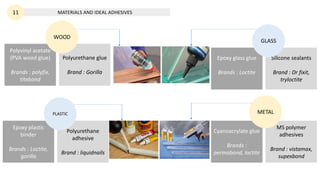
Polyurethane glue
Brand : Gorilla
Polyvinyl acetate
(PVA wood glue)
Brands : polyfix,
titebond
MATERIALS AND IDEAL ADHESIVES
11
WOOD
Silicone sealants
Brand : Dr fixit,
tryloctite
Epoxy glass glue
Brands : Loctite
GLASS
MS polymer
adhesives
Brand : vistamax,
supexbond
Cyanoacrylate glue
Brands :
permabond, loctite
METAL
Polyurethane
adhesive
Brand : liquidnails
Epoxy plastic
binder
Brands : Loctite,
gorilla
PLASTIC
MATERIAL BONDING AND IDEAL ADHESIVES
12
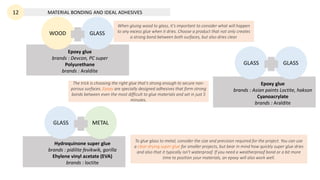
WOOD GLASS
When gluing wood to glass, it’s important to consider what will happen
to any excess glue when it dries. Choose a product that not only creates
a strong bond between both surfaces, but also dries clear.
Epoxy glue
brands : Devcon, PC super
Polyurethane
brands : Araldite
GLASS GLASS
The trick is choosing the right glue that’s strong enough to secure non-
porous surfaces. Epoxy are specially designed adhesives that form strong
bonds between even the most difficult to glue materials and set in just 5
minutes.
Epoxy glue
brands : Asian paints Loctite, hakson
Cyanoacrylate
brands : Araldite
GLASS METAL
To glue glass to metal, consider the size and precision required for the project. You can use
a clear drying super glue for smaller projects, but bear in mind how quickly super glue dries
and also that it typically isn’t waterproof. If you need a weatherproof bond or a bit more
time to position your materials, an epoxy will also work well.
Hydroquinone super glue
brands : pidilite fevikwik, gorilla
Ehylene vinyl acetate (EVA)
brands : loctite
MATERIAL BONDING AND IDEAL ADHESIVES
12
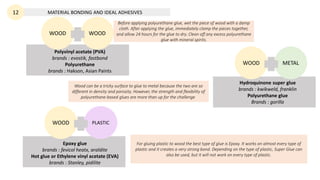
WOOD WOOD
Before applying polyurethane glue, wet the piece of wood with a damp
cloth. After applying the glue, immediately clamp the pieces together,
and allow 24 hours for the glue to dry. Clean off any excess polyurethane
glue with mineral spirits.
Polyvinyl acetate (PVA)
brands : evostik, fastbond
Polyurethane
brands : Hakson, Asian Paints
WOOD METAL
Wood can be a tricky surface to glue to metal because the two are so
different in density and porosity. However, the strength and flexibility of
polyurethane-based glues are more than up for the challenge.
Hydroquinone super glue
brands : kwikweld, franklin
Polyurethane glue
Brands : gorilla
WOOD PLASTIC
For gluing plastic to wood the best type of glue is Epoxy. It works on almost every type of
plastic and it creates a very strong bond. Depending on the type of plastic, Super Glue can
also be used, but it will not work on every type of plastic.
Epoxy glue
brands : fevicol heatx, araldite
Hot glue or Ethylene vinyl acetate (EVA)
brands : Stanley, pidilite
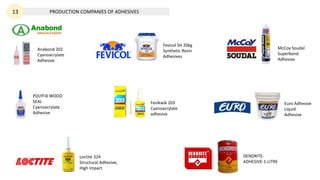
Anabond 202
Cyanoacrylate
Adhesive
POLYFIX WOOD
SEAL
Cyanoacrylate
Adhesive
Fevikwik 203
Cyanoacrylate
adhesive
DENDRITE-
ADHESIVE-1-LITRE
Loctite 324
Structural Adhesive,
High Impact
Fevicol SH 20kg
Synthetic Resin
Adhesives
Euro Adhesive
Liquid
Adhesive
McCoy Soudal
Superbond
Adhesive
PRODUCTION COMPANIES OF ADHESIVES
13
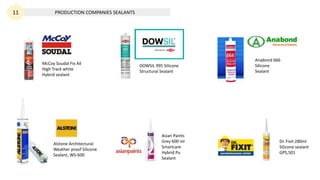
DOWSIL 995 Silicone
Structural Sealant
Asian Paints
Grey 600 ml
Smartcare
Hybrid Pu
Sealant
McCoy Soudal Fix All
High Track white
Hybrid sealant
Alstone Architectural
Weather proof Silicone
Sealant, WS-600
Anabond 666
Silicone
Sealant
Dr. Fixit 280ml
Silicone sealant
GPS,501
PRODUCTION COMPANIES SEALANTS
11
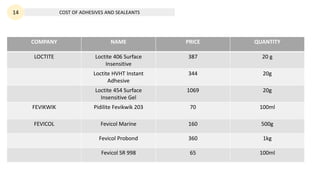
14 COST OF ADHESIVES AND SEALEANTS
COMPANY NAME PRICE QUANTITY
LOCTITE Loctite 406 Surface
Insensitive
387 20 g
Loctite HVHT Instant
Adhesive
344 20g
Loctite 454 Surface
Insensitive Gel
1069 20g
FEVIKWIK Pidilite Fevikwik 203 70 100ml
FEVICOL Fevicol Marine 160 500g
Fevicol Probond 360 1kg
Fevicol SR 998 65 100ml
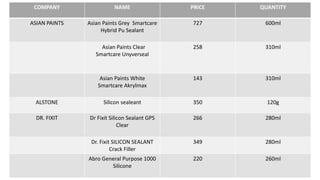
COMPANY NAME PRICE QUANTITY
ASIAN PAINTS Asian Paints Grey Smartcare
Hybrid Pu Sealant
727 600ml
Asian Paints Clear
Smartcare Unyverseal
258 310ml
Asian Paints White
Smartcare Akrylmax
143 310ml
ALSTONE Silicon sealeant 350 120g
DR. FIXIT Dr Fixit Silicon Sealant GPS
Clear
266 280ml
Dr. Fixit SILICON SEALANT
Crack Filler
349 280ml
Abro General Purpose 1000
Silicone
220 260ml

adhesives&sealants .pptx

  • 1.
    ADHESIVES AND SEALANTS A marketsurvey on : SUBJECT : BTM VI CLASS : T.Y BARCH DIV : D GROUP : 2 MENTOR : AR. SANKET JAIN GROUP MEMBERS : AISHWARYA ZARKAR ASMA PATNE AYUSHI TORASKAR DIVYA DAHAD MADHURA MALU RAKHI LUNAWAT RUCHITA DONGRE SNEHAL KINIKAR SURBHI CHAVAN VAISHALI AKELLA
  • 2.
    SR. NO TOPICSLIDE NO. 1 Introduction to Adhesives and Sealants 2 Types and classification of Adhesives and Sealants 3 Composition of Adhesives and Sealants 4 Properties of Adhesives and Sealants 5 Manufacturing process of Adhesives and Sealants 6 Factors influencing selection of Adhesives or Sealants 7 Uses of adhesives and Sealants 8 Application process of Adhesives and Sealants 9 Difference between Adhesives and Sealants 10 Advantages & Disadvantages of Adhesives and Sealants 11 Materials and Ideal Adhesives 12 Material bonding and Ideal Adhesives 13 Production Companies of Adhesives and Sealants 14 Cost and Cost Comparison of Adhesives and Sealants I N D E X
  • 3.
    INTRODUCTION TO ADHESIVESAND SEALANTS 01 What are Adhesives? o Adhesive, also known as glue, cement, mucilage, or paste, is any non-metallic substance applied to one or both surfaces of two separate items that binds them together and resists their separation. o The use of adhesives offers certain advantages over other binding techniques such as sewing, mechanical fastenings, or welding. These include the ability to bind different materials together, the more efficient distribution of stress across a joint, the cost- effectiveness of an easily mechanized process, and greater flexibility in design. What are Sealants? o Sealant is a substance used to block the passage of fluids through the surface or joints or openings in materials, a type of mechanical seal. In building construction sealant is sometimes synonymous with caulking and also serve the purposes of blocking dust, sound and heat transmission. Sealants may be weak or strong, flexible or rigid, permanent or temporary. Sealants are not adhesives but some have adhesive qualities and are called adhesive-sealants or structural sealants. o A caulking sealant has three basic functions: It fills a gap between two or more substrates; it forms a barrier through the physical properties of the sealant itself and by adhesion to the substrate; and, it maintains sealing properties for the expected lifetime, service conditions, and environments. The sealant performs these functions by way of correct formulation to achieve specific application and performance properties. ADHESIVES SEALANTS
  • 4.
    TYPES AND CLASSIFICATIONOF ADHESIVE General classification thermosetting thermoplastic elastomeric By Curing method synthetic Light/uv activated moisture activated anaerobics Pressure sensitive Two-part adhesive Based on Origin Heat activated natural Animal glue casein Fish glue Vegetable based Natural rubber Commonly used White craft glue Yellow wood glue Super glue Hot glue
  • 5.
    TYPES AND CLASSIFICATIONOF ADHESIVE AND SEALANTS 02 • CLASSIFICATION OF ADHESIVE - • GENERAL CLASSIFICATION OF ADHESIVES (CLASSIFICATION BY STRUCTURE) • CLASSIFICATION OF ADHESIVES BY CURING METHOD • CLASSIFICATION OF ADHESIVES BY ORIGIN GENERAL CLASSIFICATION OF ADHESIVES THERMOSETTING ADHESIVES THERMOSETS MOLECULES ARE CROSS-LINKED BY STRONG COVALENT INTERMOLECULAR BONDS, FORMING ONE GIANT MOLECULE. CROSS-LINKING IS IRREVERSIBLE THEREFORE THERMOSETS CAN NOT BE REPROCESSED (RE-MELT). CROSS-LINKING IS ACHIEVED IN CURING PROCESS. CURING RESULTS IN SHARP INCREASE OF STRENGTH, ELASTICITY AND STABILITY OF THERMOSETS. MOST OF THERMOSETTING ADHESIVES ARE BASED ON EPOXIES, POLYESTERS, POLYIMIDES AND PHENOLICS. THERMOPLASTIC ADHESIVES THERMOPLASTICS ARE POLYMERS, WHICH SOFTEN (BECOME PLIABLE AND PLASTIC) AND MELT WHEN HEATED. NO NEW CROSS-LINKS FORM (NO CHEMICAL CURING) WHEN A THERMOPLASTIC COOLS AND HARDEN. THERMOPLASTICS MAY BE REPROCESSED MANY TIMES BY HEATING OR APPLYING A SOLVENT. POLYAMIDES, CYANOACRYLATES, POLYACRYLATES, POLYVINYL ACETATE (PVA) ARE TYPICAL THERMOPLASTIC ADHESIVES. ELASTOMERIC ADHESIVES ELASTOMERS ARE POLYMERS POSSESSING HIGH ELASTICITY - MAY BE REVERSIBLY STRETCHED AT HIGH DEGREE. ELASTOMERS CONSISTS OF LONG LIGHTLY CROSS-LINKED MOLECULES. TYPICAL ELASTOMERIC ADHESIVES ARE BASED ON NATURAL RUBBERS, SILICONES, ACRYLONITRIDE BUTADIENE (NITRILE), NEOPRENE, BUTYL, POLYURETHANE, STYRENE-BUTADIENE. Thermosetting adhesive Thermoplastic adhesive
  • 6.
    CLASSIFICATION OF ADHESIVESBY CURING METHOD • ONE-PART ADHESIVES HEAT ACTIVATED CURING ADHESIVES. ADHESIVES OF THIS TYPE (EPOXIES, URETHANES, POLYIMIDES) CONSIST OF A READY MIXTURE OF TWO COMPONENTS. LIGHT/UV ACTIVATED CURING ADHESIVES (ACRYLICS, CYANOACRYLATES, URETHANES). LIGHT ACTIVATED ADHESIVES ARE CURED UNDER A VISIBLE OR UV LIGHT OF APPROPRIATE WAVE LENGTH. ADHESIVES OF THIS TYPE USUALLY CONTAIN PHOTOINITIATORS ENHANCING CURING REACTION. MOISTURE ACTIVATED CURING ADHESIVES (RTV SILICONES, CYANOACRYLATES, URETHANES). THESE ADHESIVES ARE CURED WHEN REACT WITH A MOISTURE PRESENT ON THE SUBSTRATE SURFACE OR IN THE AIR. ANAEROBICS - ACRYLIC-BASED ADHESIVES CURED BETWEEN METALLIC SUBSTRATES, SURFACES OF WHICH ARE DEPRIVED OF OXYGEN. PRESSURE SENSITIVE ADHESIVES (PSA). ADHESIVES OF THIS TYPE DO NOT CURE. ADHESIVE BONDING FORMS AS A RESULT OF A PRESSURE APPLIED TO THE SUBSTRATES. THE ADHESION STRENGTH IS DETERMINED BY THE PRESSURE APPLIED TO THE SUBSTRATES. TYPICAL EXAMPLE OF PRESSURE SENSITIVE ADHESIVE IS SELF-STICK TAPE. TWO-PART ADHESIVES (EPOXIES, URETHANE, ACRYLICS, SILICONES). A TWO-PART ADHESIVE IS CURED WHEN ITS TWO (OR MORE) COMPONENTS ARE MIXED. THE COMPONENTS REACT CHEMICALLY FORMING CROSS-LINKS OF THE POLYMER MOLECULES. CLASSIFICATION OF ADHESIVES BY ORIGIN SYNTHETIC ADHESIVES. TYPICAL SYNTHETIC ADHESIVES ARE EPOXIES, POLYURETHANES, CYANOACRYLATES, POLYIMIDES, SILICONES, ACRYLICS, POLYAMIDES, CYANOACRYLATES, POLYACRYLATES, POLYVINYL ACETATE (PVA), NITRILE, NEOPRENE. NATURAL ADHESIVES (GLUES) ANIMAL GLUE. ANIMAL GLUE IS PREPARED BY BOILING ANIMAL BONES AND CONNECTIVE TISSUES CONTAINING PROTEIN. CASEIN. CASEIN IS MADE OF SKIMMED MILK. THE MAIN COMPONENT OF CASEIN IS PROTEIN CONTAINED IN COW MILK. FISH GLUE. FISH GLUE IS MADE OF FISH SKIN CONTAINING PROTEIN (COLLAGEN). VEGETABLE-BASED GLUES (TAPIOCA PASTE, SOYBEAN GLUE, STARCH GLUE) - AQUEOUS DEXTRINE-BASED GLUES. NATURAL RUBBER (LATEX) GLUE. NATURAL RUBBER GLUES ARE PREPARED FROM WATER-BASED LATEX EMULSION OF PLANT ORIGIN. Anaerobic adhesive casein adhesive Animal glue
  • 7.
    TYPES OF ADHESIVES- WHITECRAFT GLUE: THIS IS THE MOST COMMON CRAFT GLUE FOR POROUS LIGHTWEIGHT MATERIALS SUCH AS PAPER, CARDBOARD, CLOTH, AND KIDS’ CRAFTS. WATER IS THE CARRIER; THIS MEANS EASY CLEAN UP AND LOW TOXICITY. KEEP IN MIND THAT THE GLUE MUST DRY BEFORE STRENGTH IS SIGNIFICANT AND THE PROJECT OFTEN REQUIRES CLAMPING TO HOLD IT IN PLACE UNTIL THE GLUE IS COMPLETELY SET AND DRY. THIS ALSO MEANS THAT WHITE CRAFT GLUE SHOULD NOT BE USED IN APPLICATIONS THAT REQUIRE WATER RESISTANCE. WHITE CRAFT GLUE DRIES CLEAR AND IS SOMEWHAT FLEXIBLE. GET CREATIVE AND ADD FILLERS, LIKE FINE GLITTER, PIGMENT, OR WATER-BASED FOOD COLORING FOR DECORATIVE EFFECTS. ~1 HOUR SET TIME, WITH FINAL CURE IN 24 HOURS. YELLOW WOOD GLUE: YELLOW WOOD GLUE IS ALSO WATER BASED – AND IS MADE OF THE SAME VINYL ACETATE POLYMERS AS CRAFT GLUE. IT IS DESIGNED TO WORK WITH WOOD AND IS IMMEDIATELY TACKY FOR BETTER HOLD IN THE UNCURED STATE. IT IS ALSO GENERALLY MORE RIGID, HENCE IT IS EASIER TO SAND. SOME WOOD GLUE CAN ALSO BE WHITE AND DRY CLEAR. AGAIN, YOU CAN ADD SAWDUST OR ANOTHER POWDERED FILLER FOR SPECIAL EFFECTS. WOOD GLUES SET IN ~LESS THAN 1 HR. THAT SAID, IT COULD TAKE AS LONG AS 24 HOURS TO REACH FULL STRENGTH. THREE TYPES OF WOOD ADHESIVES ARE AVAILABLE: 1.TYPE-I EXHIBITS SOME WATERPROOF PROPERTIES. 2.TYPE-II WILL PERFORM BETTER IN EXTERIOR CONDITIONS. THESE ADHESIVES GENERALLY HAVE A LONGER OPEN TIME AND CAN BOND AT COLDER TEMPERATURES. BOTH TYPES I AND II CAN BE USED FOR EXTERIOR APPLICATIONS, SUCH AS OUTDOOR FURNITURE AND TRIM. 3.TYPE-III IS NOT WATER RESISTANT AND IS DESIGNED FOR INTERIOR USE ONLY. TYPE-III IS GOOD FOR INTERIOR WOODWORK AND TRIM PROJECTS. White craft glue Yellow wood glue
  • 8.
    SUPER GLUE (ALSOKNOWN AS CYANOACRYLATE ADHESIVES): CYANOACRYLATE ADHESIVES BOND VERY QUICKLY AND TO A RANGE OF SUBSTRATES. THEY FORM A VERY STRONG BOND AND DRY CLEAR. THE SURFACES TO BE MATED MUST FIT TOGETHER WELL TO ACHIEVE GOOD BONDING. YOU CAN BUY SUPER GLUE IN A VARIETY OF VISCOSITIES WHICH ENABLE SOME LEEWAY IN GAP FILLING PERFORMANCE. IN GENERAL, SUPER GLUES ARE NOT GOOD FOR FOAMED PLASTIC, UNLESS SPECIFIED ON THE BOTTLE. CYANOACRYLATES WORK BEST IN TENSILE APPLICATIONS THAT HAVE LOW IMPACT STRENGTH REQUIREMENTS. HOWEVER, ONCE CURED, SOLVENTS CAN NO LONGER DISSOLVE THE ADHESIVE. CYANOACRYLATES WORK PARTICULARLY WELL FOR BALSA WOOD PROJECTS. CARPENTERS OFTEN USE A TWO PART CYANOACRYLATE TO QUICKLY BOND MITERED WOOD TRIM. CYANOACRYLATES CAN SET IN SECONDS TO MINUTES, DEPENDING ON FORMULATION. IT DRIES CLEAR AND IS WATERPROOF. HOT GLUE: THE MELTING AND COOLING OF POLYMERS PROVIDES THE METHODS OF DELIVERY AND ADHESION FOR HOT MELT ADHESIVES. HOT GLUE IS MOST COMMONLY APPLIED USING A GLUE GUN AND COMES IN LOW (250°F) AND HIGH (380°F) MELTING OPTIONS. MANY VARIETIES AND PERFORMANCES ARE AVAILABLE DEPENDING ON THE POLYMER TYPE. HOT GLUE CAN BE USED ON POROUS AND NON-POROUS SURFACES. BECAUSE OF ITS HIGH VISCOSITY, IT CAN BOND UNEVEN SURFACES TOGETHER AND IS GREAT AT FILLING GAPS. HOT GLUE IS NOT TYPICALLY USED IN HIGH STRENGTH APPLICATIONS. AND, IT WILL NOT SURVIVE ELEVATED TEMPERATURES NEAR THE APPLICATION TEMPERATURE. HOWEVER, IT PROVIDES A VERY QUICK SETTING OPTION FOR A VARIETY OF CRAFTS AND SUBSTRATES. IT’S A GREAT ALL-PURPOSE CRAFT GLUE FOR QUICK SET UP AND EXECUTION, BUT IT’S NOT FOR USE BY CHILDREN. PRESSURE SENSITIVE ADHESIVES (PSA): PSAS ARE AVAILABLE IN SHEETS AND DOTS AND CAN BE USED IN A MULTITUDE OF CRAFT PROJECTS TO INCLUDE SUBSTRATES SUCH AS LIGHTWEIGHT PAPER, PLASTIC, METAL, AND GLASS. Super glue : polyfix Hot glue application Pressure sensitive adhesive
  • 9.
    SPRAY ADHESIVES: A SPRAYADHESIVE IS A CONTACT ADHESIVE BASED IN A SOLVENT THAT IS APPLIED BY SPRAY. WHEN USING SPRAY ADHESIVES, IT IS IMPORTANT THAT YOU APPLY IN A WELL-VENTILATED ROOM. AFTER SPRAYING YOUR PROJECT, ALLOW THE SOLVENT TO COMPLETELY EVAPORATE BEFORE MATING FOR IMMEDIATE BOND. ONCE MATED, YOU CANNOT REPOSITION YOUR SUBSTRATES. SPRAY ADHESIVES CAN BE USED WITH PAPER, FOAM BOARD, FABRICS, PHOTO, AND FELT. SPECIALTY CONTACT ADHESIVES ARE ALSO AVAILABLE IN A CAN TO ROLL OR BRUSH ON FOR LARGER, MORE DEMANDING PROJECTS THAT INVOLVE WOOD, METAL, AND PLASTIC SHEET LAMINATES. FABRIC ADHESIVES: FABRIC ADHESIVES CAN BE LIQUID WHITE GLUES LIKE POLYVINYL ACETATE (PVA) TYPES. A VARIETY OF PRODUCTS COVER LIGHTWEIGHT TO HEAVYWEIGHT FABRIC BONDING, SO IT IS IMPORTANT TO GET THE CORRECT PRODUCT TO MATCH THE HAND OR DRAPE OF YOUR PROJECT. SOME VERSIONS ARE SAFE FOR WASHING AND DRY CLEANING, BUT IT’S IMPORTANT TO READ THE GLUE’S LABEL FIRST. EPOXIES ARE GENERALLY TWO PART SYSTEMS DESIGNED FOR HIGH PERFORMANCE BONDING. WHILE EPOXIES CAN BE FORMULATED TO SUIT MANY APPLICATIONS, THEY ARE GENERALLY VERY HARD, DURABLE ADHESIVES THAT BOND TO MANY SUBSTRATES SUCCESSFULLY IN MORE EXTREME ENVIRONMENTS. EPOXY ADHESIVES CAN EXHIBIT A RANGE OF FLEXIBILITY AND CLARITY AS WELL AS CURE SPEED. POLYURETHANE: POLYURETHANE ADHESIVES BOND A VARIETY OF SURFACES. THEY BOND TO TEXTILE FIBERS, METALS, PLASTICS, GLASS, SAND, CERAMICS, RUBBER, AND WOOD. POLYURETHANE IS A MULTIPURPOSE GLUE THAT COMES IN ONE PART AND TWO PART OPTIONS. POLYURETHANES CAN WORK WELL ON A WIDE VARIETY OF WOOD SPECIES, PARTICULARLY ON WOODS WITH HIGH MOISTURE CONTENT OR ON OILY WOODS, WHERE OTHER GLUES ARE NOT AS SUCCESSFUL. CLAMPING IS REQUIRED UNTIL STRENGTH IS BUILT; A FEW HOURS. FULL STRENGTH IS ACHIEVED IN SIX TO EIGHT HOURS FOR A VERY STRONG AND TOUGH BOND. Fabric adhesive application Spray adhesive
  • 10.
    TYPES OF SEALANTS- •WATERBASED LATEX POPULAR FOR RESIDENTIAL USE BECAUSE OF THE EASE OF APPLICATION AND ABILITY TO ADHERE TO MOST SUBSTRATES. THESE CAN BE PAINTED ON AND ARE SUITABLE FOR SITUATIONS WHERE GAPS / VOIDS ARE VERY SMALL AND MOVEMENT IS MINIMAL. LATEX IS CAN BE PRONE TO SHRINKAGE AND CAN PULL AWAY FROM THE SUBSTRATE CREATING GAPS, ALLOWING WATER TO PENETRATE. •ACRYLIC THESE ARE UV STABLE MAKING THEM SUITABLE FOR EXTERIOR APPLICATIONS, AND ARE NOT PRONE TO SHRINKAGE. ACRYLICS CAN BE DIFFICULT TO APPLY AND CANNOT ACCOMMODATE SIGNIFICANT MOVEMENT. •BUTYL ADHERES WELL TO A BROAD VARIETY OF SUBSTRATES BUT CAN BE HARD TO APPLY DUE TO THEIR STRINGIER CONSISTENCY. THEY HAVE POOR RESISTANCE TO ABRASION AND STRUGGLE TO ACCOMMODATE MOVEMENTS THAT INTRODUCE SHEARING FORCES. THEY ARE NOT SUITABLE FOR DEMANDING BUILDING APPLICATIONS. •POLYSULFIDE EXCELLENT FLEXIBILITY EVEN AT LOW TEMPERATURES WITH LITTLE SHRINKAGE OR UV DEGRADATION, AND CAN BE USED FOR UNDERWATER APPLICATIONS. POLYSULFIDES ARE MORE EXPENSIVE THAN SIMILAR SEALANTS AND HAVE A TENDENCY TO HAVE HIGHER LEVELS OF VOLATILE ORGANIC COMPOUNDS (VOCS). THOUGH, A LIFE EXPECTANCY OF 10 TO 20 YEARS DOES COMPENSATE FOR THE PRICE SOMEWHAT. •SILICONE HAS EXCELLENT THERMAL RESISTANCE, GOOD DYNAMIC MOVEMENT CAPABILITY AND GOOD ADHESION. THEY CAN BE EASILY VANDALISED AND TEND TO COLLECT DIRT. FOR CERTAIN SUBSTRATES (SUCH AS STONE), STAINING MAY ALSO BE AN ISSUE, IN SOME CASES MAKING THE USE OF PRIMERS A NECESSITY. AS WEATHER PROOFING AND AIR SEALING APPLICATIONS SILICONES CAN BE USED STRUCTURALLY E.G. FOR BONDING GLASS OR METAL TO FRAMES. SILICONES ARE GENERALLY THE MOST EXPENSIVE BUT QUALITY SILICONES HAVE VERY GOOD DURABILITY PERFORMANCE. •POLYISOBUTYLENES HAVE SIMILAR PROPERTIES TO NATURAL RUBBER BUT WITH IMPROVED DURABILITY, GOOD RESISTANCE TO CHEMICAL ATTACK, AND HAVE VERY LOW PERMEABILITY. THESE ARE COMMONLY USED AS THE PRIMARY SEAL FOR INSULATING GLAZING UNITS (IGU) AS THEY ARE CAPABLE OF RESISTING THE TRANSMISSION OF VAPOUR AND GASES. THE PRODUCTS ARE NORMALLY FACTORY APPLIED, RATHER THAN SITE APPLIED. •POLYURETHANE ADHERE WELL TO THE MAJORITY OF DIFFERENT SURFACES WITH LITTLE SUBSTRATE PREPARATION, AND ARE GENERALLY THE GO-TO CHOICE FOR CONTRACTORS. THEY HAVE EXCELLENT RESILIENCE TO ABRASION AND SHEAR FORCES AS WELL AS HAVING STRONG ADHESION AND MOVEMENT CAPABILITY.
  • 11.
    PROPERTIES OF ADHESIVESAND SEALANTS 04 Adhesives should have high tensile strength. The important physical properties of adhesives are cohesive strength, adherence, fluidity and wet ability of the substrate. • Cohesive strength : adhesive should have more cohesive strength than either of the surfaces being held together. Usually the adhesive becomes more brittle as its cohesive strength is increased. • Adherence : for an adhesive to hold two surfaces together the former should form a strong bond at each of the interfaces between the surface and the adhesive, and the adhesive failure occurs in the weakest bond. Failure can occur at either interface, as also for cohesive failure. Failure may also occur inside the adhesive it self. In practice the bond failure at the interface is rare. Regardless of the quality of the adhesive clean surfaces are necessary to get the best result. • Fluidity : when the liquids are stirred, they become temporarily more fluid because of alignment of their tiny crystals. The fluids thickens as soon as stirring is stopped. This property, called thixotropic of adhesive and paints helps to prevent a sag or run when these coatings are applied on vertical surfaces. If the viscosity of a liquid increases with increase in temperature, an adhesive should be applied while hot. • Wettability: adhesive must wet the surface thoroughly as it spreads. It must be able to flow into the surface crevices displacing dirt, moisture and trapped air. For this purpose the surface tension of adhesive can be lowered by adding a surfactant wetting agent.  ADHESIVE
  • 12.
    • A goodsealant must be able to be overpainted. • It should be chemically inert, non-corrosive in nature and provide protection to the underlying surface from environmental and biological effects. • A good joint sealant should be durable and long-lasting. • Its co efficient of volumetric expansion must be less so that it does not expand a lot when exposed to heat. • A good sealant should have a very good adhesion to most construction materials. • It should provide air tightness and sound insulation. • Must be flexible, elastic and softer grade and not stiff. • Good wetting behavior. • Must be able to absorb thermal as well as vibrational stresses PROPERTIES OF A GOOD SEALANT  SEALANT Important mechanical properties of sealants include elongation, compressibility, tensile strength, modulus of elasticity, tear resistance and fatigue resistance. Depending on the nature of the application, a sealant may require very little strength or great strength
  • 13.
    Adhesives and sealantscan be produced in various forms: • ONE AND TWO PART LIQUIDS • SOLVENT BASED SOLUTIONS • WATER BASED EMULSION • SUPPORTED OR UNSUPPORTED FILM • PREFORMED PELLETS OR SHAPED EXTRUSIONS • This variety of formulation possibilities and end-use forms are indicative of the advanced state of development of adhesives and sealants. • These products are generally developed and prepared for sale by formulators that range from very small operations to large international businesses • An adhesive or sealant formulation will depend on the base material that is the principal part of the formulation and on the requirements of the application • Processes and formulations are often considered proprietary to the adhesive or sealant manufacturer. METHODS BY WHICH COMMON ADHESIVES HARDEN 05
  • 14.
    AN ADHESIVE ORSEALANT FORMULATION CONSISTS OF THE FOLLOWING COMPONENTS: THE ADHESIVE BASE OR BINDER the primary component of an adhesive that holds the substrates together. The binder is, generally, thecomponent from which the name of the adhesive is derived. For example, an epoxy adhesive may have many components, but the primary material is epoxy resin. HARDENER substance added to an adhesive to promote the curing reaction by taking part in it. Two-part adhesive systems generally have one part, which is the base, and a second part, which is the hardener. Upon mixing, a chemical reaction ensues which causes the adhesive to solidify CATALYST sometimes incorporated into an adhesive formulation to speed-up the reaction between the base and hardener. Certain adhesive bases only need a source of energy to cure. This source may come from ultraviolet light, radiation, etc. In these cases, the adhesive may contain a catalyst but no hardener SOLVENTS sometimes needed to disperse the adhesive to a spreadable consistency. Solvents used with synthetic resins and elastomers are generally organic in nature, and often a mixture of solvents is required to achieve the desired properties. There must be some way for the solvent to escape the joint after the adhesive is applied and the assembly is made. Thus, solvents are generally only used in applications where passages are available for their escape, such as in the preparation of pressure sensitive coatings or bonding of porous substrates DILUENTS An ingredient added to an adhesive to reduce the concentration of base material is called a diluent. Diluents are principally used to lower the viscosity and modify the processing conditions of some adhesives and sealants. Reactive diluents chemically react with the base material during cure, become part of the product, and do not evaporate as does a solvent. Non- reactive diluents are much like solvents and could leach out of the adhesive or sealant during its life. FILLERS relatively non-adhesive substances added to the adhesive or sealant to improve their working properties, strength, permanence, or other qualities. Fillers are also used to reduce material cost. By selective use of fillers, the properties of an adhesive or sealant can be changed tremendously. Thermal expansion, electrical and thermal conduction, shrinkage, viscosity, and thermal resistance are only a few properties that can be modified by the use of fillers. CARRIER OR REINFORCEMENT thin fabric or paper used to support the semi-cured adhesive composition to provide a tape or film. The carrier may also serve as a bond-line spacer and reinforcement for the adhesive
  • 15.
    FACTORS INFLUENCING SELECTIONOF ADHESIVES 06 We must know the materials which are to be bonded. Certain commonly used adhesives as per material are : Cermaic – epoxy , superglue ( cyanoacrylate), Wood- casein, polyvinyl acetate (PVA), etc. Substrate Quality of substrate surface For example, for wooden surfaces smoothness of surface adds to the bonding strength of adhesives. To maximize adhesive contact on a surface, it must be dry and free of contaminates. Thickness of the adhesive film Very viscous adhesives produce thick film but do not wet the surface properly, leaving many voids hence, the bonding becomes weak. Bonding strength can be increased by reducing the viscosity by adding solvent or plasticizer. Eg: soudal superglue is high viscosity adhesive. Temperature The temperature at which the adhesive is being applied and used will affect its cure. Organic adhesives such as cyanoacrylate, epoxy, acrylic, anaerobic will break down around 250, and 300 °C. Inorganic based adhesives such as ceramic threadlockers can resist up to 650 °C and silicone based can exceed 350 °C.
  • 16.
    FACTORS INFLUENCING SELECTIONOF SEALANTS 06 Consistency Hardness This describes the ability of a sealant to resist deformation. Note that hardness is inversely proportional to flexibility, and as hardness increases the flexibility decreases. Mechanical properties Temperature Thermal factors include temperature extremes and variations, and cyclic frequency of the variations. High temperature sealant examples : silicone based sealants. Mechanical properties of importance include strength, elongation, compressibility, modulus of elasticity, tear resistance, and fatigue resistance. Sealants with high viscosity will not flow much from where they are applied, even on vertical joints. On the contrary, low viscosity sealants can even penetrate into a substrate, if they are used in horizontal joints. Durability Sealants have an expected life cycle under ideal conditions. However, note that these conditions are not achieved in some applications, especially when sealants are misapplied or incompatible with the substrate.
  • 17.
    USES OF ADHESIVESAND SEALANTS 07 USES OF ADHESIVES i) Ceramic Tile ii)Countertop Lamination iii) Drywall Lamination iv) Joint Cements v)Manufactured Housing vi) Pre-finished Panels vii) Resilient Flooring viii)Roofing x) Wall Covering i) Horizontal and vertical metal-to-metal and masonry-to-masonry joints. ii) Dissimilar material joints(i. metal-to-masonry or concrete-to-wood) iii) Joints between precast concrete façade panels iv) Perimeter of doors and fixed window frames v) Exposed exterior masonry joints vi) Repair of larger cracks USES OF SEALANTS
  • 18.
    APPLICATION PROCESS OFADHESIVES AND SEALANTS 08 APPLICATION PROCESS OF ADHESIVES- i) Adhesives are always applied in two ways i.e single application or double application(On only one of the face to be bonded or on both surfaces to be bonded). ii) The application can be done with the help of hand tools (i.e trowel or brush), spray guns or rollers. iii) Then it is left for 10 minutes to evaporate. The adhesive is dry to the touch and becomes tacky to the finger iv) Then the two parts are put together and they should be aligned carefully because a strong bond is formed immediately after the assembly . v) If one tries to separate it, the adhesive films would break and the whole operation should be done again. vi) The adhesive coat will slowly dry with absorption of water. vii) The bond will reach 100% of its final strength after 24 hours.
  • 19.
    APPLICATION PROCESS OFADHESIVES AND SEALANTS 08 APPLICATION PROCESS OF SEALANTS- i) The joints should be examined. The joint size and condition of all joints and should be checked. The joints shall not be wet. ii) The joint faces should be cleaned by wire brush and dust to be removed. If there is oil then it has to be cleaned by xylene or toluene. iii) The recess in the joint should be not less than 3mm below the external surface. iv) Apply primer in two coats as recommended by the manufacturers. Allow the primer to dry . v) Apply the masking tape on the edges of the both the joint faces. Tape shall be removed immediately after the tooling. vi) Fill the sealant in the ready joint by hand or machine. After tooling remove the masking tape. The material will self leveled. vii) Allow the sealant to cure as per the manufacturers recommended specification before starting the any other operation. Clean the tools and equipment immediately after the application by solvents such as xylene or toluene.
  • 20.
    DIFFERENCE BETWEEN ADHESIVES& SELANTS 09 ADHESIVES SELANTS • An adhesive is used particularly for its ability to bond two surfaces together for an indefinite length of time and varying amounts of stress. • Sealants are often used to fill gaps and resist relative movement of the surfaces to which they are applied. • Adhesives have strong shear and tensile strength, making them viable bonding materials for high-pressure situations. • A sealant is generally lower in strength compared to an adhesive. • Sealants have a paste like consistency which allows filling of gaps between substrates and has low shrinkage after application. • Adhesives are in liquid form which become solid after application and then used to bind materials together. • Adhesive will offer a more rigid and durable feel and look. • sealants are more malleable. • Adhesives are usually divided into three basic types: physically hardened, chemically cured, and pressure-sensitive. • Sealants are usually divided into three types: one-component, two-component, and tapes. • Physically hardened adhesives begin in a liquid form that hardens after application, and come in one of three types: organic solvent, water-based, or hot melt. • One-component types are the most common and can be easily applied, and chemistries include silicone, urethane, solvent-based acrylics, solvent-based butyls, water-based latex, silyl- modified polymer (SMP), and polysulfides .
  • 21.
    DIFFERENCE BETWEEN ADHESIVES& SELANTS 09 ADHESIVES SELANTS • When a sealant is used the space becomes air and water tight. • Adhesives on the other hand are primarily used to bind services together. • Adhesives are often also required to take on some of their partner’s qualities and become sealing agents, mainly to ensure the bond it makes when it binds two substrates together will last. • This sealing role usually involves waterproofing the bond, protecting it from loosening because of dynamic loads, and lessening the chances of bonds deteriorating due to oxidation and corrosion. • Applications used for Adhesives of all types are used in an extremely wide variety of commercial and industrial applications. • Applications for one-component sealants include silicone and water- based household caulk, urethanes for marine repair and RV skin bonding, solvent-based acrylics for general-purpose plastic and metal bonding, solvent-based butyl roof sealants, and polysulfide or SMP window sealants.
  • 22.
    ADVANTAGES AND DISADVANTAGESOF ADHESIVES Advantages •Provides large stress-bearing area. •Improved joint stiffness due to continuous bond area rather than point contact as in mechanical fastening. •Provides excellent fatigue strength. •Damps vibration and absorbs shock. •Minimizes or prevents galvanic corrosion between dissimilar metals. •Joins all shapes and thicknesses. •Provides smooth contours. •Seals joints. •Joins any combination of dissimilar materials. •Heat is too low to affect metal parts. •Provides attractive strength-to-weight ratio. •No distortion as in fusion welding. •Provides thin and invisible joint. Disadvantages •Surface must be carefully cleaned. •Long cure times may be needed. •Limitation on upper continuous operating temperature (generally 175–200 °C). •Heat and pressure may be required for cure. •Jigs and fixtures may be required. •Rigid process control usually necessary. •Inspection of finished joint is difficult. •Useful life depends on the service environment. •Environmental, health and safety considerations are necessary. •Special training may be required. •Adhesive joints are inherently weak under peel loading and design of bonded joints need to take this into consideration. 10
  • 23.
    ADVANTAGES AND DISADVANTAGESOF SEALANTS Advantages •Have high adhesion to any type of building materials, because it can be applied on any surface. Since the material is not exposed to temperature, and it can withstand large swings, It can be used for both external, and for interior works • The composition does not corrode, and resistant to precipitation •Acrylic sealants have high adhesion with porous bases • Improves Product Durability and Reliability. •Increases Product Performance. •Increases Design Flexibility. •Improves Process Productivity and Reduced Manufacturing Costs •Increases weathering characteristics. •Extreme temperature resistance •Silicone sealants in buildings can also make buildings more energy efficient by preventing humidity and hot or cold air from coming inside through joints and cracks. Disadvantages • Deterioration of sealants causes due to prolonged exposure to water, ultraviolet light, and freeze-thaw cycles. •Loss of Adhesion caused by the presence of coatings or contaminants that prevent proper adhesion • Cohesive failure due to deterioration of the internal integrity of the sealant; cracking parallel to the interface of the joint is an indication of this type of failure. •Inappropriate Choice of Sealant and Improper Joint Design may fail the joint and losses the adhesion. •Uncured Sealant that is uncured is often due to incomplete or improper mixing of the sealant components, or from using materials that have outlived their shelf life losses the adhesion and fails the joints. •Bubbling and Blistering of the Surface losses the adhesion and fails the joints. •sealants typically have lower strength and higher elongation than adhesives •Primers may be required on some surfaces. 10
  • 24.
    Polyurethane glue Brand :Gorilla Polyvinyl acetate (PVA wood glue) Brands : polyfix, titebond MATERIALS AND IDEAL ADHESIVES 11 WOOD Silicone sealants Brand : Dr fixit, tryloctite Epoxy glass glue Brands : Loctite GLASS MS polymer adhesives Brand : vistamax, supexbond Cyanoacrylate glue Brands : permabond, loctite METAL Polyurethane adhesive Brand : liquidnails Epoxy plastic binder Brands : Loctite, gorilla PLASTIC
  • 25.
    MATERIAL BONDING ANDIDEAL ADHESIVES 12 WOOD GLASS When gluing wood to glass, it’s important to consider what will happen to any excess glue when it dries. Choose a product that not only creates a strong bond between both surfaces, but also dries clear. Epoxy glue brands : Devcon, PC super Polyurethane brands : Araldite GLASS GLASS The trick is choosing the right glue that’s strong enough to secure non- porous surfaces. Epoxy are specially designed adhesives that form strong bonds between even the most difficult to glue materials and set in just 5 minutes. Epoxy glue brands : Asian paints Loctite, hakson Cyanoacrylate brands : Araldite GLASS METAL To glue glass to metal, consider the size and precision required for the project. You can use a clear drying super glue for smaller projects, but bear in mind how quickly super glue dries and also that it typically isn’t waterproof. If you need a weatherproof bond or a bit more time to position your materials, an epoxy will also work well. Hydroquinone super glue brands : pidilite fevikwik, gorilla Ehylene vinyl acetate (EVA) brands : loctite
  • 26.
    MATERIAL BONDING ANDIDEAL ADHESIVES 12 WOOD WOOD Before applying polyurethane glue, wet the piece of wood with a damp cloth. After applying the glue, immediately clamp the pieces together, and allow 24 hours for the glue to dry. Clean off any excess polyurethane glue with mineral spirits. Polyvinyl acetate (PVA) brands : evostik, fastbond Polyurethane brands : Hakson, Asian Paints WOOD METAL Wood can be a tricky surface to glue to metal because the two are so different in density and porosity. However, the strength and flexibility of polyurethane-based glues are more than up for the challenge. Hydroquinone super glue brands : kwikweld, franklin Polyurethane glue Brands : gorilla WOOD PLASTIC For gluing plastic to wood the best type of glue is Epoxy. It works on almost every type of plastic and it creates a very strong bond. Depending on the type of plastic, Super Glue can also be used, but it will not work on every type of plastic. Epoxy glue brands : fevicol heatx, araldite Hot glue or Ethylene vinyl acetate (EVA) brands : Stanley, pidilite
  • 27.
    Anabond 202 Cyanoacrylate Adhesive POLYFIX WOOD SEAL Cyanoacrylate Adhesive Fevikwik203 Cyanoacrylate adhesive DENDRITE- ADHESIVE-1-LITRE Loctite 324 Structural Adhesive, High Impact Fevicol SH 20kg Synthetic Resin Adhesives Euro Adhesive Liquid Adhesive McCoy Soudal Superbond Adhesive PRODUCTION COMPANIES OF ADHESIVES 13
  • 28.
    DOWSIL 995 Silicone StructuralSealant Asian Paints Grey 600 ml Smartcare Hybrid Pu Sealant McCoy Soudal Fix All High Track white Hybrid sealant Alstone Architectural Weather proof Silicone Sealant, WS-600 Anabond 666 Silicone Sealant Dr. Fixit 280ml Silicone sealant GPS,501 PRODUCTION COMPANIES SEALANTS 11
  • 29.
    14 COST OFADHESIVES AND SEALEANTS COMPANY NAME PRICE QUANTITY LOCTITE Loctite 406 Surface Insensitive 387 20 g Loctite HVHT Instant Adhesive 344 20g Loctite 454 Surface Insensitive Gel 1069 20g FEVIKWIK Pidilite Fevikwik 203 70 100ml FEVICOL Fevicol Marine 160 500g Fevicol Probond 360 1kg Fevicol SR 998 65 100ml
  • 30.
    COMPANY NAME PRICEQUANTITY ASIAN PAINTS Asian Paints Grey Smartcare Hybrid Pu Sealant 727 600ml Asian Paints Clear Smartcare Unyverseal 258 310ml Asian Paints White Smartcare Akrylmax 143 310ml ALSTONE Silicon sealeant 350 120g DR. FIXIT Dr Fixit Silicon Sealant GPS Clear 266 280ml Dr. Fixit SILICON SEALANT Crack Filler 349 280ml Abro General Purpose 1000 Silicone 220 260ml