Made by
:Manisha Khandelwal , Kashif Zafar andYaseem Mallik
 Introduction
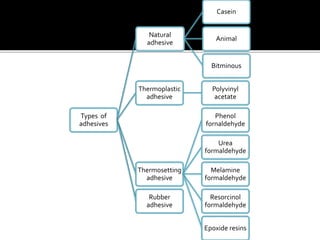
 Types of adhesives
 Natural adhesives
 Casein glue
 Animal glue
 Bituminous
 Thermoplastic adhesives (polyvinyl acetate)
 Thermosetting adhesives and plastics (phenol formaldehyde)
 Urea formaldehyde
 Melamine resin
 Resourcinol phenol formaldehyde
 Epoxy resin
 Rubber adhesives
 BSI (British standard institute)
 Bsi classification
 Market survey
 Thankyou
• “An adhesive is a medium that allows the surfaces of two or
more components to be attached or bonded together”.
• They are hugely used across the construction industries.
• Mechanical fixings can weaken or affect material structure.
• Adhesive is a substance used for sticking two unlike bodies
together, due to molecular forces existing in the area of
contact.
• The development of adhesives has continued over the
centuries to meet the requirements of various civilization,
but it was not until the industrial revolution that demands
were made for major advances in adhesive technology.
 What is adhesive made out of?
 When a liquid is added to an adhesive, it
becomes glue. Glue is an adhesive substance
that binds two porous surfaces together.
 Adhesives made of 3 bases for following
categories:-
 Wooden - water base
 Paper - water base
 Textile - water base
 Construction - solvent base
 Plastic , glass - cyno base
 :- as we go down in above category the price,
flammability is also increase with their
strength:-
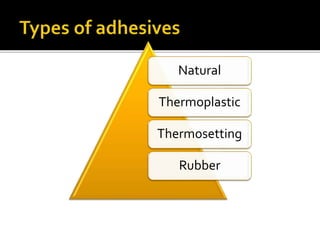
Natural
Thermoplastic
Thermosetting
Rubber
Types of
adhesives
Natural
adhesive
Casein
Animal
Bitminous
Thermoplastic
adhesive
Polyvinyl
acetate
Thermosetting
adhesive
Phenol
fornaldehyde
Urea
formaldehyde
Melamine
formaldehyde
Resorcinol
formaldehyde
Epoxide resins
Rubber
adhesive
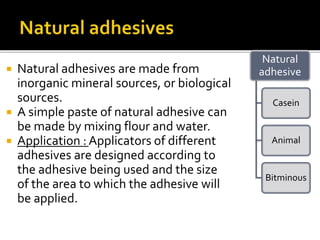
 Natural adhesives are made from
inorganic mineral sources, or biological
sources.
 A simple paste of natural adhesive can
be made by mixing flour and water.
 Application : Applicators of different
adhesives are designed according to
the adhesive being used and the size
of the area to which the adhesive will
be applied.
Natural
adhesive
Casein
Animal
Bitminous
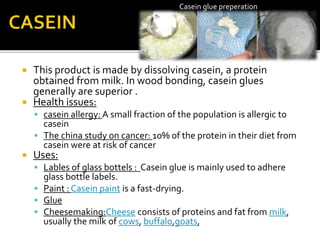
 This product is made by dissolving casein, a protein
obtained from milk. In wood bonding, casein glues
generally are superior .
 Health issues:
 casein allergy: A small fraction of the population is allergic to
casein
 The china study on cancer: 10% of the protein in their diet from
casein were at risk of cancer
 Uses:
 Lables of glass bottels : Casein glue is mainly used to adhere
glass bottle labels.
 Paint : Casein paint is a fast-drying.
 Glue
 Cheesemaking:Cheese consists of proteins and fat from milk,
usually the milk of cows, buffalo,goats,
Casein glue preperation
 An animal is an adhesive that is created
by prolonged boiling of animal
connective tissue.
 Animal glue was the most common
woodworking glue for thousands of
years.
 Types :
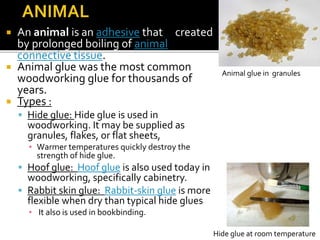
 Hide glue: Hide glue is used in
woodworking. It may be supplied as
granules, flakes, or flat sheets,
▪ Warmer temperatures quickly destroy the
strength of hide glue.
 Hoof glue: Hoof glue is also used today in
woodworking, specifically cabinetry.
 Rabbit skin glue: Rabbit-skin glue is more
flexible when dry than typical hide glues
▪ It also is used in bookbinding.
Hide glue at room temperature
Animal glue in granules
 Bitumen, bituminis is a very ancient product.
 The Egyptians, the Greek and the Romans were
already acquainted with it.
 The Romans called it earthpitch. Its natural
source was Ragusa on Sicily, where it was found
in rock-formations, which contained about 14%
of bituminis.
 Used in paints and maker inks by some graffiti
supply companies to increase the weather
resistance and to make the color much darker.
 Thermoplastic adhesives – These types of
adhesives may be in the form of a solid which
softens when heated and when cooled will
regain their original form and strength.
 POLYVINYL ACETATE (PVA)
 As an emulsion in water, PVA is sold as an adhesive for porous
materials, particularly wood, paper, and cloth. It is the most
commonly used wood glue, both as "white glue" and the yellow
"carpenter's glue."
Uses
 A wood glue PVA is known as 'white glue' and the yellow as
carpenter's glue or PVA glue.

 Paper adhesive.

 In handicrafts.
 An envelope adhesives.
 As wallpaper adhesives.
Thermoplastic
adhesive
Polyvinyl acetate
(PVA)
Thermosetting adhesives – These types of
adhesives are resins which become solid
through a chemical reaction or by applying
heat. Once set they can not be reformed.
Phenol formaldehyde
 This is pressure sensitive type of adhesive.The
aderend surfaces after being coated with this
adhesive is subjected to curing by heat and pressure.
 This is available as solid, liquid or impregnated film
and used for bonding wood and metal.
 Uses :
 Phenolic resins are also used for making exterior
plywood commonly known asWBP (Weather & boil
proof) Plywood because Phenolic resins have no
melting point
 The Dutch forger Han van Meegeren mixed phenol
formaldehyde with his oil paints before baking the
finished canvas in order to fake the drying out of the
paint over the centuries.
Thermosetting
adhesive
Phenol
formaldehyde
Urea
formaldehyde
Melamine
formaldehyde
Resorcinol
formaldehyde
Epoxide resins
• The urea–formaldehydes (UFs) are the most important and most
used class of amino resin adhesives.
• Powder, not boil proof.
• Shelf life ~1 year. Pot-life: ~3-10 hours.
• Moisture resistant, not susceptible to attack by micro-organisms.
• Example: cascamite, laminating etc.
• Advantages :
• (1) initial water solubility (this renders them eminently suitable for bulk
and relatively inexpensive production),
• (2) hardness,
• (3) nonflammability,
• (4) good thermal properties,
• (5) absence of color in cured polymers.
• Disadvantages :
• The greatest disadvantage of the amino resins is their bond
deterioration caused by water and moisture.
• Uses :
• Plywood adhesive:
• Particle board adhesive:
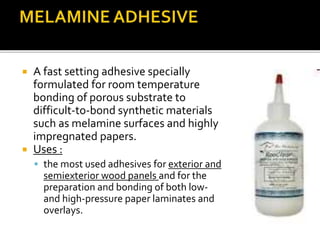
 A fast setting adhesive specially
formulated for room temperature
bonding of porous substrate to
difficult-to-bond synthetic materials
such as melamine surfaces and highly
impregnated papers.
 Uses :
 the most used adhesives for exterior and
semiexterior wood panels and for the
preparation and bonding of both low-
and high-pressure paper laminates and
overlays.
• Resorcinol-phenol formaldehyde.
• Resin + hardener (catalyst).
• i.e. Aerodux 185 + hardener.
• Used in Exterior timber structures, marine,
plywood.
• Used externally, it is an antiseptic and
disinfectant
• Used in the production of plasticizers.
• Liquid mix with hardener
• Shelf life - indefinite, pot life - 1hr @ 30o
C
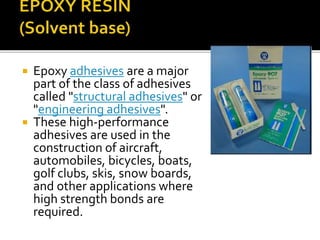
 Epoxy adhesives are a major
part of the class of adhesives
called "structural adhesives" or
"engineering adhesives".
 These high-performance
adhesives are used in the
construction of aircraft,
automobiles, bicycles, boats,
golf clubs, skis, snow boards,
and other applications where
high strength bonds are
required.
 Natural rubber is often vulcanized, a process
by which the rubber is heated and sulfur,
peroxide or bisphenol are added to improve
resilience and elasticity, and to prevent it
from perishing.
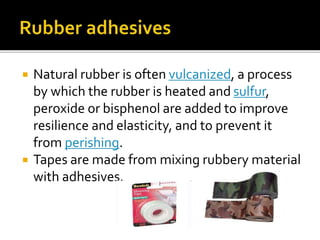
 Tapes are made from mixing rubbery material
with adhesives.
• BSI Group, also known in its home market as
the British Standards Institution (or BSI), is a
multinational business services provider whose
principal activity is the production of standards and the
supply of standards-related services.
 Test products to confirm the manufacturers
claims.
 i.e. BS 1204:1979 (adhesives for constructional
work in wood).
 i.e. BS 1203:1979 (adhesives for plywood).
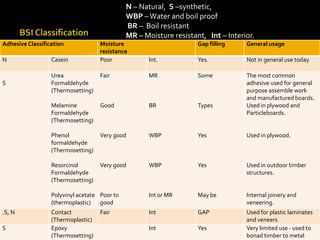
Adhesive Classification Moisture
resistance
Gap filling General usage
N Casein Poor Int. Yes. Not in general use today
S
Urea
Formaldehyde
(Thermosetting)
Melamine
Formaldehyde
(Thermosetting)
Phenol
formaldehyde
(Thermosetting)
Resorcinol
Formaldehyde
(Thermosetting)
Polyvinyl acetate
(thermoplastic)
Fair
Good
Very good
Very good
Poor to
good
MR
BR
WBP
WBP
Int or MR
Some
Types
Yes
Yes
May be
The most common
adhesive used for general
purpose assemble work
and manufactured boards.
Used in plywood and
Particleboards.
Used in plywood.
Used in outdoor timber
structures.
Internal joinery and
veneering.
.S, N Contact
(Thermoplastic)
Fair Int GAP Used for plastic laminates
and veneers
S Epoxy
(Thermosetting)
Int Yes Very limited use - used to
bonad timber to metal
N – Natural, S –synthetic,
WBP –Water and boil proof
BR – Boil resistant
MR – Moisture resistant, Int – Interior.
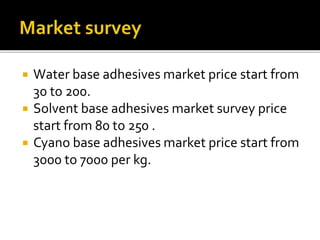
 Water base adhesives market price start from
30 to 200.
 Solvent base adhesives market survey price
start from 80 to 250 .
 Cyano base adhesives market price start from
3000 to 7000 per kg.
Adhesive  manisha

Adhesive manisha

  • 1.
    Made by :Manisha Khandelwal, Kashif Zafar andYaseem Mallik
  • 2.
     Introduction  Typesof adhesives  Natural adhesives  Casein glue  Animal glue  Bituminous  Thermoplastic adhesives (polyvinyl acetate)  Thermosetting adhesives and plastics (phenol formaldehyde)  Urea formaldehyde  Melamine resin  Resourcinol phenol formaldehyde  Epoxy resin  Rubber adhesives  BSI (British standard institute)  Bsi classification  Market survey  Thankyou
  • 3.
    • “An adhesiveis a medium that allows the surfaces of two or more components to be attached or bonded together”. • They are hugely used across the construction industries. • Mechanical fixings can weaken or affect material structure. • Adhesive is a substance used for sticking two unlike bodies together, due to molecular forces existing in the area of contact. • The development of adhesives has continued over the centuries to meet the requirements of various civilization, but it was not until the industrial revolution that demands were made for major advances in adhesive technology.
  • 4.
     What isadhesive made out of?  When a liquid is added to an adhesive, it becomes glue. Glue is an adhesive substance that binds two porous surfaces together.  Adhesives made of 3 bases for following categories:-  Wooden - water base  Paper - water base  Textile - water base  Construction - solvent base  Plastic , glass - cyno base  :- as we go down in above category the price, flammability is also increase with their strength:-
  • 5.
  • 6.
  • 7.
     Natural adhesivesare made from inorganic mineral sources, or biological sources.  A simple paste of natural adhesive can be made by mixing flour and water.  Application : Applicators of different adhesives are designed according to the adhesive being used and the size of the area to which the adhesive will be applied. Natural adhesive Casein Animal Bitminous
  • 8.
     This productis made by dissolving casein, a protein obtained from milk. In wood bonding, casein glues generally are superior .  Health issues:  casein allergy: A small fraction of the population is allergic to casein  The china study on cancer: 10% of the protein in their diet from casein were at risk of cancer  Uses:  Lables of glass bottels : Casein glue is mainly used to adhere glass bottle labels.  Paint : Casein paint is a fast-drying.  Glue  Cheesemaking:Cheese consists of proteins and fat from milk, usually the milk of cows, buffalo,goats, Casein glue preperation
  • 9.
     An animalis an adhesive that is created by prolonged boiling of animal connective tissue.  Animal glue was the most common woodworking glue for thousands of years.  Types :  Hide glue: Hide glue is used in woodworking. It may be supplied as granules, flakes, or flat sheets, ▪ Warmer temperatures quickly destroy the strength of hide glue.  Hoof glue: Hoof glue is also used today in woodworking, specifically cabinetry.  Rabbit skin glue: Rabbit-skin glue is more flexible when dry than typical hide glues ▪ It also is used in bookbinding. Hide glue at room temperature Animal glue in granules
  • 10.
     Bitumen, bituminisis a very ancient product.  The Egyptians, the Greek and the Romans were already acquainted with it.  The Romans called it earthpitch. Its natural source was Ragusa on Sicily, where it was found in rock-formations, which contained about 14% of bituminis.  Used in paints and maker inks by some graffiti supply companies to increase the weather resistance and to make the color much darker.
  • 11.
     Thermoplastic adhesives– These types of adhesives may be in the form of a solid which softens when heated and when cooled will regain their original form and strength.  POLYVINYL ACETATE (PVA)  As an emulsion in water, PVA is sold as an adhesive for porous materials, particularly wood, paper, and cloth. It is the most commonly used wood glue, both as "white glue" and the yellow "carpenter's glue." Uses  A wood glue PVA is known as 'white glue' and the yellow as carpenter's glue or PVA glue.   Paper adhesive.   In handicrafts.  An envelope adhesives.  As wallpaper adhesives. Thermoplastic adhesive Polyvinyl acetate (PVA)
  • 12.
    Thermosetting adhesives –These types of adhesives are resins which become solid through a chemical reaction or by applying heat. Once set they can not be reformed. Phenol formaldehyde  This is pressure sensitive type of adhesive.The aderend surfaces after being coated with this adhesive is subjected to curing by heat and pressure.  This is available as solid, liquid or impregnated film and used for bonding wood and metal.  Uses :  Phenolic resins are also used for making exterior plywood commonly known asWBP (Weather & boil proof) Plywood because Phenolic resins have no melting point  The Dutch forger Han van Meegeren mixed phenol formaldehyde with his oil paints before baking the finished canvas in order to fake the drying out of the paint over the centuries. Thermosetting adhesive Phenol formaldehyde Urea formaldehyde Melamine formaldehyde Resorcinol formaldehyde Epoxide resins
  • 13.
    • The urea–formaldehydes(UFs) are the most important and most used class of amino resin adhesives. • Powder, not boil proof. • Shelf life ~1 year. Pot-life: ~3-10 hours. • Moisture resistant, not susceptible to attack by micro-organisms. • Example: cascamite, laminating etc. • Advantages : • (1) initial water solubility (this renders them eminently suitable for bulk and relatively inexpensive production), • (2) hardness, • (3) nonflammability, • (4) good thermal properties, • (5) absence of color in cured polymers. • Disadvantages : • The greatest disadvantage of the amino resins is their bond deterioration caused by water and moisture. • Uses : • Plywood adhesive: • Particle board adhesive:
  • 14.
     A fastsetting adhesive specially formulated for room temperature bonding of porous substrate to difficult-to-bond synthetic materials such as melamine surfaces and highly impregnated papers.  Uses :  the most used adhesives for exterior and semiexterior wood panels and for the preparation and bonding of both low- and high-pressure paper laminates and overlays.
  • 15.
    • Resorcinol-phenol formaldehyde. •Resin + hardener (catalyst). • i.e. Aerodux 185 + hardener. • Used in Exterior timber structures, marine, plywood. • Used externally, it is an antiseptic and disinfectant • Used in the production of plasticizers. • Liquid mix with hardener • Shelf life - indefinite, pot life - 1hr @ 30o C
  • 16.
     Epoxy adhesivesare a major part of the class of adhesives called "structural adhesives" or "engineering adhesives".  These high-performance adhesives are used in the construction of aircraft, automobiles, bicycles, boats, golf clubs, skis, snow boards, and other applications where high strength bonds are required.
  • 17.
     Natural rubberis often vulcanized, a process by which the rubber is heated and sulfur, peroxide or bisphenol are added to improve resilience and elasticity, and to prevent it from perishing.  Tapes are made from mixing rubbery material with adhesives.
  • 18.
    • BSI Group,also known in its home market as the British Standards Institution (or BSI), is a multinational business services provider whose principal activity is the production of standards and the supply of standards-related services.  Test products to confirm the manufacturers claims.  i.e. BS 1204:1979 (adhesives for constructional work in wood).  i.e. BS 1203:1979 (adhesives for plywood).
  • 19.
    Adhesive Classification Moisture resistance Gapfilling General usage N Casein Poor Int. Yes. Not in general use today S Urea Formaldehyde (Thermosetting) Melamine Formaldehyde (Thermosetting) Phenol formaldehyde (Thermosetting) Resorcinol Formaldehyde (Thermosetting) Polyvinyl acetate (thermoplastic) Fair Good Very good Very good Poor to good MR BR WBP WBP Int or MR Some Types Yes Yes May be The most common adhesive used for general purpose assemble work and manufactured boards. Used in plywood and Particleboards. Used in plywood. Used in outdoor timber structures. Internal joinery and veneering. .S, N Contact (Thermoplastic) Fair Int GAP Used for plastic laminates and veneers S Epoxy (Thermosetting) Int Yes Very limited use - used to bonad timber to metal N – Natural, S –synthetic, WBP –Water and boil proof BR – Boil resistant MR – Moisture resistant, Int – Interior.
  • 20.
     Water baseadhesives market price start from 30 to 200.  Solvent base adhesives market survey price start from 80 to 250 .  Cyano base adhesives market price start from 3000 to 7000 per kg.