MMBC - 5
1KS SCHOOL OF ARCHITECTURE
WATER PROOFING
MANOJ BK
1KF18AT016
MMBC - 5
2KS SCHOOL OF ARCHITECTURE
What is the need of WATER PROOFING?
 Basic waterproofing and envelope design incorporates 3steps to ensure
a watertight and environmentally sound interior:
 Understanding water sources likely to be encountered
 Designing systems to prevent leakage from these sources
 Finalizing The design by properly detailing each individual envelope
component into adjacent compounds
 A building or structure needs waterproofing involves “membranes”,
This relies on the application of one or more layers of membrane that
act as a barrier between the water and the building structure,
preventing the passage of water
Water proofing is done in various parts of building
1.WC
2.Bathrooms
3.Terrace
4.Roofs and chejjas
5.Basement, Swimming pools, Underground ducts
6.
7.Under ground and overhead tanks
Elements in water proofing?
 Materials used to protect structural components, buildings,
and installations from the harmful effects of water and
chemically fluids, such as acids and alkalis
MMBC - 5
3KS SCHOOL OF ARCHITECTURE
 Waterproofing materials are subdivided by purposes into anti-
seepage, anti-corrosion, and by basic material into asphalt, mineral,
plastic, and metallic.
 Asphalt waterproofing materials are used in the form pf petroleum
bitumen with mineral powder, and sand, and crushed stone (asphalt
mastics, mortars, and concretes), obtained by heating (hottest and
poured asphalts), thinning the bitumen with volatile solvents
(bituminous lacquers and enamels), or emulsifying them in water
(bituminous emulsions, pastes and cold asphalts).
 Plastic waterproofing are used for painted (epoxide, polyester
,polyvinyl, and ethanol lacquers and paint’s), Plastered (polymer
mortars, concretes, and faizol), and glued(polyethylene, polyvinyl
tapes, and oppanaol)
 The nomenclature and scope of production of these materials is
constantly increasing.
CONSTRUCTION CHEMICALS
 Construction Chemicals are an important component of the chemical industry and are playing an increasingly
important role in nation building.
 Their judicious usage improves the quality as also durability of structures.
 The use of Construction Chemicals is still negligible in India because of low market awareness. With proper
awareness about this sector the use of construction chemicals will increase and thus contribute in a small but
significant way to the Indian economy.
MMBC - 5
4KS SCHOOL OF ARCHITECTURE
WATERPROOFING CHEMICALS
 Bitumen – Mixed with a filler component such as limestone or sand. Polymers are added to the bitumen as
astatic polypropylene (APP), a plastic additive that gives rigidity and tear resistance, or styrene buta-diene styrene
(SBS), a rubber additive that gives more elastic benefits.
 Base products- Polyester, fibre glass, rag fibre (hessian), and paper. These products are bought in roll format
and are pulled through the bitumen mixes on huge rollers. The
base product becomes saturated in huge tanks by the tar like
bitumen substance, creating rolls of waterproof material.
What is Water Insulation?
Waterproofing is the process of making an object or structure
waterproof or water resistant. Thanks to this process, the insulated
material or structure remains unaffected by water or resists water
ingress under the specified conditions. Such articles may be used in
wet environments or under specified depths. Sometimes it is used to
increase the comfort of buildings by using on surfaces such as
balconies or warehouses which are thought to be in contact with water.
The question of what are the waterproofing materials should be given
in accordance with the area of use.
Waterproofing in buildings is the formation of an impermeable barrier on the surfaces of foundations, roofs, walls and
other structural elements to prevent the passage of water from these surfaces. Building surfaces are water-resistant
and sometimes waterproof.
In other words, waterproofing is a protective measure that makes a surface water resistant or prevents unwanted
penetration of liquids under other external forces such as hydrostatic pressure and capillary. It is a process that
allows the installation of a continuous system with the application of elastic and durable membranes. It is a technique
used in construction and design industries to reduce the effect of liquid penetration on systems. Insulation increases
the durability of concrete surfaces in a building.
MMBC - 5
5KS SCHOOL OF ARCHITECTURE
Where to apply Waterproofing?
 Positive side Waterproofing
 Negative Side Waterproofing
 Blind Side Waterproofing
 Interior Application
 Exterior Application
Positive Side of Waterproofing
 Positive side is same side of the structures as the source of the water.
 Designed to stop water before it has a chance to enter the structure and cause
structural damage
 Typically the most effective solution
Negative Side of Waterproofing
 Interior side opposite the water Pressure side of the Structure
 Most commonly used in
Remedial Work
Elevator Pits
Tank Liners
Blind Side of Waterproofing
 Positive side applied prior to installing the structural walls or slabs
 Typically inaccessible once the structure is complete
 In many cases this is the only positive side waterproofing option
MMBC - 5
6KS SCHOOL OF ARCHITECTURE
Water proofing is done in various parts of building
Preparation of WC water-proofing
 The pre-work should be completed before starting the water-proofing Completion
of internal plaster of walls leaving a margin of 18” from the final floor
 Level of WC unit.
 Completion of grooving or chasing for concealed G.I. piping or electric conduit
piping in WC.
 Removing of all debris from WC and chiselling the extra mortar to expose the
rare slab completely.
 Completion of making holes in external walls for connecting tahini trap, p-
trap, floor trap, etc. to the external drainage line.
 Thorough cleaning of WC with sufficient quantity of water.
 Level marking in red colour on wall with respect to floor level to setup trap level Socketing of WC
water-proofing
 Fill up the WC slab with 7cm of water(after plugging trap hole)
 Keep the slab filled with water over-night for at least 12 hours.
 Check for leakages in base slab or underneath.
 If a major leakage is observed, locate the spot with porous concrete and provide a socket for grouting. In
addition provide 4 sockets at each corner of the slab.
 Grout the socket with cement slurry with consumption rate of 1 bag of cement to 75 to 100lts of water. To
spread the slurry in the porous portion of the concrete, it is required to flow the slurry with velocity.
 It is further understood that the process of socketing and grouting is to be continued until the leakage in base
slab is totally stopped.
 After completion of cement grouting and testing for leakages, remove the sockets.
Coating for WC water-proofing
 Provide 25-40mm thick cement mortar base coat in proportion 1:4 with a slope of 1:100 from the entrance door
towards the water escape pipe (drain pipe).
 Carry out this base coat on all walls up to a height of 45cm above toilet finished floor level
MMBC - 5
7KS SCHOOL OF ARCHITECTURE
 Keep this base coat full with water up to the slab drop top, for minimum 4 days for curing and testing purposes
Brick coat for WC water-proofing
• Select well burnt brick bats. Before laying brick bats, sock thoroughly in water for at least half an hour.
• Lay the brick bat on the edge and not on the flat surface.
• Any gaps between the bats should be filled with mortar. Complete the brick bat coat with joints filled with cement
mortar in 1:6. Also use water-proofing compound as per the specified dose per bag of cement while filling the joint.
• Give a slope of 1:100 in brick bat coat from the Entrance door to the water escape pipe.
• Cure the coat by ponding water for four days and check for any leakages.
Topping coat for WC water-proofing
 After curing of the brick bat coat, complete the topping coat with 1:4 cement mortar mixed with water-proofing
compound. Finish this coat properly with neat cement slurry by metal float.
 Roughen the surface with a wire brush, for bonding of the horizontal filler coat. Continue this coat on the side
walls, up to 45cms above WC floor level. This coat should not project out beyond the plastering coat of the WC
walls, so as to avoid unnecessary thickness of the glazed tile dado.
 Cure this final coat for a minimum of 7 days, with water up to minimum 7.5cms depth.
WC pan fixing and finishing of water-proofing
• Fix WC pan at the required level, considering 15mm sunk from the floor level.
• Block the p-trap outlet hole with gunny bags and fill the WC pan with sand to prevent any damage by the
water-proofing workmen.
• Check the WC pan for its centre.
• Fill the extra gap around WC pan over the topping coat with brick bat and mortar in layer up to a minimum of
7.5cm below the top of WC.
• Allow curing for a minimum of 3 days.
• The final topping coat should be done up to 50mm below top of WC with a slight slope towards The WC pan.
• Roughen the top coat surface with a wire brush to receive the mortar with the required bonding.
• Continuous curing should be done for a minimum of 7 days with wet gunny bags.
MMBC - 5
8KS SCHOOL OF ARCHITECTURE
Preparation of Bathroom water-proofing
 After completion of the internal plastering of walls, keep a margin of
450mm from the final floor level of the bathroom. Roughening of the
plaster should be done with a wire brush for fixing the glazed tiles cladding
dado.
 Complete grooving, chiselling for concealed G.I and electrical conduit
piping in bathroom.
 Remove all debris from the bathroom after chiselling the extra mortar,
if any, to expose the slab completely.
 Make the holes in the external walls for connecting tahini trap to
external drainage line and water leakage drain pipe.
Clean the bathroom thoroughly with water. Mark the level in red on
the walls, with respect to the floor level, to set up the trap level
Base Coat for bath water-proofing
• After stopping any leakages in the base slab, provide 15-25mm thick
cement mortar base coat in proportion 1:4 with a slope of 25mm in 3m from entrance door towards tahini trap.
• This base coat should cover all the walls around up to the outer face wall line at the entrance door and the
bottom portion of the tahini trap connection hole made in the wall.
• Flood this base coat with water, up to the slab drop, for a minimum of 4 days, for curing and testing.
• Fix the tahini trap and drain pipe over this base coat.
• The brick bat coat is done similar to WC water- proofing.
Topping coat for Bathroom water-proofing
 After curing the brick bat coats, complete the topping coat using 1:4 cement mortar mixed with water-proofing
compound, with a proper slope from the entrance door to the tahini trap. Finish this coat with cement slurry
using a metal float. Roughen the top coat using a wire brush to receive tile mortar bonding.
 Ensure that this coat on walls does not project beyond the bathroom wall plastering coat.
 Cure this final coat for a minimum of 7 days with standing water (depth 7.5cm)
MMBC - 5
9KS SCHOOL OF ARCHITECTURE
Basement/Swimming pool and
underground duct water
proofing
 For basements, swimming pools and
underground ducts such as lift pits,
the water-
Proofing has to withstand the water
pressure in addition to its basic stress
Work procedure
• Carry out the work of PCC bed and provide a cement mix 1:4 base coat with water- proofing compound and
above this fix rough Shahabad tiles.
• Maintain the break joint pattern while fixing the tile for base.
• After fixing the tiles, grout the joints with cement slurry completely.
• Apply a joint less layer of cement mortar 1:3 25mm thick and cure it for 7 days.
• For basement, provision of gutter and sump is made in PCC itself and Shahabad base is also prepared in the
same fashion. Gutter is given proper slope towards the sump. This is done as a preventive measure against
occasional entry of rain water into basement.
• After curing, provide the final joint less water-proof plaster coat in cement mortar 1:4 over the rough Shahabad
tiles.
Brick Bat Coba for Terrace
 Fix in a slope of 1:150, starting from the lowest point of rainwater down take and by keeping a minimum thickness
of 65mm below the rainwater outlet.
 Fix brick bats in cement mortar layer of 1:6 proportion in a slope of 1:150 with the water proofing compound.
 Fill the cement mortar 1:4 with the brick bat joints.
 Fix small pieces of brick bats along with 20mm metal for coving of watt(rounding) at the bottom of the parapet wall
 Special care should be taken for achieving the round shape near the rain water pipe.
MMBC - 5
10KS SCHOOL OF ARCHITECTURE
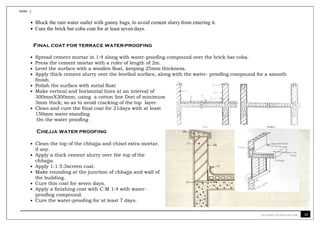
 Block the rain water outlet with gunny bags, to avoid cement slurryfrom entering it.
 Cure the brick bat coba coat for at least seven days.
Final coat for terrace water-proofing
 Spread cement mortar in 1:4 along with water-proofing compound over the brick bat coba.
 Press the cement mortar with a ruler of length of 2m.
 Level the surface with a wooden float, keeping 25mm thickness.
 Apply thick cement slurry over the levelled surface, along with the water- proofing compound for a smooth
finish.
 Polish the surface with metal float
 Make vertical and horizontal lines at an interval of
300mmX300mm, using a cotton line Dori of minimum
3mm thick; so as to avoid cracking of the top layer.
 Clean and cure the final coat for 21days with at least
150mm water standing
On the water proofing
Chejja water proofing
 Clean the top of the chhajja and chisel extra mortar,
if any.
 Apply a thick cement slurry over the top of the
chhajja.
 Apply 1:1.5:3screen coat.
 Make rounding at the junction of chhajja and wall of
the building.
 Cure this coat for seven days.
 Apply a finishing coat with C.M 1:4 with water-
proofing compound.
 Cure the water-proofing for at least 7 days.
MMBC - 5
11KS SCHOOL OF ARCHITECTURE
Sloping Terrace Water Proofing
 Clean the surface of the sloping terrace.
 Apply a thick cement slurry over the surface of the slab.
 Apply 1:1.5:3 screen coat.
 Cure this coat for 7 days by putting wet gunny bags on it.
 Over this coat, apply a finishing coat with cement sand mortar 1:4
and water-proofing compound as per design.
 Make an edge between the parapet and the sloping roof on the second day.
 Cure this water-proofing for 15 days with gunny bags spread over it.
 Constant watering is required on a sloping slab.
Overhead tank water proofing
 Chisel the extra concrete in the tank, particularly in the corners around the
chambers.
 Clean the entire tank, along with the bottom slab and side walls and throw away the
debris.
 Allow the cement slurry to penetrate all holes, cracks of bottom slab.
 Check the hacking of vertical walls from inside for better bonding with water- proofing.
 Check the inlet, outlet and washout pipes for their rigidity. If the pipes are not rigid, grout them to achieve the
desired fixity. Before grouting, check the levels of these pipes and if necessary correct them by shifting the pipes
accordingly.
 Apply water-proofing plaster in C.M 1:4, by adding water-proofing compound. Apply 15-20mm thick over this
plaster, particularly on the corners and base for avoiding shrinkage and to achieve better strength.
 The bottom of the top slab does not require water-proofing.
 The top of the overhead water tank is to be finished with brick bat, as mentioned for terrace water-proofing.
 Allow the water-proofing to set foe at least 12 hours
 Cure this water-proofing for a minimum of 15 days
MMBC - 5
12KS SCHOOL OF ARCHITECTURE
Expansion Joint Water-proofing
Surface Preparation for Expansion Joint Water Proofing
• Clean the joint surface of dust, cement mortar etc.
• Remove oil and grease (if any) from the surface.
• Protect the edges of the joint with masking tape.
• Keep the tools like suspended scaffolding, ladder, spatula,
Putty knife, hand held gun equipment etc. ready.
Work procedure for vertical expansion joint water proofing.
• Primer is applied in the joint in accordance with the type of joint. For surfaces like concrete,
masonry etc.
• After the primer dries completely, sealant is prepared by mixing base and accelerator.
Mixing should continue till a uniform colour is obtained.
• The base and accelerator are mixed in equal proportions by weight.
• This mixed compound is then applied with a spatula or hand held gun equipment
wherever required. Extra material is cut off with putty knife and a smooth vertical joint is
created.
• The masking tape is then removed and the surface is cleaned with suitable solvents.
Damp proofing
Dampness is the seepage of water through the members of the building there is very
little difference between leakage and dampness.
If the water comes out of slab of the bathroom/toilet, it is termed as leakage and if it is
observed on external walls of the building directly exposed to rains and floors, then this
percolation is termed as dampness.
MMBC - 5
13KS SCHOOL OF ARCHITECTURE
Damp proof course in plinth
• Foundation masonry is always in contact with the sub soil, which sometimes
may contain water.
• The subsoil water tries to enter the building through the walls/floored.
• Due to capillary action, the subsoil water sometimes rises into the walls of the
building against gravity and indicates dampness.
• Generally, foundation masonry is done with UCR masonry and at the plinth
level, DPC is provided to prevent capillary water of the sub soil water.
• The rich cement concrete, generally of M20 grade with water proofing compound
added to it can be used as DPC in buildings.
• Tar is also applied below DPC to prevent the entry through Capillary action.
• Above the DPC, regular masonry for super structure is done.
Causes and Precautions for wall dampness
 If the foundation masonry is directly exposed to subsoil, water may enter the
building through the walls.
• For this it is ensured that pointing or plastering the exposed walls is done to
restrict the direct contact of sub soil water with masonry.
• No hollow spaces should remain in the masonry as these are the routes for water to
enter.
• For the junctions of RCC and masonry, chicken mesh should be used for
plastering.
• Dampness is also observed on the ceiling in the form of patches. This is due to
stagnant water on the terrace or some organic matter dumped on the terrace.
• During execution of the terrace, a proper slope should be given so that water
doesn’t accumulate in any place.
• The terrace must be kept clean during rainy seasons to prevent continuous
dampness.
• The terrace slab must be cast carefully so that it attains density and permeability.
MMBC - 5
14KS SCHOOL OF ARCHITECTURE
Waterproofing Methods in Different Places
Waterproofing methods differ in rural areas and urban areas. Therefore, the answer to the question of what are the
ideal waterproofing materials also changes in rural and urban areas
 Rural Areas
Since rural areas are uniformly monotonous and less utilized in terms of the use of various materials, certain
construction styles, typical problems of the region's natural problems may arise. The use of natural and locally
available materials makes it a very typical and limited work to remove the wear of the structure. Workmanship is
handled at a grass root level to address any problems that may occur.
 Urban Areas
In urban areas there are various corners and surfaces. Macro climate changes, excessive pollution, excessive use of
soil, lack of green space, excessive use of greenhouse gases, roads are the most important causes of weather
conditions effect the process of waterproofing in urban areas. This situation causes the material to withstand high
temperature variations due to its weakening, large changes in its composition and the development of cracks.
However, often the construction, materials and methods are advanced and therefore it is easy to control and improve.
How Waterproofing is applied in Constructions?
One of the reasons why you are asking yourself what waterproofing materials are is that you can benefit from these
materials in constructions. In this case, you should take a close look at how waterproofing is applied in constructions.
Construction applications are one of the areas where water insulation is frequently
encountered. Waterproofing is achieved by using membranes and coatings to
maintain a structure or structure, contents and structural integrity.
Benefits of Waterproofing
To give a healthy answer to the question of what are waterproofing materials, we
need to understand the reason for this need at first. Each building is subject to
deterioration if it is not properly maintained. In this way, some natural factors
such as air, water, climate, wind and humidity becomes manageable. If a structure
is not protected from water, problems such as deterioration or damage to a
MMBC - 5
15KS SCHOOL OF ARCHITECTURE
structure from foundation to plaster can be encountered. Against the following causes buildings need to be insulated
against water:
 Natural factors
 Unexpected fire accidents
 Water - rain and humidity
 Strong wind
 Big earthquakes
 Non-natural factors
 Damage caused by theft
 Collapse of buildings
 Structural failure in buildings
 Other anti-social actions
Building waterproofing is a process designed to prevent water from entering a building. In general, extensive
waterproofing measures are added to provide moisture control to the building during construction, and waterproofing
can also be made after a building has been constructed, or when it arises as part of a building improvement or
renovation process.
Why Internal water proofing over External waterproofing?
 Exterior waterproofing is well known as being the ultimate solution. As it prevents water from even getting past
your external walls. Interior solutions provide waterproof protection for the inner layers of your walls, preventing
damp and mould problems in your home.
 In terms of the structure of your home, the delta membrane and pump systems channel water away, and prevent
build up and hydrostatic pressure. The helps with the long term integrity of the property, but does not offer the
same full protection as exterior solutions.
 There are four main reasons why you would choose interior waterproofing solutions over exterior ones.
 Cost effective is one of the reason why people go for interior waterproofing. It is much less expensive option, and
still provides great protection, eliminating mould and damp from your basement, and ensuring water does not
gather anywhere in your home.
EFFICIENCY:
MMBC - 5
16KS SCHOOL OF ARCHITECTURE
 Exterior waterproofing is a worthy long term investment, but interior waterproofing can solve a problem fast, and
combined with the low costs this make it a popular option. Installation may take only a couple of days, making
interior waterproofing a solution that is neither invasive nor disruptive. Any wet basement or damp problems will
be stored in no time!
PROBLEM IS MINOR:
 In the case of a minor leak or a small damp patch, as opposed to major structural issue, interior solutions may be
preferable. Sometimes a small repair job from the inside of your home is enough to prevent a problem.
EXTERNAL ACCESS IS A PROBLEM:
 Some properties may not lend themselves well to external excavation, as is the case of access is difficult, or if
houses are spaced close together. In the case that exterior waterproofing is not possible, interior solutions provide
a solid alternative that will protect and enhance your home.
Methods of Waterproofing
In order to prevent water leakage and accumulation of water, waterproofing is carried out in layers on the top of the
structure, while retaining its respiratory characteristics. Internally, it removes the existing water content in the
structure and externally forms a protective structure around itself. Typically, the building waterproofing system is
constructed by creating a large number of barriers so that water cannot enter into the building.
The development of these multiple layers forms a structure around the building with the materials and techniques
inside. This structure can be considered as a sustainable property or a green building measure by preventing
excessive heat from escaping outside. This can be done by applying a variety of paints, coatings and other materials of
coatings that help to create a transition between the external and internal temperature.
The minimum difference between the indoor and outdoor temperatures of a building results in less wear symptoms
and protects the structure. This takes place in such a way that the effect of shrinkage or expansion in the various
material composition of the building is reduced by matching or equalizing the room temperature and the outdoor
temperature.
MMBC - 5
17KS SCHOOL OF ARCHITECTURE
It reduces the load in the waterproofing system and other processes that the residents tend to use to make room
temperature liveable. This reduction can be counted in electricity consumption, drinking water consumption and
other resource consumption savings. This tends to make the building greener.
Waterproofing Applications on Roofs
One of the main areas where waterproofing is applied in constructions is the main frame of the building. This main
frame covers the construction and roof of the building. It protects the building from rain, snow, and frost. Roofing
materials are generally designed to drain water from a water-resistant. In some cases they are also equipped to defend
the building again frosting as well. Roofs. For this reason, both the general geographical
location of the house and the facade of the house in this general position are important
aspects to be considered. For example, if the house is in a place of constant rainfall, its
roof should be designed accordingly. The answer to the question of what are the best
waterproofing materials for roofs is directly related to these properties. The feasibility
studies should be carried out by experts and the people who will carry out the
construction should be directed accordingly.
Waterproofing on Walls
When you are looking for an answer to the question of what are waterproofing
materials, you should act according to the characteristics of the region where you will apply waterproofing. The
waterproofing materials used for the roof and the waterproofing materials insulated for the wall will not be identical.
This is because these surfaces are different from the water they are exposed to. Walls must also have vapour barriers
or air barriers.
Sometimes waterproofing in some houses on the walls with the right materials,
moisture problems may be experienced. This may be due to the fact that a suitable
material is not selected for moisture insulation. In such cases, the answer to the
question of what are waterproofing materials becomes even more important. Moisture
insulation is another aspect of waterproofing. The masonry walls are constructed
with a moisture resistant road to prevent moisture from rising, and the concrete in
the foundations is rendered damp or waterproof by a liquid coating, basement
waterproofing membrane. In this way, no moisture problems.
MMBC - 5
18KS SCHOOL OF ARCHITECTURE
Balcony and Terrace
Another area requiring special waterproofing is the terraces and balconies.
There are a few points to consider when choosing waterproofing materials for
balconies and terraces. The first is the impact of expansion and contraction on
waterproofing systems for roofs and terraces. The terrace continuously moves
during the temperature changes and presses the water insulation systems. One
of the leading causes of waterproof terrace system failures is the movement of
substrates that cause a lot of stress on the membranes, causing the system to
fail. In order to avoid this, it is necessary to use appropriate waterproofing
membrane, appropriate slope drainage and appropriate construction materials.
Different Waterproofing Methods
What are the ideal waterproofing materials for a venue? To give a solid answer to
this question, we need to take a closer look at the waterproofing materials.
1. Cement Based Waterproofing Method
Let's start with one of the traditional answers to the question of what are the waterproofing materials, Cement based
waterproofing is the easiest waterproofing method in construction. Cement based waterproofing materials are easily
available fin various suppliers and they are easy to mix and apply.
This method is often used in domestic wet areas such as bathrooms and toilets. This method is usually a complete or
semi-flexible type of waterproofing. It is used in areas that are not sunlight or weather conditions
Cement based waterproofing is used in the following structures:
 Water treatment plants
 Sewage Treatment Plants
 Bridges
 Dams
 Railway and metro systems
 Sea cargo port and docks
 River locks / canals and concrete dykes
MMBC - 5
19KS SCHOOL OF ARCHITECTURE
 Parking structures
 Tunnels
Cement based waterproofing is used in these areas
2. Liquid Waterproofing Membrane Method
The most ideal water insulation materials are the answers to the question
and the other is liquid (liquid) water insulation methods. The liquid
waterproofing membrane method is a thin coating, usually consisting of a
primer coat and two coats of top coat applied by spray, roller or trowel. It
offers more flexibility than cement based waterproofing types. Therefore, it
is used more intensely nowadays.
So, how to apply the liquid waterproofing membrane method? The elongation properties of the coating can reach up to
2000%. The durability of the waterproofing coating depends on what kind of polymer the manufacturer uses in the
construction of liquid waterproofing.
The liquid waterproofing membrane may be a spray-applied liquid membrane
composed of polymer modified asphalt. Different degrees of acrylic, hybrid or
polyurethane liquid membranes for trowel, roller or spray are also available
from various manufacturers.
3. Bituminous Coating Waterproofing Method
Bituminous coating is a type of coating used for waterproofing and flexible
protective coating in accordance with the degree of formulation and
polymerization. Its flexibility and protection against water can be influenced
by the polymer class as well as the reinforcement of the fibre.
Bituminous coating is also called asphalt coating. The most common applications of bituminous coatings include
areas under the screed. It is an excellent protective coating and waterproofing material on surfaces such as concrete
foundations.
MMBC - 5
20KS SCHOOL OF ARCHITECTURE
The bituminous coating is made of bitumen based materials and is not
suitable for exposure to sunlight. As long as it is not modified by a more
flexible material such as polyurethane or acrylic based polymers, it
becomes very fragile when exposed to sunlight for a long time.
The flexibility of finished products always depends on the solids content of
the polymer added to the bit.
4. Bitumen Membrane Waterproofing Method
Bituminous membrane waterproofing is a popular method used on low
slope roofs due to their proven performance. It is a bituminous
waterproofing membrane and self-adhesive membrane.
In addition to the self-adhesive compounds, asphalt, polymer and filler, certain resins and oils may be added to
improve the adhesion properties. As the adhesion properties of the membrane decrease over time, the self-adhesive
type has a low shelf life.
5. Polyurethane Liquid Membrane Waterproofing Method
Polyurethane liquid membrane waterproofing method is used for flat roof area and is exposed to weather conditions.
This waterproofing method is expensive compared to others.
Polyurethane Liquid Membrane can offer higher flexibility. Polyurethane is very sensitive to the present moisture
content, so it is necessary to be very careful when evaluating the moisture content of the concrete slab before
application, otherwise the membranes may peel off or bond after a period of time.

Manoj bk (water proofing)

  • 1.
    MMBC - 5 1KSSCHOOL OF ARCHITECTURE WATER PROOFING MANOJ BK 1KF18AT016
  • 2.
    MMBC - 5 2KSSCHOOL OF ARCHITECTURE What is the need of WATER PROOFING?  Basic waterproofing and envelope design incorporates 3steps to ensure a watertight and environmentally sound interior:  Understanding water sources likely to be encountered  Designing systems to prevent leakage from these sources  Finalizing The design by properly detailing each individual envelope component into adjacent compounds  A building or structure needs waterproofing involves “membranes”, This relies on the application of one or more layers of membrane that act as a barrier between the water and the building structure, preventing the passage of water Water proofing is done in various parts of building 1.WC 2.Bathrooms 3.Terrace 4.Roofs and chejjas 5.Basement, Swimming pools, Underground ducts 6. 7.Under ground and overhead tanks Elements in water proofing?  Materials used to protect structural components, buildings, and installations from the harmful effects of water and chemically fluids, such as acids and alkalis
  • 3.
    MMBC - 5 3KSSCHOOL OF ARCHITECTURE  Waterproofing materials are subdivided by purposes into anti- seepage, anti-corrosion, and by basic material into asphalt, mineral, plastic, and metallic.  Asphalt waterproofing materials are used in the form pf petroleum bitumen with mineral powder, and sand, and crushed stone (asphalt mastics, mortars, and concretes), obtained by heating (hottest and poured asphalts), thinning the bitumen with volatile solvents (bituminous lacquers and enamels), or emulsifying them in water (bituminous emulsions, pastes and cold asphalts).  Plastic waterproofing are used for painted (epoxide, polyester ,polyvinyl, and ethanol lacquers and paint’s), Plastered (polymer mortars, concretes, and faizol), and glued(polyethylene, polyvinyl tapes, and oppanaol)  The nomenclature and scope of production of these materials is constantly increasing. CONSTRUCTION CHEMICALS  Construction Chemicals are an important component of the chemical industry and are playing an increasingly important role in nation building.  Their judicious usage improves the quality as also durability of structures.  The use of Construction Chemicals is still negligible in India because of low market awareness. With proper awareness about this sector the use of construction chemicals will increase and thus contribute in a small but significant way to the Indian economy.
  • 4.
    MMBC - 5 4KSSCHOOL OF ARCHITECTURE WATERPROOFING CHEMICALS  Bitumen – Mixed with a filler component such as limestone or sand. Polymers are added to the bitumen as astatic polypropylene (APP), a plastic additive that gives rigidity and tear resistance, or styrene buta-diene styrene (SBS), a rubber additive that gives more elastic benefits.  Base products- Polyester, fibre glass, rag fibre (hessian), and paper. These products are bought in roll format and are pulled through the bitumen mixes on huge rollers. The base product becomes saturated in huge tanks by the tar like bitumen substance, creating rolls of waterproof material. What is Water Insulation? Waterproofing is the process of making an object or structure waterproof or water resistant. Thanks to this process, the insulated material or structure remains unaffected by water or resists water ingress under the specified conditions. Such articles may be used in wet environments or under specified depths. Sometimes it is used to increase the comfort of buildings by using on surfaces such as balconies or warehouses which are thought to be in contact with water. The question of what are the waterproofing materials should be given in accordance with the area of use. Waterproofing in buildings is the formation of an impermeable barrier on the surfaces of foundations, roofs, walls and other structural elements to prevent the passage of water from these surfaces. Building surfaces are water-resistant and sometimes waterproof. In other words, waterproofing is a protective measure that makes a surface water resistant or prevents unwanted penetration of liquids under other external forces such as hydrostatic pressure and capillary. It is a process that allows the installation of a continuous system with the application of elastic and durable membranes. It is a technique used in construction and design industries to reduce the effect of liquid penetration on systems. Insulation increases the durability of concrete surfaces in a building.
  • 5.
    MMBC - 5 5KSSCHOOL OF ARCHITECTURE Where to apply Waterproofing?  Positive side Waterproofing  Negative Side Waterproofing  Blind Side Waterproofing  Interior Application  Exterior Application Positive Side of Waterproofing  Positive side is same side of the structures as the source of the water.  Designed to stop water before it has a chance to enter the structure and cause structural damage  Typically the most effective solution Negative Side of Waterproofing  Interior side opposite the water Pressure side of the Structure  Most commonly used in Remedial Work Elevator Pits Tank Liners Blind Side of Waterproofing  Positive side applied prior to installing the structural walls or slabs  Typically inaccessible once the structure is complete  In many cases this is the only positive side waterproofing option
  • 6.
    MMBC - 5 6KSSCHOOL OF ARCHITECTURE Water proofing is done in various parts of building Preparation of WC water-proofing  The pre-work should be completed before starting the water-proofing Completion of internal plaster of walls leaving a margin of 18” from the final floor  Level of WC unit.  Completion of grooving or chasing for concealed G.I. piping or electric conduit piping in WC.  Removing of all debris from WC and chiselling the extra mortar to expose the rare slab completely.  Completion of making holes in external walls for connecting tahini trap, p- trap, floor trap, etc. to the external drainage line.  Thorough cleaning of WC with sufficient quantity of water.  Level marking in red colour on wall with respect to floor level to setup trap level Socketing of WC water-proofing  Fill up the WC slab with 7cm of water(after plugging trap hole)  Keep the slab filled with water over-night for at least 12 hours.  Check for leakages in base slab or underneath.  If a major leakage is observed, locate the spot with porous concrete and provide a socket for grouting. In addition provide 4 sockets at each corner of the slab.  Grout the socket with cement slurry with consumption rate of 1 bag of cement to 75 to 100lts of water. To spread the slurry in the porous portion of the concrete, it is required to flow the slurry with velocity.  It is further understood that the process of socketing and grouting is to be continued until the leakage in base slab is totally stopped.  After completion of cement grouting and testing for leakages, remove the sockets. Coating for WC water-proofing  Provide 25-40mm thick cement mortar base coat in proportion 1:4 with a slope of 1:100 from the entrance door towards the water escape pipe (drain pipe).  Carry out this base coat on all walls up to a height of 45cm above toilet finished floor level
  • 7.
    MMBC - 5 7KSSCHOOL OF ARCHITECTURE  Keep this base coat full with water up to the slab drop top, for minimum 4 days for curing and testing purposes Brick coat for WC water-proofing • Select well burnt brick bats. Before laying brick bats, sock thoroughly in water for at least half an hour. • Lay the brick bat on the edge and not on the flat surface. • Any gaps between the bats should be filled with mortar. Complete the brick bat coat with joints filled with cement mortar in 1:6. Also use water-proofing compound as per the specified dose per bag of cement while filling the joint. • Give a slope of 1:100 in brick bat coat from the Entrance door to the water escape pipe. • Cure the coat by ponding water for four days and check for any leakages. Topping coat for WC water-proofing  After curing of the brick bat coat, complete the topping coat with 1:4 cement mortar mixed with water-proofing compound. Finish this coat properly with neat cement slurry by metal float.  Roughen the surface with a wire brush, for bonding of the horizontal filler coat. Continue this coat on the side walls, up to 45cms above WC floor level. This coat should not project out beyond the plastering coat of the WC walls, so as to avoid unnecessary thickness of the glazed tile dado.  Cure this final coat for a minimum of 7 days, with water up to minimum 7.5cms depth. WC pan fixing and finishing of water-proofing • Fix WC pan at the required level, considering 15mm sunk from the floor level. • Block the p-trap outlet hole with gunny bags and fill the WC pan with sand to prevent any damage by the water-proofing workmen. • Check the WC pan for its centre. • Fill the extra gap around WC pan over the topping coat with brick bat and mortar in layer up to a minimum of 7.5cm below the top of WC. • Allow curing for a minimum of 3 days. • The final topping coat should be done up to 50mm below top of WC with a slight slope towards The WC pan. • Roughen the top coat surface with a wire brush to receive the mortar with the required bonding. • Continuous curing should be done for a minimum of 7 days with wet gunny bags.
  • 8.
    MMBC - 5 8KSSCHOOL OF ARCHITECTURE Preparation of Bathroom water-proofing  After completion of the internal plastering of walls, keep a margin of 450mm from the final floor level of the bathroom. Roughening of the plaster should be done with a wire brush for fixing the glazed tiles cladding dado.  Complete grooving, chiselling for concealed G.I and electrical conduit piping in bathroom.  Remove all debris from the bathroom after chiselling the extra mortar, if any, to expose the slab completely.  Make the holes in the external walls for connecting tahini trap to external drainage line and water leakage drain pipe. Clean the bathroom thoroughly with water. Mark the level in red on the walls, with respect to the floor level, to set up the trap level Base Coat for bath water-proofing • After stopping any leakages in the base slab, provide 15-25mm thick cement mortar base coat in proportion 1:4 with a slope of 25mm in 3m from entrance door towards tahini trap. • This base coat should cover all the walls around up to the outer face wall line at the entrance door and the bottom portion of the tahini trap connection hole made in the wall. • Flood this base coat with water, up to the slab drop, for a minimum of 4 days, for curing and testing. • Fix the tahini trap and drain pipe over this base coat. • The brick bat coat is done similar to WC water- proofing. Topping coat for Bathroom water-proofing  After curing the brick bat coats, complete the topping coat using 1:4 cement mortar mixed with water-proofing compound, with a proper slope from the entrance door to the tahini trap. Finish this coat with cement slurry using a metal float. Roughen the top coat using a wire brush to receive tile mortar bonding.  Ensure that this coat on walls does not project beyond the bathroom wall plastering coat.  Cure this final coat for a minimum of 7 days with standing water (depth 7.5cm)
  • 9.
    MMBC - 5 9KSSCHOOL OF ARCHITECTURE Basement/Swimming pool and underground duct water proofing  For basements, swimming pools and underground ducts such as lift pits, the water- Proofing has to withstand the water pressure in addition to its basic stress Work procedure • Carry out the work of PCC bed and provide a cement mix 1:4 base coat with water- proofing compound and above this fix rough Shahabad tiles. • Maintain the break joint pattern while fixing the tile for base. • After fixing the tiles, grout the joints with cement slurry completely. • Apply a joint less layer of cement mortar 1:3 25mm thick and cure it for 7 days. • For basement, provision of gutter and sump is made in PCC itself and Shahabad base is also prepared in the same fashion. Gutter is given proper slope towards the sump. This is done as a preventive measure against occasional entry of rain water into basement. • After curing, provide the final joint less water-proof plaster coat in cement mortar 1:4 over the rough Shahabad tiles. Brick Bat Coba for Terrace  Fix in a slope of 1:150, starting from the lowest point of rainwater down take and by keeping a minimum thickness of 65mm below the rainwater outlet.  Fix brick bats in cement mortar layer of 1:6 proportion in a slope of 1:150 with the water proofing compound.  Fill the cement mortar 1:4 with the brick bat joints.  Fix small pieces of brick bats along with 20mm metal for coving of watt(rounding) at the bottom of the parapet wall  Special care should be taken for achieving the round shape near the rain water pipe.
  • 10.
    MMBC - 5 10KSSCHOOL OF ARCHITECTURE  Block the rain water outlet with gunny bags, to avoid cement slurryfrom entering it.  Cure the brick bat coba coat for at least seven days. Final coat for terrace water-proofing  Spread cement mortar in 1:4 along with water-proofing compound over the brick bat coba.  Press the cement mortar with a ruler of length of 2m.  Level the surface with a wooden float, keeping 25mm thickness.  Apply thick cement slurry over the levelled surface, along with the water- proofing compound for a smooth finish.  Polish the surface with metal float  Make vertical and horizontal lines at an interval of 300mmX300mm, using a cotton line Dori of minimum 3mm thick; so as to avoid cracking of the top layer.  Clean and cure the final coat for 21days with at least 150mm water standing On the water proofing Chejja water proofing  Clean the top of the chhajja and chisel extra mortar, if any.  Apply a thick cement slurry over the top of the chhajja.  Apply 1:1.5:3screen coat.  Make rounding at the junction of chhajja and wall of the building.  Cure this coat for seven days.  Apply a finishing coat with C.M 1:4 with water- proofing compound.  Cure the water-proofing for at least 7 days.
  • 11.
    MMBC - 5 11KSSCHOOL OF ARCHITECTURE Sloping Terrace Water Proofing  Clean the surface of the sloping terrace.  Apply a thick cement slurry over the surface of the slab.  Apply 1:1.5:3 screen coat.  Cure this coat for 7 days by putting wet gunny bags on it.  Over this coat, apply a finishing coat with cement sand mortar 1:4 and water-proofing compound as per design.  Make an edge between the parapet and the sloping roof on the second day.  Cure this water-proofing for 15 days with gunny bags spread over it.  Constant watering is required on a sloping slab. Overhead tank water proofing  Chisel the extra concrete in the tank, particularly in the corners around the chambers.  Clean the entire tank, along with the bottom slab and side walls and throw away the debris.  Allow the cement slurry to penetrate all holes, cracks of bottom slab.  Check the hacking of vertical walls from inside for better bonding with water- proofing.  Check the inlet, outlet and washout pipes for their rigidity. If the pipes are not rigid, grout them to achieve the desired fixity. Before grouting, check the levels of these pipes and if necessary correct them by shifting the pipes accordingly.  Apply water-proofing plaster in C.M 1:4, by adding water-proofing compound. Apply 15-20mm thick over this plaster, particularly on the corners and base for avoiding shrinkage and to achieve better strength.  The bottom of the top slab does not require water-proofing.  The top of the overhead water tank is to be finished with brick bat, as mentioned for terrace water-proofing.  Allow the water-proofing to set foe at least 12 hours  Cure this water-proofing for a minimum of 15 days
  • 12.
    MMBC - 5 12KSSCHOOL OF ARCHITECTURE Expansion Joint Water-proofing Surface Preparation for Expansion Joint Water Proofing • Clean the joint surface of dust, cement mortar etc. • Remove oil and grease (if any) from the surface. • Protect the edges of the joint with masking tape. • Keep the tools like suspended scaffolding, ladder, spatula, Putty knife, hand held gun equipment etc. ready. Work procedure for vertical expansion joint water proofing. • Primer is applied in the joint in accordance with the type of joint. For surfaces like concrete, masonry etc. • After the primer dries completely, sealant is prepared by mixing base and accelerator. Mixing should continue till a uniform colour is obtained. • The base and accelerator are mixed in equal proportions by weight. • This mixed compound is then applied with a spatula or hand held gun equipment wherever required. Extra material is cut off with putty knife and a smooth vertical joint is created. • The masking tape is then removed and the surface is cleaned with suitable solvents. Damp proofing Dampness is the seepage of water through the members of the building there is very little difference between leakage and dampness. If the water comes out of slab of the bathroom/toilet, it is termed as leakage and if it is observed on external walls of the building directly exposed to rains and floors, then this percolation is termed as dampness.
  • 13.
    MMBC - 5 13KSSCHOOL OF ARCHITECTURE Damp proof course in plinth • Foundation masonry is always in contact with the sub soil, which sometimes may contain water. • The subsoil water tries to enter the building through the walls/floored. • Due to capillary action, the subsoil water sometimes rises into the walls of the building against gravity and indicates dampness. • Generally, foundation masonry is done with UCR masonry and at the plinth level, DPC is provided to prevent capillary water of the sub soil water. • The rich cement concrete, generally of M20 grade with water proofing compound added to it can be used as DPC in buildings. • Tar is also applied below DPC to prevent the entry through Capillary action. • Above the DPC, regular masonry for super structure is done. Causes and Precautions for wall dampness  If the foundation masonry is directly exposed to subsoil, water may enter the building through the walls. • For this it is ensured that pointing or plastering the exposed walls is done to restrict the direct contact of sub soil water with masonry. • No hollow spaces should remain in the masonry as these are the routes for water to enter. • For the junctions of RCC and masonry, chicken mesh should be used for plastering. • Dampness is also observed on the ceiling in the form of patches. This is due to stagnant water on the terrace or some organic matter dumped on the terrace. • During execution of the terrace, a proper slope should be given so that water doesn’t accumulate in any place. • The terrace must be kept clean during rainy seasons to prevent continuous dampness. • The terrace slab must be cast carefully so that it attains density and permeability.
  • 14.
    MMBC - 5 14KSSCHOOL OF ARCHITECTURE Waterproofing Methods in Different Places Waterproofing methods differ in rural areas and urban areas. Therefore, the answer to the question of what are the ideal waterproofing materials also changes in rural and urban areas  Rural Areas Since rural areas are uniformly monotonous and less utilized in terms of the use of various materials, certain construction styles, typical problems of the region's natural problems may arise. The use of natural and locally available materials makes it a very typical and limited work to remove the wear of the structure. Workmanship is handled at a grass root level to address any problems that may occur.  Urban Areas In urban areas there are various corners and surfaces. Macro climate changes, excessive pollution, excessive use of soil, lack of green space, excessive use of greenhouse gases, roads are the most important causes of weather conditions effect the process of waterproofing in urban areas. This situation causes the material to withstand high temperature variations due to its weakening, large changes in its composition and the development of cracks. However, often the construction, materials and methods are advanced and therefore it is easy to control and improve. How Waterproofing is applied in Constructions? One of the reasons why you are asking yourself what waterproofing materials are is that you can benefit from these materials in constructions. In this case, you should take a close look at how waterproofing is applied in constructions. Construction applications are one of the areas where water insulation is frequently encountered. Waterproofing is achieved by using membranes and coatings to maintain a structure or structure, contents and structural integrity. Benefits of Waterproofing To give a healthy answer to the question of what are waterproofing materials, we need to understand the reason for this need at first. Each building is subject to deterioration if it is not properly maintained. In this way, some natural factors such as air, water, climate, wind and humidity becomes manageable. If a structure is not protected from water, problems such as deterioration or damage to a
  • 15.
    MMBC - 5 15KSSCHOOL OF ARCHITECTURE structure from foundation to plaster can be encountered. Against the following causes buildings need to be insulated against water:  Natural factors  Unexpected fire accidents  Water - rain and humidity  Strong wind  Big earthquakes  Non-natural factors  Damage caused by theft  Collapse of buildings  Structural failure in buildings  Other anti-social actions Building waterproofing is a process designed to prevent water from entering a building. In general, extensive waterproofing measures are added to provide moisture control to the building during construction, and waterproofing can also be made after a building has been constructed, or when it arises as part of a building improvement or renovation process. Why Internal water proofing over External waterproofing?  Exterior waterproofing is well known as being the ultimate solution. As it prevents water from even getting past your external walls. Interior solutions provide waterproof protection for the inner layers of your walls, preventing damp and mould problems in your home.  In terms of the structure of your home, the delta membrane and pump systems channel water away, and prevent build up and hydrostatic pressure. The helps with the long term integrity of the property, but does not offer the same full protection as exterior solutions.  There are four main reasons why you would choose interior waterproofing solutions over exterior ones.  Cost effective is one of the reason why people go for interior waterproofing. It is much less expensive option, and still provides great protection, eliminating mould and damp from your basement, and ensuring water does not gather anywhere in your home. EFFICIENCY:
  • 16.
    MMBC - 5 16KSSCHOOL OF ARCHITECTURE  Exterior waterproofing is a worthy long term investment, but interior waterproofing can solve a problem fast, and combined with the low costs this make it a popular option. Installation may take only a couple of days, making interior waterproofing a solution that is neither invasive nor disruptive. Any wet basement or damp problems will be stored in no time! PROBLEM IS MINOR:  In the case of a minor leak or a small damp patch, as opposed to major structural issue, interior solutions may be preferable. Sometimes a small repair job from the inside of your home is enough to prevent a problem. EXTERNAL ACCESS IS A PROBLEM:  Some properties may not lend themselves well to external excavation, as is the case of access is difficult, or if houses are spaced close together. In the case that exterior waterproofing is not possible, interior solutions provide a solid alternative that will protect and enhance your home. Methods of Waterproofing In order to prevent water leakage and accumulation of water, waterproofing is carried out in layers on the top of the structure, while retaining its respiratory characteristics. Internally, it removes the existing water content in the structure and externally forms a protective structure around itself. Typically, the building waterproofing system is constructed by creating a large number of barriers so that water cannot enter into the building. The development of these multiple layers forms a structure around the building with the materials and techniques inside. This structure can be considered as a sustainable property or a green building measure by preventing excessive heat from escaping outside. This can be done by applying a variety of paints, coatings and other materials of coatings that help to create a transition between the external and internal temperature. The minimum difference between the indoor and outdoor temperatures of a building results in less wear symptoms and protects the structure. This takes place in such a way that the effect of shrinkage or expansion in the various material composition of the building is reduced by matching or equalizing the room temperature and the outdoor temperature.
  • 17.
    MMBC - 5 17KSSCHOOL OF ARCHITECTURE It reduces the load in the waterproofing system and other processes that the residents tend to use to make room temperature liveable. This reduction can be counted in electricity consumption, drinking water consumption and other resource consumption savings. This tends to make the building greener. Waterproofing Applications on Roofs One of the main areas where waterproofing is applied in constructions is the main frame of the building. This main frame covers the construction and roof of the building. It protects the building from rain, snow, and frost. Roofing materials are generally designed to drain water from a water-resistant. In some cases they are also equipped to defend the building again frosting as well. Roofs. For this reason, both the general geographical location of the house and the facade of the house in this general position are important aspects to be considered. For example, if the house is in a place of constant rainfall, its roof should be designed accordingly. The answer to the question of what are the best waterproofing materials for roofs is directly related to these properties. The feasibility studies should be carried out by experts and the people who will carry out the construction should be directed accordingly. Waterproofing on Walls When you are looking for an answer to the question of what are waterproofing materials, you should act according to the characteristics of the region where you will apply waterproofing. The waterproofing materials used for the roof and the waterproofing materials insulated for the wall will not be identical. This is because these surfaces are different from the water they are exposed to. Walls must also have vapour barriers or air barriers. Sometimes waterproofing in some houses on the walls with the right materials, moisture problems may be experienced. This may be due to the fact that a suitable material is not selected for moisture insulation. In such cases, the answer to the question of what are waterproofing materials becomes even more important. Moisture insulation is another aspect of waterproofing. The masonry walls are constructed with a moisture resistant road to prevent moisture from rising, and the concrete in the foundations is rendered damp or waterproof by a liquid coating, basement waterproofing membrane. In this way, no moisture problems.
  • 18.
    MMBC - 5 18KSSCHOOL OF ARCHITECTURE Balcony and Terrace Another area requiring special waterproofing is the terraces and balconies. There are a few points to consider when choosing waterproofing materials for balconies and terraces. The first is the impact of expansion and contraction on waterproofing systems for roofs and terraces. The terrace continuously moves during the temperature changes and presses the water insulation systems. One of the leading causes of waterproof terrace system failures is the movement of substrates that cause a lot of stress on the membranes, causing the system to fail. In order to avoid this, it is necessary to use appropriate waterproofing membrane, appropriate slope drainage and appropriate construction materials. Different Waterproofing Methods What are the ideal waterproofing materials for a venue? To give a solid answer to this question, we need to take a closer look at the waterproofing materials. 1. Cement Based Waterproofing Method Let's start with one of the traditional answers to the question of what are the waterproofing materials, Cement based waterproofing is the easiest waterproofing method in construction. Cement based waterproofing materials are easily available fin various suppliers and they are easy to mix and apply. This method is often used in domestic wet areas such as bathrooms and toilets. This method is usually a complete or semi-flexible type of waterproofing. It is used in areas that are not sunlight or weather conditions Cement based waterproofing is used in the following structures:  Water treatment plants  Sewage Treatment Plants  Bridges  Dams  Railway and metro systems  Sea cargo port and docks  River locks / canals and concrete dykes
  • 19.
    MMBC - 5 19KSSCHOOL OF ARCHITECTURE  Parking structures  Tunnels Cement based waterproofing is used in these areas 2. Liquid Waterproofing Membrane Method The most ideal water insulation materials are the answers to the question and the other is liquid (liquid) water insulation methods. The liquid waterproofing membrane method is a thin coating, usually consisting of a primer coat and two coats of top coat applied by spray, roller or trowel. It offers more flexibility than cement based waterproofing types. Therefore, it is used more intensely nowadays. So, how to apply the liquid waterproofing membrane method? The elongation properties of the coating can reach up to 2000%. The durability of the waterproofing coating depends on what kind of polymer the manufacturer uses in the construction of liquid waterproofing. The liquid waterproofing membrane may be a spray-applied liquid membrane composed of polymer modified asphalt. Different degrees of acrylic, hybrid or polyurethane liquid membranes for trowel, roller or spray are also available from various manufacturers. 3. Bituminous Coating Waterproofing Method Bituminous coating is a type of coating used for waterproofing and flexible protective coating in accordance with the degree of formulation and polymerization. Its flexibility and protection against water can be influenced by the polymer class as well as the reinforcement of the fibre. Bituminous coating is also called asphalt coating. The most common applications of bituminous coatings include areas under the screed. It is an excellent protective coating and waterproofing material on surfaces such as concrete foundations.
  • 20.
    MMBC - 5 20KSSCHOOL OF ARCHITECTURE The bituminous coating is made of bitumen based materials and is not suitable for exposure to sunlight. As long as it is not modified by a more flexible material such as polyurethane or acrylic based polymers, it becomes very fragile when exposed to sunlight for a long time. The flexibility of finished products always depends on the solids content of the polymer added to the bit. 4. Bitumen Membrane Waterproofing Method Bituminous membrane waterproofing is a popular method used on low slope roofs due to their proven performance. It is a bituminous waterproofing membrane and self-adhesive membrane. In addition to the self-adhesive compounds, asphalt, polymer and filler, certain resins and oils may be added to improve the adhesion properties. As the adhesion properties of the membrane decrease over time, the self-adhesive type has a low shelf life. 5. Polyurethane Liquid Membrane Waterproofing Method Polyurethane liquid membrane waterproofing method is used for flat roof area and is exposed to weather conditions. This waterproofing method is expensive compared to others. Polyurethane Liquid Membrane can offer higher flexibility. Polyurethane is very sensitive to the present moisture content, so it is necessary to be very careful when evaluating the moisture content of the concrete slab before application, otherwise the membranes may peel off or bond after a period of time.