Gerard B. Hawkins
Managing Director
C2PT Catalyst Process Technology
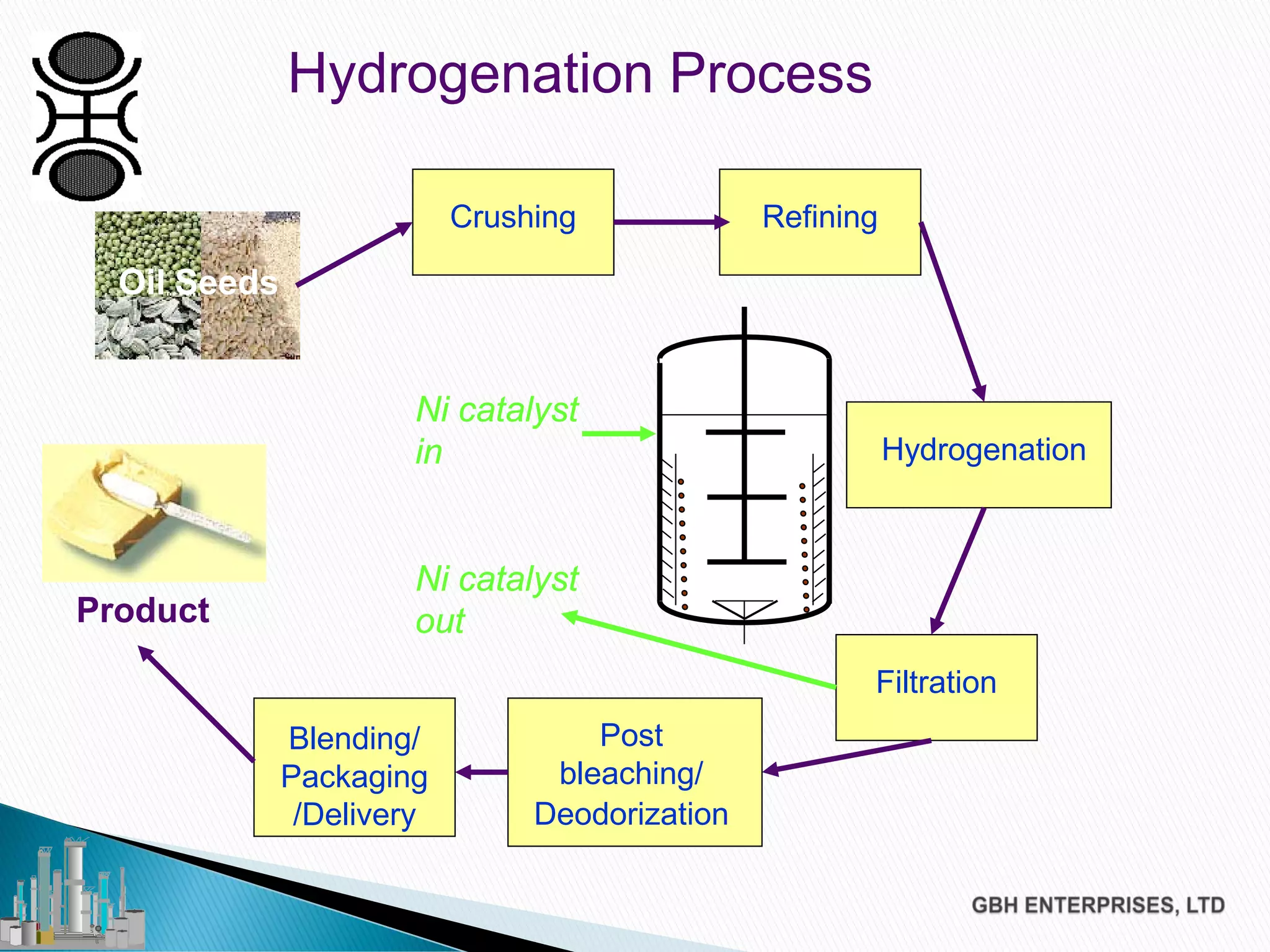
Hydrogenation Process
Crushing Refining
Filtration
Blending/
Packaging
/Delivery
Ni catalyst
in
Ni catalyst
out
Oil Seeds
Hydrogenation
Product
Post
bleaching/
Deodorization
 Reactor mix is filtered to remove the
catalyst
 There is usually a maximum allowed
residual nickel content in the product
 2 types of residual nickel
◦ (a) Particulate nickel - small black particles
◦ (b) Dissolved nickel - soluble nickel soaps,
salts, etc
 Majority of residual Ni cases are due to this
 Ni tolerances have been coming down
 ………but Fatty Acid levels haven’t
 => Increasingly difficult to keep dissolved Ni soaps
below detection
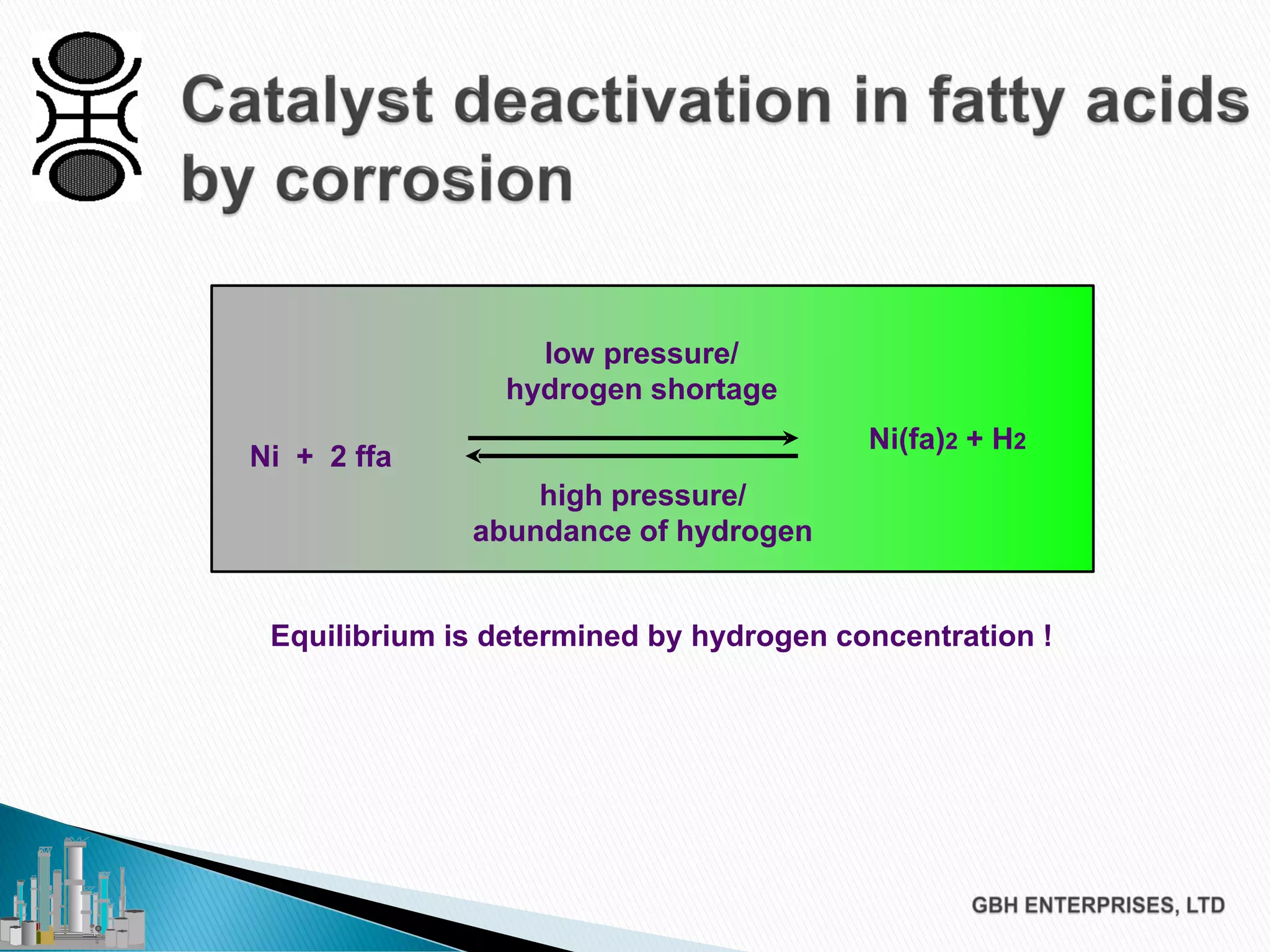
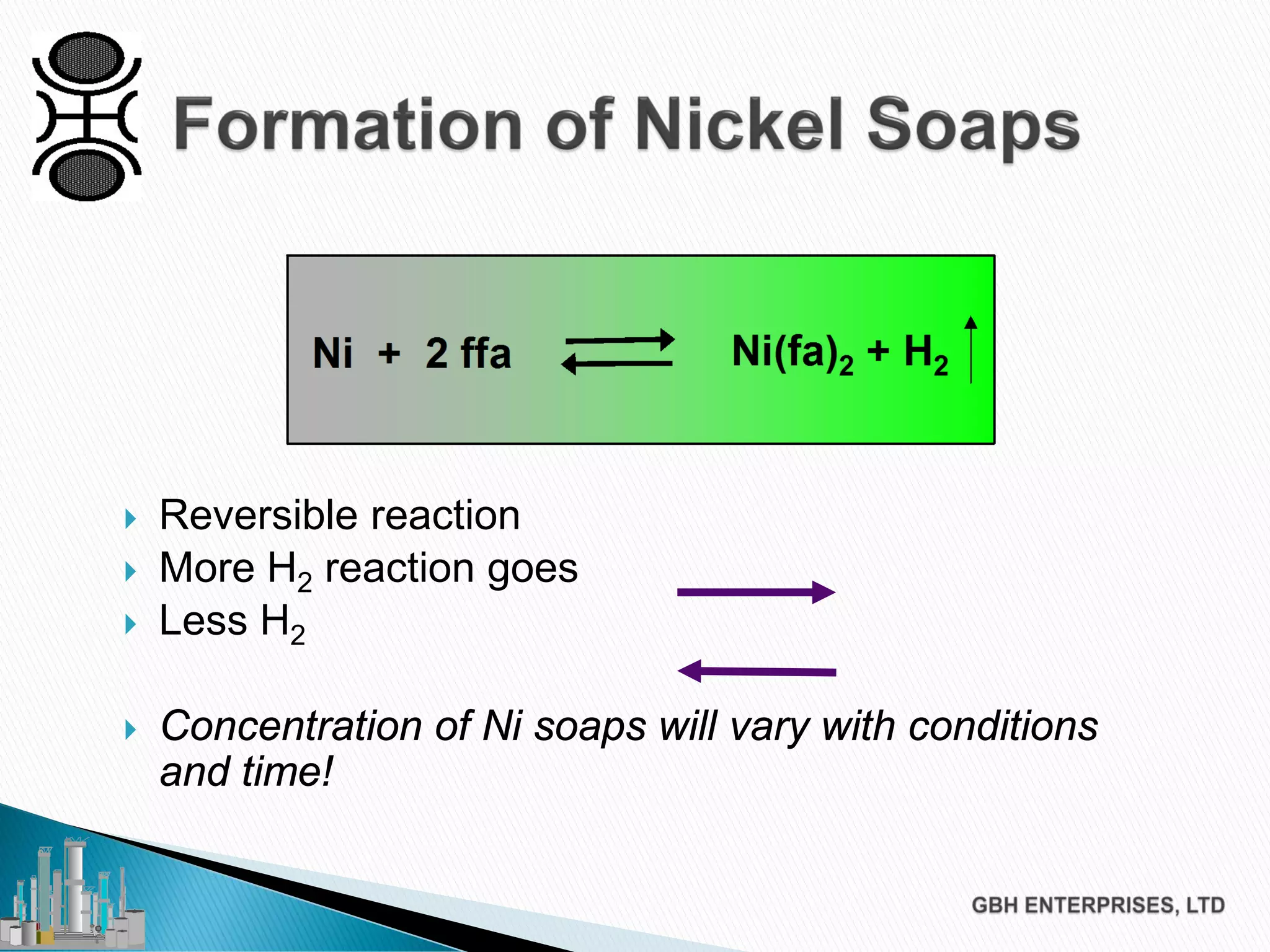
Equilibrium is determined by hydrogen concentration !
Ni(fa)2 + H2
low pressure/
hydrogen shortage
high pressure/
abundance of hydrogen
Ni + 2 ffa
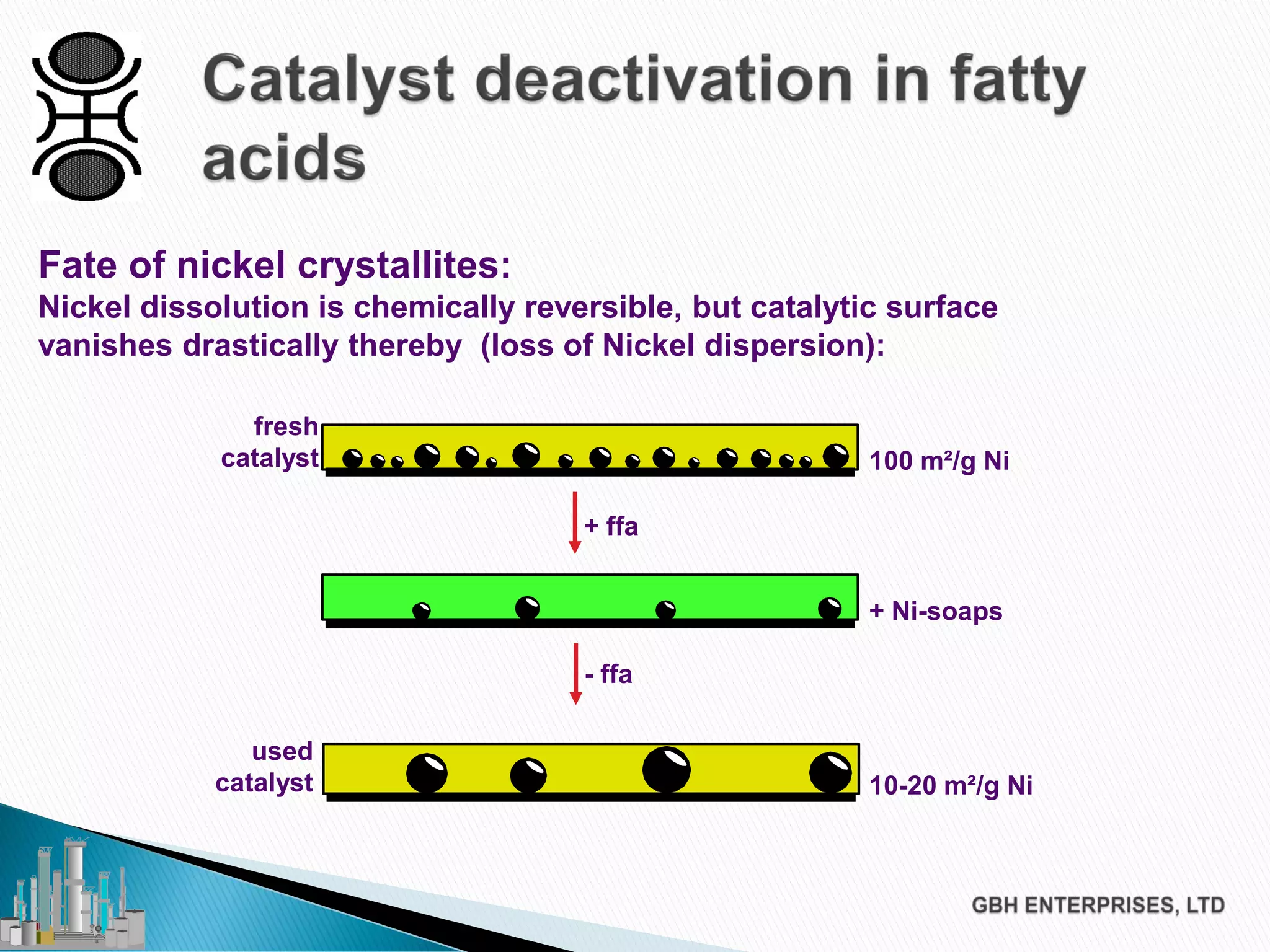
Fate of nickel crystallites:
Nickel dissolution is chemically reversible, but catalytic surface
vanishes drastically thereby (loss of Nickel dispersion):
+ ffa
- ffa
+ Ni-soaps
fresh
catalyst 100 m²/g Ni
used
catalyst 10-20 m²/g Ni
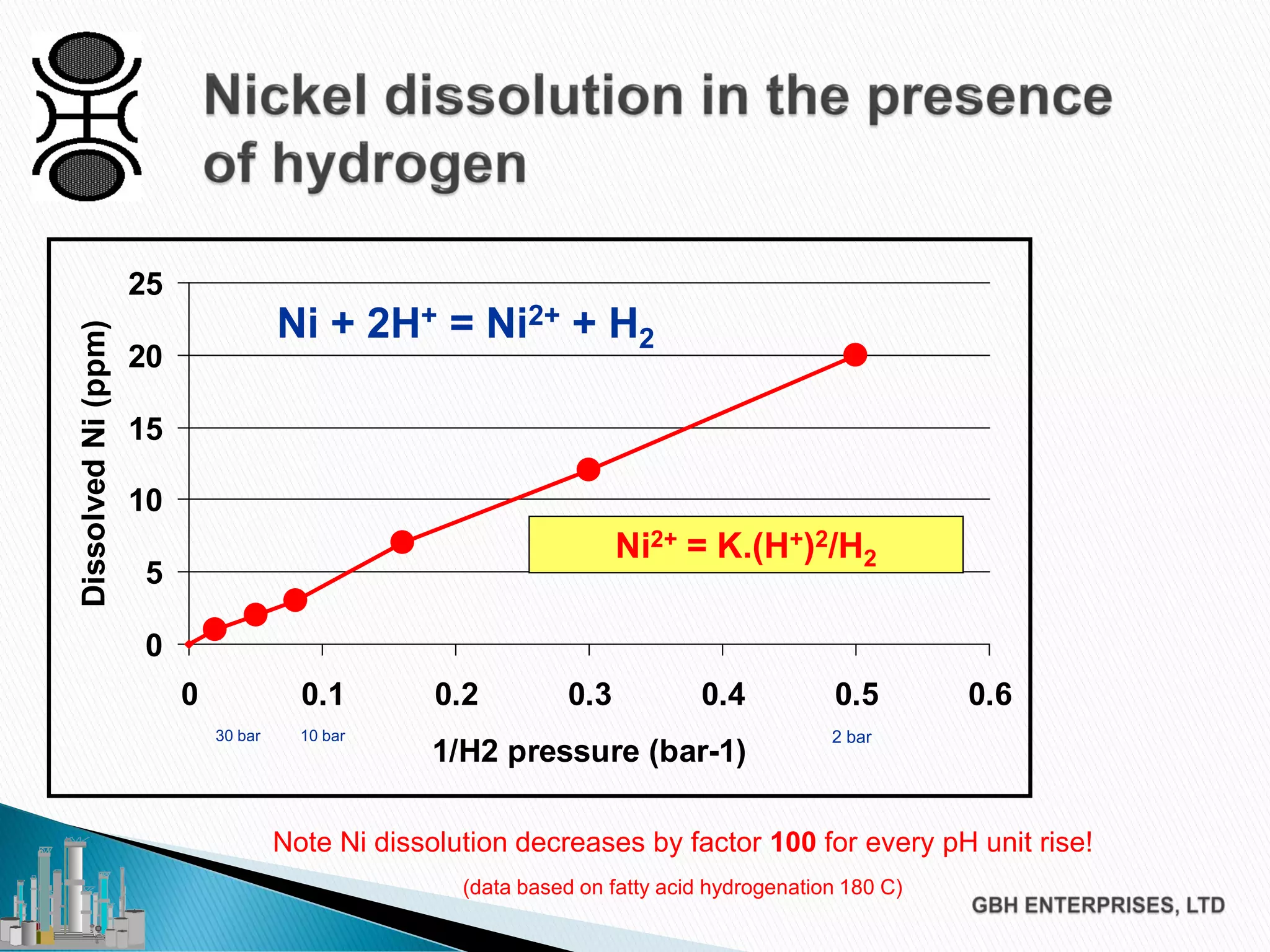
0
5
10
15
20
25
0 0.1 0.2 0.3 0.4 0.5 0.6
1/H2 pressure (bar-1)
DissolvedNi(ppm)
2 bar10 bar30 bar
Ni2+ = K.(H+)2/H2
Ni + 2H+ = Ni2+ + H2
Note Ni dissolution decreases by factor 100 for every pH unit rise!
(data based on fatty acid hydrogenation 180 C)
 Reversible reaction
 More H2 reaction goes
 Less H2
 Concentration of Ni soaps will vary with conditions
and time!
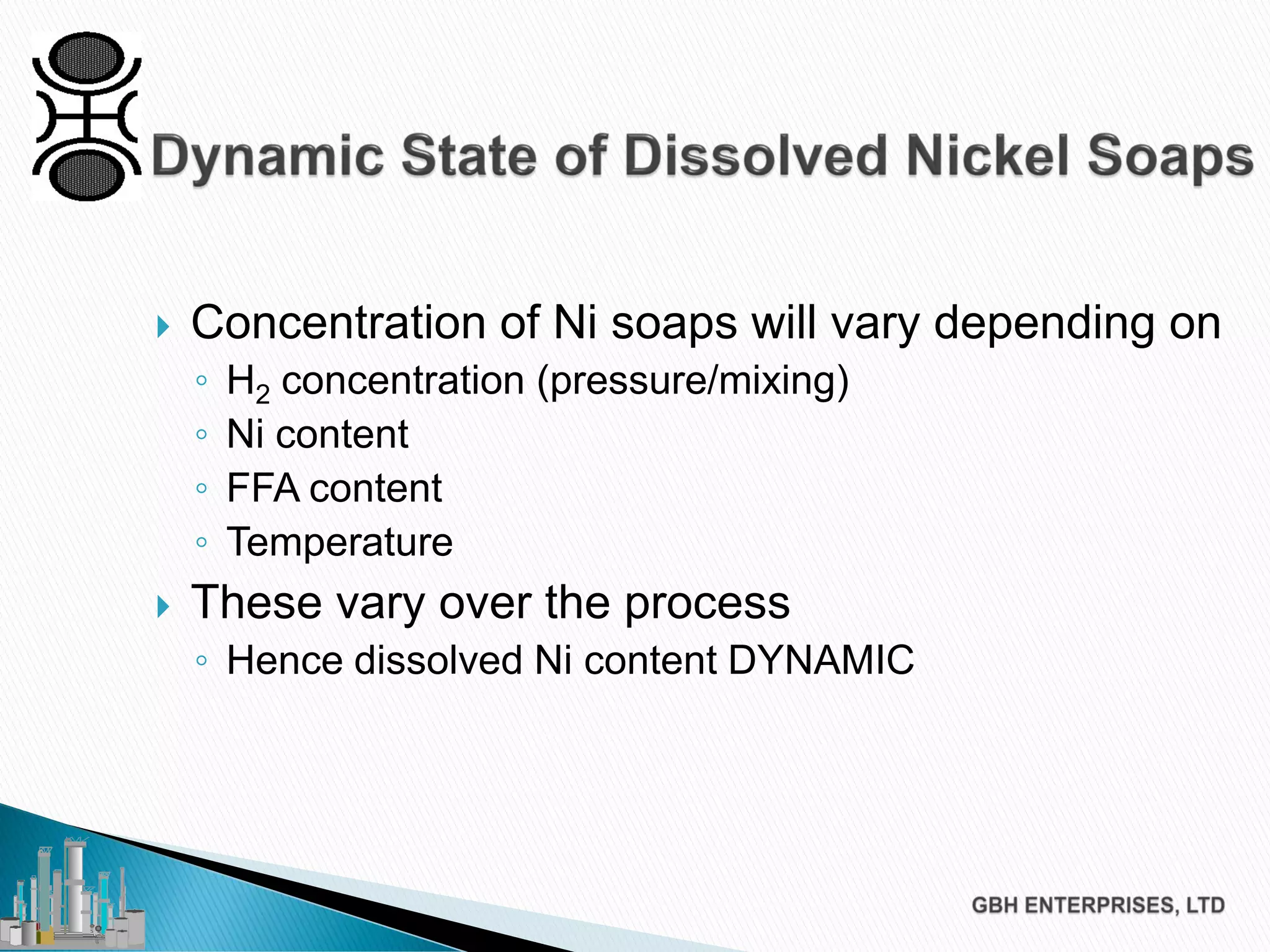
 Concentration of Ni soaps will vary depending on
◦ H2 concentration (pressure/mixing)
◦ Ni content
◦ FFA content
◦ Temperature
 These vary over the process
◦ Hence dissolved Ni content DYNAMIC
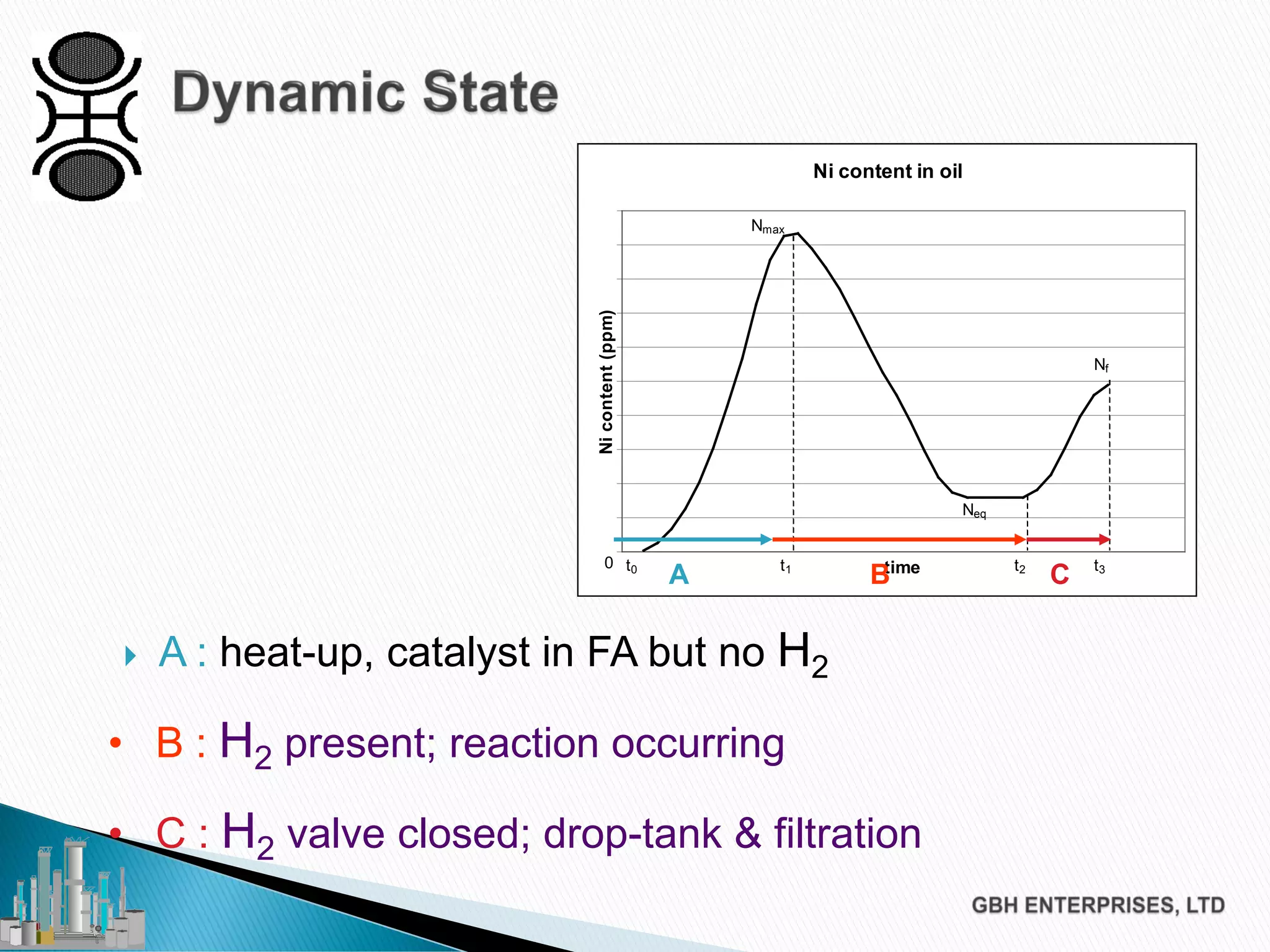
 A : heat-up, catalyst in FA but no H2
Ni content in oil
time
Nicontent(ppm)
0 t0 t1 t2 t3
Neq
Nmax
Nf
A B C
• B : H2 present; reaction occurring
• C : H2 valve closed; drop-tank & filtration
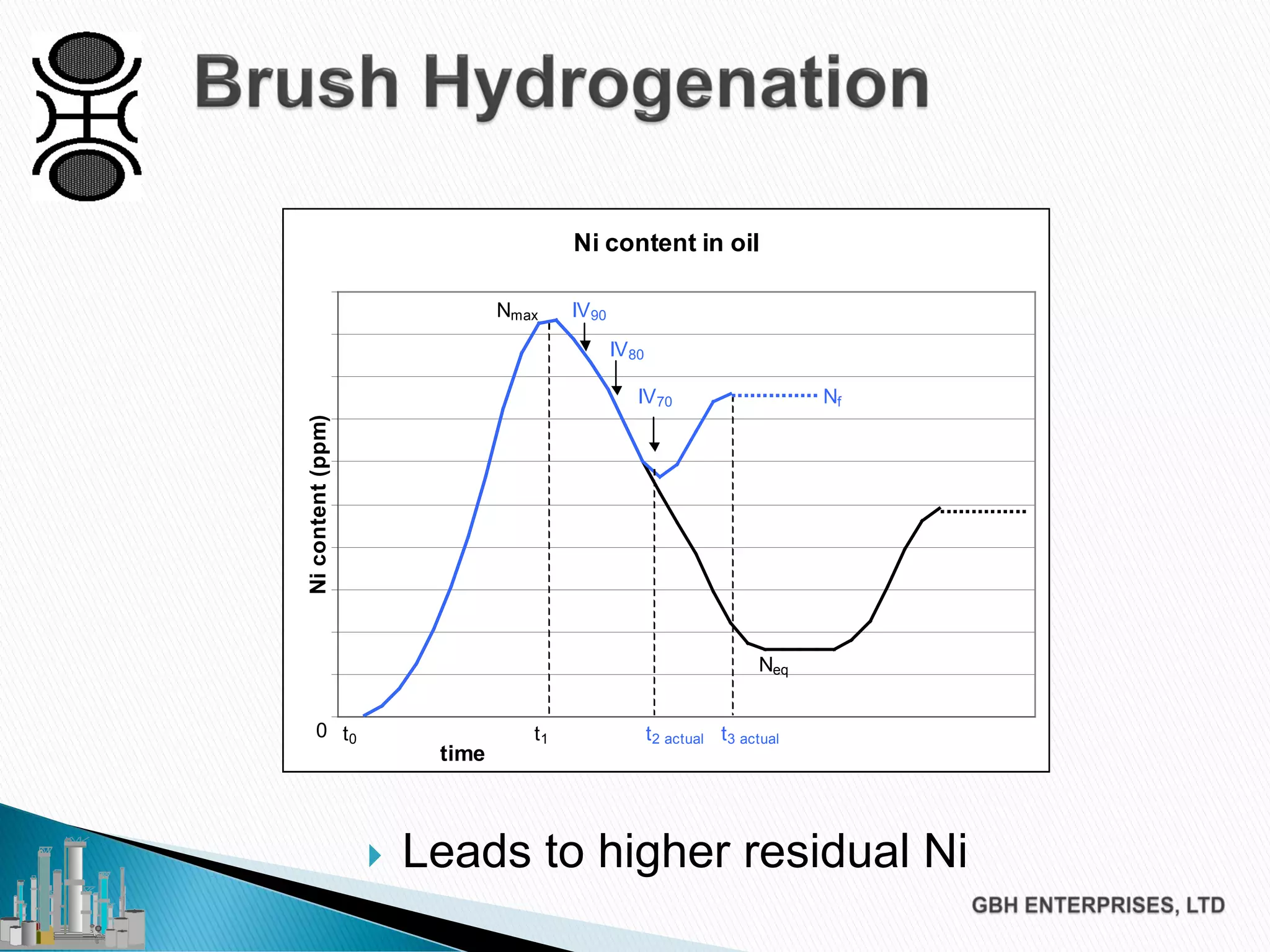
 Leads to higher residual Ni
Ni content in oil
time
Nicontent(ppm)
0 t0 t1 t2 actual t3 actual
Neq
Nmax
Nf
IV90
IV80
IV70
 “Prevention is better than cure”
 Reduce FFA even further!
 Try to minimize the formation of Ni soaps by
making conditions for it unfavorable
 Shorten contact time in absence of H2 BEFORE
reaction
Ni content in oil
minimizing t1 (catalyst in oil without hydrogen before reaction)
time
Nicontent(ppm)
0 t0 t1 new t2 t3
Nmax
Nf
IV90
IV80
IV70
Nf new
 Make addition of catalyst last possible operation
before opening H2 valve
 Dose to the reactor while under H2 pressure
 Melt catalyst only in cover fat
 Shorten contact time in absence of H2 AFTER reaction
Ni content in oil (Green Line )
minimizing t1 & t3 (catalyst in oil without hydrogen before and after
reaction)
time
Nicontent(ppm)
0 t0 t1 t2 t3
Nmax
Nf
IV90
IV70
Nf
Nf new
 Filter immediately after hydrogenation is finished
 Increasing filter area for faster filtration
 Minimizing problem-causing impurities (e.g. P,
wax)
 Optimize temperature of filtration
 Reactor mix is filtered to remove the catalyst
 There is usually a maximum allowed residual
nickel content in the product
 2 types of residual nickel
◦ (a) Particulate nickel - small black particles
◦ (b) Dissolved nickel - soluble nickel soaps, salts, etc
 Identifying which type:
◦ Can check if it is (a) by using a filter paper check and
particle analysis
◦ If no black dots on filter paper and still Ni in ICP
reading it is probably dissolved nickel
 Dissolved Nickel removed with
◦ post bleaching with citric or phosphoric acid
◦ use of bleaching earth
◦ reduction in FFAs and/or water in feed oil
◦ reduction in contact time without hydrogen
 Reduce FFA in oil
 Prevent water or soap stock getting into reactor
 Minimize t1
 Minimize t3
 Find optimum filtration temperature
Dissolved Ni Soaps - and How To Minimize Them

Dissolved Ni Soaps - and How To Minimize Them

  • 1.
    Gerard B. Hawkins ManagingDirector C2PT Catalyst Process Technology
  • 2.
    Hydrogenation Process Crushing Refining Filtration Blending/ Packaging /Delivery Nicatalyst in Ni catalyst out Oil Seeds Hydrogenation Product Post bleaching/ Deodorization
  • 3.
     Reactor mixis filtered to remove the catalyst  There is usually a maximum allowed residual nickel content in the product  2 types of residual nickel ◦ (a) Particulate nickel - small black particles ◦ (b) Dissolved nickel - soluble nickel soaps, salts, etc
  • 4.
     Majority ofresidual Ni cases are due to this  Ni tolerances have been coming down  ………but Fatty Acid levels haven’t  => Increasingly difficult to keep dissolved Ni soaps below detection
  • 5.
    Equilibrium is determinedby hydrogen concentration ! Ni(fa)2 + H2 low pressure/ hydrogen shortage high pressure/ abundance of hydrogen Ni + 2 ffa
  • 6.
    Fate of nickelcrystallites: Nickel dissolution is chemically reversible, but catalytic surface vanishes drastically thereby (loss of Nickel dispersion): + ffa - ffa + Ni-soaps fresh catalyst 100 m²/g Ni used catalyst 10-20 m²/g Ni
  • 8.
    0 5 10 15 20 25 0 0.1 0.20.3 0.4 0.5 0.6 1/H2 pressure (bar-1) DissolvedNi(ppm) 2 bar10 bar30 bar Ni2+ = K.(H+)2/H2 Ni + 2H+ = Ni2+ + H2 Note Ni dissolution decreases by factor 100 for every pH unit rise! (data based on fatty acid hydrogenation 180 C)
  • 9.
     Reversible reaction More H2 reaction goes  Less H2  Concentration of Ni soaps will vary with conditions and time!
  • 10.
     Concentration ofNi soaps will vary depending on ◦ H2 concentration (pressure/mixing) ◦ Ni content ◦ FFA content ◦ Temperature  These vary over the process ◦ Hence dissolved Ni content DYNAMIC
  • 11.
     A :heat-up, catalyst in FA but no H2 Ni content in oil time Nicontent(ppm) 0 t0 t1 t2 t3 Neq Nmax Nf A B C • B : H2 present; reaction occurring • C : H2 valve closed; drop-tank & filtration
  • 12.
     Leads tohigher residual Ni Ni content in oil time Nicontent(ppm) 0 t0 t1 t2 actual t3 actual Neq Nmax Nf IV90 IV80 IV70
  • 13.
     “Prevention isbetter than cure”  Reduce FFA even further!  Try to minimize the formation of Ni soaps by making conditions for it unfavorable
  • 14.
     Shorten contacttime in absence of H2 BEFORE reaction Ni content in oil minimizing t1 (catalyst in oil without hydrogen before reaction) time Nicontent(ppm) 0 t0 t1 new t2 t3 Nmax Nf IV90 IV80 IV70 Nf new
  • 15.
     Make additionof catalyst last possible operation before opening H2 valve  Dose to the reactor while under H2 pressure  Melt catalyst only in cover fat
  • 16.
     Shorten contacttime in absence of H2 AFTER reaction Ni content in oil (Green Line ) minimizing t1 & t3 (catalyst in oil without hydrogen before and after reaction) time Nicontent(ppm) 0 t0 t1 t2 t3 Nmax Nf IV90 IV70 Nf Nf new
  • 17.
     Filter immediatelyafter hydrogenation is finished  Increasing filter area for faster filtration  Minimizing problem-causing impurities (e.g. P, wax)  Optimize temperature of filtration
  • 18.
     Reactor mixis filtered to remove the catalyst  There is usually a maximum allowed residual nickel content in the product  2 types of residual nickel ◦ (a) Particulate nickel - small black particles ◦ (b) Dissolved nickel - soluble nickel soaps, salts, etc  Identifying which type: ◦ Can check if it is (a) by using a filter paper check and particle analysis ◦ If no black dots on filter paper and still Ni in ICP reading it is probably dissolved nickel
  • 19.
     Dissolved Nickelremoved with ◦ post bleaching with citric or phosphoric acid ◦ use of bleaching earth ◦ reduction in FFAs and/or water in feed oil ◦ reduction in contact time without hydrogen
  • 20.
     Reduce FFAin oil  Prevent water or soap stock getting into reactor  Minimize t1  Minimize t3  Find optimum filtration temperature