National Alliance
for Water Innovation
Topic: Materials & Manufacturing
Machine Learning Platform for
Catalyst Design
Anubhav Jain
Lawrence Berkeley National Laboratory
May 3, 2022
Project team:
Wei Tong, Lawrence Berkeley National Laboratory
Zachary Ulissi, Carnegie Mellon University
Jason Monnell, EPRI
Background: New advancements in
materials theory allow us to perform
computer-aided-design of materials,
at the level of atoms and electrons
Goal: Use machine learning and
theory to develop new
electrocatalyst materials for oxyanion
(nitrate) removal
i.e., what goes inside the reactor?
Project Objectives
Autonomous
Precise
Resilient
Intensified
Modular
Electrified
Control voltage
Targets a single or a few solutes
Easily adjusted for variable water quality
No need for regeneration;
no brine to dispose
No high-pressure equipment;
no moving parts
Compatible with distributed DC power
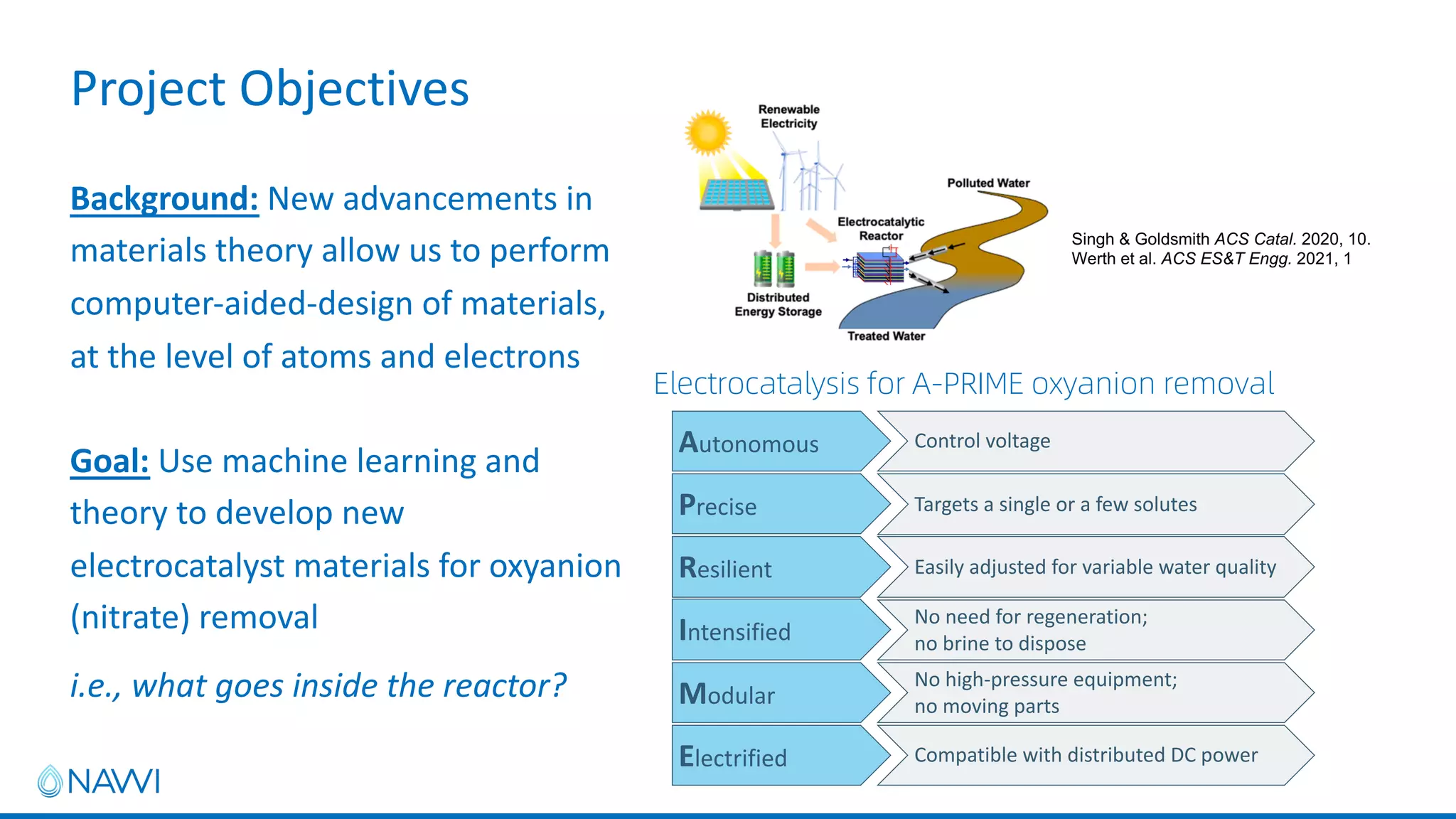
Electrocatalysis for A-PRIME oxyanion removal
Singh & Goldsmith ACS Catal. 2020, 10.
Werth et al. ACS ES&T Engg. 2021, 1
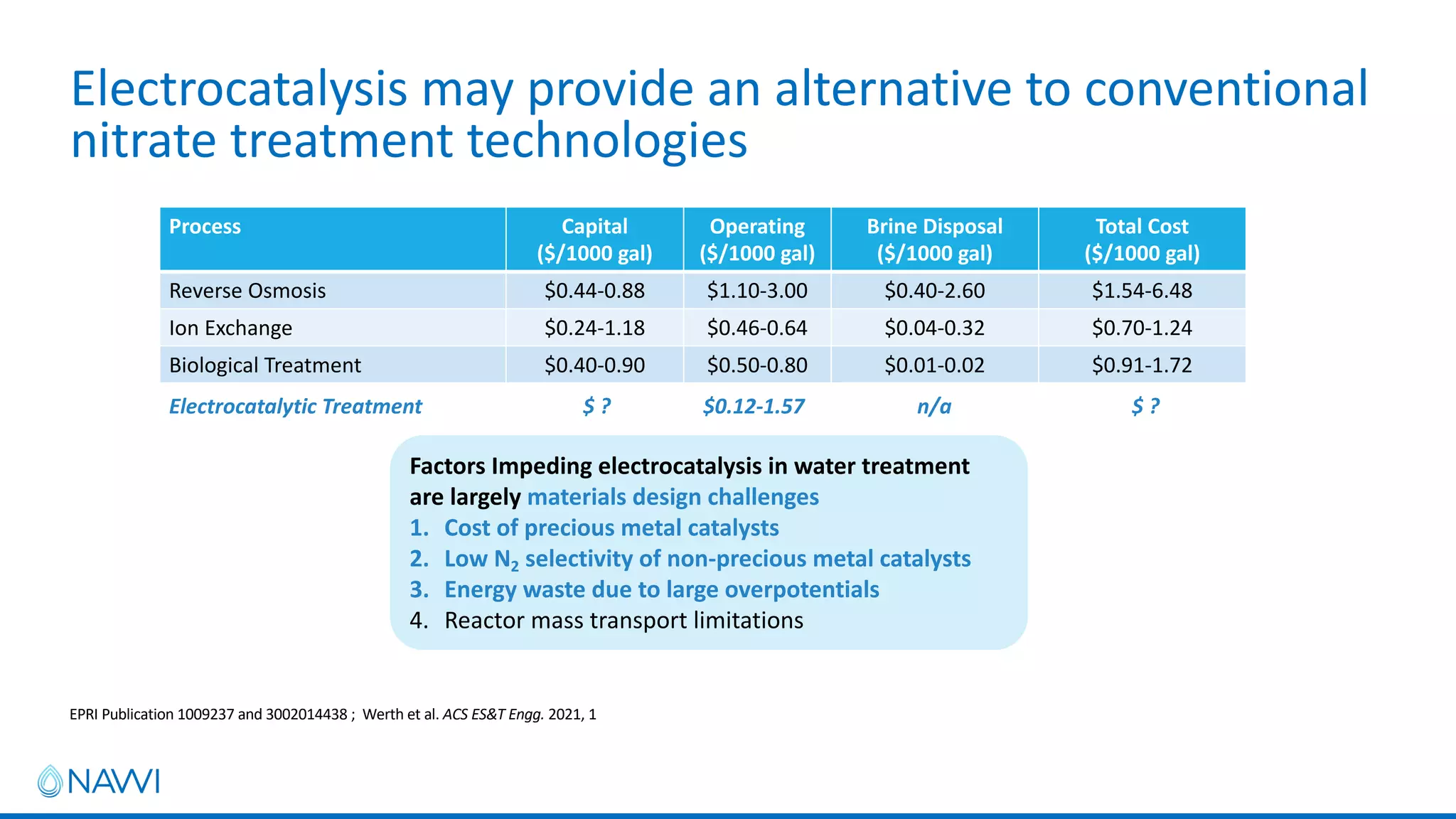
Electrocatalysis may provide an alternative to conventional
nitrate treatment technologies
EPRI Publication 1009237 and 3002014438 ; Werth et al. ACS ES&T Engg. 2021, 1
Process Capital
($/1000 gal)
Operating
($/1000 gal)
Brine Disposal
($/1000 gal)
Total Cost
($/1000 gal)
Reverse Osmosis $0.44-0.88 $1.10-3.00 $0.40-2.60 $1.54-6.48
Ion Exchange $0.24-1.18 $0.46-0.64 $0.04-0.32 $0.70-1.24
Biological Treatment $0.40-0.90 $0.50-0.80 $0.01-0.02 $0.91-1.72
Electrocatalytic Treatment $0.12-1.57 n/a
$ ? $ ?
Factors Impeding electrocatalysis in water treatment
are largely materials design challenges
1. Cost of precious metal catalysts
2. Low N2 selectivity of non-precious metal catalysts
3. Energy waste due to large overpotentials
4. Reactor mass transport limitations
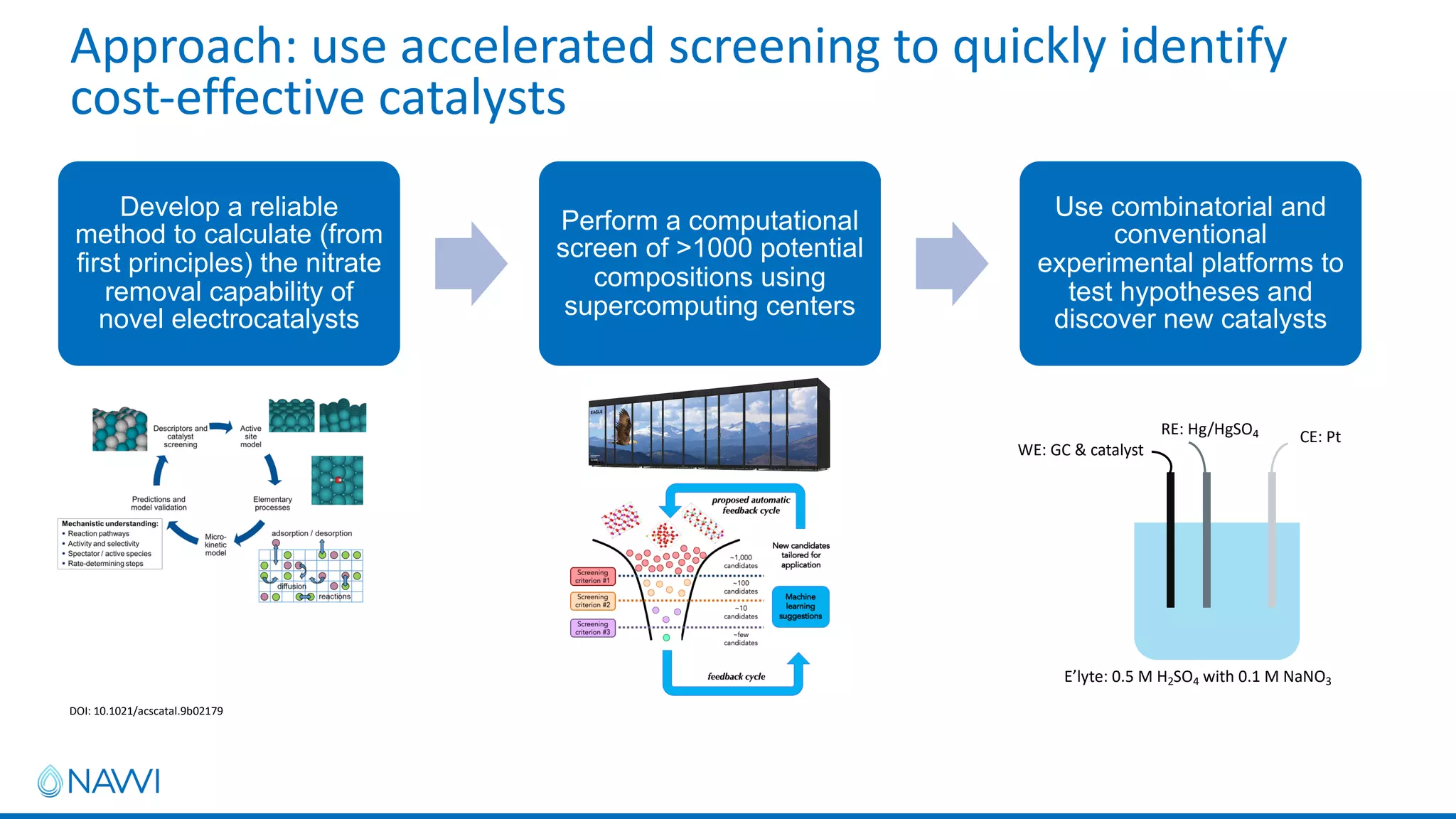
Develop a reliable
method to calculate (from
first principles) the nitrate
removal capability of
novel electrocatalysts
Perform a computational
screen of >1000 potential
compositions using
supercomputing centers
Use combinatorial and
conventional
experimental platforms to
test hypotheses and
discover new catalysts
Approach: use accelerated screening to quickly identify
cost-effective catalysts
CE: Pt
RE: Hg/HgSO4
WE: GC & catalyst
E’lyte: 0.5 M H2SO4 with 0.1 M NaNO3
DOI: 10.1021/acscatal.9b02179
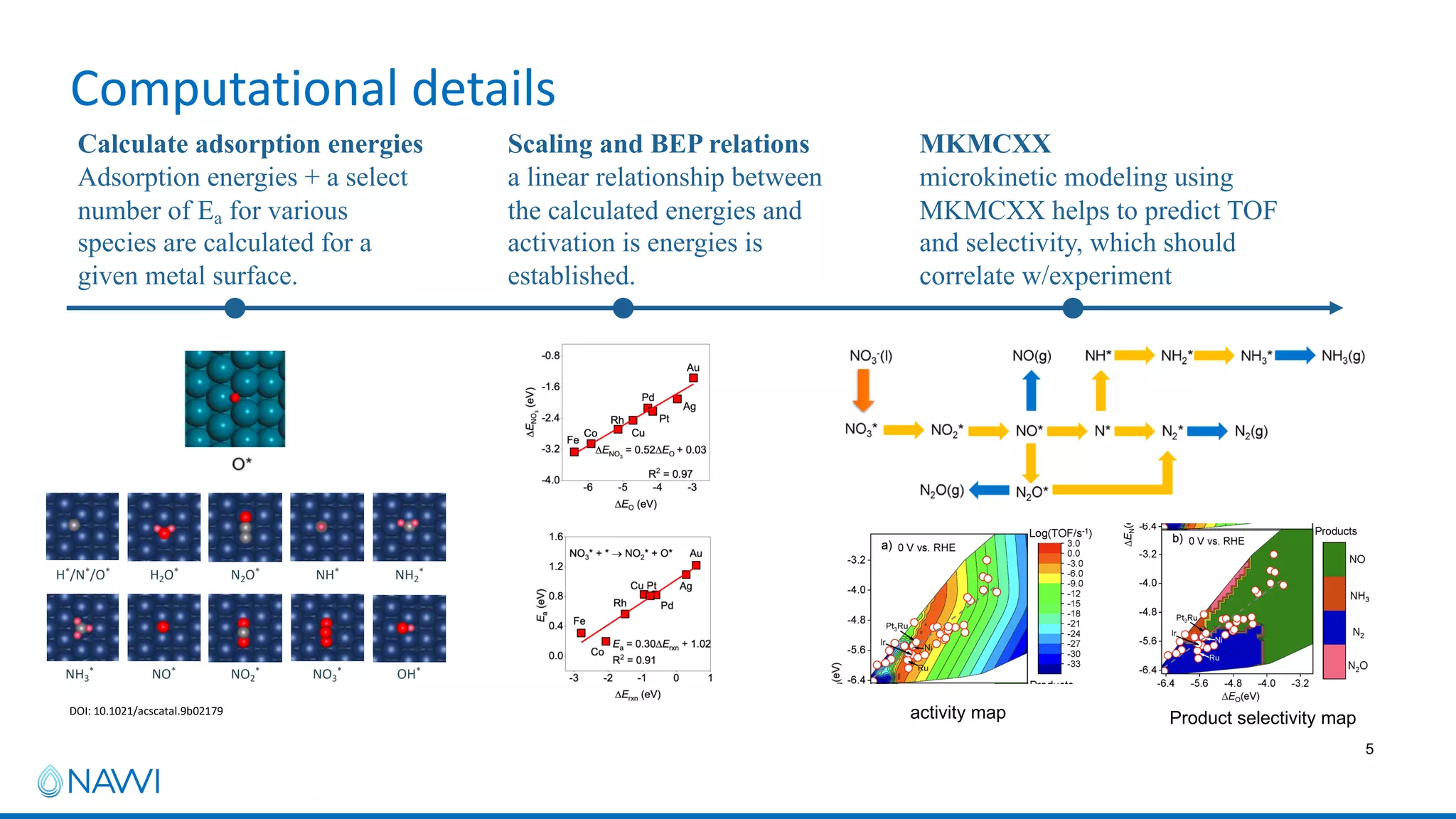
Computational details
DOI: 10.1021/acscatal.9b02179
5
Calculate adsorption energies
Adsorption energies + a select
number of Ea for various
species are calculated for a
given metal surface.
Scaling and BEP relations
a linear relationship between
the calculated energies and
activation is energies is
established.
MKMCXX
microkinetic modeling using
MKMCXX helps to predict TOF
and selectivity, which should
correlate w/experiment
OH*
H2O*
H*/N*/O* N2O* NH* NH2
*
NH3
* NO* NO2
* NO3
*
activity map Product selectivity map
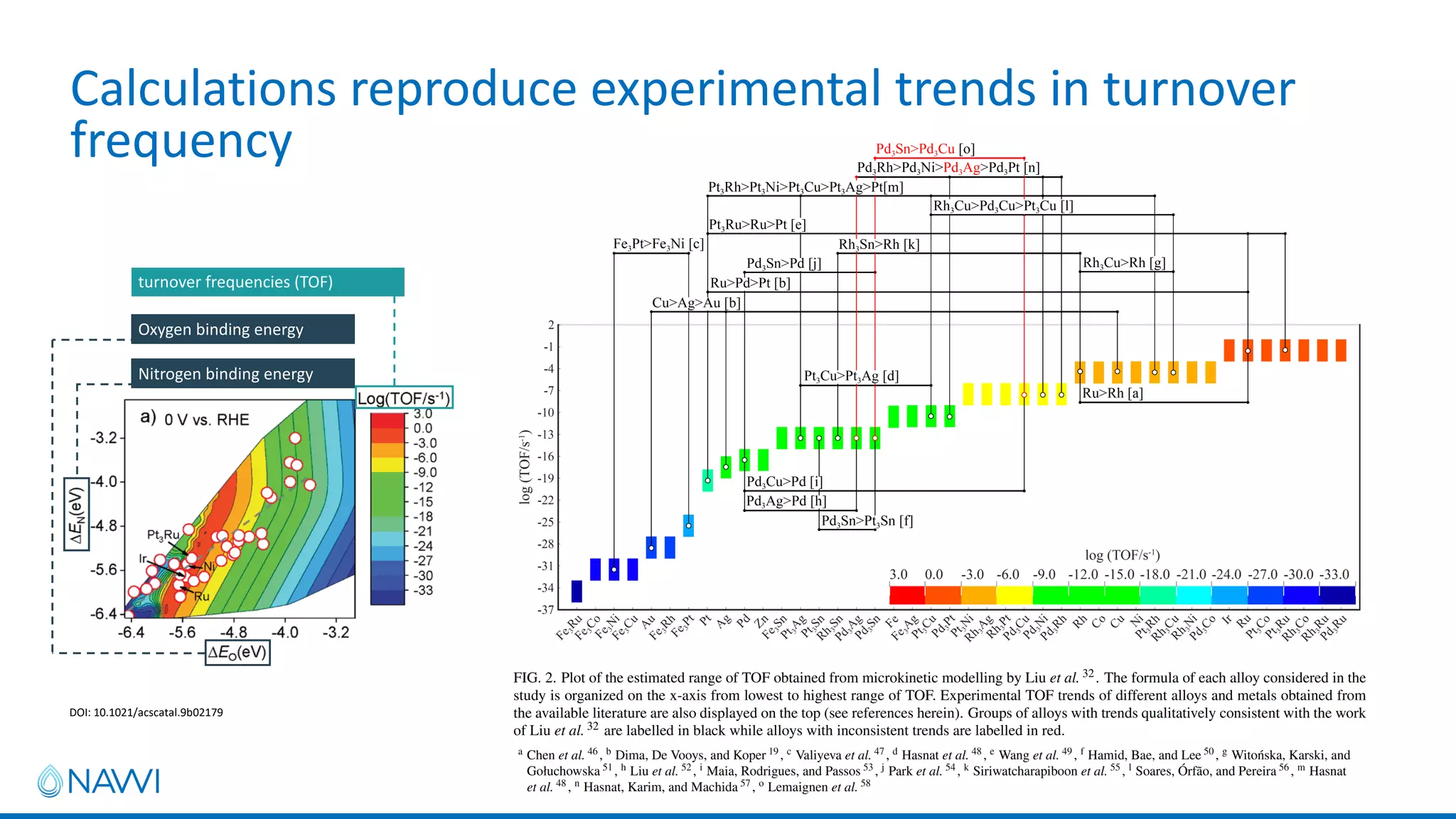
Calculations reproduce experimental trends in turnover
frequency
DOI: 10.1021/acscatal.9b02179
Oxygen binding energy
Nitrogen binding energy
turnover frequencies (TOF)
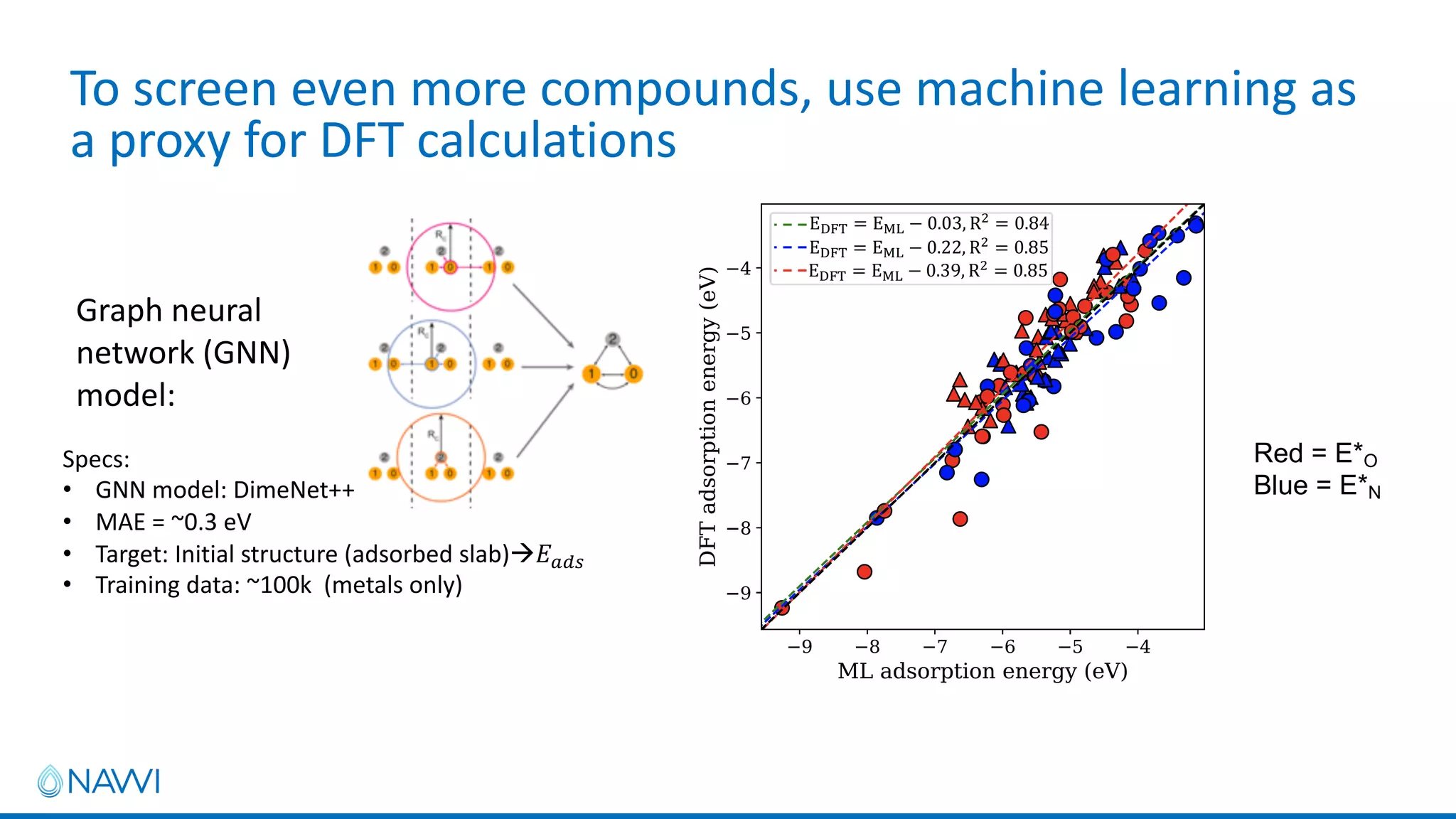
To screen even more compounds, use machine learning as
a proxy for DFT calculations
Graph neural
network (GNN)
model:
Specs:
• GNN model: DimeNet++
• MAE = ~0.3 eV
• Target: Initial structure (adsorbed slab)à!"#$
• Training data: ~100k (metals only)
Red = E*O
Blue = E*N
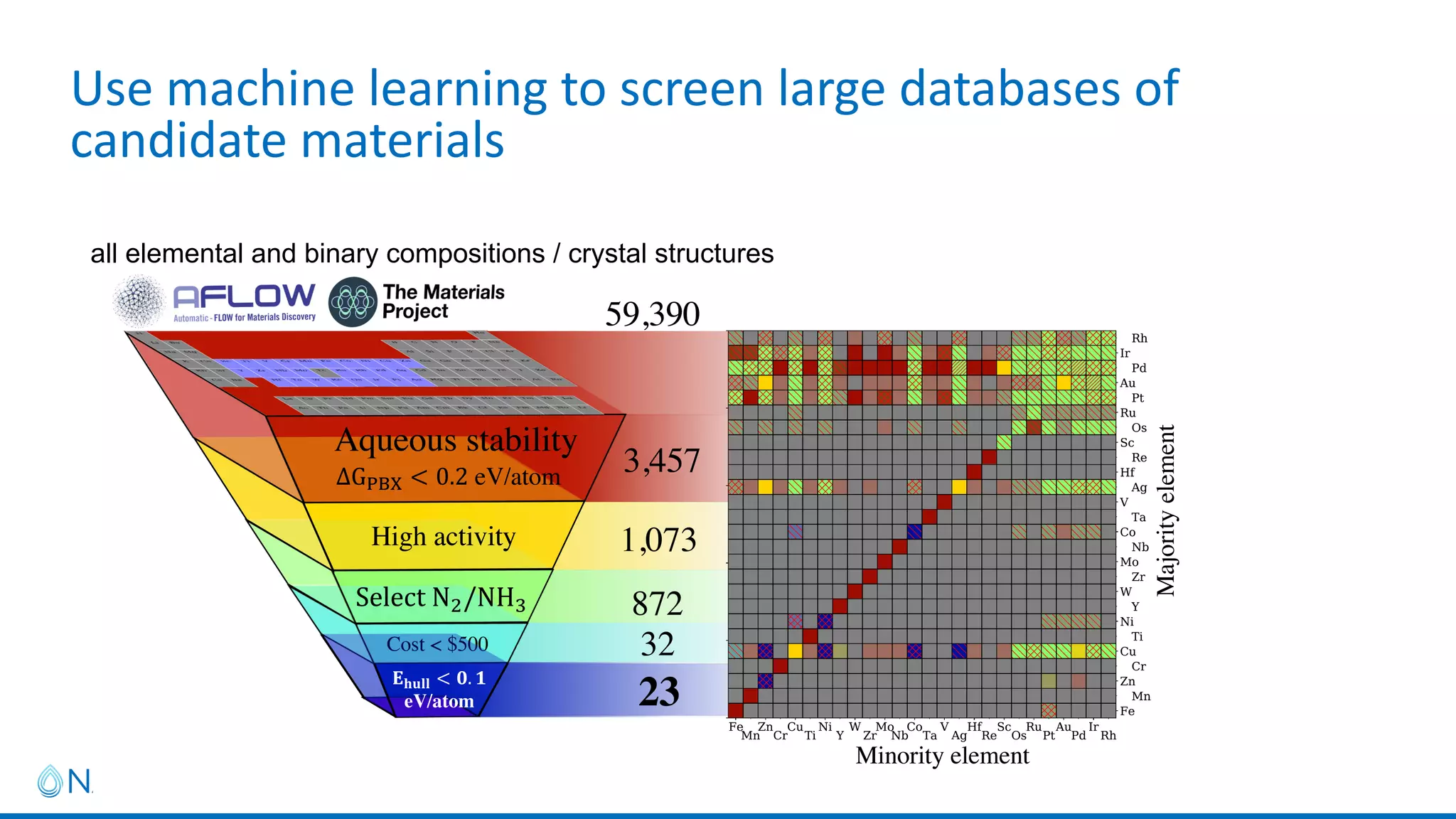
Use machine learning to screen large databases of
candidate materials
all elemental and binary compositions / crystal structures
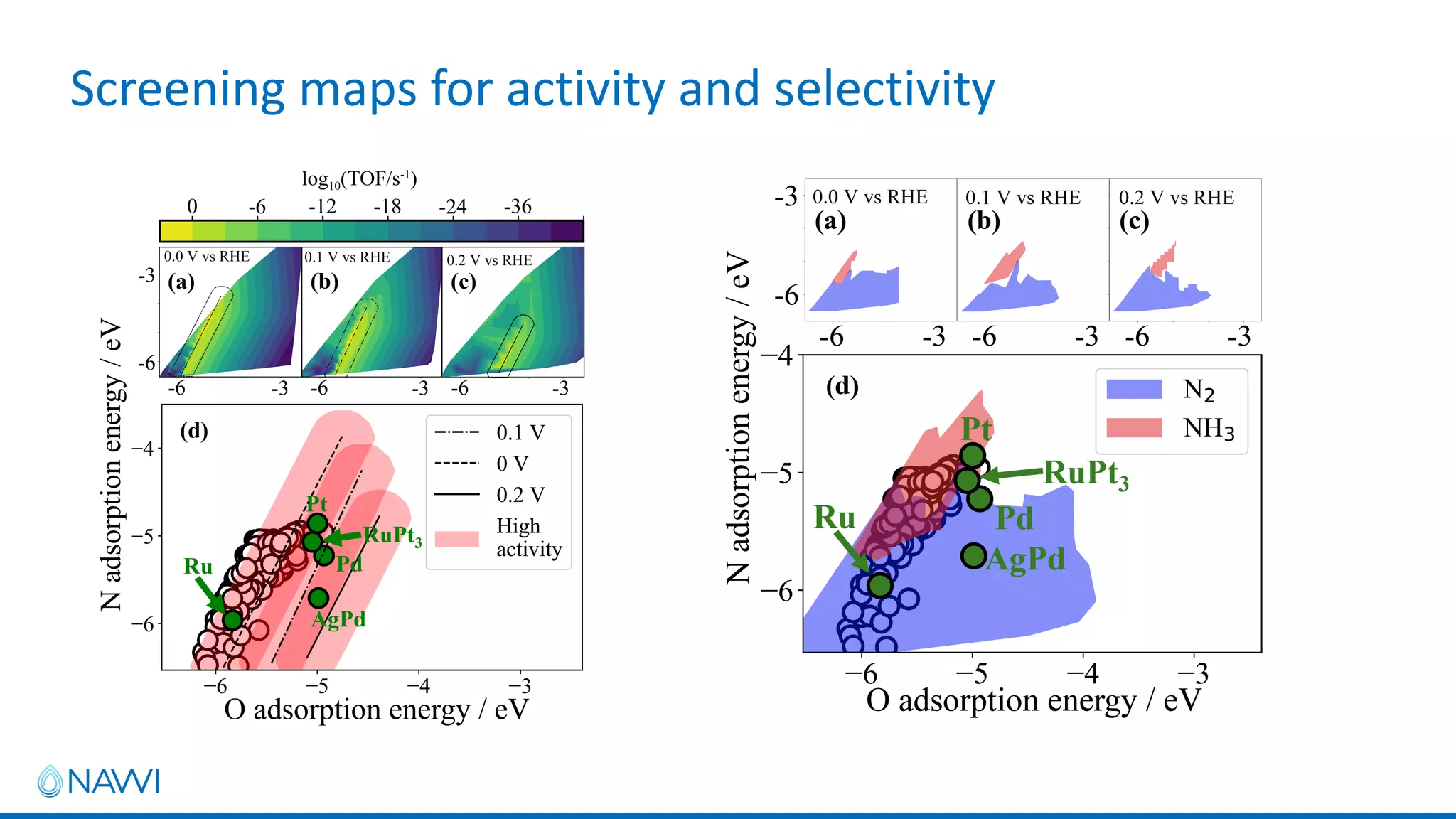
Screening maps for activity and selectivity
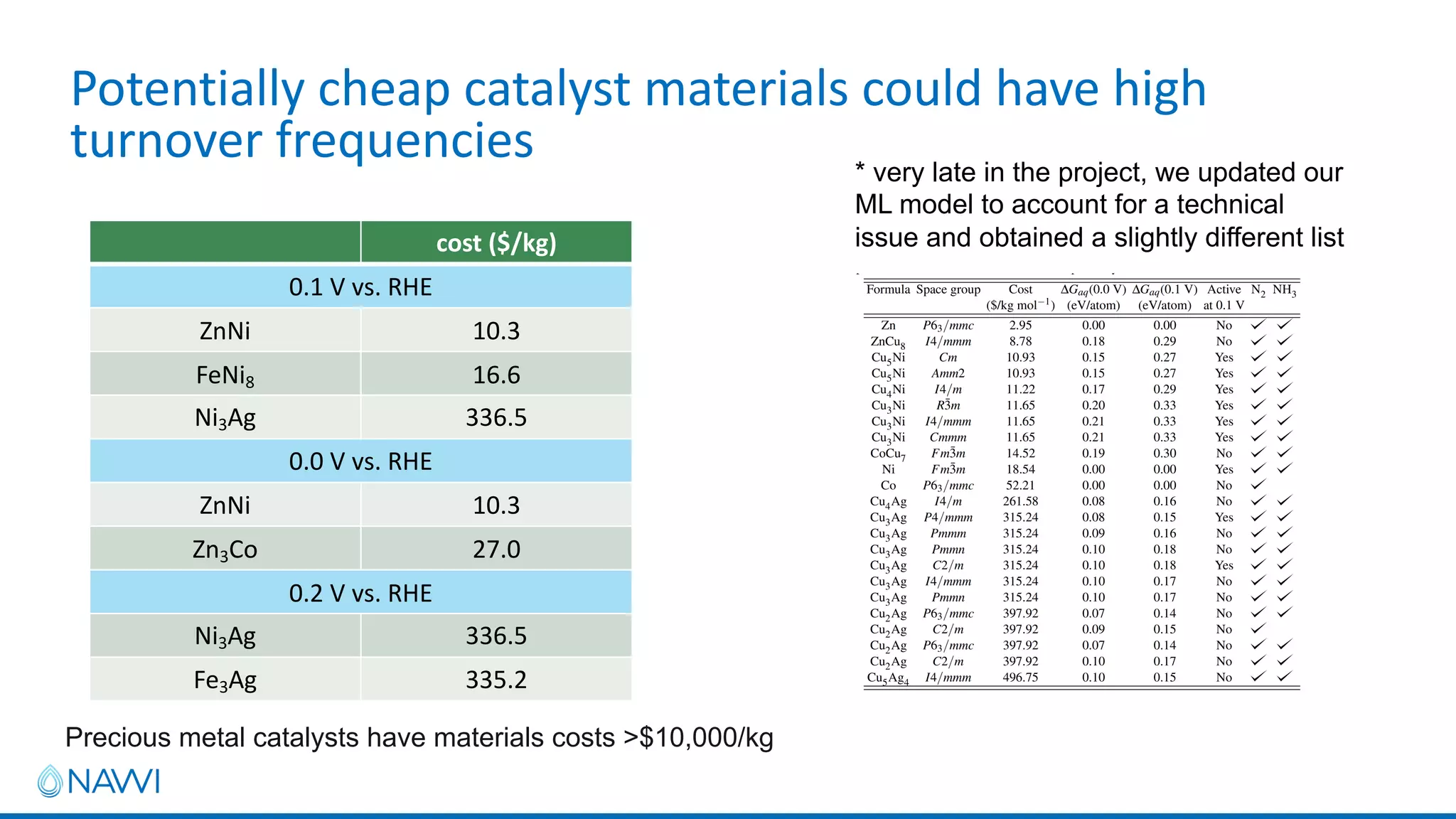
Potentially cheap catalyst materials could have high
turnover frequencies
cost ($/kg)
0.1 V vs. RHE
ZnNi 10.3
FeNi8 16.6
Ni3Ag 336.5
0.0 V vs. RHE
ZnNi 10.3
Zn3Co 27.0
0.2 V vs. RHE
Ni3Ag 336.5
Fe3Ag 335.2
Precious metal catalysts have materials costs >$10,000/kg
* very late in the project, we updated our
ML model to account for a technical
issue and obtained a slightly different list
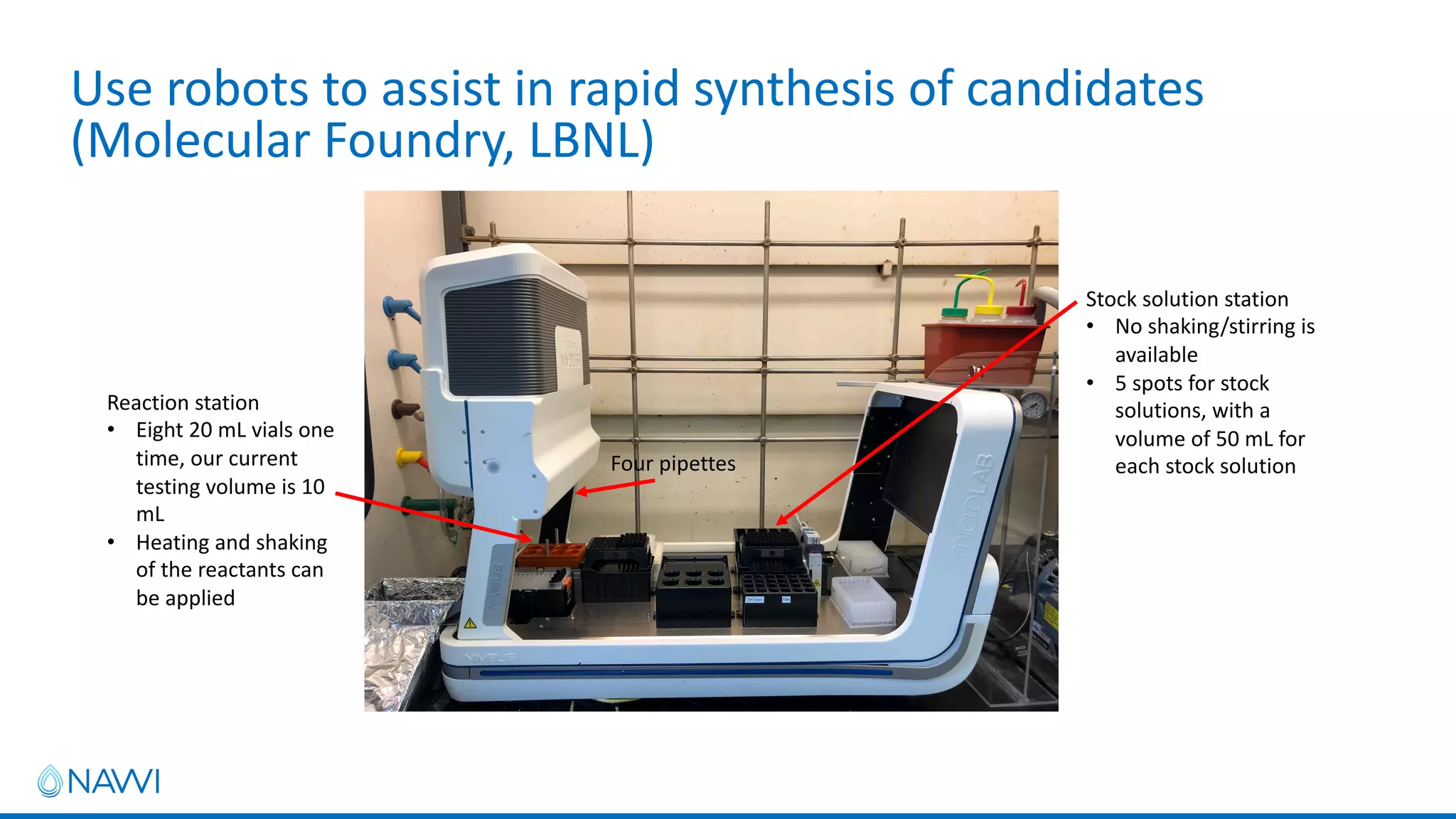
Use robots to assist in rapid synthesis of candidates
(Molecular Foundry, LBNL)
Reaction station
• Eight 20 mL vials one
time, our current
testing volume is 10
mL
• Heating and shaking
of the reactants can
be applied
Stock solution station
• No shaking/stirring is
available
• 5 spots for stock
solutions, with a
volume of 50 mL for
each stock solution
Four pipettes
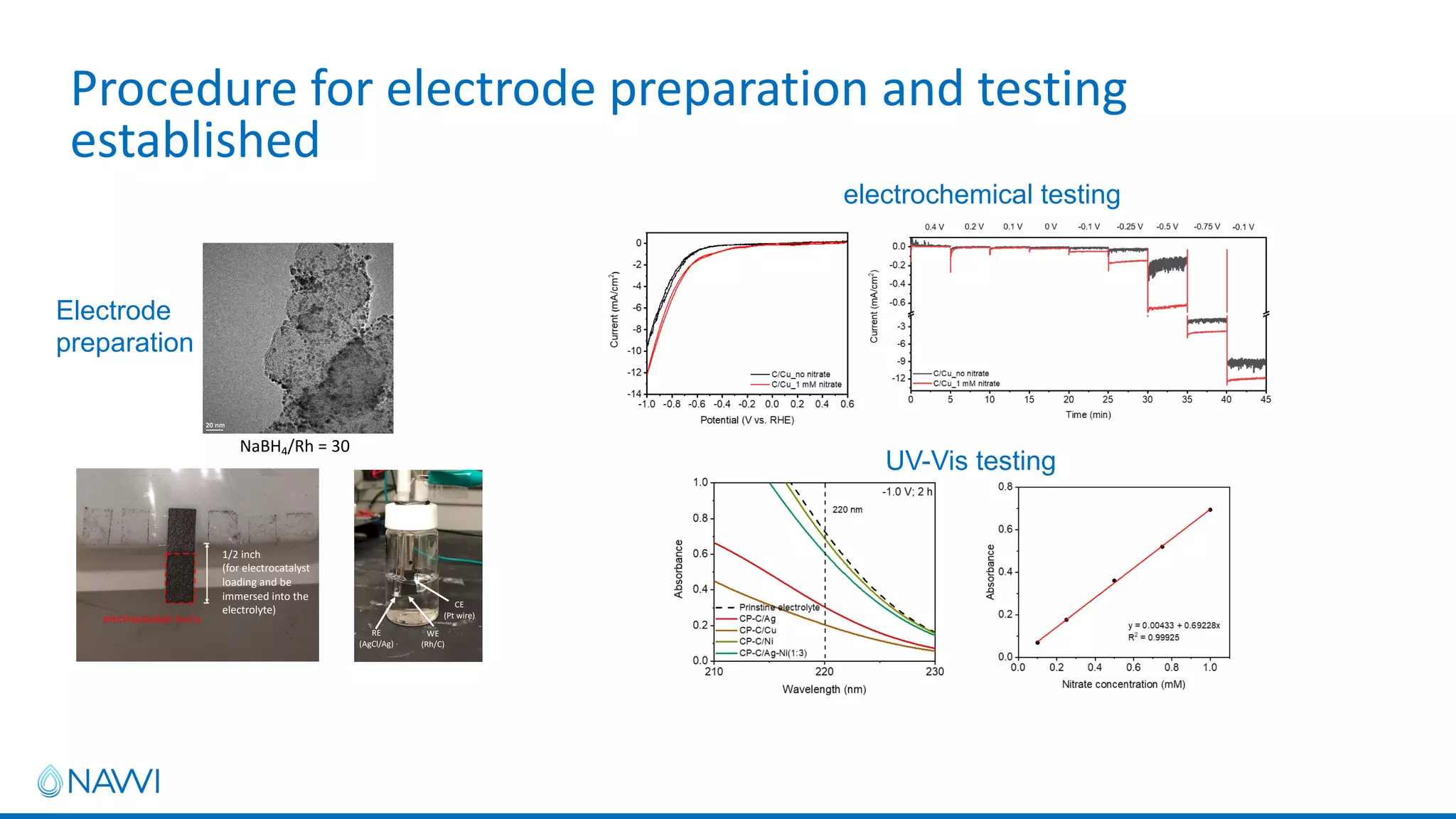
Procedure for electrode preparation and testing
established
1/2 inch
(for electrocatalyst
loading and be
immersed into the
electrolyte)
electrocatalyst slurry
RE
(AgCl/Ag)
CE
(Pt wire)
WE
(Rh/C)
NaBH4/Rh = 30
electrochemical testing
UV-Vis testing
Electrode
preparation
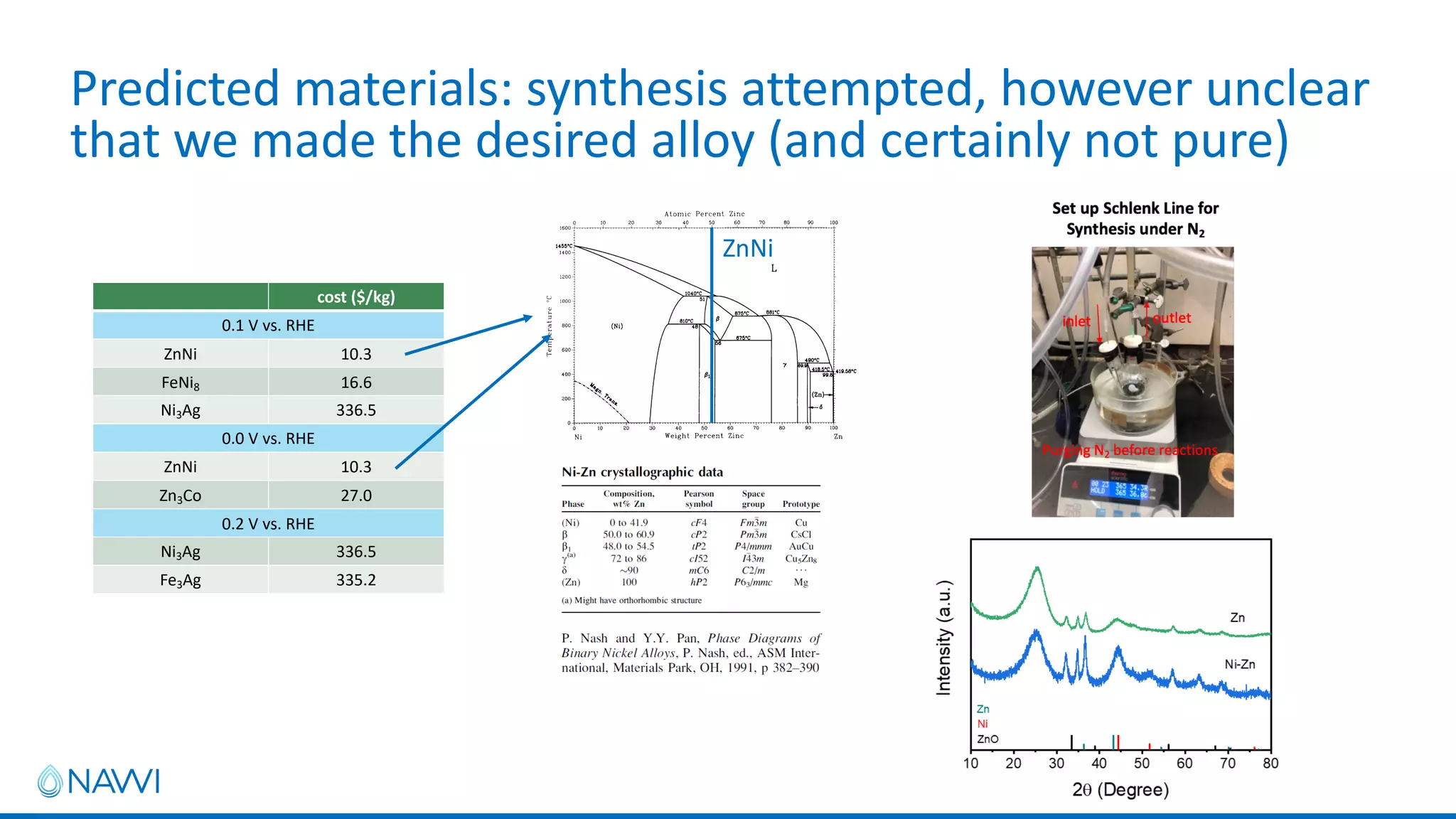
Predicted materials: synthesis attempted, however unclear
that we made the desired alloy (and certainly not pure)
ZnNi
cost ($/kg)
0.1 V vs. RHE
ZnNi 10.3
FeNi8 16.6
Ni3Ag 336.5
0.0 V vs. RHE
ZnNi 10.3
Zn3Co 27.0
0.2 V vs. RHE
Ni3Ag 336.5
Fe3Ag 335.2
• Attempts to synthesize and test target catalysts are ongoing
• Paper currently under review on screening, along w/list of candidates
for follow up by others
• If successful, low-cost materials for electrocatalytic nitrate reduction
would be identified, vastly bringing down cost projections for
electrocatalysis in water treatment
Projected Impacts
• Capability for nitrate removal currently
being adapted to target other
oxyanions, e.g. Se removal
• Project just launched – will have more
time for synthesis and characterization
this time
• However, more of the theory needs to
be developed
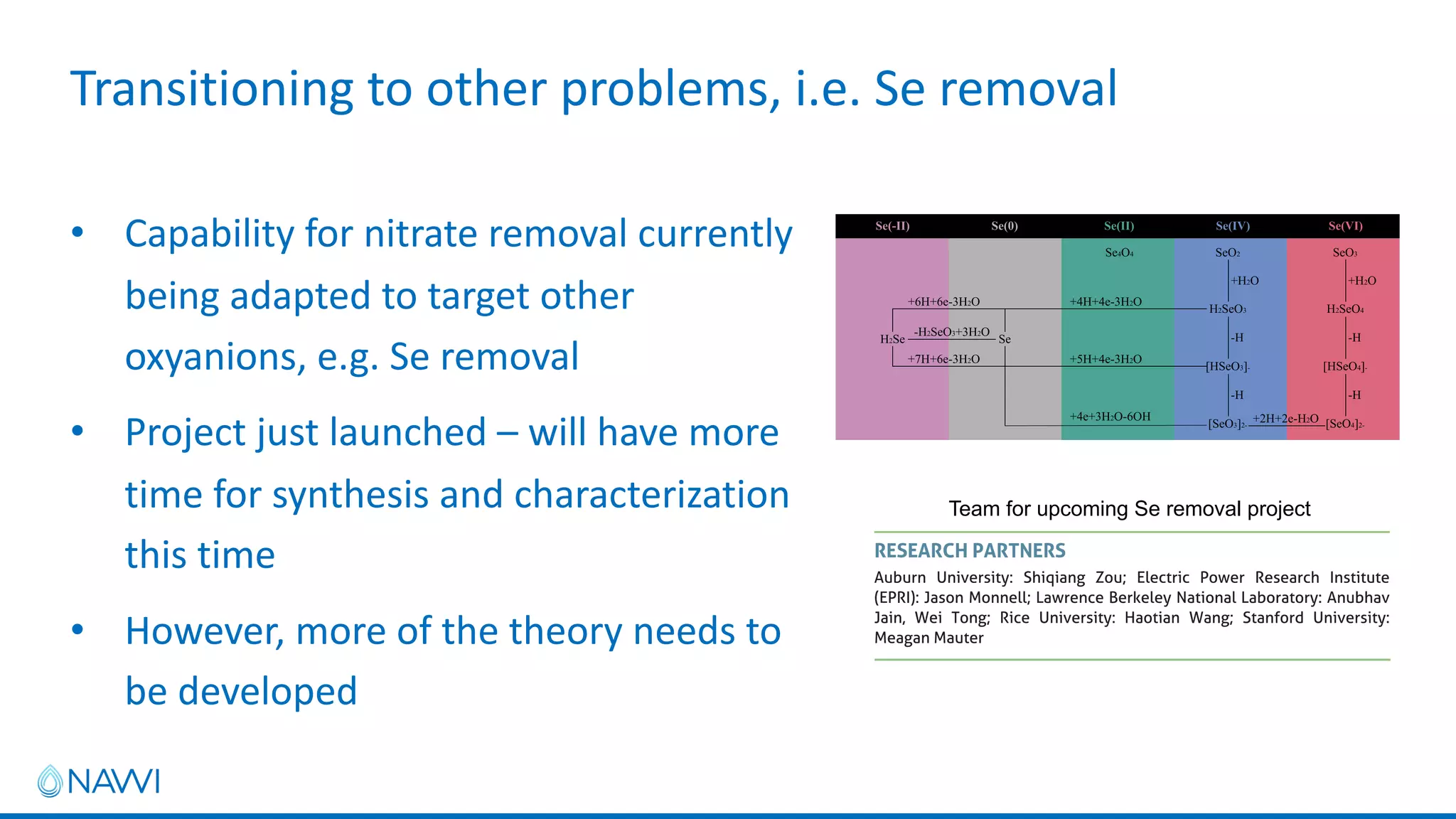
Transitioning to other problems, i.e. Se removal
Team for upcoming Se removal project
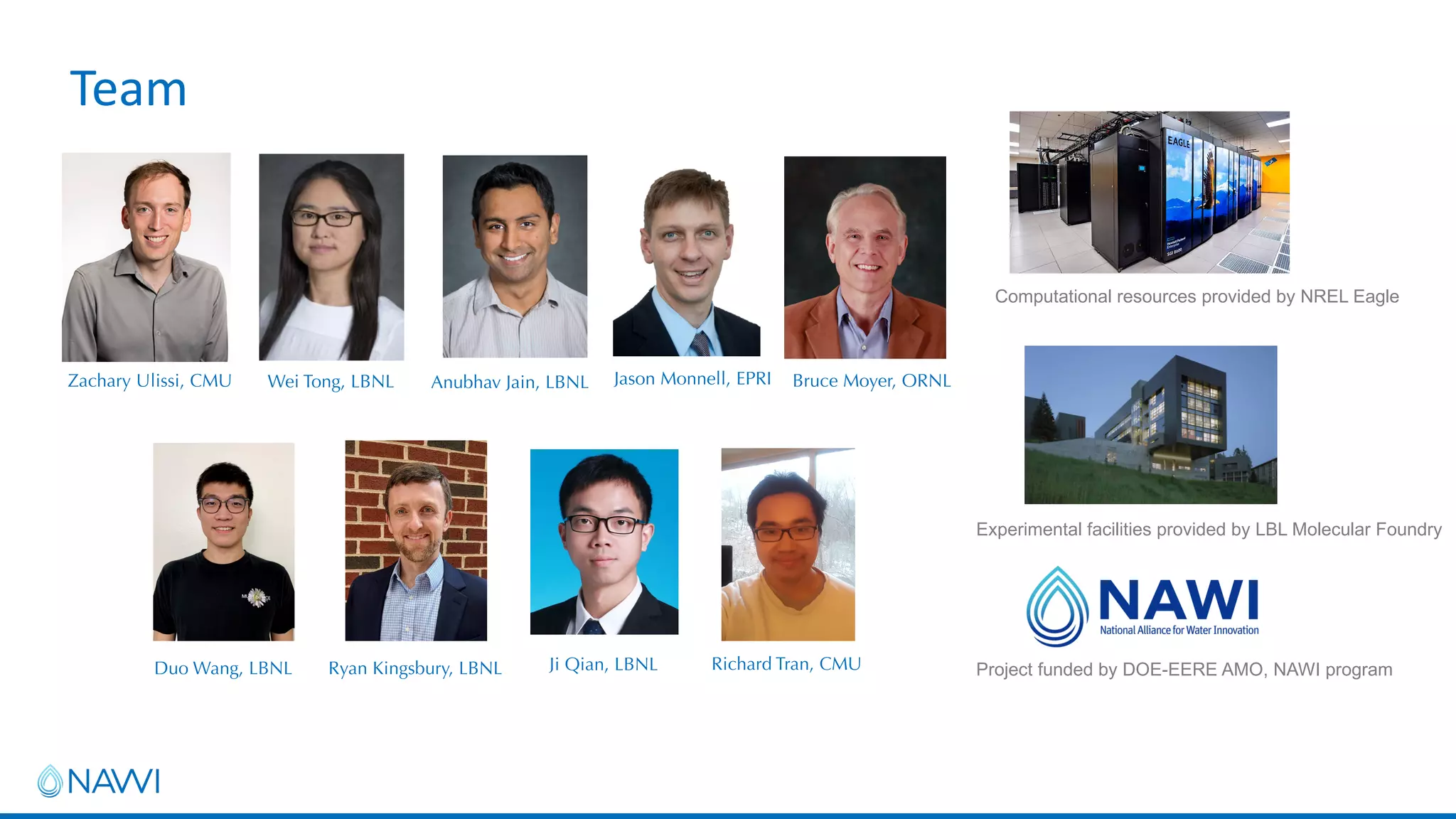
Team
Zachary Ulissi, CMU Wei Tong, LBNL Anubhav Jain, LBNL Bruce Moyer, ORNL
Jason Monnell, EPRI
Duo Wang, LBNL Ryan Kingsbury, LBNL Ji Qian, LBNL Richard Tran, CMU
Computational resources provided by NREL Eagle
Project funded by DOE-EERE AMO, NAWI program
Experimental facilities provided by LBL Molecular Foundry
QUESTIONS
Anubhav Jain
Lawrence Berkeley National Laboratory
ajain@lbl.gov

Machine Learning Platform for Catalyst Design

  • 1.
    National Alliance for WaterInnovation Topic: Materials & Manufacturing Machine Learning Platform for Catalyst Design Anubhav Jain Lawrence Berkeley National Laboratory May 3, 2022 Project team: Wei Tong, Lawrence Berkeley National Laboratory Zachary Ulissi, Carnegie Mellon University Jason Monnell, EPRI
  • 2.
    Background: New advancementsin materials theory allow us to perform computer-aided-design of materials, at the level of atoms and electrons Goal: Use machine learning and theory to develop new electrocatalyst materials for oxyanion (nitrate) removal i.e., what goes inside the reactor? Project Objectives Autonomous Precise Resilient Intensified Modular Electrified Control voltage Targets a single or a few solutes Easily adjusted for variable water quality No need for regeneration; no brine to dispose No high-pressure equipment; no moving parts Compatible with distributed DC power Electrocatalysis for A-PRIME oxyanion removal Singh & Goldsmith ACS Catal. 2020, 10. Werth et al. ACS ES&T Engg. 2021, 1
  • 3.
    Electrocatalysis may providean alternative to conventional nitrate treatment technologies EPRI Publication 1009237 and 3002014438 ; Werth et al. ACS ES&T Engg. 2021, 1 Process Capital ($/1000 gal) Operating ($/1000 gal) Brine Disposal ($/1000 gal) Total Cost ($/1000 gal) Reverse Osmosis $0.44-0.88 $1.10-3.00 $0.40-2.60 $1.54-6.48 Ion Exchange $0.24-1.18 $0.46-0.64 $0.04-0.32 $0.70-1.24 Biological Treatment $0.40-0.90 $0.50-0.80 $0.01-0.02 $0.91-1.72 Electrocatalytic Treatment $0.12-1.57 n/a $ ? $ ? Factors Impeding electrocatalysis in water treatment are largely materials design challenges 1. Cost of precious metal catalysts 2. Low N2 selectivity of non-precious metal catalysts 3. Energy waste due to large overpotentials 4. Reactor mass transport limitations
  • 4.
    Develop a reliable methodto calculate (from first principles) the nitrate removal capability of novel electrocatalysts Perform a computational screen of >1000 potential compositions using supercomputing centers Use combinatorial and conventional experimental platforms to test hypotheses and discover new catalysts Approach: use accelerated screening to quickly identify cost-effective catalysts CE: Pt RE: Hg/HgSO4 WE: GC & catalyst E’lyte: 0.5 M H2SO4 with 0.1 M NaNO3 DOI: 10.1021/acscatal.9b02179
  • 5.
    Computational details DOI: 10.1021/acscatal.9b02179 5 Calculateadsorption energies Adsorption energies + a select number of Ea for various species are calculated for a given metal surface. Scaling and BEP relations a linear relationship between the calculated energies and activation is energies is established. MKMCXX microkinetic modeling using MKMCXX helps to predict TOF and selectivity, which should correlate w/experiment OH* H2O* H*/N*/O* N2O* NH* NH2 * NH3 * NO* NO2 * NO3 * activity map Product selectivity map
  • 6.
    Calculations reproduce experimentaltrends in turnover frequency DOI: 10.1021/acscatal.9b02179 Oxygen binding energy Nitrogen binding energy turnover frequencies (TOF)
  • 7.
    To screen evenmore compounds, use machine learning as a proxy for DFT calculations Graph neural network (GNN) model: Specs: • GNN model: DimeNet++ • MAE = ~0.3 eV • Target: Initial structure (adsorbed slab)à!"#$ • Training data: ~100k (metals only) Red = E*O Blue = E*N
  • 8.
    Use machine learningto screen large databases of candidate materials all elemental and binary compositions / crystal structures
  • 9.
    Screening maps foractivity and selectivity
  • 10.
    Potentially cheap catalystmaterials could have high turnover frequencies cost ($/kg) 0.1 V vs. RHE ZnNi 10.3 FeNi8 16.6 Ni3Ag 336.5 0.0 V vs. RHE ZnNi 10.3 Zn3Co 27.0 0.2 V vs. RHE Ni3Ag 336.5 Fe3Ag 335.2 Precious metal catalysts have materials costs >$10,000/kg * very late in the project, we updated our ML model to account for a technical issue and obtained a slightly different list
  • 11.
    Use robots toassist in rapid synthesis of candidates (Molecular Foundry, LBNL) Reaction station • Eight 20 mL vials one time, our current testing volume is 10 mL • Heating and shaking of the reactants can be applied Stock solution station • No shaking/stirring is available • 5 spots for stock solutions, with a volume of 50 mL for each stock solution Four pipettes
  • 12.
    Procedure for electrodepreparation and testing established 1/2 inch (for electrocatalyst loading and be immersed into the electrolyte) electrocatalyst slurry RE (AgCl/Ag) CE (Pt wire) WE (Rh/C) NaBH4/Rh = 30 electrochemical testing UV-Vis testing Electrode preparation
  • 13.
    Predicted materials: synthesisattempted, however unclear that we made the desired alloy (and certainly not pure) ZnNi cost ($/kg) 0.1 V vs. RHE ZnNi 10.3 FeNi8 16.6 Ni3Ag 336.5 0.0 V vs. RHE ZnNi 10.3 Zn3Co 27.0 0.2 V vs. RHE Ni3Ag 336.5 Fe3Ag 335.2
  • 14.
    • Attempts tosynthesize and test target catalysts are ongoing • Paper currently under review on screening, along w/list of candidates for follow up by others • If successful, low-cost materials for electrocatalytic nitrate reduction would be identified, vastly bringing down cost projections for electrocatalysis in water treatment Projected Impacts
  • 15.
    • Capability fornitrate removal currently being adapted to target other oxyanions, e.g. Se removal • Project just launched – will have more time for synthesis and characterization this time • However, more of the theory needs to be developed Transitioning to other problems, i.e. Se removal Team for upcoming Se removal project
  • 16.
    Team Zachary Ulissi, CMUWei Tong, LBNL Anubhav Jain, LBNL Bruce Moyer, ORNL Jason Monnell, EPRI Duo Wang, LBNL Ryan Kingsbury, LBNL Ji Qian, LBNL Richard Tran, CMU Computational resources provided by NREL Eagle Project funded by DOE-EERE AMO, NAWI program Experimental facilities provided by LBL Molecular Foundry
  • 17.
    QUESTIONS Anubhav Jain Lawrence BerkeleyNational Laboratory ajain@lbl.gov