GBH Enterprises, Ltd.

Suspensions Processing Guide:
GBHE SPG PEG 310

Process Synthesis
Process Disclaimer
Information contained in this publication or as otherwise supplied to Users is
believed to be accurate and correct at time of going to press, and is given in
good faith, but it is for the User to satisfy itself of the suitability of the Product for
its own particular purpose. GBHE gives no warranty as to the fitness of the
Product for any particular purpose and any implied warranty or condition
(statutory or otherwise) is excluded except to the extent that exclusion is
prevented by law. GBHE accepts no liability for loss, damage or personnel injury
caused or resulting from reliance on this information. Freedom under Patent,
Copyright and Designs cannot be assumed.

Refinery Process Stream Purification Refinery Process Catalysts Troubleshooting Refinery Process Catalyst Start-Up / Shutdown
Activation Reduction In-situ Ex-situ Sulfiding Specializing in Refinery Process Catalyst Performance Evaluation Heat & Mass
Balance Analysis Catalyst Remaining Life Determination Catalyst Deactivation Assessment Catalyst Performance
Characterization Refining & Gas Processing & Petrochemical Industries Catalysts / Process Technology - Hydrogen Catalysts /
Process Technology – Ammonia Catalyst Process Technology - Methanol Catalysts / process Technology – Petrochemicals
Specializing in the Development & Commercialization of New Technology in the Refining & Petrochemical Industries
Web Site: www.GBHEnterprises.com
Process Engineering Guide:

Process Synthesis

CONTENTS

INTRODUCTION

1

A SUGGESTED GENERAL APPROACH

2

EXAMPLES OF PROCESS SELECTION
2.1
2.2

3

Harvesting and Thickening of Single Cell Protein
Dewatering of a Specialty Latex

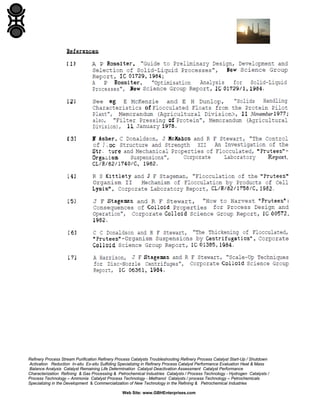
REFERENCES

TABLES

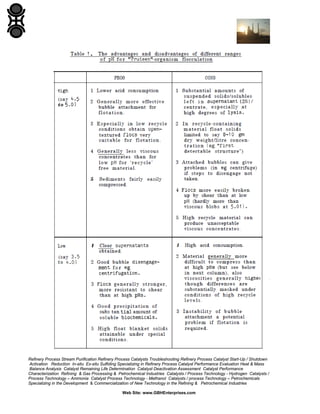
1

THE ADVANTAGES AND DISADVANTAGES OF DIFFERENT RANGE
OF PH FOR “PROTEIN” ORGANISM FLOCCULATION

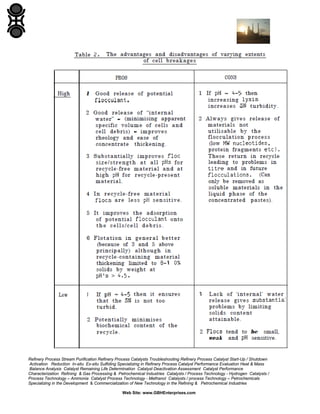
2

THE ADVANTAGES AND DISADVANTAGES OF VARYING EXTENTS
OF CELL BREAKAGES

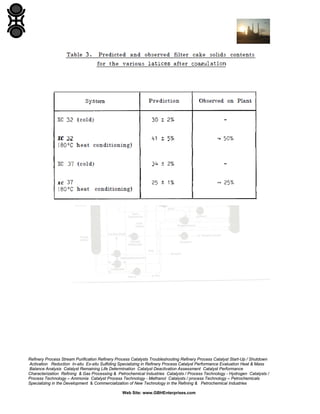
3

PREDICTED AND OBSERVED FILTER CAKE SOLIDS CONTENTS FOR
THE VARIOUS LATICES AFTER COAGULATION

Refinery Process Stream Purification Refinery Process Catalysts Troubleshooting Refinery Process Catalyst Start-Up / Shutdown
Activation Reduction In-situ Ex-situ Sulfiding Specializing in Refinery Process Catalyst Performance Evaluation Heat & Mass
Balance Analysis Catalyst Remaining Life Determination Catalyst Deactivation Assessment Catalyst Performance
Characterization Refining & Gas Processing & Petrochemical Industries Catalysts / Process Technology - Hydrogen Catalysts /
Process Technology – Ammonia Catalyst Process Technology - Methanol Catalysts / process Technology – Petrochemicals
Specializing in the Development & Commercialization of New Technology in the Refining & Petrochemical Industries
Web Site: www.GBHEnterprises.com
FIGURES
1

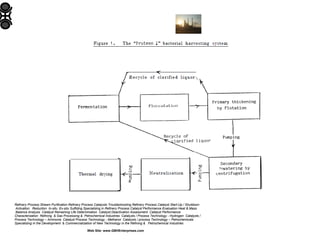
THE “PROTEIN” BACTERIAL HARVESTING SYSTEM

2

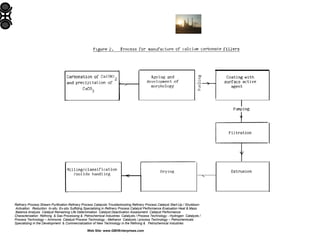
PROCESS FOR MANUFACTURE OF CALCIUM CARBONATE FILTERS

3

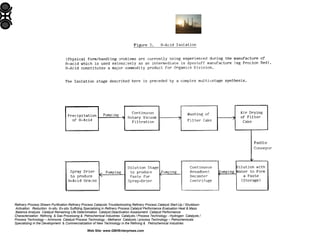
H-ACID ISOLATION

4

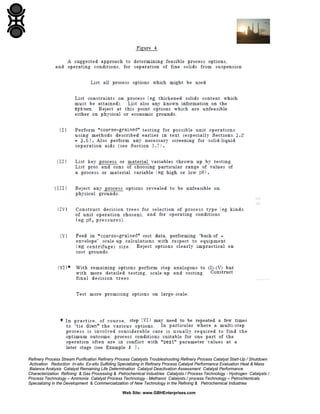
A SUGGESTED APPROACH TO DETERMINING FEASIBLE PROCESS
OPTIONS, AND OPERATING CONDITIONS FOR SEPARATION OF
FINE SOLIDS FROM SUSPENSION

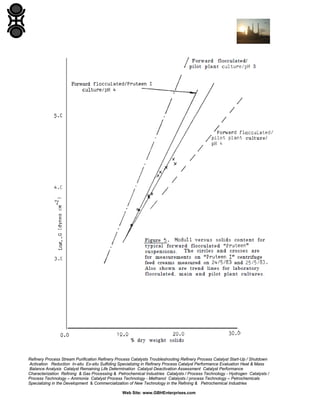
5

MODULI VERSUS SOLIDS CONTENT FORTYPICAL FORWARD
FLOCCULATED “PROTEIN” SUSPENSIONS

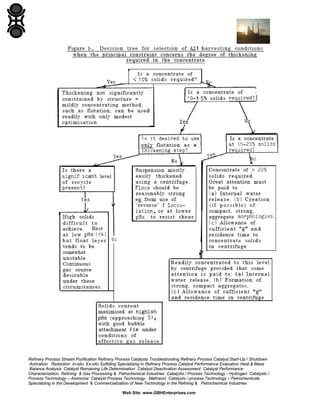
6

DECISION TREE FOR SELECTION OF AS1 HARVESTING
CONDITIONS WHEN PRINCIPAL CONSTRAINT CONCERNS THE
DEGREE OF THICKENING REQUIRED IN THE CONCENTRATE

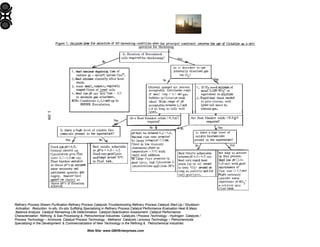
7

DECISION TREE FOR SELECTION OF AS1 HARVESTING
CONDITIONS WHEN PRINCIPAL CONSTRAINT CONCERNS THE USE
OF FLOTATION AS A UNIT OPERATION FOR THICKENING

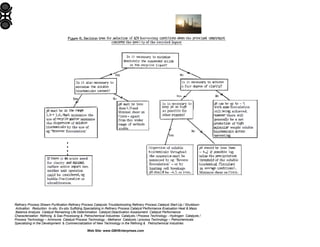
8

DECISION TREE FOR SELECTION OF AS1 HARVESTING
CONDITIONS WHEN PRINCIPAL CONSTRAINT CONCERNS THE
QUALITY OF THE RECYCLED LIQUOR

9

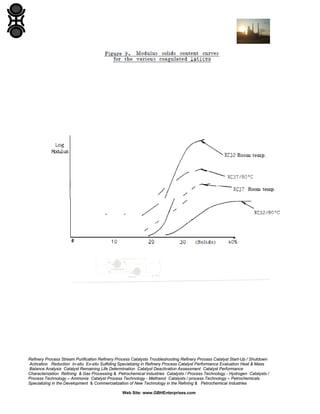
MODULUSSOLIDS CONTENT CURVES FOR THEVARIOUS
COAGULATED LATICES

Refinery Process Stream Purification Refinery Process Catalysts Troubleshooting Refinery Process Catalyst Start-Up / Shutdown
Activation Reduction In-situ Ex-situ Sulfiding Specializing in Refinery Process Catalyst Performance Evaluation Heat & Mass
Balance Analysis Catalyst Remaining Life Determination Catalyst Deactivation Assessment Catalyst Performance
Characterization Refining & Gas Processing & Petrochemical Industries Catalysts / Process Technology - Hydrogen Catalysts /
Process Technology – Ammonia Catalyst Process Technology - Methanol Catalysts / process Technology – Petrochemicals
Specializing in the Development & Commercialization of New Technology in the Refining & Petrochemical Industries
Web Site: www.GBHEnterprises.com
INTRODUCTION
One generally cannot consider the effects of different solid-liquid separation unit
operations In Isolation from one another as:
(a)

In most potential solid-liquid separation processes, several unit operations
follow each other sequentially. Thus material properties have to be
optimized for the whole range of steps, not just for a particular operation.

(b)

At an early stage of design of a solids separation process, one will
generally want to consider various possible types of step (e.g. filtration,
centrifugation) from which a final choice of method is made. To do this the
outcome of different procedures must be directly comparable. Ideally, too,
such a comparison should be capable of being made on the basis of
simple, easily-executed laboratory tests, rather than time consuming semitechnical or pilot-plant trials.

The kinds of sequences of operations encountered in typical suspension
separation operations are illustrated by the flow diagrams for three established
commercial European processes shown in Figures 1-3. We will return to more
detailed discussion of one of these examples in Section 2, after outlining
procedures for process synthesis.

1

A SUGGESTED GENERAL APPROACH

A basic procedure, which we believe is the most helpful route to determining
appropriate choices of process, and process conditions, for separation of fine
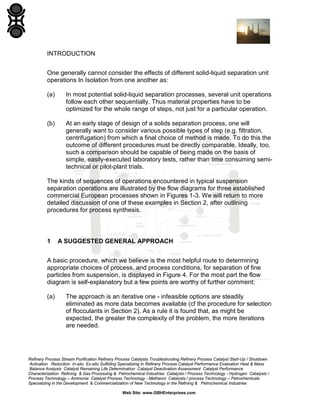
particles from suspension, is displayed in Figure 4. For the most part the flow
diagram is self-explanatory but a few points are worthy of further comment:
(a)

The approach is an iterative one - infeasible options are steadily
eliminated as more data becomes available (cf the procedure for selection
of flocculants in Section 2). As a rule it is found that, as might be
expected, the greater the complexity of the problem, the more iterations
are needed.

Refinery Process Stream Purification Refinery Process Catalysts Troubleshooting Refinery Process Catalyst Start-Up / Shutdown
Activation Reduction In-situ Ex-situ Sulfiding Specializing in Refinery Process Catalyst Performance Evaluation Heat & Mass
Balance Analysis Catalyst Remaining Life Determination Catalyst Deactivation Assessment Catalyst Performance
Characterization Refining & Gas Processing & Petrochemical Industries Catalysts / Process Technology - Hydrogen Catalysts /
Process Technology – Ammonia Catalyst Process Technology - Methanol Catalysts / process Technology – Petrochemicals
Specializing in the Development & Commercialization of New Technology in the Refining & Petrochemical Industries
Web Site: www.GBHEnterprises.com
(b)

With regard to the latter, it is important not to try to arrive at the final
technological solution too quickly (i.e. in too few iterations) otherwise one
may In fact end up performing an unnecessary amount of physical testing.
Rather it is essential to perform some analysis, whittle down the options,
and then proceed to the next, more detailed stage on a limited front. An
example would be the thickening of slurry to prescribed solids content.
Conceivably flotation, sedimentation, filtration or centrifugation could be
used. Usually it is wise to first measure the network modulus/solids
content relationship for samples at various degrees of thickening.
Inspection of the curve will immediately tell one whether the first TWC
options are "runners" or whether a significant pressure head is needed to
give the desired solids content. Whatever the outcome of the experiment
the number of possibilities will be approximately halved right away.

(c)

The scheme given In Figure 4 should, if properly employed, yield both the
appropriate choices of unit operation (e.g. flotation, centrifugation) and of
operating conditions (pH, pressures and so on). It should be noted that for
any particular problem there will probably not be one “correct” answer;
rather there will often be a series of possibilities (unit operations and
(linked) operating conditions) which will have particular advantages in
specific circumstances. For example, for thickening problems the route
eventually chosen will depend very much on local factors such as
equipment availability and cost of energy. Accordingly, the object of the
scheme is to derive a series of decision trees from which a selection of
processes can be made on a logical basis.

(d)

Although Chapter 3 has dealt mainly with the physico-chemical factors
governing solid-liquid separation it Is, of course, essential to perform a
parallel study of the process options based upon cost considerations.
Implicitly in Figure 4 it is assumed that this aspect of solving the problem
will be “built-in” right from the beginning to eliminate work on completely
impractical routes. Process synthesis methods for solids separation and
handling are, as yet, rather rudimentary compared with the techniques
available for gas-liquid systems. However, some preliminary studies of
possible methodology have recently been presented by Rossiter [1].

Refinery Process Stream Purification Refinery Process Catalysts Troubleshooting Refinery Process Catalyst Start-Up / Shutdown
Activation Reduction In-situ Ex-situ Sulfiding Specializing in Refinery Process Catalyst Performance Evaluation Heat & Mass
Balance Analysis Catalyst Remaining Life Determination Catalyst Deactivation Assessment Catalyst Performance
Characterization Refining & Gas Processing & Petrochemical Industries Catalysts / Process Technology - Hydrogen Catalysts /
Process Technology – Ammonia Catalyst Process Technology - Methanol Catalysts / process Technology – Petrochemicals
Specializing in the Development & Commercialization of New Technology in the Refining & Petrochemical Industries
Web Site: www.GBHEnterprises.com
(e)

One deficiency of Figure 4 is that at present the relative efficiency of
membrane processes compared with the other mechanical separation
techniques cannot be particularly easily assessed, except by inspection of
the results of quite lengthy experimentation. There is no obvious way
round this difficulty at the current time: the physical principles underlying
membrane separation differ considerably from the (common)
fundamentals which govern operations such as sedimentation, filtration,
and flotation and so on. Further discussion of these physical principles
pertaining to membrane processes may be found earlier in GBHE SPG
PEG 302 and GBHE SPG PEG 307.

2

EXAMPLES OF PROCESS SELECTION

2.1

Harvesting and Thickening of Single Cell Protein

This example, due to the complexity of the system, and the multipurpose nature
of the objectives of work on the material, provides a particularly good illustration
of how a separation problem may be dissected. As some aspects of single cell
protein harvesting have already been discussed in GBHE SPG PEG 302 and
GBHE SPG PEG 307, detail will be kept to a minimum here. Instead we will
describe the general approach taken and why certain routes were followed.
At the outset the aims of fundamental studies on this system may be described
as:
(a) To provide a basis for operating the (existing) process outlined in
Figure 1, in the most efficient manner.
(b) To provide a basis for design and operation of novel processing for
harvesting (ie descendents of 1). In particular to give a means of
selecting the best options when economic and other conditions were
very different from those prevailing in the early 1980s. Regimes which
one would like to consider included those of high and low energy costs,
variability of effluent disposal restrictions, and ease and simplicity of
operation (for possible building of plants in areas where skilled
technical staff would be scarce).

The first step in the procedure was "to go back to the beginning" and consider
what unit processes could conceivably be used.

Refinery Process Stream Purification Refinery Process Catalysts Troubleshooting Refinery Process Catalyst Start-Up / Shutdown
Activation Reduction In-situ Ex-situ Sulfiding Specializing in Refinery Process Catalyst Performance Evaluation Heat & Mass
Balance Analysis Catalyst Remaining Life Determination Catalyst Deactivation Assessment Catalyst Performance
Characterization Refining & Gas Processing & Petrochemical Industries Catalysts / Process Technology - Hydrogen Catalysts /
Process Technology – Ammonia Catalyst Process Technology - Methanol Catalysts / process Technology – Petrochemicals
Specializing in the Development & Commercialization of New Technology in the Refining & Petrochemical Industries
Web Site: www.GBHEnterprises.com
Attempts at membrane separation had previously proved extremely unpromising
and, due to the strong fouling propensity of the biological suspension, were not
considered further. Instead some kind of conventional mechanical dewatering
seemed inevitable with sedimentation, flotation, centrifugation and filtration all
being runners, either singly or in combination. The small size (~ 1 micron) and
low density (only marginally greater than water) of the bacteria meant, however,
that enlargement of species size, by some kind of flocculation operation, was
required for any of the unit operations to be practical. However, even after
flocculation, due to the near neutral buoyancy of the bacterial aggregates,
sedimentation tended to be very slow probably (but not certainly) ruling it out as
the thickening method. Filtration was also eliminated at an early stage: scouting
filtration studies had been somewhat disappointing owing to floe breakup and
material loss [2]. In addition, filtration was not an operation particularly lending
itself to rapid continuous thickening of a perishable material. Thus at the end of
the first assessment the options were clear: flocculation followed by flotation or
centrifugation, singly or in combination. Sedimentation and filtration were
relegated to a "reserve list", put aside but not entirely forgotten in case the
preferred options proved flawed. Flocculation could either involve components of
the broth (perhaps after pH adjustment to stimulate aggregation) or added floe
agents. However, in the latter case, toxicology imposed severe constraints on the
kinds of chemical additives which might be used. Costs also limited dose rates.
Another factor to be considered In any solution was that the rheological
characteristics of the thickened suspension had to allow for convenient handling
and control of the drying process.

When more detailed work was embarked upon, quite limited studies were
sufficient to indicate that it was unlikely that an “all purpose” floc agent could be
found which would satisfy the various restrictions. The best that could probably
be hoped for was that a natural flocculant (e.g. a gum) could be found which
would be added to retrieve the situation when the ‘normal” flocculation
mechanism broke down.
Costs, however, seemed likely to be prohibitive if continuous dosing were
applied. Accordingly, study was concentrated on optimization of flocculation by
the method of cell lysis (generally by heat shock) followed by pH adjustment to
cause aggregation of the cells, cell fragments and released biopolymers. In the
first stage of “coarse grained” testing studies were made of the flocculation
mechanism, and of the floc and thickened suspension properties using simple,
and now familiar, tools such as optical microscopy and shear modulus
measurements.

Refinery Process Stream Purification Refinery Process Catalysts Troubleshooting Refinery Process Catalyst Start-Up / Shutdown
Activation Reduction In-situ Ex-situ Sulfiding Specializing in Refinery Process Catalyst Performance Evaluation Heat & Mass
Balance Analysis Catalyst Remaining Life Determination Catalyst Deactivation Assessment Catalyst Performance
Characterization Refining & Gas Processing & Petrochemical Industries Catalysts / Process Technology - Hydrogen Catalysts /
Process Technology – Ammonia Catalyst Process Technology - Methanol Catalysts / process Technology – Petrochemicals
Specializing in the Development & Commercialization of New Technology in the Refining & Petrochemical Industries
Web Site: www.GBHEnterprises.com
In these investigations, the various properties were characterized as such
parameters as flocculation pH, and degree of cell breakage were changed. Some
results from the early parts of the study are displayed in Figure 5. The data from
the investigations provided an indication of the likely key physico-chemical
variables, e.g. pH, heat-shock temperature (through, amongst other things, its
effect on cell breakage), and the balance of biochemical’s in the supernatant. It
also provided some immediate conclusions concerning process options - for
example above ~ 9% w/w solids the mechanism of thickening was consolidation
of a cohesive structure (see e.g. Figure 5). As in flotation, there is only a marginal
compressive effect upon the float blanket; flotation could not be used for
thickening to, say, and 20% solids. For this, centrifugation (with or without
primary thickening by flotation) was needed.
In a second, more detailed, part of the investigation flotation testing (see Section
3.6) and sophisticated biochemical and colloid analysis were added to the
comparatively simple techniques used in the first experiments. This enabled a
picture of the effects of changing the key variables to be steadily built up. Tables
of the positive and negative effects of selecting a particular value of a key
process or material variable were now written down (see Tables 1 and 2). This
was a particularly important step in this “case history” as there were clearly
conflicting requirements for different stages of the process. For example, opentextured flocs suitable for flotation were facilitated by high pH whereas low pHs
help give clear centrifugates. “Decision trees” for selection of design options and
best operating conditions could now be constructed by inspection of the various
PRO/COB tables. Three examples of the latter are shown in Figures 6-8. It
should be noted that the decision trees cover both general and specific aspects
of solving the problem, e.g. Figure 6 concerns the unit operations and conditions
needed to give a particular final degree of thickening; Figure ‘7 deals with
optimization of flotation alone.
In the final stage of the work one of the more promising novel approaches, viz
“reverse flocculation” (in which acidification is followed by heat shock, contrary to
the standard process) with subsequent one-stage thickening by centrifuge, was
examined on a semi-technical scale and data was obtained for a large-scale
plant design package for potential licensing (Section 3.4). Further details on
this example are given in GBHE SPG PEG 302 and GBHE SPG PEG 307.

Refinery Process Stream Purification Refinery Process Catalysts Troubleshooting Refinery Process Catalyst Start-Up / Shutdown
Activation Reduction In-situ Ex-situ Sulfiding Specializing in Refinery Process Catalyst Performance Evaluation Heat & Mass
Balance Analysis Catalyst Remaining Life Determination Catalyst Deactivation Assessment Catalyst Performance
Characterization Refining & Gas Processing & Petrochemical Industries Catalysts / Process Technology - Hydrogen Catalysts /
Process Technology – Ammonia Catalyst Process Technology - Methanol Catalysts / process Technology – Petrochemicals
Specializing in the Development & Commercialization of New Technology in the Refining & Petrochemical Industries
Web Site: www.GBHEnterprises.com
2.2

Dewatering of a Specialty Latex

Our second example has been briefly alluded to in an earlier chapter GBHE SPG
PEG 302 in relation to predictive testing for filtration behavior. However it also
illustrates well how different process options can be compared and sifted to give
a limited number of practicable alternatives.
The basic problem concerned dewatering of a specialty, methacrylate based,
latex. An existing product (XC 32) was coagulated with electrolyte, subject to
limited heat treatment to "condition" the flocs so that they could withstand
mechanical abrasion better, and then filtered to - 50% solids. The resulting cake
was then dried. However a new product (XC 37), when put through the same
process train, gave only ~ 25% solids in the cake with a subsequent enormous
increase in drying costs. Efforts to improve matters, for example by use of
alternative coagulants, proved unsuccessful.
Obviously the coagulated material was only likely to be concentrated to a
satisfactory degree in equipment which could exert a significant concentrating
pressure, e.g. a vacuum filter, a pressure filter or a centrifuge. Accordingly, as
ultimate "dewaterabillty" for all these instances is governed by network strength,
it was appropriate to measure the modulus solids content relationships for XC 32
and XC 37. Results are displayed in Figure 9, investigations being made of both
heat-treated (as in the plant) and non-heat-treated systems. From these data
estimates were also made of the solids content expected to be found in a filter
cake at the pressures prevailing on the plant (Table 3). Agreement between
prediction and observation is excellent. From even these limited measurements a
number of important conclusions could be drawn. By far the most important was
that the high moisture contents in the filter cake resulted from the fundamental
material characteristics of the new product. Thus the only way forward was either
to:
(a)

Use a higher concentrating pressure in the dewatering equipment;

OR
(b)

Weaken the propensity of XC to form strong, open, relatively
incompressible networks.

(NB: the above are the key process and material variables referred to in Figure 4)

Refinery Process Stream Purification Refinery Process Catalysts Troubleshooting Refinery Process Catalyst Start-Up / Shutdown
Activation Reduction In-situ Ex-situ Sulfiding Specializing in Refinery Process Catalyst Performance Evaluation Heat & Mass
Balance Analysis Catalyst Remaining Life Determination Catalyst Deactivation Assessment Catalyst Performance
Characterization Refining & Gas Processing & Petrochemical Industries Catalysts / Process Technology - Hydrogen Catalysts /
Process Technology – Ammonia Catalyst Process Technology - Methanol Catalysts / process Technology – Petrochemicals
Specializing in the Development & Commercialization of New Technology in the Refining & Petrochemical Industries
Web Site: www.GBHEnterprises.com
With reference to (b), comparison of the network strength data with known results
for other (coagulated) polymer latices of similar particle size (~ 0.3 µm)
suggested that XC 37's behavior was in no way unexpected for the kind of
dispersion involved. Rather than XC 32 being "bad", it was the case that the
older product (due to a fortuitous combination of a particle size effect with the
other processing conditions) was unusually “good". As a consequence it was
unlikely that a simple change of coagulating agent would solve the problem, a
conclusion supported by the negative results from the original screen for
alternative floc agents, The comparative data for heat-treated and non-heattreated suspensions did show that abandoning the conditioning would probably
result in network weakening and higher filter cake solids, though perhaps there
might be a price to be paid in terms of effects such as greater floc breakup and
associated phenomena such as loss of fines. However, examination of the
predicted moisture contents suggested that the degree of increase in solids
would not nearly go far enough (ie within striking distance of the performance
achieved for XC 32) to be satisfactory. Thus only two options remained open:
(i)

Use of a higher concentrating pressure, perhaps associated with
abandonment/modification of the heat treatment step.

(ii)

A search for a flocculant (most probably a high molecular weight polymeric
agent) which would give easily compressible flocs of the latex.

Owing to the uncertainty of outcome of (ii), the first pathway was selected. A
centrifuge was used to obtain a better degree of concentration than before, heat
treatment being retained to minimize floc breakup prior to dewatering.

Refinery Process Stream Purification Refinery Process Catalysts Troubleshooting Refinery Process Catalyst Start-Up / Shutdown
Activation Reduction In-situ Ex-situ Sulfiding Specializing in Refinery Process Catalyst Performance Evaluation Heat & Mass
Balance Analysis Catalyst Remaining Life Determination Catalyst Deactivation Assessment Catalyst Performance
Characterization Refining & Gas Processing & Petrochemical Industries Catalysts / Process Technology - Hydrogen Catalysts /
Process Technology – Ammonia Catalyst Process Technology - Methanol Catalysts / process Technology – Petrochemicals
Specializing in the Development & Commercialization of New Technology in the Refining & Petrochemical Industries
Web Site: www.GBHEnterprises.com
Refinery Process Stream Purification Refinery Process Catalysts Troubleshooting Refinery Process Catalyst Start-Up / Shutdown
Activation Reduction In-situ Ex-situ Sulfiding Specializing in Refinery Process Catalyst Performance Evaluation Heat & Mass
Balance Analysis Catalyst Remaining Life Determination Catalyst Deactivation Assessment Catalyst Performance
Characterization Refining & Gas Processing & Petrochemical Industries Catalysts / Process Technology - Hydrogen Catalysts /
Process Technology – Ammonia Catalyst Process Technology - Methanol Catalysts / process Technology – Petrochemicals
Specializing in the Development & Commercialization of New Technology in the Refining & Petrochemical Industries
Web Site: www.GBHEnterprises.com
Refinery Process Stream Purification Refinery Process Catalysts Troubleshooting Refinery Process Catalyst Start-Up / Shutdown
Activation Reduction In-situ Ex-situ Sulfiding Specializing in Refinery Process Catalyst Performance Evaluation Heat & Mass
Balance Analysis Catalyst Remaining Life Determination Catalyst Deactivation Assessment Catalyst Performance
Characterization Refining & Gas Processing & Petrochemical Industries Catalysts / Process Technology - Hydrogen Catalysts /
Process Technology – Ammonia Catalyst Process Technology - Methanol Catalysts / process Technology – Petrochemicals
Specializing in the Development & Commercialization of New Technology in the Refining & Petrochemical Industries
Web Site: www.GBHEnterprises.com
Refinery Process Stream Purification Refinery Process Catalysts Troubleshooting Refinery Process Catalyst Start-Up / Shutdown
Activation Reduction In-situ Ex-situ Sulfiding Specializing in Refinery Process Catalyst Performance Evaluation Heat & Mass
Balance Analysis Catalyst Remaining Life Determination Catalyst Deactivation Assessment Catalyst Performance
Characterization Refining & Gas Processing & Petrochemical Industries Catalysts / Process Technology - Hydrogen Catalysts /
Process Technology – Ammonia Catalyst Process Technology - Methanol Catalysts / process Technology – Petrochemicals
Specializing in the Development & Commercialization of New Technology in the Refining & Petrochemical Industries
Web Site: www.GBHEnterprises.com
Refinery Process Stream Purification Refinery Process Catalysts Troubleshooting Refinery Process Catalyst Start-Up / Shutdown
Activation Reduction In-situ Ex-situ Sulfiding Specializing in Refinery Process Catalyst Performance Evaluation Heat & Mass
Balance Analysis Catalyst Remaining Life Determination Catalyst Deactivation Assessment Catalyst Performance
Characterization Refining & Gas Processing & Petrochemical Industries Catalysts / Process Technology - Hydrogen Catalysts /
Process Technology – Ammonia Catalyst Process Technology - Methanol Catalysts / process Technology – Petrochemicals
Specializing in the Development & Commercialization of New Technology in the Refining & Petrochemical Industries
Web Site: www.GBHEnterprises.com
Refinery Process Stream Purification Refinery Process Catalysts Troubleshooting Refinery Process Catalyst Start-Up / Shutdown
Activation Reduction In-situ Ex-situ Sulfiding Specializing in Refinery Process Catalyst Performance Evaluation Heat & Mass
Balance Analysis Catalyst Remaining Life Determination Catalyst Deactivation Assessment Catalyst Performance
Characterization Refining & Gas Processing & Petrochemical Industries Catalysts / Process Technology - Hydrogen Catalysts /
Process Technology – Ammonia Catalyst Process Technology - Methanol Catalysts / process Technology – Petrochemicals
Specializing in the Development & Commercialization of New Technology in the Refining & Petrochemical Industries
Web Site: www.GBHEnterprises.com
Refinery Process Stream Purification Refinery Process Catalysts Troubleshooting Refinery Process Catalyst Start-Up / Shutdown
Activation Reduction In-situ Ex-situ Sulfiding Specializing in Refinery Process Catalyst Performance Evaluation Heat & Mass
Balance Analysis Catalyst Remaining Life Determination Catalyst Deactivation Assessment Catalyst Performance
Characterization Refining & Gas Processing & Petrochemical Industries Catalysts / Process Technology - Hydrogen Catalysts /
Process Technology – Ammonia Catalyst Process Technology - Methanol Catalysts / process Technology – Petrochemicals
Specializing in the Development & Commercialization of New Technology in the Refining & Petrochemical Industries
Web Site: www.GBHEnterprises.com
Refinery Process Stream Purification Refinery Process Catalysts Troubleshooting Refinery Process Catalyst Start-Up / Shutdown
Activation Reduction In-situ Ex-situ Sulfiding Specializing in Refinery Process Catalyst Performance Evaluation Heat & Mass
Balance Analysis Catalyst Remaining Life Determination Catalyst Deactivation Assessment Catalyst Performance
Characterization Refining & Gas Processing & Petrochemical Industries Catalysts / Process Technology - Hydrogen Catalysts /
Process Technology – Ammonia Catalyst Process Technology - Methanol Catalysts / process Technology – Petrochemicals
Specializing in the Development & Commercialization of New Technology in the Refining & Petrochemical Industries
Web Site: www.GBHEnterprises.com
Refinery Process Stream Purification Refinery Process Catalysts Troubleshooting Refinery Process Catalyst Start-Up / Shutdown
Activation Reduction In-situ Ex-situ Sulfiding Specializing in Refinery Process Catalyst Performance Evaluation Heat & Mass
Balance Analysis Catalyst Remaining Life Determination Catalyst Deactivation Assessment Catalyst Performance
Characterization Refining & Gas Processing & Petrochemical Industries Catalysts / Process Technology - Hydrogen Catalysts /
Process Technology – Ammonia Catalyst Process Technology - Methanol Catalysts / process Technology – Petrochemicals
Specializing in the Development & Commercialization of New Technology in the Refining & Petrochemical Industries
Web Site: www.GBHEnterprises.com
Refinery Process Stream Purification Refinery Process Catalysts Troubleshooting Refinery Process Catalyst Start-Up / Shutdown
Activation Reduction In-situ Ex-situ Sulfiding Specializing in Refinery Process Catalyst Performance Evaluation Heat & Mass
Balance Analysis Catalyst Remaining Life Determination Catalyst Deactivation Assessment Catalyst Performance
Characterization Refining & Gas Processing & Petrochemical Industries Catalysts / Process Technology - Hydrogen Catalysts /
Process Technology – Ammonia Catalyst Process Technology - Methanol Catalysts / process Technology – Petrochemicals
Specializing in the Development & Commercialization of New Technology in the Refining & Petrochemical Industries
Web Site: www.GBHEnterprises.com
Refinery Process Stream Purification Refinery Process Catalysts Troubleshooting Refinery Process Catalyst Start-Up / Shutdown
Activation Reduction In-situ Ex-situ Sulfiding Specializing in Refinery Process Catalyst Performance Evaluation Heat & Mass
Balance Analysis Catalyst Remaining Life Determination Catalyst Deactivation Assessment Catalyst Performance
Characterization Refining & Gas Processing & Petrochemical Industries Catalysts / Process Technology - Hydrogen Catalysts /
Process Technology – Ammonia Catalyst Process Technology - Methanol Catalysts / process Technology – Petrochemicals
Specializing in the Development & Commercialization of New Technology in the Refining & Petrochemical Industries
Web Site: www.GBHEnterprises.com
Refinery Process Stream Purification Refinery Process Catalysts Troubleshooting Refinery Process Catalyst Start-Up / Shutdown
Activation Reduction In-situ Ex-situ Sulfiding Specializing in Refinery Process Catalyst Performance Evaluation Heat & Mass
Balance Analysis Catalyst Remaining Life Determination Catalyst Deactivation Assessment Catalyst Performance
Characterization Refining & Gas Processing & Petrochemical Industries Catalysts / Process Technology - Hydrogen Catalysts /
Process Technology – Ammonia Catalyst Process Technology - Methanol Catalysts / process Technology – Petrochemicals
Specializing in the Development & Commercialization of New Technology in the Refining & Petrochemical Industries
Web Site: www.GBHEnterprises.com
Refinery Process Stream Purification Refinery Process Catalysts Troubleshooting Refinery Process Catalyst Start-Up / Shutdown
Activation Reduction In-situ Ex-situ Sulfiding Specializing in Refinery Process Catalyst Performance Evaluation Heat & Mass
Balance Analysis Catalyst Remaining Life Determination Catalyst Deactivation Assessment Catalyst Performance
Characterization Refining & Gas Processing & Petrochemical Industries Catalysts / Process Technology - Hydrogen Catalysts /
Process Technology – Ammonia Catalyst Process Technology - Methanol Catalysts / process Technology – Petrochemicals
Specializing in the Development & Commercialization of New Technology in the Refining & Petrochemical Industries
Web Site: www.GBHEnterprises.com
Refinery Process Stream Purification Refinery Process Catalysts Troubleshooting Refinery Process Catalyst Start-Up / Shutdown
Activation Reduction In-situ Ex-situ Sulfiding Specializing in Refinery Process Catalyst Performance Evaluation Heat & Mass
Balance Analysis Catalyst Remaining Life Determination Catalyst Deactivation Assessment Catalyst Performance
Characterization Refining & Gas Processing & Petrochemical Industries Catalysts / Process Technology - Hydrogen Catalysts /
Process Technology – Ammonia Catalyst Process Technology - Methanol Catalysts / process Technology – Petrochemicals
Specializing in the Development & Commercialization of New Technology in the Refining & Petrochemical Industries
Web Site: www.GBHEnterprises.com
Refinery Process Stream Purification Refinery Process Catalysts Troubleshooting Refinery Process Catalyst Start-Up / Shutdown
Activation Reduction In-situ Ex-situ Sulfiding Specializing in Refinery Process Catalyst Performance Evaluation Heat & Mass
Balance Analysis Catalyst Remaining Life Determination Catalyst Deactivation Assessment Catalyst Performance
Characterization Refining & Gas Processing & Petrochemical Industries Catalysts / Process Technology - Hydrogen Catalysts /
Process Technology – Ammonia Catalyst Process Technology - Methanol Catalysts / process Technology – Petrochemicals
Specializing in the Development & Commercialization of New Technology in the Refining & Petrochemical Industries
Web Site: www.GBHEnterprises.com

Process Synthesis

  • 1.
    GBH Enterprises, Ltd. SuspensionsProcessing Guide: GBHE SPG PEG 310 Process Synthesis Process Disclaimer Information contained in this publication or as otherwise supplied to Users is believed to be accurate and correct at time of going to press, and is given in good faith, but it is for the User to satisfy itself of the suitability of the Product for its own particular purpose. GBHE gives no warranty as to the fitness of the Product for any particular purpose and any implied warranty or condition (statutory or otherwise) is excluded except to the extent that exclusion is prevented by law. GBHE accepts no liability for loss, damage or personnel injury caused or resulting from reliance on this information. Freedom under Patent, Copyright and Designs cannot be assumed. Refinery Process Stream Purification Refinery Process Catalysts Troubleshooting Refinery Process Catalyst Start-Up / Shutdown Activation Reduction In-situ Ex-situ Sulfiding Specializing in Refinery Process Catalyst Performance Evaluation Heat & Mass Balance Analysis Catalyst Remaining Life Determination Catalyst Deactivation Assessment Catalyst Performance Characterization Refining & Gas Processing & Petrochemical Industries Catalysts / Process Technology - Hydrogen Catalysts / Process Technology – Ammonia Catalyst Process Technology - Methanol Catalysts / process Technology – Petrochemicals Specializing in the Development & Commercialization of New Technology in the Refining & Petrochemical Industries Web Site: www.GBHEnterprises.com
  • 2.
    Process Engineering Guide: ProcessSynthesis CONTENTS INTRODUCTION 1 A SUGGESTED GENERAL APPROACH 2 EXAMPLES OF PROCESS SELECTION 2.1 2.2 3 Harvesting and Thickening of Single Cell Protein Dewatering of a Specialty Latex REFERENCES TABLES 1 THE ADVANTAGES AND DISADVANTAGES OF DIFFERENT RANGE OF PH FOR “PROTEIN” ORGANISM FLOCCULATION 2 THE ADVANTAGES AND DISADVANTAGES OF VARYING EXTENTS OF CELL BREAKAGES 3 PREDICTED AND OBSERVED FILTER CAKE SOLIDS CONTENTS FOR THE VARIOUS LATICES AFTER COAGULATION Refinery Process Stream Purification Refinery Process Catalysts Troubleshooting Refinery Process Catalyst Start-Up / Shutdown Activation Reduction In-situ Ex-situ Sulfiding Specializing in Refinery Process Catalyst Performance Evaluation Heat & Mass Balance Analysis Catalyst Remaining Life Determination Catalyst Deactivation Assessment Catalyst Performance Characterization Refining & Gas Processing & Petrochemical Industries Catalysts / Process Technology - Hydrogen Catalysts / Process Technology – Ammonia Catalyst Process Technology - Methanol Catalysts / process Technology – Petrochemicals Specializing in the Development & Commercialization of New Technology in the Refining & Petrochemical Industries Web Site: www.GBHEnterprises.com
  • 3.
    FIGURES 1 THE “PROTEIN” BACTERIALHARVESTING SYSTEM 2 PROCESS FOR MANUFACTURE OF CALCIUM CARBONATE FILTERS 3 H-ACID ISOLATION 4 A SUGGESTED APPROACH TO DETERMINING FEASIBLE PROCESS OPTIONS, AND OPERATING CONDITIONS FOR SEPARATION OF FINE SOLIDS FROM SUSPENSION 5 MODULI VERSUS SOLIDS CONTENT FORTYPICAL FORWARD FLOCCULATED “PROTEIN” SUSPENSIONS 6 DECISION TREE FOR SELECTION OF AS1 HARVESTING CONDITIONS WHEN PRINCIPAL CONSTRAINT CONCERNS THE DEGREE OF THICKENING REQUIRED IN THE CONCENTRATE 7 DECISION TREE FOR SELECTION OF AS1 HARVESTING CONDITIONS WHEN PRINCIPAL CONSTRAINT CONCERNS THE USE OF FLOTATION AS A UNIT OPERATION FOR THICKENING 8 DECISION TREE FOR SELECTION OF AS1 HARVESTING CONDITIONS WHEN PRINCIPAL CONSTRAINT CONCERNS THE QUALITY OF THE RECYCLED LIQUOR 9 MODULUSSOLIDS CONTENT CURVES FOR THEVARIOUS COAGULATED LATICES Refinery Process Stream Purification Refinery Process Catalysts Troubleshooting Refinery Process Catalyst Start-Up / Shutdown Activation Reduction In-situ Ex-situ Sulfiding Specializing in Refinery Process Catalyst Performance Evaluation Heat & Mass Balance Analysis Catalyst Remaining Life Determination Catalyst Deactivation Assessment Catalyst Performance Characterization Refining & Gas Processing & Petrochemical Industries Catalysts / Process Technology - Hydrogen Catalysts / Process Technology – Ammonia Catalyst Process Technology - Methanol Catalysts / process Technology – Petrochemicals Specializing in the Development & Commercialization of New Technology in the Refining & Petrochemical Industries Web Site: www.GBHEnterprises.com
  • 4.
    INTRODUCTION One generally cannotconsider the effects of different solid-liquid separation unit operations In Isolation from one another as: (a) In most potential solid-liquid separation processes, several unit operations follow each other sequentially. Thus material properties have to be optimized for the whole range of steps, not just for a particular operation. (b) At an early stage of design of a solids separation process, one will generally want to consider various possible types of step (e.g. filtration, centrifugation) from which a final choice of method is made. To do this the outcome of different procedures must be directly comparable. Ideally, too, such a comparison should be capable of being made on the basis of simple, easily-executed laboratory tests, rather than time consuming semitechnical or pilot-plant trials. The kinds of sequences of operations encountered in typical suspension separation operations are illustrated by the flow diagrams for three established commercial European processes shown in Figures 1-3. We will return to more detailed discussion of one of these examples in Section 2, after outlining procedures for process synthesis. 1 A SUGGESTED GENERAL APPROACH A basic procedure, which we believe is the most helpful route to determining appropriate choices of process, and process conditions, for separation of fine particles from suspension, is displayed in Figure 4. For the most part the flow diagram is self-explanatory but a few points are worthy of further comment: (a) The approach is an iterative one - infeasible options are steadily eliminated as more data becomes available (cf the procedure for selection of flocculants in Section 2). As a rule it is found that, as might be expected, the greater the complexity of the problem, the more iterations are needed. Refinery Process Stream Purification Refinery Process Catalysts Troubleshooting Refinery Process Catalyst Start-Up / Shutdown Activation Reduction In-situ Ex-situ Sulfiding Specializing in Refinery Process Catalyst Performance Evaluation Heat & Mass Balance Analysis Catalyst Remaining Life Determination Catalyst Deactivation Assessment Catalyst Performance Characterization Refining & Gas Processing & Petrochemical Industries Catalysts / Process Technology - Hydrogen Catalysts / Process Technology – Ammonia Catalyst Process Technology - Methanol Catalysts / process Technology – Petrochemicals Specializing in the Development & Commercialization of New Technology in the Refining & Petrochemical Industries Web Site: www.GBHEnterprises.com
  • 5.
    (b) With regard tothe latter, it is important not to try to arrive at the final technological solution too quickly (i.e. in too few iterations) otherwise one may In fact end up performing an unnecessary amount of physical testing. Rather it is essential to perform some analysis, whittle down the options, and then proceed to the next, more detailed stage on a limited front. An example would be the thickening of slurry to prescribed solids content. Conceivably flotation, sedimentation, filtration or centrifugation could be used. Usually it is wise to first measure the network modulus/solids content relationship for samples at various degrees of thickening. Inspection of the curve will immediately tell one whether the first TWC options are "runners" or whether a significant pressure head is needed to give the desired solids content. Whatever the outcome of the experiment the number of possibilities will be approximately halved right away. (c) The scheme given In Figure 4 should, if properly employed, yield both the appropriate choices of unit operation (e.g. flotation, centrifugation) and of operating conditions (pH, pressures and so on). It should be noted that for any particular problem there will probably not be one “correct” answer; rather there will often be a series of possibilities (unit operations and (linked) operating conditions) which will have particular advantages in specific circumstances. For example, for thickening problems the route eventually chosen will depend very much on local factors such as equipment availability and cost of energy. Accordingly, the object of the scheme is to derive a series of decision trees from which a selection of processes can be made on a logical basis. (d) Although Chapter 3 has dealt mainly with the physico-chemical factors governing solid-liquid separation it Is, of course, essential to perform a parallel study of the process options based upon cost considerations. Implicitly in Figure 4 it is assumed that this aspect of solving the problem will be “built-in” right from the beginning to eliminate work on completely impractical routes. Process synthesis methods for solids separation and handling are, as yet, rather rudimentary compared with the techniques available for gas-liquid systems. However, some preliminary studies of possible methodology have recently been presented by Rossiter [1]. Refinery Process Stream Purification Refinery Process Catalysts Troubleshooting Refinery Process Catalyst Start-Up / Shutdown Activation Reduction In-situ Ex-situ Sulfiding Specializing in Refinery Process Catalyst Performance Evaluation Heat & Mass Balance Analysis Catalyst Remaining Life Determination Catalyst Deactivation Assessment Catalyst Performance Characterization Refining & Gas Processing & Petrochemical Industries Catalysts / Process Technology - Hydrogen Catalysts / Process Technology – Ammonia Catalyst Process Technology - Methanol Catalysts / process Technology – Petrochemicals Specializing in the Development & Commercialization of New Technology in the Refining & Petrochemical Industries Web Site: www.GBHEnterprises.com
  • 6.
    (e) One deficiency ofFigure 4 is that at present the relative efficiency of membrane processes compared with the other mechanical separation techniques cannot be particularly easily assessed, except by inspection of the results of quite lengthy experimentation. There is no obvious way round this difficulty at the current time: the physical principles underlying membrane separation differ considerably from the (common) fundamentals which govern operations such as sedimentation, filtration, and flotation and so on. Further discussion of these physical principles pertaining to membrane processes may be found earlier in GBHE SPG PEG 302 and GBHE SPG PEG 307. 2 EXAMPLES OF PROCESS SELECTION 2.1 Harvesting and Thickening of Single Cell Protein This example, due to the complexity of the system, and the multipurpose nature of the objectives of work on the material, provides a particularly good illustration of how a separation problem may be dissected. As some aspects of single cell protein harvesting have already been discussed in GBHE SPG PEG 302 and GBHE SPG PEG 307, detail will be kept to a minimum here. Instead we will describe the general approach taken and why certain routes were followed. At the outset the aims of fundamental studies on this system may be described as: (a) To provide a basis for operating the (existing) process outlined in Figure 1, in the most efficient manner. (b) To provide a basis for design and operation of novel processing for harvesting (ie descendents of 1). In particular to give a means of selecting the best options when economic and other conditions were very different from those prevailing in the early 1980s. Regimes which one would like to consider included those of high and low energy costs, variability of effluent disposal restrictions, and ease and simplicity of operation (for possible building of plants in areas where skilled technical staff would be scarce). The first step in the procedure was "to go back to the beginning" and consider what unit processes could conceivably be used. Refinery Process Stream Purification Refinery Process Catalysts Troubleshooting Refinery Process Catalyst Start-Up / Shutdown Activation Reduction In-situ Ex-situ Sulfiding Specializing in Refinery Process Catalyst Performance Evaluation Heat & Mass Balance Analysis Catalyst Remaining Life Determination Catalyst Deactivation Assessment Catalyst Performance Characterization Refining & Gas Processing & Petrochemical Industries Catalysts / Process Technology - Hydrogen Catalysts / Process Technology – Ammonia Catalyst Process Technology - Methanol Catalysts / process Technology – Petrochemicals Specializing in the Development & Commercialization of New Technology in the Refining & Petrochemical Industries Web Site: www.GBHEnterprises.com
  • 7.
    Attempts at membraneseparation had previously proved extremely unpromising and, due to the strong fouling propensity of the biological suspension, were not considered further. Instead some kind of conventional mechanical dewatering seemed inevitable with sedimentation, flotation, centrifugation and filtration all being runners, either singly or in combination. The small size (~ 1 micron) and low density (only marginally greater than water) of the bacteria meant, however, that enlargement of species size, by some kind of flocculation operation, was required for any of the unit operations to be practical. However, even after flocculation, due to the near neutral buoyancy of the bacterial aggregates, sedimentation tended to be very slow probably (but not certainly) ruling it out as the thickening method. Filtration was also eliminated at an early stage: scouting filtration studies had been somewhat disappointing owing to floe breakup and material loss [2]. In addition, filtration was not an operation particularly lending itself to rapid continuous thickening of a perishable material. Thus at the end of the first assessment the options were clear: flocculation followed by flotation or centrifugation, singly or in combination. Sedimentation and filtration were relegated to a "reserve list", put aside but not entirely forgotten in case the preferred options proved flawed. Flocculation could either involve components of the broth (perhaps after pH adjustment to stimulate aggregation) or added floe agents. However, in the latter case, toxicology imposed severe constraints on the kinds of chemical additives which might be used. Costs also limited dose rates. Another factor to be considered In any solution was that the rheological characteristics of the thickened suspension had to allow for convenient handling and control of the drying process. When more detailed work was embarked upon, quite limited studies were sufficient to indicate that it was unlikely that an “all purpose” floc agent could be found which would satisfy the various restrictions. The best that could probably be hoped for was that a natural flocculant (e.g. a gum) could be found which would be added to retrieve the situation when the ‘normal” flocculation mechanism broke down. Costs, however, seemed likely to be prohibitive if continuous dosing were applied. Accordingly, study was concentrated on optimization of flocculation by the method of cell lysis (generally by heat shock) followed by pH adjustment to cause aggregation of the cells, cell fragments and released biopolymers. In the first stage of “coarse grained” testing studies were made of the flocculation mechanism, and of the floc and thickened suspension properties using simple, and now familiar, tools such as optical microscopy and shear modulus measurements. Refinery Process Stream Purification Refinery Process Catalysts Troubleshooting Refinery Process Catalyst Start-Up / Shutdown Activation Reduction In-situ Ex-situ Sulfiding Specializing in Refinery Process Catalyst Performance Evaluation Heat & Mass Balance Analysis Catalyst Remaining Life Determination Catalyst Deactivation Assessment Catalyst Performance Characterization Refining & Gas Processing & Petrochemical Industries Catalysts / Process Technology - Hydrogen Catalysts / Process Technology – Ammonia Catalyst Process Technology - Methanol Catalysts / process Technology – Petrochemicals Specializing in the Development & Commercialization of New Technology in the Refining & Petrochemical Industries Web Site: www.GBHEnterprises.com
  • 8.
    In these investigations,the various properties were characterized as such parameters as flocculation pH, and degree of cell breakage were changed. Some results from the early parts of the study are displayed in Figure 5. The data from the investigations provided an indication of the likely key physico-chemical variables, e.g. pH, heat-shock temperature (through, amongst other things, its effect on cell breakage), and the balance of biochemical’s in the supernatant. It also provided some immediate conclusions concerning process options - for example above ~ 9% w/w solids the mechanism of thickening was consolidation of a cohesive structure (see e.g. Figure 5). As in flotation, there is only a marginal compressive effect upon the float blanket; flotation could not be used for thickening to, say, and 20% solids. For this, centrifugation (with or without primary thickening by flotation) was needed. In a second, more detailed, part of the investigation flotation testing (see Section 3.6) and sophisticated biochemical and colloid analysis were added to the comparatively simple techniques used in the first experiments. This enabled a picture of the effects of changing the key variables to be steadily built up. Tables of the positive and negative effects of selecting a particular value of a key process or material variable were now written down (see Tables 1 and 2). This was a particularly important step in this “case history” as there were clearly conflicting requirements for different stages of the process. For example, opentextured flocs suitable for flotation were facilitated by high pH whereas low pHs help give clear centrifugates. “Decision trees” for selection of design options and best operating conditions could now be constructed by inspection of the various PRO/COB tables. Three examples of the latter are shown in Figures 6-8. It should be noted that the decision trees cover both general and specific aspects of solving the problem, e.g. Figure 6 concerns the unit operations and conditions needed to give a particular final degree of thickening; Figure ‘7 deals with optimization of flotation alone. In the final stage of the work one of the more promising novel approaches, viz “reverse flocculation” (in which acidification is followed by heat shock, contrary to the standard process) with subsequent one-stage thickening by centrifuge, was examined on a semi-technical scale and data was obtained for a large-scale plant design package for potential licensing (Section 3.4). Further details on this example are given in GBHE SPG PEG 302 and GBHE SPG PEG 307. Refinery Process Stream Purification Refinery Process Catalysts Troubleshooting Refinery Process Catalyst Start-Up / Shutdown Activation Reduction In-situ Ex-situ Sulfiding Specializing in Refinery Process Catalyst Performance Evaluation Heat & Mass Balance Analysis Catalyst Remaining Life Determination Catalyst Deactivation Assessment Catalyst Performance Characterization Refining & Gas Processing & Petrochemical Industries Catalysts / Process Technology - Hydrogen Catalysts / Process Technology – Ammonia Catalyst Process Technology - Methanol Catalysts / process Technology – Petrochemicals Specializing in the Development & Commercialization of New Technology in the Refining & Petrochemical Industries Web Site: www.GBHEnterprises.com
  • 9.
    2.2 Dewatering of aSpecialty Latex Our second example has been briefly alluded to in an earlier chapter GBHE SPG PEG 302 in relation to predictive testing for filtration behavior. However it also illustrates well how different process options can be compared and sifted to give a limited number of practicable alternatives. The basic problem concerned dewatering of a specialty, methacrylate based, latex. An existing product (XC 32) was coagulated with electrolyte, subject to limited heat treatment to "condition" the flocs so that they could withstand mechanical abrasion better, and then filtered to - 50% solids. The resulting cake was then dried. However a new product (XC 37), when put through the same process train, gave only ~ 25% solids in the cake with a subsequent enormous increase in drying costs. Efforts to improve matters, for example by use of alternative coagulants, proved unsuccessful. Obviously the coagulated material was only likely to be concentrated to a satisfactory degree in equipment which could exert a significant concentrating pressure, e.g. a vacuum filter, a pressure filter or a centrifuge. Accordingly, as ultimate "dewaterabillty" for all these instances is governed by network strength, it was appropriate to measure the modulus solids content relationships for XC 32 and XC 37. Results are displayed in Figure 9, investigations being made of both heat-treated (as in the plant) and non-heat-treated systems. From these data estimates were also made of the solids content expected to be found in a filter cake at the pressures prevailing on the plant (Table 3). Agreement between prediction and observation is excellent. From even these limited measurements a number of important conclusions could be drawn. By far the most important was that the high moisture contents in the filter cake resulted from the fundamental material characteristics of the new product. Thus the only way forward was either to: (a) Use a higher concentrating pressure in the dewatering equipment; OR (b) Weaken the propensity of XC to form strong, open, relatively incompressible networks. (NB: the above are the key process and material variables referred to in Figure 4) Refinery Process Stream Purification Refinery Process Catalysts Troubleshooting Refinery Process Catalyst Start-Up / Shutdown Activation Reduction In-situ Ex-situ Sulfiding Specializing in Refinery Process Catalyst Performance Evaluation Heat & Mass Balance Analysis Catalyst Remaining Life Determination Catalyst Deactivation Assessment Catalyst Performance Characterization Refining & Gas Processing & Petrochemical Industries Catalysts / Process Technology - Hydrogen Catalysts / Process Technology – Ammonia Catalyst Process Technology - Methanol Catalysts / process Technology – Petrochemicals Specializing in the Development & Commercialization of New Technology in the Refining & Petrochemical Industries Web Site: www.GBHEnterprises.com
  • 10.
    With reference to(b), comparison of the network strength data with known results for other (coagulated) polymer latices of similar particle size (~ 0.3 µm) suggested that XC 37's behavior was in no way unexpected for the kind of dispersion involved. Rather than XC 32 being "bad", it was the case that the older product (due to a fortuitous combination of a particle size effect with the other processing conditions) was unusually “good". As a consequence it was unlikely that a simple change of coagulating agent would solve the problem, a conclusion supported by the negative results from the original screen for alternative floc agents, The comparative data for heat-treated and non-heattreated suspensions did show that abandoning the conditioning would probably result in network weakening and higher filter cake solids, though perhaps there might be a price to be paid in terms of effects such as greater floc breakup and associated phenomena such as loss of fines. However, examination of the predicted moisture contents suggested that the degree of increase in solids would not nearly go far enough (ie within striking distance of the performance achieved for XC 32) to be satisfactory. Thus only two options remained open: (i) Use of a higher concentrating pressure, perhaps associated with abandonment/modification of the heat treatment step. (ii) A search for a flocculant (most probably a high molecular weight polymeric agent) which would give easily compressible flocs of the latex. Owing to the uncertainty of outcome of (ii), the first pathway was selected. A centrifuge was used to obtain a better degree of concentration than before, heat treatment being retained to minimize floc breakup prior to dewatering. Refinery Process Stream Purification Refinery Process Catalysts Troubleshooting Refinery Process Catalyst Start-Up / Shutdown Activation Reduction In-situ Ex-situ Sulfiding Specializing in Refinery Process Catalyst Performance Evaluation Heat & Mass Balance Analysis Catalyst Remaining Life Determination Catalyst Deactivation Assessment Catalyst Performance Characterization Refining & Gas Processing & Petrochemical Industries Catalysts / Process Technology - Hydrogen Catalysts / Process Technology – Ammonia Catalyst Process Technology - Methanol Catalysts / process Technology – Petrochemicals Specializing in the Development & Commercialization of New Technology in the Refining & Petrochemical Industries Web Site: www.GBHEnterprises.com
  • 11.
    Refinery Process StreamPurification Refinery Process Catalysts Troubleshooting Refinery Process Catalyst Start-Up / Shutdown Activation Reduction In-situ Ex-situ Sulfiding Specializing in Refinery Process Catalyst Performance Evaluation Heat & Mass Balance Analysis Catalyst Remaining Life Determination Catalyst Deactivation Assessment Catalyst Performance Characterization Refining & Gas Processing & Petrochemical Industries Catalysts / Process Technology - Hydrogen Catalysts / Process Technology – Ammonia Catalyst Process Technology - Methanol Catalysts / process Technology – Petrochemicals Specializing in the Development & Commercialization of New Technology in the Refining & Petrochemical Industries Web Site: www.GBHEnterprises.com
  • 12.
    Refinery Process StreamPurification Refinery Process Catalysts Troubleshooting Refinery Process Catalyst Start-Up / Shutdown Activation Reduction In-situ Ex-situ Sulfiding Specializing in Refinery Process Catalyst Performance Evaluation Heat & Mass Balance Analysis Catalyst Remaining Life Determination Catalyst Deactivation Assessment Catalyst Performance Characterization Refining & Gas Processing & Petrochemical Industries Catalysts / Process Technology - Hydrogen Catalysts / Process Technology – Ammonia Catalyst Process Technology - Methanol Catalysts / process Technology – Petrochemicals Specializing in the Development & Commercialization of New Technology in the Refining & Petrochemical Industries Web Site: www.GBHEnterprises.com
  • 13.
    Refinery Process StreamPurification Refinery Process Catalysts Troubleshooting Refinery Process Catalyst Start-Up / Shutdown Activation Reduction In-situ Ex-situ Sulfiding Specializing in Refinery Process Catalyst Performance Evaluation Heat & Mass Balance Analysis Catalyst Remaining Life Determination Catalyst Deactivation Assessment Catalyst Performance Characterization Refining & Gas Processing & Petrochemical Industries Catalysts / Process Technology - Hydrogen Catalysts / Process Technology – Ammonia Catalyst Process Technology - Methanol Catalysts / process Technology – Petrochemicals Specializing in the Development & Commercialization of New Technology in the Refining & Petrochemical Industries Web Site: www.GBHEnterprises.com
  • 14.
    Refinery Process StreamPurification Refinery Process Catalysts Troubleshooting Refinery Process Catalyst Start-Up / Shutdown Activation Reduction In-situ Ex-situ Sulfiding Specializing in Refinery Process Catalyst Performance Evaluation Heat & Mass Balance Analysis Catalyst Remaining Life Determination Catalyst Deactivation Assessment Catalyst Performance Characterization Refining & Gas Processing & Petrochemical Industries Catalysts / Process Technology - Hydrogen Catalysts / Process Technology – Ammonia Catalyst Process Technology - Methanol Catalysts / process Technology – Petrochemicals Specializing in the Development & Commercialization of New Technology in the Refining & Petrochemical Industries Web Site: www.GBHEnterprises.com
  • 15.
    Refinery Process StreamPurification Refinery Process Catalysts Troubleshooting Refinery Process Catalyst Start-Up / Shutdown Activation Reduction In-situ Ex-situ Sulfiding Specializing in Refinery Process Catalyst Performance Evaluation Heat & Mass Balance Analysis Catalyst Remaining Life Determination Catalyst Deactivation Assessment Catalyst Performance Characterization Refining & Gas Processing & Petrochemical Industries Catalysts / Process Technology - Hydrogen Catalysts / Process Technology – Ammonia Catalyst Process Technology - Methanol Catalysts / process Technology – Petrochemicals Specializing in the Development & Commercialization of New Technology in the Refining & Petrochemical Industries Web Site: www.GBHEnterprises.com
  • 16.
    Refinery Process StreamPurification Refinery Process Catalysts Troubleshooting Refinery Process Catalyst Start-Up / Shutdown Activation Reduction In-situ Ex-situ Sulfiding Specializing in Refinery Process Catalyst Performance Evaluation Heat & Mass Balance Analysis Catalyst Remaining Life Determination Catalyst Deactivation Assessment Catalyst Performance Characterization Refining & Gas Processing & Petrochemical Industries Catalysts / Process Technology - Hydrogen Catalysts / Process Technology – Ammonia Catalyst Process Technology - Methanol Catalysts / process Technology – Petrochemicals Specializing in the Development & Commercialization of New Technology in the Refining & Petrochemical Industries Web Site: www.GBHEnterprises.com
  • 17.
    Refinery Process StreamPurification Refinery Process Catalysts Troubleshooting Refinery Process Catalyst Start-Up / Shutdown Activation Reduction In-situ Ex-situ Sulfiding Specializing in Refinery Process Catalyst Performance Evaluation Heat & Mass Balance Analysis Catalyst Remaining Life Determination Catalyst Deactivation Assessment Catalyst Performance Characterization Refining & Gas Processing & Petrochemical Industries Catalysts / Process Technology - Hydrogen Catalysts / Process Technology – Ammonia Catalyst Process Technology - Methanol Catalysts / process Technology – Petrochemicals Specializing in the Development & Commercialization of New Technology in the Refining & Petrochemical Industries Web Site: www.GBHEnterprises.com
  • 18.
    Refinery Process StreamPurification Refinery Process Catalysts Troubleshooting Refinery Process Catalyst Start-Up / Shutdown Activation Reduction In-situ Ex-situ Sulfiding Specializing in Refinery Process Catalyst Performance Evaluation Heat & Mass Balance Analysis Catalyst Remaining Life Determination Catalyst Deactivation Assessment Catalyst Performance Characterization Refining & Gas Processing & Petrochemical Industries Catalysts / Process Technology - Hydrogen Catalysts / Process Technology – Ammonia Catalyst Process Technology - Methanol Catalysts / process Technology – Petrochemicals Specializing in the Development & Commercialization of New Technology in the Refining & Petrochemical Industries Web Site: www.GBHEnterprises.com
  • 19.
    Refinery Process StreamPurification Refinery Process Catalysts Troubleshooting Refinery Process Catalyst Start-Up / Shutdown Activation Reduction In-situ Ex-situ Sulfiding Specializing in Refinery Process Catalyst Performance Evaluation Heat & Mass Balance Analysis Catalyst Remaining Life Determination Catalyst Deactivation Assessment Catalyst Performance Characterization Refining & Gas Processing & Petrochemical Industries Catalysts / Process Technology - Hydrogen Catalysts / Process Technology – Ammonia Catalyst Process Technology - Methanol Catalysts / process Technology – Petrochemicals Specializing in the Development & Commercialization of New Technology in the Refining & Petrochemical Industries Web Site: www.GBHEnterprises.com
  • 20.
    Refinery Process StreamPurification Refinery Process Catalysts Troubleshooting Refinery Process Catalyst Start-Up / Shutdown Activation Reduction In-situ Ex-situ Sulfiding Specializing in Refinery Process Catalyst Performance Evaluation Heat & Mass Balance Analysis Catalyst Remaining Life Determination Catalyst Deactivation Assessment Catalyst Performance Characterization Refining & Gas Processing & Petrochemical Industries Catalysts / Process Technology - Hydrogen Catalysts / Process Technology – Ammonia Catalyst Process Technology - Methanol Catalysts / process Technology – Petrochemicals Specializing in the Development & Commercialization of New Technology in the Refining & Petrochemical Industries Web Site: www.GBHEnterprises.com
  • 21.
    Refinery Process StreamPurification Refinery Process Catalysts Troubleshooting Refinery Process Catalyst Start-Up / Shutdown Activation Reduction In-situ Ex-situ Sulfiding Specializing in Refinery Process Catalyst Performance Evaluation Heat & Mass Balance Analysis Catalyst Remaining Life Determination Catalyst Deactivation Assessment Catalyst Performance Characterization Refining & Gas Processing & Petrochemical Industries Catalysts / Process Technology - Hydrogen Catalysts / Process Technology – Ammonia Catalyst Process Technology - Methanol Catalysts / process Technology – Petrochemicals Specializing in the Development & Commercialization of New Technology in the Refining & Petrochemical Industries Web Site: www.GBHEnterprises.com
  • 22.
    Refinery Process StreamPurification Refinery Process Catalysts Troubleshooting Refinery Process Catalyst Start-Up / Shutdown Activation Reduction In-situ Ex-situ Sulfiding Specializing in Refinery Process Catalyst Performance Evaluation Heat & Mass Balance Analysis Catalyst Remaining Life Determination Catalyst Deactivation Assessment Catalyst Performance Characterization Refining & Gas Processing & Petrochemical Industries Catalysts / Process Technology - Hydrogen Catalysts / Process Technology – Ammonia Catalyst Process Technology - Methanol Catalysts / process Technology – Petrochemicals Specializing in the Development & Commercialization of New Technology in the Refining & Petrochemical Industries Web Site: www.GBHEnterprises.com
  • 23.
    Refinery Process StreamPurification Refinery Process Catalysts Troubleshooting Refinery Process Catalyst Start-Up / Shutdown Activation Reduction In-situ Ex-situ Sulfiding Specializing in Refinery Process Catalyst Performance Evaluation Heat & Mass Balance Analysis Catalyst Remaining Life Determination Catalyst Deactivation Assessment Catalyst Performance Characterization Refining & Gas Processing & Petrochemical Industries Catalysts / Process Technology - Hydrogen Catalysts / Process Technology – Ammonia Catalyst Process Technology - Methanol Catalysts / process Technology – Petrochemicals Specializing in the Development & Commercialization of New Technology in the Refining & Petrochemical Industries Web Site: www.GBHEnterprises.com
  • 24.
    Refinery Process StreamPurification Refinery Process Catalysts Troubleshooting Refinery Process Catalyst Start-Up / Shutdown Activation Reduction In-situ Ex-situ Sulfiding Specializing in Refinery Process Catalyst Performance Evaluation Heat & Mass Balance Analysis Catalyst Remaining Life Determination Catalyst Deactivation Assessment Catalyst Performance Characterization Refining & Gas Processing & Petrochemical Industries Catalysts / Process Technology - Hydrogen Catalysts / Process Technology – Ammonia Catalyst Process Technology - Methanol Catalysts / process Technology – Petrochemicals Specializing in the Development & Commercialization of New Technology in the Refining & Petrochemical Industries Web Site: www.GBHEnterprises.com