Solutions Manual for Mathematics
for Physical Chemistry
Robert G. Mortimer
AMSTERDAM • BOSTON • HEIDELBERG • LONDON • NEW YORK • OXFORD • PARIS
SAN DIEGO • SAN FRANCISCO • SINGAPORE • SYDNEY • TOKYO
Academic Press is an Imprint of Elsevier
Solutions Manual
for Mathematics for
Physical Chemistry
Fourth Edition
Professor Emeritus
Rhodes College
Memphis, Tennessee
v
Preface vii
1	Problem Solving and Numerical
Mathematicse1
2	 Mathematical Functions e7
3	Problem Solving and Symbolic
Mathematics: Algebra e13
4	 Vectors and Vector Algebra e19
5	Problem Solving and the Solution
of Algebraic Equations e23
6	 Differential Calculus e35
7	 Integral Calculus e51
8	Differential Calculus with Several
Independent Variables e59
9	Integral Calculus with Several
Independent Variables e69
10	 Mathematical Series e79
11	 Functional Series and Integral
Transformse89
12	 Differential Equations e97
13	 Operators, Matrices, and
Group Theory e113
14	 The Solution of Simultaneous
Algebraic Equations with More
Than Two Unknownse125
15	 Probability, Statistics, and
Experimental Errors e135
16	 Data Reduction and the
Propagation of Errors e145
Contents
vii
This book provides solutions to nearly of the exercises and
problems in Mathematics for Physical Chemistry, fourth
edition, by Robert G. Mortimer. This edition is a revision
of a third edition published by Elsevier/Academic Press in
2005. Some of exercises and problems are carried over from
earlier editions, but some have been modified, and some
new ones have been added. I am pleased to acknowledge
the cooperation and help of Linda Versteeg-Buschman, Beth
Campbell, Jill Cetel, and their collaborators at Elsevier. It is
also a pleasure to acknowledge the assistance of all those
who helped with all editions of the book for which this is
the solutions manual, and especially to thank my wife, Ann,
for her patience, love, and forbearance.
There are certain errors in the solutions in this manual, and
I would appreciate learning of them through the publisher.
Robert G. Mortimer
Preface
Chapter 1
Problem Solving and Numerical
Mathematics
EXERCISES
Exercise 1.1. Take a few fractions, such as 2
3 ,4
9 or 3
7 and
represent them as decimal numbers, finding either all of the
nonzero digits or the repeating pattern of digits.
2
3
= 0.66666666 · · ·
4
9
= 0.4444444 · · ·
3
7
= 0.428571428571 · · ·
Exercise 1.2. Express the following in terms of SI base
units. The electron volt (eV), a unit of energy, equals
1.6022 × 10⁻¹⁸ J.
a. (13.6 eV)
1.6022 × 10⁻¹⁹ J
1 eV
= 2.17896 × 10⁻¹⁹ J
≈ 2.18 × 10⁻¹⁸ J
b. (24.17 mi)
5280 ft
1 mi
12 in
1 ft
0.0254m
1 in
= 3.890 × 10⁴ m
c. (55 mi h−1)
5280 ft
1 mi
12 in
1 ft
0.0254 m
1 in
1 h
3600 s
= 24.59 m s−1 ≈ 25 m s−1
d. (7.53 nm ps−1)
1 m
109 nm
1012 ps
1 s
= 7.53 × 10³ m s−1
Exercise 1.3. Convert the following numbers to scientific
notation:
a. 0.00000234 = 2,34 × 10⁻⁶
b. 32.150 = 3.2150 × 101
Exercise 1.4. Round the following numbers to three
significant digits
a. 123456789123 ≈ 123,000,000,000
b. 46.45 ≈ 46.4
Exercise 1.5. Find the pressure P of a gas obeying the
ideal gas equation
PV = nRT
if the volume V is 0.200 m3, the temperature T is 298.15 K
and the amount of gas n is 1.000 mol. Take the smallest
and largest value of each variable and verify your number
of significant digits. Note that since you are dividing by
V the smallest value of the quotient will correspond to the
largest value of V.
P =
nRT
V
=
(1.000 mol)(8.3145 J K−1 mol−1)(298.15 K)
0.200 m3
= 12395 J m−3
= 12395 N m−2
≈ 1.24 × 10⁴
Pa
Pmax =
nRT
V
=
(1.0005 mol)(8.3145 J K−1 mol−1)(298.155 K)
0.1995 m3
= 1.243 × 10⁴
Pa
Pmin =
nRT
V
=
(0.9995 mol)(8.3145 J K−1 mol−1)(298.145 K)
0.2005 m3
= 1.236 × 10⁴
Pa
Mathematics for Physical Chemistry. http://dx.doi.org/10.1016/B978-0-12-415809-2.00025-2
© 2013 Elsevier Inc. All rights reserved. e1
e2 Mathematics for Physical Chemistry
Exercise 1.6. Calculate the following to the proper
numbers of significant digits.
a. 17.13 + 14.6751 + 3.123 + 7.654 − 8.123 = 34.359
≈ 34.36
b. ln (0.000123)
ln (0.0001235) = −8.99927
ln (0.0001225) = −9.00740
The answer should have three significant digits:
ln (0.000123) = −9.00
PROBLEMS
1. Find the number of inches in 1.000 meter.
(1.000 m)
1 in
0.0254 m
= 39.37 in
2. Find the number of meters in 1.000 mile and the
number of miles in 1.000 km, using the definition of
the inch.
(1.000 mi)
5280 ft
1 mi
12 in
1 ft
0.0254 m
1 in
= 1609 m
(1.000 km)
1000 m
1 km
1 in
0.0254 m
1 ft
12 in
×
1 mi
5280 ft
= 0.6214
3. Find the speed of light in miles per second.
(299792458 m s−1
)
1 in
0.0254 m
1 ft
12 in
×
1 mi
5280 ft
= 186282.397 mi s−1
4. Find the speed of light in miles per hour.
(299792458 m s−1
)
1 in
0.0254 m
1 ft
12 in
×
1 mi
5280 ft
3600 s
1 h
= 670616629 mi h−1
5. A furlong is exactly one-eighth of a mile and a
fortnight is exactly 2 weeks. Find the speed of light
in furlongs per fortnight, using the correct number of
significant digits.
(299792458 m s−1
)
1 in
0.0254 m
1 ft
12 in
×
1 mi
5280 ft
8 furlongs
1 mi
×
3600 s
1 h
24 h
1 d
14 d
1 fortnight
= 1.80261750 × 10¹²
furlongs fortnight−1
6. The distance by road from Memphis, Tennessee
to Nashville, Tennessee is 206 miles. Express this
distance in meters and in kilometers.
(206 mi)
5380 ft
1 mi
12 in
1 ft
0.0254 m
1 in
= 3.32 × 10⁵
m = 332 km
7. A U. S. gallon is defined as 231.00 cubic inches.
a. Find the number of liters in 1.000 gallon.
(1 gal)
231.00 in3
1 gal
0.0254 m
1 in
3
1000 l
1 m3
= 3.785 l
b. The volume of 1.0000 mol of an ideal gas
at 0.00 ◦C (273.15 K) and 1.000 atm is
22.414 liters. Express this volume in gallons and
in cubic feet.
(22.414 l)
1 m3
1000 l
1 in
0.0254 m3
3
×
1 gal
231.00 in3
= 5.9212 gal
(22.414 l)
1 m3
1000 l
1 in
0.0254 m3
3
×
1 ft
12 in
3
= 0.79154 ft3
8. IntheUSA,footraceswereoncemeasuredinyardsand
at one time, a time of 10.00 seconds for this distance
was thought to be unattainable. The best runners now
run 100 m in 10 seconds or less. Express 100.0 m in
yards. If a runner runs 100.0 m in 10.00 s, find his
time for 100 yards, assuming a constant speed.
(100.0 m)
1 in
0.0254 m
1 yd
36 in
= 109.4 m
(10.00 s)
100.0 yd
109.4 m
= 9.144 s
9. Find the average length of a century in seconds and in
minutes. Use the rule that a year ending in 00 is not a
leap year unless the year is divisible by 400, in which
case it is a leap year. Therefore, in four centuries there
will be 97 leap years. Find the number of minutes in a
microcentury.
e3CHAPTER | 1 Problem Solving and Numerical Mathematics
Number of days in 400 years
= (365 d)(400 y) + 97 d = 146097 d
Average number of days in a century
=
146097 d
4
= 36524.25 d
1 century = (36524.25 d)
24 h
1 d
60 min
1 h
= 5.259492 × 10⁷
min
(5.259492 × 10⁷
min)
1 century
1 × 10⁶ microcenturies
= 52.59492 min
(52.59492 min)
60 s
1 min
= 3155.695 s
10. A light year is the distance traveled by light in one
year.
a. Express this distance in meters and in kilometers.
Use the average length of a year as described in
the previous problem. How many significant digits
can be given?
(299792458 m s−1
)
60 s
1 min
×(5.259492 × 105
min)
= (9.46055060 × 10¹⁵
m)
(9.46055060 × 10¹⁵
m)
1 km
1000 m
= 9.4605506 × 10¹²
km
≈ 9.460551 × 10¹²
km
Since the number of significant digits in the
number of days in an average century is seven,
we round to seven significant digits.
b. Express a light year in miles.
(9.460551 × 10¹⁵
m)
1 in
0.0254 m
1 ft
12 in
×
1 mi
5280 ft
= 5.878514 × 10¹²
mi
11. The Rankine temperature scale is defined so that the
Rankine degree is the same size as the Fahrenheit
degree, and absolute zero is 0 ◦R, the same as 0 K.
a. Find the Rankine temperature at 0.00 ◦C.
0.00 ◦
C ↔ (273.15 K)
9 ◦F
5 K
= 491.67 ◦
R
b. Find the Rankine temperature at 0.00 ◦F.
273.15 K − 18.00 K = 255.15 K
(255.15 K)
9 ◦F
5 K
= 459.27 ◦
R
12. The volume of a sphere is given by
V =
4
3
πr3
where V is the volume and r is the radius. If a certain
sphere has a radius given as 0.005250 m, find its
volume, specifying it with the correct number of digits.
Calculate the smallest and largest volumes that the
sphere might have with the given information and
check your first answer for the volume.
V =
4
3
πr3
= V =
4
3
π(0.005250 m)3
= 6.061 × 10⁻⁷
m3
Vmin =
4
3
π(0.005245 m)3
= 6.044 × 10⁻⁷
m3
Vmax =
4
3
π(0.005255 m)3
= 6.079 × 10⁻⁷
m3
V = 6.06 × 10⁻⁷
m3
The rule of thumb gives four significant digits, but the
calculation shows that only three significant digits can
be specified and that the last digit can be wrong by
one.
13. The volume of a right circular cylinder is given by
V = πr2
h,
where r is the radius and h is the height. If a right
circular cylinder has a radius given as 0.134 m and a
height given as 0.318 m, find its volume, specifying
it with the correct number of digits. Calculate the
smallest and largest volumes that the cylinder might
have with the given information and check your first
answer for the volume.
V = π(0.134 m)2
(0.318 m) = 0.0179 m3
Vmin = π(0.1335 m)2
(0.3175 m) = 0.01778 m3
Vmax = π(0.1345 m)2
(0.3185 m) = 0.0181 m3
14. The value of an angle is given as 31◦. Find the measure
of the angle in radians. Find the smallest and largest
values that its sine and cosine might have and specify
e4 Mathematics for Physical Chemistry
the sine and cosine to the appropriate number of digits.
(31◦
)
2π rad
360◦
= 0.54 rad
sin (30.5◦
) = 0.5075
sin (31.5◦
) = 0.5225
sin (31◦
) = 0.51
cos (30.5◦
) = 0.86163
cos (31.5◦
) = 0.85264
cos (31◦
) = 0.86
15. Some elementary chemistry textbooks give
the value of R, the ideal gas constant, as
0.0821 l atm K−1 mol−1.
a. Using the SI value, 8.3145 J K−1 mol−1, obtain
the value in l atm K−1 mol−1 to five significant
digits.
(8.3145 J K−1
mol−1
)
1 Pa m3
1 J
1 atm
101325 Pa
×
1000 l
1 m3
= 0.082058 l atm K−1
mol−1
b. Calculate the pressure in atmospheres and in
N m−2 (Pa) of a sample of an ideal gas with n =
0.13678 mol, V = 10.000 l and T = 298.15 K.
P =
nRT
V
=
(0.13678 mol)(0.082058 l atm K−1 mol−1)(298.15 K)
1.000 l
= 0.33464 atm
P =
nRT
V
=
(0.13678 mol)(8.3145 J K−1 mol−1)(298.15 K)
10.000 × 10⁻³ m3
= 3.3907 × 10⁴
J m−3
= 3.3907 × 10⁴
N m−2
= 3.3907 × 10⁴
Pa
16. The van der Waals equation of state gives better
accuracy than the ideal gas equation of state. It is
P +
a
V 2
m
(Vm − b) = RT
where a and b are parameters that have different
values for different gases and where Vm =
V /n, the molar volume. For carbon dioxide,
a = 0.3640 Pa m6 mol−2, b = 4.267 ×
10−5 m3 mol−1. Calculate the pressure of carbon
dioxide in pascals, assuming that n = 0.13678 mol,
V = 10.00 l,and T = 298.15 K.Convertyouranswer
to atmospheres and torr.
P =
RT
Vm − b
−
a
V 2
m
=
(8.3145 J K−1 mol−1)(298.15 K)
7.3110×10⁻² m3 mol−1− 4.267×10⁻⁵ m3 mol−1
−
0.3640 Pa m6 mol−2
(7.3110 × 10⁻² m3 mol−1)2
P =
RT
Vm − b
−
a
V 2
m
=
(8.3145 J K−1 mol−1)(298.15 K)
7.3110×10⁻² m3 mol−1− 4.267×10⁻⁵ m3 mol−1
−
0.3640 Pa m6 mol−2
(7.3110 × 10⁻² m3 mol−1)2
= 3.3927 × 10⁴
J m−3
− 68.1 Pa
= 3.3927 × 10⁴
Pa − 68.1 Pa = 3.386 Pa
(3.3859 Pa)
1 atm
101325 Pa
= 0.33416 atm
The prediction of the ideal gas equation is
P =
(8.3145 J K−1 mol−1)(298.15 K)
7.3110 × 10⁻² m3 mol−1
= 3.3907 × 10⁴
J m−3
= 3.3907 × 10⁴
Pa
17. Thespecificheatcapacity(specificheat)ofasubstance
is crudely defined as the amount of heat required to
raise the temperature of unit mass of the substance by
1 degree Celsius (1 ◦C). The specific heat capacity of
water is 4.18 J ◦C−1 g−1. Find the rise in temperature
if 100.0 J of heat is transferred to 1.000 kg of water.
T =
100.0 J
(4.18 J ◦C−1 g−1)(1.000 kg)
1 kg
1000 g
= 0.0239 ◦
C
18. The volume of a cone is given by
V =
1
3
πr2
h
where h is the height of the cone and r is the radius
of its base. Find the volume of a cone if its radius is
given as 0.443 m and its height is given as 0.542 m.
V =
1
3
πr3
h =
1
3
π(0.443 m)2
(0.542 m) = 0.111 m3
19. The volume of a sphere is equal to 4
3 πr3 where r is the
radius of the sphere. Assume that the earth is spherical
with a radius of 3958.89 miles. (This is the radius of
a sphere with the same volume as the earth, which
e5CHAPTER | 1 Problem Solving and Numerical Mathematics
is flattened at the poles by about 30 miles.) Find the
volume of the earth in cubic miles and in cubic meters.
Use a value of π with at least six digits and give the
correct number of significant digits in your answer.
V =
4
3
πr3
=
4
3
π(3958.89 mi)3
= 2.59508 × 10¹¹
mi3
(2.59508 × 10¹¹
mi3
)
5280 ft
1 mi
3
12 in
1 ft
3
×
0.0254 m
1 in
3
= 1.08168 × 10²¹
m3
20. Using the radius of the earth in the previous problem
and the fact that the surface of the earth is about 70%
covered by water, estimate the area of all of the bodies
of water on the earth. The area of a sphere is equal to
four times the area of a great circle, or 4πr2, where r
is the radius of the sphere.
A ≈ (0.7)4πr2
= (0.7)4π(3958.89 mi)2
= 1.4 × 10⁸
mi2
We give two significant digits since the use of 1 as
a single digit would specify a possible error of about
50%. It is a fairly common practice to give an extra
digit when the last significant digit is 1.
21. The hectare is a unit of land area defined to equal
exactly 10,000 square meters, and the acre is a unit
of land area defined so that 640 acres equals exactly
one square mile. Find the number of square meters in
1.000 acre, and find the number of acres equivalent to
1.000 hectare.
1.000 acre =
(5280 ft)2
640
12 in
1 ft
2
×
0.0254 m
1 in
2
= 4047 m2
1.000 hectare = (1.000 hectare)
10000 m2
1 hectare
×
1 acre
4047 m2
= 2.471 acre
Chapter 2
Mathematical Functions
EXERCISES
Exercise 2.1. Enter a formula into cell D2 that will
compute the mean of the numbers in cells A2,B2, and C2.
= (A2 + B2 + C2)/3
Exercise 2.2. Construct a graph representing the function
y(x) = x3
− 2x2
+ 3x + 4 (2.1)
Use Excel or Mathematica or some other software to
construct your graph.
Here is the graph, constructed with Excel:
Exercise 2.3. Generate the negative logarithms in the short
table of common logarithms.
'

$
%
x y = log10 (x) x y = log10 (x)
1 0 0.1 −1
10 1 0.01 −2
100 2 0.001 −3
1000 3 0.0001 −4
0.1 = 1/10
log (0.1) = − log (10) = −1
0.01 = 1/100
log (0.01) = − log (100) = −2
0.001 = 1/1000
log (0.001) = − log (1000) = −3
0.0001 = 1/10000
log (0.001) = − log (10000) = −4
Exercise 2.4. Using a calculator or a spreadsheet, evaluate
the quantity (1+ 1
n )n for several integral values of n ranging
from 1 to 1,000,000. Notice how the value approaches the
value of e as n increases and determine the value of n needed
to provide four significant digits.
Here is a table of values
'

$
%
x (1 + 1/n)n
1 2
2 2.25
5 2.48832
10 2.59374246
100 2.704813829
1000 2.716923932
10000 2.718145927
100000 2.718268237
1000000 2.718280469
Mathematics for Physical Chemistry. http://dx.doi.org/10.1016/B978-0-12-415809-2.00026-4
© 2013 Elsevier Inc. All rights reserved. e7
e8 Mathematics for Physical Chemistry
To twelve significant digits, the value of e is
2.71828182846. The value for n = 1000000 is accurate
to six significant digits. Four significant digits are obtained
with n = 10000.
Exercise 2.5. Without using a calculator or a table of
logarithms, find the following:
a. ln (100.000) = ln (10) log10 (100.000)
= (2.30258509 · · ·)(2.0000) = 4.60517
b. ln (0.0010000) = ln (10) log10 (0.0010000)
= (2.30258509 · · ·)(−3.0000) = −6.90776
c. log10 (e) =
ln (e)
ln (10)
=
1
2.30258509 · · ·
= 0.43429 · · ·
Exercise 2.6. For a positive value of b find an expression
in terms of b for the change in x required for the function
ebx to double in size.
f (x + x)
f (x)
= 2 =
eb(x+ x)
ebx
= eb x
x =
ln (2)
b
=
0.69315 · · ·
b
Exercise 2.7. A reactant in a first-order chemical reaction
without back reaction has a concentration governed by the
same formula as radioactive decay,
[A]t = [A]0e−kt
,
where [A]0 is the concentration at time t = 0, [A]t is the
concentration at time t, and k is a function of temperature
called the rate constant. If k = 0.123 s−1 find the time
required for the concentration to drop to 21.0% of its initial
value.
t =
1
k
ln
[A]0
[A]t
=
1
0.123 s−1
ln
100.0
21.0
= 12.7 s
Exercise 2.8. Using a calculator, find the value of the
cosine of 15.5◦ and the value of the cosine of 375.5◦.
Display as many digits as your calculator is able to display.
Check to see if your calculator produces any round-off error
in the last digit. Choose another pair of angles that differ by
360◦ and repeat the calculation. Set your calculator to use
angles measured in radians. Find the value of sin (0.3000).
Find the value of sin (0.3000 + 2π). See if there is any
round-off error in the last digit.
cos (15.5◦
) = 0.96363045321
cos (375.5◦
) = 0.96363045321
sin (0.3000) = 0.29552020666
sin (0.3000 + 2π) = sin (6.58318530718)
= 0.29552020666
There is no round-off error to 11 digits in the calculator
that was used.
Exercise 2.9. Using a calculator and displaying as many
digits as possible, find the values of the sine and cosine of
49.500◦. Square the two values and add the results. See if
there is any round-off error in your calculator.
sin (49.500◦
) = 0.7604059656
cos (49.500◦
) = 0.64944804833
(0.7604059656)2
+ (0.64944804833)2
= 1.00000000000
Exercise 2.10. Construct an accurate graph of sin (x) and
tan (x) on the same graph for values of x from 0 to 0.4 rad
andfindthemaximumvalueofxforwhichthetwofunctions
differ by less than 1%.
The two functions differ by less than 1% at 0.14 rad.
Notice that at 0.4 rad, sin (x) ≺ x ≺ tan (x) and that the
three quantities differ by less than 10%.
Exercise 2.11. For an angle that is nearly as large as π/2,
find an approximate equality similar to Eq. (2.36) involving
(π/2) − α, cos (α), and cot (α).
Construct a right triangle with angle with the angle
(π/2) − α, where α is small. The triangle is tall, with a
small value of x (the horizontal leg) and a larger value of y
(the vertical leg). Let r be the hypotenuse, which is nearly
equal to y.
cos ((π/2) − α) =
x
r
cot ((π/2) − α) = x
y ≈ x
r . The measure of the angle
in radians is equal to the arc length subtending the angle
α divided by r and is very nearly equal to x/r. Therefore
cos ((π/2) − α) ≈ α
cot ((π/2) − α) ≈ α
cos ((π/2) − α) ≈ cot ((π/2) − α)
Exercise 2.12. Sketch graphs of the arcsine function, the
arccosine function, and the arctangent function. Include
only the principal values.
e9CHAPTER | 2 Mathematical Functions
Here are accurate graphs:
Exercise 2.13. Make a graph of tanh (x) and coth (x) on
the same graph for values of x ranging from 0.1 to 3.0.
Exercise 2.14. Determine the number of significant digits
in sin (95.5◦).
We calculate sin (95.45◦) and sin (95.45◦). Using a
calculator that displays 8 digits, we obtain
sin (95.45◦
) = 0.99547946
sin (95.55◦
) = 0.99531218
We report the sine of 95.5◦ as 0.9954, specifying four
significant digits, although the argument of the sine was
given with three significant digits. We have followed the
common policy of reporting a digit as significant if it might
be incorrect by one unit.
Exercise 2.15. Sketch rough graphs of the following
functions. Verify your graphs using Excel or Mathematica.
a. e−x/5 sin (x). Following is a graph representing each
of the factors and their product:
b. sin2 (x) = [sin (x)]2
Following is a graph representing sin (x) and sin2 (x).
PROBLEMS
1. The following is a set of data for the vapor pressure
of ethanol taken by a physical chemistry student.
Plot these points by hand on graph paper, with the
temperature on the horizontal axis (the abscissa) and
e10 Mathematics for Physical Chemistry
the vapor pressure on the vertical axis (the ordinate).
Decide if there are any bad data points. Draw a smooth
curve nearly through the points, disregarding any bad
points.UseExceltoconstructanothergraphandnotice
how much work the spreadsheet saves you.
'

$
%
Temperature/◦C Vapor pressure/torr
25.00 55.9
30.00 70.0
35.00 97.0
40.00 117.5
45.00 154.1
50.00 190.7
55.00 241.9
Here is a graph constructed with Excel:
The third data point might be suspect. Here is a
graph omitting that data point:
2. Using the data from the previous problem, construct a
graph of the natural logarithm of the vapor pressure as
a function of the reciprocal of the Kelvin temperature.
Why might this graph be more useful than the graph
in the previous problem?
Thisgraphmightbemoreusefulthanthefirstgraph
because the function is nearly linear. However, the
third data point still lies off the curve. Here is a graph
with that data point omitted.
Thermodynamictheoryimpliesthatitshouldbenearly
linear if there were no experimental error.
3. A reactant in a first-order chemical reaction without
back reaction has a concentration governed by the
same formula as radioactive decay,
[A]t = [A]0e−kt
,
where [A]0 is the concentration at time t = 0, [A]t
is the concentration at time t, and k is a function
of temperature called the rate constant. If k =
0.232 s−1 at 298.15 K find the time required for the
concentration to drop to 33.3% of its initial value at a
constant temperature of 298.15 K.
t =
ln [A]0/[A]t
k
=
ln (1/0.333)
0.232 s−1
= 4.74 s
4. Find the value of each of the hyperbolic trigonometric
functions for x = 0 and x = π/2. Compare
these values with the values of the ordinary (circular)
trigonometric functions for the same values of the
independent variable.
e11CHAPTER | 2 Mathematical Functions
Here are two table of values:
'

$
%
x sinh(x) cosh(x) tanh(x) csch(x) sech(x) coth(x)
0 0 1 0 ∞ 1 ∞
π/2 2.3013 2.5092 0.91715 0.43454 0.39854 1.09033
'

$
%
x sin(x) cos(x) tan(x) csc(x) sec(x) cot(x)
0 0 1 0 ∞ 0 ∞
π/2 1 0 ∞ 1 ∞ 0
5. Express the following with the correct number of
significant digits. Use the arguments in radians:
a. tan (0.600)
tan (0.600) = 0.684137
tan (0.5995) = 0.683403
tan (0.60005) = 0.684210
We report tan (0.600) = 0.684. If a digit is
probably incorrect by 1, we still treat it as
significant.
b. sin (0.100)
sin (0.100) = 0.099833
sin (0.1005) = 0.100331
sin (0.0995) = 0.099336
We report sin (0.100) = 0.100.
c. cosh (12.0)
cosh (12.0) = 81377
cosh (12.05) = 85550
cosh (11.95) = 77409
We report cosh (12.0) = 8 × 10⁴. There is only
one significant digit.
d. sinh (10.0)
sinh (10.0) = 11013
sinh (10.01) = 11578
sinh (9.995) = 10476
We report sinh (10.0) = 11000 = 1.1 × 10⁴
6. Sketch rough graphs of the following functions. Verify
your graphs using Excel or Mathematica:
a. x2e−x/2 Following is a graph of the two factors
and their product.
b. 1/x2 Following is the graph:
c. (1 − x)e−x Following is a graph showing each
factor and their product.
d. xe−x2
Following is a graph showing the two
factors and their product.
7. Tell where each of the following functions is
discontinuous. Specify the type of discontinuity:
e12 Mathematics for Physical Chemistry
a. tan (x) Infinite discontinuities at x = π/2,
x = 3π/2, x = 5π/2, · · ·
b. csc (x) Infinite discontinuities at x = 0, x = π,
x = 2π, · · ·
c. |x| Continuous everywhere, although there is a
sharp change of direction at x = 0.
8. Tell where each of the following functions is
discontinuous. Specify the type of discontinuity:
a. cot (x) Infinite discontinuities at x = 0,x = π,
x = 2π, · · ·
b. sec (x) Infinite discontinuities at x = π/2,
x = 3π/2, x = 5π/2, · · ·
c. ln (x−1) Infinitediscontinuityat x = 1,function
not defined for x ≺ 1.
9. If the two ends of a completely flexible chain (one
that requires no force to bend it) are suspended at the
same height near the surface of the earth, the curve
representing the shape of the chain is called a catenary.
It can be shown1 that the catenary is represented by
y = a cosh
x
a
where
a =
T
gρ
and where ρ is the mass per unit length, g is the
acceleration due to gravity, and T is the tension force
onthechain.Thevariablexisequaltozeroatthecenter
of the chain. Construct a graph of this function such
that the distance between the two points of support is
10.0 m and the mass per unit length is 0.500 kg m−1,
and the tension force is 50.0 N.
a =
T
gρ
=
50.0 kg m s2
(9.80 m2 s−2)(0.500 kg m−1)
= 10.20 m
y = (10.20 m) cosh (x/10.20 m)
1 G. Polya, Mathematical Methods in Science, The Mathematical Associa-
tion of America, 1977, pp. 178ff.
For this graph, we have plotted y − 11.4538 such that
this quantity vanishes at the ends of the chain.
10. For the chain in the previous problem, find the force
necessary so that the center of the chain is no more
than 0.500 m lower than the ends of the chain.
By trial and error, we found that the center of the
chain is 0.499 m below the ends when a = 25.5 m.
This corresponds to
T = gρa = (9.80 m s−2
)(0.500 kg m−1
)(25.5 m)
= 125 N
11. Construct a graph of the two functions: 2 cosh (x) and
ex for values of x from 0 to 3. At what minimum value
of x do the two functions differ by less than 1%?
By inspection in a column of values of the
difference, the two functions differ by less than 1%
at x = 2.4.
12. Verify the trigonometric identity
sin (x + y) = sin (x) cos (y) + cos (x) sin (y)
for the angles x = 1.00000 rad, y = 2.00000 rad.
Use as many digits as your calculator will display and
check for round-off error.
sin (3.00000) = 0.14112000806
sin (1.00000) cos (2.00000) + cos (1.00000)
× sin (2.00000) = 0.14112000806
There was no round-off error in the calculator that was
used.
13. Verify the trigonometric identity
cos (2x) = 1 − 2 sin2
(x)
for x = 0.50000 rad. Use as many digits as your
calculator will display and check for round-off error.
cos (1.00000) = 0.54030230587
1 − 2 sin2
(0.50000) = 1 − 0.45969769413
= 0.54030230587
There was no round-off error to 11 significant digits
in the calculator that was used.
Chapter 3
Problem Solving and Symbolic
Mathematics: Algebra
EXERCISES
Exercise 3.1. Write the following expression in a simpler
form:
B =
(x2 + 2x)2 − x2(x − 2)2 + 12x4
6x3 + 12x4
.
B =
x2(x2 + 4x + 4) − x2(x2 − 4x + 4) + 12x4
6x3 + 12x4
=
x4 + 4x3 + 4x2 − x4 + 4x3 − 4x2 + 12x4
6x3 + 12x4
=
12x4 + 8x3
6x3 + 12x4
=
12x + 8
12x + 6
=
6x + 4
6x + 3
Exercise 3.2. Manipulate the van der Waals equation into
an expression for P in terms of T and Vm. Since the pressure
is independent of the size of the system (it is an intensive
variable), thermodynamic theory implies that it can depend
on only two independent intensive variables.
P +
a
V 2
m
(Vm − b) = RT
P +
a
V 2
m
=
RT
Vm − b
P =
RT
Vm − b
−
a
V 2
m
Exercise 3.3. a. Find x and y if ρ = 6.00 and φ = π/6
radians
x = (6.00) cos (π/6) = (6.00)(0.866025) = 5.20
y = ρ sin (φ) = (6.00)(0.500) = 3.00
b. Find ρ and φ if x = 5.00 and y = 10.00.
ρ = x2 + y2 =
√
125.0 = 11.18
φ = arctan (y/x) = arctan (2.00) = 1.107 rad
= 63.43◦
Exercise 3.4. Find the spherical polar coordinates of the
point whose Cartesian coordinates are (2.00, 3.00, 4.00).
r = (2.00)2 + (3.00)2 − (4.00)2 =
√
29.00 = 5.39
φ = arctan
3.00
2.00
= 0.98279 rad = 56.3◦
θ = arccos
4.00
5.39
= 0.733 rad = 42.0◦
Exercise 3.5. Find the Cartesian coordinates of the point
whose cylindrical polar coordinates are ρ = 25.00,φ =
60.0◦, z = 17.50
x = ρ cos (φ) = 25.00 cos (60.0◦
)
= 25.00 × 0.500 = 12.50
y = ρ sin (φ) = 25.00 sin (60.0◦
)
= 25.00 × 0.86603 = 21.65
z = 17.50
Exercise 3.6. Find the cylindrical polar coordinates of the
point whose Cartesian coordinates are (−2.000,−2.000,
3.000).
ρ = ( − 2.00)2 + ( − 2.00)2 = 2.828
φ = arctan
−2.00
−2.00
= 0.7854 rad = 45.0◦
z = 3.000
Mathematics for Physical Chemistry. http://dx.doi.org/10.1016/B978-0-12-415809-2.00027-6
© 2013 Elsevier Inc. All rights reserved. e13
e14 Mathematics for Physical Chemistry
Exercise 3.7. Find the cylindrical polar coordinates of
the point whose spherical polar coordinates are r = 3.00,
θ = 30.00◦, φ = 45.00◦.
z = r cos (θ) = (3.00) cos (30.00◦
) = 3.00 × 0.86603
= 2.60
ρ = r sin (θ) = (3.00) sin (30.00◦
) = (3.00)(0.500)
= 1.50
φ = 45.00◦
Exercise 3.8. Simplify the expression
(4 + 6i)(3 + 2i) + 4i
(4 + 6i)(3 + 2i) + 4i = 12 + 18i + 8i − 12 + 4i = 30i
Exercise 3.9. Express the following complex numbers in
the form reiφ:
a. z = 4.00 + 4.00i
r =
√
32.00 = 5.66
φ = arctan
4.00
4.00
= 0.785
z = 4.00 + 4.00i = 5.66e0.785i
b. z = −1.00
z = −1 = eπi
Exercise 3.10. Express the following complex numbers in
the form x + iy
a. z = 3eπi/2
x = r cos (φ) = 3 cos (π/2) = 3 × 0 = 0
y = r sin (φ) = 3 sin (π/2) = 3 × 1 = 3
z = 3i
b. z = e3πi/2
x = r cos (φ) = cos (3π/2) = 0
y = r sin (φ) = sin (3π/2) = −1
z = −i
Exercise 3.11. Find the complex conjugates of
a. A = (x + iy)2 − 4eixy
A = x2
+ 2ixy + y2
− 4eixy
A∗
= x2
− 2ixy + y2
− 4e−ixy
= (x − iy)2
− 4e−ixy
Otherwise by changing the sign in front of every i:
A∗
= (x − iy)2
− 4e−ixy
b. B = (3 + 7i)3 − (7i)2.
B∗
= (3 − 7i)3
− (−7i)2
= (3 − 7i)3
− (7)2
Exercise 3.12. Write a complex number in the form x +iy
and show that the product of the number with its complex
conjugate is real and nonnegative
(x + iy)(x − iy) = x2
+ ixy − ixy + y2
= x2
+ y2
The square of a real number is real and nonnegative, and x
and y are real.
Exercise 3.13. If z = (3.00 + 2.00i)2, find R(z), I(z), r,
and φ.
z = 9.00 + 6.00i − 4.00 = 5.00 + 6.00i
R(z) = 5.00
I(z) = 6.00
r =
√
25.00 + 36.00 = 7.781
φ = arctan (6.00/5.00) = 0.876 rad = 50.2◦
Exercise 3.14. Find the square roots of z = 4.00 + 4.00i.
Sketch an Argand diagram and locate the roots on it.
z = reiφ
r =
√
32.00 = 5.657
φ = arctan (1.00) = 0.785398 rad = 45.00◦
√
z =
√
5.657e0.3927i
√
5.657 exp 0.785398+2π
2 i =
√
5.657e3.534i
To sketch the Argand diagram, we require the real and
imaginary parts. For the first possibility
√
z =
√
5.657( cos (22.50◦
)) + i sin (22.50◦
)
=
√
5.657(0.92388 + i(0.38268)
= 2.1973 + 0.91019i
For the second possibility
√
z =
√
5.657( cos (202.50◦
)) + i sin (202.50◦
)
=
√
5.657(−0.92388 + i(−0.38268)
= −2.1973 − 0.91019i
Exercise 3.15. Find the four fourth roots of −1.
−1 = eπi
, e3πi
, e5πi
, e7πi
4
eπi = eπi/4
, e3πi/4
, e5πi/4
, e7πi/4
e15CHAPTER | 3 Problem Solving and Symbolic Mathematics: Algebra
Exercise 3.16. Estimate the number of house painters in
Chicago.
The 2010 census lists a population of 2,695,598 for the
city of Chicago, excluding surrounding areas. Assume that
about 20% of Chicagoans live in single-family houses or
duplexes that would need exterior painting. With an average
family size of four persons for house-dwellers, this would
give about 135,000 houses. Each house would be painted
about once in six or eight years, giving roughly 20,000
house-painting jobs per year. A crew of two painters might
paint a house in one week, so that a crew of two painters
could paint about 50 houses in a year. This gives about 400
two-painter crews, or 800 house painters in Chicago.
PROBLEMS
1. Manipulate the van der Waals equation into a cubic
equation in Vm. That is, make a polynomial with terms
proportional to powers of Vm up to V 3
m on one side of
the equation.
P +
a
V 2
m
(Vm − b) = RT
Multiply by V 2
m
(PV 2
m + a)(Vm − b) = RT V 2
m
PV 3
m + aVm − bPV 2
m − ab = RT V 2
m
PV 3
m − (b + RT )V 2
m + aVm − ab = 0
2. Find the value of the expression
3(2 + 4)2 − 6(7 + | − 17|)3 +
√
37 − | − 1|
3
(1 + 22)4 − (| − 7| + 63)2 +
√
12 + | − 4|
3(2 + 4)2 − 6(7| − 17|)3 +
√
37 − | − 1|
3
(1 + 22)4 − (| − 7| + 63)2 +
√
12 + | − 4|
=
3(6)2 − 6(24)3 +
√
36
3
(5)4 − (223)2 +
√
16
=
72 − 82944 + 216
625 − 49729 + 4
=
−82656
−49100
= 1.683
3. A Boy Scout finds a tall tree while hiking and wants to
estimate its height. He walks away from the tree and
finds that when he is 45 m from the tree, he must look
upward at an angle of 32◦ to look at the top of the tree.
His eye is 1.40 m from the ground, which is perfectly
level. How tall is the tree?
h = (45 m) tan (32◦
) + 1.40 m = 28.1 m + 1.40 m
= 29.5 m ≈ 30 m
The zero in 30 m is significant, which we indicated
with a bar over it.
4. The equation x2 + y2 + z2 = c2 where c is a constant,
represents a surface in three dimensions. Express the
equation in spherical polar coordinates. What is the
shape of the surface?
x2
+ y2
+ z2
= r2
= c2
This represents a sphere with radius c.
5. Express the equation y = b, where b is a constant, in
plane polar coordinates.
y = ρ sin (φ) = b
ρ =
b
sin (φ)
= b csc (φ)
6. Express the equation y = mx + b, where m and b are
constants, in plane polar coordinates.
ρ sin (φ) = mρ cos (φ) + b
ρ tan (φ) = mρ + b sec (φ)
ρ[tan (φ) − m] = b sec (φ)
ρ =
b sec (φ)
[tan (φ) − m]
7. Find the values of the plane polar coordinates that
correspond to x = 3.00, y = 4.00.
ρ =
√
9.00 + 16.00 = 5.00
φ = arctan
4.00
3.00
= 53.1◦
= 0.927 rad
8. Find the values of the Cartesian coordinates that
correspond to r = 5.00, θ = 45.0◦, φ = 135.0◦.
9. A surface is represented in cylindrical polar
coordinates by the equation z = ρ2. Describe the
shape of the surface. This equation represents a
paraboloid of revolution, produced by revolving a
parabola around the z axis.
10. The solutions to the Schrödinger equation for the
electron in a hydrogen atom have three quantum
numbers associated with them, called n, l, and m, and
these solutions are denoted by ψnlm.
a. The ψ210 function is given by
ψ210 =
1
4
√
2π
1
a0
3/2
r
a0
e−r/2a0 cos (θ)
where a0 = 0.529 × 10⁻¹⁰ m is called the Bohr
radius. Write this function in terms of Cartesian
coordinates.
cos (θ) = z
ψ210 =
1
4
√
2π
1
a0
3/2
×
z
a0
exp −
(x2 + y2 + z2)1/2
2a0
e16 Mathematics for Physical Chemistry
b. The ψ211 function is given by
ψ211 =
1
8
√
π
1
a0
3/2
r
a0
e−r/2a0 sin (θ)eiφ
Write an expression for the magnitude of the ψ211
function.
|ψ211| = (ψ211ψ∗
211)1/2
=
1
8
√
π
1
a0
3/2
×
r
a0
e−r/2a0 sin (θ)(eiφ
e−iφ
)1/2
=
1
8
√
π
1
a0
3/2
r
a0
e−r/2a0 sin (θ)
c. The ψ211 function is sometimes called ψ2p1. Write
expressions for the real and imaginary parts of
the function, which are proportional to the related
functions called ψ2px and ψ2py.
R(ψ211) =
1
2
ψ211 + ψ∗
211
=
1
8
√
π
1
a0
3/2
r
a0
e−r/2a0 sin (θ)
×
1
2
eiφ
+ e−iφ
=
1
8
√
π
1
a0
3/2
r
a0
e−r/2a0
× sin (θ) cos (φ)
I(ψ211) =
1
2i
ψ211 − ψ∗
211
=
1
8
√
π
1
a0
3/2
r
a0
e−r/2a0 sin (θ)
×
1
2i
(eiφ
− e−iφ
)
=
1
8
√
π
1
a0
3/2
r
a0
e−r/2a0
× sin (θ) sin (φ)
11. Find the complex conjugate of the quantity
e2.00i + 3eiπ
e2.00i
+ 3eiπ
= e2.00i
− 3 = cos (2.00)
+ i sin (2.00) − 3
(e2.00i
+ 3eiπ
)∗
= cos (2.00) − i sin (2.00) − 3
= e−2.00i
− 3
12. Find the sum of 4.00e3.00i and 5.00e2.00i .
4.00e3.00i
= (4.00)[cos (3.00) + i sin (3.00)]
= (4.00)( − 0.98999 + 0.14112i)
= −3.95997 + 0.56448i
5.00e2.00i
= (5.00) ∗ ∗ ∗ ∗[cos (2.00] + i sin (2.00)
= (5.00)( − 0.41615 + 0.90930i)
= −2.08075 + 4.54650i
4.00e3.00i
+ 5.00e2.00i
= −6.04 + 5.11i
13. Find the difference 3.00eπi − 2.00e2πi .
3.00eπi
− 2.00e2πi
= −3.00 − 2.00 = 5.00
14. Find the three cube roots of z = 3.000 + 4.000i.
r =
√
9.000 + 16.000 = 5.000
φ = arctan (4.000/3.000) = 0.92730 rad
z =
⎧
⎪⎨
⎪⎩
5.000eiφ = 5.000e0.92730i
5.000e(2π+φ) = 5.000e7.21048i
5.000e(4π+φ) = 5.000e13.49367
z1/3
=
⎧
⎪⎨
⎪⎩
1.710e0.30910i
1.710e2.40349i
1.710e4.49789i
15. Find the four fourth roots of 3.000i.
3.000i =
⎧
⎪⎪⎪⎨
⎪⎪⎪⎩
3.000eπi/2
3.000e5πi/2
3.000e9πi/2
3.000e13πi/2
4
√
3.000i =
⎧
⎪⎪⎪⎨
⎪⎪⎪⎩
4
√
3.000eπi/8 = 1.316eπi/8
4
√
3.000e5πi/8 = 1.316e5πi/8
4
√
3.000e9πi/8 = 1.316e9πi/8
4
√
3.000e13πi/8 = 1.316e13πi/8
16. Find the real and imaginary parts of
z = (3.00 + i)3
+ (6.00 + 5.00i)2
Find z∗.
(3.00 + i)3
= (3.00 + i)(9.00 + 6.00i − 1)
= 27.00 + 18.00i − 3.00 + 9.00i
−6.00 − i = 18.00 + 26.00i
(6.00 + 5.00i)2
= 36.00 + 60.00i − 25.00
= 11.00 + 60.00i
(3.00 + i)3
+ (6.00 + 5.00i)2
= 29.00 + 86.00i
z∗
= 29.00 − 86.00i
e17CHAPTER | 3 Problem Solving and Symbolic Mathematics: Algebra
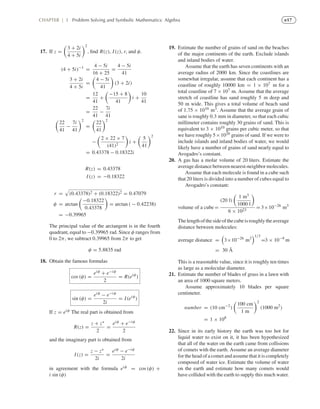
17. If z =
3 + 2i
4 + 5i
2
, find R(z), I(z), r, and φ.
(4 + 5i)−1
=
4 − 5i
16 + 25
=
4 − 5i
41
3 + 2i
4 + 5i
=
4 − 5i
41
(3 + 2i)
=
12
41
+
−15 + 8
41
i +
10
41
=
22
41
−
7i
41
22
41
−
7i
41
2
=
22
41
2
−
2 × 22 × 7
(41)2
i +
5
41
2
= 0.43378 − 0.18322i
R(z) = 0.43378
I(z) = −0.18322
r = (0.43378)2 + (0.18322)2 = 0.47079
φ = arctan
−0.18322
0.43378
= arctan ( − 0.42238)
= −0.39965
The principal value of the arctangent is in the fourth
quadrant, equal to −0.39965 rad. Since φ ranges from
0 to 2π, we subtract 0.39965 from 2π to get
φ = 5.8835 rad
18. Obtain the famous formulas
cos (φ) =
eiφ + e−iφ
2
= R(eiφ
)
sin (φ) =
eiφ − e−iφ
2i
= I(eiφ
)
If z = eiφ The real part is obtained from
R(z) =
z + z∗
2
=
eiφ + e−iφ
2
and the imaginary part is obtained from
I(z) =
z − z∗
2i
=
eiφ − e−iφ
2i
in agreement with the formula eiφ = cos (φ) +
i sin (φ)
19. Estimate the number of grains of sand on the beaches
of the major continents of the earth. Exclude islands
and inland bodies of water.
Assume that the earth has seven continents with an
average radius of 2000 km. Since the coastlines are
somewhat irregular, assume that each continent has a
coastline of roughly 10000 km = 1 × 10⁷ m for a
total coastline of 7 × 10⁷ m. Assume that the average
stretch of coastline has sand roughly 5 m deep and
50 m wide. This gives a total volume of beach sand
of 1.75 × 10¹⁰ m3. Assume that the average grain of
sane is roughly 0.3 mm in diameter, so that each cubic
millimeter contains roughly 30 grains of sand. This is
equivalent to 3 × 10¹⁰ grains per cubic meter, so that
we have roughly 5×10²⁰ grains of sand. If we were to
include islands and inland bodies of water, we would
likely have a number of grains of sand nearly equal to
Avogadro’s constant.
20. A gas has a molar volume of 20 liters. Estimate the
average distance between nearest-neighbor molecules.
Assume that each molecule is found in a cube such
that 20 liters is divided into a number of cubes equal to
Avogadro’s constant:
volume of a cube =
(20 l)
1 m3
1000 l
6 × 1023
= 3×10⁻²⁶
m3
Thelengthofthesideofthecubeisroughlytheaverage
distance between molecules:
average distance = 3×10⁻²⁶
m3
1/3
=3 × 10⁻⁹
m
= 30 Å
This is a reasonable value, since it is roughly ten times
as large as a molecular diameter.
21. Estimate the number of blades of grass in a lawn with
an area of 1000 square meters.
Assume approximately 10 blades per square
centimeter.
number = (10 cm−2
)
100 cm
1 m
2
(1000 m2
)
= 1 × 10⁸
22. Since in its early history the earth was too hot for
liquid water to exist on it, it has been hypothesized
that all of the water on the earth came from collisions
of comets with the earth. Assume an average diameter
for the head of a comet and assume that it is completely
composed of water ice. Estimate the volume of water
on the earth and estimate how many comets would
have collided with the earth to supply this much water.
e18 Mathematics for Physical Chemistry
Assume that an average comet has a spherical
nucleus 50 miles (80 kilometers) in radius. This
corresponds to a volume
V (comet) =
4
3
π(8 × 10⁴
m)3
= 2 × 10¹⁵
m3
The radius of the earth is roughly 6.4 × 10⁶ m, so its
surface area is
A = 4π(6.4 × 10⁶
m)2
= 5.1 × 10¹⁴
m2
Roughly 70% of the earth’s surface is covered by
water. Assume an average depth of 1.0 kilometer for
all bodies of water.
V (water) = (0.70)(5.1 × 10¹⁴
m2
)(1000 m)
= 3.6 × 10¹⁷
m3
Number of comets ≈
3.6 × 10¹⁷ m3
2 × 10¹⁵ m3
≈ 200
Chapter 4
Vectors and Vector Algebra
EXERCISES
Exercise 4.1. Draw vector diagrams and convince your-
self that the two schemes presented for the construction of
D = A − B give the same result.
Exercise 4.2. Find A − B if A = (2.50,1.50) and
B = (1.00,−7.50)
A − B = (1.50,9.00) = 1.50i + 9.00j
Exercise 4.3. Let |A| = 4.00,|B| = 2.00, and let the angle
between them equal 45.0◦. Find A · B.
A · B = (4.00)(2.00) cos (45◦
) = 8.00 × 0.70711 = 5.66.
Exercise 4.4. If A = (3.00)i − (4.00)j and B =
(1.00)i + (2.00)j.
a. Draw a vector diagram of the two vectors.
b. Find A · B and (2.00A) · (3.00B).
A · B = 3.00 × 1.00
+(−4.00)(2.00) = −5.00
(2A) · (3B) = 6(−5.00) = −30.00
Exercise 4.5. If A = 2.00i − 3.00 j and B = −1.00i +
4.00 j
a. Find |A| and |B|.
|A| = A =
√
4.00 + 9.00 = 3.606
|B| = B =
√
1.00 + 16.00 = 4.123
b. Find the components and the magnitude of 2.00A − B.
2.00A − B = i(4.00 + 1.00)+j(−6.00 + 4.00)
= i(5.00)+j(−2.00)
|2.00A − B| =
√
25.00 + 4.00 = 5.385
c. Find A · B.
A · B = (2.00)(−1.00) + (−3.00)(4.00) = −14.00
d. Find the angle between A and B.
cos (α) =
A · B
AB
=
−14.00
(3.606)(4.123)
= −0.94176
α = arccos (−0.94176) = 2.799 rad = 160.3◦
Exercise 4.6. Find the magnitude of the vector
A = (−3.00, 4.00, −5.00).
A =
√
9.00 + 16.00 + 25.00 =
√
50.00 = 7.07
Exercise 4.7. a. Find the Cartesian components of the
position vector whose spherical polar coordinates are
r = 2.00, θ = 90◦, φ = 0◦. Call this vector A.
x = 2.00
y = 0.00
z = r cos (θ) = 0.00
A = (2.00)i
b. Find the scalar product of the vector A from part a
and the vector B whose Cartesian components are
(1.00, 2.00, 3.00).
A · B = 2.00 + 0 + 0 = 2.00
Mathematics for Physical Chemistry. http://dx.doi.org/10.1016/B978-0-12-415809-2.00028-8
© 2013 Elsevier Inc. All rights reserved. e19
e20 Mathematics for Physical Chemistry
c. Find the angle between these two vectors. We must first
find the magnitude of B.
|B| = B =
√
1.00 + 4.00 + 9.00
=
√
14.00 = 3.742
cos (α) =
2.00
(2.00)(3.742)
= 0.26726
α = arccos (0.26726) = 74.5◦
= 1.300 rad
Exercise 4.8. From the definition, show that
A × B = −(B × A) .
This result follows immediately from the screw-thread
rule or the right-hand rule, since reversing the order of the
factors reverses the roles of the thumb and the index finger.
Exercise 4.9. Show that the vector C is perpendicular to B.
We do this by showing that B · C = 0.
B · C = BxCx + ByCy + BzCz
= −1 + 2 − 1 = 0.
Exercise 4.10. The magnitude of the earth’s magnetic
field ranges from 0.25 to 0.65 G (gauss). Assume that the
average magnitude is equal to 0.45 G, which is equivalent to
0.000045 T. Find the magnitude of the force on the electron
in the previous example due to the earth’s magnetic field,
assuming that the velocity is perpendicular to the magnetic
field.
|F| = F = (1.602 × 10⁻¹⁹
C)
×(1.000 × 10⁵
m s−1
)(0.000045 T)
= 7.210 × 10⁻¹⁹
A s m s−1
kg s−2
A−1
= 7.210 × 10⁻¹⁹
kg m s−2
= 7.210 × 10⁻¹⁹
N
Exercise 4.11. A boy is swinging a weight around his
head on a rope. Assume that the weight has a mass of
0.650 kg, that the rope plus the effective length of the boy’s
arm has a length of 1.45 m and that the weight makes
a complete circuit in 1.34 s. Find the magnitude of the
angular momentum, excluding the mass of the rope and that
of the boy’s arm. If the mass is moving counterclockwise
in a horizontal circle, what is the direction of the angular
momentum?
v =
2π(1.45 m)
1.34 s
= 6.80 m s−1
L = mvr = (0.650 kg)(6.80 m s−1
)
×(1.45 m) = 6.41 kg m2
s−1
By the right-hand rule, the angular momentum is vertically
upward.
PROBLEMS
1. Find A − B if A = 2.00i + 3.00 j and B = 1.00i +
3.00 j − 1.00k.
A − B = −1.00i + 2.00k.
2. An object of mass m = 10.0 kg near the surface
of the earth has a horizontal force of 98.0 N acting
on it in the eastward direction in addition to the
gravitational force. Find the vector sum of the two
forces (the resultant force). Let the gravitational force
be denoted by W and the eastward force be denoted by
F = (98.0 N)i. Denote the resultant force by R.
R = F + W = (98.0 N)i − mgk
= (98.0 N)i − (10.0 kg)(9.80 m s−2
)k
= (98.0 N)i − (98.0 kg m s−2
k
= (98.0 N)i − (98.0 N)k
The direction of this force is 45◦ from the vertical in
the eastward direction.
3. Find A · B if A = (0,2) and B = (2,0).
A · B = 0 + 0 = 0
4. Find |A| if A = 3.00i + 4.00 j − 5.00k.
|A| =
√
9.00 + 16.00 + 25.00 = 7.07
5. Find A · B if A = (1.00)i + (2.00) j + (3.00)k and
B = (1.00)i + (3.00) j − (2.00)k.
A · B = 1.00 + 6.00 − 6.00 = 1.00
6. Find A · B if A = (1.00,1.00,1.00) and B =
(2.00,2.00,2.00).
A · B = 2.00 + 2.00 + 2.00 = 6.00
7. Find A × B if A = (0.00,1.00,2.00) and B =
(2.00,1.00,0.00).
A × B = A × B = i(Ay Bz − Az By)
+ j(Az Bx − Ax Bz) + k(Ax By − Ay Bx )
= i(0.00 − 2.00) + j(4.00 − 0.00)
+ k(0.00 − 2.00)
= −2.00i + 4.00j − 2.00k
8. Find A × B if A = (1,1,1) and B = (2,2,2).
A × B = 0
e21CHAPTER | 4 Vectors and Vector Algebra
9. FindtheanglebetweenAandBifA = 1.00i+2.00 j+
1.00k and B = 1.00i − 1.00k.
A · B = 1.00 + 0 − 2.00 = −1.00
A =
√
1.00 + 4.00 + 1.00 =
√
6.00 = 2.4495
B =
√
1.00 + 1.00 =
√
2.00 = 1.4142
cos (α) =
−1.00
(2.4495)(1.4142)
= −0.28868
α = arccos (−0.28868) = 107◦
= 1.86 rad
10. Find the angle between A and B if A = 3.00i+2.00 j+
1.00k and B = 1.00i + 2.00 j + 3.00k.
A · B = 3.00 + 4.00 + 3.00 = 10.00
A =
√
9.00 + 4.00 + 1.00 =
√
14.00 = 3.7417
B =
√
1.00 + 4.00 + 9.00 =
√
14.00 = 3.7417
cos (α) =
10.00
(3.7417)(3.7417)
= 0.71429
α = arccos (0.71429) = 44.4◦
= 0.775 rad
11. A spherical object falling in a fluid has three forces
acting on it: (1) The gravitational force, whose
magnitude is Fg = mg, where m is the mass of the
object and g is the acceleration due to gravity, equal to
9.80 m s−2; (2) The buoyant force, whose magnitude
is Fb = mfg, where mf is the mass of the displaced
fluid, and whose direction is upward; (3) The frictional
force, which is given by Ff = −6πηrv, where r
is the radius of the object, v its velocity, and η the
coefficient of viscosity of the fluid. This formula for
the frictional forces applies only if the flow around
the object is laminar (flow in layers). The object is
falling at a constant speed in glycerol, which has a
viscosity of 1490 kg m−1 s−1. The object has a mass
of 0.00381 kg, has a radius of 0.00432 m, a mass of
0.00381 kg, and displaces a mass of fluid equal to
0.000337 kg. Find the speed of the object. Assume
that the object has attained a steady speed, so that the
net force vanishes.
Fz,total = 0 = −(0.00381 kg)(9.80 m s−2)
+ (0.000337 kg)(9.80 m s−2)
+ 6π(1490 kg m−1 s−1)(0.00432 m)v
v =
−(0.00381 kg)(9.80 m s−2)+(0.000337 kg)(9.80 m s−2)
6π(1490 kg m−1 s−1)(0.00432 m)
= 0.18 m s−1
12. An object has a force on it given by F = (4.75 N)i +
(7.00 N) j + (3.50 N)k.
a. Find the magnitude of the force.
F = (4.75 N)2 + (7.00 N)2 + (3.50 N)2
=
√
83.8125 = 915 N
b. Find the projection of the force in the x-y plane.
That is, find the vector in the x-y plane whose
head is reached from the head of the force vector
by moving in a direction perpendicular to the x-y
plane.
Fprojection = (4.75 N)i + (7.00 N)j
13. An object of mass 12.000 kg is moving in the x
direction. It has a gravitational force acting on it equal
to −mgk, where m is the mass of the object and g is
the acceleration due to gravity, equal to 9.80 m s−1.
There is a frictional force equal to (0.240 N)i. What
is the magnitude and direction of the resultant force
(the vector sum of the forces on the object)?
Ftotal = −(12.000 kg)(9.80 m s−1
)k + (0.240 N)i
= −(117.60 N)k + (0.240 N)i
Ftotal = (117.6 N)2 + (0.240 N)2 = 118 N
The angle between this vector and the negative z axis is
α = arctan
0.240
117.6
= 0.117◦
= 0.00294 rad
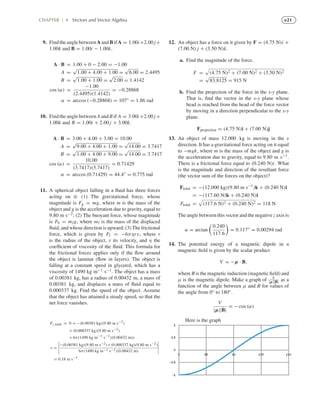
14. The potential energy of a magnetic dipole in a
magnetic field is given by the scalar product
V = −µ · B,
where B is the magnetic induction (magnetic field) and
μ is the magnetic dipole. Make a graph of V
|µ||B| as a
function of the angle between μ and B for values of
the angle from 0◦ to 180◦.
V
|µ||B|
= − cos (α)
Here is the graph
e22 Mathematics for Physical Chemistry
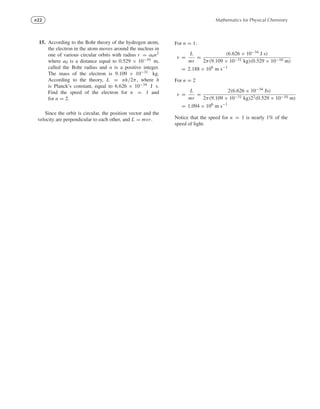
15. According to the Bohr theory of the hydrogen atom,
the electron in the atom moves around the nucleus in
one of various circular orbits with radius r = a0n2
where a0 is a distance equal to 0.529 × 10⁻¹⁰ m,
called the Bohr radius and n is a positive integer.
The mass of the electron is 9.109 × 10⁻³¹ kg.
According to the theory, L = nh/2π, where h
is Planck’s constant, equal to 6.626 × 10⁻³⁴ J s.
Find the speed of the electron for n = 1 and
for n = 2.
Since the orbit is circular, the position vector and the
velocity are perpendicular to each other, and L = mvr.
For n = 1:
v =
L
mr
=
(6.626 × 10⁻³⁴ J s)
2π(9.109 × 10⁻³¹ kg)(0.529 × 10⁻¹⁰ m)
= 2.188 × 10⁶
m s−1
For n = 2
v =
L
mr
=
2(6.626 × 10⁻³⁴ Js)
2π(9.109 × 10⁻³¹ kg)22(0.529 × 10⁻¹⁰ m)
= 1.094 × 10⁶
m s−1
Notice that the speed for n = 1 is nearly 1% of the
speed of light.
Chapter 5
Problem Solving and the Solution
of Algebraic Equations
EXERCISES
Exercise 5.1. Show by substitution that the quadratic
formula provides the roots to a quadratic equation.
For simplicity. we assume that a = 1.
−b ±
√
b2 − 4c
2
2
+ b
−b ±
√
b2 − 4c
2
+ c
=
b2
4
∓
b
√
b2 − 4c
2
+
b2 − 4c
4
−
b2
4
±
b
√
b2 − 4c
2
+ c = 0
Exercise 5.2. For hydrocyanic acid (HCN), Ka = 4.9 ×
10−10 at 25 ◦C. Find [H+] if 0.1000 mol of hydrocyanic
acid is dissolved in enough water to make 1.000 l. Assume
that activity coefficients are equal to unity and neglect
hydrogen ions from water.
x =
−Ka ± K2
a + 0.4000Ka
2
=
−4.9 × 10⁻¹⁰ ± 4.9 × 10⁻¹⁰ 2
+ (0.4000) 4.9 × 10⁻¹⁰
2
= 7.00 × 10⁻⁶ or − 7.00 × 10⁻⁶
[H+] = [A−] = 7.00 × 10⁻⁶ mol l−1.
Theneglectofhydrogenionsfromwaterisacceptable,since
neutral water provides 1 × 10⁻⁷ mol l−1 of hydrogen ions,
and will provide even less in the presence of the acid.
Exercise 5.3. Carry out the algebraic manipulations to
obtain the cubic equation in Eq. (5.9).
Ka = xy
y =
Ka
x
where we let y = [A−]/c◦. Since the ionization of water
and the ionization of the acid both produce hydrogen ions,
[HA]
c◦
=
c
c
◦ − x − y
Ka =
x x −
Kw
x
c
c◦
− x +
Kw
x
Ka
c
c◦
− x +
Kw
x
= x2
− Kw
Multiply this equation by x and collect the terms:
x3
+ Kax2
−
cKa
c◦
+ Kw x − Ka Kw = 0
Exercise 5.4. Solve for the hydrogen ion concentration
in a solution of acetic acid with stoichiometric molarity
equal to 0.00100 mol l−1. Use the method of successive
approximations.
For the first approximation
x2
= 1.754 × 10⁻⁵
(0.00100 − x)
≈ (1.754 × 10⁻⁵
)(0.00100) = 1.754 × 10⁻⁸
x ≈ 1.754 × 10−8 = 1.324 × 10⁻⁴
Mathematics for Physical Chemistry. http://dx.doi.org/10.1016/B978-0-12-415809-2.00029-X
© 2013 Elsevier Inc. All rights reserved. e23
e24 Mathematics for Physical Chemistry
For the next approximation
x2
= 1.754 × 10⁻⁵
(0.00100 − 1.324 × 10⁻⁴
)
≈ 1.754 × 10⁻⁵
(8.676 × 10⁻⁴
)
= 1.5217 × 10⁻⁸
x ≈ 1.5217 × 10−8 = 1.236 × 10⁻⁴
For the third approximation
x2
= (1.754 × 10⁻⁵
)(0.00100 − 1.236 × 10⁻⁴
)
≈ (1.754 × 10⁻⁵
)(8.7664 × 10⁻⁴
)
= 1.5376 × 10⁻⁸
x ≈ 1.5376 × 10−8 = 1.24 × 10⁻⁴
[H+
] = 1.24 × 10⁻⁴
mol l−1
Since the second and third approximations yielded nearly
the same answer, we stop at this point.
Exercise 5.5. Verify the prediction of the ideal gas
equation of state given in the previous example.
Vm =
V
n
=
RT
P
=
8.3145 J K−1 mol−1 (298.15 K)
1.01325 × 10⁶ Pa
= 2.447 × 10⁻³
m3
mol−1
Exercise 5.6. Substitute the value of the molar volume
obtained in the previous example and the given temperature
into the Dieterici equation of state to calculate the pressure.
Compare the calculated pressure with 10.00 atm =
1.01325 × 10⁶ Pa, to check the validity of the linearization
approximation used in the example.
Pea/Vm RT (Vm − b) = RT
P =
RT e−a/Vm RT
(Vm − b)
e−a/Vm RT = exp
⎡
⎣−
0.468 Pa m6 mol−2
2.30 × 10⁻³ m3 mol−1 8.3145 J K−1 mol−1 298.15 K
⎤
⎦
= e−8.208×10−2
= 0.9212
P =
RT e−a/Vm RT
(Vm − b)
=
8.3145 J K−1 mol−1 298.15 K 0.9212
2.30 × 10⁻³ m3 mol−1 − 4.63 × 10⁻⁵ m3 mol−1
= 1.013328 × 10⁶ Pa
which compares with 1.01325 × 10⁶ Pa.
Exercise 5.7. Find approximately the smallest positive
root of the equation
tan (x) − x = 0.
Since tan (x) is larger than x in the entire range from x = 0
to x = π, we look at the range from x = π to x = 2π.
By trial and error we find that the root is near 4.49. The
following graph of tan (x) − x shows that the root is near
x = 4.491.
Exercise 5.8. Using a graphical procedure, find the most
positive real root of the quartic equation:
x4
− 4.500x3
− 3.800x2
− 17.100x + 20.000 = 0
The curve representing this function crosses the x axis in
only two places. This indicates that two of the four roots
are complex numbers. Chemists are not usually interested
in complex roots to equations.
A preliminary graph indicates a root near x = 0.9 and
one near x = 5.5. The following graph indicates that the
root is near x = 5.608. To five significant digits, the correct
answer is x = 5.6079.
Exercise 5.9. Use the method of trial and error to find the
two positive roots of the equation
ex
− 3.000x = 0
to five significant digits. Begin by making a graph of the
function to find the approximate locations of the roots.
A rough graph indicates a root near x = 0.6 and a root
x = 1.5. By trial and error, values of 0.61906 and 1.5123
were found.
e25CHAPTER | 5 Problem Solving and the Solution of Algebraic Equations
Exercise 5.10. Use Excel to find the real root of the
equation
x3
+ 5.000x − 42.00 = 0
The result is that x = 3.9529.
Exercise 5.11. Write Mathematica expressions for the
following:
a. The complex conjugate of (10)e2.657i
10 Exp[−2.635 I]
b. ln (100!) − (100 ln (100) − 100)
Log[100!] − (100 Log[100] − 100]
c. The complex conjugate of (1 + 2i)2.5
(1+2I)ˆ2.5
Exercise 5.12. In the study of the rate of the chemical
reaction:
aA + bB → products
the quotient occurs:
1
([A]0 − ax)([B]0 − bx)
where [A]0 and [B]0 are the initial concentrations of A
and B, a and b are the stoichiometric coefficients of these
reactants, and x is a variable specifying the extent to which
the reaction has occurred. Write a Mathematica statement
to decompose the denominator into partial fractions.
In[1] : = Clear[x]
Apart 1/ A − a∗
x B − b∗
x
Exercise 5.13. Verify the real solutions in the preceding
example by substituting them into the equation.
The equation is
f (x) = x4
− 5x3
+ 4x2
− 3x + 2 = 0
By calculation
f (0.802307) = 8.3 × 10⁻⁷
f (4.18885) = 0.000182
By trial and error, these roots are correct to the number of
significant digits given.
Exercise 5.14. Use the NSolve statement in Mathematica
to find the numerical values of the roots of the equation
x3
+ 5.000x − 42.00 = 0
The result is
x =
⎧
⎪⎨
⎪⎩
3.00
−1.500 + 3.4278i
−1.500 − 3.4278i
Use the Find Root statement to find the real root of the same
equation.
The result is
x = 3.00
Exercise 5.15. Solve the simultaneous equations by the
method of substitution:
x2
− 2xy − x = 0
x + y = 0
We replace y in the first equation by −x:
x2
+ 2x2
− x = 3x2
− x = 0
This equation can be factored
x(3x − 1) = 0
This has the two solutions:
x =
⎧
⎨
⎩
0
1
3
The first solution set is
x = 0, y = 0
The second solution set is
x =
1
3
, y = −
1
3
Exercise 5.16. Solve the set of equations
3x + 2y = 40
2x − y = 10
We multiply the second equation by 2 and add it to the
first equation
7x = 60
x =
60
7
We substitute this into the second equation
120
7
− y = 10
y =
120
7
− 10 =
50
7
Substitute these values into the second equation to check
our work;
120
7
−
50
7
=
70
7
= 10
e26 Mathematics for Physical Chemistry
Exercise 5.17. Determine whether the set of equations has
a nontrivial solution, and find the solution if it exists:
5x + 12y = 0
15x + 36y = 0.
We multiply the first equation by 3, which makes it
identical with the second equation. There is a nontrivial
solution that gives y as a function of x. From the first
equation
y = −
5x
12
= −0.4167x
Exercise 5.18. Use Mathematica to solve the simultane-
ous equations
2x + 3y = 13
x − 4y = −10
The result is
x = 2
y = 3
PROBLEMS
1. Solve the quadratic equations:
a.
x2
− 3x + 2 = 0
(x − 2)(x − 1) = 0
x =
1
2
b.
x2
− 1 = 0
(x − 1)(x + 1) = 0
x =
1
−1
c.
x2
+ x + 2 = 0
x =
−1 ±
√
1 − 8
2
= −
1
2
±
√
7i
2
= 0.500 ± 1.323i
2. Solve the following equations by factoring:
a.
x3
+ x2
− x − 1 = 0
By carrying out a long division, we find that
x −1 is a factor and the other factor is x2 +2x +1,
so that the factors are
x3
+ x2
− x − 1 = (x − 1)(x + 1)2
The roots are
x =
⎧
⎪⎨
⎪⎩
1
−1
−1
b.
x4
− 1 = 0
This is factored as follows:
x4
− 1 = (x2
+ 1)(x2
− 1)
= (x + i)(x − i)(x + 1)(x − 1)
The roots are
x = −i, i, − 1, 1
3. Rewrite the factored quadratic equation
(x − x1)(x − x2) = 0 in the form
x2 − (x1 + x2)x + x1x2 = 0. Apply the quadratic
formula to this version and show that the roots are
x = x1 and x = x2.
x =
x1 + x2 ± (x1 + x2)2 − 4x1x2
2
=
x1 + x2 ± x2
1 + 2x12x + x2
2 − 4x1x2
2
=
x1 + x2 ± x2
1 − 2x12x + x2
2
2
=
x1 + x2 ± (x1 − x2)
2
=
x1 if + is chosen
x2 if − is chosen
4. The pH is defined for our present purposes as
pH = − log10 ([H+
]c◦
)
Find the pH of a solution formed from 0.0500 mol of
NH3 and enough water to make 1.000 l of solution.
The ionization that occurs is
NH3 + H2O NH+
4 + OH−
e27CHAPTER | 5 Problem Solving and the Solution of Algebraic Equations
The equilibrium expression in terms of molar
concentrations is
Kb =
([NH+
4 ]c◦)([OH−]/c◦)
x(H2O)([NH3]c◦)
≈
([NH+
4 ]/c◦)([OH−]/c◦)
([NH3]/c◦)
where x(H2O) represents the mole fraction of water,
which is customarily used instead of its molar
concentration. Since the mole fraction of the solvent
in a dilute solution is nearly equal to unity, we can
use the approximate version of the equation. The base
ionization constant of NH3, denoted by Kb, equals
1.80 × 10⁻⁵ at 25 ◦C.
1.80 × 10−5
=
x2
0.0500 − x
where we assume that OH− ions from water can be
neglected and where we let x = ([NH+
4 ]/c◦) =
([OH−]/c◦)
x2
= (1.80 × 10⁻⁵
)(0.0500 − x)
x2
≈ (1.80 × 10⁻⁵
)(0.0500) = 9.00 × 10=7
x ≈ 9.49 × 10−4
x2
≈ 1.80 × 10⁻⁵
0.0500 − 9.49 × 10−4
= 8.83 × 10=7
x ≈ 9.40 × 10⁻⁴
We stop the iteration at this point.
pOH = − log 9.40 × 10−4
= 3.03
pH = 14.00 − 3.03 = 10.97
5. The acid ionization constant of chloroacetic acid is
equal to 1.40 × 10⁻³ at 25 ◦C. Assume that activity
coefficients are equal to unity and find the hydrogen
ion concentration at the following stoichiometric
molarities.
a. 0.100 mol l−1
1.40 × 10−3
=
x2
0.100 − x
≈
x2
0.100
x ≈ 1.40 × 10⁻³
(0.100)
1/2
= 0.0118
x ≈ 1.40 × 10⁻³
0.100 − 0.0118
1/2
= 0.0111
x ≈ 1.40 × 10⁻³
(0.100 − 0.0111)
1/2
= 0.0112
[H+
] = 0.011 mol l−1
b. 0.0100 mol l−1
1.40 × 10−3
=
x2
0.0100 − x
≈
x2
0.0100
x ≈ [(1.40 × 10⁻³
)(0.0100)]1/2
= 0.00374
x ≈ [(1.40 × 10⁻³
)(0.0100
− 0.00374)]1/2
= 0.00296
x ≈ [(1.40 × 10⁻³
)(0.0100
− 0.00296)]1/2
= 0.00314
x ≈ [(1.40 × 10⁻³
)(0.0100
− 0.00314)]1/2
= 0.00310
[H+
] = 0.0031 mol l−1
6. Find the real roots of the following equations by
graphing:
a.
x3
− x2
+ x − 1 = 0
The only real root is x = 1.
b.
e−x
− 0.500x = 0
To four digits, the root is x = 0.8527.
e28 Mathematics for Physical Chemistry
c.
sin (x)/x − 0.75 = 0.
To four digits, the root is at x = 1.2755
7. Make a properly labeled graph of the function y(x) =
ln (x) + cos (x) for values of x from 0 to 2π
a.
b. Repeat part a using Mathematica.
8. When expressed in terms of “reduced variables” the
van der Waals equation of state is
Pr +
3
V 2
r
Vr −
1
3
=
8Tr
3
Pr =
8Tr
3 Vr − 1
3
−
3
V 2
r
a. Using Excel, construct a graph containing three
curves of Pr as a function of Vr: for the range
0.4  Vr  2: one for Tr = 0.6, one for Tr = 1,
and one for Tr = 1.4.
In this graph, Series 1 represents Tr = 0.6,
Series 2 represents Tr = 1, and Series 3 represents
Tr = 1.4.
b. Repeat part a using Mathematica.
9. Using a graphical method, find the two positive roots
of the following equation.
ex
− 3.000x = 0.
The following graph indicates a root near x = 0. 6 and
one near x = 1.5.
By trial and error, the roots are at x = 0.61906 and
x = 1.5123
10. The following data were taken for the thermal
decomposition of N2O3:
'

$
%
t/s 0 184 426 867 1877
[N2O3]/mol l−1
2.33 2.08 1.67 1.36 0.72
Using Excel, make three graphs: one with ln ([N2O3])
as a function of t, one with 1/[N2O3] as a function of t,
and one with 1/[N2O3]2 as a function of t. Determine
which graph is most nearly linear. If the first graph
is most nearly linear, the reaction is first order; if
the second graph is most nearly linear, the reaction
is second order, and if the third graph is most nearly
linear, the reaction is third order.
e29CHAPTER | 5 Problem Solving and the Solution of Algebraic Equations
Because of experimental error, it is a little difficult to
tell, but it appears that the plot of ln(c) is more nearly
linear, so the reaction is apparently first order.
11. Write an Excel worksheet that will convert a list of
distance measurements in meters to miles, feet, and
inches. If the length in meters is typed into a cell in
column A, let the corresponding length in miles appear
on the same line in column B, the length in feet in
column C, and the length in inches in column C. Here
is the result:
'

$
%
meters miles feet inches
1 0.000621371 3.28084 39.37007874
2 0.001242742 6.56168 78.74015748
5 0.003106855 16.4042 196.8503937
10 00.00621371 32.8084 393.7007874
100 0.0621371 328.084 3937.007874
12. The van der Waals equation of state is
P +
n2a
V 2
(V − nb) = nRT
where a and b are temperature-independent parame-
ters that have different values for each gas. For carbon
dioxide
a = 0.3640 Pa m6
mol−2
b = 4.267 × 10⁻⁵
m3
mol−1
a. Write the van der Waals equation of state as a cubic
equation in V.
PV +
n2a
V
− Pnb −
n3ab
V 2
= nRT
Multiply by V 2:
PV 3
+ n2
aV − PnbV 2
− n3
ab = nRT V 2
PV 3
− Pnb + nRT V 2
+ n2
aV − n3
ab = 0
b. Use the NSolve statement in Mathematica to find
the volume of 1.000 mol of carbon dioxide at P =
1.000 bar (100000 Pa) and T = 298.15 K. Notice
thattwoofthethreerootsarecomplex,andmustbe
ignored. Compare your result with the prediction
of the ideal gas equation of state.
(100000 Pa)V 3
− (100000 Pa)(4.267 × 10⁻⁵
m3
)
+ (8.3145 J K−1
)(298.15 K) V 2
+ (0.3640 Pa m6
)V
− (0.3640 Pa m6
)(4.267 × 10⁻⁵
m3
) = 0
All terms have the same units, so temporarily omit
the units and divide by 100000.
V 3
− 0.02483V 2
+ .00000364V
−1.55 × 10−10
= 0
V = 2.4683 × 10⁻²
m3
From the ideal gas equation
V −
nRT
P
=
(1.000 mol)(8.3145 J K−1 mol−1)(298.15 K)
100000 Pa
= 2.789 × 10⁻² m3
c. Use the Find Root statement in Mathematica to
find the real root in part b. The result is:
V = 2.4683 × 10⁻²
m3
e30 Mathematics for Physical Chemistry
d. Repeat part b for P = 10.000 bar (1.0000 ×
106 Pa) and T = 298.15 K. Compare your result
with the prediction of the ideal gas equation of
state.
(1000000 Pa)V 3
− [(1000000 Pa)(4.267 × 10⁻⁵
m3
)
+ (8.3145 J K−1
)(298.15 K)]V 2
+ (0.3640 Pa m6
)V − (0.3640 Pa m6
)
× (4.267 × 10⁻⁵
m3
) = 0
All terms have the same units, so temporarily omit
the units and divide by 1000000.
V 3
− 0.0025216V 2
+ .000000364V
−1.55 × 10−11
= 0
The real root is
V = 2.3708 × 10⁻³
m3
From the ideal gas equation
V −
nRT
P
=
(1.000 mol)(8.3145 J K−1 mol−1)(298.15 K)
1000000 Pa
= 2.789 × 10⁻³ m3
13. An approximate equation for the ionization of a weak
acid, including consideration of the hydrogen ions
from water is
[H+
]/co
= Kac/co + Kw,
where c is the gross acid concentration. This equation
is based on the assumption that the concentration
of unionized acid is approximately equal to the
gross acid concentration. Consider a solution of
HCN (hydrocyanic acid) with stoichiometric acid
concentration equal to 1.00 × 10⁻⁵ mol l−1. Ka =
4.0 × 10⁻¹⁰ for HCN. At this temperature, Kw =
1.00 × 10⁻¹⁴.
a. Calculate [H+] using this equation.
[H+
]/co
= (4.0 × 10⁻¹⁰)(1.00 × 10⁻⁵) + 1.00 × 10−14
= 1.18 × 10⁻⁷
≈ 1.2 × 10⁻⁷
Roughly 20% greater than the value in pure water.
b. Calculate [H+]/co using Eq. (5.9).
x3
+ 4.0 × 10−10
x2
− 1.00 × 10⁻⁵
4.0 × 10⁻¹⁰
+ 1.00
×10−14
x − 4.0 × 10⁻¹⁰
1.00 × 10−14
= 0
x3
+ 4.0 × 10−15
x2
− 1.00 × 10⁻¹⁴
x − 4.0 × 10−25
= 0
The solution is
x =
⎧
⎪⎨
⎪⎩
−4.0 × 10⁻¹¹
−9.9980 × 10⁻⁸
1.0002 × 10⁻⁷
We reject the negative roots and take [H+]/co =
1.0002×10⁻⁷, barely more than the value in pure
water.
14. Find the smallest positive root of the equation.
sinh (x) − x2
− x = 0.
A graph indicates a root near x = 3.4. By trial and
error, the root is found at x = 3.9925.
15. Solve the cubic equation by trial and error, factoring,
or by using Mathematica or Excel:
x3
+ x2
− 4x − 4 = 0
This equation can be factored:
(x + 1)(x − 2)(x + 2) = 0
The solution is:
x =
⎧
⎪⎨
⎪⎩
−2
−1
2
16. Find the real root of the equation
x2
− e−x
= 0
The solution is:
x = 0.70347
17. Find the root of the equation
x − 2.00 sin (x) = 0
By trial and error, the solution is
x = 1.8955
e31CHAPTER | 5 Problem Solving and the Solution of Algebraic Equations
18. Find two positive roots of the equation
ln (x) − 0.200x = 0
A graph indicates roots near x = 1.3 and x = 13. The
roots are
x =
1.2959
12.713
19. Find the real roots of the equation
x2
− 2.00 − cos (x) = 0
A graph indicates roots near x = ±1.4. By trial and
error, the roots are
x = ±1.4546
20. In the theory of blackbody radiation, the following
equation
x = 5(1 − e−x
)
needs to be solved to find the wavelength of maximum
spectral radiant emittance. The variable x is
x =
hc
λmaxkBT
where λmax is the wavelength of maximum spectral
radiant emittance, h is Planck’s constant, c is the speed
of light, kB is Boltzmann’s constant, and T is the
absolute temperature. Solve the equation numerically
foravalueofx.Findthevalueofλmax for T = 5800 K.
In what region of the electromagnetic spectrum does
this value lie?
A graph indicates a root near x = 4.96. By trial
and error, the solution is
x = 4.965
λmax =
hc
xkBT
=
(6.6260755 × 10⁻³⁴ J s)(2.99792458 × 10⁸ m s−1)
(4.965)(1.3806568 × 10⁻²³J K−1)(5800 K)
= 4.996 × 10⁻⁷ m = 499.6 nm
This lies in the blue-green region of the visible
spectrum.
21. Solve the simultaneous equations by hand, using the
method of substitution:
x2
+ x + 3y = 15
3x + 4y = 18
Use Mathematica to check your result. Since the first
equation is a quadratic equation, there will be two
solution sets.
y =
18 − 3x
4
Substitute this into the first equation
x2
+ x + 3
18 − 3x
4
= 15
x2
+ 1 −
9
4
x +
54
4
= 15
x2
− 1.25x + 13.5 = 15
x2
− 1.25x − 1.50 = 0
4x2
− 5x − 6 = 0
x =
5 ±
√
25 + 96
8
=
5 ±
√
121
8
x =
5 ± 11
8
=
⎧
⎨
⎩
2
−
3
4
Check the x = −3/4 value:
4
9
16
− 5
3
4
− 6 =
For x = 2
y =
18 − 6
4
= 3
For x = −3/4
y =
18 + 9/4
4
=
18 + 2.25
4
= 5.0625
Check this
9
16
−
3
4
+ 3(5.0625) = 15
22. Stirling’s approximation for ln (N!) is
ln (N!) ≈
1
2
ln (2π N) + N ln (N) − N
Determine the validity of this approximation and
of the less accurate version
ln (N!) ≈ N ln (N) − N
forseveralvaluesofNupto N = 100.Useacalculator,
Excel, or Mathematica. Here are a few values
'

$
%
N ln (N!) 1
2 ln (2πN) + N N ln (N) − N
ln (N) − N
5 4.787491743 4.770847051 3.047189562
10 15.10441257 15.09608201 13.02585093
50 148.477767 148.4761003 145.6011503
100 363.7393756 363.7385422 360.5170186
e32 Mathematics for Physical Chemistry
23. The Dieterici equation of state is
Pea/Vm RT
(Vm − b) = RT ,
where P is the pressure, T is the temperature, Vm is
the molar volume, and R is the ideal gas constant.
The constant parameters a and b have different
values for different gases. For carbon dioxide, a =
0.468 Pa m6 mol−2, b = 4.63 × 10⁻⁵ m3 mol−1.
Without linearization, find the molar volume of carbon
dioxide if T = 298.15 K and P = 10.000 atm =
1.01325 × 10⁶ Pa. Use Mathematica, Excel, or trial
and error.
(1.01325 × 10⁶
Pa)
exp
0.468 Pa m6 mol−2
Vm(8.3145 J K−1 mol−1)(298.15 K)
× (Vm − 4.63 × 10⁻⁵
m3
mol−1
)
= (8.3145 J K−1
mol−1
)(298.15 K)
Divide this equation by (1.01325 × 10⁶ Pa) and
ignore the units
exp
0.468 Pa m6 mol−2
Vm(8.3145 J K−1 mol−1)(298.15 K
× (Vm − 4.63 × 10⁻⁵
m3
mol−1
)
=
(8.3145J K−1 mol−1)(298.15 K)
(1.01325 × 10⁶ Pa)
exp
0.00018879
Vm
(Vm − 4.63 × 10⁻⁵
) − 0.00244655 = 0
Using trial and error with various values of Vm we seek
a value so that this quantity vanishes. The result was
Vm = 0.0023001 m3
mol−1
Compare this with the ideal gas value:
Vm =
RT
P
=
(8.3145J K−1mol−1)(298.15 K)
(1.01325 × 10⁶ Pa)
= 0.002447 m3
mol−1
24. Determine which, if any, of the following sets of
equations are inconsistent or linearly dependent. Draw
a graph for each set of equations, showing both
equations. Find the solution for any set that has a
unique solution.
a.
x + 3y = 4
2x + 6y = 8
These equations are linearly dependent, since the
second equation is equal to twice the first equation
b.
3x1 + 4x2 = 10
4x1 − 2x2 = 6
Try the method of substitution. From the second
equation
x = 8 − 2y
Substitute this into the first equation
2(8 − 2y) + 4y = 24
0 = 8
The equations are inconsistent
c.
3x1 + 4x2 = 10
4x1 − 2x2 = 6
Solve the second equation for x2 and substitute
the result into the first equation:
x2 = 2x1 − 3
3x1 + 4 2x1 − 3 = 10
11x1 = 22
x1 = 2
6 + 4x2 = 10
x2 = 1
25. Solve the set of equations using Mathematica or by
hand with the method of substitution:
x2
− 2xy + y2
= 0
2x + 3y = 5
To solve by hand we first solve the quadratic equation
for y in terms of x. The equation can be factored into
two identical factors:
x2
− 2xy + y2
= x − y
2
= 0
Both roots of the equation are equal:
y = x
We substitute this into the second equation
2x + 3y = 5x = 5
x = 1
The final solution is
x = 1
y = 1
e33CHAPTER | 5 Problem Solving and the Solution of Algebraic Equations
Since the two roots of the quadratic equal were equal
to each other, this is the only solution.
Alternate solution: Solve the second equation for y
y =
5 − 2x
3
x2
− 2x
5 − 2x
3
+
5
3
−
2x
3
2
= 0
x2
−
10x
3
+
4x2
3
+
25
9
−
20x
9
+
4x2
9
= 0
25
9
x2
−
50
9
x +
25
9
= 0
Multiply by 9/25
x2
− 2x + 1 = 0
This equation can be factored to give two identical
factors, leading to two equal roots:
(x − 1)2
= 0
x = 1
This gives
2 + 3y = 5
y = 1
Chapter 6
Differential Calculus
EXERCISES
Exercise 6.1. Using graph paper plot the curve represent-
ing y = sin (x) for values of x lying between 0 and π/2
radians. Using a ruler, draw the tangent line at x = π/4.
By drawing a right triangle on your graph and measuring
its sides, find the slope of the tangent line.
Your graph should look like this:
The slope of the tangent line should be equal to
√
2
2 =
0.70717 · · ·
Exercise 6.2. Decide where the following functions are
differentiable.
a.
y =
1
1 − x
This function has an infinite discontinuity at x = 1 and
is not differentiable at that point. It is differentiable
everywhere else.
b.
y = x + 2
√
x
This function has a term, x, that is differentiable
everywhere, and a term 2
√
x, that is differentiable only
for x ≺ 0.
c.
y = tan (x)
Thisfunctionisdifferentiableexceptat x = π/2,3π/2,
5π/2, . . .
Exercise 6.3. The exponential function can be represented
by the following power series
ebx
= 1 + bx +
1
2!
b2
x2
+
1
3!
b3
x3
+ · · · +
1
n!
bn
xn
· · ·
where the ellipsis (· · ·) indicates that additional terms
follow. The notation n! stands for n factorial, which is
defined to equal n(n − 1)(n − 2) · · · (3)(2)(1) for any
positive integral value of n and to equal 1 for n = 0. Derive
the expression for the derivative of ebx from this series.
d
dx
1 + bx +
1
2!
b2
x2
+
1
3!
b3
x3
+ · · · +
1
n!
bn
xn
· · ·
= b + 2
1
2!
b2
x + 3
1
3!
b3
x2 + · · · + n
1
n!
bn
xn−1
· · ·
= b 1 + bx +
1
2!
b2
x2
+
1
3!
b3
x3
+ · · · +
1
n!
bn
xn
· · ·
= bebx
Exercise 6.4. Draw rough graphs of several functions from
Table 6.1. Below each graph, on the same sheet of paper,
make a rough graph of the derivative of the same function.
Solution not given here.
Exercise 6.5. Assume that y = 3.00x2 − 4.00x + 10.00.
If x = 4.000 and x = 0.500, Find the value of y using
Eq. (6.2). Find the correct value of y
y ≈
dy
dx
x = (6.00x − 4.00)(0.500)
×(24.00 − 4.00)(0.500) = 10.00
Mathematics for Physical Chemistry. http://dx.doi.org/10.1016/B978-0-12-415809-2.00030-6
© 2013 Elsevier Inc. All rights reserved. e35
e36 Mathematics for Physical Chemistry
Now we compute the correct value of y:
y(4.500) = (3.00)(4.5002
) − (4.00)(4.500) + 10.00
= 52.75
y(4.000) = (3.00)(4.0002
) − (4.00)(4.000) + 10.00
= 42.00
y = y(4.500) − y(4.00) = 52.75 − 42.00
= 10.75
Our approximation was wrong by about 7.5%.
Exercise 6.6. Find the following derivatives. All letters
stand for constants except for the dependent and
independent variables indicated.
a.
dy
dx
, where y = (ax2 + bx + c)−3/2
d
dx
(ax2
+bx+c)−3/2
= −
3
2
2ax + b
(ax2 + bx + c)−5/2
b.
d ln (P)
dT
, where P = ke−Q/T
ln (P) = ln (k) −
Q
T
d ln (P)
dT
= −
d(Q/T )
dT
=
Q
T 2
c.
dy
dx
, where y = a cos (bx3)
d
dx
a cos (bx3
) = −a sin (bx3
)(3bx2
)
= −3abx2
sin (bx3
)
Exercise 6.7. Carry out Newton’s method by hand to find
the smallest positive root of the equation
1.000x2
− 5.000x + 1.000 = 0
d f
dx
= 2.000x − 5.000
A graph indicates a root near x = 0.200. we take x0 =
0.2000.
x1 = x0 −
f (x0)
f (1)(x0)
f (0.2000) = 0.04000 − (5.000)(0.200) + 1.000
= 0.04000
f (1)
(0.2000) = (2.000)(0.2000) − 5.000 = −4.600
x1 = 0.2000−
0.04000
−4.600
= 0.2000+0.008696 = 0.208696
x2 = x1 −
f (x1)
f (1)(x1)
f (0.208696) = 0.043554 − (5.000)(0.208696)
+ 1.000 = 0.000074
f (1)
(0.208696) = 2(0.208696) − 5.000 = −4.58261
x2 = 0.208696 +
0.000074
4.58261
= 0.20871
We discontinue iteration at the point, since the second
approximation does not differ significantly from the first
approximation. This is the correct value of the root to five
significant digits.
Exercise 6.8. Find the second and third derivatives of
the following functions. Treat all symbols except for the
specified independent variable as constants.
a. y = y(x) = axn
dy
dx
= anxn−1
d2 y
dx2
= an(n − 1)xn−2
d3 y
dx3
= an(n − 1)(n − 2)xn−3
b. y = y(x) = aebx
dy
dx
= abebx
d2 y
dx2
= ab2
ebx
a
d3 y
dx3
= ab3
ebx
Exercise 6.9. Find the curvature of the function y =
cos (x) at x = 0 and at x = π/2.
dy
dx
= − sin (x)
d2 y
dx2
= − cos (x)
K =
d2 y/dx2
1 +
dy
dx
2 3/2
=
− cos (x)
1 + ( sin (x))2 3/2
at x = 0
K =
−1
13/2
= −1
at x = π/2.
K =
0
23/2
= 0
Exercise 6.10. For the interval −10  x  10, find the
maximum and minimum values of
y = −1.000x3
+ 3.000x2
− 3.000x + 8.000
e37CHAPTER | 6 Differential Calculus
We take the first derivative:
dy
dx
= −3.000x2
+ 6.000x − 3.000
= −3.000(x2
− 2.000x + 1.000)
= −3.000(x − 1.000)2
= 0 if x = 1
We test the second derivative to see if we have a relative
maximum, a relative minimum, or an inflection point:
d2 y
dx2
= −6.000x + 6.000
= 0 if x = 1.000
The point x = 1.000 is an inflection point. The possible
maximum and minimum values are at the ends of the
interval
ymax = y(−10.000) = 1538
ymin = y(10.000) = −522
The maximum is at x = −10 and the minimum is at x = 10.
Exercise 6.11. Find the inflection points for the function
y = sin (x). The inflection points occur at points where the
second derivative vanishes.
dy
dx
= cos (x)
d2 y
dx2
= − sin (x)
d2 y
dx2
= 0 when x = ±0, ± π, ± 2π, ± 3π, . . .
Exercise 6.12. Decide which of the following limits exist
and find the values of those that do exist.
a. limx→π/2[x tan (x)] This limit does not exist, since
tan (x) diverges at x = π/2.
b. limx→0[ln (x)]. This limit does not exist, since ln (x)
diverges at x = 0.
Exercise 6.13. Find the value of the limit:
lim
x→0
tan (x)
x
We apply l’Hôpital’s rule.
lim
x→0
tan (x)
x
= lim
x→0
d tan (x)dx
dx/dx
= lim
x→0
sec2 (x)
1
= lim
x→0
1
cos2 (x)
= 1
Exercise 6.14. Investigate the limit
lim
x→∞
(x−n
ex
)
for any finite value of n.
lim
x→∞
(x−n
ex
) = lim
x→∞
ex
xn
= lim
x→∞
ex
nxn−1
Additional applications of l’Hôpital’s rule give decreasing
powers of x in the denominator times n(n − 1)(n − 2) · · ·,
until we reach a denominator equal to the derivative of a
constant, which is equal to zero. The limit does not exist.
Exercise 6.15. Find the limit
lim
x→∞
ln (x)
√
x
.
We apply l’Hôpital’s rule.
lim
x→∞
ln (x)
√
x
= lim
x→∞
1/x
x−1/2
= lim
x→∞
x1/2
x
= lim
x→∞
1
√
x
= 0
Exercise 6.16. Find the limit
lim
ν→∞
Nhν
ehν/kBT − 1
We apply Hôpital’s rule
lim
ν→∞
Nhν
ehν/kBT − 1
= lim
ν→∞
Nh
h
kBT ehν/kBT
lim
ν→∞
NkBT
ehν/kBT
= 0
Notice that this is the same as the limit taken as T → 0.
PROBLEMS
1. The sine and cosine functions are represented by the
two series
sin (x) = x −
x3
3!
+
x5
5!
−
x7
7!
+ · · ·
cos (x) = 1 −
x2
2!
+
x4
4!
−
x6
6!
+ · · ·
Differentiate each series to show that
d sin (x)
dx
= cos (x)
and
d cos (x)
dx
= − sin (x)
The derivative of the first series is
d sin (x)
dx
= 1 −
2x2
3!
+
5x4
5!
−
yx6
7!
+ · · ·
= 1 −
x2
2!
+
x4
4!
−
x6
6!
+ · · ·
e38 Mathematics for Physical Chemistry
The derivative of the second series is
d cos (x)
dx
= −
2x
2!
+
4x3
4!
−
6x5
6!
+ · · ·
= − 1 −
x2
2!
+
x4
4!
−
x6
6!
+ · · · .
2. The natural logarithm of 1 + x is represented by the
series
ln (1 + x) = x −
x2
2
+
x3
3
−
x4
4
· · ·
(valid for x2
 1 and x = 1).
Use the identity
d ln (x)
dx
=
1
x
.
to find a series to represent 1/(1 + x).
d ln (1 + x)
dx
=
1
1 + x
=
d
dx
x −
x2
2
+
x3
3
−
x4
4
· · ·
= 1 − x + x2
− x3
+ · · ·
3. Use the definition of the derivative to derive the
formula
d(yz)
dx
= y
dz
dx
+ z
dy
dx
where y and z are both functions of x.
d(yz)
dx
= lim
x2→x1
y(x2)z(x2) − y(x1)z(x1)
x2 − x1
Work backwards from the desired result:
y
dz
dx
+ z
dy
dx
= lim
x2→x1
y
z(x2) − z(x1)
x2 − x1
+ lim
x2→x1
z
y(x2) − y(x1)
x2 − x1
= lim
x2→x1
y(x2)z(x2) − y(x2)z(x1)
x2 − x1
+ lim
x2→x1
z
y(x2)z(x1) − y(x1)z(x1)
x2 − x1
Two terms cancel:
y
dz
dx
+ z
dy
dx
= lim
x2→x1
y(x2)z(x2) − y(x1)z(x1)
x2 − x1
4. The number of atoms of a radioactive substance at time
t is given by
N(t) = Noe−t/τ
,
where No is the initial number of atoms and τ is
the relaxation time. For 14C, τ = 8320 y. Calculate
the fraction of an initial sample of 14C that remains
after 15.00 years, using Equation (6.10). Calculate the
correct fraction and compare it with your first answer.
N ≈
dN
dt
t = . −
No
τ
e−t/τ
t
N
N0
≈ −
1
8320y
e0
(15.00y)
= 0.001803
Fraction remaining ≈ 1.000000 − 0.001202
= 0.998197
Fraction remaining = .e−t/τ
= exp
−15.00
8320
= 0.998199
5. Find the first and second derivatives of the following
functions
a. P = P(Vm) = RT 1/Vm + B/V 2
m + C/V 3
m
where R, B, and C are constants
dP
dVm
= RT −1/V 2
m − 2B/V 3
m − 3C/V 4
m
d2 P
dV 2
m
= RT 2/V 3
m + 6B/V 4
m + 12C/V 5
m
b. G = G(x) = G◦ + RT x ln (x) + RT (1 − x) ln
(1 − x), where G◦, R, and T are constants
dG
dx
= RT [1 + ln (x)] + RT [−1 − ln (1 − x)]
d2G
dx2
= RT
1
x
+ RT
1
1 − x
c. y = y(x) = a ln (x1/3)
dy
dx
=
a
x1/3
1
3
x−2/3
=
a
3x
6. Find the first and second derivatives of the following
functions:
a. y = y(x) = 3x3 ln (x)
dy
dx
= 3x2
+ 9x2
ln x
d2 y
dx2
= 15x + 18x ln x
b. y = y(x) = 1/(c − x2)
dy
dx
=
2x
(c − x2)2
d2 y
dx2
=
2
(c − x2)2
+ 4x
2x
(c − x2)3
=
2
(c − x2)2
+
8x2
(c − x2)3
e39CHAPTER | 6 Differential Calculus
c. y = y(x) = ce−a cos (bx), where a, b, and c are
constants
dy
dx
= ce−a cos (bx)
[ab sin (bx)]
d2 y
dx2
= ce−a cos (bx)
[ab2
cos (bx)]
+ ce−a cos (bx)
[ab sin (bx)]2
7. Find the first and second derivatives of the following
functions.
a. y =
1
x
1
1 + x
dy
dx
= −
1
x2
1
1 + x
−
1
x
1
(1 + x)2
= 2
1
x3
1
1 + x
+
1
x2
1
(1 + x)2
+
1
x2
1
(1 + x)2
+ 2
1
x
1
(1 + x)3
= 2
1
x3
1
1 + x
+ 2
1
x2
1
(1 + x)2
+ 2
1
x
1
(1 + x)3
b. f = f (v) = ce−mv2/(2kT ) where m, c, k, and T
are constants
d f
dv
= −ce−mv2/(2kT ) 2mv
2kT
= −ce−mv2/(2kT ) mv
kT
d2 f
dv2
= ce−mv2/(2kT ) mv
kT
2
− ce−mv2/(2kT ) m
kT
8. Find the first and second derivatives of the following
functions.
a. y = 3 sin2 (2x) = 3 sin (2x)2
dy
dx
= 12 sin (2x) cos 2x)
d2 y
dx2
= 24 cos2
2x − 24 sin2
2x
b. y = a0 +a1x +a2x2 +a3x3 +a4x4 +a5x5, where
a0, a1, and so on, are constants
dy
dx
= a1 + 2a2x + 3a3x2
+ 4a4x3
+ 5a5x4
d2 y
dx2
= 2a2 + 6a3x + 12a4x2
+ 20a5x3
c. y = a cos (e−bx ), where a and b are constants
dy
dx
= ab sin (e−bx
)e−bx
d2 y
dx2
= −ab2
e−xb
sin (e−xb
)
− ab2
e−2xb
( cos (e−xb
))
9. Find the second and third derivatives of the following
functions. Treat all symbols except for the specified
independent variable as constants.
a. vrms = vrms(T ) = 3RT
M
dvrms
dT
=
1
2
3RT
M
−1/2
d2vrms
dT 2
= −
1
2
1
2
3RT
M
−3/2
= −
1
4
3RT
M
−3/2
d3vrms
dT 3
=
1
4
3
2
3RT
M
−5/2
=
3
8
3RT
M
−5/2
b. P = P(V ) =
nRT
(V − nb)
−
an2
V 2
dP
dV
= −
nRT
(V − nb)2
+ 2
an2
V 3
d2 P
dV 2
= 2
nRT
(V − nb)3
− 6
an2
V 4
d3 P
dV 3
= −6
nRT
(V − nb)4
+ 24
an2
V 5
10. Find the following derivatives and evaluate them at the
points indicated.
a. (dy/dx)x=0 if y = sin (bx), where b is a constant
dy
dx
= b cos (bx)
dy
dx x=0
= b cos (0) = b
b. (d f /dt)t=0 if f = Ae−kt , where A and k are
constants
d f
dt
= −Ake−kt
d f
dt t=0
= −Ake0
= −Ak
e40 Mathematics for Physical Chemistry
11. Find the following derivatives and evaluate them at the
points indicated.
a. (dy/dx)x=1, if y = (ax3 + bx2 + cx + 1)−1/2,
where a, b, and c are constants
dy
dx
=
−1
2
(ax3
+ bx2
+ cx + 1)−3/2
× (3ax2
+ 2bx + c)
dy
dx x=1
=
−1
2
(a + b + c + 1)−3/2
(3a + 2b + c)
b. (d2 y/dx2)x=0, if y = ae−bx , where a and b are
constants.
dy
dx
= −abe−bx
d2 y
dx2
= ab2
e−bx
d2 y
dx2
x=0
= ab2
12. Find the following derivatives
a.
d(yz)
dx
, where y = ax2, z = sin (bx)
d(yz)
dx
=
d
dx
[ax2
sin (bx)]
= abx2
cos (bx) + 2ax sin (bx)
b.
dP
dV
, where P =
nRT
(V − nb)
−
an2
V 2
dP
dV
= −
nRT
(V − nb)2
+ 2
an2
V 3
c.
dη
dλ
, where η =
2πhc2
λ5(ehc/λkT − 1)
dη
dλ
=
d
dλ
[2πhc2
λ−5
(ehc/λkT
− 1)−1
]
= −10πhc2
λ−6
(ehc/λkT
− 1)−1
− 2πhc2
λ−5
(ehc/λkT
− 1)−2
× ehc/λkT
−
hc
λ2kT
= −
10πhc2
λ6(ehc/λkT − 1)
−
2πh2c3ehc/λkT
λ7kT (ehc/λkT − 1)2
13. Find a formula for the curvature of the function
P(V ) =
nRT
V − nb
−
an2
V 2
.
where n, R, a, b, and T are constants
K =
d2 y/dx2
[1 + (dy/dx)2]3/2
dP
dV
= −
nRT
(V − nb)2
+ 2
an2
V 3
d2 P
dV 2
= 2
nRT
(V − nb)3
− 6
an2
V 4
K =
2
nRT
(V − nb)3
− 6
an2
V 4
1 + −
nRT
(V − nb)2
+ 2
an2
V 3
2 3/2
14. The volume of a cube is given by
V = V (a) = a3
,
where a is the length of a side. Estimate the percent
error in the volume if a 1.00% error is made in
measuring the length, using the formula
V ≈
dV
da
a.
Check the accuracy of this estimate by comparing
V (a) and V (1.01a).
V
V
≈
1
V
dV
da
a
=
1
V
(3a2
) a =
1
a3
(3a2
) a
=
3 a
a
= 0.0300
V (1.0100) − V (1.000)
V (1.000)
=
(1.0100)3 − 1.0000
1.00000
= 0.030301
15. Draw a rough graph of the function
y = y(x) = e−|x|
Your graph of the function should look like this:
e41CHAPTER | 6 Differential Calculus
Is the function differentiable at x = 0? Draw a rough
graph of the derivative of the function.
dy
dx
=
−e−x if x 0
ex if x 0
The function is not differentiable at x = 0. Your graph
of the derivative should look like this:
16. Draw a rough graph of the function
y = y(x) = sin (|x|)
y =
sin (− x) if x ≺ 0
sin (x) if x ≺ 0
Your graph should look like this:
Is the function differentiable at x = 0? The function
is not differentiable at x = 0. Draw a rough graph
of the derivative of the function. The derivative of the
function is
dy
dx
=
− cos (−x) = − cos (x) if x ≺ 0
cos (x) if x ≺ 0
Your graph of the derivative should look like this:
17. Draw a rough graph of the function
y = y(x) = cos (|x|)
Is the function differentiable at x = 0? Since the
cosine function is an even function
cos (|x|) = cos (x)
The function is differentiable at all points. Draw a
rough graph of the derivative of the function, your
graph of the function should look like a graph of the
cosine function:
18. Show that the function ψ = ψ(x) = A sin (kx)
satisfies the equation
d2ψ
dx2
= −k2
ψ
if A and k are constants.
dψ
dx
= Ak cos (kx)
d2ψ
dx2
= −Ak2
sin (kx) = −k2
ψ
19. Show that the function ψ(x) = cos (kx) satisfies the
equation
d2ψ
dx2
= −k2
ψ
if A and k are constants.
dψ
dx
= −k sin (kx)
d2ψ
dx2
= −k2
cos (kx) = −k2
ψ
e42 Mathematics for Physical Chemistry
20. Draw rough graphs of the third and fourth derivatives
of the function whose graph is given in Fig. 6.6.
21. The mean molar Gibbs energy of a mixture of two
enantiomorphs(opticalisomersofthesamesubstance)
is given at a constant temperature T by
Gm = Gm(x)
= G◦
m + RT x ln (x) + RT (1 − x) ln (1 − x)
where x is the mole fraction of one of them. G
◦
m is
a constant, R is the ideal gas constant, and T is the
constant temperature. What is the concentration of
each enantiomorph when G has its minimum value?
What is the maximum value of G in the interval
0 x 1?
dGm
dx
= RT [1 + ln (x)] + RT [−1 − ln (1 − x)]
This derivative vanishes when
1 + ln (x) − 1 − ln (1 − x) = 0
ln (x) − ln (1 − x) = 0
ln
x
1 − x
= 0
x
1 − x
= 1
x = 1 − x
x =
1
2
The minimum occurs at x = 1/2. There is no
relative maximum. To find the maximum, consider the
endpoints of the interval:
Gm(0) = G
◦
m + RT lim
x→0
[x ln (x)]
Apply l’Hôpital’s rule
lim
x→0
ln (x)
x−1
= lim
x→0
1/x
−1/x2
= lim
x→0
(x) = 0
The same value occurs at x = 1, since 1 − x plays
the same role in the function as does x. The maximum
value of the function is
Gm(0) = Gm(1) = G
◦
m
22. A rancher wants to enclose a rectangular part of a
large pasture so that 1.000 km2 is enclosed with the
minimum amount of fence.
a. Find the dimensions of the rectangle that he should
choose. The area is
A = xy
but A is fixed at 1.000 km2, so that y = A/x. The
perimeter of the area is
p = 2x + 2y = 2x +
2A
x
To minimize the perimeter, we find
dp
dx
= 2 −
2A
x2
= 0
x2
= A
x =
√
A = 1.000 km = 1000 m
The area is a square.
b. The rancher now decides that the fenced area must
lie along a road and finds that the fence costs
$20.00 per meter along the road and $10.00 per
meter along the other edges. Find the dimensions
of the rectangle that would minimize the cost of
the fence. The cost of the fence is
c = ($20.00)x +
($10.00)A
x
dc
dx
= $20.00 −
($10.00)A
x2
x2
=
($10.00)A
($20.00)2
= 0.025A
x = 0.1581
√
A = 0.1581(1000 m) = 158 m
The area has 158 m along the road, and 6325 m
in the other direction.
23. The sum of two nonnegative numbers is 100. Find their
values if their product plus twice the square of the first
is to be a maximum. We denote the first number by x
and let
f = x(100 − x) + 2x2
d f
dx
= 100 − 2x + 4x = 100 + 2x
At an extremum
0 = 100 + 2x
This corresponds to x = −50. Since we specified that
the numbers are nonzero, we inspect the ends of the
region.
f (0) = 0
f (100) = 20000
The maximum corresponds to x = 100.
e43CHAPTER | 6 Differential Calculus
24. A cylindrical tank in a chemical factory is to contain
2.000 m3 of a corrosive liquid. Because of the cost of
the material, it is desirable to minimize the area of the
tank. Find the optimum radius and height and find the
resultingarea.Welettheradiusberandtheheightbeh.
V = πr2
h = 2.000 m3
h =
2.000 m3
πr2
A = 2πr2
+ 2πrh
= 2πr2
+ 2πr
V
πr2
= 2πr2
+
2V
r
To minimize A we let
dA
dr
= 4πr −
2V
r2
= 0
r3
=
2V
4π
=
V
2π
=
1.000 m3
π
= 0.3183 m3
r = (0.3183 m3
)1/3
= 0.6828 m
h =
2.000 m3
π(0.6828 m)2
= 1.366 m
A = 2π(0.6828 m)2
+ 2π(0.6828 m)(1.366 m)
= 2.929 m3
+ 5.860 m3
= 8.790 m3
V = πr2
h = π(0.6828 m)2
(1.366 m) = 2.000 m3
25. Find the following limits.
a. limx→∞[ln (x)/x2] Apply l’Hôpital’s rule:
lim
x→∞
[ln (x)/x2
] = lim
x→∞
1/x
2x
= 0
b. limx→3[(x3 − 27)/(x2 − 9)] Apply l’Hôpital’s
rule:
lim
x→3
(x3 − 27)
(x2 − 9)
= lim
x→3
3x2
2x
= lim
x→3
3x
2
=
9
2
c. limx→∞ x ln
1
1 + x
lim
x→∞
x ln
1
1 + x
= lim
x→∞
⎡
⎣
ln 1
1+x
1/x
⎤
⎦
= lim
x→∞
− ln (1 + x)
1/x
Apply l’Hôpital’s rule:
lim
x→∞
− ln (1 + x)
1/x
= lim
x→∞
−1/(1 + x)
−1/x2
= lim
x→∞
x2
1 + x
This diverges and the limit does not exist.
26. Find the following limits.
a. limx→0+
ln (1+x)
sin (x) Apply l’Hôpital’s rule:
lim
x→0+
ln (1 + x)
sin (x)
= lim
x→0+
1/(1 + x)
cos (x)
= 1
b. limx→0+ [sin (x) ln (x)]
lim
x→0+
[sin (x) ln (x)] = lim
x→0+
ln (x)
1/ sin (x)
Apply l’Hôpital’s rule:
lim
x→0+
ln (x)
1/ sin (x)
= lim
x→0+
1/x
−[1/ sin2 (x)] cos (x)
= lim
x→0+
− sin2 (x)
x cos (x)
Apply l’Hôpital’s rule again
lim
x→0+
− sin2 (x)
x cos (x)
= lim
x→0+
−2 sin (x) cos (x)
cos (x) − x sin (x)
= 0
27. Find the following limits
a. limx→∞ (e−x2
/e−x ).
lim
x→∞
e−x2
e−x
= lim
x→∞
(e−x2+x
) = 0
b. limx→0[x2/(1 − cos (2x))]. Apply l’Hôpital’s
rule twice:
lim
x→0
x2
1 − cos (2x)
= lim
x→0
2x
2 sin (2x)
= lim
x→0
2
4 cos (2x)
=
1
2
c. limx→π [sin (x)/ sin (3x/2)]. Apply l’Hôpital’s
rule
lim
x→π
sin (x)
sin (3x/2)
lim
x→π
cos (x)
3 cos 3x)/2
=
2
3
28. Find the maximum and minimum values of the
function
y = x3
− 4x2
− 10x
e44 Mathematics for Physical Chemistry
in the interval −5  x  5.
dy
dx
= 3x2
− 8x − 10
A relative extremum corresponds to
3x2
− 8x − 10 = 0
x =
8 ±
√
64 + 120
6
=
8 ± 13.56
6
=
4
3
± 2.26 =
3.594
−0.927
y(3.594) = −41.18
y(−0.927) = 5.036
y(−5) = −175
y(5) = −25
The minimum is at x = −5, and the maximum is at
x = −0.927.
29. If a hydrogen atom is in a 2s state, the probability of
finding the electron at a distance r from the nucleus
is proportional to 4πr2ψ2
2s where ψ represents the
orbital (wave function):
ψ2s =
1
4
√
2π
1
a0
3/2
2 −
r
a0
e−r/2a0 ,
where a0 is a constant known as the Bohr radius,
equal to 0.529 × 10⁻¹⁰ m.
a. Locate the maxima and minima of ψ2s. To find
the extrema, we omit the constant factor:
d
dr
2 −
r
a0
e−r/2a0
=
−1
a0
e−r/2a0 + 2 −
r
a0
e−r/2a0
−1
2a0
= 0
We cancel the exponential factor, which is the
same in all terms:
−1
a0
+ 2 −
r
a0
−1
2a0
= 0
−
2
a0
+
r
2a2
0
= 0
At the relative extremum
r = 4a0
This is a relative minimum, since the function is
negative at this point. The function approaches
zero as r becomes large, so the maximum is
at r = 0.
b. Draw a rough graph of ψ2s. For a rough graph,
we omit the constant factor and let r/a0 = u. We
graph the function
f = (2 − u)e−u/2
your graph should look like this:
c. Locate the maxima and minima of ψ2
2s.
ψ2
2s =
1
4
√
2π
1
32π
1
a0
3
2 −
r
a0
2
e−r/a0 ,
To locate the extrema, we omit the constant factor
d
dr
2 −
r
a0
2
e−r/a0
=
d
dr
4 −
4r
a0
+
r2
a2
0
e−r/a0
= −
4
a0
+
2r
a2
0
e−r/a0
+ 4 −
4r
a0
+
r2
a2
0
e−r/a0
−1
a0
= 0
Cancel the exponential term:
−
4
a0
+
2r
a2
0
−
4
a0
−
4r
a2
0
+
r2
a3
0
= 0
−
4
a0
+
2r
a2
0
−
4
a0
+
4r
a2
0
−
r2
a3
0
= 0
−
8
a0
+
6r
a2
0
−
r2
a3
0
= 0
Let u = r/a0: and multiply by a0
u2
− 6u + 8 = (x − 2)(x − 4) = 0
The relative extrema occur at x = 3 and x = 4.
The first is a relative minimum, where f = 0,
and the second is a relative maximum.
e45CHAPTER | 6 Differential Calculus
d. Draw a rough graph of ψ2
2s. For a rough graph,
we plot
f (u) = (2 − u)2
e−u
e. Locate the maxima and minima of 4πr2ψ2
2s.
4πr2ψ2
2s =
4π
4
√
2π
1
32π
1
a0
3
r2 2 −
r
a0
2
e−r/a0
=
1
32
√
2π
1
a0
3
2r −
r2
a0
2
e−r/a0
To locate the relative extrema, we omit the
constant factor
d f
dr
=
d
dr
2r −
r2
a0
2
e−r/a0
= 2 2r −
r2
a0
2 −
2r
a0
e−r/a0
+ 2r −
r2
a0
2
e−r/a0
−1
a0
= 0
We cancel the exponential factor
4r −
2r2
a0
2 −
2r
a0
− 2r −
r2
a0
2
1
a0
= 0
8r −
12r2
a0
+
4r3
a2
0
−
4r2
a0
−
4r3
a2
0
+
r4
a3
0
= 0
Divide by a0, replace r/a0 by u and collect terms:
8u − 16u2
+ 8u3
− u4
= 0
We multiply by −1
u(−8 + 16u − 8u2
+ u3
) = 0
One root is u = 0. The roots from the cubic factor
are
u =
⎧
⎪⎨
⎪⎩
0.763 93
2
5. 236 1
The two minima are at r = 0 and at r = 2a0, and
the maximum is at r = 5. 236 1a0
f. Draw a rough graph of 4πr2ψ2
2s. For our rough
graph, we plot
f = (2u − u2
)2
e−u
30. The probability that a molecule in a gas will have a
speed v is proportional to the function
fv(v) = 4π
m
2πkBT
3/2
v2
exp
−mv2
2kBT
where m is the mass of the molecule, kB is Boltzmann’s
constant, and T is the temperature on the Kelvin scale.
The most probable speed is the speed for which this
function is at a maximum. Find the expression for the
most probable speed and find its value for nitrogen
molecules at T = 298 K. Remember to use the mass
of a molecule, not the mass of a mole. To find the
maximum, we ignore the constant factor:
dg
dv
= 2v exp
−mv2
2kBT
+ v2
exp
−mv2
2kBT
−2mv
2kBT
= 0
we cancel the exponential factor and denote the most
probable speed by vp
2vp + v2
p
−mvp
kBT
= 0
vp 2 −
mv2
p
kBT
= 0
vp =
2kBT
m
m =
M
NAv
=
0.028014 kg mol−1
6.0221367 × 10²³ mol−1
= 4.652 × 10⁻²⁶
kg
e46 Mathematics for Physical Chemistry
where M is the molar mass and NAv is Avogadro’s
constant:
vp = 2mkBT
=
2(1.3806568 × 10⁻²³ J K−1)(298.15 K)
(4.652 × 10⁻²⁶ kg)
1/2
= 420.7 m s−1
For a rough graph, we omit a constant factor and plot
the function
g = u2
e−u2
where u = v/vp.
31. According to the Planck theory of black-body
radiation, the radiant spectral emittance is given by
the formula
η = η(λ) =
2πhc2
λ5(ehc/λkBT − 1)
,
where λ is the wavelength of the radiation, h is
Planck’s constant, kB is Boltzmann’s constant, c is the
speed of light, and T is the temperature on the Kelvin
scale. Treat T as a constant and find an equation that
gives the wavelength of maximum emittance.
dη
dλ
= (2πhc2
)
−5
λ6(ehc/λkBT − 1)
−
1
λ5(ehc/λkBT − 1)2
ehc/λkBT −hc
λ2kBT
At the maximum, this derivative vanishes. We place
both terms in the square brackets over a common
denominator and set this factor equal to zero.
−5(ehc/λkBT − 1) + ehc/λkT (hc/λkBT )
λ6(ehc/λkBT − 1)2
= 0
We set the numerator equal to zero
−5(ehc/λkT
− 1) + ehc/λkBT
(hc/λkBT ) = 0
We let x = hc/λkBT so that
−5(ex
− 1) + ex
x = 0
We divide by ex
−5(1 − e−x
) + x = 0
This equation is solved numerically to give x = 4.965
λmax =
hc
kBT x
=
hc
4.965kBT
32. The thermodynamic energy of a collection of N
harmonic oscillators (approximate representations of
molecular vibrations) is given by
U =
Nhν
ehν/kBT − 1
a. Draw a rough sketch of the thermodynamic
energy as a function of T. Here is an accurate
graph. For this graph, we omit the constant Nhν
and plot the variable u = kBT /hν.
b. The heat capacity of this system is given by
C =
dU
dT
.
Show that the heat capacity is given by
C = NkB
hν
kBT
2
ehν/kBT
(ehν/kBT − 1)2
.
C =
dU
dT
=
d
dT
Nhν
ehν/kBT − 1
=
−Nhν
(ehν/kBT − 1)2
ehν/kBT −hν
kBT 2
= NkB
hν
kBT
2
ehν/kBT
(ehν/kBT − 1)2
c. Find the limit of the heat capacity as T → 0 and
as T → ∞. Note that the limit as T → ∞ is the
same as the limit ν → 0.
lim
T →0
C = lim
T →0
NkB
hν
kBT
2
ehν/kBT
(ehν/kBT − 1)2
e47CHAPTER | 6 Differential Calculus
In this limit, the 1 in the denominator becomes
negligible.
lim
T →0
C = lim
T →0
NkB
hν
kBT
2
ehν/kBT
(ehν/kBT − 1)2
= lim
T →0
NkB
hν
kBT
2
ehν/kBT
(ehν/kBT )2
= lim
T →0
NkB
hν
kBT
2
1
ehν/kBT
= lim
T →0
NkB
hν
kBT
2
e−hν/kBT
=
Nh2ν2
kB
lim
T →0
e−hν/kBT
T 2
= 0
lim
T →∞
C = lim
ν→0
C
= lim
ν→0
NkB
hν
kBT
2
ehν/kBT
(ehν/kBT − 1)2
= NkB
h
kBT
2
lim
ν→0
ν2ehν/kBT
(ehν/kBT − 1)2
= NkB
h
kBT
2
lim
ν→0
ν2
(ehν/kBT − 1)2
As ν → 0
ehν/kBT
− 1 → 1 +
hν
kBT
− 1 →
hν
kBT
NkB
h
kBT
2
lim
ν→0
ν2
(ehν/kBT − 1)2
= NkB
h
kBT
2
lim
ν→0
ν2
(hν/kBT )2
Apply l’Hôpital’s rule
lim
ν→0
ν2
(ehν/kBT − 1)2
= lim
ν→0
2ν
(ehν/kBT − 1)ehν/kBT (−hν/kBT )
= NkB
h
kBT
2
lim
ν→0
1
(h/kBT )2
= NkB
d. Draw a rough graph of C as a function of T. For
the rough graph, we use the variable u = kBT /hν
and plot C/NkB.
C ∝ NkB
1
u2
e1/u
(e1/u − 1)2
The limit of C as T → ∞ is NkB
33. Draw a rough graph of the function
y =
tan (x)
x
in the interval −π  x  π. Use l’Hôpital’s rule to
evaluate the function at x = 0. Here is an accurate
graph. The function diverges at x = −π/2 and
x = π/2 so we plot only from 1.5 to 1.5. At x = 0
lim
x→0
tan (x)
x
= lim
x→0
sec2 (x)
1
=
sec2 (0)
1
= 1
34. Find the relative maxima and minima of the function
f (x) = x3 + 3.00x2 − 2.00x for all real values of x.
d f
dx
= 3.00x2
+ 6.00x − 2.00 = 0
x =
−6.00 ±
√
36.00 + 24.00
6.00
=
−6.00 ±
√
60.00
6.00
=
0.291
−2.291
The second derivative is
d2 f
dx2
= 6.00x + 6.00
At x = 0.291 the second derivative is positive, so
this represents a relative minimum. At x = −2.291
the second derivative is negative, so this represents a
relative maximum.
e48 Mathematics for Physical Chemistry
35. The van der Waals equation of state is
P +
n2a
V 2
(V − nb) = nRT
When the temperature of a given gas is equal to
its critical temperature, the gas has a state at which
the pressure as a function of V at constant T and n
exhibits an inflection point at which dP/dV = 0 and
d2 P/dV 2 = 0.Thisinflectionpointcorrespondstothe
critical point of the gas. Write P as a function of T, V,
and nand write expressions for dP/dV and d2 P/dV 2,
treating T and n as constants. Set these two expressions
equal to zero and solve the simultaneous equations to
find an expression for the pressure at the critical point.
P =
nRT
V − nb
−
n2a
V 2
dP
dV
= −
nRT
(V − nb)2
+
2n2a
V 3
= 0 at the critical point (6.1)
d2 P
dV 2
=
2nRT
(V − nb)3
+
6n2a
V 4
= 0 at the critical point (6.2)
Solve Eq. (6.1) for Tc:
Tc =
2n2a(Vc − nb)2
nRV 3
c
(6.3)
Substitute this expression into Eq. (6.2):
0 = −
2nR
(V − nb)3
2n2a(V − nb)2
nRV 3
+
6n2a
V 4
0 = −
4n2a
(V − nb)
+
6n2a
V
0 = −
2
(V − nb)
+
3
V
when V = Vc
Vc = 3nb
Substitute this into Eq. (6.3)
Tc =
2n2a(2nb)2
nR(27n3b3)
=
8a
27Rb
Pc =
nRTc
Vc − nb
−
n2a
V 2
c
=
8nRa
27Rb(2nb)
−
n2a
9n2b2
=
4a
27b2
−
a
9b2
=
a
27b2
36. Carry out Newton’s method to find the smallest
positive root of the equation
5.000x − ex
= 0
Do the calculation by hand, and verify your result by
use of Excel. A graph indicates a root near x = 0.300.
we take x0 = 0.300.
x1 = x0 −
f (x0)
f (x0)
f (0.3) = 1.500 − e0.300
= 0.15014
f (0.300) = 5.000 − 1.34986 = 3.65014
x1 = 0.300 −
0.15014
3.65014
= 0.300 − 0.04113 = 0.2589
x2 = x1 −
f (x1)
f (x1)
f (0.2589) = 1.29434 − e0.0.2589
= 1.29434 − 1.29546 = −0.001130
f (0.2589) = 5.00 − e0.2589
= 5.000 − 1.2956 = 3.70454
x2 = 0.2589 −
−0.001130
3.70454
= 0.2589 + 0.00359 = 0.26245
x3 = x2 −
f (x2)
f (x2)
f (0.26245) = 1.31226 − e0.26245
= 1.31226 − 1.30011 = 0.01215
f (0.26245) = 5.00 − e0.26245
= 5.000 − 1.30011 = 3.69989
x3 = 0.26245 −
0.01215
3.69989
= 0.2589 + 0.00359 = 0.25917
We discontinue iteration at this point. The root is
actually at x = 0.25917 to five significant digits.
Notice that the approximations oscillate around the
correct value.
37. Solve the following equations by hand, using
Newton’s method. Verify your results using Excel or
Mathematica:
a. e−x − 0.3000x = 0. A rough graph indicates a
root near x = 1. We take x0 = 1.000
f = e−x
− 0.3000x
f = −e−x
− 0.3000
x1 = x0 −
f (x0)
f (x0)
f (1.000) = e−1.000
− 0.3000 = 0.06788
f (1.000) = −e−1.000
− 0.3000 = −1.205
x1 = 1.000 −
0.06788
−1.205
= 1.000 + 0.0563 = 1.0563
e49CHAPTER | 6 Differential Calculus
x2 = x1 −
f (x1)
f (x1)
f (1.0563) = e−1.0563
− (0.3000)(1.0563)
= 0.3477 − 0.3169 = 0.03082
f (1.0563) = −e−1.0563
− (0.3000)(1.0563)
= −0.3477 − 0.3169 = −0.6646
x2 = 1.0563 −
0.03082
−0.6646
= 1.0563 + 0.0464 = 1.10271
x3 = x2 −
f (x2)
f (x2)
f (1.10271) = e−1.10271
− (0.3000)(1.10271)
= 0.33197 − 0.33081 = 0.001155
f (1.10271) = −e−1.0563
− (0.3000)(1.0563)
= −0.33197 − 0.33081 = −0.66278
x3 = 1.10271 −
0.001155
−0.66278
= 1.1045
To five significant digits, this is the correct answer.
b. sin (x)/x − 0.7500 = 0. A graph indicates a root
near x = 1.25. We take x0 = 1.25.
sin (x)/x − 0.7500
f =
cos (x)
x
−
sin (x)
x2
x1 = x0 −
f (x0)
f (x0)
f (1.25) =
sin (1.25)
1.25
− 0.7500 = 0.009188
f (1.25) =
cos (x)
x
−
sin (x)
x2
= 0.25226 − 0.60735 = −0.35509
x1 = 1.25 −
0.009188
−0.35509
= 1.25 + 0.02587 = 1.2759
x2 = x1 −
f (x1)
f (x1)
f (1.2759) =
sin (1.2759)
1.2759
− 0.7500
= −0.00006335
f (1.2759) =
cos (x)
x
−
sin (x)
x2
= 0.2278 − 0.58878 = −0.35997
x1 = 1.2759 −
−0.00006335
−0.35997
= 1.2759 − 0.000259 = 1.2756
We stop iterating at this point. The correct answer
to five significant digits is x = 1.2757
Chapter 7
Integral Calculus
EXERCISES
Exercise 7.1. Find the maximum height for the particle in
the preceding example.
We find the time of the maximum height by setting the
first derivative of z(t) equal to zero:
dz
dt
= 0.00 m s−1
= 10.00 m s−1
− (9.80 m s−2
)t = 0
The time at which the maximum height is reached is
t =
10.00 m s−1
9.80 m s−2
= 1.020 s
The position at this time is
z(t) = (10.00 m s−1
)(1.020 s) −
(9.80 m s−2)(1.020 s)2
2
= 5.204 m
Exercise 7.2. Find the function whose derivative is
−(10.00)e−5.00x and whose value at x = 0.00 is 10.00.
The antiderivative of the given function is
F(x) = (2.00)e−5.00x
+ C
where C is a constant.
F(0.00) = 10.00 = (2.00)e0.00
+ C
C = 10.00 − 2.00 = 8.00
F(x) = (2.00)e−5.00x
+ 8.00
Exercise 7.3. Evaluate the definite integral
1
0
ex
dx.
The antiderivative function is F = ex so that the definite
integral is
1
0
ex
dx = ex
|1
0 = e1
− e0
= 2.71828 · · · − 1
= 1.71828 · · ·
Exercise 7.4. Find the area bounded by the curve
representing y = x3, the positive x axis, and the line
x = 3.000.
area =
3.000
0.000
x3
dx =
1
2
x2
3.000
0.000
=
1
2
(9.000 − 0.000)
= 4.500
Exercise 7.5. Find the approximate value of the integral
1
0
e−x2
dx
by making a graph of the integrand function and measuring
an area.
We do not display the graph, but the correct value of the
integral is 0.74682.
Exercise 7.6. Draw a rough graph of f (x) = xe−x2
and
satisfy yourself that this is an odd function. Identify the
area in this graph that is equal to the following integral and
satisfy yourself that the integral vanishes:
4
−4
xe−x2
dx = 0.
Mathematics for Physical Chemistry. http://dx.doi.org/10.1016/B978-0-12-415809-2.00031-8
© 2013 Elsevier Inc. All rights reserved. e51
e52 Mathematics for Physical Chemistry
The area to the right of the origin is positive, and the area
to the left of the origin is negative, and the two areas have
the same magnitude.
Exercise 7.7. Draw a rough graph of f (x) = e−x2
. Satisfy
yourself that this is an even function. Identify the area in
the graph that is equal to the definite integral
I1 =
3
−3
e−x2
dx
and satisfy yourself that this integral is equal to twice the
integral
I2 =
3
0
e−x2
dx.
Here is the graph. The area to the left of the origin is
equal to the area to the right of the origin. The value of the
integrals areI1 = 1.4936 and I2 = 0.7468.
Exercise 7.8. a. By drawing rough graphs, satisfy
yourself that ψ1 is even about the center of the box.
That is, ψ1(x) = ψ1(a − x). Satisfy yourself that ψ2
is odd about the center of box.
For the purpose of the graphs, we let a = 1. Here
is a graph for ψ1
Here is a graph for ψ2:
b. Draw a rough graph of the product ψ1ψ2 and satisfy
yourself that the integral of this product from x = 0
to x = a vanishes. Here is graph of the two functions
and their product:
Exercise 7.9. Using a table of indefinite integrals, find the
definite integral.
3.000
0.000
cosh (2x)dx
3.000
0.000
cosh (2x)dx =
1
2
6.000
0.000
cosh (y)dy
=
1
2
sinh (y)
6.000
0.000
=
1
2
[sinh (6.000) − sinh (0.000)]
e53CHAPTER | 7 Integral Calculus
=
1
2
sinh (6.000) =
1
4
[e6.000
− e−6.000
] = 100.8
Exercise 7.10. Determine whether each of the following
improper integrals converges, and if so, determine its value:
a.
1
0
1
x dx
1
0
1
x
dx = lim
b→0
ln (x)|1
b = 0 + ∞
Thisintegraldivergessincetheintegrandtendsstrongly
toward infinity as x approaches x = 0.
b.
∞
0
1
1+x dx
∞
0
1
1 + x
dx = lim
b→∞
ln (1 + x)|b
0 = ∞
This integral diverges since the integrand approaches
zero too slowly as x becomes large.
Exercise 7.11. Evaluate the integral
π/2
0
esin (θ)
cos (θ)dθ
without using a table of integrals. We let
y = sin (θ)
dy = cos (θ)dθ
π/2
0
esin (θ)
cos (θ)dθ =
θ=π/2
0
ey
dy =
y=1
0
ey
dy
= ey
|1
0 = e − 1 = 1.7183
Exercise 7.12. Evaluate the integral
π
0
x2
sin (x)dx
without using a table. You will have to apply partial
integration twice. For the first integration, we let u(x) = x2
and sin (x)dx = dv
du = 2x dx
v = − cos (x)
π
0
x2
sin (x)dx = −x2
cos (x)|π
0 + 2
π
0
x cos (x)dx
For the second integration, we let u(x) = x and
cos (x)dx = dv
du = dx
v = sin (x)
π
0
x cos (x)dx = x sin (x)|π
0 −
π
0
sin (x)dx
= 0 + cos (x)|π
0 = −2
π
0
x2
sin (x)dx = −x2
cos (x)|π
0 + 2 × ( − 2)
= π2
− 4
Exercise 7.13. Solve the simultaneous equations to obtain
the result of the previous example.
A1 + A2 = 6
A1 + 2A2 = −30
Subtract the first equation from the second equation:
A2 = −36
Substitute this into the first equation
A1 − 36 = 6
A1 = 42
Exercise 7.14. Use Mathematica to verify the partial
fractions in the above example.
Solution not given.
Exercise 7.15. Show that the expressions for G and H
are correct. Verify your result using Mathematica if it is
available. Substitute the expressions for G and H into the
equation
1
([A]0 − ax)([B]0 − bx)
=
1
[A]0 − ax
1
[B]0 − b[A]0/a
+
1
[B]0 − bx
1
[A]0 − a[B]0/b
.
=
1
[A]0 − ax
([B]0 − bx)
[B]0 − bx
a
a[B]0 − b[A]0
+
[A]0 − ax
[B]0 − bx
1
[A]0 − ax
b
b[A]0 − a[B]0
.
=
1
[A]0 − ax
([B]0 − bx)
[B]0 − bx
a
a[B]0 − b[A]0
−
[A]0 − ax
[B]0 − bx
1
[A]0 − ax
b
(a[B]0 − b[A]0)
=
a([B]0 − bx) − b([A]0 − ax)
([B]0 − bx)([A]0 − ax)(a[B]0 − b[A]0)
=
a[B]0 − abx − b[A]0 + abx
([B]0 − bx)([A]0 − ax)(a[B]0 − b[A]0)
=
1
([B]0 − bx)([A]0 − ax)
e54 Mathematics for Physical Chemistry
Exercise 7.16. Using the trapezoidal approximation, eval-
uate the following integral, using five panels.
2.00
1.00
cosh (x)dx
We apply the definition of the hyperbolic cosine
cosh (x) =
1
2
(ex
+ e−x
)
2.00
1.00
ex
dx ≈
e1.00
2
+ e1.20
+ e1.400
+e1.600
+ e1.800
+
e2.00
2
(0.200) = 4.686
2.00
1.00
e−x
dx ≈
e−1.00
2
+ e−1.20
+ e−1.400
+e−1.600
+ e−1.800
+
e−2.00
2
×(0.200) = 0.2333
2.00
1.00
cosh (x)dx ≈
4.6866 + 0.2333
2
= 2.460
The correct value is 2.4517
Exercise 7.17. Apply Simpson’s rule to the integral
20.00
10.00
x2
dx
using two panels. Since the integrand curve is a parabola,
your result should be exactly correct.
20.00
10.00
x2
dx ≈
( f0 + 4 f1 + fn) x
3
=
1
3
(10.002
+ 4(15.00)2
+ 20.002
)(5.00) = 2333.3
This is correct to five significant digits.
Exercise 7.18. Using Simpson’s rule, calculate the integral
from x = 0.00 to x = 1.20 for the following values of the
integrand.
x 0.00 0.20 0.40 0.60 0.80 1.00 1.20
f (x) 1.000 1.041 1.174 1.433 1.896 2.718 4.220
1.20
0.00
f (x)dx ≈
1
3
[1.000 + 4(1.041) + 2(1.174 + 4(1.433)
+2(1.896) + 4(2.718) + 4.200)](0.20) ≈ 2.142
Exercise 7.19. Write Mathematica entries to obtain the
following integrals:
a. cos3 (x)dx
b.
2
1 e5x2
dx
The correct values are
a.
cos3
(x)dx =
3
4
sin x +
1
12
sin 3x
b.
2
1
e5x2
dx = 2.4917 × 10⁷
PROBLEMS
1. Find the indefinite integral without using a table:
a. x ln (x)dx
u(x) = x
du/dx = 1
ln (x) = dv/dx
v = x ln (x) − x
x ln (x)dx = x(x ln (x) − x)
− (x ln (x) − x)dx + C
2 x ln (x)dx = x(x ln (x) − x) + x dx + C
= x2
ln (x) − x2
+
x2
2
= x2
ln (x) −
x2
2
x ln (x)dx =
1
2
x2
ln (x) −
x2
4
b. x sin2 (x)dx
x sin2
(x)dx =
1
2
x[1 − cos (2x)]dx
=
1
2
x dx −
1
2
x cos (2x)dx
x cos (2x)dx =
1
2
x sin (2x)
−
1
2
sin (2x)dx
=
1
2
x sin (2x) +
1
4
sin (2x)
x sin2
(x)dx =
1
4
x2
−
1
4
x sin (2x)
−
1
8
cos (2x)
e55CHAPTER | 7 Integral Calculus
2. Find the indefinite integrals without using a table:
1
x(x−a) dx
1
x(x − a)
=
A
x
+
B
x − a
1 = A(x − a) + Bx
1 = Ba if x = a
B =
1
a
1 = −Aa if x = 0
A = −
1
a
1
x(x − a)
= −
1
ax
+
1
a(x − a)
1
x(x − a)
dx = −
1
ax
dx +
1
a(x − a)
dx
= −
1
a
ln (x) +
1
a
ln (x − a)
3. Evaluate the definite integrals, using a table of
indefinite integrals
a.
2.000
1.000
ln (3x)
x dx
2.00
1.00
ln (3x)
x
dx =
1
2
[ln (3x)]2
2
1
=
1
2
{[ln (6.000)]2
− [ln (3.000)]}2
= 1.0017
b.
5.000
0.000 4x dx.
5.000
0.000
4x
dx =
4x
ln (4)
5.000
0.000
=
1
ln (4)
45.000
− 40.000
=
1
1.38629
(1024.0 − 1.000)
= 737.9
4. Evaluate the definite integral:
2π
0 sin2 (x)dx
2π
0
sin2
(x)dx =
x
2
−
sin (2x)
4
2π
0
= π
5. Evaluate the definite integral:
4
2
1
x ln (x) dx
4
2
1
x ln (x)
dx = ln ( ln (|(x)|)|4
2 = ln ( ln (4)))
− ln ( ln 2))
= ln (1.38629) − ln (0.69315)
= 0.32663 + 0.36651 = 0.69314
6. Evaluate the definite integral:
π/2
0 sin (x) cos (x)dx
π/2
0
sin (x) cos (x)dx =
sin2 (x)
2
π/2
0
=
1
2
(1−0)=
1
2
7. Evaluate the definite integral:
10
1 x ln (x)dx
10
1
x ln (x)dx =
x2
2
ln (x) −
x2
4
10
1
= 50 ln (10) −
100
4
+
1
4
= 50 ln (10) −
99
4
= 90.38
8. Evaluate the definite integral:
π/2
0 sin (x) cos2 (x)dx.
Let u = cos (x),du = − sin (x)dx
π/2
0
sin (x) cos2
(x)dx = −
0
1
u2
du
= −
1
3
u3
0
1
=
1
3
9. Evaluate the definite integral:
π/2
0 x sin (x2)
dx = 1
2 − 1
2 cos 1
4 π2. x sin (x2)dx = −1
2 cos x2.
π/2
0
x sin (x2
)dx =
1
2
π2/4
0
sin (u)du
= −
1
2
cos (u)
π2/4
0
= −
1
2
cos (π2
/4) +
1
2
= −
1
2
( − 0.78121) +
1
2
= 0.89061
e56 Mathematics for Physical Chemistry
10. Evaluate the definite integral:
π/2
0 x sin (x2) cos (x2)dx = 1
8 − 1
8 cos 1
2 π2
π/2
0
x sin (x2
) cos (x2
)dx
=
1
2
π2/4
0
sin (u) cos (u)du
=
1
4
π2/4
0
sin (2u)du
= −
1
8
cos (2u)
π2/4
0
= −
1
8
cos
π2
2
+
1
8
= −
1
8
(0.22058) +
1
8
= 0.9743
11. Find the following area by computing the values of a
definite integral: The area bounded by the straight line
y = 2x + 3, the x axis, the line x = 1, and the line
x = 4.
area =
4
1
(2x + 3)dx = (x2
+ 3x)|4
1
= 16 + 12 − 1 − 3 = 24
12. Find the following area by computing the values of
a definite integral: The area bounded by the parabola
y = 4 − x2 and the x axis. You will have to find the
limits of integration. The integrand vanishes whenx =
−2 or x = 2 so these are the limits.
area =
2
−2
(4 − x2
)dx = 4x −
1
3
x3
2
−2
= 8 −
8
3
− ( − 8) +
−8
3
= 16 −
16
3
=
32
3
= 10.667
13. Determine whether each of the following improper
integrals converges, and if so, determine its value:
a.
∞
0
1
x3 dx
∞
0
1
x3
dx = −
1
2x2
∞
0
= 0 + ∞ (diverges)
b.
0
−∞ ex dx
0
−∞
ex
dx = ex
|0
−∞ = 1 (converges)
14. Determine whether the following improper integrals
converge. Evaluate the convergent integrals.
a.
∞
1
1
x2 dx converges
∞
1
1
x2
dx = −
1
x
∞
1
= −0 + 1 = 1
b.
π/2
1 tan (x)dx. diverges
π/2
1
tan (x)dx = − ln[cos (x)|]|
π/2
1
= − lim
x→π/2
ln[cos (x) + ln[cos (1)] = −∞
15. Determine whether the following improper integrals
converge. Evaluate the convergent integrals
a.
1
0
1
x ln (x)
dx = −∞
b.
∞
1
1
x
dx = ∞
16. Determine whether the following improper inte-
grals converge. Evaluate the convergent integrals
π
0 tan (x)dx
a.
π/2
0 tan (x)dx
b.
1
0
1
x
dx
17. Determine whether the following improper integrals
converge. Evaluate the convergent integrals.
a.
∞
0 sin (x)dx diverges, The integrand continues to
oscillate as x increases,
b.
π/2
−π/2 tan (x)dx
π/2
−π/2
tan (x)dx = lim
u→π/2
ln (| cos (u)|)
u
−u
= lim
u→π/2
[ln ( cos (u)) − ln ( cos (u))] = 0
Since the cosine is an even function, the two terms
are canceled before taking the limit, so that the
result vanishes.
18. Approximate the integral
∞
0
e−x2
dx
using Simpson’s rule. You will have to take a finite
upper limit, choosing a value large enough so that the
error caused by using the wrong limit is negligible.
The correct answer is
√
π/2 = 0.886226926 · · ·. With
an upper limit of 4.00 and x = 0.100 the result
was 0.886226912, which is correct to seven significant
digits.
19. Using Simpson’s rule, evaluate erf(2):
erf(2) =
2
√
π
2.000
0
e−t2
dt
e57CHAPTER | 7 Integral Calculus
Compare your answer with the correct value from a
more extended table than the table in Appendix G,
er f (2.000) = 0.995322265. With x = 0.0500, the
result from Simpson’s rule was 0.997100808. With
x = 0.100, the result from Simpson’s rule was
0.99541241.
20. Find the integral: sin[x(x + 1)](2x + 1)dx. Let u =
22 + x; du = (3x + 1)dx
sin[x(x + 1)](2x + 1)dx = sin (u)du
= − cos (u) = − cos (x2
+ x)
21. Find the integral:
x ln (x2
)dx =
1
2
ln (u)du
=
1
2
[u ln (u) − u] =
1
2
x2
ln (x2
) −
1
2
x2
22. When a gas expands reversibly, the work that it does
on its surroundings is given by the integral
wsurr =
V2
V1
P dV ,
where V1 is the initial volume, V2 the final volume,
and P the pressure of the gas. Certain nonideal gases
are described by the van der Waals equation of state,
P +
n2a
V 2
(V − nb) = nRT
where V is the volume, n is the amount of gas in moles,
T is the temperature on the Kelvin scale, and a and b
are constants. R is usually taken to be the ideal gas
constant, 8.3145 J K−1 mol−1.
a. Obtain a formula for the work done on the
surroundings if 1.000 mol of such a gas expands
reversibly at constant temperature from a volume
V1 to a volume V2.
P =
nRT
V − nb
−
n2a
V 2
wsurr =
V2
V1
P dV =
V2
V1
nRT
V − nb
−
n2a
V 2
dV
= nRT ln
V2 − nb
V1 − nb
+ n2
a
1
V2
−
1
V1
b. lf T = 298.15 K,V1 = 1.00 l (1.000 × 10⁻³ m3),
and V2 = 100.0 l = 0.100 m3, find the value of
the work done for 1.000 mol of CO2, which has
a = 0.3640 Pa m6 mol−2, and b = 4.267 ×
10−5 m3 mol−1. The ideal gas constant, R =
8.3145 J K−1 mol−1.
wsurr = (1.000 mol)(8.3145 J K−1
mol−1
)
×(298.15 K)
× ln
0.100 m3 − 4.267 × 10⁻⁵ m3
0.00100 m3 − 4.267 × 10⁻⁵ m3
+(0.3640 Pa m6
)
×
1
0.100 m3
−
1
0.00100 m3
= 11523 J − 360 Pa m3
= 11523 J − 360 J = 11163 J
c. Calculate the work done in the process of part b if
the gas is assumed to be ideal.
wsurr =
V2
V1
P dV =
V2
V1
nRT
V
dV
= nRT ln
V2
V1
= (1.000 mol)(8.3145 J K−1
mol−1
)
×(298.15 K) ln
0.100 m3
0.00100 m3
−11416 J
23. The entropy change to bring a sample from 0 K
(absolute zero) to a given state is called the absolute
entropy of the sample in that state.
Sm(T ) =
T
0
CP,m
T
dT
where Sm(T ) is the absolute molar entropy at
temperature T ,CP,m is the molar heat capacity at
constant pressure, and T is the absolute temperature.
Using Simpson’s rule, calculate the absolute entropy
of 1.000 mol of solid silver at 270 K. For the region
0 K to 30 K, use the approximate relation
CP = aT 3
,
where a is a constant that you can evaluate from the
value of CP at 30 K. For the region 30 K to 270 K,
use the following data:1
1 Meads. Forsythe, and Giaque, J. Am. Chem. Soc. 63, 1902 (1941).
e58 Mathematics for Physical Chemistry
'

$
%
T/K CP/J K−1
mol−1
T/K CP/J K−1
mol−1
30 4.77 170 23.61
50 11.65 190 24.09
70 16.33 210 24.42
90 19.13 230 24.73
110 20.96 250 25.03
130 22.13 270 25.31
150 22.97
We divide the integral into two parts, one from t = 0 K
to T = 30 K, and one from 30 K to 270 K.
a =
4.77 J K−1 mol−1
(30 K)3
= 1.77 × 10⁻⁴
Sm(30 K) =
30 K
0
CP,m
T
dT =
30 K
0
a
T 4
dT
=
1
3
a
T 3
=
1
3
CP.m(30 K)
= 1.59 J K−1
mol−1
Sm(270 K) = 1.59 J K−1
mol−1
+
270 K
30 K
CP,m
T
dT
The second integral is evaluated using Simpson’s rule.
The result is of this integration is 38.397 J K−1 mol−1
so that
Sm(270 K) = 1.59 J K−1
mol−1
+ 38.40 J K−1
mol−1
= 39.99 J K−1
mol−1
24. Use Simpson’s rule with at least 10 panels to evaluate
the following definite integrals. Use Mathematica to
check your results.
2
0 e−3x3
dx Using Simpson’s rule
with 20 panels, the result was 0.61917. The correct
value is 0.61916.
25. Use Simpson’s rule with at least 4 panels to evaluate
the following definite integral. Use Mathematica to
check your results.
3
1
ex2
dx
With 20 panels, the result was 1444.2. The correct
value is 1443.1.
Chapter 8
Differential Calculus with Several
Independent Variables
EXERCISES
Exercise 8.1. The volume of a right circular cylinder is
given by
V = πr2
h,
where r is the radius and h the height. Calculate the
percentage error in the volume if the radius and the
height are measured and a 1.00% error is made in each
measurement in the same direction. Use the formula for the
differential, and also direct substitution into the formula for
the volume, and compare the two answers.
V ≈
∂V
∂r h
r +
∂V
∂h r
h
≈ 2πrh r + πr2
h
V
V
≈
2πrh r
πr2h
+
πr2 h
πr2h
=
2 r
r
+
h
h
= 2(0.0100) + 0.0100 = 0.0300
The estimated percent error is 3%. We find the actual
percent error:
V2 − V1
V1
=
πr2(1.0100)2h(1.0100)
πr2h
−
πr2h
πr2h
= (1.0100)3
− 1 = 1.03030 − 1 = .03030
percent error = 3.03%
Exercise 8.2. Complete the following equations.
a.
∂ H
∂T P, n
=
∂ H
∂T V, n
+?
∂ H
∂T P, n
=
∂ H
∂T V, n
+
∂ H
∂V t,n
∂V
∂T P, n
b.
∂z
∂u x,y
=
∂z
∂u x,w
+?
∂z
∂u x,y
=
∂z
∂u x,w
+
∂z
∂w x,u
∂w
∂u x,y
c. Apply the equation of part b if z = z(x,y,u) =
cos (x) + y/u and w = y/u.
∂z
∂u x,y
= −
y
u2
z(x,u,w) = cos (x) + w
∂z
∂w x,u
= 1
w(x,y,u) = − cos (x) + z
∂w
∂u x,y
=
∂z
∂u x,y
= −
y
u2
∂z
∂w x,u
∂w
∂u x,y
= 1 −
y
u2
=
∂z
∂u x,y
Exercise 8.3. Show that the reciprocal identity is satisfied
by (∂z/∂x) and (∂z/∂z)y if
z = sin
x
y
and x = y sin−1
(z) = y arcsin (z).
From the table of derivatives
∂z
∂x y
=
1
y
cos
x
y
∂x
∂z y
= y
1
√
1 − z2
=
y
1 − sin2 x
y
=
y
cos x
y
Mathematics for Physical Chemistry. http://dx.doi.org/10.1016/B978-0-12-415809-2.00032-X
© 2013 Elsevier Inc. All rights reserved. e59
e60 Mathematics for Physical Chemistry
where we have used the identity
sin2
(α) + cos2
(α) = 1
Exercise 8.4. Show by differentiation that (∂2z/∂y∂x) =
(∂2z/∂x∂y) if
z = exy
sin (x).
∂2z
∂y∂x
=
∂
∂y
[yexy
sin (x) + exy
cos (x)]
=
∂
∂y
{exy
[y sin (x) + cos (x)]}
= exy
[xy sin (x) + x cos (x)] + exy
sin (x)]
∂2z
∂x∂y
=
∂
∂x
xexy
sin (x)
= exy
sin (x) + xyexy
sin (x) + xexy
cos (x)
= exy
[xy sin (x) + x cos (x)] + exy
sin (x)]
Exercise 8.5. Using the mnemonic device, write three
additional Maxwell relations.
∂T
∂ P S,n
=
∂V
∂S V, n
∂S
∂ P T, n
= −
∂V
∂T P, n
∂S
∂V T, n
=
∂ P
∂T V, n
Exercise 8.6. For the function y = x2/z, show that the
cycle rule is valid.
∂y
∂x z
=
2x
z
∂x
∂z y
=
∂[(yz)1/2]
∂z y
=
1
2
y1/2
z−1/2
∂z
∂y x
= −
x2
y2
∂y
∂x z
∂x
∂z y
∂z
∂y x
=
2x
z
1
2
y1/2
z−1/2
× −
x2
y2
= −
x3
z3/2 y3/2
= −
z3/2 y3/2
z3/2 y3/2
= −1
Exercise 8.7. Show that if z = ax2 + bu sin (y) and x =
uvy then the chain rule is valid.
z(u,v,y) = a(uvy)2
+ bu sin (y)
∂z
∂y u,v
= 2au2
v2
y + bu cos (y)
z(u,v,x) = ax2
+ bu sin
x
uv
∂z
∂x u,v
= 2ax +
bu
uv
cos
x
uv
∂x
∂y u,v
= uv
∂z
∂x u,v
∂x
∂y u,v
= 2ax +
bu
uv
cos
x
uv
uv
= 2auvx + bu cos (y)
= 2au2
v2
y + bu cos (y)
Exercise 8.8. Determine whether the following differen-
tial is exact:
du = (2ax + by2
)dx + (bxy)dy
∂(2ax + by2)
∂y x
= 2by
∂(bxy)
∂x y
= by
The differential is not exact.
Exercise 8.9. Show that the following is not an exact
differential du = (2y)dx + (x)dy + cos (z)dz.
∂(2y)
∂y x
= 2
∂x
∂x y
= 1
There is no need to test the other two relations.
Exercise 8.10. The thermodynamic energy of a mona-
tomic ideal gas is given by
U =
3nRT
2
Find the partial derivatives and write the expression for dU
using T, V, and n as independent variables. Show that your
differential is exact.
∂U
∂T V, n
=
3nR
2
∂U
∂V T, n
= 0
∂U
∂n V, n
=
3RT
2
e61CHAPTER | 8 Differential Calculus with Several Independent Variables
dU =
3nR
2
dT + (0)dV +
3RT
2
dn
∂2U
∂V ∂T n
= 0
∂2U
∂T ∂V n
= 0
∂2U
∂V ∂n T
= 0
∂2U
∂n∂V T
= 0
∂2U
∂n∂T V
=
3R
2
∂2U
∂T ∂n V
=
3R
2
Exercise 8.11. Show that the differential
(1 + x)dx +
x ln (x)
y
+
x2
y
dy
is inexact, and that y/x is an integrating factor.
∂
∂y
(1 + x) = 0
∂
∂x
x ln (x)
y
+
x2
y
=
ln (x)
y
+
1
y
+
2x
y
= 0
The new differential is
y(1 + x)
x
dx + [ln (x) + x]dy
y
x
+ y dx + [ln (x) + x]dy
∂
∂y
y
x
+ 1 =
1
x
+ 1
∂
∂x
[ln (x) + x] =
1
x
+ 1
Exercise 8.12. Evaluate D at the point (0,0) for the
function of the previous example and establish that the point
is a local maximum.
∂ f
∂x y
= −2xe−x2−y2
∂2 f
∂x2
y
= −2e−x2−y2
− 2xe−x2−y2
( − 2x)
= (4x2
− 2)e−x2−y2
∂ f
∂y x
= −2ye−x2−y2
= 0
∂2 f
∂y2
x
= −2e−x2−y2
− 2ye−x2−y2
( − 2y)
= (4y2
− 2)e−x2−y2
∂2 f
∂x∂y
= −2ye−x2−y2
( − 2x) = 4xye−x2−y2
At (0,0)
D = ( − 2)( − 2) − 0 = 4
∂2 f
∂x2
y
= −2
Since D 0 and (∂2 f /∂x2)y ≺ 0, we have a local
maximum.
Exercise 8.13. a. Find the local minimum in the
function
f (x,y) = x2
+ y2
+ 2x
At a relative extremum
∂ f
∂x y
= 2x + 2
∂2 f
∂x2
y
= 2
∂ f
∂y x
= 2y
∂2 f
∂y2
x
= 2
∂2 f
∂x∂y
= 0
At the extremum
2x + 2 = 0
2y = 0
This corresponds to x = −1,y = 0.
D =
∂2 f
∂x2
∂2 f
∂y2
−
∂2 f
∂x∂y
2
= (2)(2)−0 = 4
This point, ( − 1,0), corresponds to a local minimum.
The value of the function at this point is
f ( − 1,0) = ( − 1)2
+ 2( − 1) = −1
b. Find the constrained minimum subject to the
constraint
x + y = 0.
On the constraint, x = −y. Substitute the con-
straint into the function. Call the constrained function
g(x,y).
g(x,y) = x2
+ ( − x)2
+ 2x = 2x2
+ 2x
∂g
∂x
= 4x + 2
e62 Mathematics for Physical Chemistry
At the constrained relative minimum
x = −1/2, y = 1/2
The value of the function at this point is
f ( − 1/2,1/2) =
1
4
+
1
4
− 2(1/2) = −
1
2
c. Find the constrained minimum using the method of
Lagrange.
The constraint can be written
g(x,y) = x + y = 0
so that
u(x,y) = x2
+ y2
+ 2x + λ(x + y)
The equations to be solved are
∂u
∂x y
= 2x + 2 + λ = 0
∂u
∂y x
= 2y + λ = 0
Solve the second equation for λ:
λ = −2y
Substitute this into the first equation:
2x + 2 − 2y = 0
We know from the constraint that y = −x so that
4x + 2 = 0
x = −
1
2
y =
1
2
The value of the function is
f −
1
2
,
1
2
=
1
4
+
1
4
− 1 = −
1
2
Exercise 8.14. Find the minimum of the previous example
without using the method of Lagrange. We eliminate y and
z from the equation by using the constraints:
f = x2
+ 1 + 4 = x2
+ 5
The minimum is found by differentiating:
∂ f
∂x
= 2x = 0
The solution is
x = 0, y = 1, z = 2
Exercise 8.15. Find the gradient of the function
g(x,y,z) = ax3
+ yebz
,
where a and b are constants.
∇g = i
∂g
∂y
+j
∂g
∂y
+k
∂g
∂z
= i3ax2
+jebz
+kbyebz
Exercise 8.16. The average distance from the center of the
sun to the center of the earth is 1.495 × 10¹¹ m. The mass
of the earth is 5.983 × 1024 kg, and the mass of the sun
is greater than the mass of the earth by a factor of 332958.
Find the magnitude of the force exerted on the earth by the
sun and the magnitude of the force exerted on the sun by
the earth.
The magnitude of the force on the earth due to the sun
is the same as the magnitude of the force on the sun due to
the earth:
F = Gmsme
|r|
r3
= Gmsme
1
r2
=
(6.673×10⁻¹¹ m3 s−2 kg−1)(5.983×1024 kg)2(332958)
(1.495 × 10¹¹ m)2
= 3.558 × 10²² kg m2 s−2 = 3.558 × 10²² J
Exercise 8.17. Find ∇ · r if
r = ix + jy + kz.
∇ · r =
∂x
∂x
+
∂y
∂y
+
∂z
∂z
= 3
Exercise 8.18. Find ∇ × r where
r = ix + jy + kz.
Explain your result.
∇×r = i
∂z
∂y
−
∂y
∂z
+ j
∂x
∂z
−
∂z
∂x
+ k
∂y
∂x
−
∂x
∂y
= 0
The interpretation of this result is that the vector r has no
rotational component.
Exercise 8.19. Find the Laplacian of the function
f = exp (x2 + y2 + z2) = ex2
ey2
ez2
.
∇2
f =
∂
∂x
2xex2
ey2
ez2
+
∂
∂y
2yey2
ex2
ez2
+
∂
∂z
2zez2
ex2
ey2
= (2ex2
+ 4x2
ex2
)ey2
ez2
+ (2ey2
+ 4y2
ey2
)ex2
ez2
+ (2ez2
+ 4z2
ez2
)ex2
ey2
= [6 + 4(x2
+ y2
+ z2
)]ex2
ey2
ez2
e63CHAPTER | 8 Differential Calculus with Several Independent Variables
Exercise 8.20. Show that ∇ × ∇ f = 0 if f is a differ-
entiable scalar function of x,y, and z.
∇ f = i
∂ f
∂x
+ j
∂ f
∂y
+ k
∂ f
∂z
∇ × ∇ f = i
∂2 f
∂y∂z
−
∂2 f
∂z∂z
+ j
∂2 f
∂z∂x
−
∂2 f
∂x∂z
+ k
∂2 f
∂x∂y
−
∂2 f
∂y∂x
= 0
This vanishes because each term vanishes by the Euler
reciprocity relation.
Exercise 8.21. a. Find the h factors for cylindrical polar
coordinates.
hr = 1
hφ = ρ
hz = 1
b. Find the expression for the gradient of a function of
cylindrical polar coordinates, f = f (ρ,φ,z).
∇ f = eρ
∂ f
∂ρ
+ eφ
1
r
∂ f
∂φ
+ k
∂ f
∂z
c. Find the gradient of the function
f = e−(ρ2+z2)/a2
sin (φ).
∇e−(ρ2+z2)/a2
sin (φ) = eρ
−2ρ
a2
e−(ρ2+z2)/a2
sin (φ)
+ eφ
1
ρ
e−(ρ2+z2)/a2
cos (φ)
+ k −
2z
a2
e−(ρ2+z2)/a2
sin (φ)
= eρ
−2ρ
a2
sin (φ) + eφ
1
r
cos (φ)
+ k −
2z
a2
sin (φ) e−(ρ2+z2)/a2
Exercise 8.22. Write the formula for the divergence of a
vector function F expressed in terms of cylindrical polar
coordinates. Note that ez is the same as k.
∇ · F =
1
ρ
∂
∂ρ
(Fρρ) +
∂
∂φ
(Fφ) +
∂
∂z
(Fzρ)
Exercise 8.23. Write the expression for the Laplacian of
the function e−r2
∇2
e−r2
=
1
r2
∂
∂r
r2 ∂e−r2
∂r
=
1
r2
∂
∂r
r2
( − 2r)
1
r2
e−r2
= −
2
r2
∂
∂r
[re−r2
]
= −
2
r2
(e−r2
− 2r2
e−r2
) =
2
r2
(2r2
− 1)e−r2
= 2 2 −
1
r2
e−r2
PROBLEMS
1. A certain nonideal gas is described by the equation of
state
PVm
RT
= 1 +
B2
Vm
where T is the temperature on the Kelvin scale, Vm is
the molar volume, P is the pressure, and R is the gas
constant. For this gas, the second virial coefficient B2
is given as a function of T by
B2 = [−1.00 × 10⁻⁴
− (2.148 × 10⁻⁶
)
×e(1956 K)/T
]m3
mol−1
,
Find (∂ P/∂Vm)T and (∂ P/∂T )Vm and an expression
for dP.
P =
RT
Vm
+
RT B2
V 2
m
∂ P
∂Vm T
= −
RT
V 2
m
−
2RT B2
V 3
m
∂ P
∂T Vm
=
R
Vm
+
RB2
V 2
m
+
RT
V 2
m
d B2
dT
=
R
Vm
+
RB2
V 2
m
+ need term here
dP = −
RT
V 2
m
−
2RT B2
V 3
m
+
RT
V 2
m
d B2
dT
dT
+
R
Vm
+
RB2
V 2
m
dVm
2. For a certain system, the thermodynamic energy U is
given as a function of S, V, and n by
U = U(S,V ,n) = Kn5/3
V −2/3
e2S/3nR
,
where S is the entropy, V is the volume, n is the
number of moles, K is a constant, and R is the ideal
gas constant.
a. According to thermodynamic theory,
T = (∂U/∂S)V, n. Find an expression for
(∂U/∂S)V, n.
T =
∂U
∂S V, n
= Kn5/3
V −2/3
e2S/3nR 2
3nR
=
2U
3nR
e64 Mathematics for Physical Chemistry
From this we can deduce
U =
3
2
nRT
which is the relation for a monatomic ideal gas
with constant heat capacity
b. According to thermodynamic theory, the pressure
P = − (∂U/∂V )S,n. Find an expression for
(∂U/∂V )S,n.
P = −
∂U
∂V S,n
=
2
3
Kn5/3
V −5/3
e2S/3nR
=
2U
3V
=
nRT
V
which is the relation for an ideal gas.
c. According to thermodynamic theory, the chemical
potential μ = −(∂U/∂n)S,V . Find an expression
for (∂U/∂n)S,V .
μ =
∂U
∂n S,V
=
5
3
Kn2/3
V −5/3
e2S/3nR
− Kn5/3
V −2/3
e2S/3nR 2S
3n2 R
=
5U
3n
−
2SU
3n2 R
=
5
2
RT −
T S
n
=
U
n
+
PV
n
−
T S
n
=
G
n
where G is the Gibbs energy.
d. Find dU in terms of dS, dV, and dn.
dU =
2U
3nR
dS −
2U
3V
dV
+
5U
3n
−
2SU
3n2 R
dn
= T dS − P dV + μ dn
3. Find (∂ f /∂x)y, and (∂ f /∂y)x for each of the
following functions, where a, b, and c are constants.
a. f = axy ln (y)
∂ f
∂x y
= ay ln (y)
∂ f
∂y x
= ax ln (y) + ax
b. f = c sin (x2 y)
∂ f
∂x y
= c cos (x2
y)(2xy)
∂ f
∂y x
= c cos (x2
y)(x2
)
4. Find (∂ f /∂x)y, and (∂ f /∂y)x for each of the
following functions, where a, b, and c are constants.
a. f = (x + y)/(c + x)
∂ f
∂x y
=
y
(c + x)
−
x + y
(c + x)2
∂ f
∂y x
=
x
(c + x)
b. f = (ax + by)−2
∂ f
∂x y
=
−2a
(ax + by)3
∂ f
∂y x
=
−2b
(ax + by)3
5. Find (∂ f /∂x)y , and (∂ f /∂y)x for each of the
following functions, where a, b, and c are constants.
a. f = a cos2 (bxy)
∂ f
∂x y
= −2a cos (bxy)a sin (bxy)(by)
∂ f
∂y x
= −2a cos (bxy)a sin (bxy)(bx)
b. f = a exp −b(x2 + y2)
∂ f
∂x y
= a exp ( − b(x2
+ y2
)( − 2bx)
∂ f
∂y x
= a exp ( − b(x2
+ y2
)( − 2by)
6. Find (∂2 f /∂x2)y,(∂2 f /∂x∂y),(∂2 f /∂y∂x), and
(∂2 f /∂y2), for each of the following functions, where
a, b, and c are constants.
a. f = (x + y)−2
∂ f
∂x y
= −2
1
(x + y)3
∂2 f
∂x2
y
= 6
1
(x + y)4
∂2 f
∂y∂x
= 6
1
(x + y)4
∂ f
∂y x
= −2
1
(x + y)3
∂2 f
∂y2
x
= 6
1
(x + y)4
∂2 f
∂x∂y
= 6
1
(x + y)4
e65CHAPTER | 8 Differential Calculus with Several Independent Variables
b. f = cos (xy)
∂ f
∂x y
= −y sin (xy)
∂2 f
∂x2
y
= −y2
cos (xy)
∂2 f
∂y∂x
= −xy cos (xy) − sin (xy)
∂ f
∂y x
= −x sin (xy)
∂2 f
∂y2
x
= −x2
cos (xy)
∂2 f
∂x∂y
= xy cos (xy) − sin (xy)
7. Find (∂2 f /∂x2)y,(∂2 f /∂x∂y),(∂2 f /∂y∂x), and
(∂2 f /∂y2), for each of the following functions, where
a, b, and c are constants.
a. f = e(ax2+by2)
∂ f
∂x y
= e(ax2+by2)
(2ax)
∂2 f
∂x2
y
= e(ax2+by2)
(2a) + e(ax2+by2)
(2ax)2
∂2 f
∂y∂x
= e(ax2+by2)
(2ax)(2by)
∂ f
∂y x
= e(ax2+by2)
(2by)
∂2 f
∂y2
x
= e(ax2+by2)
(2b) + e(ax2+by2)
(2by)2
∂2 f
∂x∂y
= e(ax2+by2)
(2ax)(2by)
b. f = ln (bx2 + cy2)
∂ f
∂x y
=
1
(bx2 + cy2)
(2bx)
∂2 f
∂x2
y
=
1
(bx2 + cy2)
(2b)
−
1
(bx2 + cy2)2
(2bx)2
∂2 f
∂y∂x
= −
1
(bx2 + cy2)2
(2bx)(2cy)
∂ f
∂y x
=
1
(bx2 + cy2)
(2cy)
∂2 f
∂y2
x
=
2
(x2 + y2)3
(2x)2
−
2
(x2 + y2)2
=
1
(bx2 + cy2)
(2c)
−
1
(bx2 + cy2)2
(2cy)2
∂2 f
∂x∂y
= −
1
(bx2 + cy2)2
(2bx)(2cy)
8. Find (∂2 f /∂x2)y, (∂2 f /∂x∂y), (∂2 f /∂y∂x), and
(∂2 f /∂y2), for each of the following functions, where
a, b, and c are constants
a. f = (x2 + y2)−1
∂ f
∂x y
= −
1
(x2 + y2)2
(2x)
∂2 f
∂x2
y
=
2
(x2 + y2)3
(2x)2
−
2
(x2 + y2)2
∂2 f
∂y∂x
=
2
(x2 + y2)3
(2x)(2y)
∂ f
∂y x
= −
1
(x2 + y2)2
(2y)
∂2 f
∂y2
x
=
2
(x2 + y2)3
(2y)2
−
2
(x2 + y2)2
∂2 f
∂x∂y
=
2
(x2 + y2)3
(2x)(2y)
b. f = sin (xy)
∂ f
∂x y
= y cos (xy)
∂2 f
∂x2
y
= −y2
sin (xy)
∂2 f
∂y∂x
= cos (xy) − xy sin (xy)
∂ f
∂y x
= x cos (xy)
∂2 f
∂y2
x
= −x2
sin (xy)
∂2 f
∂x∂y
= cos (xy) − xy sin (xy)
9. Test each of the following differentials for exactness.
a. du = sec2 (xy)dx + tan (xy)dy
∂
dy
[sec2
(xy)] = 2 sec (xy) sec (xy) tan (xy)(x)
= 2x sec2
(xy) tan (xy)
∂
dx
[tan (xy)] = sec2
(xy)(y)
The differential is not exact.
e66 Mathematics for Physical Chemistry
b. du = y sin (xy)dx + x sin (xy)dy
∂
dy
[y sin (xy)] = sin (xy) + xy cos (xy)
∂
dx
[x sin (xy)] = sin (xy) + xy cos (xy)
The differential is exact.
10. Test each of the following differentials for exactness.
a. du =
y
1 + x2
dx − tan−1
(x)dy
∂
dy
y
1 + x2
=
1
1 + x2
∂
dx
tan−1
(x) =
1
1 + x2
The differential is exact.
b. du = (x2 + 2x + 1)dx + (y2 + 5y + 4)dy.
∂
dy
(x2
+ 2x + 1) = 0
∂
dx
(y2
+ 5y + 4) = 0
The differential is exact.
11. Test each of the following differentials for exactness.
a. du = xy dx + xy dy
∂(xy)
dy
= x
∂(xy)
dx
= y
The differential is not exact.
b. du = yeaxy dx + xeaxy dy.
∂
dy
(yeaxy
) = eaxy
+ axyeaxy
∂
dx
(xeaxy
) = eaxy
+ axyeaxy
The differential is exact.
12. If u = RT ln (aT V n) find du in terms of dT, dV, and
dn, where R and a are constants.
du =
∂u
∂T V, n
dT +
∂u
∂V T, n
dV +
∂u
∂n T ,V
dn
= R ln (aT V n) +
RT
aT V n
(aV n) dT
+
RT
aT V n
(aT n)dV +
RT
aT V n
(aT V )dn
13. Complete the formula
∂S
∂V P, n
=
∂S
∂V T, n
+?
dS =
∂S
∂V T, n
dV +
∂S
∂T V, n
dT
∂S
∂V P, n
=
∂S
∂V T, n
∂V
∂V P, n
+
∂S
∂T V, n
∂T
∂V P, n
=
∂S
∂V T, n
+
∂S
∂T V, n
∂T
∂V P, n
14. Find the location of the minimum in the function
f = f (x,y) = x2
− x − y + y2
considering all real values of x and y. What is the value
of the function at the minimum?
∂
dx
(x2
− x − y + y2
)
y
= 2x − 1
∂
dy
(x2
− x − y + y2
)
x
= −1 + 2y
2x − 1 = 0 if x = 1/2
−1 + 2y = 0 if y = 1/2
Test to see that this is a relative minimum:
∂2
dx2
(x2
− x − y + y2
)
y
= 2
∂2
dy2
(x2
− x − y + y2
)
x
= 2
∂2
dxdy
(x2
− x − y + y2
)
x
= 0
D = 4
The test shows that we have a local minimum. The
value of the function at the minimum is
f (1/2,1/2) =
1
4
−
1
2
−
1
2
+
1
4
= −
1
2
15. Find the minimum in the function of the previous
problem subject to the constraint x + y = 2. Do this
by substitution and by the method of undetermined
multipliers. On the constraint
y = 2 − x
f = x2
− x − (2 − x) + (2 − x)2
= x2
− 2 + 4 − 4x + x2
= 2x2
− 4x + 2
e67CHAPTER | 8 Differential Calculus with Several Independent Variables
d f
dx
= 4x − 4 = 0 at the minimum
x = 1 at the minimum
y = 2 − x = 1 at the minimum
Now use Lagrange’s method. The constraint can be
written
g(x,y) = x + y − 2 = 0
u(x,y) = x2
− x − y + y2
+ λ(x + y − 2)
The equations to be solved are
∂u
∂x y
= 2x − 1 + λ = 0
∂u
∂y x
= −1 + 2y + λ = 0
Solve the second equation for λ:
λ = 1 − 2y
Substitute this into the first equation:
2x − 1 + 1 − 2y = 0
We know from the constraint that y = 2 − x so that
2x − 1 + 1 − 2(2 − x) = 0
4x − 4 = 0
x = 1
y = 1
16. Find the location of the maximum in the function
f = f (x,y) = x2
− 6x + 8y + y2
considering the region 0  x  2 and 0  y  2.
What is the value of the function at the maximum?
∂ f
∂x
= 2x − 6
∂ f
∂y
= 8 + 2y
The relative extremum is at x = 3, y = −4, which
is outside our region. The value of the function at this
point is:
f (3, − 4) = 9 − 18 − 32 + 16 = −25
Test to see if this is a maximum or a minimum:
∂2 f
∂x2
= 2
∂2 f
∂y2
= 2
∂2 f
∂y∂y
0
D = (2)(2) − 0 = 4
This is a local minimum. The maximum must be on
the boundary of the region. On the boundary given by
x = 0
f (0,y) = 8y + y2
d f (0,y)
dy
= 8 + 2y
This vanishes at y = −4, which is outside our region.
Check the endpoints of this part of the boundary:
f (0,0) = 0
f (0,2) = 20
On the boundary given by y = 0
f (x,0) = x2
− 6x
d f
dx
= 2x − 6
This vanishes at x = 3, which is outside our region.
Check the endpoints of the part of the boundary
f (2,0) = 4 − 12 = −8
On the boundary given by x = 2
f (2,y) = −8 + 8y + y2
d f (2,y)
dy
= 8 − 2y
This vanishes at y = 4, which is outside our region.
Test the endpoint of this part of the boundary that we
have not already tested:
f (2,2) = 4 − 12 + 16 + 4 = 12
We have tested the four corners of our region and have
found the maximum at (0,2). Check the final side of
our region
f (x,2) = x2
− 6x + 20
d f (x,2)
dx
= 2x − 6
This vanishes at x = 3, which is outside our region.
The maximum of our function is (0,2) and is equal
to 20.
17. Find the maximum in the function of the previous
problem subject to the constraint x + y = 2.
f (x,y) = x2
− 6x + 8y + y2
We replace y by 2 − x:
f (x) = x2
− 6x − 8(2 − x) + (2 − x)2
= x2
− 6x −16 + 8x + 2 − 2x + x2
=2x2
−14
d f
dx
= 4x
e68 Mathematics for Physical Chemistry
This vanishes at x = 0, corresponding to (0,2), which
is on the boundary of our region. This constrained
maximum must be at (0,2) or at (2,0). The value of
the function at (0,2) is 20 and the value at (0,2) is 20.
This is the same as the unconstrained maximum.
18. Neglecting the attractions of all other celestial bodies,
the gravitational potential energy of the earth and the
sun is given by
V = −
Gmsme
r
,
where G is the universal gravitational constant, equal
to 6.673 × 10⁻¹¹ m3 s−2 kg−1, ms is the mass of the
sun, me is the mass of the earth, and r is the distance
from the center of the sun to the center of the earth.
Find an expression for the force on the earth due to
the sun using spherical polar coordinates. Compare
your result with that using Cartesian coordinates in
the example in the chapter.
F = −∇ −
Gmsme
r
= −er
∂
∂r
−
Gmsme
r
= −er
Gmsme
r2
F =
Gmsme
r2
This agrees with the result of the example.
19. Find an expression for the gradient of the function
f (x,y,z) = cos (xy) sin (z)
∇ f = −iy sin (xy) sin (z) + jx sin (xy) sin (z)
+ k cos (xy) cos (z)
20. Find an expression for the divergence of the function
F = i sin2
(x) + j sin2
(y) + k sin2
(z)
∇ · F = 2 sin (x) cos (x) + 2 sin (y) cos (y)
+2 sin (z) cos (z)
21. Find an expression for the Laplacian of the function
f = r2
sin (θ) cos (φ)
∇2
f = =
1
r2
∂
∂r
r2 ∂
∂r
r2
sin (θ) cos (φ)
+
1
r2 sin (θ)
∂
∂θ
sin (θ)
∂
∂θ
r2
sin (θ) cos (φ)
+
1
r2 sin2 (θ)
∂2
∂φ2
r2
sin (θ) cos (φ)
=
2 sin (θ) cos (φ)
r2
∂
∂r
(r3
)
+
r2 cos (φ)
r2 sin (θ)
∂
∂θ
[sin (θ) cos (θ)]
−
r2
r2 sin2 (θ)
sin (θ) cos (φ)
= 6( sin (θ) cos (φ))
+
cos (φ)
sin (θ)
[cos2
(θ) − sin2
(θ)]
−
1
sin2 (θ)
sin (θ) cos (φ)
= 6 sin (θ) cos (φ) +
cos2 (θ) cos (φ)
sin (θ)
− sin (θ) cos (φ) −
cos (φ)
sin (θ)
= 6 sin (θ) +
cos2 (θ)
sin (θ)
−
1
sin (θ)
cos (φ)
Chapter 9
Integral Calculus with Several
Independent Variables
EXERCISES
Exercise 9.1. Show that the differential in the preceding
example is exact.
The differential is
dF = (2x + 3y)dx + (3x + 4y)dy
We apply the test based on the Euler reciprocity theorem:
∂
∂y
(2x + 3y) = 3
∂
∂x
(3x + 4y) = 3
Exercise 9.2. a. Show that the following differential is
exact:
dz = (yexy
)dx + (xexy
)dy
∂
∂y
(yexy
) = exy
+ xyexy
∂
∂x
(xexy
) = exy
+ xyexy
b. Calculate the line integral c dz on the line segment
from (0,0) to (2,2). On this line segment, y = x and
x = y.
c
dz =
2
0
(xex2
)dx +
2
0
(yey2
)dy
= 2
2
0
(xex2
)dx
We let u = x2; du = 2x dx
2
2
0
(xex2
)dx =
4
0
(eu
)du = e4
− e0
= e4
− 1
c. Calculate the line integral c dz on the path going from
(0,0) to (0,2) and then to (2,2) (a rectangular path).
On the first leg:
c
dz =
2
0
((0)e0
)dx + 0 = 0
On the second leg
c
dz = 0 +
2
0
(2)e2y
dy
We let w = 2y; dw = 2 dy
2
0
(2)e2y
dy =
4
0
ew
dw = e4
− 1
Exercise 9.3. Carry out the two line integral of du = dx +
x dy from (0,0) to (x1,y1):
a. On the rectangular path from (0,0) to (0,y1) and then
to (x1,y1);
On the first leg
c
dz = 0 +
y1
0
0 dy = 0
On the second leg:
c
dz =
x1
0
dx + 0 = x1
Mathematics for Physical Chemistry. http://dx.doi.org/10.1016/B978-0-12-415809-2.00033-1
© 2013 Elsevier Inc. All rights reserved. e69
e70 Mathematics for Physical Chemistry
The line integral is
c
(dx + x dy) = x1
b. On the rectangular path from (0,0) to (x1,0) and then
to (x1,y1).
On the first leg
c
dz =
x1
0
dx + 0 = x1
On the second leg:
c
dz = 0 +
y1
0
x1 dy = x1 y1
The line integral is
c
(dx + x dy) = x1 + x1y1
The two line integrals do not agree, because the differential
is not exact.
Exercise 9.4. Carry out the line integral of the previous
example, du = yz dx + xz dy + xy dz, on the path from
(0,0,0) to (3,0,0) and then from (3,0,0) to (3,3,0) and then
from (3,3,0) to (3,3,3).
On the first leg
y = 0, z = 0
c
du =
3
0
(0)dx + 0 + 0
On the second leg
x = 3, z = 0
c
du =
3
0
(0)dy + 0
On the third leg
x = 3, y = 3
c
du =
3
0
(9)dz = 27
The line integral on the specified path is
c
(yz dx + xz dy + xy dz) = 0 + 0 + 27 = 27
The function with this exact differential is u = xyz + C
where C is a constant, and the line integral is equal to
z(3,3,3) − z(0,0,0) = 27 + C − 0 − C = 27
Exercise 9.5. A two-phase system contains both liquid
and gaseous water, so its equilibrium pressure is determined
by the temperature. Calculate the cyclic integral of dwrev
for the following process: The volume of the system is
changed from 10.00 l to 20.00 l at a constant temperature of
25.00 ◦C, at which the pressure is 24.756 torr. The system
is then heated to a temperature of 100.0 ◦C at constant
volume of 20.00 l. The system is then compressed to a
volume of 10.00 l at a temperature of 100.0 ◦C, at which
the pressure is 760.0 torr. The system is then cooled from
100.0 ◦C to a temperature of 25.00 ◦C at a constant volume
of 10.00 l. Remember to use consistent units.
On the first leg
C
dwrev = −
C
P dV = −P
C
dV = −P V
= −(23.756 torr)
101325 Pa
760 torr
× (10.00 l)
1 m3
1000 l
= −31.76 J
On the second leg
C
dwrev = 0
On the third leg
C
dwrev = −
C
P dV = −P V
−(760.0 torr)
101325 Pa
760.0 torr
( − 10.00 l)
1 m3
1000 l
= 1013 J
On the fourth leg
C
dwrev = 0
wrev = dwrev = −31.76 J + 1013 J = 981 J
The cyclic integral does not vanish because the differential
is not exact.
Exercise 9.6. The thermodynamic energy of a monatomic
ideal gas is temperature-independent, so that dU = 0 in an
isothermal process (one in which the temperature does not
change). Evaluate wrev andqrev for the isothermal reversible
expansion of 1.000 mol of a monatomic ideal gas from a
volume of 15.50 l to a volume of 24.40 l at a constant
e71CHAPTER | 9 Integral Calculus with Several Independent Variables
temperature of 298.15 K.
U = q + w
wrev = −
C
P dV = −nRT
V2
V1
1
V
dV
= −nRT ln
V2
V1
= −(1.000 mol)(8.3145 J K−1
mol−1
)
×(298.15 K) ln
24.40 l
15.50 l
= −1125 J
qrev = 1125 J
The negative sign of w indicates that the system did work
on its surroundings, and the positive sign of q indicates that
heat was transferred to the system.
Exercise 9.7. Evaluate the double integral
4
2
π
0
x sin2
(y)dy dx.
We integrate the dy integral and then the dx integral. We
use the formula for the indefinite integral over y:
4
2
π
0
x sin2
(y)dy dx
=
4
2
x
y
2
−
sin (2y)
4
π
0
dx =
4
2
x
π
2
dx
=
π
2
x2
2
4
2
=
π
2
16
2
−
4
2
= 3π
Exercise 9.8. Find the volume of the solid object shown in
Fig.9.3.Thetopoftheobjectcorrespondsto f = 5.00−x−
y, the bottom of the object is the x-y plane, the trapezoidal
face is the x-f plane, and the large triangular face is the y-f
plane. The small triangular face corresponds to x = 3.00.
V =
3.00
0
5.00−x
0
(5.00 − x − y)dy dx
The first integration is
5.00−x
0
(5.00 − x − y)dy
= (5.00y − xy − y2
/2)
5.00−x
0
= 5.00(5.00 − x) − 5.00x −
25.00 − 10.00x + x2
2
= 12.50 − 5.00x +
x2
2
V =
3.00
0
12.50 − 5.00x +
x2
2
dx = 12.50x
−
5.00x2
2
+
x3
6
3.00
0
= 37.5 − 22.50 +
27.00
6
= 19.5
Exercise 9.9. Find the value of the constant A so that the
following integral equals unity.
A
∞
−∞
∞
−∞
e−x2−y2
dy dx.
The integral can be factored
A
∞
−∞
∞
−∞
e−x2−y2
dy dx
= A
∞
−∞
e−x2
dx
∞
−∞
e−y2
dy
The integrals can be looked up in a table of definite integrals
∞
−∞
e−x2
dx = 2
∞
0
e−x2
dx =
√
π
A
∞
−∞
∞
−∞
e−x2−y2
dy dx = Aπ = 1
A =
1
π
Exercise 9.10. Use a double integral to find the volume of
a cone of height h and radius a at the base. If the cone is
standing with its point upward and with its base centered at
the origin, the equation giving the height of the surface of
the cone as a function of ρ is
f = h 1 −
ρ
a
.
V = h
a
0
2π
0
1 −
ρ
a
ρ dφ dρ
= 2πh
a
0
ρ −
ρ2
a
ρ dρ
= 2πh
ρ2
2
−
ρ3
3a
a
0
= 2πh
a2
2
−
a2
3
=
πha2
3
Exercise 9.11. Find the Jacobian for the transformation
from Cartesian to cylindrical polar coordinates. Without
resorting to a determinant, we find the expression for the
element of volume in cylindrical polar coordinates:
dV = element of volume = ρ dφ dρ dz.
e72 Mathematics for Physical Chemistry
The Jacobian is
∂(x,y,z)
∂(ρ,φ,z)
= ρ
Exercise 9.12. Evaluate the triple integral in cylindrical
polar coordinates:
I =
3.00
0
4.00
0
2π
0
zρ3
cos2
(φ)dφ dρ dz
The integral can be factored:
I =
2π
0
cos2
(φ)dφ
4.00
0
ρ3
dρ
3.00
0
z dz
The φ integral can be looked up in a table of indefinite
integrals:
2π
0
cos2
(φ)dφ =
φ
2
−
sin (2φ)
4
2π
0
= π
4.00
0
ρ3
dρ =
ρ4
4
4.00
0
= 64.0
3.00
0
z dz =
z2
2
3
0
=
9.00
2
= 4.50
I = 4.50 × 64.0 × π = 288π = 905
PROBLEMS
1. Perform the line integral
C
du =
C
(x2
y dx + xy2
dy),
a. on the line segment from (0,0) to (2,2). On this
path, x = y, so
C
du
2
0
x3
dx +
2
0
y3
dy =
x4
4
2
0
+
y4
4
2
0
=
16
4
+
16
4
= 8
b. on the path from (0,0) to (2,0) and then from (2,0)
to (2,2). On the first leg of this path, y = 0 and
dy = 0, so both terms of the integral vanish on
this leg. On the second leg, x = 2 and dx = 0.
C
du = 0 +
2
0
2y2
dy = 2
y3
3
2
0
=
16
3
The two results do not agree, so the differential is
not exact. Test for exactness:
∂
∂y
(x2
y)
x
= x2
∂
∂x
(xy2
)
y
= y2
The differential is not exact.
2. Perform the line integral
C
du =
C
(y dx + x dy)
on the curve represented by
y = x2
from (0,0) to (2,4).
C
du =
C
(x2
dx + y1/2
dy)
=
2
0
x2
dx +
4
0
y1/2
dy
=
x3
3
2
0
+
y3/2
3/2
4
0
=
8
3
+
8
1.5
= 8
Note that du is exact, so that
u = xy
the line integral is equal to
u(2,4) − u(0,0) = 8
3. Perform the line integral
C
du =
C
1
x
dx +
1
y
dy
on the curve represented by
y = x
From (1,1) to (2,2).
C
du =
2
1
1
x
dx +
2
1
1
y
dy
= [ln (x)]2
1 + [ln (y)]2
1
= 2[ln (2) − ln (1)] = 2 ln (2)
Note that du is exact, so that
u = ln (xy)
the line integral is equal to
u(2,2) − u(1,1) = ln (22
) − 2 ln (2) = 1.38629
4. Find the function whose differential is
d f = cos (x) cos (y)dx − sin (x) sin (y)dy
e73CHAPTER | 9 Integral Calculus with Several Independent Variables
and whose value at x = 0, y = 0 is 0. Test for
exactness
∂
∂y
[cos (x) cos (y)] = − cos (x) sin (y)
∂
∂x
[− sin (x) sin (y)] = − cos (x) sin (y)
We integrate on a rectangular path from (0,0) to (x1,0)
and then from (x1,0) to (x1,y1). On the first leg, y = 0
and dy = 0. On the second leg, x = x1 and dx = 0.
Since the differential is exact,
f (x1,y1) − f (0,0)
=
C
[cos (x) cos (y)dx − sin (x) sin (y)dy]
=
x1
0
cos (x)(1)dx −
y1
0
sin (x1) sin (y)dy
= sin (x)|x1
0 + sin (x1) cos (y)|
y1
0
= sin (x1) + sin (x1) cos (y1) − sin (x1)
= sin (x1) cos (y1)
f (x,y) = sin (x) cos (y)
5. Find the function f (x,y) whose differential is
d f = (x + y)−1
dx + (x + y)−1
dy
and which has the value f (1,1) = 0. Do this by
performing a line integral on a rectangular path from
(1,1) to (x1,y1) where x1  0 and y1  0. Since the
differential is exact,
f (x1,y1) − f (1,1)
=
C
(x + y)−1
dx + (x + y)−1
dy
We choose the path from (1,1) to (1,x1) and from
(1,x1) to (x1,y1). On the first leg, x = 1 and dy = 0.
On the second leg, x = x1 and dx = 0
C
(x + y)−1
dx + (x + y)−1
dy
=
x1
1
1
x + 1
dx +
y1
1
1
x1 + y
dy
= ln (x + 1)|x1
1 + ln (x1 + y)|
y1
1
= ln (x1 + 1) − ln (2) + ln (x1 + y1) − ln (x1 + 1)
f (x1,y1) − f (1,1) = ln (x1 + y1) − ln (2)
Since f (1,1) = 0 the function is
f (x,y) = ln (x + y) − ln (2)
where we drop the subscripts on x and y.
6. Find the function whose exact differential is
d f = cos (x) sin (y) sin (z)dx
+ sin (x) cos (y) sin (z)dy
+ sin (x) sin (y) cos (z)dz
and whose value at (0,0,0) is 0. Since the differential
is exact,
f (x1,y1,z1) − f (0,0,0)
=
C
[cos (x) sin (y) sin (z)dx
+ sin (x) cos (y) sin (z)dy
+ sin (x) sin (y) cos (z)dz]
where C represents any path from (0,0,0) to
(x1,y1,z1). We choose the rectangular path from
(0,0,0) to (x1,0,0) and then to (x1,y1,0) and then to
(x1,y1,z1). On the first leg, y = 0,z = 0,dy = 0,dz =
0. On the second leg, x = x1,z = 0,dx = 0,dz = 0 .
On the third leg, x = x1,y = y1,dx = 0,dy = 0.
C
d f = f (x1,y1,z1) − f (0,0,0)
=
x1
0
cos (x)(0)dx +
x1
0
sin (x1)(0)dx
+ sin (x1) sin (y1)
z1
0
cos (z)dz
= sin (x1) sin (y1) sin (z1) − 0
f (x,y,z) = sin (x) sin (y) sin (z)
Find the area of the circle of radius a given by
ρ = a
by doing the double integral
a
0
2π
0
1ρ dφ dρ.
A =
a
0
2π
0
1ρ dφ dρ = 2π
a
0
ρ dρ
= 2π
ρ2
2
a
0
= πa2
7. Find the moment of inertia of a uniform disk of radius
0.500m and a mass per unit area of 25.00 g m2. The
moment of inertia, is defined by
I = m(ρ)ρ2
dA =
R
0
2π
0
m(ρ)ρ2
ρ dφ dρ
e74 Mathematics for Physical Chemistry
where m(ρ) is the mass per unit area and R is the radius
of the disk.
I = (25.00 g m−2
)
1 kg
1000 g
×
0.500 m
0
2π
0
ρ2
ρ dφ dρ
= (0.02500 kg m−2
)(2π)
0.500 m
0
ρ3
dρ
= (0.15708 kg m−2
)
(0.500 m)4
4
= 0.002454 kg m2
The mass of the disk is
M = m(ρ)dA =
R
0
2π
0
m(ρ)ρ dφ dρ
= 2πm(ρ)
R
0
ρ dρ = 2πm(ρ)
R2
2
= 2π(0.02500 kg m2
)
(0.500 m)2
2
= 0.01963 kg
The standard formula from an elementary physics
book is
I =
1
2
M R2
=
1
2
(0.01963 kg)(0.500 m)2
= 0.002454 kg m2
8. A flywheel of radius R has a distribution of mass given
by
m(ρ) = aρ + b,
where ρ is the distance from the center, a and b are
constants, and m(ρ) is the mass per unit area as a
function of ρ. The flywheel has a circular hole in the
centerwithradiusr.Findanexpressionforthemoment
of inertia, defined by
I = m(ρ)ρ2
dA =
R
0
2π
0
m(ρ)ρ2
ρ dφ dρ,
I =
R
r
2π
0
(aρ + b)ρ2
ρ dφ dρ
=
R
r
2π
0
(aρ4
+ bρ3
)dφ dρ
= 2π
R
r
(aρ4
+ bρ3
)dρ = 2π
aρ5
4
+
bρ4
3
R
r
= 2π
aR5
4
+
bR4
3
− 2π
ar5
4
+
br4
3
9. Find an expression for the moment of inertia of a
hollow sphere of radius a, a thickness a, and a
uniform mass per unit volume of m. Evaluate your
expression if a = 0.500 m, a = 0.112 mm,
m = 3515 kg m−3.
I =
a+ a
a
π
0
2π
0
mr2
r2
sin (θ)dφ dθ d
r = 2π
a+ a
a
π
0
mr2
r2
sin (θ)dθ dr
= (2)2π
a+ a
a
mr4
dr
= 4πm
(a + a)5
5
−
a5
5
Expanding the polynomial
(a + a)5
= a5
+ 5a4
a + 10a3
a2
+ 10a2
a3
+5a a4
+ a5
If a is small, so that we can ignore a2 compare
with a,
(a + a)5
− a5
≈ 5a4
a
I ≈ 4πma4
a
We apply this approximation
I ≈ 4π(3515 kg m−3
)(0.500 m)4
(0.112 mm)
×
1 m
1000 mm
= 0.309 kg m2
10. Derive the formula for the volume of a sphere by
integrating over the interior of a sphere of radius a
with a surface given by r = a
V =
a
0
π
0
2π
0
r2
sin (θ)dφ dθ dr
= 2π
a
0
π
0
r2
sin (θ)dθ dr
= −2π
a
0
r2
dr[cos (π) − cos (0)]
= 4π
a
0
r2
dr = 4π
a3
3
=
4
3
πa3
11. Derive the formula for the volume of a right circular
cylinder of radius a and height h.
V =
h
0
a
0
2π
0
ρ dφ dρ dz
= 2π
h
0
a
0
ρ dρ dz
= 2π
h
0
a
0
ρ dρ dz
= 2π
h
0
dz
a2
2
= πa2
h
e75CHAPTER | 9 Integral Calculus with Several Independent Variables
12. Find the volume of a cup obtained by rotating the
parabola
z = 4.00ρ2
around the z axis and cutting off the top of the
paraboloid of revolution at z = 4.00.
V =
1.00
0
4.00
4.00ρ2
2π
0
ρ dφ dz dρ
Since the limits of the z integration depend on ρ, the
z integration must be done before the ρ integration.
Note that ρ = 1.00 when z = 1.00 on the parabola.
V = 2π
1.00
0
4.00
4.00ρ2
ρ dz dρ
= 2π
1.00
0
ρ dρ(4.00 − 4.00ρ2
)
= 8.00π
1.00
0
ρ dρ − 8.00π
1.00
0
ρ3
dρ
= 8.00π
1.00
2
− 8.00π
1.00
4
= 2.00π = 6.28
13. Find the volume of a right circular cylinder of radius
a = 4.00 with a paraboloid of revolution scooped out
of the top of it such that the top surface is given by
z = 10.00 + 1.00ρ2
and the bottom surface is given by z = 0.00.
V =
2.00
0
10.00+1.00ρ2
0.00
2π
0
ρ dφ dz dρ
The limit on ρ is obtained from the fact that ρ = 2.00
when the parabola intersects with the cylinder.
V = 2π
2.00
0
10.00+1.00ρ2
0.00
ρ dz dρ
= 2π
2.00
0
ρ dρ[10.00 + 1.00ρ2
]
= 20.00π
4.00
2
+ 2.00π
8
3
= 40.00π +
16.00π
3
= 142.4
14. Find the volume of a solid with vertical walls such
that its base is a square in the x − y plane defined by
0 x 2.00 and 0 x 2.00 and its top is defined
by the plane z = 20.00 + x + y.
V =
2.00
0
2.00
0
20.00+x+y
0
dz dx dy
=
2.00
0
2.00
0
(20.00 + x + y)dx dy
The z integration must be done first, since its limits
depend on x and y. We do the x integration next,
followed by the y integration:
V =
2.00
0
(20.00)(2.00) +
(2.00)2
2
+ 2.00y dy
= (42.00)(2.00)) + 2.00
4.00
2
= 88.00
15. Find the volume of a solid produced by scooping out
the interior of a circular cylinder of radius 10.00 cm
and height 12.00 cm so that the inner surface conforms
to z = 2.00 cm + (0.01000 cm−2)ρ3.
V =
10.00 cm
0
2π
0
× 2.00 cm + (0.01000 cm−2
)ρ3
ρ dρ dφ
=
2π
0
dφ
×
2.00 cm
2
ρ2
+
0.01000 cm−2
5
ρ5
10.00 cm
0.00
= (2π) 100.0 cm3
+ (0.00200 cm−2
)
×(1.00 × 10⁵
cm5
)
= 1885 cm3
16. Find the moment of inertia of a ring with radius
10.00 cm, width 0.25 cm and a mass of 0.100 kg
I = m(ρ)ρ2
dA
=
10.00 cm
9.75 cm
2π
0
m(ρ)ρ2
ρ dφ dρ
= 2π
10.00 cm
9.75 cm
m(ρ)ρ3
dρ
≈ 2πm(ρ)
10.00 cm
9.75 cm
ρ3
dρ
= 2πm(ρ)
ρ4
4
10.00 cm
9.75 cm
=
2πm(ρ)
4
(10.00 cm)4
− (9.75 cm)4
=
πm(ρ)
2
(983.12 cm4
) = (1512.9 cm4
)m(ρ)
where have factored m(ρ) out of the integral since the
width is small. We now need to find a value for m(ρ).
The mass of the ring is given by
M = 2π
10.00 cm
9.75 cm
m(ρ)ρ dρ
e76 Mathematics for Physical Chemistry
Since 0.25 cm is quite small compared with 10.00 cm,
we factor m(ρ) out of the integral
M = 2πm(ρ)
10.00 cm
9.75 cm
ρ2
dρ
=
2πm(ρ)
2
(10.00 cm)2
− (9.75 cm)2
0.100 kg = (πm(ρ)) 100.0 cm2
− 95.0625 cm2
= 15.512 cm2
m(ρ)
m(ρ) =
0.100 kg
15.512 cm2
= 6.4468 × 10⁻³
kg cm−2
I = (1512.9 cm4
)m(ρ)
= (1512.9 cm4
) 6.4468 × 10⁻³
kg cm−2
= 9.753 kg cm2 1 m
100 cm
2
= 9.753 × 10⁻⁴
kg m2
From an elementary physics textbook, the formula for
a thin ring is
I = M R2
= (0.100 kg)(0.0100 m)2
= 1.00 × 10⁻⁵
kg m2
17. Find the moment of inertia of a flat rectangular plate
with dimensions 0.500 m by 0.400 m around an axis
through the center of the plate and perpendicular to it.
Assume that the plate has a mass M = 2.000 kg and
that the mass is uniformly distributed.
I =
0.250 m
−0.250 m
0.200 m
−0.200 m
m(x2
+ y2
)dx dy
where we let m be the mass per unit area.
m =
2.000 kg
0.200 m2
= 10.00 kg m2
I =
0.250 m
−0.250 m
0.200 m
−0.200 m
mx2
dx dy + I
=
0.250 m
−0.250 m
0.200 m
−0.200 m
my2
dx dy
= (0.500 m)
0.200 m
−0.200 m
mx2
dx
+(0.400 m)
0.250 m
−0.250 m
my2
dy
= (0.500 m)
1
3
m[x3
]0.200 m
−0.200 m
+(0.400 m)
1
3
m y3
0.250 m
−0.250 m
= (0.500 m)
2
3
m(0.200 m)3
+(0.400 m)
2
3
m(0.250 m)3
= (0.500 m)
2
3
(10.00 kg m−2
)(0.00800 m3
)
+(0.400 m)
2
3
(10.00 kg m−2
)(0.015625 m3
)
= 0.02667 kg m2
+ 0.04167 kg m2
= 0.06833 kg m2
From an elementary physics textbook
I =
1
12
M(a2
+ b2
)
where a and b are the dimensions of the plate. From
this formula
I =
1
12
(2.000 kg) (0.400 m)2
+ (0.500 m)2
= 0.06833 kg m2
18. Find the volume of a circular cylinder of radius
0.1000 m centered on the z axis, with a bottom surface
given by the x − y plane and a top surface given by
z = 0.1000 m + 0.500y.
V =
0.100 m
0
2π
0
zρ dφ dρ
=
0.100 m
0
2π
0
(0.1000 m + 0.500y)ρ dφ dρ
=
0.100 m
0
2π
0
0.1000 m
+ 0.500 mρ sin (φ) ρ dφ dρ
e77CHAPTER | 9 Integral Calculus with Several Independent Variables
=
0.100 m
0
2π
0
[0.1000 m]ρ dφ dρ
+
0.100 m
0
2π
0
[0.500 m sin (φ)]ρ dφ dρ
= 2π[0.1000 m]
0.100 m
0
ρdρ
+(0.500 m)
0.100 m
0
2π
0
[sin (φ)]ρ dφ dρ
= 2π[0.1000 m]
(0.100 m)2
2
+(0.500 m)
0.100 m
0
ρ dρ[− cos (φ)]2π
0
= π(0.00100 m3
) + 0 = 0.003142 m3
Note that this is the same as the volume of a cylinder
with height 0.100 m.
Chapter 10
Mathematical Series
EXERCISES
Exercise 10.1. Show that in the series of Eq. (10.4) any
term of the series is equal to the sum of all the terms
following it. ( Hint: Factor a factor out of all of the following
terms so that they will equal this factor times the original
series, whose value is now known.)
Let the given term be denoted by
term =
1
2n
The following terms are
1
2n+1
+
1
2n+2
+
1
2n+3
+
1
2n+4
+ · · ·
=
1
2n+1
1 +
1
2
+
1
4
+
1
8
+ · · · +
1
2n
+ · · ·
=
2
2n+1
=
1
2n
Exercise 10.2. Consider the series
s = 1 +
1
22
+
1
32
+
1
42
+ · · · +
1
n2
+ · · ·
which is known to be convergent and to equal
π26/ = 1.64993 · · ·. Using Eq. (10.5) as an approximation,
determine which partial sum approximates the series to
a. 1%
1% of 1.64993 is equal to 0.016449. The n = 8 term is
equal to 0.015625, so we need the partial sum S8, which
is equal to 1.2574· · ·. The series is slowly convergent
and S8 is equal to 1.5274, so this approximation does
not work very well.
b. 0.001%.
0.001% of 1.64993 is equal to 0.00016449. The
n = 79 term is equal to 0.0001602, so we need the
partial sum S79. However, this partial sum is equal to
1.6324, so again this approximation does not work very
well.
Exercise 10.3. Find the value of the infinite series
∞
n=0
[ln (2)]n
Determine how well this series is approximated by S2,S5,
and S10.
This is a geometric series, so the sum is
s =
1
1 − ln (2)
= 3.25889 · · ·
The partial sums are
S2 = 1 + ln (2) = 1.693 · · ·
S5 = 1 + ln (2) + ln (2)2
+ ln (2)3
+ ln (2)4
= 2.73746 · · ·
S10 = 3.175461
S20 = 3.256755 · · ·
Exercise 10.4. Evaluate the first 20 partial sums of the
harmonic series.
Mathematics for Physical Chemistry. http://dx.doi.org/10.1016/B978-0-12-415809-2.00034-3
© 2013 Elsevier Inc. All rights reserved. e79
e80 Mathematics for Physical Chemistry
Here are the first 20 partial sums, obtained with Excel:
'

$
%
1
1.5
1.833333333
2.083333333
2.283333333
2.45
2.592857143
2.717857143
2.828968254
2.928968254
3.019877345
3.103210678
3.180133755
3.251562327
3.318228993
3.380728993
3.439552523
3.495108078
3.547739657
3.597739657
Exercise 10.5. Show that the geometric series converges
if r2 ≺ 1.
If r is positive, we apply the ratio test:
lim
n→∞
an+1
an
= r
If r2 ≺ 1 and if r is positive, then r ≺ 1, so the series
converges. If r is negative, apply the alternating series test.
Each term is smaller than the previous term and approaches
zeroasyougofurtherintotheseries,sotheseriesconverges.
Exercise 10.6. Test the following series for convergence.
∞
n=1
1
n2
Apply the ratio test:
r = lim
n→∞
1/(n + 1)2
1/n2
= lim
n→∞
n2
(n + 1)2
= 1
The ratio test fails. We apply the integral text:
∞
1
1
x2
dx = −
1
x
∞
1
= 1
The integral converges, so the series converges.
Exercise 10.7. Show that the Maclaurin series for ex is
ex
= 1 +
1
1!
x +
1
2!
x2
+
1
3!
x3
+
1
4!
x4
+ · · ·
Every derivative of ex is equal to ex
an =
1
n!
dn f
dxn
x=0
=
1
n!
Exercise 10.8. Find the Maclaurin series for ln (1 + x).
You can save some work by using the result of the previous
example.
The series is
ln (1 + x) = a0 + a1x + a2x2
+ · · ·
a0 = ln (1) = 0
d f
dx x=0
=
1
1 + x x=0
= 1
The second derivative is
d2 f
dx2
x=0
= −1
1
1 + x
2
x=0
= −1
The derivatives follow a pattern:
dn f
dxn
x=1
= (− 1)n−1 (n − 1)!
(1 + x)n
x=0
= −1
n−1
(n−1)!
1
n!
dn f
dxn
x=1
=
(− 1)n−1
n
The series is
ln (1+x) = x−
1
2
x2
+
1
3
x3
−
1
4
x4
+
1
5
x5
+· · ·
Exercise 10.9. Find the Taylor series for ln (x), expanding
about x = 2, and show that the radius of convergence for
this series is equal to 2, so that the series can represent the
function in the region 0 ≺ x 4.
The first term is determined by letting x = 2 in which
case all of the terms except for a0 vanish:
a0 = ln (2)
The first derivative of ln (x) is 1/x, which equals 1/2 at
x = 2. The second derivative is −1/x2, which equals −1/4
at x = 2. The third derivative is 2!/x3, which equals 1/4 at
x = 1. The derivatives follow a regular pattern,
dn f
dxn
x=2
= (−1)n−1 (n − 1)!
xn
x=2
= ( − 1)n−1 (n − 1)!
2n
so that
1
n!
dn f
dxn
x=1
=
(−1)n−1
n2n
e81CHAPTER | 10 Mathematical Series
and
ln (x) = ln (2) + (x − 2) −
1
8
(x − 2)2
+
1
24
(x − 2)3
−
1
64
(x − 2)4
+ · · ·
The function is not analytic at x = 0, so the series is
not valid at x = 0. For positive values of x the series is
alternating, so we apply the alternating series test:
tn = an(x − 2)n
=
(x − 2)n( − 1)n−1
n2n
lim
n→∞
|tn| =
0 if|x − 2| ≺ 2 or 0 ≺ x 4
∞ if|x − 2|  2 or x  4.
Exercise 10.10. Find the series for 1/(1 − x), expanding
about x = 0. What is the interval of convergence?
1
1 + x
= a0 + a1x + a2x2
+ · · ·
a0 = 1
a1 =
d
dx
1
1 + x x=0
= −
1
(1 + x)2
x=0
= −1
a2 =
1
2!
d
dx
1
(1 + x)2
x=0
=
2
2!
−
1
(1 + x)3
x=0
= 1
The pattern continues:
an = (−1)n
1
1 + x
= 1 − x + x2
− x3
+ x4
− x5
+ · · ·
Since the function is not analytic at x = −1, the interval of
convergence is −1 ≺ x ≺ 1
Exercise 10.11. Find the relationship between the
coefficients A3 and B3.
We begin with the virial equation of state
P =
RT
Vm
+
RT B2
V 2
m
+
RT B3
V 3
m
+ · · ·
We write the pressure virial equation of state:
P =
RT
Vm
+
A2 P
Vm
+
A3 P2
Vm
+ · · ·
We replace P and P2 in this equation with the expression
from the virial equation of state:
P =
RT
Vm
+
A2
Vm
RT
Vm
+
RT B2
V 2
m
+
RT B3
V 3
m
+ · · ·
+
A3
Vm
RT
Vm
+
RT B2
V 2
m
+
RT B3
V 3
m
+ · · ·
2
+ · · ·
We use the expression for the square of a power series from
Eq. (5) of Appendix C, part 2:
RT
Vm
+
RT B2
V 2
m
+
RT B3
V 3
m
+ · · ·
2
=
RT
Vm
2
+ 2
RT
Vm
RT B2
V 2
m
+ O
1
Vm
4
=
RT
Vm
2
+ 2
R2T 2 B2
V 3
m
+ O
1
Vm
4
P =
RT
Vm
+
A2
Vm
RT
Vm
+
RT B2
V 2
m
+
RT B3
V 3
m
+ · · ·
+
A3
Vm
RT
Vm
2
+ 2
R2T 2 B2
V 3
m
+ O
1
Vm
4
+ · · · =
RT
Vm
+
RT A2
V 2
m
+
RT A2 B2
V 3
m
+
A3
Vm
RT
Vm
2
=
RT
Vm
+
RT B2
V 2
m
+
RT B2
2
V 3
m
+
A3 R2T 2
V 3
m
where we have replaced A2 by B2. We now equation
coefficients of equal powers of 1/Vm
2
in the two series
for P:
RT B3 = RT B2
2 + A3 R2
T 2
A3 = B3 − RT B2
2
Exercise 10.12. Determine how large X2 can be before
the truncation of Eq. (10.28) that was used in Eq. (10.16)
is inaccurate by more than 1%.
− ln (X1) = − ln (1 − X2) = X2 −
1
2
X2
2 + · · ·
If the second term is smaller than 1% of the first term
(which was the only one used in the approximation) the
approximation should be adequate. By trial and error, we
find that if X2 = 0.019, the second term is equal to
0.0095 = 0.95% of the first term.
Exercise 10.13. From the Maclaurin series for ln (1 + x)
ln (1 + x) = x −
1
2
x2
+
1
3
x3
+ · · ·
find the Taylor series for 1/(1 + x), using the fact that
d[ln (1 + x)]
dx
=
1
1 + x
.
For what values of x is your series valid?
1
1 + x
=
d
dx
x −
1
2
x2
+
1
3
x3
· · ·
= 1 −
2x
2
+
3x2
3
−
4x3
4
= 1 − x + x2 − x3 + x4 − x5 + · · ·
which is the series already obtained for 1/(1 + x) in an
earlier example. The series is invalid if x 1.
e82 Mathematics for Physical Chemistry
Exercise 10.14. Find the formulas for the coefficients in a
Taylor series that expands the function f (x,y) around the
point x = a,y = b.
f (x,y) = a00 + a10(x − a) + a01(y − b) + a11(x − a)
(y − b) + a21(x − a)2(y − b) + a12(x − a)
(y − b)2 + · · ·
a00 = f (a,b)
a10 =
∂ f
∂y x x=a,b=y
a01 =
∂ f
∂y x a,b
a11 =
∂2 f
∂y∂x a,b
amn =
1
n!m!
∂n+m f
∂m y∂nx a,b
PROBLEMS
1. Test the following series for convergence.
∞
n=0
(( − 1)n
(n − 1)/n2
).
We apply the alternating series test:
limn→∞ |tn|=limn→∞
n − 1
n2
=limn→∞
n
n2
= limn→∞
1
n
= 0
The series is convergent.
2. Test the following series for convergence.
∞
n=0
((−1)n
n/n!).
Note: n! = n(n − 1)(n − 2) · · · (2)(1) for positive
integral values of n, and 0! = 1. We apply the
alternating series test:
lim
n→∞
|tn| = lim
n→∞
n
n!
= lim
n→∞
1
(n − 1)!
= 0
The series is convergent.
3. Test the following series for convergence.
∞
n=0
1/n! .
Try the ratio test
r = lim
n→∞
an+1
an
= lim
n→∞
n!
(n + 1)!
= lim
n→∞
1
n + 1
= 0
The series converges.
4. Find the Maclaurin series for cos (x).
a0 = cos (0) = 1
a1 =
d
dx
cos (x)
0
= − sin (0) = 0
a2 = −
1
2!
d
dx
sin (x)
0
= −
1
2!
cos (0) = −
1
2!
There is a repeating pattern. All of the odd-number
coefficients vanish, and the even-number coefficients
alternate between 1/n! and −1/n!.
cos (x) = 1 −
x2
2!
+
1
4!
x4
−
1
6!
x6
+ · · ·
5. Find the Taylor series for cos (x), expanding about
x = π/2.
cos (x)= a0 + a1(x − π/2) + a2(x − π/2)2
+ · · ·
a0 = cos π/2 = 0
a1 =
1
1!
d
dx
[cos (x)]
π/2
= −
1
2!
sin (x)
π/2
= −1
a2 =
1
2!
d
dx
[cos (x)]
π/2
= −
1
2!
cos (x)
π/2
= 0
a3 = −
1
3!
d
dx
[cos (x)]
π/2
=
1
3!
sin (x)
π/2
=
1
3!
There is a pattern, with all even-numbered coefficients
vanishing and odd-numbered coefficients alternating
between 1/n! and −1/n!.
cos (x) = −
1
1!
(x − π/2) +
1
3!
(x − π/2)3
−
1
5!
(x − π/2)5
+ · · ·
6. By use of the Maclaurin series already obtained in this
chapter, prove the identity eix = cos (x) + i sin (x).
eix
= 1 +
1
1!
ix +
1
2!
(ix)2
+
1
3!
(ix)3
+
1
4!
(ix)4
· · ·
= 1 +
i
1!
x −
1
2!
(x)2
−
i
3!
(x)3
+
1
4!
(x)4
· · ·
cos (x) + i sin (x) = 1 −
x2
2!
+
1
4!
x4
−
1
6!
x6
+ · · · + i x −
1
3!
x3
+
1
5!
x5
−
1
7!
x7
+ · · ·
e83CHAPTER | 10 Mathematical Series
= = 1 +
i
1!
x −
1
2!
(x)2
−
i
3!
(x)3
+
1
4!
(x)4
+
i
5!
x5
· · ·
a. Show that no Maclaurin series
f (x) = a0 + a1x + a2x2
+ · · ·
can be formed to represent the function f (x) =√
x. Why is this? The function is not analytic at
x = 0. Its derivative is equal to 1/x, which is
infinite at x = 0.
b. Find the first few coefficients of the Maclaurin
series for the function
f (x) =
√
1 + x.
√
1 + x = (1 + x)1/2
=a0 + a1x + a2x2
+ · · ·
a0 =
√
1 − 0 = 1
a1 =
1
1!
d
dx
(1 + x)1/2
0
=
1
2
1
1!
(1 + x)−1/2
0
=
1
2
a2 =
1
2!
1
2
1
2
d
dx
(1 + x)−1/2
0
= −
1
4
1
2!
(1 + x)−3/2
0
= −
1
8
a3 = −
1
4
1
3!
d
dx
(1 + x)−3/2
0
=
1
4
3
2
1
3!
(1 + x)−5/2
0
=
1
16
a4 =
3
8
1
4!
d
dx
(1 + x)−5/2
0
= −
3
8
5
2
1
4!
(1 + x)−7/2
0
= −
5
128
√
1 + x = 1 +
x
2
−
x2
8
+
x3
16
−
5x4
128
+ · · ·
7. Find the coefficients of the first few terms of the Taylor
series
sin (x) = a0 + a1 x −
π
4
+ a2 x −
π
4
2
+ · · ·
where x is measured in radians. What is the radius of
convergence of the series?
a0 = sin (π/4) =
1
√
2
= 0.717107
a1 =
1
1!
cos (x)
π/4
=
1
√
2
a2 = −
1
2!
sin (x)
π/4
= −
1
2!
√
2
a3 =
1
3!
cos (x)
π/4
=
1
3!
√
2
The coefficients form a regular pattern:
an = −(−1)n 1
n!
√
2
sin (x) =
1
√
2
−
1
√
2
x −
π
4
+
1
2!
√
2
x −
π
4
2
−
1
3!
√
2
x −
π
4
3
+ · · · − −1
n 1
n!
√
2
x −
π
4
n
+ · · ·
Since the function is analytic everywhere, the radius
of convergence is infinite.
8. Find the coefficients of the first few terms of the
Maclaurin series
sinh (x) = a0 + a1x + a2x2
+ · · ·
What is the radius of convergence of the series?
sinh (x) =
1
2
ex
− e−x
=
1
2
1 + x +
x2
2!
+
x3
3!
+ · · ·
− 1 − x +
x2
2!
−
x3
3!
+ · · ·
= x +
x3
3!
+
x5
5!
+
x7
7!
+ · · ·
The function is analytic everywhere, so the radius of
convergence is infinite.
9. The sine of π/4 radians (45◦) is
√
2/2 =
0.70710678 . . .. How many terms in the series
sin (x) = x −
x3
3!
+
x5
5!
−
x7
7!
+ · · ·
must be taken to achieve 1% accuracy at x = π/4?
π
4
= 0.785398
x −
x3
3!
= 0.785398 − 0.080746 = 0.704653
e84 Mathematics for Physical Chemistry
This is accurate to about 0.4%, so only two terms are
needed.
10. The cosine of 30◦ (π/6) radians is equal to
√
3/2 =
0.866025 · · ·. How many terms in the series
cos (x) = 1 −
x2
2!
+
x4
4!
−
x6
6!
+ · · ·
must be taken to achieve 0.1% accuracy x = π/6?
1 −
x2
2!
= 1 − 0.137078 = 0.8629
This is accurate to about 0.4%.
1−
x2
2!
+
x4
4!
= 1−0.137078+0.003132 = 0.866154
This is accurate to about 0.003%. Three terms must be
included.
11. Estimate the largest value of x that allows ex to be
approximated to 1% accuracy by the following partial
sum
ex
≈ 1 + x.
Here is a table of values:
'

$
%
a. • x difference 1 + x ex %
• 0.20000 1.20000 1.221402758 1.78
• 0.19000 1.19000 1.209249598 1.62
• 0.18000 1.18000 1.197217363 1.46
• 0.17000 1.17000 1.185304851 1.31
• 0.15000 1.15000 1.161834243 1.03
• 0.14000 1.14000 1.150273799 0.90
• 0.14500 1.14500 1.156039570 0.96
• 0.14777 1.14777 1.159246239 0.9999
• By trial and error, 1% accuracy is obtained
with x ≺ 0.14777.
12. Estimate the largest value of x that allows ex to be
approximated to 0.01% accuracy by the following
partial sum
ex
≈ 1 + x +
x2
2!
.
Here is a table of values, calculated with Excel:
'

$
%
x 1 + x ex % difference
0.1000 1.1050000 1.105170918 0.015467699
0.2000 1.2200000 1.221402758 0.114980177
0.0900 1.0940500 1.094174284 0.011359966
0.0800 1.0832000 1.083287068 0.008038005
0.0850 1.0886125 1.088717067 0.009605502
0.0860 1.0896980 1.089806328 0.009941131
0.0870 1.0907845 1.090896680 0.010284315
0.0869 1.0906758 1.090787596 0.010249655
0.0868 1.0905671 1.090678522 0.010215070
0.0865 1.0902411 1.090351368 0.010111774
0.0864 1.0901325 1.090242338 0.010077494
0.0863 1.0900238 1.090133319 0.010043289
0.0862 1.0899152 1.090024311 0.010009161
0.0861 1.0898066 1.089915314 0.009975108
By trial and error, 0.01% accuracy is obtained
with x ≺ 0.0861.
13. Find two different Taylor series to represent the
function
f (x) =
1
x
such that one series is
f (x) = a0 + a1(x − 1) + a2(x − 1)2
+ · · ·
and the other is
f (x) = b0 + b1(x − 2) + b3(x − 2)2
+ · · ·
Show that bn = an/2n for any value of n. Find the
interval of convergence for each series (the ratio test
maybeused).Whichseriesmustyouuseinthevicinity
of x = 3? Why? Find the Taylor series in powers of
(x − 10) that represents the function ln (x).
1
x
= a0 + a1(x − 1) + a2(x − 1)2
+ · · ·
a0 =
1
1
= 1
a1 = −
1
x2
1
= −1
a2 =
1
2!
2
x3
1
= 1
a3 = −
1
2!
6
x4
1
= 1
The coefficients follow a regular pattern so that
an = ( − 1)n 1
x
= 1 − (x − 1) + (x − 1)2
−(x − 1)3
+ (x − 1)4
+ · · ·
e85CHAPTER | 10 Mathematical Series
The function is not analytic at x = 0, so the interval
of convergence is 0 ≺ x ≺ 2
1
x
= b0 + b1(x − 2) + b2(x − 2)2
+ · · ·
b0 =
1
2
=
1
2
b1 = −
1
x2
2
= −
1
4
b2 =
1
2!
2
x3
2
=
1
8
b3 = −
1
2!
6
x4
2
= −
1
16
The coefficients follow a regular pattern so that
bn = ( − 1)n 1
2n
=
an
2n
1
x
=
1
2
−
1
4
(x − 1) +
1
8
(x − 1)2
−
1
16
(x − 1)3
+
1
32
(x − 1)4
+ · · ·
The function is not analytic at x = 0, so the interval
of convergence is 0 ≺ x ≺ 4. The second series must
be used for x = 3, since this value of x is outside the
region of convergence of the first series.
14. Find the Taylor series in powers of (x − 5) that
represents the function ln (x).
ln (x) = ln (5) +
1
1!
d
dx
ln (x)
5
+ · · ·
+
1
n!
dn
dxn
ln (x)
5
+ · · ·
d
dx
ln (x)
x=5
=
1
x x=5
=
1
5
The derivatives follow a regular pattern:
dn f
dxn
x=1
= (−1)n−1 (n − 1)!
xn
x=5
=
(−1)n−1(n − 1)!
5n
an =
(−1)n−1(n − 1)!
n!5n
=
( − 1)n−1
n5n
ln (x) = ln (5)+
1
5
x −
1
50
x2
+
1
375
x3
−
1
2500
x4
+· · ·
15. Using the Maclaurin series for ex , show that the
derivative of ex is equal to ex .
ex
= 1 + x +
x2
2!
+
x3
3!
+
x4
4!
+ · · ·
d
dx
ex
= 0 + 1 +
2x
2!
+
3x2
3!
+
4x3
4!
+ · · ·
= 1 + x +
x2
2!
+
x3
3!
+ · · · = ex
16. Find the Maclaurin series that represents cosh (x).
What is its radius of convergence?
cosh (x) =
1
2
(ex
+ x−x
) =
1
2
1 + x +
x2
2!
+
x3
3!
+
x4
4!
+ · · · + 1 − x +
x2
2!
−
x3
3!
+
x4
4!
+ · · ·
=
1
2
2 + 2
x2
2!
+ 2
x4
4!
+ · · ·
= 1 +
x2
2!
+
x4
4!
+
x6
6!
+ · · ·
Apply the ratio test:
r = limn→∞
an+1
an
= limn→∞
x2n/(2n)!
x2n−2/(2n − 2)!
= limn→∞
x2(2n − 2)!
/(2n)!
= limn→∞
x2
(2n)(2n − 1)
= 0
The series converges for any finite value of x.
17. Find the Taylor series for sin (x), expanding around
π/2.
sin (x) = a0 + a1(x − π/2) + a2(x − π/2)2
+a3(x − π/2)3 + · · ·
a0 = sin π/2 = 1
an =
1
n!
dn
dxn
sin (x)
π/2
d f
dx
= cos (x)
a1 = cos π/2 = 0
d2 f
dx2
= − sin (x)
a2 = −
1
2!
sin π/2 = −
1
2!
d3 f
dx3
= − cos (x)
a3 = −
1
3!
cos π/2 = 0
d4 f
dx4
= sin (x)
a4 =
1
4!
sin (π/2) =
1
4!
e86 Mathematics for Physical Chemistry
There is a pattern. Only even values of n occur,and
signs alternate.
sin (x) = 1 −
1
2!
(x − π/2)2
+
1
4!
(x − π/2)4
−
1
6!
(x − π/2)6
+ · · ·
18. Find the interval of convergence for the series for
sin (x).
sin (x) = x −
1
3!
x3
+
1
5!
x5
−
1
7!
x7
+ · · ·
Apply the alternating series test. Each term is smaller
than the previous term if x is finite and if you go far
enough into the series. The series converges for all
finite values of x.
19. Find the interval of convergence for the series for
cos (x).
cos (x) = 1 −
x2
2!
+
x4
4!
−
x6
6!
+ · · ·
Apply the alternating series test. Each term is smaller
than the previous term if x is finite and if you go far
enough into the series. The series converges for all
finite values of x.
20. Prove the following fact about power series: If two
power series in the same independent variable are
equal to each other for all values of the independent
variable, then any coefficient in one series is equal to
the corresponding coefficient of the other series.
a0+a1x+a2x2
+a3x3
· · · = b0+b1x+b2x2
+b3x3
+· · ·
Since this equality is valid for all values of x, it is value
for x = 0 :
a0 = b0
Since all derivatives are assume to exist, take the first
derivative:
a1 + 2a2x + 3a3x2
+ · · · = b1 + 2b2x + 3b3x2
+ · · ·
This must be valid for x = 0
a1 = b1
Take the second derivative
2a2 + 6a3x + · · · = 2b2 + 6b3x + · · ·
This must be valid for x = 0
a2 = b2
Continuewithmorederivatives,settingeachderivative
equal to its value for x = 0. The result is that, for every
value of n 0:
an = bn
21. Using the Maclaurin series, show that
x1
0
es
dx = ex x1
0
= ex1 − 1
x
0
es
dx =
x
0
1 + x +
x2
2!
+
x3
3!
+
x4
4!
+ · · · dx
= x +
x2
2
+
x3
(3)2!
+
x4
(4)3!
+ · · ·
x1
0
= 1 + x +
x2
2!
+
x3
3!
+
x4
4!
+ · · · − 1
= ex1 − 1
22. Using the Maclaurin series, show that
x1
0
cos (ax)dx =
1
a
sin (x)
x1
0
=
1
a
sin (ax1)
x1
0
cos (ax)dx
=
x1
0
1 −
(ax)2
2!
+
(ax)4
4!
−
(ax)6
6!
+ · · · dx
= x −
a2x3
(3)2!
+
a4x5
(5)4!
−
a6x7
(7)6!
+ · · ·
x1
0
=
1
a
ax −
a3x3
3!
+
a5x5
5!
−
a7x7
7!
+ · · ·
x1
0
=
1
a
sin (ax1)
23. Find the first few terms of the two-variable Maclaurin
series representing the function
f (x,y) = sin (x + y)
f (0,0) = sin (0) = 0
∂ f
∂x y 0,0
= cos (x + y)|0,0 = 1
∂ f
∂y x 0,0
= cos (x + y)|0,0 = 1
∂2 f
∂y∂x 0,0
= − sin (x + y)|0,0 = 1
∂2 f
∂x2
0,0
= − sin (x + y)|0,0 = 0
∂2 f
∂y2
0,0
= − sin (x + y)|0,0 = 0
∂3 f
∂y∂x2
0,0
= − cos (x + y) 0,0
= −1
e87CHAPTER | 10 Mathematical Series
∂3 f
∂y2∂x 0,0
= − cos (x + y) 0,0
= −1
∂4 f
∂y2∂x2
0,0
= sin (x + y) 0,0
= 0
∂5 f
∂y2∂x3
0,0
= cos (x + y) 0,0
= 1
There is a pattern. If n + m is even, the derivative
vanishes. If n +m is odd, the derivative has magnitude
1 with alternating signs.
sin (x + y) = x + y −
1
1!2!
(x2
y + xy2
)
+
1
3!2!
(x2
y3
+ x3
y2
) −
1
3!4!
(x4
y3
+ x3
y4
) + · · ·
24. Find the first few terms of the two-variable Taylor
series:
ln (xy) =
∞
m=0
∞
n=0
amn(x − 1)n
(y − 1)m
f (1,1) = ln (1) = 0
∂ f
∂x y 0,0
=
y
xy 1,1
=
1
x 1,1
= 1
∂ f
∂y x 0,0
=
x
xy 1,1
=
1
y 1,1
= 1
∂2 f
∂x∂y 1,1
=
∂2 f
∂y∂x 1,1
= 0
∂2 f
∂x2
1,1
= −
1
x2
1,1
= −1
∂2 f
∂y2
1,1
= −
1
y2
1,1
= −1
∂3 f
∂x3
1,1
= 2
1
y3
1,1
= 2
There is a pattern: All of the mixed derivatives vanish.
∂n f
∂xn
1,1
=
∂n f
∂xn
1,1
= −( − 1)n
(n − 1)!
The series is
ln (xy) = 1 + 1 − (x − 1) − (y − 1) +
1
2
[(x − 1)2
+(y − 1)2] −
1
3
This is the same as the sum of the two series
ln (x) = (x − 1) −
1
2
(x − 1)2
+
1
3
(x − 1)3
−
1
4
(x − 1)4
+ · · ·
ln (x) = (y − 1) −
1
2
(y − 1)2
+
1
3
(y − 1)3
−
1
4
(y − 1)4
+ · · ·
This could have been deduced from the fact that
ln (xy) = ln (x) + ln (y)
Chapter 11
Functional Series and Integral Transforms
EXERCISES
Exercise 11.1. Using trigonometric identities, show that
the basis functions in the series in Eq. (11.1) are periodic
with period 2L.
We need to show for arbitrary n that
sin
nπ(x + 2L)
L
= sin
nπx
L
and
cos
nπ(x + 2L)
L
= cos
nπx
L
From a trigonometric identity
sin
nπ(x + 2L)
L
= sin
nπ(x)
L
cos[2nπ]
+ cos
nπ(x)
L
sin (2nπ)
= sin
nπ(x)
L
This result follows from the facts that
cos[2nπ] = 1
sin (2nπ) = 0
Similarly,
cos
nπ(x + 2L)
L
= cos
nπ(x)
L
cos[2nπ]
+ sin
nπ(x)
L
sin (2nπ)
= cos
nπ(x)
L
Exercise 11.2. Sketch a rough graph of the product
cos πx
L sin πx
L from 0 to 2π and convince yourself that
its integral from −L to L vanishes. For purposes of the
graph, we let u = x/L, so that we plot from −π to π.
Here is an accurate graph showing the sine, the cosine,
and the product. It is apparent that the negative area of the
product cancels the positive area.
Exercise 11.3. Show that Eq. (11.15) is correct.
L
−L
f (x) sin
mπx
L
dx =
∞
n=0
an
L
−L
cos
nπx
L
× sin
mπx
L
dx
+
∞
n=0
bn
L
−L
sin
nπx
L
× sin
mπx
L
dx
By orthogonality, all of the integrals vanish except the
integral with two sines and m = n. This integral equals L.
Mathematics for Physical Chemistry. http://dx.doi.org/10.1016/B978-0-12-415809-2.00035-5
© 2013 Elsevier Inc. All rights reserved. e89
e90 Mathematics for Physical Chemistry
L
−L
f (x) sin
nπx
L
dx = bn L
bn =
1
L
L
−L
f (x) sin
nπx
L
dx
Exercise 11.4. Show that the an coefficients for the series
representing the function in the previous example allvanish.
a0 =
1
2L
L
−L
xdx =
x2
2
L
−L
= 0
an =
1
L
L
−L
x cos
nπx
L
dx
Integratebyparts:Letu = x,du = dx,dv = (dv/dx)dx =
cos (nπx/L)dx, v = (L/nπ) sin (nπx/L)
udv = uv − vdu
L
−L
x cos
nπx
L
dx = x
L
nπ
sin (nπx/L)
L
−L
−
L
nπ
L
−L
sin
nπx
L
dx
=
L
nπ
[nπ sin (nπ)
−nπ sin ( − nπ)]
+
L
nπ
( cos
nπx
L
L
−L
= 0 +
L
nπ
[cos (nπ)
− cos ( − nπ)] = 0
Exercise 11.5. Find the Fourier cosine series for the even
function
f (x) = |x| for − L  x  L.
Sketch a graph of the periodic function that is represented
by the series. This is an even function, so the b coefficients
vanish.
a0 =
1
2L
L
−L
|x|dx =
1
L
L
0
xdx =
1
L
x2
2
L
0
=
L
2
For n 1,
an =
1
L
L
−L
|x| cos
nπx
L
dx =
2
L
L
0
x cos
nπx
L
dx
L
0
x cos
nπx
L
dx = x
L
nπ
sin (nπx/L)
L
0
−
L
nπ
L
0
sin
nπx
L
dx
=
L
nπ
[nπ sin (nπ) − nπ
sin (0)] +
L
nπ
( cos
nπx
L
L
0
= 0 +
L
nπ
[cos (nπ) − cos (0)]
=
L
nπ
[( − 1)n
) − 1]
|x| =
L
2
+
∞
n−1
L
nπ
[( − 1)n
) − 1]
× cos
nπx
L
Exercise 11.6. Derivetheorthogonalityrelationexpressed
above.
L
−L
exp
imπx
L
∗
exp
inπx
L
dx
=
L
−L
cos
mπx
L
− i sin
mπx
L
cos
nπx
L
+ i sin
nπx
L
dx
=
L
−L
cos
mπx
L
cos
nπx
L
dx
− i
L
−L
× sin
mπx
L
cos
nπx
L
dx
+ i
L
−L
cos
mπx
L
sin
nπx
L
dx
+
L
−L
sin
mπx
L
sin
nπx
L
dx
= δmn L − i × 0 + i × 0 + δmn L = 2δmn L
We have looked up the integrals in the table of definite
integrals.
Exercise 11.7. Construct a graph with the function f from
the previous example and c1ψ1 on the same graph. Let a =
1 for your graph. Comment on how well the partial sum
with one term approximates the function.
f = x2
− x ≈ −0.258012 sin (πx)
Here is the graph, constructed with Excel:
e91CHAPTER | 11 Functional Series and Integral Transforms
Exercise 11.8. Find the Fourier transform of the function
f (x) = e−|x|. Since this is an even function, you can use
the one-sided cosine transform.
F(k) =
2
π
∞
0
e−x
cos (kx)dx
This integral is found in the table of definite integrals:
F(k) =
2
π
∞
0
e−x
cos (kx)dx =
2
π
1
1 + k2
Exercise 11.9. Repeat the calculation of the previous
example with a = 0.500 s−1, b = 5.00 s−1 Show that
a narrower line width occurs.
The Fourier transform is:
F(ω) =
2
√
π
2abω
[a2 + (b − ω)2][a2 + (b + ω)2]
F(ω) =
2
√
π
(5.00 s−2)ω
[0.250 s−2 + (5.00 s−1 − ω)2][0.250 s−2 + (5.00 s−1 + ω)2]
Here is the graph of the transform, ignoring a constant
factor:
Exercise 11.10. FindtheLaplacetransformofthefunction
f (t) = eat where a is a constant.
F(s) =
∞
0
eat
e−st
dt =
∞
0
e(a−s)t
dt
=
1
a − s
e(a−s)t
∞
0
If a − s ≺ 0,
F(s) =
1
a − s
(0 − 1) =
1
s − a
as shown in Table 11.1. If a − s 0, the integral diverges
and the Laplace transform is not defined.
Exercise 11.11. Derive the version of Eq. (11.49) for
n = 2. Apply the derivative theorem to the first derivative
L{d2
f /dt2
} = L{ f (2)
} = sL{ f (1)
} − f (1)
(0)
= s[sL{ f } − f (0)] − f (1)
(0)
= s2
L{ f } − s f (0) − f (1)
(0)
Exercise 11.12. FindtheLaplacetransformofthefunction
f (t) = tn
eat
.
where n is an integer.
F(s) =
∞
0
tn
e(a−s)t
dt =
∞
0
tn
e−bt
dt =
1
bn+1
∞
0
un
eu
du =
n!
bn+1
=
n!
(s − a)n+1
where b = s − a and where u = bt and where we have
used Eq. (1) of Appendix F.
Exercise 11.13. Find the inverse Laplace transform of
1
s(s2 + k2)
.
We recognize k/(s2 + k2) as the Laplace transform of
cos (kt), so that
1
s2 + k2
= L
cos (kt)
k
From the integral theorem
L
1
k
t
0
cos (ku)du = L
1
k2
sin (kt)
=
1
s
L
cos (kt)
k
=
1
ks(s2 + k2)
L
1
k
sin (kt) =
1
s(s2 + k2)
L−1 1
s(s2 + k2)
=
1
k
sin (kt)
e92 Mathematics for Physical Chemistry
PROBLEMS
1. Find the Fourier series that represents the square wave
A(t) =
−A0 −T  t  0
A0 0  t  T ,
where A0 isaconstantandTistheperiod.Makegraphs
of the first two partial sums. This is an odd function,
so we will have a sine series:
an = 0
bn =
1
T
T
−T
f (t) sin
nπt
T
dt = −
A0
T
×
0
−T
sin
nπt
T
dt +
A0
T
T
0
sin
nπt
T
dt
= −
A0
T
T
nπ
0
−nπ
sin (u)du +
A0
T
T
nπ
×
nπ
0
sin (u)du
=
A0
nπ
[cos (0) − cos ( − nπ)] −
A0
nπ
×[cos (nπ) − cos (0)]
=
2A0
nπ
[cos (0)−cos (nπ)] =
2A0
nπ
[1 − (−1)n
]
A(t) =
∞
n=1
2A0
nπ
[1 − ( − 1)n
] sin
nπt
T
=
4A0
π
sin
πt
T
+
4A0
3π
sin
3πt
T
+ · · ·
where we have let u = nπt/T and dt = (T /nπ)du
and have used the fact that the cosine is an even
function. Here is a graph that shows the first term (the
first partial sum), the second term, and the sum of these
two terms (the second partial sum):
For the graph, we have let A0 equal unity.
2. Find the Fourier series to represent the function
f (x) =
−1 if − L ≺ x ≺ −L/2
1 if − L/2 ≺ x ≺ L/2
−1 if L/2 ≺ x ≺ L
Construct a graph showing the first three terms of
the series and the third partial sum. This is an even
function, so the Fourier series will be a cosine series.
a0 =
1
2L
L
−L
f (x)dx =
1
2L
−L/2
−L
( − 1)dx
+
1
2L
L/2
−L/2
(1)dx
1
2L
L
L/2
( − 1)dx
=
1
2L
−
L
2
+ L −
L
2
= 0
an =
1
L
L
−L
f (x) cos
nπx
L
dx =
1
L
−L/2
−L
( − 1)
× cos
nπx
L
dx +
1
L
L/2
−L/2
(1) cos
nπx
L
dx
×
1
L
L
L/2
( − 1) cos
nπx
L
dx
u =
nπx
L
; du =
nπ
L
dx; x =
Lu
nπ
; dx =
L
nπ
du
an =
1
L
L
nπ
−nπ/2
−nπ
( − 1) cos (u)du
+
nπ/2
−nπ/2
(1) cos (u)du+
nπ
nπ/2
(− 1) cos (u)du
=
1
nπ
− sin
−nπ
2
+sin (− nπ)+sin
nπ
2
− sin
−nπ
2
− sin (nπ) + sin
nπ
2
We use the fact the sine is an odd function:
an =
1
nπ
sin
nπ
2
+ 0 + sin
nπ
2
+ sin
nπ
2
−0 + sin
nπ
2
=
1
nπ
4 sin
nπ
2
sin (nπ/2) follows the pattern 0,1,0, − 1,0,1,0, −
1, . . . so that the even values of n produce vanishing
terms. The Fourier series is
f (x) =
4
π
cos
πx
L
−
4
3π
cos
3πx
L
+
4
5π
cos
5πx
L
− · · ·
The following graph shows the first three terms and the
third partial sums. For this graph, we have let L = 1.
e93CHAPTER | 11 Functional Series and Integral Transforms
Note that we have the typical overshoot at the
discontinuity in the function.
3. Find the Fourier series to represent the function
A(t) =
e−|x/L| −L  t  L
0 elsewhere
Your series will be periodic and will represent the
function only in the region −L  t  L. Since the
function is even, the series will be a cosine series.
a0 =
1
2L
L
−L
f (x)dx =
1
L
L
0
e−x/L
dx
= − e−x/L
L
0
= −(e−1
− 1) = (1 − e−1
)
= 0.6321206
an =
1
L
L
−L
f (x) cos
nπx
L
dx
=
2
L
L
0
e−x/L
cos
nπx
L
dx
u =
nπx
L
; x =
Lu
nπ
; dx =
L
nπ
du
an =
2
L
L
nπ
nπ
0
exp −
u
nπ
cos (u)du
=
2
nπ
exp (−u/nπ)
1
nπ
2
+ 1
×
−1
nπ
cos (u) + sin (u)
nπ
0
where we have used Eq. (50) of Appendix E.
an =
2
nπ
exp (−1)
1
nπ
2
+ 1
1
nπ
cos (nπ)
+ sin (nπ)
−
2
nπ
exp (−0)
1
nπ
2
+ 1
−1
nπ
cos (0)
+ sin (0)
=
2
n2π2
exp (−1)
1
nπ
2
+ 1
−1
nπ
− (−1)n
+
2
nπ
1
1
nπ
2
+ 1
1
nπ
=
2
n2π2
(−1)n+1e−1 + 1
1
nπ
2
+ 1
a1 =
1
π2
e−1 + 1
1
π2 + 1
= 0.1258445
a2 =
1
4π2
−e−1 + 1
1
π2 + 1
= 0.1115872
f (x) = (1 − e−L
) +
∞
n=1
2
n2π2
×
(−1)n+1e−1 − 1
1
nπ
2
+ 1
cos
nπx
L
= 0.6321206 +
2
π2
−e−1 − 1
1
π
2
+ 1
cos
πx
L
+
2
π2
e−1 − 1
1
2π
2
+ 1
cos
2πx
L
+ · · ·
= 0.6321206 + 0.1258445 cos
πx
L
+ 0.1115872 cos (2πx) + · · ·
For purposes of a graph, we let L = 1. The following
graph shows the function and the third partial sum. It
appears that a larger partial sum would be needed for
adequate accuracy.
4. Find the one-sided Fourier cosine transform of the
function f (x) = xe−ax .
F(k) =
2
√
2π
∞
0
xe−ax
cos (kx)dx
=
a2 − k2
(a2 + k2)2
where have used Eq. (41) of Appendix F.
e94 Mathematics for Physical Chemistry
5. Find the one-sided Fourier sine transform of the
function f (x) = e−ax
x .
F(k) =
2
√
2π
∞
0
e−ax
x
sin (kx)
dx =
2
π
arctan k
a
where have used Eq. (33) of Appendix F.
6. Find the Fourier transform of the function exp[−(x −
x0)2] where a and b are constants.
F(k) =
1
√
2π
∞
−∞
exp[−(x − x0)2
]e−ikx
dx.
Let u = x − x0, x = u + x0
F(k) =
1
√
2π
∞
−∞
e−u2
e−ik(u+x0)
dx
=
1
√
2π
∞
−∞
e−u2
cos[k(u + x0)]dx
+
i
√
2π
∞
−∞
e−u2
sin[k(u + x0)]dx
=
1
√
2π
∞
−∞
e−u2
cos (ku) cos (kx0)dx
−
1
√
2π
∞
−∞
e−u2
sin (ku) sin (kx0)dx
+
i
√
2π
∞
−∞
e−u2
sin (ku) cos (kx0)dx
+
i
√
2π
∞
−∞
e−u2
cos (ku) sin (x0)dx
=
cos (kx0)
√
2π
∞
−∞
e−u2
cos (ku)dx
−
sin (x0)
√
2π
∞
−∞
e−u2
sin (ku)dx
+
i cos (kx0)
√
2π
∞
−∞
e−u2
sin (ku)dx
+
i sin (x0)
√
2π
∞
−∞
e−u2
cos (ku)dx
The integrals with sin (u) vanish since the integrands
are odd functions:
F(k) =
cos (kx0)
√
2π
∞
−∞
e−u2
cos (ku)dx +
i sin (kx0)
√
2π
×
∞
−∞
e−u2
cos (ku)dx
These integrals are the same as for the transform
of e−x2
:
F(k) =
cos (kx0)
√
2π
2
√
2π
1
2
√
πe−k2/4
+
i sin (kx0)
√
2π
×
2
√
2π
1
2
√
πe−k2/4
=
1
2
√
π
[cos (kx0) + i sin (kx0)]e−k2/4
=
1
2
√
π
eikx0 e−k2/4
7. Find the one-sided Fourier sine transform of the
function ae−bx
F(k) =
2
π
a
∞
0
e−bx
sin (kx)dx
=
2
π
a
k2
b2 + k2
where we have used Eq. (26) of Appendix F.
8. Find the one-sided Fourier cosine transform of the
function a/(b2 + t2).
F(ω) =
2
π
a
∞
0
cos (ωt)
b2 + t2
dt =
2
π
a
π
2b
e−aω
=
a
b
π
2
e−aω
where we have used Eq. (14) of Appendix F.
9. Find the one-sided Fourier sine transform of the
function f (x) = xe−a2x2
.
F(k) =
2
π
∞
0
xe−a2x2
sin (kx)dx
=
2
π
m
√
π
4a3
e−k2/(4a2)
=
k
√
2
4a3
e−k2/(4a2)
where we have used Eq. (42) of Appendix F.
10. Show that L{t cos (at)} = (s2 − a2)/(s2 + a2)2.
∞
0
te−st
cos (at)dt =
s2 − a2
(s2 + a2)2
where we have used Eq. (41) of Appendix F.
11. Find the Laplace transform of cos2 (at).
∞
0
e−st
cos2
(ax)dx =
s2 + 2a2
s(s2 + 2a2)
where we have used Eq. (43) of Appendix F
12. Find the Laplace transform of sin2 (at).
∞
0
e−st
sin2
(ax)dx =
2a2
s(s2 + 2a2)
where we have used Eq. (44) of Appendix F.
e95CHAPTER | 11 Functional Series and Integral Transforms
13. Use the derivative theorem to derive the Laplace
transform of cos (at) from the Laplace transform of
sin (at).
d sin (ax)
dx
= a cos (ax)
L
d
dt
sin (at) = L{a cos (at)}
= sL{sin (at)} − sin (0)
=
as
s2 + a2
L{cos (at)} =
s
s2 + a2
14. Find the inverse Laplace transform of 1/(s2 −a2). We
recognize this as
1
s2 − a2
=
1
s
s
s2 − a2
=
1
s
L{cosh (at)}
From the integral theorem
L
t
0
cosh (au)du =
1
s
L{cosh (at)}
L−1 s
s(s2 − a2)
=
t
0
cosh (ay)dy
=
1
a
sinh (au)
t
0
=
1
a
sinh (at)
in agreement with Table 11.1.
Chapter 12
Differential Equations
EXERCISES
Exercise 12.1. An object falling in a vacuum near the
surface of the earth experiences a gravitational force in the
z direction given by
Fz = −mg
where g is called the acceleration due to gravity, and is equal
to 9.80 m s−2. This corresponds to a constant acceleration
az = −g
Find the expression for the position of the particle as a
function of time. Find the position of the particle at time
t = 1.00 s if its initial position is z(0) = 10.00 m and its
initial velocity is vz(0) = 0.00 m s−1
vz(t1) − vz(0) =
t1
0
az(t)dt = −
t1
0
gdt = −gt1
vz(t1) = −gt1
zz(t2) − z(0) =
t2
0
vz(t1)dt1 = −
t2
0
gt1dt1 = −
1
2
gt2
2
z(t2) = z(0) −
1
2
gt2
2
z(10.00 s) = 10.00 m −
1
2
(9.80 m s−2
)(1.00 s)2
= 10.00 m − 4.90 m = 5.10 m
Exercise 12.2. Find the general solution to the differential
equation
d2 y
dx2
− 3
dy
dx
+ 2y = 0
Substitution of the trial solution y = eλx gives the
equation
λ2
eλx
− 3λeλx
+ 2eλx
= 0
Division by eλx gives the characteristic equation.
λ2
− 3λ + 2 = 0
This quadratic equation can be factored:
(λ − 1)(λ − 2) = 0
The solutions to this equation are
λ = 1, λ = 2.
The general solution to the differential equation is
y(x) = c1ex
+ c2e2x
Exercise 12.3. Show that the function of Eq. (12.21)
satisfies Eq. (12.9).
z = b1 cos (ωt) + b2 sin (ωt)
∂z
∂t
= −ωb1 sin (ωt) + ωb2 cos (ωt)
∂2z
∂t2
= −ω2
b1 cos (ωt) − ω2
b2 sin (ωt)
m
d2z
dt2
= −ω2
m b1 cos (ωt) + b2 sin (ωt)
= −kz
Exercise 12.4. The frequency of vibration of the H2
molecule is 1.3194 × 10¹⁴ s−1. Find the value of the force
constant.
μNAv =
(1.0078 g mol−1)2
2(1.0078 g mol−1)
1 kg
1000 g
= 5.039 × 10⁻⁴
kg mol−1
μ =
5.039 × 10⁻⁴ kg mol−1
6.02214 × 10²³ mol−1
= 8.367 × 10⁻²⁸
kg
k = (2πν)2μ = 2π(1.3194 × 10¹⁴ s−1)
2
(8.367 × 10⁻²⁸ kg) = 575.1 N m−1
Mathematics for Physical Chemistry. http://dx.doi.org/10.1016/B978-0-12-415809-2.00036-7
© 2013 Elsevier Inc. All rights reserved. e97
e98 Mathematics for Physical Chemistry
Exercise 12.5. According to quantum mechanics, the
energy of a harmonic oscillator is quantized. That is, it can
take on only one of a certain set of values, given by
E = hν v +
1
2
where h is Planck’s constant, equal to 6.62608 × 10⁻³⁴J s,
ν is the frequency and v is a quantum number, which can
equal 0,1,2, . . . The frequency of oscillation of a hydrogen
molecule is 1.319 × 10¹⁴ s−1. If a classical harmonic
oscillator having this frequency happens to have an energy
equal to the v = 1 quantum energy, find this energy. What
is the maximum value that its kinetic energy can have in this
state? What is the maximum value that its potential energy
can have? What is the value of the kinetic energy when the
potential energy has its maximum value?
E = hν 3
2 = 3
2 (6.62608×10⁻³⁴ J s)(1.319×10¹⁴ s−1)
= 1.311 × 10⁻¹⁹ J
This is the maximum value of the kinetic energy and also the
maximum value of the potential energy. When the potential
energy is equal to this value, the kinetic energy vanishes.
Exercise 12.6. Show that eλ1t does satisfy the differential
equation.
−ζ
dz
dt
− kz = m
d2z
dt2
−ζλ1eλ1t
− keλ1t
= mλ2
1eλ1t
Divide by eλ1t and substitute the expression for λ1 into the
equation
−ζ
⎛
⎝−
ζ
2m
+
ζ/m
2
− 4k/m
2
⎞
⎠ − k
= m
⎛
⎝−
ζ
2m
+
ζ/m
2
− 4k/m
2
⎞
⎠
2
ζ2
2m
−
ζ ζ/m
2
− 4k/m
2
− k
= m
ζ
2m
2
−
ζ (ζ/m)2 − 4k/m
2m
+
1
4
ζ/m
2
− 4k/m
ζ2
2m
− k = m
ζ
2m
2
+
m
4
ζ/m
2
− 4k/m
=
ζ2
4m
+
ζ2
4m
− k
=
ζ2
2m
− k
Exercise 12.7. If z(0) = z0 and if vz(0) = 0, express the
constants b1 and b2 in terms of z0.
z(t) = b1 cos (ωt) + b2 sin (ωt) e−ζt/2m
z(0) = b1 = z0
v(t) = b1 cos (ωt) + b2 sin (ωt)
−ζ
2m
e−ζt/2m
+ −b1ω sin (ωt) + b2ω cos (ωt) e−ζt/2m
v(0) = b1
−ζ
2m
+ b2ω = 0
b2 =
b1ζ
2mω
=
z0ζ
2mω
Exercise 12.8. Substitute this trial solution into Eq.
(12.39), using the condition of Eq. (12.40), and show that
the equation is satisfied.
The trial solution is
z(t) = teλt
We substitute the trial solution into this equation and show
that it is a valid equation.
−ζ
dz
dt
− kz = m
d2z
dt2
−ζ eλt
+ λteλt
− kteλt
= m λeλt
+ λeλt
+ λ2
teλt
Divide by meλt
−
ζ
m
1 + tλ −
k
m
t = 2λ + tλ2
Replace k/m by (ζ/2m)2
−
ζ
m
[1 + tλ] −
ζ
2m
2
t = 2λ + tλ2
−
ζ
2m
[2 + 2tλ] −
ζ
2m
2
t = 2λ + tλ2
Let ζ/2m = u
u2
t + [2 + 2tλ]u + 2λ + tλ2
= 0
tλ2
+ (2tu + 2)λ + u2
t + 2u = 0
Exercise 12.9. Locate the time at which z attains its
maximum value and find the maximum value. The
maximum occurs where dz/dt = 0.
c2eλt
+ c2tλeλt
= 0
Divide by eλt
1.00 m s−1
+ (1.00 m s−1
)(−1.00 s−1
)t = 0
e99CHAPTER | 12 Differential Equations
At the maximum
t = 1.00 s
z(1.00 s) = (1.00 m s−1
) (1.00 s−1
)(t = 1.00 s)
exp −(1.00 s−1
)(t = 1.00 s)
= (1.00 m)e−1.00
= 0.3679 m
Exercise 12.10. If zc(t) is a general solution to the
complementaryequationand zp(t)isaparticularsolutionto
the inhomogeneous equation, show that zc +zp is a solution
to the inhomogeneous equation of Eq. (12.1).
Since zc satisfies the complementary equation
f3(t)
d3zc
dt3
+ f2(t)
d2zc
dt2
+ f1(t)
dzc
dt
= 0
Since zp satisfies the inhomogeneous equation
f3(t)
d3zp
dt3
+ f2(t)
d2zp
dt2
+ f1(t)
dzp
dt
= g(t)
Add these two equations
f3(t)
d3
dt3
(zc + zp) + f2(t)
d2
dt2
(zc + zp)
+ f1(t)
d
dt
(zc + zp) = g(t)
Exercise 12.11. Find an expression for the initial velocity.
vz(t) =
dz
dt
=
d
dt
b2 sin (ωt) +
F0
m(ω2 − α2)
sin (αt)
= b2ω cos (ωt) +
F0α
m(ω2 − α2)
cos (αt)
vz(0) = b2ω +
F0α
m(ω2 − α2)
Exercise 12.12. In a second-order chemical reaction
involving one reactant and having no back reaction,
−
dc
dt
= kc2
.
Solve this differential equation by separation of variables.
Do a definite integration from t = 0 to t = t1.
−
1
c2
dc = k dt
−
c(t1)
c(0)
1
c2
dc =
1
c(t1)
−
1
c(t0)
= k
t1
0
dt = kt1
1
c(t1)
=
1
c(t0)
+ kt1
Exercise 12.13. Solve the equation (4x+y)dx+x dy = 0.
Check for exactness
d
dy
(4x + y) = 1
d
dx
(x) = 1
The Pfaffian form is the differential of a function f =
f (x,y)
f (x1,y1) − f (x0,y0) =
x1
x0
(4x + y0)dx +
y1
y0
x1 dy
= 2x2
+ y0x
x1
x0
+ x1y|
y1
y0
2x2
1 + y0x1 − 2x2
0 − y0x0 + x1y1 − x1y0 = 0
2x2
1 − 2x2
0 − y0x0 + x1 y1 = 0
We regard x0 and y0 as constants
2x2
1 + x1y1 + k = 0
We drop the subscripts and solve for y as a function of x.
xy = −k − 2x2
y = −
k
x
− 2x
This is a solution, but an additional condition would be
required to evaluate k. Verify that this is a solution:
dy
dx
=
k
x2
− 2
From the original equation
dy
dx
= −
4x + y
x
= −4 −
y
x
= −4 −
1
x
k
x
− 2x
= −4 +
k
x2
+ 2 =
k
x2
− 2
Exercise 12.14. Show that 1/y2 is an integrating factors
for the equation in the previous example and show that it
leads to the same solution.
After multiplication by 1/y2 the Pfaffian form is
1
y
dx −
x
y2
dy = 0
This is an exact differential of a function f = f (x,y), since
∂(1/y)
∂y x
= −
1
y2
∂(−x/y2)
∂x y
= −
1
y2
e100 Mathematics for Physical Chemistry
f (x1,y1) − f (x0,y0) =
x1
x0
1
y0
dx −
y1
y0
x1
y2
dy = 0
=
x1
y0
−
x0
y0
+
x1
y1
−
x1
y0
= 0
= −
y0
x0
+
y1
x1
= 0
We regard x0 and y0 as constants, so that
y
x
=
y0
x0
= k
where k is a constant. We solve for y in terms of x to obtain
the same solution as in the example:
y = kx
Exercise 12.15. A certain violin string has a mass per unit
length of 20.00 mg cm−1 and a length of 55.0 cm. Find the
tension force necessary to make it produce a fundamental
tone of A above middle C (440 oscillations per second =
440 s−1 = 440 Hz).
ν =
nc
2L
=
n
2L
T
ρ
1/2
T = ρ
2Lν
n
2
= (20.00 mg cm−1
)
1 kg
106 mg
100 cm
1 m
2(0.550 m)(440 s−1)
1
2
= 468.5 kg m s−2
≈ 469 N
Exercise 12.16. Find the speed of propagation of a
traveling wave in an infinite string with the same mass per
unit length and the same tension force as the violin string
in the previous exercise.
c = T
ρ = 469 N
20.00 mg cm−1
106 mg
1 kg
1/2
= 4843 m s−1 ≈ 4840 m s−1
Exercise 12.17. Obtain the solution of Eq. (12.1) in the
case of critical damping, using Laplace transforms.
The equation is
−ζ
dz
dt
− kz = m
d2z
dt2
with the condition.
ζ
2m
2
=
k
m
.
From the example in Chapter 11 we have the Laplace
transform
Z =
z(0)(s + 2a)
(s + a)2 + ω2
+
z(1)(0)
(s2 + a)2 + ω2
=
z(0)(s + a)
(s + a)2 + ω2
+
az(0) + z(1)(0)
(s + a)2 + ω2
.
where
a =
ζ
2m
and ω2
=
k
m
− a2
We now apply the critical damping condition
a2
=
k
m
so that
ω = 0
Z =
z(0)(s + a)
(s + a)2
+
z(1)(0) + az(0)
(s + a)2
From Table 11.1 we have
L−1 1
s
= 1
L−1 1
s2
= t
From the shifting theorem
L e−at
f (t) = F(s + a)
so that
z(t) = z(0)e−at
+
z(1)(0) + az(0)
(s + a)2
te−at
Except for the symbols for the constants, this is the same
as the solution in the text.
Exercise 12.18. The differential equation for a second-
order chemical reaction without back reaction is
dc
dt
= −kc2
,
where c is the concentration of the single reactant and k
is the rate constant. Set up an Excel spreadsheet to carry
out Euler’s method for this differential equation. Carry out
the calculation for the initial concentration 1.000 mol l−1,
k = 1.000 l mol−1s−1 for a time of 2.000 s and for t =
0.100 s. Compare your result with the correct answer.
Here are the numbers from the spreadsheet
e101CHAPTER | 12 Differential Equations
'

$
%
time/s concentration/mol l−1
0.0 1
0.1 0.9
0.2 0.819
0.3 0.7519239
0.4 0.695384945
0.5 0.647028923
0.6 0.60516428
0.7 0.568541899
0.8 0.53621791
0.9 0.507464946
1.0 0.481712878
1.1 0.458508149
1.2 0.437485176
1.3 0.418345849
1.4 0.400844524
1.5 0.38477689
1.6 0.369971565
1.7 0.356283669
1.8 0.343589864
1.9 0.331784464
2.0 0.320776371
The result of the spreadsheet calculation is
c(t) ≈ 0.3208 mol l−1
Solving the differential equation by separation of variables:
dc
c2
= −k dt
−
1
c
c(t)
c(0)
= −
1
c(t)
+
1
c(t)
= −kt
1
c(t)
=
1
1.000 mol l−1
+ 1.000 l mol−1
s−1
(2.000 s)
= 3.000 l mol−1
c(t) = 0.3333 mol l−1
PROBLEMS
1. An object moves through a fluid in the x direction. The
only force acting on the object is a frictional force that
is proportional to the negative of the velocity:
Fx = −ζυx = −ζ
dx
dt
.
Write the equation of motion of the object. Find the
general solution to this equation, and obtain the par-
ticular solution that applies if x(0) = 0 and vx (0) =
v0 = constant. Construct a graph of the position as a
function of time. The equation of motion is
d2x
dt2
= −
ζ
m
dx
dt
The trial solution is
x = eλt
λ2
eλt
= −
ζ
m
λeλt
The characteristic equation is
λ2
+
ζ
m
λ = 0
The solution is
λ =
0
− ζ
m
The general solution is
x = c1 + c2 exp −
ζt
m
The velocity is
v = −c2
ζ
m
exp −
ζt
m
v0 = −c2
ζ
m
c2 = −
mv0
ζ
The initial position is
x(0) = 0 = c1 + c2
c1 =
mv0
ζ
The particular solution is
x =
mv0
ζ
1 − exp −
ζt
m
For the graph, we let mv0/ζ = 1,ζ/m = 1.
e102 Mathematics for Physical Chemistry
2. A particle moves along the z axis. It is acted upon by
a constant gravitational force equal to −kmg , where
k is the unit vector in the z direction. It is also acted
on by a frictional force given by
F f = −kζ
dz
dt
.
where ζ is a constant called a “friction constant.” Find
the equation of motion and obtain a general solution.
Find the particular solution for the case that z(0) = 0
and vx (0) = 0 . Construct a graph of z as a function
of time for this case. The equation of motion is
d2z
dt2
+
ζ
m
dz
dt
= −g
d2z
dt2
+ a
dz
dt
+ b = 0
where
a =
ζ
m
; b = g
This is a linear inhomogeneous equation. The
complementary equation is
d2z
dt2
+
ζ
m
dz
dt
= 0
The trial solution to the complementary equation is
z = eλt
The characteristic equation is
λ2
+
ζ
m
λ = 0
This equation has the solution
λ =
0
− ζ
m
The solution to the complementary equation is
z = c1 + c2 exp −
ζt
m
To find a particular solution, we apply the variation
of parameters method. From Table 12.1, the
recommended trial solution for a constant inhomo-
geneous term is a constant, A.
d2 A
dt2
+
ζ
m
dA
dt
= −g
This won’t work, since the left-hand side of the
equation vanishes. We try the next trial solution
z = A0 + A1t
substitution into the inhomogeneous equation gives
0 +
ζ
m
A1 = −g
A1 = −
mg
ζ
Our solution is now
z = A0 + c1 −
mgt
ζ
+ c2 exp −
ζt
m
m
ζ
2
g −
C4m
ζ
−
m
ζ
gt + C5e−ζt/m
The velocity is
v = −
mg
ζ
− c2
ζ
m
exp −
ζt
m
where the constants would be evaluated to
suit a specific case. We consider the case that
z(0) = 0,v(0) = 0. From the velocity condition
v(0) = −
mg
ζ
− c2
ζ
m
= 0
c2 =
m
ζ
2
g
z = A0 + c1 −
mgt
ζ
+
m
ζ
2
g exp −
ζt
m
From the position condition
z(0) = A0 + c1 +
m
ζ
2
g = 0
A0 + c1 = −
m
ζ
2
g
For our case,
z = −
m
ζ
2
g −
mgt
ζ
+
m
ζ
2
g exp −
ζt
m
= −
mgt
ζ
+
m
ζ
2
g exp −
ζt
m
− 1
e103CHAPTER | 12 Differential Equations
We construct a graph, assuming for convenience that
m/ζ = 1.
Notice that the graph is nearly linear toward the
end of the graph, when the particle would have nearly
reached its terminal velocity.
3. An object sliding on a solid surface experiences a
frictional force that is constant and in the opposite
direction to the velocity if the particle is moving, and is
zeroitisnotmoving.Findthepositionoftheparticleas
a function of time if it moves only in the x direction and
the initial position is x(0) = 0 and the initial velocity
is vx (0) = v0 = constant. Proceed as though the
constant force were present at all times and then cut the
solution off at the point at which the velocity vanishes.
That is, just say that the particle is fixed after this time.
Construct a graph of x as a function of time for the case
that v0 = 10.00 m s−1. The equation of motion is
d2x
dt2
= −
F0
m
Except for the symbols used, this is the same as
the equation of motion for a free-falling object. The
solution is
v(t1) − v(0) =
t1
0 az(t)dt = −
t1
0
F0
m dt
= − F0
m t1
x(t2) − x(0) =
t2
0
v(t1)dt1
=
t2
0
v(0) −
F0
m
t1 dt1
= v(0)t2 −
t2
0
F0
m
t1dt1
= v(0)t2 −
1
2
F0
m
t2
2
For the case that x(0) = 0,
x(t) = −
1
2
F0
m
t2
The time at which the velocity vanishes is given by
0 = v0 −
F0
m
tstop
tstop =
mv0
F0
For a graph, we assume that
vo = 10.00 m s−1
; m = 1.000 kg; F0 = 5.00 N
tstop =
mv0
F0
=
(1.000 kg) 10.00 m s−1
5.00 kg m s−2
= 2.00 s
For this case
x = (10.00 m s−1)t − 1
2
5.00 kg m s−2
1.000 kg
t2 = 10.00 m s−1 t − (2.500 m s−2)t2
4. A harmonic oscillator has a mass m = 0.300 kg and
a force constant k = 155 N m−1.
a. Find the period and the frequency of oscillation.
τ = 2π
m
k
= 2π
0.300 kg
155 N m−1
1/2
= 0.276 s
ν =
1
τ
=
1
0.276 s
= 3.62 s−1
b. Find the value of the friction constant ζ necessary
to produce critical damping with this oscillator.
Find the value of the constant λ. For critical
damping
ζ
2m
2
=
k
m
ζ = 2m
k
m
= 2
√
km
= 2 (155 N m−1
) 0.300 kg
1/2
= 13.6 kg s−1
e104 Mathematics for Physical Chemistry
For critical damping
λ = −
ζ
2m
= −
13.6 kg s−1
2 0.300 kg
= −22.7 s−1
c. Construct a graph of the position of the oscillator
as a function of t for the initial conditions
z(0) = 0,vz(0) = 0.100 m s−1.
z(t) = (c1 + c2t)eλt
For these conditions
c1 = 0
v = c2eλt
+ c2tλeλt
= c2(1 + tλ)eλt
v(0) = c2 = 0.100 m s−1
z = (0.100 m s−1
)(t) exp[−(22.7 s−1
)t]
5. A less than critically damped harmonic oscillator
has a mass m = 0.3000 kg, a force constant
k = 98.00 N m−1 and a friction constant
ζ = 1.000 kg s−1 .
a. Find the circular frequency of oscillation ω and
compare it with the frequency that would occur if
there were no damping.
ω =
k
m
−
ζ
2m
2
=
⎡
⎣98.00 N m−1
0.3000 kg
−
1.000 kg s−1
2 0.3000 kg
2
⎤
⎦
1/2
= 18.00 s−1
Without damping
ω =
k
m
=
98.00 N m−1
0.3000 kg
1/2
= 18.07 s−1
b. Find the time required for the real exponential
factor in the solution to drop to one-half of its
value at t = 0 .
e−ζt/2m
=
1
2
ζt
2m
= − ln (0.5000) = ln (2.000)
t =
2m ln (2.000)
ζ
=
2 0.300 kg ln (2.000)
1.000 kg s−1
= 0.4159 s
6. A forced harmonic oscillator with a circular frequency
ω = 6.283 s−1 (frequency ν = 1.000 s−1 is exposed
to an external force F0 sin (αt) with circular frequency
α = 7.540 s−1 such that in the solution of Eq. (12.5)
becomes
z(t) = sin (ωt) + 0.100 sin (αt)
= sin (6.283 s−1
)t
+ (0.100) sin (7.540 s−1
)t
Using Excel or Mathematica, make a graph of z(t)
for a time period of at least 20 s . Here is a graph
constructed with Excel:
7. A forced harmonic oscillator with mass m = 0.200 kg
and a circular frequency ω = 6.283 s−1 (frequency
ν = 1.000 s−1) is exposed to an external force
F0 exp (−αt) with α = 0.7540 s−1 . Find the solution
to its equation of motion. Construct a graph of the
motion for several values of F0. The solution to the
complementary equation is
zc = b1 cos (ωt) + b2 sin (ωt)
Table 12.1 gives the trial particular solution
zp = Ae−αt
We need to substitute this into the differential equation
d2z
dt2
+
k
m
z =
d2z
dt2
+ ω2
z =
F0 exp (−αt)
m
e105CHAPTER | 12 Differential Equations
Aα2
e−αt
+ ω2
Ae−αt
=
F0e−αt
m
Divide by e−αt .
Aα2
+ ω2
A =
F0
m
Solve for A
A =
F0
m(a2 + ω2)
The solution to the differential equation is
z = b1 cos (ωt) + b2 sin (ωt) +
F0e−αt
m(a2 + ω2)
For our first graph, we take the case that b1 = 1.000 m,
b2 = 0, and F0 = 10.000 N
z = cos (6.283)t
+
(10.000 N) exp (0.7540 s−1)t
(0.300 kg) (0.7540 s−1)2 + (6.283 s−1)2
= cos[(6.283)t] + 0.8324 exp[−(0.7540)t]
Other graphs will be similar.
8. A tank contains a solution that is rapidly stirred, so
that it remains uniform at all times. A solution of the
same solute is flowing into the tank at a fixed rate of
flow, and an overflow pipe allows solution from the
tank to flow out at the same rate. If the solution flowing
in has a fixed concentration that is different from the
initial concentration in the tank, write and solve the
differential equation that governs the number of moles
of solute in the tank. The inlet pipe allows A moles per
hour to flow in and the overflow pipe allows Bn moles
per hour to flow out, where A and B are constants and
n is the number of moles of solute in the tank. Find the
values of A and B that correspond to a volume in the
tank of 100.0 l, an input of 1.000 l h−1 of a solution
with 1.000 mol l−1, and an output of 1.000 l h−1 of
the solution in the tank. Find the concentration in the
tank after 4.00 h, if the initial concentration is zero.
dn
dt
= A − Bn
This is an inhomogeneous equation. The
complementary equation is
dnc
dt
+ Bnc = 0
nc = Ce−Bt
where C is a constant. The particular solution from
Table 12.1 is
np = K
where K is a constant.
dK
dt
= 0 = A − BK
K =
A
B
The general solution is
n = Ce−Bt
+
A
B
At t = 0, n = 0
C = −
A
B
n(t) =
A
B
(1 − e−Bt
)
The molar concentration is
c =
n
100.0 l
Bn = (1.000 l h−1
)c =
1.000 l h−1
100.0 l
n
= (0.0100 h−1
)n
B = 0.0100 h−1
A = 1.000 mol h−1
n(t) =
A
B
(1 − e−Bt
) =
1.000 mol h−1
0.0100 h−1
1 − exp (−0.0100 h−1
t)
= (100.0 mol) 1 − exp (−0.0100 h−1
t)
At t = 4.00 h
n(4.00 h) = (100.0 mol) 1 − exp (−0.0400)
= 3.92 mol
9. An nth-order chemical reaction with one reactant
obeys the differential equation
dc
dt
= −kcn
e106 Mathematics for Physical Chemistry
where c is the concentration of the reactant and k
is a constant. Solve this differential equation by
separation of variables. If the initial concentration
is c0 moles per liter, find an expression for the time
required for half of the reactant to react.
c(t1)
c(0)
1
cn
dc = −k
t1
0
dt
−
1
n − 1
1
cn−1
c(t1)
c(0)
= −kt1
1
(n − 1) c(t1)n+1
−
1
(n − 1) c(0)n+1
= kt
1
c(t1)n−1
=
1
c(0)n−1
+ (n − 1)kt
For half of the original amount to react
2n−1
c(0)n−1
−
1
c(0)n−1
= (n − 1)kt1/2
2n−1 − 1
c(0)n−1
= (n − 1)kt1/2
t1/2 =
2n−1 − 1
(n − 1)kc(0)n+1
10. Find the solution to the differential equation
d2 y
dx2
−
dy
dx
− 2y = ex
This is an inhomogeneous equation. The
complementary equation is
d2 yc
dx2
−
dyc
dx
− 2yc = 0
With the trial solution y = eλx . The characteristic
equation for this differential equation is
λ2
− λ − 2 = 0 = (x − 2)(x + 1)
This has the solution
λ =
2
−1
yc = c1e2x
− c2e−x
From Table 12.1, a particular solution is
yp = Aeαx
dyp
dx
= aAeαx
d2 yp
dx2
= a2
Aeαx
d2 yc
dx2
−
dyc
dx
−2yc = a2
Aeαx
−aAeαx
−2Aeαx
= ex
Divide by eax
A(a2
− a − 2) = ex−ax
A =
ex(1−a)
a2 − a − 2
this can be a correct equation only if a − 1.
A = −
1
2
The solution is
y = c1e2x
− c2e−x
−
1
2
ex
11. Test the following equations for exactness, and solve
the exact equations:
a. (x2 + xy + y2)dx + (4x2 − 2xy + 3y2)dy = 0
d
dy
(x2
+ xy + y2
) = x + 2y
d
dx
(4x2
− 2xy + 3y2
) = 8x − y
Not exact
b.
yex
dx + ex
dy = 0
d
dy
yex
= ex
d
dx
ex
= ex
This is exact. the Pfaffian form is the differential
of a function, f = f (x,y). Do a line integral as
in the example
c
d f = 0 =
x2
x1
y1ex
dx +
y2
y1
ex2 dy
= y1(ex2 − ex1 ) + ex2 (y2 − y1) = 0
= y1(−ex1 ) + ex2 (y2)
We regard x1 and y1 as constants, and drop the
subscripts on x2 and y2
yex
= C
y = Cex
where C is a constant
c.
[2xy − cos (x)]dx + (x2
− 1)dy = 0
dy
dx
=
2xy − cos (x)
x2 − 1
e107CHAPTER | 12 Differential Equations
d
dy
[2xy − cos (x)] = 2x
d
dy
(x2
− 1) = 2x
This is exact. the Pfaffian form is the differential
of a function, f = f (x,y). Do a line integral as in
the example
c
d f = 0 =
x2
x1
[2xy1 − cos (x)]dx +
y2
y1
(x2
2 − 1)dy
= y1(x2
2 − x2
1) − sin (x2) + sin (x1) + (x2
2 − 1)
(y2 − y1)
= y1(−x2
1) − sin (x2) + sin (x1) + (x2
2 − 1)(y2)
We regard x1and y1as constants, and drop the
subscripts on x2 and y2
y(x2
− 1) − sin (x) = C
where C is a constant.
y =
C + sin (x)
x2 − 1
12. Use Mathematica to solve the differential equation
symbolically
dy
dx
+ y cos (x) − e− sin (x)
= 0
The solution is
y = Ce− sin (x)
+
x
esin (x)
where C is constant.
13. Use Mathematica to obtain a numerical solution to
the differential equation in the previous problem for
the range 0  x  10 and for the initial condition
y(0) = 1. Evaluate the interpolating function for
several values of x and make a plot of the interpolating
function for the range 0  x  10.
dy
dx
+ y cos (x) = e− sin (x)
dy
dx
+ y cos (x) = e− sin (x)
y(0) = 1
Here are the values for integer values of x from x = 0
to x = 10
⎡
⎢
⎢
⎢
⎢
⎢
⎢
⎢
⎢
⎢
⎢
⎢
⎢
⎢
⎢
⎢
⎢
⎢
⎢
⎢
⎣
1.0
0.86215
1.2084
3.4735
10.657
15.653
9.2565
4.1473
3.3463
6.6225
18.952
⎤
⎥
⎥
⎥
⎥
⎥
⎥
⎥
⎥
⎥
⎥
⎥
⎥
⎥
⎥
⎥
⎥
⎥
⎥
⎥
⎦
Here is a graph of the values
14. Solve the differential equation:
d2 y
dx2
− 4y = 2e3x
+ sin (x)
This is an inhomogeneous equation and the
complementary equation is
d2 yc
dx2
− 4yc = 0
Take the trial solution of the complementary equation:
yc = eλx
λ2
eλx
− 4eλx
= 0
λ2
− 4 = 0
λ = ± 2
The solution of the complementary equation is
yc = c1e2x
+ c2e−2x
e108 Mathematics for Physical Chemistry
To seek a particular solution, since we have two terms
in the inhomogeneous term, we try
yp = Aeax
+ B cos (x) + C sin (x)
d2 yp
dx2
=
dy
dx
Aaeax
− B sin (x) + C cos (x)
= Aa2
eax
− B cos (x) − C sin (x)
Aa2
eax
− B cos (x) − C sin (x) − 4
Aeax
+ B cos (x) + C sin (x) = 2e3x
+ sin (x)
−5Aa2
eax
− 5B cos (x) − 5C sin (x) = 2e3x
+ sin (x)
This be a valid equation only if a = 3 and B = 0
9Ae3x
− 4Ae3x
− C sin (x) − 4C sin (x)
= 2e3x
+ sin (x)
5Ae3x
− 5C sin (x) = 2e3x
+ sin (x)
A =
2
5
C = −
1
5
The solution is
y = c1e2x
+ c2e−2x
+
2
5
e3x
−
1
5
sin x
= c1e2x
+ c2e−2x
+
2
5
e3x
−
1
5
sin x
15. Radioactive nuclei decay according to the same
differential equation that governs first-order chemical
reactions. In living matter, the isotope 14C is
continually replaced as it decays, but it decays without
replacement beginning with the death of the organism.
The half-life of the isotope (the time required for half
of an initial sample to decay) is 5730 years. If a sample
of charcoal from an archaeological specimen exhibits
1.27 disintegrations of 14C per gram of carbon per
minute and wood recently taken from a living tree
exhibits 15.3 disintegrations of 14C per gram of
carbon per minute, estimate the age of the charcoal.
N(t) = N(0)e−kt
1
2
= e−kt1/2
−kt1/2 = ln (1/2 = − ln (2)
k =
ln (2)
t1/2
=
ln (2)
5739 y
= 1.210 × 10⁻⁴
y−1
The rate of disintegrations is proportional to the
number of atoms present:
N(t)
N(0)
=
1.27
15.3
= 0.0830 = e−kt
−kt = ln (0.0830)
t =
− ln (0.0830)
1.210 × 10⁻⁴ y−1
= 2.06 × 10⁴
y
= 20600 y
16. A pendulum of length L oscillates in a vertical
plane. Assuming that the mass of the pendulum is all
concentrated at the end of the pendulum, show that it
obeys the differential equation
L
d2φ
dt2
= −g sin (φ)
where g is the acceleration due to gravity and φ is
the angle between the pendulum and the vertical.
This equation cannot be solved exactly. For small
oscillations such that
sin (φ) ≈ φ
find the solution to the equation. What is the period
of the motion? What is the frequency? Find the value
of L such that the period equals 2.000 s.
d2φ
dt2
= −
g
L
φ
The real solution to this equation is
φ = c1 sin
g
L
t + c2 sin
g
L
t
The circular frequency is
ω =
g
L
and the frequency is
ν =
1
2π
g
L
The period is
τ =
1
ν
= 2π
L
g
To have a period of 2.000 s
L = g
τ
2π
2
= (9.80 m s−2)
2.000 s
2π
2
= 0.9930 m
17. Use Mathematica to obtain a numerical solution to the
pendulum equation in the previous problem without
approximation for the case that L = 1.000 m with
the initial conditions φ(0) = 0.350 rad (about 20◦)
and dφ/dt = 0. Evaluate the solution for t = 0.500 s,
1.000 s, and 1.500 s. Make a graph of your solution
for 0  t  4.00 s. Repeat your solution for φ(0) =
0.050 rad (about 2.9◦) and dφ/dt = 0. Determine
the period and the frequency from your graphs.
e109CHAPTER | 12 Differential Equations
How do they compare with the solution from the
previous problem?
L
d2φ
dt2
= −g sin (φ)
d2φ
dt2
= −9.80 sin (φ)
φ(0) = 0.350
φ = −9.80 sin (φ)
φ (0) = 0
φ(0) = 0.350
φ
⎡
⎢
⎣
0.5
1
1.5
⎤
⎥
⎦ =
⎡
⎢
⎣
6.1493 × 10⁻³
−0.34979
−0.01844
⎤
⎥
⎦
φ
⎡
⎢
⎢
⎢
⎢
⎢
⎢
⎢
⎢
⎢
⎢
⎢
⎢
⎢
⎢
⎢
⎢
⎢
⎢
⎢
⎢
⎢
⎢
⎢
⎢
⎢
⎢
⎢
⎢
⎢
⎢
⎢
⎣
0
0.25
0.5
0.75
1
1.25
1.5
1.75
2
2.25
2.5
2.75
3
3.25
3.5
3.75
⎤
⎥
⎥
⎥
⎥
⎥
⎥
⎥
⎥
⎥
⎥
⎥
⎥
⎥
⎥
⎥
⎥
⎥
⎥
⎥
⎥
⎥
⎥
⎥
⎥
⎥
⎥
⎥
⎥
⎥
⎥
⎥
⎦
=
⎡
⎢
⎢
⎢
⎢
⎢
⎢
⎢
⎢
⎢
⎢
⎢
⎢
⎢
⎢
⎢
⎢
⎢
⎢
⎢
⎢
⎢
⎢
⎢
⎢
⎢
⎢
⎢
⎢
⎢
⎢
⎢
⎣
0.35
0.24996
6.1493 × 10⁻³
−0.24122
−0.34979
−0.25839
−0.01844
0.23219
0.34914
0.2665
3.0708 × 10⁻²
−0.22286
−0.34808
−0.27429
−4.2938 × 10⁻²
0.21326
⎤
⎥
⎥
⎥
⎥
⎥
⎥
⎥
⎥
⎥
⎥
⎥
⎥
⎥
⎥
⎥
⎥
⎥
⎥
⎥
⎥
⎥
⎥
⎥
⎥
⎥
⎥
⎥
⎥
⎥
⎥
⎥
⎦
From the graph, the period appears to be about
2.1 s. From the method of the pervious problem
τ = 2π
L
g
= 2π
1.000 m
9.80 m s−2
1/2
= 2.007 s
For the second case
φ = −9.80 sin (φ)
φ (0) = 0
φ(0) = 0.050
Here are the values for plotting:
φ
⎡
⎢
⎢
⎢
⎢
⎢
⎢
⎢
⎢
⎢
⎢
⎢
⎢
⎢
⎢
⎢
⎢
⎢
⎢
⎢
⎢
⎢
⎢
⎢
⎢
⎢
⎢
⎢
⎢
⎢
⎢
⎢
⎣
0
0.25
0.5
0.75
1.00
1.25
1.50
1.5
1.75
2.00
2.25
2.50
2.75
3.00
3.25
3.5
⎤
⎥
⎥
⎥
⎥
⎥
⎥
⎥
⎥
⎥
⎥
⎥
⎥
⎥
⎥
⎥
⎥
⎥
⎥
⎥
⎥
⎥
⎥
⎥
⎥
⎥
⎥
⎥
⎥
⎥
⎥
⎥
⎦
=
⎡
⎢
⎢
⎢
⎢
⎢
⎢
⎢
⎢
⎢
⎢
⎢
⎢
⎢
⎢
⎢
⎢
⎢
⎢
⎢
⎢
⎢
⎢
⎢
⎢
⎢
⎢
⎢
⎢
⎢
⎢
⎢
⎣
0.05
3.5459 × 10⁻²
2.8968 × 10⁻⁴
−3.5048 × 10⁻²
−4.9997 × 10⁻²
−3.5865 × 10⁻²
−8.6900 × 10⁻⁴
−8.6900 × 10⁻⁴
3.4632 × 10⁻²
4.9987 × 10⁻²
3.6266 × 10⁻²
1.4482 × 10⁻³
−3.4212 × 10⁻²
−4.9970 × 10⁻²
−3.6662 × 10⁻²
−2.0272 × 10⁻³
⎤
⎥
⎥
⎥
⎥
⎥
⎥
⎥
⎥
⎥
⎥
⎥
⎥
⎥
⎥
⎥
⎥
⎥
⎥
⎥
⎥
⎥
⎥
⎥
⎥
⎥
⎥
⎥
⎥
⎥
⎥
⎥
⎦
The period appears again to be near 2.1 s.
18. Obtain the solution for Eq. (12.4) for the forced
harmonic oscillator using Laplace transforms.
d2z
dt2
+
k
m
z =
d2z
dt2
+ ω2
z =
F0 sin (αt)
m
s2
Z − sz(0) − z(1)
(0) + ω2
Z =
F0
m
α
s2 + α2
Z(s2
+ ω2
) =
F0
m
α
s2 + α2
+ sz(0) + z(1)
(0)
e110 Mathematics for Physical Chemistry
Z =
F0
m
α
(s2 + α2)(s2 + ω2)
+
sz(0) + z(1)(0)
s2 + ω2
=
F0
m
α
(s2 + α2)(s2 + ω2)
+
sz(0)
s2 + ω2
+
z(1)(0)
s2 + ω2
Take the terms separately
F0
m
α
(s2 + α2)(s2 + ω2)
From the SWP software, this is Laplace transform of
F0
m
α
√
α2
√
ω2(α2 − ω2)
α2 sin t ω2
− ω2 sin t α2
=
F0
m
1
ω
1
ω2 − α2
ω sin (αt) − α sin (ωt)
For the next term
sz(0)
s2 + k
m
is Laplace transform of
z(0) cos (ωt)
For the final term
z(1)(0)
s2 + ω2
is Laplace transform of
1
ω
z(1)
(0) sin (ωt)
The result is
z = z(0) cos (ωt) + 1
ω z(1)(0) sin (ωt)
+
F0
m
1
ω
1
ω2 − α2
ω sin (at) − α sin (ωt)
The case in the chapter was that z(0) = 0, so that
z =
1
ω
z(1)
(0) sin (ωt) +
F0
m
1
ω
1
(ω2 − α2)
ω sin (αt) − α sin (ωt)
=
1
ω
z(1)
(0) +
F0
m
1
ω2 − α2
sin ωt) +
F0
m ω2 − α2
sin (αt)
19. An object of mass m is subjected to an oscillating
force in the x direction given by F0 sin (bt) where F0
and b are constants. Find the solution to the equation
of motion of the particle. Find the particular solution
for the case that x(0) = 0 and dx/dt = 0 at t = 0.
m
d2x
dt2
= m
dv
dt
= F0a sin (bt)
dv
dt
=
F0
m
sin (bt)
v(t1) = v(0) +
F0
m
t1
0
sin (bt)dt
= v(0) −
F0
bm
cos (bt1)|t1
0
= v(0) −
F0
bm
cos (bt1) − 1
x(t1) = x(0) +
t1
0
v(0) −
F0
bm
cos (bt) +
F0
bm
dt
= x(0) + v(0)t1−
F0
b2m
sin (bt)
t1
0
+
F0
bm
t1
= x(0) + v(0)t1 −
F0
b2m
sin (bt1) +
F0
bm
t1
x(t) = x(0) + v(0) +
F0
bm
t −
F0
b2m
sin (bt)
For the case that x(0) = 0 and dx/dt = 0 at t = 0.
x(t) =
F0
bm
t −
F0
b2m
sin (bt) =
F0
bm
t −
1
b
sin (bt)
20. An object of mass m is subjected to a gradually
increasing force given by a(1 − e−bt ) where a and
b are constants. Solve the equation of motion of the
particle. Find the particular solution for the case that
x(0) = 0 and dx/dt = 0 at t = 0.
m
d2x
dt2
= m
dv
dt
= F0(1 − e−bt
)
dv
dt
=
F0
m
(1 − e−bt
)
v(t1) = v(0) +
F0
m
t1
0
(1 − e−bt
)dt = v(0)
+
F0
bm
t +
1
b
e−bt
t1
0
= v(0) +
F0
bm
t1 +
1
b
e−bt1 −
1
b
e111CHAPTER | 12 Differential Equations
x(t1) = x(0) +
t1
0
v(0)dt +
F0
bm
t1
0
t +
1
b
e−bt
−
1
b
dt
= x(0) + v(0)t1
+
F0
bm
t2
2
−
1
b2
e−bt
−
t
b
t1
0
= x(0) + v(0)t1
+
F0
bm
t2
1
2
−
1
b2
(e−bt1 − 1) −
t1
b
In the case that x(0) = 0 and dx/dt = 0 at t = 0.
x(t) =
F0
bm
t2
1
2
−
1
b2
(e−bt1 − 1) −
t1
b
Chapter 13
Operators, Matrices, and Group Theory
EXERCISES
Exercise 13.1. Find the eigenfunctions and eigenvalues of
the operator i
d
dx
, where i =
√
−1.
i
d f
dx
= af
Separate the variables:
d f
dx
dx =
d f
f
=
a
i
= −ia
ln ( f ) = −iax + C
f = eC
e−iax
= Ae−iax
d f
dx
= −iaAe−iax
= −iaf
The single eigenfunction is Ae−iax and the eigenvalue is
−ia. Since no boundary conditions were specified, the
constants A and a can take on any values.
Exercise 13.2. Find the operator equal to the operator
product
d2
dx2
x.
d2
dx2
x f =
d
dx
x
d f
dx
+ f = x
d2 f
dx2
+
d f
dx
+
d f
dx
= x
d2 f
dx2
+ 2
d f
dx
The operator equation is
d2
dx2
x = x
d2
dx2
+ 2
d
dx
Exercise 13.3. Find the commutator [x2,
d2
dx2
].
[x2
,
d2
dx2
] f = x2 d2
dx2
f −
d2
dx2
(x2
f )
= x2 d2 f
dx2
−
d
dx
2x f + x2 d f
dx
= x2 d2 f
dx2
− 2 f − 2x
d f
dx
− x2 d2 f
dx2
= −2 f − 2x
d f
dx
x2
,
d2
dx2
= −2 − 2x
d
dx
Exercise 13.4. If A = x +
d
dx
, find A3.
A3
= x +
d
dx
x +
d
dx
x +
d
dx
= x +
d
dx
x2
+
d
dx
x + x
d
dx
+
d2
dx2
= x3
+ x
d
dx
x + x2 d
dx
+ x
d2
dx2
+
d
dx
x2
+
d2
dx2
x
+
d
dx
x
d
dx
+
d3
dx3
.
Exercise 13.5. Find an expression for B2 if B = x(d/dx)
and find B2 f if f = bx4.
B2
f = x
d
dx
2
f = x
d
dx
x
d f
dx
= x
d f
dx
+ x
d2 f
dx2
= x
d f
dx
+ x2 d2 f
dx2
B2
(bx4
) = x
d f
dx
+ x2 d2 f
dx2
bx4
= 4bx4
+ x2
(4)(3)bx2
= 16bx4
Mathematics for Physical Chemistry. http://dx.doi.org/10.1016/B978-0-12-415809-2.00037-9
© 2013 Elsevier Inc. All rights reserved. e113
e114 Mathematics for Physical Chemistry
Exercise 13.6. Show that the solution in the previous
example satisfies the original equation.
d2 y
dx2
− 3
dy
dx
+ 2y = 0
d2
dx2
c1e2x
+ c2ex
− 3
d
dx
c1e2x
+ c2ex
+2 c1e2x
+ c2ex
= 4c1e2x
+ c2ex
− 3 2c1e2x
+ c2ex
+ 2 c1e2x
+ c2ex
= 0
Exercise 13.7. Find the eigenfunction of the Hamiltonian
operator for motion in the x direction if V(x) = E0 =
constant.
−
2m
∂2
∂x2
+ ˙E0 ψ = Eψ
∂2ψ
∂x2
= −
2m
E − E0 ψ = −κ2
ψ
where we let
κ2
=
2m
(E − E0)
If E E0 the real solution is
ψreal = c1 sin (κx) + c2 cos (κx)
In order for ψreal to be an eigenfunction, either c1 or c2 has
to vanish. Another version of the solution is
ψcomplex = b1eiκx
+ b2e−iκx
In order for ψcomplex to be an eigenfunction, either b1 or b2
has to vanish.
Exercise 13.8. Show that the operator for the momentum
in Eq. (13.19) is hermitian.
We integrate by parts
i
∞
−∞
χ∗ dψ
dx
dx =
i
χ∗
ψ
∞
−∞
−
i
∞
−∞
dχ∗
dx
ψdx
= −
i
∞
−∞
dχ∗
dx
ψdx
The other side of the equation is, after taking the complex
conjugate of the operator
−
i
∞
−∞
dχ∗
dx
ψdx
which is the same expression.
Exercise 13.9. Write an equation similar to Eq. (13.20) for
the ˆσv operator whose symmetry element is the y-z plane.
ˆσv(yz)(x1,y1,z1) = (− x1,y1,z1)
Exercise 13.10. Find C2(x)(1,2, − 3).
C2(z)(1,2, − 3) = (− 1, − 2, − 3)
Exercise 13.11. Find S2(y)(3,4,5).
S2(y)(3,4,5) = (− 3. − 4, − 5)
Exercise 13.12. List the symmetry elements of a uniform
cube centered at the origin with its faces perpendicular to
the coordinate axes.
The inversion center at the origin.
Three C4 axes coinciding with the coordinate axes.
Four C3 axes passing through opposite corners of the cube.
Four S6 axes coinciding with the C3 axes.
Six C2 axes connecting the midpoints of opposite edges.
Three mirror planes in the coordinate planes.
Six mirror planes passing through opposite edges.
Exercise 13.13. List the symmetry elements for
a. H2O (bent)
E,C2(z),σxz,σyz
b. CO2 (linear)
E,i,σh,C∞(z),∞C2,σh,∞σv
Exercise 13.14. Find iψ2px where i is the inversion
operator. Show that ψ2px is an eigenfunction of the
inversion operator, and find its eigenvalue.
iψ2px = i x exp
−(x2 + y2 + z2)1/2
2a0
= −x exp
−(x2 + y2 + z2)1/2
2a0
= −ψ2px
The eigenvalue is equal to −1.
Exercise 13.15. The potential energy of two charges Q1
and Q2 in a vacuum is
V =
Q1 Q2
4π 0r12
where r12 is the distance between the charges and ε0
is a constant called the permittivity of a vacuum, equal
to 8.854187817 × 10⁻¹² Fm−1 = 8.854187817 ×
10−12 C2N−1m−2. The potential energy of a hydrogen
molecules is given by
V =
e2
4π 0rAB
−
e2
4π 0r1A
−
e2
4π 0r1B
−
e2
4π 0r2A
−
e2
4π 0r2B
+
e2
4π 0r12
where A and B represent the nuclei and 1 and 2 represent
the electrons, and where the two indexes indicate the
e115CHAPTER | 13 Operators, Matrices, and Group Theory
two particles whose interparticle distance is denoted. If a
hydrogen molecule is placed so that the origin is midway
between the two nuclei and the nuclei are on the z axis, show
that the inversion operator ˆı and the reflection operator ˆσh
do not change the potential energy if applied to the electrons
but not to the nuclei.
We use the fact that the origin is midway between the
nuclei. Under the inversion operation, electron 1 is now the
same distance from nucleus A as it was originally from
nucleus B, and the same is true of electron 2. Under the ˆσh
operation, the same is true. The potential energy function
is unchanged under each of these operations.
Exercise 13.16. Find the product
⎡
⎢
⎣
1 0 2
0 −1 1
0 0 1
⎤
⎥
⎦
⎡
⎢
⎣
0
3
1
⎤
⎥
⎦ =
⎡
⎢
⎣
2
−2
1
⎤
⎥
⎦
Exercise 13.17. Find the two matrix products
⎡
⎢
⎣
1 2 3
3 2 1
1 −1 2
⎤
⎥
⎦
⎡
⎢
⎣
1 3 2
2 2 −1
−2 1 −1
⎤
⎥
⎦ and
⎡
⎢
⎣
1 3 2
2 2 −1
−2 −1 −1
⎤
⎥
⎦
×
⎡
⎢
⎣
1 2 3
3 2 1
1 −1 2
⎤
⎥
⎦
The left factor in one product is equal to the right factor
in the other product, and vice versa. Are the two products
equal to each other?
⎡
⎢
⎣
1 2 3
3 2 1
1 −1 2
⎤
⎥
⎦
⎡
⎢
⎣
1 3 2
2 2 −1
−2 1 −1
⎤
⎥
⎦ =
⎡
⎢
⎣
−1 10 −3
5 14 3
−5 3 1
⎤
⎥
⎦
⎡
⎢
⎣
1 3 2
2 2 −1
−2 −1 −1
⎤
⎥
⎦
⎡
⎢
⎣
1 2 3
3 2 1
1 −1 2
⎤
⎥
⎦ =
⎡
⎢
⎣
12 6 10
7 9 6
−6 −5 −9
⎤
⎥
⎦ .
The two products are not equal to each other.
Exercise 13.18. Show that the properties of Eqs. (13.45)
and (13.46) are obeyed by the particular matrices
A =
⎡
⎢
⎣
1 2 3
4 5 6
7 8 9
⎤
⎥
⎦ B =
⎡
⎢
⎣
0 2 2
−3 1 2
1 −2 −3
⎤
⎥
⎦
× C =
⎡
⎢
⎣
1 0 1
0 3 −2
2 7 −7
⎤
⎥
⎦
BC =
⎡
⎢
⎣
0 2 2
−3 1 2
1 −2 −3
⎤
⎥
⎦
⎡
⎢
⎣
1 0 1
0 3 −2
2 7 −7
⎤
⎥
⎦
=
⎡
⎢
⎣
4 20 −18
1 17 −19
−5 −27 26
⎤
⎥
⎦
A(BC) =
⎡
⎢
⎣
1 2 3
4 5 6
7 8 9
⎤
⎥
⎦
⎡
⎢
⎣
4 20 −18
1 17 −19
−5 −27 26
⎤
⎥
⎦
=
⎡
⎢
⎣
−9 −27 22
−9 3 −11
−9 33 −44
⎤
⎥
⎦
AB =
⎡
⎢
⎣
1 2 3
4 5 6
7 8 9
⎤
⎥
⎦
⎡
⎢
⎣
0 2 2
−3 1 2
1 −2 −3
⎤
⎥
⎦ =
⎡
⎢
⎣
−3 −2 −3
−9 1 0
−15 4 3
⎤
⎥
⎦
(AB)C =
⎡
⎢
⎣
−3 −2 −3
−9 1 0
−15 4 3
⎤
⎥
⎦
⎡
⎢
⎣
1 0 1
0 3 −2
2 7 −7
⎤
⎥
⎦
=
⎡
⎢
⎣
−9 −27 22
−9 3 −11
−9 33 −44
⎤
⎥
⎦ .
⎡
⎢
⎣
1 2 3
4 5 6
7 8 9
⎤
⎥
⎦
⎛
⎜
⎝
⎡
⎢
⎣
0 2 2
−3 1 2
1 −2 −3
⎤
⎥
⎦ +
⎡
⎢
⎣
1 0 1
0 3 −2
2 7 −7
⎤
⎥
⎦
⎞
⎟
⎠
=
⎡
⎢
⎣
4 25 −27
7 58 −48
10 91 −69
⎤
⎥
⎦
⎡
⎢
⎣
1 2 3
4 5 6
7 8 9
⎤
⎥
⎦
⎡
⎢
⎣
0 2 2
−3 1 2
1 −2 −3
⎤
⎥
⎦ +
⎡
⎢
⎣
1 2 3
4 5 6
7 8 9
⎤
⎥
⎦
⎡
⎢
⎣
1 0 1
0 3 −2
2 7 −7
⎤
⎥
⎦
=
⎡
⎢
⎣
−3 −2 −3
−9 1 0
−15 4 3
⎤
⎥
⎦ +
⎡
⎢
⎣
7 27 −24
16 57 −48
25 87 −72
⎤
⎥
⎦ =
⎡
⎢
⎣
4 25 −27
7 58 −48
10 91 −69
⎤
⎥
⎦
e116 Mathematics for Physical Chemistry
Exercise 13.19. Show by explicit matrix multiplication
that
⎡
⎢
⎢
⎢
⎣
1 0 0 0
0 1 0 0
0 0 1 0
0 0 0 1
⎤
⎥
⎥
⎥
⎦
⎡
⎢
⎢
⎢
⎣
a11 a12 a13 a14
a21 a22 a31 a41
a31 a31 a31 a41
a41 a41 a31 a41
⎤
⎥
⎥
⎥
⎦
=
⎡
⎢
⎢
⎢
⎣
a11 a12 a13 a14
a21 a21 a31 a41
a31 a31 a31 a41
a41 a41 a31 a41
⎤
⎥
⎥
⎥
⎦
.
:Each element is produces as a single term since the other
terms in the same contain a factor zero.
Exercise 13.20. Show that AA−1
= E and that A−1A = E
for the matrices of the preceding example.
Mathematica and other software packages can find a
matrix product with a single command. Using the Scientific
Work Place software
AA−1
=
⎡
⎢
⎣
2 1 0
1 2 1
0 1 2
⎤
⎥
⎦
⎡
⎢
⎢
⎢
⎢
⎢
⎢
⎣
3
4
−
1
2
1
4
−
1
2
1 −
1
2
1
4
−
1
2
3
4
⎤
⎥
⎥
⎥
⎥
⎥
⎥
⎦
=
⎡
⎢
⎣
1 0 0
0 1 0
0 0 1
⎤
⎥
⎦
A−1
A =
⎡
⎢
⎢
⎢
⎢
⎢
⎢
⎣
3
4
−
1
2
1
4
−
1
2
1 −
1
2
1
4
−
1
2
3
4
⎤
⎥
⎥
⎥
⎥
⎥
⎥
⎦
⎡
⎢
⎣
2 1 0
1 2 1
0 1 2
⎤
⎥
⎦ =
⎡
⎢
⎣
1 0 0
0 1 0
0 0 1
⎤
⎥
⎦
Exercise 13.21. Use Mathematica or another software
package to verify the inverse found in the preceding
example. Using the Scientific Work Place software
⎡
⎢
⎣
2 1 0
1 2 1
0 1 2
⎤
⎥
⎦
−1
=
⎡
⎢
⎢
⎢
⎢
⎢
⎢
⎣
3
4
−
1
2
1
4
−
1
2
1 −
1
2
1
4
−
1
2
3
4
⎤
⎥
⎥
⎥
⎥
⎥
⎥
⎦
Exercise 13.22. Find the inverse of the matrix
A =
1 2
3 4
Using the Scientific Work Place software,
A−1
=
1 2
3 4
−1
=
⎡
⎣
−2 1
3
2
−
1
2
⎤
⎦
Check this
1 2
3 4
⎡
⎣
−2 1
3
2
−
1
2
⎤
⎦ =
1 0
0 1
Exercise 13.23. Expand the following determinant by
minors:
3 2 0
7 −1 5
2 3 4
= 3
−1 5
3 4
− 2
7 5
2 4
= 3(− 4 − 15) − 2(28 − 10) = −93
Exercise 13.24. a. Find the value of the determinant
3 4 5
2 1 6
3 −5 10
= 47
b. Interchange the first and second columns and find the
value of the resulting determinant.
4 3 5
1 2 6
−5 3 10
= −47
c. Replace the second column by the sum of the first
and second columns and find the value of the resulting
determinant.
7 4 5
3 1 6
−2 −5 10
= 47
d. Replace the second column by the first, thus making
two identical columns, and find the value of the
resulting determinant.
3 3 5
2 2 6
3 3 10
= 0
Exercise 13.25. Obtain the inverse of the following matrix
by hand. Then use Mathematica to verify your answer.
⎡
⎢
⎣
1 3 0
3 0 4
1 2 0
⎤
⎥
⎦
−1
=
⎡
⎢
⎢
⎣
−2 0 3
1 0 −1
3
2
1
4
−
9
4
⎤
⎥
⎥
⎦
⎡
⎢
⎣
1 3 0
3 0 4
1 2 0
⎤
⎥
⎦
⎡
⎢
⎢
⎣
−2 0 3
1 0 −1
3
2
1
4
−
9
4
⎤
⎥
⎥
⎦ =
⎡
⎢
⎣
1 0 0
0 1 0
0 0 1
⎤
⎥
⎦
Exercise 13.26. Obtain the multiplication table for the C2v
point group and show that it satisfies the conditions to be a
group.
e117CHAPTER | 13 Operators, Matrices, and Group Theory
Think of the H2 O molecule, which possesses all of the
symmetry operators in this group. Place the molecule in
the y − z plane with the rotation axis on the z axis. Note
that in this group, each element is its own inverse. For the
other operators, one inspects the action of the right-most
operator, followed by the action of the left-most operator.
If the result is ambiguous, you need to use the fact that a
reflection changes a right-handed system to a left-handed
system while the rotation does not. For example, σv(yz)
followed by σv(xz) exchanges the hydrogens, but changes
the handedness of a coordinate system, so the result is the
same as σv(xz).
'

$
%
E C2 σv(yz) σv(xz)
E E C2 σv(yz) σv(xz)
C2 C2 E σv(xz) σv(yz)
σv(yz) σv(yz) σv(xz) E C2
σv(xz) σv(xz) σv(xz) C2 E
These operators form a group because (1) each product
is a member of the group; (2) the group does include the
identity operator; (3) because each of the members is its
own inverse; and (4) multiplication is associative.
Exercise 13.27.
a. Find the matrix equivalent to C2(z).
x = −x
y = −y
z = z
C2(z) ↔
−1 0 0
0 −1 0
0 0 1
b. Find the matrix equivalent to S3(z).
x = cos (2π/3)x − sin (2π/3)y = −
1
2
x
−
1
2
√
3 y
y = sin (2π/3)x + cos (2π/3)y =
1
2
√
3 x −
1
2
y
z = z.
S3(z) ↔
⎡
⎢
⎣
−1/2 −
√
3/2 0
√
3/2 −1/2 0
0 0 1
⎤
⎥
⎦
c. Find the matrix equivalent to ˆσh.
x = x
y = y
z = −z
ˆσh ↔
1 0 0
0 1 0
0 0 −1
Exercise 13.28. By transcribing Table 13.1 with appropri-
ate changes in symbols, generate the multiplication table for
the matrices in Eq. (13.65).
E A B C D F
E E A B C D F
A A B E F C D
B B E A D F C
C C D F E A B
D D D F C E A
F F C D A B E
Exercise 13.29. Verify several of the entries in the
multiplication table by matrix multiplication of the matrices
in Eq. (13.65).
AB =
⎡
⎢
⎣
−1/2 −
√
3/2 0
√
3/2 −1/2 0
0 0 1
⎤
⎥
⎦
⎡
⎢
⎣
−1/2
√
3/2 0
−
√
3/2 −1/2 0
0 0 1
⎤
⎥
⎦
=
⎡
⎢
⎣
1 0 0
0 1 0
0 0 1
⎤
⎥
⎦ = E
AD =
⎡
⎢
⎣
−1/2 −
√
3/2 0
√
3/2 −1/2 0
0 0 1
⎤
⎥
⎦
⎡
⎢
⎣
1/2 −
√
3/2 0
−
√
3/2 −1/2 0
0 0 1
⎤
⎥
⎦
=
⎡
⎢
⎢
⎢
⎢
⎣
1
2
1
2
√
3 0
1
2
√
3 −
1
2
0
0 0 1
⎤
⎥
⎥
⎥
⎥
⎦
= C
CD =
⎡
⎢
⎣
1/2
√
3/2 0
√
3/2 −1/2 0
0 0 1
⎤
⎥
⎦
⎡
⎢
⎣
1/2 −
√
3/2 0
−
√
3/2 −1/2 0
0 0 1
⎤
⎥
⎦
=
⎡
⎢
⎢
⎢
⎢
⎣
−
1
2
−
1
2
√
3 0
1
2
√
3 −
1
2
0
0 0 1
⎤
⎥
⎥
⎥
⎥
⎦
= A
e118 Mathematics for Physical Chemistry
Exercise 13.30. Show by matrix multiplication that two
matrices with a 2 by 2 block and two 1 by 1 blocks produce
another matrix with a 2 by 2 block and two 1 by 1 blocks
when multiplied together.
⎡
⎢
⎢
⎢
⎣
a b 0 0
c d 0 0
0 0 e 0
0 0 0 f
⎤
⎥
⎥
⎥
⎦
⎡
⎢
⎢
⎢
⎣
α β 0 0
γ δ 0 0
0 0 ε 0
0 0 0 φ
⎤
⎥
⎥
⎥
⎦
=
⎡
⎢
⎢
⎢
⎣
aα + bγ aβ + bδ 0 0
cα + dγ cβ + dδ 0 0
0 0 εe 0
0 0 0 f φ
⎤
⎥
⎥
⎥
⎦
Exercise 13.31. Pick a few pairs of 2 by 2 submatrices
from Eq. (13.65) and show that they multiply in the same
way as the 3 by 3 matrices.
−1/2 −
√
3/2
√
3/2 −1/2
−1/2
√
3/2
−
√
3/2 −1/2
=
1 0
0 1
1/2
√
3/2
√
3/2 −1/2
1/2 −
√
3/2
−
√
3/2 −1/2
=
⎡
⎢
⎣
−
1
2
−
1
2
√
3
1
2
√
3 −
1
2
⎤
⎥
⎦
−1/2 −
√
3/2
√
3/2 −1/2
1/2 −
√
3/2
−
√
3/2 −1/2
=
⎡
⎢
⎣
1
2
1
2
√
3
1
2
√
3 −
1
2
⎤
⎥
⎦ .
Exercise 13.32. Show that the 1 by 1 matrices (scalars) in
Eq. (13.67) obey the same multiplication table as does the
group of symmetry operators.
Since the elements E ↔ 1 C3 ↔ 1 C2
3 ↔ 1,
the product of any two of these will yield +1. Since
ˆσa ↔ −1 ˆσb ↔ −1 ˆσc ↔ −1, the product of any two of
these will yield 1. The product of any of the first three with
any of the second three will yield −1. the multiplication
table is
'

$
%
E C3 C2
3 ˆσa ˆσb ˆσc
E 1 1 1 −1 −1 −1
C3 1 1 1 −1 −1 −1
C2
3 1 1 1 −1 −1 −1
ˆσa −1 −1 −1 1 1 1
ˆσb −1 −1 −1 1 1 1
ˆσc −1 −1 −1 1 1 1
PROBLEMS
1. Find the following commutators, where Dx = d/dx:
a. d
dx
, sin (x) ;
d
dx
, sin (x) f =
d
dx
[sin (x) f ] − sin (x)
d f
dx
= cos (x) f + sin (x)
d f
dx
− sin (x)
d f
dx
= cos (x) f
d
dx
, sin (x) = cos (x)
b.
d2
dx2
,x ;
d2
dx2
,x f =
d2
dx2
[x f ] − x
d2
dx2
f
=
d
dx
x
d f
dx
+ f − x
d2
dx2
f
=
d f
dx
+ x
d2
dx2
f +
d f
dx
− x
d2
dx2
f
= 2
d f
dx
d2
dx2
,x = 2
d
dx
2. Find the following commutators, where Dx = d/dx:
a. d2
dx2 ,x2 ;
d2
dx2
,x2
f =
d2
dx2
,[x2
f ] − x2 d2 f
d f 2
=
d
dx
2x f + x2 d f
dx
− x2 d2 f
d f 2
= +2x
d f
dx
+ 2 f + 2x
d f
dx
+ x2 d2 f
dx2
−x2 d2 f
d f 2
= 4x
d f
dx
+ 2 f
d2
dx2
,x2
= 4x
d
dx
+ 2
b. d2
dx2 ,g(x) .
d2
dx2
,g(x) f =
d2
dx2
[g(x) f (x)] − g(x)
d2 f
dx2
=
d
dx
g
d f
dx
+ f
dg
dx
− g(x)
d2 f
dx2
= g
d2 f
dx2
+
d f
dx
dg
dx
+
d f
dx
dg
dx
+g(x)
d2 f
dx2
− g(x)
d2 f
dx2
= g
d2 f
dx2
+ 2
d f
dx
dg
dx
d2
dx2
,g(x) = g
d2
dx2
+ 2
dg
dx
d
dx
e119CHAPTER | 13 Operators, Matrices, and Group Theory
3. Thecomponentsoftheangularmomentumcorrespond
to the quantum mechanical operators:
Lx =
i
y
∂
∂z
− z
∂
∂y
, Ly =
i
z
∂
∂x
− x
∂
∂z
,
Lz =
i
x
∂
∂y
− y
∂
∂x
.
These operators do not commute with each other. Find
the commutator Lx ,Ly .
Lx ,Ly f
=
i
y
∂
∂z
− z
∂
∂y i
z
∂
∂x
− x
∂
∂z
f
−
i
z
∂
∂x
− x
∂
∂z i
y
∂
∂z
− z
∂
∂y
f
= − 2
y
∂
∂z
z
∂ f
∂x
− y
∂
∂z
x
∂ f
∂z
− z
∂
∂y
z
∂ f
∂x
+ z
∂
∂y
x
∂ f
∂z
− z
∂
∂x
y
∂ f
∂z
+ z
∂
∂x
z
∂ f
∂y
− x
∂
∂z
z
∂ f
∂y
+ x
∂
∂z
y
∂ f
∂z
= − 2
yz
∂2 f
∂z∂x
+ y
∂ f
∂z
− xy
∂2 f
∂z2
− z2 ∂2 f
∂y∂x
+ zx
∂2 f
∂y∂z
− zy
∂2 f
∂x∂z
+ z2 ∂2 f
∂x∂y
+zy
∂2 f
∂z2
− x
∂ f
∂y
− xz
∂2 f
∂z∂y
WecannowapplyEuler’sreciprocityrelationtocancel
all of the terms but two:
Lx ,Ly f = − 2
y
∂ f
∂z
− x
∂ f
∂y
= 2
x
∂ f
∂y
− y
∂ f
∂z
= i Lz
4. The Hamiltonian operator for a one-dimensional
harmonic oscillator moving in the x direction is
H = −
2
2m
d2
dx2
+
kx2
2
.
Find the value of the constant a such that the function
e−ax2
is an eigenfunction of the Hamiltonian operator
and find the eigenvalue E. The quantity k is the force
constant, m is the mass of the oscillating panicle, and
is Planck’s constant divided by 2π.
−
2
2m
d2e−ax2
dx2
+
kx2e−ax2
2
= −
2
2m
d
dx
−2axe−ax2
+
kx2e−ax2
2
= Ee−ax2
= −
2
2m
−2ae−ax2
+ 4a2
x2
e−ax2
+
kx2e−ax2
2
= Ee−ax2
Divide by e−ax2
= −
2
2m
(− 2a + 4a2
x2
) +
kx2
2
= E
The coefficients of x2 on the two sides of the equation
must be equal:
2
2m
(4a2
x2
) =
kx2
2
a2
=
mk
4 2
a =
√
mk
2
The constant terms on the two sides of the equation
must be equal:
E =
2a
m
=
2
2m
(mk)1/2
=
2
k
m
=
1
2
hν
where ν is the frequency of the classical oscillator.
5. In quantum mechanics, the expectation value of a
mechanical quantity is given by
A =
ψ∗ Aψ dx
ψ∗ψ dx
,
where A is the operator for the mechanical quantity
and ψ is the wave function for the state of the system.
The integrals are over all permitted values of the
coordinates of the system. The expectation value is
defined as the prediction of the mean of a large number
ofmeasurementsofthemechanicalquantity,giventhat
the system is in the state corresponding to ψ prior to
each measurement.
For a particle moving in the x direction only and
confined to a region on the x axis from x = 0 to x = a,
the integrals are single integrals from 0 to a and ˆpx is
given by ( /i)∂/∂x. The normalized wave function is
ψ =
2
a
sin
πx
a
e120 Mathematics for Physical Chemistry
Normalization means that the integral in the
denominator of the expectation value expression is
equal to unity.
a. Show that this wave function is normalized. We
let u = πx/a
2
a
a
0
sin2 πx
a
dx =
2
a
a
π
π
0
sin2
u du
=
2
π
x
2
−
sin 2x
4
π
0
=
2
π
π
2
= 1
b. Find the expectation value of x.
x =
2
a
a
0
sin
πx
a
x sin
πx
a
dx
=
2
a
a
0
x sin2 πx
a
dx
=
2
a
a
π
2 π
0
u sin2
u du
=
2a
π2
x2
4
−
x sin (2x)
4
−
cos 2x
8
π
0
=
2a
π2
π2
4
−
1
8
+
1
8
=
a
2
c. The operator corresponding to px is i
d
dx
.
Find the expectation value of px .
px =
i
2
a
a
0
sin
πx
a
d
dx
sin
πx
a
dx
=
2
ia
π
a
a
0
sin
πx
a
cos
πx
a
dx
=
2
ia
π
a
a
π
π
0
sin (u) cos (u)du
=
2
ia
sin (u)
2
π
0
= 0
d. Find the expectation value of p2
x .
p2
x = − 2 2
a
a
0
sin
πx
a
d2
dx2
sin
πx
a
dx
= −
2
a
π
a
a
0
sin
πx
a
d
dx
cos
πx
a
dx
= 2 2
a
π
a
2 a
0
sin2 πx
a
dx
= 2 2
a
π
a
2 a
π
π
0
sin2
(u)du
= 2 2π
a2
x
2
−
sin 2x
4
π
0
= 2 2π
a2
π
2
=
2π2
a2
=
h2
4a2
6. If A is the operator corresponding to the mechanical
quantity A and φn is an eigenfunction of A, such that
Aφn = anφn
show that the expectation value of A is equal to an if
the state of the system corresponds to φn. See Problem
5 for the formula for the expectation value.
A =
φ∗
n Aφn dx
φ∗
n φn dx
=
φ∗
nanφn dx
φ∗
n φn dx
=
an φ∗
n φn dx
φ∗
n φn dx
= an
7. If x is an ordinary variable, the Maclaurin series for
1/(1 − x) is
1
1 − x
= 1 + x2
+ x3
+ x4
+ · · · .
If X is some operator, show that the series
1 + X + X2
+ X3
+ X4
+ · · ·
is the inverse of the operator 1 − X.
1 − X 1 + X + X2
+ X3
+ X4
+ · · ·
= 1 + X + X2
+ X3
+ X4
+ · · ·
− X + X2
+ X3
+ X4
+ · · · = 1
8. Find the result of each operation on the given point
(represented by Cartesian coordinates):
a. i(2,4,6) = (− 2, − 4, − 6)
b. C2(y)(1,1,1) = (− 1,1, − 1)
9. Find the result of each operation on the given point
(represented by Cartesian coordinates):
a. C3(z)(1,1,1) = −
1
2
,
1
2
√
3.1
b. S4(z)(1,1,1) = (1, − 1, − 1)
10. Find the result of each operation on the given point
(represented by Cartesian coordinates):
a. C2(z)ˆı ˆσh(1,1,1) = C2(z)ˆı(− 1, − 1,1)
= C2(z)(1,1, − 1) = (1, − 1, − 1)
b. S2(y) ˆσh(1,1,0) = ˆS2(y)(1,1,0) = (− 1,1,0)
11. Find the result of each operation on the given point
(represented by Cartesian coordinates):
a. C2(z)ˆı(1,1,1) = C2(z)(− 1, − 1, − 1)
= (1, − 1, − 1)
b. ˆıC2(z)(1,1,1) = ˆı(− 1, − 1,1) = (1,1, − 1)
e121CHAPTER | 13 Operators, Matrices, and Group Theory
12. Find the 3 by 3 matrix that is equivalent in its action
to each of the symmetry operators:
a. S2(z)
x = −x
y = −y
z = −z
S2(z) ↔
−1 0 0
0 −1 0
0 0 −1
b. C2(x)
x = x
y = −y
z = −z
S2(z) ↔
1 0 0
0 −1 0
0 0 −1
13. Find the 3 by 3 matrix that is equivalent in its action
to each of the symmetry operators:
a. C8(x): Let α = π/8 ↔ 45◦
x = x
y = cos (α)y + sin (α)z =
1
√
2
(y + z)
z = sin (α)y + cos (α)z =
1
√
2
(y + z)
C8(x) ↔
1 0 0
0
1
√
2
0
0 0
1
√
2
b. S6(x): Let α = π/3 ↔ 60◦
x = cos (α)x − sin (α)y =
1
2
x −
√
3
2
y
y = sin (α)x + cos (α)y =
√
3
2
x +
1
2
y
z = −z.
C8(x) ↔
1
2
−
√
3
2
0
√
3
2
1
2
0
0 0 −1
14. Give the function that results if the given symmetry
operator operates on the given function for each of the
following:
a. C4(z)x2 = y2
b. ˆσh x cos (x/y) = x cos (x/y)
15. Give the function that results if the given symmetry
operator operates on the given function for each of the
following:
a. ˆı(x + y + z2
) = (− x − y + z2)
b. S4(x)(x + y + z) = x + z − y
16. Find the matrix products. Use Mathematica to check
your result.
a.
⎡
⎢
⎣
0 1 2
4 3 2
7 6 1
⎤
⎥
⎦
⎡
⎢
⎣
1 2 3
6 8 1
7 4 3
⎤
⎥
⎦ =
⎡
⎢
⎣
20 16 7
36 40 21
50 66 30
⎤
⎥
⎦
b.
⎡
⎢
⎢
⎢
⎣
6 3 2 −1
−7 4 3 2
1 3 2 −2
6 7 −1 −3
⎤
⎥
⎥
⎥
⎦
⎡
⎢
⎢
⎢
⎣
4 7 −6 −8
3 −6 8 −6
2 3 −3 4
−1 4 2 3
⎤
⎥
⎥
⎥
⎦
=
⎡
⎢
⎢
⎢
⎣
38 26 −20 −61
−12 −56 69 50
19 −13 8 −24
46 −15 17 −103
⎤
⎥
⎥
⎥
⎦
17. Find the matrix products. Use Mathematica to check
your result.
a. 3 2 1 4
⎡
⎢
⎢
⎢
⎣
1 2 3
0 3 −4
1 −2 1
3 1 0
⎤
⎥
⎥
⎥
⎦
=
⎡
⎢
⎢
⎢
⎣
1 2 3
0 3 −4
1 −2 1
3 1 0
⎤
⎥
⎥
⎥
⎦
b.
⎡
⎢
⎢
⎢
⎣
1 2 3
0 3 −4
1 −2 1
3 1 0
⎤
⎥
⎥
⎥
⎦
⎡
⎢
⎣
2
3
3
⎤
⎥
⎦ =
⎡
⎢
⎢
⎢
⎣
17
−3
−1
9
⎤
⎥
⎥
⎥
⎦
c.
6 3 −1
7 4 −2
⎡
⎢
⎣
1 4 −7 3
2 5 8 −2
3 6 −9 1
⎤
⎥
⎦
=
9 33 −9 11
9 36 1 11
18. Show that (AB)C = A(BC) for the matrices:
A =
⎡
⎢
⎣
0 1 2
3 1 −4
2 3 1
⎤
⎥
⎦ B =
⎡
⎢
⎣
3 1 4
−2 0 1
3 2 1
⎤
⎥
⎦
e122 Mathematics for Physical Chemistry
C =
⎡
⎢
⎣
0 3 1
−4 2 3
3 1 −2
⎤
⎥
⎦
AB =
⎡
⎢
⎣
0 1 2
3 1 −4
2 3 1
⎤
⎥
⎦
⎡
⎢
⎣
3 1 4
−2 0 1
3 2 1
⎤
⎥
⎦ =
⎡
⎢
⎣
4 4 3
−5 −5 9
3 4 12
⎤
⎥
⎦
(AB)C =
⎡
⎢
⎣
4 4 3
−5 −5 9
3 4 12
⎤
⎥
⎦
⎡
⎢
⎣
0 3 1
−4 2 3
3 1 −2
⎤
⎥
⎦
=
⎡
⎢
⎣
−7 23 10
47 −16 −38
20 29 −9
⎤
⎥
⎦
BC =
⎡
⎢
⎣
3 1 4
−2 0 1
3 2 1
⎤
⎥
⎦
⎡
⎢
⎣
0 3 1
−4 2 3
3 1 −2
⎤
⎥
⎦
=
⎡
⎢
⎣
8 15 −2
3 −5 −4
−5 14 7
⎤
⎥
⎦
A(BC) =
⎡
⎢
⎣
0 1 2
3 1 −4
2 3 1
⎤
⎥
⎦
⎡
⎢
⎣
8 15 −2
3 −5 −4
−5 14 7
⎤
⎥
⎦
=
⎡
⎢
⎣
−7 23 10
47 −16 −38
20 29 −9
⎤
⎥
⎦
19. Show that A(B + C) = AB + AC for the example
matrices in the previous problem.
B + C =
⎡
⎢
⎣
3 1 4
−2 0 1
3 2 1
⎤
⎥
⎦ +
⎡
⎢
⎣
0 3 1
−4 2 3
3 1 −2
⎤
⎥
⎦
=
⎡
⎢
⎣
3 4 5
−6 2 4
6 3 −1
⎤
⎥
⎦
A(B + C) =
⎡
⎢
⎣
0 1 2
3 1 −4
2 3 1
⎤
⎥
⎦
⎡
⎢
⎣
3 4 5
−6 2 4
6 3 −1
⎤
⎥
⎦
=
⎡
⎢
⎣
6 8 2
−21 2 23
−6 17 21
⎤
⎥
⎦
AB =
⎡
⎢
⎣
0 1 2
3 1 −4
2 3 1
⎤
⎥
⎦
⎡
⎢
⎣
3 1 4
−2 0 1
3 2 1
⎤
⎥
⎦
=
⎡
⎢
⎣
4 4 3
−5 −5 9
3 4 12
⎤
⎥
⎦
AC =
⎡
⎢
⎣
0 1 2
3 1 −4
2 3 1
⎤
⎥
⎦
⎡
⎢
⎣
0 3 1
−4 2 3
3 1 −2
⎤
⎥
⎦
=
⎡
⎢
⎣
2 4 −1
−16 7 14
−9 13 9
⎤
⎥
⎦
AB + AC =
⎡
⎢
⎣
4 4 3
−5 −5 9
3 4 12
⎤
⎥
⎦
+
⎡
⎢
⎣
2 4 −1
−16 7 14
−9 13 9
⎤
⎥
⎦ =
⎡
⎢
⎣
6 8 2
−21 2 23
−6 17 21
⎤
⎥
⎦
20. Test the following matrices for singularity. Find
the inverses of any that are nonsingular. Multiply the
original matrix by its inverse to check your work.
Use Mathematica to check your work.
a.
⎡
⎢
⎣
0 1 2
3 4 5
6 7 8
⎤
⎥
⎦
0 1 2
3 4 5
6 7 8
= 0
Singular
b.
⎡
⎢
⎣
6 8 1
7 3 2
4 6 −9
⎤
⎥
⎦
6 8 1
7 3 2
4 6 −9
= 364
Not singular
⎡
⎢
⎣
6 8 1
7 3 2
4 6 −9
⎤
⎥
⎦
−1
=
⎡
⎢
⎢
⎢
⎢
⎢
⎣
−
3
28
3
14
1
28
71
364
−
29
182
−
5
364
15
182
−
1
91
−
19
182
⎤
⎥
⎥
⎥
⎥
⎥
⎦
Check:
⎡
⎢
⎣
6 8 1
7 3 2
4 6 −9
⎤
⎥
⎦
⎡
⎢
⎢
⎢
⎢
⎢
⎣
−
3
28
3
14
1
28
71
364
−
29
182
−
5
364
15
182
−
1
91
−
19
182
⎤
⎥
⎥
⎥
⎥
⎥
⎦
=
⎡
⎢
⎣
1 0 0
0 1 0
0 0 1
⎤
⎥
⎦
e123CHAPTER | 13 Operators, Matrices, and Group Theory
21. Test the following matrices for singularity. Find the
inverses of any that are nonsingular. Multiply the
original matrix by its inverse to check your work. Use
Mathematica to check your work.
a.
⎡
⎢
⎣
3 2 −1
−4 6 3
7 2 −1
⎤
⎥
⎦
3 2 −1
−4 6 3
7 2 −1
= 48
Not singular
⎡
⎢
⎣
3 2 −1
−4 6 3
7 2 −1
⎤
⎥
⎦
−1
⎡
⎢
⎢
⎢
⎢
⎢
⎣
−
1
4
0
1
4
17
48
1
12
−
5
48
−
25
24
1
6
13
24
⎤
⎥
⎥
⎥
⎥
⎥
⎦
⎡
⎢
⎣
3 2 −1
−4 6 3
7 2 −1
⎤
⎥
⎦
⎡
⎢
⎢
⎢
⎢
⎢
⎣
−
1
4
0
1
4
17
48
1
12
−
5
48
−
25
24
1
6
13
24
⎤
⎥
⎥
⎥
⎥
⎥
⎦
=
⎡
⎢
⎣
1 0 0
0 1 0
0 0 1
⎤
⎥
⎦ .
b.
⎡
⎢
⎣
0 2 3
1 0 1
2 0 1
⎤
⎥
⎦
0 2 3
1 0 1
2 0 1
= 2
Not singular
⎡
⎢
⎣
0 2 3
1 0 1
2 0 1
⎤
⎥
⎦
−1
=
⎡
⎢
⎢
⎣
0 −1 1
1
2
−3
3
2
0 2 −1
⎤
⎥
⎥
⎦
Check:
⎡
⎢
⎣
0 2 3
1 0 1
2 0 1
⎤
⎥
⎦
⎡
⎢
⎢
⎣
0 −1 1
1
2
−3
3
2
0 2 −1
⎤
⎥
⎥
⎦ =
⎡
⎢
⎣
1 0 0
0 1 0
0 0 1
⎤
⎥
⎦ .
22. Find the matrix P that results from the similarity
transformation
P = X−1
QX,
where
Q =
1 2
2 1
, X =
2 3
4 3
.
X−1
=
2 3
4 3
−1
=
⎡
⎢
⎣
−
1
2
1
2
2
3
−
1
3
⎤
⎥
⎦
QX =
1 2
2 1
2 3
4 3
=
10 9
8 9
X−1
QX =
⎡
⎢
⎣
−
1
2
1
2
2
3
−
1
3
⎤
⎥
⎦
10 9
8 9
=
−1 0
4 3
23. The H2O molecule belongs to the point group C2v,
which contains the symmetry operators E, C2, ˆσa,
and ˆσb, where the C2 axis passes through the oxygen
nucleus and midway between the two hydrogen nuclei,
and where the σa mirror plane contains the three nuclei
and the σb mirror plane is perpendicular to the σa
mirror plane.
a. Find the 3 by 3 matrix that is equivalent to each
symmetry operator.
E ↔
⎡
⎢
⎣
1 0 0
0 1 0
0 0 1
⎤
⎥
⎦
C2 ↔
⎡
⎢
⎣
−1 0 0
0 −1 0
0 0 1
⎤
⎥
⎦
ˆσa ↔
⎡
⎢
⎣
1 0 0
0 1 0
0 0 1
⎤
⎥
⎦
ˆσb ↔
⎡
⎢
⎣
−1 0 0
0 −1 0
0 0 1
⎤
⎥
⎦
b. Show that the matrices obtained in part (a)
have the same multiplication table as the
symmetry operators, and that they form a group.
The multiplication table for the group was to
be obtained in an exercise. The multiplication
table is
E C2 σv(yz) σv(xz)
E E C2 σv(yz) σv(xz)
C2 C2 E σv(xz) σv(yz)
σv(yz) σv(yz) σv(xz) E C2
σv(xz) σv(xz) σv(yz) C2 E
e124 Mathematics for Physical Chemistry
where σv(yz) = ˆσa and σv(xz) =ˆσb. We perform
a few of the multiplications.
ˆσa ˆσb ↔
⎡
⎢
⎣
1 0 0
0 1 0
0 0 1
⎤
⎥
⎦
⎡
⎢
⎣
−1 0 0
0 −1 0
0 0 1
⎤
⎥
⎦
=
⎡
⎢
⎣
−1 0 0
0 −1 0
0 0 1
⎤
⎥
⎦ ↔ C2
C2
2
↔
⎡
⎢
⎣
−1 0 0
0 −1 0
0 0 1
⎤
⎥
⎦
⎡
⎢
⎣
−1 0 0
0 −1 0
0 0 1
⎤
⎥
⎦
=
⎡
⎢
⎣
1 0 0
0 1 0
0 0 1
⎤
⎥
⎦ ↔ E
C2σv(xz) ↔
⎡
⎢
⎣
−1 0 0
0 −1 0
0 0 1
⎤
⎥
⎦
⎡
⎢
⎣
−1 0 0
0 −1 0
0 0 1
⎤
⎥
⎦
=
⎡
⎢
⎣
1 0 0
0 1 0
0 0 1
⎤
⎥
⎦ ↔ σv(yz)
24. The BF3 molecule is planar with bond angles of 120◦.
a. List the symmetry operators that belong to this
molecule. We place the molecule in the x-y
plane with the boron atom at the origin and
one of the fluorine atoms on the x axis. Call
the fluorine atoms a, b, and c starting at the
x axis and proceeding counterclockwise around
the x-y plane. The symmetry elements are:
a threefold rotation axis, three vertical mirror
planes containing a fluorine atom, the horizontal
mirror plane, and three twofold rotation axes
containing a fluorine atom. The operators are
E,C3(z),σa,σb,σc,σh,C2a,C2b,C2c.
b. Find the three-dimensional matrices correspond-
ing to the operators:
i. C3(z)
x = cos (120◦
)x − sin (120◦
)y
= −
1
2
x −
√
3
2
y
y = sin (120◦
)x + cos (120◦
)y
=
√
3
2
x −
1
2
y
z = z.
C3(z) ↔
⎡
⎢
⎣
−1
2 −
√
3
2 0√
3
2 −1
2 0
0 0 1
⎤
⎥
⎦
ii. σa
x = x
y = −y
z = z
σa ↔
⎡
⎢
⎣
1 0 0
0 −1 0
0 0 1
⎤
⎥
⎦ .
iii. C2a
x = x
y = −y
z = z
C2a ↔
⎡
⎢
⎣
1 0 0
0 −1 0
0 0 1
⎤
⎥
⎦ .
c. Find the following operator products:
i. C3(z)σa = σc
ii. σaσh = σa
iii. C3(z)C2a = σc
Chapter 14
The Solution of Simultaneous
Algebraic Equations with More
Than Two Unknowns
EXERCISES
Exercise 14.1. Use the rules of matrix multiplication to
show that Eq. (14.3) is identical with Eqs. (14.1) and (14.2).
a11 a12
a21 a22
x1
x2
=
⎡
⎢
⎢
⎢
⎣
c1
c2
⎤
⎥
⎥
⎥
⎦
a11x1 + a12x2 = c1
a21x1 + a22x2 = c2
Exercise 14.2. Use Cramer’s rule to solve the simultane-
ous equations
4x + 3y = 17
2x − 3y = −5
x =
17 3
−5 −3
4 3
2 −3
=
−51 + 15
−12 − 6
=
36
18
= 2
y =
4 17
2 −5
4 3
2 −3
=
−20 − 34
−12 − 6
=
54
18
= 3
Exercise 14.3. Findthevaluesof x2 and x3 fortheprevious
example.
x2 =
2 21 1
1 4 1
1 10 1
2 4 1
1 −1 1
1 1 1
=
2
4 1
10 1
− 21
1 1
1 1
+ 1
1 4
1 10
2
−1 1
1 1
− 1
4 ]
1 1
+ 1
4 ]
−1 1
=
2(4 − 10) − 21(0) + 10 − 4
2( − 1 − 1) − (4 − 1) + (4 + 1)
=
−6
−2
= 3
x3 =
2 4 21
1 −1 4
1 1 10
2 4 1
1 −1 1
1 1 1
=
2
−1 4
1 10
− 1
4 21
1 10
+ 1
4 21
−1 4
2
−1 1
1 1
− 1
4 ]
1 1
+ 1
4 ]
−1 1
=
2(− 10 − 4) − 1(40 − 21) + 1(16 + 21)
2(− 1 − 1) − (4 − 1) + (4 + 1)
=
−10
−2
= 5
Exercise 14.4. Find the value of x1 that satisfies the set of
equations
⎡
⎢
⎢
⎢
⎣
1 1 1 1
1 −1 1 1
1 1 −1 1
1 1 1 −1
⎤
⎥
⎥
⎥
⎦
⎡
⎢
⎢
⎢
⎣
x1
x2
x3
x4
⎤
⎥
⎥
⎥
⎦
=
⎡
⎢
⎢
⎢
⎣
10
6
4
1
⎤
⎥
⎥
⎥
⎦
Mathematics for Physical Chemistry. http://dx.doi.org/10.1016/B978-0-12-415809-2.00014-8
© 2013 Elsevier Inc. All rights reserved. e125
e126 Mathematics for Physical Chemistry
1 1 1 1
1 −1 1 1
1 1 −1 1
1 1 1 −1
= −8
10 1 1 1
6 −1 1 1
4 1 −1 1
1 1 1 −1
= −4
x1 =
−4
−8
=
1
2
The complete solution is
X =
⎡
⎢
⎢
⎢
⎢
⎢
⎢
⎢
⎢
⎣
1
2
2
3
9
2
⎤
⎥
⎥
⎥
⎥
⎥
⎥
⎥
⎥
⎦
Exercise 14.5. Determine whether the set of four
equations in three unknowns can be solved:
x1 + x2 + x3 = 12
4x1 + 2x2 + 8x3 = 52
3x1 + 3x2 + x3 = 25
2x1 + x2 + 4x3 = 26
We first disregard the first equation. The determinant of the
coefficients of the last three equations vanishes:
4 2 8
3 3 1
2 1 4
= 0
These three equations are apparently linearly dependent.
We disregard the fourth equation and solve the first three
equations. The result is:
x1 = −
5
2
, x2 = 9, x3 =
11
2
Exercise 14.6. Solve the simultaneous equations by
matrix inversion
2x1 + x2 = 4
x1 + 2x2 + x3 = 7
x2 + 2x3 = 8
⎡
⎢
⎣
2 1 0
1 2 1
0 1 2
⎤
⎥
⎦
−1
=
⎡
⎢
⎢
⎢
⎢
⎢
⎢
⎣
3
4
−
1
2
1
4
−
1
2
1 −
1
2
1
4
−
1
2
3
4
⎤
⎥
⎥
⎥
⎥
⎥
⎥
⎦
⎡
⎢
⎢
⎢
⎢
⎢
⎢
⎣
3
4
−
1
2
1
4
−
1
2
1 −
1
2
1
4
−
1
2
3
4
⎤
⎥
⎥
⎥
⎥
⎥
⎥
⎦
⎡
⎢
⎣
4
7
8
⎤
⎥
⎦ =
⎡
⎢
⎢
⎢
⎣
3
2
1
7
2
⎤
⎥
⎥
⎥
⎦
The solution is
x1 =
3
2
, x2 = 1, x3 =
7
2
Exercise 14.7. Use Gauss–Jordan elimination to solve the
set of simultaneous equations in the previous exercise. The
same row operations will be required that were used in
Example 13.16.
2x1 + x2 = 1
x1 + 2x2 + x3 = 2
x2 + 2x3 = 3
In matrix notation
AX = C
⎡
⎢
⎣
2 1 0
1 2 1
0 1 2
⎤
⎥
⎦
⎡
⎢
⎣
x1
x2
x3
⎤
⎥
⎦ =
⎡
⎢
⎣
1
2
3
⎤
⎥
⎦
The augmented matrix is
⎡
⎢
⎢
⎢
⎣
2 1 0
... 1
1 2 1
... 2
0 1 2
... 3
⎤
⎥
⎥
⎥
⎦
We multiply the first row by
1
2
, obtaining
⎡
⎢
⎢
⎢
⎢
⎣
1
1
2
0
...
1
2
1 2 1
... 2
0 1 2
... 3
⎤
⎥
⎥
⎥
⎥
⎦
.
We subtract the first row from the second and replace the
second row by this difference. The result is
⎡
⎢
⎢
⎢
⎢
⎢
⎣
1
1
2
0
...
1
2
0
3
2
1
...
3
2
0 1 2
... 3
⎤
⎥
⎥
⎥
⎥
⎥
⎦
.
e127CHAPTER | 14 The Solution of Simultaneous Algebraic Equations
We multiply the second row by
1
3
⎡
⎢
⎢
⎢
⎢
⎢
⎢
⎣
1
1
2
0
...
1
2
0
1
2
1
3
...
1
2
0 1 2
... 3
⎤
⎥
⎥
⎥
⎥
⎥
⎥
⎦
.
We replace the first row by the difference of the first row
and the second to obtain
⎡
⎢
⎢
⎢
⎢
⎢
⎢
⎣
1 0 −
1
3
... 0
0
1
2
1
3
...
1
2
0 1 2
... 3
⎤
⎥
⎥
⎥
⎥
⎥
⎥
⎦
.
We multiply the second row by 2,
⎡
⎢
⎢
⎢
⎢
⎢
⎢
⎣
1 0 −
1
3
... 0
0 1
2
3
... 1
0 1 2
... 3
⎤
⎥
⎥
⎥
⎥
⎥
⎥
⎦
.
We subtract the second row from the third row, and replace
the third row by the difference. The result is
⎡
⎢
⎢
⎢
⎢
⎢
⎢
⎢
⎣
1 0 −
1
3
... 0
0 1
2
3
... 1
0 0
4
3
... 2
⎤
⎥
⎥
⎥
⎥
⎥
⎥
⎥
⎦
.
We now multiply the third row by
1
2
,
⎡
⎢
⎢
⎢
⎢
⎢
⎢
⎢
⎣
1 0 −
1
3
... 0
0 1
2
3
... 1
0 0
2
3
... 1
⎤
⎥
⎥
⎥
⎥
⎥
⎥
⎥
⎦
.
We subtract the third row from the second and replace the
second row by the difference, obtaining
⎡
⎢
⎢
⎢
⎢
⎣
1 0 −
1
3
... 0
0 1 0
... 0
0 0
2
3
... 1
⎤
⎥
⎥
⎥
⎥
⎦
.
We now multiply the third row by
1
2
,
⎡
⎢
⎢
⎢
⎢
⎢
⎢
⎢
⎣
1 0 −
1
3
...
1
2
0 1 0
... 0
0 0
1
3
...
1
2
⎤
⎥
⎥
⎥
⎥
⎥
⎥
⎥
⎦
We add the third row to the first row, and replace the first
row by the sum. The result is
⎡
⎢
⎢
⎢
⎢
⎢
⎢
⎢
⎣
1 0 0
...
1
2
0 1 0
... 0
0 0
1
3
...
1
2
⎤
⎥
⎥
⎥
⎥
⎥
⎥
⎥
⎦
.
We multiply of the third row by 3 to obtain
⎡
⎢
⎢
⎢
⎢
⎢
⎢
⎢
⎣
1 0 0
...
1
2
0 1 0
... 0
0 0 1
...
3
2
⎤
⎥
⎥
⎥
⎥
⎥
⎥
⎥
⎦
.
We now reconstitute the matrix equation. The left-hand side
of the equation is EX and the right-hand side of the equation
is equal to X.
AX = C
EX = C = X
EX = X =
⎡
⎢
⎢
⎢
⎢
⎢
⎢
⎣
1
2
0
3
2
⎤
⎥
⎥
⎥
⎥
⎥
⎥
⎦
.
The solution is
x1 =
1
2
, x2 = 0, x3 =
3
2
Exercise 14.8. Find expressions for x and y in terms of z
for the set of equations
2x + 3y − 12z = 0
x − y − z = 0
3x + 2y − 13z = 0
The determinant of the coefficients is
2 3 −12
1 −1 −1
3 2 −13
= 0
e128 Mathematics for Physical Chemistry
Sincethedeterminantvanishes,thissystemofequationscan
have a nontrivial solution. We multiply the second equation
by 3 and add the first two equations:
5x − 15z = 0
x = 3z
We multiply the second equation by 2 and subtract the
second equation from the first:
5y − 10z = 0
y = 2z
Exercise 14.9. Show that the second eigenvector in the
previous example is an eigenvector.
⎡
⎢
⎣
√
2 1 0
1
√
2 1
0 1
√
2
⎤
⎥
⎦
⎡
⎢
⎣
1/2
−1/
√
2
1/2
⎤
⎥
⎦ =
⎡
⎢
⎣
0
0
0
⎤
⎥
⎦
Exercise 14.10. Find the third eigenvector for the previous
example.
−
√
2x1 + x2 + 0 = 0
x1 −
√
2x2 + x3 = 0
0 + x2 −
√
2x3 = 0
The solution is:
x1 = x3, x2 = x3
√
2
With the normalization condition
x2
3 + 2x2
3 + x2
3 = 4x2
3
x1 = x3 =
1
2
x2 =
√
2
2
=
1
2
X =
⎡
⎢
⎣
1/2
1/
√
2
1/2
⎤
⎥
⎦
Exercise 14.11. The Hückel secular equation for the
hydrogen molecule is
α − W β
β α − W
= 0
Determine the two orbital energies in terms of α and β.
x 1
1 x
= 0 = x2
− 1
x = ±1
W =
α − β
α + β
PROBLEMS
1. Solve the set of simultaneous equations:
3x + y + 2z = 17
x − 3y + z = −3
x + 2y − 3z = −4
Find the inverse matrix
⎡
⎢
⎣
3 1 2
1 −3 1
1 2 −3
⎤
⎥
⎦
−1
=
⎡
⎢
⎢
⎢
⎢
⎢
⎢
⎣
1
5
1
5
1
5
4
35
−
11
35
−
1
35
1
7
−
1
7
−
2
7
⎤
⎥
⎥
⎥
⎥
⎥
⎥
⎦
:
⎡
⎢
⎢
⎢
⎢
⎢
⎢
⎣
1
5
1
5
1
5
4
35
−
11
35
−
1
35
1
7
−
1
7
−
2
7
⎤
⎥
⎥
⎥
⎥
⎥
⎥
⎦
⎡
⎢
⎣
17
−3
−4
⎤
⎥
⎦ =
⎡
⎢
⎣
2
3
4
⎤
⎥
⎦
x = 2, y = 3, z = 4
:
2. Solve the set of simultaneous equations
y + z = 2
x + z = 3
x + y = 4
Find the inverse matrix:
⎡
⎢
⎣
0 1 1
1 0 1
1 1 0
⎤
⎥
⎦
−1
=
⎡
⎢
⎢
⎢
⎢
⎢
⎢
⎣
−
1
2
1
2
1
2
1
2
−
1
2
1
2
1
2
1
2
−
1
2
⎤
⎥
⎥
⎥
⎥
⎥
⎥
⎦
⎡
⎢
⎢
⎢
⎢
⎢
⎢
⎣
−
1
2
1
2
1
2
1
2
−
1
2
1
2
1
2
1
2
−
1
2
⎤
⎥
⎥
⎥
⎥
⎥
⎥
⎦
2
3
4
=
5
2
3
2
1
2
x =
5
2
, y =
3
2
, z =
1
2
e129CHAPTER | 14 The Solution of Simultaneous Algebraic Equations
3. Solve the set of equations, using Cramer’s rule:
3x1 + x2 + x3 = 19
x1 − 2x2 + 3x3 = 13
x1 + 2x2 + 2x3 = 23
x1 =
19 1 1
13 −2 3
23 2 2
3 1 1
1 −2 3
1 2 2
=
−75
−25
= 3
x2 =
3 19 1
1 13 3
1 23 2
3 1 1
1 −2 3
1 2 2
=
−100
−25
= 4
x3 =
3 1 19
1 −2 13
1 2 23
3 1 1
1 −2 3
1 2 2
=
−150
−25
= 6
Verify your result using Mathematica.
⎡
⎢
⎣
3 1 1
1 −2 3
1 2 2
⎤
⎥
⎦
−1
=
⎡
⎢
⎢
⎢
⎢
⎢
⎢
⎣
2
5
0 −
1
5
−
1
25
−
1
5
8
25
−
4
25
1
5
7
25
⎤
⎥
⎥
⎥
⎥
⎥
⎥
⎦
⎡
⎢
⎢
⎢
⎢
⎢
⎢
⎣
2
5
0 −
1
5
−
1
25
−
1
5
8
25
−
4
25
1
5
7
25
⎤
⎥
⎥
⎥
⎥
⎥
⎥
⎦
⎡
⎢
⎣
19
13
23
⎤
⎥
⎦ =
⎡
⎢
⎣
3
4
6
⎤
⎥
⎦
4. Solve the set of equations, using Gauss-Jordan
elimination.
x1 + x2 = 6
2x2 − x3 = 1
x1 + 2x2 = 5
Write the augmented matrix
⎡
⎢
⎢
⎢
⎣
1 1 0
... 6
0 2 −1
... 1
1 2 0
... 5
⎤
⎥
⎥
⎥
⎦
Multiply the first row by 2
⎡
⎢
⎢
⎢
⎣
2 2 0
... 12
0 2 −1
... 1
1 2 0
... 5
⎤
⎥
⎥
⎥
⎦
Subtract the third line from the first line and replace
the first line by the difference
⎡
⎢
⎢
⎢
⎣
1 0 0
... 7
0 2 −1
... 1
1 2 0
... 5
⎤
⎥
⎥
⎥
⎦
Subtract the second line from the third line and replace
the third line by the difference
⎡
⎢
⎢
⎢
⎣
1 0 0
... 7
0 2 −1
... 1
1 0 1
... 4
⎤
⎥
⎥
⎥
⎦
Subtract the third line from the first line and replace
the third line by the difference
⎡
⎢
⎢
⎢
⎣
1 0 0
... 7
0 2 −1
... 1
0 0 −1
... 3
⎤
⎥
⎥
⎥
⎦
Subtract the third line from the second line and replace
the second line by the difference
⎡
⎢
⎢
⎢
⎣
1 0 0
... 7
0 2 0
... −2
0 0 −1
... 3
⎤
⎥
⎥
⎥
⎦
Multiply the second line by 1/2 and the second line
by −1 ⎡
⎢
⎢
⎢
⎣
1 0 0
... 7
0 1 0
... −1
0 0 1
... −3
⎤
⎥
⎥
⎥
⎦
The solution is
x1 = 7, x2 = −1, x3 = −3
e130 Mathematics for Physical Chemistry
Use Mathematica to confirm your solution.
⎡
⎢
⎣
1 1 0
0 2 −1
1 2 0
⎤
⎥
⎦
−1
=
⎡
⎢
⎣
2 0 −1
−1 0 1
−2 −1 2
⎤
⎥
⎦
⎡
⎢
⎣
2 0 −1
−1 0 1
−2 −1 2
⎤
⎥
⎦
⎡
⎢
⎣
6
1
5
⎤
⎥
⎦ =
⎡
⎢
⎣
7
−1
−3
⎤
⎥
⎦
x1 = 7, x2 = −1, x3 = −3
5. Solve the equations:
3x1 + 4x2 + 5x3 = 25
4x1 + 3x2 − 6x3 = −7
x1 + x2 + x3 = 6
In matrix notation
⎡
⎢
⎣
3 4 5
4 3 −6
1 1 1
⎤
⎥
⎦
⎡
⎢
⎣
x1
x2
x3
⎤
⎥
⎦ =
⎡
⎢
⎣
25
−7
6
⎤
⎥
⎦
The inverse matrix is
⎡
⎢
⎣
3 4 5
4 3 −6
1 1 1
⎤
⎥
⎦
−1
=
⎡
⎢
⎢
⎢
⎢
⎢
⎢
⎣
−
9
8
−
1
8
39
8
5
4
1
4
−
19
4
−
1
8
−
1
8
7
8
⎤
⎥
⎥
⎥
⎥
⎥
⎥
⎦
⎡
⎢
⎢
⎢
⎢
⎢
⎢
⎣
−
9
8
−
1
8
39
8
5
4
1
4
−
19
4
−
1
8
−
1
8
7
8
⎤
⎥
⎥
⎥
⎥
⎥
⎥
⎦
⎡
⎢
⎣
25
−7
6
⎤
⎥
⎦ =
⎡
⎢
⎣
2
1
3
⎤
⎥
⎦
The solution is
x1 = 2, x2 = 1, x3 = 3
6. Solve the equation:
⎡
⎢
⎢
⎢
⎣
1 1 1 3
2 1 1 1
1 2 3 4
2 0 1 4
⎤
⎥
⎥
⎥
⎦
⎡
⎢
⎢
⎢
⎣
x1
x2
x3
x4
⎤
⎥
⎥
⎥
⎦
=
⎡
⎢
⎢
⎢
⎣
6
5
10
7
⎤
⎥
⎥
⎥
⎦
.
The inverse matrix is
⎡
⎢
⎢
⎢
⎣
1 1 1 3
2 1 1 1
1 2 3 4
2 0 1 4
⎤
⎥
⎥
⎥
⎦
−1
=
⎡
⎢
⎢
⎢
⎢
⎢
⎢
⎢
⎢
⎢
⎢
⎢
⎣
−
1
6
1
2
−
1
6
1
6
5
4
1
4
−
1
4
−
3
4
−
4
3
0
2
3
1
3
5
12
−
1
4
−
1
12
1
12
⎤
⎥
⎥
⎥
⎥
⎥
⎥
⎥
⎥
⎥
⎥
⎥
⎦
⎡
⎢
⎢
⎢
⎢
⎢
⎢
⎢
⎢
⎢
⎢
⎢
⎣
−
1
6
1
2
−
1
6
1
6
5
4
1
4
−
1
4
−
3
4
−
4
3
0
2
3
1
3
5
12
−
1
4
−
1
12
1
12
⎤
⎥
⎥
⎥
⎥
⎥
⎥
⎥
⎥
⎥
⎥
⎥
⎦
⎡
⎢
⎢
⎢
⎣
6
5
10
7
⎤
⎥
⎥
⎥
⎦
=
⎡
⎢
⎢
⎢
⎣
1
1
1
1
⎤
⎥
⎥
⎥
⎦
The solution is
x1 = x2 = x3 = x4 = 1
7. Decide whether the following set of equations has a
solution. Solve the equations if it does.
3x + 4y + z = 13
4x + 3y + 2z = 10
7x + 7y + 3z = 23
The determinant of the coefficients is
3 4 1
4 3 2
7 7 3
= 0
A solution of x and y in terms of z is possible. Solve
the first two equations
3 4
4 3
x
y
=
13 − z
10 − 2z
Use Gauss-Jordan elimination. Construct the aug-
mented matrix
⎡
⎣ 3 4
... 13 − z
4 3
... 10 − 2z
⎤
⎦
Multiply the first equation by 3 and the second
equation by 4:
⎡
⎣ 9 12
... 39 − 3z
16 12
... 40 − 8z
⎤
⎦
e131CHAPTER | 14 The Solution of Simultaneous Algebraic Equations
Subtract the first line from the second line and replace
the first line by the difference
⎡
⎣ 7 0
... 1 − 5z
16 12
... 40 − 8z
⎤
⎦
Multiply the first line by 16 and the second line by 7
⎡
⎣ 112 0
... 16 − 80z
112 84
... 280 − 56z
⎤
⎦
Subtract the first line from the second line and replace
the second line by the difference
⎡
⎣ 112 0
... 16 − 80z
0 84
... 264 + 24z
⎤
⎦
Divide the first equation by 112 and the second
equation by 84:
⎡
⎢
⎢
⎣
1 0
...
16
112
−
80
112
z
0 1
...
264
84
+
24
84
z
⎤
⎥
⎥
⎦
x =
16
112
−
80
112
z =
1
7
−
5
7
z
y =
264
84
+
24
84
z =
22
7
+
2
7
z
8. Solve the set of equations by matrix inversion. If
available, use Mathematica to invert the matrix.
2x1 + 4x2 + x3 = 40
x1 + 6x2 + 2x3 = 55
3x1 + x2 + x3 = 23
The inverse matrix is
⎡
⎢
⎣
2 4 1
1 6 2
3 1 1
⎤
⎥
⎦
−1
=
⎡
⎢
⎢
⎢
⎢
⎢
⎢
⎣
4
11
−
3
11
2
11
5
11
−
1
11
−
3
11
−
17
11
10
11
8
11
⎤
⎥
⎥
⎥
⎥
⎥
⎥
⎦
⎡
⎢
⎢
⎢
⎢
⎢
⎢
⎣
4
11
−
3
11
2
11
5
11
−
1
11
−
3
11
−
17
11
10
11
8
11
⎤
⎥
⎥
⎥
⎥
⎥
⎥
⎦
⎡
⎢
⎣
40
55
23
⎤
⎥
⎦ =
⎡
⎢
⎢
⎢
⎢
⎢
⎢
⎣
41
11
76
11
54
11
⎤
⎥
⎥
⎥
⎥
⎥
⎥
⎦
The solution is
x1 =
41
11
, x2 =
76
11
, x3 =
54
11
Check the inverse
⎡
⎢
⎣
2 4 1
1 6 2
3 1 1
⎤
⎥
⎦
⎡
⎢
⎢
⎢
⎢
⎢
⎢
⎣
4
11
−
3
11
2
11
5
11
−
1
11
−
3
11
−
17
11
10
11
8
11
⎤
⎥
⎥
⎥
⎥
⎥
⎥
⎦
=
⎡
⎢
⎣
1 0 0
0 1 0
0 0 1
⎤
⎥
⎦
9. Find the eigenvalues and eigenvectors of the matrix
⎡
⎢
⎣
1 1 1
1 1 1
1 1 1
⎤
⎥
⎦
The eigenvalues are 0,3. The eigenvectors are, for
eigenvalue 0:
⎡
⎢
⎣
−1
0
1
⎤
⎥
⎦ and
⎡
⎢
⎣
−1
1
0
⎤
⎥
⎦
Check the first eigenvalue:
⎡
⎢
⎣
1 1 1
1 1 1
1 1 1
⎤
⎥
⎦
⎡
⎢
⎣
−1
0
1
⎤
⎥
⎦ =
⎡
⎢
⎣
0
0
0
⎤
⎥
⎦
For the eigenvalue 3, the eigenvector is
⎡
⎢
⎣
1
1
1
⎤
⎥
⎦
Check this
⎡
⎢
⎣
1 1 1
1 1 1
1 1 1
⎤
⎥
⎦
⎡
⎢
⎣
1
1
1
⎤
⎥
⎦ =
⎡
⎢
⎣
3
3
3
⎤
⎥
⎦
The eigenvalue is equal to 3.
10. Find the eigenvalues and eigenvectors of the matrix
⎡
⎢
⎣
0 1 1
1 0 1
1 1 0
⎤
⎥
⎦
The eigenvalues are −1, − 1, and 2, and the
eigenvectors are:
⎧
⎪⎨
⎪⎩
⎡
⎢
⎣
−1
0
1
⎤
⎥
⎦ ,
⎡
⎢
⎣
−1
1
0
⎤
⎥
⎦
⎫
⎪⎬
⎪⎭
↔ −1,
⎧
⎪⎨
⎪⎩
⎡
⎢
⎣
1
1
1
⎤
⎥
⎦
⎫
⎪⎬
⎪⎭
↔ 2
e132 Mathematics for Physical Chemistry
Check the first case:
⎡
⎢
⎣
0 1 1
1 0 1
1 1 0
⎤
⎥
⎦
⎡
⎢
⎣
−1
0
1
⎤
⎥
⎦ =
⎡
⎢
⎣
1
0
−1
⎤
⎥
⎦
11. Find the eigenvalues and eigenvectors of the matrix
⎡
⎢
⎣
1 0 1
1 0 1
1 0 1
⎤
⎥
⎦
Does this matrix have an inverse? The eigenvalues are
0 and 2. The eigenvectors are
⎧
⎪⎨
⎪⎩
⎡
⎢
⎣
0
1
0
⎤
⎥
⎦ ,
⎡
⎢
⎣
−1
0
1
⎤
⎥
⎦
⎫
⎪⎬
⎪⎭
↔ 0,
⎧
⎪⎨
⎪⎩
⎡
⎢
⎣
1
1
1
⎤
⎥
⎦
⎫
⎪⎬
⎪⎭
↔ 2
Check the last case:
⎡
⎢
⎣
1 0 1
1 0 1
1 0 1
⎤
⎥
⎦
⎡
⎢
⎣
1
1
1
⎤
⎥
⎦ =
⎡
⎢
⎣
2
2
2
⎤
⎥
⎦ D
The determinant is
1 0 1
1 0 1
1 0 1
= 0
There is no inverse matrix.
12. In the Hückel treatment of the cyclopropenyl radical,
the basis functions are the three 2pz atomic orbitals,
which we denote by f1, f2, and f3.
ψ = c1 f1 + c2 f2 + c3 f3
The possible values of the orbital energy W are sought
as a function of the c coefficients by solving the three
simultaneous equations
xc1 + c2 + c3 = 0
c1 + xc2 + c3 = 0
c1 + c2 + xc3 = 0
where x = α − W)/β and where α and β are certain
integrals whose values are to be determined later.
a. The determinant of the c coefficients must be set
equal to zero in order for a nontrivial solution
to exist. This is the secular equation. Solve the
secular equation and obtain the orbital energies.
x 1 1
1 x 1
1 1 x
= 0
x 1 1
1 x 1
1 1 x
= x
x 1
1 x
−
1 1
1 x
+
1 x
1 1
= x3
− x − x + 1 + 1 − x = 0
= x3
− 3x + 2 = 0
x3
− 3x + 2 = 0
The roots to this equation are
x = −2, x = 1, x = 1
The orbital energies are
W =
⎧
⎪⎨
⎪⎩
α − β
α − β
α + 2β
b. Solve the three simultaneous equations, once
for each value of x. Since there are only two
independent equations, express c2 and c3 in terms
of c1. For x = −2:
−2c1 + c2 + c3 = 0
c1 − 2c2 + c3 = 0
c1 + c2 − 2c3 = 0
The solution is:
c1 = c2 = c3
For x = 1:
c1 + c2 + c3 = 0
c1 + c2 + c3 = 0
c1 + c2 + c3 = 0
The solution is:
c1 = 0, c2 = −c3
or
c2 = 0, c1 = −c3
or
c3 = 0, c1 = −c2
c. Impose the normalization condition
c2
1 + c2
2 + c2
3 = 1
to find the values of the c coefficients for each
value of W. For x = 1,W = α − β
c1 = 0, c2 =
1
√
2
, c3 = −
1
√
2
For x = −2,W = α + 2β:
c1 =
1
√
3
, c2 =
1
√
3
, c3 =
1
√
3
e133CHAPTER | 14 The Solution of Simultaneous Algebraic Equations
d. Check your work by using Mathematica to find
the eigenvalues and eigenvectors of the matrix
⎡
⎢
⎣
x 1 1
1 x 1
1 1 x
⎤
⎥
⎦
Using the Scientific Workplace software, we find
that the eigenvalues are:
x + 2, x − 1
The eigenvectors are:
⎧
⎪⎨
⎪⎩
⎡
⎢
⎣
−1
0
1
⎤
⎥
⎦ ↔ x − 1,
⎡
⎢
⎣
−1
1
0
⎤
⎥
⎦
⎫
⎪⎬
⎪⎭
↔ x − 1,
⎧
⎪⎨
⎪⎩
⎡
⎢
⎣
1
1
1
⎤
⎥
⎦
⎫
⎪⎬
⎪⎭
↔ x + 2,
Check the last case:
⎡
⎢
⎣
x 1 1
1 x 1
1 1 x
⎤
⎥
⎦
⎡
⎢
⎣
1
1
1
⎤
⎥
⎦ =
⎡
⎢
⎣
x + 2
x + 2
x + 2
⎤
⎥
⎦
Chapter 15
Probability, Statistics, and Experimental
Errors
EXERCISES
Exercise 15.1. List as many sources of error as you can for
some of the following measurements. Classify each one as
systematic or random and estimate the magnitude of each
source of error.
a. The measurement of the diameter of a copper wire
using a micrometer caliper.
Systematic: faulty calibration of the caliper 0.1 mm
Random: parallax and other errors in reading the
caliper 0.1 mm
b. The measurement of the mass of a silver chloride
precipitate in a porcelain crucible using a digital
balance.
Systematic: faulty calibration of the balance 1 mg
Random: impurities in the sample
lack of proper drying of the sample
air currents
c. The measurement of the resistance of an electrical
heater using an electronic meter.
Systematic: faulty calibration of the meter 2
Random: parallax error and other error in
reading the meter 1
d. The measurement of the time required for an
automobile to travel the distance between two highway
markers nominally 1 km apart, using a stopwatch.
Systematic: faulty calibration of the stopwatch 0.2 s
incorrect spacing of the markers 0.5 s
Random: reaction time difference in pressing the
start and stop buttons 0.3 s
The reader should be able to find additional error
sources.
Exercise 15.2. Calculate the probability that “heads” will
come up 60 times if an unbiased coin is tossed 100 times.
probability =
100!
60!40!
1
2
100
=
9.3326 × 10157
(8.32099 × 1081)(8.15915 × 1047)
× 7.8886 × 10−31
= 0.01084
Exercise 15.3. Find the mean and the standard deviation
for the distribution of “heads” coins in the case of 10 throws
of an unbiased coin. Find the probability that a single toss
will give a value within one standard deviation of the mean.
The probabilities are as follows:
Mathematics for Physical Chemistry. http://dx.doi.org/10.1016/B978-0-12-415809-2.00039-2
© 2013 Elsevier Inc. All rights reserved. e135
e136 Mathematics for Physical Chemistry
'

$
%
no. of heads binomial probability
= n coefficient = pn
0 1 0.0009766
1 10 0.009766
2 45 0.043947
3 120 0.117192
4 210 0.205086
5 252 0.2461032
6 210 0.205086
7 120 0.117192
8 45 0.043947
9 10 0.009766
10 1 0.0009766
n =
10
n=1
pnn = 5.000
n2
=
10
n=1
pnn2
= 27.501
σ2
n = n2
− n 2
= 27.501 − 25.000 = 2.501
σn =
√
2.501 = 1.581
The probability that n lies within one standard deviation of
the mean is
probability = 0.205086+0.2461032+0.205086 = 0.656
This is close to the rule of thumb that roughly two-thirds
of the probability lies within one standard deviation of the
mean.
Exercise 15.4. If x ranges from 0.00 to 10.00 and if f (x) =
cx2, find the value of c so that f (x) is normalized. Find the
mean value of x, the root-mean-square value of x and the
standard deviation.
1 = c
10.00
0.00
x2
dx = c
1
3
x3
10.00
0.00
=
c
3
(1000.0)
c =
3
1000.0
= 0.003000
x = c
10.00
0.00
x3
dx = c
1
4
x4
10.00
0.00
=
0.003000
4
(10000) = 7.50
x2
= c
10.00
0.00
x4
dx = c
1
5
x5
10.00
0.00
=
0.003000
5
(100000) = 60.0
xrms = x2 1/2
= (60.0)1/2
= 7.75
σ2
x = x2
− x 2
= 60.0 − (7.50)2
= 3.75
σx =
√
3.75 = 1.94
Exercise 15.5. Calculate the mean and standard deviation
of the Gaussian distribution, showing that μ is the mean
and that σ is the standard deviation.
x =
1
√
2πσ
∞
−∞
xe−(x−μ)2/2σ2
dx
=
1
√
2πσ
∞
−∞
(y + μ)e−y2/2σ2
dx
=
1
√
2πσ
∞
−∞
ye−y2/2σ2
dx
+
1
√
2πσ
∞
−∞
μe−y2/2σ2
dy = 0 + μ = μ
x2
=
1
√
2πσ
∞
−∞
x2
e−(x−μ)2/2σ2
dx
=
1
√
2πσ
∞
−∞
(y + μ)2
e−y2/2σ2
dy
=
1
√
2πσ
∞
−∞
(y2
+ 2y + μ2
)e−y2/2σ2
dy
=
1
√
2πσ
∞
−∞
y2
e−y2/2σ2
dy
+
2
√
2πσ
∞
−∞
ye−y2/2σ2
dy
+
1
√
2πσ
∞
−∞
μ2
e−y2/2σ2
dy
=
1
√
2πσ
√
π
2
(2σ2
)3/2
+ 0 + μ2
= σ2
+ μ2
σ2
x = x2
= μ2
= σ2
σx = σ
Exercise 15.6. Show that the fraction of a population lying
between μ−1.96σ and μ+1.96σ is equal to 0.950 for the
Gaussian distribution.
fraction =
1
√
2πσ
μ+1.96σ
μ−1.96σ
e−(x−μ)2/2σ2
dx
=
1
√
2πσ
1.96σ
−1.96σ
e−y2/2σ2
dy
=
1
√
2πσ
1.96σ
0
e−y2/2σ2
dy
Let u = y√
2σ
y = 1.96σ ↔ u =
1.96σ
√
2σ
= 1.386
e137CHAPTER | 15 Probability, Statistics, and Experimental Errors
fraction =
√
2σ
√
2πσ
1.386
0
e−u2
du
=
1
√
π
1.386
0
e−u2
du = erf(1.386) = 0.950
Exercise 15.7. For the lowest-energy state of a particle in
a box of length L, find the probability that the particle will
be found between L/4 and 3L/4. The probability is
(probability) =
2
L
0.7500L
0.2500L
sin2
(πx/L)dx
=
2
L
L
π
2.3562
0.7854
sin2
(y)dy
=
2
π
y
2
−
sin (y) cos (y)
2
2.3562
0.7854
=
2
π
2.3562
2
−
sin (2.3562) cos (2.3562)
2
−
0.7854
2
+
sin (0.7854) cos (0.7854)
2
=
2
π
(1.1781 + 0.2500 − 0.39270 + 0.2500)
= 0.8183
Exercise 15.8. Find the expectation values for px and p2
x
for our particle in a box in its lowest-energy state. Find the
standard deviation.
px =
i
2
L
L
0
sin (πx/L)
d
dx
sin (πx/L) dx
=
i
2
L
π
L
L
0
sin (πx/L) cos (πx/L)dx
=
i
2
L
π
L
L
π
π
0
sin (u) cos (u)du
=
i
2
L
sin2 (u)
2
π
0
= 0
This vanishing value of the momentum corresponds to the
fact that the particle might be traveling in either direction
with the same probability. The expectation value of the
square of the momentum does not vanish:
p2
x = − 2 2
L
L
0
sin (πx/L)
d2
dx2
sin (πx/L)
=
π
L
2
2 2
L
L
0
sin2
(πx/L)dx
=
π
L
2
2 2
L
L
π
π
0
sin2
(u)du
=
π
L
2
2 2
L
L
π
u
2
−
sin (2u)
4
π
0
=
π
L
2
2 2
L
L
π
π
2
=
π2 2
L2
=
h2
4L2
σ2
px
= p2
x − px =
h2
4L2
σpx =
h
2L
Exercise 15.9. Find the expression for v2
x
1/2, the root-
mean-squarevalueofvx ,andtheexpressionforthestandard
deviation of vx .
v2
x =
m
2πkBT
1/2 ∞
−∞
v2
x exp −
mv2
x
2kBT
dvx
= 2
m
2πkBT
1/2 ∞
0
v2
x exp −
mv2
x
2kBT
dvx
= 2
m
2πkBT
1/2
2kBT
m
3/2 ∞
0
u2
× exp ( − u2
) du
= 2
m
2πkBT
1/2
2kBT
m
3/2 √
π
4
=
kBT
m
σ2
vx
= v2
x − 0 = v2
x =
kBT
m
σvx =
kBT
m
Exercise 15.10. Evaluate of v for N2 gas at 298.15 K.
v =
8RT
π M
1/2
=
8(8.3145 J K−1 mol−1)(298.15 K)
π(0.028013 kg mol−1)
1/2
= 474.7 m s−1
Exercise 15.11. Evaluate vrms for N2 gas at 298.15 K.
vrms =
3RT
M
1/2
=
3(8.3145 J K−1 mol−1)(298.15 K)
(0.028013 kg mol−1)
1/2
= 515.2 m s−1
Exercise 15.12. Evaluate the most probable speed for
nitrogen molecules at 298.15 K.
vmp =
2RT
M
1/2
=
2(8.3145 J K−1 mol=1)(298.15 K)
(0.028013 kg mol−1)
1/2
= 420.7 m s−1
e138 Mathematics for Physical Chemistry
Exercise 15.13. Find the value of the z coordinate after
1.00 s and find the time-average value of the z coordinate
of the particle in the previous example for the first 1.00 s of
fall if the initial position is z = 0.00 m.
zz(t) − z(0) = vz(0)t −
1
2
gt2
= −
1
2
(9.80 m s−2
)t2
= −4.90 m
z = −
1
2(1.00 s)
1.00
0
gt2
dt
= −
(9.80 m s−2)
2(1.00 s)
t3
3
1.00
0
= −
9.80 m s−2
2.00 s
(1.00 s)3
3
= −1.633 m
Exercise 15.14. A sample of 7 individuals has the
followingsetofannualincomes:$40000,$41,000,$41,000,
$62,000, $65,000, $125,000, and $650,000. Find the mean
income, the median income, and the mode of this sample.
mean =
1
7
($40,000 + $41,000 + $41,000 + $62,000
+ $65,000 + $125,000 + $650,000)
= $146,300
median = $62,000
mode = $41,000
Notice how the presence of two high-income members of
the set cause the mean to exceed the median. Some persons
might try to mislead you by announcing a number as an
“average” without specifying whether it is a median or a
mean.
Exercise 15.15. Find the mean, x , and the sample
standard deviation, sx , for the following set of values:
x = 2.876 m, 2.881 m, 2.864 m, 2.879 m, 2.872 m,
2.889 m, 2.869 m. Determine how many values lie below
x − sx and how many lie above x + sx .
x = 2.876
s2
x =
1
6
[(0.000)2
+ ( − 0.005)2
+ ( − 0.012)2
+ (0.003)2
+ ( − 0.004)2
+ (0.013)2
+ ( − 0.007)2
]
= 0.0000687
sx =
√
0.0000687 = 0.008
x − sx = 2.868, x + sx = 2.884
There is one value smaller than 2.868, and one value
greater than 2.884. Five of the seven values, or 71%, lie in
the range between x − sx and x + sx .
Exercise 15.16. Assume that the H–O–H bond angles
in various crystalline hydrates have been measured to be
108◦,109◦,110◦,103◦,111◦, and 107◦. Give your estimate
of the correct bond angle and its 95% confidence interval.
Bond angle = α =
1
6
(108◦
+ 109◦
+ 110◦
+ 103◦
+ 111
◦
+ 107◦
) = 108◦
s = 2.8◦
ε =
(2.571)(2.8◦)
√
6
= 3.3◦
Exercise 15.17. Apply the Q test to the 39.75 ◦C data
point appended to the data set of the previous example.
Q =
|(outlying value) − (value nearest the outlying value)|
(highest value) − (lowest value)
=
42.58 − 39.75
42.83 − 39.75
=
2.83
3.08
= 0.919
By interpolation in Table 15.2 for N = 11, the critical Q
value is 0.46. Our value exceeds this, so the data point can
safely be neglected.
PROBLEMS
1. Assume the following discrete probability distribu-
tion:
'

$
%
x 0 1 2 3 4 5
px 0.00193 0.01832 0.1054 0.3679 0.7788 1.0000
6 7 8 9 10
0.7788 0.3679 0.1054 0.01832 0.00193
Find the mean and the standard deviation. Find the
probability that x lies between x − σx and x − σx .
n =
10
n=0 npn
10
n=0 pn
10
n=0
pn = 2(0.00193) + 2(0.01832) + 2(0.1054)
+ 2(0.3679) + 2(0.7788) + 1.000
= 3.5447
e139CHAPTER | 15 Probability, Statistics, and Experimental Errors
10
n=0
npn = (0 + 10)2(0.00193) + (1 + 9)2(0.01832)
+ (2 + 8)2(0.1054) + (3 + 7)2(0.3679)
+ (4 + 6)2(0.7788) + 1.000
= 17.723
n =
17.723
3.5447
= 5.00
n2
=
10
n=0 n2 pn
10
n=0 pn
10
n=0
n2
pn = 95.697
n2
=
95.697
3.5447
= 26.997
σ2
n = n2
− n 2
= 26.997 − 25.00 = 1.0799
σn =
√
1.0799 = 1.039
probability that x lies between x − σx and x − σx
=
1.000 + 2(0.7788)
3.5447
= 0.722
2. Assume that a certain biased coin has a 51.0%
probability of coming up “heads” when thrown.
a. Find the probability that in ten throws five
“heads” will occur.
probability =
10!
5!5!
(0.510)5
(0.490)5
= (252)(0.03450)(0.02825)
= 0.2456
b. Find the probability that in ten throws seven
“heads” will occur.
probability =
10!
7!3!
(0.510)7
(0.490)3
= (120)(0.008974)(0.11765)
= 0.1267
3. Calculate the mean and the standard deviation of all of
the possible cases of ten throws for the biased coin in
the previous problem. Let n be the number of “heads”
in a given set of ten throws. Using Excel, we calculated
the following:
'

$
%
n bin. (0.510)n pn npn n2pn
coeff. (0.490)10−n
0 1 0.000797923 0.000797923 0 0
1 10 0.000830491 0.008304909 0.008304909 0.008304909
2 45 0.000864389 0.038897484 0.077794967 0.155589934
3 120 0.000899670 0.107960363 0.323881088 0.971643263
4 210 0.000936391 0.196642089 0.786568356 3.146273424
5 252 0.000974611 0.245601956 1.228009780 6.140048902
6 210 0.001014391 0.213022105 1.278132629 7.668795772
7 120 0.001055795 0.126695363 0.886867538 6.208072768
8 45 0.001098888 0.049449976 0.395599806 3.164798446
9 10 0.001143741 0.011437409 0.102936684 0.926430157
10 1 0.001190424 0.001190424 0.011904242 0.119042424
n =
10
n=0
npn = 5.100
n2
=
10
n=0
n2
pn = 28.509
σ2
n = n2
− n 2
= 28.509 − 26.010 = 2.499
σn =
√
2.499 = 1.580
The three values n = 4, n = 5, and n = 6 lie
within one standard deviation of the mean, so that the
probability that n lies within one standard deviation of
the mean is equal to
probability = 0.196642 + 0.245602 + 0.213022
= 0.655266 = 65.53%
This is close to the rule of thumb value of 2/3.
4. Consider the uniform probability distribution such
that all values of x are equally probable in the range
−5.00 ≺ x ≺ 5.00. Find the mean and the standard
deviation. Compare these values with those found in
the chapter for a uniform probability distribution in
the range 0.00 ≺ x ≺ 10.00.
x =
1
2
(5.00 − 5.00) = 0.00
σx = σ2
x =
1
2
√
3
(5.00 + 5.00) = 2.8875
The mean is in the center of the range as expected, and
the standard deviation is the same as in the case in the
chapter.
5. Assume that a random variable, x, is governed by the
probability distribution
f (x) =
c
x
where x ranges from 1.00 to 10.00.
e140 Mathematics for Physical Chemistry
a. Find the mean value of x and its variance and
standard deviation. We first find the value of c so
that the distribution is normalized:
10.00
1.00
c
x
dx = c ln (x)|10.00
1.00
= c[ln (10.00) − ln (1.000)]
= c ln (10.00)
c =
1
ln (10.00)
= 0.43429
x =
10.00
1.00
x
c
x
dx
= c
10.00
1.00
dx = c(9.00)
=
9.00
ln (10.00)
= 3.909
x2
=
10.00
1.00
x2 c
x
dx
= c
10.00
1.00
x dx =
c
2
x2
10.00
1.00
=
c
2
(100.0 − 1.00)
=
99.0
2 ln (10.00)
= 21.50
σ2
x = x2
− x 2
= 21.50 − (3.909)2
= 6.220
σx =
√
6.220 = 2.494
b. Find the probability that x lies between x − σx
and x − σx .
probability =
6.403
1.415
c
x
dx
= c ln (x)|6.403
1.415
=
1
ln (10.00)
[ln (6.403) − ln (1.415)]
=
ln (6.403/1.415)
ln (10.00)
= 0.6556
This close to the rule of thumb value of 2/3.
6. Assume that a random variable, x, is governed by the
probability distribution (a version of the Lorentzian
function)
f (x) =
c
x2 + 1
where x ranges from −6.000 to 6.000.
a. Find the mean value of x and its variance
and standard deviation. We first normalize the
distribution:
1 = c
6.000
−6.000
1
x2 + 1
dx
= 2c
6.000
0
1
x2 + 1
dx
= 2c arctan (x)|6.000
0
= 2c[1.40565] = 2.8113c
c =
1
2.8113
= 0.35571
where we have used Eq. (11) of Appendix E.
x = c
6.000
−6.000
x
x2 + 1
dx = 0
where have used the fact that the integrand is an
odd function.
x2
= c
6.000
−6.000
x2
x2 + 1
dx
= 2c
6.000
0
x2
x2 + 1
dx
= 2c[x − arctan (x)]|6.000
0
= 2c[6.000 − arctan (6.000) − 0]
= 2(0.35571)[6.000 − 1.40565] = 3.2685
where we have used Eq. (13) of Appendix E.
σ2
x = [ x2
− 0] = 3.2685
σx =
√
3.2685 = 1.8079
b. Find the probability that x lies between x − σx
and x + σx .
probability = c
1.8079
−1.8079
1
x2 + 1
dx
= 2c
1.8079
0
1
x2 + 1
dx
= 2c arctan (x)|1.8079
0
= 2c[1.06556]
= 2(0.35571)(1.06556) = 0.7581
7. Assume that a random variable, x, is governed by the
probability distribution (a version of the Lorentzian
function)
f (x) =
c
x2 + 4
e141CHAPTER | 15 Probability, Statistics, and Experimental Errors
where x ranges from −10.000 to 10.000. Here is a
graph of the unnormalized function:
a. Find the mean value of x and its variance
and standard deviation. We first normalize the
distribution:
1 = c
10.00
−10.00
1
x2 + 4
dx
= 2c
10.00
0
1
x2 + 4
dx
= 2c
arctan (x/2)
2
10.00
0
= c[1.3734]
c =
1
1.3734
= 0.72812
where we have used Eq. (11) of Appendix E.
x = c
10.00
−10.00
x
x2 + 1
dx = 0
where have used the fact that the integrand is an
odd function.
x2
= c
10.00
−10.00
x2
x2 + 1
dx = 2c
10.00
0
x2
x2 + 1
dx
= 2c x −
arctan (x/2)
2
10.000
0
= 2c 10.000 −
arctan (5.000)
2
− 0
= 2(0.72812)[10.000 − 0.68670] = 13.5624
where we have used Eq. (13) of Appendix E.
σ2
x = [ x2
− 0] = 13.562
σx =
√
13.562 = 3.6827
b. Find the probability that x lies between x − σx
and x + σx .
probability = c
3.6827
−3.6827
1
x2 + 4
dx
= 2c
3.6827
0
1
x2 + 1
dx
= 2c
arctan (x/2)
2
3.6827
0
= c[1.07328]
= (0.72812)(1.07328) = 0.7815
8. Find the probability that x lies between μ − 1.500σ
and μ + 1.500σ for a Gaussian distribution.
fraction =
1
√
2πσ
μ+1.500σ
μ−1.500σ
e−(x−μ)2/2σ2
dx
=
1
√
2πσ
1.500σ
−1.500σ
e−y2/2σ2
dy
=
1
√
2πσ
1.500σ
0
e−y2/2σ2
dy
Let u =
y
√
2σ
y = 1.500σ↔u =
1.500σ
√
2σ
= 1.061
fraction =
√
2σ
√
2πσ
1.061
0
e−u2
du
=
1
√
π
1.061
0
e−u2
du
= erf(1.061) = 0.8662
9. The nth moment of a probability distribution is
defined by
Mn = (x − μ)n
f (x)dx.
The second moment is the variance, or square of
the standard deviation. Show that for the Gaussian
distribution, M3 = 0, and find the value of M4, the
fourth moment. Find the value of the fourth root of M4.
M3 =
∞
−∞
(x − μ)3 1
√
2πσ
e−(x−μ)2/2σ2
dx
=
∞
−∞
y3 1
√
2πσ
e−y2/2σ2
dx = 0
e142 Mathematics for Physical Chemistry
wherewehavelet y = x−μ,andwherewesettheinte-
gral equal to zero since its integrand is an odd function.
M4 =
∞
−∞
(x − μ)4 1
√
2πσ
e−(x−μ)2/2σ2
dx
=
∞
−∞
y4 1
√
2πσ
e−y2/2σ2
dx
=
2
√
2πσ
∞
0
y4
e−y2/2σ2
dx
where have recognized that the integrand is an even
function. From Eq. (23) of Appendix F,
∞
0
x2n
e−r2x2
dx =
(1)(3)(5) · · · (2n − 1)
2n+1r2n+1
√
π
so that
∞
0
x4
e−r2x2
dx =
(1)(3)
23r5
√
π
M4 =
2
√
2πσ
3
8
(2σ2
)5/2√
π = 3σ4
M
1/4
4 =
4
√
3σ = 1.316σ
10. Find the third and fourth moments (defined in the pre-
viousproblem)fortheuniformprobabilitydistribution
such that all values of x in the range −5.00 ≺ x ≺ 5.00
are equally probable. Find the value of the fourth root
of M4. Find the value of the fourth root of M4.
M3 =
1
10.00
5.00
−5.00
x3
dx
=
1
10.00
x4
4
5.00
−5.00
=
1
10.00
(5.00)4
4
−
(5.00)4
4
= 0.00
M4 =
1
10.00
5.00
−5.00
x4
dx
=
1
10.00
x5
5
5.00
−5.00
=
1
10.00
(5.00)5
5
−
( − 5.00)5
5
= 125.0
M
1/4
4 =
4
√
125.0 = 3.344
11. A sample of 10 sheets of paper has been selected
randomly from a ream (500 sheets) of paper. The
width and length of each sheet of the sample were
measured, with the following results:
'

$
%
Sheet number Width/in Length/in
1 8.50 11.03
2 8.48 10.99
3 8.51 10.98
4 8.49 11.00
5 8.50 11.01
6 8.48 11.02
7 8.52 10.98
8 8.47 11.04
9 8.53 10.97
10 8.51 11.00
a. Calculate the sample mean width and its sample
standard deviation, and the sample mean length
and its sample standard deviation.
w =
1
10
(8.50 in + 8.48 in + 8.51 in + 8.49 in
+ 8.50 in + 8.48 in + 8.52 in + 8.47 in
+ 8.53 in + 8.51 in) = 8.499 in
sw =
1
9
(0.00 in)2
+ (0.02 in)2
+ (0.01 in)2
+ (0.01 in)2
+ (0.00 in)2
+ (0.02 in)2
+ (0.02 in)2
+ (0.03 in)2
+(0.03 in)2
+ (0.01 in)2
1/2
= 0.019 in
l =
1
10
(11.03 in + 10.99 in + 10.98 in
+ 11.00 in + 11.01 in + 11.02 in
+ 10.98 in + 11.04 in
+ 10.97 in + 11.00 in) = 11.002 in
sl =
1
9
(0.03 in)2
+ (0.01 in)2
+ (0.02 in)2
+ (0.00 in)2
+ (0.01 in)2
+ (0.02 in)2
+ (0.02 in)2
+ (0.04 in)2
+ (0.03 in)2
+(0.00 in)2
1/2
= 0.023 in
b. Give the expected error in the width and length
at the 95% confidence level.
εw =
(2.262)(0.019 in)
√
10
= 0.014 in
εl =
(2.262)(0.023 in)
√
10
= 0.016 in
w = 8.50 in ± 0.02 in
l = 11.01 in ± 0.02 in
e143CHAPTER | 15 Probability, Statistics, and Experimental Errors
c. Calculate the expected real mean area from the
width and length.
A = (8.499 in)(11.002 in) = 93.506 in2
d. Calculate the area of each sheet in the sample.
Calculate from these areas the sample mean area
and the standard deviation in the area.
'

$
%
Sheet Width/in Length/in Area/in2
number
1 8.50 11.03 93.755
2 8.48 10.99 93.1952
3 8.51 10.98 93.4398
4 8.49 11.00 93.39
5 8.50 11.01 93.585
6 8.48 11.02 93.4496
7 8.52 10.98 93.5496
8 8.47 11.04 93.5088
9 8.53 10.97 93.5741
10 8.51 11.00 93.61
A = 93.506 in2
sA = 0.150 in2
e. Give the expected error in the area from the
results of part d.
εA =
(2.262)(0.159 in)
√
10
= 0.114 in2
12. A certain harmonic oscillator has a position given as
a function of time by
z = (0.150 m)[sin (ωt)]
where
ω =
k
m
.
The value of the force constant k is 0.455 N m−1
and the mass of the oscillator m is 0.544 kg. Find
time average of the potential energy of the oscillator
over 1.00 period of the oscillator. How does the time
average compare with the maximum value of the
potential energy?
ω =
0.455 N m−1
0.544 kg
= 0.915 s−1
τ =
1
ν
=
2π
ω
= 6.87 s
V =
1
2
kz2
V =
1
6.87 s
1
2
(0.455 N m−1
)(0.150 m)2
×
6.87 s
0
sin2
(0.915 s−1
)t dt
Let u = (0.915 s−1)t.
V =
1
6.87 s
1
2
(0.455 N m−1
)(0.150 m)2
×
1
0.915 s−1
2π
0
sin2
(u)dt
= (0.0008143 N m)
u
2
−
sin (2u)
4
2π
0
= (0.0008143 N m)π = 0.00256 J
The time average is equal to 1
2 of the maximum value
of the potential energy:
Vmax =
1
2
kz2
max =
1
2
(0.455 N m−1
)(0.150 m)2
= 0.00512 J
13. A certain harmonic oscillator has a position given by
z = (0.150 m)[sin (ωt)]
where
ω =
k
m
.
The value of the force constant k is 0.455 N m−1
and the mass of the oscillator m is 0.544 kg. Find
time average of the kinetic energy of the oscillator
over 1.00 period of the oscillator. How does the time
average compare with the maximum value of the
kinetic energy?A certain harmonic oscillator has a
position given by
z = (0.150 m)[sin (ωt)]
where
ω =
k
m
.
The value of the force constant k is 0.455 N m−1
and the mass of the oscillator m is 0.544 kg. Find
time average of the kinetic energy of the oscillator
over 1.00 period of the oscillator. How does the time
average compare with the maximum value of the
kinetic energy?
ω =
0.455 N m−1
0.544 kg
= 0.915 s−1
v =
dz
dt
= (0.150 m)ω[cos (ωt)]
= (0.150 m)(0.915 s−1
)[cos (ωt)]
= (0.1372 m s−1
) cos[(0.915 s−1
)t]
e144 Mathematics for Physical Chemistry
τ =
1
ν
=
2π
ω
= 6.87 s
K =
1
2
mv2
K =
1
6.87 s
1
2
(0.544 kg)(0.1372 m s−1
)2
×
6.87 s
0
cos2
(0.915 s−1
)t dt
Let u = (0.915 s−1)t.
K =
1
6.87 s
1
2
(0.544 kg)(0.1372 m s−1
)2
×
1
0.915 s−1
2π
0
cos2
(u)dt
= (0.0008143 kg m2
s−2
)
u
2
+
sin (2u)
4
2π
0
= (0.0008143 kg m2
s−2
)π = 0.00256 J
The time average is equal to 1
2 of the maximum value
of the kinetic energy:
Vmax =
1
2
kz2
max =
1
2
(0.544 kg)(0.1372 m s−1
)2
= 0.00512 J
14. The following measurements of a given variable
have been obtained: 23.2, 24.5, 23.8, 23.2, 23.9,
23.5, 24.0. Apply the Q test to see if one of the data
points can be disregarded. Calculate the mean of
these values, excluding the suspect value if one can
be disregarded.
Q =
0.5
1.3
= 0.38
The critical value of Q for a set of 6 members is equal
to 0.63. No data point can be disregarded. The mean is
mean =
1
7
(23.2 + 24.5 + 23.8
+ 23.2 + 23.9 + 23.5 + 24.0)
= 23.73
15. The following measurements of a given variable
have been obtained: 68.25, 68.36, 68.12, 68.40,
69.20, 68.53, 68.18, 68.32. Apply the Q test to see if
one of the data points can be disregarded.
The suspect data point is equal to 69.20. The
closest value to it is equal to 68.53 and the range from
the highest to the lowest is equal to 1.08.
Q =
0.67
1.08
= 0.62
The critical value of Q for a set of 8 members is
equal to 0.53. The fifth value, 69.20, can safely be
disregarded. The mean of the remaining values is
mean =
1
7
(68.25 + 68.36 + 68.12,68.40
+ 68.53 + 68.18 + 68.32)
= 68.31
Chapter 16
Data Reduction and the Propagation
of Errors
EXERCISES
Exercise 16.1. Two time intervals have been clocked as
t1 = 6.57 s ± 0.13 s and t2 = 75.12 s ± 0.17 s. Find
the probable value of their sum and its probable error. Let
t = t1 + t2.
t = 56.57 s + 75.12 s = 131.69 s
εt = [(0.13 s)2
+ (0.17 s)2
]1/2
= 0.21 s
t = 131.69 s ± 0.21 s
Exercise 16.2. Assume that you estimate the total system-
atic error in a melting temperature measurement as 0.20 ◦C
at the 95% confidence level and that the random error has
been determined to be 0.06 ◦C at the same confidence level.
Find the total expected error.
εt = [(0.06 ◦
C)2
+ (0.20 ◦
C)2
]1/2
= 0.21 ◦
C.
Notice that the random error, which is 30% as large as the
systematic error, makes only a 5% contribution to the total
error.
Exercise 16.3. In the cryoscopic determination of molar
mass,1 the molar mass in kg mol−1 is given by
M =
wK f
W Tf
(1 − k f Tf),
where W is the mass of the solvent in kilograms, w is the
mass of the unknown solute in kilograms, Tf is the amount
1 Carl W. Garland, Joseph W. Nibler, and David P. Shoemaker, Experi-
ments in Physical Chemistry, 7th ed., p. 182, McGraw-Hill, New York,
2003.
by which the freezing point of the solution is less than that of
the pure solvent, and K f and k f are constants characteristic
of the solvent. Assume that in a given experiment, a sample
of an unknown substance was dissolved in benzene, for
which K f = 5.12 K kg mol−1 and k f = 0.011 K−1. For
the following data, calculate M and its probable error:
W = 13.185 ± 0.003 g
w = 0.423 ± 0.002 g
Tf = 1.263 ± 0.020 K.
M =
wK f
W Tf
(1 − k f Tf)
=
(0.423 g)(5.12 K kg mol−1)
(13.185 g)(1.263 K)
×[1 − (0.011 K−1
)(1.263 K)]
= (0.13005 kg mol−1
)[1 − 0.01389]
= 0.12825 kg mol−1
= 128.25 g mol−1
We assume that errors in K f and k f are negligible.
∂M
∂w
=
K f
W Tf
(1 − k f Tf)
=
(5.12 K kg mol−1)
(13.185 g)(1.263 K)
×[1 − (0.011 K−1
)(1.263 K)]
= 0.30319 kg mol−1
g−1
∂M
∂W
= −
wK f
W2 Tf
(1 − k f Tf)
=
(0.423 g)(5.12 K kg mol−1)
(13.185 g)2(1.263 K)
Mathematics for Physical Chemistry. http://dx.doi.org/10.1016/B978-0-12-415809-2.00040-9
© 2013 Elsevier Inc. All rights reserved. e145
e146 Mathematics for Physical Chemistry
×[1 − (0.011 K−1
)(1.263 K)]
= 0.00973 kg mol−1
g−1
∂M
∂ Tf
= −
wK f
W(1Tf)2
(1 − k f Tf) −
wK f
W Tf
(k f )
=
(0.423 g)(5.12 K kg mol−1)
(13.185 g)(1.263 K)2
×[1 − (0.011 K−1
)(1.263 K)]
−
(0.423 g)(5.12 K kg mol−1)(0.011 K−1)
(13.185 g)(1.263 K)
= 0.10154 kg mol−1
K−1
− 0.00143 kg mol−1
K−1
= 0.10011 kg mol−1
K−1
εM = [(0.30319 kg mol−1
g−1
)2
0.002 g)2
+(0.00973 kg mol−1
g−1
)2
(0.003 g)2
+(0.10011 kg mol−1
K−1
)2
(0.020 K)2
]1/2
= [3.68 × 10⁻⁷
kg2
mol−2
+8.52 × 10⁻¹⁰
kg2
mol−2
+4.008 × 10⁻⁶
kg2
mol−2
]1/2
= 0.00209 kg mol−1
M = 0.128 kg mol−1
± 0.002 kg mol−1
= 128 g mol−1
± 2 g mol−1
The principal source of error was in the measurement of
Tf.
Exercise 16.4. The following data give the vapor pressure
of water at various temperatures.2 Transform the data,
using ln (P) for the dependent variable and 1/T for the
independentvariable. Carry outthe leastsquaresfitby hand,
calculating the four sums. Find the molar enthalpy change
of vaporization.
'

$
%
Temperature/◦C Vapor pressure/torr
0 4.579
5 6.543
10 9.209
15 12.788
20 17.535
25 23.756
2 R. Weast, Ed., Handbook of Chemistry and Physics, 51st ed., p. D-143,
CRC Press, Boca Raton, FL, 1971–1972.
'

$
%
1/(T/K) ln (P/torr)
0.003354 3.167835
0.003411 2.864199
0.003470 2.548507
0.003532 2.220181
0.003595 1.878396
0.003661 1.521481
Sx = 0.02102
Sy = 14.200
Sxy = 0.04940
Sx2 = 7.373 × 10⁻⁵
D = N Sx2 − S2
x = 6(7.373 × 10⁻⁵
) − (0.02102)2
= 3.9575 × 10⁻⁷
m =
N Sxy − Sx Sy
D
=
[6(0.049404) − (0.021024)(14.2006)]
3.95751 × 10−7
= −5362 K
b =
Sx2 Sy − Sx Sxy
D
=
(7.46607 × 10⁻⁵)(14.2006) − (0.021024)(0.049404)
3.95751 × 10−7
= 21.156
Our value for the molar enthalpy change of vaporization is
Hm = −mR = −(−5362 K)(8.3145 J K−1
mol−1
)
= 44.6 × 10³
J mol−1
= 44.6 kJ mol−1
Exercise 16.5. Calculate the covariance for the following
ordered pairs:
'

$
%
y x
−1.00 0.00
0 1.00
1.00 0.00
0.00 −1.00
x = 0.00
y = 0.00
sx,y =
1
3
(0.00 + 0.00 + 0.00 + 0.00) = 0
e147CHAPTER | 16 Data Reduction and the Propagation of Errors
Exercise 16.6. Assume that the expected error in the
logarithm of each concentration in Example 16.5 is equal to
0.010. Find the expected error in the rate constant, assuming
the reaction to be first order.
D = N Sx2 − S2
x = 9(7125) − (225)2
= 13500 min2
εm =
9
13500 min
1/2
(0.010) = 2.6 × 10⁻⁴
min−1
m = −0.03504 min−1
± 0.0003 min−1
k = 0.0350 min−1
± 0.0003 min−1
Exercise 16.7. Sum the residuals in Example 16.5 and
show that this sum vanishes in each of the three least-square
fits. For the first-order fit
r1 = −0.00109 r6 = 0.00634
r2 = 0.00207 r7 = −0.00480
r3 = −0.00639 r8 = 0.01891
r4 = −0.00994 r9 = −0.01859.
r5 = 0.01348
sum = −0.00001 ≈ 0
For the second-order fit
r1 = 0.3882 r6 = −0.3062
r2 = 0.1249 r7 = −0.1492
r3 = −0.0660 r8 = −0.0182
r4 = −0.2012 r9 = 0.5634.
r5 = −0.3359
sum = −0.00020 ≈ 0
For the third-order fit
r1 = 2.2589 r6 = −2.0285
r2 = 0.8876 r5 = −1.2927
r3 = −0.2631 r8 = −0.2121
r4 = −1.1901 r9 = 3.8031.
r5 = −1.9531
sum = 0.0101 ≈ 0
There is apparently some round-off error.
Exercise 16.8. Assuming that the reaction in Example
16.5 is first order, find the expected error in the rate constant,
using the residuals as estimates of the errors. Here are
the residuals, obtained by a least-squares fit in an Excel
worksheet.
r1 = −0.00109 r6 = 0.00634
r2 = 0.00207 r7 = −0.00480
r3 = −0.00639 r8 = 0.01891
r4 = −0.00994 r9 = −0.01859.
r5 = 0.01348
The standard deviation of the residuals is
s2
r =
1
7
9
i=1
r2
1 =
1
7
(0.001093)
sr = 0.033064
D = N Sx2 − S2
x = 9(7125) − (225)2
= 13500 min2
εm =
N
D
1/2
t(ν,0.05)sr
=
9
13500 min2
1/2
(2.365)(0.033064)
= 0.0020 min−1
k = 0.0350 min−1
± 0.002 min−1
Exercise 16.9. The following is a set of data for the
following reaction at 25 ◦C.3
(CH3)3CBr + H2O → (CH3)3COH + HBr
'

$
%
Time/h [(CH3)3CBr]/mol l−1
0 0.1051
5 0.0803
10 0.0614
15 0.0470
20 0.0359
25 0.0274
30 0.0210
35 0.0160
40 0.0123
3 L. C. Bateman, E. D. Hughes, and C. K. Ingold, “Mechanism
of Substitution at a Saturated Carbon Atom. Pm XIX. A Kinetic
Demonstration of the Unimolecular Solvolysis of Alkyl Halides,” J. Chem.
Soc. 960 (1940).
e148 Mathematics for Physical Chemistry
Using linear least squares, determine whether the
reaction obeys first-order, second-order, or third-order
kinetics and find the value of the rate constant.
To test for first order, we create a spreadsheet with the time
inonecolumnandthenaturallogarithmoftheconcentration
in the next column. A linear fit on the graph gives the
following:
ln (conc) = −(0.0537)t − 2.2533
with a correlation coefficient equal to 1.00. The fit gives a
value of the rate constant
k = 0.0537 h−1
To test for second order, we create a spreadsheet with the
time in one column and the reciprocal of the concentration
in the next column. This yielded a set of points with an
obvious curvature and a correlation coefficient squared
for the linear fit equal to 0.9198. The first order fit is
better. To test for third order, we created a spreadsheet with
the time in one column and the reciprocal of the square
of the concentration in the next column. This yielded a
set of points with an obvious curvature and a correlation
coefficient squared for the linear fit equal to 0.7647. The
first order fit is the best fit.
Exercise 16.10. Take the data from the previous exercise
and test for first order by carrying out an exponential fit
using Excel. Find the value of the rate constant. Here is the
graph
The function fit to the data is
c = (0.1051 mol l−1
)e−0.0537t
so that the rate constant is
k = 0.0537 h−1
which agrees with the result of the previous exercise.
Exercise 16.11. Change the data set of Table 16.1
by adding a value of the vapor pressure at 70 ◦C of
421 torr ± 40 torr. Find the least-squares line using both
the unweighted and weighted procedures. After the point
was added, the results were as follows: For the unweighted
procedure,
m = slope = −4752 K
b = intercept = 19.95;
For the weighted procedure,
m = slope = −4855 K
b = intercept = 20.28.
Compare these values with those obtained in the earlier
example: m = slope = −4854 K, and b = intercept =
20.28. The spurious data point has done less damage in the
weighted procedure than in the unweighted procedure.
Exercise 16.12. Carry out a linear least squares fit on the
following data, once with the intercept fixed at zero and one
without specifying the intercept:


x 0 1 2 3 4 5
y 2.10 2.99 4.01 4.99 6.01 6.98
Compare your slopes and your correlation coefficients for
the two fits. With the intercept set equal to 2.00, the fit is
y = 0.9985x + 2.00
r2
= 0.9994
Without specifying the intercept, the fit is
y = 0.984x + 2.0533
r2
= 0.9997
e149CHAPTER | 16 Data Reduction and the Propagation of Errors
Exercise 16.13. Fit the data of the previous example to a
quadratic function (polynomial of degree 2) and repeat the
calculation. Here is the fit to a graph, obtained with Excel
P = 0.1627t2
− 6.7771t + 126.82
where we omit the units.
dP
dt
= 0.3254t − 6.7771
This gives a value of 7.8659 torr ◦C−1 for dP/dt at 45 ◦C.
Hm = (T Vm)
dP
dT
= (318.15 K)(0.1287 m3
mol−1
)
×(7.8659 torr K−1
)
101325 J m−3
760 torr
= 4.294 × 10⁴
J mol−1
= 42.94 kJ mol−1
This is less accurate than the fit to a fourth-degree
polynomial in the example.
PROBLEMS
1. In order to determine the intrinsic viscosity [η] of a
solution of polyvinyl alcohol, the viscosities of several
solutions with different concentrations are measured.
The intrinsic viscosity is defined as the limit4
lim
c→0
1
c
ln
η
η0
where c is the concentration of the polymer measured
in grams per deciliter, η is the viscosity of a solution
of concentration c, and η0 is the viscosity of the pure
solvent (water in this case). The intrinsic viscosity and
the viscosity-average molar mass are related by the
formula
[η] = (2.00 × 10⁻⁴
dl g−1
)
M
M0
0.76
where M is the molar mass and M0 = 1 g mol−1
(1 dalton). Find the molar mass if [η] = 0.86 dl g−1.
Find the expected error in the molar mass if the
expected error in [η] is 0.03 dl g−1.
[η]
(2.00 × 10⁻⁴ dl g−1)
=
M
M0
0.76
M
M0
=
[η]
(2.00 × 10⁻⁴ dl g−1)
1/0.76
=
[η]
(2.00 × 10⁻⁴ dl g−1)
1.32
M = (1 g mol−1
)
0.86 dl g−1
(2.00 × 10⁻⁴ dl g−1)
1.32
= 6.25 × 10⁴
g mol−1
εM =
∂M
∂[η]
ε[η]
= 1.32M0(5.00 × 10³
g dl−1
)1.32
[η]0.32
ε[η]
= (1.32)(1 g mol−1
)(5.00 × 10³
g dl−1
)1.32
×(0.86 dl g−1
)0.32
(0.03 dl g−1
)
= 2.2 × 10³
g mol−1
Assume that the error in the constants M0 and 2.00 ×
10−4 dl g−1 is negligible.
2. Assuming that the ideal gas law holds, find the amount
of nitrogen gas in a container if
P = 0.836 atm ± 0.003 atm
V = 0.01985 m3
± 0.00008 m3
T = 29.3 K ± 0.2 K.
4 Carl W. Garland, Joseph W. Nibler, and David P. Shoemaker,
Experiments in Physical Chemistry, 7th ed., McGraw-Hill, New York,
2003, pp. 321–323.
e150 Mathematics for Physical Chemistry
Find the expected error in the amount of nitrogen.
n =
PV
RT
=
(0.836 atm)(101325 J m−3 atm−1)(0.01985 m3)
(8.3145 J K−1 mol−1)(298.3 K)
= 0.6779 mol
εn ≈
∂n
∂ P
2
ε2
P +
∂n
∂T
2
ε2
T +
∂n
∂V
2
ε2
V
1/2
∂n
∂ P T ,V
=
V
RT
=
(0.01985 m3)
(8.3145 J K−1 mol−1)(298.3 K)
= 5.53 × 10⁻⁴ mol J−1 m3 = 8.003 × 10⁻⁶ mol Pa−1
∂n
∂T P,V
= −
PV
RT 2
= −
(0.836 atm)(101325 J m−3 atm−1)(0.01985 m3)
(8.3145 J K−1 mol−1)(298.3 K)2
= −2.273 × 10⁻³ mol K−1
∂n
∂V T ,P
=
P
RT
=
(0.836 atm)(101325 J m−3 atm−1)
(8.3145 J K−1 mol−1)(298.3 K)
= 34.153 mol m−3
εn ≈ (8.003 × 10⁻⁶ mol Pa−1)2
×[(0.003 atm)(101325 Pa atm−1)]2
+( − 2.273 × 10⁻³ mol K−1)2(0.2 K)2
+(34.153 mol m−3)2(0.00008 m3)2 1/2
εn ≈ [5.918 × 10⁻⁶ mol2 + 2.067 × 10⁻⁷ mol2
+7.465 × 10⁻⁶ mol2]1/2 = 3.7 × 10⁻³ mol
n = 0.678 mol ± 0.004 mol
3. The van der Waals equation of state is
P +
n2a
V 2
(V − nb) = nRT
For carbon dioxide, a = 0.3640 Pa m6 mol−1 and
b = 4.267 × 10⁻⁵ m3 mol−1. Find the pressure of
0.7500 mol of carbon dioxide if V = 0.0242 m3
and T = 298.15 K. Find the uncertainty in the
pressure if the uncertainty in the volume is 0.00004 m3
and the uncertainty in the temperature is 0.4 K.
Assume that the uncertainty in n is negligible. Find
the pressure predicted by the ideal gas equation
of state. Compare the difference between the two
pressures you calculated and the expected error in the
pressure.
P =
nRT
V − nb
−
n2a
V 2
=
(0.7500 mol)(8.3145 J K−1 mol−1)(298.1 K)
0.0242 m3 − (0.7500 mol)(4.267 × 10⁻⁵ m3 mol−1)
−
(0.7500 mol)2(0.3640 Pa m6 mol−1)
(0.0242 m3)2
= 7.6916 × 10⁴ Pa − 3.496 × 10² Pa = 7.657 × 10⁴ Pa
∂ P
∂V n,T
=
nRT
(V − nb)2
+
2n2a
V 3
=
(0.7500 mol)(8.3145 J K−1 mol−1)(298.1 K)
[0.0242 m3 − (0.7500 mol)(4.267 × 10⁻⁵ m3 mol−1)]2
+
2(0.7500 mol)2(0.3640 Pa m6 mol−1)
(0.0242 m3)3
= 3.1836 × 10⁶ Pa m−3 + 2.889 × 10⁴ Pa m−3
= 3.212 × 10⁶ Pa m−3
∂ P
∂T n,V
=
nR
V − nb
=
(0.7500 mol)(8.3145 J K−1 mol−1)
0.0242 m3 − (0.7500 mol)(4.267 × 10⁻⁵ m3 mol−1)
= 2.580 × 10² Pa K−1
εP =
∂ P
∂V
2
ε2
V +
∂ P
∂T
2
ε2
T
1/2
= (3.212 × 10⁶ Pa m−3)2(0.00004 m3)2
+(2.580 × 10² Pa K−1)2(0.4 K)2 1/2
= 1.651 × 10⁴ Pa2 + 1.065 × 10⁴ Pa2 1/2
= 1.65 × 10² Pa
P = 7.657 × 10⁴ Pa ± 1.65 × 10² Pa
= 7.66 × 10⁴ Pa ± 0.02 × 10⁴ Pa
From the ideal gas equation of state
P =
nRT
V
=
(0.7500 mol)(8.3145 J K−1 mol−1)(298.1 K)
0.0242 m3
= 7.681 × 10⁴
Pa
The difference between the value from the van der
Waals equation of state and the ideal gas equation of
state is
difference = 7.657 × 10⁴
Pa − 7.681 × 10⁴
Pa
= −2.4 × 10²
Pa = −0.024 × 10⁴
Pa
This is roughly the same magnitude as the estimated
error.
4. The following is a set of student data on the vapor
pressure of liquid ammonia, obtained in a physical
chemistry laboratory course.
a. Find the indicated enthalpy change of
vaporization.
e151CHAPTER | 16 Data Reduction and the Propagation of Errors
'

$
%
Temperature/◦C Pressure/torr
−76.0 51.15
−74.0 59.40
−72.0 60.00
−70.0 75.10
−68.0 91.70
−64.0 112.75
−62.0 134.80
−60.0 154.30
−58.0 176.45
−56.0 192.90
Taking the natural logarithms of the pressures and
the reciprocals of the absolute temperatures, we
carry out the linear least squares fit
ln (Pvap/torr) = −2958.7 + 18.903
Hm,vap = −Rm = (8.3145 J mol−1
K−1
)
×(2958.7 K) = 24600 J mol−1
b. Ignoring the systematic errors, find the 95%
confidence interval for the enthalpy change of
vaporization.
s2
r =
1
8
10
i=1
r2
1 = 0.002113
The expected error in the slope is
εm =
N
D
1/2
t(ν,0.05)sr
D = N Sx2 − S2
x
By calculation
Sx = 0.048324
Sx2 = 0.00023376
D = (10)(0.00023376) − (0.048324)2
= 2.39 × 10⁻⁶
εm =
N
D
1/2
t(ν,0.05)sr
=
10
2.39 × 10⁻⁶
1/2
(2.306)(0.002113)1/2
= 216.8 K
m = 2958.7 K ± 217 K
Hvap = 24600 J mol−1
± 1800 J mol−1
5. The vibrational contribution to the molar heat capacity
of a gas of nonlinear molecules is given in statistical
mechanics by the formula
Cm(vib) = R
3n−6
i=1
u2
i e−ui
(1 − e−ui )2
where ui = hvi /kBT . Here νi is the frequency of
the i th normal mode of vibration, of which there are
3n −6 if n is the number of nuclei in the molecule, h is
Planck’s constant, kB is Boltzmann’s constant, R is the
ideal gas constant, and T is the absolute temperature.
The H2O molecule has three normal modes. The
frequencies are given by
v1 = 4.78 × 10¹³
s−1
± 0.02 × 10¹³
s−1
v2 = 1.095 × 10¹⁴
s−1
± 0.004 × 10¹⁴
s−1
v3 = 1.126 × 10¹⁴
s−1
± 0.005 × 10¹⁴
s−1
Calculate the vibrational contribution to the heat
capacity of H2O vapor at 500.0 K and find the 95%
confidence interval. Assume the temperature to be
fixed without error.
u1 =
hν1
kBT
=
(6.6260755 × 10⁻³⁴ J s)(4.78 × 10¹³ s−1)
(1.3806568 × 10⁻²³ J K−1)(500.0 K)
= 4.588
u2 =
hν2
kBT
=
(6.6260755 × 10⁻³⁴ J s)(1.095 × 10¹⁴ s−1)
(1.3806568 × 10⁻²³ J K−1)(500.0 K)
= 10.510
u3 =
hν3
kBT
=
(6.6260755 × 10⁻³⁴ J s)(1.126 × 10¹⁴ s−1)
(1.3806568 × 10⁻²³ J K−1)(500.0 K)
= 10.580
e152 Mathematics for Physical Chemistry
Cm(mode 1) = (8.3145 J K−1 mol−1)
(4.588)2e−4.588
(1 − e−4.588)2
= 1.817 J K−1 mol−1
Cm(mode 2) = (8.3145 J K−1 mol−1)
(10.51)e−10.51
(1 − e−10.51)2
= 0.00238 J K−1 mol−1
Cm(mode 3) = (8.3145 J K−1 mol−1)
(10.58)e−10.58
(1 − e−10.58)2
= 0.00224 J K−1 mol−1
Cm(vib) = 1.1863 J K−1 mol−1
ε1 =
hεν1
kBT
=
(6.6260755 × 10⁻³⁴ J s)(0.02 × 10¹³ s−1)
(1.3806568 × 10⁻²³ J K−1)(500.0 K)
= 1.92 × 10⁻²
ε2 =
hεν2
kBT
=
(6.6260755 × 10⁻³⁴ J s)(0.004 × 10¹⁴ s−1)
(1.3806568 × 10⁻²³ J K−1)(500.0 K)
= 3.84 × 10⁻²
ε3 =
hεν3
kBT
=
(6.6260755 × 10⁻³⁴ J s)(0.005 × 10¹⁴ s−1)
(1.3806568 × 10⁻²³ J K−1)(500.0 K)
= 4.80 × 10⁻²
∂Cm
∂u1
= R
2u1e−u1
(1 − e−u1 )2
−
u2
1e−u1
(1 − e−u1 )2
− 2
u2
1e−u1
(1 − e−u1 )3
e−u1
= (8.3145 J K−1 mol−1)
×
2(4.588)e−4.588
(1 − e−4.588)2
−
(4.588)2e−4.588
(1 − e−4.588)2
−
2(4.588)2e−2(4.588)
(1 − e−4.588)3
= (8.3145 J K−1 mol−1)
×[0.09528 − 0.21857 − 0.00449] = −1.025 J K−1 mol−1
∂Cm
∂u2
= R
2u2e−ui2
(1 − e−u2 )2
−
u2
i e−u2
(1 − e−u2 )2
− 2
u2
2e−u2
(1 − e−u2 )3
e−u2
= (8.3145 J K−1 mol−1)
×
2(10.51)e−10.51
(1 − e−10.51)2
−
(10.51)2e−10.51
(1 − e−10.51)2
−
2(10.51)2e−2(10.51)
(1 − e−10.51)3
= (8.3145 J K−1 mol−1)
×[0.000573 − 0.00301 − 0.000000164]
= −0.02026 J K−1 mol−1]
∂Cm
∂u3
= R
2u2e−ui3
(1 − e−u3 )2
−
u2
3e−u3
(1 − e−u3 )2
− 2
u2
3e−u3
(1 − e−u3 )3
e−u3
= (8.3145 J K−1 mol−1)
×
2(10.58)e−10.58
(1 − e−10.58)2
−
(10.58)2e−10.58
(1 − e−10.58)2
−
2(10.58)2e−2(10.58)
(1 − e−10.58)3
= (8.3145 J K−1 mol−1)[0.0005379 − 0.0028455
−0.000000145] = −0.01918 J K−1 mol−1
εCm =
∂Cm
∂u1
2
ε2
1 +
∂Cm
∂u2
2
ε2
2 +
∂Cm
∂u3
2
ε2
3
1/2
= [( − 1.025 J K−1 mol−1)2(1.92 × 10⁻²)2
+( − 0.02026 J K−1 mol−1)2(3.84 × 10⁻²)2
+( − 0.01918 J K−1 mol−1)2(4.80 × 10⁻²)2]1/2
= [3.87 × 10⁻⁴ J2 K−2 mol−2 + 6.05 × 10⁻⁷ J2 K−2 mol−2
+8.48 × 10⁻⁷ J2 K−2 mol−2]1/2
= 0.0197 J K−1 mol−1
Cm(vib) = 1.1863 J K−1 mol−1
±0.0197 J K−1 mol−1
6. Water rises in a clean glass capillary tube to a height
h given by
h +
r
3
=
2γ
ρgr
where r is the radius of the tube,ρ is the density of
water, equal to 998.2 kg m−3 at 20 ◦C, g is the
acceleration due to gravity, equal to 9.80 m s−2, h
is the height to the bottom of the meniscus, and γ is
the surface tension of the water. The term r/3 corrects
for the liquid above the bottom of the meniscus.
a. If water at 20 ◦C rises to a height h of 29.6 mm in
a tube of radius r = 0.500 mm, find the value of
the surface tension of water at this temperature.
γ =
1
2
ρgr h +
r
3
=
1
2
(998.2 kg m−3
)
×(9.80 m s−2
)(0.500 × 10⁻³
m)
× 29.6 × 10⁻³
m +
0.500 × 10⁻³ m
3
= 0.0728 kg s−2
= 0.0728 kg m2
s−2
m−2
= 0.0728 J m−2
b. If the height h is uncertain by 0.4 mm and
the radius of the capillary tube is uncertain by
0.02 mm, find the uncertainty in the surface
tension.
εγ =
∂γ
∂h
2
ε2
h +
∂γ
∂r
2
ε2
r
1/2
∂γ
∂h
=
1
2
ρgr
=
(998.2 kg m−3)(9.80 m s−2)(0.500 × 10⁻³ m)
2
= 2.446 J m−3
e153CHAPTER | 16 Data Reduction and the Propagation of Errors
∂γ
∂r
=
1
6
2ρgr =
1
3
ρgr
=
(998.2 kg m−3)(9.80 m s−2)(0.500 × 10⁻³ m)
3
= 1.630 J m−3
εγ = (2.446 J m−3
)2
(0.0004 m)2
+(1.630 J m−3
)2
(0.00002 m)
1/2
= [9.6 × 10⁻⁷
J2
m−6
+ 1.0630 × 10⁻⁹
J2
m−6
]1/2
= 9.8 × 10⁻⁴
J m−2
γ = 0.0728 J m−2
± 0.00098 J m−2
c. The acceleration due to gravity varies with
latitude. At the poles of the earth it is equal
to 9.83 m s−2. Find the error in the surface
tension of water due to using this value rather
than 9.80 m s−2, which applies to latitude 38◦.
∂γ
∂g
=
1
2
ρr(h +
r
3
)
=
1
2
(998.2 kg m−3
)(0.500 × 10⁻³
m)
× 29.6 × 10⁻³
m +
0.500 × 10⁻³ m
3
= 0.00743 kg m−1
εγ =
∂γ
∂g
(εg) = (0.00743 kg m−1
)
×(0.03 m s−2
) = 0.00022 J m−2
7. Vaughan obtained the following data for the
dimerization of butadiene at 326 ◦C.
'

$
%
Time/min Partial pressure of butadiene/ atm
0 to be deduced
3.25 0.7961
8.02 0.7457
12.18 0.7057
17.30 0.6657
24.55 0.6073
33.00 0.5573
42.50 0.5087
55.08 0.4585
68.05 0.4173
90.05 0.3613
119.00 0.3073
259.50 0.1711
373.00 0.1081
Determine whether the reaction is first, second, or third
order. Find the rate constant and its 95% confidence
interval, ignoring systematic errors. Find the initial
pressure of butadiene. A linear fit of the logarithm of
the partial pressure against time shows considerable
curvature, with a correlation coefficient squared equal
to 0.9609. This is a poor fit. Here is the fit of the
reciprocal of the partial pressure against time:
This is a better fit than the first order fit. A fit of
the reciprocal of the square of the partial pressure is
significantly worse. The reaction is second order. The
rate constant is
k = slope = 0.0206 atm−1
min−1
P(0) =
1
b
=
1
1.0664 atm−1
= 0.938 atm
The last two points do not lie close to the line. If one
or more of these points were deleted, the fit would be
better. If the last point is deleted, a closer fit is obtained,
with a correlation coefficient squared equal to 0.9997,
a slope equal to 0.0178, and an initial partial pressure
equal to 0.837 atm.
8. Make a graph of the partial pressure of butadiene
as a function of time, using the data in the previous
problem. Find the slope of the tangent line at
24.55 min and deduce the rate constant from it.
Compare with the result from the previous problem.
e154 Mathematics for Physical Chemistry
Here is the graph, with a fit to a third-degree
polynomial. To find the derivative, we differentiate the
polynomial:
dP
dt
= −9.639 × 10⁻⁷
t2
+1.8614 × 10⁻⁴
t − 0.01091
dP
dt t=24.55
= −0.00692 atm min−1
dP
dt
= −kc2
k = −
dP/dt
P2
=
0.00692 atm min−1
(0.6073 atm)2
= 0.0188 atm−1
min−1
This value is smaller than the value in the previous
problem by 9%, but is larger than the value obtained
by deleting the last two data points by 8%.
9. The following are (contrived) data for a chemical
reaction of one substances.
'

$
%
Time/min Concentration/mol l−1
0 1.000
2 0.832
4 0.714
6 0.626
8 0.555
10 0.501
12 0.454
14 0.417
16 0.384
18 0.357
20 0.334
a. Assume that there is no appreciable back reaction
and determine the order of the reaction and
the value of the rate constant. A linear fit of the
natural logarithm of the concentration against the
time showed a general curvature and a correlation
coefficient squared equal to 0.977. A linear fit
of the reciprocal of the concentration against the
time gave the following fit:
This close fit indicates that the reaction is second
order. The slope is equal to the rate constant, so
that
k = 0.0999 l mol−1
min−1
b. Find the expected error in the rate constant at the
95% confidence level. The sum of the squares of
the residuals is equal to 9.08 × 10⁻⁵. The square
of the standard deviation of the residuals is
s2
r =
1
9
(9.08 × 10⁻⁵
) = 1.009 × 10⁻⁵
D = N Sx2 − S2
x = 11(1540) − (110)2
= 1.694 × 10⁴
− 1.21 × 104
= 4.84 × 10³
εm =
N
D
1/2
t(ν,0.05)sr =
11
4.84 × 10³
1/2
×(2.262)(1.009 × 10⁻⁵
)
= 3.4 × 10⁻⁴
l mol−1
min−1
k = 0.0999 l mol−1
min−1
±0.0003 l mol−1
min−1
c. Fit the raw data to a third-degree polynomial and
determine the value of the rate constant from the
slope at t = 10.00 min. Here is the fit:
e155CHAPTER | 16 Data Reduction and the Propagation of Errors
c = −8.86 × 10⁻⁵
t3
+ 4.32 × 10⁻³
t2
−8.41 × 10⁻²
t + 0.993
dc
dt
= −2.66 × 10⁻⁴
t2
+ 8.64 × 10⁻³
t
−8.41 × 10⁻²
At time t = 10.00 min
dc
dt
= −0.0243
dc
dt
= −kc2
k = −
dc/dt
c2
=
0.0243 mol l−1 min−1
(0.501 mol l−1)2
= 0.0968 l mol−1
min−1
The value from the least-squares fit is probably
more reliable.
10. If a capacitor of capacitance C is discharged through
a resistor of resistance R the voltage on the capacitor
follows the formula
V (t) = V (0)e−t/RC
The following are data on the voltage as a function
of time for the discharge of a capacitor through a
resistance of 102 k .
'

$
%
t/s V/volt
0.00 1.00
0.020 0.819
0.040 0.670
0.060 0.549
0.080 0.449
0.100 0.368
0.120 0.301
0.140 0.247
0.160 0.202
0.180 0.165
0.200 0.135
Find the capacitance and its expected error.
ln
V (t)
V (0)
= −
t
RC
Here is the linear fit of ln[V (t)/V (0)] against time
C = −
m
R
=
10.007 s−1
102000
= 9.81×10⁻⁵
F = 98.1 µF
The sum of the squares of the residuals is equal to
1.10017 × 10⁻⁵
s2
r =
1
9
(1.10017 × 10⁻⁵
) = 1.222 × 10⁻⁶
sr = 1.222 × 10−6 = 1.105 × 10⁻³
D = N Sx2 − S2
x = 12(0.154) − (1.100)2
= 1.848 − 1.2100 = 0.638
e156 Mathematics for Physical Chemistry
The expected error in the slope is given by
εm =
N
D
1/2
t(9,0.05)sr =
11
0.638
1/2
×(2.262)(1.105 × 10⁻³
) = 1.04 × 10⁻²
m = −10.007 s−1
± 0.0104 s−1
C =
10.007 s−1
102000
±
0.0104 s−1
102000
= 9.81 × 10⁻⁵
F ± 1.0 × 10⁻⁷
F
= 98.1 µF ± 0.1 µF
11. The Bouguer–Beer law (sometimes called the
Lambert–Beer law or Beer’s law) states that A =
abc, where A is the of a solution, defined as
log10 (I0/I) where I0 is the incident intensity of light
at the appropriate wavelength and I is the transmitted
intensity; b is the length of the cell through which
the light passes; and c is the concentration of the
absorbing substance. The coefficient a is called the
molar absorptivity if the concentration is in moles per
liter. The following is a setofdata forthe absorbance of
a set of solutions of disodium fumarate at a wavelength
of 250 nm.
'

$
%
A 0.1425 0.2865 0.4280 0.5725 0.7160 0.8575
c (mol l−1
) 1.00 × 10⁻⁴ 2.00 × 10⁻⁴ 3.00 × 10⁻⁴ 4.00 × 10⁻⁴ 5.00 × 10⁻⁴ 6.00 × 10⁻⁴
Using a linear least-squares fit with intercept set
equal to zero, find the value of the absorptivity a if b =
1.000 cm. For comparison, carry out the fit without
specifying zero intercept.
Here is the fit with zero intercept specified:
A = abc
slope = m = ab = 1436.8 l mol−1
a =
m
b
=
1436.8
1.000 cm
= 1437 l mol−1
cm−1
Here is the fit with no intercept value specified:
a =
m
b
=
1445.1
1.000 cm
= 1445 l mol−1
cm−1
The value from the fit with zero intercept specified is
probably more reliable.
a = 1437 l mol−1
cm−1

Solutions manual

  • 1.
    Solutions Manual forMathematics for Physical Chemistry
  • 2.
    Robert G. Mortimer AMSTERDAM• BOSTON • HEIDELBERG • LONDON • NEW YORK • OXFORD • PARIS SAN DIEGO • SAN FRANCISCO • SINGAPORE • SYDNEY • TOKYO Academic Press is an Imprint of Elsevier Solutions Manual for Mathematics for Physical Chemistry Fourth Edition Professor Emeritus Rhodes College Memphis, Tennessee
  • 3.
    v Preface vii 1 Problem Solvingand Numerical Mathematicse1 2 Mathematical Functions e7 3 Problem Solving and Symbolic Mathematics: Algebra e13 4 Vectors and Vector Algebra e19 5 Problem Solving and the Solution of Algebraic Equations e23 6 Differential Calculus e35 7 Integral Calculus e51 8 Differential Calculus with Several Independent Variables e59 9 Integral Calculus with Several Independent Variables e69 10  Mathematical Series e79 11  Functional Series and Integral Transformse89 12  Differential Equations e97 13  Operators, Matrices, and Group Theory e113 14  The Solution of Simultaneous Algebraic Equations with More Than Two Unknownse125 15  Probability, Statistics, and Experimental Errors e135 16  Data Reduction and the Propagation of Errors e145 Contents
  • 4.
    vii This book providessolutions to nearly of the exercises and problems in Mathematics for Physical Chemistry, fourth edition, by Robert G. Mortimer. This edition is a revision of a third edition published by Elsevier/Academic Press in 2005. Some of exercises and problems are carried over from earlier editions, but some have been modified, and some new ones have been added. I am pleased to acknowledge the cooperation and help of Linda Versteeg-Buschman, Beth Campbell, Jill Cetel, and their collaborators at Elsevier. It is also a pleasure to acknowledge the assistance of all those who helped with all editions of the book for which this is the solutions manual, and especially to thank my wife, Ann, for her patience, love, and forbearance. There are certain errors in the solutions in this manual, and I would appreciate learning of them through the publisher. Robert G. Mortimer Preface
  • 5.
    Chapter 1 Problem Solvingand Numerical Mathematics EXERCISES Exercise 1.1. Take a few fractions, such as 2 3 ,4 9 or 3 7 and represent them as decimal numbers, finding either all of the nonzero digits or the repeating pattern of digits. 2 3 = 0.66666666 · · · 4 9 = 0.4444444 · · · 3 7 = 0.428571428571 · · · Exercise 1.2. Express the following in terms of SI base units. The electron volt (eV), a unit of energy, equals 1.6022 × 10⁻¹⁸ J. a. (13.6 eV) 1.6022 × 10⁻¹⁹ J 1 eV = 2.17896 × 10⁻¹⁹ J ≈ 2.18 × 10⁻¹⁸ J b. (24.17 mi) 5280 ft 1 mi 12 in 1 ft 0.0254m 1 in = 3.890 × 10⁴ m c. (55 mi h−1) 5280 ft 1 mi 12 in 1 ft 0.0254 m 1 in 1 h 3600 s = 24.59 m s−1 ≈ 25 m s−1 d. (7.53 nm ps−1) 1 m 109 nm 1012 ps 1 s = 7.53 × 10³ m s−1 Exercise 1.3. Convert the following numbers to scientific notation: a. 0.00000234 = 2,34 × 10⁻⁶ b. 32.150 = 3.2150 × 101 Exercise 1.4. Round the following numbers to three significant digits a. 123456789123 ≈ 123,000,000,000 b. 46.45 ≈ 46.4 Exercise 1.5. Find the pressure P of a gas obeying the ideal gas equation PV = nRT if the volume V is 0.200 m3, the temperature T is 298.15 K and the amount of gas n is 1.000 mol. Take the smallest and largest value of each variable and verify your number of significant digits. Note that since you are dividing by V the smallest value of the quotient will correspond to the largest value of V. P = nRT V = (1.000 mol)(8.3145 J K−1 mol−1)(298.15 K) 0.200 m3 = 12395 J m−3 = 12395 N m−2 ≈ 1.24 × 10⁴ Pa Pmax = nRT V = (1.0005 mol)(8.3145 J K−1 mol−1)(298.155 K) 0.1995 m3 = 1.243 × 10⁴ Pa Pmin = nRT V = (0.9995 mol)(8.3145 J K−1 mol−1)(298.145 K) 0.2005 m3 = 1.236 × 10⁴ Pa Mathematics for Physical Chemistry. http://dx.doi.org/10.1016/B978-0-12-415809-2.00025-2 © 2013 Elsevier Inc. All rights reserved. e1
  • 6.
    e2 Mathematics forPhysical Chemistry Exercise 1.6. Calculate the following to the proper numbers of significant digits. a. 17.13 + 14.6751 + 3.123 + 7.654 − 8.123 = 34.359 ≈ 34.36 b. ln (0.000123) ln (0.0001235) = −8.99927 ln (0.0001225) = −9.00740 The answer should have three significant digits: ln (0.000123) = −9.00 PROBLEMS 1. Find the number of inches in 1.000 meter. (1.000 m) 1 in 0.0254 m = 39.37 in 2. Find the number of meters in 1.000 mile and the number of miles in 1.000 km, using the definition of the inch. (1.000 mi) 5280 ft 1 mi 12 in 1 ft 0.0254 m 1 in = 1609 m (1.000 km) 1000 m 1 km 1 in 0.0254 m 1 ft 12 in × 1 mi 5280 ft = 0.6214 3. Find the speed of light in miles per second. (299792458 m s−1 ) 1 in 0.0254 m 1 ft 12 in × 1 mi 5280 ft = 186282.397 mi s−1 4. Find the speed of light in miles per hour. (299792458 m s−1 ) 1 in 0.0254 m 1 ft 12 in × 1 mi 5280 ft 3600 s 1 h = 670616629 mi h−1 5. A furlong is exactly one-eighth of a mile and a fortnight is exactly 2 weeks. Find the speed of light in furlongs per fortnight, using the correct number of significant digits. (299792458 m s−1 ) 1 in 0.0254 m 1 ft 12 in × 1 mi 5280 ft 8 furlongs 1 mi × 3600 s 1 h 24 h 1 d 14 d 1 fortnight = 1.80261750 × 10¹² furlongs fortnight−1 6. The distance by road from Memphis, Tennessee to Nashville, Tennessee is 206 miles. Express this distance in meters and in kilometers. (206 mi) 5380 ft 1 mi 12 in 1 ft 0.0254 m 1 in = 3.32 × 10⁵ m = 332 km 7. A U. S. gallon is defined as 231.00 cubic inches. a. Find the number of liters in 1.000 gallon. (1 gal) 231.00 in3 1 gal 0.0254 m 1 in 3 1000 l 1 m3 = 3.785 l b. The volume of 1.0000 mol of an ideal gas at 0.00 ◦C (273.15 K) and 1.000 atm is 22.414 liters. Express this volume in gallons and in cubic feet. (22.414 l) 1 m3 1000 l 1 in 0.0254 m3 3 × 1 gal 231.00 in3 = 5.9212 gal (22.414 l) 1 m3 1000 l 1 in 0.0254 m3 3 × 1 ft 12 in 3 = 0.79154 ft3 8. IntheUSA,footraceswereoncemeasuredinyardsand at one time, a time of 10.00 seconds for this distance was thought to be unattainable. The best runners now run 100 m in 10 seconds or less. Express 100.0 m in yards. If a runner runs 100.0 m in 10.00 s, find his time for 100 yards, assuming a constant speed. (100.0 m) 1 in 0.0254 m 1 yd 36 in = 109.4 m (10.00 s) 100.0 yd 109.4 m = 9.144 s 9. Find the average length of a century in seconds and in minutes. Use the rule that a year ending in 00 is not a leap year unless the year is divisible by 400, in which case it is a leap year. Therefore, in four centuries there will be 97 leap years. Find the number of minutes in a microcentury.
  • 7.
    e3CHAPTER | 1Problem Solving and Numerical Mathematics Number of days in 400 years = (365 d)(400 y) + 97 d = 146097 d Average number of days in a century = 146097 d 4 = 36524.25 d 1 century = (36524.25 d) 24 h 1 d 60 min 1 h = 5.259492 × 10⁷ min (5.259492 × 10⁷ min) 1 century 1 × 10⁶ microcenturies = 52.59492 min (52.59492 min) 60 s 1 min = 3155.695 s 10. A light year is the distance traveled by light in one year. a. Express this distance in meters and in kilometers. Use the average length of a year as described in the previous problem. How many significant digits can be given? (299792458 m s−1 ) 60 s 1 min ×(5.259492 × 105 min) = (9.46055060 × 10¹⁵ m) (9.46055060 × 10¹⁵ m) 1 km 1000 m = 9.4605506 × 10¹² km ≈ 9.460551 × 10¹² km Since the number of significant digits in the number of days in an average century is seven, we round to seven significant digits. b. Express a light year in miles. (9.460551 × 10¹⁵ m) 1 in 0.0254 m 1 ft 12 in × 1 mi 5280 ft = 5.878514 × 10¹² mi 11. The Rankine temperature scale is defined so that the Rankine degree is the same size as the Fahrenheit degree, and absolute zero is 0 ◦R, the same as 0 K. a. Find the Rankine temperature at 0.00 ◦C. 0.00 ◦ C ↔ (273.15 K) 9 ◦F 5 K = 491.67 ◦ R b. Find the Rankine temperature at 0.00 ◦F. 273.15 K − 18.00 K = 255.15 K (255.15 K) 9 ◦F 5 K = 459.27 ◦ R 12. The volume of a sphere is given by V = 4 3 πr3 where V is the volume and r is the radius. If a certain sphere has a radius given as 0.005250 m, find its volume, specifying it with the correct number of digits. Calculate the smallest and largest volumes that the sphere might have with the given information and check your first answer for the volume. V = 4 3 πr3 = V = 4 3 π(0.005250 m)3 = 6.061 × 10⁻⁷ m3 Vmin = 4 3 π(0.005245 m)3 = 6.044 × 10⁻⁷ m3 Vmax = 4 3 π(0.005255 m)3 = 6.079 × 10⁻⁷ m3 V = 6.06 × 10⁻⁷ m3 The rule of thumb gives four significant digits, but the calculation shows that only three significant digits can be specified and that the last digit can be wrong by one. 13. The volume of a right circular cylinder is given by V = πr2 h, where r is the radius and h is the height. If a right circular cylinder has a radius given as 0.134 m and a height given as 0.318 m, find its volume, specifying it with the correct number of digits. Calculate the smallest and largest volumes that the cylinder might have with the given information and check your first answer for the volume. V = π(0.134 m)2 (0.318 m) = 0.0179 m3 Vmin = π(0.1335 m)2 (0.3175 m) = 0.01778 m3 Vmax = π(0.1345 m)2 (0.3185 m) = 0.0181 m3 14. The value of an angle is given as 31◦. Find the measure of the angle in radians. Find the smallest and largest values that its sine and cosine might have and specify
  • 8.
    e4 Mathematics forPhysical Chemistry the sine and cosine to the appropriate number of digits. (31◦ ) 2π rad 360◦ = 0.54 rad sin (30.5◦ ) = 0.5075 sin (31.5◦ ) = 0.5225 sin (31◦ ) = 0.51 cos (30.5◦ ) = 0.86163 cos (31.5◦ ) = 0.85264 cos (31◦ ) = 0.86 15. Some elementary chemistry textbooks give the value of R, the ideal gas constant, as 0.0821 l atm K−1 mol−1. a. Using the SI value, 8.3145 J K−1 mol−1, obtain the value in l atm K−1 mol−1 to five significant digits. (8.3145 J K−1 mol−1 ) 1 Pa m3 1 J 1 atm 101325 Pa × 1000 l 1 m3 = 0.082058 l atm K−1 mol−1 b. Calculate the pressure in atmospheres and in N m−2 (Pa) of a sample of an ideal gas with n = 0.13678 mol, V = 10.000 l and T = 298.15 K. P = nRT V = (0.13678 mol)(0.082058 l atm K−1 mol−1)(298.15 K) 1.000 l = 0.33464 atm P = nRT V = (0.13678 mol)(8.3145 J K−1 mol−1)(298.15 K) 10.000 × 10⁻³ m3 = 3.3907 × 10⁴ J m−3 = 3.3907 × 10⁴ N m−2 = 3.3907 × 10⁴ Pa 16. The van der Waals equation of state gives better accuracy than the ideal gas equation of state. It is P + a V 2 m (Vm − b) = RT where a and b are parameters that have different values for different gases and where Vm = V /n, the molar volume. For carbon dioxide, a = 0.3640 Pa m6 mol−2, b = 4.267 × 10⁻⁵ m3 mol−1. Calculate the pressure of carbon dioxide in pascals, assuming that n = 0.13678 mol, V = 10.00 l,and T = 298.15 K.Convertyouranswer to atmospheres and torr. P = RT Vm − b − a V 2 m = (8.3145 J K−1 mol−1)(298.15 K) 7.3110×10⁻² m3 mol−1− 4.267×10⁻⁵ m3 mol−1 − 0.3640 Pa m6 mol−2 (7.3110 × 10⁻² m3 mol−1)2 P = RT Vm − b − a V 2 m = (8.3145 J K−1 mol−1)(298.15 K) 7.3110×10⁻² m3 mol−1− 4.267×10⁻⁵ m3 mol−1 − 0.3640 Pa m6 mol−2 (7.3110 × 10⁻² m3 mol−1)2 = 3.3927 × 10⁴ J m−3 − 68.1 Pa = 3.3927 × 10⁴ Pa − 68.1 Pa = 3.386 Pa (3.3859 Pa) 1 atm 101325 Pa = 0.33416 atm The prediction of the ideal gas equation is P = (8.3145 J K−1 mol−1)(298.15 K) 7.3110 × 10⁻² m3 mol−1 = 3.3907 × 10⁴ J m−3 = 3.3907 × 10⁴ Pa 17. Thespecificheatcapacity(specificheat)ofasubstance is crudely defined as the amount of heat required to raise the temperature of unit mass of the substance by 1 degree Celsius (1 ◦C). The specific heat capacity of water is 4.18 J ◦C−1 g−1. Find the rise in temperature if 100.0 J of heat is transferred to 1.000 kg of water. T = 100.0 J (4.18 J ◦C−1 g−1)(1.000 kg) 1 kg 1000 g = 0.0239 ◦ C 18. The volume of a cone is given by V = 1 3 πr2 h where h is the height of the cone and r is the radius of its base. Find the volume of a cone if its radius is given as 0.443 m and its height is given as 0.542 m. V = 1 3 πr3 h = 1 3 π(0.443 m)2 (0.542 m) = 0.111 m3 19. The volume of a sphere is equal to 4 3 πr3 where r is the radius of the sphere. Assume that the earth is spherical with a radius of 3958.89 miles. (This is the radius of a sphere with the same volume as the earth, which
  • 9.
    e5CHAPTER | 1Problem Solving and Numerical Mathematics is flattened at the poles by about 30 miles.) Find the volume of the earth in cubic miles and in cubic meters. Use a value of π with at least six digits and give the correct number of significant digits in your answer. V = 4 3 πr3 = 4 3 π(3958.89 mi)3 = 2.59508 × 10¹¹ mi3 (2.59508 × 10¹¹ mi3 ) 5280 ft 1 mi 3 12 in 1 ft 3 × 0.0254 m 1 in 3 = 1.08168 × 10²¹ m3 20. Using the radius of the earth in the previous problem and the fact that the surface of the earth is about 70% covered by water, estimate the area of all of the bodies of water on the earth. The area of a sphere is equal to four times the area of a great circle, or 4πr2, where r is the radius of the sphere. A ≈ (0.7)4πr2 = (0.7)4π(3958.89 mi)2 = 1.4 × 10⁸ mi2 We give two significant digits since the use of 1 as a single digit would specify a possible error of about 50%. It is a fairly common practice to give an extra digit when the last significant digit is 1. 21. The hectare is a unit of land area defined to equal exactly 10,000 square meters, and the acre is a unit of land area defined so that 640 acres equals exactly one square mile. Find the number of square meters in 1.000 acre, and find the number of acres equivalent to 1.000 hectare. 1.000 acre = (5280 ft)2 640 12 in 1 ft 2 × 0.0254 m 1 in 2 = 4047 m2 1.000 hectare = (1.000 hectare) 10000 m2 1 hectare × 1 acre 4047 m2 = 2.471 acre
  • 10.
    Chapter 2 Mathematical Functions EXERCISES Exercise2.1. Enter a formula into cell D2 that will compute the mean of the numbers in cells A2,B2, and C2. = (A2 + B2 + C2)/3 Exercise 2.2. Construct a graph representing the function y(x) = x3 − 2x2 + 3x + 4 (2.1) Use Excel or Mathematica or some other software to construct your graph. Here is the graph, constructed with Excel: Exercise 2.3. Generate the negative logarithms in the short table of common logarithms. ' $ % x y = log10 (x) x y = log10 (x) 1 0 0.1 −1 10 1 0.01 −2 100 2 0.001 −3 1000 3 0.0001 −4 0.1 = 1/10 log (0.1) = − log (10) = −1 0.01 = 1/100 log (0.01) = − log (100) = −2 0.001 = 1/1000 log (0.001) = − log (1000) = −3 0.0001 = 1/10000 log (0.001) = − log (10000) = −4 Exercise 2.4. Using a calculator or a spreadsheet, evaluate the quantity (1+ 1 n )n for several integral values of n ranging from 1 to 1,000,000. Notice how the value approaches the value of e as n increases and determine the value of n needed to provide four significant digits. Here is a table of values ' $ % x (1 + 1/n)n 1 2 2 2.25 5 2.48832 10 2.59374246 100 2.704813829 1000 2.716923932 10000 2.718145927 100000 2.718268237 1000000 2.718280469 Mathematics for Physical Chemistry. http://dx.doi.org/10.1016/B978-0-12-415809-2.00026-4 © 2013 Elsevier Inc. All rights reserved. e7
  • 11.
    e8 Mathematics forPhysical Chemistry To twelve significant digits, the value of e is 2.71828182846. The value for n = 1000000 is accurate to six significant digits. Four significant digits are obtained with n = 10000. Exercise 2.5. Without using a calculator or a table of logarithms, find the following: a. ln (100.000) = ln (10) log10 (100.000) = (2.30258509 · · ·)(2.0000) = 4.60517 b. ln (0.0010000) = ln (10) log10 (0.0010000) = (2.30258509 · · ·)(−3.0000) = −6.90776 c. log10 (e) = ln (e) ln (10) = 1 2.30258509 · · · = 0.43429 · · · Exercise 2.6. For a positive value of b find an expression in terms of b for the change in x required for the function ebx to double in size. f (x + x) f (x) = 2 = eb(x+ x) ebx = eb x x = ln (2) b = 0.69315 · · · b Exercise 2.7. A reactant in a first-order chemical reaction without back reaction has a concentration governed by the same formula as radioactive decay, [A]t = [A]0e−kt , where [A]0 is the concentration at time t = 0, [A]t is the concentration at time t, and k is a function of temperature called the rate constant. If k = 0.123 s−1 find the time required for the concentration to drop to 21.0% of its initial value. t = 1 k ln [A]0 [A]t = 1 0.123 s−1 ln 100.0 21.0 = 12.7 s Exercise 2.8. Using a calculator, find the value of the cosine of 15.5◦ and the value of the cosine of 375.5◦. Display as many digits as your calculator is able to display. Check to see if your calculator produces any round-off error in the last digit. Choose another pair of angles that differ by 360◦ and repeat the calculation. Set your calculator to use angles measured in radians. Find the value of sin (0.3000). Find the value of sin (0.3000 + 2π). See if there is any round-off error in the last digit. cos (15.5◦ ) = 0.96363045321 cos (375.5◦ ) = 0.96363045321 sin (0.3000) = 0.29552020666 sin (0.3000 + 2π) = sin (6.58318530718) = 0.29552020666 There is no round-off error to 11 digits in the calculator that was used. Exercise 2.9. Using a calculator and displaying as many digits as possible, find the values of the sine and cosine of 49.500◦. Square the two values and add the results. See if there is any round-off error in your calculator. sin (49.500◦ ) = 0.7604059656 cos (49.500◦ ) = 0.64944804833 (0.7604059656)2 + (0.64944804833)2 = 1.00000000000 Exercise 2.10. Construct an accurate graph of sin (x) and tan (x) on the same graph for values of x from 0 to 0.4 rad andfindthemaximumvalueofxforwhichthetwofunctions differ by less than 1%. The two functions differ by less than 1% at 0.14 rad. Notice that at 0.4 rad, sin (x) ≺ x ≺ tan (x) and that the three quantities differ by less than 10%. Exercise 2.11. For an angle that is nearly as large as π/2, find an approximate equality similar to Eq. (2.36) involving (π/2) − α, cos (α), and cot (α). Construct a right triangle with angle with the angle (π/2) − α, where α is small. The triangle is tall, with a small value of x (the horizontal leg) and a larger value of y (the vertical leg). Let r be the hypotenuse, which is nearly equal to y. cos ((π/2) − α) = x r cot ((π/2) − α) = x y ≈ x r . The measure of the angle in radians is equal to the arc length subtending the angle α divided by r and is very nearly equal to x/r. Therefore cos ((π/2) − α) ≈ α cot ((π/2) − α) ≈ α cos ((π/2) − α) ≈ cot ((π/2) − α) Exercise 2.12. Sketch graphs of the arcsine function, the arccosine function, and the arctangent function. Include only the principal values.
  • 12.
    e9CHAPTER | 2Mathematical Functions Here are accurate graphs: Exercise 2.13. Make a graph of tanh (x) and coth (x) on the same graph for values of x ranging from 0.1 to 3.0. Exercise 2.14. Determine the number of significant digits in sin (95.5◦). We calculate sin (95.45◦) and sin (95.45◦). Using a calculator that displays 8 digits, we obtain sin (95.45◦ ) = 0.99547946 sin (95.55◦ ) = 0.99531218 We report the sine of 95.5◦ as 0.9954, specifying four significant digits, although the argument of the sine was given with three significant digits. We have followed the common policy of reporting a digit as significant if it might be incorrect by one unit. Exercise 2.15. Sketch rough graphs of the following functions. Verify your graphs using Excel or Mathematica. a. e−x/5 sin (x). Following is a graph representing each of the factors and their product: b. sin2 (x) = [sin (x)]2 Following is a graph representing sin (x) and sin2 (x). PROBLEMS 1. The following is a set of data for the vapor pressure of ethanol taken by a physical chemistry student. Plot these points by hand on graph paper, with the temperature on the horizontal axis (the abscissa) and
  • 13.
    e10 Mathematics forPhysical Chemistry the vapor pressure on the vertical axis (the ordinate). Decide if there are any bad data points. Draw a smooth curve nearly through the points, disregarding any bad points.UseExceltoconstructanothergraphandnotice how much work the spreadsheet saves you. ' $ % Temperature/◦C Vapor pressure/torr 25.00 55.9 30.00 70.0 35.00 97.0 40.00 117.5 45.00 154.1 50.00 190.7 55.00 241.9 Here is a graph constructed with Excel: The third data point might be suspect. Here is a graph omitting that data point: 2. Using the data from the previous problem, construct a graph of the natural logarithm of the vapor pressure as a function of the reciprocal of the Kelvin temperature. Why might this graph be more useful than the graph in the previous problem? Thisgraphmightbemoreusefulthanthefirstgraph because the function is nearly linear. However, the third data point still lies off the curve. Here is a graph with that data point omitted. Thermodynamictheoryimpliesthatitshouldbenearly linear if there were no experimental error. 3. A reactant in a first-order chemical reaction without back reaction has a concentration governed by the same formula as radioactive decay, [A]t = [A]0e−kt , where [A]0 is the concentration at time t = 0, [A]t is the concentration at time t, and k is a function of temperature called the rate constant. If k = 0.232 s−1 at 298.15 K find the time required for the concentration to drop to 33.3% of its initial value at a constant temperature of 298.15 K. t = ln [A]0/[A]t k = ln (1/0.333) 0.232 s−1 = 4.74 s 4. Find the value of each of the hyperbolic trigonometric functions for x = 0 and x = π/2. Compare these values with the values of the ordinary (circular) trigonometric functions for the same values of the independent variable.
  • 14.
    e11CHAPTER | 2Mathematical Functions Here are two table of values: ' $ % x sinh(x) cosh(x) tanh(x) csch(x) sech(x) coth(x) 0 0 1 0 ∞ 1 ∞ π/2 2.3013 2.5092 0.91715 0.43454 0.39854 1.09033 ' $ % x sin(x) cos(x) tan(x) csc(x) sec(x) cot(x) 0 0 1 0 ∞ 0 ∞ π/2 1 0 ∞ 1 ∞ 0 5. Express the following with the correct number of significant digits. Use the arguments in radians: a. tan (0.600) tan (0.600) = 0.684137 tan (0.5995) = 0.683403 tan (0.60005) = 0.684210 We report tan (0.600) = 0.684. If a digit is probably incorrect by 1, we still treat it as significant. b. sin (0.100) sin (0.100) = 0.099833 sin (0.1005) = 0.100331 sin (0.0995) = 0.099336 We report sin (0.100) = 0.100. c. cosh (12.0) cosh (12.0) = 81377 cosh (12.05) = 85550 cosh (11.95) = 77409 We report cosh (12.0) = 8 × 10⁴. There is only one significant digit. d. sinh (10.0) sinh (10.0) = 11013 sinh (10.01) = 11578 sinh (9.995) = 10476 We report sinh (10.0) = 11000 = 1.1 × 10⁴ 6. Sketch rough graphs of the following functions. Verify your graphs using Excel or Mathematica: a. x2e−x/2 Following is a graph of the two factors and their product. b. 1/x2 Following is the graph: c. (1 − x)e−x Following is a graph showing each factor and their product. d. xe−x2 Following is a graph showing the two factors and their product. 7. Tell where each of the following functions is discontinuous. Specify the type of discontinuity:
  • 15.
    e12 Mathematics forPhysical Chemistry a. tan (x) Infinite discontinuities at x = π/2, x = 3π/2, x = 5π/2, · · · b. csc (x) Infinite discontinuities at x = 0, x = π, x = 2π, · · · c. |x| Continuous everywhere, although there is a sharp change of direction at x = 0. 8. Tell where each of the following functions is discontinuous. Specify the type of discontinuity: a. cot (x) Infinite discontinuities at x = 0,x = π, x = 2π, · · · b. sec (x) Infinite discontinuities at x = π/2, x = 3π/2, x = 5π/2, · · · c. ln (x−1) Infinitediscontinuityat x = 1,function not defined for x ≺ 1. 9. If the two ends of a completely flexible chain (one that requires no force to bend it) are suspended at the same height near the surface of the earth, the curve representing the shape of the chain is called a catenary. It can be shown1 that the catenary is represented by y = a cosh x a where a = T gρ and where ρ is the mass per unit length, g is the acceleration due to gravity, and T is the tension force onthechain.Thevariablexisequaltozeroatthecenter of the chain. Construct a graph of this function such that the distance between the two points of support is 10.0 m and the mass per unit length is 0.500 kg m−1, and the tension force is 50.0 N. a = T gρ = 50.0 kg m s2 (9.80 m2 s−2)(0.500 kg m−1) = 10.20 m y = (10.20 m) cosh (x/10.20 m) 1 G. Polya, Mathematical Methods in Science, The Mathematical Associa- tion of America, 1977, pp. 178ff. For this graph, we have plotted y − 11.4538 such that this quantity vanishes at the ends of the chain. 10. For the chain in the previous problem, find the force necessary so that the center of the chain is no more than 0.500 m lower than the ends of the chain. By trial and error, we found that the center of the chain is 0.499 m below the ends when a = 25.5 m. This corresponds to T = gρa = (9.80 m s−2 )(0.500 kg m−1 )(25.5 m) = 125 N 11. Construct a graph of the two functions: 2 cosh (x) and ex for values of x from 0 to 3. At what minimum value of x do the two functions differ by less than 1%? By inspection in a column of values of the difference, the two functions differ by less than 1% at x = 2.4. 12. Verify the trigonometric identity sin (x + y) = sin (x) cos (y) + cos (x) sin (y) for the angles x = 1.00000 rad, y = 2.00000 rad. Use as many digits as your calculator will display and check for round-off error. sin (3.00000) = 0.14112000806 sin (1.00000) cos (2.00000) + cos (1.00000) × sin (2.00000) = 0.14112000806 There was no round-off error in the calculator that was used. 13. Verify the trigonometric identity cos (2x) = 1 − 2 sin2 (x) for x = 0.50000 rad. Use as many digits as your calculator will display and check for round-off error. cos (1.00000) = 0.54030230587 1 − 2 sin2 (0.50000) = 1 − 0.45969769413 = 0.54030230587 There was no round-off error to 11 significant digits in the calculator that was used.
  • 16.
    Chapter 3 Problem Solvingand Symbolic Mathematics: Algebra EXERCISES Exercise 3.1. Write the following expression in a simpler form: B = (x2 + 2x)2 − x2(x − 2)2 + 12x4 6x3 + 12x4 . B = x2(x2 + 4x + 4) − x2(x2 − 4x + 4) + 12x4 6x3 + 12x4 = x4 + 4x3 + 4x2 − x4 + 4x3 − 4x2 + 12x4 6x3 + 12x4 = 12x4 + 8x3 6x3 + 12x4 = 12x + 8 12x + 6 = 6x + 4 6x + 3 Exercise 3.2. Manipulate the van der Waals equation into an expression for P in terms of T and Vm. Since the pressure is independent of the size of the system (it is an intensive variable), thermodynamic theory implies that it can depend on only two independent intensive variables. P + a V 2 m (Vm − b) = RT P + a V 2 m = RT Vm − b P = RT Vm − b − a V 2 m Exercise 3.3. a. Find x and y if ρ = 6.00 and φ = π/6 radians x = (6.00) cos (π/6) = (6.00)(0.866025) = 5.20 y = ρ sin (φ) = (6.00)(0.500) = 3.00 b. Find ρ and φ if x = 5.00 and y = 10.00. ρ = x2 + y2 = √ 125.0 = 11.18 φ = arctan (y/x) = arctan (2.00) = 1.107 rad = 63.43◦ Exercise 3.4. Find the spherical polar coordinates of the point whose Cartesian coordinates are (2.00, 3.00, 4.00). r = (2.00)2 + (3.00)2 − (4.00)2 = √ 29.00 = 5.39 φ = arctan 3.00 2.00 = 0.98279 rad = 56.3◦ θ = arccos 4.00 5.39 = 0.733 rad = 42.0◦ Exercise 3.5. Find the Cartesian coordinates of the point whose cylindrical polar coordinates are ρ = 25.00,φ = 60.0◦, z = 17.50 x = ρ cos (φ) = 25.00 cos (60.0◦ ) = 25.00 × 0.500 = 12.50 y = ρ sin (φ) = 25.00 sin (60.0◦ ) = 25.00 × 0.86603 = 21.65 z = 17.50 Exercise 3.6. Find the cylindrical polar coordinates of the point whose Cartesian coordinates are (−2.000,−2.000, 3.000). ρ = ( − 2.00)2 + ( − 2.00)2 = 2.828 φ = arctan −2.00 −2.00 = 0.7854 rad = 45.0◦ z = 3.000 Mathematics for Physical Chemistry. http://dx.doi.org/10.1016/B978-0-12-415809-2.00027-6 © 2013 Elsevier Inc. All rights reserved. e13
  • 17.
    e14 Mathematics forPhysical Chemistry Exercise 3.7. Find the cylindrical polar coordinates of the point whose spherical polar coordinates are r = 3.00, θ = 30.00◦, φ = 45.00◦. z = r cos (θ) = (3.00) cos (30.00◦ ) = 3.00 × 0.86603 = 2.60 ρ = r sin (θ) = (3.00) sin (30.00◦ ) = (3.00)(0.500) = 1.50 φ = 45.00◦ Exercise 3.8. Simplify the expression (4 + 6i)(3 + 2i) + 4i (4 + 6i)(3 + 2i) + 4i = 12 + 18i + 8i − 12 + 4i = 30i Exercise 3.9. Express the following complex numbers in the form reiφ: a. z = 4.00 + 4.00i r = √ 32.00 = 5.66 φ = arctan 4.00 4.00 = 0.785 z = 4.00 + 4.00i = 5.66e0.785i b. z = −1.00 z = −1 = eπi Exercise 3.10. Express the following complex numbers in the form x + iy a. z = 3eπi/2 x = r cos (φ) = 3 cos (π/2) = 3 × 0 = 0 y = r sin (φ) = 3 sin (π/2) = 3 × 1 = 3 z = 3i b. z = e3πi/2 x = r cos (φ) = cos (3π/2) = 0 y = r sin (φ) = sin (3π/2) = −1 z = −i Exercise 3.11. Find the complex conjugates of a. A = (x + iy)2 − 4eixy A = x2 + 2ixy + y2 − 4eixy A∗ = x2 − 2ixy + y2 − 4e−ixy = (x − iy)2 − 4e−ixy Otherwise by changing the sign in front of every i: A∗ = (x − iy)2 − 4e−ixy b. B = (3 + 7i)3 − (7i)2. B∗ = (3 − 7i)3 − (−7i)2 = (3 − 7i)3 − (7)2 Exercise 3.12. Write a complex number in the form x +iy and show that the product of the number with its complex conjugate is real and nonnegative (x + iy)(x − iy) = x2 + ixy − ixy + y2 = x2 + y2 The square of a real number is real and nonnegative, and x and y are real. Exercise 3.13. If z = (3.00 + 2.00i)2, find R(z), I(z), r, and φ. z = 9.00 + 6.00i − 4.00 = 5.00 + 6.00i R(z) = 5.00 I(z) = 6.00 r = √ 25.00 + 36.00 = 7.781 φ = arctan (6.00/5.00) = 0.876 rad = 50.2◦ Exercise 3.14. Find the square roots of z = 4.00 + 4.00i. Sketch an Argand diagram and locate the roots on it. z = reiφ r = √ 32.00 = 5.657 φ = arctan (1.00) = 0.785398 rad = 45.00◦ √ z = √ 5.657e0.3927i √ 5.657 exp 0.785398+2π 2 i = √ 5.657e3.534i To sketch the Argand diagram, we require the real and imaginary parts. For the first possibility √ z = √ 5.657( cos (22.50◦ )) + i sin (22.50◦ ) = √ 5.657(0.92388 + i(0.38268) = 2.1973 + 0.91019i For the second possibility √ z = √ 5.657( cos (202.50◦ )) + i sin (202.50◦ ) = √ 5.657(−0.92388 + i(−0.38268) = −2.1973 − 0.91019i Exercise 3.15. Find the four fourth roots of −1. −1 = eπi , e3πi , e5πi , e7πi 4 eπi = eπi/4 , e3πi/4 , e5πi/4 , e7πi/4
  • 18.
    e15CHAPTER | 3Problem Solving and Symbolic Mathematics: Algebra Exercise 3.16. Estimate the number of house painters in Chicago. The 2010 census lists a population of 2,695,598 for the city of Chicago, excluding surrounding areas. Assume that about 20% of Chicagoans live in single-family houses or duplexes that would need exterior painting. With an average family size of four persons for house-dwellers, this would give about 135,000 houses. Each house would be painted about once in six or eight years, giving roughly 20,000 house-painting jobs per year. A crew of two painters might paint a house in one week, so that a crew of two painters could paint about 50 houses in a year. This gives about 400 two-painter crews, or 800 house painters in Chicago. PROBLEMS 1. Manipulate the van der Waals equation into a cubic equation in Vm. That is, make a polynomial with terms proportional to powers of Vm up to V 3 m on one side of the equation. P + a V 2 m (Vm − b) = RT Multiply by V 2 m (PV 2 m + a)(Vm − b) = RT V 2 m PV 3 m + aVm − bPV 2 m − ab = RT V 2 m PV 3 m − (b + RT )V 2 m + aVm − ab = 0 2. Find the value of the expression 3(2 + 4)2 − 6(7 + | − 17|)3 + √ 37 − | − 1| 3 (1 + 22)4 − (| − 7| + 63)2 + √ 12 + | − 4| 3(2 + 4)2 − 6(7| − 17|)3 + √ 37 − | − 1| 3 (1 + 22)4 − (| − 7| + 63)2 + √ 12 + | − 4| = 3(6)2 − 6(24)3 + √ 36 3 (5)4 − (223)2 + √ 16 = 72 − 82944 + 216 625 − 49729 + 4 = −82656 −49100 = 1.683 3. A Boy Scout finds a tall tree while hiking and wants to estimate its height. He walks away from the tree and finds that when he is 45 m from the tree, he must look upward at an angle of 32◦ to look at the top of the tree. His eye is 1.40 m from the ground, which is perfectly level. How tall is the tree? h = (45 m) tan (32◦ ) + 1.40 m = 28.1 m + 1.40 m = 29.5 m ≈ 30 m The zero in 30 m is significant, which we indicated with a bar over it. 4. The equation x2 + y2 + z2 = c2 where c is a constant, represents a surface in three dimensions. Express the equation in spherical polar coordinates. What is the shape of the surface? x2 + y2 + z2 = r2 = c2 This represents a sphere with radius c. 5. Express the equation y = b, where b is a constant, in plane polar coordinates. y = ρ sin (φ) = b ρ = b sin (φ) = b csc (φ) 6. Express the equation y = mx + b, where m and b are constants, in plane polar coordinates. ρ sin (φ) = mρ cos (φ) + b ρ tan (φ) = mρ + b sec (φ) ρ[tan (φ) − m] = b sec (φ) ρ = b sec (φ) [tan (φ) − m] 7. Find the values of the plane polar coordinates that correspond to x = 3.00, y = 4.00. ρ = √ 9.00 + 16.00 = 5.00 φ = arctan 4.00 3.00 = 53.1◦ = 0.927 rad 8. Find the values of the Cartesian coordinates that correspond to r = 5.00, θ = 45.0◦, φ = 135.0◦. 9. A surface is represented in cylindrical polar coordinates by the equation z = ρ2. Describe the shape of the surface. This equation represents a paraboloid of revolution, produced by revolving a parabola around the z axis. 10. The solutions to the Schrödinger equation for the electron in a hydrogen atom have three quantum numbers associated with them, called n, l, and m, and these solutions are denoted by ψnlm. a. The ψ210 function is given by ψ210 = 1 4 √ 2π 1 a0 3/2 r a0 e−r/2a0 cos (θ) where a0 = 0.529 × 10⁻¹⁰ m is called the Bohr radius. Write this function in terms of Cartesian coordinates. cos (θ) = z ψ210 = 1 4 √ 2π 1 a0 3/2 × z a0 exp − (x2 + y2 + z2)1/2 2a0
  • 19.
    e16 Mathematics forPhysical Chemistry b. The ψ211 function is given by ψ211 = 1 8 √ π 1 a0 3/2 r a0 e−r/2a0 sin (θ)eiφ Write an expression for the magnitude of the ψ211 function. |ψ211| = (ψ211ψ∗ 211)1/2 = 1 8 √ π 1 a0 3/2 × r a0 e−r/2a0 sin (θ)(eiφ e−iφ )1/2 = 1 8 √ π 1 a0 3/2 r a0 e−r/2a0 sin (θ) c. The ψ211 function is sometimes called ψ2p1. Write expressions for the real and imaginary parts of the function, which are proportional to the related functions called ψ2px and ψ2py. R(ψ211) = 1 2 ψ211 + ψ∗ 211 = 1 8 √ π 1 a0 3/2 r a0 e−r/2a0 sin (θ) × 1 2 eiφ + e−iφ = 1 8 √ π 1 a0 3/2 r a0 e−r/2a0 × sin (θ) cos (φ) I(ψ211) = 1 2i ψ211 − ψ∗ 211 = 1 8 √ π 1 a0 3/2 r a0 e−r/2a0 sin (θ) × 1 2i (eiφ − e−iφ ) = 1 8 √ π 1 a0 3/2 r a0 e−r/2a0 × sin (θ) sin (φ) 11. Find the complex conjugate of the quantity e2.00i + 3eiπ e2.00i + 3eiπ = e2.00i − 3 = cos (2.00) + i sin (2.00) − 3 (e2.00i + 3eiπ )∗ = cos (2.00) − i sin (2.00) − 3 = e−2.00i − 3 12. Find the sum of 4.00e3.00i and 5.00e2.00i . 4.00e3.00i = (4.00)[cos (3.00) + i sin (3.00)] = (4.00)( − 0.98999 + 0.14112i) = −3.95997 + 0.56448i 5.00e2.00i = (5.00) ∗ ∗ ∗ ∗[cos (2.00] + i sin (2.00) = (5.00)( − 0.41615 + 0.90930i) = −2.08075 + 4.54650i 4.00e3.00i + 5.00e2.00i = −6.04 + 5.11i 13. Find the difference 3.00eπi − 2.00e2πi . 3.00eπi − 2.00e2πi = −3.00 − 2.00 = 5.00 14. Find the three cube roots of z = 3.000 + 4.000i. r = √ 9.000 + 16.000 = 5.000 φ = arctan (4.000/3.000) = 0.92730 rad z = ⎧ ⎪⎨ ⎪⎩ 5.000eiφ = 5.000e0.92730i 5.000e(2π+φ) = 5.000e7.21048i 5.000e(4π+φ) = 5.000e13.49367 z1/3 = ⎧ ⎪⎨ ⎪⎩ 1.710e0.30910i 1.710e2.40349i 1.710e4.49789i 15. Find the four fourth roots of 3.000i. 3.000i = ⎧ ⎪⎪⎪⎨ ⎪⎪⎪⎩ 3.000eπi/2 3.000e5πi/2 3.000e9πi/2 3.000e13πi/2 4 √ 3.000i = ⎧ ⎪⎪⎪⎨ ⎪⎪⎪⎩ 4 √ 3.000eπi/8 = 1.316eπi/8 4 √ 3.000e5πi/8 = 1.316e5πi/8 4 √ 3.000e9πi/8 = 1.316e9πi/8 4 √ 3.000e13πi/8 = 1.316e13πi/8 16. Find the real and imaginary parts of z = (3.00 + i)3 + (6.00 + 5.00i)2 Find z∗. (3.00 + i)3 = (3.00 + i)(9.00 + 6.00i − 1) = 27.00 + 18.00i − 3.00 + 9.00i −6.00 − i = 18.00 + 26.00i (6.00 + 5.00i)2 = 36.00 + 60.00i − 25.00 = 11.00 + 60.00i (3.00 + i)3 + (6.00 + 5.00i)2 = 29.00 + 86.00i z∗ = 29.00 − 86.00i
  • 20.
    e17CHAPTER | 3Problem Solving and Symbolic Mathematics: Algebra 17. If z = 3 + 2i 4 + 5i 2 , find R(z), I(z), r, and φ. (4 + 5i)−1 = 4 − 5i 16 + 25 = 4 − 5i 41 3 + 2i 4 + 5i = 4 − 5i 41 (3 + 2i) = 12 41 + −15 + 8 41 i + 10 41 = 22 41 − 7i 41 22 41 − 7i 41 2 = 22 41 2 − 2 × 22 × 7 (41)2 i + 5 41 2 = 0.43378 − 0.18322i R(z) = 0.43378 I(z) = −0.18322 r = (0.43378)2 + (0.18322)2 = 0.47079 φ = arctan −0.18322 0.43378 = arctan ( − 0.42238) = −0.39965 The principal value of the arctangent is in the fourth quadrant, equal to −0.39965 rad. Since φ ranges from 0 to 2π, we subtract 0.39965 from 2π to get φ = 5.8835 rad 18. Obtain the famous formulas cos (φ) = eiφ + e−iφ 2 = R(eiφ ) sin (φ) = eiφ − e−iφ 2i = I(eiφ ) If z = eiφ The real part is obtained from R(z) = z + z∗ 2 = eiφ + e−iφ 2 and the imaginary part is obtained from I(z) = z − z∗ 2i = eiφ − e−iφ 2i in agreement with the formula eiφ = cos (φ) + i sin (φ) 19. Estimate the number of grains of sand on the beaches of the major continents of the earth. Exclude islands and inland bodies of water. Assume that the earth has seven continents with an average radius of 2000 km. Since the coastlines are somewhat irregular, assume that each continent has a coastline of roughly 10000 km = 1 × 10⁷ m for a total coastline of 7 × 10⁷ m. Assume that the average stretch of coastline has sand roughly 5 m deep and 50 m wide. This gives a total volume of beach sand of 1.75 × 10¹⁰ m3. Assume that the average grain of sane is roughly 0.3 mm in diameter, so that each cubic millimeter contains roughly 30 grains of sand. This is equivalent to 3 × 10¹⁰ grains per cubic meter, so that we have roughly 5×10²⁰ grains of sand. If we were to include islands and inland bodies of water, we would likely have a number of grains of sand nearly equal to Avogadro’s constant. 20. A gas has a molar volume of 20 liters. Estimate the average distance between nearest-neighbor molecules. Assume that each molecule is found in a cube such that 20 liters is divided into a number of cubes equal to Avogadro’s constant: volume of a cube = (20 l) 1 m3 1000 l 6 × 1023 = 3×10⁻²⁶ m3 Thelengthofthesideofthecubeisroughlytheaverage distance between molecules: average distance = 3×10⁻²⁶ m3 1/3 =3 × 10⁻⁹ m = 30 Å This is a reasonable value, since it is roughly ten times as large as a molecular diameter. 21. Estimate the number of blades of grass in a lawn with an area of 1000 square meters. Assume approximately 10 blades per square centimeter. number = (10 cm−2 ) 100 cm 1 m 2 (1000 m2 ) = 1 × 10⁸ 22. Since in its early history the earth was too hot for liquid water to exist on it, it has been hypothesized that all of the water on the earth came from collisions of comets with the earth. Assume an average diameter for the head of a comet and assume that it is completely composed of water ice. Estimate the volume of water on the earth and estimate how many comets would have collided with the earth to supply this much water.
  • 21.
    e18 Mathematics forPhysical Chemistry Assume that an average comet has a spherical nucleus 50 miles (80 kilometers) in radius. This corresponds to a volume V (comet) = 4 3 π(8 × 10⁴ m)3 = 2 × 10¹⁵ m3 The radius of the earth is roughly 6.4 × 10⁶ m, so its surface area is A = 4π(6.4 × 10⁶ m)2 = 5.1 × 10¹⁴ m2 Roughly 70% of the earth’s surface is covered by water. Assume an average depth of 1.0 kilometer for all bodies of water. V (water) = (0.70)(5.1 × 10¹⁴ m2 )(1000 m) = 3.6 × 10¹⁷ m3 Number of comets ≈ 3.6 × 10¹⁷ m3 2 × 10¹⁵ m3 ≈ 200
  • 22.
    Chapter 4 Vectors andVector Algebra EXERCISES Exercise 4.1. Draw vector diagrams and convince your- self that the two schemes presented for the construction of D = A − B give the same result. Exercise 4.2. Find A − B if A = (2.50,1.50) and B = (1.00,−7.50) A − B = (1.50,9.00) = 1.50i + 9.00j Exercise 4.3. Let |A| = 4.00,|B| = 2.00, and let the angle between them equal 45.0◦. Find A · B. A · B = (4.00)(2.00) cos (45◦ ) = 8.00 × 0.70711 = 5.66. Exercise 4.4. If A = (3.00)i − (4.00)j and B = (1.00)i + (2.00)j. a. Draw a vector diagram of the two vectors. b. Find A · B and (2.00A) · (3.00B). A · B = 3.00 × 1.00 +(−4.00)(2.00) = −5.00 (2A) · (3B) = 6(−5.00) = −30.00 Exercise 4.5. If A = 2.00i − 3.00 j and B = −1.00i + 4.00 j a. Find |A| and |B|. |A| = A = √ 4.00 + 9.00 = 3.606 |B| = B = √ 1.00 + 16.00 = 4.123 b. Find the components and the magnitude of 2.00A − B. 2.00A − B = i(4.00 + 1.00)+j(−6.00 + 4.00) = i(5.00)+j(−2.00) |2.00A − B| = √ 25.00 + 4.00 = 5.385 c. Find A · B. A · B = (2.00)(−1.00) + (−3.00)(4.00) = −14.00 d. Find the angle between A and B. cos (α) = A · B AB = −14.00 (3.606)(4.123) = −0.94176 α = arccos (−0.94176) = 2.799 rad = 160.3◦ Exercise 4.6. Find the magnitude of the vector A = (−3.00, 4.00, −5.00). A = √ 9.00 + 16.00 + 25.00 = √ 50.00 = 7.07 Exercise 4.7. a. Find the Cartesian components of the position vector whose spherical polar coordinates are r = 2.00, θ = 90◦, φ = 0◦. Call this vector A. x = 2.00 y = 0.00 z = r cos (θ) = 0.00 A = (2.00)i b. Find the scalar product of the vector A from part a and the vector B whose Cartesian components are (1.00, 2.00, 3.00). A · B = 2.00 + 0 + 0 = 2.00 Mathematics for Physical Chemistry. http://dx.doi.org/10.1016/B978-0-12-415809-2.00028-8 © 2013 Elsevier Inc. All rights reserved. e19
  • 23.
    e20 Mathematics forPhysical Chemistry c. Find the angle between these two vectors. We must first find the magnitude of B. |B| = B = √ 1.00 + 4.00 + 9.00 = √ 14.00 = 3.742 cos (α) = 2.00 (2.00)(3.742) = 0.26726 α = arccos (0.26726) = 74.5◦ = 1.300 rad Exercise 4.8. From the definition, show that A × B = −(B × A) . This result follows immediately from the screw-thread rule or the right-hand rule, since reversing the order of the factors reverses the roles of the thumb and the index finger. Exercise 4.9. Show that the vector C is perpendicular to B. We do this by showing that B · C = 0. B · C = BxCx + ByCy + BzCz = −1 + 2 − 1 = 0. Exercise 4.10. The magnitude of the earth’s magnetic field ranges from 0.25 to 0.65 G (gauss). Assume that the average magnitude is equal to 0.45 G, which is equivalent to 0.000045 T. Find the magnitude of the force on the electron in the previous example due to the earth’s magnetic field, assuming that the velocity is perpendicular to the magnetic field. |F| = F = (1.602 × 10⁻¹⁹ C) ×(1.000 × 10⁵ m s−1 )(0.000045 T) = 7.210 × 10⁻¹⁹ A s m s−1 kg s−2 A−1 = 7.210 × 10⁻¹⁹ kg m s−2 = 7.210 × 10⁻¹⁹ N Exercise 4.11. A boy is swinging a weight around his head on a rope. Assume that the weight has a mass of 0.650 kg, that the rope plus the effective length of the boy’s arm has a length of 1.45 m and that the weight makes a complete circuit in 1.34 s. Find the magnitude of the angular momentum, excluding the mass of the rope and that of the boy’s arm. If the mass is moving counterclockwise in a horizontal circle, what is the direction of the angular momentum? v = 2π(1.45 m) 1.34 s = 6.80 m s−1 L = mvr = (0.650 kg)(6.80 m s−1 ) ×(1.45 m) = 6.41 kg m2 s−1 By the right-hand rule, the angular momentum is vertically upward. PROBLEMS 1. Find A − B if A = 2.00i + 3.00 j and B = 1.00i + 3.00 j − 1.00k. A − B = −1.00i + 2.00k. 2. An object of mass m = 10.0 kg near the surface of the earth has a horizontal force of 98.0 N acting on it in the eastward direction in addition to the gravitational force. Find the vector sum of the two forces (the resultant force). Let the gravitational force be denoted by W and the eastward force be denoted by F = (98.0 N)i. Denote the resultant force by R. R = F + W = (98.0 N)i − mgk = (98.0 N)i − (10.0 kg)(9.80 m s−2 )k = (98.0 N)i − (98.0 kg m s−2 k = (98.0 N)i − (98.0 N)k The direction of this force is 45◦ from the vertical in the eastward direction. 3. Find A · B if A = (0,2) and B = (2,0). A · B = 0 + 0 = 0 4. Find |A| if A = 3.00i + 4.00 j − 5.00k. |A| = √ 9.00 + 16.00 + 25.00 = 7.07 5. Find A · B if A = (1.00)i + (2.00) j + (3.00)k and B = (1.00)i + (3.00) j − (2.00)k. A · B = 1.00 + 6.00 − 6.00 = 1.00 6. Find A · B if A = (1.00,1.00,1.00) and B = (2.00,2.00,2.00). A · B = 2.00 + 2.00 + 2.00 = 6.00 7. Find A × B if A = (0.00,1.00,2.00) and B = (2.00,1.00,0.00). A × B = A × B = i(Ay Bz − Az By) + j(Az Bx − Ax Bz) + k(Ax By − Ay Bx ) = i(0.00 − 2.00) + j(4.00 − 0.00) + k(0.00 − 2.00) = −2.00i + 4.00j − 2.00k 8. Find A × B if A = (1,1,1) and B = (2,2,2). A × B = 0
  • 24.
    e21CHAPTER | 4Vectors and Vector Algebra 9. FindtheanglebetweenAandBifA = 1.00i+2.00 j+ 1.00k and B = 1.00i − 1.00k. A · B = 1.00 + 0 − 2.00 = −1.00 A = √ 1.00 + 4.00 + 1.00 = √ 6.00 = 2.4495 B = √ 1.00 + 1.00 = √ 2.00 = 1.4142 cos (α) = −1.00 (2.4495)(1.4142) = −0.28868 α = arccos (−0.28868) = 107◦ = 1.86 rad 10. Find the angle between A and B if A = 3.00i+2.00 j+ 1.00k and B = 1.00i + 2.00 j + 3.00k. A · B = 3.00 + 4.00 + 3.00 = 10.00 A = √ 9.00 + 4.00 + 1.00 = √ 14.00 = 3.7417 B = √ 1.00 + 4.00 + 9.00 = √ 14.00 = 3.7417 cos (α) = 10.00 (3.7417)(3.7417) = 0.71429 α = arccos (0.71429) = 44.4◦ = 0.775 rad 11. A spherical object falling in a fluid has three forces acting on it: (1) The gravitational force, whose magnitude is Fg = mg, where m is the mass of the object and g is the acceleration due to gravity, equal to 9.80 m s−2; (2) The buoyant force, whose magnitude is Fb = mfg, where mf is the mass of the displaced fluid, and whose direction is upward; (3) The frictional force, which is given by Ff = −6πηrv, where r is the radius of the object, v its velocity, and η the coefficient of viscosity of the fluid. This formula for the frictional forces applies only if the flow around the object is laminar (flow in layers). The object is falling at a constant speed in glycerol, which has a viscosity of 1490 kg m−1 s−1. The object has a mass of 0.00381 kg, has a radius of 0.00432 m, a mass of 0.00381 kg, and displaces a mass of fluid equal to 0.000337 kg. Find the speed of the object. Assume that the object has attained a steady speed, so that the net force vanishes. Fz,total = 0 = −(0.00381 kg)(9.80 m s−2) + (0.000337 kg)(9.80 m s−2) + 6π(1490 kg m−1 s−1)(0.00432 m)v v = −(0.00381 kg)(9.80 m s−2)+(0.000337 kg)(9.80 m s−2) 6π(1490 kg m−1 s−1)(0.00432 m) = 0.18 m s−1 12. An object has a force on it given by F = (4.75 N)i + (7.00 N) j + (3.50 N)k. a. Find the magnitude of the force. F = (4.75 N)2 + (7.00 N)2 + (3.50 N)2 = √ 83.8125 = 915 N b. Find the projection of the force in the x-y plane. That is, find the vector in the x-y plane whose head is reached from the head of the force vector by moving in a direction perpendicular to the x-y plane. Fprojection = (4.75 N)i + (7.00 N)j 13. An object of mass 12.000 kg is moving in the x direction. It has a gravitational force acting on it equal to −mgk, where m is the mass of the object and g is the acceleration due to gravity, equal to 9.80 m s−1. There is a frictional force equal to (0.240 N)i. What is the magnitude and direction of the resultant force (the vector sum of the forces on the object)? Ftotal = −(12.000 kg)(9.80 m s−1 )k + (0.240 N)i = −(117.60 N)k + (0.240 N)i Ftotal = (117.6 N)2 + (0.240 N)2 = 118 N The angle between this vector and the negative z axis is α = arctan 0.240 117.6 = 0.117◦ = 0.00294 rad 14. The potential energy of a magnetic dipole in a magnetic field is given by the scalar product V = −µ · B, where B is the magnetic induction (magnetic field) and μ is the magnetic dipole. Make a graph of V |µ||B| as a function of the angle between μ and B for values of the angle from 0◦ to 180◦. V |µ||B| = − cos (α) Here is the graph
  • 25.
    e22 Mathematics forPhysical Chemistry 15. According to the Bohr theory of the hydrogen atom, the electron in the atom moves around the nucleus in one of various circular orbits with radius r = a0n2 where a0 is a distance equal to 0.529 × 10⁻¹⁰ m, called the Bohr radius and n is a positive integer. The mass of the electron is 9.109 × 10⁻³¹ kg. According to the theory, L = nh/2π, where h is Planck’s constant, equal to 6.626 × 10⁻³⁴ J s. Find the speed of the electron for n = 1 and for n = 2. Since the orbit is circular, the position vector and the velocity are perpendicular to each other, and L = mvr. For n = 1: v = L mr = (6.626 × 10⁻³⁴ J s) 2π(9.109 × 10⁻³¹ kg)(0.529 × 10⁻¹⁰ m) = 2.188 × 10⁶ m s−1 For n = 2 v = L mr = 2(6.626 × 10⁻³⁴ Js) 2π(9.109 × 10⁻³¹ kg)22(0.529 × 10⁻¹⁰ m) = 1.094 × 10⁶ m s−1 Notice that the speed for n = 1 is nearly 1% of the speed of light.
  • 26.
    Chapter 5 Problem Solvingand the Solution of Algebraic Equations EXERCISES Exercise 5.1. Show by substitution that the quadratic formula provides the roots to a quadratic equation. For simplicity. we assume that a = 1. −b ± √ b2 − 4c 2 2 + b −b ± √ b2 − 4c 2 + c = b2 4 ∓ b √ b2 − 4c 2 + b2 − 4c 4 − b2 4 ± b √ b2 − 4c 2 + c = 0 Exercise 5.2. For hydrocyanic acid (HCN), Ka = 4.9 × 10⁻¹⁰ at 25 ◦C. Find [H+] if 0.1000 mol of hydrocyanic acid is dissolved in enough water to make 1.000 l. Assume that activity coefficients are equal to unity and neglect hydrogen ions from water. x = −Ka ± K2 a + 0.4000Ka 2 = −4.9 × 10⁻¹⁰ ± 4.9 × 10⁻¹⁰ 2 + (0.4000) 4.9 × 10⁻¹⁰ 2 = 7.00 × 10⁻⁶ or − 7.00 × 10⁻⁶ [H+] = [A−] = 7.00 × 10⁻⁶ mol l−1. Theneglectofhydrogenionsfromwaterisacceptable,since neutral water provides 1 × 10⁻⁷ mol l−1 of hydrogen ions, and will provide even less in the presence of the acid. Exercise 5.3. Carry out the algebraic manipulations to obtain the cubic equation in Eq. (5.9). Ka = xy y = Ka x where we let y = [A−]/c◦. Since the ionization of water and the ionization of the acid both produce hydrogen ions, [HA] c◦ = c c ◦ − x − y Ka = x x − Kw x c c◦ − x + Kw x Ka c c◦ − x + Kw x = x2 − Kw Multiply this equation by x and collect the terms: x3 + Kax2 − cKa c◦ + Kw x − Ka Kw = 0 Exercise 5.4. Solve for the hydrogen ion concentration in a solution of acetic acid with stoichiometric molarity equal to 0.00100 mol l−1. Use the method of successive approximations. For the first approximation x2 = 1.754 × 10⁻⁵ (0.00100 − x) ≈ (1.754 × 10⁻⁵ )(0.00100) = 1.754 × 10⁻⁸ x ≈ 1.754 × 10−8 = 1.324 × 10⁻⁴ Mathematics for Physical Chemistry. http://dx.doi.org/10.1016/B978-0-12-415809-2.00029-X © 2013 Elsevier Inc. All rights reserved. e23
  • 27.
    e24 Mathematics forPhysical Chemistry For the next approximation x2 = 1.754 × 10⁻⁵ (0.00100 − 1.324 × 10⁻⁴ ) ≈ 1.754 × 10⁻⁵ (8.676 × 10⁻⁴ ) = 1.5217 × 10⁻⁸ x ≈ 1.5217 × 10−8 = 1.236 × 10⁻⁴ For the third approximation x2 = (1.754 × 10⁻⁵ )(0.00100 − 1.236 × 10⁻⁴ ) ≈ (1.754 × 10⁻⁵ )(8.7664 × 10⁻⁴ ) = 1.5376 × 10⁻⁸ x ≈ 1.5376 × 10−8 = 1.24 × 10⁻⁴ [H+ ] = 1.24 × 10⁻⁴ mol l−1 Since the second and third approximations yielded nearly the same answer, we stop at this point. Exercise 5.5. Verify the prediction of the ideal gas equation of state given in the previous example. Vm = V n = RT P = 8.3145 J K−1 mol−1 (298.15 K) 1.01325 × 10⁶ Pa = 2.447 × 10⁻³ m3 mol−1 Exercise 5.6. Substitute the value of the molar volume obtained in the previous example and the given temperature into the Dieterici equation of state to calculate the pressure. Compare the calculated pressure with 10.00 atm = 1.01325 × 10⁶ Pa, to check the validity of the linearization approximation used in the example. Pea/Vm RT (Vm − b) = RT P = RT e−a/Vm RT (Vm − b) e−a/Vm RT = exp ⎡ ⎣− 0.468 Pa m6 mol−2 2.30 × 10⁻³ m3 mol−1 8.3145 J K−1 mol−1 298.15 K ⎤ ⎦ = e−8.208×10−2 = 0.9212 P = RT e−a/Vm RT (Vm − b) = 8.3145 J K−1 mol−1 298.15 K 0.9212 2.30 × 10⁻³ m3 mol−1 − 4.63 × 10⁻⁵ m3 mol−1 = 1.013328 × 10⁶ Pa which compares with 1.01325 × 10⁶ Pa. Exercise 5.7. Find approximately the smallest positive root of the equation tan (x) − x = 0. Since tan (x) is larger than x in the entire range from x = 0 to x = π, we look at the range from x = π to x = 2π. By trial and error we find that the root is near 4.49. The following graph of tan (x) − x shows that the root is near x = 4.491. Exercise 5.8. Using a graphical procedure, find the most positive real root of the quartic equation: x4 − 4.500x3 − 3.800x2 − 17.100x + 20.000 = 0 The curve representing this function crosses the x axis in only two places. This indicates that two of the four roots are complex numbers. Chemists are not usually interested in complex roots to equations. A preliminary graph indicates a root near x = 0.9 and one near x = 5.5. The following graph indicates that the root is near x = 5.608. To five significant digits, the correct answer is x = 5.6079. Exercise 5.9. Use the method of trial and error to find the two positive roots of the equation ex − 3.000x = 0 to five significant digits. Begin by making a graph of the function to find the approximate locations of the roots. A rough graph indicates a root near x = 0.6 and a root x = 1.5. By trial and error, values of 0.61906 and 1.5123 were found.
  • 28.
    e25CHAPTER | 5Problem Solving and the Solution of Algebraic Equations Exercise 5.10. Use Excel to find the real root of the equation x3 + 5.000x − 42.00 = 0 The result is that x = 3.9529. Exercise 5.11. Write Mathematica expressions for the following: a. The complex conjugate of (10)e2.657i 10 Exp[−2.635 I] b. ln (100!) − (100 ln (100) − 100) Log[100!] − (100 Log[100] − 100] c. The complex conjugate of (1 + 2i)2.5 (1+2I)ˆ2.5 Exercise 5.12. In the study of the rate of the chemical reaction: aA + bB → products the quotient occurs: 1 ([A]0 − ax)([B]0 − bx) where [A]0 and [B]0 are the initial concentrations of A and B, a and b are the stoichiometric coefficients of these reactants, and x is a variable specifying the extent to which the reaction has occurred. Write a Mathematica statement to decompose the denominator into partial fractions. In[1] : = Clear[x] Apart 1/ A − a∗ x B − b∗ x Exercise 5.13. Verify the real solutions in the preceding example by substituting them into the equation. The equation is f (x) = x4 − 5x3 + 4x2 − 3x + 2 = 0 By calculation f (0.802307) = 8.3 × 10⁻⁷ f (4.18885) = 0.000182 By trial and error, these roots are correct to the number of significant digits given. Exercise 5.14. Use the NSolve statement in Mathematica to find the numerical values of the roots of the equation x3 + 5.000x − 42.00 = 0 The result is x = ⎧ ⎪⎨ ⎪⎩ 3.00 −1.500 + 3.4278i −1.500 − 3.4278i Use the Find Root statement to find the real root of the same equation. The result is x = 3.00 Exercise 5.15. Solve the simultaneous equations by the method of substitution: x2 − 2xy − x = 0 x + y = 0 We replace y in the first equation by −x: x2 + 2x2 − x = 3x2 − x = 0 This equation can be factored x(3x − 1) = 0 This has the two solutions: x = ⎧ ⎨ ⎩ 0 1 3 The first solution set is x = 0, y = 0 The second solution set is x = 1 3 , y = − 1 3 Exercise 5.16. Solve the set of equations 3x + 2y = 40 2x − y = 10 We multiply the second equation by 2 and add it to the first equation 7x = 60 x = 60 7 We substitute this into the second equation 120 7 − y = 10 y = 120 7 − 10 = 50 7 Substitute these values into the second equation to check our work; 120 7 − 50 7 = 70 7 = 10
  • 29.
    e26 Mathematics forPhysical Chemistry Exercise 5.17. Determine whether the set of equations has a nontrivial solution, and find the solution if it exists: 5x + 12y = 0 15x + 36y = 0. We multiply the first equation by 3, which makes it identical with the second equation. There is a nontrivial solution that gives y as a function of x. From the first equation y = − 5x 12 = −0.4167x Exercise 5.18. Use Mathematica to solve the simultane- ous equations 2x + 3y = 13 x − 4y = −10 The result is x = 2 y = 3 PROBLEMS 1. Solve the quadratic equations: a. x2 − 3x + 2 = 0 (x − 2)(x − 1) = 0 x = 1 2 b. x2 − 1 = 0 (x − 1)(x + 1) = 0 x = 1 −1 c. x2 + x + 2 = 0 x = −1 ± √ 1 − 8 2 = − 1 2 ± √ 7i 2 = 0.500 ± 1.323i 2. Solve the following equations by factoring: a. x3 + x2 − x − 1 = 0 By carrying out a long division, we find that x −1 is a factor and the other factor is x2 +2x +1, so that the factors are x3 + x2 − x − 1 = (x − 1)(x + 1)2 The roots are x = ⎧ ⎪⎨ ⎪⎩ 1 −1 −1 b. x4 − 1 = 0 This is factored as follows: x4 − 1 = (x2 + 1)(x2 − 1) = (x + i)(x − i)(x + 1)(x − 1) The roots are x = −i, i, − 1, 1 3. Rewrite the factored quadratic equation (x − x1)(x − x2) = 0 in the form x2 − (x1 + x2)x + x1x2 = 0. Apply the quadratic formula to this version and show that the roots are x = x1 and x = x2. x = x1 + x2 ± (x1 + x2)2 − 4x1x2 2 = x1 + x2 ± x2 1 + 2x12x + x2 2 − 4x1x2 2 = x1 + x2 ± x2 1 − 2x12x + x2 2 2 = x1 + x2 ± (x1 − x2) 2 = x1 if + is chosen x2 if − is chosen 4. The pH is defined for our present purposes as pH = − log10 ([H+ ]c◦ ) Find the pH of a solution formed from 0.0500 mol of NH3 and enough water to make 1.000 l of solution. The ionization that occurs is NH3 + H2O NH+ 4 + OH−
  • 30.
    e27CHAPTER | 5Problem Solving and the Solution of Algebraic Equations The equilibrium expression in terms of molar concentrations is Kb = ([NH+ 4 ]c◦)([OH−]/c◦) x(H2O)([NH3]c◦) ≈ ([NH+ 4 ]/c◦)([OH−]/c◦) ([NH3]/c◦) where x(H2O) represents the mole fraction of water, which is customarily used instead of its molar concentration. Since the mole fraction of the solvent in a dilute solution is nearly equal to unity, we can use the approximate version of the equation. The base ionization constant of NH3, denoted by Kb, equals 1.80 × 10⁻⁵ at 25 ◦C. 1.80 × 10−5 = x2 0.0500 − x where we assume that OH− ions from water can be neglected and where we let x = ([NH+ 4 ]/c◦) = ([OH−]/c◦) x2 = (1.80 × 10⁻⁵ )(0.0500 − x) x2 ≈ (1.80 × 10⁻⁵ )(0.0500) = 9.00 × 10=7 x ≈ 9.49 × 10−4 x2 ≈ 1.80 × 10⁻⁵ 0.0500 − 9.49 × 10−4 = 8.83 × 10=7 x ≈ 9.40 × 10⁻⁴ We stop the iteration at this point. pOH = − log 9.40 × 10−4 = 3.03 pH = 14.00 − 3.03 = 10.97 5. The acid ionization constant of chloroacetic acid is equal to 1.40 × 10⁻³ at 25 ◦C. Assume that activity coefficients are equal to unity and find the hydrogen ion concentration at the following stoichiometric molarities. a. 0.100 mol l−1 1.40 × 10−3 = x2 0.100 − x ≈ x2 0.100 x ≈ 1.40 × 10⁻³ (0.100) 1/2 = 0.0118 x ≈ 1.40 × 10⁻³ 0.100 − 0.0118 1/2 = 0.0111 x ≈ 1.40 × 10⁻³ (0.100 − 0.0111) 1/2 = 0.0112 [H+ ] = 0.011 mol l−1 b. 0.0100 mol l−1 1.40 × 10−3 = x2 0.0100 − x ≈ x2 0.0100 x ≈ [(1.40 × 10⁻³ )(0.0100)]1/2 = 0.00374 x ≈ [(1.40 × 10⁻³ )(0.0100 − 0.00374)]1/2 = 0.00296 x ≈ [(1.40 × 10⁻³ )(0.0100 − 0.00296)]1/2 = 0.00314 x ≈ [(1.40 × 10⁻³ )(0.0100 − 0.00314)]1/2 = 0.00310 [H+ ] = 0.0031 mol l−1 6. Find the real roots of the following equations by graphing: a. x3 − x2 + x − 1 = 0 The only real root is x = 1. b. e−x − 0.500x = 0 To four digits, the root is x = 0.8527.
  • 31.
    e28 Mathematics forPhysical Chemistry c. sin (x)/x − 0.75 = 0. To four digits, the root is at x = 1.2755 7. Make a properly labeled graph of the function y(x) = ln (x) + cos (x) for values of x from 0 to 2π a. b. Repeat part a using Mathematica. 8. When expressed in terms of “reduced variables” the van der Waals equation of state is Pr + 3 V 2 r Vr − 1 3 = 8Tr 3 Pr = 8Tr 3 Vr − 1 3 − 3 V 2 r a. Using Excel, construct a graph containing three curves of Pr as a function of Vr: for the range 0.4 Vr 2: one for Tr = 0.6, one for Tr = 1, and one for Tr = 1.4. In this graph, Series 1 represents Tr = 0.6, Series 2 represents Tr = 1, and Series 3 represents Tr = 1.4. b. Repeat part a using Mathematica. 9. Using a graphical method, find the two positive roots of the following equation. ex − 3.000x = 0. The following graph indicates a root near x = 0. 6 and one near x = 1.5. By trial and error, the roots are at x = 0.61906 and x = 1.5123 10. The following data were taken for the thermal decomposition of N2O3: ' $ % t/s 0 184 426 867 1877 [N2O3]/mol l−1 2.33 2.08 1.67 1.36 0.72 Using Excel, make three graphs: one with ln ([N2O3]) as a function of t, one with 1/[N2O3] as a function of t, and one with 1/[N2O3]2 as a function of t. Determine which graph is most nearly linear. If the first graph is most nearly linear, the reaction is first order; if the second graph is most nearly linear, the reaction is second order, and if the third graph is most nearly linear, the reaction is third order.
  • 32.
    e29CHAPTER | 5Problem Solving and the Solution of Algebraic Equations Because of experimental error, it is a little difficult to tell, but it appears that the plot of ln(c) is more nearly linear, so the reaction is apparently first order. 11. Write an Excel worksheet that will convert a list of distance measurements in meters to miles, feet, and inches. If the length in meters is typed into a cell in column A, let the corresponding length in miles appear on the same line in column B, the length in feet in column C, and the length in inches in column C. Here is the result: ' $ % meters miles feet inches 1 0.000621371 3.28084 39.37007874 2 0.001242742 6.56168 78.74015748 5 0.003106855 16.4042 196.8503937 10 00.00621371 32.8084 393.7007874 100 0.0621371 328.084 3937.007874 12. The van der Waals equation of state is P + n2a V 2 (V − nb) = nRT where a and b are temperature-independent parame- ters that have different values for each gas. For carbon dioxide a = 0.3640 Pa m6 mol−2 b = 4.267 × 10⁻⁵ m3 mol−1 a. Write the van der Waals equation of state as a cubic equation in V. PV + n2a V − Pnb − n3ab V 2 = nRT Multiply by V 2: PV 3 + n2 aV − PnbV 2 − n3 ab = nRT V 2 PV 3 − Pnb + nRT V 2 + n2 aV − n3 ab = 0 b. Use the NSolve statement in Mathematica to find the volume of 1.000 mol of carbon dioxide at P = 1.000 bar (100000 Pa) and T = 298.15 K. Notice thattwoofthethreerootsarecomplex,andmustbe ignored. Compare your result with the prediction of the ideal gas equation of state. (100000 Pa)V 3 − (100000 Pa)(4.267 × 10⁻⁵ m3 ) + (8.3145 J K−1 )(298.15 K) V 2 + (0.3640 Pa m6 )V − (0.3640 Pa m6 )(4.267 × 10⁻⁵ m3 ) = 0 All terms have the same units, so temporarily omit the units and divide by 100000. V 3 − 0.02483V 2 + .00000364V −1.55 × 10−10 = 0 V = 2.4683 × 10⁻² m3 From the ideal gas equation V − nRT P = (1.000 mol)(8.3145 J K−1 mol−1)(298.15 K) 100000 Pa = 2.789 × 10⁻² m3 c. Use the Find Root statement in Mathematica to find the real root in part b. The result is: V = 2.4683 × 10⁻² m3
  • 33.
    e30 Mathematics forPhysical Chemistry d. Repeat part b for P = 10.000 bar (1.0000 × 10⁶ Pa) and T = 298.15 K. Compare your result with the prediction of the ideal gas equation of state. (1000000 Pa)V 3 − [(1000000 Pa)(4.267 × 10⁻⁵ m3 ) + (8.3145 J K−1 )(298.15 K)]V 2 + (0.3640 Pa m6 )V − (0.3640 Pa m6 ) × (4.267 × 10⁻⁵ m3 ) = 0 All terms have the same units, so temporarily omit the units and divide by 1000000. V 3 − 0.0025216V 2 + .000000364V −1.55 × 10−11 = 0 The real root is V = 2.3708 × 10⁻³ m3 From the ideal gas equation V − nRT P = (1.000 mol)(8.3145 J K−1 mol−1)(298.15 K) 1000000 Pa = 2.789 × 10⁻³ m3 13. An approximate equation for the ionization of a weak acid, including consideration of the hydrogen ions from water is [H+ ]/co = Kac/co + Kw, where c is the gross acid concentration. This equation is based on the assumption that the concentration of unionized acid is approximately equal to the gross acid concentration. Consider a solution of HCN (hydrocyanic acid) with stoichiometric acid concentration equal to 1.00 × 10⁻⁵ mol l−1. Ka = 4.0 × 10⁻¹⁰ for HCN. At this temperature, Kw = 1.00 × 10⁻¹⁴. a. Calculate [H+] using this equation. [H+ ]/co = (4.0 × 10⁻¹⁰)(1.00 × 10⁻⁵) + 1.00 × 10−14 = 1.18 × 10⁻⁷ ≈ 1.2 × 10⁻⁷ Roughly 20% greater than the value in pure water. b. Calculate [H+]/co using Eq. (5.9). x3 + 4.0 × 10−10 x2 − 1.00 × 10⁻⁵ 4.0 × 10⁻¹⁰ + 1.00 ×10⁻¹⁴ x − 4.0 × 10⁻¹⁰ 1.00 × 10−14 = 0 x3 + 4.0 × 10−15 x2 − 1.00 × 10⁻¹⁴ x − 4.0 × 10−25 = 0 The solution is x = ⎧ ⎪⎨ ⎪⎩ −4.0 × 10⁻¹¹ −9.9980 × 10⁻⁸ 1.0002 × 10⁻⁷ We reject the negative roots and take [H+]/co = 1.0002×10⁻⁷, barely more than the value in pure water. 14. Find the smallest positive root of the equation. sinh (x) − x2 − x = 0. A graph indicates a root near x = 3.4. By trial and error, the root is found at x = 3.9925. 15. Solve the cubic equation by trial and error, factoring, or by using Mathematica or Excel: x3 + x2 − 4x − 4 = 0 This equation can be factored: (x + 1)(x − 2)(x + 2) = 0 The solution is: x = ⎧ ⎪⎨ ⎪⎩ −2 −1 2 16. Find the real root of the equation x2 − e−x = 0 The solution is: x = 0.70347 17. Find the root of the equation x − 2.00 sin (x) = 0 By trial and error, the solution is x = 1.8955
  • 34.
    e31CHAPTER | 5Problem Solving and the Solution of Algebraic Equations 18. Find two positive roots of the equation ln (x) − 0.200x = 0 A graph indicates roots near x = 1.3 and x = 13. The roots are x = 1.2959 12.713 19. Find the real roots of the equation x2 − 2.00 − cos (x) = 0 A graph indicates roots near x = ±1.4. By trial and error, the roots are x = ±1.4546 20. In the theory of blackbody radiation, the following equation x = 5(1 − e−x ) needs to be solved to find the wavelength of maximum spectral radiant emittance. The variable x is x = hc λmaxkBT where λmax is the wavelength of maximum spectral radiant emittance, h is Planck’s constant, c is the speed of light, kB is Boltzmann’s constant, and T is the absolute temperature. Solve the equation numerically foravalueofx.Findthevalueofλmax for T = 5800 K. In what region of the electromagnetic spectrum does this value lie? A graph indicates a root near x = 4.96. By trial and error, the solution is x = 4.965 λmax = hc xkBT = (6.6260755 × 10⁻³⁴ J s)(2.99792458 × 10⁸ m s−1) (4.965)(1.3806568 × 10⁻²³J K−1)(5800 K) = 4.996 × 10⁻⁷ m = 499.6 nm This lies in the blue-green region of the visible spectrum. 21. Solve the simultaneous equations by hand, using the method of substitution: x2 + x + 3y = 15 3x + 4y = 18 Use Mathematica to check your result. Since the first equation is a quadratic equation, there will be two solution sets. y = 18 − 3x 4 Substitute this into the first equation x2 + x + 3 18 − 3x 4 = 15 x2 + 1 − 9 4 x + 54 4 = 15 x2 − 1.25x + 13.5 = 15 x2 − 1.25x − 1.50 = 0 4x2 − 5x − 6 = 0 x = 5 ± √ 25 + 96 8 = 5 ± √ 121 8 x = 5 ± 11 8 = ⎧ ⎨ ⎩ 2 − 3 4 Check the x = −3/4 value: 4 9 16 − 5 3 4 − 6 = For x = 2 y = 18 − 6 4 = 3 For x = −3/4 y = 18 + 9/4 4 = 18 + 2.25 4 = 5.0625 Check this 9 16 − 3 4 + 3(5.0625) = 15 22. Stirling’s approximation for ln (N!) is ln (N!) ≈ 1 2 ln (2π N) + N ln (N) − N Determine the validity of this approximation and of the less accurate version ln (N!) ≈ N ln (N) − N forseveralvaluesofNupto N = 100.Useacalculator, Excel, or Mathematica. Here are a few values ' $ % N ln (N!) 1 2 ln (2πN) + N N ln (N) − N ln (N) − N 5 4.787491743 4.770847051 3.047189562 10 15.10441257 15.09608201 13.02585093 50 148.477767 148.4761003 145.6011503 100 363.7393756 363.7385422 360.5170186
  • 35.
    e32 Mathematics forPhysical Chemistry 23. The Dieterici equation of state is Pea/Vm RT (Vm − b) = RT , where P is the pressure, T is the temperature, Vm is the molar volume, and R is the ideal gas constant. The constant parameters a and b have different values for different gases. For carbon dioxide, a = 0.468 Pa m6 mol−2, b = 4.63 × 10⁻⁵ m3 mol−1. Without linearization, find the molar volume of carbon dioxide if T = 298.15 K and P = 10.000 atm = 1.01325 × 10⁶ Pa. Use Mathematica, Excel, or trial and error. (1.01325 × 10⁶ Pa) exp 0.468 Pa m6 mol−2 Vm(8.3145 J K−1 mol−1)(298.15 K) × (Vm − 4.63 × 10⁻⁵ m3 mol−1 ) = (8.3145 J K−1 mol−1 )(298.15 K) Divide this equation by (1.01325 × 10⁶ Pa) and ignore the units exp 0.468 Pa m6 mol−2 Vm(8.3145 J K−1 mol−1)(298.15 K × (Vm − 4.63 × 10⁻⁵ m3 mol−1 ) = (8.3145J K−1 mol−1)(298.15 K) (1.01325 × 10⁶ Pa) exp 0.00018879 Vm (Vm − 4.63 × 10⁻⁵ ) − 0.00244655 = 0 Using trial and error with various values of Vm we seek a value so that this quantity vanishes. The result was Vm = 0.0023001 m3 mol−1 Compare this with the ideal gas value: Vm = RT P = (8.3145J K−1mol−1)(298.15 K) (1.01325 × 10⁶ Pa) = 0.002447 m3 mol−1 24. Determine which, if any, of the following sets of equations are inconsistent or linearly dependent. Draw a graph for each set of equations, showing both equations. Find the solution for any set that has a unique solution. a. x + 3y = 4 2x + 6y = 8 These equations are linearly dependent, since the second equation is equal to twice the first equation b. 3x1 + 4x2 = 10 4x1 − 2x2 = 6 Try the method of substitution. From the second equation x = 8 − 2y Substitute this into the first equation 2(8 − 2y) + 4y = 24 0 = 8 The equations are inconsistent c. 3x1 + 4x2 = 10 4x1 − 2x2 = 6 Solve the second equation for x2 and substitute the result into the first equation: x2 = 2x1 − 3 3x1 + 4 2x1 − 3 = 10 11x1 = 22 x1 = 2 6 + 4x2 = 10 x2 = 1 25. Solve the set of equations using Mathematica or by hand with the method of substitution: x2 − 2xy + y2 = 0 2x + 3y = 5 To solve by hand we first solve the quadratic equation for y in terms of x. The equation can be factored into two identical factors: x2 − 2xy + y2 = x − y 2 = 0 Both roots of the equation are equal: y = x We substitute this into the second equation 2x + 3y = 5x = 5 x = 1 The final solution is x = 1 y = 1
  • 36.
    e33CHAPTER | 5Problem Solving and the Solution of Algebraic Equations Since the two roots of the quadratic equal were equal to each other, this is the only solution. Alternate solution: Solve the second equation for y y = 5 − 2x 3 x2 − 2x 5 − 2x 3 + 5 3 − 2x 3 2 = 0 x2 − 10x 3 + 4x2 3 + 25 9 − 20x 9 + 4x2 9 = 0 25 9 x2 − 50 9 x + 25 9 = 0 Multiply by 9/25 x2 − 2x + 1 = 0 This equation can be factored to give two identical factors, leading to two equal roots: (x − 1)2 = 0 x = 1 This gives 2 + 3y = 5 y = 1
  • 37.
    Chapter 6 Differential Calculus EXERCISES Exercise6.1. Using graph paper plot the curve represent- ing y = sin (x) for values of x lying between 0 and π/2 radians. Using a ruler, draw the tangent line at x = π/4. By drawing a right triangle on your graph and measuring its sides, find the slope of the tangent line. Your graph should look like this: The slope of the tangent line should be equal to √ 2 2 = 0.70717 · · · Exercise 6.2. Decide where the following functions are differentiable. a. y = 1 1 − x This function has an infinite discontinuity at x = 1 and is not differentiable at that point. It is differentiable everywhere else. b. y = x + 2 √ x This function has a term, x, that is differentiable everywhere, and a term 2 √ x, that is differentiable only for x ≺ 0. c. y = tan (x) Thisfunctionisdifferentiableexceptat x = π/2,3π/2, 5π/2, . . . Exercise 6.3. The exponential function can be represented by the following power series ebx = 1 + bx + 1 2! b2 x2 + 1 3! b3 x3 + · · · + 1 n! bn xn · · · where the ellipsis (· · ·) indicates that additional terms follow. The notation n! stands for n factorial, which is defined to equal n(n − 1)(n − 2) · · · (3)(2)(1) for any positive integral value of n and to equal 1 for n = 0. Derive the expression for the derivative of ebx from this series. d dx 1 + bx + 1 2! b2 x2 + 1 3! b3 x3 + · · · + 1 n! bn xn · · · = b + 2 1 2! b2 x + 3 1 3! b3 x2 + · · · + n 1 n! bn xn−1 · · · = b 1 + bx + 1 2! b2 x2 + 1 3! b3 x3 + · · · + 1 n! bn xn · · · = bebx Exercise 6.4. Draw rough graphs of several functions from Table 6.1. Below each graph, on the same sheet of paper, make a rough graph of the derivative of the same function. Solution not given here. Exercise 6.5. Assume that y = 3.00x2 − 4.00x + 10.00. If x = 4.000 and x = 0.500, Find the value of y using Eq. (6.2). Find the correct value of y y ≈ dy dx x = (6.00x − 4.00)(0.500) ×(24.00 − 4.00)(0.500) = 10.00 Mathematics for Physical Chemistry. http://dx.doi.org/10.1016/B978-0-12-415809-2.00030-6 © 2013 Elsevier Inc. All rights reserved. e35
  • 38.
    e36 Mathematics forPhysical Chemistry Now we compute the correct value of y: y(4.500) = (3.00)(4.5002 ) − (4.00)(4.500) + 10.00 = 52.75 y(4.000) = (3.00)(4.0002 ) − (4.00)(4.000) + 10.00 = 42.00 y = y(4.500) − y(4.00) = 52.75 − 42.00 = 10.75 Our approximation was wrong by about 7.5%. Exercise 6.6. Find the following derivatives. All letters stand for constants except for the dependent and independent variables indicated. a. dy dx , where y = (ax2 + bx + c)−3/2 d dx (ax2 +bx+c)−3/2 = − 3 2 2ax + b (ax2 + bx + c)−5/2 b. d ln (P) dT , where P = ke−Q/T ln (P) = ln (k) − Q T d ln (P) dT = − d(Q/T ) dT = Q T 2 c. dy dx , where y = a cos (bx3) d dx a cos (bx3 ) = −a sin (bx3 )(3bx2 ) = −3abx2 sin (bx3 ) Exercise 6.7. Carry out Newton’s method by hand to find the smallest positive root of the equation 1.000x2 − 5.000x + 1.000 = 0 d f dx = 2.000x − 5.000 A graph indicates a root near x = 0.200. we take x0 = 0.2000. x1 = x0 − f (x0) f (1)(x0) f (0.2000) = 0.04000 − (5.000)(0.200) + 1.000 = 0.04000 f (1) (0.2000) = (2.000)(0.2000) − 5.000 = −4.600 x1 = 0.2000− 0.04000 −4.600 = 0.2000+0.008696 = 0.208696 x2 = x1 − f (x1) f (1)(x1) f (0.208696) = 0.043554 − (5.000)(0.208696) + 1.000 = 0.000074 f (1) (0.208696) = 2(0.208696) − 5.000 = −4.58261 x2 = 0.208696 + 0.000074 4.58261 = 0.20871 We discontinue iteration at the point, since the second approximation does not differ significantly from the first approximation. This is the correct value of the root to five significant digits. Exercise 6.8. Find the second and third derivatives of the following functions. Treat all symbols except for the specified independent variable as constants. a. y = y(x) = axn dy dx = anxn−1 d2 y dx2 = an(n − 1)xn−2 d3 y dx3 = an(n − 1)(n − 2)xn−3 b. y = y(x) = aebx dy dx = abebx d2 y dx2 = ab2 ebx a d3 y dx3 = ab3 ebx Exercise 6.9. Find the curvature of the function y = cos (x) at x = 0 and at x = π/2. dy dx = − sin (x) d2 y dx2 = − cos (x) K = d2 y/dx2 1 + dy dx 2 3/2 = − cos (x) 1 + ( sin (x))2 3/2 at x = 0 K = −1 13/2 = −1 at x = π/2. K = 0 23/2 = 0 Exercise 6.10. For the interval −10 x 10, find the maximum and minimum values of y = −1.000x3 + 3.000x2 − 3.000x + 8.000
  • 39.
    e37CHAPTER | 6Differential Calculus We take the first derivative: dy dx = −3.000x2 + 6.000x − 3.000 = −3.000(x2 − 2.000x + 1.000) = −3.000(x − 1.000)2 = 0 if x = 1 We test the second derivative to see if we have a relative maximum, a relative minimum, or an inflection point: d2 y dx2 = −6.000x + 6.000 = 0 if x = 1.000 The point x = 1.000 is an inflection point. The possible maximum and minimum values are at the ends of the interval ymax = y(−10.000) = 1538 ymin = y(10.000) = −522 The maximum is at x = −10 and the minimum is at x = 10. Exercise 6.11. Find the inflection points for the function y = sin (x). The inflection points occur at points where the second derivative vanishes. dy dx = cos (x) d2 y dx2 = − sin (x) d2 y dx2 = 0 when x = ±0, ± π, ± 2π, ± 3π, . . . Exercise 6.12. Decide which of the following limits exist and find the values of those that do exist. a. limx→π/2[x tan (x)] This limit does not exist, since tan (x) diverges at x = π/2. b. limx→0[ln (x)]. This limit does not exist, since ln (x) diverges at x = 0. Exercise 6.13. Find the value of the limit: lim x→0 tan (x) x We apply l’Hôpital’s rule. lim x→0 tan (x) x = lim x→0 d tan (x)dx dx/dx = lim x→0 sec2 (x) 1 = lim x→0 1 cos2 (x) = 1 Exercise 6.14. Investigate the limit lim x→∞ (x−n ex ) for any finite value of n. lim x→∞ (x−n ex ) = lim x→∞ ex xn = lim x→∞ ex nxn−1 Additional applications of l’Hôpital’s rule give decreasing powers of x in the denominator times n(n − 1)(n − 2) · · ·, until we reach a denominator equal to the derivative of a constant, which is equal to zero. The limit does not exist. Exercise 6.15. Find the limit lim x→∞ ln (x) √ x . We apply l’Hôpital’s rule. lim x→∞ ln (x) √ x = lim x→∞ 1/x x−1/2 = lim x→∞ x1/2 x = lim x→∞ 1 √ x = 0 Exercise 6.16. Find the limit lim ν→∞ Nhν ehν/kBT − 1 We apply Hôpital’s rule lim ν→∞ Nhν ehν/kBT − 1 = lim ν→∞ Nh h kBT ehν/kBT lim ν→∞ NkBT ehν/kBT = 0 Notice that this is the same as the limit taken as T → 0. PROBLEMS 1. The sine and cosine functions are represented by the two series sin (x) = x − x3 3! + x5 5! − x7 7! + · · · cos (x) = 1 − x2 2! + x4 4! − x6 6! + · · · Differentiate each series to show that d sin (x) dx = cos (x) and d cos (x) dx = − sin (x) The derivative of the first series is d sin (x) dx = 1 − 2x2 3! + 5x4 5! − yx6 7! + · · · = 1 − x2 2! + x4 4! − x6 6! + · · ·
  • 40.
    e38 Mathematics forPhysical Chemistry The derivative of the second series is d cos (x) dx = − 2x 2! + 4x3 4! − 6x5 6! + · · · = − 1 − x2 2! + x4 4! − x6 6! + · · · . 2. The natural logarithm of 1 + x is represented by the series ln (1 + x) = x − x2 2 + x3 3 − x4 4 · · · (valid for x2 1 and x = 1). Use the identity d ln (x) dx = 1 x . to find a series to represent 1/(1 + x). d ln (1 + x) dx = 1 1 + x = d dx x − x2 2 + x3 3 − x4 4 · · · = 1 − x + x2 − x3 + · · · 3. Use the definition of the derivative to derive the formula d(yz) dx = y dz dx + z dy dx where y and z are both functions of x. d(yz) dx = lim x2→x1 y(x2)z(x2) − y(x1)z(x1) x2 − x1 Work backwards from the desired result: y dz dx + z dy dx = lim x2→x1 y z(x2) − z(x1) x2 − x1 + lim x2→x1 z y(x2) − y(x1) x2 − x1 = lim x2→x1 y(x2)z(x2) − y(x2)z(x1) x2 − x1 + lim x2→x1 z y(x2)z(x1) − y(x1)z(x1) x2 − x1 Two terms cancel: y dz dx + z dy dx = lim x2→x1 y(x2)z(x2) − y(x1)z(x1) x2 − x1 4. The number of atoms of a radioactive substance at time t is given by N(t) = Noe−t/τ , where No is the initial number of atoms and τ is the relaxation time. For 14C, τ = 8320 y. Calculate the fraction of an initial sample of 14C that remains after 15.00 years, using Equation (6.10). Calculate the correct fraction and compare it with your first answer. N ≈ dN dt t = . − No τ e−t/τ t N N0 ≈ − 1 8320y e0 (15.00y) = 0.001803 Fraction remaining ≈ 1.000000 − 0.001202 = 0.998197 Fraction remaining = .e−t/τ = exp −15.00 8320 = 0.998199 5. Find the first and second derivatives of the following functions a. P = P(Vm) = RT 1/Vm + B/V 2 m + C/V 3 m where R, B, and C are constants dP dVm = RT −1/V 2 m − 2B/V 3 m − 3C/V 4 m d2 P dV 2 m = RT 2/V 3 m + 6B/V 4 m + 12C/V 5 m b. G = G(x) = G◦ + RT x ln (x) + RT (1 − x) ln (1 − x), where G◦, R, and T are constants dG dx = RT [1 + ln (x)] + RT [−1 − ln (1 − x)] d2G dx2 = RT 1 x + RT 1 1 − x c. y = y(x) = a ln (x1/3) dy dx = a x1/3 1 3 x−2/3 = a 3x 6. Find the first and second derivatives of the following functions: a. y = y(x) = 3x3 ln (x) dy dx = 3x2 + 9x2 ln x d2 y dx2 = 15x + 18x ln x b. y = y(x) = 1/(c − x2) dy dx = 2x (c − x2)2 d2 y dx2 = 2 (c − x2)2 + 4x 2x (c − x2)3 = 2 (c − x2)2 + 8x2 (c − x2)3
  • 41.
    e39CHAPTER | 6Differential Calculus c. y = y(x) = ce−a cos (bx), where a, b, and c are constants dy dx = ce−a cos (bx) [ab sin (bx)] d2 y dx2 = ce−a cos (bx) [ab2 cos (bx)] + ce−a cos (bx) [ab sin (bx)]2 7. Find the first and second derivatives of the following functions. a. y = 1 x 1 1 + x dy dx = − 1 x2 1 1 + x − 1 x 1 (1 + x)2 = 2 1 x3 1 1 + x + 1 x2 1 (1 + x)2 + 1 x2 1 (1 + x)2 + 2 1 x 1 (1 + x)3 = 2 1 x3 1 1 + x + 2 1 x2 1 (1 + x)2 + 2 1 x 1 (1 + x)3 b. f = f (v) = ce−mv2/(2kT ) where m, c, k, and T are constants d f dv = −ce−mv2/(2kT ) 2mv 2kT = −ce−mv2/(2kT ) mv kT d2 f dv2 = ce−mv2/(2kT ) mv kT 2 − ce−mv2/(2kT ) m kT 8. Find the first and second derivatives of the following functions. a. y = 3 sin2 (2x) = 3 sin (2x)2 dy dx = 12 sin (2x) cos 2x) d2 y dx2 = 24 cos2 2x − 24 sin2 2x b. y = a0 +a1x +a2x2 +a3x3 +a4x4 +a5x5, where a0, a1, and so on, are constants dy dx = a1 + 2a2x + 3a3x2 + 4a4x3 + 5a5x4 d2 y dx2 = 2a2 + 6a3x + 12a4x2 + 20a5x3 c. y = a cos (e−bx ), where a and b are constants dy dx = ab sin (e−bx )e−bx d2 y dx2 = −ab2 e−xb sin (e−xb ) − ab2 e−2xb ( cos (e−xb )) 9. Find the second and third derivatives of the following functions. Treat all symbols except for the specified independent variable as constants. a. vrms = vrms(T ) = 3RT M dvrms dT = 1 2 3RT M −1/2 d2vrms dT 2 = − 1 2 1 2 3RT M −3/2 = − 1 4 3RT M −3/2 d3vrms dT 3 = 1 4 3 2 3RT M −5/2 = 3 8 3RT M −5/2 b. P = P(V ) = nRT (V − nb) − an2 V 2 dP dV = − nRT (V − nb)2 + 2 an2 V 3 d2 P dV 2 = 2 nRT (V − nb)3 − 6 an2 V 4 d3 P dV 3 = −6 nRT (V − nb)4 + 24 an2 V 5 10. Find the following derivatives and evaluate them at the points indicated. a. (dy/dx)x=0 if y = sin (bx), where b is a constant dy dx = b cos (bx) dy dx x=0 = b cos (0) = b b. (d f /dt)t=0 if f = Ae−kt , where A and k are constants d f dt = −Ake−kt d f dt t=0 = −Ake0 = −Ak
  • 42.
    e40 Mathematics forPhysical Chemistry 11. Find the following derivatives and evaluate them at the points indicated. a. (dy/dx)x=1, if y = (ax3 + bx2 + cx + 1)−1/2, where a, b, and c are constants dy dx = −1 2 (ax3 + bx2 + cx + 1)−3/2 × (3ax2 + 2bx + c) dy dx x=1 = −1 2 (a + b + c + 1)−3/2 (3a + 2b + c) b. (d2 y/dx2)x=0, if y = ae−bx , where a and b are constants. dy dx = −abe−bx d2 y dx2 = ab2 e−bx d2 y dx2 x=0 = ab2 12. Find the following derivatives a. d(yz) dx , where y = ax2, z = sin (bx) d(yz) dx = d dx [ax2 sin (bx)] = abx2 cos (bx) + 2ax sin (bx) b. dP dV , where P = nRT (V − nb) − an2 V 2 dP dV = − nRT (V − nb)2 + 2 an2 V 3 c. dη dλ , where η = 2πhc2 λ5(ehc/λkT − 1) dη dλ = d dλ [2πhc2 λ−5 (ehc/λkT − 1)−1 ] = −10πhc2 λ−6 (ehc/λkT − 1)−1 − 2πhc2 λ−5 (ehc/λkT − 1)−2 × ehc/λkT − hc λ2kT = − 10πhc2 λ6(ehc/λkT − 1) − 2πh2c3ehc/λkT λ7kT (ehc/λkT − 1)2 13. Find a formula for the curvature of the function P(V ) = nRT V − nb − an2 V 2 . where n, R, a, b, and T are constants K = d2 y/dx2 [1 + (dy/dx)2]3/2 dP dV = − nRT (V − nb)2 + 2 an2 V 3 d2 P dV 2 = 2 nRT (V − nb)3 − 6 an2 V 4 K = 2 nRT (V − nb)3 − 6 an2 V 4 1 + − nRT (V − nb)2 + 2 an2 V 3 2 3/2 14. The volume of a cube is given by V = V (a) = a3 , where a is the length of a side. Estimate the percent error in the volume if a 1.00% error is made in measuring the length, using the formula V ≈ dV da a. Check the accuracy of this estimate by comparing V (a) and V (1.01a). V V ≈ 1 V dV da a = 1 V (3a2 ) a = 1 a3 (3a2 ) a = 3 a a = 0.0300 V (1.0100) − V (1.000) V (1.000) = (1.0100)3 − 1.0000 1.00000 = 0.030301 15. Draw a rough graph of the function y = y(x) = e−|x| Your graph of the function should look like this:
  • 43.
    e41CHAPTER | 6Differential Calculus Is the function differentiable at x = 0? Draw a rough graph of the derivative of the function. dy dx = −e−x if x 0 ex if x 0 The function is not differentiable at x = 0. Your graph of the derivative should look like this: 16. Draw a rough graph of the function y = y(x) = sin (|x|) y = sin (− x) if x ≺ 0 sin (x) if x ≺ 0 Your graph should look like this: Is the function differentiable at x = 0? The function is not differentiable at x = 0. Draw a rough graph of the derivative of the function. The derivative of the function is dy dx = − cos (−x) = − cos (x) if x ≺ 0 cos (x) if x ≺ 0 Your graph of the derivative should look like this: 17. Draw a rough graph of the function y = y(x) = cos (|x|) Is the function differentiable at x = 0? Since the cosine function is an even function cos (|x|) = cos (x) The function is differentiable at all points. Draw a rough graph of the derivative of the function, your graph of the function should look like a graph of the cosine function: 18. Show that the function ψ = ψ(x) = A sin (kx) satisfies the equation d2ψ dx2 = −k2 ψ if A and k are constants. dψ dx = Ak cos (kx) d2ψ dx2 = −Ak2 sin (kx) = −k2 ψ 19. Show that the function ψ(x) = cos (kx) satisfies the equation d2ψ dx2 = −k2 ψ if A and k are constants. dψ dx = −k sin (kx) d2ψ dx2 = −k2 cos (kx) = −k2 ψ
  • 44.
    e42 Mathematics forPhysical Chemistry 20. Draw rough graphs of the third and fourth derivatives of the function whose graph is given in Fig. 6.6. 21. The mean molar Gibbs energy of a mixture of two enantiomorphs(opticalisomersofthesamesubstance) is given at a constant temperature T by Gm = Gm(x) = G◦ m + RT x ln (x) + RT (1 − x) ln (1 − x) where x is the mole fraction of one of them. G ◦ m is a constant, R is the ideal gas constant, and T is the constant temperature. What is the concentration of each enantiomorph when G has its minimum value? What is the maximum value of G in the interval 0 x 1? dGm dx = RT [1 + ln (x)] + RT [−1 − ln (1 − x)] This derivative vanishes when 1 + ln (x) − 1 − ln (1 − x) = 0 ln (x) − ln (1 − x) = 0 ln x 1 − x = 0 x 1 − x = 1 x = 1 − x x = 1 2 The minimum occurs at x = 1/2. There is no relative maximum. To find the maximum, consider the endpoints of the interval: Gm(0) = G ◦ m + RT lim x→0 [x ln (x)] Apply l’Hôpital’s rule lim x→0 ln (x) x−1 = lim x→0 1/x −1/x2 = lim x→0 (x) = 0 The same value occurs at x = 1, since 1 − x plays the same role in the function as does x. The maximum value of the function is Gm(0) = Gm(1) = G ◦ m 22. A rancher wants to enclose a rectangular part of a large pasture so that 1.000 km2 is enclosed with the minimum amount of fence. a. Find the dimensions of the rectangle that he should choose. The area is A = xy but A is fixed at 1.000 km2, so that y = A/x. The perimeter of the area is p = 2x + 2y = 2x + 2A x To minimize the perimeter, we find dp dx = 2 − 2A x2 = 0 x2 = A x = √ A = 1.000 km = 1000 m The area is a square. b. The rancher now decides that the fenced area must lie along a road and finds that the fence costs $20.00 per meter along the road and $10.00 per meter along the other edges. Find the dimensions of the rectangle that would minimize the cost of the fence. The cost of the fence is c = ($20.00)x + ($10.00)A x dc dx = $20.00 − ($10.00)A x2 x2 = ($10.00)A ($20.00)2 = 0.025A x = 0.1581 √ A = 0.1581(1000 m) = 158 m The area has 158 m along the road, and 6325 m in the other direction. 23. The sum of two nonnegative numbers is 100. Find their values if their product plus twice the square of the first is to be a maximum. We denote the first number by x and let f = x(100 − x) + 2x2 d f dx = 100 − 2x + 4x = 100 + 2x At an extremum 0 = 100 + 2x This corresponds to x = −50. Since we specified that the numbers are nonzero, we inspect the ends of the region. f (0) = 0 f (100) = 20000 The maximum corresponds to x = 100.
  • 45.
    e43CHAPTER | 6Differential Calculus 24. A cylindrical tank in a chemical factory is to contain 2.000 m3 of a corrosive liquid. Because of the cost of the material, it is desirable to minimize the area of the tank. Find the optimum radius and height and find the resultingarea.Welettheradiusberandtheheightbeh. V = πr2 h = 2.000 m3 h = 2.000 m3 πr2 A = 2πr2 + 2πrh = 2πr2 + 2πr V πr2 = 2πr2 + 2V r To minimize A we let dA dr = 4πr − 2V r2 = 0 r3 = 2V 4π = V 2π = 1.000 m3 π = 0.3183 m3 r = (0.3183 m3 )1/3 = 0.6828 m h = 2.000 m3 π(0.6828 m)2 = 1.366 m A = 2π(0.6828 m)2 + 2π(0.6828 m)(1.366 m) = 2.929 m3 + 5.860 m3 = 8.790 m3 V = πr2 h = π(0.6828 m)2 (1.366 m) = 2.000 m3 25. Find the following limits. a. limx→∞[ln (x)/x2] Apply l’Hôpital’s rule: lim x→∞ [ln (x)/x2 ] = lim x→∞ 1/x 2x = 0 b. limx→3[(x3 − 27)/(x2 − 9)] Apply l’Hôpital’s rule: lim x→3 (x3 − 27) (x2 − 9) = lim x→3 3x2 2x = lim x→3 3x 2 = 9 2 c. limx→∞ x ln 1 1 + x lim x→∞ x ln 1 1 + x = lim x→∞ ⎡ ⎣ ln 1 1+x 1/x ⎤ ⎦ = lim x→∞ − ln (1 + x) 1/x Apply l’Hôpital’s rule: lim x→∞ − ln (1 + x) 1/x = lim x→∞ −1/(1 + x) −1/x2 = lim x→∞ x2 1 + x This diverges and the limit does not exist. 26. Find the following limits. a. limx→0+ ln (1+x) sin (x) Apply l’Hôpital’s rule: lim x→0+ ln (1 + x) sin (x) = lim x→0+ 1/(1 + x) cos (x) = 1 b. limx→0+ [sin (x) ln (x)] lim x→0+ [sin (x) ln (x)] = lim x→0+ ln (x) 1/ sin (x) Apply l’Hôpital’s rule: lim x→0+ ln (x) 1/ sin (x) = lim x→0+ 1/x −[1/ sin2 (x)] cos (x) = lim x→0+ − sin2 (x) x cos (x) Apply l’Hôpital’s rule again lim x→0+ − sin2 (x) x cos (x) = lim x→0+ −2 sin (x) cos (x) cos (x) − x sin (x) = 0 27. Find the following limits a. limx→∞ (e−x2 /e−x ). lim x→∞ e−x2 e−x = lim x→∞ (e−x2+x ) = 0 b. limx→0[x2/(1 − cos (2x))]. Apply l’Hôpital’s rule twice: lim x→0 x2 1 − cos (2x) = lim x→0 2x 2 sin (2x) = lim x→0 2 4 cos (2x) = 1 2 c. limx→π [sin (x)/ sin (3x/2)]. Apply l’Hôpital’s rule lim x→π sin (x) sin (3x/2) lim x→π cos (x) 3 cos 3x)/2 = 2 3 28. Find the maximum and minimum values of the function y = x3 − 4x2 − 10x
  • 46.
    e44 Mathematics forPhysical Chemistry in the interval −5 x 5. dy dx = 3x2 − 8x − 10 A relative extremum corresponds to 3x2 − 8x − 10 = 0 x = 8 ± √ 64 + 120 6 = 8 ± 13.56 6 = 4 3 ± 2.26 = 3.594 −0.927 y(3.594) = −41.18 y(−0.927) = 5.036 y(−5) = −175 y(5) = −25 The minimum is at x = −5, and the maximum is at x = −0.927. 29. If a hydrogen atom is in a 2s state, the probability of finding the electron at a distance r from the nucleus is proportional to 4πr2ψ2 2s where ψ represents the orbital (wave function): ψ2s = 1 4 √ 2π 1 a0 3/2 2 − r a0 e−r/2a0 , where a0 is a constant known as the Bohr radius, equal to 0.529 × 10⁻¹⁰ m. a. Locate the maxima and minima of ψ2s. To find the extrema, we omit the constant factor: d dr 2 − r a0 e−r/2a0 = −1 a0 e−r/2a0 + 2 − r a0 e−r/2a0 −1 2a0 = 0 We cancel the exponential factor, which is the same in all terms: −1 a0 + 2 − r a0 −1 2a0 = 0 − 2 a0 + r 2a2 0 = 0 At the relative extremum r = 4a0 This is a relative minimum, since the function is negative at this point. The function approaches zero as r becomes large, so the maximum is at r = 0. b. Draw a rough graph of ψ2s. For a rough graph, we omit the constant factor and let r/a0 = u. We graph the function f = (2 − u)e−u/2 your graph should look like this: c. Locate the maxima and minima of ψ2 2s. ψ2 2s = 1 4 √ 2π 1 32π 1 a0 3 2 − r a0 2 e−r/a0 , To locate the extrema, we omit the constant factor d dr 2 − r a0 2 e−r/a0 = d dr 4 − 4r a0 + r2 a2 0 e−r/a0 = − 4 a0 + 2r a2 0 e−r/a0 + 4 − 4r a0 + r2 a2 0 e−r/a0 −1 a0 = 0 Cancel the exponential term: − 4 a0 + 2r a2 0 − 4 a0 − 4r a2 0 + r2 a3 0 = 0 − 4 a0 + 2r a2 0 − 4 a0 + 4r a2 0 − r2 a3 0 = 0 − 8 a0 + 6r a2 0 − r2 a3 0 = 0 Let u = r/a0: and multiply by a0 u2 − 6u + 8 = (x − 2)(x − 4) = 0 The relative extrema occur at x = 3 and x = 4. The first is a relative minimum, where f = 0, and the second is a relative maximum.
  • 47.
    e45CHAPTER | 6Differential Calculus d. Draw a rough graph of ψ2 2s. For a rough graph, we plot f (u) = (2 − u)2 e−u e. Locate the maxima and minima of 4πr2ψ2 2s. 4πr2ψ2 2s = 4π 4 √ 2π 1 32π 1 a0 3 r2 2 − r a0 2 e−r/a0 = 1 32 √ 2π 1 a0 3 2r − r2 a0 2 e−r/a0 To locate the relative extrema, we omit the constant factor d f dr = d dr 2r − r2 a0 2 e−r/a0 = 2 2r − r2 a0 2 − 2r a0 e−r/a0 + 2r − r2 a0 2 e−r/a0 −1 a0 = 0 We cancel the exponential factor 4r − 2r2 a0 2 − 2r a0 − 2r − r2 a0 2 1 a0 = 0 8r − 12r2 a0 + 4r3 a2 0 − 4r2 a0 − 4r3 a2 0 + r4 a3 0 = 0 Divide by a0, replace r/a0 by u and collect terms: 8u − 16u2 + 8u3 − u4 = 0 We multiply by −1 u(−8 + 16u − 8u2 + u3 ) = 0 One root is u = 0. The roots from the cubic factor are u = ⎧ ⎪⎨ ⎪⎩ 0.763 93 2 5. 236 1 The two minima are at r = 0 and at r = 2a0, and the maximum is at r = 5. 236 1a0 f. Draw a rough graph of 4πr2ψ2 2s. For our rough graph, we plot f = (2u − u2 )2 e−u 30. The probability that a molecule in a gas will have a speed v is proportional to the function fv(v) = 4π m 2πkBT 3/2 v2 exp −mv2 2kBT where m is the mass of the molecule, kB is Boltzmann’s constant, and T is the temperature on the Kelvin scale. The most probable speed is the speed for which this function is at a maximum. Find the expression for the most probable speed and find its value for nitrogen molecules at T = 298 K. Remember to use the mass of a molecule, not the mass of a mole. To find the maximum, we ignore the constant factor: dg dv = 2v exp −mv2 2kBT + v2 exp −mv2 2kBT −2mv 2kBT = 0 we cancel the exponential factor and denote the most probable speed by vp 2vp + v2 p −mvp kBT = 0 vp 2 − mv2 p kBT = 0 vp = 2kBT m m = M NAv = 0.028014 kg mol−1 6.0221367 × 10²³ mol−1 = 4.652 × 10⁻²⁶ kg
  • 48.
    e46 Mathematics forPhysical Chemistry where M is the molar mass and NAv is Avogadro’s constant: vp = 2mkBT = 2(1.3806568 × 10⁻²³ J K−1)(298.15 K) (4.652 × 10⁻²⁶ kg) 1/2 = 420.7 m s−1 For a rough graph, we omit a constant factor and plot the function g = u2 e−u2 where u = v/vp. 31. According to the Planck theory of black-body radiation, the radiant spectral emittance is given by the formula η = η(λ) = 2πhc2 λ5(ehc/λkBT − 1) , where λ is the wavelength of the radiation, h is Planck’s constant, kB is Boltzmann’s constant, c is the speed of light, and T is the temperature on the Kelvin scale. Treat T as a constant and find an equation that gives the wavelength of maximum emittance. dη dλ = (2πhc2 ) −5 λ6(ehc/λkBT − 1) − 1 λ5(ehc/λkBT − 1)2 ehc/λkBT −hc λ2kBT At the maximum, this derivative vanishes. We place both terms in the square brackets over a common denominator and set this factor equal to zero. −5(ehc/λkBT − 1) + ehc/λkT (hc/λkBT ) λ6(ehc/λkBT − 1)2 = 0 We set the numerator equal to zero −5(ehc/λkT − 1) + ehc/λkBT (hc/λkBT ) = 0 We let x = hc/λkBT so that −5(ex − 1) + ex x = 0 We divide by ex −5(1 − e−x ) + x = 0 This equation is solved numerically to give x = 4.965 λmax = hc kBT x = hc 4.965kBT 32. The thermodynamic energy of a collection of N harmonic oscillators (approximate representations of molecular vibrations) is given by U = Nhν ehν/kBT − 1 a. Draw a rough sketch of the thermodynamic energy as a function of T. Here is an accurate graph. For this graph, we omit the constant Nhν and plot the variable u = kBT /hν. b. The heat capacity of this system is given by C = dU dT . Show that the heat capacity is given by C = NkB hν kBT 2 ehν/kBT (ehν/kBT − 1)2 . C = dU dT = d dT Nhν ehν/kBT − 1 = −Nhν (ehν/kBT − 1)2 ehν/kBT −hν kBT 2 = NkB hν kBT 2 ehν/kBT (ehν/kBT − 1)2 c. Find the limit of the heat capacity as T → 0 and as T → ∞. Note that the limit as T → ∞ is the same as the limit ν → 0. lim T →0 C = lim T →0 NkB hν kBT 2 ehν/kBT (ehν/kBT − 1)2
  • 49.
    e47CHAPTER | 6Differential Calculus In this limit, the 1 in the denominator becomes negligible. lim T →0 C = lim T →0 NkB hν kBT 2 ehν/kBT (ehν/kBT − 1)2 = lim T →0 NkB hν kBT 2 ehν/kBT (ehν/kBT )2 = lim T →0 NkB hν kBT 2 1 ehν/kBT = lim T →0 NkB hν kBT 2 e−hν/kBT = Nh2ν2 kB lim T →0 e−hν/kBT T 2 = 0 lim T →∞ C = lim ν→0 C = lim ν→0 NkB hν kBT 2 ehν/kBT (ehν/kBT − 1)2 = NkB h kBT 2 lim ν→0 ν2ehν/kBT (ehν/kBT − 1)2 = NkB h kBT 2 lim ν→0 ν2 (ehν/kBT − 1)2 As ν → 0 ehν/kBT − 1 → 1 + hν kBT − 1 → hν kBT NkB h kBT 2 lim ν→0 ν2 (ehν/kBT − 1)2 = NkB h kBT 2 lim ν→0 ν2 (hν/kBT )2 Apply l’Hôpital’s rule lim ν→0 ν2 (ehν/kBT − 1)2 = lim ν→0 2ν (ehν/kBT − 1)ehν/kBT (−hν/kBT ) = NkB h kBT 2 lim ν→0 1 (h/kBT )2 = NkB d. Draw a rough graph of C as a function of T. For the rough graph, we use the variable u = kBT /hν and plot C/NkB. C ∝ NkB 1 u2 e1/u (e1/u − 1)2 The limit of C as T → ∞ is NkB 33. Draw a rough graph of the function y = tan (x) x in the interval −π x π. Use l’Hôpital’s rule to evaluate the function at x = 0. Here is an accurate graph. The function diverges at x = −π/2 and x = π/2 so we plot only from 1.5 to 1.5. At x = 0 lim x→0 tan (x) x = lim x→0 sec2 (x) 1 = sec2 (0) 1 = 1 34. Find the relative maxima and minima of the function f (x) = x3 + 3.00x2 − 2.00x for all real values of x. d f dx = 3.00x2 + 6.00x − 2.00 = 0 x = −6.00 ± √ 36.00 + 24.00 6.00 = −6.00 ± √ 60.00 6.00 = 0.291 −2.291 The second derivative is d2 f dx2 = 6.00x + 6.00 At x = 0.291 the second derivative is positive, so this represents a relative minimum. At x = −2.291 the second derivative is negative, so this represents a relative maximum.
  • 50.
    e48 Mathematics forPhysical Chemistry 35. The van der Waals equation of state is P + n2a V 2 (V − nb) = nRT When the temperature of a given gas is equal to its critical temperature, the gas has a state at which the pressure as a function of V at constant T and n exhibits an inflection point at which dP/dV = 0 and d2 P/dV 2 = 0.Thisinflectionpointcorrespondstothe critical point of the gas. Write P as a function of T, V, and nand write expressions for dP/dV and d2 P/dV 2, treating T and n as constants. Set these two expressions equal to zero and solve the simultaneous equations to find an expression for the pressure at the critical point. P = nRT V − nb − n2a V 2 dP dV = − nRT (V − nb)2 + 2n2a V 3 = 0 at the critical point (6.1) d2 P dV 2 = 2nRT (V − nb)3 + 6n2a V 4 = 0 at the critical point (6.2) Solve Eq. (6.1) for Tc: Tc = 2n2a(Vc − nb)2 nRV 3 c (6.3) Substitute this expression into Eq. (6.2): 0 = − 2nR (V − nb)3 2n2a(V − nb)2 nRV 3 + 6n2a V 4 0 = − 4n2a (V − nb) + 6n2a V 0 = − 2 (V − nb) + 3 V when V = Vc Vc = 3nb Substitute this into Eq. (6.3) Tc = 2n2a(2nb)2 nR(27n3b3) = 8a 27Rb Pc = nRTc Vc − nb − n2a V 2 c = 8nRa 27Rb(2nb) − n2a 9n2b2 = 4a 27b2 − a 9b2 = a 27b2 36. Carry out Newton’s method to find the smallest positive root of the equation 5.000x − ex = 0 Do the calculation by hand, and verify your result by use of Excel. A graph indicates a root near x = 0.300. we take x0 = 0.300. x1 = x0 − f (x0) f (x0) f (0.3) = 1.500 − e0.300 = 0.15014 f (0.300) = 5.000 − 1.34986 = 3.65014 x1 = 0.300 − 0.15014 3.65014 = 0.300 − 0.04113 = 0.2589 x2 = x1 − f (x1) f (x1) f (0.2589) = 1.29434 − e0.0.2589 = 1.29434 − 1.29546 = −0.001130 f (0.2589) = 5.00 − e0.2589 = 5.000 − 1.2956 = 3.70454 x2 = 0.2589 − −0.001130 3.70454 = 0.2589 + 0.00359 = 0.26245 x3 = x2 − f (x2) f (x2) f (0.26245) = 1.31226 − e0.26245 = 1.31226 − 1.30011 = 0.01215 f (0.26245) = 5.00 − e0.26245 = 5.000 − 1.30011 = 3.69989 x3 = 0.26245 − 0.01215 3.69989 = 0.2589 + 0.00359 = 0.25917 We discontinue iteration at this point. The root is actually at x = 0.25917 to five significant digits. Notice that the approximations oscillate around the correct value. 37. Solve the following equations by hand, using Newton’s method. Verify your results using Excel or Mathematica: a. e−x − 0.3000x = 0. A rough graph indicates a root near x = 1. We take x0 = 1.000 f = e−x − 0.3000x f = −e−x − 0.3000 x1 = x0 − f (x0) f (x0) f (1.000) = e−1.000 − 0.3000 = 0.06788 f (1.000) = −e−1.000 − 0.3000 = −1.205 x1 = 1.000 − 0.06788 −1.205 = 1.000 + 0.0563 = 1.0563
  • 51.
    e49CHAPTER | 6Differential Calculus x2 = x1 − f (x1) f (x1) f (1.0563) = e−1.0563 − (0.3000)(1.0563) = 0.3477 − 0.3169 = 0.03082 f (1.0563) = −e−1.0563 − (0.3000)(1.0563) = −0.3477 − 0.3169 = −0.6646 x2 = 1.0563 − 0.03082 −0.6646 = 1.0563 + 0.0464 = 1.10271 x3 = x2 − f (x2) f (x2) f (1.10271) = e−1.10271 − (0.3000)(1.10271) = 0.33197 − 0.33081 = 0.001155 f (1.10271) = −e−1.0563 − (0.3000)(1.0563) = −0.33197 − 0.33081 = −0.66278 x3 = 1.10271 − 0.001155 −0.66278 = 1.1045 To five significant digits, this is the correct answer. b. sin (x)/x − 0.7500 = 0. A graph indicates a root near x = 1.25. We take x0 = 1.25. sin (x)/x − 0.7500 f = cos (x) x − sin (x) x2 x1 = x0 − f (x0) f (x0) f (1.25) = sin (1.25) 1.25 − 0.7500 = 0.009188 f (1.25) = cos (x) x − sin (x) x2 = 0.25226 − 0.60735 = −0.35509 x1 = 1.25 − 0.009188 −0.35509 = 1.25 + 0.02587 = 1.2759 x2 = x1 − f (x1) f (x1) f (1.2759) = sin (1.2759) 1.2759 − 0.7500 = −0.00006335 f (1.2759) = cos (x) x − sin (x) x2 = 0.2278 − 0.58878 = −0.35997 x1 = 1.2759 − −0.00006335 −0.35997 = 1.2759 − 0.000259 = 1.2756 We stop iterating at this point. The correct answer to five significant digits is x = 1.2757
  • 52.
    Chapter 7 Integral Calculus EXERCISES Exercise7.1. Find the maximum height for the particle in the preceding example. We find the time of the maximum height by setting the first derivative of z(t) equal to zero: dz dt = 0.00 m s−1 = 10.00 m s−1 − (9.80 m s−2 )t = 0 The time at which the maximum height is reached is t = 10.00 m s−1 9.80 m s−2 = 1.020 s The position at this time is z(t) = (10.00 m s−1 )(1.020 s) − (9.80 m s−2)(1.020 s)2 2 = 5.204 m Exercise 7.2. Find the function whose derivative is −(10.00)e−5.00x and whose value at x = 0.00 is 10.00. The antiderivative of the given function is F(x) = (2.00)e−5.00x + C where C is a constant. F(0.00) = 10.00 = (2.00)e0.00 + C C = 10.00 − 2.00 = 8.00 F(x) = (2.00)e−5.00x + 8.00 Exercise 7.3. Evaluate the definite integral 1 0 ex dx. The antiderivative function is F = ex so that the definite integral is 1 0 ex dx = ex |1 0 = e1 − e0 = 2.71828 · · · − 1 = 1.71828 · · · Exercise 7.4. Find the area bounded by the curve representing y = x3, the positive x axis, and the line x = 3.000. area = 3.000 0.000 x3 dx = 1 2 x2 3.000 0.000 = 1 2 (9.000 − 0.000) = 4.500 Exercise 7.5. Find the approximate value of the integral 1 0 e−x2 dx by making a graph of the integrand function and measuring an area. We do not display the graph, but the correct value of the integral is 0.74682. Exercise 7.6. Draw a rough graph of f (x) = xe−x2 and satisfy yourself that this is an odd function. Identify the area in this graph that is equal to the following integral and satisfy yourself that the integral vanishes: 4 −4 xe−x2 dx = 0. Mathematics for Physical Chemistry. http://dx.doi.org/10.1016/B978-0-12-415809-2.00031-8 © 2013 Elsevier Inc. All rights reserved. e51
  • 53.
    e52 Mathematics forPhysical Chemistry The area to the right of the origin is positive, and the area to the left of the origin is negative, and the two areas have the same magnitude. Exercise 7.7. Draw a rough graph of f (x) = e−x2 . Satisfy yourself that this is an even function. Identify the area in the graph that is equal to the definite integral I1 = 3 −3 e−x2 dx and satisfy yourself that this integral is equal to twice the integral I2 = 3 0 e−x2 dx. Here is the graph. The area to the left of the origin is equal to the area to the right of the origin. The value of the integrals areI1 = 1.4936 and I2 = 0.7468. Exercise 7.8. a. By drawing rough graphs, satisfy yourself that ψ1 is even about the center of the box. That is, ψ1(x) = ψ1(a − x). Satisfy yourself that ψ2 is odd about the center of box. For the purpose of the graphs, we let a = 1. Here is a graph for ψ1 Here is a graph for ψ2: b. Draw a rough graph of the product ψ1ψ2 and satisfy yourself that the integral of this product from x = 0 to x = a vanishes. Here is graph of the two functions and their product: Exercise 7.9. Using a table of indefinite integrals, find the definite integral. 3.000 0.000 cosh (2x)dx 3.000 0.000 cosh (2x)dx = 1 2 6.000 0.000 cosh (y)dy = 1 2 sinh (y) 6.000 0.000 = 1 2 [sinh (6.000) − sinh (0.000)]
  • 54.
    e53CHAPTER | 7Integral Calculus = 1 2 sinh (6.000) = 1 4 [e6.000 − e−6.000 ] = 100.8 Exercise 7.10. Determine whether each of the following improper integrals converges, and if so, determine its value: a. 1 0 1 x dx 1 0 1 x dx = lim b→0 ln (x)|1 b = 0 + ∞ Thisintegraldivergessincetheintegrandtendsstrongly toward infinity as x approaches x = 0. b. ∞ 0 1 1+x dx ∞ 0 1 1 + x dx = lim b→∞ ln (1 + x)|b 0 = ∞ This integral diverges since the integrand approaches zero too slowly as x becomes large. Exercise 7.11. Evaluate the integral π/2 0 esin (θ) cos (θ)dθ without using a table of integrals. We let y = sin (θ) dy = cos (θ)dθ π/2 0 esin (θ) cos (θ)dθ = θ=π/2 0 ey dy = y=1 0 ey dy = ey |1 0 = e − 1 = 1.7183 Exercise 7.12. Evaluate the integral π 0 x2 sin (x)dx without using a table. You will have to apply partial integration twice. For the first integration, we let u(x) = x2 and sin (x)dx = dv du = 2x dx v = − cos (x) π 0 x2 sin (x)dx = −x2 cos (x)|π 0 + 2 π 0 x cos (x)dx For the second integration, we let u(x) = x and cos (x)dx = dv du = dx v = sin (x) π 0 x cos (x)dx = x sin (x)|π 0 − π 0 sin (x)dx = 0 + cos (x)|π 0 = −2 π 0 x2 sin (x)dx = −x2 cos (x)|π 0 + 2 × ( − 2) = π2 − 4 Exercise 7.13. Solve the simultaneous equations to obtain the result of the previous example. A1 + A2 = 6 A1 + 2A2 = −30 Subtract the first equation from the second equation: A2 = −36 Substitute this into the first equation A1 − 36 = 6 A1 = 42 Exercise 7.14. Use Mathematica to verify the partial fractions in the above example. Solution not given. Exercise 7.15. Show that the expressions for G and H are correct. Verify your result using Mathematica if it is available. Substitute the expressions for G and H into the equation 1 ([A]0 − ax)([B]0 − bx) = 1 [A]0 − ax 1 [B]0 − b[A]0/a + 1 [B]0 − bx 1 [A]0 − a[B]0/b . = 1 [A]0 − ax ([B]0 − bx) [B]0 − bx a a[B]0 − b[A]0 + [A]0 − ax [B]0 − bx 1 [A]0 − ax b b[A]0 − a[B]0 . = 1 [A]0 − ax ([B]0 − bx) [B]0 − bx a a[B]0 − b[A]0 − [A]0 − ax [B]0 − bx 1 [A]0 − ax b (a[B]0 − b[A]0) = a([B]0 − bx) − b([A]0 − ax) ([B]0 − bx)([A]0 − ax)(a[B]0 − b[A]0) = a[B]0 − abx − b[A]0 + abx ([B]0 − bx)([A]0 − ax)(a[B]0 − b[A]0) = 1 ([B]0 − bx)([A]0 − ax)
  • 55.
    e54 Mathematics forPhysical Chemistry Exercise 7.16. Using the trapezoidal approximation, eval- uate the following integral, using five panels. 2.00 1.00 cosh (x)dx We apply the definition of the hyperbolic cosine cosh (x) = 1 2 (ex + e−x ) 2.00 1.00 ex dx ≈ e1.00 2 + e1.20 + e1.400 +e1.600 + e1.800 + e2.00 2 (0.200) = 4.686 2.00 1.00 e−x dx ≈ e−1.00 2 + e−1.20 + e−1.400 +e−1.600 + e−1.800 + e−2.00 2 ×(0.200) = 0.2333 2.00 1.00 cosh (x)dx ≈ 4.6866 + 0.2333 2 = 2.460 The correct value is 2.4517 Exercise 7.17. Apply Simpson’s rule to the integral 20.00 10.00 x2 dx using two panels. Since the integrand curve is a parabola, your result should be exactly correct. 20.00 10.00 x2 dx ≈ ( f0 + 4 f1 + fn) x 3 = 1 3 (10.002 + 4(15.00)2 + 20.002 )(5.00) = 2333.3 This is correct to five significant digits. Exercise 7.18. Using Simpson’s rule, calculate the integral from x = 0.00 to x = 1.20 for the following values of the integrand. x 0.00 0.20 0.40 0.60 0.80 1.00 1.20 f (x) 1.000 1.041 1.174 1.433 1.896 2.718 4.220 1.20 0.00 f (x)dx ≈ 1 3 [1.000 + 4(1.041) + 2(1.174 + 4(1.433) +2(1.896) + 4(2.718) + 4.200)](0.20) ≈ 2.142 Exercise 7.19. Write Mathematica entries to obtain the following integrals: a. cos3 (x)dx b. 2 1 e5x2 dx The correct values are a. cos3 (x)dx = 3 4 sin x + 1 12 sin 3x b. 2 1 e5x2 dx = 2.4917 × 10⁷ PROBLEMS 1. Find the indefinite integral without using a table: a. x ln (x)dx u(x) = x du/dx = 1 ln (x) = dv/dx v = x ln (x) − x x ln (x)dx = x(x ln (x) − x) − (x ln (x) − x)dx + C 2 x ln (x)dx = x(x ln (x) − x) + x dx + C = x2 ln (x) − x2 + x2 2 = x2 ln (x) − x2 2 x ln (x)dx = 1 2 x2 ln (x) − x2 4 b. x sin2 (x)dx x sin2 (x)dx = 1 2 x[1 − cos (2x)]dx = 1 2 x dx − 1 2 x cos (2x)dx x cos (2x)dx = 1 2 x sin (2x) − 1 2 sin (2x)dx = 1 2 x sin (2x) + 1 4 sin (2x) x sin2 (x)dx = 1 4 x2 − 1 4 x sin (2x) − 1 8 cos (2x)
  • 56.
    e55CHAPTER | 7Integral Calculus 2. Find the indefinite integrals without using a table: 1 x(x−a) dx 1 x(x − a) = A x + B x − a 1 = A(x − a) + Bx 1 = Ba if x = a B = 1 a 1 = −Aa if x = 0 A = − 1 a 1 x(x − a) = − 1 ax + 1 a(x − a) 1 x(x − a) dx = − 1 ax dx + 1 a(x − a) dx = − 1 a ln (x) + 1 a ln (x − a) 3. Evaluate the definite integrals, using a table of indefinite integrals a. 2.000 1.000 ln (3x) x dx 2.00 1.00 ln (3x) x dx = 1 2 [ln (3x)]2 2 1 = 1 2 {[ln (6.000)]2 − [ln (3.000)]}2 = 1.0017 b. 5.000 0.000 4x dx. 5.000 0.000 4x dx = 4x ln (4) 5.000 0.000 = 1 ln (4) 45.000 − 40.000 = 1 1.38629 (1024.0 − 1.000) = 737.9 4. Evaluate the definite integral: 2π 0 sin2 (x)dx 2π 0 sin2 (x)dx = x 2 − sin (2x) 4 2π 0 = π 5. Evaluate the definite integral: 4 2 1 x ln (x) dx 4 2 1 x ln (x) dx = ln ( ln (|(x)|)|4 2 = ln ( ln (4))) − ln ( ln 2)) = ln (1.38629) − ln (0.69315) = 0.32663 + 0.36651 = 0.69314 6. Evaluate the definite integral: π/2 0 sin (x) cos (x)dx π/2 0 sin (x) cos (x)dx = sin2 (x) 2 π/2 0 = 1 2 (1−0)= 1 2 7. Evaluate the definite integral: 10 1 x ln (x)dx 10 1 x ln (x)dx = x2 2 ln (x) − x2 4 10 1 = 50 ln (10) − 100 4 + 1 4 = 50 ln (10) − 99 4 = 90.38 8. Evaluate the definite integral: π/2 0 sin (x) cos2 (x)dx. Let u = cos (x),du = − sin (x)dx π/2 0 sin (x) cos2 (x)dx = − 0 1 u2 du = − 1 3 u3 0 1 = 1 3 9. Evaluate the definite integral: π/2 0 x sin (x2) dx = 1 2 − 1 2 cos 1 4 π2. x sin (x2)dx = −1 2 cos x2. π/2 0 x sin (x2 )dx = 1 2 π2/4 0 sin (u)du = − 1 2 cos (u) π2/4 0 = − 1 2 cos (π2 /4) + 1 2 = − 1 2 ( − 0.78121) + 1 2 = 0.89061
  • 57.
    e56 Mathematics forPhysical Chemistry 10. Evaluate the definite integral: π/2 0 x sin (x2) cos (x2)dx = 1 8 − 1 8 cos 1 2 π2 π/2 0 x sin (x2 ) cos (x2 )dx = 1 2 π2/4 0 sin (u) cos (u)du = 1 4 π2/4 0 sin (2u)du = − 1 8 cos (2u) π2/4 0 = − 1 8 cos π2 2 + 1 8 = − 1 8 (0.22058) + 1 8 = 0.9743 11. Find the following area by computing the values of a definite integral: The area bounded by the straight line y = 2x + 3, the x axis, the line x = 1, and the line x = 4. area = 4 1 (2x + 3)dx = (x2 + 3x)|4 1 = 16 + 12 − 1 − 3 = 24 12. Find the following area by computing the values of a definite integral: The area bounded by the parabola y = 4 − x2 and the x axis. You will have to find the limits of integration. The integrand vanishes whenx = −2 or x = 2 so these are the limits. area = 2 −2 (4 − x2 )dx = 4x − 1 3 x3 2 −2 = 8 − 8 3 − ( − 8) + −8 3 = 16 − 16 3 = 32 3 = 10.667 13. Determine whether each of the following improper integrals converges, and if so, determine its value: a. ∞ 0 1 x3 dx ∞ 0 1 x3 dx = − 1 2x2 ∞ 0 = 0 + ∞ (diverges) b. 0 −∞ ex dx 0 −∞ ex dx = ex |0 −∞ = 1 (converges) 14. Determine whether the following improper integrals converge. Evaluate the convergent integrals. a. ∞ 1 1 x2 dx converges ∞ 1 1 x2 dx = − 1 x ∞ 1 = −0 + 1 = 1 b. π/2 1 tan (x)dx. diverges π/2 1 tan (x)dx = − ln[cos (x)|]| π/2 1 = − lim x→π/2 ln[cos (x) + ln[cos (1)] = −∞ 15. Determine whether the following improper integrals converge. Evaluate the convergent integrals a. 1 0 1 x ln (x) dx = −∞ b. ∞ 1 1 x dx = ∞ 16. Determine whether the following improper inte- grals converge. Evaluate the convergent integrals π 0 tan (x)dx a. π/2 0 tan (x)dx b. 1 0 1 x dx 17. Determine whether the following improper integrals converge. Evaluate the convergent integrals. a. ∞ 0 sin (x)dx diverges, The integrand continues to oscillate as x increases, b. π/2 −π/2 tan (x)dx π/2 −π/2 tan (x)dx = lim u→π/2 ln (| cos (u)|) u −u = lim u→π/2 [ln ( cos (u)) − ln ( cos (u))] = 0 Since the cosine is an even function, the two terms are canceled before taking the limit, so that the result vanishes. 18. Approximate the integral ∞ 0 e−x2 dx using Simpson’s rule. You will have to take a finite upper limit, choosing a value large enough so that the error caused by using the wrong limit is negligible. The correct answer is √ π/2 = 0.886226926 · · ·. With an upper limit of 4.00 and x = 0.100 the result was 0.886226912, which is correct to seven significant digits. 19. Using Simpson’s rule, evaluate erf(2): erf(2) = 2 √ π 2.000 0 e−t2 dt
  • 58.
    e57CHAPTER | 7Integral Calculus Compare your answer with the correct value from a more extended table than the table in Appendix G, er f (2.000) = 0.995322265. With x = 0.0500, the result from Simpson’s rule was 0.997100808. With x = 0.100, the result from Simpson’s rule was 0.99541241. 20. Find the integral: sin[x(x + 1)](2x + 1)dx. Let u = 22 + x; du = (3x + 1)dx sin[x(x + 1)](2x + 1)dx = sin (u)du = − cos (u) = − cos (x2 + x) 21. Find the integral: x ln (x2 )dx = 1 2 ln (u)du = 1 2 [u ln (u) − u] = 1 2 x2 ln (x2 ) − 1 2 x2 22. When a gas expands reversibly, the work that it does on its surroundings is given by the integral wsurr = V2 V1 P dV , where V1 is the initial volume, V2 the final volume, and P the pressure of the gas. Certain nonideal gases are described by the van der Waals equation of state, P + n2a V 2 (V − nb) = nRT where V is the volume, n is the amount of gas in moles, T is the temperature on the Kelvin scale, and a and b are constants. R is usually taken to be the ideal gas constant, 8.3145 J K−1 mol−1. a. Obtain a formula for the work done on the surroundings if 1.000 mol of such a gas expands reversibly at constant temperature from a volume V1 to a volume V2. P = nRT V − nb − n2a V 2 wsurr = V2 V1 P dV = V2 V1 nRT V − nb − n2a V 2 dV = nRT ln V2 − nb V1 − nb + n2 a 1 V2 − 1 V1 b. lf T = 298.15 K,V1 = 1.00 l (1.000 × 10⁻³ m3), and V2 = 100.0 l = 0.100 m3, find the value of the work done for 1.000 mol of CO2, which has a = 0.3640 Pa m6 mol−2, and b = 4.267 × 10⁻⁵ m3 mol−1. The ideal gas constant, R = 8.3145 J K−1 mol−1. wsurr = (1.000 mol)(8.3145 J K−1 mol−1 ) ×(298.15 K) × ln 0.100 m3 − 4.267 × 10⁻⁵ m3 0.00100 m3 − 4.267 × 10⁻⁵ m3 +(0.3640 Pa m6 ) × 1 0.100 m3 − 1 0.00100 m3 = 11523 J − 360 Pa m3 = 11523 J − 360 J = 11163 J c. Calculate the work done in the process of part b if the gas is assumed to be ideal. wsurr = V2 V1 P dV = V2 V1 nRT V dV = nRT ln V2 V1 = (1.000 mol)(8.3145 J K−1 mol−1 ) ×(298.15 K) ln 0.100 m3 0.00100 m3 −11416 J 23. The entropy change to bring a sample from 0 K (absolute zero) to a given state is called the absolute entropy of the sample in that state. Sm(T ) = T 0 CP,m T dT where Sm(T ) is the absolute molar entropy at temperature T ,CP,m is the molar heat capacity at constant pressure, and T is the absolute temperature. Using Simpson’s rule, calculate the absolute entropy of 1.000 mol of solid silver at 270 K. For the region 0 K to 30 K, use the approximate relation CP = aT 3 , where a is a constant that you can evaluate from the value of CP at 30 K. For the region 30 K to 270 K, use the following data:1 1 Meads. Forsythe, and Giaque, J. Am. Chem. Soc. 63, 1902 (1941).
  • 59.
    e58 Mathematics forPhysical Chemistry ' $ % T/K CP/J K−1 mol−1 T/K CP/J K−1 mol−1 30 4.77 170 23.61 50 11.65 190 24.09 70 16.33 210 24.42 90 19.13 230 24.73 110 20.96 250 25.03 130 22.13 270 25.31 150 22.97 We divide the integral into two parts, one from t = 0 K to T = 30 K, and one from 30 K to 270 K. a = 4.77 J K−1 mol−1 (30 K)3 = 1.77 × 10⁻⁴ Sm(30 K) = 30 K 0 CP,m T dT = 30 K 0 a T 4 dT = 1 3 a T 3 = 1 3 CP.m(30 K) = 1.59 J K−1 mol−1 Sm(270 K) = 1.59 J K−1 mol−1 + 270 K 30 K CP,m T dT The second integral is evaluated using Simpson’s rule. The result is of this integration is 38.397 J K−1 mol−1 so that Sm(270 K) = 1.59 J K−1 mol−1 + 38.40 J K−1 mol−1 = 39.99 J K−1 mol−1 24. Use Simpson’s rule with at least 10 panels to evaluate the following definite integrals. Use Mathematica to check your results. 2 0 e−3x3 dx Using Simpson’s rule with 20 panels, the result was 0.61917. The correct value is 0.61916. 25. Use Simpson’s rule with at least 4 panels to evaluate the following definite integral. Use Mathematica to check your results. 3 1 ex2 dx With 20 panels, the result was 1444.2. The correct value is 1443.1.
  • 60.
    Chapter 8 Differential Calculuswith Several Independent Variables EXERCISES Exercise 8.1. The volume of a right circular cylinder is given by V = πr2 h, where r is the radius and h the height. Calculate the percentage error in the volume if the radius and the height are measured and a 1.00% error is made in each measurement in the same direction. Use the formula for the differential, and also direct substitution into the formula for the volume, and compare the two answers. V ≈ ∂V ∂r h r + ∂V ∂h r h ≈ 2πrh r + πr2 h V V ≈ 2πrh r πr2h + πr2 h πr2h = 2 r r + h h = 2(0.0100) + 0.0100 = 0.0300 The estimated percent error is 3%. We find the actual percent error: V2 − V1 V1 = πr2(1.0100)2h(1.0100) πr2h − πr2h πr2h = (1.0100)3 − 1 = 1.03030 − 1 = .03030 percent error = 3.03% Exercise 8.2. Complete the following equations. a. ∂ H ∂T P, n = ∂ H ∂T V, n +? ∂ H ∂T P, n = ∂ H ∂T V, n + ∂ H ∂V t,n ∂V ∂T P, n b. ∂z ∂u x,y = ∂z ∂u x,w +? ∂z ∂u x,y = ∂z ∂u x,w + ∂z ∂w x,u ∂w ∂u x,y c. Apply the equation of part b if z = z(x,y,u) = cos (x) + y/u and w = y/u. ∂z ∂u x,y = − y u2 z(x,u,w) = cos (x) + w ∂z ∂w x,u = 1 w(x,y,u) = − cos (x) + z ∂w ∂u x,y = ∂z ∂u x,y = − y u2 ∂z ∂w x,u ∂w ∂u x,y = 1 − y u2 = ∂z ∂u x,y Exercise 8.3. Show that the reciprocal identity is satisfied by (∂z/∂x) and (∂z/∂z)y if z = sin x y and x = y sin−1 (z) = y arcsin (z). From the table of derivatives ∂z ∂x y = 1 y cos x y ∂x ∂z y = y 1 √ 1 − z2 = y 1 − sin2 x y = y cos x y Mathematics for Physical Chemistry. http://dx.doi.org/10.1016/B978-0-12-415809-2.00032-X © 2013 Elsevier Inc. All rights reserved. e59
  • 61.
    e60 Mathematics forPhysical Chemistry where we have used the identity sin2 (α) + cos2 (α) = 1 Exercise 8.4. Show by differentiation that (∂2z/∂y∂x) = (∂2z/∂x∂y) if z = exy sin (x). ∂2z ∂y∂x = ∂ ∂y [yexy sin (x) + exy cos (x)] = ∂ ∂y {exy [y sin (x) + cos (x)]} = exy [xy sin (x) + x cos (x)] + exy sin (x)] ∂2z ∂x∂y = ∂ ∂x xexy sin (x) = exy sin (x) + xyexy sin (x) + xexy cos (x) = exy [xy sin (x) + x cos (x)] + exy sin (x)] Exercise 8.5. Using the mnemonic device, write three additional Maxwell relations. ∂T ∂ P S,n = ∂V ∂S V, n ∂S ∂ P T, n = − ∂V ∂T P, n ∂S ∂V T, n = ∂ P ∂T V, n Exercise 8.6. For the function y = x2/z, show that the cycle rule is valid. ∂y ∂x z = 2x z ∂x ∂z y = ∂[(yz)1/2] ∂z y = 1 2 y1/2 z−1/2 ∂z ∂y x = − x2 y2 ∂y ∂x z ∂x ∂z y ∂z ∂y x = 2x z 1 2 y1/2 z−1/2 × − x2 y2 = − x3 z3/2 y3/2 = − z3/2 y3/2 z3/2 y3/2 = −1 Exercise 8.7. Show that if z = ax2 + bu sin (y) and x = uvy then the chain rule is valid. z(u,v,y) = a(uvy)2 + bu sin (y) ∂z ∂y u,v = 2au2 v2 y + bu cos (y) z(u,v,x) = ax2 + bu sin x uv ∂z ∂x u,v = 2ax + bu uv cos x uv ∂x ∂y u,v = uv ∂z ∂x u,v ∂x ∂y u,v = 2ax + bu uv cos x uv uv = 2auvx + bu cos (y) = 2au2 v2 y + bu cos (y) Exercise 8.8. Determine whether the following differen- tial is exact: du = (2ax + by2 )dx + (bxy)dy ∂(2ax + by2) ∂y x = 2by ∂(bxy) ∂x y = by The differential is not exact. Exercise 8.9. Show that the following is not an exact differential du = (2y)dx + (x)dy + cos (z)dz. ∂(2y) ∂y x = 2 ∂x ∂x y = 1 There is no need to test the other two relations. Exercise 8.10. The thermodynamic energy of a mona- tomic ideal gas is given by U = 3nRT 2 Find the partial derivatives and write the expression for dU using T, V, and n as independent variables. Show that your differential is exact. ∂U ∂T V, n = 3nR 2 ∂U ∂V T, n = 0 ∂U ∂n V, n = 3RT 2
  • 62.
    e61CHAPTER | 8Differential Calculus with Several Independent Variables dU = 3nR 2 dT + (0)dV + 3RT 2 dn ∂2U ∂V ∂T n = 0 ∂2U ∂T ∂V n = 0 ∂2U ∂V ∂n T = 0 ∂2U ∂n∂V T = 0 ∂2U ∂n∂T V = 3R 2 ∂2U ∂T ∂n V = 3R 2 Exercise 8.11. Show that the differential (1 + x)dx + x ln (x) y + x2 y dy is inexact, and that y/x is an integrating factor. ∂ ∂y (1 + x) = 0 ∂ ∂x x ln (x) y + x2 y = ln (x) y + 1 y + 2x y = 0 The new differential is y(1 + x) x dx + [ln (x) + x]dy y x + y dx + [ln (x) + x]dy ∂ ∂y y x + 1 = 1 x + 1 ∂ ∂x [ln (x) + x] = 1 x + 1 Exercise 8.12. Evaluate D at the point (0,0) for the function of the previous example and establish that the point is a local maximum. ∂ f ∂x y = −2xe−x2−y2 ∂2 f ∂x2 y = −2e−x2−y2 − 2xe−x2−y2 ( − 2x) = (4x2 − 2)e−x2−y2 ∂ f ∂y x = −2ye−x2−y2 = 0 ∂2 f ∂y2 x = −2e−x2−y2 − 2ye−x2−y2 ( − 2y) = (4y2 − 2)e−x2−y2 ∂2 f ∂x∂y = −2ye−x2−y2 ( − 2x) = 4xye−x2−y2 At (0,0) D = ( − 2)( − 2) − 0 = 4 ∂2 f ∂x2 y = −2 Since D 0 and (∂2 f /∂x2)y ≺ 0, we have a local maximum. Exercise 8.13. a. Find the local minimum in the function f (x,y) = x2 + y2 + 2x At a relative extremum ∂ f ∂x y = 2x + 2 ∂2 f ∂x2 y = 2 ∂ f ∂y x = 2y ∂2 f ∂y2 x = 2 ∂2 f ∂x∂y = 0 At the extremum 2x + 2 = 0 2y = 0 This corresponds to x = −1,y = 0. D = ∂2 f ∂x2 ∂2 f ∂y2 − ∂2 f ∂x∂y 2 = (2)(2)−0 = 4 This point, ( − 1,0), corresponds to a local minimum. The value of the function at this point is f ( − 1,0) = ( − 1)2 + 2( − 1) = −1 b. Find the constrained minimum subject to the constraint x + y = 0. On the constraint, x = −y. Substitute the con- straint into the function. Call the constrained function g(x,y). g(x,y) = x2 + ( − x)2 + 2x = 2x2 + 2x ∂g ∂x = 4x + 2
  • 63.
    e62 Mathematics forPhysical Chemistry At the constrained relative minimum x = −1/2, y = 1/2 The value of the function at this point is f ( − 1/2,1/2) = 1 4 + 1 4 − 2(1/2) = − 1 2 c. Find the constrained minimum using the method of Lagrange. The constraint can be written g(x,y) = x + y = 0 so that u(x,y) = x2 + y2 + 2x + λ(x + y) The equations to be solved are ∂u ∂x y = 2x + 2 + λ = 0 ∂u ∂y x = 2y + λ = 0 Solve the second equation for λ: λ = −2y Substitute this into the first equation: 2x + 2 − 2y = 0 We know from the constraint that y = −x so that 4x + 2 = 0 x = − 1 2 y = 1 2 The value of the function is f − 1 2 , 1 2 = 1 4 + 1 4 − 1 = − 1 2 Exercise 8.14. Find the minimum of the previous example without using the method of Lagrange. We eliminate y and z from the equation by using the constraints: f = x2 + 1 + 4 = x2 + 5 The minimum is found by differentiating: ∂ f ∂x = 2x = 0 The solution is x = 0, y = 1, z = 2 Exercise 8.15. Find the gradient of the function g(x,y,z) = ax3 + yebz , where a and b are constants. ∇g = i ∂g ∂y +j ∂g ∂y +k ∂g ∂z = i3ax2 +jebz +kbyebz Exercise 8.16. The average distance from the center of the sun to the center of the earth is 1.495 × 10¹¹ m. The mass of the earth is 5.983 × 1024 kg, and the mass of the sun is greater than the mass of the earth by a factor of 332958. Find the magnitude of the force exerted on the earth by the sun and the magnitude of the force exerted on the sun by the earth. The magnitude of the force on the earth due to the sun is the same as the magnitude of the force on the sun due to the earth: F = Gmsme |r| r3 = Gmsme 1 r2 = (6.673×10⁻¹¹ m3 s−2 kg−1)(5.983×1024 kg)2(332958) (1.495 × 10¹¹ m)2 = 3.558 × 10²² kg m2 s−2 = 3.558 × 10²² J Exercise 8.17. Find ∇ · r if r = ix + jy + kz. ∇ · r = ∂x ∂x + ∂y ∂y + ∂z ∂z = 3 Exercise 8.18. Find ∇ × r where r = ix + jy + kz. Explain your result. ∇×r = i ∂z ∂y − ∂y ∂z + j ∂x ∂z − ∂z ∂x + k ∂y ∂x − ∂x ∂y = 0 The interpretation of this result is that the vector r has no rotational component. Exercise 8.19. Find the Laplacian of the function f = exp (x2 + y2 + z2) = ex2 ey2 ez2 . ∇2 f = ∂ ∂x 2xex2 ey2 ez2 + ∂ ∂y 2yey2 ex2 ez2 + ∂ ∂z 2zez2 ex2 ey2 = (2ex2 + 4x2 ex2 )ey2 ez2 + (2ey2 + 4y2 ey2 )ex2 ez2 + (2ez2 + 4z2 ez2 )ex2 ey2 = [6 + 4(x2 + y2 + z2 )]ex2 ey2 ez2
  • 64.
    e63CHAPTER | 8Differential Calculus with Several Independent Variables Exercise 8.20. Show that ∇ × ∇ f = 0 if f is a differ- entiable scalar function of x,y, and z. ∇ f = i ∂ f ∂x + j ∂ f ∂y + k ∂ f ∂z ∇ × ∇ f = i ∂2 f ∂y∂z − ∂2 f ∂z∂z + j ∂2 f ∂z∂x − ∂2 f ∂x∂z + k ∂2 f ∂x∂y − ∂2 f ∂y∂x = 0 This vanishes because each term vanishes by the Euler reciprocity relation. Exercise 8.21. a. Find the h factors for cylindrical polar coordinates. hr = 1 hφ = ρ hz = 1 b. Find the expression for the gradient of a function of cylindrical polar coordinates, f = f (ρ,φ,z). ∇ f = eρ ∂ f ∂ρ + eφ 1 r ∂ f ∂φ + k ∂ f ∂z c. Find the gradient of the function f = e−(ρ2+z2)/a2 sin (φ). ∇e−(ρ2+z2)/a2 sin (φ) = eρ −2ρ a2 e−(ρ2+z2)/a2 sin (φ) + eφ 1 ρ e−(ρ2+z2)/a2 cos (φ) + k − 2z a2 e−(ρ2+z2)/a2 sin (φ) = eρ −2ρ a2 sin (φ) + eφ 1 r cos (φ) + k − 2z a2 sin (φ) e−(ρ2+z2)/a2 Exercise 8.22. Write the formula for the divergence of a vector function F expressed in terms of cylindrical polar coordinates. Note that ez is the same as k. ∇ · F = 1 ρ ∂ ∂ρ (Fρρ) + ∂ ∂φ (Fφ) + ∂ ∂z (Fzρ) Exercise 8.23. Write the expression for the Laplacian of the function e−r2 ∇2 e−r2 = 1 r2 ∂ ∂r r2 ∂e−r2 ∂r = 1 r2 ∂ ∂r r2 ( − 2r) 1 r2 e−r2 = − 2 r2 ∂ ∂r [re−r2 ] = − 2 r2 (e−r2 − 2r2 e−r2 ) = 2 r2 (2r2 − 1)e−r2 = 2 2 − 1 r2 e−r2 PROBLEMS 1. A certain nonideal gas is described by the equation of state PVm RT = 1 + B2 Vm where T is the temperature on the Kelvin scale, Vm is the molar volume, P is the pressure, and R is the gas constant. For this gas, the second virial coefficient B2 is given as a function of T by B2 = [−1.00 × 10⁻⁴ − (2.148 × 10⁻⁶ ) ×e(1956 K)/T ]m3 mol−1 , Find (∂ P/∂Vm)T and (∂ P/∂T )Vm and an expression for dP. P = RT Vm + RT B2 V 2 m ∂ P ∂Vm T = − RT V 2 m − 2RT B2 V 3 m ∂ P ∂T Vm = R Vm + RB2 V 2 m + RT V 2 m d B2 dT = R Vm + RB2 V 2 m + need term here dP = − RT V 2 m − 2RT B2 V 3 m + RT V 2 m d B2 dT dT + R Vm + RB2 V 2 m dVm 2. For a certain system, the thermodynamic energy U is given as a function of S, V, and n by U = U(S,V ,n) = Kn5/3 V −2/3 e2S/3nR , where S is the entropy, V is the volume, n is the number of moles, K is a constant, and R is the ideal gas constant. a. According to thermodynamic theory, T = (∂U/∂S)V, n. Find an expression for (∂U/∂S)V, n. T = ∂U ∂S V, n = Kn5/3 V −2/3 e2S/3nR 2 3nR = 2U 3nR
  • 65.
    e64 Mathematics forPhysical Chemistry From this we can deduce U = 3 2 nRT which is the relation for a monatomic ideal gas with constant heat capacity b. According to thermodynamic theory, the pressure P = − (∂U/∂V )S,n. Find an expression for (∂U/∂V )S,n. P = − ∂U ∂V S,n = 2 3 Kn5/3 V −5/3 e2S/3nR = 2U 3V = nRT V which is the relation for an ideal gas. c. According to thermodynamic theory, the chemical potential μ = −(∂U/∂n)S,V . Find an expression for (∂U/∂n)S,V . μ = ∂U ∂n S,V = 5 3 Kn2/3 V −5/3 e2S/3nR − Kn5/3 V −2/3 e2S/3nR 2S 3n2 R = 5U 3n − 2SU 3n2 R = 5 2 RT − T S n = U n + PV n − T S n = G n where G is the Gibbs energy. d. Find dU in terms of dS, dV, and dn. dU = 2U 3nR dS − 2U 3V dV + 5U 3n − 2SU 3n2 R dn = T dS − P dV + μ dn 3. Find (∂ f /∂x)y, and (∂ f /∂y)x for each of the following functions, where a, b, and c are constants. a. f = axy ln (y) ∂ f ∂x y = ay ln (y) ∂ f ∂y x = ax ln (y) + ax b. f = c sin (x2 y) ∂ f ∂x y = c cos (x2 y)(2xy) ∂ f ∂y x = c cos (x2 y)(x2 ) 4. Find (∂ f /∂x)y, and (∂ f /∂y)x for each of the following functions, where a, b, and c are constants. a. f = (x + y)/(c + x) ∂ f ∂x y = y (c + x) − x + y (c + x)2 ∂ f ∂y x = x (c + x) b. f = (ax + by)−2 ∂ f ∂x y = −2a (ax + by)3 ∂ f ∂y x = −2b (ax + by)3 5. Find (∂ f /∂x)y , and (∂ f /∂y)x for each of the following functions, where a, b, and c are constants. a. f = a cos2 (bxy) ∂ f ∂x y = −2a cos (bxy)a sin (bxy)(by) ∂ f ∂y x = −2a cos (bxy)a sin (bxy)(bx) b. f = a exp −b(x2 + y2) ∂ f ∂x y = a exp ( − b(x2 + y2 )( − 2bx) ∂ f ∂y x = a exp ( − b(x2 + y2 )( − 2by) 6. Find (∂2 f /∂x2)y,(∂2 f /∂x∂y),(∂2 f /∂y∂x), and (∂2 f /∂y2), for each of the following functions, where a, b, and c are constants. a. f = (x + y)−2 ∂ f ∂x y = −2 1 (x + y)3 ∂2 f ∂x2 y = 6 1 (x + y)4 ∂2 f ∂y∂x = 6 1 (x + y)4 ∂ f ∂y x = −2 1 (x + y)3 ∂2 f ∂y2 x = 6 1 (x + y)4 ∂2 f ∂x∂y = 6 1 (x + y)4
  • 66.
    e65CHAPTER | 8Differential Calculus with Several Independent Variables b. f = cos (xy) ∂ f ∂x y = −y sin (xy) ∂2 f ∂x2 y = −y2 cos (xy) ∂2 f ∂y∂x = −xy cos (xy) − sin (xy) ∂ f ∂y x = −x sin (xy) ∂2 f ∂y2 x = −x2 cos (xy) ∂2 f ∂x∂y = xy cos (xy) − sin (xy) 7. Find (∂2 f /∂x2)y,(∂2 f /∂x∂y),(∂2 f /∂y∂x), and (∂2 f /∂y2), for each of the following functions, where a, b, and c are constants. a. f = e(ax2+by2) ∂ f ∂x y = e(ax2+by2) (2ax) ∂2 f ∂x2 y = e(ax2+by2) (2a) + e(ax2+by2) (2ax)2 ∂2 f ∂y∂x = e(ax2+by2) (2ax)(2by) ∂ f ∂y x = e(ax2+by2) (2by) ∂2 f ∂y2 x = e(ax2+by2) (2b) + e(ax2+by2) (2by)2 ∂2 f ∂x∂y = e(ax2+by2) (2ax)(2by) b. f = ln (bx2 + cy2) ∂ f ∂x y = 1 (bx2 + cy2) (2bx) ∂2 f ∂x2 y = 1 (bx2 + cy2) (2b) − 1 (bx2 + cy2)2 (2bx)2 ∂2 f ∂y∂x = − 1 (bx2 + cy2)2 (2bx)(2cy) ∂ f ∂y x = 1 (bx2 + cy2) (2cy) ∂2 f ∂y2 x = 2 (x2 + y2)3 (2x)2 − 2 (x2 + y2)2 = 1 (bx2 + cy2) (2c) − 1 (bx2 + cy2)2 (2cy)2 ∂2 f ∂x∂y = − 1 (bx2 + cy2)2 (2bx)(2cy) 8. Find (∂2 f /∂x2)y, (∂2 f /∂x∂y), (∂2 f /∂y∂x), and (∂2 f /∂y2), for each of the following functions, where a, b, and c are constants a. f = (x2 + y2)−1 ∂ f ∂x y = − 1 (x2 + y2)2 (2x) ∂2 f ∂x2 y = 2 (x2 + y2)3 (2x)2 − 2 (x2 + y2)2 ∂2 f ∂y∂x = 2 (x2 + y2)3 (2x)(2y) ∂ f ∂y x = − 1 (x2 + y2)2 (2y) ∂2 f ∂y2 x = 2 (x2 + y2)3 (2y)2 − 2 (x2 + y2)2 ∂2 f ∂x∂y = 2 (x2 + y2)3 (2x)(2y) b. f = sin (xy) ∂ f ∂x y = y cos (xy) ∂2 f ∂x2 y = −y2 sin (xy) ∂2 f ∂y∂x = cos (xy) − xy sin (xy) ∂ f ∂y x = x cos (xy) ∂2 f ∂y2 x = −x2 sin (xy) ∂2 f ∂x∂y = cos (xy) − xy sin (xy) 9. Test each of the following differentials for exactness. a. du = sec2 (xy)dx + tan (xy)dy ∂ dy [sec2 (xy)] = 2 sec (xy) sec (xy) tan (xy)(x) = 2x sec2 (xy) tan (xy) ∂ dx [tan (xy)] = sec2 (xy)(y) The differential is not exact.
  • 67.
    e66 Mathematics forPhysical Chemistry b. du = y sin (xy)dx + x sin (xy)dy ∂ dy [y sin (xy)] = sin (xy) + xy cos (xy) ∂ dx [x sin (xy)] = sin (xy) + xy cos (xy) The differential is exact. 10. Test each of the following differentials for exactness. a. du = y 1 + x2 dx − tan−1 (x)dy ∂ dy y 1 + x2 = 1 1 + x2 ∂ dx tan−1 (x) = 1 1 + x2 The differential is exact. b. du = (x2 + 2x + 1)dx + (y2 + 5y + 4)dy. ∂ dy (x2 + 2x + 1) = 0 ∂ dx (y2 + 5y + 4) = 0 The differential is exact. 11. Test each of the following differentials for exactness. a. du = xy dx + xy dy ∂(xy) dy = x ∂(xy) dx = y The differential is not exact. b. du = yeaxy dx + xeaxy dy. ∂ dy (yeaxy ) = eaxy + axyeaxy ∂ dx (xeaxy ) = eaxy + axyeaxy The differential is exact. 12. If u = RT ln (aT V n) find du in terms of dT, dV, and dn, where R and a are constants. du = ∂u ∂T V, n dT + ∂u ∂V T, n dV + ∂u ∂n T ,V dn = R ln (aT V n) + RT aT V n (aV n) dT + RT aT V n (aT n)dV + RT aT V n (aT V )dn 13. Complete the formula ∂S ∂V P, n = ∂S ∂V T, n +? dS = ∂S ∂V T, n dV + ∂S ∂T V, n dT ∂S ∂V P, n = ∂S ∂V T, n ∂V ∂V P, n + ∂S ∂T V, n ∂T ∂V P, n = ∂S ∂V T, n + ∂S ∂T V, n ∂T ∂V P, n 14. Find the location of the minimum in the function f = f (x,y) = x2 − x − y + y2 considering all real values of x and y. What is the value of the function at the minimum? ∂ dx (x2 − x − y + y2 ) y = 2x − 1 ∂ dy (x2 − x − y + y2 ) x = −1 + 2y 2x − 1 = 0 if x = 1/2 −1 + 2y = 0 if y = 1/2 Test to see that this is a relative minimum: ∂2 dx2 (x2 − x − y + y2 ) y = 2 ∂2 dy2 (x2 − x − y + y2 ) x = 2 ∂2 dxdy (x2 − x − y + y2 ) x = 0 D = 4 The test shows that we have a local minimum. The value of the function at the minimum is f (1/2,1/2) = 1 4 − 1 2 − 1 2 + 1 4 = − 1 2 15. Find the minimum in the function of the previous problem subject to the constraint x + y = 2. Do this by substitution and by the method of undetermined multipliers. On the constraint y = 2 − x f = x2 − x − (2 − x) + (2 − x)2 = x2 − 2 + 4 − 4x + x2 = 2x2 − 4x + 2
  • 68.
    e67CHAPTER | 8Differential Calculus with Several Independent Variables d f dx = 4x − 4 = 0 at the minimum x = 1 at the minimum y = 2 − x = 1 at the minimum Now use Lagrange’s method. The constraint can be written g(x,y) = x + y − 2 = 0 u(x,y) = x2 − x − y + y2 + λ(x + y − 2) The equations to be solved are ∂u ∂x y = 2x − 1 + λ = 0 ∂u ∂y x = −1 + 2y + λ = 0 Solve the second equation for λ: λ = 1 − 2y Substitute this into the first equation: 2x − 1 + 1 − 2y = 0 We know from the constraint that y = 2 − x so that 2x − 1 + 1 − 2(2 − x) = 0 4x − 4 = 0 x = 1 y = 1 16. Find the location of the maximum in the function f = f (x,y) = x2 − 6x + 8y + y2 considering the region 0 x 2 and 0 y 2. What is the value of the function at the maximum? ∂ f ∂x = 2x − 6 ∂ f ∂y = 8 + 2y The relative extremum is at x = 3, y = −4, which is outside our region. The value of the function at this point is: f (3, − 4) = 9 − 18 − 32 + 16 = −25 Test to see if this is a maximum or a minimum: ∂2 f ∂x2 = 2 ∂2 f ∂y2 = 2 ∂2 f ∂y∂y 0 D = (2)(2) − 0 = 4 This is a local minimum. The maximum must be on the boundary of the region. On the boundary given by x = 0 f (0,y) = 8y + y2 d f (0,y) dy = 8 + 2y This vanishes at y = −4, which is outside our region. Check the endpoints of this part of the boundary: f (0,0) = 0 f (0,2) = 20 On the boundary given by y = 0 f (x,0) = x2 − 6x d f dx = 2x − 6 This vanishes at x = 3, which is outside our region. Check the endpoints of the part of the boundary f (2,0) = 4 − 12 = −8 On the boundary given by x = 2 f (2,y) = −8 + 8y + y2 d f (2,y) dy = 8 − 2y This vanishes at y = 4, which is outside our region. Test the endpoint of this part of the boundary that we have not already tested: f (2,2) = 4 − 12 + 16 + 4 = 12 We have tested the four corners of our region and have found the maximum at (0,2). Check the final side of our region f (x,2) = x2 − 6x + 20 d f (x,2) dx = 2x − 6 This vanishes at x = 3, which is outside our region. The maximum of our function is (0,2) and is equal to 20. 17. Find the maximum in the function of the previous problem subject to the constraint x + y = 2. f (x,y) = x2 − 6x + 8y + y2 We replace y by 2 − x: f (x) = x2 − 6x − 8(2 − x) + (2 − x)2 = x2 − 6x −16 + 8x + 2 − 2x + x2 =2x2 −14 d f dx = 4x
  • 69.
    e68 Mathematics forPhysical Chemistry This vanishes at x = 0, corresponding to (0,2), which is on the boundary of our region. This constrained maximum must be at (0,2) or at (2,0). The value of the function at (0,2) is 20 and the value at (0,2) is 20. This is the same as the unconstrained maximum. 18. Neglecting the attractions of all other celestial bodies, the gravitational potential energy of the earth and the sun is given by V = − Gmsme r , where G is the universal gravitational constant, equal to 6.673 × 10⁻¹¹ m3 s−2 kg−1, ms is the mass of the sun, me is the mass of the earth, and r is the distance from the center of the sun to the center of the earth. Find an expression for the force on the earth due to the sun using spherical polar coordinates. Compare your result with that using Cartesian coordinates in the example in the chapter. F = −∇ − Gmsme r = −er ∂ ∂r − Gmsme r = −er Gmsme r2 F = Gmsme r2 This agrees with the result of the example. 19. Find an expression for the gradient of the function f (x,y,z) = cos (xy) sin (z) ∇ f = −iy sin (xy) sin (z) + jx sin (xy) sin (z) + k cos (xy) cos (z) 20. Find an expression for the divergence of the function F = i sin2 (x) + j sin2 (y) + k sin2 (z) ∇ · F = 2 sin (x) cos (x) + 2 sin (y) cos (y) +2 sin (z) cos (z) 21. Find an expression for the Laplacian of the function f = r2 sin (θ) cos (φ) ∇2 f = = 1 r2 ∂ ∂r r2 ∂ ∂r r2 sin (θ) cos (φ) + 1 r2 sin (θ) ∂ ∂θ sin (θ) ∂ ∂θ r2 sin (θ) cos (φ) + 1 r2 sin2 (θ) ∂2 ∂φ2 r2 sin (θ) cos (φ) = 2 sin (θ) cos (φ) r2 ∂ ∂r (r3 ) + r2 cos (φ) r2 sin (θ) ∂ ∂θ [sin (θ) cos (θ)] − r2 r2 sin2 (θ) sin (θ) cos (φ) = 6( sin (θ) cos (φ)) + cos (φ) sin (θ) [cos2 (θ) − sin2 (θ)] − 1 sin2 (θ) sin (θ) cos (φ) = 6 sin (θ) cos (φ) + cos2 (θ) cos (φ) sin (θ) − sin (θ) cos (φ) − cos (φ) sin (θ) = 6 sin (θ) + cos2 (θ) sin (θ) − 1 sin (θ) cos (φ)
  • 70.
    Chapter 9 Integral Calculuswith Several Independent Variables EXERCISES Exercise 9.1. Show that the differential in the preceding example is exact. The differential is dF = (2x + 3y)dx + (3x + 4y)dy We apply the test based on the Euler reciprocity theorem: ∂ ∂y (2x + 3y) = 3 ∂ ∂x (3x + 4y) = 3 Exercise 9.2. a. Show that the following differential is exact: dz = (yexy )dx + (xexy )dy ∂ ∂y (yexy ) = exy + xyexy ∂ ∂x (xexy ) = exy + xyexy b. Calculate the line integral c dz on the line segment from (0,0) to (2,2). On this line segment, y = x and x = y. c dz = 2 0 (xex2 )dx + 2 0 (yey2 )dy = 2 2 0 (xex2 )dx We let u = x2; du = 2x dx 2 2 0 (xex2 )dx = 4 0 (eu )du = e4 − e0 = e4 − 1 c. Calculate the line integral c dz on the path going from (0,0) to (0,2) and then to (2,2) (a rectangular path). On the first leg: c dz = 2 0 ((0)e0 )dx + 0 = 0 On the second leg c dz = 0 + 2 0 (2)e2y dy We let w = 2y; dw = 2 dy 2 0 (2)e2y dy = 4 0 ew dw = e4 − 1 Exercise 9.3. Carry out the two line integral of du = dx + x dy from (0,0) to (x1,y1): a. On the rectangular path from (0,0) to (0,y1) and then to (x1,y1); On the first leg c dz = 0 + y1 0 0 dy = 0 On the second leg: c dz = x1 0 dx + 0 = x1 Mathematics for Physical Chemistry. http://dx.doi.org/10.1016/B978-0-12-415809-2.00033-1 © 2013 Elsevier Inc. All rights reserved. e69
  • 71.
    e70 Mathematics forPhysical Chemistry The line integral is c (dx + x dy) = x1 b. On the rectangular path from (0,0) to (x1,0) and then to (x1,y1). On the first leg c dz = x1 0 dx + 0 = x1 On the second leg: c dz = 0 + y1 0 x1 dy = x1 y1 The line integral is c (dx + x dy) = x1 + x1y1 The two line integrals do not agree, because the differential is not exact. Exercise 9.4. Carry out the line integral of the previous example, du = yz dx + xz dy + xy dz, on the path from (0,0,0) to (3,0,0) and then from (3,0,0) to (3,3,0) and then from (3,3,0) to (3,3,3). On the first leg y = 0, z = 0 c du = 3 0 (0)dx + 0 + 0 On the second leg x = 3, z = 0 c du = 3 0 (0)dy + 0 On the third leg x = 3, y = 3 c du = 3 0 (9)dz = 27 The line integral on the specified path is c (yz dx + xz dy + xy dz) = 0 + 0 + 27 = 27 The function with this exact differential is u = xyz + C where C is a constant, and the line integral is equal to z(3,3,3) − z(0,0,0) = 27 + C − 0 − C = 27 Exercise 9.5. A two-phase system contains both liquid and gaseous water, so its equilibrium pressure is determined by the temperature. Calculate the cyclic integral of dwrev for the following process: The volume of the system is changed from 10.00 l to 20.00 l at a constant temperature of 25.00 ◦C, at which the pressure is 24.756 torr. The system is then heated to a temperature of 100.0 ◦C at constant volume of 20.00 l. The system is then compressed to a volume of 10.00 l at a temperature of 100.0 ◦C, at which the pressure is 760.0 torr. The system is then cooled from 100.0 ◦C to a temperature of 25.00 ◦C at a constant volume of 10.00 l. Remember to use consistent units. On the first leg C dwrev = − C P dV = −P C dV = −P V = −(23.756 torr) 101325 Pa 760 torr × (10.00 l) 1 m3 1000 l = −31.76 J On the second leg C dwrev = 0 On the third leg C dwrev = − C P dV = −P V −(760.0 torr) 101325 Pa 760.0 torr ( − 10.00 l) 1 m3 1000 l = 1013 J On the fourth leg C dwrev = 0 wrev = dwrev = −31.76 J + 1013 J = 981 J The cyclic integral does not vanish because the differential is not exact. Exercise 9.6. The thermodynamic energy of a monatomic ideal gas is temperature-independent, so that dU = 0 in an isothermal process (one in which the temperature does not change). Evaluate wrev andqrev for the isothermal reversible expansion of 1.000 mol of a monatomic ideal gas from a volume of 15.50 l to a volume of 24.40 l at a constant
  • 72.
    e71CHAPTER | 9Integral Calculus with Several Independent Variables temperature of 298.15 K. U = q + w wrev = − C P dV = −nRT V2 V1 1 V dV = −nRT ln V2 V1 = −(1.000 mol)(8.3145 J K−1 mol−1 ) ×(298.15 K) ln 24.40 l 15.50 l = −1125 J qrev = 1125 J The negative sign of w indicates that the system did work on its surroundings, and the positive sign of q indicates that heat was transferred to the system. Exercise 9.7. Evaluate the double integral 4 2 π 0 x sin2 (y)dy dx. We integrate the dy integral and then the dx integral. We use the formula for the indefinite integral over y: 4 2 π 0 x sin2 (y)dy dx = 4 2 x y 2 − sin (2y) 4 π 0 dx = 4 2 x π 2 dx = π 2 x2 2 4 2 = π 2 16 2 − 4 2 = 3π Exercise 9.8. Find the volume of the solid object shown in Fig.9.3.Thetopoftheobjectcorrespondsto f = 5.00−x− y, the bottom of the object is the x-y plane, the trapezoidal face is the x-f plane, and the large triangular face is the y-f plane. The small triangular face corresponds to x = 3.00. V = 3.00 0 5.00−x 0 (5.00 − x − y)dy dx The first integration is 5.00−x 0 (5.00 − x − y)dy = (5.00y − xy − y2 /2) 5.00−x 0 = 5.00(5.00 − x) − 5.00x − 25.00 − 10.00x + x2 2 = 12.50 − 5.00x + x2 2 V = 3.00 0 12.50 − 5.00x + x2 2 dx = 12.50x − 5.00x2 2 + x3 6 3.00 0 = 37.5 − 22.50 + 27.00 6 = 19.5 Exercise 9.9. Find the value of the constant A so that the following integral equals unity. A ∞ −∞ ∞ −∞ e−x2−y2 dy dx. The integral can be factored A ∞ −∞ ∞ −∞ e−x2−y2 dy dx = A ∞ −∞ e−x2 dx ∞ −∞ e−y2 dy The integrals can be looked up in a table of definite integrals ∞ −∞ e−x2 dx = 2 ∞ 0 e−x2 dx = √ π A ∞ −∞ ∞ −∞ e−x2−y2 dy dx = Aπ = 1 A = 1 π Exercise 9.10. Use a double integral to find the volume of a cone of height h and radius a at the base. If the cone is standing with its point upward and with its base centered at the origin, the equation giving the height of the surface of the cone as a function of ρ is f = h 1 − ρ a . V = h a 0 2π 0 1 − ρ a ρ dφ dρ = 2πh a 0 ρ − ρ2 a ρ dρ = 2πh ρ2 2 − ρ3 3a a 0 = 2πh a2 2 − a2 3 = πha2 3 Exercise 9.11. Find the Jacobian for the transformation from Cartesian to cylindrical polar coordinates. Without resorting to a determinant, we find the expression for the element of volume in cylindrical polar coordinates: dV = element of volume = ρ dφ dρ dz.
  • 73.
    e72 Mathematics forPhysical Chemistry The Jacobian is ∂(x,y,z) ∂(ρ,φ,z) = ρ Exercise 9.12. Evaluate the triple integral in cylindrical polar coordinates: I = 3.00 0 4.00 0 2π 0 zρ3 cos2 (φ)dφ dρ dz The integral can be factored: I = 2π 0 cos2 (φ)dφ 4.00 0 ρ3 dρ 3.00 0 z dz The φ integral can be looked up in a table of indefinite integrals: 2π 0 cos2 (φ)dφ = φ 2 − sin (2φ) 4 2π 0 = π 4.00 0 ρ3 dρ = ρ4 4 4.00 0 = 64.0 3.00 0 z dz = z2 2 3 0 = 9.00 2 = 4.50 I = 4.50 × 64.0 × π = 288π = 905 PROBLEMS 1. Perform the line integral C du = C (x2 y dx + xy2 dy), a. on the line segment from (0,0) to (2,2). On this path, x = y, so C du 2 0 x3 dx + 2 0 y3 dy = x4 4 2 0 + y4 4 2 0 = 16 4 + 16 4 = 8 b. on the path from (0,0) to (2,0) and then from (2,0) to (2,2). On the first leg of this path, y = 0 and dy = 0, so both terms of the integral vanish on this leg. On the second leg, x = 2 and dx = 0. C du = 0 + 2 0 2y2 dy = 2 y3 3 2 0 = 16 3 The two results do not agree, so the differential is not exact. Test for exactness: ∂ ∂y (x2 y) x = x2 ∂ ∂x (xy2 ) y = y2 The differential is not exact. 2. Perform the line integral C du = C (y dx + x dy) on the curve represented by y = x2 from (0,0) to (2,4). C du = C (x2 dx + y1/2 dy) = 2 0 x2 dx + 4 0 y1/2 dy = x3 3 2 0 + y3/2 3/2 4 0 = 8 3 + 8 1.5 = 8 Note that du is exact, so that u = xy the line integral is equal to u(2,4) − u(0,0) = 8 3. Perform the line integral C du = C 1 x dx + 1 y dy on the curve represented by y = x From (1,1) to (2,2). C du = 2 1 1 x dx + 2 1 1 y dy = [ln (x)]2 1 + [ln (y)]2 1 = 2[ln (2) − ln (1)] = 2 ln (2) Note that du is exact, so that u = ln (xy) the line integral is equal to u(2,2) − u(1,1) = ln (22 ) − 2 ln (2) = 1.38629 4. Find the function whose differential is d f = cos (x) cos (y)dx − sin (x) sin (y)dy
  • 74.
    e73CHAPTER | 9Integral Calculus with Several Independent Variables and whose value at x = 0, y = 0 is 0. Test for exactness ∂ ∂y [cos (x) cos (y)] = − cos (x) sin (y) ∂ ∂x [− sin (x) sin (y)] = − cos (x) sin (y) We integrate on a rectangular path from (0,0) to (x1,0) and then from (x1,0) to (x1,y1). On the first leg, y = 0 and dy = 0. On the second leg, x = x1 and dx = 0. Since the differential is exact, f (x1,y1) − f (0,0) = C [cos (x) cos (y)dx − sin (x) sin (y)dy] = x1 0 cos (x)(1)dx − y1 0 sin (x1) sin (y)dy = sin (x)|x1 0 + sin (x1) cos (y)| y1 0 = sin (x1) + sin (x1) cos (y1) − sin (x1) = sin (x1) cos (y1) f (x,y) = sin (x) cos (y) 5. Find the function f (x,y) whose differential is d f = (x + y)−1 dx + (x + y)−1 dy and which has the value f (1,1) = 0. Do this by performing a line integral on a rectangular path from (1,1) to (x1,y1) where x1 0 and y1 0. Since the differential is exact, f (x1,y1) − f (1,1) = C (x + y)−1 dx + (x + y)−1 dy We choose the path from (1,1) to (1,x1) and from (1,x1) to (x1,y1). On the first leg, x = 1 and dy = 0. On the second leg, x = x1 and dx = 0 C (x + y)−1 dx + (x + y)−1 dy = x1 1 1 x + 1 dx + y1 1 1 x1 + y dy = ln (x + 1)|x1 1 + ln (x1 + y)| y1 1 = ln (x1 + 1) − ln (2) + ln (x1 + y1) − ln (x1 + 1) f (x1,y1) − f (1,1) = ln (x1 + y1) − ln (2) Since f (1,1) = 0 the function is f (x,y) = ln (x + y) − ln (2) where we drop the subscripts on x and y. 6. Find the function whose exact differential is d f = cos (x) sin (y) sin (z)dx + sin (x) cos (y) sin (z)dy + sin (x) sin (y) cos (z)dz and whose value at (0,0,0) is 0. Since the differential is exact, f (x1,y1,z1) − f (0,0,0) = C [cos (x) sin (y) sin (z)dx + sin (x) cos (y) sin (z)dy + sin (x) sin (y) cos (z)dz] where C represents any path from (0,0,0) to (x1,y1,z1). We choose the rectangular path from (0,0,0) to (x1,0,0) and then to (x1,y1,0) and then to (x1,y1,z1). On the first leg, y = 0,z = 0,dy = 0,dz = 0. On the second leg, x = x1,z = 0,dx = 0,dz = 0 . On the third leg, x = x1,y = y1,dx = 0,dy = 0. C d f = f (x1,y1,z1) − f (0,0,0) = x1 0 cos (x)(0)dx + x1 0 sin (x1)(0)dx + sin (x1) sin (y1) z1 0 cos (z)dz = sin (x1) sin (y1) sin (z1) − 0 f (x,y,z) = sin (x) sin (y) sin (z) Find the area of the circle of radius a given by ρ = a by doing the double integral a 0 2π 0 1ρ dφ dρ. A = a 0 2π 0 1ρ dφ dρ = 2π a 0 ρ dρ = 2π ρ2 2 a 0 = πa2 7. Find the moment of inertia of a uniform disk of radius 0.500m and a mass per unit area of 25.00 g m2. The moment of inertia, is defined by I = m(ρ)ρ2 dA = R 0 2π 0 m(ρ)ρ2 ρ dφ dρ
  • 75.
    e74 Mathematics forPhysical Chemistry where m(ρ) is the mass per unit area and R is the radius of the disk. I = (25.00 g m−2 ) 1 kg 1000 g × 0.500 m 0 2π 0 ρ2 ρ dφ dρ = (0.02500 kg m−2 )(2π) 0.500 m 0 ρ3 dρ = (0.15708 kg m−2 ) (0.500 m)4 4 = 0.002454 kg m2 The mass of the disk is M = m(ρ)dA = R 0 2π 0 m(ρ)ρ dφ dρ = 2πm(ρ) R 0 ρ dρ = 2πm(ρ) R2 2 = 2π(0.02500 kg m2 ) (0.500 m)2 2 = 0.01963 kg The standard formula from an elementary physics book is I = 1 2 M R2 = 1 2 (0.01963 kg)(0.500 m)2 = 0.002454 kg m2 8. A flywheel of radius R has a distribution of mass given by m(ρ) = aρ + b, where ρ is the distance from the center, a and b are constants, and m(ρ) is the mass per unit area as a function of ρ. The flywheel has a circular hole in the centerwithradiusr.Findanexpressionforthemoment of inertia, defined by I = m(ρ)ρ2 dA = R 0 2π 0 m(ρ)ρ2 ρ dφ dρ, I = R r 2π 0 (aρ + b)ρ2 ρ dφ dρ = R r 2π 0 (aρ4 + bρ3 )dφ dρ = 2π R r (aρ4 + bρ3 )dρ = 2π aρ5 4 + bρ4 3 R r = 2π aR5 4 + bR4 3 − 2π ar5 4 + br4 3 9. Find an expression for the moment of inertia of a hollow sphere of radius a, a thickness a, and a uniform mass per unit volume of m. Evaluate your expression if a = 0.500 m, a = 0.112 mm, m = 3515 kg m−3. I = a+ a a π 0 2π 0 mr2 r2 sin (θ)dφ dθ d r = 2π a+ a a π 0 mr2 r2 sin (θ)dθ dr = (2)2π a+ a a mr4 dr = 4πm (a + a)5 5 − a5 5 Expanding the polynomial (a + a)5 = a5 + 5a4 a + 10a3 a2 + 10a2 a3 +5a a4 + a5 If a is small, so that we can ignore a2 compare with a, (a + a)5 − a5 ≈ 5a4 a I ≈ 4πma4 a We apply this approximation I ≈ 4π(3515 kg m−3 )(0.500 m)4 (0.112 mm) × 1 m 1000 mm = 0.309 kg m2 10. Derive the formula for the volume of a sphere by integrating over the interior of a sphere of radius a with a surface given by r = a V = a 0 π 0 2π 0 r2 sin (θ)dφ dθ dr = 2π a 0 π 0 r2 sin (θ)dθ dr = −2π a 0 r2 dr[cos (π) − cos (0)] = 4π a 0 r2 dr = 4π a3 3 = 4 3 πa3 11. Derive the formula for the volume of a right circular cylinder of radius a and height h. V = h 0 a 0 2π 0 ρ dφ dρ dz = 2π h 0 a 0 ρ dρ dz = 2π h 0 a 0 ρ dρ dz = 2π h 0 dz a2 2 = πa2 h
  • 76.
    e75CHAPTER | 9Integral Calculus with Several Independent Variables 12. Find the volume of a cup obtained by rotating the parabola z = 4.00ρ2 around the z axis and cutting off the top of the paraboloid of revolution at z = 4.00. V = 1.00 0 4.00 4.00ρ2 2π 0 ρ dφ dz dρ Since the limits of the z integration depend on ρ, the z integration must be done before the ρ integration. Note that ρ = 1.00 when z = 1.00 on the parabola. V = 2π 1.00 0 4.00 4.00ρ2 ρ dz dρ = 2π 1.00 0 ρ dρ(4.00 − 4.00ρ2 ) = 8.00π 1.00 0 ρ dρ − 8.00π 1.00 0 ρ3 dρ = 8.00π 1.00 2 − 8.00π 1.00 4 = 2.00π = 6.28 13. Find the volume of a right circular cylinder of radius a = 4.00 with a paraboloid of revolution scooped out of the top of it such that the top surface is given by z = 10.00 + 1.00ρ2 and the bottom surface is given by z = 0.00. V = 2.00 0 10.00+1.00ρ2 0.00 2π 0 ρ dφ dz dρ The limit on ρ is obtained from the fact that ρ = 2.00 when the parabola intersects with the cylinder. V = 2π 2.00 0 10.00+1.00ρ2 0.00 ρ dz dρ = 2π 2.00 0 ρ dρ[10.00 + 1.00ρ2 ] = 20.00π 4.00 2 + 2.00π 8 3 = 40.00π + 16.00π 3 = 142.4 14. Find the volume of a solid with vertical walls such that its base is a square in the x − y plane defined by 0 x 2.00 and 0 x 2.00 and its top is defined by the plane z = 20.00 + x + y. V = 2.00 0 2.00 0 20.00+x+y 0 dz dx dy = 2.00 0 2.00 0 (20.00 + x + y)dx dy The z integration must be done first, since its limits depend on x and y. We do the x integration next, followed by the y integration: V = 2.00 0 (20.00)(2.00) + (2.00)2 2 + 2.00y dy = (42.00)(2.00)) + 2.00 4.00 2 = 88.00 15. Find the volume of a solid produced by scooping out the interior of a circular cylinder of radius 10.00 cm and height 12.00 cm so that the inner surface conforms to z = 2.00 cm + (0.01000 cm−2)ρ3. V = 10.00 cm 0 2π 0 × 2.00 cm + (0.01000 cm−2 )ρ3 ρ dρ dφ = 2π 0 dφ × 2.00 cm 2 ρ2 + 0.01000 cm−2 5 ρ5 10.00 cm 0.00 = (2π) 100.0 cm3 + (0.00200 cm−2 ) ×(1.00 × 105 cm5 ) = 1885 cm3 16. Find the moment of inertia of a ring with radius 10.00 cm, width 0.25 cm and a mass of 0.100 kg I = m(ρ)ρ2 dA = 10.00 cm 9.75 cm 2π 0 m(ρ)ρ2 ρ dφ dρ = 2π 10.00 cm 9.75 cm m(ρ)ρ3 dρ ≈ 2πm(ρ) 10.00 cm 9.75 cm ρ3 dρ = 2πm(ρ) ρ4 4 10.00 cm 9.75 cm = 2πm(ρ) 4 (10.00 cm)4 − (9.75 cm)4 = πm(ρ) 2 (983.12 cm4 ) = (1512.9 cm4 )m(ρ) where have factored m(ρ) out of the integral since the width is small. We now need to find a value for m(ρ). The mass of the ring is given by M = 2π 10.00 cm 9.75 cm m(ρ)ρ dρ
  • 77.
    e76 Mathematics forPhysical Chemistry Since 0.25 cm is quite small compared with 10.00 cm, we factor m(ρ) out of the integral M = 2πm(ρ) 10.00 cm 9.75 cm ρ2 dρ = 2πm(ρ) 2 (10.00 cm)2 − (9.75 cm)2 0.100 kg = (πm(ρ)) 100.0 cm2 − 95.0625 cm2 = 15.512 cm2 m(ρ) m(ρ) = 0.100 kg 15.512 cm2 = 6.4468 × 10⁻³ kg cm−2 I = (1512.9 cm4 )m(ρ) = (1512.9 cm4 ) 6.4468 × 10⁻³ kg cm−2 = 9.753 kg cm2 1 m 100 cm 2 = 9.753 × 10⁻⁴ kg m2 From an elementary physics textbook, the formula for a thin ring is I = M R2 = (0.100 kg)(0.0100 m)2 = 1.00 × 10⁻⁵ kg m2 17. Find the moment of inertia of a flat rectangular plate with dimensions 0.500 m by 0.400 m around an axis through the center of the plate and perpendicular to it. Assume that the plate has a mass M = 2.000 kg and that the mass is uniformly distributed. I = 0.250 m −0.250 m 0.200 m −0.200 m m(x2 + y2 )dx dy where we let m be the mass per unit area. m = 2.000 kg 0.200 m2 = 10.00 kg m2 I = 0.250 m −0.250 m 0.200 m −0.200 m mx2 dx dy + I = 0.250 m −0.250 m 0.200 m −0.200 m my2 dx dy = (0.500 m) 0.200 m −0.200 m mx2 dx +(0.400 m) 0.250 m −0.250 m my2 dy = (0.500 m) 1 3 m[x3 ]0.200 m −0.200 m +(0.400 m) 1 3 m y3 0.250 m −0.250 m = (0.500 m) 2 3 m(0.200 m)3 +(0.400 m) 2 3 m(0.250 m)3 = (0.500 m) 2 3 (10.00 kg m−2 )(0.00800 m3 ) +(0.400 m) 2 3 (10.00 kg m−2 )(0.015625 m3 ) = 0.02667 kg m2 + 0.04167 kg m2 = 0.06833 kg m2 From an elementary physics textbook I = 1 12 M(a2 + b2 ) where a and b are the dimensions of the plate. From this formula I = 1 12 (2.000 kg) (0.400 m)2 + (0.500 m)2 = 0.06833 kg m2 18. Find the volume of a circular cylinder of radius 0.1000 m centered on the z axis, with a bottom surface given by the x − y plane and a top surface given by z = 0.1000 m + 0.500y. V = 0.100 m 0 2π 0 zρ dφ dρ = 0.100 m 0 2π 0 (0.1000 m + 0.500y)ρ dφ dρ = 0.100 m 0 2π 0 0.1000 m + 0.500 mρ sin (φ) ρ dφ dρ
  • 78.
    e77CHAPTER | 9Integral Calculus with Several Independent Variables = 0.100 m 0 2π 0 [0.1000 m]ρ dφ dρ + 0.100 m 0 2π 0 [0.500 m sin (φ)]ρ dφ dρ = 2π[0.1000 m] 0.100 m 0 ρdρ +(0.500 m) 0.100 m 0 2π 0 [sin (φ)]ρ dφ dρ = 2π[0.1000 m] (0.100 m)2 2 +(0.500 m) 0.100 m 0 ρ dρ[− cos (φ)]2π 0 = π(0.00100 m3 ) + 0 = 0.003142 m3 Note that this is the same as the volume of a cylinder with height 0.100 m.
  • 79.
    Chapter 10 Mathematical Series EXERCISES Exercise10.1. Show that in the series of Eq. (10.4) any term of the series is equal to the sum of all the terms following it. ( Hint: Factor a factor out of all of the following terms so that they will equal this factor times the original series, whose value is now known.) Let the given term be denoted by term = 1 2n The following terms are 1 2n+1 + 1 2n+2 + 1 2n+3 + 1 2n+4 + · · · = 1 2n+1 1 + 1 2 + 1 4 + 1 8 + · · · + 1 2n + · · · = 2 2n+1 = 1 2n Exercise 10.2. Consider the series s = 1 + 1 22 + 1 32 + 1 42 + · · · + 1 n2 + · · · which is known to be convergent and to equal π26/ = 1.64993 · · ·. Using Eq. (10.5) as an approximation, determine which partial sum approximates the series to a. 1% 1% of 1.64993 is equal to 0.016449. The n = 8 term is equal to 0.015625, so we need the partial sum S8, which is equal to 1.2574· · ·. The series is slowly convergent and S8 is equal to 1.5274, so this approximation does not work very well. b. 0.001%. 0.001% of 1.64993 is equal to 0.00016449. The n = 79 term is equal to 0.0001602, so we need the partial sum S79. However, this partial sum is equal to 1.6324, so again this approximation does not work very well. Exercise 10.3. Find the value of the infinite series ∞ n=0 [ln (2)]n Determine how well this series is approximated by S2,S5, and S10. This is a geometric series, so the sum is s = 1 1 − ln (2) = 3.25889 · · · The partial sums are S2 = 1 + ln (2) = 1.693 · · · S5 = 1 + ln (2) + ln (2)2 + ln (2)3 + ln (2)4 = 2.73746 · · · S10 = 3.175461 S20 = 3.256755 · · · Exercise 10.4. Evaluate the first 20 partial sums of the harmonic series. Mathematics for Physical Chemistry. http://dx.doi.org/10.1016/B978-0-12-415809-2.00034-3 © 2013 Elsevier Inc. All rights reserved. e79
  • 80.
    e80 Mathematics forPhysical Chemistry Here are the first 20 partial sums, obtained with Excel: ' $ % 1 1.5 1.833333333 2.083333333 2.283333333 2.45 2.592857143 2.717857143 2.828968254 2.928968254 3.019877345 3.103210678 3.180133755 3.251562327 3.318228993 3.380728993 3.439552523 3.495108078 3.547739657 3.597739657 Exercise 10.5. Show that the geometric series converges if r2 ≺ 1. If r is positive, we apply the ratio test: lim n→∞ an+1 an = r If r2 ≺ 1 and if r is positive, then r ≺ 1, so the series converges. If r is negative, apply the alternating series test. Each term is smaller than the previous term and approaches zeroasyougofurtherintotheseries,sotheseriesconverges. Exercise 10.6. Test the following series for convergence. ∞ n=1 1 n2 Apply the ratio test: r = lim n→∞ 1/(n + 1)2 1/n2 = lim n→∞ n2 (n + 1)2 = 1 The ratio test fails. We apply the integral text: ∞ 1 1 x2 dx = − 1 x ∞ 1 = 1 The integral converges, so the series converges. Exercise 10.7. Show that the Maclaurin series for ex is ex = 1 + 1 1! x + 1 2! x2 + 1 3! x3 + 1 4! x4 + · · · Every derivative of ex is equal to ex an = 1 n! dn f dxn x=0 = 1 n! Exercise 10.8. Find the Maclaurin series for ln (1 + x). You can save some work by using the result of the previous example. The series is ln (1 + x) = a0 + a1x + a2x2 + · · · a0 = ln (1) = 0 d f dx x=0 = 1 1 + x x=0 = 1 The second derivative is d2 f dx2 x=0 = −1 1 1 + x 2 x=0 = −1 The derivatives follow a pattern: dn f dxn x=1 = (− 1)n−1 (n − 1)! (1 + x)n x=0 = −1 n−1 (n−1)! 1 n! dn f dxn x=1 = (− 1)n−1 n The series is ln (1+x) = x− 1 2 x2 + 1 3 x3 − 1 4 x4 + 1 5 x5 +· · · Exercise 10.9. Find the Taylor series for ln (x), expanding about x = 2, and show that the radius of convergence for this series is equal to 2, so that the series can represent the function in the region 0 ≺ x 4. The first term is determined by letting x = 2 in which case all of the terms except for a0 vanish: a0 = ln (2) The first derivative of ln (x) is 1/x, which equals 1/2 at x = 2. The second derivative is −1/x2, which equals −1/4 at x = 2. The third derivative is 2!/x3, which equals 1/4 at x = 1. The derivatives follow a regular pattern, dn f dxn x=2 = (−1)n−1 (n − 1)! xn x=2 = ( − 1)n−1 (n − 1)! 2n so that 1 n! dn f dxn x=1 = (−1)n−1 n2n
  • 81.
    e81CHAPTER | 10Mathematical Series and ln (x) = ln (2) + (x − 2) − 1 8 (x − 2)2 + 1 24 (x − 2)3 − 1 64 (x − 2)4 + · · · The function is not analytic at x = 0, so the series is not valid at x = 0. For positive values of x the series is alternating, so we apply the alternating series test: tn = an(x − 2)n = (x − 2)n( − 1)n−1 n2n lim n→∞ |tn| = 0 if|x − 2| ≺ 2 or 0 ≺ x 4 ∞ if|x − 2| 2 or x 4. Exercise 10.10. Find the series for 1/(1 − x), expanding about x = 0. What is the interval of convergence? 1 1 + x = a0 + a1x + a2x2 + · · · a0 = 1 a1 = d dx 1 1 + x x=0 = − 1 (1 + x)2 x=0 = −1 a2 = 1 2! d dx 1 (1 + x)2 x=0 = 2 2! − 1 (1 + x)3 x=0 = 1 The pattern continues: an = (−1)n 1 1 + x = 1 − x + x2 − x3 + x4 − x5 + · · · Since the function is not analytic at x = −1, the interval of convergence is −1 ≺ x ≺ 1 Exercise 10.11. Find the relationship between the coefficients A3 and B3. We begin with the virial equation of state P = RT Vm + RT B2 V 2 m + RT B3 V 3 m + · · · We write the pressure virial equation of state: P = RT Vm + A2 P Vm + A3 P2 Vm + · · · We replace P and P2 in this equation with the expression from the virial equation of state: P = RT Vm + A2 Vm RT Vm + RT B2 V 2 m + RT B3 V 3 m + · · · + A3 Vm RT Vm + RT B2 V 2 m + RT B3 V 3 m + · · · 2 + · · · We use the expression for the square of a power series from Eq. (5) of Appendix C, part 2: RT Vm + RT B2 V 2 m + RT B3 V 3 m + · · · 2 = RT Vm 2 + 2 RT Vm RT B2 V 2 m + O 1 Vm 4 = RT Vm 2 + 2 R2T 2 B2 V 3 m + O 1 Vm 4 P = RT Vm + A2 Vm RT Vm + RT B2 V 2 m + RT B3 V 3 m + · · · + A3 Vm RT Vm 2 + 2 R2T 2 B2 V 3 m + O 1 Vm 4 + · · · = RT Vm + RT A2 V 2 m + RT A2 B2 V 3 m + A3 Vm RT Vm 2 = RT Vm + RT B2 V 2 m + RT B2 2 V 3 m + A3 R2T 2 V 3 m where we have replaced A2 by B2. We now equation coefficients of equal powers of 1/Vm 2 in the two series for P: RT B3 = RT B2 2 + A3 R2 T 2 A3 = B3 − RT B2 2 Exercise 10.12. Determine how large X2 can be before the truncation of Eq. (10.28) that was used in Eq. (10.16) is inaccurate by more than 1%. − ln (X1) = − ln (1 − X2) = X2 − 1 2 X2 2 + · · · If the second term is smaller than 1% of the first term (which was the only one used in the approximation) the approximation should be adequate. By trial and error, we find that if X2 = 0.019, the second term is equal to 0.0095 = 0.95% of the first term. Exercise 10.13. From the Maclaurin series for ln (1 + x) ln (1 + x) = x − 1 2 x2 + 1 3 x3 + · · · find the Taylor series for 1/(1 + x), using the fact that d[ln (1 + x)] dx = 1 1 + x . For what values of x is your series valid? 1 1 + x = d dx x − 1 2 x2 + 1 3 x3 · · · = 1 − 2x 2 + 3x2 3 − 4x3 4 = 1 − x + x2 − x3 + x4 − x5 + · · · which is the series already obtained for 1/(1 + x) in an earlier example. The series is invalid if x 1.
  • 82.
    e82 Mathematics forPhysical Chemistry Exercise 10.14. Find the formulas for the coefficients in a Taylor series that expands the function f (x,y) around the point x = a,y = b. f (x,y) = a00 + a10(x − a) + a01(y − b) + a11(x − a) (y − b) + a21(x − a)2(y − b) + a12(x − a) (y − b)2 + · · · a00 = f (a,b) a10 = ∂ f ∂y x x=a,b=y a01 = ∂ f ∂y x a,b a11 = ∂2 f ∂y∂x a,b amn = 1 n!m! ∂n+m f ∂m y∂nx a,b PROBLEMS 1. Test the following series for convergence. ∞ n=0 (( − 1)n (n − 1)/n2 ). We apply the alternating series test: limn→∞ |tn|=limn→∞ n − 1 n2 =limn→∞ n n2 = limn→∞ 1 n = 0 The series is convergent. 2. Test the following series for convergence. ∞ n=0 ((−1)n n/n!). Note: n! = n(n − 1)(n − 2) · · · (2)(1) for positive integral values of n, and 0! = 1. We apply the alternating series test: lim n→∞ |tn| = lim n→∞ n n! = lim n→∞ 1 (n − 1)! = 0 The series is convergent. 3. Test the following series for convergence. ∞ n=0 1/n! . Try the ratio test r = lim n→∞ an+1 an = lim n→∞ n! (n + 1)! = lim n→∞ 1 n + 1 = 0 The series converges. 4. Find the Maclaurin series for cos (x). a0 = cos (0) = 1 a1 = d dx cos (x) 0 = − sin (0) = 0 a2 = − 1 2! d dx sin (x) 0 = − 1 2! cos (0) = − 1 2! There is a repeating pattern. All of the odd-number coefficients vanish, and the even-number coefficients alternate between 1/n! and −1/n!. cos (x) = 1 − x2 2! + 1 4! x4 − 1 6! x6 + · · · 5. Find the Taylor series for cos (x), expanding about x = π/2. cos (x)= a0 + a1(x − π/2) + a2(x − π/2)2 + · · · a0 = cos π/2 = 0 a1 = 1 1! d dx [cos (x)] π/2 = − 1 2! sin (x) π/2 = −1 a2 = 1 2! d dx [cos (x)] π/2 = − 1 2! cos (x) π/2 = 0 a3 = − 1 3! d dx [cos (x)] π/2 = 1 3! sin (x) π/2 = 1 3! There is a pattern, with all even-numbered coefficients vanishing and odd-numbered coefficients alternating between 1/n! and −1/n!. cos (x) = − 1 1! (x − π/2) + 1 3! (x − π/2)3 − 1 5! (x − π/2)5 + · · · 6. By use of the Maclaurin series already obtained in this chapter, prove the identity eix = cos (x) + i sin (x). eix = 1 + 1 1! ix + 1 2! (ix)2 + 1 3! (ix)3 + 1 4! (ix)4 · · · = 1 + i 1! x − 1 2! (x)2 − i 3! (x)3 + 1 4! (x)4 · · · cos (x) + i sin (x) = 1 − x2 2! + 1 4! x4 − 1 6! x6 + · · · + i x − 1 3! x3 + 1 5! x5 − 1 7! x7 + · · ·
  • 83.
    e83CHAPTER | 10Mathematical Series = = 1 + i 1! x − 1 2! (x)2 − i 3! (x)3 + 1 4! (x)4 + i 5! x5 · · · a. Show that no Maclaurin series f (x) = a0 + a1x + a2x2 + · · · can be formed to represent the function f (x) =√ x. Why is this? The function is not analytic at x = 0. Its derivative is equal to 1/x, which is infinite at x = 0. b. Find the first few coefficients of the Maclaurin series for the function f (x) = √ 1 + x. √ 1 + x = (1 + x)1/2 =a0 + a1x + a2x2 + · · · a0 = √ 1 − 0 = 1 a1 = 1 1! d dx (1 + x)1/2 0 = 1 2 1 1! (1 + x)−1/2 0 = 1 2 a2 = 1 2! 1 2 1 2 d dx (1 + x)−1/2 0 = − 1 4 1 2! (1 + x)−3/2 0 = − 1 8 a3 = − 1 4 1 3! d dx (1 + x)−3/2 0 = 1 4 3 2 1 3! (1 + x)−5/2 0 = 1 16 a4 = 3 8 1 4! d dx (1 + x)−5/2 0 = − 3 8 5 2 1 4! (1 + x)−7/2 0 = − 5 128 √ 1 + x = 1 + x 2 − x2 8 + x3 16 − 5x4 128 + · · · 7. Find the coefficients of the first few terms of the Taylor series sin (x) = a0 + a1 x − π 4 + a2 x − π 4 2 + · · · where x is measured in radians. What is the radius of convergence of the series? a0 = sin (π/4) = 1 √ 2 = 0.717107 a1 = 1 1! cos (x) π/4 = 1 √ 2 a2 = − 1 2! sin (x) π/4 = − 1 2! √ 2 a3 = 1 3! cos (x) π/4 = 1 3! √ 2 The coefficients form a regular pattern: an = −(−1)n 1 n! √ 2 sin (x) = 1 √ 2 − 1 √ 2 x − π 4 + 1 2! √ 2 x − π 4 2 − 1 3! √ 2 x − π 4 3 + · · · − −1 n 1 n! √ 2 x − π 4 n + · · · Since the function is analytic everywhere, the radius of convergence is infinite. 8. Find the coefficients of the first few terms of the Maclaurin series sinh (x) = a0 + a1x + a2x2 + · · · What is the radius of convergence of the series? sinh (x) = 1 2 ex − e−x = 1 2 1 + x + x2 2! + x3 3! + · · · − 1 − x + x2 2! − x3 3! + · · · = x + x3 3! + x5 5! + x7 7! + · · · The function is analytic everywhere, so the radius of convergence is infinite. 9. The sine of π/4 radians (45◦) is √ 2/2 = 0.70710678 . . .. How many terms in the series sin (x) = x − x3 3! + x5 5! − x7 7! + · · · must be taken to achieve 1% accuracy at x = π/4? π 4 = 0.785398 x − x3 3! = 0.785398 − 0.080746 = 0.704653
  • 84.
    e84 Mathematics forPhysical Chemistry This is accurate to about 0.4%, so only two terms are needed. 10. The cosine of 30◦ (π/6) radians is equal to √ 3/2 = 0.866025 · · ·. How many terms in the series cos (x) = 1 − x2 2! + x4 4! − x6 6! + · · · must be taken to achieve 0.1% accuracy x = π/6? 1 − x2 2! = 1 − 0.137078 = 0.8629 This is accurate to about 0.4%. 1− x2 2! + x4 4! = 1−0.137078+0.003132 = 0.866154 This is accurate to about 0.003%. Three terms must be included. 11. Estimate the largest value of x that allows ex to be approximated to 1% accuracy by the following partial sum ex ≈ 1 + x. Here is a table of values: ' $ % a. • x difference 1 + x ex % • 0.20000 1.20000 1.221402758 1.78 • 0.19000 1.19000 1.209249598 1.62 • 0.18000 1.18000 1.197217363 1.46 • 0.17000 1.17000 1.185304851 1.31 • 0.15000 1.15000 1.161834243 1.03 • 0.14000 1.14000 1.150273799 0.90 • 0.14500 1.14500 1.156039570 0.96 • 0.14777 1.14777 1.159246239 0.9999 • By trial and error, 1% accuracy is obtained with x ≺ 0.14777. 12. Estimate the largest value of x that allows ex to be approximated to 0.01% accuracy by the following partial sum ex ≈ 1 + x + x2 2! . Here is a table of values, calculated with Excel: ' $ % x 1 + x ex % difference 0.1000 1.1050000 1.105170918 0.015467699 0.2000 1.2200000 1.221402758 0.114980177 0.0900 1.0940500 1.094174284 0.011359966 0.0800 1.0832000 1.083287068 0.008038005 0.0850 1.0886125 1.088717067 0.009605502 0.0860 1.0896980 1.089806328 0.009941131 0.0870 1.0907845 1.090896680 0.010284315 0.0869 1.0906758 1.090787596 0.010249655 0.0868 1.0905671 1.090678522 0.010215070 0.0865 1.0902411 1.090351368 0.010111774 0.0864 1.0901325 1.090242338 0.010077494 0.0863 1.0900238 1.090133319 0.010043289 0.0862 1.0899152 1.090024311 0.010009161 0.0861 1.0898066 1.089915314 0.009975108 By trial and error, 0.01% accuracy is obtained with x ≺ 0.0861. 13. Find two different Taylor series to represent the function f (x) = 1 x such that one series is f (x) = a0 + a1(x − 1) + a2(x − 1)2 + · · · and the other is f (x) = b0 + b1(x − 2) + b3(x − 2)2 + · · · Show that bn = an/2n for any value of n. Find the interval of convergence for each series (the ratio test maybeused).Whichseriesmustyouuseinthevicinity of x = 3? Why? Find the Taylor series in powers of (x − 10) that represents the function ln (x). 1 x = a0 + a1(x − 1) + a2(x − 1)2 + · · · a0 = 1 1 = 1 a1 = − 1 x2 1 = −1 a2 = 1 2! 2 x3 1 = 1 a3 = − 1 2! 6 x4 1 = 1 The coefficients follow a regular pattern so that an = ( − 1)n 1 x = 1 − (x − 1) + (x − 1)2 −(x − 1)3 + (x − 1)4 + · · ·
  • 85.
    e85CHAPTER | 10Mathematical Series The function is not analytic at x = 0, so the interval of convergence is 0 ≺ x ≺ 2 1 x = b0 + b1(x − 2) + b2(x − 2)2 + · · · b0 = 1 2 = 1 2 b1 = − 1 x2 2 = − 1 4 b2 = 1 2! 2 x3 2 = 1 8 b3 = − 1 2! 6 x4 2 = − 1 16 The coefficients follow a regular pattern so that bn = ( − 1)n 1 2n = an 2n 1 x = 1 2 − 1 4 (x − 1) + 1 8 (x − 1)2 − 1 16 (x − 1)3 + 1 32 (x − 1)4 + · · · The function is not analytic at x = 0, so the interval of convergence is 0 ≺ x ≺ 4. The second series must be used for x = 3, since this value of x is outside the region of convergence of the first series. 14. Find the Taylor series in powers of (x − 5) that represents the function ln (x). ln (x) = ln (5) + 1 1! d dx ln (x) 5 + · · · + 1 n! dn dxn ln (x) 5 + · · · d dx ln (x) x=5 = 1 x x=5 = 1 5 The derivatives follow a regular pattern: dn f dxn x=1 = (−1)n−1 (n − 1)! xn x=5 = (−1)n−1(n − 1)! 5n an = (−1)n−1(n − 1)! n!5n = ( − 1)n−1 n5n ln (x) = ln (5)+ 1 5 x − 1 50 x2 + 1 375 x3 − 1 2500 x4 +· · · 15. Using the Maclaurin series for ex , show that the derivative of ex is equal to ex . ex = 1 + x + x2 2! + x3 3! + x4 4! + · · · d dx ex = 0 + 1 + 2x 2! + 3x2 3! + 4x3 4! + · · · = 1 + x + x2 2! + x3 3! + · · · = ex 16. Find the Maclaurin series that represents cosh (x). What is its radius of convergence? cosh (x) = 1 2 (ex + x−x ) = 1 2 1 + x + x2 2! + x3 3! + x4 4! + · · · + 1 − x + x2 2! − x3 3! + x4 4! + · · · = 1 2 2 + 2 x2 2! + 2 x4 4! + · · · = 1 + x2 2! + x4 4! + x6 6! + · · · Apply the ratio test: r = limn→∞ an+1 an = limn→∞ x2n/(2n)! x2n−2/(2n − 2)! = limn→∞ x2(2n − 2)! /(2n)! = limn→∞ x2 (2n)(2n − 1) = 0 The series converges for any finite value of x. 17. Find the Taylor series for sin (x), expanding around π/2. sin (x) = a0 + a1(x − π/2) + a2(x − π/2)2 +a3(x − π/2)3 + · · · a0 = sin π/2 = 1 an = 1 n! dn dxn sin (x) π/2 d f dx = cos (x) a1 = cos π/2 = 0 d2 f dx2 = − sin (x) a2 = − 1 2! sin π/2 = − 1 2! d3 f dx3 = − cos (x) a3 = − 1 3! cos π/2 = 0 d4 f dx4 = sin (x) a4 = 1 4! sin (π/2) = 1 4!
  • 86.
    e86 Mathematics forPhysical Chemistry There is a pattern. Only even values of n occur,and signs alternate. sin (x) = 1 − 1 2! (x − π/2)2 + 1 4! (x − π/2)4 − 1 6! (x − π/2)6 + · · · 18. Find the interval of convergence for the series for sin (x). sin (x) = x − 1 3! x3 + 1 5! x5 − 1 7! x7 + · · · Apply the alternating series test. Each term is smaller than the previous term if x is finite and if you go far enough into the series. The series converges for all finite values of x. 19. Find the interval of convergence for the series for cos (x). cos (x) = 1 − x2 2! + x4 4! − x6 6! + · · · Apply the alternating series test. Each term is smaller than the previous term if x is finite and if you go far enough into the series. The series converges for all finite values of x. 20. Prove the following fact about power series: If two power series in the same independent variable are equal to each other for all values of the independent variable, then any coefficient in one series is equal to the corresponding coefficient of the other series. a0+a1x+a2x2 +a3x3 · · · = b0+b1x+b2x2 +b3x3 +· · · Since this equality is valid for all values of x, it is value for x = 0 : a0 = b0 Since all derivatives are assume to exist, take the first derivative: a1 + 2a2x + 3a3x2 + · · · = b1 + 2b2x + 3b3x2 + · · · This must be valid for x = 0 a1 = b1 Take the second derivative 2a2 + 6a3x + · · · = 2b2 + 6b3x + · · · This must be valid for x = 0 a2 = b2 Continuewithmorederivatives,settingeachderivative equal to its value for x = 0. The result is that, for every value of n 0: an = bn 21. Using the Maclaurin series, show that x1 0 es dx = ex x1 0 = ex1 − 1 x 0 es dx = x 0 1 + x + x2 2! + x3 3! + x4 4! + · · · dx = x + x2 2 + x3 (3)2! + x4 (4)3! + · · · x1 0 = 1 + x + x2 2! + x3 3! + x4 4! + · · · − 1 = ex1 − 1 22. Using the Maclaurin series, show that x1 0 cos (ax)dx = 1 a sin (x) x1 0 = 1 a sin (ax1) x1 0 cos (ax)dx = x1 0 1 − (ax)2 2! + (ax)4 4! − (ax)6 6! + · · · dx = x − a2x3 (3)2! + a4x5 (5)4! − a6x7 (7)6! + · · · x1 0 = 1 a ax − a3x3 3! + a5x5 5! − a7x7 7! + · · · x1 0 = 1 a sin (ax1) 23. Find the first few terms of the two-variable Maclaurin series representing the function f (x,y) = sin (x + y) f (0,0) = sin (0) = 0 ∂ f ∂x y 0,0 = cos (x + y)|0,0 = 1 ∂ f ∂y x 0,0 = cos (x + y)|0,0 = 1 ∂2 f ∂y∂x 0,0 = − sin (x + y)|0,0 = 1 ∂2 f ∂x2 0,0 = − sin (x + y)|0,0 = 0 ∂2 f ∂y2 0,0 = − sin (x + y)|0,0 = 0 ∂3 f ∂y∂x2 0,0 = − cos (x + y) 0,0 = −1
  • 87.
    e87CHAPTER | 10Mathematical Series ∂3 f ∂y2∂x 0,0 = − cos (x + y) 0,0 = −1 ∂4 f ∂y2∂x2 0,0 = sin (x + y) 0,0 = 0 ∂5 f ∂y2∂x3 0,0 = cos (x + y) 0,0 = 1 There is a pattern. If n + m is even, the derivative vanishes. If n +m is odd, the derivative has magnitude 1 with alternating signs. sin (x + y) = x + y − 1 1!2! (x2 y + xy2 ) + 1 3!2! (x2 y3 + x3 y2 ) − 1 3!4! (x4 y3 + x3 y4 ) + · · · 24. Find the first few terms of the two-variable Taylor series: ln (xy) = ∞ m=0 ∞ n=0 amn(x − 1)n (y − 1)m f (1,1) = ln (1) = 0 ∂ f ∂x y 0,0 = y xy 1,1 = 1 x 1,1 = 1 ∂ f ∂y x 0,0 = x xy 1,1 = 1 y 1,1 = 1 ∂2 f ∂x∂y 1,1 = ∂2 f ∂y∂x 1,1 = 0 ∂2 f ∂x2 1,1 = − 1 x2 1,1 = −1 ∂2 f ∂y2 1,1 = − 1 y2 1,1 = −1 ∂3 f ∂x3 1,1 = 2 1 y3 1,1 = 2 There is a pattern: All of the mixed derivatives vanish. ∂n f ∂xn 1,1 = ∂n f ∂xn 1,1 = −( − 1)n (n − 1)! The series is ln (xy) = 1 + 1 − (x − 1) − (y − 1) + 1 2 [(x − 1)2 +(y − 1)2] − 1 3 This is the same as the sum of the two series ln (x) = (x − 1) − 1 2 (x − 1)2 + 1 3 (x − 1)3 − 1 4 (x − 1)4 + · · · ln (x) = (y − 1) − 1 2 (y − 1)2 + 1 3 (y − 1)3 − 1 4 (y − 1)4 + · · · This could have been deduced from the fact that ln (xy) = ln (x) + ln (y)
  • 88.
    Chapter 11 Functional Seriesand Integral Transforms EXERCISES Exercise 11.1. Using trigonometric identities, show that the basis functions in the series in Eq. (11.1) are periodic with period 2L. We need to show for arbitrary n that sin nπ(x + 2L) L = sin nπx L and cos nπ(x + 2L) L = cos nπx L From a trigonometric identity sin nπ(x + 2L) L = sin nπ(x) L cos[2nπ] + cos nπ(x) L sin (2nπ) = sin nπ(x) L This result follows from the facts that cos[2nπ] = 1 sin (2nπ) = 0 Similarly, cos nπ(x + 2L) L = cos nπ(x) L cos[2nπ] + sin nπ(x) L sin (2nπ) = cos nπ(x) L Exercise 11.2. Sketch a rough graph of the product cos πx L sin πx L from 0 to 2π and convince yourself that its integral from −L to L vanishes. For purposes of the graph, we let u = x/L, so that we plot from −π to π. Here is an accurate graph showing the sine, the cosine, and the product. It is apparent that the negative area of the product cancels the positive area. Exercise 11.3. Show that Eq. (11.15) is correct. L −L f (x) sin mπx L dx = ∞ n=0 an L −L cos nπx L × sin mπx L dx + ∞ n=0 bn L −L sin nπx L × sin mπx L dx By orthogonality, all of the integrals vanish except the integral with two sines and m = n. This integral equals L. Mathematics for Physical Chemistry. http://dx.doi.org/10.1016/B978-0-12-415809-2.00035-5 © 2013 Elsevier Inc. All rights reserved. e89
  • 89.
    e90 Mathematics forPhysical Chemistry L −L f (x) sin nπx L dx = bn L bn = 1 L L −L f (x) sin nπx L dx Exercise 11.4. Show that the an coefficients for the series representing the function in the previous example allvanish. a0 = 1 2L L −L xdx = x2 2 L −L = 0 an = 1 L L −L x cos nπx L dx Integratebyparts:Letu = x,du = dx,dv = (dv/dx)dx = cos (nπx/L)dx, v = (L/nπ) sin (nπx/L) udv = uv − vdu L −L x cos nπx L dx = x L nπ sin (nπx/L) L −L − L nπ L −L sin nπx L dx = L nπ [nπ sin (nπ) −nπ sin ( − nπ)] + L nπ ( cos nπx L L −L = 0 + L nπ [cos (nπ) − cos ( − nπ)] = 0 Exercise 11.5. Find the Fourier cosine series for the even function f (x) = |x| for − L x L. Sketch a graph of the periodic function that is represented by the series. This is an even function, so the b coefficients vanish. a0 = 1 2L L −L |x|dx = 1 L L 0 xdx = 1 L x2 2 L 0 = L 2 For n 1, an = 1 L L −L |x| cos nπx L dx = 2 L L 0 x cos nπx L dx L 0 x cos nπx L dx = x L nπ sin (nπx/L) L 0 − L nπ L 0 sin nπx L dx = L nπ [nπ sin (nπ) − nπ sin (0)] + L nπ ( cos nπx L L 0 = 0 + L nπ [cos (nπ) − cos (0)] = L nπ [( − 1)n ) − 1] |x| = L 2 + ∞ n−1 L nπ [( − 1)n ) − 1] × cos nπx L Exercise 11.6. Derivetheorthogonalityrelationexpressed above. L −L exp imπx L ∗ exp inπx L dx = L −L cos mπx L − i sin mπx L cos nπx L + i sin nπx L dx = L −L cos mπx L cos nπx L dx − i L −L × sin mπx L cos nπx L dx + i L −L cos mπx L sin nπx L dx + L −L sin mπx L sin nπx L dx = δmn L − i × 0 + i × 0 + δmn L = 2δmn L We have looked up the integrals in the table of definite integrals. Exercise 11.7. Construct a graph with the function f from the previous example and c1ψ1 on the same graph. Let a = 1 for your graph. Comment on how well the partial sum with one term approximates the function. f = x2 − x ≈ −0.258012 sin (πx) Here is the graph, constructed with Excel:
  • 90.
    e91CHAPTER | 11Functional Series and Integral Transforms Exercise 11.8. Find the Fourier transform of the function f (x) = e−|x|. Since this is an even function, you can use the one-sided cosine transform. F(k) = 2 π ∞ 0 e−x cos (kx)dx This integral is found in the table of definite integrals: F(k) = 2 π ∞ 0 e−x cos (kx)dx = 2 π 1 1 + k2 Exercise 11.9. Repeat the calculation of the previous example with a = 0.500 s−1, b = 5.00 s−1 Show that a narrower line width occurs. The Fourier transform is: F(ω) = 2 √ π 2abω [a2 + (b − ω)2][a2 + (b + ω)2] F(ω) = 2 √ π (5.00 s−2)ω [0.250 s−2 + (5.00 s−1 − ω)2][0.250 s−2 + (5.00 s−1 + ω)2] Here is the graph of the transform, ignoring a constant factor: Exercise 11.10. FindtheLaplacetransformofthefunction f (t) = eat where a is a constant. F(s) = ∞ 0 eat e−st dt = ∞ 0 e(a−s)t dt = 1 a − s e(a−s)t ∞ 0 If a − s ≺ 0, F(s) = 1 a − s (0 − 1) = 1 s − a as shown in Table 11.1. If a − s 0, the integral diverges and the Laplace transform is not defined. Exercise 11.11. Derive the version of Eq. (11.49) for n = 2. Apply the derivative theorem to the first derivative L{d2 f /dt2 } = L{ f (2) } = sL{ f (1) } − f (1) (0) = s[sL{ f } − f (0)] − f (1) (0) = s2 L{ f } − s f (0) − f (1) (0) Exercise 11.12. FindtheLaplacetransformofthefunction f (t) = tn eat . where n is an integer. F(s) = ∞ 0 tn e(a−s)t dt = ∞ 0 tn e−bt dt = 1 bn+1 ∞ 0 un eu du = n! bn+1 = n! (s − a)n+1 where b = s − a and where u = bt and where we have used Eq. (1) of Appendix F. Exercise 11.13. Find the inverse Laplace transform of 1 s(s2 + k2) . We recognize k/(s2 + k2) as the Laplace transform of cos (kt), so that 1 s2 + k2 = L cos (kt) k From the integral theorem L 1 k t 0 cos (ku)du = L 1 k2 sin (kt) = 1 s L cos (kt) k = 1 ks(s2 + k2) L 1 k sin (kt) = 1 s(s2 + k2) L−1 1 s(s2 + k2) = 1 k sin (kt)
  • 91.
    e92 Mathematics forPhysical Chemistry PROBLEMS 1. Find the Fourier series that represents the square wave A(t) = −A0 −T t 0 A0 0 t T , where A0 isaconstantandTistheperiod.Makegraphs of the first two partial sums. This is an odd function, so we will have a sine series: an = 0 bn = 1 T T −T f (t) sin nπt T dt = − A0 T × 0 −T sin nπt T dt + A0 T T 0 sin nπt T dt = − A0 T T nπ 0 −nπ sin (u)du + A0 T T nπ × nπ 0 sin (u)du = A0 nπ [cos (0) − cos ( − nπ)] − A0 nπ ×[cos (nπ) − cos (0)] = 2A0 nπ [cos (0)−cos (nπ)] = 2A0 nπ [1 − (−1)n ] A(t) = ∞ n=1 2A0 nπ [1 − ( − 1)n ] sin nπt T = 4A0 π sin πt T + 4A0 3π sin 3πt T + · · · where we have let u = nπt/T and dt = (T /nπ)du and have used the fact that the cosine is an even function. Here is a graph that shows the first term (the first partial sum), the second term, and the sum of these two terms (the second partial sum): For the graph, we have let A0 equal unity. 2. Find the Fourier series to represent the function f (x) = −1 if − L ≺ x ≺ −L/2 1 if − L/2 ≺ x ≺ L/2 −1 if L/2 ≺ x ≺ L Construct a graph showing the first three terms of the series and the third partial sum. This is an even function, so the Fourier series will be a cosine series. a0 = 1 2L L −L f (x)dx = 1 2L −L/2 −L ( − 1)dx + 1 2L L/2 −L/2 (1)dx 1 2L L L/2 ( − 1)dx = 1 2L − L 2 + L − L 2 = 0 an = 1 L L −L f (x) cos nπx L dx = 1 L −L/2 −L ( − 1) × cos nπx L dx + 1 L L/2 −L/2 (1) cos nπx L dx × 1 L L L/2 ( − 1) cos nπx L dx u = nπx L ; du = nπ L dx; x = Lu nπ ; dx = L nπ du an = 1 L L nπ −nπ/2 −nπ ( − 1) cos (u)du + nπ/2 −nπ/2 (1) cos (u)du+ nπ nπ/2 (− 1) cos (u)du = 1 nπ − sin −nπ 2 +sin (− nπ)+sin nπ 2 − sin −nπ 2 − sin (nπ) + sin nπ 2 We use the fact the sine is an odd function: an = 1 nπ sin nπ 2 + 0 + sin nπ 2 + sin nπ 2 −0 + sin nπ 2 = 1 nπ 4 sin nπ 2 sin (nπ/2) follows the pattern 0,1,0, − 1,0,1,0, − 1, . . . so that the even values of n produce vanishing terms. The Fourier series is f (x) = 4 π cos πx L − 4 3π cos 3πx L + 4 5π cos 5πx L − · · · The following graph shows the first three terms and the third partial sums. For this graph, we have let L = 1.
  • 92.
    e93CHAPTER | 11Functional Series and Integral Transforms Note that we have the typical overshoot at the discontinuity in the function. 3. Find the Fourier series to represent the function A(t) = e−|x/L| −L t L 0 elsewhere Your series will be periodic and will represent the function only in the region −L t L. Since the function is even, the series will be a cosine series. a0 = 1 2L L −L f (x)dx = 1 L L 0 e−x/L dx = − e−x/L L 0 = −(e−1 − 1) = (1 − e−1 ) = 0.6321206 an = 1 L L −L f (x) cos nπx L dx = 2 L L 0 e−x/L cos nπx L dx u = nπx L ; x = Lu nπ ; dx = L nπ du an = 2 L L nπ nπ 0 exp − u nπ cos (u)du = 2 nπ exp (−u/nπ) 1 nπ 2 + 1 × −1 nπ cos (u) + sin (u) nπ 0 where we have used Eq. (50) of Appendix E. an = 2 nπ exp (−1) 1 nπ 2 + 1 1 nπ cos (nπ) + sin (nπ) − 2 nπ exp (−0) 1 nπ 2 + 1 −1 nπ cos (0) + sin (0) = 2 n2π2 exp (−1) 1 nπ 2 + 1 −1 nπ − (−1)n + 2 nπ 1 1 nπ 2 + 1 1 nπ = 2 n2π2 (−1)n+1e−1 + 1 1 nπ 2 + 1 a1 = 1 π2 e−1 + 1 1 π2 + 1 = 0.1258445 a2 = 1 4π2 −e−1 + 1 1 π2 + 1 = 0.1115872 f (x) = (1 − e−L ) + ∞ n=1 2 n2π2 × (−1)n+1e−1 − 1 1 nπ 2 + 1 cos nπx L = 0.6321206 + 2 π2 −e−1 − 1 1 π 2 + 1 cos πx L + 2 π2 e−1 − 1 1 2π 2 + 1 cos 2πx L + · · · = 0.6321206 + 0.1258445 cos πx L + 0.1115872 cos (2πx) + · · · For purposes of a graph, we let L = 1. The following graph shows the function and the third partial sum. It appears that a larger partial sum would be needed for adequate accuracy. 4. Find the one-sided Fourier cosine transform of the function f (x) = xe−ax . F(k) = 2 √ 2π ∞ 0 xe−ax cos (kx)dx = a2 − k2 (a2 + k2)2 where have used Eq. (41) of Appendix F.
  • 93.
    e94 Mathematics forPhysical Chemistry 5. Find the one-sided Fourier sine transform of the function f (x) = e−ax x . F(k) = 2 √ 2π ∞ 0 e−ax x sin (kx) dx = 2 π arctan k a where have used Eq. (33) of Appendix F. 6. Find the Fourier transform of the function exp[−(x − x0)2] where a and b are constants. F(k) = 1 √ 2π ∞ −∞ exp[−(x − x0)2 ]e−ikx dx. Let u = x − x0, x = u + x0 F(k) = 1 √ 2π ∞ −∞ e−u2 e−ik(u+x0) dx = 1 √ 2π ∞ −∞ e−u2 cos[k(u + x0)]dx + i √ 2π ∞ −∞ e−u2 sin[k(u + x0)]dx = 1 √ 2π ∞ −∞ e−u2 cos (ku) cos (kx0)dx − 1 √ 2π ∞ −∞ e−u2 sin (ku) sin (kx0)dx + i √ 2π ∞ −∞ e−u2 sin (ku) cos (kx0)dx + i √ 2π ∞ −∞ e−u2 cos (ku) sin (x0)dx = cos (kx0) √ 2π ∞ −∞ e−u2 cos (ku)dx − sin (x0) √ 2π ∞ −∞ e−u2 sin (ku)dx + i cos (kx0) √ 2π ∞ −∞ e−u2 sin (ku)dx + i sin (x0) √ 2π ∞ −∞ e−u2 cos (ku)dx The integrals with sin (u) vanish since the integrands are odd functions: F(k) = cos (kx0) √ 2π ∞ −∞ e−u2 cos (ku)dx + i sin (kx0) √ 2π × ∞ −∞ e−u2 cos (ku)dx These integrals are the same as for the transform of e−x2 : F(k) = cos (kx0) √ 2π 2 √ 2π 1 2 √ πe−k2/4 + i sin (kx0) √ 2π × 2 √ 2π 1 2 √ πe−k2/4 = 1 2 √ π [cos (kx0) + i sin (kx0)]e−k2/4 = 1 2 √ π eikx0 e−k2/4 7. Find the one-sided Fourier sine transform of the function ae−bx F(k) = 2 π a ∞ 0 e−bx sin (kx)dx = 2 π a k2 b2 + k2 where we have used Eq. (26) of Appendix F. 8. Find the one-sided Fourier cosine transform of the function a/(b2 + t2). F(ω) = 2 π a ∞ 0 cos (ωt) b2 + t2 dt = 2 π a π 2b e−aω = a b π 2 e−aω where we have used Eq. (14) of Appendix F. 9. Find the one-sided Fourier sine transform of the function f (x) = xe−a2x2 . F(k) = 2 π ∞ 0 xe−a2x2 sin (kx)dx = 2 π m √ π 4a3 e−k2/(4a2) = k √ 2 4a3 e−k2/(4a2) where we have used Eq. (42) of Appendix F. 10. Show that L{t cos (at)} = (s2 − a2)/(s2 + a2)2. ∞ 0 te−st cos (at)dt = s2 − a2 (s2 + a2)2 where we have used Eq. (41) of Appendix F. 11. Find the Laplace transform of cos2 (at). ∞ 0 e−st cos2 (ax)dx = s2 + 2a2 s(s2 + 2a2) where we have used Eq. (43) of Appendix F 12. Find the Laplace transform of sin2 (at). ∞ 0 e−st sin2 (ax)dx = 2a2 s(s2 + 2a2) where we have used Eq. (44) of Appendix F.
  • 94.
    e95CHAPTER | 11Functional Series and Integral Transforms 13. Use the derivative theorem to derive the Laplace transform of cos (at) from the Laplace transform of sin (at). d sin (ax) dx = a cos (ax) L d dt sin (at) = L{a cos (at)} = sL{sin (at)} − sin (0) = as s2 + a2 L{cos (at)} = s s2 + a2 14. Find the inverse Laplace transform of 1/(s2 −a2). We recognize this as 1 s2 − a2 = 1 s s s2 − a2 = 1 s L{cosh (at)} From the integral theorem L t 0 cosh (au)du = 1 s L{cosh (at)} L−1 s s(s2 − a2) = t 0 cosh (ay)dy = 1 a sinh (au) t 0 = 1 a sinh (at) in agreement with Table 11.1.
  • 95.
    Chapter 12 Differential Equations EXERCISES Exercise12.1. An object falling in a vacuum near the surface of the earth experiences a gravitational force in the z direction given by Fz = −mg where g is called the acceleration due to gravity, and is equal to 9.80 m s−2. This corresponds to a constant acceleration az = −g Find the expression for the position of the particle as a function of time. Find the position of the particle at time t = 1.00 s if its initial position is z(0) = 10.00 m and its initial velocity is vz(0) = 0.00 m s−1 vz(t1) − vz(0) = t1 0 az(t)dt = − t1 0 gdt = −gt1 vz(t1) = −gt1 zz(t2) − z(0) = t2 0 vz(t1)dt1 = − t2 0 gt1dt1 = − 1 2 gt2 2 z(t2) = z(0) − 1 2 gt2 2 z(10.00 s) = 10.00 m − 1 2 (9.80 m s−2 )(1.00 s)2 = 10.00 m − 4.90 m = 5.10 m Exercise 12.2. Find the general solution to the differential equation d2 y dx2 − 3 dy dx + 2y = 0 Substitution of the trial solution y = eλx gives the equation λ2 eλx − 3λeλx + 2eλx = 0 Division by eλx gives the characteristic equation. λ2 − 3λ + 2 = 0 This quadratic equation can be factored: (λ − 1)(λ − 2) = 0 The solutions to this equation are λ = 1, λ = 2. The general solution to the differential equation is y(x) = c1ex + c2e2x Exercise 12.3. Show that the function of Eq. (12.21) satisfies Eq. (12.9). z = b1 cos (ωt) + b2 sin (ωt) ∂z ∂t = −ωb1 sin (ωt) + ωb2 cos (ωt) ∂2z ∂t2 = −ω2 b1 cos (ωt) − ω2 b2 sin (ωt) m d2z dt2 = −ω2 m b1 cos (ωt) + b2 sin (ωt) = −kz Exercise 12.4. The frequency of vibration of the H2 molecule is 1.3194 × 10¹⁴ s−1. Find the value of the force constant. μNAv = (1.0078 g mol−1)2 2(1.0078 g mol−1) 1 kg 1000 g = 5.039 × 10⁻⁴ kg mol−1 μ = 5.039 × 10⁻⁴ kg mol−1 6.02214 × 10²³ mol−1 = 8.367 × 10⁻²⁸ kg k = (2πν)2μ = 2π(1.3194 × 10¹⁴ s−1) 2 (8.367 × 10⁻²⁸ kg) = 575.1 N m−1 Mathematics for Physical Chemistry. http://dx.doi.org/10.1016/B978-0-12-415809-2.00036-7 © 2013 Elsevier Inc. All rights reserved. e97
  • 96.
    e98 Mathematics forPhysical Chemistry Exercise 12.5. According to quantum mechanics, the energy of a harmonic oscillator is quantized. That is, it can take on only one of a certain set of values, given by E = hν v + 1 2 where h is Planck’s constant, equal to 6.62608 × 10⁻³⁴J s, ν is the frequency and v is a quantum number, which can equal 0,1,2, . . . The frequency of oscillation of a hydrogen molecule is 1.319 × 10¹⁴ s−1. If a classical harmonic oscillator having this frequency happens to have an energy equal to the v = 1 quantum energy, find this energy. What is the maximum value that its kinetic energy can have in this state? What is the maximum value that its potential energy can have? What is the value of the kinetic energy when the potential energy has its maximum value? E = hν 3 2 = 3 2 (6.62608×10⁻³⁴ J s)(1.319×10¹⁴ s−1) = 1.311 × 10⁻¹⁹ J This is the maximum value of the kinetic energy and also the maximum value of the potential energy. When the potential energy is equal to this value, the kinetic energy vanishes. Exercise 12.6. Show that eλ1t does satisfy the differential equation. −ζ dz dt − kz = m d2z dt2 −ζλ1eλ1t − keλ1t = mλ2 1eλ1t Divide by eλ1t and substitute the expression for λ1 into the equation −ζ ⎛ ⎝− ζ 2m + ζ/m 2 − 4k/m 2 ⎞ ⎠ − k = m ⎛ ⎝− ζ 2m + ζ/m 2 − 4k/m 2 ⎞ ⎠ 2 ζ2 2m − ζ ζ/m 2 − 4k/m 2 − k = m ζ 2m 2 − ζ (ζ/m)2 − 4k/m 2m + 1 4 ζ/m 2 − 4k/m ζ2 2m − k = m ζ 2m 2 + m 4 ζ/m 2 − 4k/m = ζ2 4m + ζ2 4m − k = ζ2 2m − k Exercise 12.7. If z(0) = z0 and if vz(0) = 0, express the constants b1 and b2 in terms of z0. z(t) = b1 cos (ωt) + b2 sin (ωt) e−ζt/2m z(0) = b1 = z0 v(t) = b1 cos (ωt) + b2 sin (ωt) −ζ 2m e−ζt/2m + −b1ω sin (ωt) + b2ω cos (ωt) e−ζt/2m v(0) = b1 −ζ 2m + b2ω = 0 b2 = b1ζ 2mω = z0ζ 2mω Exercise 12.8. Substitute this trial solution into Eq. (12.39), using the condition of Eq. (12.40), and show that the equation is satisfied. The trial solution is z(t) = teλt We substitute the trial solution into this equation and show that it is a valid equation. −ζ dz dt − kz = m d2z dt2 −ζ eλt + λteλt − kteλt = m λeλt + λeλt + λ2 teλt Divide by meλt − ζ m 1 + tλ − k m t = 2λ + tλ2 Replace k/m by (ζ/2m)2 − ζ m [1 + tλ] − ζ 2m 2 t = 2λ + tλ2 − ζ 2m [2 + 2tλ] − ζ 2m 2 t = 2λ + tλ2 Let ζ/2m = u u2 t + [2 + 2tλ]u + 2λ + tλ2 = 0 tλ2 + (2tu + 2)λ + u2 t + 2u = 0 Exercise 12.9. Locate the time at which z attains its maximum value and find the maximum value. The maximum occurs where dz/dt = 0. c2eλt + c2tλeλt = 0 Divide by eλt 1.00 m s−1 + (1.00 m s−1 )(−1.00 s−1 )t = 0
  • 97.
    e99CHAPTER | 12Differential Equations At the maximum t = 1.00 s z(1.00 s) = (1.00 m s−1 ) (1.00 s−1 )(t = 1.00 s) exp −(1.00 s−1 )(t = 1.00 s) = (1.00 m)e−1.00 = 0.3679 m Exercise 12.10. If zc(t) is a general solution to the complementaryequationand zp(t)isaparticularsolutionto the inhomogeneous equation, show that zc +zp is a solution to the inhomogeneous equation of Eq. (12.1). Since zc satisfies the complementary equation f3(t) d3zc dt3 + f2(t) d2zc dt2 + f1(t) dzc dt = 0 Since zp satisfies the inhomogeneous equation f3(t) d3zp dt3 + f2(t) d2zp dt2 + f1(t) dzp dt = g(t) Add these two equations f3(t) d3 dt3 (zc + zp) + f2(t) d2 dt2 (zc + zp) + f1(t) d dt (zc + zp) = g(t) Exercise 12.11. Find an expression for the initial velocity. vz(t) = dz dt = d dt b2 sin (ωt) + F0 m(ω2 − α2) sin (αt) = b2ω cos (ωt) + F0α m(ω2 − α2) cos (αt) vz(0) = b2ω + F0α m(ω2 − α2) Exercise 12.12. In a second-order chemical reaction involving one reactant and having no back reaction, − dc dt = kc2 . Solve this differential equation by separation of variables. Do a definite integration from t = 0 to t = t1. − 1 c2 dc = k dt − c(t1) c(0) 1 c2 dc = 1 c(t1) − 1 c(t0) = k t1 0 dt = kt1 1 c(t1) = 1 c(t0) + kt1 Exercise 12.13. Solve the equation (4x+y)dx+x dy = 0. Check for exactness d dy (4x + y) = 1 d dx (x) = 1 The Pfaffian form is the differential of a function f = f (x,y) f (x1,y1) − f (x0,y0) = x1 x0 (4x + y0)dx + y1 y0 x1 dy = 2x2 + y0x x1 x0 + x1y| y1 y0 2x2 1 + y0x1 − 2x2 0 − y0x0 + x1y1 − x1y0 = 0 2x2 1 − 2x2 0 − y0x0 + x1 y1 = 0 We regard x0 and y0 as constants 2x2 1 + x1y1 + k = 0 We drop the subscripts and solve for y as a function of x. xy = −k − 2x2 y = − k x − 2x This is a solution, but an additional condition would be required to evaluate k. Verify that this is a solution: dy dx = k x2 − 2 From the original equation dy dx = − 4x + y x = −4 − y x = −4 − 1 x k x − 2x = −4 + k x2 + 2 = k x2 − 2 Exercise 12.14. Show that 1/y2 is an integrating factors for the equation in the previous example and show that it leads to the same solution. After multiplication by 1/y2 the Pfaffian form is 1 y dx − x y2 dy = 0 This is an exact differential of a function f = f (x,y), since ∂(1/y) ∂y x = − 1 y2 ∂(−x/y2) ∂x y = − 1 y2
  • 98.
    e100 Mathematics forPhysical Chemistry f (x1,y1) − f (x0,y0) = x1 x0 1 y0 dx − y1 y0 x1 y2 dy = 0 = x1 y0 − x0 y0 + x1 y1 − x1 y0 = 0 = − y0 x0 + y1 x1 = 0 We regard x0 and y0 as constants, so that y x = y0 x0 = k where k is a constant. We solve for y in terms of x to obtain the same solution as in the example: y = kx Exercise 12.15. A certain violin string has a mass per unit length of 20.00 mg cm−1 and a length of 55.0 cm. Find the tension force necessary to make it produce a fundamental tone of A above middle C (440 oscillations per second = 440 s−1 = 440 Hz). ν = nc 2L = n 2L T ρ 1/2 T = ρ 2Lν n 2 = (20.00 mg cm−1 ) 1 kg 106 mg 100 cm 1 m 2(0.550 m)(440 s−1) 1 2 = 468.5 kg m s−2 ≈ 469 N Exercise 12.16. Find the speed of propagation of a traveling wave in an infinite string with the same mass per unit length and the same tension force as the violin string in the previous exercise. c = T ρ = 469 N 20.00 mg cm−1 106 mg 1 kg 1/2 = 4843 m s−1 ≈ 4840 m s−1 Exercise 12.17. Obtain the solution of Eq. (12.1) in the case of critical damping, using Laplace transforms. The equation is −ζ dz dt − kz = m d2z dt2 with the condition. ζ 2m 2 = k m . From the example in Chapter 11 we have the Laplace transform Z = z(0)(s + 2a) (s + a)2 + ω2 + z(1)(0) (s2 + a)2 + ω2 = z(0)(s + a) (s + a)2 + ω2 + az(0) + z(1)(0) (s + a)2 + ω2 . where a = ζ 2m and ω2 = k m − a2 We now apply the critical damping condition a2 = k m so that ω = 0 Z = z(0)(s + a) (s + a)2 + z(1)(0) + az(0) (s + a)2 From Table 11.1 we have L−1 1 s = 1 L−1 1 s2 = t From the shifting theorem L e−at f (t) = F(s + a) so that z(t) = z(0)e−at + z(1)(0) + az(0) (s + a)2 te−at Except for the symbols for the constants, this is the same as the solution in the text. Exercise 12.18. The differential equation for a second- order chemical reaction without back reaction is dc dt = −kc2 , where c is the concentration of the single reactant and k is the rate constant. Set up an Excel spreadsheet to carry out Euler’s method for this differential equation. Carry out the calculation for the initial concentration 1.000 mol l−1, k = 1.000 l mol−1s−1 for a time of 2.000 s and for t = 0.100 s. Compare your result with the correct answer. Here are the numbers from the spreadsheet
  • 99.
    e101CHAPTER | 12Differential Equations ' $ % time/s concentration/mol l−1 0.0 1 0.1 0.9 0.2 0.819 0.3 0.7519239 0.4 0.695384945 0.5 0.647028923 0.6 0.60516428 0.7 0.568541899 0.8 0.53621791 0.9 0.507464946 1.0 0.481712878 1.1 0.458508149 1.2 0.437485176 1.3 0.418345849 1.4 0.400844524 1.5 0.38477689 1.6 0.369971565 1.7 0.356283669 1.8 0.343589864 1.9 0.331784464 2.0 0.320776371 The result of the spreadsheet calculation is c(t) ≈ 0.3208 mol l−1 Solving the differential equation by separation of variables: dc c2 = −k dt − 1 c c(t) c(0) = − 1 c(t) + 1 c(t) = −kt 1 c(t) = 1 1.000 mol l−1 + 1.000 l mol−1 s−1 (2.000 s) = 3.000 l mol−1 c(t) = 0.3333 mol l−1 PROBLEMS 1. An object moves through a fluid in the x direction. The only force acting on the object is a frictional force that is proportional to the negative of the velocity: Fx = −ζυx = −ζ dx dt . Write the equation of motion of the object. Find the general solution to this equation, and obtain the par- ticular solution that applies if x(0) = 0 and vx (0) = v0 = constant. Construct a graph of the position as a function of time. The equation of motion is d2x dt2 = − ζ m dx dt The trial solution is x = eλt λ2 eλt = − ζ m λeλt The characteristic equation is λ2 + ζ m λ = 0 The solution is λ = 0 − ζ m The general solution is x = c1 + c2 exp − ζt m The velocity is v = −c2 ζ m exp − ζt m v0 = −c2 ζ m c2 = − mv0 ζ The initial position is x(0) = 0 = c1 + c2 c1 = mv0 ζ The particular solution is x = mv0 ζ 1 − exp − ζt m For the graph, we let mv0/ζ = 1,ζ/m = 1.
  • 100.
    e102 Mathematics forPhysical Chemistry 2. A particle moves along the z axis. It is acted upon by a constant gravitational force equal to −kmg , where k is the unit vector in the z direction. It is also acted on by a frictional force given by F f = −kζ dz dt . where ζ is a constant called a “friction constant.” Find the equation of motion and obtain a general solution. Find the particular solution for the case that z(0) = 0 and vx (0) = 0 . Construct a graph of z as a function of time for this case. The equation of motion is d2z dt2 + ζ m dz dt = −g d2z dt2 + a dz dt + b = 0 where a = ζ m ; b = g This is a linear inhomogeneous equation. The complementary equation is d2z dt2 + ζ m dz dt = 0 The trial solution to the complementary equation is z = eλt The characteristic equation is λ2 + ζ m λ = 0 This equation has the solution λ = 0 − ζ m The solution to the complementary equation is z = c1 + c2 exp − ζt m To find a particular solution, we apply the variation of parameters method. From Table 12.1, the recommended trial solution for a constant inhomo- geneous term is a constant, A. d2 A dt2 + ζ m dA dt = −g This won’t work, since the left-hand side of the equation vanishes. We try the next trial solution z = A0 + A1t substitution into the inhomogeneous equation gives 0 + ζ m A1 = −g A1 = − mg ζ Our solution is now z = A0 + c1 − mgt ζ + c2 exp − ζt m m ζ 2 g − C4m ζ − m ζ gt + C5e−ζt/m The velocity is v = − mg ζ − c2 ζ m exp − ζt m where the constants would be evaluated to suit a specific case. We consider the case that z(0) = 0,v(0) = 0. From the velocity condition v(0) = − mg ζ − c2 ζ m = 0 c2 = m ζ 2 g z = A0 + c1 − mgt ζ + m ζ 2 g exp − ζt m From the position condition z(0) = A0 + c1 + m ζ 2 g = 0 A0 + c1 = − m ζ 2 g For our case, z = − m ζ 2 g − mgt ζ + m ζ 2 g exp − ζt m = − mgt ζ + m ζ 2 g exp − ζt m − 1
  • 101.
    e103CHAPTER | 12Differential Equations We construct a graph, assuming for convenience that m/ζ = 1. Notice that the graph is nearly linear toward the end of the graph, when the particle would have nearly reached its terminal velocity. 3. An object sliding on a solid surface experiences a frictional force that is constant and in the opposite direction to the velocity if the particle is moving, and is zeroitisnotmoving.Findthepositionoftheparticleas a function of time if it moves only in the x direction and the initial position is x(0) = 0 and the initial velocity is vx (0) = v0 = constant. Proceed as though the constant force were present at all times and then cut the solution off at the point at which the velocity vanishes. That is, just say that the particle is fixed after this time. Construct a graph of x as a function of time for the case that v0 = 10.00 m s−1. The equation of motion is d2x dt2 = − F0 m Except for the symbols used, this is the same as the equation of motion for a free-falling object. The solution is v(t1) − v(0) = t1 0 az(t)dt = − t1 0 F0 m dt = − F0 m t1 x(t2) − x(0) = t2 0 v(t1)dt1 = t2 0 v(0) − F0 m t1 dt1 = v(0)t2 − t2 0 F0 m t1dt1 = v(0)t2 − 1 2 F0 m t2 2 For the case that x(0) = 0, x(t) = − 1 2 F0 m t2 The time at which the velocity vanishes is given by 0 = v0 − F0 m tstop tstop = mv0 F0 For a graph, we assume that vo = 10.00 m s−1 ; m = 1.000 kg; F0 = 5.00 N tstop = mv0 F0 = (1.000 kg) 10.00 m s−1 5.00 kg m s−2 = 2.00 s For this case x = (10.00 m s−1)t − 1 2 5.00 kg m s−2 1.000 kg t2 = 10.00 m s−1 t − (2.500 m s−2)t2 4. A harmonic oscillator has a mass m = 0.300 kg and a force constant k = 155 N m−1. a. Find the period and the frequency of oscillation. τ = 2π m k = 2π 0.300 kg 155 N m−1 1/2 = 0.276 s ν = 1 τ = 1 0.276 s = 3.62 s−1 b. Find the value of the friction constant ζ necessary to produce critical damping with this oscillator. Find the value of the constant λ. For critical damping ζ 2m 2 = k m ζ = 2m k m = 2 √ km = 2 (155 N m−1 ) 0.300 kg 1/2 = 13.6 kg s−1
  • 102.
    e104 Mathematics forPhysical Chemistry For critical damping λ = − ζ 2m = − 13.6 kg s−1 2 0.300 kg = −22.7 s−1 c. Construct a graph of the position of the oscillator as a function of t for the initial conditions z(0) = 0,vz(0) = 0.100 m s−1. z(t) = (c1 + c2t)eλt For these conditions c1 = 0 v = c2eλt + c2tλeλt = c2(1 + tλ)eλt v(0) = c2 = 0.100 m s−1 z = (0.100 m s−1 )(t) exp[−(22.7 s−1 )t] 5. A less than critically damped harmonic oscillator has a mass m = 0.3000 kg, a force constant k = 98.00 N m−1 and a friction constant ζ = 1.000 kg s−1 . a. Find the circular frequency of oscillation ω and compare it with the frequency that would occur if there were no damping. ω = k m − ζ 2m 2 = ⎡ ⎣98.00 N m−1 0.3000 kg − 1.000 kg s−1 2 0.3000 kg 2 ⎤ ⎦ 1/2 = 18.00 s−1 Without damping ω = k m = 98.00 N m−1 0.3000 kg 1/2 = 18.07 s−1 b. Find the time required for the real exponential factor in the solution to drop to one-half of its value at t = 0 . e−ζt/2m = 1 2 ζt 2m = − ln (0.5000) = ln (2.000) t = 2m ln (2.000) ζ = 2 0.300 kg ln (2.000) 1.000 kg s−1 = 0.4159 s 6. A forced harmonic oscillator with a circular frequency ω = 6.283 s−1 (frequency ν = 1.000 s−1 is exposed to an external force F0 sin (αt) with circular frequency α = 7.540 s−1 such that in the solution of Eq. (12.5) becomes z(t) = sin (ωt) + 0.100 sin (αt) = sin (6.283 s−1 )t + (0.100) sin (7.540 s−1 )t Using Excel or Mathematica, make a graph of z(t) for a time period of at least 20 s . Here is a graph constructed with Excel: 7. A forced harmonic oscillator with mass m = 0.200 kg and a circular frequency ω = 6.283 s−1 (frequency ν = 1.000 s−1) is exposed to an external force F0 exp (−αt) with α = 0.7540 s−1 . Find the solution to its equation of motion. Construct a graph of the motion for several values of F0. The solution to the complementary equation is zc = b1 cos (ωt) + b2 sin (ωt) Table 12.1 gives the trial particular solution zp = Ae−αt We need to substitute this into the differential equation d2z dt2 + k m z = d2z dt2 + ω2 z = F0 exp (−αt) m
  • 103.
    e105CHAPTER | 12Differential Equations Aα2 e−αt + ω2 Ae−αt = F0e−αt m Divide by e−αt . Aα2 + ω2 A = F0 m Solve for A A = F0 m(a2 + ω2) The solution to the differential equation is z = b1 cos (ωt) + b2 sin (ωt) + F0e−αt m(a2 + ω2) For our first graph, we take the case that b1 = 1.000 m, b2 = 0, and F0 = 10.000 N z = cos (6.283)t + (10.000 N) exp (0.7540 s−1)t (0.300 kg) (0.7540 s−1)2 + (6.283 s−1)2 = cos[(6.283)t] + 0.8324 exp[−(0.7540)t] Other graphs will be similar. 8. A tank contains a solution that is rapidly stirred, so that it remains uniform at all times. A solution of the same solute is flowing into the tank at a fixed rate of flow, and an overflow pipe allows solution from the tank to flow out at the same rate. If the solution flowing in has a fixed concentration that is different from the initial concentration in the tank, write and solve the differential equation that governs the number of moles of solute in the tank. The inlet pipe allows A moles per hour to flow in and the overflow pipe allows Bn moles per hour to flow out, where A and B are constants and n is the number of moles of solute in the tank. Find the values of A and B that correspond to a volume in the tank of 100.0 l, an input of 1.000 l h−1 of a solution with 1.000 mol l−1, and an output of 1.000 l h−1 of the solution in the tank. Find the concentration in the tank after 4.00 h, if the initial concentration is zero. dn dt = A − Bn This is an inhomogeneous equation. The complementary equation is dnc dt + Bnc = 0 nc = Ce−Bt where C is a constant. The particular solution from Table 12.1 is np = K where K is a constant. dK dt = 0 = A − BK K = A B The general solution is n = Ce−Bt + A B At t = 0, n = 0 C = − A B n(t) = A B (1 − e−Bt ) The molar concentration is c = n 100.0 l Bn = (1.000 l h−1 )c = 1.000 l h−1 100.0 l n = (0.0100 h−1 )n B = 0.0100 h−1 A = 1.000 mol h−1 n(t) = A B (1 − e−Bt ) = 1.000 mol h−1 0.0100 h−1 1 − exp (−0.0100 h−1 t) = (100.0 mol) 1 − exp (−0.0100 h−1 t) At t = 4.00 h n(4.00 h) = (100.0 mol) 1 − exp (−0.0400) = 3.92 mol 9. An nth-order chemical reaction with one reactant obeys the differential equation dc dt = −kcn
  • 104.
    e106 Mathematics forPhysical Chemistry where c is the concentration of the reactant and k is a constant. Solve this differential equation by separation of variables. If the initial concentration is c0 moles per liter, find an expression for the time required for half of the reactant to react. c(t1) c(0) 1 cn dc = −k t1 0 dt − 1 n − 1 1 cn−1 c(t1) c(0) = −kt1 1 (n − 1) c(t1)n+1 − 1 (n − 1) c(0)n+1 = kt 1 c(t1)n−1 = 1 c(0)n−1 + (n − 1)kt For half of the original amount to react 2n−1 c(0)n−1 − 1 c(0)n−1 = (n − 1)kt1/2 2n−1 − 1 c(0)n−1 = (n − 1)kt1/2 t1/2 = 2n−1 − 1 (n − 1)kc(0)n+1 10. Find the solution to the differential equation d2 y dx2 − dy dx − 2y = ex This is an inhomogeneous equation. The complementary equation is d2 yc dx2 − dyc dx − 2yc = 0 With the trial solution y = eλx . The characteristic equation for this differential equation is λ2 − λ − 2 = 0 = (x − 2)(x + 1) This has the solution λ = 2 −1 yc = c1e2x − c2e−x From Table 12.1, a particular solution is yp = Aeαx dyp dx = aAeαx d2 yp dx2 = a2 Aeαx d2 yc dx2 − dyc dx −2yc = a2 Aeαx −aAeαx −2Aeαx = ex Divide by eax A(a2 − a − 2) = ex−ax A = ex(1−a) a2 − a − 2 this can be a correct equation only if a − 1. A = − 1 2 The solution is y = c1e2x − c2e−x − 1 2 ex 11. Test the following equations for exactness, and solve the exact equations: a. (x2 + xy + y2)dx + (4x2 − 2xy + 3y2)dy = 0 d dy (x2 + xy + y2 ) = x + 2y d dx (4x2 − 2xy + 3y2 ) = 8x − y Not exact b. yex dx + ex dy = 0 d dy yex = ex d dx ex = ex This is exact. the Pfaffian form is the differential of a function, f = f (x,y). Do a line integral as in the example c d f = 0 = x2 x1 y1ex dx + y2 y1 ex2 dy = y1(ex2 − ex1 ) + ex2 (y2 − y1) = 0 = y1(−ex1 ) + ex2 (y2) We regard x1 and y1 as constants, and drop the subscripts on x2 and y2 yex = C y = Cex where C is a constant c. [2xy − cos (x)]dx + (x2 − 1)dy = 0 dy dx = 2xy − cos (x) x2 − 1
  • 105.
    e107CHAPTER | 12Differential Equations d dy [2xy − cos (x)] = 2x d dy (x2 − 1) = 2x This is exact. the Pfaffian form is the differential of a function, f = f (x,y). Do a line integral as in the example c d f = 0 = x2 x1 [2xy1 − cos (x)]dx + y2 y1 (x2 2 − 1)dy = y1(x2 2 − x2 1) − sin (x2) + sin (x1) + (x2 2 − 1) (y2 − y1) = y1(−x2 1) − sin (x2) + sin (x1) + (x2 2 − 1)(y2) We regard x1and y1as constants, and drop the subscripts on x2 and y2 y(x2 − 1) − sin (x) = C where C is a constant. y = C + sin (x) x2 − 1 12. Use Mathematica to solve the differential equation symbolically dy dx + y cos (x) − e− sin (x) = 0 The solution is y = Ce− sin (x) + x esin (x) where C is constant. 13. Use Mathematica to obtain a numerical solution to the differential equation in the previous problem for the range 0 x 10 and for the initial condition y(0) = 1. Evaluate the interpolating function for several values of x and make a plot of the interpolating function for the range 0 x 10. dy dx + y cos (x) = e− sin (x) dy dx + y cos (x) = e− sin (x) y(0) = 1 Here are the values for integer values of x from x = 0 to x = 10 ⎡ ⎢ ⎢ ⎢ ⎢ ⎢ ⎢ ⎢ ⎢ ⎢ ⎢ ⎢ ⎢ ⎢ ⎢ ⎢ ⎢ ⎢ ⎢ ⎢ ⎣ 1.0 0.86215 1.2084 3.4735 10.657 15.653 9.2565 4.1473 3.3463 6.6225 18.952 ⎤ ⎥ ⎥ ⎥ ⎥ ⎥ ⎥ ⎥ ⎥ ⎥ ⎥ ⎥ ⎥ ⎥ ⎥ ⎥ ⎥ ⎥ ⎥ ⎥ ⎦ Here is a graph of the values 14. Solve the differential equation: d2 y dx2 − 4y = 2e3x + sin (x) This is an inhomogeneous equation and the complementary equation is d2 yc dx2 − 4yc = 0 Take the trial solution of the complementary equation: yc = eλx λ2 eλx − 4eλx = 0 λ2 − 4 = 0 λ = ± 2 The solution of the complementary equation is yc = c1e2x + c2e−2x
  • 106.
    e108 Mathematics forPhysical Chemistry To seek a particular solution, since we have two terms in the inhomogeneous term, we try yp = Aeax + B cos (x) + C sin (x) d2 yp dx2 = dy dx Aaeax − B sin (x) + C cos (x) = Aa2 eax − B cos (x) − C sin (x) Aa2 eax − B cos (x) − C sin (x) − 4 Aeax + B cos (x) + C sin (x) = 2e3x + sin (x) −5Aa2 eax − 5B cos (x) − 5C sin (x) = 2e3x + sin (x) This be a valid equation only if a = 3 and B = 0 9Ae3x − 4Ae3x − C sin (x) − 4C sin (x) = 2e3x + sin (x) 5Ae3x − 5C sin (x) = 2e3x + sin (x) A = 2 5 C = − 1 5 The solution is y = c1e2x + c2e−2x + 2 5 e3x − 1 5 sin x = c1e2x + c2e−2x + 2 5 e3x − 1 5 sin x 15. Radioactive nuclei decay according to the same differential equation that governs first-order chemical reactions. In living matter, the isotope 14C is continually replaced as it decays, but it decays without replacement beginning with the death of the organism. The half-life of the isotope (the time required for half of an initial sample to decay) is 5730 years. If a sample of charcoal from an archaeological specimen exhibits 1.27 disintegrations of 14C per gram of carbon per minute and wood recently taken from a living tree exhibits 15.3 disintegrations of 14C per gram of carbon per minute, estimate the age of the charcoal. N(t) = N(0)e−kt 1 2 = e−kt1/2 −kt1/2 = ln (1/2 = − ln (2) k = ln (2) t1/2 = ln (2) 5739 y = 1.210 × 10⁻⁴ y−1 The rate of disintegrations is proportional to the number of atoms present: N(t) N(0) = 1.27 15.3 = 0.0830 = e−kt −kt = ln (0.0830) t = − ln (0.0830) 1.210 × 10⁻⁴ y−1 = 2.06 × 10⁴ y = 20600 y 16. A pendulum of length L oscillates in a vertical plane. Assuming that the mass of the pendulum is all concentrated at the end of the pendulum, show that it obeys the differential equation L d2φ dt2 = −g sin (φ) where g is the acceleration due to gravity and φ is the angle between the pendulum and the vertical. This equation cannot be solved exactly. For small oscillations such that sin (φ) ≈ φ find the solution to the equation. What is the period of the motion? What is the frequency? Find the value of L such that the period equals 2.000 s. d2φ dt2 = − g L φ The real solution to this equation is φ = c1 sin g L t + c2 sin g L t The circular frequency is ω = g L and the frequency is ν = 1 2π g L The period is τ = 1 ν = 2π L g To have a period of 2.000 s L = g τ 2π 2 = (9.80 m s−2) 2.000 s 2π 2 = 0.9930 m 17. Use Mathematica to obtain a numerical solution to the pendulum equation in the previous problem without approximation for the case that L = 1.000 m with the initial conditions φ(0) = 0.350 rad (about 20◦) and dφ/dt = 0. Evaluate the solution for t = 0.500 s, 1.000 s, and 1.500 s. Make a graph of your solution for 0 t 4.00 s. Repeat your solution for φ(0) = 0.050 rad (about 2.9◦) and dφ/dt = 0. Determine the period and the frequency from your graphs.
  • 107.
    e109CHAPTER | 12Differential Equations How do they compare with the solution from the previous problem? L d2φ dt2 = −g sin (φ) d2φ dt2 = −9.80 sin (φ) φ(0) = 0.350 φ = −9.80 sin (φ) φ (0) = 0 φ(0) = 0.350 φ ⎡ ⎢ ⎣ 0.5 1 1.5 ⎤ ⎥ ⎦ = ⎡ ⎢ ⎣ 6.1493 × 10⁻³ −0.34979 −0.01844 ⎤ ⎥ ⎦ φ ⎡ ⎢ ⎢ ⎢ ⎢ ⎢ ⎢ ⎢ ⎢ ⎢ ⎢ ⎢ ⎢ ⎢ ⎢ ⎢ ⎢ ⎢ ⎢ ⎢ ⎢ ⎢ ⎢ ⎢ ⎢ ⎢ ⎢ ⎢ ⎢ ⎢ ⎢ ⎢ ⎣ 0 0.25 0.5 0.75 1 1.25 1.5 1.75 2 2.25 2.5 2.75 3 3.25 3.5 3.75 ⎤ ⎥ ⎥ ⎥ ⎥ ⎥ ⎥ ⎥ ⎥ ⎥ ⎥ ⎥ ⎥ ⎥ ⎥ ⎥ ⎥ ⎥ ⎥ ⎥ ⎥ ⎥ ⎥ ⎥ ⎥ ⎥ ⎥ ⎥ ⎥ ⎥ ⎥ ⎥ ⎦ = ⎡ ⎢ ⎢ ⎢ ⎢ ⎢ ⎢ ⎢ ⎢ ⎢ ⎢ ⎢ ⎢ ⎢ ⎢ ⎢ ⎢ ⎢ ⎢ ⎢ ⎢ ⎢ ⎢ ⎢ ⎢ ⎢ ⎢ ⎢ ⎢ ⎢ ⎢ ⎢ ⎣ 0.35 0.24996 6.1493 × 10⁻³ −0.24122 −0.34979 −0.25839 −0.01844 0.23219 0.34914 0.2665 3.0708 × 10⁻² −0.22286 −0.34808 −0.27429 −4.2938 × 10⁻² 0.21326 ⎤ ⎥ ⎥ ⎥ ⎥ ⎥ ⎥ ⎥ ⎥ ⎥ ⎥ ⎥ ⎥ ⎥ ⎥ ⎥ ⎥ ⎥ ⎥ ⎥ ⎥ ⎥ ⎥ ⎥ ⎥ ⎥ ⎥ ⎥ ⎥ ⎥ ⎥ ⎥ ⎦ From the graph, the period appears to be about 2.1 s. From the method of the pervious problem τ = 2π L g = 2π 1.000 m 9.80 m s−2 1/2 = 2.007 s For the second case φ = −9.80 sin (φ) φ (0) = 0 φ(0) = 0.050 Here are the values for plotting: φ ⎡ ⎢ ⎢ ⎢ ⎢ ⎢ ⎢ ⎢ ⎢ ⎢ ⎢ ⎢ ⎢ ⎢ ⎢ ⎢ ⎢ ⎢ ⎢ ⎢ ⎢ ⎢ ⎢ ⎢ ⎢ ⎢ ⎢ ⎢ ⎢ ⎢ ⎢ ⎢ ⎣ 0 0.25 0.5 0.75 1.00 1.25 1.50 1.5 1.75 2.00 2.25 2.50 2.75 3.00 3.25 3.5 ⎤ ⎥ ⎥ ⎥ ⎥ ⎥ ⎥ ⎥ ⎥ ⎥ ⎥ ⎥ ⎥ ⎥ ⎥ ⎥ ⎥ ⎥ ⎥ ⎥ ⎥ ⎥ ⎥ ⎥ ⎥ ⎥ ⎥ ⎥ ⎥ ⎥ ⎥ ⎥ ⎦ = ⎡ ⎢ ⎢ ⎢ ⎢ ⎢ ⎢ ⎢ ⎢ ⎢ ⎢ ⎢ ⎢ ⎢ ⎢ ⎢ ⎢ ⎢ ⎢ ⎢ ⎢ ⎢ ⎢ ⎢ ⎢ ⎢ ⎢ ⎢ ⎢ ⎢ ⎢ ⎢ ⎣ 0.05 3.5459 × 10⁻² 2.8968 × 10⁻⁴ −3.5048 × 10⁻² −4.9997 × 10⁻² −3.5865 × 10⁻² −8.6900 × 10⁻⁴ −8.6900 × 10⁻⁴ 3.4632 × 10⁻² 4.9987 × 10⁻² 3.6266 × 10⁻² 1.4482 × 10⁻³ −3.4212 × 10⁻² −4.9970 × 10⁻² −3.6662 × 10⁻² −2.0272 × 10⁻³ ⎤ ⎥ ⎥ ⎥ ⎥ ⎥ ⎥ ⎥ ⎥ ⎥ ⎥ ⎥ ⎥ ⎥ ⎥ ⎥ ⎥ ⎥ ⎥ ⎥ ⎥ ⎥ ⎥ ⎥ ⎥ ⎥ ⎥ ⎥ ⎥ ⎥ ⎥ ⎥ ⎦ The period appears again to be near 2.1 s. 18. Obtain the solution for Eq. (12.4) for the forced harmonic oscillator using Laplace transforms. d2z dt2 + k m z = d2z dt2 + ω2 z = F0 sin (αt) m s2 Z − sz(0) − z(1) (0) + ω2 Z = F0 m α s2 + α2 Z(s2 + ω2 ) = F0 m α s2 + α2 + sz(0) + z(1) (0)
  • 108.
    e110 Mathematics forPhysical Chemistry Z = F0 m α (s2 + α2)(s2 + ω2) + sz(0) + z(1)(0) s2 + ω2 = F0 m α (s2 + α2)(s2 + ω2) + sz(0) s2 + ω2 + z(1)(0) s2 + ω2 Take the terms separately F0 m α (s2 + α2)(s2 + ω2) From the SWP software, this is Laplace transform of F0 m α √ α2 √ ω2(α2 − ω2) α2 sin t ω2 − ω2 sin t α2 = F0 m 1 ω 1 ω2 − α2 ω sin (αt) − α sin (ωt) For the next term sz(0) s2 + k m is Laplace transform of z(0) cos (ωt) For the final term z(1)(0) s2 + ω2 is Laplace transform of 1 ω z(1) (0) sin (ωt) The result is z = z(0) cos (ωt) + 1 ω z(1)(0) sin (ωt) + F0 m 1 ω 1 ω2 − α2 ω sin (at) − α sin (ωt) The case in the chapter was that z(0) = 0, so that z = 1 ω z(1) (0) sin (ωt) + F0 m 1 ω 1 (ω2 − α2) ω sin (αt) − α sin (ωt) = 1 ω z(1) (0) + F0 m 1 ω2 − α2 sin ωt) + F0 m ω2 − α2 sin (αt) 19. An object of mass m is subjected to an oscillating force in the x direction given by F0 sin (bt) where F0 and b are constants. Find the solution to the equation of motion of the particle. Find the particular solution for the case that x(0) = 0 and dx/dt = 0 at t = 0. m d2x dt2 = m dv dt = F0a sin (bt) dv dt = F0 m sin (bt) v(t1) = v(0) + F0 m t1 0 sin (bt)dt = v(0) − F0 bm cos (bt1)|t1 0 = v(0) − F0 bm cos (bt1) − 1 x(t1) = x(0) + t1 0 v(0) − F0 bm cos (bt) + F0 bm dt = x(0) + v(0)t1− F0 b2m sin (bt) t1 0 + F0 bm t1 = x(0) + v(0)t1 − F0 b2m sin (bt1) + F0 bm t1 x(t) = x(0) + v(0) + F0 bm t − F0 b2m sin (bt) For the case that x(0) = 0 and dx/dt = 0 at t = 0. x(t) = F0 bm t − F0 b2m sin (bt) = F0 bm t − 1 b sin (bt) 20. An object of mass m is subjected to a gradually increasing force given by a(1 − e−bt ) where a and b are constants. Solve the equation of motion of the particle. Find the particular solution for the case that x(0) = 0 and dx/dt = 0 at t = 0. m d2x dt2 = m dv dt = F0(1 − e−bt ) dv dt = F0 m (1 − e−bt ) v(t1) = v(0) + F0 m t1 0 (1 − e−bt )dt = v(0) + F0 bm t + 1 b e−bt t1 0 = v(0) + F0 bm t1 + 1 b e−bt1 − 1 b
  • 109.
    e111CHAPTER | 12Differential Equations x(t1) = x(0) + t1 0 v(0)dt + F0 bm t1 0 t + 1 b e−bt − 1 b dt = x(0) + v(0)t1 + F0 bm t2 2 − 1 b2 e−bt − t b t1 0 = x(0) + v(0)t1 + F0 bm t2 1 2 − 1 b2 (e−bt1 − 1) − t1 b In the case that x(0) = 0 and dx/dt = 0 at t = 0. x(t) = F0 bm t2 1 2 − 1 b2 (e−bt1 − 1) − t1 b
  • 110.
    Chapter 13 Operators, Matrices,and Group Theory EXERCISES Exercise 13.1. Find the eigenfunctions and eigenvalues of the operator i d dx , where i = √ −1. i d f dx = af Separate the variables: d f dx dx = d f f = a i = −ia ln ( f ) = −iax + C f = eC e−iax = Ae−iax d f dx = −iaAe−iax = −iaf The single eigenfunction is Ae−iax and the eigenvalue is −ia. Since no boundary conditions were specified, the constants A and a can take on any values. Exercise 13.2. Find the operator equal to the operator product d2 dx2 x. d2 dx2 x f = d dx x d f dx + f = x d2 f dx2 + d f dx + d f dx = x d2 f dx2 + 2 d f dx The operator equation is d2 dx2 x = x d2 dx2 + 2 d dx Exercise 13.3. Find the commutator [x2, d2 dx2 ]. [x2 , d2 dx2 ] f = x2 d2 dx2 f − d2 dx2 (x2 f ) = x2 d2 f dx2 − d dx 2x f + x2 d f dx = x2 d2 f dx2 − 2 f − 2x d f dx − x2 d2 f dx2 = −2 f − 2x d f dx x2 , d2 dx2 = −2 − 2x d dx Exercise 13.4. If A = x + d dx , find A3. A3 = x + d dx x + d dx x + d dx = x + d dx x2 + d dx x + x d dx + d2 dx2 = x3 + x d dx x + x2 d dx + x d2 dx2 + d dx x2 + d2 dx2 x + d dx x d dx + d3 dx3 . Exercise 13.5. Find an expression for B2 if B = x(d/dx) and find B2 f if f = bx4. B2 f = x d dx 2 f = x d dx x d f dx = x d f dx + x d2 f dx2 = x d f dx + x2 d2 f dx2 B2 (bx4 ) = x d f dx + x2 d2 f dx2 bx4 = 4bx4 + x2 (4)(3)bx2 = 16bx4 Mathematics for Physical Chemistry. http://dx.doi.org/10.1016/B978-0-12-415809-2.00037-9 © 2013 Elsevier Inc. All rights reserved. e113
  • 111.
    e114 Mathematics forPhysical Chemistry Exercise 13.6. Show that the solution in the previous example satisfies the original equation. d2 y dx2 − 3 dy dx + 2y = 0 d2 dx2 c1e2x + c2ex − 3 d dx c1e2x + c2ex +2 c1e2x + c2ex = 4c1e2x + c2ex − 3 2c1e2x + c2ex + 2 c1e2x + c2ex = 0 Exercise 13.7. Find the eigenfunction of the Hamiltonian operator for motion in the x direction if V(x) = E0 = constant. − 2m ∂2 ∂x2 + ˙E0 ψ = Eψ ∂2ψ ∂x2 = − 2m E − E0 ψ = −κ2 ψ where we let κ2 = 2m (E − E0) If E E0 the real solution is ψreal = c1 sin (κx) + c2 cos (κx) In order for ψreal to be an eigenfunction, either c1 or c2 has to vanish. Another version of the solution is ψcomplex = b1eiκx + b2e−iκx In order for ψcomplex to be an eigenfunction, either b1 or b2 has to vanish. Exercise 13.8. Show that the operator for the momentum in Eq. (13.19) is hermitian. We integrate by parts i ∞ −∞ χ∗ dψ dx dx = i χ∗ ψ ∞ −∞ − i ∞ −∞ dχ∗ dx ψdx = − i ∞ −∞ dχ∗ dx ψdx The other side of the equation is, after taking the complex conjugate of the operator − i ∞ −∞ dχ∗ dx ψdx which is the same expression. Exercise 13.9. Write an equation similar to Eq. (13.20) for the ˆσv operator whose symmetry element is the y-z plane. ˆσv(yz)(x1,y1,z1) = (− x1,y1,z1) Exercise 13.10. Find C2(x)(1,2, − 3). C2(z)(1,2, − 3) = (− 1, − 2, − 3) Exercise 13.11. Find S2(y)(3,4,5). S2(y)(3,4,5) = (− 3. − 4, − 5) Exercise 13.12. List the symmetry elements of a uniform cube centered at the origin with its faces perpendicular to the coordinate axes. The inversion center at the origin. Three C4 axes coinciding with the coordinate axes. Four C3 axes passing through opposite corners of the cube. Four S6 axes coinciding with the C3 axes. Six C2 axes connecting the midpoints of opposite edges. Three mirror planes in the coordinate planes. Six mirror planes passing through opposite edges. Exercise 13.13. List the symmetry elements for a. H2O (bent) E,C2(z),σxz,σyz b. CO2 (linear) E,i,σh,C∞(z),∞C2,σh,∞σv Exercise 13.14. Find iψ2px where i is the inversion operator. Show that ψ2px is an eigenfunction of the inversion operator, and find its eigenvalue. iψ2px = i x exp −(x2 + y2 + z2)1/2 2a0 = −x exp −(x2 + y2 + z2)1/2 2a0 = −ψ2px The eigenvalue is equal to −1. Exercise 13.15. The potential energy of two charges Q1 and Q2 in a vacuum is V = Q1 Q2 4π 0r12 where r12 is the distance between the charges and ε0 is a constant called the permittivity of a vacuum, equal to 8.854187817 × 10⁻¹² Fm−1 = 8.854187817 × 10⁻¹² C2N−1m−2. The potential energy of a hydrogen molecules is given by V = e2 4π 0rAB − e2 4π 0r1A − e2 4π 0r1B − e2 4π 0r2A − e2 4π 0r2B + e2 4π 0r12 where A and B represent the nuclei and 1 and 2 represent the electrons, and where the two indexes indicate the
  • 112.
    e115CHAPTER | 13Operators, Matrices, and Group Theory two particles whose interparticle distance is denoted. If a hydrogen molecule is placed so that the origin is midway between the two nuclei and the nuclei are on the z axis, show that the inversion operator ˆı and the reflection operator ˆσh do not change the potential energy if applied to the electrons but not to the nuclei. We use the fact that the origin is midway between the nuclei. Under the inversion operation, electron 1 is now the same distance from nucleus A as it was originally from nucleus B, and the same is true of electron 2. Under the ˆσh operation, the same is true. The potential energy function is unchanged under each of these operations. Exercise 13.16. Find the product ⎡ ⎢ ⎣ 1 0 2 0 −1 1 0 0 1 ⎤ ⎥ ⎦ ⎡ ⎢ ⎣ 0 3 1 ⎤ ⎥ ⎦ = ⎡ ⎢ ⎣ 2 −2 1 ⎤ ⎥ ⎦ Exercise 13.17. Find the two matrix products ⎡ ⎢ ⎣ 1 2 3 3 2 1 1 −1 2 ⎤ ⎥ ⎦ ⎡ ⎢ ⎣ 1 3 2 2 2 −1 −2 1 −1 ⎤ ⎥ ⎦ and ⎡ ⎢ ⎣ 1 3 2 2 2 −1 −2 −1 −1 ⎤ ⎥ ⎦ × ⎡ ⎢ ⎣ 1 2 3 3 2 1 1 −1 2 ⎤ ⎥ ⎦ The left factor in one product is equal to the right factor in the other product, and vice versa. Are the two products equal to each other? ⎡ ⎢ ⎣ 1 2 3 3 2 1 1 −1 2 ⎤ ⎥ ⎦ ⎡ ⎢ ⎣ 1 3 2 2 2 −1 −2 1 −1 ⎤ ⎥ ⎦ = ⎡ ⎢ ⎣ −1 10 −3 5 14 3 −5 3 1 ⎤ ⎥ ⎦ ⎡ ⎢ ⎣ 1 3 2 2 2 −1 −2 −1 −1 ⎤ ⎥ ⎦ ⎡ ⎢ ⎣ 1 2 3 3 2 1 1 −1 2 ⎤ ⎥ ⎦ = ⎡ ⎢ ⎣ 12 6 10 7 9 6 −6 −5 −9 ⎤ ⎥ ⎦ . The two products are not equal to each other. Exercise 13.18. Show that the properties of Eqs. (13.45) and (13.46) are obeyed by the particular matrices A = ⎡ ⎢ ⎣ 1 2 3 4 5 6 7 8 9 ⎤ ⎥ ⎦ B = ⎡ ⎢ ⎣ 0 2 2 −3 1 2 1 −2 −3 ⎤ ⎥ ⎦ × C = ⎡ ⎢ ⎣ 1 0 1 0 3 −2 2 7 −7 ⎤ ⎥ ⎦ BC = ⎡ ⎢ ⎣ 0 2 2 −3 1 2 1 −2 −3 ⎤ ⎥ ⎦ ⎡ ⎢ ⎣ 1 0 1 0 3 −2 2 7 −7 ⎤ ⎥ ⎦ = ⎡ ⎢ ⎣ 4 20 −18 1 17 −19 −5 −27 26 ⎤ ⎥ ⎦ A(BC) = ⎡ ⎢ ⎣ 1 2 3 4 5 6 7 8 9 ⎤ ⎥ ⎦ ⎡ ⎢ ⎣ 4 20 −18 1 17 −19 −5 −27 26 ⎤ ⎥ ⎦ = ⎡ ⎢ ⎣ −9 −27 22 −9 3 −11 −9 33 −44 ⎤ ⎥ ⎦ AB = ⎡ ⎢ ⎣ 1 2 3 4 5 6 7 8 9 ⎤ ⎥ ⎦ ⎡ ⎢ ⎣ 0 2 2 −3 1 2 1 −2 −3 ⎤ ⎥ ⎦ = ⎡ ⎢ ⎣ −3 −2 −3 −9 1 0 −15 4 3 ⎤ ⎥ ⎦ (AB)C = ⎡ ⎢ ⎣ −3 −2 −3 −9 1 0 −15 4 3 ⎤ ⎥ ⎦ ⎡ ⎢ ⎣ 1 0 1 0 3 −2 2 7 −7 ⎤ ⎥ ⎦ = ⎡ ⎢ ⎣ −9 −27 22 −9 3 −11 −9 33 −44 ⎤ ⎥ ⎦ . ⎡ ⎢ ⎣ 1 2 3 4 5 6 7 8 9 ⎤ ⎥ ⎦ ⎛ ⎜ ⎝ ⎡ ⎢ ⎣ 0 2 2 −3 1 2 1 −2 −3 ⎤ ⎥ ⎦ + ⎡ ⎢ ⎣ 1 0 1 0 3 −2 2 7 −7 ⎤ ⎥ ⎦ ⎞ ⎟ ⎠ = ⎡ ⎢ ⎣ 4 25 −27 7 58 −48 10 91 −69 ⎤ ⎥ ⎦ ⎡ ⎢ ⎣ 1 2 3 4 5 6 7 8 9 ⎤ ⎥ ⎦ ⎡ ⎢ ⎣ 0 2 2 −3 1 2 1 −2 −3 ⎤ ⎥ ⎦ + ⎡ ⎢ ⎣ 1 2 3 4 5 6 7 8 9 ⎤ ⎥ ⎦ ⎡ ⎢ ⎣ 1 0 1 0 3 −2 2 7 −7 ⎤ ⎥ ⎦ = ⎡ ⎢ ⎣ −3 −2 −3 −9 1 0 −15 4 3 ⎤ ⎥ ⎦ + ⎡ ⎢ ⎣ 7 27 −24 16 57 −48 25 87 −72 ⎤ ⎥ ⎦ = ⎡ ⎢ ⎣ 4 25 −27 7 58 −48 10 91 −69 ⎤ ⎥ ⎦
  • 113.
    e116 Mathematics forPhysical Chemistry Exercise 13.19. Show by explicit matrix multiplication that ⎡ ⎢ ⎢ ⎢ ⎣ 1 0 0 0 0 1 0 0 0 0 1 0 0 0 0 1 ⎤ ⎥ ⎥ ⎥ ⎦ ⎡ ⎢ ⎢ ⎢ ⎣ a11 a12 a13 a14 a21 a22 a31 a41 a31 a31 a31 a41 a41 a41 a31 a41 ⎤ ⎥ ⎥ ⎥ ⎦ = ⎡ ⎢ ⎢ ⎢ ⎣ a11 a12 a13 a14 a21 a21 a31 a41 a31 a31 a31 a41 a41 a41 a31 a41 ⎤ ⎥ ⎥ ⎥ ⎦ . :Each element is produces as a single term since the other terms in the same contain a factor zero. Exercise 13.20. Show that AA−1 = E and that A−1A = E for the matrices of the preceding example. Mathematica and other software packages can find a matrix product with a single command. Using the Scientific Work Place software AA−1 = ⎡ ⎢ ⎣ 2 1 0 1 2 1 0 1 2 ⎤ ⎥ ⎦ ⎡ ⎢ ⎢ ⎢ ⎢ ⎢ ⎢ ⎣ 3 4 − 1 2 1 4 − 1 2 1 − 1 2 1 4 − 1 2 3 4 ⎤ ⎥ ⎥ ⎥ ⎥ ⎥ ⎥ ⎦ = ⎡ ⎢ ⎣ 1 0 0 0 1 0 0 0 1 ⎤ ⎥ ⎦ A−1 A = ⎡ ⎢ ⎢ ⎢ ⎢ ⎢ ⎢ ⎣ 3 4 − 1 2 1 4 − 1 2 1 − 1 2 1 4 − 1 2 3 4 ⎤ ⎥ ⎥ ⎥ ⎥ ⎥ ⎥ ⎦ ⎡ ⎢ ⎣ 2 1 0 1 2 1 0 1 2 ⎤ ⎥ ⎦ = ⎡ ⎢ ⎣ 1 0 0 0 1 0 0 0 1 ⎤ ⎥ ⎦ Exercise 13.21. Use Mathematica or another software package to verify the inverse found in the preceding example. Using the Scientific Work Place software ⎡ ⎢ ⎣ 2 1 0 1 2 1 0 1 2 ⎤ ⎥ ⎦ −1 = ⎡ ⎢ ⎢ ⎢ ⎢ ⎢ ⎢ ⎣ 3 4 − 1 2 1 4 − 1 2 1 − 1 2 1 4 − 1 2 3 4 ⎤ ⎥ ⎥ ⎥ ⎥ ⎥ ⎥ ⎦ Exercise 13.22. Find the inverse of the matrix A = 1 2 3 4 Using the Scientific Work Place software, A−1 = 1 2 3 4 −1 = ⎡ ⎣ −2 1 3 2 − 1 2 ⎤ ⎦ Check this 1 2 3 4 ⎡ ⎣ −2 1 3 2 − 1 2 ⎤ ⎦ = 1 0 0 1 Exercise 13.23. Expand the following determinant by minors: 3 2 0 7 −1 5 2 3 4 = 3 −1 5 3 4 − 2 7 5 2 4 = 3(− 4 − 15) − 2(28 − 10) = −93 Exercise 13.24. a. Find the value of the determinant 3 4 5 2 1 6 3 −5 10 = 47 b. Interchange the first and second columns and find the value of the resulting determinant. 4 3 5 1 2 6 −5 3 10 = −47 c. Replace the second column by the sum of the first and second columns and find the value of the resulting determinant. 7 4 5 3 1 6 −2 −5 10 = 47 d. Replace the second column by the first, thus making two identical columns, and find the value of the resulting determinant. 3 3 5 2 2 6 3 3 10 = 0 Exercise 13.25. Obtain the inverse of the following matrix by hand. Then use Mathematica to verify your answer. ⎡ ⎢ ⎣ 1 3 0 3 0 4 1 2 0 ⎤ ⎥ ⎦ −1 = ⎡ ⎢ ⎢ ⎣ −2 0 3 1 0 −1 3 2 1 4 − 9 4 ⎤ ⎥ ⎥ ⎦ ⎡ ⎢ ⎣ 1 3 0 3 0 4 1 2 0 ⎤ ⎥ ⎦ ⎡ ⎢ ⎢ ⎣ −2 0 3 1 0 −1 3 2 1 4 − 9 4 ⎤ ⎥ ⎥ ⎦ = ⎡ ⎢ ⎣ 1 0 0 0 1 0 0 0 1 ⎤ ⎥ ⎦ Exercise 13.26. Obtain the multiplication table for the C2v point group and show that it satisfies the conditions to be a group.
  • 114.
    e117CHAPTER | 13Operators, Matrices, and Group Theory Think of the H2 O molecule, which possesses all of the symmetry operators in this group. Place the molecule in the y − z plane with the rotation axis on the z axis. Note that in this group, each element is its own inverse. For the other operators, one inspects the action of the right-most operator, followed by the action of the left-most operator. If the result is ambiguous, you need to use the fact that a reflection changes a right-handed system to a left-handed system while the rotation does not. For example, σv(yz) followed by σv(xz) exchanges the hydrogens, but changes the handedness of a coordinate system, so the result is the same as σv(xz). ' $ % E C2 σv(yz) σv(xz) E E C2 σv(yz) σv(xz) C2 C2 E σv(xz) σv(yz) σv(yz) σv(yz) σv(xz) E C2 σv(xz) σv(xz) σv(xz) C2 E These operators form a group because (1) each product is a member of the group; (2) the group does include the identity operator; (3) because each of the members is its own inverse; and (4) multiplication is associative. Exercise 13.27. a. Find the matrix equivalent to C2(z). x = −x y = −y z = z C2(z) ↔ −1 0 0 0 −1 0 0 0 1 b. Find the matrix equivalent to S3(z). x = cos (2π/3)x − sin (2π/3)y = − 1 2 x − 1 2 √ 3 y y = sin (2π/3)x + cos (2π/3)y = 1 2 √ 3 x − 1 2 y z = z. S3(z) ↔ ⎡ ⎢ ⎣ −1/2 − √ 3/2 0 √ 3/2 −1/2 0 0 0 1 ⎤ ⎥ ⎦ c. Find the matrix equivalent to ˆσh. x = x y = y z = −z ˆσh ↔ 1 0 0 0 1 0 0 0 −1 Exercise 13.28. By transcribing Table 13.1 with appropri- ate changes in symbols, generate the multiplication table for the matrices in Eq. (13.65). E A B C D F E E A B C D F A A B E F C D B B E A D F C C C D F E A B D D D F C E A F F C D A B E Exercise 13.29. Verify several of the entries in the multiplication table by matrix multiplication of the matrices in Eq. (13.65). AB = ⎡ ⎢ ⎣ −1/2 − √ 3/2 0 √ 3/2 −1/2 0 0 0 1 ⎤ ⎥ ⎦ ⎡ ⎢ ⎣ −1/2 √ 3/2 0 − √ 3/2 −1/2 0 0 0 1 ⎤ ⎥ ⎦ = ⎡ ⎢ ⎣ 1 0 0 0 1 0 0 0 1 ⎤ ⎥ ⎦ = E AD = ⎡ ⎢ ⎣ −1/2 − √ 3/2 0 √ 3/2 −1/2 0 0 0 1 ⎤ ⎥ ⎦ ⎡ ⎢ ⎣ 1/2 − √ 3/2 0 − √ 3/2 −1/2 0 0 0 1 ⎤ ⎥ ⎦ = ⎡ ⎢ ⎢ ⎢ ⎢ ⎣ 1 2 1 2 √ 3 0 1 2 √ 3 − 1 2 0 0 0 1 ⎤ ⎥ ⎥ ⎥ ⎥ ⎦ = C CD = ⎡ ⎢ ⎣ 1/2 √ 3/2 0 √ 3/2 −1/2 0 0 0 1 ⎤ ⎥ ⎦ ⎡ ⎢ ⎣ 1/2 − √ 3/2 0 − √ 3/2 −1/2 0 0 0 1 ⎤ ⎥ ⎦ = ⎡ ⎢ ⎢ ⎢ ⎢ ⎣ − 1 2 − 1 2 √ 3 0 1 2 √ 3 − 1 2 0 0 0 1 ⎤ ⎥ ⎥ ⎥ ⎥ ⎦ = A
  • 115.
    e118 Mathematics forPhysical Chemistry Exercise 13.30. Show by matrix multiplication that two matrices with a 2 by 2 block and two 1 by 1 blocks produce another matrix with a 2 by 2 block and two 1 by 1 blocks when multiplied together. ⎡ ⎢ ⎢ ⎢ ⎣ a b 0 0 c d 0 0 0 0 e 0 0 0 0 f ⎤ ⎥ ⎥ ⎥ ⎦ ⎡ ⎢ ⎢ ⎢ ⎣ α β 0 0 γ δ 0 0 0 0 ε 0 0 0 0 φ ⎤ ⎥ ⎥ ⎥ ⎦ = ⎡ ⎢ ⎢ ⎢ ⎣ aα + bγ aβ + bδ 0 0 cα + dγ cβ + dδ 0 0 0 0 εe 0 0 0 0 f φ ⎤ ⎥ ⎥ ⎥ ⎦ Exercise 13.31. Pick a few pairs of 2 by 2 submatrices from Eq. (13.65) and show that they multiply in the same way as the 3 by 3 matrices. −1/2 − √ 3/2 √ 3/2 −1/2 −1/2 √ 3/2 − √ 3/2 −1/2 = 1 0 0 1 1/2 √ 3/2 √ 3/2 −1/2 1/2 − √ 3/2 − √ 3/2 −1/2 = ⎡ ⎢ ⎣ − 1 2 − 1 2 √ 3 1 2 √ 3 − 1 2 ⎤ ⎥ ⎦ −1/2 − √ 3/2 √ 3/2 −1/2 1/2 − √ 3/2 − √ 3/2 −1/2 = ⎡ ⎢ ⎣ 1 2 1 2 √ 3 1 2 √ 3 − 1 2 ⎤ ⎥ ⎦ . Exercise 13.32. Show that the 1 by 1 matrices (scalars) in Eq. (13.67) obey the same multiplication table as does the group of symmetry operators. Since the elements E ↔ 1 C3 ↔ 1 C2 3 ↔ 1, the product of any two of these will yield +1. Since ˆσa ↔ −1 ˆσb ↔ −1 ˆσc ↔ −1, the product of any two of these will yield 1. The product of any of the first three with any of the second three will yield −1. the multiplication table is ' $ % E C3 C2 3 ˆσa ˆσb ˆσc E 1 1 1 −1 −1 −1 C3 1 1 1 −1 −1 −1 C2 3 1 1 1 −1 −1 −1 ˆσa −1 −1 −1 1 1 1 ˆσb −1 −1 −1 1 1 1 ˆσc −1 −1 −1 1 1 1 PROBLEMS 1. Find the following commutators, where Dx = d/dx: a. d dx , sin (x) ; d dx , sin (x) f = d dx [sin (x) f ] − sin (x) d f dx = cos (x) f + sin (x) d f dx − sin (x) d f dx = cos (x) f d dx , sin (x) = cos (x) b. d2 dx2 ,x ; d2 dx2 ,x f = d2 dx2 [x f ] − x d2 dx2 f = d dx x d f dx + f − x d2 dx2 f = d f dx + x d2 dx2 f + d f dx − x d2 dx2 f = 2 d f dx d2 dx2 ,x = 2 d dx 2. Find the following commutators, where Dx = d/dx: a. d2 dx2 ,x2 ; d2 dx2 ,x2 f = d2 dx2 ,[x2 f ] − x2 d2 f d f 2 = d dx 2x f + x2 d f dx − x2 d2 f d f 2 = +2x d f dx + 2 f + 2x d f dx + x2 d2 f dx2 −x2 d2 f d f 2 = 4x d f dx + 2 f d2 dx2 ,x2 = 4x d dx + 2 b. d2 dx2 ,g(x) . d2 dx2 ,g(x) f = d2 dx2 [g(x) f (x)] − g(x) d2 f dx2 = d dx g d f dx + f dg dx − g(x) d2 f dx2 = g d2 f dx2 + d f dx dg dx + d f dx dg dx +g(x) d2 f dx2 − g(x) d2 f dx2 = g d2 f dx2 + 2 d f dx dg dx d2 dx2 ,g(x) = g d2 dx2 + 2 dg dx d dx
  • 116.
    e119CHAPTER | 13Operators, Matrices, and Group Theory 3. Thecomponentsoftheangularmomentumcorrespond to the quantum mechanical operators: Lx = i y ∂ ∂z − z ∂ ∂y , Ly = i z ∂ ∂x − x ∂ ∂z , Lz = i x ∂ ∂y − y ∂ ∂x . These operators do not commute with each other. Find the commutator Lx ,Ly . Lx ,Ly f = i y ∂ ∂z − z ∂ ∂y i z ∂ ∂x − x ∂ ∂z f − i z ∂ ∂x − x ∂ ∂z i y ∂ ∂z − z ∂ ∂y f = − 2 y ∂ ∂z z ∂ f ∂x − y ∂ ∂z x ∂ f ∂z − z ∂ ∂y z ∂ f ∂x + z ∂ ∂y x ∂ f ∂z − z ∂ ∂x y ∂ f ∂z + z ∂ ∂x z ∂ f ∂y − x ∂ ∂z z ∂ f ∂y + x ∂ ∂z y ∂ f ∂z = − 2 yz ∂2 f ∂z∂x + y ∂ f ∂z − xy ∂2 f ∂z2 − z2 ∂2 f ∂y∂x + zx ∂2 f ∂y∂z − zy ∂2 f ∂x∂z + z2 ∂2 f ∂x∂y +zy ∂2 f ∂z2 − x ∂ f ∂y − xz ∂2 f ∂z∂y WecannowapplyEuler’sreciprocityrelationtocancel all of the terms but two: Lx ,Ly f = − 2 y ∂ f ∂z − x ∂ f ∂y = 2 x ∂ f ∂y − y ∂ f ∂z = i Lz 4. The Hamiltonian operator for a one-dimensional harmonic oscillator moving in the x direction is H = − 2 2m d2 dx2 + kx2 2 . Find the value of the constant a such that the function e−ax2 is an eigenfunction of the Hamiltonian operator and find the eigenvalue E. The quantity k is the force constant, m is the mass of the oscillating panicle, and is Planck’s constant divided by 2π. − 2 2m d2e−ax2 dx2 + kx2e−ax2 2 = − 2 2m d dx −2axe−ax2 + kx2e−ax2 2 = Ee−ax2 = − 2 2m −2ae−ax2 + 4a2 x2 e−ax2 + kx2e−ax2 2 = Ee−ax2 Divide by e−ax2 = − 2 2m (− 2a + 4a2 x2 ) + kx2 2 = E The coefficients of x2 on the two sides of the equation must be equal: 2 2m (4a2 x2 ) = kx2 2 a2 = mk 4 2 a = √ mk 2 The constant terms on the two sides of the equation must be equal: E = 2a m = 2 2m (mk)1/2 = 2 k m = 1 2 hν where ν is the frequency of the classical oscillator. 5. In quantum mechanics, the expectation value of a mechanical quantity is given by A = ψ∗ Aψ dx ψ∗ψ dx , where A is the operator for the mechanical quantity and ψ is the wave function for the state of the system. The integrals are over all permitted values of the coordinates of the system. The expectation value is defined as the prediction of the mean of a large number ofmeasurementsofthemechanicalquantity,giventhat the system is in the state corresponding to ψ prior to each measurement. For a particle moving in the x direction only and confined to a region on the x axis from x = 0 to x = a, the integrals are single integrals from 0 to a and ˆpx is given by ( /i)∂/∂x. The normalized wave function is ψ = 2 a sin πx a
  • 117.
    e120 Mathematics forPhysical Chemistry Normalization means that the integral in the denominator of the expectation value expression is equal to unity. a. Show that this wave function is normalized. We let u = πx/a 2 a a 0 sin2 πx a dx = 2 a a π π 0 sin2 u du = 2 π x 2 − sin 2x 4 π 0 = 2 π π 2 = 1 b. Find the expectation value of x. x = 2 a a 0 sin πx a x sin πx a dx = 2 a a 0 x sin2 πx a dx = 2 a a π 2 π 0 u sin2 u du = 2a π2 x2 4 − x sin (2x) 4 − cos 2x 8 π 0 = 2a π2 π2 4 − 1 8 + 1 8 = a 2 c. The operator corresponding to px is i d dx . Find the expectation value of px . px = i 2 a a 0 sin πx a d dx sin πx a dx = 2 ia π a a 0 sin πx a cos πx a dx = 2 ia π a a π π 0 sin (u) cos (u)du = 2 ia sin (u) 2 π 0 = 0 d. Find the expectation value of p2 x . p2 x = − 2 2 a a 0 sin πx a d2 dx2 sin πx a dx = − 2 a π a a 0 sin πx a d dx cos πx a dx = 2 2 a π a 2 a 0 sin2 πx a dx = 2 2 a π a 2 a π π 0 sin2 (u)du = 2 2π a2 x 2 − sin 2x 4 π 0 = 2 2π a2 π 2 = 2π2 a2 = h2 4a2 6. If A is the operator corresponding to the mechanical quantity A and φn is an eigenfunction of A, such that Aφn = anφn show that the expectation value of A is equal to an if the state of the system corresponds to φn. See Problem 5 for the formula for the expectation value. A = φ∗ n Aφn dx φ∗ n φn dx = φ∗ nanφn dx φ∗ n φn dx = an φ∗ n φn dx φ∗ n φn dx = an 7. If x is an ordinary variable, the Maclaurin series for 1/(1 − x) is 1 1 − x = 1 + x2 + x3 + x4 + · · · . If X is some operator, show that the series 1 + X + X2 + X3 + X4 + · · · is the inverse of the operator 1 − X. 1 − X 1 + X + X2 + X3 + X4 + · · · = 1 + X + X2 + X3 + X4 + · · · − X + X2 + X3 + X4 + · · · = 1 8. Find the result of each operation on the given point (represented by Cartesian coordinates): a. i(2,4,6) = (− 2, − 4, − 6) b. C2(y)(1,1,1) = (− 1,1, − 1) 9. Find the result of each operation on the given point (represented by Cartesian coordinates): a. C3(z)(1,1,1) = − 1 2 , 1 2 √ 3.1 b. S4(z)(1,1,1) = (1, − 1, − 1) 10. Find the result of each operation on the given point (represented by Cartesian coordinates): a. C2(z)ˆı ˆσh(1,1,1) = C2(z)ˆı(− 1, − 1,1) = C2(z)(1,1, − 1) = (1, − 1, − 1) b. S2(y) ˆσh(1,1,0) = ˆS2(y)(1,1,0) = (− 1,1,0) 11. Find the result of each operation on the given point (represented by Cartesian coordinates): a. C2(z)ˆı(1,1,1) = C2(z)(− 1, − 1, − 1) = (1, − 1, − 1) b. ˆıC2(z)(1,1,1) = ˆı(− 1, − 1,1) = (1,1, − 1)
  • 118.
    e121CHAPTER | 13Operators, Matrices, and Group Theory 12. Find the 3 by 3 matrix that is equivalent in its action to each of the symmetry operators: a. S2(z) x = −x y = −y z = −z S2(z) ↔ −1 0 0 0 −1 0 0 0 −1 b. C2(x) x = x y = −y z = −z S2(z) ↔ 1 0 0 0 −1 0 0 0 −1 13. Find the 3 by 3 matrix that is equivalent in its action to each of the symmetry operators: a. C8(x): Let α = π/8 ↔ 45◦ x = x y = cos (α)y + sin (α)z = 1 √ 2 (y + z) z = sin (α)y + cos (α)z = 1 √ 2 (y + z) C8(x) ↔ 1 0 0 0 1 √ 2 0 0 0 1 √ 2 b. S6(x): Let α = π/3 ↔ 60◦ x = cos (α)x − sin (α)y = 1 2 x − √ 3 2 y y = sin (α)x + cos (α)y = √ 3 2 x + 1 2 y z = −z. C8(x) ↔ 1 2 − √ 3 2 0 √ 3 2 1 2 0 0 0 −1 14. Give the function that results if the given symmetry operator operates on the given function for each of the following: a. C4(z)x2 = y2 b. ˆσh x cos (x/y) = x cos (x/y) 15. Give the function that results if the given symmetry operator operates on the given function for each of the following: a. ˆı(x + y + z2 ) = (− x − y + z2) b. S4(x)(x + y + z) = x + z − y 16. Find the matrix products. Use Mathematica to check your result. a. ⎡ ⎢ ⎣ 0 1 2 4 3 2 7 6 1 ⎤ ⎥ ⎦ ⎡ ⎢ ⎣ 1 2 3 6 8 1 7 4 3 ⎤ ⎥ ⎦ = ⎡ ⎢ ⎣ 20 16 7 36 40 21 50 66 30 ⎤ ⎥ ⎦ b. ⎡ ⎢ ⎢ ⎢ ⎣ 6 3 2 −1 −7 4 3 2 1 3 2 −2 6 7 −1 −3 ⎤ ⎥ ⎥ ⎥ ⎦ ⎡ ⎢ ⎢ ⎢ ⎣ 4 7 −6 −8 3 −6 8 −6 2 3 −3 4 −1 4 2 3 ⎤ ⎥ ⎥ ⎥ ⎦ = ⎡ ⎢ ⎢ ⎢ ⎣ 38 26 −20 −61 −12 −56 69 50 19 −13 8 −24 46 −15 17 −103 ⎤ ⎥ ⎥ ⎥ ⎦ 17. Find the matrix products. Use Mathematica to check your result. a. 3 2 1 4 ⎡ ⎢ ⎢ ⎢ ⎣ 1 2 3 0 3 −4 1 −2 1 3 1 0 ⎤ ⎥ ⎥ ⎥ ⎦ = ⎡ ⎢ ⎢ ⎢ ⎣ 1 2 3 0 3 −4 1 −2 1 3 1 0 ⎤ ⎥ ⎥ ⎥ ⎦ b. ⎡ ⎢ ⎢ ⎢ ⎣ 1 2 3 0 3 −4 1 −2 1 3 1 0 ⎤ ⎥ ⎥ ⎥ ⎦ ⎡ ⎢ ⎣ 2 3 3 ⎤ ⎥ ⎦ = ⎡ ⎢ ⎢ ⎢ ⎣ 17 −3 −1 9 ⎤ ⎥ ⎥ ⎥ ⎦ c. 6 3 −1 7 4 −2 ⎡ ⎢ ⎣ 1 4 −7 3 2 5 8 −2 3 6 −9 1 ⎤ ⎥ ⎦ = 9 33 −9 11 9 36 1 11 18. Show that (AB)C = A(BC) for the matrices: A = ⎡ ⎢ ⎣ 0 1 2 3 1 −4 2 3 1 ⎤ ⎥ ⎦ B = ⎡ ⎢ ⎣ 3 1 4 −2 0 1 3 2 1 ⎤ ⎥ ⎦
  • 119.
    e122 Mathematics forPhysical Chemistry C = ⎡ ⎢ ⎣ 0 3 1 −4 2 3 3 1 −2 ⎤ ⎥ ⎦ AB = ⎡ ⎢ ⎣ 0 1 2 3 1 −4 2 3 1 ⎤ ⎥ ⎦ ⎡ ⎢ ⎣ 3 1 4 −2 0 1 3 2 1 ⎤ ⎥ ⎦ = ⎡ ⎢ ⎣ 4 4 3 −5 −5 9 3 4 12 ⎤ ⎥ ⎦ (AB)C = ⎡ ⎢ ⎣ 4 4 3 −5 −5 9 3 4 12 ⎤ ⎥ ⎦ ⎡ ⎢ ⎣ 0 3 1 −4 2 3 3 1 −2 ⎤ ⎥ ⎦ = ⎡ ⎢ ⎣ −7 23 10 47 −16 −38 20 29 −9 ⎤ ⎥ ⎦ BC = ⎡ ⎢ ⎣ 3 1 4 −2 0 1 3 2 1 ⎤ ⎥ ⎦ ⎡ ⎢ ⎣ 0 3 1 −4 2 3 3 1 −2 ⎤ ⎥ ⎦ = ⎡ ⎢ ⎣ 8 15 −2 3 −5 −4 −5 14 7 ⎤ ⎥ ⎦ A(BC) = ⎡ ⎢ ⎣ 0 1 2 3 1 −4 2 3 1 ⎤ ⎥ ⎦ ⎡ ⎢ ⎣ 8 15 −2 3 −5 −4 −5 14 7 ⎤ ⎥ ⎦ = ⎡ ⎢ ⎣ −7 23 10 47 −16 −38 20 29 −9 ⎤ ⎥ ⎦ 19. Show that A(B + C) = AB + AC for the example matrices in the previous problem. B + C = ⎡ ⎢ ⎣ 3 1 4 −2 0 1 3 2 1 ⎤ ⎥ ⎦ + ⎡ ⎢ ⎣ 0 3 1 −4 2 3 3 1 −2 ⎤ ⎥ ⎦ = ⎡ ⎢ ⎣ 3 4 5 −6 2 4 6 3 −1 ⎤ ⎥ ⎦ A(B + C) = ⎡ ⎢ ⎣ 0 1 2 3 1 −4 2 3 1 ⎤ ⎥ ⎦ ⎡ ⎢ ⎣ 3 4 5 −6 2 4 6 3 −1 ⎤ ⎥ ⎦ = ⎡ ⎢ ⎣ 6 8 2 −21 2 23 −6 17 21 ⎤ ⎥ ⎦ AB = ⎡ ⎢ ⎣ 0 1 2 3 1 −4 2 3 1 ⎤ ⎥ ⎦ ⎡ ⎢ ⎣ 3 1 4 −2 0 1 3 2 1 ⎤ ⎥ ⎦ = ⎡ ⎢ ⎣ 4 4 3 −5 −5 9 3 4 12 ⎤ ⎥ ⎦ AC = ⎡ ⎢ ⎣ 0 1 2 3 1 −4 2 3 1 ⎤ ⎥ ⎦ ⎡ ⎢ ⎣ 0 3 1 −4 2 3 3 1 −2 ⎤ ⎥ ⎦ = ⎡ ⎢ ⎣ 2 4 −1 −16 7 14 −9 13 9 ⎤ ⎥ ⎦ AB + AC = ⎡ ⎢ ⎣ 4 4 3 −5 −5 9 3 4 12 ⎤ ⎥ ⎦ + ⎡ ⎢ ⎣ 2 4 −1 −16 7 14 −9 13 9 ⎤ ⎥ ⎦ = ⎡ ⎢ ⎣ 6 8 2 −21 2 23 −6 17 21 ⎤ ⎥ ⎦ 20. Test the following matrices for singularity. Find the inverses of any that are nonsingular. Multiply the original matrix by its inverse to check your work. Use Mathematica to check your work. a. ⎡ ⎢ ⎣ 0 1 2 3 4 5 6 7 8 ⎤ ⎥ ⎦ 0 1 2 3 4 5 6 7 8 = 0 Singular b. ⎡ ⎢ ⎣ 6 8 1 7 3 2 4 6 −9 ⎤ ⎥ ⎦ 6 8 1 7 3 2 4 6 −9 = 364 Not singular ⎡ ⎢ ⎣ 6 8 1 7 3 2 4 6 −9 ⎤ ⎥ ⎦ −1 = ⎡ ⎢ ⎢ ⎢ ⎢ ⎢ ⎣ − 3 28 3 14 1 28 71 364 − 29 182 − 5 364 15 182 − 1 91 − 19 182 ⎤ ⎥ ⎥ ⎥ ⎥ ⎥ ⎦ Check: ⎡ ⎢ ⎣ 6 8 1 7 3 2 4 6 −9 ⎤ ⎥ ⎦ ⎡ ⎢ ⎢ ⎢ ⎢ ⎢ ⎣ − 3 28 3 14 1 28 71 364 − 29 182 − 5 364 15 182 − 1 91 − 19 182 ⎤ ⎥ ⎥ ⎥ ⎥ ⎥ ⎦ = ⎡ ⎢ ⎣ 1 0 0 0 1 0 0 0 1 ⎤ ⎥ ⎦
  • 120.
    e123CHAPTER | 13Operators, Matrices, and Group Theory 21. Test the following matrices for singularity. Find the inverses of any that are nonsingular. Multiply the original matrix by its inverse to check your work. Use Mathematica to check your work. a. ⎡ ⎢ ⎣ 3 2 −1 −4 6 3 7 2 −1 ⎤ ⎥ ⎦ 3 2 −1 −4 6 3 7 2 −1 = 48 Not singular ⎡ ⎢ ⎣ 3 2 −1 −4 6 3 7 2 −1 ⎤ ⎥ ⎦ −1 ⎡ ⎢ ⎢ ⎢ ⎢ ⎢ ⎣ − 1 4 0 1 4 17 48 1 12 − 5 48 − 25 24 1 6 13 24 ⎤ ⎥ ⎥ ⎥ ⎥ ⎥ ⎦ ⎡ ⎢ ⎣ 3 2 −1 −4 6 3 7 2 −1 ⎤ ⎥ ⎦ ⎡ ⎢ ⎢ ⎢ ⎢ ⎢ ⎣ − 1 4 0 1 4 17 48 1 12 − 5 48 − 25 24 1 6 13 24 ⎤ ⎥ ⎥ ⎥ ⎥ ⎥ ⎦ = ⎡ ⎢ ⎣ 1 0 0 0 1 0 0 0 1 ⎤ ⎥ ⎦ . b. ⎡ ⎢ ⎣ 0 2 3 1 0 1 2 0 1 ⎤ ⎥ ⎦ 0 2 3 1 0 1 2 0 1 = 2 Not singular ⎡ ⎢ ⎣ 0 2 3 1 0 1 2 0 1 ⎤ ⎥ ⎦ −1 = ⎡ ⎢ ⎢ ⎣ 0 −1 1 1 2 −3 3 2 0 2 −1 ⎤ ⎥ ⎥ ⎦ Check: ⎡ ⎢ ⎣ 0 2 3 1 0 1 2 0 1 ⎤ ⎥ ⎦ ⎡ ⎢ ⎢ ⎣ 0 −1 1 1 2 −3 3 2 0 2 −1 ⎤ ⎥ ⎥ ⎦ = ⎡ ⎢ ⎣ 1 0 0 0 1 0 0 0 1 ⎤ ⎥ ⎦ . 22. Find the matrix P that results from the similarity transformation P = X−1 QX, where Q = 1 2 2 1 , X = 2 3 4 3 . X−1 = 2 3 4 3 −1 = ⎡ ⎢ ⎣ − 1 2 1 2 2 3 − 1 3 ⎤ ⎥ ⎦ QX = 1 2 2 1 2 3 4 3 = 10 9 8 9 X−1 QX = ⎡ ⎢ ⎣ − 1 2 1 2 2 3 − 1 3 ⎤ ⎥ ⎦ 10 9 8 9 = −1 0 4 3 23. The H2O molecule belongs to the point group C2v, which contains the symmetry operators E, C2, ˆσa, and ˆσb, where the C2 axis passes through the oxygen nucleus and midway between the two hydrogen nuclei, and where the σa mirror plane contains the three nuclei and the σb mirror plane is perpendicular to the σa mirror plane. a. Find the 3 by 3 matrix that is equivalent to each symmetry operator. E ↔ ⎡ ⎢ ⎣ 1 0 0 0 1 0 0 0 1 ⎤ ⎥ ⎦ C2 ↔ ⎡ ⎢ ⎣ −1 0 0 0 −1 0 0 0 1 ⎤ ⎥ ⎦ ˆσa ↔ ⎡ ⎢ ⎣ 1 0 0 0 1 0 0 0 1 ⎤ ⎥ ⎦ ˆσb ↔ ⎡ ⎢ ⎣ −1 0 0 0 −1 0 0 0 1 ⎤ ⎥ ⎦ b. Show that the matrices obtained in part (a) have the same multiplication table as the symmetry operators, and that they form a group. The multiplication table for the group was to be obtained in an exercise. The multiplication table is E C2 σv(yz) σv(xz) E E C2 σv(yz) σv(xz) C2 C2 E σv(xz) σv(yz) σv(yz) σv(yz) σv(xz) E C2 σv(xz) σv(xz) σv(yz) C2 E
  • 121.
    e124 Mathematics forPhysical Chemistry where σv(yz) = ˆσa and σv(xz) =ˆσb. We perform a few of the multiplications. ˆσa ˆσb ↔ ⎡ ⎢ ⎣ 1 0 0 0 1 0 0 0 1 ⎤ ⎥ ⎦ ⎡ ⎢ ⎣ −1 0 0 0 −1 0 0 0 1 ⎤ ⎥ ⎦ = ⎡ ⎢ ⎣ −1 0 0 0 −1 0 0 0 1 ⎤ ⎥ ⎦ ↔ C2 C2 2 ↔ ⎡ ⎢ ⎣ −1 0 0 0 −1 0 0 0 1 ⎤ ⎥ ⎦ ⎡ ⎢ ⎣ −1 0 0 0 −1 0 0 0 1 ⎤ ⎥ ⎦ = ⎡ ⎢ ⎣ 1 0 0 0 1 0 0 0 1 ⎤ ⎥ ⎦ ↔ E C2σv(xz) ↔ ⎡ ⎢ ⎣ −1 0 0 0 −1 0 0 0 1 ⎤ ⎥ ⎦ ⎡ ⎢ ⎣ −1 0 0 0 −1 0 0 0 1 ⎤ ⎥ ⎦ = ⎡ ⎢ ⎣ 1 0 0 0 1 0 0 0 1 ⎤ ⎥ ⎦ ↔ σv(yz) 24. The BF3 molecule is planar with bond angles of 120◦. a. List the symmetry operators that belong to this molecule. We place the molecule in the x-y plane with the boron atom at the origin and one of the fluorine atoms on the x axis. Call the fluorine atoms a, b, and c starting at the x axis and proceeding counterclockwise around the x-y plane. The symmetry elements are: a threefold rotation axis, three vertical mirror planes containing a fluorine atom, the horizontal mirror plane, and three twofold rotation axes containing a fluorine atom. The operators are E,C3(z),σa,σb,σc,σh,C2a,C2b,C2c. b. Find the three-dimensional matrices correspond- ing to the operators: i. C3(z) x = cos (120◦ )x − sin (120◦ )y = − 1 2 x − √ 3 2 y y = sin (120◦ )x + cos (120◦ )y = √ 3 2 x − 1 2 y z = z. C3(z) ↔ ⎡ ⎢ ⎣ −1 2 − √ 3 2 0√ 3 2 −1 2 0 0 0 1 ⎤ ⎥ ⎦ ii. σa x = x y = −y z = z σa ↔ ⎡ ⎢ ⎣ 1 0 0 0 −1 0 0 0 1 ⎤ ⎥ ⎦ . iii. C2a x = x y = −y z = z C2a ↔ ⎡ ⎢ ⎣ 1 0 0 0 −1 0 0 0 1 ⎤ ⎥ ⎦ . c. Find the following operator products: i. C3(z)σa = σc ii. σaσh = σa iii. C3(z)C2a = σc
  • 122.
    Chapter 14 The Solutionof Simultaneous Algebraic Equations with More Than Two Unknowns EXERCISES Exercise 14.1. Use the rules of matrix multiplication to show that Eq. (14.3) is identical with Eqs. (14.1) and (14.2). a11 a12 a21 a22 x1 x2 = ⎡ ⎢ ⎢ ⎢ ⎣ c1 c2 ⎤ ⎥ ⎥ ⎥ ⎦ a11x1 + a12x2 = c1 a21x1 + a22x2 = c2 Exercise 14.2. Use Cramer’s rule to solve the simultane- ous equations 4x + 3y = 17 2x − 3y = −5 x = 17 3 −5 −3 4 3 2 −3 = −51 + 15 −12 − 6 = 36 18 = 2 y = 4 17 2 −5 4 3 2 −3 = −20 − 34 −12 − 6 = 54 18 = 3 Exercise 14.3. Findthevaluesof x2 and x3 fortheprevious example. x2 = 2 21 1 1 4 1 1 10 1 2 4 1 1 −1 1 1 1 1 = 2 4 1 10 1 − 21 1 1 1 1 + 1 1 4 1 10 2 −1 1 1 1 − 1 4 ] 1 1 + 1 4 ] −1 1 = 2(4 − 10) − 21(0) + 10 − 4 2( − 1 − 1) − (4 − 1) + (4 + 1) = −6 −2 = 3 x3 = 2 4 21 1 −1 4 1 1 10 2 4 1 1 −1 1 1 1 1 = 2 −1 4 1 10 − 1 4 21 1 10 + 1 4 21 −1 4 2 −1 1 1 1 − 1 4 ] 1 1 + 1 4 ] −1 1 = 2(− 10 − 4) − 1(40 − 21) + 1(16 + 21) 2(− 1 − 1) − (4 − 1) + (4 + 1) = −10 −2 = 5 Exercise 14.4. Find the value of x1 that satisfies the set of equations ⎡ ⎢ ⎢ ⎢ ⎣ 1 1 1 1 1 −1 1 1 1 1 −1 1 1 1 1 −1 ⎤ ⎥ ⎥ ⎥ ⎦ ⎡ ⎢ ⎢ ⎢ ⎣ x1 x2 x3 x4 ⎤ ⎥ ⎥ ⎥ ⎦ = ⎡ ⎢ ⎢ ⎢ ⎣ 10 6 4 1 ⎤ ⎥ ⎥ ⎥ ⎦ Mathematics for Physical Chemistry. http://dx.doi.org/10.1016/B978-0-12-415809-2.00014-8 © 2013 Elsevier Inc. All rights reserved. e125
  • 123.
    e126 Mathematics forPhysical Chemistry 1 1 1 1 1 −1 1 1 1 1 −1 1 1 1 1 −1 = −8 10 1 1 1 6 −1 1 1 4 1 −1 1 1 1 1 −1 = −4 x1 = −4 −8 = 1 2 The complete solution is X = ⎡ ⎢ ⎢ ⎢ ⎢ ⎢ ⎢ ⎢ ⎢ ⎣ 1 2 2 3 9 2 ⎤ ⎥ ⎥ ⎥ ⎥ ⎥ ⎥ ⎥ ⎥ ⎦ Exercise 14.5. Determine whether the set of four equations in three unknowns can be solved: x1 + x2 + x3 = 12 4x1 + 2x2 + 8x3 = 52 3x1 + 3x2 + x3 = 25 2x1 + x2 + 4x3 = 26 We first disregard the first equation. The determinant of the coefficients of the last three equations vanishes: 4 2 8 3 3 1 2 1 4 = 0 These three equations are apparently linearly dependent. We disregard the fourth equation and solve the first three equations. The result is: x1 = − 5 2 , x2 = 9, x3 = 11 2 Exercise 14.6. Solve the simultaneous equations by matrix inversion 2x1 + x2 = 4 x1 + 2x2 + x3 = 7 x2 + 2x3 = 8 ⎡ ⎢ ⎣ 2 1 0 1 2 1 0 1 2 ⎤ ⎥ ⎦ −1 = ⎡ ⎢ ⎢ ⎢ ⎢ ⎢ ⎢ ⎣ 3 4 − 1 2 1 4 − 1 2 1 − 1 2 1 4 − 1 2 3 4 ⎤ ⎥ ⎥ ⎥ ⎥ ⎥ ⎥ ⎦ ⎡ ⎢ ⎢ ⎢ ⎢ ⎢ ⎢ ⎣ 3 4 − 1 2 1 4 − 1 2 1 − 1 2 1 4 − 1 2 3 4 ⎤ ⎥ ⎥ ⎥ ⎥ ⎥ ⎥ ⎦ ⎡ ⎢ ⎣ 4 7 8 ⎤ ⎥ ⎦ = ⎡ ⎢ ⎢ ⎢ ⎣ 3 2 1 7 2 ⎤ ⎥ ⎥ ⎥ ⎦ The solution is x1 = 3 2 , x2 = 1, x3 = 7 2 Exercise 14.7. Use Gauss–Jordan elimination to solve the set of simultaneous equations in the previous exercise. The same row operations will be required that were used in Example 13.16. 2x1 + x2 = 1 x1 + 2x2 + x3 = 2 x2 + 2x3 = 3 In matrix notation AX = C ⎡ ⎢ ⎣ 2 1 0 1 2 1 0 1 2 ⎤ ⎥ ⎦ ⎡ ⎢ ⎣ x1 x2 x3 ⎤ ⎥ ⎦ = ⎡ ⎢ ⎣ 1 2 3 ⎤ ⎥ ⎦ The augmented matrix is ⎡ ⎢ ⎢ ⎢ ⎣ 2 1 0 ... 1 1 2 1 ... 2 0 1 2 ... 3 ⎤ ⎥ ⎥ ⎥ ⎦ We multiply the first row by 1 2 , obtaining ⎡ ⎢ ⎢ ⎢ ⎢ ⎣ 1 1 2 0 ... 1 2 1 2 1 ... 2 0 1 2 ... 3 ⎤ ⎥ ⎥ ⎥ ⎥ ⎦ . We subtract the first row from the second and replace the second row by this difference. The result is ⎡ ⎢ ⎢ ⎢ ⎢ ⎢ ⎣ 1 1 2 0 ... 1 2 0 3 2 1 ... 3 2 0 1 2 ... 3 ⎤ ⎥ ⎥ ⎥ ⎥ ⎥ ⎦ .
  • 124.
    e127CHAPTER | 14The Solution of Simultaneous Algebraic Equations We multiply the second row by 1 3 ⎡ ⎢ ⎢ ⎢ ⎢ ⎢ ⎢ ⎣ 1 1 2 0 ... 1 2 0 1 2 1 3 ... 1 2 0 1 2 ... 3 ⎤ ⎥ ⎥ ⎥ ⎥ ⎥ ⎥ ⎦ . We replace the first row by the difference of the first row and the second to obtain ⎡ ⎢ ⎢ ⎢ ⎢ ⎢ ⎢ ⎣ 1 0 − 1 3 ... 0 0 1 2 1 3 ... 1 2 0 1 2 ... 3 ⎤ ⎥ ⎥ ⎥ ⎥ ⎥ ⎥ ⎦ . We multiply the second row by 2, ⎡ ⎢ ⎢ ⎢ ⎢ ⎢ ⎢ ⎣ 1 0 − 1 3 ... 0 0 1 2 3 ... 1 0 1 2 ... 3 ⎤ ⎥ ⎥ ⎥ ⎥ ⎥ ⎥ ⎦ . We subtract the second row from the third row, and replace the third row by the difference. The result is ⎡ ⎢ ⎢ ⎢ ⎢ ⎢ ⎢ ⎢ ⎣ 1 0 − 1 3 ... 0 0 1 2 3 ... 1 0 0 4 3 ... 2 ⎤ ⎥ ⎥ ⎥ ⎥ ⎥ ⎥ ⎥ ⎦ . We now multiply the third row by 1 2 , ⎡ ⎢ ⎢ ⎢ ⎢ ⎢ ⎢ ⎢ ⎣ 1 0 − 1 3 ... 0 0 1 2 3 ... 1 0 0 2 3 ... 1 ⎤ ⎥ ⎥ ⎥ ⎥ ⎥ ⎥ ⎥ ⎦ . We subtract the third row from the second and replace the second row by the difference, obtaining ⎡ ⎢ ⎢ ⎢ ⎢ ⎣ 1 0 − 1 3 ... 0 0 1 0 ... 0 0 0 2 3 ... 1 ⎤ ⎥ ⎥ ⎥ ⎥ ⎦ . We now multiply the third row by 1 2 , ⎡ ⎢ ⎢ ⎢ ⎢ ⎢ ⎢ ⎢ ⎣ 1 0 − 1 3 ... 1 2 0 1 0 ... 0 0 0 1 3 ... 1 2 ⎤ ⎥ ⎥ ⎥ ⎥ ⎥ ⎥ ⎥ ⎦ We add the third row to the first row, and replace the first row by the sum. The result is ⎡ ⎢ ⎢ ⎢ ⎢ ⎢ ⎢ ⎢ ⎣ 1 0 0 ... 1 2 0 1 0 ... 0 0 0 1 3 ... 1 2 ⎤ ⎥ ⎥ ⎥ ⎥ ⎥ ⎥ ⎥ ⎦ . We multiply of the third row by 3 to obtain ⎡ ⎢ ⎢ ⎢ ⎢ ⎢ ⎢ ⎢ ⎣ 1 0 0 ... 1 2 0 1 0 ... 0 0 0 1 ... 3 2 ⎤ ⎥ ⎥ ⎥ ⎥ ⎥ ⎥ ⎥ ⎦ . We now reconstitute the matrix equation. The left-hand side of the equation is EX and the right-hand side of the equation is equal to X. AX = C EX = C = X EX = X = ⎡ ⎢ ⎢ ⎢ ⎢ ⎢ ⎢ ⎣ 1 2 0 3 2 ⎤ ⎥ ⎥ ⎥ ⎥ ⎥ ⎥ ⎦ . The solution is x1 = 1 2 , x2 = 0, x3 = 3 2 Exercise 14.8. Find expressions for x and y in terms of z for the set of equations 2x + 3y − 12z = 0 x − y − z = 0 3x + 2y − 13z = 0 The determinant of the coefficients is 2 3 −12 1 −1 −1 3 2 −13 = 0
  • 125.
    e128 Mathematics forPhysical Chemistry Sincethedeterminantvanishes,thissystemofequationscan have a nontrivial solution. We multiply the second equation by 3 and add the first two equations: 5x − 15z = 0 x = 3z We multiply the second equation by 2 and subtract the second equation from the first: 5y − 10z = 0 y = 2z Exercise 14.9. Show that the second eigenvector in the previous example is an eigenvector. ⎡ ⎢ ⎣ √ 2 1 0 1 √ 2 1 0 1 √ 2 ⎤ ⎥ ⎦ ⎡ ⎢ ⎣ 1/2 −1/ √ 2 1/2 ⎤ ⎥ ⎦ = ⎡ ⎢ ⎣ 0 0 0 ⎤ ⎥ ⎦ Exercise 14.10. Find the third eigenvector for the previous example. − √ 2x1 + x2 + 0 = 0 x1 − √ 2x2 + x3 = 0 0 + x2 − √ 2x3 = 0 The solution is: x1 = x3, x2 = x3 √ 2 With the normalization condition x2 3 + 2x2 3 + x2 3 = 4x2 3 x1 = x3 = 1 2 x2 = √ 2 2 = 1 2 X = ⎡ ⎢ ⎣ 1/2 1/ √ 2 1/2 ⎤ ⎥ ⎦ Exercise 14.11. The Hückel secular equation for the hydrogen molecule is α − W β β α − W = 0 Determine the two orbital energies in terms of α and β. x 1 1 x = 0 = x2 − 1 x = ±1 W = α − β α + β PROBLEMS 1. Solve the set of simultaneous equations: 3x + y + 2z = 17 x − 3y + z = −3 x + 2y − 3z = −4 Find the inverse matrix ⎡ ⎢ ⎣ 3 1 2 1 −3 1 1 2 −3 ⎤ ⎥ ⎦ −1 = ⎡ ⎢ ⎢ ⎢ ⎢ ⎢ ⎢ ⎣ 1 5 1 5 1 5 4 35 − 11 35 − 1 35 1 7 − 1 7 − 2 7 ⎤ ⎥ ⎥ ⎥ ⎥ ⎥ ⎥ ⎦ : ⎡ ⎢ ⎢ ⎢ ⎢ ⎢ ⎢ ⎣ 1 5 1 5 1 5 4 35 − 11 35 − 1 35 1 7 − 1 7 − 2 7 ⎤ ⎥ ⎥ ⎥ ⎥ ⎥ ⎥ ⎦ ⎡ ⎢ ⎣ 17 −3 −4 ⎤ ⎥ ⎦ = ⎡ ⎢ ⎣ 2 3 4 ⎤ ⎥ ⎦ x = 2, y = 3, z = 4 : 2. Solve the set of simultaneous equations y + z = 2 x + z = 3 x + y = 4 Find the inverse matrix: ⎡ ⎢ ⎣ 0 1 1 1 0 1 1 1 0 ⎤ ⎥ ⎦ −1 = ⎡ ⎢ ⎢ ⎢ ⎢ ⎢ ⎢ ⎣ − 1 2 1 2 1 2 1 2 − 1 2 1 2 1 2 1 2 − 1 2 ⎤ ⎥ ⎥ ⎥ ⎥ ⎥ ⎥ ⎦ ⎡ ⎢ ⎢ ⎢ ⎢ ⎢ ⎢ ⎣ − 1 2 1 2 1 2 1 2 − 1 2 1 2 1 2 1 2 − 1 2 ⎤ ⎥ ⎥ ⎥ ⎥ ⎥ ⎥ ⎦ 2 3 4 = 5 2 3 2 1 2 x = 5 2 , y = 3 2 , z = 1 2
  • 126.
    e129CHAPTER | 14The Solution of Simultaneous Algebraic Equations 3. Solve the set of equations, using Cramer’s rule: 3x1 + x2 + x3 = 19 x1 − 2x2 + 3x3 = 13 x1 + 2x2 + 2x3 = 23 x1 = 19 1 1 13 −2 3 23 2 2 3 1 1 1 −2 3 1 2 2 = −75 −25 = 3 x2 = 3 19 1 1 13 3 1 23 2 3 1 1 1 −2 3 1 2 2 = −100 −25 = 4 x3 = 3 1 19 1 −2 13 1 2 23 3 1 1 1 −2 3 1 2 2 = −150 −25 = 6 Verify your result using Mathematica. ⎡ ⎢ ⎣ 3 1 1 1 −2 3 1 2 2 ⎤ ⎥ ⎦ −1 = ⎡ ⎢ ⎢ ⎢ ⎢ ⎢ ⎢ ⎣ 2 5 0 − 1 5 − 1 25 − 1 5 8 25 − 4 25 1 5 7 25 ⎤ ⎥ ⎥ ⎥ ⎥ ⎥ ⎥ ⎦ ⎡ ⎢ ⎢ ⎢ ⎢ ⎢ ⎢ ⎣ 2 5 0 − 1 5 − 1 25 − 1 5 8 25 − 4 25 1 5 7 25 ⎤ ⎥ ⎥ ⎥ ⎥ ⎥ ⎥ ⎦ ⎡ ⎢ ⎣ 19 13 23 ⎤ ⎥ ⎦ = ⎡ ⎢ ⎣ 3 4 6 ⎤ ⎥ ⎦ 4. Solve the set of equations, using Gauss-Jordan elimination. x1 + x2 = 6 2x2 − x3 = 1 x1 + 2x2 = 5 Write the augmented matrix ⎡ ⎢ ⎢ ⎢ ⎣ 1 1 0 ... 6 0 2 −1 ... 1 1 2 0 ... 5 ⎤ ⎥ ⎥ ⎥ ⎦ Multiply the first row by 2 ⎡ ⎢ ⎢ ⎢ ⎣ 2 2 0 ... 12 0 2 −1 ... 1 1 2 0 ... 5 ⎤ ⎥ ⎥ ⎥ ⎦ Subtract the third line from the first line and replace the first line by the difference ⎡ ⎢ ⎢ ⎢ ⎣ 1 0 0 ... 7 0 2 −1 ... 1 1 2 0 ... 5 ⎤ ⎥ ⎥ ⎥ ⎦ Subtract the second line from the third line and replace the third line by the difference ⎡ ⎢ ⎢ ⎢ ⎣ 1 0 0 ... 7 0 2 −1 ... 1 1 0 1 ... 4 ⎤ ⎥ ⎥ ⎥ ⎦ Subtract the third line from the first line and replace the third line by the difference ⎡ ⎢ ⎢ ⎢ ⎣ 1 0 0 ... 7 0 2 −1 ... 1 0 0 −1 ... 3 ⎤ ⎥ ⎥ ⎥ ⎦ Subtract the third line from the second line and replace the second line by the difference ⎡ ⎢ ⎢ ⎢ ⎣ 1 0 0 ... 7 0 2 0 ... −2 0 0 −1 ... 3 ⎤ ⎥ ⎥ ⎥ ⎦ Multiply the second line by 1/2 and the second line by −1 ⎡ ⎢ ⎢ ⎢ ⎣ 1 0 0 ... 7 0 1 0 ... −1 0 0 1 ... −3 ⎤ ⎥ ⎥ ⎥ ⎦ The solution is x1 = 7, x2 = −1, x3 = −3
  • 127.
    e130 Mathematics forPhysical Chemistry Use Mathematica to confirm your solution. ⎡ ⎢ ⎣ 1 1 0 0 2 −1 1 2 0 ⎤ ⎥ ⎦ −1 = ⎡ ⎢ ⎣ 2 0 −1 −1 0 1 −2 −1 2 ⎤ ⎥ ⎦ ⎡ ⎢ ⎣ 2 0 −1 −1 0 1 −2 −1 2 ⎤ ⎥ ⎦ ⎡ ⎢ ⎣ 6 1 5 ⎤ ⎥ ⎦ = ⎡ ⎢ ⎣ 7 −1 −3 ⎤ ⎥ ⎦ x1 = 7, x2 = −1, x3 = −3 5. Solve the equations: 3x1 + 4x2 + 5x3 = 25 4x1 + 3x2 − 6x3 = −7 x1 + x2 + x3 = 6 In matrix notation ⎡ ⎢ ⎣ 3 4 5 4 3 −6 1 1 1 ⎤ ⎥ ⎦ ⎡ ⎢ ⎣ x1 x2 x3 ⎤ ⎥ ⎦ = ⎡ ⎢ ⎣ 25 −7 6 ⎤ ⎥ ⎦ The inverse matrix is ⎡ ⎢ ⎣ 3 4 5 4 3 −6 1 1 1 ⎤ ⎥ ⎦ −1 = ⎡ ⎢ ⎢ ⎢ ⎢ ⎢ ⎢ ⎣ − 9 8 − 1 8 39 8 5 4 1 4 − 19 4 − 1 8 − 1 8 7 8 ⎤ ⎥ ⎥ ⎥ ⎥ ⎥ ⎥ ⎦ ⎡ ⎢ ⎢ ⎢ ⎢ ⎢ ⎢ ⎣ − 9 8 − 1 8 39 8 5 4 1 4 − 19 4 − 1 8 − 1 8 7 8 ⎤ ⎥ ⎥ ⎥ ⎥ ⎥ ⎥ ⎦ ⎡ ⎢ ⎣ 25 −7 6 ⎤ ⎥ ⎦ = ⎡ ⎢ ⎣ 2 1 3 ⎤ ⎥ ⎦ The solution is x1 = 2, x2 = 1, x3 = 3 6. Solve the equation: ⎡ ⎢ ⎢ ⎢ ⎣ 1 1 1 3 2 1 1 1 1 2 3 4 2 0 1 4 ⎤ ⎥ ⎥ ⎥ ⎦ ⎡ ⎢ ⎢ ⎢ ⎣ x1 x2 x3 x4 ⎤ ⎥ ⎥ ⎥ ⎦ = ⎡ ⎢ ⎢ ⎢ ⎣ 6 5 10 7 ⎤ ⎥ ⎥ ⎥ ⎦ . The inverse matrix is ⎡ ⎢ ⎢ ⎢ ⎣ 1 1 1 3 2 1 1 1 1 2 3 4 2 0 1 4 ⎤ ⎥ ⎥ ⎥ ⎦ −1 = ⎡ ⎢ ⎢ ⎢ ⎢ ⎢ ⎢ ⎢ ⎢ ⎢ ⎢ ⎢ ⎣ − 1 6 1 2 − 1 6 1 6 5 4 1 4 − 1 4 − 3 4 − 4 3 0 2 3 1 3 5 12 − 1 4 − 1 12 1 12 ⎤ ⎥ ⎥ ⎥ ⎥ ⎥ ⎥ ⎥ ⎥ ⎥ ⎥ ⎥ ⎦ ⎡ ⎢ ⎢ ⎢ ⎢ ⎢ ⎢ ⎢ ⎢ ⎢ ⎢ ⎢ ⎣ − 1 6 1 2 − 1 6 1 6 5 4 1 4 − 1 4 − 3 4 − 4 3 0 2 3 1 3 5 12 − 1 4 − 1 12 1 12 ⎤ ⎥ ⎥ ⎥ ⎥ ⎥ ⎥ ⎥ ⎥ ⎥ ⎥ ⎥ ⎦ ⎡ ⎢ ⎢ ⎢ ⎣ 6 5 10 7 ⎤ ⎥ ⎥ ⎥ ⎦ = ⎡ ⎢ ⎢ ⎢ ⎣ 1 1 1 1 ⎤ ⎥ ⎥ ⎥ ⎦ The solution is x1 = x2 = x3 = x4 = 1 7. Decide whether the following set of equations has a solution. Solve the equations if it does. 3x + 4y + z = 13 4x + 3y + 2z = 10 7x + 7y + 3z = 23 The determinant of the coefficients is 3 4 1 4 3 2 7 7 3 = 0 A solution of x and y in terms of z is possible. Solve the first two equations 3 4 4 3 x y = 13 − z 10 − 2z Use Gauss-Jordan elimination. Construct the aug- mented matrix ⎡ ⎣ 3 4 ... 13 − z 4 3 ... 10 − 2z ⎤ ⎦ Multiply the first equation by 3 and the second equation by 4: ⎡ ⎣ 9 12 ... 39 − 3z 16 12 ... 40 − 8z ⎤ ⎦
  • 128.
    e131CHAPTER | 14The Solution of Simultaneous Algebraic Equations Subtract the first line from the second line and replace the first line by the difference ⎡ ⎣ 7 0 ... 1 − 5z 16 12 ... 40 − 8z ⎤ ⎦ Multiply the first line by 16 and the second line by 7 ⎡ ⎣ 112 0 ... 16 − 80z 112 84 ... 280 − 56z ⎤ ⎦ Subtract the first line from the second line and replace the second line by the difference ⎡ ⎣ 112 0 ... 16 − 80z 0 84 ... 264 + 24z ⎤ ⎦ Divide the first equation by 112 and the second equation by 84: ⎡ ⎢ ⎢ ⎣ 1 0 ... 16 112 − 80 112 z 0 1 ... 264 84 + 24 84 z ⎤ ⎥ ⎥ ⎦ x = 16 112 − 80 112 z = 1 7 − 5 7 z y = 264 84 + 24 84 z = 22 7 + 2 7 z 8. Solve the set of equations by matrix inversion. If available, use Mathematica to invert the matrix. 2x1 + 4x2 + x3 = 40 x1 + 6x2 + 2x3 = 55 3x1 + x2 + x3 = 23 The inverse matrix is ⎡ ⎢ ⎣ 2 4 1 1 6 2 3 1 1 ⎤ ⎥ ⎦ −1 = ⎡ ⎢ ⎢ ⎢ ⎢ ⎢ ⎢ ⎣ 4 11 − 3 11 2 11 5 11 − 1 11 − 3 11 − 17 11 10 11 8 11 ⎤ ⎥ ⎥ ⎥ ⎥ ⎥ ⎥ ⎦ ⎡ ⎢ ⎢ ⎢ ⎢ ⎢ ⎢ ⎣ 4 11 − 3 11 2 11 5 11 − 1 11 − 3 11 − 17 11 10 11 8 11 ⎤ ⎥ ⎥ ⎥ ⎥ ⎥ ⎥ ⎦ ⎡ ⎢ ⎣ 40 55 23 ⎤ ⎥ ⎦ = ⎡ ⎢ ⎢ ⎢ ⎢ ⎢ ⎢ ⎣ 41 11 76 11 54 11 ⎤ ⎥ ⎥ ⎥ ⎥ ⎥ ⎥ ⎦ The solution is x1 = 41 11 , x2 = 76 11 , x3 = 54 11 Check the inverse ⎡ ⎢ ⎣ 2 4 1 1 6 2 3 1 1 ⎤ ⎥ ⎦ ⎡ ⎢ ⎢ ⎢ ⎢ ⎢ ⎢ ⎣ 4 11 − 3 11 2 11 5 11 − 1 11 − 3 11 − 17 11 10 11 8 11 ⎤ ⎥ ⎥ ⎥ ⎥ ⎥ ⎥ ⎦ = ⎡ ⎢ ⎣ 1 0 0 0 1 0 0 0 1 ⎤ ⎥ ⎦ 9. Find the eigenvalues and eigenvectors of the matrix ⎡ ⎢ ⎣ 1 1 1 1 1 1 1 1 1 ⎤ ⎥ ⎦ The eigenvalues are 0,3. The eigenvectors are, for eigenvalue 0: ⎡ ⎢ ⎣ −1 0 1 ⎤ ⎥ ⎦ and ⎡ ⎢ ⎣ −1 1 0 ⎤ ⎥ ⎦ Check the first eigenvalue: ⎡ ⎢ ⎣ 1 1 1 1 1 1 1 1 1 ⎤ ⎥ ⎦ ⎡ ⎢ ⎣ −1 0 1 ⎤ ⎥ ⎦ = ⎡ ⎢ ⎣ 0 0 0 ⎤ ⎥ ⎦ For the eigenvalue 3, the eigenvector is ⎡ ⎢ ⎣ 1 1 1 ⎤ ⎥ ⎦ Check this ⎡ ⎢ ⎣ 1 1 1 1 1 1 1 1 1 ⎤ ⎥ ⎦ ⎡ ⎢ ⎣ 1 1 1 ⎤ ⎥ ⎦ = ⎡ ⎢ ⎣ 3 3 3 ⎤ ⎥ ⎦ The eigenvalue is equal to 3. 10. Find the eigenvalues and eigenvectors of the matrix ⎡ ⎢ ⎣ 0 1 1 1 0 1 1 1 0 ⎤ ⎥ ⎦ The eigenvalues are −1, − 1, and 2, and the eigenvectors are: ⎧ ⎪⎨ ⎪⎩ ⎡ ⎢ ⎣ −1 0 1 ⎤ ⎥ ⎦ , ⎡ ⎢ ⎣ −1 1 0 ⎤ ⎥ ⎦ ⎫ ⎪⎬ ⎪⎭ ↔ −1, ⎧ ⎪⎨ ⎪⎩ ⎡ ⎢ ⎣ 1 1 1 ⎤ ⎥ ⎦ ⎫ ⎪⎬ ⎪⎭ ↔ 2
  • 129.
    e132 Mathematics forPhysical Chemistry Check the first case: ⎡ ⎢ ⎣ 0 1 1 1 0 1 1 1 0 ⎤ ⎥ ⎦ ⎡ ⎢ ⎣ −1 0 1 ⎤ ⎥ ⎦ = ⎡ ⎢ ⎣ 1 0 −1 ⎤ ⎥ ⎦ 11. Find the eigenvalues and eigenvectors of the matrix ⎡ ⎢ ⎣ 1 0 1 1 0 1 1 0 1 ⎤ ⎥ ⎦ Does this matrix have an inverse? The eigenvalues are 0 and 2. The eigenvectors are ⎧ ⎪⎨ ⎪⎩ ⎡ ⎢ ⎣ 0 1 0 ⎤ ⎥ ⎦ , ⎡ ⎢ ⎣ −1 0 1 ⎤ ⎥ ⎦ ⎫ ⎪⎬ ⎪⎭ ↔ 0, ⎧ ⎪⎨ ⎪⎩ ⎡ ⎢ ⎣ 1 1 1 ⎤ ⎥ ⎦ ⎫ ⎪⎬ ⎪⎭ ↔ 2 Check the last case: ⎡ ⎢ ⎣ 1 0 1 1 0 1 1 0 1 ⎤ ⎥ ⎦ ⎡ ⎢ ⎣ 1 1 1 ⎤ ⎥ ⎦ = ⎡ ⎢ ⎣ 2 2 2 ⎤ ⎥ ⎦ D The determinant is 1 0 1 1 0 1 1 0 1 = 0 There is no inverse matrix. 12. In the Hückel treatment of the cyclopropenyl radical, the basis functions are the three 2pz atomic orbitals, which we denote by f1, f2, and f3. ψ = c1 f1 + c2 f2 + c3 f3 The possible values of the orbital energy W are sought as a function of the c coefficients by solving the three simultaneous equations xc1 + c2 + c3 = 0 c1 + xc2 + c3 = 0 c1 + c2 + xc3 = 0 where x = α − W)/β and where α and β are certain integrals whose values are to be determined later. a. The determinant of the c coefficients must be set equal to zero in order for a nontrivial solution to exist. This is the secular equation. Solve the secular equation and obtain the orbital energies. x 1 1 1 x 1 1 1 x = 0 x 1 1 1 x 1 1 1 x = x x 1 1 x − 1 1 1 x + 1 x 1 1 = x3 − x − x + 1 + 1 − x = 0 = x3 − 3x + 2 = 0 x3 − 3x + 2 = 0 The roots to this equation are x = −2, x = 1, x = 1 The orbital energies are W = ⎧ ⎪⎨ ⎪⎩ α − β α − β α + 2β b. Solve the three simultaneous equations, once for each value of x. Since there are only two independent equations, express c2 and c3 in terms of c1. For x = −2: −2c1 + c2 + c3 = 0 c1 − 2c2 + c3 = 0 c1 + c2 − 2c3 = 0 The solution is: c1 = c2 = c3 For x = 1: c1 + c2 + c3 = 0 c1 + c2 + c3 = 0 c1 + c2 + c3 = 0 The solution is: c1 = 0, c2 = −c3 or c2 = 0, c1 = −c3 or c3 = 0, c1 = −c2 c. Impose the normalization condition c2 1 + c2 2 + c2 3 = 1 to find the values of the c coefficients for each value of W. For x = 1,W = α − β c1 = 0, c2 = 1 √ 2 , c3 = − 1 √ 2 For x = −2,W = α + 2β: c1 = 1 √ 3 , c2 = 1 √ 3 , c3 = 1 √ 3
  • 130.
    e133CHAPTER | 14The Solution of Simultaneous Algebraic Equations d. Check your work by using Mathematica to find the eigenvalues and eigenvectors of the matrix ⎡ ⎢ ⎣ x 1 1 1 x 1 1 1 x ⎤ ⎥ ⎦ Using the Scientific Workplace software, we find that the eigenvalues are: x + 2, x − 1 The eigenvectors are: ⎧ ⎪⎨ ⎪⎩ ⎡ ⎢ ⎣ −1 0 1 ⎤ ⎥ ⎦ ↔ x − 1, ⎡ ⎢ ⎣ −1 1 0 ⎤ ⎥ ⎦ ⎫ ⎪⎬ ⎪⎭ ↔ x − 1, ⎧ ⎪⎨ ⎪⎩ ⎡ ⎢ ⎣ 1 1 1 ⎤ ⎥ ⎦ ⎫ ⎪⎬ ⎪⎭ ↔ x + 2, Check the last case: ⎡ ⎢ ⎣ x 1 1 1 x 1 1 1 x ⎤ ⎥ ⎦ ⎡ ⎢ ⎣ 1 1 1 ⎤ ⎥ ⎦ = ⎡ ⎢ ⎣ x + 2 x + 2 x + 2 ⎤ ⎥ ⎦
  • 131.
    Chapter 15 Probability, Statistics,and Experimental Errors EXERCISES Exercise 15.1. List as many sources of error as you can for some of the following measurements. Classify each one as systematic or random and estimate the magnitude of each source of error. a. The measurement of the diameter of a copper wire using a micrometer caliper. Systematic: faulty calibration of the caliper 0.1 mm Random: parallax and other errors in reading the caliper 0.1 mm b. The measurement of the mass of a silver chloride precipitate in a porcelain crucible using a digital balance. Systematic: faulty calibration of the balance 1 mg Random: impurities in the sample lack of proper drying of the sample air currents c. The measurement of the resistance of an electrical heater using an electronic meter. Systematic: faulty calibration of the meter 2 Random: parallax error and other error in reading the meter 1 d. The measurement of the time required for an automobile to travel the distance between two highway markers nominally 1 km apart, using a stopwatch. Systematic: faulty calibration of the stopwatch 0.2 s incorrect spacing of the markers 0.5 s Random: reaction time difference in pressing the start and stop buttons 0.3 s The reader should be able to find additional error sources. Exercise 15.2. Calculate the probability that “heads” will come up 60 times if an unbiased coin is tossed 100 times. probability = 100! 60!40! 1 2 100 = 9.3326 × 10157 (8.32099 × 1081)(8.15915 × 1047) × 7.8886 × 10−31 = 0.01084 Exercise 15.3. Find the mean and the standard deviation for the distribution of “heads” coins in the case of 10 throws of an unbiased coin. Find the probability that a single toss will give a value within one standard deviation of the mean. The probabilities are as follows: Mathematics for Physical Chemistry. http://dx.doi.org/10.1016/B978-0-12-415809-2.00039-2 © 2013 Elsevier Inc. All rights reserved. e135
  • 132.
    e136 Mathematics forPhysical Chemistry ' $ % no. of heads binomial probability = n coefficient = pn 0 1 0.0009766 1 10 0.009766 2 45 0.043947 3 120 0.117192 4 210 0.205086 5 252 0.2461032 6 210 0.205086 7 120 0.117192 8 45 0.043947 9 10 0.009766 10 1 0.0009766 n = 10 n=1 pnn = 5.000 n2 = 10 n=1 pnn2 = 27.501 σ2 n = n2 − n 2 = 27.501 − 25.000 = 2.501 σn = √ 2.501 = 1.581 The probability that n lies within one standard deviation of the mean is probability = 0.205086+0.2461032+0.205086 = 0.656 This is close to the rule of thumb that roughly two-thirds of the probability lies within one standard deviation of the mean. Exercise 15.4. If x ranges from 0.00 to 10.00 and if f (x) = cx2, find the value of c so that f (x) is normalized. Find the mean value of x, the root-mean-square value of x and the standard deviation. 1 = c 10.00 0.00 x2 dx = c 1 3 x3 10.00 0.00 = c 3 (1000.0) c = 3 1000.0 = 0.003000 x = c 10.00 0.00 x3 dx = c 1 4 x4 10.00 0.00 = 0.003000 4 (10000) = 7.50 x2 = c 10.00 0.00 x4 dx = c 1 5 x5 10.00 0.00 = 0.003000 5 (100000) = 60.0 xrms = x2 1/2 = (60.0)1/2 = 7.75 σ2 x = x2 − x 2 = 60.0 − (7.50)2 = 3.75 σx = √ 3.75 = 1.94 Exercise 15.5. Calculate the mean and standard deviation of the Gaussian distribution, showing that μ is the mean and that σ is the standard deviation. x = 1 √ 2πσ ∞ −∞ xe−(x−μ)2/2σ2 dx = 1 √ 2πσ ∞ −∞ (y + μ)e−y2/2σ2 dx = 1 √ 2πσ ∞ −∞ ye−y2/2σ2 dx + 1 √ 2πσ ∞ −∞ μe−y2/2σ2 dy = 0 + μ = μ x2 = 1 √ 2πσ ∞ −∞ x2 e−(x−μ)2/2σ2 dx = 1 √ 2πσ ∞ −∞ (y + μ)2 e−y2/2σ2 dy = 1 √ 2πσ ∞ −∞ (y2 + 2y + μ2 )e−y2/2σ2 dy = 1 √ 2πσ ∞ −∞ y2 e−y2/2σ2 dy + 2 √ 2πσ ∞ −∞ ye−y2/2σ2 dy + 1 √ 2πσ ∞ −∞ μ2 e−y2/2σ2 dy = 1 √ 2πσ √ π 2 (2σ2 )3/2 + 0 + μ2 = σ2 + μ2 σ2 x = x2 = μ2 = σ2 σx = σ Exercise 15.6. Show that the fraction of a population lying between μ−1.96σ and μ+1.96σ is equal to 0.950 for the Gaussian distribution. fraction = 1 √ 2πσ μ+1.96σ μ−1.96σ e−(x−μ)2/2σ2 dx = 1 √ 2πσ 1.96σ −1.96σ e−y2/2σ2 dy = 1 √ 2πσ 1.96σ 0 e−y2/2σ2 dy Let u = y√ 2σ y = 1.96σ ↔ u = 1.96σ √ 2σ = 1.386
  • 133.
    e137CHAPTER | 15Probability, Statistics, and Experimental Errors fraction = √ 2σ √ 2πσ 1.386 0 e−u2 du = 1 √ π 1.386 0 e−u2 du = erf(1.386) = 0.950 Exercise 15.7. For the lowest-energy state of a particle in a box of length L, find the probability that the particle will be found between L/4 and 3L/4. The probability is (probability) = 2 L 0.7500L 0.2500L sin2 (πx/L)dx = 2 L L π 2.3562 0.7854 sin2 (y)dy = 2 π y 2 − sin (y) cos (y) 2 2.3562 0.7854 = 2 π 2.3562 2 − sin (2.3562) cos (2.3562) 2 − 0.7854 2 + sin (0.7854) cos (0.7854) 2 = 2 π (1.1781 + 0.2500 − 0.39270 + 0.2500) = 0.8183 Exercise 15.8. Find the expectation values for px and p2 x for our particle in a box in its lowest-energy state. Find the standard deviation. px = i 2 L L 0 sin (πx/L) d dx sin (πx/L) dx = i 2 L π L L 0 sin (πx/L) cos (πx/L)dx = i 2 L π L L π π 0 sin (u) cos (u)du = i 2 L sin2 (u) 2 π 0 = 0 This vanishing value of the momentum corresponds to the fact that the particle might be traveling in either direction with the same probability. The expectation value of the square of the momentum does not vanish: p2 x = − 2 2 L L 0 sin (πx/L) d2 dx2 sin (πx/L) = π L 2 2 2 L L 0 sin2 (πx/L)dx = π L 2 2 2 L L π π 0 sin2 (u)du = π L 2 2 2 L L π u 2 − sin (2u) 4 π 0 = π L 2 2 2 L L π π 2 = π2 2 L2 = h2 4L2 σ2 px = p2 x − px = h2 4L2 σpx = h 2L Exercise 15.9. Find the expression for v2 x 1/2, the root- mean-squarevalueofvx ,andtheexpressionforthestandard deviation of vx . v2 x = m 2πkBT 1/2 ∞ −∞ v2 x exp − mv2 x 2kBT dvx = 2 m 2πkBT 1/2 ∞ 0 v2 x exp − mv2 x 2kBT dvx = 2 m 2πkBT 1/2 2kBT m 3/2 ∞ 0 u2 × exp ( − u2 ) du = 2 m 2πkBT 1/2 2kBT m 3/2 √ π 4 = kBT m σ2 vx = v2 x − 0 = v2 x = kBT m σvx = kBT m Exercise 15.10. Evaluate of v for N2 gas at 298.15 K. v = 8RT π M 1/2 = 8(8.3145 J K−1 mol−1)(298.15 K) π(0.028013 kg mol−1) 1/2 = 474.7 m s−1 Exercise 15.11. Evaluate vrms for N2 gas at 298.15 K. vrms = 3RT M 1/2 = 3(8.3145 J K−1 mol−1)(298.15 K) (0.028013 kg mol−1) 1/2 = 515.2 m s−1 Exercise 15.12. Evaluate the most probable speed for nitrogen molecules at 298.15 K. vmp = 2RT M 1/2 = 2(8.3145 J K−1 mol=1)(298.15 K) (0.028013 kg mol−1) 1/2 = 420.7 m s−1
  • 134.
    e138 Mathematics forPhysical Chemistry Exercise 15.13. Find the value of the z coordinate after 1.00 s and find the time-average value of the z coordinate of the particle in the previous example for the first 1.00 s of fall if the initial position is z = 0.00 m. zz(t) − z(0) = vz(0)t − 1 2 gt2 = − 1 2 (9.80 m s−2 )t2 = −4.90 m z = − 1 2(1.00 s) 1.00 0 gt2 dt = − (9.80 m s−2) 2(1.00 s) t3 3 1.00 0 = − 9.80 m s−2 2.00 s (1.00 s)3 3 = −1.633 m Exercise 15.14. A sample of 7 individuals has the followingsetofannualincomes:$40000,$41,000,$41,000, $62,000, $65,000, $125,000, and $650,000. Find the mean income, the median income, and the mode of this sample. mean = 1 7 ($40,000 + $41,000 + $41,000 + $62,000 + $65,000 + $125,000 + $650,000) = $146,300 median = $62,000 mode = $41,000 Notice how the presence of two high-income members of the set cause the mean to exceed the median. Some persons might try to mislead you by announcing a number as an “average” without specifying whether it is a median or a mean. Exercise 15.15. Find the mean, x , and the sample standard deviation, sx , for the following set of values: x = 2.876 m, 2.881 m, 2.864 m, 2.879 m, 2.872 m, 2.889 m, 2.869 m. Determine how many values lie below x − sx and how many lie above x + sx . x = 2.876 s2 x = 1 6 [(0.000)2 + ( − 0.005)2 + ( − 0.012)2 + (0.003)2 + ( − 0.004)2 + (0.013)2 + ( − 0.007)2 ] = 0.0000687 sx = √ 0.0000687 = 0.008 x − sx = 2.868, x + sx = 2.884 There is one value smaller than 2.868, and one value greater than 2.884. Five of the seven values, or 71%, lie in the range between x − sx and x + sx . Exercise 15.16. Assume that the H–O–H bond angles in various crystalline hydrates have been measured to be 108◦,109◦,110◦,103◦,111◦, and 107◦. Give your estimate of the correct bond angle and its 95% confidence interval. Bond angle = α = 1 6 (108◦ + 109◦ + 110◦ + 103◦ + 111 ◦ + 107◦ ) = 108◦ s = 2.8◦ ε = (2.571)(2.8◦) √ 6 = 3.3◦ Exercise 15.17. Apply the Q test to the 39.75 ◦C data point appended to the data set of the previous example. Q = |(outlying value) − (value nearest the outlying value)| (highest value) − (lowest value) = 42.58 − 39.75 42.83 − 39.75 = 2.83 3.08 = 0.919 By interpolation in Table 15.2 for N = 11, the critical Q value is 0.46. Our value exceeds this, so the data point can safely be neglected. PROBLEMS 1. Assume the following discrete probability distribu- tion: ' $ % x 0 1 2 3 4 5 px 0.00193 0.01832 0.1054 0.3679 0.7788 1.0000 6 7 8 9 10 0.7788 0.3679 0.1054 0.01832 0.00193 Find the mean and the standard deviation. Find the probability that x lies between x − σx and x − σx . n = 10 n=0 npn 10 n=0 pn 10 n=0 pn = 2(0.00193) + 2(0.01832) + 2(0.1054) + 2(0.3679) + 2(0.7788) + 1.000 = 3.5447
  • 135.
    e139CHAPTER | 15Probability, Statistics, and Experimental Errors 10 n=0 npn = (0 + 10)2(0.00193) + (1 + 9)2(0.01832) + (2 + 8)2(0.1054) + (3 + 7)2(0.3679) + (4 + 6)2(0.7788) + 1.000 = 17.723 n = 17.723 3.5447 = 5.00 n2 = 10 n=0 n2 pn 10 n=0 pn 10 n=0 n2 pn = 95.697 n2 = 95.697 3.5447 = 26.997 σ2 n = n2 − n 2 = 26.997 − 25.00 = 1.0799 σn = √ 1.0799 = 1.039 probability that x lies between x − σx and x − σx = 1.000 + 2(0.7788) 3.5447 = 0.722 2. Assume that a certain biased coin has a 51.0% probability of coming up “heads” when thrown. a. Find the probability that in ten throws five “heads” will occur. probability = 10! 5!5! (0.510)5 (0.490)5 = (252)(0.03450)(0.02825) = 0.2456 b. Find the probability that in ten throws seven “heads” will occur. probability = 10! 7!3! (0.510)7 (0.490)3 = (120)(0.008974)(0.11765) = 0.1267 3. Calculate the mean and the standard deviation of all of the possible cases of ten throws for the biased coin in the previous problem. Let n be the number of “heads” in a given set of ten throws. Using Excel, we calculated the following: ' $ % n bin. (0.510)n pn npn n2pn coeff. (0.490)10−n 0 1 0.000797923 0.000797923 0 0 1 10 0.000830491 0.008304909 0.008304909 0.008304909 2 45 0.000864389 0.038897484 0.077794967 0.155589934 3 120 0.000899670 0.107960363 0.323881088 0.971643263 4 210 0.000936391 0.196642089 0.786568356 3.146273424 5 252 0.000974611 0.245601956 1.228009780 6.140048902 6 210 0.001014391 0.213022105 1.278132629 7.668795772 7 120 0.001055795 0.126695363 0.886867538 6.208072768 8 45 0.001098888 0.049449976 0.395599806 3.164798446 9 10 0.001143741 0.011437409 0.102936684 0.926430157 10 1 0.001190424 0.001190424 0.011904242 0.119042424 n = 10 n=0 npn = 5.100 n2 = 10 n=0 n2 pn = 28.509 σ2 n = n2 − n 2 = 28.509 − 26.010 = 2.499 σn = √ 2.499 = 1.580 The three values n = 4, n = 5, and n = 6 lie within one standard deviation of the mean, so that the probability that n lies within one standard deviation of the mean is equal to probability = 0.196642 + 0.245602 + 0.213022 = 0.655266 = 65.53% This is close to the rule of thumb value of 2/3. 4. Consider the uniform probability distribution such that all values of x are equally probable in the range −5.00 ≺ x ≺ 5.00. Find the mean and the standard deviation. Compare these values with those found in the chapter for a uniform probability distribution in the range 0.00 ≺ x ≺ 10.00. x = 1 2 (5.00 − 5.00) = 0.00 σx = σ2 x = 1 2 √ 3 (5.00 + 5.00) = 2.8875 The mean is in the center of the range as expected, and the standard deviation is the same as in the case in the chapter. 5. Assume that a random variable, x, is governed by the probability distribution f (x) = c x where x ranges from 1.00 to 10.00.
  • 136.
    e140 Mathematics forPhysical Chemistry a. Find the mean value of x and its variance and standard deviation. We first find the value of c so that the distribution is normalized: 10.00 1.00 c x dx = c ln (x)|10.00 1.00 = c[ln (10.00) − ln (1.000)] = c ln (10.00) c = 1 ln (10.00) = 0.43429 x = 10.00 1.00 x c x dx = c 10.00 1.00 dx = c(9.00) = 9.00 ln (10.00) = 3.909 x2 = 10.00 1.00 x2 c x dx = c 10.00 1.00 x dx = c 2 x2 10.00 1.00 = c 2 (100.0 − 1.00) = 99.0 2 ln (10.00) = 21.50 σ2 x = x2 − x 2 = 21.50 − (3.909)2 = 6.220 σx = √ 6.220 = 2.494 b. Find the probability that x lies between x − σx and x − σx . probability = 6.403 1.415 c x dx = c ln (x)|6.403 1.415 = 1 ln (10.00) [ln (6.403) − ln (1.415)] = ln (6.403/1.415) ln (10.00) = 0.6556 This close to the rule of thumb value of 2/3. 6. Assume that a random variable, x, is governed by the probability distribution (a version of the Lorentzian function) f (x) = c x2 + 1 where x ranges from −6.000 to 6.000. a. Find the mean value of x and its variance and standard deviation. We first normalize the distribution: 1 = c 6.000 −6.000 1 x2 + 1 dx = 2c 6.000 0 1 x2 + 1 dx = 2c arctan (x)|6.000 0 = 2c[1.40565] = 2.8113c c = 1 2.8113 = 0.35571 where we have used Eq. (11) of Appendix E. x = c 6.000 −6.000 x x2 + 1 dx = 0 where have used the fact that the integrand is an odd function. x2 = c 6.000 −6.000 x2 x2 + 1 dx = 2c 6.000 0 x2 x2 + 1 dx = 2c[x − arctan (x)]|6.000 0 = 2c[6.000 − arctan (6.000) − 0] = 2(0.35571)[6.000 − 1.40565] = 3.2685 where we have used Eq. (13) of Appendix E. σ2 x = [ x2 − 0] = 3.2685 σx = √ 3.2685 = 1.8079 b. Find the probability that x lies between x − σx and x + σx . probability = c 1.8079 −1.8079 1 x2 + 1 dx = 2c 1.8079 0 1 x2 + 1 dx = 2c arctan (x)|1.8079 0 = 2c[1.06556] = 2(0.35571)(1.06556) = 0.7581 7. Assume that a random variable, x, is governed by the probability distribution (a version of the Lorentzian function) f (x) = c x2 + 4
  • 137.
    e141CHAPTER | 15Probability, Statistics, and Experimental Errors where x ranges from −10.000 to 10.000. Here is a graph of the unnormalized function: a. Find the mean value of x and its variance and standard deviation. We first normalize the distribution: 1 = c 10.00 −10.00 1 x2 + 4 dx = 2c 10.00 0 1 x2 + 4 dx = 2c arctan (x/2) 2 10.00 0 = c[1.3734] c = 1 1.3734 = 0.72812 where we have used Eq. (11) of Appendix E. x = c 10.00 −10.00 x x2 + 1 dx = 0 where have used the fact that the integrand is an odd function. x2 = c 10.00 −10.00 x2 x2 + 1 dx = 2c 10.00 0 x2 x2 + 1 dx = 2c x − arctan (x/2) 2 10.000 0 = 2c 10.000 − arctan (5.000) 2 − 0 = 2(0.72812)[10.000 − 0.68670] = 13.5624 where we have used Eq. (13) of Appendix E. σ2 x = [ x2 − 0] = 13.562 σx = √ 13.562 = 3.6827 b. Find the probability that x lies between x − σx and x + σx . probability = c 3.6827 −3.6827 1 x2 + 4 dx = 2c 3.6827 0 1 x2 + 1 dx = 2c arctan (x/2) 2 3.6827 0 = c[1.07328] = (0.72812)(1.07328) = 0.7815 8. Find the probability that x lies between μ − 1.500σ and μ + 1.500σ for a Gaussian distribution. fraction = 1 √ 2πσ μ+1.500σ μ−1.500σ e−(x−μ)2/2σ2 dx = 1 √ 2πσ 1.500σ −1.500σ e−y2/2σ2 dy = 1 √ 2πσ 1.500σ 0 e−y2/2σ2 dy Let u = y √ 2σ y = 1.500σ↔u = 1.500σ √ 2σ = 1.061 fraction = √ 2σ √ 2πσ 1.061 0 e−u2 du = 1 √ π 1.061 0 e−u2 du = erf(1.061) = 0.8662 9. The nth moment of a probability distribution is defined by Mn = (x − μ)n f (x)dx. The second moment is the variance, or square of the standard deviation. Show that for the Gaussian distribution, M3 = 0, and find the value of M4, the fourth moment. Find the value of the fourth root of M4. M3 = ∞ −∞ (x − μ)3 1 √ 2πσ e−(x−μ)2/2σ2 dx = ∞ −∞ y3 1 √ 2πσ e−y2/2σ2 dx = 0
  • 138.
    e142 Mathematics forPhysical Chemistry wherewehavelet y = x−μ,andwherewesettheinte- gral equal to zero since its integrand is an odd function. M4 = ∞ −∞ (x − μ)4 1 √ 2πσ e−(x−μ)2/2σ2 dx = ∞ −∞ y4 1 √ 2πσ e−y2/2σ2 dx = 2 √ 2πσ ∞ 0 y4 e−y2/2σ2 dx where have recognized that the integrand is an even function. From Eq. (23) of Appendix F, ∞ 0 x2n e−r2x2 dx = (1)(3)(5) · · · (2n − 1) 2n+1r2n+1 √ π so that ∞ 0 x4 e−r2x2 dx = (1)(3) 23r5 √ π M4 = 2 √ 2πσ 3 8 (2σ2 )5/2√ π = 3σ4 M 1/4 4 = 4 √ 3σ = 1.316σ 10. Find the third and fourth moments (defined in the pre- viousproblem)fortheuniformprobabilitydistribution such that all values of x in the range −5.00 ≺ x ≺ 5.00 are equally probable. Find the value of the fourth root of M4. Find the value of the fourth root of M4. M3 = 1 10.00 5.00 −5.00 x3 dx = 1 10.00 x4 4 5.00 −5.00 = 1 10.00 (5.00)4 4 − (5.00)4 4 = 0.00 M4 = 1 10.00 5.00 −5.00 x4 dx = 1 10.00 x5 5 5.00 −5.00 = 1 10.00 (5.00)5 5 − ( − 5.00)5 5 = 125.0 M 1/4 4 = 4 √ 125.0 = 3.344 11. A sample of 10 sheets of paper has been selected randomly from a ream (500 sheets) of paper. The width and length of each sheet of the sample were measured, with the following results: ' $ % Sheet number Width/in Length/in 1 8.50 11.03 2 8.48 10.99 3 8.51 10.98 4 8.49 11.00 5 8.50 11.01 6 8.48 11.02 7 8.52 10.98 8 8.47 11.04 9 8.53 10.97 10 8.51 11.00 a. Calculate the sample mean width and its sample standard deviation, and the sample mean length and its sample standard deviation. w = 1 10 (8.50 in + 8.48 in + 8.51 in + 8.49 in + 8.50 in + 8.48 in + 8.52 in + 8.47 in + 8.53 in + 8.51 in) = 8.499 in sw = 1 9 (0.00 in)2 + (0.02 in)2 + (0.01 in)2 + (0.01 in)2 + (0.00 in)2 + (0.02 in)2 + (0.02 in)2 + (0.03 in)2 +(0.03 in)2 + (0.01 in)2 1/2 = 0.019 in l = 1 10 (11.03 in + 10.99 in + 10.98 in + 11.00 in + 11.01 in + 11.02 in + 10.98 in + 11.04 in + 10.97 in + 11.00 in) = 11.002 in sl = 1 9 (0.03 in)2 + (0.01 in)2 + (0.02 in)2 + (0.00 in)2 + (0.01 in)2 + (0.02 in)2 + (0.02 in)2 + (0.04 in)2 + (0.03 in)2 +(0.00 in)2 1/2 = 0.023 in b. Give the expected error in the width and length at the 95% confidence level. εw = (2.262)(0.019 in) √ 10 = 0.014 in εl = (2.262)(0.023 in) √ 10 = 0.016 in w = 8.50 in ± 0.02 in l = 11.01 in ± 0.02 in
  • 139.
    e143CHAPTER | 15Probability, Statistics, and Experimental Errors c. Calculate the expected real mean area from the width and length. A = (8.499 in)(11.002 in) = 93.506 in2 d. Calculate the area of each sheet in the sample. Calculate from these areas the sample mean area and the standard deviation in the area. ' $ % Sheet Width/in Length/in Area/in2 number 1 8.50 11.03 93.755 2 8.48 10.99 93.1952 3 8.51 10.98 93.4398 4 8.49 11.00 93.39 5 8.50 11.01 93.585 6 8.48 11.02 93.4496 7 8.52 10.98 93.5496 8 8.47 11.04 93.5088 9 8.53 10.97 93.5741 10 8.51 11.00 93.61 A = 93.506 in2 sA = 0.150 in2 e. Give the expected error in the area from the results of part d. εA = (2.262)(0.159 in) √ 10 = 0.114 in2 12. A certain harmonic oscillator has a position given as a function of time by z = (0.150 m)[sin (ωt)] where ω = k m . The value of the force constant k is 0.455 N m−1 and the mass of the oscillator m is 0.544 kg. Find time average of the potential energy of the oscillator over 1.00 period of the oscillator. How does the time average compare with the maximum value of the potential energy? ω = 0.455 N m−1 0.544 kg = 0.915 s−1 τ = 1 ν = 2π ω = 6.87 s V = 1 2 kz2 V = 1 6.87 s 1 2 (0.455 N m−1 )(0.150 m)2 × 6.87 s 0 sin2 (0.915 s−1 )t dt Let u = (0.915 s−1)t. V = 1 6.87 s 1 2 (0.455 N m−1 )(0.150 m)2 × 1 0.915 s−1 2π 0 sin2 (u)dt = (0.0008143 N m) u 2 − sin (2u) 4 2π 0 = (0.0008143 N m)π = 0.00256 J The time average is equal to 1 2 of the maximum value of the potential energy: Vmax = 1 2 kz2 max = 1 2 (0.455 N m−1 )(0.150 m)2 = 0.00512 J 13. A certain harmonic oscillator has a position given by z = (0.150 m)[sin (ωt)] where ω = k m . The value of the force constant k is 0.455 N m−1 and the mass of the oscillator m is 0.544 kg. Find time average of the kinetic energy of the oscillator over 1.00 period of the oscillator. How does the time average compare with the maximum value of the kinetic energy?A certain harmonic oscillator has a position given by z = (0.150 m)[sin (ωt)] where ω = k m . The value of the force constant k is 0.455 N m−1 and the mass of the oscillator m is 0.544 kg. Find time average of the kinetic energy of the oscillator over 1.00 period of the oscillator. How does the time average compare with the maximum value of the kinetic energy? ω = 0.455 N m−1 0.544 kg = 0.915 s−1 v = dz dt = (0.150 m)ω[cos (ωt)] = (0.150 m)(0.915 s−1 )[cos (ωt)] = (0.1372 m s−1 ) cos[(0.915 s−1 )t]
  • 140.
    e144 Mathematics forPhysical Chemistry τ = 1 ν = 2π ω = 6.87 s K = 1 2 mv2 K = 1 6.87 s 1 2 (0.544 kg)(0.1372 m s−1 )2 × 6.87 s 0 cos2 (0.915 s−1 )t dt Let u = (0.915 s−1)t. K = 1 6.87 s 1 2 (0.544 kg)(0.1372 m s−1 )2 × 1 0.915 s−1 2π 0 cos2 (u)dt = (0.0008143 kg m2 s−2 ) u 2 + sin (2u) 4 2π 0 = (0.0008143 kg m2 s−2 )π = 0.00256 J The time average is equal to 1 2 of the maximum value of the kinetic energy: Vmax = 1 2 kz2 max = 1 2 (0.544 kg)(0.1372 m s−1 )2 = 0.00512 J 14. The following measurements of a given variable have been obtained: 23.2, 24.5, 23.8, 23.2, 23.9, 23.5, 24.0. Apply the Q test to see if one of the data points can be disregarded. Calculate the mean of these values, excluding the suspect value if one can be disregarded. Q = 0.5 1.3 = 0.38 The critical value of Q for a set of 6 members is equal to 0.63. No data point can be disregarded. The mean is mean = 1 7 (23.2 + 24.5 + 23.8 + 23.2 + 23.9 + 23.5 + 24.0) = 23.73 15. The following measurements of a given variable have been obtained: 68.25, 68.36, 68.12, 68.40, 69.20, 68.53, 68.18, 68.32. Apply the Q test to see if one of the data points can be disregarded. The suspect data point is equal to 69.20. The closest value to it is equal to 68.53 and the range from the highest to the lowest is equal to 1.08. Q = 0.67 1.08 = 0.62 The critical value of Q for a set of 8 members is equal to 0.53. The fifth value, 69.20, can safely be disregarded. The mean of the remaining values is mean = 1 7 (68.25 + 68.36 + 68.12,68.40 + 68.53 + 68.18 + 68.32) = 68.31
  • 141.
    Chapter 16 Data Reductionand the Propagation of Errors EXERCISES Exercise 16.1. Two time intervals have been clocked as t1 = 6.57 s ± 0.13 s and t2 = 75.12 s ± 0.17 s. Find the probable value of their sum and its probable error. Let t = t1 + t2. t = 56.57 s + 75.12 s = 131.69 s εt = [(0.13 s)2 + (0.17 s)2 ]1/2 = 0.21 s t = 131.69 s ± 0.21 s Exercise 16.2. Assume that you estimate the total system- atic error in a melting temperature measurement as 0.20 ◦C at the 95% confidence level and that the random error has been determined to be 0.06 ◦C at the same confidence level. Find the total expected error. εt = [(0.06 ◦ C)2 + (0.20 ◦ C)2 ]1/2 = 0.21 ◦ C. Notice that the random error, which is 30% as large as the systematic error, makes only a 5% contribution to the total error. Exercise 16.3. In the cryoscopic determination of molar mass,1 the molar mass in kg mol−1 is given by M = wK f W Tf (1 − k f Tf), where W is the mass of the solvent in kilograms, w is the mass of the unknown solute in kilograms, Tf is the amount 1 Carl W. Garland, Joseph W. Nibler, and David P. Shoemaker, Experi- ments in Physical Chemistry, 7th ed., p. 182, McGraw-Hill, New York, 2003. by which the freezing point of the solution is less than that of the pure solvent, and K f and k f are constants characteristic of the solvent. Assume that in a given experiment, a sample of an unknown substance was dissolved in benzene, for which K f = 5.12 K kg mol−1 and k f = 0.011 K−1. For the following data, calculate M and its probable error: W = 13.185 ± 0.003 g w = 0.423 ± 0.002 g Tf = 1.263 ± 0.020 K. M = wK f W Tf (1 − k f Tf) = (0.423 g)(5.12 K kg mol−1) (13.185 g)(1.263 K) ×[1 − (0.011 K−1 )(1.263 K)] = (0.13005 kg mol−1 )[1 − 0.01389] = 0.12825 kg mol−1 = 128.25 g mol−1 We assume that errors in K f and k f are negligible. ∂M ∂w = K f W Tf (1 − k f Tf) = (5.12 K kg mol−1) (13.185 g)(1.263 K) ×[1 − (0.011 K−1 )(1.263 K)] = 0.30319 kg mol−1 g−1 ∂M ∂W = − wK f W2 Tf (1 − k f Tf) = (0.423 g)(5.12 K kg mol−1) (13.185 g)2(1.263 K) Mathematics for Physical Chemistry. http://dx.doi.org/10.1016/B978-0-12-415809-2.00040-9 © 2013 Elsevier Inc. All rights reserved. e145
  • 142.
    e146 Mathematics forPhysical Chemistry ×[1 − (0.011 K−1 )(1.263 K)] = 0.00973 kg mol−1 g−1 ∂M ∂ Tf = − wK f W(1Tf)2 (1 − k f Tf) − wK f W Tf (k f ) = (0.423 g)(5.12 K kg mol−1) (13.185 g)(1.263 K)2 ×[1 − (0.011 K−1 )(1.263 K)] − (0.423 g)(5.12 K kg mol−1)(0.011 K−1) (13.185 g)(1.263 K) = 0.10154 kg mol−1 K−1 − 0.00143 kg mol−1 K−1 = 0.10011 kg mol−1 K−1 εM = [(0.30319 kg mol−1 g−1 )2 0.002 g)2 +(0.00973 kg mol−1 g−1 )2 (0.003 g)2 +(0.10011 kg mol−1 K−1 )2 (0.020 K)2 ]1/2 = [3.68 × 10⁻⁷ kg2 mol−2 +8.52 × 10⁻¹⁰ kg2 mol−2 +4.008 × 10⁻⁶ kg2 mol−2 ]1/2 = 0.00209 kg mol−1 M = 0.128 kg mol−1 ± 0.002 kg mol−1 = 128 g mol−1 ± 2 g mol−1 The principal source of error was in the measurement of Tf. Exercise 16.4. The following data give the vapor pressure of water at various temperatures.2 Transform the data, using ln (P) for the dependent variable and 1/T for the independentvariable. Carry outthe leastsquaresfitby hand, calculating the four sums. Find the molar enthalpy change of vaporization. ' $ % Temperature/◦C Vapor pressure/torr 0 4.579 5 6.543 10 9.209 15 12.788 20 17.535 25 23.756 2 R. Weast, Ed., Handbook of Chemistry and Physics, 51st ed., p. D-143, CRC Press, Boca Raton, FL, 1971–1972. ' $ % 1/(T/K) ln (P/torr) 0.003354 3.167835 0.003411 2.864199 0.003470 2.548507 0.003532 2.220181 0.003595 1.878396 0.003661 1.521481 Sx = 0.02102 Sy = 14.200 Sxy = 0.04940 Sx2 = 7.373 × 10⁻⁵ D = N Sx2 − S2 x = 6(7.373 × 10⁻⁵ ) − (0.02102)2 = 3.9575 × 10⁻⁷ m = N Sxy − Sx Sy D = [6(0.049404) − (0.021024)(14.2006)] 3.95751 × 10−7 = −5362 K b = Sx2 Sy − Sx Sxy D = (7.46607 × 10⁻⁵)(14.2006) − (0.021024)(0.049404) 3.95751 × 10−7 = 21.156 Our value for the molar enthalpy change of vaporization is Hm = −mR = −(−5362 K)(8.3145 J K−1 mol−1 ) = 44.6 × 10³ J mol−1 = 44.6 kJ mol−1 Exercise 16.5. Calculate the covariance for the following ordered pairs: ' $ % y x −1.00 0.00 0 1.00 1.00 0.00 0.00 −1.00 x = 0.00 y = 0.00 sx,y = 1 3 (0.00 + 0.00 + 0.00 + 0.00) = 0
  • 143.
    e147CHAPTER | 16Data Reduction and the Propagation of Errors Exercise 16.6. Assume that the expected error in the logarithm of each concentration in Example 16.5 is equal to 0.010. Find the expected error in the rate constant, assuming the reaction to be first order. D = N Sx2 − S2 x = 9(7125) − (225)2 = 13500 min2 εm = 9 13500 min 1/2 (0.010) = 2.6 × 10⁻⁴ min−1 m = −0.03504 min−1 ± 0.0003 min−1 k = 0.0350 min−1 ± 0.0003 min−1 Exercise 16.7. Sum the residuals in Example 16.5 and show that this sum vanishes in each of the three least-square fits. For the first-order fit r1 = −0.00109 r6 = 0.00634 r2 = 0.00207 r7 = −0.00480 r3 = −0.00639 r8 = 0.01891 r4 = −0.00994 r9 = −0.01859. r5 = 0.01348 sum = −0.00001 ≈ 0 For the second-order fit r1 = 0.3882 r6 = −0.3062 r2 = 0.1249 r7 = −0.1492 r3 = −0.0660 r8 = −0.0182 r4 = −0.2012 r9 = 0.5634. r5 = −0.3359 sum = −0.00020 ≈ 0 For the third-order fit r1 = 2.2589 r6 = −2.0285 r2 = 0.8876 r5 = −1.2927 r3 = −0.2631 r8 = −0.2121 r4 = −1.1901 r9 = 3.8031. r5 = −1.9531 sum = 0.0101 ≈ 0 There is apparently some round-off error. Exercise 16.8. Assuming that the reaction in Example 16.5 is first order, find the expected error in the rate constant, using the residuals as estimates of the errors. Here are the residuals, obtained by a least-squares fit in an Excel worksheet. r1 = −0.00109 r6 = 0.00634 r2 = 0.00207 r7 = −0.00480 r3 = −0.00639 r8 = 0.01891 r4 = −0.00994 r9 = −0.01859. r5 = 0.01348 The standard deviation of the residuals is s2 r = 1 7 9 i=1 r2 1 = 1 7 (0.001093) sr = 0.033064 D = N Sx2 − S2 x = 9(7125) − (225)2 = 13500 min2 εm = N D 1/2 t(ν,0.05)sr = 9 13500 min2 1/2 (2.365)(0.033064) = 0.0020 min−1 k = 0.0350 min−1 ± 0.002 min−1 Exercise 16.9. The following is a set of data for the following reaction at 25 ◦C.3 (CH3)3CBr + H2O → (CH3)3COH + HBr ' $ % Time/h [(CH3)3CBr]/mol l−1 0 0.1051 5 0.0803 10 0.0614 15 0.0470 20 0.0359 25 0.0274 30 0.0210 35 0.0160 40 0.0123 3 L. C. Bateman, E. D. Hughes, and C. K. Ingold, “Mechanism of Substitution at a Saturated Carbon Atom. Pm XIX. A Kinetic Demonstration of the Unimolecular Solvolysis of Alkyl Halides,” J. Chem. Soc. 960 (1940).
  • 144.
    e148 Mathematics forPhysical Chemistry Using linear least squares, determine whether the reaction obeys first-order, second-order, or third-order kinetics and find the value of the rate constant. To test for first order, we create a spreadsheet with the time inonecolumnandthenaturallogarithmoftheconcentration in the next column. A linear fit on the graph gives the following: ln (conc) = −(0.0537)t − 2.2533 with a correlation coefficient equal to 1.00. The fit gives a value of the rate constant k = 0.0537 h−1 To test for second order, we create a spreadsheet with the time in one column and the reciprocal of the concentration in the next column. This yielded a set of points with an obvious curvature and a correlation coefficient squared for the linear fit equal to 0.9198. The first order fit is better. To test for third order, we created a spreadsheet with the time in one column and the reciprocal of the square of the concentration in the next column. This yielded a set of points with an obvious curvature and a correlation coefficient squared for the linear fit equal to 0.7647. The first order fit is the best fit. Exercise 16.10. Take the data from the previous exercise and test for first order by carrying out an exponential fit using Excel. Find the value of the rate constant. Here is the graph The function fit to the data is c = (0.1051 mol l−1 )e−0.0537t so that the rate constant is k = 0.0537 h−1 which agrees with the result of the previous exercise. Exercise 16.11. Change the data set of Table 16.1 by adding a value of the vapor pressure at 70 ◦C of 421 torr ± 40 torr. Find the least-squares line using both the unweighted and weighted procedures. After the point was added, the results were as follows: For the unweighted procedure, m = slope = −4752 K b = intercept = 19.95; For the weighted procedure, m = slope = −4855 K b = intercept = 20.28. Compare these values with those obtained in the earlier example: m = slope = −4854 K, and b = intercept = 20.28. The spurious data point has done less damage in the weighted procedure than in the unweighted procedure. Exercise 16.12. Carry out a linear least squares fit on the following data, once with the intercept fixed at zero and one without specifying the intercept: x 0 1 2 3 4 5 y 2.10 2.99 4.01 4.99 6.01 6.98 Compare your slopes and your correlation coefficients for the two fits. With the intercept set equal to 2.00, the fit is y = 0.9985x + 2.00 r2 = 0.9994 Without specifying the intercept, the fit is y = 0.984x + 2.0533 r2 = 0.9997
  • 145.
    e149CHAPTER | 16Data Reduction and the Propagation of Errors Exercise 16.13. Fit the data of the previous example to a quadratic function (polynomial of degree 2) and repeat the calculation. Here is the fit to a graph, obtained with Excel P = 0.1627t2 − 6.7771t + 126.82 where we omit the units. dP dt = 0.3254t − 6.7771 This gives a value of 7.8659 torr ◦C−1 for dP/dt at 45 ◦C. Hm = (T Vm) dP dT = (318.15 K)(0.1287 m3 mol−1 ) ×(7.8659 torr K−1 ) 101325 J m−3 760 torr = 4.294 × 10⁴ J mol−1 = 42.94 kJ mol−1 This is less accurate than the fit to a fourth-degree polynomial in the example. PROBLEMS 1. In order to determine the intrinsic viscosity [η] of a solution of polyvinyl alcohol, the viscosities of several solutions with different concentrations are measured. The intrinsic viscosity is defined as the limit4 lim c→0 1 c ln η η0 where c is the concentration of the polymer measured in grams per deciliter, η is the viscosity of a solution of concentration c, and η0 is the viscosity of the pure solvent (water in this case). The intrinsic viscosity and the viscosity-average molar mass are related by the formula [η] = (2.00 × 10⁻⁴ dl g−1 ) M M0 0.76 where M is the molar mass and M0 = 1 g mol−1 (1 dalton). Find the molar mass if [η] = 0.86 dl g−1. Find the expected error in the molar mass if the expected error in [η] is 0.03 dl g−1. [η] (2.00 × 10⁻⁴ dl g−1) = M M0 0.76 M M0 = [η] (2.00 × 10⁻⁴ dl g−1) 1/0.76 = [η] (2.00 × 10⁻⁴ dl g−1) 1.32 M = (1 g mol−1 ) 0.86 dl g−1 (2.00 × 10⁻⁴ dl g−1) 1.32 = 6.25 × 10⁴ g mol−1 εM = ∂M ∂[η] ε[η] = 1.32M0(5.00 × 10³ g dl−1 )1.32 [η]0.32 ε[η] = (1.32)(1 g mol−1 )(5.00 × 10³ g dl−1 )1.32 ×(0.86 dl g−1 )0.32 (0.03 dl g−1 ) = 2.2 × 10³ g mol−1 Assume that the error in the constants M0 and 2.00 × 10⁻⁴ dl g−1 is negligible. 2. Assuming that the ideal gas law holds, find the amount of nitrogen gas in a container if P = 0.836 atm ± 0.003 atm V = 0.01985 m3 ± 0.00008 m3 T = 29.3 K ± 0.2 K. 4 Carl W. Garland, Joseph W. Nibler, and David P. Shoemaker, Experiments in Physical Chemistry, 7th ed., McGraw-Hill, New York, 2003, pp. 321–323.
  • 146.
    e150 Mathematics forPhysical Chemistry Find the expected error in the amount of nitrogen. n = PV RT = (0.836 atm)(101325 J m−3 atm−1)(0.01985 m3) (8.3145 J K−1 mol−1)(298.3 K) = 0.6779 mol εn ≈ ∂n ∂ P 2 ε2 P + ∂n ∂T 2 ε2 T + ∂n ∂V 2 ε2 V 1/2 ∂n ∂ P T ,V = V RT = (0.01985 m3) (8.3145 J K−1 mol−1)(298.3 K) = 5.53 × 10⁻⁴ mol J−1 m3 = 8.003 × 10⁻⁶ mol Pa−1 ∂n ∂T P,V = − PV RT 2 = − (0.836 atm)(101325 J m−3 atm−1)(0.01985 m3) (8.3145 J K−1 mol−1)(298.3 K)2 = −2.273 × 10⁻³ mol K−1 ∂n ∂V T ,P = P RT = (0.836 atm)(101325 J m−3 atm−1) (8.3145 J K−1 mol−1)(298.3 K) = 34.153 mol m−3 εn ≈ (8.003 × 10⁻⁶ mol Pa−1)2 ×[(0.003 atm)(101325 Pa atm−1)]2 +( − 2.273 × 10⁻³ mol K−1)2(0.2 K)2 +(34.153 mol m−3)2(0.00008 m3)2 1/2 εn ≈ [5.918 × 10⁻⁶ mol2 + 2.067 × 10⁻⁷ mol2 +7.465 × 10⁻⁶ mol2]1/2 = 3.7 × 10⁻³ mol n = 0.678 mol ± 0.004 mol 3. The van der Waals equation of state is P + n2a V 2 (V − nb) = nRT For carbon dioxide, a = 0.3640 Pa m6 mol−1 and b = 4.267 × 10⁻⁵ m3 mol−1. Find the pressure of 0.7500 mol of carbon dioxide if V = 0.0242 m3 and T = 298.15 K. Find the uncertainty in the pressure if the uncertainty in the volume is 0.00004 m3 and the uncertainty in the temperature is 0.4 K. Assume that the uncertainty in n is negligible. Find the pressure predicted by the ideal gas equation of state. Compare the difference between the two pressures you calculated and the expected error in the pressure. P = nRT V − nb − n2a V 2 = (0.7500 mol)(8.3145 J K−1 mol−1)(298.1 K) 0.0242 m3 − (0.7500 mol)(4.267 × 10⁻⁵ m3 mol−1) − (0.7500 mol)2(0.3640 Pa m6 mol−1) (0.0242 m3)2 = 7.6916 × 10⁴ Pa − 3.496 × 10² Pa = 7.657 × 10⁴ Pa ∂ P ∂V n,T = nRT (V − nb)2 + 2n2a V 3 = (0.7500 mol)(8.3145 J K−1 mol−1)(298.1 K) [0.0242 m3 − (0.7500 mol)(4.267 × 10⁻⁵ m3 mol−1)]2 + 2(0.7500 mol)2(0.3640 Pa m6 mol−1) (0.0242 m3)3 = 3.1836 × 10⁶ Pa m−3 + 2.889 × 10⁴ Pa m−3 = 3.212 × 10⁶ Pa m−3 ∂ P ∂T n,V = nR V − nb = (0.7500 mol)(8.3145 J K−1 mol−1) 0.0242 m3 − (0.7500 mol)(4.267 × 10⁻⁵ m3 mol−1) = 2.580 × 10² Pa K−1 εP = ∂ P ∂V 2 ε2 V + ∂ P ∂T 2 ε2 T 1/2 = (3.212 × 10⁶ Pa m−3)2(0.00004 m3)2 +(2.580 × 10² Pa K−1)2(0.4 K)2 1/2 = 1.651 × 10⁴ Pa2 + 1.065 × 10⁴ Pa2 1/2 = 1.65 × 10² Pa P = 7.657 × 10⁴ Pa ± 1.65 × 10² Pa = 7.66 × 10⁴ Pa ± 0.02 × 10⁴ Pa From the ideal gas equation of state P = nRT V = (0.7500 mol)(8.3145 J K−1 mol−1)(298.1 K) 0.0242 m3 = 7.681 × 10⁴ Pa The difference between the value from the van der Waals equation of state and the ideal gas equation of state is difference = 7.657 × 10⁴ Pa − 7.681 × 10⁴ Pa = −2.4 × 10² Pa = −0.024 × 10⁴ Pa This is roughly the same magnitude as the estimated error. 4. The following is a set of student data on the vapor pressure of liquid ammonia, obtained in a physical chemistry laboratory course. a. Find the indicated enthalpy change of vaporization.
  • 147.
    e151CHAPTER | 16Data Reduction and the Propagation of Errors ' $ % Temperature/◦C Pressure/torr −76.0 51.15 −74.0 59.40 −72.0 60.00 −70.0 75.10 −68.0 91.70 −64.0 112.75 −62.0 134.80 −60.0 154.30 −58.0 176.45 −56.0 192.90 Taking the natural logarithms of the pressures and the reciprocals of the absolute temperatures, we carry out the linear least squares fit ln (Pvap/torr) = −2958.7 + 18.903 Hm,vap = −Rm = (8.3145 J mol−1 K−1 ) ×(2958.7 K) = 24600 J mol−1 b. Ignoring the systematic errors, find the 95% confidence interval for the enthalpy change of vaporization. s2 r = 1 8 10 i=1 r2 1 = 0.002113 The expected error in the slope is εm = N D 1/2 t(ν,0.05)sr D = N Sx2 − S2 x By calculation Sx = 0.048324 Sx2 = 0.00023376 D = (10)(0.00023376) − (0.048324)2 = 2.39 × 10⁻⁶ εm = N D 1/2 t(ν,0.05)sr = 10 2.39 × 10⁻⁶ 1/2 (2.306)(0.002113)1/2 = 216.8 K m = 2958.7 K ± 217 K Hvap = 24600 J mol−1 ± 1800 J mol−1 5. The vibrational contribution to the molar heat capacity of a gas of nonlinear molecules is given in statistical mechanics by the formula Cm(vib) = R 3n−6 i=1 u2 i e−ui (1 − e−ui )2 where ui = hvi /kBT . Here νi is the frequency of the i th normal mode of vibration, of which there are 3n −6 if n is the number of nuclei in the molecule, h is Planck’s constant, kB is Boltzmann’s constant, R is the ideal gas constant, and T is the absolute temperature. The H2O molecule has three normal modes. The frequencies are given by v1 = 4.78 × 10¹³ s−1 ± 0.02 × 10¹³ s−1 v2 = 1.095 × 10¹⁴ s−1 ± 0.004 × 10¹⁴ s−1 v3 = 1.126 × 10¹⁴ s−1 ± 0.005 × 10¹⁴ s−1 Calculate the vibrational contribution to the heat capacity of H2O vapor at 500.0 K and find the 95% confidence interval. Assume the temperature to be fixed without error. u1 = hν1 kBT = (6.6260755 × 10⁻³⁴ J s)(4.78 × 10¹³ s−1) (1.3806568 × 10⁻²³ J K−1)(500.0 K) = 4.588 u2 = hν2 kBT = (6.6260755 × 10⁻³⁴ J s)(1.095 × 10¹⁴ s−1) (1.3806568 × 10⁻²³ J K−1)(500.0 K) = 10.510 u3 = hν3 kBT = (6.6260755 × 10⁻³⁴ J s)(1.126 × 10¹⁴ s−1) (1.3806568 × 10⁻²³ J K−1)(500.0 K) = 10.580
  • 148.
    e152 Mathematics forPhysical Chemistry Cm(mode 1) = (8.3145 J K−1 mol−1) (4.588)2e−4.588 (1 − e−4.588)2 = 1.817 J K−1 mol−1 Cm(mode 2) = (8.3145 J K−1 mol−1) (10.51)e−10.51 (1 − e−10.51)2 = 0.00238 J K−1 mol−1 Cm(mode 3) = (8.3145 J K−1 mol−1) (10.58)e−10.58 (1 − e−10.58)2 = 0.00224 J K−1 mol−1 Cm(vib) = 1.1863 J K−1 mol−1 ε1 = hεν1 kBT = (6.6260755 × 10⁻³⁴ J s)(0.02 × 10¹³ s−1) (1.3806568 × 10⁻²³ J K−1)(500.0 K) = 1.92 × 10⁻² ε2 = hεν2 kBT = (6.6260755 × 10⁻³⁴ J s)(0.004 × 10¹⁴ s−1) (1.3806568 × 10⁻²³ J K−1)(500.0 K) = 3.84 × 10⁻² ε3 = hεν3 kBT = (6.6260755 × 10⁻³⁴ J s)(0.005 × 10¹⁴ s−1) (1.3806568 × 10⁻²³ J K−1)(500.0 K) = 4.80 × 10⁻² ∂Cm ∂u1 = R 2u1e−u1 (1 − e−u1 )2 − u2 1e−u1 (1 − e−u1 )2 − 2 u2 1e−u1 (1 − e−u1 )3 e−u1 = (8.3145 J K−1 mol−1) × 2(4.588)e−4.588 (1 − e−4.588)2 − (4.588)2e−4.588 (1 − e−4.588)2 − 2(4.588)2e−2(4.588) (1 − e−4.588)3 = (8.3145 J K−1 mol−1) ×[0.09528 − 0.21857 − 0.00449] = −1.025 J K−1 mol−1 ∂Cm ∂u2 = R 2u2e−ui2 (1 − e−u2 )2 − u2 i e−u2 (1 − e−u2 )2 − 2 u2 2e−u2 (1 − e−u2 )3 e−u2 = (8.3145 J K−1 mol−1) × 2(10.51)e−10.51 (1 − e−10.51)2 − (10.51)2e−10.51 (1 − e−10.51)2 − 2(10.51)2e−2(10.51) (1 − e−10.51)3 = (8.3145 J K−1 mol−1) ×[0.000573 − 0.00301 − 0.000000164] = −0.02026 J K−1 mol−1] ∂Cm ∂u3 = R 2u2e−ui3 (1 − e−u3 )2 − u2 3e−u3 (1 − e−u3 )2 − 2 u2 3e−u3 (1 − e−u3 )3 e−u3 = (8.3145 J K−1 mol−1) × 2(10.58)e−10.58 (1 − e−10.58)2 − (10.58)2e−10.58 (1 − e−10.58)2 − 2(10.58)2e−2(10.58) (1 − e−10.58)3 = (8.3145 J K−1 mol−1)[0.0005379 − 0.0028455 −0.000000145] = −0.01918 J K−1 mol−1 εCm = ∂Cm ∂u1 2 ε2 1 + ∂Cm ∂u2 2 ε2 2 + ∂Cm ∂u3 2 ε2 3 1/2 = [( − 1.025 J K−1 mol−1)2(1.92 × 10⁻²)2 +( − 0.02026 J K−1 mol−1)2(3.84 × 10⁻²)2 +( − 0.01918 J K−1 mol−1)2(4.80 × 10⁻²)2]1/2 = [3.87 × 10⁻⁴ J2 K−2 mol−2 + 6.05 × 10⁻⁷ J2 K−2 mol−2 +8.48 × 10⁻⁷ J2 K−2 mol−2]1/2 = 0.0197 J K−1 mol−1 Cm(vib) = 1.1863 J K−1 mol−1 ±0.0197 J K−1 mol−1 6. Water rises in a clean glass capillary tube to a height h given by h + r 3 = 2γ ρgr where r is the radius of the tube,ρ is the density of water, equal to 998.2 kg m−3 at 20 ◦C, g is the acceleration due to gravity, equal to 9.80 m s−2, h is the height to the bottom of the meniscus, and γ is the surface tension of the water. The term r/3 corrects for the liquid above the bottom of the meniscus. a. If water at 20 ◦C rises to a height h of 29.6 mm in a tube of radius r = 0.500 mm, find the value of the surface tension of water at this temperature. γ = 1 2 ρgr h + r 3 = 1 2 (998.2 kg m−3 ) ×(9.80 m s−2 )(0.500 × 10⁻³ m) × 29.6 × 10⁻³ m + 0.500 × 10⁻³ m 3 = 0.0728 kg s−2 = 0.0728 kg m2 s−2 m−2 = 0.0728 J m−2 b. If the height h is uncertain by 0.4 mm and the radius of the capillary tube is uncertain by 0.02 mm, find the uncertainty in the surface tension. εγ = ∂γ ∂h 2 ε2 h + ∂γ ∂r 2 ε2 r 1/2 ∂γ ∂h = 1 2 ρgr = (998.2 kg m−3)(9.80 m s−2)(0.500 × 10⁻³ m) 2 = 2.446 J m−3
  • 149.
    e153CHAPTER | 16Data Reduction and the Propagation of Errors ∂γ ∂r = 1 6 2ρgr = 1 3 ρgr = (998.2 kg m−3)(9.80 m s−2)(0.500 × 10⁻³ m) 3 = 1.630 J m−3 εγ = (2.446 J m−3 )2 (0.0004 m)2 +(1.630 J m−3 )2 (0.00002 m) 1/2 = [9.6 × 10⁻⁷ J2 m−6 + 1.0630 × 10⁻⁹ J2 m−6 ]1/2 = 9.8 × 10⁻⁴ J m−2 γ = 0.0728 J m−2 ± 0.00098 J m−2 c. The acceleration due to gravity varies with latitude. At the poles of the earth it is equal to 9.83 m s−2. Find the error in the surface tension of water due to using this value rather than 9.80 m s−2, which applies to latitude 38◦. ∂γ ∂g = 1 2 ρr(h + r 3 ) = 1 2 (998.2 kg m−3 )(0.500 × 10⁻³ m) × 29.6 × 10⁻³ m + 0.500 × 10⁻³ m 3 = 0.00743 kg m−1 εγ = ∂γ ∂g (εg) = (0.00743 kg m−1 ) ×(0.03 m s−2 ) = 0.00022 J m−2 7. Vaughan obtained the following data for the dimerization of butadiene at 326 ◦C. ' $ % Time/min Partial pressure of butadiene/ atm 0 to be deduced 3.25 0.7961 8.02 0.7457 12.18 0.7057 17.30 0.6657 24.55 0.6073 33.00 0.5573 42.50 0.5087 55.08 0.4585 68.05 0.4173 90.05 0.3613 119.00 0.3073 259.50 0.1711 373.00 0.1081 Determine whether the reaction is first, second, or third order. Find the rate constant and its 95% confidence interval, ignoring systematic errors. Find the initial pressure of butadiene. A linear fit of the logarithm of the partial pressure against time shows considerable curvature, with a correlation coefficient squared equal to 0.9609. This is a poor fit. Here is the fit of the reciprocal of the partial pressure against time: This is a better fit than the first order fit. A fit of the reciprocal of the square of the partial pressure is significantly worse. The reaction is second order. The rate constant is k = slope = 0.0206 atm−1 min−1 P(0) = 1 b = 1 1.0664 atm−1 = 0.938 atm The last two points do not lie close to the line. If one or more of these points were deleted, the fit would be better. If the last point is deleted, a closer fit is obtained, with a correlation coefficient squared equal to 0.9997, a slope equal to 0.0178, and an initial partial pressure equal to 0.837 atm. 8. Make a graph of the partial pressure of butadiene as a function of time, using the data in the previous problem. Find the slope of the tangent line at 24.55 min and deduce the rate constant from it. Compare with the result from the previous problem.
  • 150.
    e154 Mathematics forPhysical Chemistry Here is the graph, with a fit to a third-degree polynomial. To find the derivative, we differentiate the polynomial: dP dt = −9.639 × 10⁻⁷ t2 +1.8614 × 10⁻⁴ t − 0.01091 dP dt t=24.55 = −0.00692 atm min−1 dP dt = −kc2 k = − dP/dt P2 = 0.00692 atm min−1 (0.6073 atm)2 = 0.0188 atm−1 min−1 This value is smaller than the value in the previous problem by 9%, but is larger than the value obtained by deleting the last two data points by 8%. 9. The following are (contrived) data for a chemical reaction of one substances. ' $ % Time/min Concentration/mol l−1 0 1.000 2 0.832 4 0.714 6 0.626 8 0.555 10 0.501 12 0.454 14 0.417 16 0.384 18 0.357 20 0.334 a. Assume that there is no appreciable back reaction and determine the order of the reaction and the value of the rate constant. A linear fit of the natural logarithm of the concentration against the time showed a general curvature and a correlation coefficient squared equal to 0.977. A linear fit of the reciprocal of the concentration against the time gave the following fit: This close fit indicates that the reaction is second order. The slope is equal to the rate constant, so that k = 0.0999 l mol−1 min−1 b. Find the expected error in the rate constant at the 95% confidence level. The sum of the squares of the residuals is equal to 9.08 × 10⁻⁵. The square of the standard deviation of the residuals is s2 r = 1 9 (9.08 × 10⁻⁵ ) = 1.009 × 10⁻⁵ D = N Sx2 − S2 x = 11(1540) − (110)2 = 1.694 × 10⁴ − 1.21 × 104 = 4.84 × 10³ εm = N D 1/2 t(ν,0.05)sr = 11 4.84 × 10³ 1/2 ×(2.262)(1.009 × 10⁻⁵ ) = 3.4 × 10⁻⁴ l mol−1 min−1 k = 0.0999 l mol−1 min−1 ±0.0003 l mol−1 min−1 c. Fit the raw data to a third-degree polynomial and determine the value of the rate constant from the slope at t = 10.00 min. Here is the fit:
  • 151.
    e155CHAPTER | 16Data Reduction and the Propagation of Errors c = −8.86 × 10⁻⁵ t3 + 4.32 × 10⁻³ t2 −8.41 × 10⁻² t + 0.993 dc dt = −2.66 × 10⁻⁴ t2 + 8.64 × 10⁻³ t −8.41 × 10⁻² At time t = 10.00 min dc dt = −0.0243 dc dt = −kc2 k = − dc/dt c2 = 0.0243 mol l−1 min−1 (0.501 mol l−1)2 = 0.0968 l mol−1 min−1 The value from the least-squares fit is probably more reliable. 10. If a capacitor of capacitance C is discharged through a resistor of resistance R the voltage on the capacitor follows the formula V (t) = V (0)e−t/RC The following are data on the voltage as a function of time for the discharge of a capacitor through a resistance of 102 k . ' $ % t/s V/volt 0.00 1.00 0.020 0.819 0.040 0.670 0.060 0.549 0.080 0.449 0.100 0.368 0.120 0.301 0.140 0.247 0.160 0.202 0.180 0.165 0.200 0.135 Find the capacitance and its expected error. ln V (t) V (0) = − t RC Here is the linear fit of ln[V (t)/V (0)] against time C = − m R = 10.007 s−1 102000 = 9.81×10⁻⁵ F = 98.1 µF The sum of the squares of the residuals is equal to 1.10017 × 10⁻⁵ s2 r = 1 9 (1.10017 × 10⁻⁵ ) = 1.222 × 10⁻⁶ sr = 1.222 × 10−6 = 1.105 × 10⁻³ D = N Sx2 − S2 x = 12(0.154) − (1.100)2 = 1.848 − 1.2100 = 0.638
  • 152.
    e156 Mathematics forPhysical Chemistry The expected error in the slope is given by εm = N D 1/2 t(9,0.05)sr = 11 0.638 1/2 ×(2.262)(1.105 × 10⁻³ ) = 1.04 × 10⁻² m = −10.007 s−1 ± 0.0104 s−1 C = 10.007 s−1 102000 ± 0.0104 s−1 102000 = 9.81 × 10⁻⁵ F ± 1.0 × 10⁻⁷ F = 98.1 µF ± 0.1 µF 11. The Bouguer–Beer law (sometimes called the Lambert–Beer law or Beer’s law) states that A = abc, where A is the of a solution, defined as log10 (I0/I) where I0 is the incident intensity of light at the appropriate wavelength and I is the transmitted intensity; b is the length of the cell through which the light passes; and c is the concentration of the absorbing substance. The coefficient a is called the molar absorptivity if the concentration is in moles per liter. The following is a setofdata forthe absorbance of a set of solutions of disodium fumarate at a wavelength of 250 nm. ' $ % A 0.1425 0.2865 0.4280 0.5725 0.7160 0.8575 c (mol l−1 ) 1.00 × 10⁻⁴ 2.00 × 10⁻⁴ 3.00 × 10⁻⁴ 4.00 × 10⁻⁴ 5.00 × 10⁻⁴ 6.00 × 10⁻⁴ Using a linear least-squares fit with intercept set equal to zero, find the value of the absorptivity a if b = 1.000 cm. For comparison, carry out the fit without specifying zero intercept. Here is the fit with zero intercept specified: A = abc slope = m = ab = 1436.8 l mol−1 a = m b = 1436.8 1.000 cm = 1437 l mol−1 cm−1 Here is the fit with no intercept value specified: a = m b = 1445.1 1.000 cm = 1445 l mol−1 cm−1 The value from the fit with zero intercept specified is probably more reliable. a = 1437 l mol−1 cm−1