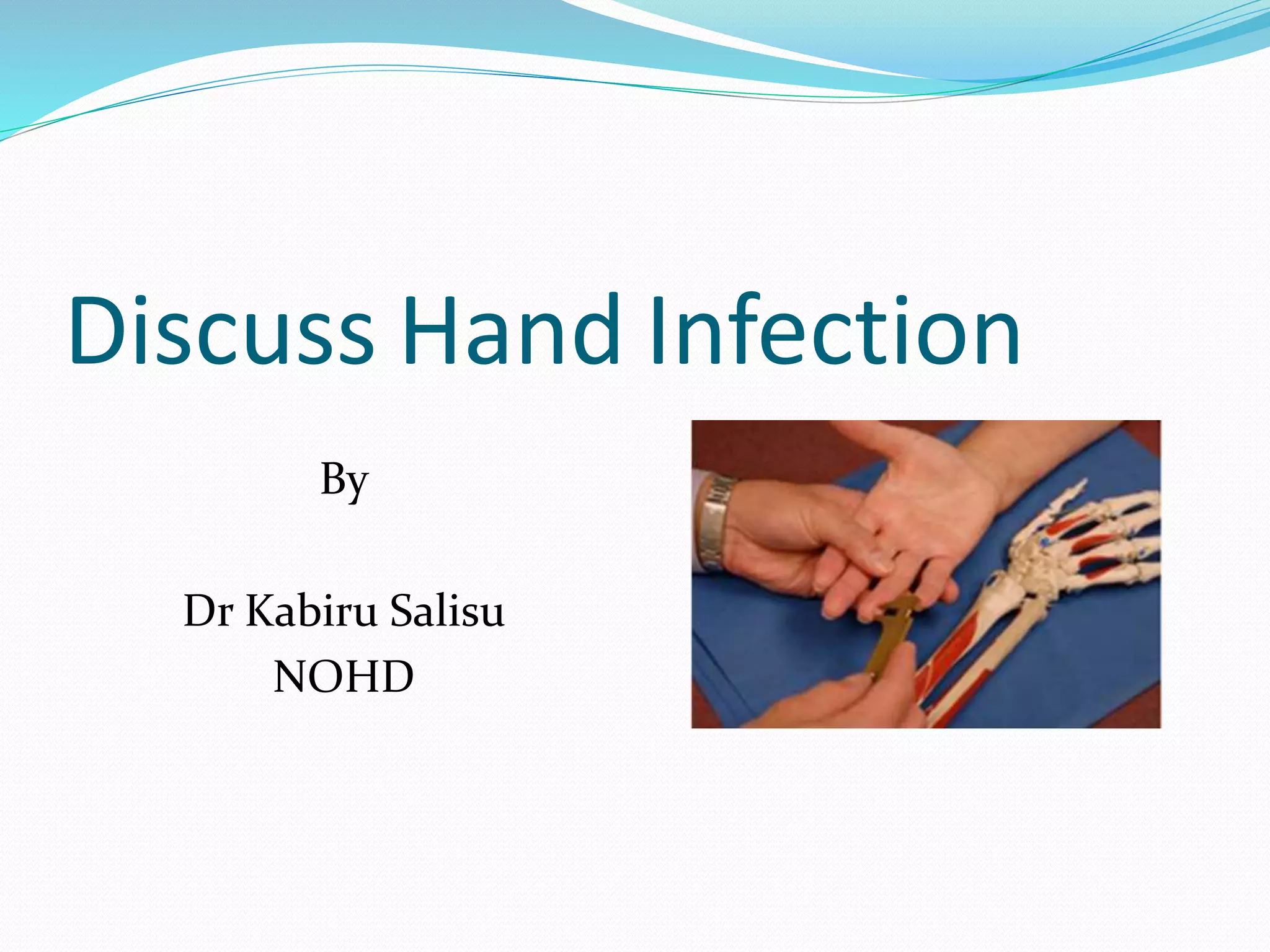
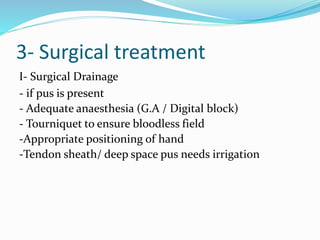
Discuss Hand Infection
By
Dr Kabiru Salisu
NOHD
Out line
 Introduction
 Relevant Anatomy
 Aetiopathogenesis
 Specific infections
 Management
 Complication
 Conclusion
Introduction
Hand infection
is the infection of the Confined Spaces, Joints,
Tendon Sheaths and Bursae of the hand.
The hand is a tool with which the individual can receive
information from the outside world and then act upon
it. It must be supple, sensate, pain-free and co-
ordinated
History
 Surgery derived from “chirurgerie” meaning ‘hand
work’
 Allen B. Kanavel 1938
Relevant Anatomy
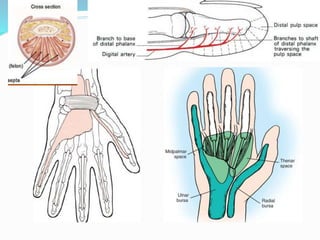
 The spaces of the hand are of practical significance
because they may become infected and distended with
pus
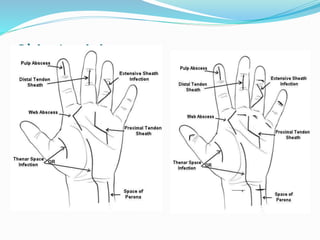
1- the superficial pulp spaces of the fingers
2- the synovial tendon sheaths of the 2nd, 3rd and 4th
fingers
3- the ulnar bursa
4- the radial bursa
5-the midpalmar space
6- the thenar space
 Edema in hand infections is commonly dorsal,
irrespective of the location of the infection
- Palmer skin is relatively tight and inelastic
- Palmer aponeurosis is also tight and inelastic
Aetiology
 Bacterial e.g Staphylococcus aureus (commonest)
streptococci, clostridium, anaerobes
Mycobacterium species,
pasturella multocida (Animal bite)
Eikenella corrodens (human bite)
 Fungal eg Candida Albicans
 Viral infections eg Herpes Simplex Virus
Predisposed individuals
 Manual workers
 House wives
 Dish washers
 Laundry men
 Immunocompromised
 Diabetics
 Dental workers
 Nail chewers
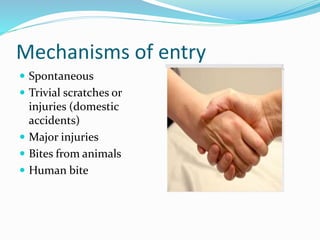
Mechanisms of entry
 Spontaneous
 Trivial scratches or
injuries (domestic
accidents)
 Major injuries
 Bites from animals
 Human bite
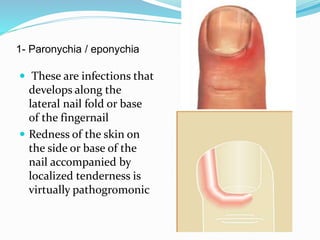
1- Paronychia / eponychia
 These are infections that
develops along the
lateral nail fold or base
of the fingernail
 Redness of the skin on
the side or base of the
nail accompanied by
localized tenderness is
virtually pathogromonic
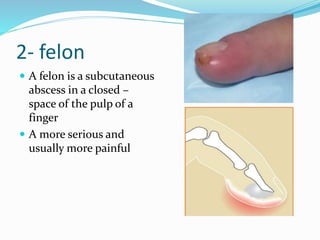
2- felon
 A felon is a subcutaneous
abscess in a closed –
space of the pulp of a
finger
 A more serious and
usually more painful
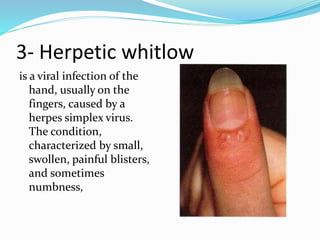
3- Herpetic whitlow
is a viral infection of the
hand, usually on the
fingers, caused by a
herpes simplex virus.
The condition,
characterized by small,
swollen, painful blisters,
and sometimes
numbness,
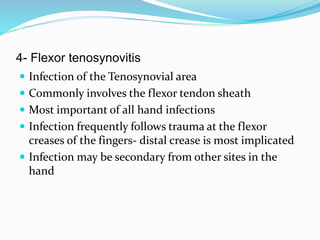
4- Flexor tenosynovitis
 Infection of the Tenosynovial area
 Commonly involves the flexor tendon sheath
 Most important of all hand infections
 Infection frequently follows trauma at the flexor
creases of the fingers- distal crease is most implicated
 Infection may be secondary from other sites in the
hand
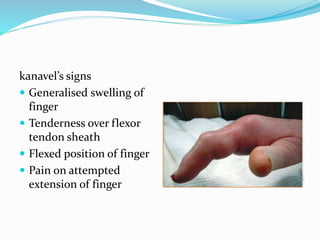
kanavel’s signs
 Generalised swelling of
finger
 Tenderness over flexor
tendon sheath
 Flexed position of finger
 Pain on attempted
extension of finger
5- Deep space infection
 Infections in these spaces present a serious surgical
problem
 Good knowledge of the fascial anatomy is essential for
proper treatment
Mid-Palmer space-
- Infection usually results from tendon sheath infection
of middle or ring fingers
- Obliteration of the concavity of the palm and the
presence of a slight bulging are pathognomonic
Thenar space infection
Involved by direct extension of infection of the index
finger
Xterise by
 widening of thenar area
 dorsal edema and ballooning of thenar area
 Flexion of distal phalanx but the thumb is not rigid
Hypothenar Space
 Located deep to the hypothenar eminence
 Involvement is usually by direct implantation
 To aid diagnosis there is relative lack of palmar
swelling and absence of involvement of the tendon
sheath
Deep Fascial Space Infections
 Dorsal subaponeurotic abcess
 Swelling and erythema on dorsum of hand
 Pain with passive movement of extensor tendons
 Looks like cellulitis
 Subfacial web space infection
 Secondary to infection of palmar space
 Spreads dorsally - “collar button abcess”
5- Bites
Animal or human bites can lead to infection
6- Pilonidal sinus;
A hair implanted in the palm or web space can cause a
recurrently infected cyst resulting in discharging
sinus
7- Septic arthritis
8- Osteomyelitis
9- mycobacterium infection
Managment
 Early, accurate, careful assessment improves outcome
 History
-hand pain, swelling, loss of function, drainage
-penetrating trauma, animal bites
-onset, duration
-constitutional symptoms- eg fever
-hand dominance
- occupation
-premorbid - Diabetes
 Examination
1. General - ill looking, painful distress, febrile
2. Specific –
skin- point of trauma, bruises, bite point,
pointing of the abscess
soft tissues- edema
bones –deformity ( in osteomyelitis)
joint –swelling (in septic arthritis)
limitation of ROM of hand
Kanavel’s signs
 Investigations
- Aspirate/ pus for m/c/s
-Tissue biopsy for histology/ afb
- FBC, ESR- ↑wbc with neutrophilia, ↑ESR
- RBS- diabetes
- X-rays- hand
Treatment
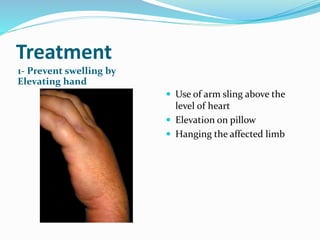
1- Prevent swelling by
Elevating hand
 Use of arm sling above the
level of heart
 Elevation on pillow
 Hanging the affected limb
2- medications
 Antibiotics ;- broad spectrum , after m/c/s sample is
obtained
 TT / ATS
 Analgesia- opioid /NSAID
 Acyclovir
 AntiTB
3- Surgical treatment
I- Surgical Drainage
- if pus is present
- Adequate anaesthesia (G.A / Digital block)
- Tourniquet to ensure bloodless field
-Appropriate positioning of hand
-Tendon sheath/ deep space pus needs irrigation
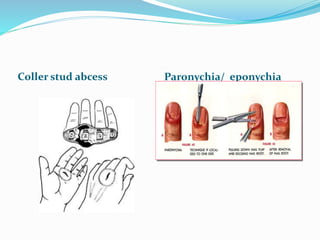
Skin Incisions
Coller stud abcess Paronychia/ eponychia
- Bites should be explored, debrided, cleaned and
managed with broad-spectrum antibiotics
- Wound is left open
- The pus obtained is sent for m/c/s
- Hand should be re examine 24hrs after drainage
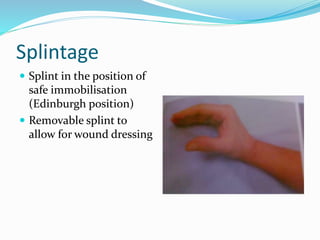
Splintage
 Splint in the position of
safe immobilisation
(Edinburgh position)
 Removable splint to
allow for wound dressing
 All infections need early mobilization once
inflammation Subsided
 Active / passive joint physiotherapy
Complications
 Hand infections
a) Tendon destruction
b) Sepsis
c) Functional disability
d) Extension into the
forearm
e) Compartment syndrome
f) Septic arthritis
g) Osteomylitis
h) Contractures
 Surgical intervention
a. injury to hand structures
Conclusion
 Hand is an important tool to livelihood, Rapid
precise diagnosis and quick surgical intervention
makes significant difference between patient
loosing his hand or getting back his livelihood
Referances
 Canale: Campbell’s Operative Orthopaedics, 10th ed. 2003 Mosby,
p.3814
 Habif: Clinical Dermatology, 3rd ed. 1996 Mosby, p.343
 Marx: Rosen’s Emergency Medicine: Concepts in Clinical Practice, 5th
ed, 2002. Mosby, pp.529-532
 Tintinalli: Emergency Medicine – a comprehensive study guide, 2000,
McGraw pp.1885-1890.
 Loius S. etal , Apley’s system of orthopaedics and fracture ninth ed.
2010 p429-435
 DR Muna Chira , hand infection ppt.
 Opart pinchai MD, Hand infection, hand infection manual 2011
 DR knight, Hand infection, pub. Hand infection surgeons los Angelis
 Russel R. G. etal baily and loves short practice of surgery, 24th edition
Arnord 2004
 Hand infection, american society for surgery of hand
Thank U for listening

Discuss hand infection (2)

  • 1.
    Discuss Hand Infection By DrKabiru Salisu NOHD
  • 2.
    Out line  Introduction Relevant Anatomy  Aetiopathogenesis  Specific infections  Management  Complication  Conclusion
  • 3.
    Introduction Hand infection is theinfection of the Confined Spaces, Joints, Tendon Sheaths and Bursae of the hand. The hand is a tool with which the individual can receive information from the outside world and then act upon it. It must be supple, sensate, pain-free and co- ordinated
  • 4.
    History  Surgery derivedfrom “chirurgerie” meaning ‘hand work’  Allen B. Kanavel 1938
  • 5.
    Relevant Anatomy  Thespaces of the hand are of practical significance because they may become infected and distended with pus
  • 6.
    1- the superficialpulp spaces of the fingers 2- the synovial tendon sheaths of the 2nd, 3rd and 4th fingers 3- the ulnar bursa 4- the radial bursa 5-the midpalmar space 6- the thenar space
  • 8.
     Edema inhand infections is commonly dorsal, irrespective of the location of the infection - Palmer skin is relatively tight and inelastic - Palmer aponeurosis is also tight and inelastic
  • 9.
    Aetiology  Bacterial e.gStaphylococcus aureus (commonest) streptococci, clostridium, anaerobes Mycobacterium species, pasturella multocida (Animal bite) Eikenella corrodens (human bite)  Fungal eg Candida Albicans  Viral infections eg Herpes Simplex Virus
  • 10.
    Predisposed individuals  Manualworkers  House wives  Dish washers  Laundry men  Immunocompromised  Diabetics  Dental workers  Nail chewers
  • 11.
    Mechanisms of entry Spontaneous  Trivial scratches or injuries (domestic accidents)  Major injuries  Bites from animals  Human bite
  • 13.
    1- Paronychia /eponychia  These are infections that develops along the lateral nail fold or base of the fingernail  Redness of the skin on the side or base of the nail accompanied by localized tenderness is virtually pathogromonic
  • 14.
    2- felon  Afelon is a subcutaneous abscess in a closed – space of the pulp of a finger  A more serious and usually more painful
  • 15.
    3- Herpetic whitlow isa viral infection of the hand, usually on the fingers, caused by a herpes simplex virus. The condition, characterized by small, swollen, painful blisters, and sometimes numbness,
  • 16.
    4- Flexor tenosynovitis Infection of the Tenosynovial area  Commonly involves the flexor tendon sheath  Most important of all hand infections  Infection frequently follows trauma at the flexor creases of the fingers- distal crease is most implicated  Infection may be secondary from other sites in the hand
  • 17.
    kanavel’s signs  Generalisedswelling of finger  Tenderness over flexor tendon sheath  Flexed position of finger  Pain on attempted extension of finger
  • 18.
    5- Deep spaceinfection  Infections in these spaces present a serious surgical problem  Good knowledge of the fascial anatomy is essential for proper treatment
  • 19.
    Mid-Palmer space- - Infectionusually results from tendon sheath infection of middle or ring fingers - Obliteration of the concavity of the palm and the presence of a slight bulging are pathognomonic
  • 20.
    Thenar space infection Involvedby direct extension of infection of the index finger Xterise by  widening of thenar area  dorsal edema and ballooning of thenar area  Flexion of distal phalanx but the thumb is not rigid
  • 21.
    Hypothenar Space  Locateddeep to the hypothenar eminence  Involvement is usually by direct implantation  To aid diagnosis there is relative lack of palmar swelling and absence of involvement of the tendon sheath
  • 22.
    Deep Fascial SpaceInfections  Dorsal subaponeurotic abcess  Swelling and erythema on dorsum of hand  Pain with passive movement of extensor tendons  Looks like cellulitis  Subfacial web space infection  Secondary to infection of palmar space  Spreads dorsally - “collar button abcess”
  • 23.
    5- Bites Animal orhuman bites can lead to infection 6- Pilonidal sinus; A hair implanted in the palm or web space can cause a recurrently infected cyst resulting in discharging sinus
  • 24.
    7- Septic arthritis 8-Osteomyelitis 9- mycobacterium infection
  • 25.
    Managment  Early, accurate,careful assessment improves outcome  History -hand pain, swelling, loss of function, drainage -penetrating trauma, animal bites -onset, duration -constitutional symptoms- eg fever -hand dominance - occupation -premorbid - Diabetes
  • 26.
     Examination 1. General- ill looking, painful distress, febrile 2. Specific – skin- point of trauma, bruises, bite point, pointing of the abscess soft tissues- edema bones –deformity ( in osteomyelitis) joint –swelling (in septic arthritis) limitation of ROM of hand Kanavel’s signs
  • 27.
     Investigations - Aspirate/pus for m/c/s -Tissue biopsy for histology/ afb - FBC, ESR- ↑wbc with neutrophilia, ↑ESR - RBS- diabetes - X-rays- hand
  • 28.
    Treatment 1- Prevent swellingby Elevating hand  Use of arm sling above the level of heart  Elevation on pillow  Hanging the affected limb
  • 29.
    2- medications  Antibiotics;- broad spectrum , after m/c/s sample is obtained  TT / ATS  Analgesia- opioid /NSAID  Acyclovir  AntiTB
  • 30.
    3- Surgical treatment I-Surgical Drainage - if pus is present - Adequate anaesthesia (G.A / Digital block) - Tourniquet to ensure bloodless field -Appropriate positioning of hand -Tendon sheath/ deep space pus needs irrigation
  • 31.
  • 32.
    Coller stud abcessParonychia/ eponychia
  • 33.
    - Bites shouldbe explored, debrided, cleaned and managed with broad-spectrum antibiotics - Wound is left open - The pus obtained is sent for m/c/s - Hand should be re examine 24hrs after drainage
  • 34.
    Splintage  Splint inthe position of safe immobilisation (Edinburgh position)  Removable splint to allow for wound dressing
  • 35.
     All infectionsneed early mobilization once inflammation Subsided  Active / passive joint physiotherapy
  • 36.
    Complications  Hand infections a)Tendon destruction b) Sepsis c) Functional disability d) Extension into the forearm e) Compartment syndrome f) Septic arthritis g) Osteomylitis h) Contractures  Surgical intervention a. injury to hand structures
  • 37.
    Conclusion  Hand isan important tool to livelihood, Rapid precise diagnosis and quick surgical intervention makes significant difference between patient loosing his hand or getting back his livelihood
  • 38.
    Referances  Canale: Campbell’sOperative Orthopaedics, 10th ed. 2003 Mosby, p.3814  Habif: Clinical Dermatology, 3rd ed. 1996 Mosby, p.343  Marx: Rosen’s Emergency Medicine: Concepts in Clinical Practice, 5th ed, 2002. Mosby, pp.529-532  Tintinalli: Emergency Medicine – a comprehensive study guide, 2000, McGraw pp.1885-1890.  Loius S. etal , Apley’s system of orthopaedics and fracture ninth ed. 2010 p429-435  DR Muna Chira , hand infection ppt.  Opart pinchai MD, Hand infection, hand infection manual 2011  DR knight, Hand infection, pub. Hand infection surgeons los Angelis  Russel R. G. etal baily and loves short practice of surgery, 24th edition Arnord 2004  Hand infection, american society for surgery of hand
  • 39.
    Thank U forlistening

Editor's Notes

  • #5 underlying the importance of the hand to our discipline as well as the rest of mankind
  • #8 1- The tips of the fingers and thumb are composed entirely of subcutaneous fat broken up and packed between fibrous septa, which pass from the skin down to the periosteum of the terminal phalanx. The tight packing of this compartment is responsible for the severe pain of a ‘septic finger’—there is little room for the expansion of inflamed and oedematous tissues. 2- sepsis in the 1st and 5th sheaths may spread proximally into the palm through the radial and ulnar bursa respectively, and may pass from one bursa to the other via the frequent cross-communication between the two Since these bursae both extend proximally beyond the wrist, infection may, on occasion, spread into the forearm. 3- The midpalmar space lies behind the flexor tendons and ulnar bursa in the palm and in front of the 3rd, 4th and 5th metacarpals with their attached interossei. The 1st and 2nd metacarpals are curtained off from this space by the adductor pollicis, which arises from the shaft of the 3rd metacarpal and passes as a triangular sheet to the base of the proximal phalanx of the thumb.The thenar space is the space superficial to the 2nd and 3rd metacarpals and the adductor pollicis. It is separated from the midpalmar space by afibrous partition.
  • #16 This is more commonly seen in healthcare workers whose hands are exposed to the saliva of patients carrying herpes. Do not drain blisters
  • #17 because of its sequelae. It destroys gliding mechanisms within the sheath
  • #20 Bounded radially by fascia attached to middle meta carpal and on Ulna side by hypothenar eminence. Distally, it extends to within a thumb’s breath of the web and proximally to the base of the palm it lies on the fascia covering the interosseous muscles and its superficial covering are the flexor tendons.
  • #21 Lies to radial side of the middle metacarpal bone upon the adductor policies. Superficial to it are the palmar fascia and flexor tendons of the index finger Also limited distally by deep transverse fascia and proximally by the base of the palm
  • #24 Eickenella coridens
  • #25 Mycobacterium marinum
  • #28 ), sequestrum, involucrum seen in Osteomyelitis; widening of joint space in SA
  • #31 . Do not exsanguinate with bandaging. Should be well padded. Tourniquet time is 1.5-2hrs.
  • #35 wrist extension of 15-30°, MCP flexion of 70-90°, and IP extension