By
Dr Kabiru Salisu
NOHD Kano
OUTLINE
 Introduction
 classification
 Brief Anatomy of the knee joint
 Aetiology
 pathology
 Management
- Resuscitation
- History
- Physical Examination
- Investigation
- Treatment
 Conclusion
 References
INTRODUCTION
Knee joint is prone to number of disorders that present
essentially with Swelling.
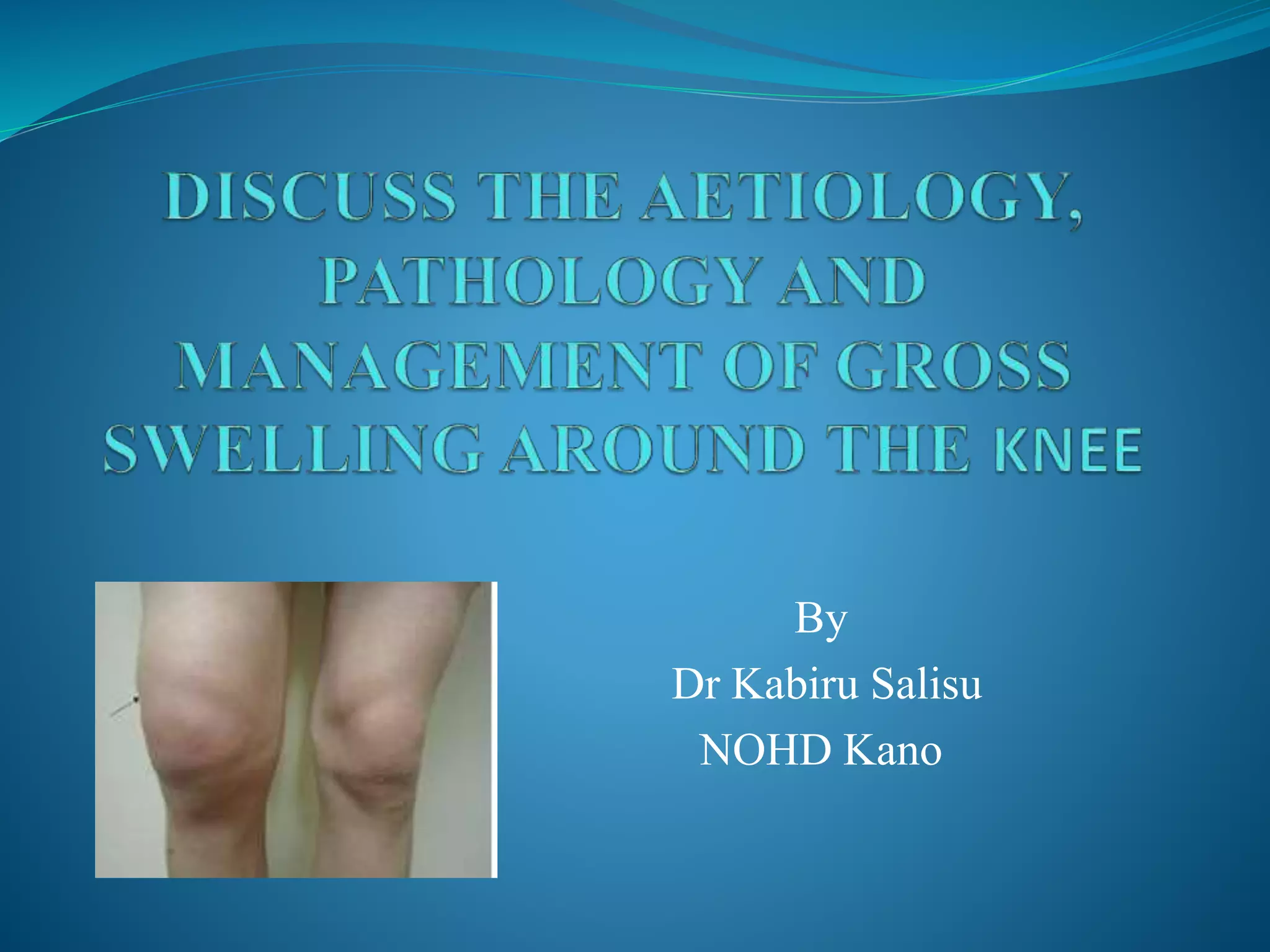
Gross swelling around the knee is a knee swelling that is
obvious on inspection
Knee is a mobile, weight bearing joint which function
depends on structures around it
Gross swelling around the knee will impair joint function
resulting in morbidity, reduction in quality of life, and
even mortality
Gross knee swelling most commonly result from knee
injuries.
Classification
 Swelling of the entire joint eg Heamearthrosis, Septic
artheritis, OA
 Swellings in front of the joint eg Bursitis
 Swellings behind the joint eg popliteal cyst
 Bony swellings eg Exostosis
a) Tuberculous arthritis
b) Rheumatoid arthritis
c) Charcot’s disease
d) Villous synovitis
e) Haemophilia
f) Malignant synovioma
BRIEF ANATOMY OF THE
KNEE
AETIOLOGY OF GROSS KNEE
SWELLING
1- Traumatic
 Heamearthrosis
 Fractures
 Dislocation
 Soft tissue injuries
2- Infective
 Septic arthritis
 TB arthritis
 Chronic osteomyelitis
 Pyomyotosis
3- Degenerative- Osteoartheritis
4- Imflammatory artheritis- Rheumatoid artheritis
5 - Coaglopathy - Hemophilia
6- Bursitis – prepatella
- Infrapatella
7 – Post operative knee swelling
8- Tumors
 Benign- lipoma, Exostosis, GCT
 Malignant - Synovial Sarcoma, Osteosercoma
PATHOLOGY
 TRAUMA
Acute posttraumatic Heamarthrosis
Inflammatory Oedema
Reactive synovitis – Joint effusion
 INFECTIONS
- Inflammation / Synovitis
- Accumulation of pus
- Synovial thickening
- Sequestrum, new bone formation – in COM
- Bursitis
Inflamatory / Degenarative (RA/OA)
 Synovitis- Synoviocytes proliferation
- Infiltration by inflm. Cells
- Villous formation
- Effusion
 Thickening of synovial membrane
 Joint destruction
HEAMOPHILIA
- Acute Non traumatic haemarthrosis
- Synovitis and synovial thickening
- Joint effusion
 TUMOUR
Intraarticular or exraarticular
Soft tissue or Bony swelling
Pathological fracture
Resuscitation
History
Examination
Investigation
Treatment
Resuscitation Post traumatic gross knee swelling
 ATLS protocol
 PRICE
- Protection- Splint , Brace or Crutches
- Rest- Traction, NWB, Cast
- Ice-
- Compression
- Elevation
 Analgesics – NSAID or combination
History
 Biodata – Age, Sex, Occupation
 Complaint – Swelling around the knee
- Onset- Rapid or slow
- site
- extend
- Diffused or localised
- other joint affectation
 Determine the aetiology
- Trauma
- Fever, pain
- Chronic cough, Weight loss and night sweat
- Insidious, recurrent assoc. with pain
- Recurrent, history of bleeding
- Painless, Slow growing and localised
- Anoresia, weight loss and easy fatigue
 History of previous interventions eg Aspiration,
intraarticular injection
 Past medical, surgical / Drug Hx
Physical examination
 General; Fever, pallor, weight loss,
 Vital signs
 MSS
- Swelling; Size, Location, Diffuse(Circumferential) or
Localized
- Sinuses and scars
- Bruises/ laceration
- Muscle wasting
 Tender, Tense or doughy – acute haemoarthrosis
 Tender, Differential warmth, fluctuate - SA
 Palpate thickening synovial membrane- TB or RA
 Bony hard – Bone tumour
 Attachment to skin or underlying structure – malignant
tumour
 Check for features of
massive joint effusion
- Cross fluctuation
- patella tap
- Juxta-patellar hallor test
 Limitation of movement
 Test for Ligament/
meniscal injury
- Stress and Drawer tests
- EUA
 Neurovascular status
INVESTIGATION
 X-ray knee AP/Lat/
skyline/ stress
 CT-Scan
 MRI
 FBC +diff
 Erythrocyte
sedimentation rate (ESR)
- Elevate within 24- 48hrs
of onset of infection.
 Rheumatoid factor
 Coagulation profile
PT, APTT
 Mantoux test
•Joint aspirate m/c/s
+ve in >60% of cases
 Diagnostic Arthroscopy
 Biopsy ;- Diagnostic in up to 95% of case
- Synovial
- Tumour
TreatmentDepend on the cause
1- Knee injuries
(a)Acute post traumatic Heamarthrosis
- Joint Aspiration
- PRICE”
- Compression with crepe bandage
- EUA
(b) Ligament injury-
- Non- operative care using “PRICER” regimen for sprain, incomplete
tear of ligament and isolated ligament injuries
- Primary arthroscopic repair
- Delayed repair
(b) Knee dislocation
Reduction under anaesthesia and repair of collateral
ligaments and capsule
(c) Intra articular fractures
- Anatomical reduction and fixation
- Image guided or open
2- Infective conditions
 Septic Artheritis / Pyomyocitis
I&D, Antibiotics, Joint irrigation and splintage
 COM - Debridement / Antibiotic beads
 TB arthritis
Chemotherapy for 12 – 18month
Splintage
Surgical debridement
3- Osteoathritis
Non operative care- NSAID, Glucosamine
Arthroscopic washout
Realignment osteotomy
Replacement arthroplasty
4- Rheumatoid artheritis
- Anti Inflammatory Drugs
- DMARD
- Intraarticular triamsinalone
- Synovectomy and joint debridement
- Joint replacement
5- Heamophilic Atheritis
 Is managed both by haematologist and orthopaedic
surgeon
 Compression and Splintage
 Clotting factor replacement
 Aspiration
 Joint replacement
6 –Tumour
 Benign – excision or curettage
 Malignant bone tumour
- Grade IA : Curettage, marginal excision
- Grade IB : Wide Excision
- Grade IIA : Radical Excision
- Grade III : Multi-model approach
Conclusion
 Gross swellings around the knee are common
presentation to trauma and orthopaedic surgeons. It
has multiple aetiology and variable methods of
management, thus require careful assessment and
precise diagnosis before a successful management
References
 Ellis H. clinical Anatomy. Blackwell UK 2006. Part 4. The lower limb;
the knee joint.p229-233
 Solomon L, Warwick D, Nayagam S. Apley’s system of orthopaedics
and fractures. 9th ed. Hodder Arnold UK.2010
 Ebnezer J. Textbook of orthopedics. 4th ed. Jaypee brothers medical
pub. Ltd.2010. chapter 43. Bone neoplasias; P615- 642
 Harwaood FS. Treatment of tuberclosis of the knee of the knee.
Postgrad. Med J 1964;40:549- 554
 Sarimo J, Rantenen J, Heikkila J et al. Acute traumatic haemarthrosis of
the knee; is routine Arthroscopic examination necessary?. Scand J
surgn2002;91:361-364
 The acutely swollen joint. The royl children’s hospital melbourne.
 Carter W. red, sore, swollen joints.medwords.com.au
 Resnick D. Diagnosis of Bone and Joint Disorders.4th Ed. Philadelphia,
WB Saunders, 2002.
Knee swelling

Knee swelling

  • 1.
  • 2.
    OUTLINE  Introduction  classification Brief Anatomy of the knee joint  Aetiology  pathology  Management - Resuscitation - History - Physical Examination - Investigation - Treatment  Conclusion  References
  • 3.
    INTRODUCTION Knee joint isprone to number of disorders that present essentially with Swelling. Gross swelling around the knee is a knee swelling that is obvious on inspection Knee is a mobile, weight bearing joint which function depends on structures around it
  • 4.
    Gross swelling aroundthe knee will impair joint function resulting in morbidity, reduction in quality of life, and even mortality Gross knee swelling most commonly result from knee injuries.
  • 5.
    Classification  Swelling ofthe entire joint eg Heamearthrosis, Septic artheritis, OA  Swellings in front of the joint eg Bursitis  Swellings behind the joint eg popliteal cyst  Bony swellings eg Exostosis
  • 6.
    a) Tuberculous arthritis b)Rheumatoid arthritis c) Charcot’s disease d) Villous synovitis e) Haemophilia f) Malignant synovioma
  • 8.
  • 10.
    AETIOLOGY OF GROSSKNEE SWELLING 1- Traumatic  Heamearthrosis  Fractures  Dislocation  Soft tissue injuries 2- Infective  Septic arthritis  TB arthritis  Chronic osteomyelitis  Pyomyotosis
  • 11.
    3- Degenerative- Osteoartheritis 4-Imflammatory artheritis- Rheumatoid artheritis 5 - Coaglopathy - Hemophilia 6- Bursitis – prepatella - Infrapatella
  • 12.
    7 – Postoperative knee swelling 8- Tumors  Benign- lipoma, Exostosis, GCT  Malignant - Synovial Sarcoma, Osteosercoma
  • 13.
    PATHOLOGY  TRAUMA Acute posttraumaticHeamarthrosis Inflammatory Oedema Reactive synovitis – Joint effusion
  • 14.
     INFECTIONS - Inflammation/ Synovitis - Accumulation of pus - Synovial thickening - Sequestrum, new bone formation – in COM - Bursitis
  • 15.
    Inflamatory / Degenarative(RA/OA)  Synovitis- Synoviocytes proliferation - Infiltration by inflm. Cells - Villous formation - Effusion  Thickening of synovial membrane  Joint destruction
  • 16.
    HEAMOPHILIA - Acute Nontraumatic haemarthrosis - Synovitis and synovial thickening - Joint effusion
  • 17.
     TUMOUR Intraarticular orexraarticular Soft tissue or Bony swelling Pathological fracture
  • 18.
  • 19.
    Resuscitation Post traumaticgross knee swelling  ATLS protocol  PRICE - Protection- Splint , Brace or Crutches - Rest- Traction, NWB, Cast - Ice- - Compression - Elevation  Analgesics – NSAID or combination
  • 20.
    History  Biodata –Age, Sex, Occupation  Complaint – Swelling around the knee - Onset- Rapid or slow - site - extend - Diffused or localised - other joint affectation
  • 21.
     Determine theaetiology - Trauma - Fever, pain - Chronic cough, Weight loss and night sweat - Insidious, recurrent assoc. with pain - Recurrent, history of bleeding - Painless, Slow growing and localised - Anoresia, weight loss and easy fatigue
  • 22.
     History ofprevious interventions eg Aspiration, intraarticular injection  Past medical, surgical / Drug Hx
  • 23.
    Physical examination  General;Fever, pallor, weight loss,  Vital signs  MSS - Swelling; Size, Location, Diffuse(Circumferential) or Localized - Sinuses and scars - Bruises/ laceration - Muscle wasting
  • 24.
     Tender, Tenseor doughy – acute haemoarthrosis  Tender, Differential warmth, fluctuate - SA  Palpate thickening synovial membrane- TB or RA  Bony hard – Bone tumour  Attachment to skin or underlying structure – malignant tumour
  • 25.
     Check forfeatures of massive joint effusion - Cross fluctuation - patella tap - Juxta-patellar hallor test  Limitation of movement  Test for Ligament/ meniscal injury - Stress and Drawer tests - EUA  Neurovascular status
  • 26.
    INVESTIGATION  X-ray kneeAP/Lat/ skyline/ stress  CT-Scan  MRI  FBC +diff  Erythrocyte sedimentation rate (ESR) - Elevate within 24- 48hrs of onset of infection.
  • 27.
     Rheumatoid factor Coagulation profile PT, APTT  Mantoux test
  • 28.
  • 29.
     Diagnostic Arthroscopy Biopsy ;- Diagnostic in up to 95% of case - Synovial - Tumour
  • 30.
    TreatmentDepend on thecause 1- Knee injuries (a)Acute post traumatic Heamarthrosis - Joint Aspiration - PRICE” - Compression with crepe bandage - EUA (b) Ligament injury- - Non- operative care using “PRICER” regimen for sprain, incomplete tear of ligament and isolated ligament injuries - Primary arthroscopic repair - Delayed repair
  • 31.
    (b) Knee dislocation Reductionunder anaesthesia and repair of collateral ligaments and capsule (c) Intra articular fractures - Anatomical reduction and fixation - Image guided or open
  • 32.
    2- Infective conditions Septic Artheritis / Pyomyocitis I&D, Antibiotics, Joint irrigation and splintage  COM - Debridement / Antibiotic beads  TB arthritis Chemotherapy for 12 – 18month Splintage Surgical debridement
  • 33.
    3- Osteoathritis Non operativecare- NSAID, Glucosamine Arthroscopic washout Realignment osteotomy Replacement arthroplasty
  • 34.
    4- Rheumatoid artheritis -Anti Inflammatory Drugs - DMARD - Intraarticular triamsinalone - Synovectomy and joint debridement - Joint replacement
  • 35.
    5- Heamophilic Atheritis Is managed both by haematologist and orthopaedic surgeon  Compression and Splintage  Clotting factor replacement  Aspiration  Joint replacement
  • 36.
    6 –Tumour  Benign– excision or curettage  Malignant bone tumour - Grade IA : Curettage, marginal excision - Grade IB : Wide Excision - Grade IIA : Radical Excision - Grade III : Multi-model approach
  • 37.
    Conclusion  Gross swellingsaround the knee are common presentation to trauma and orthopaedic surgeons. It has multiple aetiology and variable methods of management, thus require careful assessment and precise diagnosis before a successful management
  • 38.
    References  Ellis H.clinical Anatomy. Blackwell UK 2006. Part 4. The lower limb; the knee joint.p229-233  Solomon L, Warwick D, Nayagam S. Apley’s system of orthopaedics and fractures. 9th ed. Hodder Arnold UK.2010  Ebnezer J. Textbook of orthopedics. 4th ed. Jaypee brothers medical pub. Ltd.2010. chapter 43. Bone neoplasias; P615- 642  Harwaood FS. Treatment of tuberclosis of the knee of the knee. Postgrad. Med J 1964;40:549- 554  Sarimo J, Rantenen J, Heikkila J et al. Acute traumatic haemarthrosis of the knee; is routine Arthroscopic examination necessary?. Scand J surgn2002;91:361-364  The acutely swollen joint. The royl children’s hospital melbourne.  Carter W. red, sore, swollen joints.medwords.com.au  Resnick D. Diagnosis of Bone and Joint Disorders.4th Ed. Philadelphia, WB Saunders, 2002.

Editor's Notes

  • #4 it is such a large joint with a number of synovial recesses, the swelling is often painless until the tissues become tense
  • #9 The knee is a hinge joint made up of the articulations between the femoral and tibial condyles and between the patella and the patellar surface of the Femur. The capsule is attached to the margins of these articular surfaces but communicates above with the suprapatellar bursa (between the lower femoral shaft and the quadriceps), posteriorly with the bursa under the medial head of gastrocnemius and often, through it, with the bursa under semimembranosus. It may also communicate with the bursa under the lateral head of gastrocnemius. The capsule is also perforated posteriorly by popliteus, which emerges from it in much the same way that the long head of biceps bursts out of the shoulder joint. The capsule of the knee joint is reinforced on each side by the medial and lateral collateral ligaments, the latter passing to the head of the fibula and lying free from the capsule. Anteriorly, the capsule is considerably strengthened by the ligamentum patellae, and, on each side of the patella, by the medial and lateral patellar retinacula, which are expansions from vastus medialis and lateralis. Posteriorly, the tough oblique ligament arises as an expansion from the insertion of semimembranosus and blends with the joint capsule
  • #10 Within the joint are a number of important structures. The cruciate ligaments are extremely strong connections between the tibia and femur. They arise from the anterior and posterior intercondylar areas of the superior aspect of the tibia, taking their names from their tibial origins, and pass obliquely upwards to attach to the intercondylar notch of the femur. The anterior ligament resists forward displacement of the tibia on the femur and becomes taut in hyperextension of the knee, it also resists rotation, the posterior resists backward displacement of the tibia and becomes taut in hyperflexion. The semilunar cartilages (menisci) are crescent-shaped and are triangular in cross-section, the medial being larger and less curved than the lateral. They are attached by their extremities to the tibial intercondylar area and by their periphery to the capsule of the joint, although the lateral cartilage is only loosely adherent and the popliteus tendon intervenes between it and the lateral collateral ligament. They deepen, although to only a negligible extent, the articulations between the tibial and femoral condyles and probably act as shock absorbers. If both menisci are removed, the knee can regain complete functional efficiency, although it is interesting that, following surgery, a rim of fibrocartilage regenerates from the connective tissue margin of the excised menisci. An infrapatellar pad of fat fills the space between the ligamentum patellae and the femoral intercondylar notch. The synovium covering this pad projects into the joint as two folds termed the alar folds.
  • #13 - Post operative knee swelling ;- This is largely due to intra-articular bleeding and inflammation of periarticular tissues
  • #14 Haemoarthrosis Causes—-complete tears of capsules/ligament -Detachment of menisci -Fractures near joint (patella fracture, intra articular fracture and supracondylar fracture) These lead to rapid accumulation of blood (within 2—6 hrs) Blood irritates synovial membrane, mucin production—very slowly reabsorbed Knee joint swelling within 12 hours after an injury is, by definition, hemorrhage into the joint. An effusion that occurs after 12 hours suggests synovial fluid accumulation due to reactive synovitis, often due to cartilage or meniscus damage
  • #16 synovitis Early changes are vascular congestion with new blood vessel formation, proliferation of synoviocytes and infiltration of the subsynovial layers by polymorphs, lymphocytes and plasma cells. There is thickening of the capsular structures, villous formation of the synovium and a cell-rich effusion into the joints and tendon sheaths. Although painful, swollen and tender, these structures are still intact and mobile, and the disorder is potentially reversible.
  • #17 Acute non traumatic haemoarthrosis Haemophilia X-linked recessive disorder Coagulation factor deficiency lead to spontaneous bleeding into joint Irritation of synovium , effusion
  • #26 Special tests in trauma Collateral ligament tears Tenderness over it Positive stress test Cruciate ligament injury Positive drawer test Meniscal tears Joint line tenderness Painful hyperextension Apley’s grinding test
  • #27 X-ray knee AP/Lat Soft tissue swelling Avulsed bone fragments: suggest ligament injury Intra articular fracture, etc. Sun burst appearance – osteosarcoma Sequestrum – C.O.M Periarticular osteoporosis – RA Sky line view – patella fracture Tunnel view – intra articular loose bodies EUA: stress views – if in doubt of ligament injury Arthroscopy – meniscal tears, intra articular fractures CT Scan – intra articular fractures MRI – cruciate ligament, meniscal tear - extent of involvement in tumour
  • #28 - The erythrocyte sedimentation rate (ESR) is usually increased in acute and chronic inflammatory disorders and after tissue injury -Rheumatoid factor, an IgM autoantibody, is present in about 75% of adults with rheumatoid arthritis. However, it is not pathognomonic: some patients with undoubted rheumatoid arthritis remain ‘seronegative’, while rheumatoid factor is found in some patients with other disorders such as systemic lupus erythematosus and scleroderma.
  • #29 A white cell count and Gram stain should be carried out immediately: the normal synovial fluid leucocyte count is under 300 per mL; it may be over 10 000 per mL in non-infective inflammatory disorders,but counts of over 50 000 per mL are highly suggestive of sepsis.
  • #30 CT Scan – intra articular fractures MRI – cruciate ligament, meniscal tear - extent of involvement in tumour CXR – TB, metastasis Sarimo et al, Routine arthroscopy on patient with acute post traumatic haemarthrosis they found that; 45% ACL injury, 23% patella dislocation, 21% have meniscal tear. Immediate therapeutic procedure was only feasible in 35% of cases, hence discourage routine arthroscopy immediately following traumatic heamarthrosis of knee.