HAND INFECTION: AN OFTEN-
IGNORED PROBLEM
Dr. Ahmed Suparno Bahar Moni
MS (Ortho)
Medical lecturer
Advanced Medical and Dental Institute
USM, Penang, Malaysia.
INTRODUCTION
• Hand infection – very common but often ignored and
neglect
• In diabetics or other immunocompromised, it could rapidly
lead to tissue destruction, necrosis even sepsis.
• Most acute infections are surgical emergency.
PRESENTATION
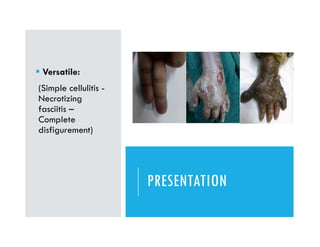
 Versatile:
(Simple cellulitis -
Necrotizing
fasciitis –
Complete
disfigurement)
CLASSIFICATION
Divided broadly in Two groups:
Superficial – cellulitis, paronychia, eponychia, felon,
dactylitis, dorsal space inf. – only subcutaneous tissue
involvement
Deep – involvement of bone, joint, tendon sheath, or
deep palmar spaces.
ETIOLOGY
Most hand infections are either -
•Spontaneous/unknown origin or
•Result of minor trauma like neglected simple prick of throne,
fish bone
FACTORS INFLUENCING OUTCOME
 Location of the infection
 Infecting organism
 Timing of treatment
 Efficacy of antibiotics
 Adequacy of surgical drainage
 Health status, immunocompetence of the host
Associated other medical conditions like CKD,
malnutrition, alcoholism, immune suppression,
HIV infection, chronic steroid use, autoimmune
diseases.
PATIENT EVALUATION
Clinical examination is the hallmark of
diagnosis.
C/F:
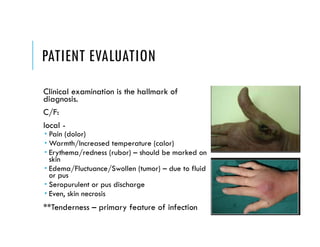
local -
 Pain (dolor)
 Warmth/Increased temperature (calor)
 Erythema/redness (rubor) – should be marked on
skin
 Edema/Fluctuance/Swollen (tumor) – due to fluid
or pus
 Seropurulent or pus discharge
 Even, skin necrosis
**Tenderness – primary feature of infection
Systemic features : (Not common in healthy adult)
Fever, malaise, lethargy, dehydration
Thorough Medical History:
Risk factors for immunocompromised
Investigation:
Leukocytosis with raised Neutrophil count
Raised ESR or CRP
Electrolytes
Blood glucose
Specimen for culture in open wound
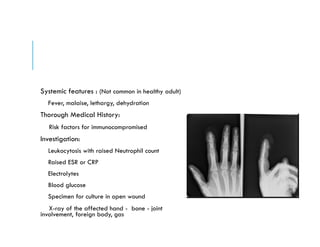
X-ray of the affected hand - bone - joint
involvement, foreign body, gas
TREATMENT
Hippocrates’ principles : fundamentally valid today.
1. Wounds were kept clean with frequent changes of wine-
soaked dressings.
2. Dressings were kept loose “so as not to intercept the pus,
but to allow it to flow away freely.”
TREATMENT
• Tetanus prophylaxis – TIG, TT
• Empirical Antibiotic
• NSAID - to distinguish between inflammation/infection.
• Soak in warm saline or warm water + povidone
iodine(10:1)
• Careful monitoring
• If needed, emergent Surgery (Necrotizing fasciitis, gas
gangrene )
TREATMENT
Most acute infections are surgical emergency.
If area of fluctuation present – I &D is recommended.
If any doubt, aspiration could be done to identify deep inf.
* Swollen, painful joint should be aspirated with caution.
* Site of aspiration should not be over area of cellulitis.
Aspirated fluid should be sent for culture, microbiological
and biochemical study(cell count, glucose & protein level)
Empirical antibiotic can be started on best educated guess
after a culture specimen is obtained.
PRINCIPLE OF SURGICAL TREATMENT
I&D –
 Could be performed under tourniquet control.
 Arm elevated for several minutes before inflating tourniquet.
 * Exsanguination with elastic wrapping is not recommended.
 Incision should be large and extensile - so that can be extended
proximally or distally
 It should extend past the area of erythema.
 Longitudinal incision should be avoided across flexion crease.
 Can keep bridge of skin or oblique incision.
 Should not expose vessels , nerves, tendons.
 All necrotic tissue should be excised.
 Copious irrigation is mandatory to reduce bacterial load.
 Specimens for CS should be obtained from periphery of the
abscess cavity.
 Most wounds could be left open with moist, loose gauze
covering.
 For large wound managements, negative pressure sponge
dressing.
 Multiple debridement might be needed.
 Early amputation may be necessary.
POST OP MANAGEMENT
Frequent dressing change
Short period of immobilization (for 24 to 48 hours) with
splint – relieve pain.
Early mobilization under therapist supervision – reduces
edema, stiffness and contracture.
Delayed primary closure could be performed.
RECONSTRUCTION OF DEFECT
Soft tissue defect:
 If wound is small could be left open to heal by secondary
intention or delayed primary closure
 Big wounds could be covered with negative-pressure
dressings.
 Early effective reconstruction of soft tissue by either graft
(not recommended for digits) or flaps is recommended.
Bony defect:
 Thorough debridement and stabilization with K – wire or Ex. Fix is
recommended.
 Partial or ray amputation of the digit is sometimes required.
 Arthrodesis is only recommended after infection subsided completely.
COMPLICATIONS
If not addressed effectively -
 Long term disability
 Stiffness
 Contracture
 Amputation
 Even death.
CHRONIC INFECTION
Rare and diagnosis is often delayed
Cause:
Virus – HIV, HPV, HSV
Bacteria – Actinomycosis, brucellosis, mycetoma, syphilis, yaws
Tuberculous – M tuberculosis, M bovis
Non tuberculous Mycobacteria – M marinum, M fortuitum, M avium
Fungi – candida, histoplasma
Protozoa, parasite
An infection that does not respond to antibiotics, I & D is suspect.
“ Culture a tumour and biopsy an infection” – is applicable.
Diagnosis:
Careful history –
 Underlying disease – DM, Leukemia
 Medications – steroid
 Occupation – barbar
 Recent travel
Proper investigation: Debridement and Biopsy
Tissue specimen: immediately bisected
 Halft to pathologist in formalin
 Half to microbiologist promptly, without formalin, in sterile container,
divided into 8 parts
Smear and stain:
1. Gram stain
2. AFB stain
3. Fungus stain (KOH)
C & S –
 4. Aerobic
 5. Anaerobic
 6. Tuberculosis at 37º
 7. Non tuberculous Mycobacteria at 30º and at 42º
 8. Fungus.
 9. (sometimes, mycetoma)
Fluid ( pus, exudates, synovial fluid) –
 For 3 smear and 5- 6 culture (>3 months)
**Consultation of Infectious disease specialist for chemotherapy
medication.
DIABETIC HAND INFECTION: AN
EMERGING CHALLENGE
Study period: From August 2014 to December 2015
Place of study: BIRDEM Hospital, Bangladesh
Number of pt.: 49 (out of 61)
Mean age: 51.63 (range 19-85) years
Male: female:: 4:3
Type I: type II DM:: 2: 47
SUPERFICIAL HAND INFECTION - 21(43%)
 Paronychia - Three
 Felon - Four
 Dactylitis - One
 Cellulitis/Infection of dorsum of the digit or hand - 13
DEEP HAND INFECTION - 28 (57%)
 Infective flexor tenosynovitis - 2
 Thenar space infection – 3
 Mid palmar space inf. - 1
 Necrotizing fasciitis - 3
 Hand infection extended to forearm or arm - 2
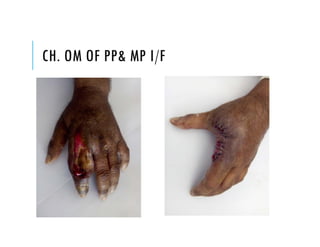
 Hand infection with Ch. OM of phalanx/metacarpal ±
septic arthritis – 17
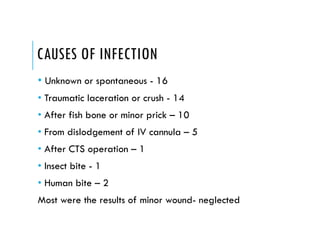
CAUSES OF INFECTION
• Unknown or spontaneous - 16
• Traumatic laceration or crush - 14
• After fish bone or minor prick – 10
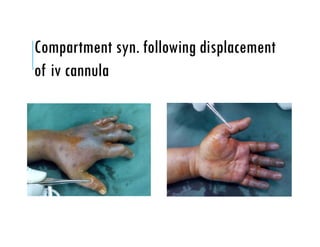
• From dislodgement of IV cannula – 5
• After CTS operation – 1
• Insect bite - 1
• Human bite – 2
Most were the results of minor wound- neglected
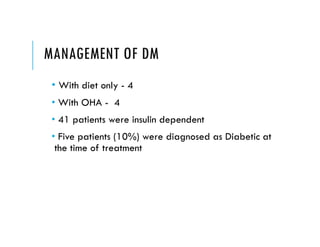
MANAGEMENT OF DM
• With diet only - 4
• With OHA - 4
• 41 patients were insulin dependent
• Five patients (10%) were diagnosed as Diabetic at
the time of treatment
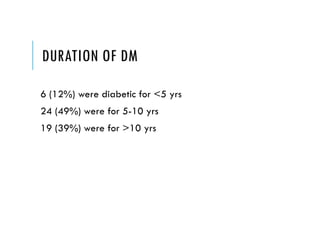
DURATION OF DM
6 (12%) were diabetic for <5 yrs
24 (49%) were for 5-10 yrs
19 (39%) were for >10 yrs
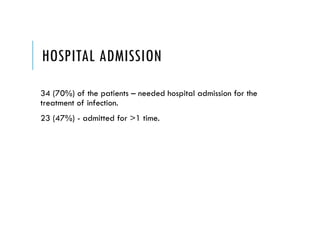
HOSPITAL ADMISSION
34 (70%) of the patients – needed hospital admission for the
treatment of infection.
23 (47%) - admitted for >1 time.
TREATMENT OF INFECTION
Conservative: 4 patients
Operative - 45 (92%) patients
 16 (35%) cases, wound was healed by secondary
intention following I&D.
• In 5, wound was closed secondarily.
• Partial Thickness Skin Grafting (PTSG) applied in 15
• 4 - treated with local flaps.
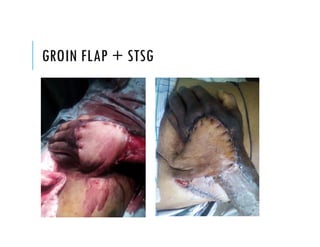
• 3 - treated with groin flap.
• Arthrodesis - in 4 (9%) patients.
• Partial digital amputation - in 8 (17%)
• Ray amputation - in 8 (17%)
• All fingers except thumb were amputated - in one
• Amputation from wrist - in one
Outcome predictor:
** 18 (38%) patients required amputations
** 25 (51%) patients required multiple surgeries
SURGICAL PROCEDURE
We followed aggressive surgical management
protocol.
Extensile incisions were used
Wound was debrided until the healthy muscles
After initial control of infection pt. were discharged
Dressing was changed daily for admitted patients and
alternate day for those out patients.
Re debridement was done if necessary
Due to high cost neg. pressure dressing was not used
Reconstruction ladder followed for reconstruction of the
wound.
Simpler procedures were chosen.
Primary amputations were done whenever necessary.
Most of the times closed amputation with drain was done.
RESULTS
Infection resolved with healing in 47 cases.
Two patients died during treatment from sepsis (with ESRD
and were on dialysis).
One patient developed severe depression, attempted even
suicide. He also developed groin infection.
Post operative hand function assessment was not adequately
documented.
OUTCOME V INSULIN DEPENDENCE
• 17 out of 41 insulin-dependent patients required
amputation in comparison to one of the Eight of non-
insulin-dependent patients (p>.05).
• 23 insulin-dependent patients required multiple
surgeries, where 2 of the non-insulin-dependent
patients required multiple surgeries (p>.05).
** 2 death cases were from insulin dependent gr.
OUTCOME V DM STATUS
HbA1C: >7, in 31
67%- suffered from Deep hand infection
52% - required multiple surgeries
42% - required amputation
OUTCOME V TYPE OF INFECTION
• One of the 21 superficial infections required partial
fingertip amputation in respect to 17(53.6%) out of
28 deep infections (p>.05).
• Five (23.8%) of the 21 superficial infections required
multiple surgeries compared to 20 (64.3%) of deep
infections
OUTCOME V ESRD
No. of patients: Eight
Six presented with deep infection, one with
compartment syndrome
Three with necrotizing fasciitis
Four (50%) - needed amputation, one through wrist.
(Francel et al reported100% amputation rate in his
series)
Two - died during the treatment
**NF occurs with greater frequency in DM with ESRD.
**Rate of amputation and even mortality is higher in this
group.
NATIONAL ANTIBIOTIC GUIDELINE 2019
(MALAYSIA)
Prophylactic antibiotic:
A. Clean operation of hand and not involving implantation of foreign
material -
 No prophylactic antibiotic is indicated.
B. For fracture fixation, arthroscopy or arthroplasty: single dose, 60
min prior surgery
 1. Cefazolin 2 gm iv or
 2. Cefuroxime 1.5 gm iv or
 3. For penicillin allergy, clindamycin 600-900 mg iv
 If used for post op prophylaxis, should not exceed 24 hours
 Re dosing is needed, in excessive bleeding (1.5 L), after 4 hours.
ANTIBIOTIC TREATMENT
A. Cellulitis: 5-10 days
Mild:
 Cephalexin 500 mg PO, 6 h
 Cefuroxime, 250-500mg, PO, 12 h
 Augmentin, 625 mg, PO, 8 h
Moderate:
 Cloxacillin 1-2 gm, iv, 6 h
 Cefazolin, 1-2 gm, iv, 8 h
Severe:
 Ampicillin/salbactum 3gm iv 6-8 h ± Clindamycin 600 mg iv 6 h
 Piperacillin/tozabactum 4.5 gm iv 6-8 h ± Clindamycin 600 mg iv 6 h
B. Necrotizing fasciitis:
Piperacillin/tozabactum 4.5 gm iv 6-8 h
± Clindamycin 600 -900 mg iv 8 h
Along with immediate aggressive surgical debridement
Dog/cat/human bite:
 Augmentin, 625 mg, PO, 8 h
 In severe inf., 3rd gen cephalosporin
Salt water exposure:
 Doxycycline 200 mg stat followed by 100 mg PO 12 h
For thrombophlebitis:
 Mild – remove cannula
 Moderate – severe –
 Remove cannula, blood culture
 Cephalexin 500 mg PO 6 h or cloxacillin 1 – 2 gm iv 6 h
MRSA
 Vancomycin 15-20 mg/kg iv 8-12 h
Open fracture:
Antibiotics should be given within 3 hours
G I & II – for G I 3 dose. For G II, 24 – 48 h.
 Cefazolin – 1-2 gm, iv 8 h or
 Cefuroxime – 1.5 gm, iv 8 h or
 Augmentin – 1.2 gm, iv 8 h
G III – 24 hours after would closure or for 3 days
 Any of the above
 + Gentamicin 3-5 mg/kg iv stat (
 + Metronidazol 500 mg iv 8 h (soil or rust contamination)
Soft tissue inj.
Cloxacillin – 2 gm iv 6 h
± Gentamicin – 5mg/kg iv 24 h
± Metronidazole – 5oo mg iv 8 h (soil or rust contamination)
Or,
Cefuroxime 1.5 gm stat iv, followed by 750 mg iv 8 h
± Metronidazole – 5oo mg iv 8 h (soil or rust contamination)
Acute OM or septic arthritis: iv for 2-4 weks then oral. Total 6 wks.
 Cloxacillin 2 gm iv 6 h
 Or cefazolin 2 gm iv 6-8 h
 Tailor according to definitive culture
 In case of amputation, 1 – 2 wk.
Chronic OM:
 Empirical treatment before obtaining culture is not recommended.
 Choice of antibiotic depends on bone or tissue culture
 Treatment for 6 wks, 3 months.
Poly articular:
 Ceftriaxone 2 gm iv 24 h 1-2 wks.
CASE STUDY
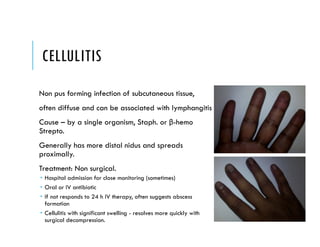
CELLULITIS
Non pus forming infection of subcutaneous tissue,
often diffuse and can be associated with lymphangitis
Cause – by a single organism, Staph. or β-hemo
Strepto.
Generally has more distal nidus and spreads
proximally.
Treatment: Non surgical.
 Hospital admission for close monitoring (sometimes)
 Oral or IV antibiotic
 If not responds to 24 h IV therapy, often suggests abscess
formation
 Cellulitis with significant swelling - resolves more quickly with
surgical decompression.
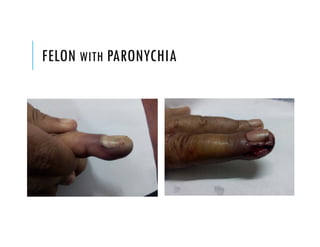
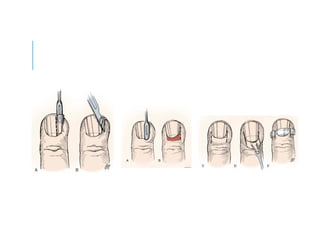
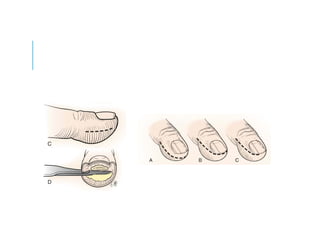
FELON WITH PARONYCHIA
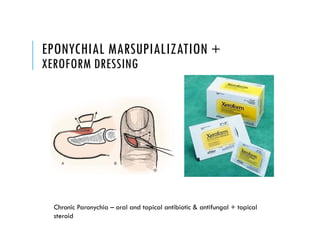
EPONYCHIAL MARSUPIALIZATION +
XEROFORM DRESSING
Chronic Paronychia – oral and topical antibiotic & antifungal + topical
steroid
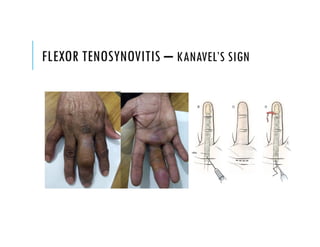
FLEXOR TENOSYNOVITIS – KANAVEL’S SIGN
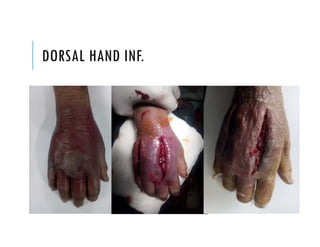
DORSAL HAND INF.
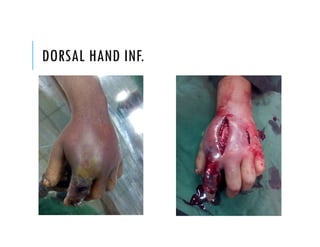
DORSAL HAND INF.
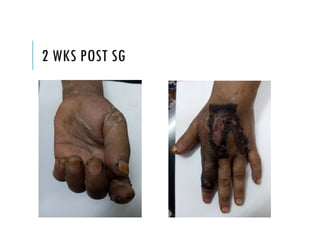
2 WKS POST SG
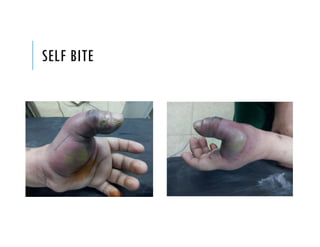
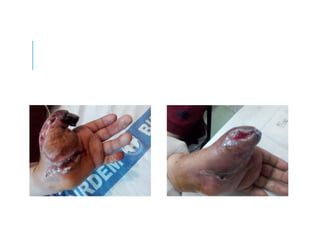
SELF BITE
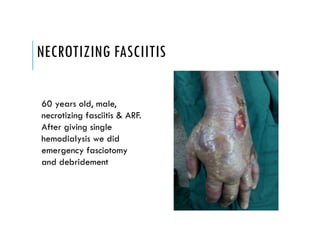
NECROTIZING FASCIITIS
60 years old, male,
necrotizing fasciitis & ARF.
After giving single
hemodialysis we did
emergency fasciotomy
and debridement
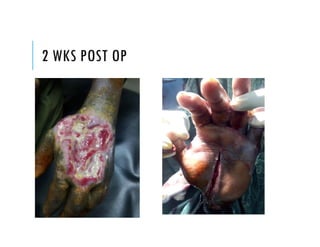
2 WKS POST OP
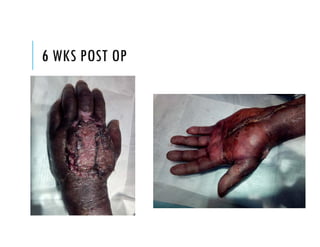
6 WKS POST OP
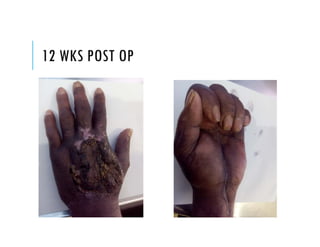
12 WKS POST OP
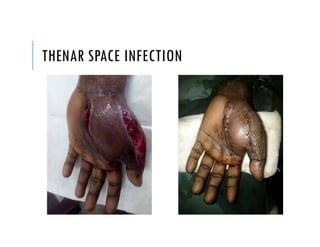
THENAR SPACE INFECTION
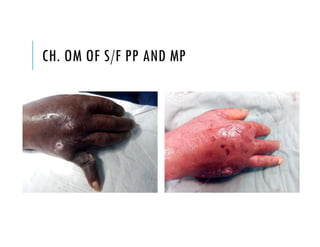
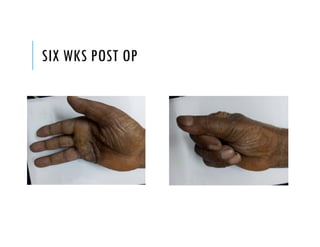
CH. OM OF S/F PP AND MP
SIX WKS POST OP
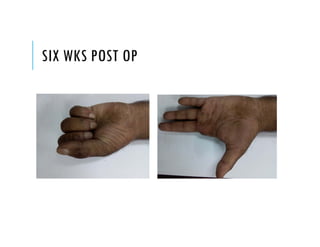
CH. OM OF PP& MP I/F
SIX WKS POST OP
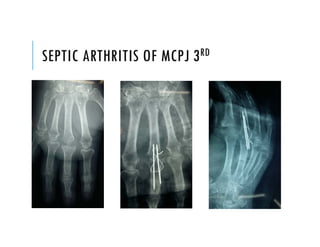
SEPTIC ARTHRITIS OF MCPJ 3RD
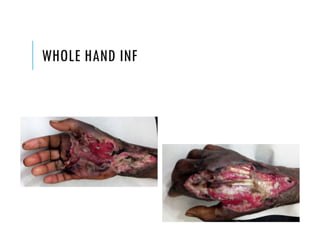
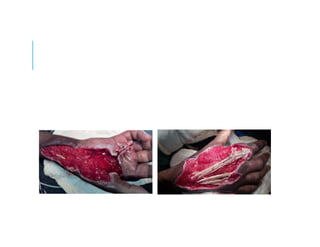
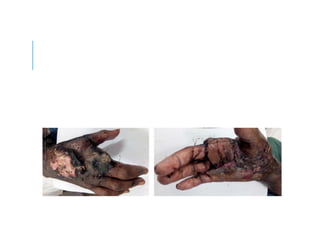
WHOLE HAND INF
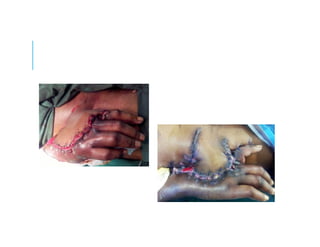
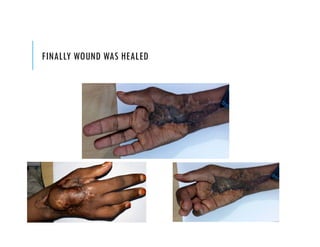
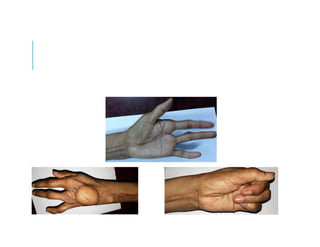
FINALLY WOUND WAS HEALED
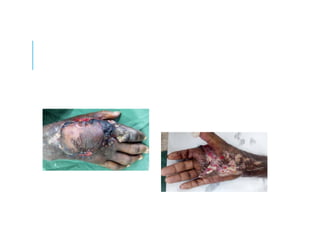
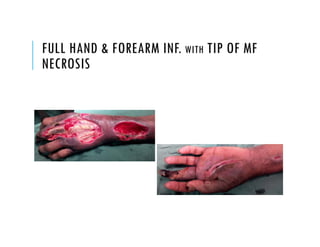
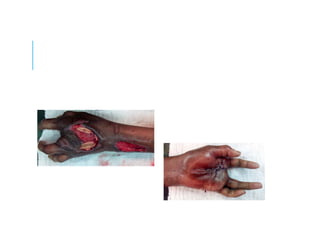
FULL HAND & FOREARM INF. WITH TIP OF MF
NECROSIS
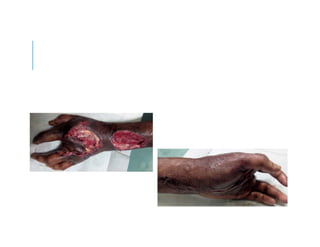
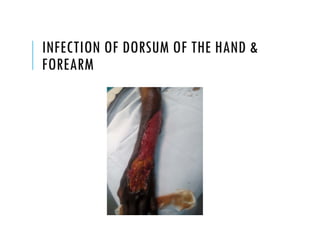
INFECTION OF DORSUM OF THE HAND &
FOREARM
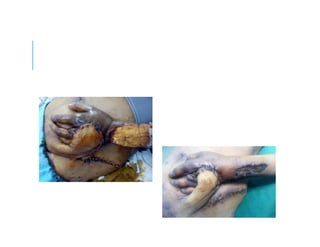
GROIN FLAP + STSG
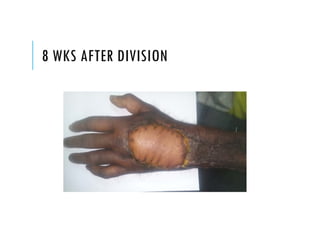
8 WKS AFTER DIVISION
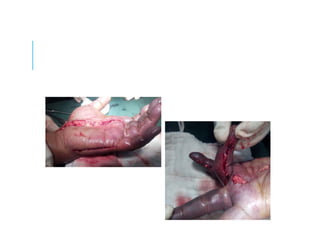
Compartment syn. following displacement
of iv cannula
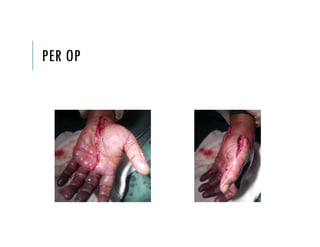
PER OP
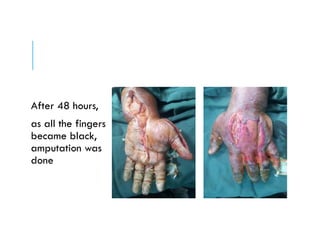
After 48 hours,
as all the fingers
became black,
amputation was
done
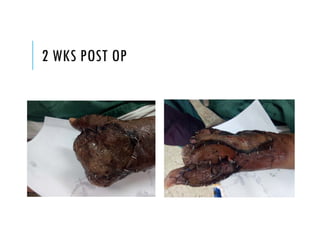
2 WKS POST OP
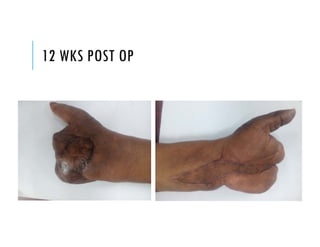
12 WKS POST OP
CONCLUSION
For hand infection – prompt and effective treatment.
Appropriate antibiotics and sometimes emergency surgery
with extensile incision is crucial.
Negative pressure therapy can be applied after I&D
wherever needed.
Primary amputation of the part could be life and limb
saving.
Hand infection - An often ignored problem

Hand infection - An often ignored problem

  • 1.
    HAND INFECTION: ANOFTEN- IGNORED PROBLEM Dr. Ahmed Suparno Bahar Moni MS (Ortho) Medical lecturer Advanced Medical and Dental Institute USM, Penang, Malaysia.
  • 2.
    INTRODUCTION • Hand infection– very common but often ignored and neglect • In diabetics or other immunocompromised, it could rapidly lead to tissue destruction, necrosis even sepsis. • Most acute infections are surgical emergency.
  • 3.
    PRESENTATION  Versatile: (Simple cellulitis- Necrotizing fasciitis – Complete disfigurement)
  • 4.
    CLASSIFICATION Divided broadly inTwo groups: Superficial – cellulitis, paronychia, eponychia, felon, dactylitis, dorsal space inf. – only subcutaneous tissue involvement Deep – involvement of bone, joint, tendon sheath, or deep palmar spaces.
  • 5.
    ETIOLOGY Most hand infectionsare either - •Spontaneous/unknown origin or •Result of minor trauma like neglected simple prick of throne, fish bone
  • 6.
    FACTORS INFLUENCING OUTCOME Location of the infection  Infecting organism  Timing of treatment  Efficacy of antibiotics  Adequacy of surgical drainage  Health status, immunocompetence of the host Associated other medical conditions like CKD, malnutrition, alcoholism, immune suppression, HIV infection, chronic steroid use, autoimmune diseases.
  • 7.
    PATIENT EVALUATION Clinical examinationis the hallmark of diagnosis. C/F: local -  Pain (dolor)  Warmth/Increased temperature (calor)  Erythema/redness (rubor) – should be marked on skin  Edema/Fluctuance/Swollen (tumor) – due to fluid or pus  Seropurulent or pus discharge  Even, skin necrosis **Tenderness – primary feature of infection
  • 8.
    Systemic features :(Not common in healthy adult) Fever, malaise, lethargy, dehydration Thorough Medical History: Risk factors for immunocompromised Investigation: Leukocytosis with raised Neutrophil count Raised ESR or CRP Electrolytes Blood glucose Specimen for culture in open wound X-ray of the affected hand - bone - joint involvement, foreign body, gas
  • 9.
    TREATMENT Hippocrates’ principles :fundamentally valid today. 1. Wounds were kept clean with frequent changes of wine- soaked dressings. 2. Dressings were kept loose “so as not to intercept the pus, but to allow it to flow away freely.”
  • 10.
    TREATMENT • Tetanus prophylaxis– TIG, TT • Empirical Antibiotic • NSAID - to distinguish between inflammation/infection. • Soak in warm saline or warm water + povidone iodine(10:1) • Careful monitoring • If needed, emergent Surgery (Necrotizing fasciitis, gas gangrene )
  • 11.
    TREATMENT Most acute infectionsare surgical emergency. If area of fluctuation present – I &D is recommended. If any doubt, aspiration could be done to identify deep inf. * Swollen, painful joint should be aspirated with caution. * Site of aspiration should not be over area of cellulitis. Aspirated fluid should be sent for culture, microbiological and biochemical study(cell count, glucose & protein level) Empirical antibiotic can be started on best educated guess after a culture specimen is obtained.
  • 12.
    PRINCIPLE OF SURGICALTREATMENT I&D –  Could be performed under tourniquet control.  Arm elevated for several minutes before inflating tourniquet.  * Exsanguination with elastic wrapping is not recommended.  Incision should be large and extensile - so that can be extended proximally or distally  It should extend past the area of erythema.  Longitudinal incision should be avoided across flexion crease.  Can keep bridge of skin or oblique incision.
  • 13.
     Should notexpose vessels , nerves, tendons.  All necrotic tissue should be excised.  Copious irrigation is mandatory to reduce bacterial load.  Specimens for CS should be obtained from periphery of the abscess cavity.  Most wounds could be left open with moist, loose gauze covering.  For large wound managements, negative pressure sponge dressing.  Multiple debridement might be needed.  Early amputation may be necessary.
  • 14.
    POST OP MANAGEMENT Frequentdressing change Short period of immobilization (for 24 to 48 hours) with splint – relieve pain. Early mobilization under therapist supervision – reduces edema, stiffness and contracture. Delayed primary closure could be performed.
  • 15.
    RECONSTRUCTION OF DEFECT Softtissue defect:  If wound is small could be left open to heal by secondary intention or delayed primary closure  Big wounds could be covered with negative-pressure dressings.  Early effective reconstruction of soft tissue by either graft (not recommended for digits) or flaps is recommended.
  • 16.
    Bony defect:  Thoroughdebridement and stabilization with K – wire or Ex. Fix is recommended.  Partial or ray amputation of the digit is sometimes required.  Arthrodesis is only recommended after infection subsided completely.
  • 17.
    COMPLICATIONS If not addressedeffectively -  Long term disability  Stiffness  Contracture  Amputation  Even death.
  • 18.
    CHRONIC INFECTION Rare anddiagnosis is often delayed Cause: Virus – HIV, HPV, HSV Bacteria – Actinomycosis, brucellosis, mycetoma, syphilis, yaws Tuberculous – M tuberculosis, M bovis Non tuberculous Mycobacteria – M marinum, M fortuitum, M avium Fungi – candida, histoplasma Protozoa, parasite
  • 19.
    An infection thatdoes not respond to antibiotics, I & D is suspect. “ Culture a tumour and biopsy an infection” – is applicable. Diagnosis: Careful history –  Underlying disease – DM, Leukemia  Medications – steroid  Occupation – barbar  Recent travel
  • 20.
    Proper investigation: Debridementand Biopsy Tissue specimen: immediately bisected  Halft to pathologist in formalin  Half to microbiologist promptly, without formalin, in sterile container, divided into 8 parts Smear and stain: 1. Gram stain 2. AFB stain 3. Fungus stain (KOH)
  • 21.
    C & S–  4. Aerobic  5. Anaerobic  6. Tuberculosis at 37º  7. Non tuberculous Mycobacteria at 30º and at 42º  8. Fungus.  9. (sometimes, mycetoma) Fluid ( pus, exudates, synovial fluid) –  For 3 smear and 5- 6 culture (>3 months) **Consultation of Infectious disease specialist for chemotherapy medication.
  • 22.
    DIABETIC HAND INFECTION:AN EMERGING CHALLENGE Study period: From August 2014 to December 2015 Place of study: BIRDEM Hospital, Bangladesh Number of pt.: 49 (out of 61) Mean age: 51.63 (range 19-85) years Male: female:: 4:3 Type I: type II DM:: 2: 47
  • 23.
    SUPERFICIAL HAND INFECTION- 21(43%)  Paronychia - Three  Felon - Four  Dactylitis - One  Cellulitis/Infection of dorsum of the digit or hand - 13
  • 24.
    DEEP HAND INFECTION- 28 (57%)  Infective flexor tenosynovitis - 2  Thenar space infection – 3  Mid palmar space inf. - 1  Necrotizing fasciitis - 3  Hand infection extended to forearm or arm - 2  Hand infection with Ch. OM of phalanx/metacarpal ± septic arthritis – 17
  • 25.
    CAUSES OF INFECTION •Unknown or spontaneous - 16 • Traumatic laceration or crush - 14 • After fish bone or minor prick – 10 • From dislodgement of IV cannula – 5 • After CTS operation – 1 • Insect bite - 1 • Human bite – 2 Most were the results of minor wound- neglected
  • 26.
    MANAGEMENT OF DM •With diet only - 4 • With OHA - 4 • 41 patients were insulin dependent • Five patients (10%) were diagnosed as Diabetic at the time of treatment
  • 27.
    DURATION OF DM 6(12%) were diabetic for <5 yrs 24 (49%) were for 5-10 yrs 19 (39%) were for >10 yrs
  • 28.
    HOSPITAL ADMISSION 34 (70%)of the patients – needed hospital admission for the treatment of infection. 23 (47%) - admitted for >1 time.
  • 29.
    TREATMENT OF INFECTION Conservative:4 patients Operative - 45 (92%) patients  16 (35%) cases, wound was healed by secondary intention following I&D. • In 5, wound was closed secondarily. • Partial Thickness Skin Grafting (PTSG) applied in 15 • 4 - treated with local flaps. • 3 - treated with groin flap.
  • 30.
    • Arthrodesis -in 4 (9%) patients. • Partial digital amputation - in 8 (17%) • Ray amputation - in 8 (17%) • All fingers except thumb were amputated - in one • Amputation from wrist - in one Outcome predictor: ** 18 (38%) patients required amputations ** 25 (51%) patients required multiple surgeries
  • 31.
    SURGICAL PROCEDURE We followedaggressive surgical management protocol. Extensile incisions were used Wound was debrided until the healthy muscles After initial control of infection pt. were discharged Dressing was changed daily for admitted patients and alternate day for those out patients. Re debridement was done if necessary Due to high cost neg. pressure dressing was not used
  • 32.
    Reconstruction ladder followedfor reconstruction of the wound. Simpler procedures were chosen. Primary amputations were done whenever necessary. Most of the times closed amputation with drain was done.
  • 33.
    RESULTS Infection resolved withhealing in 47 cases. Two patients died during treatment from sepsis (with ESRD and were on dialysis). One patient developed severe depression, attempted even suicide. He also developed groin infection. Post operative hand function assessment was not adequately documented.
  • 34.
    OUTCOME V INSULINDEPENDENCE • 17 out of 41 insulin-dependent patients required amputation in comparison to one of the Eight of non- insulin-dependent patients (p>.05). • 23 insulin-dependent patients required multiple surgeries, where 2 of the non-insulin-dependent patients required multiple surgeries (p>.05). ** 2 death cases were from insulin dependent gr.
  • 35.
    OUTCOME V DMSTATUS HbA1C: >7, in 31 67%- suffered from Deep hand infection 52% - required multiple surgeries 42% - required amputation
  • 36.
    OUTCOME V TYPEOF INFECTION • One of the 21 superficial infections required partial fingertip amputation in respect to 17(53.6%) out of 28 deep infections (p>.05). • Five (23.8%) of the 21 superficial infections required multiple surgeries compared to 20 (64.3%) of deep infections
  • 37.
    OUTCOME V ESRD No.of patients: Eight Six presented with deep infection, one with compartment syndrome Three with necrotizing fasciitis Four (50%) - needed amputation, one through wrist. (Francel et al reported100% amputation rate in his series) Two - died during the treatment **NF occurs with greater frequency in DM with ESRD. **Rate of amputation and even mortality is higher in this group.
  • 38.
    NATIONAL ANTIBIOTIC GUIDELINE2019 (MALAYSIA) Prophylactic antibiotic: A. Clean operation of hand and not involving implantation of foreign material -  No prophylactic antibiotic is indicated. B. For fracture fixation, arthroscopy or arthroplasty: single dose, 60 min prior surgery  1. Cefazolin 2 gm iv or  2. Cefuroxime 1.5 gm iv or  3. For penicillin allergy, clindamycin 600-900 mg iv  If used for post op prophylaxis, should not exceed 24 hours  Re dosing is needed, in excessive bleeding (1.5 L), after 4 hours.
  • 39.
    ANTIBIOTIC TREATMENT A. Cellulitis:5-10 days Mild:  Cephalexin 500 mg PO, 6 h  Cefuroxime, 250-500mg, PO, 12 h  Augmentin, 625 mg, PO, 8 h Moderate:  Cloxacillin 1-2 gm, iv, 6 h  Cefazolin, 1-2 gm, iv, 8 h Severe:  Ampicillin/salbactum 3gm iv 6-8 h ± Clindamycin 600 mg iv 6 h  Piperacillin/tozabactum 4.5 gm iv 6-8 h ± Clindamycin 600 mg iv 6 h
  • 40.
    B. Necrotizing fasciitis: Piperacillin/tozabactum4.5 gm iv 6-8 h ± Clindamycin 600 -900 mg iv 8 h Along with immediate aggressive surgical debridement
  • 41.
    Dog/cat/human bite:  Augmentin,625 mg, PO, 8 h  In severe inf., 3rd gen cephalosporin Salt water exposure:  Doxycycline 200 mg stat followed by 100 mg PO 12 h For thrombophlebitis:  Mild – remove cannula  Moderate – severe –  Remove cannula, blood culture  Cephalexin 500 mg PO 6 h or cloxacillin 1 – 2 gm iv 6 h MRSA  Vancomycin 15-20 mg/kg iv 8-12 h
  • 42.
    Open fracture: Antibiotics shouldbe given within 3 hours G I & II – for G I 3 dose. For G II, 24 – 48 h.  Cefazolin – 1-2 gm, iv 8 h or  Cefuroxime – 1.5 gm, iv 8 h or  Augmentin – 1.2 gm, iv 8 h G III – 24 hours after would closure or for 3 days  Any of the above  + Gentamicin 3-5 mg/kg iv stat (  + Metronidazol 500 mg iv 8 h (soil or rust contamination)
  • 43.
    Soft tissue inj. Cloxacillin– 2 gm iv 6 h ± Gentamicin – 5mg/kg iv 24 h ± Metronidazole – 5oo mg iv 8 h (soil or rust contamination) Or, Cefuroxime 1.5 gm stat iv, followed by 750 mg iv 8 h ± Metronidazole – 5oo mg iv 8 h (soil or rust contamination)
  • 44.
    Acute OM orseptic arthritis: iv for 2-4 weks then oral. Total 6 wks.  Cloxacillin 2 gm iv 6 h  Or cefazolin 2 gm iv 6-8 h  Tailor according to definitive culture  In case of amputation, 1 – 2 wk. Chronic OM:  Empirical treatment before obtaining culture is not recommended.  Choice of antibiotic depends on bone or tissue culture  Treatment for 6 wks, 3 months. Poly articular:  Ceftriaxone 2 gm iv 24 h 1-2 wks.
  • 45.
  • 46.
    CELLULITIS Non pus forminginfection of subcutaneous tissue, often diffuse and can be associated with lymphangitis Cause – by a single organism, Staph. or β-hemo Strepto. Generally has more distal nidus and spreads proximally. Treatment: Non surgical.  Hospital admission for close monitoring (sometimes)  Oral or IV antibiotic  If not responds to 24 h IV therapy, often suggests abscess formation  Cellulitis with significant swelling - resolves more quickly with surgical decompression.
  • 47.
  • 50.
    EPONYCHIAL MARSUPIALIZATION + XEROFORMDRESSING Chronic Paronychia – oral and topical antibiotic & antifungal + topical steroid
  • 51.
    FLEXOR TENOSYNOVITIS –KANAVEL’S SIGN
  • 52.
  • 53.
  • 54.
  • 55.
  • 57.
    NECROTIZING FASCIITIS 60 yearsold, male, necrotizing fasciitis & ARF. After giving single hemodialysis we did emergency fasciotomy and debridement
  • 58.
  • 59.
  • 60.
  • 61.
  • 62.
    CH. OM OFS/F PP AND MP
  • 63.
  • 64.
    CH. OM OFPP& MP I/F
  • 65.
  • 66.
  • 67.
  • 72.
  • 73.
    FULL HAND &FOREARM INF. WITH TIP OF MF NECROSIS
  • 78.
    INFECTION OF DORSUMOF THE HAND & FOREARM
  • 79.
  • 80.
    8 WKS AFTERDIVISION
  • 81.
    Compartment syn. followingdisplacement of iv cannula
  • 82.
  • 84.
    After 48 hours, asall the fingers became black, amputation was done
  • 85.
  • 86.
  • 87.
    CONCLUSION For hand infection– prompt and effective treatment. Appropriate antibiotics and sometimes emergency surgery with extensile incision is crucial. Negative pressure therapy can be applied after I&D wherever needed. Primary amputation of the part could be life and limb saving.