Hand Infections
Hand Infections
                           Introduction
 In the pre-antibiotic era:
    65% of hand disability resulted from minor injuries that became
      infected
    50 - 75% of all hand deformities were the result of infection

 Kanavel’s study of the surgical anatomy of the hand:
    defined anatomical planes and channels
    careful placement of incisions for optimal drainage
    became the cornerstone of treatment in the pre-antibiotic era

 Penicillin changed the landscape:
    severe hand infections are relatively uncommon today
    incidence stable since 1940’s
Hand Infections
                              Antibiotics
 valuable adjunct in infections but used alone will effect a cure
  in only a limited number of situations
    early diagnosis: 24 - 48 hrs.
    high dose IV therapy
    elevation & splinting to rest the affected part
 Beyond this time success is unlikely:
    thrombosis of small vessels
    swelling & pressure within closed anatomical spaces
 Abx need not be continued more than 7 - 10 days
    exception: osteomyelitis
    can usually switch to oral route in 2 - 3 days (if improving)
Hand Infections
                            Outline
   Principles
   High Risk Patients
   Felons & Paronychia
   Flexor Tenosynovitis
   Deep Space Infections
   Bites
   IDU
   Osteomyelitis
   Septic Arthritis
   Chronic Infections
Hand Infections
                        Introduction
 Treatment principles
   early & adequate decompression of pus to avoid soft
    tissue loss
   proper placement of incisions
      avoids damage to adjacent structures
      minimizes scar contracture
   appropriate debridement of necrotic tissue
   judicious splinting & early mobilization to minimize joint
    stiffness
   appropriate use of Abx as adjunct to prevent
    dissemination of established infection
Hand Infections
                              Introduction
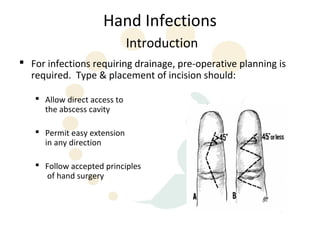
 For infections requiring drainage, pre-operative planning is
  required. Type & placement of incision should:

    Allow direct access to
     the abscess cavity

    Permit easy extension
     in any direction

    Follow accepted principles
     of hand surgery
Hand Infections
                           Introduction
 Principles:
    carry out procedure with optimal lighting, positioning,
     visualization, analgesia & tourniquet control
        Do not exsanguinate part as this may cause bacterial seeding
    incisions don’t cross flexion creases at > 45°
    avoid injury to vessels, nerves & tendons
    avoid compromising the blood supply to adjacent area
    avoid leaving a sensitive scar, especially in an important
     tactile area
    wounds left open are packed for 48 - 72 hrs. followed by
     saline soaks & exercise
Hand Infections
                       High Risk Patient
 Up to 50% of hand infections involve:
    Diabetic / Immune compromised
    IDU
    Bites

 Higher risk for developing severe complications:
    Joint stiffness     - Osteomyelitis
    Contracture         - Necrotizing Fasciitis
    Amputation          - Death
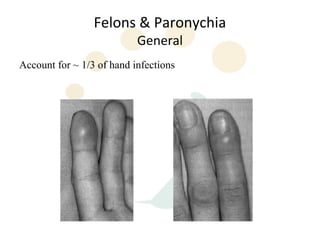
Felons & Paronychia
                           General
Account for ~ 1/3 of hand infections
Felons
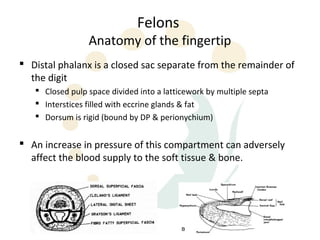
                 Anatomy of the fingertip
 Distal phalanx is a closed sac separate from the remainder of
  the digit
    Closed pulp space divided into a latticework by multiple septa
    Interstices filled with eccrine glands & fat
    Dorsum is rigid (bound by DP & perionychium)


 An increase in pressure of this compartment can adversely
  affect the blood supply to the soft tissue & bone.
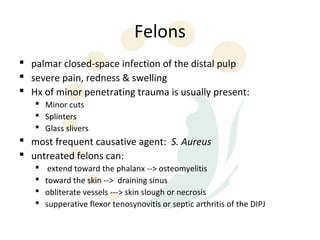
Felons
 palmar closed-space infection of the distal pulp
 severe pain, redness & swelling
 Hx of minor penetrating trauma is usually present:
    Minor cuts
    Splinters
    Glass slivers
 most frequent causative agent: S. Aureus
 untreated felons can:
       extend toward the phalanx --> osteomyelitis
      toward the skin --> draining sinus
      obliterate vessels ---> skin slough or necrosis
      supperative flexor tenosynovitis or septic arthritis of the DIPJ
Felons
                            Treatment
 If recognized early (mild cellulitis): soaks & Abx
 Later (abscess formation): surgical drainage
    Usually process has been going on > 48 hrs.

 Principles:
    Avoid injury to n/v structures
    Utilize an incision that won’t leave a disabling scar
    Do not violate flexor sheath (stay distal)
    Produce adequate drainage
Felons
                             Treatment
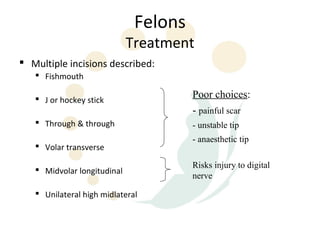
 Multiple incisions described:
    Fishmouth

    J or hockey stick                 Poor choices:
                                       - painful scar
    Through & through                 - unstable tip
                                       - anaesthetic tip
    Volar transverse

                                       Risks injury to digital
    Midvolar longitudinal
                                       nerve

    Unilateral high midlateral
Felons
                           Treatment
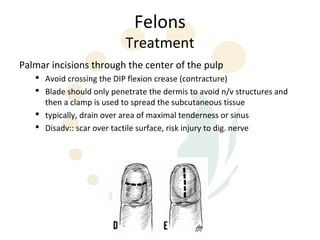
Palmar incisions through the center of the pulp
    Avoid crossing the DIP flexion crease (contracture)
    Blade should only penetrate the dermis to avoid n/v structures and
     then a clamp is used to spread the subcutaneous tissue
    typically, drain over area of maximal tenderness or sinus
    Disadv:: scar over tactile surface, risk injury to dig. nerve
Felons
                            Treatment
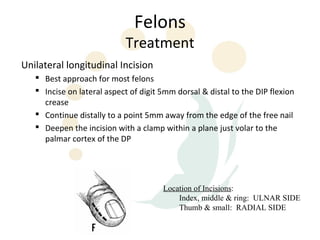
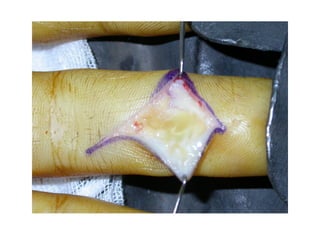
Unilateral longitudinal Incision
    Best approach for most felons
    Incise on lateral aspect of digit 5mm dorsal & distal to the DIP flexion
     crease
    Continue distally to a point 5mm away from the edge of the free nail
    Deepen the incision with a clamp within a plane just volar to the
     palmar cortex of the DP


                                       Location of Incisions:
                                           Index, middle & ring: ULNAR SIDE
                                           Thumb & small: RADIAL SIDE
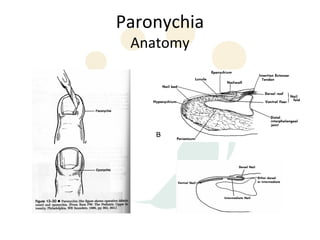
Paronychia
 Anatomy
Paronychia
 infection in and around the nail fold
 Acute: any break in the seal between the nail and nail fold
  may serve as a portal of entry for infection
     hangnails
     manicures
     nail biting
 usual causative agent: S. Aureus
 in more advanced infections, pus may accumulate beneath the nail plate,
  separating it from the underlying nail bed. This infection involves the
  entire eponychium and is called an “eponychia”
 Pus can also spread around the nail fold resulting in a “runaround
  infection”
Paronychia
                             Treatment
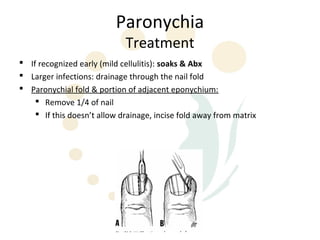
 If recognized early (mild cellulitis): soaks & Abx
 Larger infections: drainage through the nail fold
 Paronychial fold & portion of adjacent eponychium:
     Remove 1/4 of nail
     If this doesn’t allow drainage, incise fold away from matrix
Paronychia
                            Treatment
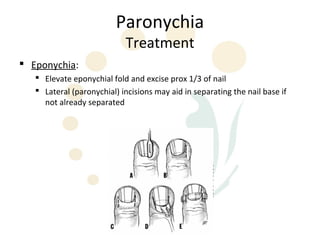
 Eponychia:
    Elevate eponychial fold and excise prox 1/3 of nail
    Lateral (paronychial) incisions may aid in separating the nail base if
     not already separated
Chronic Paronychia
 Slightly different disease process with an indolent course
  marked by exacerbations & remissions
 Etiology: proximal nail fold obstruction + fungal infection
 Often seen in people whose hands are constantly in a moist
  environment
 Inflammation of the eponychial fold, often with separation
  from the underlying nail and intermittent drainage
 usual causative agent: fungus > gram negative bacteria
 Tx: eponychial marsupialization + topical antifungal
    Crescent-shaped piece of skin excised proximal to nail fold
    medical tx alone is largely unsuccessful
Tenosynovitis
                                     Anatomy
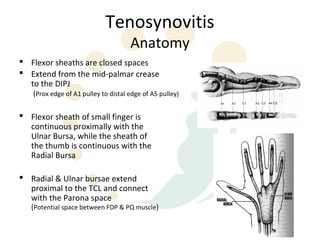
 Flexor sheaths are closed spaces
 Extend from the mid-palmar crease
  to the DIPJ
   (Prox edge of A1 pulley to distal edge of A5 pulley)

 Flexor sheath of small finger is
  continuous proximally with the
  Ulnar Bursa, while the sheath of
  the thumb is continuous with the
  Radial Bursa

 Radial & Ulnar bursae extend
  proximal to the TCL and connect
  with the Parona space
   (Potential space between FDP & PQ muscle)
Tenosynovitis
                              General
 Flexor sheath infections most often as a result of penetrating
  trauma
    More likely at joint flexion creases
    Sheaths are separated from skin by only a small amount of
     subcutaneous tissue here
 Also, Felons can rupture into the distal flexor sheath
 Usual causative agent: S. Aureus
 most commonly affected digits:
    Ring, long & index fingers
Tenosynovitis
                         General
 Purulence within the sheath destroys the gliding mechanism,
  rapidly creating adhesions that lead to loss of function
 destroys the blood supply producing tendon necrosis
Tenosynovitis
                                Clinical
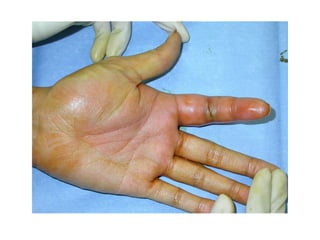
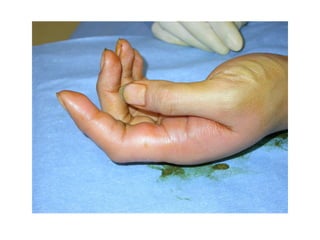
 Kanavel’s 4 cardinal signs:

      Tenderness over & limited to the flexor sheath
      Symmetrical enlargement of the digit (“fusiform”)
      Severe pain on passive extension of the finger (> proximally)
      Flexed posture of the involved digit

 Not all four signs may be present early on
 Most reliable sign: pain w. passive extension
 Cellulitis of the hand may appear similar, but swelling &
  tenderness is not usually isolated to a single digit
Tenosynovitis
                           Treatment
 Early infection < 48 hrs (& usually lacking all 4 signs) may
  initially be treated with IV Abx, splinting & elevation
    Failure to respond within 24 hrs. should necessitate drainage


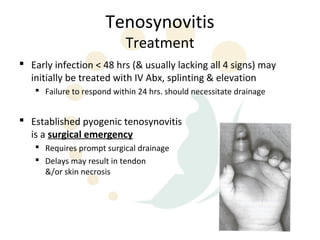
 Established pyogenic tenosynovitis
  is a surgical emergency
    Requires prompt surgical drainage
    Delays may result in tendon
     &/or skin necrosis
Tenosynovitis
                           Treatment
 2 basic approaches:
    Open vs. Closed

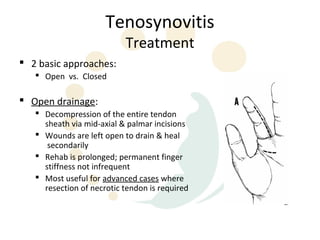
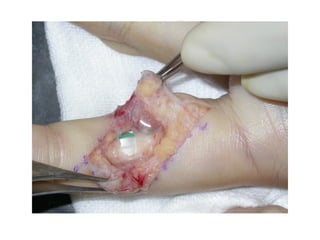
 Open drainage:
    Decompression of the entire tendon
     sheath via mid-axial & palmar incisions
    Wounds are left open to drain & heal
      secondarily
    Rehab is prolonged; permanent finger
     stiffness not infrequent
    Most useful for advanced cases where
     resection of necrotic tendon is required
Tenosynovitis
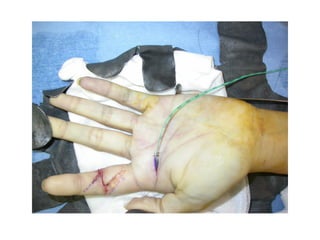
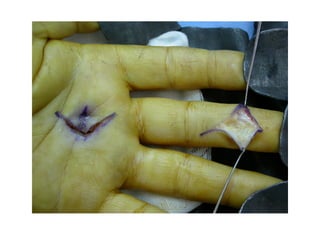
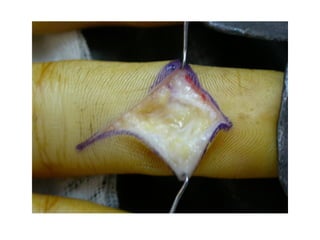
                            Treatment
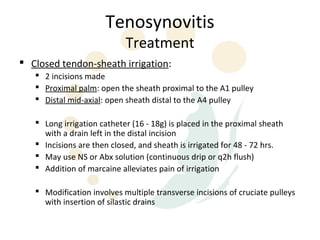
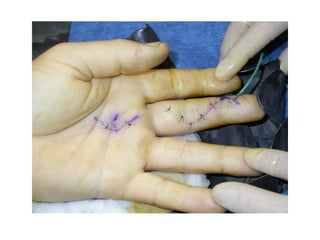
 Closed tendon-sheath irrigation:
    2 incisions made
    Proximal palm: open the sheath proximal to the A1 pulley
    Distal mid-axial: open sheath distal to the A4 pulley

    Long irrigation catheter (16 - 18g) is placed in the proximal sheath
     with a drain left in the distal incision
    Incisions are then closed, and sheath is irrigated for 48 - 72 hrs.
    May use NS or Abx solution (continuous drip or q2h flush)
    Addition of marcaine alleviates pain of irrigation

    Modification involves multiple transverse incisions of cruciate pulleys
     with insertion of silastic drains
Tenosynovitis
                          Treatment
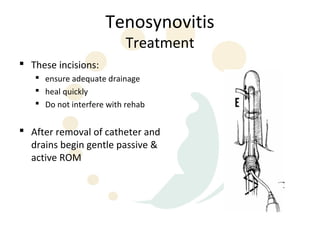
 These incisions:
    ensure adequate drainage
    heal quickly
    Do not interfere with rehab


 After removal of catheter and
  drains begin gentle passive &
  active ROM
Chronic Tenosynovitis
 Unusual cases may be seen which present differently than
  acute pyogenic infections:
    Chronic swelling of the flexor sheath
    No disabling pain or loss of function


 These are chronic infections most frequently caused by
  mycobacteria
    usually the result of a puncture wound in an aquatic environment
    M. Kansasii or M. Marinarum

 Dx: AFB stains & culture of synovium
 Tx: tenosynovectomy + antituberculous drugs (6 - 24 mo)
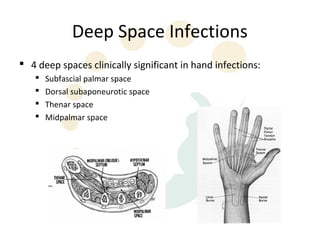
Deep Space Infections
 4 deep spaces clinically significant in hand infections:
      Subfascial palmar space
      Dorsal subaponeurotic space
      Thenar space
      Midpalmar space
Deep Space Infections
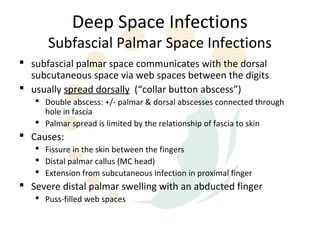
      Subfascial Palmar Space Infections
 subfascial palmar space communicates with the dorsal
  subcutaneous space via web spaces between the digits
 usually spread dorsally (“collar button abscess”)
    Double abscess: +/- palmar & dorsal abscesses connected through
     hole in fascia
    Palmar spread is limited by the relationship of fascia to skin
 Causes:
    Fissure in the skin between the fingers
    Distal palmar callus (MC head)
    Extension from subcutaneous infection in proximal finger
 Severe distal palmar swelling with an abducted finger
    Puss-filled web spaces
Subfascial Palmar Space Infections
                            Treatment
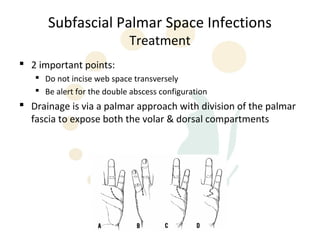
 2 important points:
    Do not incise web space transversely
    Be alert for the double abscess configuration
 Drainage is via a palmar approach with division of the palmar
  fascia to expose both the volar & dorsal compartments
Deep Space Infections
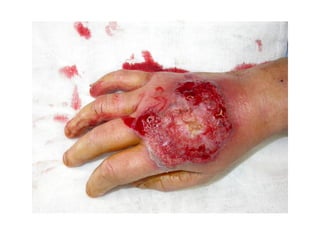
  Dorsal Subaponeurotic Space Infections
 DSS is beneath the extensor tendons on the dorsum of the
  hand
 Often the result of penetrating trauma
    IDU’s
    neglected human bites
 Dorsal swelling, erythema & tenderness + history make the
  diagnosis
 Drain via linear incisions over the 2nd & 4th MC’s while
  preserving soft tissue coverage over the tendons
    occasionally direct incision over a pointing abscess is necessary
    Risks exposure (desiccation) of extensor tendons
Deep Space Infections
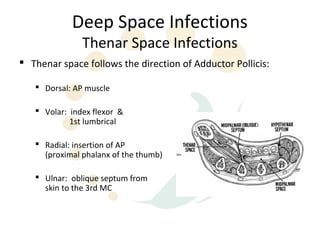
               Thenar Space Infections
 Thenar space follows the direction of Adductor Pollicis:

    Dorsal: AP muscle

    Volar: index flexor &
            1st lumbrical

    Radial: insertion of AP
     (proximal phalanx of the thumb)

    Ulnar: oblique septum from
     skin to the 3rd MC
Thenar Space Infections
                                 Clinical
 Causes:
       penetrating injury
       thumb or index subcutaneous abscess
       thumb or index flexor tenosynovitis
       extension from radial bursa or
        midpalmar space
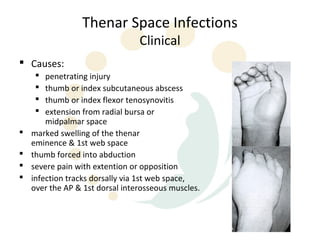
   marked swelling of the thenar
    eminence & 1st web space
   thumb forced into abduction
   severe pain with extention or opposition
   infection tracks dorsally via 1st web space,
    over the AP & 1st dorsal interosseous muscles.
Thenar Space Infections
                            Treatment
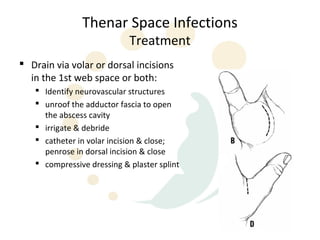
 Drain via volar or dorsal incisions
  in the 1st web space or both:
    Identify neurovascular structures
    unroof the adductor fascia to open
     the abscess cavity
    irrigate & debride
    catheter in volar incision & close;
     penrose in dorsal incision & close
    compressive dressing & plaster splint
Deep Space Infections
             Midpalmar Space Infections
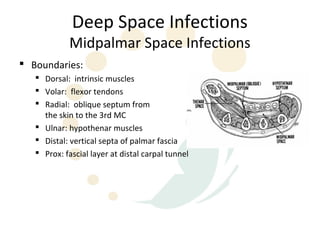
 Boundaries:
    Dorsal: intrinsic muscles
    Volar: flexor tendons
    Radial: oblique septum from
     the skin to the 3rd MC
    Ulnar: hypothenar muscles
    Distal: vertical septa of palmar fascia
    Prox: fascial layer at distal carpal tunnel
Deep Space Infections
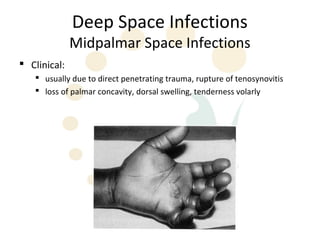
              Midpalmar Space Infections
 Clinical:
    usually due to direct penetrating trauma, rupture of tenosynovitis
    loss of palmar concavity, dorsal swelling, tenderness volarly
Midpalmar Space Infections
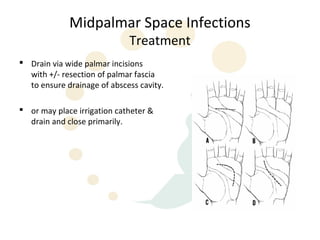
                             Treatment
 Drain via wide palmar incisions
  with +/- resection of palmar fascia
  to ensure drainage of abscess cavity.

 or may place irrigation catheter &
  drain and close primarily.
Bursal Infections
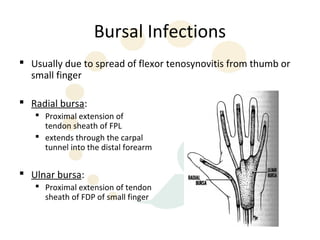
 Usually due to spread of flexor tenosynovitis from thumb or
  small finger

 Radial bursa:
    Proximal extension of
     tendon sheath of FPL
    extends through the carpal
     tunnel into the distal forearm


 Ulnar bursa:
    Proximal extension of tendon
     sheath of FDP of small finger
Bursal Infections
                         Treatment
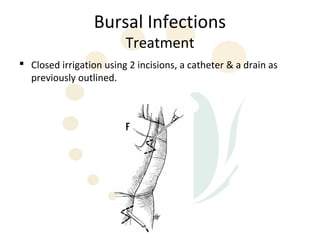
 Closed irrigation using 2 incisions, a catheter & a drain as
  previously outlined.
Human Bites
 Often undertreated & misdiagnosed leading to significant
  morbidity
 The most serious form of human bite infection is the clenched
  fist injury:


   Any laceration over the head of a metacarpal
    is a human bite injury until proven
    otherwise
Human Bites
 The wound that results from a punch to the mouth may
  appear insignificant and treatment may not be sought for
  days.
 It often results in immediate inoculation of the subcutaneous
  tissue, the subtendinous space and the MCP joint with saliva
    Human saliva may contain over 108 microorganisms per ml.
    Over 42 species of bacteria identified
    Thus: Polymicrobial infection is the rule
 Common organisms:
    S. Aureus, Strep sp.,
    Eikenella: gram neg facultative anaerobe in ~ 30% (incr. severity)
Human Bites
 Delay in onset of treatment is directly proportional to poor
  outcomes:
    In general, human bites treated within 24 hrs. rarely have serious
     complications

 in E.D.:
    Debride, irrigate, pack open
    Abx to cover gram +’s & eikenella (Pen & Ceph)
    +/- admission to follow response

 To O.R.:
    Established joint space penetration, & more severe infections
Animal Bites
 Dog more common than cat (5%)
    Cat bites are particularly virulent & can result in deep puncture
     wounds that are hard to clean
 More than half involve kids
 Basic principles of debridement & irrigation apply
    Deep puncture wounds are left open & may require extension
    Established infections are debrided & packed open
    Superficial lacerations may be loosely closed after irrigation
 Common organisms:
    S. Aureus, Strep viridans, Pasturella (#1 in cats), anaerobes
 Abx: ampicillin (Clavulin on outpatient basis)
Injection Drug Use
 Common sites of infection:
      Dorsum of hand
      Radiodorsal area of the wrist
      Palmar aspect of the forearm
      Dorsum of the fingers at the PIPJ
 Clinical spectrum:
      Cellulitis
      Subcutaneous abscess
      Flexor tenosynovitis
      Septic joints
      Osteomyelitis
      Necrotizing fasciitis
Injection Drug Use
 Source of infection from a variety of sources
    Skin
    Saliva
    Bowel

 Tx:
       Admission
       elevation of limb
       broad spectrum IV Abx
       analgesia (may need support from APS or CDRT)
       +/- debridement & irrigation
       Medicine consult
Hand Infections
                        Osteomyelitis
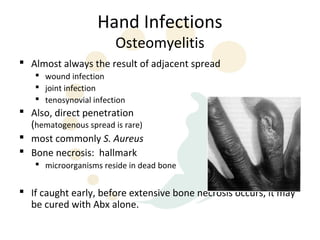
 Almost always the result of adjacent spread
    wound infection
    joint infection
    tenosynovial infection
 Also, direct penetration
  (hematogenous spread is rare)
 most commonly S. Aureus
 Bone necrosis: hallmark
    microorganisms reside in dead bone


 If caught early, before extensive bone necrosis occurs, it may
  be cured with Abx alone.
Osteomyelitis
                              Diagnosis
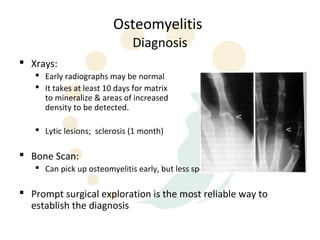
 Xrays:
    Early radiographs may be normal
    It takes at least 10 days for matrix
     to mineralize & areas of increased
     density to be detected.

    Lytic lesions; sclerosis (1 month)

 Bone Scan:
    Can pick up osteomyelitis early, but less specific

 Prompt surgical exploration is the most reliable way to
  establish the diagnosis
Osteomyelitis
                             Treatment
 Approach depends on location of involved bone:
    Phalanx: mid-axial incision
    Metacarpals: dorsal approach
 all infected bone must be removed
    Soft bone may be curetted
    may need to use drill holes to remove a small window of cortical bone
     for decompression of the infection
 routine post-Op care or may also use constant irrigation
  methods (1 wk)
 severe, extensive involvement of a digit may be best treated
  by amputation
    Will prevent stiffness & major disability of the uninfected parts
Hand Infections
                        Septic Arthritis
 usually the result of penetrating trauma:
    bite or tooth wound
 also, spread from soft tissue or bony infection
 joint is swollen, warm & tender
    pain with axial loading
    passive motion is restricted & painful
 Xrays:
    thinning of joint (cartilagenous loss)
    resorption of subchondral bone
    osteomyelitis (late)
 aspiration of joint for C & S
Septic Arthritis
                             Treatment
 Drainage is imperative as soon as the diagnosis is made
    Destruction of the articular cartilage by lysozymal activity
 approach is through a longitudinal dorsolateral incision over
  the affected joint
 access to the joint is via an incision dorsal to the cord portion
  of the collateral ligament
 joint is irrigated & debrided
 packed open for 48 - 72 hrs. (or closed over irrigation)
 packing removed and gentle ROM begun
 wound granulates closed
Hand Infections
                      Chronic Infections
 Atypical mycobacterium infections:
    penetrating wound often in a marine environment
    prolonged, relatively non-painful swelling of finger, palm or wrist
    Tuberculous & atypical mycobacteria have a predilection for synovial
     tissue of joints & tendon sheaths
    Tenosynovium is thick, infected & hypertrophic. It surrounds the
     tendons & erodes the pulleys.
    Dx: culture synovial biopsy
        Noncaseating granulomas & AFB
    Tx: thorough joint synovectomy
        For ++ joint damage: rest the joint until the infection is cured before
         undertaking reconstruction
        For tenosynovium: complete synovectomy sparing the pulleys
        Start anti-TB meds empirically (around time of synovectomy)
Hand Infections
                   Chronic Infections
 Tuberculous Infections:
    less common now than several decades ago
    Presents in a similar manner as atypical mycobacterial
     infections
    Tx: as above, synovectomy + anti-TB drugs
    In addition, can produce a dactylitis
       Enlarged fingers
       Proliferation of subperiosteal reaction on Xray
    Tx: surgical excision & curettage of the involved areas
Hand Infections
                     Chronic Infections
 Leprosy:
    M. lepraemurium
    Predilection for cooler areas of the body including the hands
    Most frequently produces a neuropathy involving the ulnar nerve:
        intrinsic atrophy
        clawing
        weakness in pinch
    Tx: surgical procedures limited to reconstruction for the neurological
     deficits
Hand Infections
                     Chronic Infections
 Fungal Infections:
    except for biopsy for diagnostic purposes, surgical treatment is rarely
     necessary
    best treated with systemic &/or local anti-fungal agents
    occasionally a tenosynovitis, septic arthritis or osteomyelitis is seen:
        Appropriate debridement required as above
        Mainstay is still anti-fungal agent
Post Op Care
 Wound care & early initiation of therapy are key in achieving
  good functional results in treating hand infections
 In general:
      wounds are debrided, irrigated & packed open
      packing usually removed 24 - 48 hrs. post-op
      initiation of regular wound cleansing
      gentle active ROM
      splints may be helpful in enhancing joint motions
      early involvement of a hand therapist is important in achieving a good
       functional result.
Hand infections
Hand infections
Hand infections
Hand infections
Hand infections
Hand infections
Hand infections
Hand infections
Hand infections
Hand infections

Hand infections

  • 2.
  • 3.
    Hand Infections Introduction  In the pre-antibiotic era:  65% of hand disability resulted from minor injuries that became infected  50 - 75% of all hand deformities were the result of infection  Kanavel’s study of the surgical anatomy of the hand:  defined anatomical planes and channels  careful placement of incisions for optimal drainage  became the cornerstone of treatment in the pre-antibiotic era  Penicillin changed the landscape:  severe hand infections are relatively uncommon today  incidence stable since 1940’s
  • 4.
    Hand Infections Antibiotics  valuable adjunct in infections but used alone will effect a cure in only a limited number of situations  early diagnosis: 24 - 48 hrs.  high dose IV therapy  elevation & splinting to rest the affected part  Beyond this time success is unlikely:  thrombosis of small vessels  swelling & pressure within closed anatomical spaces  Abx need not be continued more than 7 - 10 days  exception: osteomyelitis  can usually switch to oral route in 2 - 3 days (if improving)
  • 5.
    Hand Infections Outline  Principles  High Risk Patients  Felons & Paronychia  Flexor Tenosynovitis  Deep Space Infections  Bites  IDU  Osteomyelitis  Septic Arthritis  Chronic Infections
  • 6.
    Hand Infections Introduction  Treatment principles  early & adequate decompression of pus to avoid soft tissue loss  proper placement of incisions  avoids damage to adjacent structures  minimizes scar contracture  appropriate debridement of necrotic tissue  judicious splinting & early mobilization to minimize joint stiffness  appropriate use of Abx as adjunct to prevent dissemination of established infection
  • 7.
    Hand Infections Introduction  For infections requiring drainage, pre-operative planning is required. Type & placement of incision should:  Allow direct access to the abscess cavity  Permit easy extension in any direction  Follow accepted principles of hand surgery
  • 8.
    Hand Infections Introduction  Principles:  carry out procedure with optimal lighting, positioning, visualization, analgesia & tourniquet control  Do not exsanguinate part as this may cause bacterial seeding  incisions don’t cross flexion creases at > 45°  avoid injury to vessels, nerves & tendons  avoid compromising the blood supply to adjacent area  avoid leaving a sensitive scar, especially in an important tactile area  wounds left open are packed for 48 - 72 hrs. followed by saline soaks & exercise
  • 9.
    Hand Infections High Risk Patient  Up to 50% of hand infections involve:  Diabetic / Immune compromised  IDU  Bites  Higher risk for developing severe complications:  Joint stiffness - Osteomyelitis  Contracture - Necrotizing Fasciitis  Amputation - Death
  • 10.
    Felons & Paronychia General Account for ~ 1/3 of hand infections
  • 11.
    Felons Anatomy of the fingertip  Distal phalanx is a closed sac separate from the remainder of the digit  Closed pulp space divided into a latticework by multiple septa  Interstices filled with eccrine glands & fat  Dorsum is rigid (bound by DP & perionychium)  An increase in pressure of this compartment can adversely affect the blood supply to the soft tissue & bone.
  • 12.
    Felons  palmar closed-spaceinfection of the distal pulp  severe pain, redness & swelling  Hx of minor penetrating trauma is usually present:  Minor cuts  Splinters  Glass slivers  most frequent causative agent: S. Aureus  untreated felons can:  extend toward the phalanx --> osteomyelitis  toward the skin --> draining sinus  obliterate vessels ---> skin slough or necrosis  supperative flexor tenosynovitis or septic arthritis of the DIPJ
  • 13.
    Felons Treatment  If recognized early (mild cellulitis): soaks & Abx  Later (abscess formation): surgical drainage  Usually process has been going on > 48 hrs.  Principles:  Avoid injury to n/v structures  Utilize an incision that won’t leave a disabling scar  Do not violate flexor sheath (stay distal)  Produce adequate drainage
  • 14.
    Felons Treatment  Multiple incisions described:  Fishmouth  J or hockey stick Poor choices: - painful scar  Through & through - unstable tip - anaesthetic tip  Volar transverse Risks injury to digital  Midvolar longitudinal nerve  Unilateral high midlateral
  • 15.
    Felons Treatment Palmar incisions through the center of the pulp  Avoid crossing the DIP flexion crease (contracture)  Blade should only penetrate the dermis to avoid n/v structures and then a clamp is used to spread the subcutaneous tissue  typically, drain over area of maximal tenderness or sinus  Disadv:: scar over tactile surface, risk injury to dig. nerve
  • 16.
    Felons Treatment Unilateral longitudinal Incision  Best approach for most felons  Incise on lateral aspect of digit 5mm dorsal & distal to the DIP flexion crease  Continue distally to a point 5mm away from the edge of the free nail  Deepen the incision with a clamp within a plane just volar to the palmar cortex of the DP Location of Incisions: Index, middle & ring: ULNAR SIDE Thumb & small: RADIAL SIDE
  • 17.
  • 18.
    Paronychia  infection inand around the nail fold  Acute: any break in the seal between the nail and nail fold may serve as a portal of entry for infection  hangnails  manicures  nail biting  usual causative agent: S. Aureus  in more advanced infections, pus may accumulate beneath the nail plate, separating it from the underlying nail bed. This infection involves the entire eponychium and is called an “eponychia”  Pus can also spread around the nail fold resulting in a “runaround infection”
  • 19.
    Paronychia Treatment  If recognized early (mild cellulitis): soaks & Abx  Larger infections: drainage through the nail fold  Paronychial fold & portion of adjacent eponychium:  Remove 1/4 of nail  If this doesn’t allow drainage, incise fold away from matrix
  • 20.
    Paronychia Treatment  Eponychia:  Elevate eponychial fold and excise prox 1/3 of nail  Lateral (paronychial) incisions may aid in separating the nail base if not already separated
  • 21.
    Chronic Paronychia  Slightlydifferent disease process with an indolent course marked by exacerbations & remissions  Etiology: proximal nail fold obstruction + fungal infection  Often seen in people whose hands are constantly in a moist environment  Inflammation of the eponychial fold, often with separation from the underlying nail and intermittent drainage  usual causative agent: fungus > gram negative bacteria  Tx: eponychial marsupialization + topical antifungal  Crescent-shaped piece of skin excised proximal to nail fold  medical tx alone is largely unsuccessful
  • 22.
    Tenosynovitis Anatomy  Flexor sheaths are closed spaces  Extend from the mid-palmar crease to the DIPJ (Prox edge of A1 pulley to distal edge of A5 pulley)  Flexor sheath of small finger is continuous proximally with the Ulnar Bursa, while the sheath of the thumb is continuous with the Radial Bursa  Radial & Ulnar bursae extend proximal to the TCL and connect with the Parona space (Potential space between FDP & PQ muscle)
  • 23.
    Tenosynovitis General  Flexor sheath infections most often as a result of penetrating trauma  More likely at joint flexion creases  Sheaths are separated from skin by only a small amount of subcutaneous tissue here  Also, Felons can rupture into the distal flexor sheath  Usual causative agent: S. Aureus  most commonly affected digits:  Ring, long & index fingers
  • 24.
    Tenosynovitis General  Purulence within the sheath destroys the gliding mechanism, rapidly creating adhesions that lead to loss of function  destroys the blood supply producing tendon necrosis
  • 25.
    Tenosynovitis Clinical  Kanavel’s 4 cardinal signs:  Tenderness over & limited to the flexor sheath  Symmetrical enlargement of the digit (“fusiform”)  Severe pain on passive extension of the finger (> proximally)  Flexed posture of the involved digit  Not all four signs may be present early on  Most reliable sign: pain w. passive extension  Cellulitis of the hand may appear similar, but swelling & tenderness is not usually isolated to a single digit
  • 26.
    Tenosynovitis Treatment  Early infection < 48 hrs (& usually lacking all 4 signs) may initially be treated with IV Abx, splinting & elevation  Failure to respond within 24 hrs. should necessitate drainage  Established pyogenic tenosynovitis is a surgical emergency  Requires prompt surgical drainage  Delays may result in tendon &/or skin necrosis
  • 27.
    Tenosynovitis Treatment  2 basic approaches:  Open vs. Closed  Open drainage:  Decompression of the entire tendon sheath via mid-axial & palmar incisions  Wounds are left open to drain & heal secondarily  Rehab is prolonged; permanent finger stiffness not infrequent  Most useful for advanced cases where resection of necrotic tendon is required
  • 28.
    Tenosynovitis Treatment  Closed tendon-sheath irrigation:  2 incisions made  Proximal palm: open the sheath proximal to the A1 pulley  Distal mid-axial: open sheath distal to the A4 pulley  Long irrigation catheter (16 - 18g) is placed in the proximal sheath with a drain left in the distal incision  Incisions are then closed, and sheath is irrigated for 48 - 72 hrs.  May use NS or Abx solution (continuous drip or q2h flush)  Addition of marcaine alleviates pain of irrigation  Modification involves multiple transverse incisions of cruciate pulleys with insertion of silastic drains
  • 29.
    Tenosynovitis Treatment  These incisions:  ensure adequate drainage  heal quickly  Do not interfere with rehab  After removal of catheter and drains begin gentle passive & active ROM
  • 30.
    Chronic Tenosynovitis  Unusualcases may be seen which present differently than acute pyogenic infections:  Chronic swelling of the flexor sheath  No disabling pain or loss of function  These are chronic infections most frequently caused by mycobacteria  usually the result of a puncture wound in an aquatic environment  M. Kansasii or M. Marinarum  Dx: AFB stains & culture of synovium  Tx: tenosynovectomy + antituberculous drugs (6 - 24 mo)
  • 31.
    Deep Space Infections 4 deep spaces clinically significant in hand infections:  Subfascial palmar space  Dorsal subaponeurotic space  Thenar space  Midpalmar space
  • 32.
    Deep Space Infections Subfascial Palmar Space Infections  subfascial palmar space communicates with the dorsal subcutaneous space via web spaces between the digits  usually spread dorsally (“collar button abscess”)  Double abscess: +/- palmar & dorsal abscesses connected through hole in fascia  Palmar spread is limited by the relationship of fascia to skin  Causes:  Fissure in the skin between the fingers  Distal palmar callus (MC head)  Extension from subcutaneous infection in proximal finger  Severe distal palmar swelling with an abducted finger  Puss-filled web spaces
  • 33.
    Subfascial Palmar SpaceInfections Treatment  2 important points:  Do not incise web space transversely  Be alert for the double abscess configuration  Drainage is via a palmar approach with division of the palmar fascia to expose both the volar & dorsal compartments
  • 34.
    Deep Space Infections Dorsal Subaponeurotic Space Infections  DSS is beneath the extensor tendons on the dorsum of the hand  Often the result of penetrating trauma  IDU’s  neglected human bites  Dorsal swelling, erythema & tenderness + history make the diagnosis  Drain via linear incisions over the 2nd & 4th MC’s while preserving soft tissue coverage over the tendons  occasionally direct incision over a pointing abscess is necessary  Risks exposure (desiccation) of extensor tendons
  • 35.
    Deep Space Infections Thenar Space Infections  Thenar space follows the direction of Adductor Pollicis:  Dorsal: AP muscle  Volar: index flexor & 1st lumbrical  Radial: insertion of AP (proximal phalanx of the thumb)  Ulnar: oblique septum from skin to the 3rd MC
  • 36.
    Thenar Space Infections Clinical  Causes:  penetrating injury  thumb or index subcutaneous abscess  thumb or index flexor tenosynovitis  extension from radial bursa or midpalmar space  marked swelling of the thenar eminence & 1st web space  thumb forced into abduction  severe pain with extention or opposition  infection tracks dorsally via 1st web space, over the AP & 1st dorsal interosseous muscles.
  • 37.
    Thenar Space Infections Treatment  Drain via volar or dorsal incisions in the 1st web space or both:  Identify neurovascular structures  unroof the adductor fascia to open the abscess cavity  irrigate & debride  catheter in volar incision & close; penrose in dorsal incision & close  compressive dressing & plaster splint
  • 38.
    Deep Space Infections Midpalmar Space Infections  Boundaries:  Dorsal: intrinsic muscles  Volar: flexor tendons  Radial: oblique septum from the skin to the 3rd MC  Ulnar: hypothenar muscles  Distal: vertical septa of palmar fascia  Prox: fascial layer at distal carpal tunnel
  • 39.
    Deep Space Infections Midpalmar Space Infections  Clinical:  usually due to direct penetrating trauma, rupture of tenosynovitis  loss of palmar concavity, dorsal swelling, tenderness volarly
  • 40.
    Midpalmar Space Infections Treatment  Drain via wide palmar incisions with +/- resection of palmar fascia to ensure drainage of abscess cavity.  or may place irrigation catheter & drain and close primarily.
  • 41.
    Bursal Infections  Usuallydue to spread of flexor tenosynovitis from thumb or small finger  Radial bursa:  Proximal extension of tendon sheath of FPL  extends through the carpal tunnel into the distal forearm  Ulnar bursa:  Proximal extension of tendon sheath of FDP of small finger
  • 42.
    Bursal Infections Treatment  Closed irrigation using 2 incisions, a catheter & a drain as previously outlined.
  • 43.
    Human Bites  Oftenundertreated & misdiagnosed leading to significant morbidity  The most serious form of human bite infection is the clenched fist injury: Any laceration over the head of a metacarpal is a human bite injury until proven otherwise
  • 44.
    Human Bites  Thewound that results from a punch to the mouth may appear insignificant and treatment may not be sought for days.  It often results in immediate inoculation of the subcutaneous tissue, the subtendinous space and the MCP joint with saliva  Human saliva may contain over 108 microorganisms per ml.  Over 42 species of bacteria identified  Thus: Polymicrobial infection is the rule  Common organisms:  S. Aureus, Strep sp.,  Eikenella: gram neg facultative anaerobe in ~ 30% (incr. severity)
  • 45.
    Human Bites  Delayin onset of treatment is directly proportional to poor outcomes:  In general, human bites treated within 24 hrs. rarely have serious complications  in E.D.:  Debride, irrigate, pack open  Abx to cover gram +’s & eikenella (Pen & Ceph)  +/- admission to follow response  To O.R.:  Established joint space penetration, & more severe infections
  • 46.
    Animal Bites  Dogmore common than cat (5%)  Cat bites are particularly virulent & can result in deep puncture wounds that are hard to clean  More than half involve kids  Basic principles of debridement & irrigation apply  Deep puncture wounds are left open & may require extension  Established infections are debrided & packed open  Superficial lacerations may be loosely closed after irrigation  Common organisms:  S. Aureus, Strep viridans, Pasturella (#1 in cats), anaerobes  Abx: ampicillin (Clavulin on outpatient basis)
  • 47.
    Injection Drug Use Common sites of infection:  Dorsum of hand  Radiodorsal area of the wrist  Palmar aspect of the forearm  Dorsum of the fingers at the PIPJ  Clinical spectrum:  Cellulitis  Subcutaneous abscess  Flexor tenosynovitis  Septic joints  Osteomyelitis  Necrotizing fasciitis
  • 48.
    Injection Drug Use Source of infection from a variety of sources  Skin  Saliva  Bowel  Tx:  Admission  elevation of limb  broad spectrum IV Abx  analgesia (may need support from APS or CDRT)  +/- debridement & irrigation  Medicine consult
  • 49.
    Hand Infections Osteomyelitis  Almost always the result of adjacent spread  wound infection  joint infection  tenosynovial infection  Also, direct penetration (hematogenous spread is rare)  most commonly S. Aureus  Bone necrosis: hallmark  microorganisms reside in dead bone  If caught early, before extensive bone necrosis occurs, it may be cured with Abx alone.
  • 50.
    Osteomyelitis Diagnosis  Xrays:  Early radiographs may be normal  It takes at least 10 days for matrix to mineralize & areas of increased density to be detected.  Lytic lesions; sclerosis (1 month)  Bone Scan:  Can pick up osteomyelitis early, but less specific  Prompt surgical exploration is the most reliable way to establish the diagnosis
  • 51.
    Osteomyelitis Treatment  Approach depends on location of involved bone:  Phalanx: mid-axial incision  Metacarpals: dorsal approach  all infected bone must be removed  Soft bone may be curetted  may need to use drill holes to remove a small window of cortical bone for decompression of the infection  routine post-Op care or may also use constant irrigation methods (1 wk)  severe, extensive involvement of a digit may be best treated by amputation  Will prevent stiffness & major disability of the uninfected parts
  • 52.
    Hand Infections Septic Arthritis  usually the result of penetrating trauma:  bite or tooth wound  also, spread from soft tissue or bony infection  joint is swollen, warm & tender  pain with axial loading  passive motion is restricted & painful  Xrays:  thinning of joint (cartilagenous loss)  resorption of subchondral bone  osteomyelitis (late)  aspiration of joint for C & S
  • 53.
    Septic Arthritis Treatment  Drainage is imperative as soon as the diagnosis is made  Destruction of the articular cartilage by lysozymal activity  approach is through a longitudinal dorsolateral incision over the affected joint  access to the joint is via an incision dorsal to the cord portion of the collateral ligament  joint is irrigated & debrided  packed open for 48 - 72 hrs. (or closed over irrigation)  packing removed and gentle ROM begun  wound granulates closed
  • 54.
    Hand Infections Chronic Infections  Atypical mycobacterium infections:  penetrating wound often in a marine environment  prolonged, relatively non-painful swelling of finger, palm or wrist  Tuberculous & atypical mycobacteria have a predilection for synovial tissue of joints & tendon sheaths  Tenosynovium is thick, infected & hypertrophic. It surrounds the tendons & erodes the pulleys.  Dx: culture synovial biopsy  Noncaseating granulomas & AFB  Tx: thorough joint synovectomy  For ++ joint damage: rest the joint until the infection is cured before undertaking reconstruction  For tenosynovium: complete synovectomy sparing the pulleys  Start anti-TB meds empirically (around time of synovectomy)
  • 55.
    Hand Infections Chronic Infections  Tuberculous Infections:  less common now than several decades ago  Presents in a similar manner as atypical mycobacterial infections  Tx: as above, synovectomy + anti-TB drugs  In addition, can produce a dactylitis  Enlarged fingers  Proliferation of subperiosteal reaction on Xray  Tx: surgical excision & curettage of the involved areas
  • 56.
    Hand Infections Chronic Infections  Leprosy:  M. lepraemurium  Predilection for cooler areas of the body including the hands  Most frequently produces a neuropathy involving the ulnar nerve:  intrinsic atrophy  clawing  weakness in pinch  Tx: surgical procedures limited to reconstruction for the neurological deficits
  • 57.
    Hand Infections Chronic Infections  Fungal Infections:  except for biopsy for diagnostic purposes, surgical treatment is rarely necessary  best treated with systemic &/or local anti-fungal agents  occasionally a tenosynovitis, septic arthritis or osteomyelitis is seen:  Appropriate debridement required as above  Mainstay is still anti-fungal agent
  • 58.
    Post Op Care Wound care & early initiation of therapy are key in achieving good functional results in treating hand infections  In general:  wounds are debrided, irrigated & packed open  packing usually removed 24 - 48 hrs. post-op  initiation of regular wound cleansing  gentle active ROM  splints may be helpful in enhancing joint motions  early involvement of a hand therapist is important in achieving a good functional result.