ETHIRAJ COLLEGE FOR WOMEN
(AUTONOMOUS)
Chennai – 600 008
Presented by
Dr. Taibangnganbi Nameirakpam
Assistant Professor
Department of Business Economics (SS)
What is capital budgeting?
 Analysis of potential additions to fixed assets.
 Long-term decisions; involve large expenditures.
 Very important to firm’s future.
 Planning on long-term assets
 Investment concept
Examples
New equipment
Plant expansion
Equipment selection
Lease or buy
Timing of replacement
Capital budgeting is the process of evaluating and
selecting long term investments that are consistent with
the goal of shareholders (owners) wealth maximization
Features of capital budgeting
Potentially large anticipated benefits
A relatively high degree of risk
A relatively long period between the initial outlay and
the anticipated returns
Capital expenditure is an outlay of funds that is
expected to produce benefits over a period of time
exceeding one year
Capital expenditure management includes addition,
disposition, modification and replacement of fixed assets
Significance of capital budgeting
Capital Budgeting decisions affect the profitability of the
firm
Risk exposure of funds committed in capital expenditure
projects
Effects on operating expenditures and the patterns of cash
flows for a longer period
Where a company is contemplating to diversify its
operations or expand its activity the management is required
to make a series of investment decisions
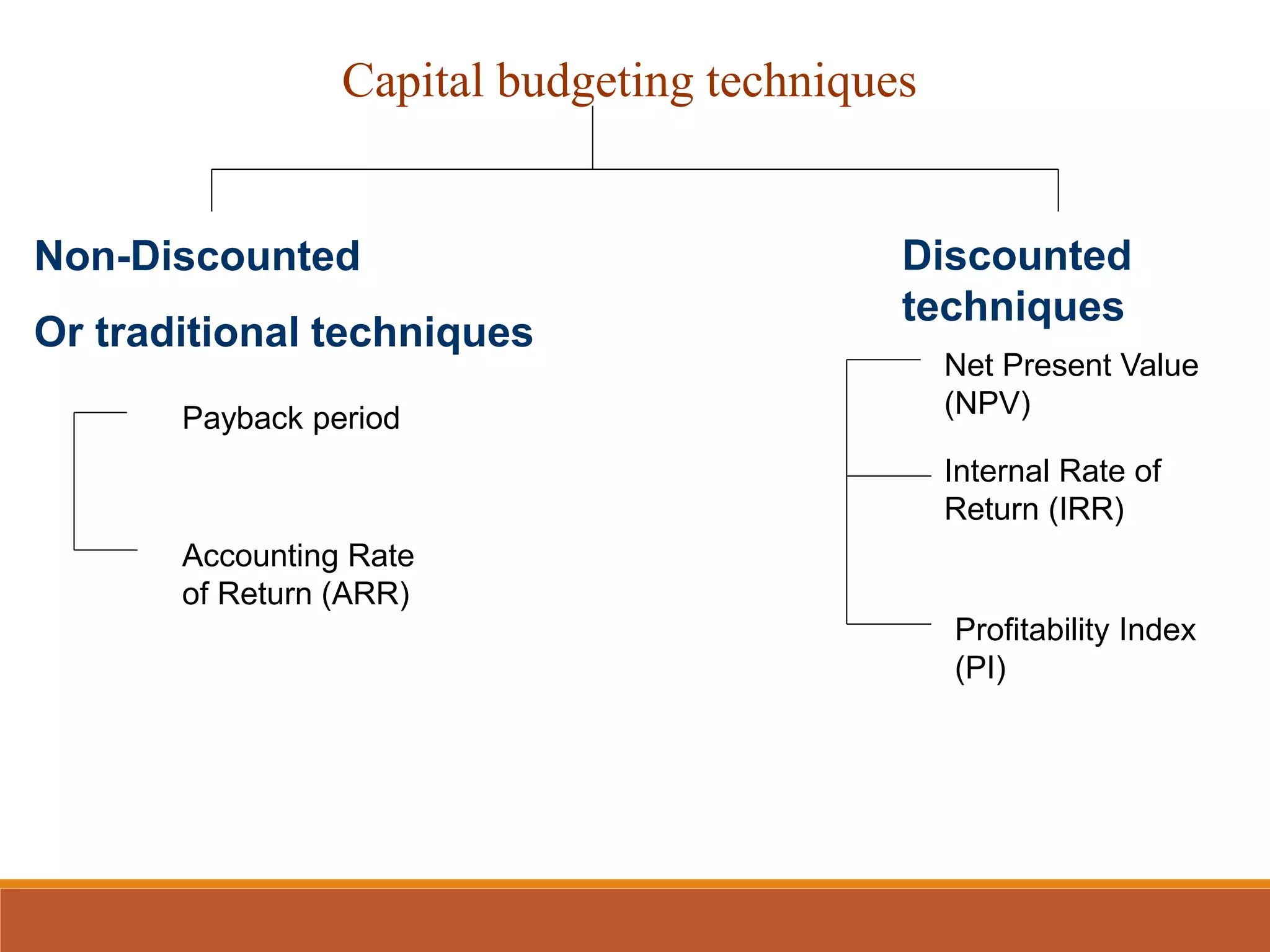
Capital budgeting techniques
Discounted
techniques
Non-Discounted
Or traditional techniques
Payback period
Accounting Rate
of Return (ARR)
Net Present Value
(NPV)
Internal Rate of
Return (IRR)
Profitability Index
(PI)
1. Payback Method
Payback is the no. of years required to recover the
original cash outlay invested in a project. If the project
generates constant annual cash inflows, the payback period
can be computed by dividing cash outlay by the annual
cash inflow.
Payback = Initial Investment = Co
Annual Cash Inflow C
Acceptance Rule
Many firm’s compare the project’s payback with a
predetermined, standard payback. The project would be
accepted if its payback period is less than the maximum or
standard payback set by the management
Advantages of payback
 Simplicity
 Cost Effective
 Short-term effects
 Risk shields
 Liquidity
Limitations
 Cash flows after payback
 Cash flows ignored
Cash flow patterns
 Administrative Difficulties
 Inconsistent with shareholder value
II. Accounting Rate of Return
The accounting rate of return (ARR), also known as
the return on investment (ROI), uses the accounting
information, as revealed by the financial statements, to
measure the profitability of an investment
ARR = Average Income
Average Investment
Acceptance rule
This method will accept all those projects whose ARR is
higher than the minimum rate established by the
management and reject those projects which have ARR less
than the minimum rate
Merits
Simplicity
Accounting data
Accounting profitability
Limitations
Cash flows ignored
Time value ignored
Arbitrary cut- off
III Net Present Value Method
Discounted cash flow technique that explicitly that
recognizes the time value of money
It correctly postulates that cash flows arising at different
time periods differ in value are comparable only when their
equivalents present values are found out
The following steps are involved in the calculation of NPV:
1. Cash flows of the investment project should be forecasted
based on realistic assumptions.
2. Appropriate discount rate should be identified to discount
the forecasted cash flows. (The appropriate discount rate is
the project’s opportunity cost of capital , which is equal to
the required rate of return expected by investors on
investments of equivalent risk).
3. Present value of cash flows should be calculated using the
opportunity cost of capital as the discount rate
4. NPV should be found out by subtracting present value of
cash inflows
Acceptance rule
The project should be accepted if NPV is positive (i.e.,
NPV>0) and to reject it if the net present value is negative
i.e. (NPV<0)
Positive NPV contributes to the net wealth of the
shareholders, which should result in the increased price of a
firm’s share.
The positive NPV will result only if the project generates
cash inflows at a rate higher than the opportunity cost of
capital
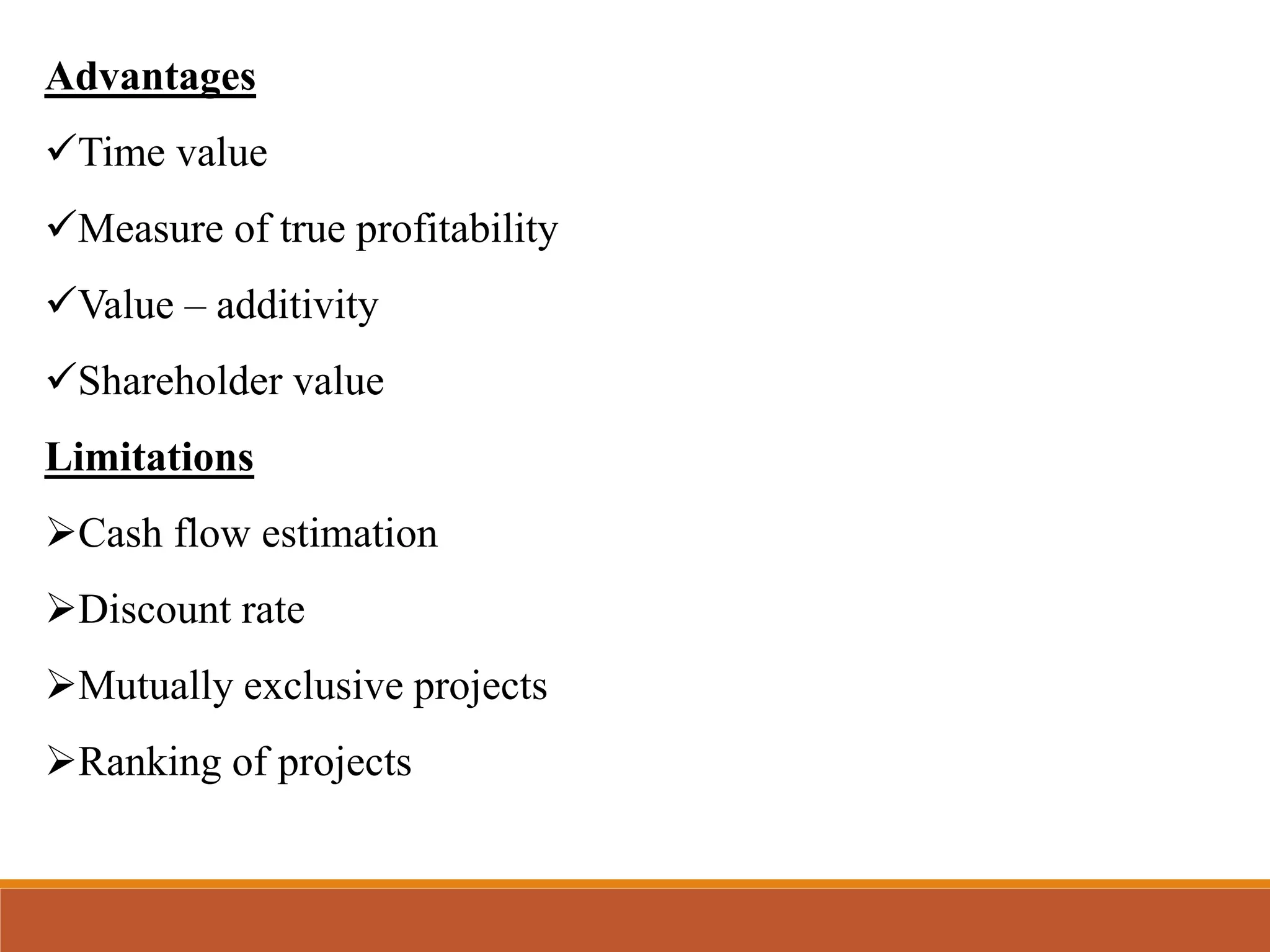
Advantages
Time value
Measure of true profitability
Value – additivity
Shareholder value
Limitations
Cash flow estimation
Discount rate
Mutually exclusive projects
Ranking of projects
IV Internal Rate Of Return Method (IRR)
–is another model using discounted cash flows.
The internal rate of return (IRR) is the rate of return that
a company can expect to earn by investing in a project.
The higher the IRR, the more desirable the investment.
The IRR is the rate of return at which the net present
value equals zero.
Investment = Expected annual net cash inflow × PV
annuity factor
Investment ÷ Expected annual net cash inflow = PV
annuity factor
•Decision rule:
Accept the project if the IRR is greater than the
required rate of return.
 If IRR > k, accept project.
 If IRR < k, reject project.
 May accept the project when r=k
Advantages
Time value
Profitability measure
Acceptance rule
Shareholder value
Pitfall of the IRR method
Multiple rates
Mutually exclusive projects
Value additivity
Thank You

Capital Budgeting.ppt

  • 1.
    ETHIRAJ COLLEGE FORWOMEN (AUTONOMOUS) Chennai – 600 008 Presented by Dr. Taibangnganbi Nameirakpam Assistant Professor Department of Business Economics (SS)
  • 2.
    What is capitalbudgeting?  Analysis of potential additions to fixed assets.  Long-term decisions; involve large expenditures.  Very important to firm’s future.  Planning on long-term assets  Investment concept Examples New equipment Plant expansion Equipment selection Lease or buy Timing of replacement
  • 3.
    Capital budgeting isthe process of evaluating and selecting long term investments that are consistent with the goal of shareholders (owners) wealth maximization Features of capital budgeting Potentially large anticipated benefits A relatively high degree of risk A relatively long period between the initial outlay and the anticipated returns
  • 4.
    Capital expenditure isan outlay of funds that is expected to produce benefits over a period of time exceeding one year Capital expenditure management includes addition, disposition, modification and replacement of fixed assets Significance of capital budgeting Capital Budgeting decisions affect the profitability of the firm Risk exposure of funds committed in capital expenditure projects
  • 5.
    Effects on operatingexpenditures and the patterns of cash flows for a longer period Where a company is contemplating to diversify its operations or expand its activity the management is required to make a series of investment decisions
  • 6.
    Capital budgeting techniques Discounted techniques Non-Discounted Ortraditional techniques Payback period Accounting Rate of Return (ARR) Net Present Value (NPV) Internal Rate of Return (IRR) Profitability Index (PI)
  • 7.
    1. Payback Method Paybackis the no. of years required to recover the original cash outlay invested in a project. If the project generates constant annual cash inflows, the payback period can be computed by dividing cash outlay by the annual cash inflow. Payback = Initial Investment = Co Annual Cash Inflow C Acceptance Rule Many firm’s compare the project’s payback with a predetermined, standard payback. The project would be accepted if its payback period is less than the maximum or standard payback set by the management
  • 8.
    Advantages of payback Simplicity  Cost Effective  Short-term effects  Risk shields  Liquidity Limitations  Cash flows after payback  Cash flows ignored Cash flow patterns
  • 9.
     Administrative Difficulties Inconsistent with shareholder value II. Accounting Rate of Return The accounting rate of return (ARR), also known as the return on investment (ROI), uses the accounting information, as revealed by the financial statements, to measure the profitability of an investment ARR = Average Income Average Investment
  • 10.
    Acceptance rule This methodwill accept all those projects whose ARR is higher than the minimum rate established by the management and reject those projects which have ARR less than the minimum rate Merits Simplicity Accounting data Accounting profitability
  • 11.
    Limitations Cash flows ignored Timevalue ignored Arbitrary cut- off III Net Present Value Method Discounted cash flow technique that explicitly that recognizes the time value of money It correctly postulates that cash flows arising at different time periods differ in value are comparable only when their equivalents present values are found out
  • 12.
    The following stepsare involved in the calculation of NPV: 1. Cash flows of the investment project should be forecasted based on realistic assumptions. 2. Appropriate discount rate should be identified to discount the forecasted cash flows. (The appropriate discount rate is the project’s opportunity cost of capital , which is equal to the required rate of return expected by investors on investments of equivalent risk). 3. Present value of cash flows should be calculated using the opportunity cost of capital as the discount rate 4. NPV should be found out by subtracting present value of cash inflows
  • 13.
    Acceptance rule The projectshould be accepted if NPV is positive (i.e., NPV>0) and to reject it if the net present value is negative i.e. (NPV<0) Positive NPV contributes to the net wealth of the shareholders, which should result in the increased price of a firm’s share. The positive NPV will result only if the project generates cash inflows at a rate higher than the opportunity cost of capital
  • 14.
    Advantages Time value Measure oftrue profitability Value – additivity Shareholder value Limitations Cash flow estimation Discount rate Mutually exclusive projects Ranking of projects
  • 15.
    IV Internal RateOf Return Method (IRR) –is another model using discounted cash flows. The internal rate of return (IRR) is the rate of return that a company can expect to earn by investing in a project. The higher the IRR, the more desirable the investment. The IRR is the rate of return at which the net present value equals zero. Investment = Expected annual net cash inflow × PV annuity factor Investment ÷ Expected annual net cash inflow = PV annuity factor
  • 16.
    •Decision rule: Accept theproject if the IRR is greater than the required rate of return.  If IRR > k, accept project.  If IRR < k, reject project.  May accept the project when r=k Advantages Time value Profitability measure Acceptance rule Shareholder value
  • 17.
    Pitfall of theIRR method Multiple rates Mutually exclusive projects Value additivity
  • 18.