Net Present Value and Other Investment Rules
Chapter 5
Copyright © 2010 by the McGraw-Hill Companies, Inc. All rights reserved.McGraw-Hill/Irwin
5-2
Key Concepts and Skills
 Be able to compute payback and discounted
payback and understand their shortcomings
 Be able to compute the internal rate of return and
profitability index, understanding the strengths
and weaknesses of both approaches
 Be able to compute net present value and
understand why it is the best decision criterion
5-3
Chapter Outline
5.1 Why Use Net Present Value?
5.2 The Payback Period Method
5.3 The Discounted Payback Period Method
5.4 The Internal Rate of Return
5.5 Problems with the IRR Approach
5.6 The Profitability Index
5.7 The Practice of Capital Budgeting
5-4
5.1 Why Use Net Present Value?
 Accepting positive NPV projects benefits
shareholders.
 NPV uses cash flows
 NPV uses all the cash flows of the project
 NPV discounts the cash flows properly
5-5
The Net Present Value (NPV) Rule
 Net Present Value (NPV) =
Total PV of future CF’s + Initial Investment
 Estimating NPV:
1. Estimate future cash flows: how much? and when?
2. Estimate discount rate
3. Estimate initial costs
 Minimum Acceptance Criteria: Accept if NPV > 0
 Ranking Criteria: Choose the highest NPV
5-6
Calculating NPV with Spreadsheets
 Spreadsheets are an excellent way to compute
NPVs, especially when you have to compute
the cash flows as well.
 Using the NPV function:
 The first component is the required return entered
as a decimal.
 The second component is the range of cash flows
beginning with year 1.
 Add the initial investment after computing the
NPV.
5-7
5.2 The Payback Period Method
 How long does it take the project to “pay
back” its initial investment?
 Payback Period = number of years to recover
initial costs
 Minimum Acceptance Criteria:
 Set by management
 Ranking Criteria:
 Set by management
5-8
The Payback Period Method
 Disadvantages:
 Ignores the time value of money
 Ignores cash flows after the payback period
 Biased against long-term projects
 Requires an arbitrary acceptance criteria
 A project accepted based on the payback
criteria may not have a positive NPV
 Advantages:
 Easy to understand
 Biased toward liquidity
5-9
5.3 The Discounted Payback Period
 How long does it take the project to “pay
back” its initial investment, taking the time
value of money into account?
 Decision rule: Accept the project if it pays
back on a discounted basis within the specified
time.
 By the time you have discounted the cash
flows, you might as well calculate the NPV.
5-10
5.4 The Internal Rate of Return
 IRR: the discount rate that sets NPV to zero
 Minimum Acceptance Criteria:
 Accept if the IRR exceeds the required return
 Ranking Criteria:
 Select alternative with the highest IRR
 Reinvestment assumption:
 All future cash flows are assumed to be
reinvested at the IRR
5-11
Internal Rate of Return (IRR)
 Disadvantages:
 Does not distinguish between investing and
borrowing
 IRR may not exist, or there may be multiple IRRs
 Problems with mutually exclusive investments
 Advantages:
 Easy to understand and communicate
5-12
IRR: Example
Consider the following project:
0 1 2 3
$50 $100 $150
-$200
The internal rate of return for this project is 19.44%
32
)1(
150$
)1(
100$
)1(
50$
2000
IRRIRRIRR
NPV
+
+
+
+
+
+−==
5-13
NPV Payoff Profile
0% $100.00
4% $73.88
8% $51.11
12% $31.13
16% $13.52
20% ($2.08)
24% ($15.97)
28% ($28.38)
32% ($39.51)
36% ($49.54)
40% ($58.60)
44% ($66.82)
If we graph NPV versus the discount rate, we can see the IRR
as the x-axis intercept.
IRR = 19.44%
($100.00)
($50.00)
$0.00
$50.00
$100.00
$150.00
-1% 9% 19% 29% 39%
Discount rate
NPV
5-14
Calculating IRR with Spreadsheets
 You start with the same cash flows as you did
for the NPV.
 You use the IRR function:
 You first enter your range of cash flows, beginning
with the initial cash flow.
 You can enter a guess, but it is not necessary.
 The default format is a whole percent – you will
normally want to increase the decimal places to at
least two.
5-15
5.5 Problems with IRR
 Multiple IRRs
 Are We Borrowing or Lending
 The Scale Problem
 The Timing Problem
5-16
Mutually Exclusive vs. Independent
 Mutually Exclusive Projects: only ONE of several
potential projects can be chosen, e.g., acquiring an
accounting system.
 RANK all alternatives, and select the best one.
 Independent Projects: accepting or rejecting one
project does not affect the decision of the other
projects.
 Must exceed a MINIMUM acceptance criteria
5-17
Multiple IRRs
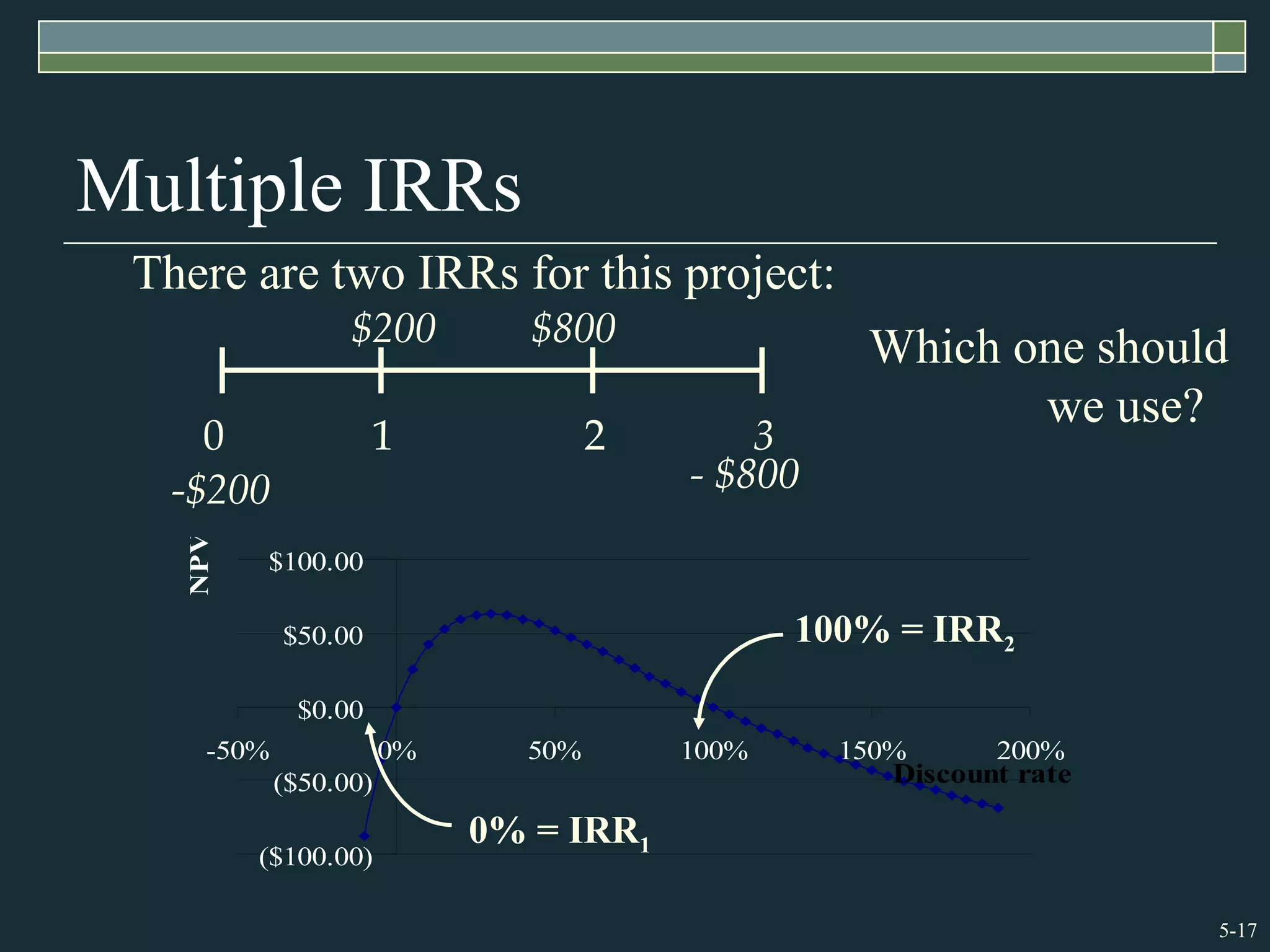
There are two IRRs for this project:
0 1 2 3
$200 $800
-$200 - $800
($100.00)
($50.00)
$0.00
$50.00
$100.00
-50% 0% 50% 100% 150% 200%
Discount rate
NPV
100% = IRR2
0% = IRR1
Which one should
we use?
5-18
Modified IRR
 Calculate the net present value of all cash
outflows using the borrowing rate.
 Calculate the net future value of all cash
inflows using the investing rate.
 Find the rate of return that equates these
values.
 Benefits: single answer and specific rates for
borrowing and reinvestment
5-19
The Scale Problem
Would you rather make 100% or 50% on your
investments?
What if the 100% return is on a $1
investment, while the 50% return is on a
$1,000 investment?
5-20
The Timing Problem
0 1 2 3
$10,000 $1,000 $1,000
-$10,000
Project A
0 1 2 3
$1,000 $1,000 $12,000
-$10,000
Project B
5-21
The Timing Problem
($5,000.00)
($4,000.00)
($3,000.00)
($2,000.00)
($1,000.00)
$0.00
$1,000.00
$2,000.00
$3,000.00
$4,000.00
$5,000.00
0% 10% 20% 30% 40%
Discount rate
NPV
Project A
Project B
10.55% = crossover rate
16.04% = IRRA12.94% = IRRB
5-22
Calculating the Crossover Rate
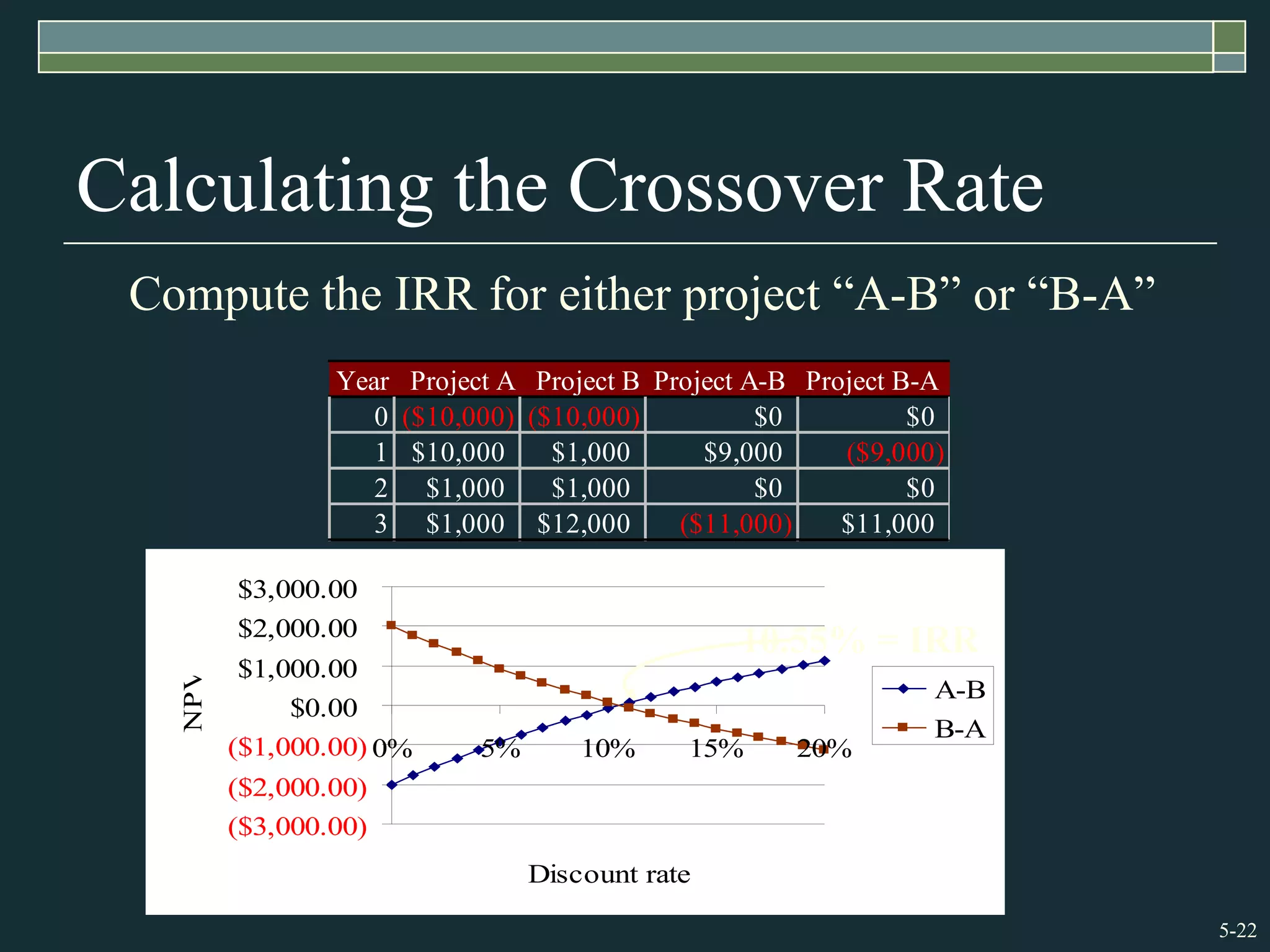
Compute the IRR for either project “A-B” or “B-A”
Year Project A Project B Project A-B Project B-A
0 ($10,000) ($10,000) $0 $0
1 $10,000 $1,000 $9,000 ($9,000)
2 $1,000 $1,000 $0 $0
3 $1,000 $12,000 ($11,000) $11,000
($3,000.00)
($2,000.00)
($1,000.00)
$0.00
$1,000.00
$2,000.00
$3,000.00
0% 5% 10% 15% 20%
Discount rate
NPV
A-B
B-A
10.55% = IRR
5-23
NPV versus IRR
 NPV and IRR will generally give the same
decision.
 Exceptions:
 Non-conventional cash flows – cash flow signs
change more than once
 Mutually exclusive projects
 Initial investments are substantially different
 Timing of cash flows is substantially different
5-24
5.6 The Profitability Index (PI)
 Minimum Acceptance Criteria:
 Accept if PI > 1
 Ranking Criteria:
 Select alternative with highest PI
InvestentInitial
FlowsCashFutureofPVTotal
PI =
5-25
The Profitability Index
 Disadvantages:
 Problems with mutually exclusive investments
 Advantages:
 May be useful when available investment funds
are limited
 Easy to understand and communicate
 Correct decision when evaluating independent
projects
5-26
5.7 The Practice of Capital Budgeting
 Varies by industry:
 Some firms use payback, others use accounting
rate of return.
 The most frequently used technique for large
corporations is either IRR or NPV.
5-27
Example of Investment Rules
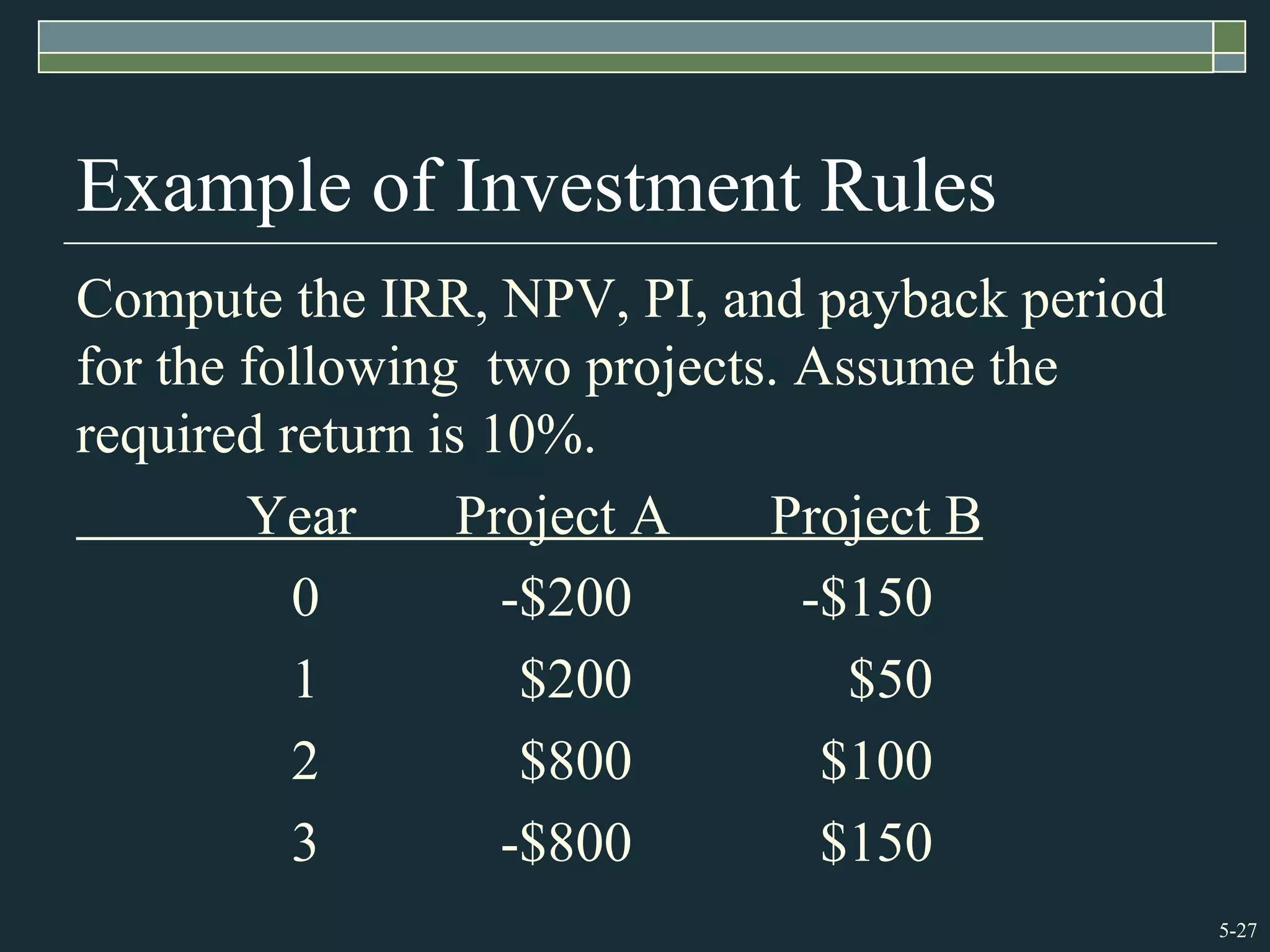
Compute the IRR, NPV, PI, and payback period
for the following two projects. Assume the
required return is 10%.
Year Project A Project B
0 -$200 -$150
1 $200 $50
2 $800 $100
3 -$800 $150
5-28
Example of Investment Rules
Project A Project B
CF0 -$200.00 -$150.00
PV0 of CF1-3 $241.92 $240.80
NPV = $41.92 $90.80
IRR = 0%, 100% 36.19%
PI = 1.2096 1.6053
5-29
Example of Investment Rules
Payback Period:
Project A Project B
Time CF Cum. CF CF Cum. CF
0 -200 -200 -150 -150
1 200 0 50 -100
2 800 800 100 0
3 -800 0 150 150
Payback period for project B = 2 years.
Payback period for project A = 1 or 3 years?
5-30
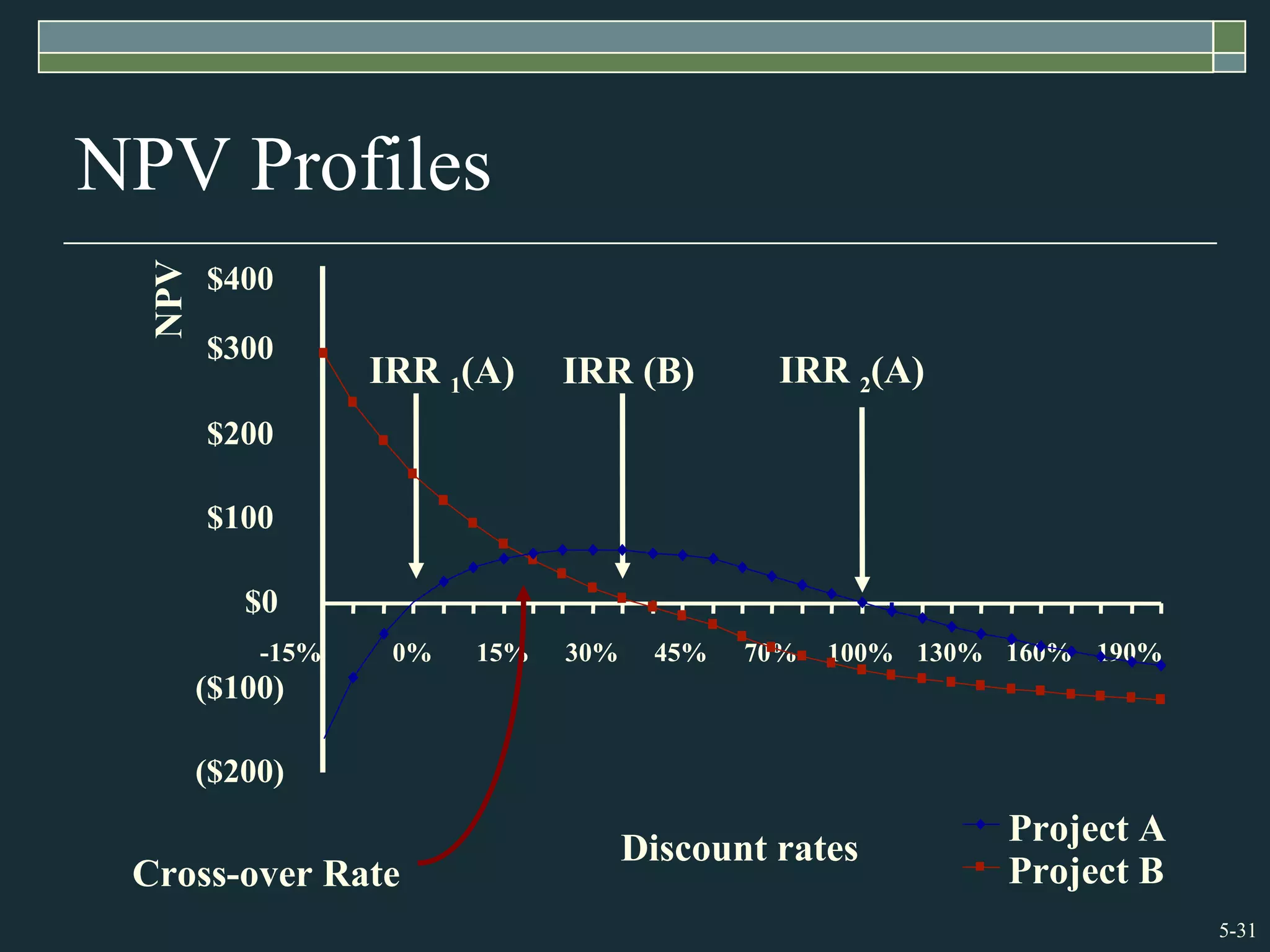
NPV and IRR Relationship
Discount rate NPV for A NPV for B
-10% -87.52 234.77
0% 0.00 150.00
20% 59.26 47.92
40% 59.48 -8.60
60% 42.19 -43.07
80% 20.85 -65.64
100% 0.00 -81.25
120% -18.93 -92.52
5-31
Project A
Project B
($200)
($100)
$0
$100
$200
$300
$400
-15% 0% 15% 30% 45% 70% 100% 130% 160% 190%
Discount rates
NPV
IRR 1(A) IRR (B)
NPV Profiles
IRR 2(A)
Cross-over Rate
5-32
Summary – Discounted Cash Flow
 Net present value
 Difference between market value and cost
 Accept the project if the NPV is positive
 Has no serious problems
 Preferred decision criterion
 Internal rate of return
 Discount rate that makes NPV = 0
 Take the project if the IRR is greater than the required return
 Same decision as NPV with conventional cash flows
 IRR is unreliable with non-conventional cash flows or mutually exclusive
projects
 Profitability Index
 Benefit-cost ratio
 Take investment if PI > 1
 Cannot be used to rank mutually exclusive projects
 May be used to rank projects in the presence of capital rationing
5-33
Summary – Payback Criteria
 Payback period
 Length of time until initial investment is recovered
 Take the project if it pays back in some specified period
 Does not account for time value of money, and there is an
arbitrary cutoff period
 Discounted payback period
 Length of time until initial investment is recovered on a
discounted basis
 Take the project if it pays back in some specified period
 There is an arbitrary cutoff period
5-34
Quick Quiz
 Consider an investment that costs $100,000 and has a
cash inflow of $25,000 every year for 5 years. The
required return is 9%, and payback cutoff is 4 years.
 What is the payback period?
 What is the discounted payback period?
 What is the NPV?
 What is the IRR?
 Should we accept the project?
 What method should be the primary decision rule?
 When is the IRR rule unreliable?

Chap005

  • 1.
    Net Present Valueand Other Investment Rules Chapter 5 Copyright © 2010 by the McGraw-Hill Companies, Inc. All rights reserved.McGraw-Hill/Irwin
  • 2.
    5-2 Key Concepts andSkills  Be able to compute payback and discounted payback and understand their shortcomings  Be able to compute the internal rate of return and profitability index, understanding the strengths and weaknesses of both approaches  Be able to compute net present value and understand why it is the best decision criterion
  • 3.
    5-3 Chapter Outline 5.1 WhyUse Net Present Value? 5.2 The Payback Period Method 5.3 The Discounted Payback Period Method 5.4 The Internal Rate of Return 5.5 Problems with the IRR Approach 5.6 The Profitability Index 5.7 The Practice of Capital Budgeting
  • 4.
    5-4 5.1 Why UseNet Present Value?  Accepting positive NPV projects benefits shareholders.  NPV uses cash flows  NPV uses all the cash flows of the project  NPV discounts the cash flows properly
  • 5.
    5-5 The Net PresentValue (NPV) Rule  Net Present Value (NPV) = Total PV of future CF’s + Initial Investment  Estimating NPV: 1. Estimate future cash flows: how much? and when? 2. Estimate discount rate 3. Estimate initial costs  Minimum Acceptance Criteria: Accept if NPV > 0  Ranking Criteria: Choose the highest NPV
  • 6.
    5-6 Calculating NPV withSpreadsheets  Spreadsheets are an excellent way to compute NPVs, especially when you have to compute the cash flows as well.  Using the NPV function:  The first component is the required return entered as a decimal.  The second component is the range of cash flows beginning with year 1.  Add the initial investment after computing the NPV.
  • 7.
    5-7 5.2 The PaybackPeriod Method  How long does it take the project to “pay back” its initial investment?  Payback Period = number of years to recover initial costs  Minimum Acceptance Criteria:  Set by management  Ranking Criteria:  Set by management
  • 8.
    5-8 The Payback PeriodMethod  Disadvantages:  Ignores the time value of money  Ignores cash flows after the payback period  Biased against long-term projects  Requires an arbitrary acceptance criteria  A project accepted based on the payback criteria may not have a positive NPV  Advantages:  Easy to understand  Biased toward liquidity
  • 9.
    5-9 5.3 The DiscountedPayback Period  How long does it take the project to “pay back” its initial investment, taking the time value of money into account?  Decision rule: Accept the project if it pays back on a discounted basis within the specified time.  By the time you have discounted the cash flows, you might as well calculate the NPV.
  • 10.
    5-10 5.4 The InternalRate of Return  IRR: the discount rate that sets NPV to zero  Minimum Acceptance Criteria:  Accept if the IRR exceeds the required return  Ranking Criteria:  Select alternative with the highest IRR  Reinvestment assumption:  All future cash flows are assumed to be reinvested at the IRR
  • 11.
    5-11 Internal Rate ofReturn (IRR)  Disadvantages:  Does not distinguish between investing and borrowing  IRR may not exist, or there may be multiple IRRs  Problems with mutually exclusive investments  Advantages:  Easy to understand and communicate
  • 12.
    5-12 IRR: Example Consider thefollowing project: 0 1 2 3 $50 $100 $150 -$200 The internal rate of return for this project is 19.44% 32 )1( 150$ )1( 100$ )1( 50$ 2000 IRRIRRIRR NPV + + + + + +−==
  • 13.
    5-13 NPV Payoff Profile 0%$100.00 4% $73.88 8% $51.11 12% $31.13 16% $13.52 20% ($2.08) 24% ($15.97) 28% ($28.38) 32% ($39.51) 36% ($49.54) 40% ($58.60) 44% ($66.82) If we graph NPV versus the discount rate, we can see the IRR as the x-axis intercept. IRR = 19.44% ($100.00) ($50.00) $0.00 $50.00 $100.00 $150.00 -1% 9% 19% 29% 39% Discount rate NPV
  • 14.
    5-14 Calculating IRR withSpreadsheets  You start with the same cash flows as you did for the NPV.  You use the IRR function:  You first enter your range of cash flows, beginning with the initial cash flow.  You can enter a guess, but it is not necessary.  The default format is a whole percent – you will normally want to increase the decimal places to at least two.
  • 15.
    5-15 5.5 Problems withIRR  Multiple IRRs  Are We Borrowing or Lending  The Scale Problem  The Timing Problem
  • 16.
    5-16 Mutually Exclusive vs.Independent  Mutually Exclusive Projects: only ONE of several potential projects can be chosen, e.g., acquiring an accounting system.  RANK all alternatives, and select the best one.  Independent Projects: accepting or rejecting one project does not affect the decision of the other projects.  Must exceed a MINIMUM acceptance criteria
  • 17.
    5-17 Multiple IRRs There aretwo IRRs for this project: 0 1 2 3 $200 $800 -$200 - $800 ($100.00) ($50.00) $0.00 $50.00 $100.00 -50% 0% 50% 100% 150% 200% Discount rate NPV 100% = IRR2 0% = IRR1 Which one should we use?
  • 18.
    5-18 Modified IRR  Calculatethe net present value of all cash outflows using the borrowing rate.  Calculate the net future value of all cash inflows using the investing rate.  Find the rate of return that equates these values.  Benefits: single answer and specific rates for borrowing and reinvestment
  • 19.
    5-19 The Scale Problem Wouldyou rather make 100% or 50% on your investments? What if the 100% return is on a $1 investment, while the 50% return is on a $1,000 investment?
  • 20.
    5-20 The Timing Problem 01 2 3 $10,000 $1,000 $1,000 -$10,000 Project A 0 1 2 3 $1,000 $1,000 $12,000 -$10,000 Project B
  • 21.
    5-21 The Timing Problem ($5,000.00) ($4,000.00) ($3,000.00) ($2,000.00) ($1,000.00) $0.00 $1,000.00 $2,000.00 $3,000.00 $4,000.00 $5,000.00 0%10% 20% 30% 40% Discount rate NPV Project A Project B 10.55% = crossover rate 16.04% = IRRA12.94% = IRRB
  • 22.
    5-22 Calculating the CrossoverRate Compute the IRR for either project “A-B” or “B-A” Year Project A Project B Project A-B Project B-A 0 ($10,000) ($10,000) $0 $0 1 $10,000 $1,000 $9,000 ($9,000) 2 $1,000 $1,000 $0 $0 3 $1,000 $12,000 ($11,000) $11,000 ($3,000.00) ($2,000.00) ($1,000.00) $0.00 $1,000.00 $2,000.00 $3,000.00 0% 5% 10% 15% 20% Discount rate NPV A-B B-A 10.55% = IRR
  • 23.
    5-23 NPV versus IRR NPV and IRR will generally give the same decision.  Exceptions:  Non-conventional cash flows – cash flow signs change more than once  Mutually exclusive projects  Initial investments are substantially different  Timing of cash flows is substantially different
  • 24.
    5-24 5.6 The ProfitabilityIndex (PI)  Minimum Acceptance Criteria:  Accept if PI > 1  Ranking Criteria:  Select alternative with highest PI InvestentInitial FlowsCashFutureofPVTotal PI =
  • 25.
    5-25 The Profitability Index Disadvantages:  Problems with mutually exclusive investments  Advantages:  May be useful when available investment funds are limited  Easy to understand and communicate  Correct decision when evaluating independent projects
  • 26.
    5-26 5.7 The Practiceof Capital Budgeting  Varies by industry:  Some firms use payback, others use accounting rate of return.  The most frequently used technique for large corporations is either IRR or NPV.
  • 27.
    5-27 Example of InvestmentRules Compute the IRR, NPV, PI, and payback period for the following two projects. Assume the required return is 10%. Year Project A Project B 0 -$200 -$150 1 $200 $50 2 $800 $100 3 -$800 $150
  • 28.
    5-28 Example of InvestmentRules Project A Project B CF0 -$200.00 -$150.00 PV0 of CF1-3 $241.92 $240.80 NPV = $41.92 $90.80 IRR = 0%, 100% 36.19% PI = 1.2096 1.6053
  • 29.
    5-29 Example of InvestmentRules Payback Period: Project A Project B Time CF Cum. CF CF Cum. CF 0 -200 -200 -150 -150 1 200 0 50 -100 2 800 800 100 0 3 -800 0 150 150 Payback period for project B = 2 years. Payback period for project A = 1 or 3 years?
  • 30.
    5-30 NPV and IRRRelationship Discount rate NPV for A NPV for B -10% -87.52 234.77 0% 0.00 150.00 20% 59.26 47.92 40% 59.48 -8.60 60% 42.19 -43.07 80% 20.85 -65.64 100% 0.00 -81.25 120% -18.93 -92.52
  • 31.
    5-31 Project A Project B ($200) ($100) $0 $100 $200 $300 $400 -15%0% 15% 30% 45% 70% 100% 130% 160% 190% Discount rates NPV IRR 1(A) IRR (B) NPV Profiles IRR 2(A) Cross-over Rate
  • 32.
    5-32 Summary – DiscountedCash Flow  Net present value  Difference between market value and cost  Accept the project if the NPV is positive  Has no serious problems  Preferred decision criterion  Internal rate of return  Discount rate that makes NPV = 0  Take the project if the IRR is greater than the required return  Same decision as NPV with conventional cash flows  IRR is unreliable with non-conventional cash flows or mutually exclusive projects  Profitability Index  Benefit-cost ratio  Take investment if PI > 1  Cannot be used to rank mutually exclusive projects  May be used to rank projects in the presence of capital rationing
  • 33.
    5-33 Summary – PaybackCriteria  Payback period  Length of time until initial investment is recovered  Take the project if it pays back in some specified period  Does not account for time value of money, and there is an arbitrary cutoff period  Discounted payback period  Length of time until initial investment is recovered on a discounted basis  Take the project if it pays back in some specified period  There is an arbitrary cutoff period
  • 34.
    5-34 Quick Quiz  Consideran investment that costs $100,000 and has a cash inflow of $25,000 every year for 5 years. The required return is 9%, and payback cutoff is 4 years.  What is the payback period?  What is the discounted payback period?  What is the NPV?  What is the IRR?  Should we accept the project?  What method should be the primary decision rule?  When is the IRR rule unreliable?

Editor's Notes

  • #5 Note that the NPV recognizes the magnitude, risk, and timing of cash flows, which was an important description of why stock price maximization should be the primary corporate goal.
  • #6 <number> Note that although we add the initial investment, this value is a negative number.
  • #7 Click on the Excel icon to go to an embedded Excel worksheet that has example cash flows, along with the correct and incorrect ways to compute NPV. Click on the cell with the solution to show the students the difference in the formulas. Again, note that when we add the initial investment, this is a negative number.
  • #8 <number>
  • #9 <number> Cash flows prior to the cutoff are implicitly discounted at a rate of zero, and cash flows after the cutoff are discounted using an infinite discount rate.
  • #10 Similar advantages and disadvantages as standard payback method, with the exception that cash flows prior to the cutoff are not discounted at zero.
  • #15 Click on the Excel icon to go to an embedded spreadsheet so that you can illustrate how to compute IRR on a spreadsheet.
  • #17 <number>
  • #18 It is good to mention that the number of IRRs is equivalent to the number of sign changes in the cash flows.
  • #19 The alternative approach discussed in the text is to discount cash flows over a single period (or subset of time), then combine them as necessary to eliminate any sign differences. The approach presented in the slide is more generalized.
  • #21 The preferred project in this case depends on the discount rate, not the IRR.
  • #22 The cross-over rate is the IRR of project A-B
  • #35 Payback period = 4 years The project does not pay back on a discounted basis. NPV = -2758.72 IRR = 7.93%