Capital Budgeting/Investment
Decision
Chapter 5
Definition and Importance of
Capital Budgeting
 The investment decisions of a firm are generally
known as the capital budgeting, or capital
expenditure decisions.
 It is analysis of potential additions to fixed assets.
 Very important to firm’s future.
 The goal of these decisions is to select capital
projects that will increase the value of the firm
 Long-term decisions; involve large expenditures.
 Capital-budgeting techniques help management to
systematically analyze potential business
opportunities in order to decide which are worth
undertaking
Project classifications
 Capital budgeting projects can be
broadly classified into three types:
1. Independent projects
2. Mutually exclusive projects
3. Contingent projects
1. Independent Projects:
 Projects are independent when their
cash flows are unrelated
Classification of Investment Projects
 If two projects are independent,
accepting or rejecting one project has
no bearing on the decision for the
other
2. Mutually Exclusive Projects:
 When two projects are mutually
exclusive, accepting one automatically
precludes the other
Classification of Investment Projects
 Mutually exclusive projects typically
perform the same function
3. Contingent Projects:
 Contingent projects are those where the
acceptance of one project is dependent
on another project
Classification of Investment Projects
Capital Budgeting Processes
1. Estimate CFs (inflows & outflows).
2. Assess riskiness of CFs.
3. Determine the appropriate cost of
capital.
4. Find NPV and/or IRR.
5. Accept if NPV > 0 and/or IRR >
WACC.
Capital Budgeting Evaluation Techniques
 1. Discounted Cash Flow (DCF) Criteria
 Net Present Value (NPV)
 Internal Rate of Return (IRR)
 Profitability Index (PI)
 Discounted Payback Period (DPB)
 2. Non-discounted Cash Flow Criteria
 Payback Period (PB)
 Accounting Rate of Return (ARR)
Net Present Value (NPV)
 The difference between the market value of
a project and its cost
 How much value is created from
undertaking an investment?
 The first step is to estimate the expected future
cash flows.
 The second step is to estimate the required
return for projects of this risk level.
 The third step is to find the present value of the
cash flows and subtract the initial investment.
Net Present Value Method
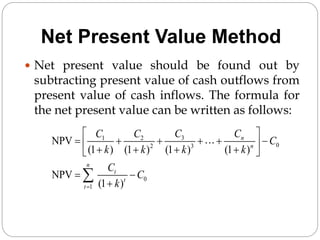
 Net present value should be found out by
subtracting present value of cash outflows from
present value of cash inflows. The formula for
the net present value can be written as follows:
3
1 2
0
2 3
0
1
NPV
(1 ) (1 ) (1 ) (1 )
NPV
(1 )
n
n
n
t
t
t
C C
C C
C
k k k k
C
C
k

 
     
 
   
 
 


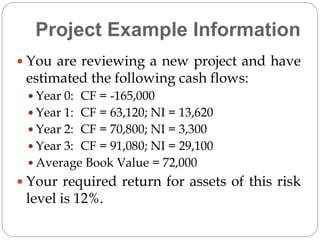
Project Example Information
 You are reviewing a new project and have
estimated the following cash flows:
 Year 0: CF = -165,000
 Year 1: CF = 63,120; NI = 13,620
 Year 2: CF = 70,800; NI = 3,300
 Year 3: CF = 91,080; NI = 29,100
 Average Book Value = 72,000
 Your required return for assets of this risk
level is 12%.
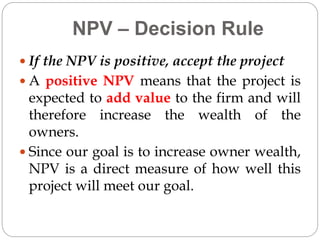
NPV – Decision Rule
 If the NPV is positive, accept the project
 A positive NPV means that the project is
expected to add value to the firm and will
therefore increase the wealth of the
owners.
 Since our goal is to increase owner wealth,
NPV is a direct measure of how well this
project will meet our goal.
Computing NPV for the Project
 Using the formulas:
NPV = -165,000 + 63,120/(1.12) +
70,800/(1.12)2 + 91,080/(1.12)3 = 12,627.41
 Do we accept or reject the project?
 Since we have a positive NPV, we
should accept the project.
Internal Rate of Return (IRR)
 This is the most important alternative to
NPV
 It is often used in practice and is
intuitively appealing
 It is based entirely on the estimated cash
flows and is independent of interest rates
found elsewhere
IRR – Definition and Decision
Rule
 Definition: IRR is the return that makes the
NPV = 0
 Decision Rule: Accept the project if the IRR
is greater than the required return
Computing IRR for the
Project
 If you do not have a financial calculator,
then this becomes a trial and error process
 Calculator
 Enter the cash flows as you did with NPV
 Press IRR and then CPT
 IRR = 16.13% > 12% required return
 Do we accept or reject the project?
 Accept the project since IRR > R.
Profitability Index (PI)
 Profitability index is the ratio of the present
value of cash inflows, at the required rate of
return, to the initial cash outflow of the
investment.
 Measures the benefit per unit cost, based
on the time value of money
 A profitability index of 1.1 implies that for
every $1 of investment, we create an
additional $0.10 in value
 This measure can be very useful in
situations in which we have limited capital
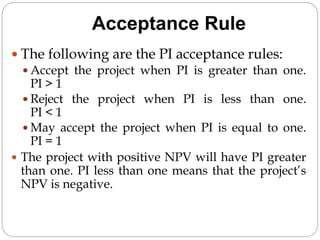
Acceptance Rule
 The following are the PI acceptance rules:
 Accept the project when PI is greater than one.
PI > 1
 Reject the project when PI is less than one.
PI < 1
 May accept the project when PI is equal to one.
PI = 1
 The project with positive NPV will have PI greater
than one. PI less than one means that the project’s
NPV is negative.
Payback Period (PB)
 How long does it take to get the initial cost
back in a nominal sense?
 Computation
 Estimate the cash flows
 Subtract the future cash flows from the initial
cost until the initial investment has been
recovered
 Decision Rule – Accept if the payback
period is less than standard payback
period set by management.
Computing Payback for the Project
 Assume we will accept the project if it pays back within
two years.
 Year 1: 165,000 – 63,120 = 101,880 still to recover
 Year 2: 101,880 – 70,800 = 31,080 still to recover
 Year 3: 31,080 – 91,080 = -60,000 project pays back in year 3
 Do we accept or reject the project?
 The payback period is year 3 if you assume that the cash
flows occur at the end of the year, as we do with all of
the other decision rules.
 If we assume that the cash flows occur evenly
throughout the year, then the project pays back in 2.34
years.
 Either way, the payback rule would say to reject the
project.
Discounted Payback Period
(DPB)
 Compute the present value of each cash
flow and then determine how long it takes
to pay back on a discounted basis
 Compare to a specified required period
 Decision Rule - Accept the project if it pays
back on a discounted basis within the
specified time
Computing Discounted Payback for the
Project
 Assume we will accept the project if it pays back
on a discounted basis in 2 years.
 Compute the PV for each cash flow and
determine the payback period using discounted
cash flows
 Year 1: 165,000 – 63,120/1.121 = 108,643
 Year 2: 108,643 – 70,800/1.122 = 52,202
 Year 3: 52,202 – 91,080/1.123 = -12,627 project pays
back in year 3
 Do we accept or reject the project?
 No – it doesn’t pay back on a discounted basis
within the required 2-year period
Average Accounting Return (AAR)
 There are many different definitions for
average accounting return
 The one is:
 Average net income / average book value
 Note that the average book value depends on
how the asset is depreciated.
 Need to have a target cutoff rate
 Decision Rule: Accept the project if the
AAR is greater than a present rate
Computing AAR for the Project
 Assume we require an average accounting
return of 25%
 Average Net Income:
(13,620 + 3,300 + 29,100) / 3 = 15,340
 AAR = 15,340 / 72,000 = .213 = 21.3%
 Do we accept or reject the project?
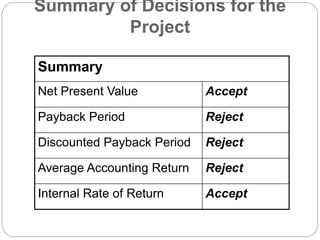
Summary of Decisions for the
Project
Summary
Net Present Value Accept
Payback Period Reject
Discounted Payback Period Reject
Average Accounting Return Reject
Internal Rate of Return Accept
END OF THE CHAPTER

Chapter 5 FM.pptx

  • 1.
  • 2.
    Definition and Importanceof Capital Budgeting  The investment decisions of a firm are generally known as the capital budgeting, or capital expenditure decisions.  It is analysis of potential additions to fixed assets.  Very important to firm’s future.  The goal of these decisions is to select capital projects that will increase the value of the firm  Long-term decisions; involve large expenditures.  Capital-budgeting techniques help management to systematically analyze potential business opportunities in order to decide which are worth undertaking
  • 3.
    Project classifications  Capitalbudgeting projects can be broadly classified into three types: 1. Independent projects 2. Mutually exclusive projects 3. Contingent projects
  • 4.
    1. Independent Projects: Projects are independent when their cash flows are unrelated Classification of Investment Projects  If two projects are independent, accepting or rejecting one project has no bearing on the decision for the other
  • 5.
    2. Mutually ExclusiveProjects:  When two projects are mutually exclusive, accepting one automatically precludes the other Classification of Investment Projects  Mutually exclusive projects typically perform the same function
  • 6.
    3. Contingent Projects: Contingent projects are those where the acceptance of one project is dependent on another project Classification of Investment Projects
  • 7.
    Capital Budgeting Processes 1.Estimate CFs (inflows & outflows). 2. Assess riskiness of CFs. 3. Determine the appropriate cost of capital. 4. Find NPV and/or IRR. 5. Accept if NPV > 0 and/or IRR > WACC.
  • 8.
    Capital Budgeting EvaluationTechniques  1. Discounted Cash Flow (DCF) Criteria  Net Present Value (NPV)  Internal Rate of Return (IRR)  Profitability Index (PI)  Discounted Payback Period (DPB)  2. Non-discounted Cash Flow Criteria  Payback Period (PB)  Accounting Rate of Return (ARR)
  • 9.
    Net Present Value(NPV)  The difference between the market value of a project and its cost  How much value is created from undertaking an investment?  The first step is to estimate the expected future cash flows.  The second step is to estimate the required return for projects of this risk level.  The third step is to find the present value of the cash flows and subtract the initial investment.
  • 10.
    Net Present ValueMethod  Net present value should be found out by subtracting present value of cash outflows from present value of cash inflows. The formula for the net present value can be written as follows: 3 1 2 0 2 3 0 1 NPV (1 ) (1 ) (1 ) (1 ) NPV (1 ) n n n t t t C C C C C k k k k C C k                     
  • 11.
    Project Example Information You are reviewing a new project and have estimated the following cash flows:  Year 0: CF = -165,000  Year 1: CF = 63,120; NI = 13,620  Year 2: CF = 70,800; NI = 3,300  Year 3: CF = 91,080; NI = 29,100  Average Book Value = 72,000  Your required return for assets of this risk level is 12%.
  • 12.
    NPV – DecisionRule  If the NPV is positive, accept the project  A positive NPV means that the project is expected to add value to the firm and will therefore increase the wealth of the owners.  Since our goal is to increase owner wealth, NPV is a direct measure of how well this project will meet our goal.
  • 13.
    Computing NPV forthe Project  Using the formulas: NPV = -165,000 + 63,120/(1.12) + 70,800/(1.12)2 + 91,080/(1.12)3 = 12,627.41  Do we accept or reject the project?  Since we have a positive NPV, we should accept the project.
  • 14.
    Internal Rate ofReturn (IRR)  This is the most important alternative to NPV  It is often used in practice and is intuitively appealing  It is based entirely on the estimated cash flows and is independent of interest rates found elsewhere
  • 15.
    IRR – Definitionand Decision Rule  Definition: IRR is the return that makes the NPV = 0  Decision Rule: Accept the project if the IRR is greater than the required return
  • 16.
    Computing IRR forthe Project  If you do not have a financial calculator, then this becomes a trial and error process  Calculator  Enter the cash flows as you did with NPV  Press IRR and then CPT  IRR = 16.13% > 12% required return  Do we accept or reject the project?  Accept the project since IRR > R.
  • 17.
    Profitability Index (PI) Profitability index is the ratio of the present value of cash inflows, at the required rate of return, to the initial cash outflow of the investment.  Measures the benefit per unit cost, based on the time value of money  A profitability index of 1.1 implies that for every $1 of investment, we create an additional $0.10 in value  This measure can be very useful in situations in which we have limited capital
  • 18.
    Acceptance Rule  Thefollowing are the PI acceptance rules:  Accept the project when PI is greater than one. PI > 1  Reject the project when PI is less than one. PI < 1  May accept the project when PI is equal to one. PI = 1  The project with positive NPV will have PI greater than one. PI less than one means that the project’s NPV is negative.
  • 19.
    Payback Period (PB) How long does it take to get the initial cost back in a nominal sense?  Computation  Estimate the cash flows  Subtract the future cash flows from the initial cost until the initial investment has been recovered  Decision Rule – Accept if the payback period is less than standard payback period set by management.
  • 20.
    Computing Payback forthe Project  Assume we will accept the project if it pays back within two years.  Year 1: 165,000 – 63,120 = 101,880 still to recover  Year 2: 101,880 – 70,800 = 31,080 still to recover  Year 3: 31,080 – 91,080 = -60,000 project pays back in year 3  Do we accept or reject the project?  The payback period is year 3 if you assume that the cash flows occur at the end of the year, as we do with all of the other decision rules.  If we assume that the cash flows occur evenly throughout the year, then the project pays back in 2.34 years.  Either way, the payback rule would say to reject the project.
  • 21.
    Discounted Payback Period (DPB) Compute the present value of each cash flow and then determine how long it takes to pay back on a discounted basis  Compare to a specified required period  Decision Rule - Accept the project if it pays back on a discounted basis within the specified time
  • 22.
    Computing Discounted Paybackfor the Project  Assume we will accept the project if it pays back on a discounted basis in 2 years.  Compute the PV for each cash flow and determine the payback period using discounted cash flows  Year 1: 165,000 – 63,120/1.121 = 108,643  Year 2: 108,643 – 70,800/1.122 = 52,202  Year 3: 52,202 – 91,080/1.123 = -12,627 project pays back in year 3  Do we accept or reject the project?  No – it doesn’t pay back on a discounted basis within the required 2-year period
  • 23.
    Average Accounting Return(AAR)  There are many different definitions for average accounting return  The one is:  Average net income / average book value  Note that the average book value depends on how the asset is depreciated.  Need to have a target cutoff rate  Decision Rule: Accept the project if the AAR is greater than a present rate
  • 24.
    Computing AAR forthe Project  Assume we require an average accounting return of 25%  Average Net Income: (13,620 + 3,300 + 29,100) / 3 = 15,340  AAR = 15,340 / 72,000 = .213 = 21.3%  Do we accept or reject the project?
  • 25.
    Summary of Decisionsfor the Project Summary Net Present Value Accept Payback Period Reject Discounted Payback Period Reject Average Accounting Return Reject Internal Rate of Return Accept
  • 26.
    END OF THECHAPTER