WORKING CAPITAL
MANAGEMENT
Prof. Mohasin A. Tamboli
Mob: 9766010560
Email: mohasinat@gmail.com1Prof. M.A.Tamboli
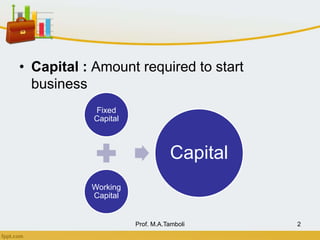
• Capital : Amount required to start
business
Fixed
Capital
Working
Capital
Capital
2Prof. M.A.Tamboli
• Fixed Capital: Fixed Capital required for
Establishment of business.
• Working Capital: Working Capital required
to utilize fixed assets.
Prof. M.A.Tamboli 3
Working Capital
• Working capital plays a key role in a
business just as the role of heart in human
body.
• It act as ‘grease’ to run the wheels of fixed
assets.
• The efficiency of a business enterprise
depends largely on its ability to manage
working capital.
Prof. M.A.Tamboli 4
Working Capital
• Working Capital refers to short term
funds, to meet operating expenses.
• In simple ‘Working Capital is a fund
required by firm to finance day-to-day
operations.
• Broadly, there are two concepts of Working
Capital:
– Gross Working Capital
– Net Working Capital
Prof. M.A.Tamboli 5
Nature of Working Capital
A. Short term need
B. Circulating
C. Permanent
D. Fluctuating
E. Liquid
F. Less Risky
Prof. M.A.Tamboli 6
Scope of Working Capital
A. Cover all expenditure
B. Keep business going
C. Generate operating profit
Prof. M.A.Tamboli 7
Concept of Working Capital
I. Gross Working Capital: It is the sum of
all current assets appear in balance
sheet.
Current Assets are those assets which can be
easily converted into cash
II. Net Working Capital: It is the difference
between current assets and current
liabilities
Current liabilities are short term liabilities
Prof. M.A.Tamboli 8
Types of Working Capital
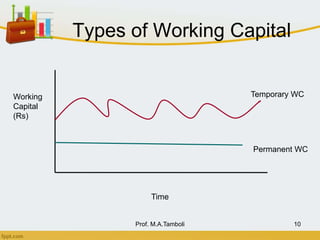
I. Permanent Working Capital: It is the
minimum working capital required for
producing predetermined production.
II. Temporary Working Capital: It is the
additional current assets required for
temporary period, and it is above
permanent working capital.
Prof. M.A.Tamboli 9
Types of Working Capital
Prof. M.A.Tamboli 10
Temporary WC
Permanent WC
Time
Working
Capital
(Rs)
Components of Working
Capital
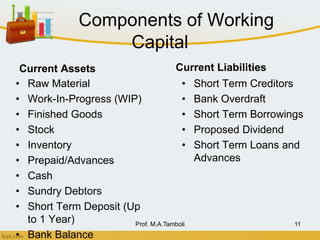
Current Assets
• Raw Material
• Work-In-Progress (WIP)
• Finished Goods
• Stock
• Inventory
• Prepaid/Advances
• Cash
• Sundry Debtors
• Short Term Deposit (Up
to 1 Year)
• Bank Balance
Current Liabilities
• Short Term Creditors
• Bank Overdraft
• Short Term Borrowings
• Proposed Dividend
• Short Term Loans and
Advances
Prof. M.A.Tamboli 11
Determinants of Working Capital
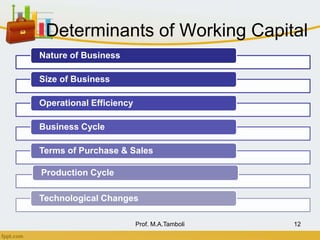
Nature of Business
Size of Business
Operational Efficiency
Business Cycle
Terms of Purchase & Sales
Production Cycle
Technological Changes
Prof. M.A.Tamboli 12
Operating Cycle
• The time that require to convert raw
materials into cash.
• The length of operating cycle is depend
upon several factors like –
• Length of Manufacturing Process
• Holding period of inventories
Prof. M.A.Tamboli 13
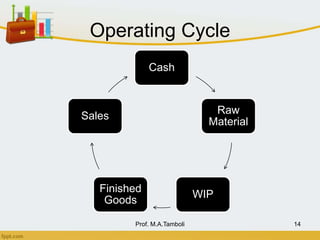
Operating Cycle
Cash
Raw
Material
WIP
Finished
Goods
Sales
Prof. M.A.Tamboli 14
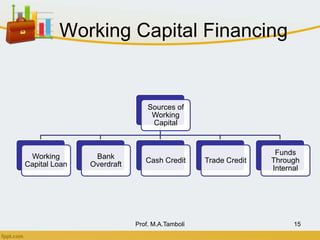
Working Capital Financing
Sources of
Working
Capital
Working
Capital Loan
Bank
Overdraft
Cash Credit Trade Credit
Funds
Through
Internal
Prof. M.A.Tamboli 15

Working capital

  • 1.
    WORKING CAPITAL MANAGEMENT Prof. MohasinA. Tamboli Mob: 9766010560 Email: mohasinat@gmail.com1Prof. M.A.Tamboli
  • 2.
    • Capital :Amount required to start business Fixed Capital Working Capital Capital 2Prof. M.A.Tamboli
  • 3.
    • Fixed Capital:Fixed Capital required for Establishment of business. • Working Capital: Working Capital required to utilize fixed assets. Prof. M.A.Tamboli 3
  • 4.
    Working Capital • Workingcapital plays a key role in a business just as the role of heart in human body. • It act as ‘grease’ to run the wheels of fixed assets. • The efficiency of a business enterprise depends largely on its ability to manage working capital. Prof. M.A.Tamboli 4
  • 5.
    Working Capital • WorkingCapital refers to short term funds, to meet operating expenses. • In simple ‘Working Capital is a fund required by firm to finance day-to-day operations. • Broadly, there are two concepts of Working Capital: – Gross Working Capital – Net Working Capital Prof. M.A.Tamboli 5
  • 6.
    Nature of WorkingCapital A. Short term need B. Circulating C. Permanent D. Fluctuating E. Liquid F. Less Risky Prof. M.A.Tamboli 6
  • 7.
    Scope of WorkingCapital A. Cover all expenditure B. Keep business going C. Generate operating profit Prof. M.A.Tamboli 7
  • 8.
    Concept of WorkingCapital I. Gross Working Capital: It is the sum of all current assets appear in balance sheet. Current Assets are those assets which can be easily converted into cash II. Net Working Capital: It is the difference between current assets and current liabilities Current liabilities are short term liabilities Prof. M.A.Tamboli 8
  • 9.
    Types of WorkingCapital I. Permanent Working Capital: It is the minimum working capital required for producing predetermined production. II. Temporary Working Capital: It is the additional current assets required for temporary period, and it is above permanent working capital. Prof. M.A.Tamboli 9
  • 10.
    Types of WorkingCapital Prof. M.A.Tamboli 10 Temporary WC Permanent WC Time Working Capital (Rs)
  • 11.
    Components of Working Capital CurrentAssets • Raw Material • Work-In-Progress (WIP) • Finished Goods • Stock • Inventory • Prepaid/Advances • Cash • Sundry Debtors • Short Term Deposit (Up to 1 Year) • Bank Balance Current Liabilities • Short Term Creditors • Bank Overdraft • Short Term Borrowings • Proposed Dividend • Short Term Loans and Advances Prof. M.A.Tamboli 11
  • 12.
    Determinants of WorkingCapital Nature of Business Size of Business Operational Efficiency Business Cycle Terms of Purchase & Sales Production Cycle Technological Changes Prof. M.A.Tamboli 12
  • 13.
    Operating Cycle • Thetime that require to convert raw materials into cash. • The length of operating cycle is depend upon several factors like – • Length of Manufacturing Process • Holding period of inventories Prof. M.A.Tamboli 13
  • 14.
  • 15.
    Working Capital Financing Sourcesof Working Capital Working Capital Loan Bank Overdraft Cash Credit Trade Credit Funds Through Internal Prof. M.A.Tamboli 15