Natural Undesirable Changes
Prepared By
Ronnith Nandy
What are Natural Undesirable
Changes ?
Examples:
 Avalanche
 Cyclone
 Tsunami
 Forest Fire
 Flood
 Earthquake
 Volcanic Eruption
A change that is
harmful to us or
causes destruction is
called an undesirable
change.
AVALANCHE
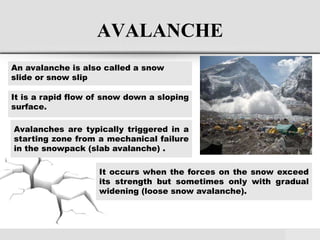
An avalanche is also called a snow
slide or snow slip
It is a rapid flow of snow down a sloping
surface.
Avalanches are typically triggered in a
starting zone from a mechanical failure
in the snowpack (slab avalanche) .
It occurs when the forces on the snow exceed
its strength but sometimes only with gradual
widening (loose snow avalanche).
Safety Rules To Be Followed During
Avalanche
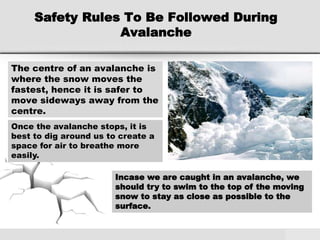
The centre of an avalanche is
where the snow moves the
fastest, hence it is safer to
move sideways away from the
centre.
Incase we are caught in an avalanche, we
should try to swim to the top of the moving
snow to stay as close as possible to the
surface.
Once the avalanche stops, it is
best to dig around us to create a
space for air to breathe more
easily.
CYCLONE
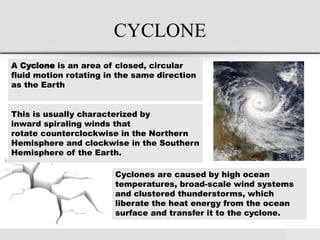
A Cyclone is an area of closed, circular
fluid motion rotating in the same direction
as the Earth
This is usually characterized by
inward spiraling winds that
rotate counterclockwise in the Northern
Hemisphere and clockwise in the Southern
Hemisphere of the Earth.
Cyclones are caused by high ocean
temperatures, broad-scale wind systems
and clustered thunderstorms, which
liberate the heat energy from the ocean
surface and transfer it to the cyclone.
Safety Rules To Be Followed
During Cyclone
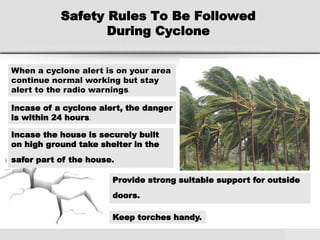
When a cyclone alert is on your area
continue normal working but stay
alert to the radio warnings.
Incase of a cyclone alert, the danger
is within 24 hours.
Incase the house is securely built
on high ground take shelter in the
safer part of the house.
Provide strong suitable support for outside
doors.
Keep torches handy.
TSUNAMI
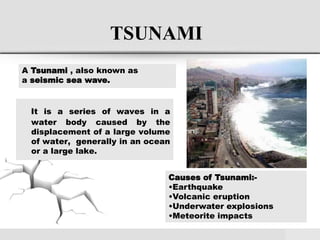
It is a series of waves in a
water body caused by the
displacement of a large volume
of water, generally in an ocean
or a large lake.
A Tsunami , also known as
a seismic sea wave.
Causes of Tsunami:-
•Earthquake
•Volcanic eruption
•Underwater explosions
•Meteorite impacts
Warning Signs For
Tsunami
An earthquake is a natural tsunami
warning. An earthquake can trigger
killer waves thousands of miles
across the oceans many hours after
the event generated a tsunami.
An approaching tsunami is
sometimes preceded by a noticeable
fall or rise in the water level.
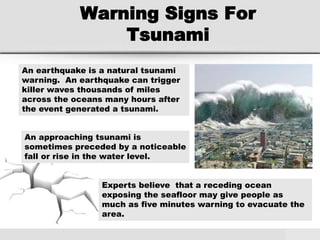
Experts believe that a receding ocean
exposing the seafloor may give people as
much as five minutes warning to evacuate the
area.
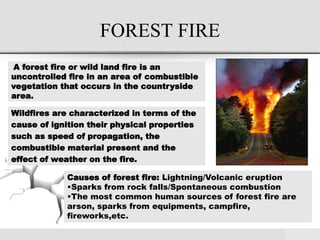
FOREST FIRE
Wildfires are characterized in terms of the
cause of ignition their physical properties
such as speed of propagation, the
combustible material present and the
effect of weather on the fire.
A forest fire or wild land fire is an
uncontrolled fire in an area of combustible
vegetation that occurs in the countryside
area.
Causes of forest fire: Lightning/Volcanic eruption
•Sparks from rock falls/Spontaneous combustion
•The most common human sources of forest fire are
arson, sparks from equipments, campfire,
fireworks,etc.
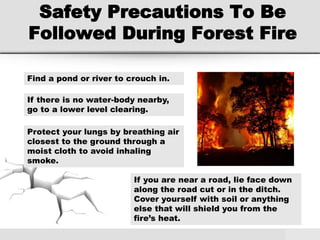
Safety Precautions To Be
Followed During Forest Fire
Find a pond or river to crouch in.
If there is no water-body nearby,
go to a lower level clearing.
Protect your lungs by breathing air
closest to the ground through a
moist cloth to avoid inhaling
smoke.
If you are near a road, lie face down
along the road cut or in the ditch.
Cover yourself with soil or anything
else that will shield you from the
fire’s heat.
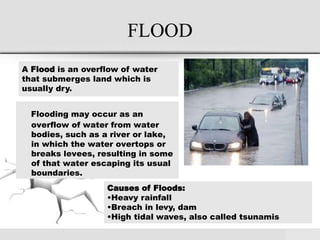
FLOOD
Flooding may occur as an
overflow of water from water
bodies, such as a river or lake,
in which the water overtops or
breaks levees, resulting in some
of that water escaping its usual
boundaries.
A Flood is an overflow of water
that submerges land which is
usually dry.
Causes of Floods:
•Heavy rainfall
•Breach in levy, dam
•High tidal waves, also called tsunamis
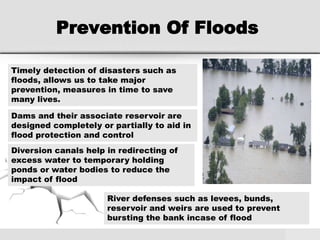
Prevention Of Floods
Timely detection of disasters such as
floods, allows us to take major
prevention, measures in time to save
many lives.
Dams and their associate reservoir are
designed completely or partially to aid in
flood protection and control
Diversion canals help in redirecting of
excess water to temporary holding
ponds or water bodies to reduce the
impact of flood
River defenses such as levees, bunds,
reservoir and weirs are used to prevent
bursting the bank incase of flood
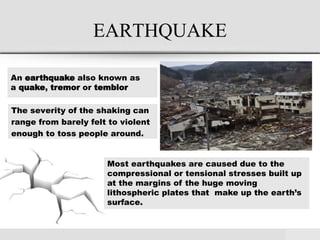
EARTHQUAKE
The severity of the shaking can
range from barely felt to violent
enough to toss people around.
An earthquake also known as
a quake, tremor or temblor
Most earthquakes are caused due to the
compressional or tensional stresses built up
at the margins of the huge moving
lithospheric plates that make up the earth’s
surface.
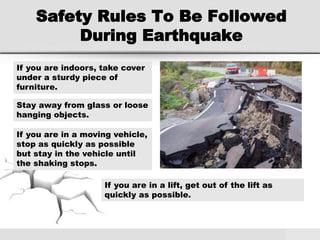
Safety Rules To Be Followed
During Earthquake
If you are indoors, take cover
under a sturdy piece of
furniture.
Stay away from glass or loose
hanging objects.
If you are in a moving vehicle,
stop as quickly as possible
but stay in the vehicle until
the shaking stops.
If you are in a lift, get out of the lift as
quickly as possible.
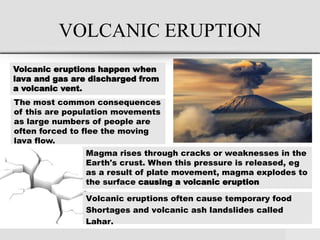
VOLCANIC ERUPTION
Volcanic eruptions often cause temporary food
Shortages and volcanic ash landslides called
Lahar.
Volcanic eruptions happen when
lava and gas are discharged from
a volcanic vent.
The most common consequences
of this are population movements
as large numbers of people are
often forced to flee the moving
lava flow.
Magma rises through cracks or weaknesses in the
Earth's crust. When this pressure is released, eg
as a result of plate movement, magma explodes to
the surface causing a volcanic eruption
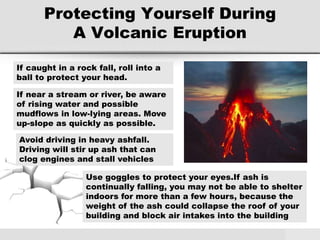
Protecting Yourself During
A Volcanic Eruption
If caught in a rock fall, roll into a
ball to protect your head.
If near a stream or river, be aware
of rising water and possible
mudflows in low-lying areas. Move
up-slope as quickly as possible.
Use goggles to protect your eyes.If ash is
continually falling, you may not be able to shelter
indoors for more than a few hours, because the
weight of the ash could collapse the roof of your
building and block air intakes into the building
Avoid driving in heavy ashfall.
Driving will stir up ash that can
clog engines and stall vehicles
Thank You

Natural Disasters

  • 1.
  • 2.
    What are NaturalUndesirable Changes ? Examples:  Avalanche  Cyclone  Tsunami  Forest Fire  Flood  Earthquake  Volcanic Eruption A change that is harmful to us or causes destruction is called an undesirable change.
  • 3.
    AVALANCHE An avalanche isalso called a snow slide or snow slip It is a rapid flow of snow down a sloping surface. Avalanches are typically triggered in a starting zone from a mechanical failure in the snowpack (slab avalanche) . It occurs when the forces on the snow exceed its strength but sometimes only with gradual widening (loose snow avalanche).
  • 4.
    Safety Rules ToBe Followed During Avalanche The centre of an avalanche is where the snow moves the fastest, hence it is safer to move sideways away from the centre. Incase we are caught in an avalanche, we should try to swim to the top of the moving snow to stay as close as possible to the surface. Once the avalanche stops, it is best to dig around us to create a space for air to breathe more easily.
  • 5.
    CYCLONE A Cyclone isan area of closed, circular fluid motion rotating in the same direction as the Earth This is usually characterized by inward spiraling winds that rotate counterclockwise in the Northern Hemisphere and clockwise in the Southern Hemisphere of the Earth. Cyclones are caused by high ocean temperatures, broad-scale wind systems and clustered thunderstorms, which liberate the heat energy from the ocean surface and transfer it to the cyclone.
  • 6.
    Safety Rules ToBe Followed During Cyclone When a cyclone alert is on your area continue normal working but stay alert to the radio warnings. Incase of a cyclone alert, the danger is within 24 hours. Incase the house is securely built on high ground take shelter in the safer part of the house. Provide strong suitable support for outside doors. Keep torches handy.
  • 7.
    TSUNAMI It is aseries of waves in a water body caused by the displacement of a large volume of water, generally in an ocean or a large lake. A Tsunami , also known as a seismic sea wave. Causes of Tsunami:- •Earthquake •Volcanic eruption •Underwater explosions •Meteorite impacts
  • 8.
    Warning Signs For Tsunami Anearthquake is a natural tsunami warning. An earthquake can trigger killer waves thousands of miles across the oceans many hours after the event generated a tsunami. An approaching tsunami is sometimes preceded by a noticeable fall or rise in the water level. Experts believe that a receding ocean exposing the seafloor may give people as much as five minutes warning to evacuate the area.
  • 9.
    FOREST FIRE Wildfires arecharacterized in terms of the cause of ignition their physical properties such as speed of propagation, the combustible material present and the effect of weather on the fire. A forest fire or wild land fire is an uncontrolled fire in an area of combustible vegetation that occurs in the countryside area. Causes of forest fire: Lightning/Volcanic eruption •Sparks from rock falls/Spontaneous combustion •The most common human sources of forest fire are arson, sparks from equipments, campfire, fireworks,etc.
  • 10.
    Safety Precautions ToBe Followed During Forest Fire Find a pond or river to crouch in. If there is no water-body nearby, go to a lower level clearing. Protect your lungs by breathing air closest to the ground through a moist cloth to avoid inhaling smoke. If you are near a road, lie face down along the road cut or in the ditch. Cover yourself with soil or anything else that will shield you from the fire’s heat.
  • 11.
    FLOOD Flooding may occuras an overflow of water from water bodies, such as a river or lake, in which the water overtops or breaks levees, resulting in some of that water escaping its usual boundaries. A Flood is an overflow of water that submerges land which is usually dry. Causes of Floods: •Heavy rainfall •Breach in levy, dam •High tidal waves, also called tsunamis
  • 12.
    Prevention Of Floods Timelydetection of disasters such as floods, allows us to take major prevention, measures in time to save many lives. Dams and their associate reservoir are designed completely or partially to aid in flood protection and control Diversion canals help in redirecting of excess water to temporary holding ponds or water bodies to reduce the impact of flood River defenses such as levees, bunds, reservoir and weirs are used to prevent bursting the bank incase of flood
  • 13.
    EARTHQUAKE The severity ofthe shaking can range from barely felt to violent enough to toss people around. An earthquake also known as a quake, tremor or temblor Most earthquakes are caused due to the compressional or tensional stresses built up at the margins of the huge moving lithospheric plates that make up the earth’s surface.
  • 14.
    Safety Rules ToBe Followed During Earthquake If you are indoors, take cover under a sturdy piece of furniture. Stay away from glass or loose hanging objects. If you are in a moving vehicle, stop as quickly as possible but stay in the vehicle until the shaking stops. If you are in a lift, get out of the lift as quickly as possible.
  • 15.
    VOLCANIC ERUPTION Volcanic eruptionsoften cause temporary food Shortages and volcanic ash landslides called Lahar. Volcanic eruptions happen when lava and gas are discharged from a volcanic vent. The most common consequences of this are population movements as large numbers of people are often forced to flee the moving lava flow. Magma rises through cracks or weaknesses in the Earth's crust. When this pressure is released, eg as a result of plate movement, magma explodes to the surface causing a volcanic eruption
  • 16.
    Protecting Yourself During AVolcanic Eruption If caught in a rock fall, roll into a ball to protect your head. If near a stream or river, be aware of rising water and possible mudflows in low-lying areas. Move up-slope as quickly as possible. Use goggles to protect your eyes.If ash is continually falling, you may not be able to shelter indoors for more than a few hours, because the weight of the ash could collapse the roof of your building and block air intakes into the building Avoid driving in heavy ashfall. Driving will stir up ash that can clog engines and stall vehicles
  • 17.