Natural Disasters
M. Borowik
N. Murray
K. Nabbs
A. Pakebusch
An Overview of Natural Disasters; Tornadoes,
Earthquakes, Volcanoes, and Tsunamis
Informational Resources and their
Credibility
This presentation contains information from online resources that were selected using Metzger
(2007) recommended assessment of credibility criteria for online information. In particular,
resources were chosen based on;
 Accuracy – the degree to which online sources are free from error, and can be
verified offline.
 Authority – qualifications and affiliations of the author or organisation,
as well as availability of contact information.
 Objectivity – the underlying purpose of the source (i.e commercial intent), transparency, and
whether source information is considered to be fact or opinion.
 Currency – whether provided information is up to date.
 Coverage – refers to quality and depth of information provided by the source.
Consequently, credible online resources derive fact from carefully deducted theory, provide
highly accurate data, and offer objective evidence (with no commercial intent) to support their
conclusions (Metzger, 2007).
What are Natural Disasters?
Natural disasters are
serious disruptions to
regions or
communities by a
naturally occurring,
rapid phenomena that
causes injury, death,
or damage to property
or the environment.
Natural disasters
require substantial co-
ordinated involvement
of Government
organisations and
community groups.
Australia.gov.au (2015).
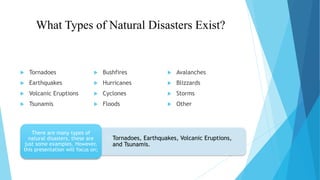
 Tornadoes
 Earthquakes
 Volcanic Eruptions
 Tsunamis
 Bushfires
 Hurricanes
 Cyclones
 Floods
 Avalanches
 Blizzards
 Storms
 Other
• Tornadoes, Earthquakes, Volcanic Eruptions,
and Tsunamis.
There are many types of
natural disasters, these are
just some examples. However,
this presentation will focus on;
What Types of Natural Disasters Exist?
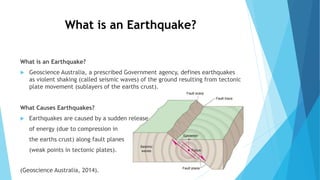
What is an Earthquake?
 Geoscience Australia, a prescribed Government agency, defines earthquakes
as violent shaking (called seismic waves) of the ground resulting from tectonic
plate movement (sublayers of the earths crust).
What Causes Earthquakes?
 Earthquakes are caused by a sudden release
of energy (due to compression in
the earths crust) along fault planes
(weak points in tectonic plates).
(Geoscience Australia, 2014).
What is an Earthquake?
Destruction and Historical Events
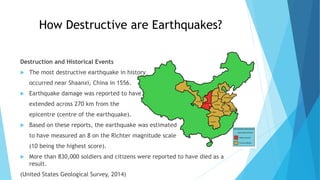
 The most destructive earthquake in history
occurred near Shaanxi, China in 1556.
 Earthquake damage was reported to have
extended across 270 km from the
epicentre (centre of the earthquake).
 Based on these reports, the earthquake was estimated
to have measured an 8 on the Richter magnitude scale
(10 being the highest score).
 More than 830,000 soldiers and citizens were reported to have died as a
result.
(United States Geological Survey, 2014)
How Destructive are Earthquakes?
What Warning Systems Exist for
Earthquakes?
Warning Systems
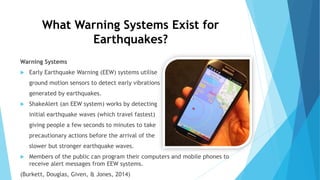
 Early Earthquake Warning (EEW) systems utilise
ground motion sensors to detect early vibrations
generated by earthquakes.
 ShakeAlert (an EEW system) works by detecting
initial earthquake waves (which travel fastest)
giving people a few seconds to minutes to take
precautionary actions before the arrival of the
slower but stronger earthquake waves.
 Members of the public can program their computers and mobile phones to
receive alert messages from EEW systems.
(Burkett, Douglas, Given, & Jones, 2014)
What Precautions are put in place for
Earthquake Hazard Areas?
Precautions
 People are advised to prepare a basic emergency kit (water, food, first aid,
etc.), and a family emergency plan (families should discuss how they will
contact each other in case of an emergency, and what to do when alerted of
an earthquake).
 All book cases, filing cabinets, picture frames, and light fixtures should be
safely anchored to walls.
 Members of the public, and business owners are recommended to hold regular
emergency evacuation
drills.
(The Ready Campaign, 2014)
What is a Tsunami?
What is a Tsunami?
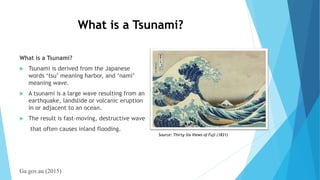
 Tsunami is derived from the Japanese
words ‘tsu’ meaning harbor, and ‘nami’
meaning wave.
 A tsunami is a large wave resulting from an
earthquake, landslide or volcanic eruption
in or adjacent to an ocean.
 The result is fast-moving, destructive wave
that often causes inland flooding.
Ga.gov.au (2015)
Source: Thirty-Six Views of Fuji (1831)
What Causes Tsunamis?
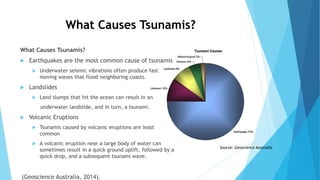
 Earthquakes are the most common cause of tsunamis
 Underwater seismic vibrations often produce fast
moving waves that flood neighboring coasts.
 Landslides
 Land slumps that hit the ocean can result in an
underwater landslide, and in turn, a tsunami.
 Volcanic Eruptions
 Tsunamis caused by volcanic eruptions are least
common
 A volcanic eruption near a large body of water can
sometimes result in a quick ground uplift, followed by a
quick drop, and a subsequent tsunami wave.
(Geoscience Australia, 2014).
Source: Geoscience Australia
How Destructive are Tsunamis?
Destruction and Historical Events
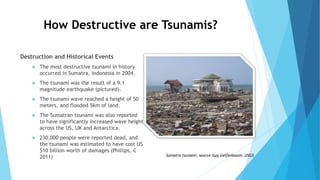
 The most destructive tsunami in history
occurred in Sumatra, Indonesia in 2004.
 The tsunami was the result of a 9.1
magnitude earthquake (pictured).
 The tsunami wave reached a height of 50
meters, and flooded 5km of land.
 The Sumatran tsunami was also reported
to have significantly increased wave height
across the US, UK and Antarctica.
 230,000 people were reported dead, and
the tsunami was estimated to have cost US
$10 billion worth of damages (Phillips, C
2011) Sumatra tsunami, source Guy Gelfenbaum, USGS
Historical Tsunamis
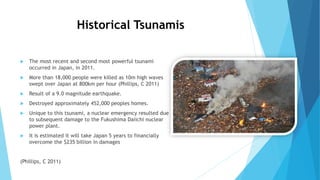
 The most recent and second most powerful tsunami
occurred in Japan, in 2011.
 More than 18,000 people were killed as 10m high waves
swept over Japan at 800km per hour (Phillips, C 2011)
 Result of a 9.0 magnitude earthquake.
 Destroyed approximately 452,000 peoples homes.
 Unique to this tsunami, a nuclear emergency resulted due
to subsequent damage to the Fukushima Daiichi nuclear
power plant.
 It is estimated it will take Japan 5 years to financially
overcome the $235 billion in damages
(Phillips, C 2011)
What Warning Systems Exist for
Tsunamis?
Warning Systems
 Unpredictability, infrequency and unique causes
have made forecasting tsunamis very difficult
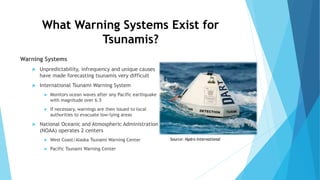
 International Tsunami Warning System
 Monitors ocean waves after any Pacific earthquake
with magnitude over 6.5
 If necessary, warnings are then issued to local
authorities to evacuate low-lying areas
 National Oceanic and Atmospheric Administration
(NOAA) operates 2 centers
 West Coast/Alaska Tsunami Warning Center
 Pacific Tsunami Warning Center
Source: Hydro International
What Precautions are put in place for
Tsunami Hazard Areas?
Precautions
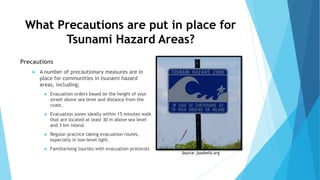
 A number of precautionary measures are in
place for communities in tsunami hazard
areas, including;
 Evacuation orders based on the height of your
street above sea level and distance from the
coast.
 Evacuation zones ideally within 15 minutes walk
that are located at least 30 m above sea level
and 3 km inland.
 Regular practice taking evacuation routes,
especially in low-level light.
 Familiarising tourists with evacuation protocols
Source: jaxshells.org
What is a Volcanic Eruption?
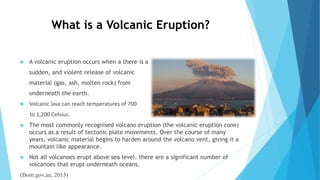
 A volcanic eruption occurs when a there is a
sudden, and violent release of volcanic
material (gas, ash, molten rock) from
underneath the earth.
 Volcanic lava can reach temperatures of 700
to 1,200 Celsius.
 The most commonly recognised volcano eruption (the volcanic eruption cone)
occurs as a result of tectonic plate movements. Over the course of many
years, volcanic material begins to harden around the volcano vent, giving it a
mountain like appearance.
 Not all volcanoes erupt above sea level, there are a significant number of
volcanoes that erupt underneath oceans.
(Bom.gov.au, 2015)
What Causes Volcanic Eruptions?
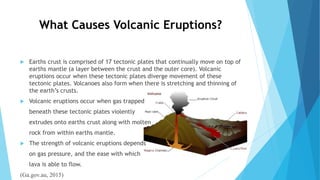
 Earths crust is comprised of 17 tectonic plates that continually move on top of
earths mantle (a layer between the crust and the outer core). Volcanic
eruptions occur when these tectonic plates diverge movement of these
tectonic plates. Volcanoes also form when there is stretching and thinning of
the earth’s crusts.
 Volcanic eruptions occur when gas trapped
beneath these tectonic plates violently
extrudes onto earths crust along with molten
rock from within earths mantle.
 The strength of volcanic eruptions depends
on gas pressure, and the ease with which
lava is able to flow.
(Ga.gov.au, 2015)
How Destructive are Volcanic
Eruptions?
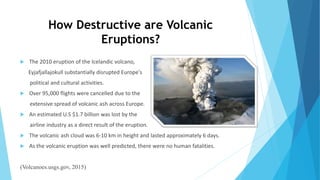
 The 2010 eruption of the Icelandic volcano,
Eyjafjallajokull substantially disrupted Europe's
political and cultural activities.
 Over 95,000 flights were cancelled due to the
extensive spread of volcanic ash across Europe.
 An estimated U.S $1.7 billion was lost by the
airline industry as a direct result of the eruption.
 The volcanic ash cloud was 6-10 km in height and lasted approximately 6 days.
 As the volcanic eruption was well predicted, there were no human fatalities.
(Volcanoes.usgs.gov, 2015)
What Warning Systems Exist for
Volcanic Eruptions?
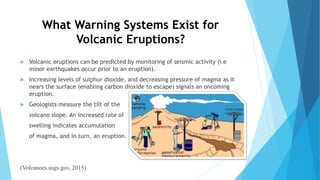
 Volcanic eruptions can be predicted by monitoring of seismic activity (i.e
minor earthquakes occur prior to an eruption).
 Increasing levels of sulphur dioxide, and decreasing pressure of magma as it
nears the surface (enabling carbon dioxide to escape) signals an oncoming
eruption.
 Geologists measure the tilt of the
volcano slope. An increased rate of
swelling indicates accumulation
of magma, and in turn, an eruption.
(Volcanoes.usgs.gov, 2015)
What Precautions are put in place for
Volcano Eruption Hazard Areas?
 Governments outline clear evacuation and
medical plans for members of the public, and
affected industries.
 News broadcasters regularly report updates
received from volcanic monitoring centres.
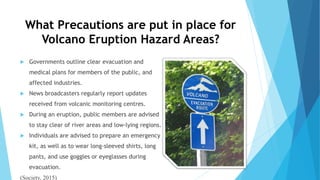
 During an eruption, public members are advised
to stay clear of river areas and low-lying regions.
 Individuals are advised to prepare an emergency
kit, as well as to wear long-sleeved shirts, long
pants, and use goggles or eyeglasses during
evacuation.
(Society, 2015)
What is a Tornado?
What is a Tornado?
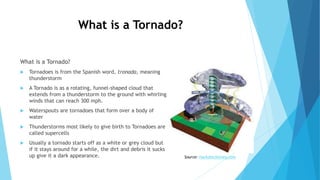
 Tornadoes is from the Spanish word, tronada, meaning
thunderstorm
 A Tornado is as a rotating, funnel-shaped cloud that
extends from a thunderstorm to the ground with whirling
winds that can reach 300 mph.
 Waterspouts are tornadoes that form over a body of
water
 Thunderstorms most likely to give birth to Tornadoes are
called supercells
 Usually a tornado starts off as a white or grey cloud but
if it stays around for a while, the dirt and debris it sucks
up give it a dark appearance. Source: markdmckinney.com
What Causes Tornadoes?
What Causes a Tornado?
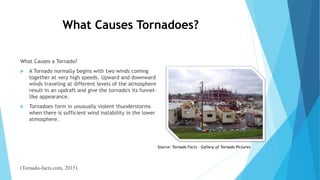
 A Tornado normally begins with two winds coming
together at very high speeds. Upward and downward
winds traveling at different levels of the atmosphere
result in an updraft and give the tornado's its funnel-
like appearance.
 Tornadoes form in unusually violent thunderstorms
when there is sufficient wind instability in the lower
atmosphere.
(Tornado-facts.com, 2015)
Source: Tornado Facts – Gallery of Tornado Pictures
How Destructive are Tornadoes?
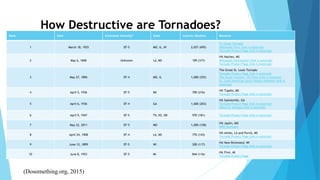
Rank Date Estimated Intensity* State Injuries (Deaths) Remarks
1 March 18, 1925 EF-5 MO, IL, IN 2,027 (695)
Tri-State Tornado
Wikipedia Entry (link is external)
Tornado Project Page (link is external)
2 May 6, 1840 Unknown LA, MS 109 (317)
Hit Nachez, MS
Wikipedia Information (link is external)
Tornado Project Page (link is external)
3 May 27, 1896 EF-4 MO, IL 1,000 (255)
The Great St. Louis Tornado
Tornado Project Page (link is external)
The Great Cyclone. SIU Press (link is external)
St. Louis American Local History Network (link is
external)
4 April 5, 1936 EF-5 MS 700 (216)
Hit Tupelo, MS
Tornado Project Page (link is external)
5 April 6, 1936 EF-4 GA 1,600 (203)
Hit Gainesville, GA
Tornado Project Page (link is external)
About N. Georgia (link is external)
6 April 9, 1947 EF-5 TX, KS, OK 970 (181) Tornado Project Page (link is external)
7 May 22, 2011 EF-5 MO 1,000 (158)
Hit Joplin, MO
NWS Summary
8 April 24, 1908 EF-4 LA, MS 770 (143)
Hit Amite, LA and Purvis, MS
Tornado Project Page (link is external)
9 June 12, 1899 EF-5 WI 200 (117)
Hit New Richmond, WI
Tornado Project Page (link is external)
10 June 8, 1953 EF-5 MI 844 (116)
Hit Flint, MI
Tornado Project Page
(Dosomething.org, 2015)
What Warning Systems Exist for
Tornadoes?
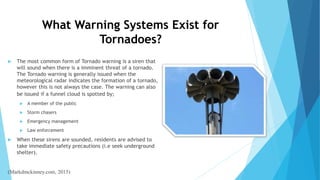
 The most common form of Tornado warning is a siren that
will sound when there is a imminent threat of a tornado.
The Tornado warning is generally issued when the
meteorological radar indicates the formation of a tornado,
however this is not always the case. The warning can also
be issued if a funnel cloud is spotted by;
 A member of the public
 Storm chasers
 Emergency management
 Law enforcement
 When these sirens are sounded, residents are advised to
take immediate safety precautions (i.e seek underground
shelter).
(Markdmckinney.com, 2015)
What Precautions are put in place for
Tornado Hazard Areas?
Source: ravingreader.wordpress.com
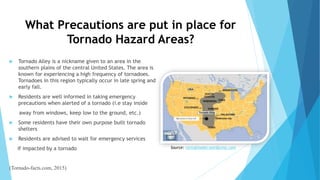
 Tornado Alley is a nickname given to an area in the
southern plains of the central United States. The area is
known for experiencing a high frequency of tornadoes.
Tornadoes in this region typically occur in late spring and
early fall.
 Residents are well informed in taking emergency
precautions when alerted of a tornado (i.e stay inside
away from windows, keep low to the ground, etc.)
 Some residents have their own purpose built tornado
shelters
 Residents are advised to wait for emergency services
if impacted by a tornado
(Tornado-facts.com, 2015)
References
Australia.gov.au,. (2015). natural-disasters | australia.gov.au. Retrieved 21 January 2015, from http://www.australia.gov.au/about-australia/australian-story/natural-disasters
Australiangeographic.com.au,. (2015). The 10 most destructive tsunamis in history. Retrieved 21 January 2015, from http://www.australiangeographic.com.au/topics/science-
environment/2011/03/the-10-most-destructive-tsunamis-in-history/
Bom.gov.au,. (2015). BoM-Darwin Volcanic Ash Advisory Centre. Retrieved 21 January 2015, from http://www.bom.gov.au/info/vaac/
Dosomething.org,. (2015). 11 Facts About Tornadoes | DoSomething.org | America's largest organization for youth volunteering opportunities, with 2,700,000 members and
counting. Retrieved 21 January 2015, from https://www.dosomething.org/facts/11-facts-about-tornadoes
Earthquake.usgs.gov,. (2015). Earthquakes with 50,000 or More Deaths. Retrieved 21 January 2015, from http://earthquake.usgs.gov/earthquakes/world/most_destructive.php
Ga.gov.au,. (2015). About Us - Geoscience Australia. Retrieved 21 January 2015, from http://www.ga.gov.au/about
Ga.gov.au,. (2015). What is a Tsunami? - Geoscience Australia. Retrieved 21 January 2015, from http://www.ga.gov.au/scientific-topics/hazards/tsunami/basics/what
Historyofgeology.fieldofscience.com,. (2015). History of Geology: Historic tsunamis in Japan. Retrieved 21 January 2015, from
http://historyofgeology.fieldofscience.com/2011/03/historic-tsunamis-in-japan.html
http://distriqt.com, d. (2015). Australian Emergency Management Knowledge Hub. Australian Emergency Management Knowledge Hub. Retrieved 21 January 2015, from
https://www.emknowledge.gov.au/connect/tsunami-the-ultimate-guide/#/
Hydro-international.com,. (2015). Full-scale Test of Indian Ocean Tsunami Warning System - News - Hydro International. Retrieved 21 January 2015, from http://www.hydro-
international.com/news/id5118-Indian_Ocean_Tsunami_Warning_System_Test.html
References - Continued
Markdmckinney.com,. (2015). Tornado Facts. Retrieved 21 January 2015, from http://markdmckinney.com/tornadofacts.html
Ncdc.noaa.gov,. (2015). Deadliest Tornadoes | National Climatic Data Center (NCDC). Retrieved 21 January 2015, from http://www.ncdc.noaa.gov/climate-information/extreme-
events/us-tornado-climatology/deadliest
Ready.gov,. (2015). Earthquakes | Ready.gov. Retrieved 21 January 2015, from http://www.ready.gov/earthquakes
Redcross.org,. (2015). Tsunami Survival | What to Do & How to Survive | Red Cross. Retrieved 21 January 2015, from http://www.redcross.org/prepare/disaster/tsunami
Society, N. (2015). Environment Facts, Environment Science, Global Warming, Natural Disasters, Ecosystems, Green Living - National Geographic. National Geographic. Retrieved
21 January 2015, from http://environment.nationalgeographic.com
Spaceplace.nasa.gov,. (2015). NASA's Space Place :: Home :: NASA's The Space Place. Retrieved 21 January 2015, from http://spaceplace.nasa.gov
Tornado-facts.com,. (2015). Amazing Tornado Facts | Tornado Facts. Retrieved 21 January 2015, from http://tornado-facts.com/amazing-tornado-facts/
Volcanoes.usgs.gov,. (2015). Volcano Hazards Program. Retrieved 21 January 2015, from http://volcanoes.usgs.gov/
www.hawaiiactive.com,. (2015). Hawaii Activities - Best Things To Do in Hawaii. Retrieved 21 January 2015, from http://www.hawaiiactive.com

Natural Disasters

  • 1.
    Natural Disasters M. Borowik N.Murray K. Nabbs A. Pakebusch An Overview of Natural Disasters; Tornadoes, Earthquakes, Volcanoes, and Tsunamis
  • 2.
    Informational Resources andtheir Credibility This presentation contains information from online resources that were selected using Metzger (2007) recommended assessment of credibility criteria for online information. In particular, resources were chosen based on;  Accuracy – the degree to which online sources are free from error, and can be verified offline.  Authority – qualifications and affiliations of the author or organisation, as well as availability of contact information.  Objectivity – the underlying purpose of the source (i.e commercial intent), transparency, and whether source information is considered to be fact or opinion.  Currency – whether provided information is up to date.  Coverage – refers to quality and depth of information provided by the source. Consequently, credible online resources derive fact from carefully deducted theory, provide highly accurate data, and offer objective evidence (with no commercial intent) to support their conclusions (Metzger, 2007).
  • 3.
    What are NaturalDisasters? Natural disasters are serious disruptions to regions or communities by a naturally occurring, rapid phenomena that causes injury, death, or damage to property or the environment. Natural disasters require substantial co- ordinated involvement of Government organisations and community groups. Australia.gov.au (2015).
  • 4.
     Tornadoes  Earthquakes Volcanic Eruptions  Tsunamis  Bushfires  Hurricanes  Cyclones  Floods  Avalanches  Blizzards  Storms  Other • Tornadoes, Earthquakes, Volcanic Eruptions, and Tsunamis. There are many types of natural disasters, these are just some examples. However, this presentation will focus on; What Types of Natural Disasters Exist?
  • 5.
    What is anEarthquake?  Geoscience Australia, a prescribed Government agency, defines earthquakes as violent shaking (called seismic waves) of the ground resulting from tectonic plate movement (sublayers of the earths crust). What Causes Earthquakes?  Earthquakes are caused by a sudden release of energy (due to compression in the earths crust) along fault planes (weak points in tectonic plates). (Geoscience Australia, 2014). What is an Earthquake?
  • 6.
    Destruction and HistoricalEvents  The most destructive earthquake in history occurred near Shaanxi, China in 1556.  Earthquake damage was reported to have extended across 270 km from the epicentre (centre of the earthquake).  Based on these reports, the earthquake was estimated to have measured an 8 on the Richter magnitude scale (10 being the highest score).  More than 830,000 soldiers and citizens were reported to have died as a result. (United States Geological Survey, 2014) How Destructive are Earthquakes?
  • 7.
    What Warning SystemsExist for Earthquakes? Warning Systems  Early Earthquake Warning (EEW) systems utilise ground motion sensors to detect early vibrations generated by earthquakes.  ShakeAlert (an EEW system) works by detecting initial earthquake waves (which travel fastest) giving people a few seconds to minutes to take precautionary actions before the arrival of the slower but stronger earthquake waves.  Members of the public can program their computers and mobile phones to receive alert messages from EEW systems. (Burkett, Douglas, Given, & Jones, 2014)
  • 8.
    What Precautions areput in place for Earthquake Hazard Areas? Precautions  People are advised to prepare a basic emergency kit (water, food, first aid, etc.), and a family emergency plan (families should discuss how they will contact each other in case of an emergency, and what to do when alerted of an earthquake).  All book cases, filing cabinets, picture frames, and light fixtures should be safely anchored to walls.  Members of the public, and business owners are recommended to hold regular emergency evacuation drills. (The Ready Campaign, 2014)
  • 9.
    What is aTsunami? What is a Tsunami?  Tsunami is derived from the Japanese words ‘tsu’ meaning harbor, and ‘nami’ meaning wave.  A tsunami is a large wave resulting from an earthquake, landslide or volcanic eruption in or adjacent to an ocean.  The result is fast-moving, destructive wave that often causes inland flooding. Ga.gov.au (2015) Source: Thirty-Six Views of Fuji (1831)
  • 10.
    What Causes Tsunamis? WhatCauses Tsunamis?  Earthquakes are the most common cause of tsunamis  Underwater seismic vibrations often produce fast moving waves that flood neighboring coasts.  Landslides  Land slumps that hit the ocean can result in an underwater landslide, and in turn, a tsunami.  Volcanic Eruptions  Tsunamis caused by volcanic eruptions are least common  A volcanic eruption near a large body of water can sometimes result in a quick ground uplift, followed by a quick drop, and a subsequent tsunami wave. (Geoscience Australia, 2014). Source: Geoscience Australia
  • 11.
    How Destructive areTsunamis? Destruction and Historical Events  The most destructive tsunami in history occurred in Sumatra, Indonesia in 2004.  The tsunami was the result of a 9.1 magnitude earthquake (pictured).  The tsunami wave reached a height of 50 meters, and flooded 5km of land.  The Sumatran tsunami was also reported to have significantly increased wave height across the US, UK and Antarctica.  230,000 people were reported dead, and the tsunami was estimated to have cost US $10 billion worth of damages (Phillips, C 2011) Sumatra tsunami, source Guy Gelfenbaum, USGS
  • 12.
    Historical Tsunamis  Themost recent and second most powerful tsunami occurred in Japan, in 2011.  More than 18,000 people were killed as 10m high waves swept over Japan at 800km per hour (Phillips, C 2011)  Result of a 9.0 magnitude earthquake.  Destroyed approximately 452,000 peoples homes.  Unique to this tsunami, a nuclear emergency resulted due to subsequent damage to the Fukushima Daiichi nuclear power plant.  It is estimated it will take Japan 5 years to financially overcome the $235 billion in damages (Phillips, C 2011)
  • 13.
    What Warning SystemsExist for Tsunamis? Warning Systems  Unpredictability, infrequency and unique causes have made forecasting tsunamis very difficult  International Tsunami Warning System  Monitors ocean waves after any Pacific earthquake with magnitude over 6.5  If necessary, warnings are then issued to local authorities to evacuate low-lying areas  National Oceanic and Atmospheric Administration (NOAA) operates 2 centers  West Coast/Alaska Tsunami Warning Center  Pacific Tsunami Warning Center Source: Hydro International
  • 14.
    What Precautions areput in place for Tsunami Hazard Areas? Precautions  A number of precautionary measures are in place for communities in tsunami hazard areas, including;  Evacuation orders based on the height of your street above sea level and distance from the coast.  Evacuation zones ideally within 15 minutes walk that are located at least 30 m above sea level and 3 km inland.  Regular practice taking evacuation routes, especially in low-level light.  Familiarising tourists with evacuation protocols Source: jaxshells.org
  • 15.
    What is aVolcanic Eruption?  A volcanic eruption occurs when a there is a sudden, and violent release of volcanic material (gas, ash, molten rock) from underneath the earth.  Volcanic lava can reach temperatures of 700 to 1,200 Celsius.  The most commonly recognised volcano eruption (the volcanic eruption cone) occurs as a result of tectonic plate movements. Over the course of many years, volcanic material begins to harden around the volcano vent, giving it a mountain like appearance.  Not all volcanoes erupt above sea level, there are a significant number of volcanoes that erupt underneath oceans. (Bom.gov.au, 2015)
  • 16.
    What Causes VolcanicEruptions?  Earths crust is comprised of 17 tectonic plates that continually move on top of earths mantle (a layer between the crust and the outer core). Volcanic eruptions occur when these tectonic plates diverge movement of these tectonic plates. Volcanoes also form when there is stretching and thinning of the earth’s crusts.  Volcanic eruptions occur when gas trapped beneath these tectonic plates violently extrudes onto earths crust along with molten rock from within earths mantle.  The strength of volcanic eruptions depends on gas pressure, and the ease with which lava is able to flow. (Ga.gov.au, 2015)
  • 17.
    How Destructive areVolcanic Eruptions?  The 2010 eruption of the Icelandic volcano, Eyjafjallajokull substantially disrupted Europe's political and cultural activities.  Over 95,000 flights were cancelled due to the extensive spread of volcanic ash across Europe.  An estimated U.S $1.7 billion was lost by the airline industry as a direct result of the eruption.  The volcanic ash cloud was 6-10 km in height and lasted approximately 6 days.  As the volcanic eruption was well predicted, there were no human fatalities. (Volcanoes.usgs.gov, 2015)
  • 18.
    What Warning SystemsExist for Volcanic Eruptions?  Volcanic eruptions can be predicted by monitoring of seismic activity (i.e minor earthquakes occur prior to an eruption).  Increasing levels of sulphur dioxide, and decreasing pressure of magma as it nears the surface (enabling carbon dioxide to escape) signals an oncoming eruption.  Geologists measure the tilt of the volcano slope. An increased rate of swelling indicates accumulation of magma, and in turn, an eruption. (Volcanoes.usgs.gov, 2015)
  • 19.
    What Precautions areput in place for Volcano Eruption Hazard Areas?  Governments outline clear evacuation and medical plans for members of the public, and affected industries.  News broadcasters regularly report updates received from volcanic monitoring centres.  During an eruption, public members are advised to stay clear of river areas and low-lying regions.  Individuals are advised to prepare an emergency kit, as well as to wear long-sleeved shirts, long pants, and use goggles or eyeglasses during evacuation. (Society, 2015)
  • 20.
    What is aTornado? What is a Tornado?  Tornadoes is from the Spanish word, tronada, meaning thunderstorm  A Tornado is as a rotating, funnel-shaped cloud that extends from a thunderstorm to the ground with whirling winds that can reach 300 mph.  Waterspouts are tornadoes that form over a body of water  Thunderstorms most likely to give birth to Tornadoes are called supercells  Usually a tornado starts off as a white or grey cloud but if it stays around for a while, the dirt and debris it sucks up give it a dark appearance. Source: markdmckinney.com
  • 21.
    What Causes Tornadoes? WhatCauses a Tornado?  A Tornado normally begins with two winds coming together at very high speeds. Upward and downward winds traveling at different levels of the atmosphere result in an updraft and give the tornado's its funnel- like appearance.  Tornadoes form in unusually violent thunderstorms when there is sufficient wind instability in the lower atmosphere. (Tornado-facts.com, 2015) Source: Tornado Facts – Gallery of Tornado Pictures
  • 22.
    How Destructive areTornadoes? Rank Date Estimated Intensity* State Injuries (Deaths) Remarks 1 March 18, 1925 EF-5 MO, IL, IN 2,027 (695) Tri-State Tornado Wikipedia Entry (link is external) Tornado Project Page (link is external) 2 May 6, 1840 Unknown LA, MS 109 (317) Hit Nachez, MS Wikipedia Information (link is external) Tornado Project Page (link is external) 3 May 27, 1896 EF-4 MO, IL 1,000 (255) The Great St. Louis Tornado Tornado Project Page (link is external) The Great Cyclone. SIU Press (link is external) St. Louis American Local History Network (link is external) 4 April 5, 1936 EF-5 MS 700 (216) Hit Tupelo, MS Tornado Project Page (link is external) 5 April 6, 1936 EF-4 GA 1,600 (203) Hit Gainesville, GA Tornado Project Page (link is external) About N. Georgia (link is external) 6 April 9, 1947 EF-5 TX, KS, OK 970 (181) Tornado Project Page (link is external) 7 May 22, 2011 EF-5 MO 1,000 (158) Hit Joplin, MO NWS Summary 8 April 24, 1908 EF-4 LA, MS 770 (143) Hit Amite, LA and Purvis, MS Tornado Project Page (link is external) 9 June 12, 1899 EF-5 WI 200 (117) Hit New Richmond, WI Tornado Project Page (link is external) 10 June 8, 1953 EF-5 MI 844 (116) Hit Flint, MI Tornado Project Page (Dosomething.org, 2015)
  • 23.
    What Warning SystemsExist for Tornadoes?  The most common form of Tornado warning is a siren that will sound when there is a imminent threat of a tornado. The Tornado warning is generally issued when the meteorological radar indicates the formation of a tornado, however this is not always the case. The warning can also be issued if a funnel cloud is spotted by;  A member of the public  Storm chasers  Emergency management  Law enforcement  When these sirens are sounded, residents are advised to take immediate safety precautions (i.e seek underground shelter). (Markdmckinney.com, 2015)
  • 24.
    What Precautions areput in place for Tornado Hazard Areas? Source: ravingreader.wordpress.com  Tornado Alley is a nickname given to an area in the southern plains of the central United States. The area is known for experiencing a high frequency of tornadoes. Tornadoes in this region typically occur in late spring and early fall.  Residents are well informed in taking emergency precautions when alerted of a tornado (i.e stay inside away from windows, keep low to the ground, etc.)  Some residents have their own purpose built tornado shelters  Residents are advised to wait for emergency services if impacted by a tornado (Tornado-facts.com, 2015)
  • 25.
    References Australia.gov.au,. (2015). natural-disasters| australia.gov.au. Retrieved 21 January 2015, from http://www.australia.gov.au/about-australia/australian-story/natural-disasters Australiangeographic.com.au,. (2015). The 10 most destructive tsunamis in history. Retrieved 21 January 2015, from http://www.australiangeographic.com.au/topics/science- environment/2011/03/the-10-most-destructive-tsunamis-in-history/ Bom.gov.au,. (2015). BoM-Darwin Volcanic Ash Advisory Centre. Retrieved 21 January 2015, from http://www.bom.gov.au/info/vaac/ Dosomething.org,. (2015). 11 Facts About Tornadoes | DoSomething.org | America's largest organization for youth volunteering opportunities, with 2,700,000 members and counting. Retrieved 21 January 2015, from https://www.dosomething.org/facts/11-facts-about-tornadoes Earthquake.usgs.gov,. (2015). Earthquakes with 50,000 or More Deaths. Retrieved 21 January 2015, from http://earthquake.usgs.gov/earthquakes/world/most_destructive.php Ga.gov.au,. (2015). About Us - Geoscience Australia. Retrieved 21 January 2015, from http://www.ga.gov.au/about Ga.gov.au,. (2015). What is a Tsunami? - Geoscience Australia. Retrieved 21 January 2015, from http://www.ga.gov.au/scientific-topics/hazards/tsunami/basics/what Historyofgeology.fieldofscience.com,. (2015). History of Geology: Historic tsunamis in Japan. Retrieved 21 January 2015, from http://historyofgeology.fieldofscience.com/2011/03/historic-tsunamis-in-japan.html http://distriqt.com, d. (2015). Australian Emergency Management Knowledge Hub. Australian Emergency Management Knowledge Hub. Retrieved 21 January 2015, from https://www.emknowledge.gov.au/connect/tsunami-the-ultimate-guide/#/ Hydro-international.com,. (2015). Full-scale Test of Indian Ocean Tsunami Warning System - News - Hydro International. Retrieved 21 January 2015, from http://www.hydro- international.com/news/id5118-Indian_Ocean_Tsunami_Warning_System_Test.html
  • 26.
    References - Continued Markdmckinney.com,.(2015). Tornado Facts. Retrieved 21 January 2015, from http://markdmckinney.com/tornadofacts.html Ncdc.noaa.gov,. (2015). Deadliest Tornadoes | National Climatic Data Center (NCDC). Retrieved 21 January 2015, from http://www.ncdc.noaa.gov/climate-information/extreme- events/us-tornado-climatology/deadliest Ready.gov,. (2015). Earthquakes | Ready.gov. Retrieved 21 January 2015, from http://www.ready.gov/earthquakes Redcross.org,. (2015). Tsunami Survival | What to Do & How to Survive | Red Cross. Retrieved 21 January 2015, from http://www.redcross.org/prepare/disaster/tsunami Society, N. (2015). Environment Facts, Environment Science, Global Warming, Natural Disasters, Ecosystems, Green Living - National Geographic. National Geographic. Retrieved 21 January 2015, from http://environment.nationalgeographic.com Spaceplace.nasa.gov,. (2015). NASA's Space Place :: Home :: NASA's The Space Place. Retrieved 21 January 2015, from http://spaceplace.nasa.gov Tornado-facts.com,. (2015). Amazing Tornado Facts | Tornado Facts. Retrieved 21 January 2015, from http://tornado-facts.com/amazing-tornado-facts/ Volcanoes.usgs.gov,. (2015). Volcano Hazards Program. Retrieved 21 January 2015, from http://volcanoes.usgs.gov/ www.hawaiiactive.com,. (2015). Hawaii Activities - Best Things To Do in Hawaii. Retrieved 21 January 2015, from http://www.hawaiiactive.com