Kripa Bhardwaj
Group Members: Submitted To:
LANDSLIDE
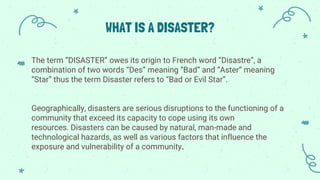
WHAT IS A DISASTER?
The term “DISASTER” owes its origin to French word “Disastre”, a
combination of two words “Des” meaning “Bad” and “Aster” meaning
“Star” thus the term Disaster refers to “Bad or Evil Star”.
Geographically, disasters are serious disruptions to the functioning of a
community that exceed its capacity to cope using its own
resources. Disasters can be caused by natural, man-made and
technological hazards, as well as various factors that influence the
exposure and vulnerability of a community.
Natural disasters are the result of
naturally occurring processes that have
operated throughout Earth's history. They
are beyond human control and are often
termed an “Act of God”. The list of natural
disasters include weather phenomena
such as tropical storms, extreme heat or
extreme cold, winds, floods, earthquakes,
landslides and volcanic eruptions.
TYPES OF DISASTER
NATURAL DISASTERS MAN-MADE DISASTERS
Man-made disasters have an element of
human intent, negligence, or error
involving a failure of a man-made system,
as opposed to natural disasters resulting
from natural hazards. Such man-made
disasters are crime, arson, civil disorder,
terrorism, war, biological/chemical threat,
cyber-attacks, etc.
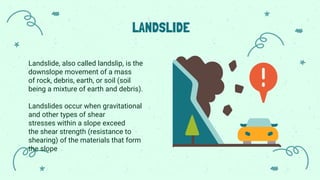
LANDSLIDE
Landslide, also called landslip, is the
downslope movement of a mass
of rock, debris, earth, or soil (soil
being a mixture of earth and debris).
Landslides occur when gravitational
and other types of shear
stresses within a slope exceed
the shear strength (resistance to
shearing) of the materials that form
the slope
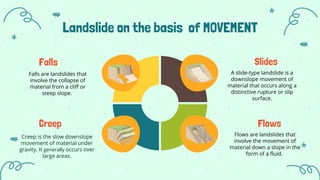
Landslide on the basis of MOVEMENT
Falls
Falls are landslides that
involve the collapse of
material from a cliff or
steep slope.
Creep
Creep is the slow downslope
movement of material under
gravity. It generally occurs over
large areas.
Slides
A slide-type landslide is a
downslope movement of
material that occurs along a
distinctive rupture or slip
surface.
Flows
Flows are landslides that
involve the movement of
material down a slope in the
form of a fluid.
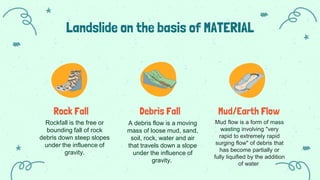
Landslide on the basis of MATERIAL
Rock Fall
Rockfall is the free or
bounding fall of rock
debris down steep slopes
under the influence of
gravity.
Debris Fall
A debris flow is a moving
mass of loose mud, sand,
soil, rock, water and air
that travels down a slope
under the influence of
gravity.
Mud/Earth Flow
Mud flow is a form of mass
wasting involving "very
rapid to extremely rapid
surging flow" of debris that
has become partially or
fully liquified by the addition
of water
Causes of Landslide
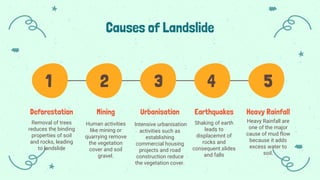
Deforestation
Removal of trees
reduces the binding
properties of soil
and rocks, leading
to landslide
Mining
Human activities
like mining or
quarrying remove
the vegetation
cover and soil
gravel.
Urbanisation
Intensive urbanisation
activities such as
establishing
commercial housing
projects and road
construction reduce
the vegetation cover.
Heavy Rainfall
Heavy Rainfall are
one of the major
cause of mud flow
because it adds
excess water to
soil.
Earthquakes
Shaking of earth
leads to
displacemnt of
rocks and
consequent slides
and falls
1 2 3 4 5
Impacts of Landslide
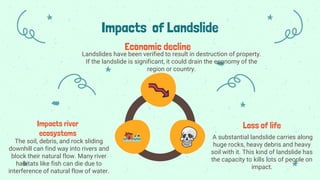
Economic decline
Landslides have been verified to result in destruction of property.
If the landslide is significant, it could drain the economy of the
region or country.
Impacts river
ecosystems
The soil, debris, and rock sliding
downhill can find way into rivers and
block their natural flow. Many river
habitats like fish can die due to
interference of natural flow of water.
Loss of life
A substantial landslide carries along
huge rocks, heavy debris and heavy
soil with it. This kind of landslide has
the capacity to kills lots of people on
impact.
Impacts of Landslide
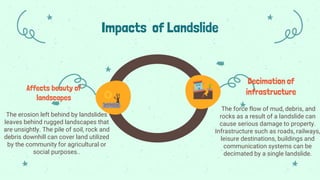
Affects beauty of
landscapes
The erosion left behind by landslides
leaves behind rugged landscapes that
are unsightly. The pile of soil, rock and
debris downhill can cover land utilized
by the community for agricultural or
social purposes..
Decimation of
infrastructure
The force flow of mud, debris, and
rocks as a result of a landslide can
cause serious damage to property.
Infrastructure such as roads, railways,
leisure destinations, buildings and
communication systems can be
decimated by a single landslide.
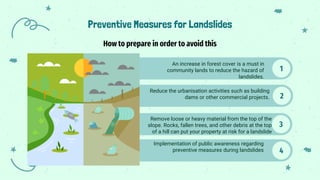
1
An increase in forest cover is a must in
community lands to reduce the hazard of
landslides.
2
Reduce the urbanisation activities such as building
dams or other commercial projects.
3
Remove loose or heavy material from the top of the
slope. Rocks, fallen trees, and other debris at the top
of a hill can put your property at risk for a landslide
4
Implementation of public awareness regarding
preventive measures during landslides
Preventive Measures for Landslides
How to prepare in order to avoid this
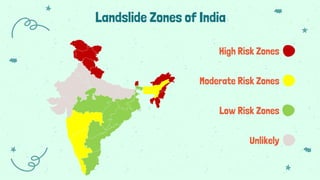
Landslide Zones of India
High Risk Zones
Moderate Risk Zones
Low Risk Zones
Unlikely
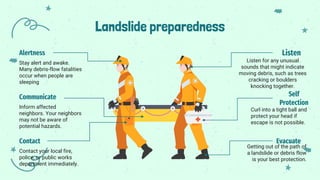
Landslide preparedness
Contact
Contact your local fire,
police, or public works
department immediately.
Communicate
Inform affected
neighbors. Your neighbors
may not be aware of
potential hazards.
Alertness
Stay alert and awake.
Many debris-flow fatalities
occur when people are
sleeping
Evacuate
Curl into a tight ball and
protect your head if
escape is not possible.
Self
Protection
Getting out of the path of
a landslide or debris flow
is your best protection.
Listen
Listen for any unusual
sounds that might indicate
moving debris, such as trees
cracking or boulders
knocking together.
THANKS!

Landslide.pptx

  • 1.
    Kripa Bhardwaj Group Members:Submitted To: LANDSLIDE
  • 2.
    WHAT IS ADISASTER? The term “DISASTER” owes its origin to French word “Disastre”, a combination of two words “Des” meaning “Bad” and “Aster” meaning “Star” thus the term Disaster refers to “Bad or Evil Star”. Geographically, disasters are serious disruptions to the functioning of a community that exceed its capacity to cope using its own resources. Disasters can be caused by natural, man-made and technological hazards, as well as various factors that influence the exposure and vulnerability of a community.
  • 3.
    Natural disasters arethe result of naturally occurring processes that have operated throughout Earth's history. They are beyond human control and are often termed an “Act of God”. The list of natural disasters include weather phenomena such as tropical storms, extreme heat or extreme cold, winds, floods, earthquakes, landslides and volcanic eruptions. TYPES OF DISASTER NATURAL DISASTERS MAN-MADE DISASTERS Man-made disasters have an element of human intent, negligence, or error involving a failure of a man-made system, as opposed to natural disasters resulting from natural hazards. Such man-made disasters are crime, arson, civil disorder, terrorism, war, biological/chemical threat, cyber-attacks, etc.
  • 4.
    LANDSLIDE Landslide, also calledlandslip, is the downslope movement of a mass of rock, debris, earth, or soil (soil being a mixture of earth and debris). Landslides occur when gravitational and other types of shear stresses within a slope exceed the shear strength (resistance to shearing) of the materials that form the slope
  • 5.
    Landslide on thebasis of MOVEMENT Falls Falls are landslides that involve the collapse of material from a cliff or steep slope. Creep Creep is the slow downslope movement of material under gravity. It generally occurs over large areas. Slides A slide-type landslide is a downslope movement of material that occurs along a distinctive rupture or slip surface. Flows Flows are landslides that involve the movement of material down a slope in the form of a fluid.
  • 6.
    Landslide on thebasis of MATERIAL Rock Fall Rockfall is the free or bounding fall of rock debris down steep slopes under the influence of gravity. Debris Fall A debris flow is a moving mass of loose mud, sand, soil, rock, water and air that travels down a slope under the influence of gravity. Mud/Earth Flow Mud flow is a form of mass wasting involving "very rapid to extremely rapid surging flow" of debris that has become partially or fully liquified by the addition of water
  • 7.
    Causes of Landslide Deforestation Removalof trees reduces the binding properties of soil and rocks, leading to landslide Mining Human activities like mining or quarrying remove the vegetation cover and soil gravel. Urbanisation Intensive urbanisation activities such as establishing commercial housing projects and road construction reduce the vegetation cover. Heavy Rainfall Heavy Rainfall are one of the major cause of mud flow because it adds excess water to soil. Earthquakes Shaking of earth leads to displacemnt of rocks and consequent slides and falls 1 2 3 4 5
  • 8.
    Impacts of Landslide Economicdecline Landslides have been verified to result in destruction of property. If the landslide is significant, it could drain the economy of the region or country. Impacts river ecosystems The soil, debris, and rock sliding downhill can find way into rivers and block their natural flow. Many river habitats like fish can die due to interference of natural flow of water. Loss of life A substantial landslide carries along huge rocks, heavy debris and heavy soil with it. This kind of landslide has the capacity to kills lots of people on impact.
  • 9.
    Impacts of Landslide Affectsbeauty of landscapes The erosion left behind by landslides leaves behind rugged landscapes that are unsightly. The pile of soil, rock and debris downhill can cover land utilized by the community for agricultural or social purposes.. Decimation of infrastructure The force flow of mud, debris, and rocks as a result of a landslide can cause serious damage to property. Infrastructure such as roads, railways, leisure destinations, buildings and communication systems can be decimated by a single landslide.
  • 10.
    1 An increase inforest cover is a must in community lands to reduce the hazard of landslides. 2 Reduce the urbanisation activities such as building dams or other commercial projects. 3 Remove loose or heavy material from the top of the slope. Rocks, fallen trees, and other debris at the top of a hill can put your property at risk for a landslide 4 Implementation of public awareness regarding preventive measures during landslides Preventive Measures for Landslides How to prepare in order to avoid this
  • 11.
    Landslide Zones ofIndia High Risk Zones Moderate Risk Zones Low Risk Zones Unlikely
  • 12.
    Landslide preparedness Contact Contact yourlocal fire, police, or public works department immediately. Communicate Inform affected neighbors. Your neighbors may not be aware of potential hazards. Alertness Stay alert and awake. Many debris-flow fatalities occur when people are sleeping Evacuate Curl into a tight ball and protect your head if escape is not possible. Self Protection Getting out of the path of a landslide or debris flow is your best protection. Listen Listen for any unusual sounds that might indicate moving debris, such as trees cracking or boulders knocking together.
  • 13.