LANDSLIDES
Umair Azam
MS Earth Sciences
Karakoram International
University
CONTENTS
 INTRODUCTION
 CAUSES OF LANDSLIDE
 PREVENTION TECHNIQUES
 ENVIRONMENTAL IMPACTS
 METHOD OF MITIGATION
CAUSES OF LANDSLIDE
There are multiple type of events that causes of
landslides, three that cause most destruction
around the world are these :
 Landslides and Water
 Landslides and Seismic Activity
 Landslides and Volcanic Activity
CAUSES OF LANDSLIDE
Landslides and Water
• When it comes to water rain is the primary source for Landslides
especially along the slop. Landslide depends intensity and time
period of rain.
• Land sliding and flooding are closely allied because both are
related to precipitation, runoff, and the saturation of ground by
water.
• Landslides can cause flooding by forming landslide dams that
block valleys and stream channels, allowing large amounts of
water to back up.
• Water saturation of ground weakens the sediment and allows
eroded material to move down the slope
CAUSES OF LANDSLIDE
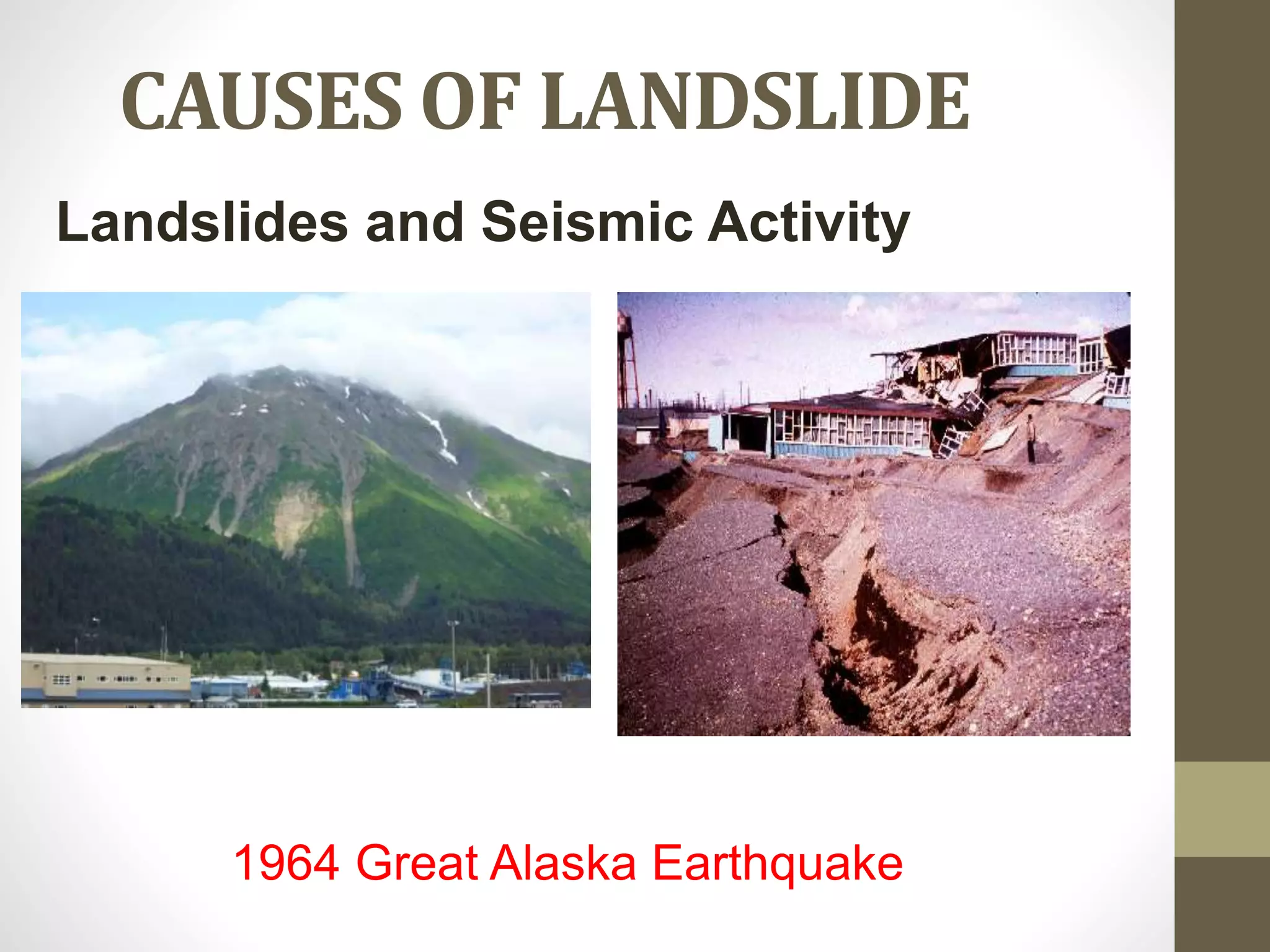
Landslides and Seismic Activity
• Many mountainous areas that are vulnerable to landslides have
also experienced at least moderate rates of earthquake occurrence
in recorded times.
• The occurrence of earthquakes in steep landslide-prone areas
greatly increases the likelihood that landslides will occur, due to
ground shaking alone or shaking- caused dilation of soil materials,
which allows rapid infiltration of water.
• The 1964 Great Alaska Earthquake caused widespread land
sliding and other ground failure, which caused most of the
monetary loss due to the earthquake.
CAUSES OF LANDSLIDE
Landslides and Seismic Activity
1964 Great Alaska Earthquake
CAUSES OF LANDSLIDE
Landslides and Volcanic Activity
• Landslides due to volcanic activity are some of the most devastating
types. Volcanic lava may melt snow at a rapid rate, causing a deluge
of rock, soil, ash, and water that accelerates rapidly on the steep
slopes of volcanoes, devastating anything in its path.
• These volcanic debris flows (lahars “Indonesian word”) reach great
distances, once they leave the flanks of the volcano, and can damage
structures in flat areas surrounding the volcanoes.
• The 1980 eruption of Mount St. Helens, in Washington triggered
a massive landslide on the north flank of the volcano, the largest
landslide in recorded times.
CAUSES OF LANDSLIDE
Landslides and Volcanic Activity
CAUSES OF LANDSLIDE
• Groundwater (pore water) pressure acting to destabilize the
slope.
• Loss or absence of vertical vegetative structure, soil nutrients,
and soil structure (e.g. after a wildfire, fire in forests lasting
for 3–4 days)
• Erosion of the toe of a slope by rivers or ocean waves
• weakening of a slope through saturation by snow melt,
glaciers melting, or heavy rains
• Earthquakes adding loads to barely stable slope
• Volcanic eruption
 Natural Causes
CAUSES OF LANDSLIDE
• Deforestation, cultivation and construction, which destabilize
the already fragile slopes.
• Vibrations from machinery or traffic
• Blasting
• Earthwork which alters the shape of a slope, or which imposes
new loads on an existing slope
• In shallow soils, the removal of deep-rooted vegetation that
binds colluvium to bedrock
• Construction, agricultural or forestry activities which change
the amount of water which infiltrates the soil.
 Anthropogenic Causes
ENVIRONMENTAL IMPACTS
• Landslides cause property damage, injury, and death and adversely
affect a variety of resources.
• For example, water supplies, fisheries, sewage disposal systems,
forests, dams, and roadways can be affected for years after a slide
event.
• The economic effects of landslides include the cost to repair
structures, loss of property value, disruption of transportation
routes, medical costs in the event of injury, and indirect costs, such
as lost timber and fish stocks.
• Landslides that occur undersea, or have impact into
water, can generate tsunamis. Massive landslides can
also generate megatsunamis, which are usually
hundreds of metres high.
• Water availability, quantity, and quality can be affected
by landslides.
• Geotechnical studies and engineering projects to assess
and stabilize potentially dangerous sites can be costly.
METHODS OF MITIGATION
• Vulnerability to landslide hazards is a function of location, type of
human activity, use, and frequency of landslide events.
• The effects of landslides on people and structures can be lessened by
total avoidance of landslide hazard areas or by restricting,
prohibiting, or imposing conditions on hazard-zone activity.
• . Local governments can reduce landslide effects through land-use
policies and regulations.
• Government can help in its reduction by educating local
communities through the past hazard history of a site and restriction
on construction without authorized survey of the area by competent
authority.
WARNING SIGNS
• Small slips, rock falls and subsidence at the bottom of slopes.
• Sticking doors and window frames.
• Gaps where frames are not fitting properly.
• Outside fixtures such as steps, decks, and verandas moving or tilting
away from the rest of the house.
• New cracks or bulges on the ground, road, footpath, retaining walls
and other hard surfaces.
• Tilting trees, retaining walls or fences.
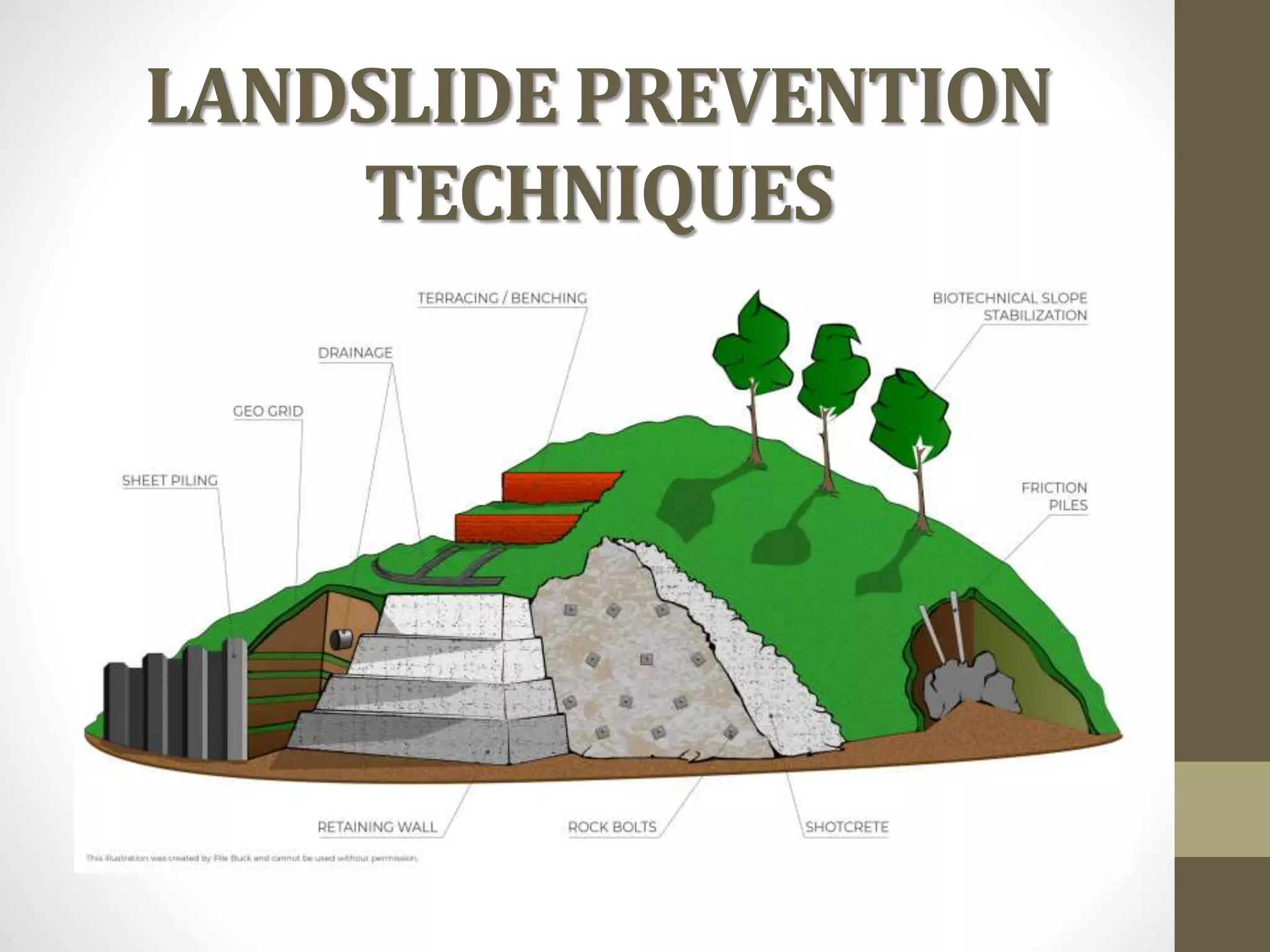
Landslide Prevention Techniques
Different techniques could help in preventing Landslide and
decreases the chances of human and property loss. Some of
them are:
• Retaining Walls
• Geogrid
• Expansive anchor bolt
• Hydrological approach
• Keeping Material and Structures Away from Slopes
• Controlling the Water Drainage on Property
• Retaining Walls
• A retaining wall needs to be built on level ground. To
avoid back-filing excavate deep enough for the base
material which is crushed stone base.
• Installation of drainage pipes in the wall reduces the
saturated soil pressure.
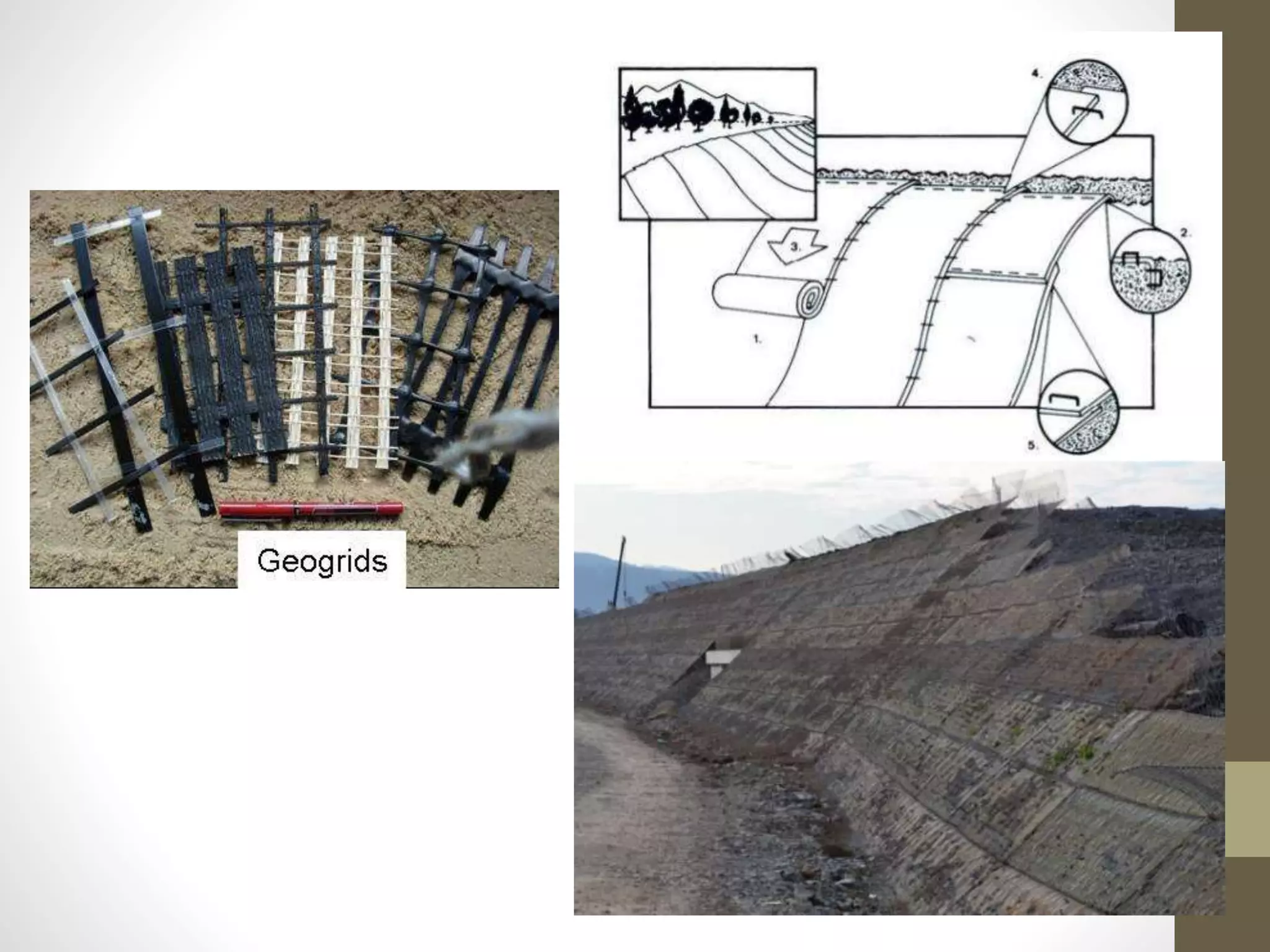
• Geogrid
• Geogrids are materials for erosion control that ensure the soil
capacity to grow plants, reducing the damage caused by
heavy rains and wind in slopes and embankments. They are
two-dimensional structures made by polymers to supplement
soil stress. The best application is in soft soils such as sand or
clay.
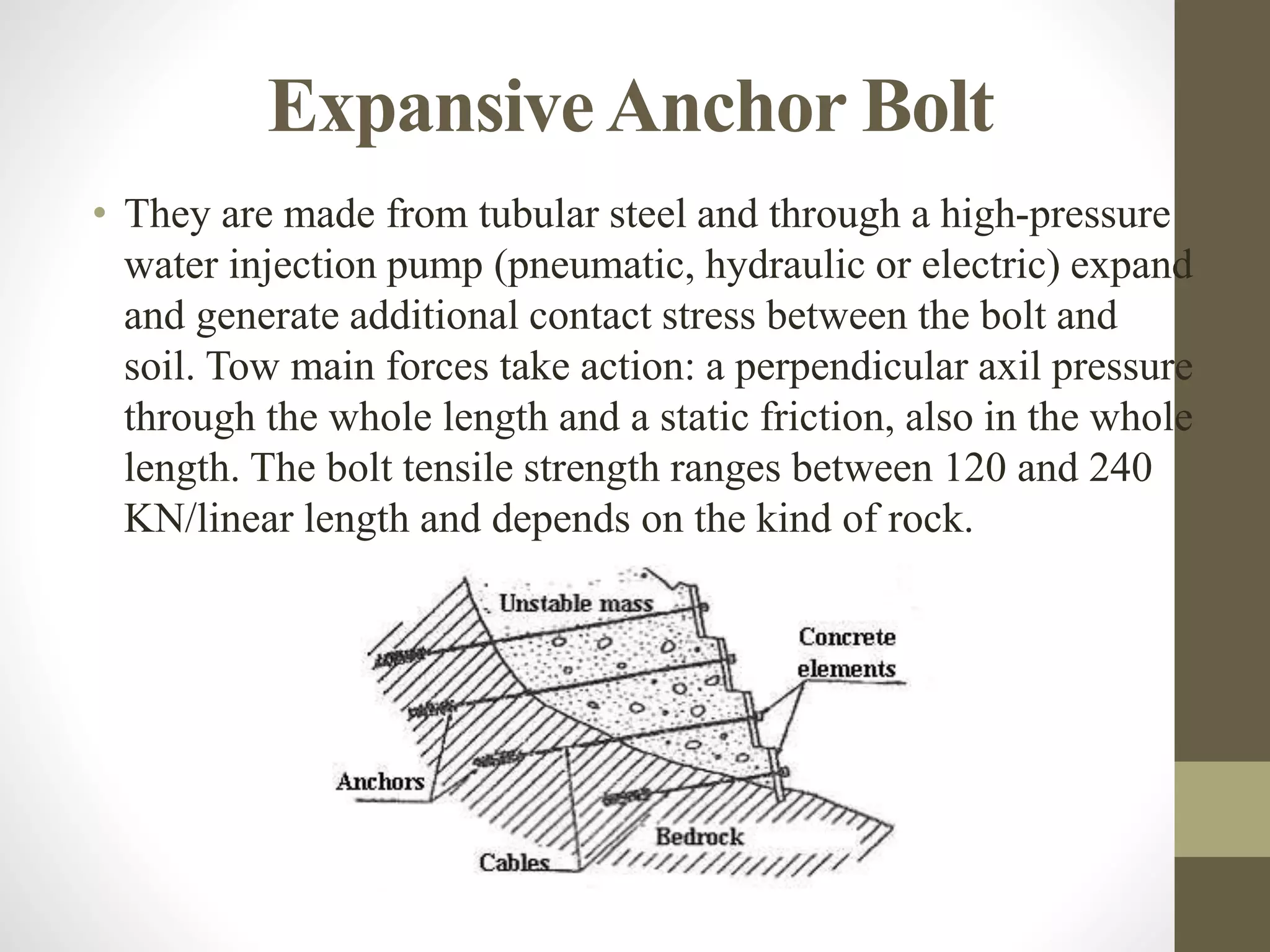
ExpansiveAnchor Bolt
• They are made from tubular steel and through a high-pressure
water injection pump (pneumatic, hydraulic or electric) expand
and generate additional contact stress between the bolt and
soil. Tow main forces take action: a perpendicular axil pressure
through the whole length and a static friction, also in the whole
length. The bolt tensile strength ranges between 120 and 240
KN/linear length and depends on the kind of rock.
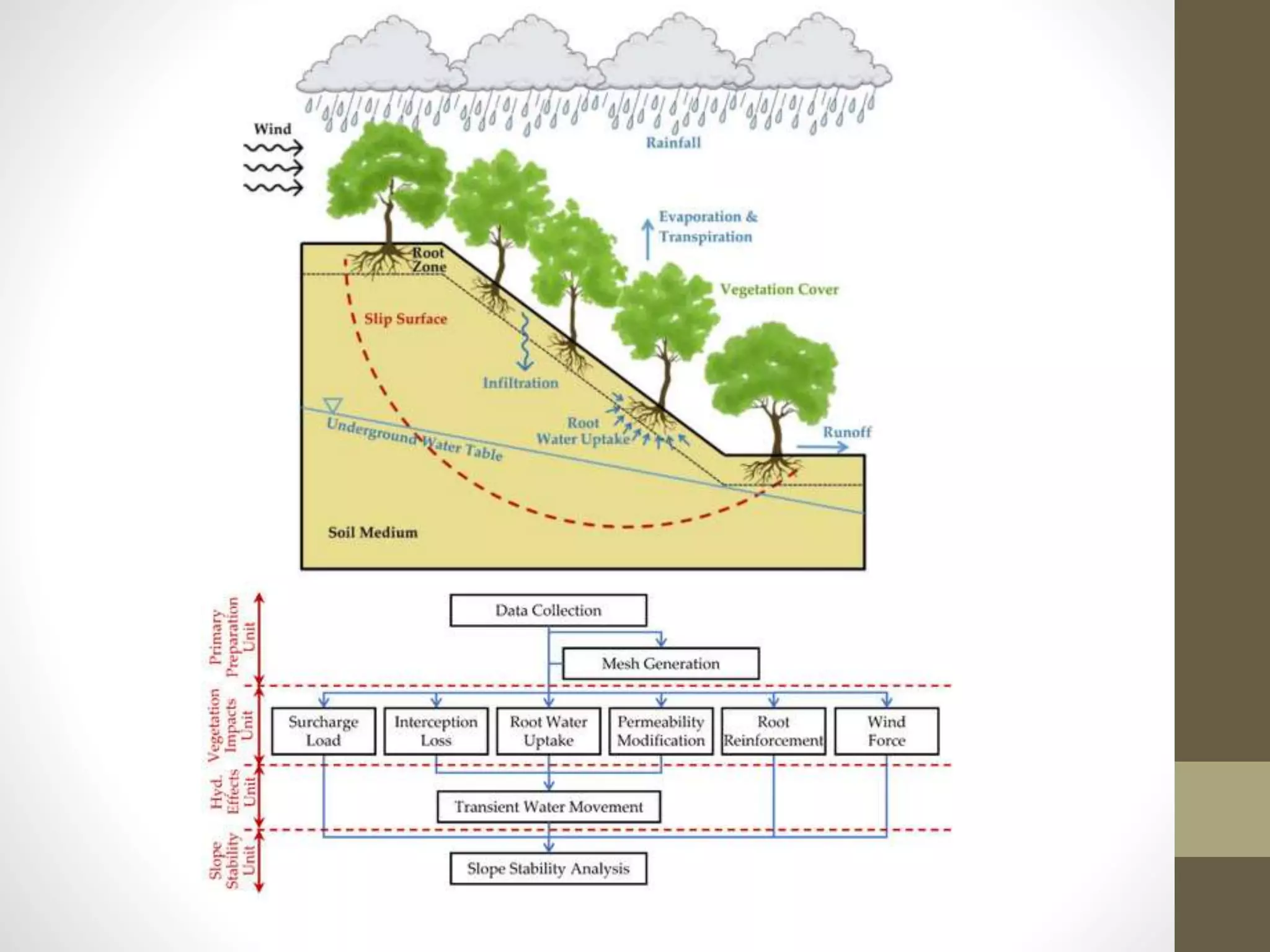
• Hydrological Approach
• Slope stability model SSHV-2D, is developed that considers
various aspects of hydrological effects and vegetation impacts
on the stability of slopes.
• The rainfall infiltration and water uptake of roots change the
water content of the unsaturated zone.
• Vegetation impacts through roots on hydraulic conductivity
and the influence of vegetation weight on slope stability.
• It is also observed that the existence of trees with high density
on a slope can increase the factor of safety about 50% and
prevent shallow landslides.
https://www.mdpi.com/2073-4441/11/10/2146/htm
LANDSLIDE PREVENTION
TECHNIQUES
UMAIR
AZAM

Landslides Causes and Prevention ppt

  • 2.
    LANDSLIDES Umair Azam MS EarthSciences Karakoram International University
  • 3.
    CONTENTS  INTRODUCTION  CAUSESOF LANDSLIDE  PREVENTION TECHNIQUES  ENVIRONMENTAL IMPACTS  METHOD OF MITIGATION
  • 4.
    CAUSES OF LANDSLIDE Thereare multiple type of events that causes of landslides, three that cause most destruction around the world are these :  Landslides and Water  Landslides and Seismic Activity  Landslides and Volcanic Activity
  • 5.
    CAUSES OF LANDSLIDE Landslidesand Water • When it comes to water rain is the primary source for Landslides especially along the slop. Landslide depends intensity and time period of rain. • Land sliding and flooding are closely allied because both are related to precipitation, runoff, and the saturation of ground by water. • Landslides can cause flooding by forming landslide dams that block valleys and stream channels, allowing large amounts of water to back up. • Water saturation of ground weakens the sediment and allows eroded material to move down the slope
  • 6.
    CAUSES OF LANDSLIDE Landslidesand Seismic Activity • Many mountainous areas that are vulnerable to landslides have also experienced at least moderate rates of earthquake occurrence in recorded times. • The occurrence of earthquakes in steep landslide-prone areas greatly increases the likelihood that landslides will occur, due to ground shaking alone or shaking- caused dilation of soil materials, which allows rapid infiltration of water. • The 1964 Great Alaska Earthquake caused widespread land sliding and other ground failure, which caused most of the monetary loss due to the earthquake.
  • 7.
    CAUSES OF LANDSLIDE Landslidesand Seismic Activity 1964 Great Alaska Earthquake
  • 8.
    CAUSES OF LANDSLIDE Landslidesand Volcanic Activity • Landslides due to volcanic activity are some of the most devastating types. Volcanic lava may melt snow at a rapid rate, causing a deluge of rock, soil, ash, and water that accelerates rapidly on the steep slopes of volcanoes, devastating anything in its path. • These volcanic debris flows (lahars “Indonesian word”) reach great distances, once they leave the flanks of the volcano, and can damage structures in flat areas surrounding the volcanoes. • The 1980 eruption of Mount St. Helens, in Washington triggered a massive landslide on the north flank of the volcano, the largest landslide in recorded times.
  • 9.
    CAUSES OF LANDSLIDE Landslidesand Volcanic Activity
  • 10.
    CAUSES OF LANDSLIDE •Groundwater (pore water) pressure acting to destabilize the slope. • Loss or absence of vertical vegetative structure, soil nutrients, and soil structure (e.g. after a wildfire, fire in forests lasting for 3–4 days) • Erosion of the toe of a slope by rivers or ocean waves • weakening of a slope through saturation by snow melt, glaciers melting, or heavy rains • Earthquakes adding loads to barely stable slope • Volcanic eruption  Natural Causes
  • 11.
    CAUSES OF LANDSLIDE •Deforestation, cultivation and construction, which destabilize the already fragile slopes. • Vibrations from machinery or traffic • Blasting • Earthwork which alters the shape of a slope, or which imposes new loads on an existing slope • In shallow soils, the removal of deep-rooted vegetation that binds colluvium to bedrock • Construction, agricultural or forestry activities which change the amount of water which infiltrates the soil.  Anthropogenic Causes
  • 12.
    ENVIRONMENTAL IMPACTS • Landslidescause property damage, injury, and death and adversely affect a variety of resources. • For example, water supplies, fisheries, sewage disposal systems, forests, dams, and roadways can be affected for years after a slide event. • The economic effects of landslides include the cost to repair structures, loss of property value, disruption of transportation routes, medical costs in the event of injury, and indirect costs, such as lost timber and fish stocks.
  • 13.
    • Landslides thatoccur undersea, or have impact into water, can generate tsunamis. Massive landslides can also generate megatsunamis, which are usually hundreds of metres high. • Water availability, quantity, and quality can be affected by landslides. • Geotechnical studies and engineering projects to assess and stabilize potentially dangerous sites can be costly.
  • 14.
    METHODS OF MITIGATION •Vulnerability to landslide hazards is a function of location, type of human activity, use, and frequency of landslide events. • The effects of landslides on people and structures can be lessened by total avoidance of landslide hazard areas or by restricting, prohibiting, or imposing conditions on hazard-zone activity. • . Local governments can reduce landslide effects through land-use policies and regulations. • Government can help in its reduction by educating local communities through the past hazard history of a site and restriction on construction without authorized survey of the area by competent authority.
  • 15.
    WARNING SIGNS • Smallslips, rock falls and subsidence at the bottom of slopes. • Sticking doors and window frames. • Gaps where frames are not fitting properly. • Outside fixtures such as steps, decks, and verandas moving or tilting away from the rest of the house. • New cracks or bulges on the ground, road, footpath, retaining walls and other hard surfaces. • Tilting trees, retaining walls or fences.
  • 16.
    Landslide Prevention Techniques Differenttechniques could help in preventing Landslide and decreases the chances of human and property loss. Some of them are: • Retaining Walls • Geogrid • Expansive anchor bolt • Hydrological approach • Keeping Material and Structures Away from Slopes • Controlling the Water Drainage on Property
  • 17.
    • Retaining Walls •A retaining wall needs to be built on level ground. To avoid back-filing excavate deep enough for the base material which is crushed stone base. • Installation of drainage pipes in the wall reduces the saturated soil pressure.
  • 18.
    • Geogrid • Geogridsare materials for erosion control that ensure the soil capacity to grow plants, reducing the damage caused by heavy rains and wind in slopes and embankments. They are two-dimensional structures made by polymers to supplement soil stress. The best application is in soft soils such as sand or clay.
  • 20.
    ExpansiveAnchor Bolt • Theyare made from tubular steel and through a high-pressure water injection pump (pneumatic, hydraulic or electric) expand and generate additional contact stress between the bolt and soil. Tow main forces take action: a perpendicular axil pressure through the whole length and a static friction, also in the whole length. The bolt tensile strength ranges between 120 and 240 KN/linear length and depends on the kind of rock.
  • 22.
    • Hydrological Approach •Slope stability model SSHV-2D, is developed that considers various aspects of hydrological effects and vegetation impacts on the stability of slopes. • The rainfall infiltration and water uptake of roots change the water content of the unsaturated zone. • Vegetation impacts through roots on hydraulic conductivity and the influence of vegetation weight on slope stability. • It is also observed that the existence of trees with high density on a slope can increase the factor of safety about 50% and prevent shallow landslides. https://www.mdpi.com/2073-4441/11/10/2146/htm
  • 24.
  • 25.