
DISASTER
MANAGEMENT
Presented by,
Mr. Abhijit Bhoyar
DEFINITION
• Disaster is "any occurrence that causes damage,
economic disruption, loss of human life and
deterioration of health and health service on a scale
sufficient to warrant an extraordinary response from
outside the affected community or area". (WHO)
Conti..
• "Disaster can be defined as an overwhelming
ecological disruption, which exceeds the capacity of
a community to adjust and consequently requires
assistance from outside. - Pan American Health
Organisation(PAHO)
Conti..
• Disaster is an event, natural or manmade, sudden or
progressive, which impacts with such severity that
the affected community has to respond by taking
exceptional measures. - W. Nick Carter
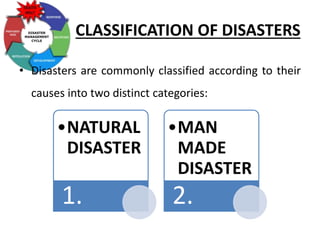
CLASSIFICATION OF DISASTERS
• Disasters are commonly classified according to their
causes into two distinct categories:
•NATURAL
DISASTER
1.
•MAN
MADE
DISASTER
2.
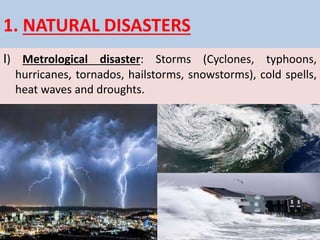
1. NATURAL DISASTERS
I) Metrological disaster: Storms (Cyclones, typhoons,
hurricanes, tornados, hailstorms, snowstorms), cold spells,
heat waves and droughts.
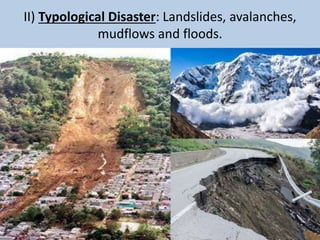
II) Typological Disaster: Landslides, avalanches,
mudflows and floods.
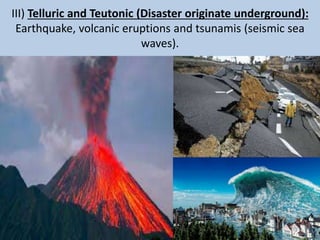
III) Telluric and Teutonic (Disaster originate underground):
Earthquake, volcanic eruptions and tsunamis (seismic sea
waves).
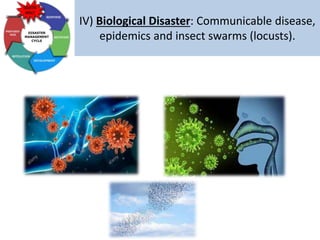
IV) Biological Disaster: Communicable disease,
epidemics and insect swarms (locusts).
2. MAN MADE DISASTERS
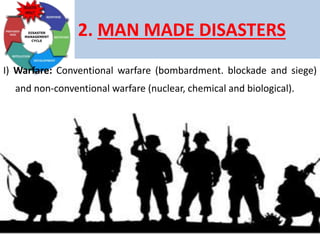
I) Warfare: Conventional warfare (bombardment. blockade and siege)
and non-conventional warfare (nuclear, chemical and biological).
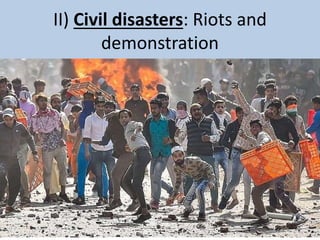
II) Civil disasters: Riots and
demonstration
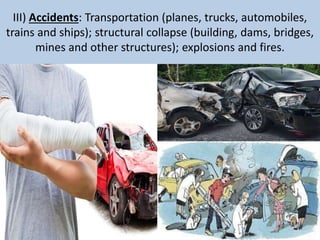
III) Accidents: Transportation (planes, trucks, automobiles,
trains and ships); structural collapse (building, dams, bridges,
mines and other structures); explosions and fires.
IV) Technological failures: A mishap at a nuclear power
station, leak at a chemical plant causing pollution of
atmosphere or the breakdown of a public sanitation.
PRINCIPLES OF DISASTER
MANAGEMENT
1. Prevent the
disaster
2. Prevent further
casualties
3. Rescue the
victims
• 4. Minimize the
casualties
• 5. Evacuate
• 6. First aid
• 7. Medical care
• 8. Reconstruction
READINESS FOR DISASTER
• Readiness for disaster involves two aspects
1. Resource for readiness.
2. Disaster pre planning.
1. Resources for readiness
• RED CROSS: Its primary concern in a disaster
situation is to provide relief for human
suffering in the form of food, shelter, clothing,
medical care, and occupational rehabilitation
of victims
Conti..
• COMMUNITY AND LOCAL GOVERNMENT: It shares
the responsibility in clearing rubble, maintaining law
and order, determining the safety of a structure of
habitation, repairing bridges, resuming
transportation, maintaining sanitation, providing safe
food and drinking water, etc.
Conti..
• CIVIL DEFENCE SERVICES: The civil defense and its
medical facility programmers provide for shelters,
establishing communication linkage, post disaster
services, assistance to affected community in the
area of health, sanitation, maintaining law and order,
fire fighting, clearing debris, prevention and control
of epidemic of various diseases etc.
2. Disaster pre-planning
• It is important to make the best possible use of the
resources.
• Some of the preplanning aspects for disaster related
to medical care as follows:
• HOSPITAL DISASTER PLANING: Depending upon the
hospital's location and size, it mobilizes its resources
to manage any disaster.
Conti..
It should provide for immediate action in the event of:
I. An internal disaster in hospital itself eg. Fire, explosion,
etc.
ii. Some minor external disaster.
iii. Major external disaster.
iv. Threat of disaster.
v. Disaster in neighboring communities/country
EVACUATION
There is usually a system which on order of the medical
superintendent, is activated : eg.
• Percentage of evacuation (discharge) of the patient
from the hospital.
• Addition of extra beds.
• Preparation of emergency ward.
• Such facilities should be near to X-ray, operation
theatre, central supply, medical store, etc.
Conti..
• ORDERLY FLOW OF CASUALITY: It is important to
minimize confusion in receiving causalities. A team of
well qualified physician and nurses at the reception
itself sorts out causalities and make quick decisions
of the treatment.
Conti..
• i. Additional nursing staff volunteers may be called
and posted.
• ii. Services of all departments of the hospital should
be well integrated in the disaster plan viz. dietary
department, laundry, public works department
(PWD), engineering unit, etc.
Conti..
• iii. The planning should also take into consideration
other aspects like traffic control, types of medical
records to be maintained, standardization of
emergency medical tags, public information centers,
controlled dissemination of information without or
with minimum distortion, preparation of emergency
supplies kept ready, all ambulance kept ready,
arrangement of additional vehicles.
Conti..
• COMMUNICATION SYSTEM: Additional
communication system should be planned. It
is also important to keep the hospital
informed about the inflow of the casualties
from the scene.
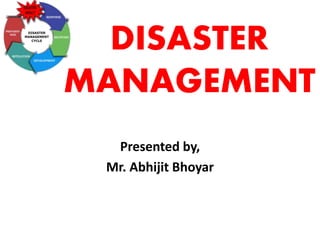
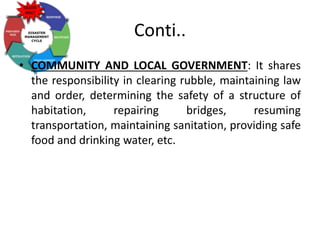
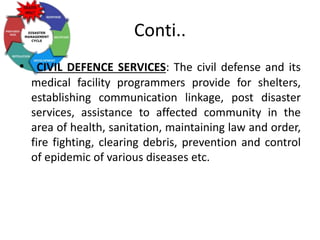
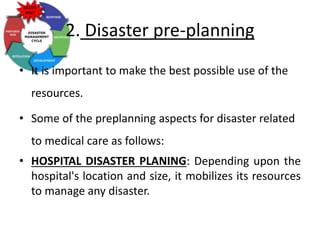
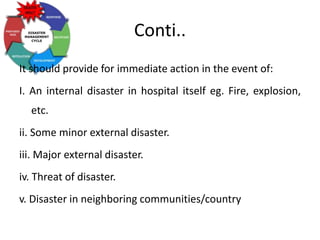
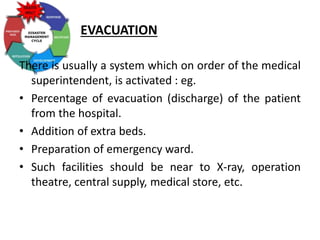
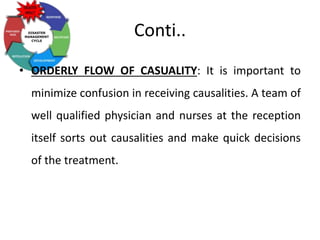
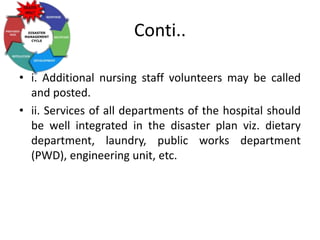
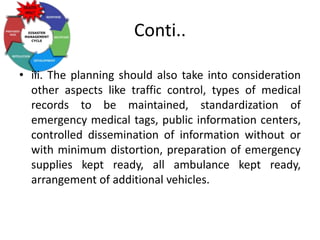
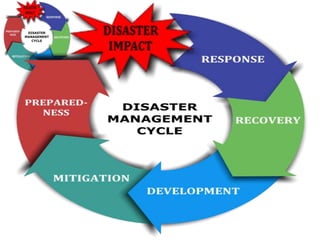
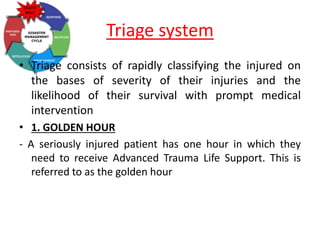
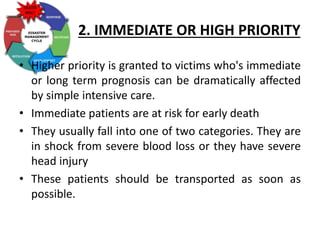
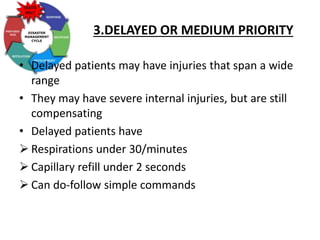
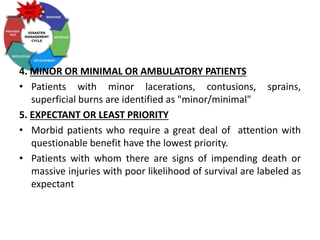
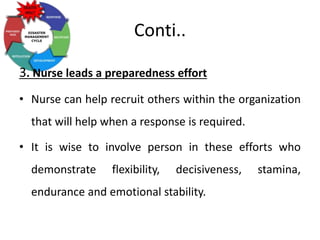
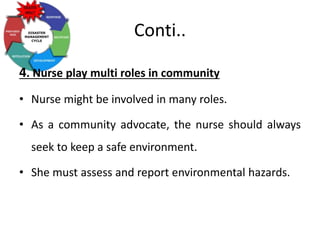
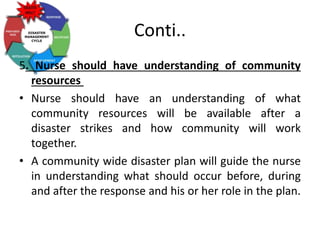
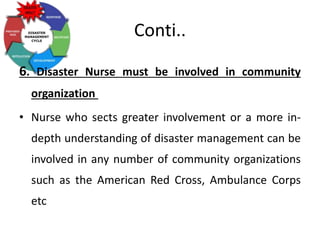
THE DISASTER MANAGEMENT
CYCLE
DISASTER EVENT: This refers to the
"REAL TIME“event of the hazard
occurring and affecting elements
of risk
RESPONSE AND RELIEF: This
refers to the first stage response
to any calamity, which include
setting up control rooms, putting
the contingency plan in action,
issue warnings, evacuating
people to safe areas, rendering
medical aid to the needy, etc.
RECOVERY: It has three
overlapping phases of emergency
relief rehabilitation and
reconstructing.
DEVELOPMENT: Evolving economy and
long-term prevention/disaster
reduction measures like construction
of houses capable of withstanding the
onslought of heavy rains, wind speeds
and shocks of earthquakes.
REDUCTION AND MITIGATION:
Protective or preventive actions that
lessons the scale of impact. Minimizing
the effects of disaster. Eg. building
codes and zoning, vulnerability
analyses, public education
PREPAREDNESS: Includes the
formulation and development
of viable emergency plans, of
the warning system, the
maintenance of inventories
and the training of personnel
TRIAGE
OBJECTIVES OF TRIAGE
An effective triage system should be able to achieve the
following:
• Ensure immediate medical intervention in life
threatening situations.
• Expedite the care of patents through a systematic
initial assessment.
The word triage is derived from
French word "trier" which means
sorting or choosing
Conti..
• Ensure that patients are prioritised for treatment in
accordance with the severity of their medical
condition.
• Reduce morbidity through early medical
intervention.
• Improve public relations by communicating
appropriate information to friends and relatives who
accompany patients.
Conti..
• Improve patients flow within emergency
departments and/or disaster management situation.
• Provide supervised learning for appropriate
personnel.
Principles of triage
The main principles of triage are as follows
• Every patient should be received and triaged by
appropriate skilled health-care professionals.
• Triage is a clinic-managerial decision and must
involve collaborative planning.
• The triage process should not cause a delay in the
delivery of effective clinical care.
Triage system
• Triage consists of rapidly classifying the injured on
the bases of severity of their injuries and the
likelihood of their survival with prompt medical
intervention
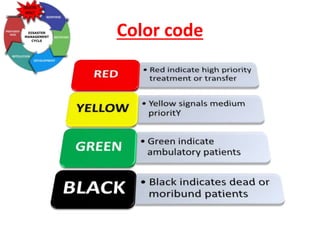
• 1. GOLDEN HOUR
- A seriously injured patient has one hour in which they
need to receive Advanced Trauma Life Support. This is
referred to as the golden hour
2. IMMEDIATE OR HIGH PRIORITY
• Higher priority is granted to victims who's immediate
or long term prognosis can be dramatically affected
by simple intensive care.
• Immediate patients are at risk for early death
• They usually fall into one of two categories. They are
in shock from severe blood loss or they have severe
head injury
• These patients should be transported as soon as
possible.
3.DELAYED OR MEDIUM PRIORITY
• Delayed patients may have injuries that span a wide
range
• They may have severe internal injuries, but are still
compensating
• Delayed patients have
 Respirations under 30/minutes
 Capillary refill under 2 seconds
 Can do-follow simple commands
4. MINOR OR MINIMAL OR AMBULATORY PATIENTS
• Patients with minor lacerations, contusions, sprains,
superficial burns are identified as "minor/minimal"
5. EXPECTANT OR LEAST PRIORITY
• Morbid patients who require a great deal of attention with
questionable benefit have the lowest priority.
• Patients with whom there are signs of impending death or
massive injuries with poor likelihood of survival are labeled as
expectant
Color code
HOSPITAL DISASTER PLAN
• The hospital is an integral part of the society and it has great
role to play in the disaster management.
• Every hospital big or small, public or private has to prepare a
disaster plan, and must learn to activate the disaster plan at
the hour of need.
• Disasters in the hospital perspective can be grouped into two
categories:
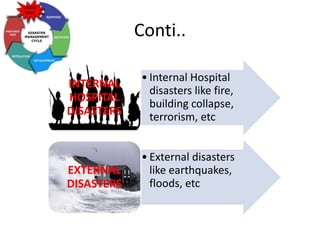
Conti..
• Internal Hospital
disasters like fire,
building collapse,
terrorism, etc
INTERNAL
HOSPITAL
DISASTERS
• External disasters
like earthquakes,
floods, etc
EXTERNAL
DISASTERS
OBJECTIVES OF HOSPITAL
DISASTER PLAN
• Preparedness of staff, optimising of resources and
mobilization of the logistics and supplies within short notice
• To make community aware about the hospital disaster plan
and benefits of plan
• Training and motivation of the staff
• To carry out mock drills
• Documentation of the plan and making hospital staff aware
about the various steps of the plan
DESIGNING OF HOSPITAL
DISASTER PLAN
1. DISASTER MANAGEMENT COMMITTEE
• The hospital disaster management committee is the decision
making body for formulation of the policy and plan for
disaster management.
• It constitutes the following members
a. Director of the hospital
b. HOD of accidents and emergency services
c. All heads of the departments
d. Nursing superintendent
e. Hospital administrator
f. Representatives of the staff
2. FUNCTIONS OF THE DISASTER
MANAGEMENT COMMITTEE
• The functions of the committee are:
a. To prepare a hospital disaster plan for the hospital
b. To prepare departmental plan in support of the hospital plan
c. Assign duties to the staff.
d. Establishment of criteria for emergency care
e. To conduct, supervise and evaluate the training programmes.
f. To supervise the mock drills .
Conti..
g. Updating of plans as need arises.
h. Organise community awareness programmes, through mass
media
i. Assist in information, education, communication
(IEC)_programmes in respect of the disaster preparedness,
prevention and management.
3. ROLE AND FUNCTIONS:
• The effective implementation of the program will depend
upon clarity of the plan, role and functions of the different
members and the staff. They are:
• DISASTER CO-ORDINATOR: The co-ordinators role will be:
Organising
Communicating
Assigning duties
Deployment of staff
Taking key decisions
Conti..
• ADMINISTRATOR: The responsibilities of the administrator is
to execute the authority through the departmental heads
• DEPARTMENTAL HEADS: Development of departmental plans
• NURSING SUPERINTENDENT : deployment of nursing staff
• MEDICAL STAFF: Specific role of rendering medical care. both
pre-hospital and hospital care
• NURSING STAFF: Nursing care and support critical care
4. IMPORTANT DEPARTMENTS
• The important department
of the hospital have to play
a key role in the disaster
management
a. Accident and emergency
department
b. Operating department
c. Critical care units
d. Radiology departments
e. Laboratory
f. Blood bank
5. SUPPORT AREAS
• Prompt supply of drugs,
linen and surgical items,
fluids are required in the
hospital and due care has to
be taken to incorporate the
role and function of
following units.
Laundry
CSSD
Dietary department
Housekeeping services
Medical records
Public relations
Communications
Conti..
Transportation
Mortuary
Medic-social worker
Security and safety
services
Media relations
Engineering
department
DISASTER DRILL
• Definition
• A disaster drill is an exercise in which people
simulate the circumstances of a disaster so
that they have an opportunity to practice their
responses.
Features
• On a basic level, drills can include responses by individuals to
protect themselves, such as
 Learning how to shelter in place,
 Understanding what to do in an evacuation, and
 Organizing meet up points so that people can find each other
after a disaster.
Conti..
• Disaster drills handle topics like what to do, when
communications are cut off, how to deal with lack of
access to equipment, tools, and even basic services
like water and power, and how to handle
evacuations.
• It also provides a chance to practice for events such
as mass casualties which can occur during a disaster
Conti..
• Regular disaster drills are often required for public
buildings like government offices and schools where
people are expected to practice things like
evacuating the building and assisting each other so
that they will know what to do when a real alarm
sounds.
Conti..
• Community-based disaster drills such as whole-city
drills provide a chance to practice the full spectrum
of disaster response.
• These drills can include actors and civilian volunteers
who play roles of victims, looters, and other people
who may be encountered during a disaster, and
extensive planning may go into such drills.
• A disaster drill on this scale may be done once a year
or once every few years.
BENEFITS OF DRILL
• Used to identify weak points in a disaster
response plan
• To get people familiar with the steps they
need to take so that their response in a
disaster will be automatic.
ROLE OF NURSES IN DISASTER
MANAGEMENT
• I. IN DISASTER PREPAREDNESS
1. To facilitate preparation with
community
 For facilitating preparation within the
community, the nurse can help
initiate updating disaster plan,
provide educational programmes &
material regarding disasters specific
to areas.
Conti..
2. To provide updated record of vulnerable
populations within community
The nurse should be involved in educating
these populations about what impact the
disaster can have on them.
Conti..
3. Nurse leads a preparedness effort
• Nurse can help recruit others within the organization
that will help when a response is required.
• It is wise to involve person in these efforts who
demonstrate flexibility, decisiveness, stamina,
endurance and emotional stability.
Conti..
4. Nurse play multi roles in community
• Nurse might be involved in many roles.
• As a community advocate, the nurse should always
seek to keep a safe environment.
• She must assess and report environmental hazards.
Conti..
5. Nurse should have understanding of community
resources
• Nurse should have an understanding of what
community resources will be available after a
disaster strikes and how community will work
together.
• A community wide disaster plan will guide the nurse
in understanding what should occur before, during
and after the response and his or her role in the plan.
Conti..
6. Disaster Nurse must be involved in community
organization
• Nurse who sects greater involvement or a more in-
depth understanding of disaster management can be
involved in any number of community organizations
such as the American Red Cross, Ambulance Corps
etc
II. In disaster response
1. Nurse must involve in community assessment, case
finding and referring, (prevention, health education
and surveillance)
2. Once rescue workers begin to arrive at the
scene, immediate plans for triage should begin.
- Triage is the process of separating causalities and
allocating treatment based on the victim's potential
for survival.
Conti..
• Higher priority is always given to victim's potential who have
life threatening injuries but who have a high probability of
survival once stabilized.
• Second Priority is given to victims who have injuries with
systemic complications that are not yet life threatening but
who can wait up to 45-60 minutes of treatment.
• Last priority in given to those victims who have local injuries
many immediate complications and who can wait several
hours for medical attention
Conti..
3. Nurse works as a member of assessment team
- Nurse working as members of an assessment team have the
responsibility of give accurate feed back to relief managers to
facilitate rapid rescue and recovery.
4. To be involved in ongoing surveillance
• Nurse involved in ongoing surveillance uses the following
methods to gather information - interview, observation,
physical examination, health and illness screening surveys,
records etc.
III. In disaster recovery
1. Successful Recovery Preparation
• Flexibility is an important component of successful
recovery preparation.
• Community clean up efforts can incur a host of
physical and psychological problems. Eg. Physical
stress of moving heavy objects can cause back injury,
severe fatigue and even death from heart attacks.
2. Health teaching
• The continuing threat of communicable disease will continue
as long as the water supply remains threat and the relieving
conditions remain crowded.
• Nurses must remain vigilant in teaching proper hygiene and
making sure immunization records are up to date.
3. Psychological support
• Acute and chronic illness can be exacerbated by prolonged
effects of disaster.
• The psychological stress of cleanup and moving can bring
about feelings of severe hopelessness and depression.
Conti..
4. Referrals to hospital as needed
• Stress can lead to suicide and domestic abuse. Although most
people recover from disasters, mental distress may persist in
vulnerable populations.
• Referrals to mental health professionals should continue as
long as the need exists.
5. Remain alert for environmental health
• Nurse must also remain alert for environment health hazards
during recovery phase of a disaster.
• Home visit may lead the nurse to uncover situations such as
lack of water supply or lack of electricity.
PARAMETERS FOR NURSING
PRACTICE
• All nurses providing health care at mass
gatherings must be competent in the basic
principles of first aid including CPR and use of
automated external defibrillator.
• In addition nurses should possess the
following minimum care competencies.
•
Nursing assessment
• Perform respiratory airway assessment
• Perform a cardiovascular assessment including vital
signs, monitoring for signs of shade. Perform an
integumentary assessment, including burn
assessment Perform a pain assessment.
• Perform a trauma assessment from head to toe
• Perform a mental status including Glasgow coma
scale
• Know the indications of intubation
Disaster management

Disaster management

  • 1.
  • 2.
    DEFINITION • Disaster is"any occurrence that causes damage, economic disruption, loss of human life and deterioration of health and health service on a scale sufficient to warrant an extraordinary response from outside the affected community or area". (WHO)
  • 3.
    Conti.. • "Disaster canbe defined as an overwhelming ecological disruption, which exceeds the capacity of a community to adjust and consequently requires assistance from outside. - Pan American Health Organisation(PAHO)
  • 4.
    Conti.. • Disaster isan event, natural or manmade, sudden or progressive, which impacts with such severity that the affected community has to respond by taking exceptional measures. - W. Nick Carter
  • 5.
    CLASSIFICATION OF DISASTERS •Disasters are commonly classified according to their causes into two distinct categories: •NATURAL DISASTER 1. •MAN MADE DISASTER 2.
  • 6.
    1. NATURAL DISASTERS I)Metrological disaster: Storms (Cyclones, typhoons, hurricanes, tornados, hailstorms, snowstorms), cold spells, heat waves and droughts.
  • 7.
    II) Typological Disaster:Landslides, avalanches, mudflows and floods.
  • 8.
    III) Telluric andTeutonic (Disaster originate underground): Earthquake, volcanic eruptions and tsunamis (seismic sea waves).
  • 9.
    IV) Biological Disaster:Communicable disease, epidemics and insect swarms (locusts).
  • 10.
    2. MAN MADEDISASTERS I) Warfare: Conventional warfare (bombardment. blockade and siege) and non-conventional warfare (nuclear, chemical and biological).
  • 11.
    II) Civil disasters:Riots and demonstration
  • 12.
    III) Accidents: Transportation(planes, trucks, automobiles, trains and ships); structural collapse (building, dams, bridges, mines and other structures); explosions and fires.
  • 13.
    IV) Technological failures:A mishap at a nuclear power station, leak at a chemical plant causing pollution of atmosphere or the breakdown of a public sanitation.
  • 14.
    PRINCIPLES OF DISASTER MANAGEMENT 1.Prevent the disaster 2. Prevent further casualties 3. Rescue the victims • 4. Minimize the casualties • 5. Evacuate • 6. First aid • 7. Medical care • 8. Reconstruction
  • 15.
    READINESS FOR DISASTER •Readiness for disaster involves two aspects 1. Resource for readiness. 2. Disaster pre planning.
  • 16.
    1. Resources forreadiness • RED CROSS: Its primary concern in a disaster situation is to provide relief for human suffering in the form of food, shelter, clothing, medical care, and occupational rehabilitation of victims
  • 17.
    Conti.. • COMMUNITY ANDLOCAL GOVERNMENT: It shares the responsibility in clearing rubble, maintaining law and order, determining the safety of a structure of habitation, repairing bridges, resuming transportation, maintaining sanitation, providing safe food and drinking water, etc.
  • 18.
    Conti.. • CIVIL DEFENCESERVICES: The civil defense and its medical facility programmers provide for shelters, establishing communication linkage, post disaster services, assistance to affected community in the area of health, sanitation, maintaining law and order, fire fighting, clearing debris, prevention and control of epidemic of various diseases etc.
  • 19.
    2. Disaster pre-planning •It is important to make the best possible use of the resources. • Some of the preplanning aspects for disaster related to medical care as follows: • HOSPITAL DISASTER PLANING: Depending upon the hospital's location and size, it mobilizes its resources to manage any disaster.
  • 20.
    Conti.. It should providefor immediate action in the event of: I. An internal disaster in hospital itself eg. Fire, explosion, etc. ii. Some minor external disaster. iii. Major external disaster. iv. Threat of disaster. v. Disaster in neighboring communities/country
  • 21.
    EVACUATION There is usuallya system which on order of the medical superintendent, is activated : eg. • Percentage of evacuation (discharge) of the patient from the hospital. • Addition of extra beds. • Preparation of emergency ward. • Such facilities should be near to X-ray, operation theatre, central supply, medical store, etc.
  • 22.
    Conti.. • ORDERLY FLOWOF CASUALITY: It is important to minimize confusion in receiving causalities. A team of well qualified physician and nurses at the reception itself sorts out causalities and make quick decisions of the treatment.
  • 23.
    Conti.. • i. Additionalnursing staff volunteers may be called and posted. • ii. Services of all departments of the hospital should be well integrated in the disaster plan viz. dietary department, laundry, public works department (PWD), engineering unit, etc.
  • 24.
    Conti.. • iii. Theplanning should also take into consideration other aspects like traffic control, types of medical records to be maintained, standardization of emergency medical tags, public information centers, controlled dissemination of information without or with minimum distortion, preparation of emergency supplies kept ready, all ambulance kept ready, arrangement of additional vehicles.
  • 25.
    Conti.. • COMMUNICATION SYSTEM:Additional communication system should be planned. It is also important to keep the hospital informed about the inflow of the casualties from the scene.
  • 27.
    THE DISASTER MANAGEMENT CYCLE DISASTEREVENT: This refers to the "REAL TIME“event of the hazard occurring and affecting elements of risk RESPONSE AND RELIEF: This refers to the first stage response to any calamity, which include setting up control rooms, putting the contingency plan in action, issue warnings, evacuating people to safe areas, rendering medical aid to the needy, etc. RECOVERY: It has three overlapping phases of emergency relief rehabilitation and reconstructing. DEVELOPMENT: Evolving economy and long-term prevention/disaster reduction measures like construction of houses capable of withstanding the onslought of heavy rains, wind speeds and shocks of earthquakes. REDUCTION AND MITIGATION: Protective or preventive actions that lessons the scale of impact. Minimizing the effects of disaster. Eg. building codes and zoning, vulnerability analyses, public education
  • 28.
    PREPAREDNESS: Includes the formulationand development of viable emergency plans, of the warning system, the maintenance of inventories and the training of personnel
  • 29.
    TRIAGE OBJECTIVES OF TRIAGE Aneffective triage system should be able to achieve the following: • Ensure immediate medical intervention in life threatening situations. • Expedite the care of patents through a systematic initial assessment. The word triage is derived from French word "trier" which means sorting or choosing
  • 30.
    Conti.. • Ensure thatpatients are prioritised for treatment in accordance with the severity of their medical condition. • Reduce morbidity through early medical intervention. • Improve public relations by communicating appropriate information to friends and relatives who accompany patients.
  • 31.
    Conti.. • Improve patientsflow within emergency departments and/or disaster management situation. • Provide supervised learning for appropriate personnel.
  • 32.
    Principles of triage Themain principles of triage are as follows • Every patient should be received and triaged by appropriate skilled health-care professionals. • Triage is a clinic-managerial decision and must involve collaborative planning. • The triage process should not cause a delay in the delivery of effective clinical care.
  • 33.
    Triage system • Triageconsists of rapidly classifying the injured on the bases of severity of their injuries and the likelihood of their survival with prompt medical intervention • 1. GOLDEN HOUR - A seriously injured patient has one hour in which they need to receive Advanced Trauma Life Support. This is referred to as the golden hour
  • 34.
    2. IMMEDIATE ORHIGH PRIORITY • Higher priority is granted to victims who's immediate or long term prognosis can be dramatically affected by simple intensive care. • Immediate patients are at risk for early death • They usually fall into one of two categories. They are in shock from severe blood loss or they have severe head injury • These patients should be transported as soon as possible.
  • 35.
    3.DELAYED OR MEDIUMPRIORITY • Delayed patients may have injuries that span a wide range • They may have severe internal injuries, but are still compensating • Delayed patients have  Respirations under 30/minutes  Capillary refill under 2 seconds  Can do-follow simple commands
  • 36.
    4. MINOR ORMINIMAL OR AMBULATORY PATIENTS • Patients with minor lacerations, contusions, sprains, superficial burns are identified as "minor/minimal" 5. EXPECTANT OR LEAST PRIORITY • Morbid patients who require a great deal of attention with questionable benefit have the lowest priority. • Patients with whom there are signs of impending death or massive injuries with poor likelihood of survival are labeled as expectant
  • 37.
  • 38.
    HOSPITAL DISASTER PLAN •The hospital is an integral part of the society and it has great role to play in the disaster management. • Every hospital big or small, public or private has to prepare a disaster plan, and must learn to activate the disaster plan at the hour of need. • Disasters in the hospital perspective can be grouped into two categories:
  • 39.
    Conti.. • Internal Hospital disasterslike fire, building collapse, terrorism, etc INTERNAL HOSPITAL DISASTERS • External disasters like earthquakes, floods, etc EXTERNAL DISASTERS
  • 40.
    OBJECTIVES OF HOSPITAL DISASTERPLAN • Preparedness of staff, optimising of resources and mobilization of the logistics and supplies within short notice • To make community aware about the hospital disaster plan and benefits of plan • Training and motivation of the staff • To carry out mock drills • Documentation of the plan and making hospital staff aware about the various steps of the plan
  • 41.
    DESIGNING OF HOSPITAL DISASTERPLAN 1. DISASTER MANAGEMENT COMMITTEE • The hospital disaster management committee is the decision making body for formulation of the policy and plan for disaster management. • It constitutes the following members a. Director of the hospital b. HOD of accidents and emergency services c. All heads of the departments d. Nursing superintendent e. Hospital administrator f. Representatives of the staff
  • 42.
    2. FUNCTIONS OFTHE DISASTER MANAGEMENT COMMITTEE • The functions of the committee are: a. To prepare a hospital disaster plan for the hospital b. To prepare departmental plan in support of the hospital plan c. Assign duties to the staff. d. Establishment of criteria for emergency care e. To conduct, supervise and evaluate the training programmes. f. To supervise the mock drills .
  • 43.
    Conti.. g. Updating ofplans as need arises. h. Organise community awareness programmes, through mass media i. Assist in information, education, communication (IEC)_programmes in respect of the disaster preparedness, prevention and management.
  • 44.
    3. ROLE ANDFUNCTIONS: • The effective implementation of the program will depend upon clarity of the plan, role and functions of the different members and the staff. They are: • DISASTER CO-ORDINATOR: The co-ordinators role will be: Organising Communicating Assigning duties Deployment of staff Taking key decisions
  • 45.
    Conti.. • ADMINISTRATOR: Theresponsibilities of the administrator is to execute the authority through the departmental heads • DEPARTMENTAL HEADS: Development of departmental plans • NURSING SUPERINTENDENT : deployment of nursing staff • MEDICAL STAFF: Specific role of rendering medical care. both pre-hospital and hospital care • NURSING STAFF: Nursing care and support critical care
  • 46.
    4. IMPORTANT DEPARTMENTS •The important department of the hospital have to play a key role in the disaster management a. Accident and emergency department b. Operating department c. Critical care units d. Radiology departments e. Laboratory f. Blood bank
  • 47.
    5. SUPPORT AREAS •Prompt supply of drugs, linen and surgical items, fluids are required in the hospital and due care has to be taken to incorporate the role and function of following units. Laundry CSSD Dietary department Housekeeping services Medical records Public relations Communications
  • 48.
    Conti.. Transportation Mortuary Medic-social worker Security andsafety services Media relations Engineering department
  • 49.
    DISASTER DRILL • Definition •A disaster drill is an exercise in which people simulate the circumstances of a disaster so that they have an opportunity to practice their responses.
  • 50.
    Features • On abasic level, drills can include responses by individuals to protect themselves, such as  Learning how to shelter in place,  Understanding what to do in an evacuation, and  Organizing meet up points so that people can find each other after a disaster.
  • 51.
    Conti.. • Disaster drillshandle topics like what to do, when communications are cut off, how to deal with lack of access to equipment, tools, and even basic services like water and power, and how to handle evacuations. • It also provides a chance to practice for events such as mass casualties which can occur during a disaster
  • 52.
    Conti.. • Regular disasterdrills are often required for public buildings like government offices and schools where people are expected to practice things like evacuating the building and assisting each other so that they will know what to do when a real alarm sounds.
  • 53.
    Conti.. • Community-based disasterdrills such as whole-city drills provide a chance to practice the full spectrum of disaster response. • These drills can include actors and civilian volunteers who play roles of victims, looters, and other people who may be encountered during a disaster, and extensive planning may go into such drills. • A disaster drill on this scale may be done once a year or once every few years.
  • 54.
    BENEFITS OF DRILL •Used to identify weak points in a disaster response plan • To get people familiar with the steps they need to take so that their response in a disaster will be automatic.
  • 55.
    ROLE OF NURSESIN DISASTER MANAGEMENT • I. IN DISASTER PREPAREDNESS 1. To facilitate preparation with community  For facilitating preparation within the community, the nurse can help initiate updating disaster plan, provide educational programmes & material regarding disasters specific to areas.
  • 56.
    Conti.. 2. To provideupdated record of vulnerable populations within community The nurse should be involved in educating these populations about what impact the disaster can have on them.
  • 57.
    Conti.. 3. Nurse leadsa preparedness effort • Nurse can help recruit others within the organization that will help when a response is required. • It is wise to involve person in these efforts who demonstrate flexibility, decisiveness, stamina, endurance and emotional stability.
  • 58.
    Conti.. 4. Nurse playmulti roles in community • Nurse might be involved in many roles. • As a community advocate, the nurse should always seek to keep a safe environment. • She must assess and report environmental hazards.
  • 59.
    Conti.. 5. Nurse shouldhave understanding of community resources • Nurse should have an understanding of what community resources will be available after a disaster strikes and how community will work together. • A community wide disaster plan will guide the nurse in understanding what should occur before, during and after the response and his or her role in the plan.
  • 60.
    Conti.. 6. Disaster Nursemust be involved in community organization • Nurse who sects greater involvement or a more in- depth understanding of disaster management can be involved in any number of community organizations such as the American Red Cross, Ambulance Corps etc
  • 61.
    II. In disasterresponse 1. Nurse must involve in community assessment, case finding and referring, (prevention, health education and surveillance) 2. Once rescue workers begin to arrive at the scene, immediate plans for triage should begin. - Triage is the process of separating causalities and allocating treatment based on the victim's potential for survival.
  • 62.
    Conti.. • Higher priorityis always given to victim's potential who have life threatening injuries but who have a high probability of survival once stabilized. • Second Priority is given to victims who have injuries with systemic complications that are not yet life threatening but who can wait up to 45-60 minutes of treatment. • Last priority in given to those victims who have local injuries many immediate complications and who can wait several hours for medical attention
  • 63.
    Conti.. 3. Nurse worksas a member of assessment team - Nurse working as members of an assessment team have the responsibility of give accurate feed back to relief managers to facilitate rapid rescue and recovery. 4. To be involved in ongoing surveillance • Nurse involved in ongoing surveillance uses the following methods to gather information - interview, observation, physical examination, health and illness screening surveys, records etc.
  • 64.
    III. In disasterrecovery 1. Successful Recovery Preparation • Flexibility is an important component of successful recovery preparation. • Community clean up efforts can incur a host of physical and psychological problems. Eg. Physical stress of moving heavy objects can cause back injury, severe fatigue and even death from heart attacks.
  • 65.
    2. Health teaching •The continuing threat of communicable disease will continue as long as the water supply remains threat and the relieving conditions remain crowded. • Nurses must remain vigilant in teaching proper hygiene and making sure immunization records are up to date. 3. Psychological support • Acute and chronic illness can be exacerbated by prolonged effects of disaster. • The psychological stress of cleanup and moving can bring about feelings of severe hopelessness and depression.
  • 66.
    Conti.. 4. Referrals tohospital as needed • Stress can lead to suicide and domestic abuse. Although most people recover from disasters, mental distress may persist in vulnerable populations. • Referrals to mental health professionals should continue as long as the need exists. 5. Remain alert for environmental health • Nurse must also remain alert for environment health hazards during recovery phase of a disaster. • Home visit may lead the nurse to uncover situations such as lack of water supply or lack of electricity.
  • 67.
    PARAMETERS FOR NURSING PRACTICE •All nurses providing health care at mass gatherings must be competent in the basic principles of first aid including CPR and use of automated external defibrillator. • In addition nurses should possess the following minimum care competencies. •
  • 68.
    Nursing assessment • Performrespiratory airway assessment • Perform a cardiovascular assessment including vital signs, monitoring for signs of shade. Perform an integumentary assessment, including burn assessment Perform a pain assessment. • Perform a trauma assessment from head to toe • Perform a mental status including Glasgow coma scale • Know the indications of intubation