ADVANCED DISASTER
MANAGEMENT SYSTEMS
PRESENTED BY:
MOHANAHARIHARAN .R
Pre – Final year / Civil
SAKTHI POLYTECHNIC
COLLEGE
SAKTHINAGAR – 638315
INTRODUCTION
 Disaster is a serious disruption of the
functioning of a community or a society.
 Disasters involve widespread human,
material, economic or environmental impacts,
which exceed the ability of the affected
community or society to cope using its own
resource
TYPES OF DISASTERS
 Natural disasters
Flood Earthquake Landslides
T-sunami Fire Cyclone
TYPES OF DISASTERS
 Man-made disaster: Nuclear disaster,
chemical disaster and biological disaster
 Industrial accidents
 Attacking the critical places during war
 Spread of Disaster
Nuclear disaster
Biological disaster
WEAKNESS IN DISASTER MANAGEMENT
SYSTEM
 Inadequate Early Warning System
 Lack of Pre-disaster Preparedness
 Inadequate and Slow Relief
 Lack of Co-ordination
 Slow Rehabilitation and Reconstruction
 Poor Management of Finances for Post-disaster
Relief
 Symbolism Rather than Relief
 No Instruction for Pre-seismic Period
DISASTER MANAGEMENT:
 It is the organization and management of
resources and responsibilities
 Response and recovery in order to lessen the
impact of disasters.
 Events covered by disaster management include
acts of terrorism, industrial sabotage, fire, natural
disasters such as earthquakes, hurricanes,
etc., public disorder, industrial accidents, and
communication failures.
DISASTER MANAGEMENT CYCLE
DISASTER MANAGEMENT PLANNING
 Recognition or identification of risks
 Ranking or evaluation of risks
 Responding to significant risks
 Tolerate
 Treat
 Transfer
 Terminate
 Resourcing controls
 Reaction Planning
 Reporting & monitoring risk performance
 Reviewing the Risk Management framework
IMPLEMENTATION
 An emergency plan must be regularly maintained,
in a structured and methodical manner, to ensure it
is up-to-date in the event of an emergency
 The following are the systematic approach
◦ Pre-incident training and testing
◦ Communicating and incident assessment
◦ Disaster prevention
◦ Mitigation
◦ Disaster preparedness
◦ Local Emergency Planning Committees
◦ Preparedness measures
◦ Relief activities
◦ Disaster recovery
Pre-incident training and testing
 The identification of appropriately trained staff
members responsible for decision-making
when an emergency occurs
 Testing of a plan's effectiveness should occur
regularly
COMMUNICATING AND INCIDENT
ASSESSMENT
 Communication is one of the key issues during
any emergency, pre-planning of communications
is critical
 Once an emergency has been identified a
comprehensive assessment evaluating the level
of impact and its financial implications should be
undertaken
DISASTER PREVENTION:
 Activities designed to provide permanent protection from
disasters
 The risk of loss of life and injury can be mitigated with
good evacuation plans, environmental planning and
design standards
MITIGATION:
 Personal mitigation is a key to national preparedness.
Individuals and families not to travel in train to avoid
unnecessary risks.
 Steps taken to minimize the effects of a disaster, or
procure insurance to protect them against effects of a
DISASTER PREPAREDNESS
 These activities are designed to
minimize loss of life and damage
 Preparedness is the main way of
reducing the impact of disasters
LOCAL EMERGENCY PLANNING
COMMITTEES
 Identification of facilities and transportation –
hazardous area
 Emergency response procedures -on and off site
 Outline of emergency notification procedures
 To determine the probable affected area and
population by releases
 Local emergency equipment and facilities and the
persons responsible
 Outline of evacuation plans
 A training program for emergency responders
 Methods and schedules for exercising emergency
response plans
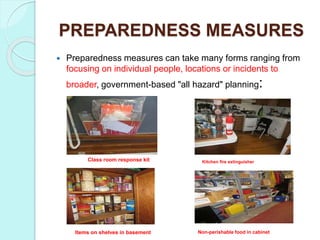
PREPAREDNESS MEASURES
 Preparedness measures can take many forms ranging from
focusing on individual people, locations or incidents to
broader, government-based "all hazard" planning:
Class room response kit Kitchen fire extinguisher
Items on shelves in basement Non-perishable food in cabinet
RELIEF ACTIVITIES:
 Relief activities include rescue, relocation, providing
food and water, preventing disease and disability
 Repairing vital services such as telecommunications
and transport, providing temporary shelter and
emergency health care.
DISASTER RECOVERY
 Recovery activities include rebuilding infrastructure,
health care and rehabilitation.
 Building human resources for health and developing
policies and practices to avoid similar situations in
DEVELOPMENT OF RESPONSE
SYSTEM
 Preparation of Special Response
Teams
 Incident Command System
 Standard Operating Procedure
 Trigger Mechanism
 Emergency Operation Centre
TECHNOLOGICAL DEVELOPMENTS
 Technological innovations are vital for effective
disaster management is taking several measure to
upgrade technological inputs.
 The important developments include:
Disaster Resource Network:
Development of GIS based Data base
Installation of Early Warning and Hazard
Detection Equipment
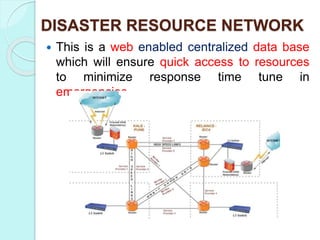
DISASTER RESOURCE NETWORK
 This is a web enabled centralized data base
which will ensure quick access to resources
to minimize response time tune in
emergencies
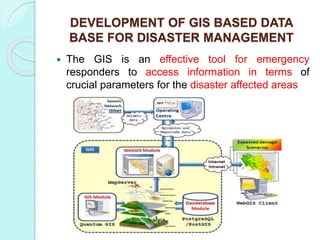
DEVELOPMENT OF GIS BASED DATA
BASE FOR DISASTER MANAGEMENT
 The GIS is an effective tool for emergency
responders to access information in terms of
crucial parameters for the disaster affected areas
INSTALLATION OF EARLY WARNING AND
HAZARD DETECTION EQUIPMENT
 Early warning systems have already been
installed for cyclones and floods in the country
 A well established organizational set up for
detecting, tackling and forecasting cyclones.
 Cyclone tracking is done with the help of
satellites.
 Cyclone detection radars are located at ten
centres indifferent coastal areas.
 Now acquiring and installing the Tsunami
HAZARD DETECTION EQUIPMENT
Earthquake detector
Cyclone detector
T-sunami warning system
CONCLUSION
 Disaster not attended properly it causes severe
damage
 Disaster management department should be
established
 Properly educate the people about the different forms
of disaster and creating awareness
 Disaster management team must be given proper
training and equipped with latest equipments,.
 Government should allocate sufficient funds
DiSaStEr MaNaGeMeNt

DiSaStEr MaNaGeMeNt

  • 1.
    ADVANCED DISASTER MANAGEMENT SYSTEMS PRESENTEDBY: MOHANAHARIHARAN .R Pre – Final year / Civil SAKTHI POLYTECHNIC COLLEGE SAKTHINAGAR – 638315
  • 2.
    INTRODUCTION  Disaster isa serious disruption of the functioning of a community or a society.  Disasters involve widespread human, material, economic or environmental impacts, which exceed the ability of the affected community or society to cope using its own resource
  • 3.
    TYPES OF DISASTERS Natural disasters Flood Earthquake Landslides T-sunami Fire Cyclone
  • 4.
    TYPES OF DISASTERS Man-made disaster: Nuclear disaster, chemical disaster and biological disaster  Industrial accidents  Attacking the critical places during war  Spread of Disaster Nuclear disaster Biological disaster
  • 5.
    WEAKNESS IN DISASTERMANAGEMENT SYSTEM  Inadequate Early Warning System  Lack of Pre-disaster Preparedness  Inadequate and Slow Relief  Lack of Co-ordination  Slow Rehabilitation and Reconstruction  Poor Management of Finances for Post-disaster Relief  Symbolism Rather than Relief  No Instruction for Pre-seismic Period
  • 6.
    DISASTER MANAGEMENT:  Itis the organization and management of resources and responsibilities  Response and recovery in order to lessen the impact of disasters.  Events covered by disaster management include acts of terrorism, industrial sabotage, fire, natural disasters such as earthquakes, hurricanes, etc., public disorder, industrial accidents, and communication failures.
  • 7.
  • 8.
    DISASTER MANAGEMENT PLANNING Recognition or identification of risks  Ranking or evaluation of risks  Responding to significant risks  Tolerate  Treat  Transfer  Terminate  Resourcing controls  Reaction Planning  Reporting & monitoring risk performance  Reviewing the Risk Management framework
  • 9.
    IMPLEMENTATION  An emergencyplan must be regularly maintained, in a structured and methodical manner, to ensure it is up-to-date in the event of an emergency  The following are the systematic approach ◦ Pre-incident training and testing ◦ Communicating and incident assessment ◦ Disaster prevention ◦ Mitigation ◦ Disaster preparedness ◦ Local Emergency Planning Committees ◦ Preparedness measures ◦ Relief activities ◦ Disaster recovery
  • 10.
    Pre-incident training andtesting  The identification of appropriately trained staff members responsible for decision-making when an emergency occurs  Testing of a plan's effectiveness should occur regularly
  • 11.
    COMMUNICATING AND INCIDENT ASSESSMENT Communication is one of the key issues during any emergency, pre-planning of communications is critical  Once an emergency has been identified a comprehensive assessment evaluating the level of impact and its financial implications should be undertaken
  • 12.
    DISASTER PREVENTION:  Activitiesdesigned to provide permanent protection from disasters  The risk of loss of life and injury can be mitigated with good evacuation plans, environmental planning and design standards MITIGATION:  Personal mitigation is a key to national preparedness. Individuals and families not to travel in train to avoid unnecessary risks.  Steps taken to minimize the effects of a disaster, or procure insurance to protect them against effects of a
  • 13.
    DISASTER PREPAREDNESS  Theseactivities are designed to minimize loss of life and damage  Preparedness is the main way of reducing the impact of disasters
  • 14.
    LOCAL EMERGENCY PLANNING COMMITTEES Identification of facilities and transportation – hazardous area  Emergency response procedures -on and off site  Outline of emergency notification procedures  To determine the probable affected area and population by releases  Local emergency equipment and facilities and the persons responsible  Outline of evacuation plans  A training program for emergency responders  Methods and schedules for exercising emergency response plans
  • 15.
    PREPAREDNESS MEASURES  Preparednessmeasures can take many forms ranging from focusing on individual people, locations or incidents to broader, government-based "all hazard" planning: Class room response kit Kitchen fire extinguisher Items on shelves in basement Non-perishable food in cabinet
  • 16.
    RELIEF ACTIVITIES:  Reliefactivities include rescue, relocation, providing food and water, preventing disease and disability  Repairing vital services such as telecommunications and transport, providing temporary shelter and emergency health care. DISASTER RECOVERY  Recovery activities include rebuilding infrastructure, health care and rehabilitation.  Building human resources for health and developing policies and practices to avoid similar situations in
  • 17.
    DEVELOPMENT OF RESPONSE SYSTEM Preparation of Special Response Teams  Incident Command System  Standard Operating Procedure  Trigger Mechanism  Emergency Operation Centre
  • 18.
    TECHNOLOGICAL DEVELOPMENTS  Technologicalinnovations are vital for effective disaster management is taking several measure to upgrade technological inputs.  The important developments include: Disaster Resource Network: Development of GIS based Data base Installation of Early Warning and Hazard Detection Equipment
  • 19.
    DISASTER RESOURCE NETWORK This is a web enabled centralized data base which will ensure quick access to resources to minimize response time tune in emergencies
  • 20.
    DEVELOPMENT OF GISBASED DATA BASE FOR DISASTER MANAGEMENT  The GIS is an effective tool for emergency responders to access information in terms of crucial parameters for the disaster affected areas
  • 21.
    INSTALLATION OF EARLYWARNING AND HAZARD DETECTION EQUIPMENT  Early warning systems have already been installed for cyclones and floods in the country  A well established organizational set up for detecting, tackling and forecasting cyclones.  Cyclone tracking is done with the help of satellites.  Cyclone detection radars are located at ten centres indifferent coastal areas.  Now acquiring and installing the Tsunami
  • 22.
    HAZARD DETECTION EQUIPMENT Earthquakedetector Cyclone detector T-sunami warning system
  • 23.
    CONCLUSION  Disaster notattended properly it causes severe damage  Disaster management department should be established  Properly educate the people about the different forms of disaster and creating awareness  Disaster management team must be given proper training and equipped with latest equipments,.  Government should allocate sufficient funds