Piter Biswas
piterbiswas11@gmail.com
“A disaster can bedefined asany occurrencethat cause
damage, ecological disruption, lossof human life,
deterioration of health and health serviceson ascale,
sufficient to warrant an extraordinary responsefrom
outsidetheaffected community or area”.
World Health Organization (WHO)
“A disaster can bedefined asan occurrenceeither nature
or manmadethat causeshuman suffering and creates
human needsthat victimscannot alleviatewithout
assistance”.
American Red Cross (ARC)
U
npredictability
Unfam
iliarity
Speed
U
rgency
Threat
Uncertainty
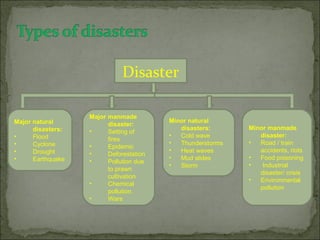
Disaster
Major natural
disasters:   
• Flood
• Cyclone
• Drought
• Earthquake
Major manmade
disaster: 
• Setting of 
fires
• Epidemic
• Deforestation
• Pollution due 
to prawn 
cultivation
• Chemical 
pollution.
• Wars
Minor natural
disasters: 
• Cold wave
• Thunderstorms
• Heat waves
• Mud slides
• Storm
Minor manmade
disaster:
• Road / train 
accidents, riots
• Food poisoning 
• Industrial 
disaster/ crisis
• Environmental 
pollution 
Risk:
Risk is a measure of the expected losses due to a
hazardous event . The level of risk depends on:
Nature of the Hazard
Vulnerability of the elements which are affected
Economic value of those elements
Vulnerability:
Predisposition of a community, structure, service,
and/or geographic area to damage on account of their
nature, construction and proximity to hazardous
terrain or a disaster prone area”
Hazards:
“Phenomena that pose a threat to people, structures,
or economic assets and which may cause a disaster.
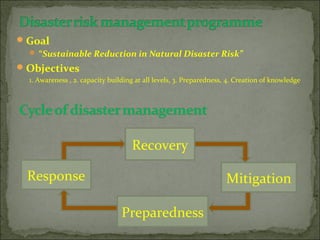
Goal
 “Sustainable Reduction in Natural Disaster Risk”
Objectives
1. Awareness , 2. capacity building at all levels, 3. Preparedness, 4. Creation of knowledge
Recovery
Mitigation
Preparedness
Response
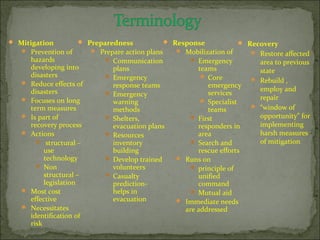
 Preparedness
 Prepare action plans
 Communication
plans
 Emergency
response teams
 Emergency
warning
methods
 Shelters,
evacuation plans
 Resources
inventory
building
 Develop trained
volunteers
 Casualty
prediction-
helps in
evacuation
 Response
 Mobilization of
 Emergency
teams
 Core
emergency
services
 Specialist
teams
 First
responders in
area
 Search and
rescue efforts
 Runs on
 principle of
unified
command
 Mutual aid
 Immediate needs
are addressed
 Recovery
 Restore affected
area to previous
state
 Rebuild ,
employ and
repair
 “window of
opportunity” for
implementing
harsh measures
of mitigation
 Mitigation
 Prevention of
hazards
developing into
disasters
 Reduce effects of
disasters
 Focuses on long
term measures
 Is part of
recovery process
 Actions
 structural –
use
technology
 Non
structural –
legislation
 Most cost
effective
 Necessitates
identification of
risk
Armed Forces-Ministry of Defence
Central Para Military Forces- Ministry of
Home Affairs
International Response- Ministry of External
Affairs
Ministries/Departments:
 Rural Development, Drinking Water Supply
 Power, Telecom , Health, Urban Development
 Food & Public Distribution, Shipping
 Surface Transport, Railways, Civil Aviation
 Women & Child Development
 Water Resources, Animal Husbandry
 India Meteorological Department(IMD)
Moving away from the Great Bengal famine of 1769-
1770 in which a third of the population perished.
The Chalisa famine of 1783, the Doji Bara or Skull
famine of 1790 to 1792, the North West Provinces
famine of 1838, the North West India Famine of 1861,
the Bengal and Orissa famine of 1866, the Rajputana
famine of 1869, the famine of 1899 to 1901, the Bengal
famine of 1943…
The drought years of 1965, 1972, 1979, 1987, 2002
57% land is vulnerable to earthquakes. Of these,
12% is vulnerable to severe earthquakes.
68% land is vulnerable to drought.
12% land is vulnerable to floods.
8% land is vulnerable to cyclones.
Apart from natural disasters, some cities in India
are also vulnerable to chemical and industrial
disasters and man-made disasters.
 Activating an Early Warning System network and its close monitoring.
 Mechanisms for integrating the scientific, technological and administrative agencies for
effective disaster management.
 Terrestrial communication links which collapse in the event of a rapid onset disaster.
 Vulnerability of critical infrastructures (power supply, communication, water supply,
transport, etc.) to disaster events.
 Funding : Primacy of relief as disaster response.
 Preparedness and Mitigation very often ignored.
 Lack of integrated efforts to collect and compile data, information and local knowledge on
disaster history and traditional response patterns.
 Need for standardised efforts in compiling and interpreting geo-spatial data, satellite imagery
and early warning signals.
 Weak areas continue to be forecasting, modelling, risk prediction, simulation and scenario
analysis, etc.
 Absence of a national level, state level, and district level directory of experts and inventory of
resources.
 Absence of a National Disaster Management Plan, and State level and district level disaster
management plans.
 Sustainability of efforts.
 Effective Inter Agency Co-ordination and Standard Operating Procedures for stakeholder
groups, especially critical first responder agencies.
 Emergency medicine, critical care medicine, triage, first aid.
 Floods : Ministry of Water Resources, CWC
 Cyclones : Indian Meteorological Department
 Earthquakes : Indian Meteorological Department
 Epidemics : Ministry of Health and Family Welfare
 Avian Flu: Ministry of Health, Ministry of Environment,
Ministry of Agriculture and Animal Husbandry
 Chemical Disasters : Ministry of Environment and Forests
 Industrial Disasters : Ministry of Labour
 Rail Accidents : Ministry of Railways
 Air Accidents : Ministry of Civil Aviation
 Fire : Ministry of Home Affairs
 Nuclear Incidents : Department of Atomic Energy
 Mine Disasters : Department of Mines
There is a high probability of a low probability
event happening somewhere sometime soon…
The unpredictability of disaster events and the
high risk and vulnerability profiles make it
imperative to strengthen disaster preparedness,
mitigation and enforcement of guidelines,
building codes and restrictions on construction of
buildings in flood-prone areas and storm surge
prone coastal areas.
The National Disaster Management Authority (NDMA)
has been set up as the apex body for Disaster Management
in India, with the Prime Minister as its Chairman.
Disaster Management Authorities will be set up at the
State and District Levels to be headed by the Chief
Ministers and Collectors/Zilla Parishad Chairmen
respectively.
A National Disaster Mitigation Fund will be administerd
by NDMA. States and districts will administer mitigation
funds.
A National Disaster Response Fund will be administerd by
NDMA through the National Executive Committee. States
and Districts will administer state Disaster Response Fund
and Disaster Response Fund respectively.
8 Battalions of National Disaster Response Force (NDRF)
are being trained and deployed with CSSR and MFR
equipments and tools in eight strategic locations.
A National Disaster Management Policy and National
Be Prepared : Preparedness and Mitigation is bound to
yield more effective returns than distributing relief after
a disaster.
Create a Culture of Preparedness and Prevention.
Evolve a code of conduct for all stake-holders
 Encourage and consolidate knowledge networks.
 Mobilise and train disaster volunteers for more effective preparedness,
mitigation and response (NSS, NCC, Scouts and Guides, NYK, Civil
Defence, Homeguards).
 Increased capacity building leads to faster vulnerability reduction.
 Learn from best practices in disaster preparedness, mitigation and disaster
response.
 Mobilising stakeholder participation of Self Help Groups, Women’s
Groups, Youth Groups, Panchayati Raj Institutions.
 Anticipatory Governance: Simulation exercises, Mock drills and Scenario
Analysis.
 Indigenous knowledge systems and coping practices.
 Living with Risk: Community Based Disaster Risk Management.
 Inclusive, participatory, gender sensitive, child friendly, eco-friendly and
disabled friendly disaster management.
 Technology driven but people owned.
 Knowledge Management: Documentation and dissemination of good
practices.
 Public Private Partnership.
Investments in Preparedness and Prevention (Mitigation)
will yield sustainable results, rather than spending money
on relief after a disaster.
Most disasters are predictable, especially in their
seasonality and the disaster-prone areas which are
vulnerable.
Communities must be involved in disaster preparedness.
On 12 November, 1970 a major cyclone hit the coastal
belt of Bangladesh at 223 km/hr. with a storm surge of
six to nine meters height, killing an estimated 500,000
people.
Due to the Cyclone Preparedness Program, the April
1991 cyclone with wind speed of 225 km/hr. killed only
138,000 people even though the coastal population
had doubled by that time.
In May 1994, in a similar cyclone with a wind speed of
250 km/hr. only 127 people lost their lives.
In May 1997, in a cyclone with wind speed of 200
km/hr. only 111 people lost their lives.
National Urban Renewal Mission for 70 cities:
recent experience of “unprecedented” extreme
weather conditions in a few major metros and
megacities
100,000 Rural Knowledge Centres
( IT Kiosks): Need for Spatial e-Governance for
informed decision making in disaster-prone areas:
before, during and after disasters
Academic
& Research
Institutions
NATMO
NDMA
NSDI
Spatial Information
Electronic Clearing HouseFSI
NRSA
NIC
URBAN
BODIESBSI
NRDMS
NNRMS
GSI
PSUs
GoI
Ministries
CGWB
NBSSLUP
Census
of India
IMD
CPCB
Private Sector
CWC ISRO
Dept. of SpaceSOI
Knowledge Networking
BMTPC
NGOsPRIs
1. It is possible to reduce loss of life and property
through preparedness.
2. Preparedness is necessary at every level –
national, provincial, local and community.
3. Preparedness is necessary in every sector.
4. Pre-Disaster Recovery Planning to ensure better
coordination among various sectors in different
levels.
5. Such planning needs to be formalized in the
shape of manuals and Standard Operating
Procedures so that there is no confusion during
and after disasters.
1. Holistic - cover housing, infrastructure, education,
livelihood, health, psycho-social care etc.
2. Long term - provide livelihood support including
development of skill, provisioning of credit and
marketing support etc
3. ‘Build back better’ - ensure that the houses and
infrastructure constructed after disasters withstand the
hazards and risks of nature and the hazards do not
become disasters again
4. Sustainable - integrate environmental issues, such
regeneration of mangroves, conservation of water,
5. Inclusive -care for poor and vulnerable - women,
children, aged, physically and mentally challenged people
Recovery
Pre- Disaster Recovery Planning
Sort Term
(0 -30 days)
Intermediate
(1 to 6 months)
Long Term
(6 m to 3 years)
• Search and rescue
• Emergency health
• Temporary shelter
• Food, clothes
• Damage assessment
• Restoration of critical
infrastructure (power,
telephone, drinking
water etc)
• Intermediate shelter
• Health Care
• Continuation of support
for food, clothes etc
• Psycho-social care
• School and day care
• Preparation of
long term recovery plan
• Arranging resources
• Permanent housing
• Livelihood support
• Restoration of physical
Infrastructure
• Restoration of
social infrastructure
• Psycho-social recovery
• Documentation
• Memorials
Disaster management

Disaster management

  • 1.
  • 3.
    “A disaster canbedefined asany occurrencethat cause damage, ecological disruption, lossof human life, deterioration of health and health serviceson ascale, sufficient to warrant an extraordinary responsefrom outsidetheaffected community or area”. World Health Organization (WHO) “A disaster can bedefined asan occurrenceeither nature or manmadethat causeshuman suffering and creates human needsthat victimscannot alleviatewithout assistance”. American Red Cross (ARC)
  • 5.
  • 6.
    Disaster Major natural disasters:    • Flood •Cyclone • Drought • Earthquake Major manmade disaster:  • Setting of  fires • Epidemic • Deforestation • Pollution due  to prawn  cultivation • Chemical  pollution. • Wars Minor natural disasters:  • Cold wave • Thunderstorms • Heat waves • Mud slides • Storm Minor manmade disaster: • Road / train  accidents, riots • Food poisoning  • Industrial  disaster/ crisis • Environmental  pollution 
  • 7.
    Risk: Risk is ameasure of the expected losses due to a hazardous event . The level of risk depends on: Nature of the Hazard Vulnerability of the elements which are affected Economic value of those elements Vulnerability: Predisposition of a community, structure, service, and/or geographic area to damage on account of their nature, construction and proximity to hazardous terrain or a disaster prone area” Hazards: “Phenomena that pose a threat to people, structures, or economic assets and which may cause a disaster.
  • 10.
    Goal  “Sustainable Reductionin Natural Disaster Risk” Objectives 1. Awareness , 2. capacity building at all levels, 3. Preparedness, 4. Creation of knowledge Recovery Mitigation Preparedness Response
  • 11.
     Preparedness  Prepareaction plans  Communication plans  Emergency response teams  Emergency warning methods  Shelters, evacuation plans  Resources inventory building  Develop trained volunteers  Casualty prediction- helps in evacuation  Response  Mobilization of  Emergency teams  Core emergency services  Specialist teams  First responders in area  Search and rescue efforts  Runs on  principle of unified command  Mutual aid  Immediate needs are addressed  Recovery  Restore affected area to previous state  Rebuild , employ and repair  “window of opportunity” for implementing harsh measures of mitigation  Mitigation  Prevention of hazards developing into disasters  Reduce effects of disasters  Focuses on long term measures  Is part of recovery process  Actions  structural – use technology  Non structural – legislation  Most cost effective  Necessitates identification of risk
  • 12.
    Armed Forces-Ministry ofDefence Central Para Military Forces- Ministry of Home Affairs International Response- Ministry of External Affairs Ministries/Departments:  Rural Development, Drinking Water Supply  Power, Telecom , Health, Urban Development  Food & Public Distribution, Shipping  Surface Transport, Railways, Civil Aviation  Women & Child Development  Water Resources, Animal Husbandry  India Meteorological Department(IMD)
  • 14.
    Moving away fromthe Great Bengal famine of 1769- 1770 in which a third of the population perished. The Chalisa famine of 1783, the Doji Bara or Skull famine of 1790 to 1792, the North West Provinces famine of 1838, the North West India Famine of 1861, the Bengal and Orissa famine of 1866, the Rajputana famine of 1869, the famine of 1899 to 1901, the Bengal famine of 1943… The drought years of 1965, 1972, 1979, 1987, 2002
  • 15.
    57% land isvulnerable to earthquakes. Of these, 12% is vulnerable to severe earthquakes. 68% land is vulnerable to drought. 12% land is vulnerable to floods. 8% land is vulnerable to cyclones. Apart from natural disasters, some cities in India are also vulnerable to chemical and industrial disasters and man-made disasters.
  • 21.
     Activating anEarly Warning System network and its close monitoring.  Mechanisms for integrating the scientific, technological and administrative agencies for effective disaster management.  Terrestrial communication links which collapse in the event of a rapid onset disaster.  Vulnerability of critical infrastructures (power supply, communication, water supply, transport, etc.) to disaster events.  Funding : Primacy of relief as disaster response.  Preparedness and Mitigation very often ignored.  Lack of integrated efforts to collect and compile data, information and local knowledge on disaster history and traditional response patterns.  Need for standardised efforts in compiling and interpreting geo-spatial data, satellite imagery and early warning signals.  Weak areas continue to be forecasting, modelling, risk prediction, simulation and scenario analysis, etc.  Absence of a national level, state level, and district level directory of experts and inventory of resources.  Absence of a National Disaster Management Plan, and State level and district level disaster management plans.  Sustainability of efforts.  Effective Inter Agency Co-ordination and Standard Operating Procedures for stakeholder groups, especially critical first responder agencies.  Emergency medicine, critical care medicine, triage, first aid.
  • 22.
     Floods :Ministry of Water Resources, CWC  Cyclones : Indian Meteorological Department  Earthquakes : Indian Meteorological Department  Epidemics : Ministry of Health and Family Welfare  Avian Flu: Ministry of Health, Ministry of Environment, Ministry of Agriculture and Animal Husbandry  Chemical Disasters : Ministry of Environment and Forests  Industrial Disasters : Ministry of Labour  Rail Accidents : Ministry of Railways  Air Accidents : Ministry of Civil Aviation  Fire : Ministry of Home Affairs  Nuclear Incidents : Department of Atomic Energy  Mine Disasters : Department of Mines
  • 23.
    There is ahigh probability of a low probability event happening somewhere sometime soon… The unpredictability of disaster events and the high risk and vulnerability profiles make it imperative to strengthen disaster preparedness, mitigation and enforcement of guidelines, building codes and restrictions on construction of buildings in flood-prone areas and storm surge prone coastal areas.
  • 24.
    The National DisasterManagement Authority (NDMA) has been set up as the apex body for Disaster Management in India, with the Prime Minister as its Chairman. Disaster Management Authorities will be set up at the State and District Levels to be headed by the Chief Ministers and Collectors/Zilla Parishad Chairmen respectively. A National Disaster Mitigation Fund will be administerd by NDMA. States and districts will administer mitigation funds. A National Disaster Response Fund will be administerd by NDMA through the National Executive Committee. States and Districts will administer state Disaster Response Fund and Disaster Response Fund respectively. 8 Battalions of National Disaster Response Force (NDRF) are being trained and deployed with CSSR and MFR equipments and tools in eight strategic locations. A National Disaster Management Policy and National
  • 25.
    Be Prepared :Preparedness and Mitigation is bound to yield more effective returns than distributing relief after a disaster. Create a Culture of Preparedness and Prevention. Evolve a code of conduct for all stake-holders
  • 26.
     Encourage andconsolidate knowledge networks.  Mobilise and train disaster volunteers for more effective preparedness, mitigation and response (NSS, NCC, Scouts and Guides, NYK, Civil Defence, Homeguards).  Increased capacity building leads to faster vulnerability reduction.  Learn from best practices in disaster preparedness, mitigation and disaster response.  Mobilising stakeholder participation of Self Help Groups, Women’s Groups, Youth Groups, Panchayati Raj Institutions.  Anticipatory Governance: Simulation exercises, Mock drills and Scenario Analysis.  Indigenous knowledge systems and coping practices.  Living with Risk: Community Based Disaster Risk Management.  Inclusive, participatory, gender sensitive, child friendly, eco-friendly and disabled friendly disaster management.  Technology driven but people owned.  Knowledge Management: Documentation and dissemination of good practices.  Public Private Partnership.
  • 27.
    Investments in Preparednessand Prevention (Mitigation) will yield sustainable results, rather than spending money on relief after a disaster. Most disasters are predictable, especially in their seasonality and the disaster-prone areas which are vulnerable. Communities must be involved in disaster preparedness.
  • 28.
    On 12 November,1970 a major cyclone hit the coastal belt of Bangladesh at 223 km/hr. with a storm surge of six to nine meters height, killing an estimated 500,000 people. Due to the Cyclone Preparedness Program, the April 1991 cyclone with wind speed of 225 km/hr. killed only 138,000 people even though the coastal population had doubled by that time. In May 1994, in a similar cyclone with a wind speed of 250 km/hr. only 127 people lost their lives. In May 1997, in a cyclone with wind speed of 200 km/hr. only 111 people lost their lives.
  • 29.
    National Urban RenewalMission for 70 cities: recent experience of “unprecedented” extreme weather conditions in a few major metros and megacities 100,000 Rural Knowledge Centres ( IT Kiosks): Need for Spatial e-Governance for informed decision making in disaster-prone areas: before, during and after disasters
  • 30.
    Academic & Research Institutions NATMO NDMA NSDI Spatial Information ElectronicClearing HouseFSI NRSA NIC URBAN BODIESBSI NRDMS NNRMS GSI PSUs GoI Ministries CGWB NBSSLUP Census of India IMD CPCB Private Sector CWC ISRO Dept. of SpaceSOI Knowledge Networking BMTPC NGOsPRIs
  • 31.
    1. It ispossible to reduce loss of life and property through preparedness. 2. Preparedness is necessary at every level – national, provincial, local and community. 3. Preparedness is necessary in every sector. 4. Pre-Disaster Recovery Planning to ensure better coordination among various sectors in different levels. 5. Such planning needs to be formalized in the shape of manuals and Standard Operating Procedures so that there is no confusion during and after disasters.
  • 32.
    1. Holistic -cover housing, infrastructure, education, livelihood, health, psycho-social care etc. 2. Long term - provide livelihood support including development of skill, provisioning of credit and marketing support etc 3. ‘Build back better’ - ensure that the houses and infrastructure constructed after disasters withstand the hazards and risks of nature and the hazards do not become disasters again 4. Sustainable - integrate environmental issues, such regeneration of mangroves, conservation of water, 5. Inclusive -care for poor and vulnerable - women, children, aged, physically and mentally challenged people
  • 33.
    Recovery Pre- Disaster RecoveryPlanning Sort Term (0 -30 days) Intermediate (1 to 6 months) Long Term (6 m to 3 years) • Search and rescue • Emergency health • Temporary shelter • Food, clothes • Damage assessment • Restoration of critical infrastructure (power, telephone, drinking water etc) • Intermediate shelter • Health Care • Continuation of support for food, clothes etc • Psycho-social care • School and day care • Preparation of long term recovery plan • Arranging resources • Permanent housing • Livelihood support • Restoration of physical Infrastructure • Restoration of social infrastructure • Psycho-social recovery • Documentation • Memorials