Content 
 What Is Algebra ? 
 Why Algebra is important in your life ? 
 History of Algebra
What is Algebra ? 
 Algebra is one of the broad parts 
of mathematics, together 
with number theory , 
geometry and analysis. 
 As such, it includes everything from 
elementary equation solving to the 
study of abstractions such 
as groups, rings, and fields. 
 Elementary algebra is essential for 
any study of mathematics, science, or 
engineering, as well as such 
applications as medicine and 
economics.
 The more basic parts of algebra are 
called elementary algebra, the more 
abstract parts are called abstract algebra or 
modern algebra. 
 Much early work in algebra, as the origin 
of its name suggests, was done in the Near 
East, by such mathematicians as Omar 
Khayyam (1050-1123).
 The word algebra is also used in certain specialized 
ways. A special kind of mathematical object in 
abstract algebra is called an "algebra", and the word 
is used, for example, in the phrases linear 
algebra and algebraic topology . 
 A mathematician who does research in algebra is 
called an algebraist.
Why Algebra is important in your 
life ? 
 Mathematics is one of the first things you 
learn in life. Even as a baby you learn to 
count. Starting from that tiny age you will 
start to learn how to use building blocks 
how to count and then move on to drawing 
objects and figures. All of these things are 
important preparation to doing algebra.
The key to opportunity 
 These are the years of small beginnings 
until the day comes that you have to be 
able to do something as intricate as 
algebra. Algebra is the key that will 
unlock the door before you. Having the 
ability to do algebra will help you excel 
into the field that you want to specialize 
in. We live in a world where only the best 
succeed.
Prerequisite for advanced 
training 
 Most employers expect their employees to be 
able to do the fundamentals of algebra. If 
you want to do any advanced training you 
will have to be able to be fluent in the 
concept of letters and symbols used to 
represent quantities.
Science 
 When doing any form of science, whether just a 
project or a lifetime career choice, you will have 
to be able to do and understand how to use and 
apply algebra.
Every day life 
 Formulas are a part of our lives. Whether 
we drive a car and need to calculate the 
distance, or need to work out the volume in 
a milk container, algebraic formulas are 
used everyday without you even realizing it.
Data entry 
 What about the entering of any 
data. Your use of algebraic 
expressions and the use of 
equations will be like a corner 
stone when working with data 
entry. When working on the 
computer with spreadsheets you 
will need algebraic skills to 
enter, design and plan.
Interest Rates 
 How much can you earn on 
an annual basis with the 
correct interest rate. How 
will you know which 
company gives the best if you 
can't work out the graphs 
and understand the 
percentages. In today's life a 
good investment is 
imperative.
Algebra in day-to-day life 
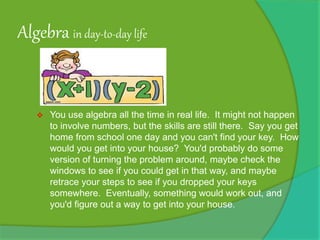
 You use algebra all the time in real life. It might not happen 
to involve numbers, but the skills are still there. Say you get 
home from school one day and you can't find your key. How 
would you get into your house? You'd probably do some 
version of turning the problem around, maybe check the 
windows to see if you could get in that way, and maybe 
retrace your steps to see if you dropped your keys 
somewhere. Eventually, something would work out, and 
you'd figure out a way to get into your house.
Uses of algebra 
 Most of us use algebra every day - simple problems that 
we "do in our heads". For instance, say you have $20 
and you go to the store. The store is having a "buy one 
and get one at half price" sale. How do you figure out 
what you can buy? There's an equation for that. Or, "how 
tall is that building?" If you know how far away it is, and 
the height of any one thing you have at hand, there's an 
equation for that.
 Like when we are playing games also 
we use algebra. Pointing from where to 
start and where to end.
Egyptian Algebra 
 Earliest finding from the Rhind Papyrus – 
written approx. 1650 B.C. 
 Solve algebra problems equivalent to linear 
equations and 1 unknown 
 Algebra was rhetorical – use of no symbols 
 Problems were stated and solved verbally 
 Cairo Papyrus (300 B.C.) – solve systems of 
2 degree equations
Babylonian Algebra 
 Babylonians were more advanced than 
Egyptians 
 Like Egyptians, algebra was also rhetorical 
 Could solve quadratic equations 
 Method of solving problems was rhetorical, 
taught through examples 
 No explanations to findings were given 
 Recognized on positive rational numbers
Greek Algebra 
 The Greeks originally learned algebra from 
Egypt as indicated in their writings of the 
6th century BCE. Later they learned 
Mesopotamian geometric algebra from the 
Persians. They studied number theory, 
beginning with Pythagoras (ca 500 BCE), 
continuing with Euclid (ca 300 BCE) and 
Nicomachus (ca 100 CE). The culmination 
of Greek algebra is the work of Diophantus 
in the 3rd century CE.
Syncopated Algebra 
 200 CE-1500 CE 
 Started with Diophantus who used 
syncopated algebra in his Arithmetica (250 
CE) and lasted until 17th Century BCE. 
 However, in most parts of the world other 
than Greece and India, rhetorical algebra 
persisted for a longer period (in W. Europe 
until 15th Century CE).
Aryabhata & Brahmagupta 
 1st century CE from India 
 Developed a syncopated algebra 
 Ya stood for the main unknown and their words 
for colors stood for other unknowns
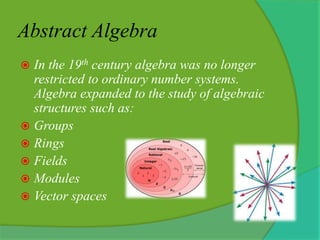
Abstract Algebra 
 In the 19th century algebra was no longer 
restricted to ordinary number systems. 
Algebra expanded to the study of algebraic 
structures such as: 
 Groups 
 Rings 
 Fields 
 Modules 
 Vector spaces
The permutations of Rubik’s Cube have a group 
structure; the group is a fundamental concept 
within abstract algebra.
 19th century 
 British mathematicians explored 
vectors, matrices, transformations, etc. 
 Galois (French, 1811-1832) 
 Developed the concept of a group (set of operations with 
a single operation which satisfies three axioms) 
 Cayley (British, 1821-1895) 
 Developed the algebra of matrices 
 Gibbs (American, 1839-1903) 
 Developed vectors in three 
dimensional space
Abhinav S. , Vaibhav S. , Saksham, 
Nishit .

Application of algebra

  • 2.
    Content  WhatIs Algebra ?  Why Algebra is important in your life ?  History of Algebra
  • 3.
    What is Algebra?  Algebra is one of the broad parts of mathematics, together with number theory , geometry and analysis.  As such, it includes everything from elementary equation solving to the study of abstractions such as groups, rings, and fields.  Elementary algebra is essential for any study of mathematics, science, or engineering, as well as such applications as medicine and economics.
  • 4.
     The morebasic parts of algebra are called elementary algebra, the more abstract parts are called abstract algebra or modern algebra.  Much early work in algebra, as the origin of its name suggests, was done in the Near East, by such mathematicians as Omar Khayyam (1050-1123).
  • 5.
     The wordalgebra is also used in certain specialized ways. A special kind of mathematical object in abstract algebra is called an "algebra", and the word is used, for example, in the phrases linear algebra and algebraic topology .  A mathematician who does research in algebra is called an algebraist.
  • 6.
    Why Algebra isimportant in your life ?  Mathematics is one of the first things you learn in life. Even as a baby you learn to count. Starting from that tiny age you will start to learn how to use building blocks how to count and then move on to drawing objects and figures. All of these things are important preparation to doing algebra.
  • 7.
    The key toopportunity  These are the years of small beginnings until the day comes that you have to be able to do something as intricate as algebra. Algebra is the key that will unlock the door before you. Having the ability to do algebra will help you excel into the field that you want to specialize in. We live in a world where only the best succeed.
  • 8.
    Prerequisite for advanced training  Most employers expect their employees to be able to do the fundamentals of algebra. If you want to do any advanced training you will have to be able to be fluent in the concept of letters and symbols used to represent quantities.
  • 9.
    Science  Whendoing any form of science, whether just a project or a lifetime career choice, you will have to be able to do and understand how to use and apply algebra.
  • 10.
    Every day life  Formulas are a part of our lives. Whether we drive a car and need to calculate the distance, or need to work out the volume in a milk container, algebraic formulas are used everyday without you even realizing it.
  • 11.
    Data entry What about the entering of any data. Your use of algebraic expressions and the use of equations will be like a corner stone when working with data entry. When working on the computer with spreadsheets you will need algebraic skills to enter, design and plan.
  • 12.
    Interest Rates How much can you earn on an annual basis with the correct interest rate. How will you know which company gives the best if you can't work out the graphs and understand the percentages. In today's life a good investment is imperative.
  • 13.
    Algebra in day-to-daylife  You use algebra all the time in real life. It might not happen to involve numbers, but the skills are still there. Say you get home from school one day and you can't find your key. How would you get into your house? You'd probably do some version of turning the problem around, maybe check the windows to see if you could get in that way, and maybe retrace your steps to see if you dropped your keys somewhere. Eventually, something would work out, and you'd figure out a way to get into your house.
  • 14.
    Uses of algebra  Most of us use algebra every day - simple problems that we "do in our heads". For instance, say you have $20 and you go to the store. The store is having a "buy one and get one at half price" sale. How do you figure out what you can buy? There's an equation for that. Or, "how tall is that building?" If you know how far away it is, and the height of any one thing you have at hand, there's an equation for that.
  • 15.
     Like whenwe are playing games also we use algebra. Pointing from where to start and where to end.
  • 17.
    Egyptian Algebra Earliest finding from the Rhind Papyrus – written approx. 1650 B.C.  Solve algebra problems equivalent to linear equations and 1 unknown  Algebra was rhetorical – use of no symbols  Problems were stated and solved verbally  Cairo Papyrus (300 B.C.) – solve systems of 2 degree equations
  • 18.
    Babylonian Algebra Babylonians were more advanced than Egyptians  Like Egyptians, algebra was also rhetorical  Could solve quadratic equations  Method of solving problems was rhetorical, taught through examples  No explanations to findings were given  Recognized on positive rational numbers
  • 19.
    Greek Algebra The Greeks originally learned algebra from Egypt as indicated in their writings of the 6th century BCE. Later they learned Mesopotamian geometric algebra from the Persians. They studied number theory, beginning with Pythagoras (ca 500 BCE), continuing with Euclid (ca 300 BCE) and Nicomachus (ca 100 CE). The culmination of Greek algebra is the work of Diophantus in the 3rd century CE.
  • 20.
    Syncopated Algebra 200 CE-1500 CE  Started with Diophantus who used syncopated algebra in his Arithmetica (250 CE) and lasted until 17th Century BCE.  However, in most parts of the world other than Greece and India, rhetorical algebra persisted for a longer period (in W. Europe until 15th Century CE).
  • 21.
    Aryabhata & Brahmagupta  1st century CE from India  Developed a syncopated algebra  Ya stood for the main unknown and their words for colors stood for other unknowns
  • 22.
    Abstract Algebra In the 19th century algebra was no longer restricted to ordinary number systems. Algebra expanded to the study of algebraic structures such as:  Groups  Rings  Fields  Modules  Vector spaces
  • 23.
    The permutations ofRubik’s Cube have a group structure; the group is a fundamental concept within abstract algebra.
  • 24.
     19th century  British mathematicians explored vectors, matrices, transformations, etc.  Galois (French, 1811-1832)  Developed the concept of a group (set of operations with a single operation which satisfies three axioms)  Cayley (British, 1821-1895)  Developed the algebra of matrices  Gibbs (American, 1839-1903)  Developed vectors in three dimensional space
  • 25.
    Abhinav S. ,Vaibhav S. , Saksham, Nishit .