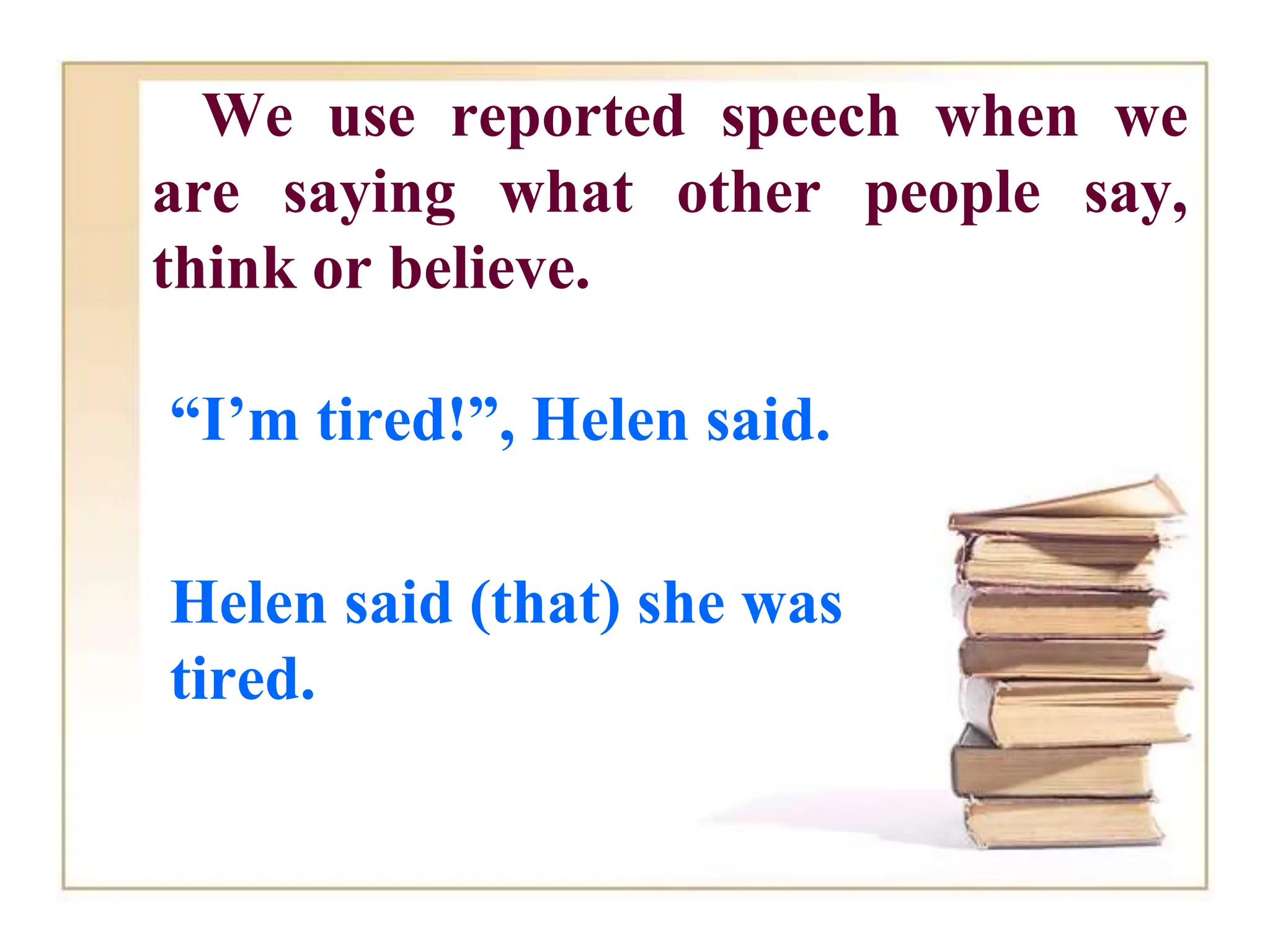
We use reported speech when we
are saying what other people say,
think or believe.
“I’m tired!”, Helen said.
Helen said (that) she was
tired.
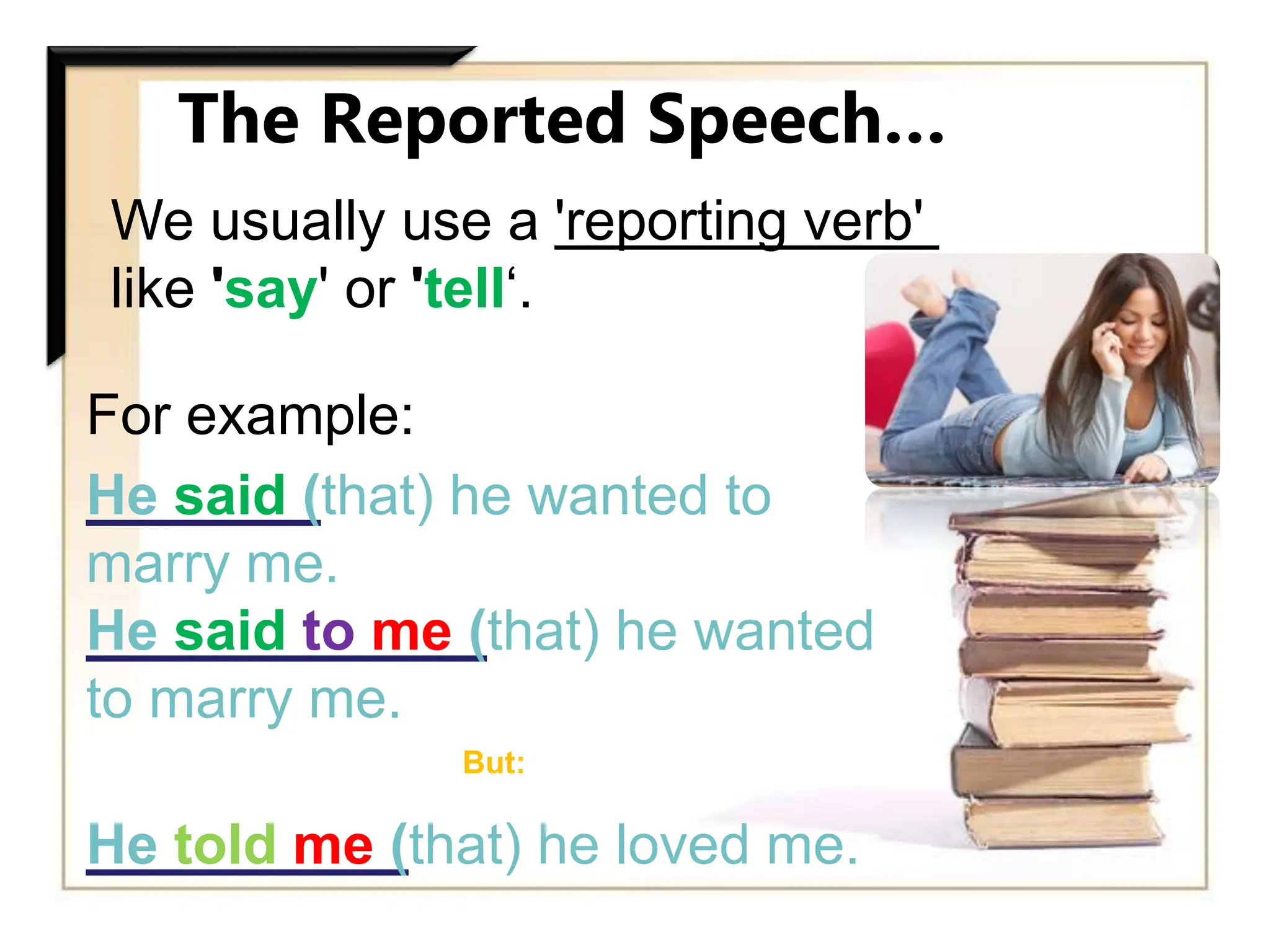
We usually use a 'reporting verb'
like 'say' or 'tell‘.
The Reported Speech…
For example:
He said (that) he wanted to
marry me.
He said to me (that) he wanted
to marry me.
But:
He told me (that) he loved me.
Reporting Verbs… Say & Tell
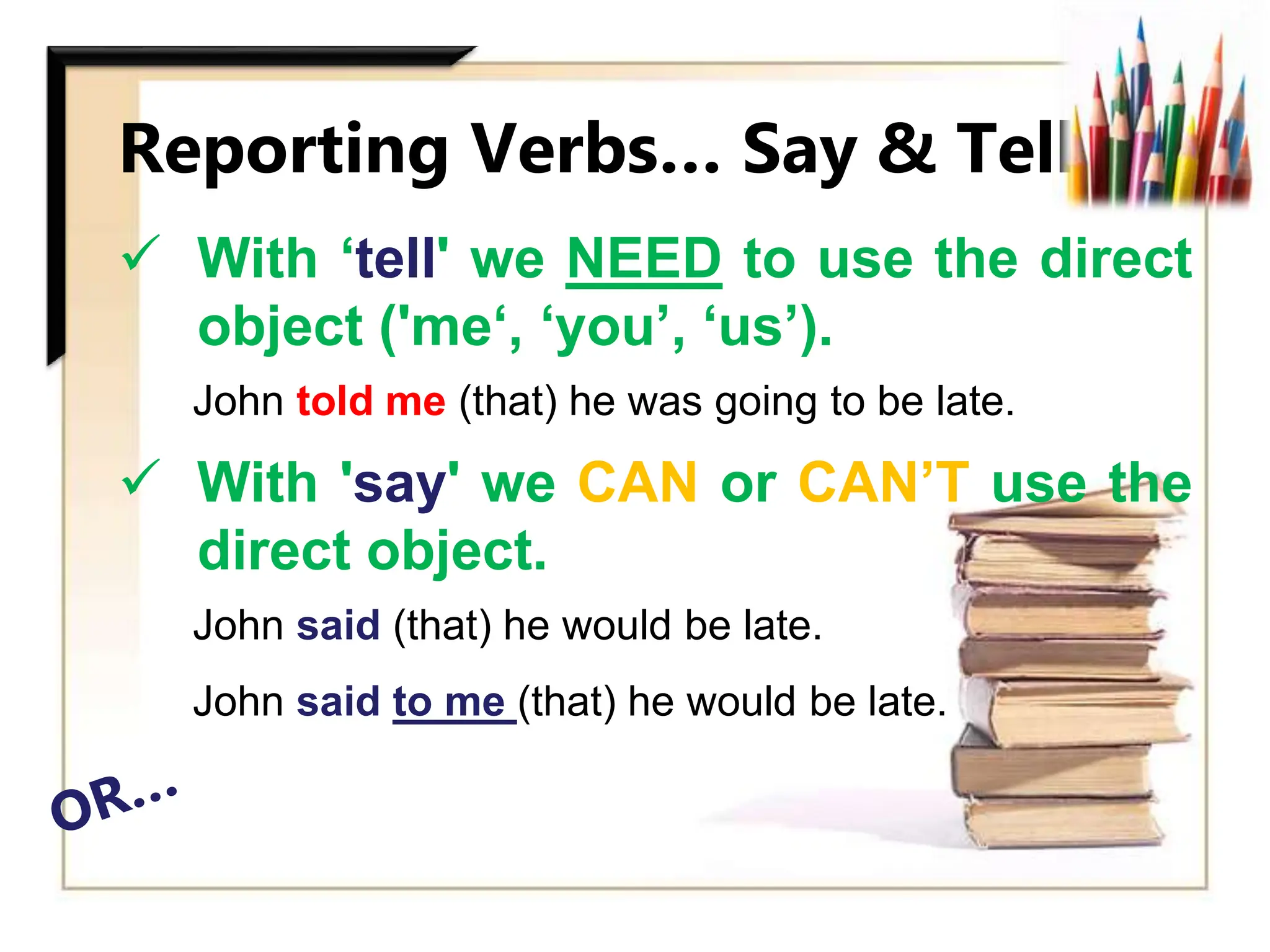
 With ‘tell' we NEED to use the direct
object ('me‘, ‘you’, ‘us’).
John told me (that) he was going to be late.
 With 'say' we CAN or CAN’T use the
direct object.
John said (that) he would be late.
John said to me (that) he would be late.
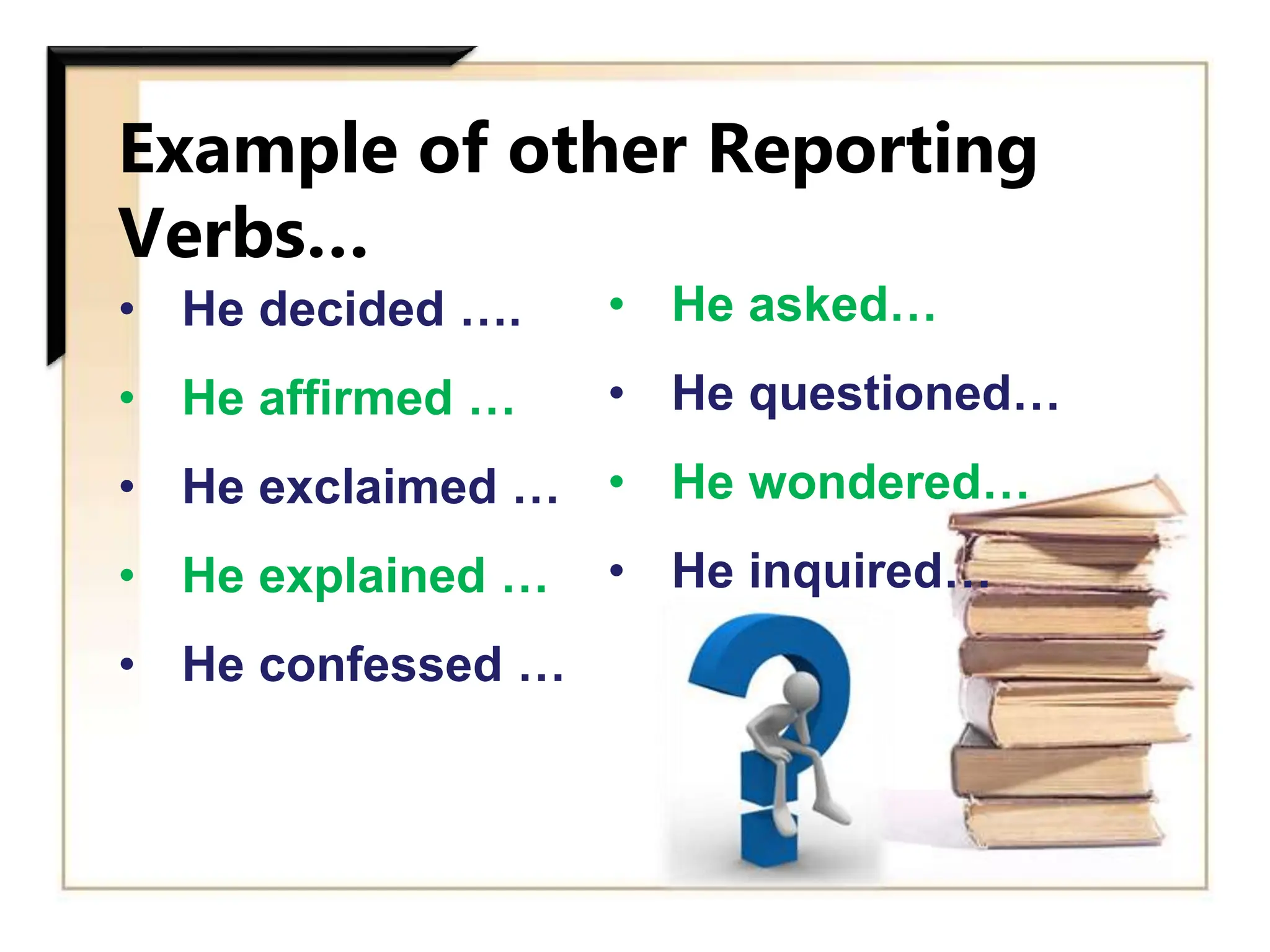
Example of other Reporting
Verbs…
• He decided ….
• He affirmed …
• He exclaimed …
• He explained …
• He confessed …
• He asked…
• He questioned…
• He wondered…
• He inquired…
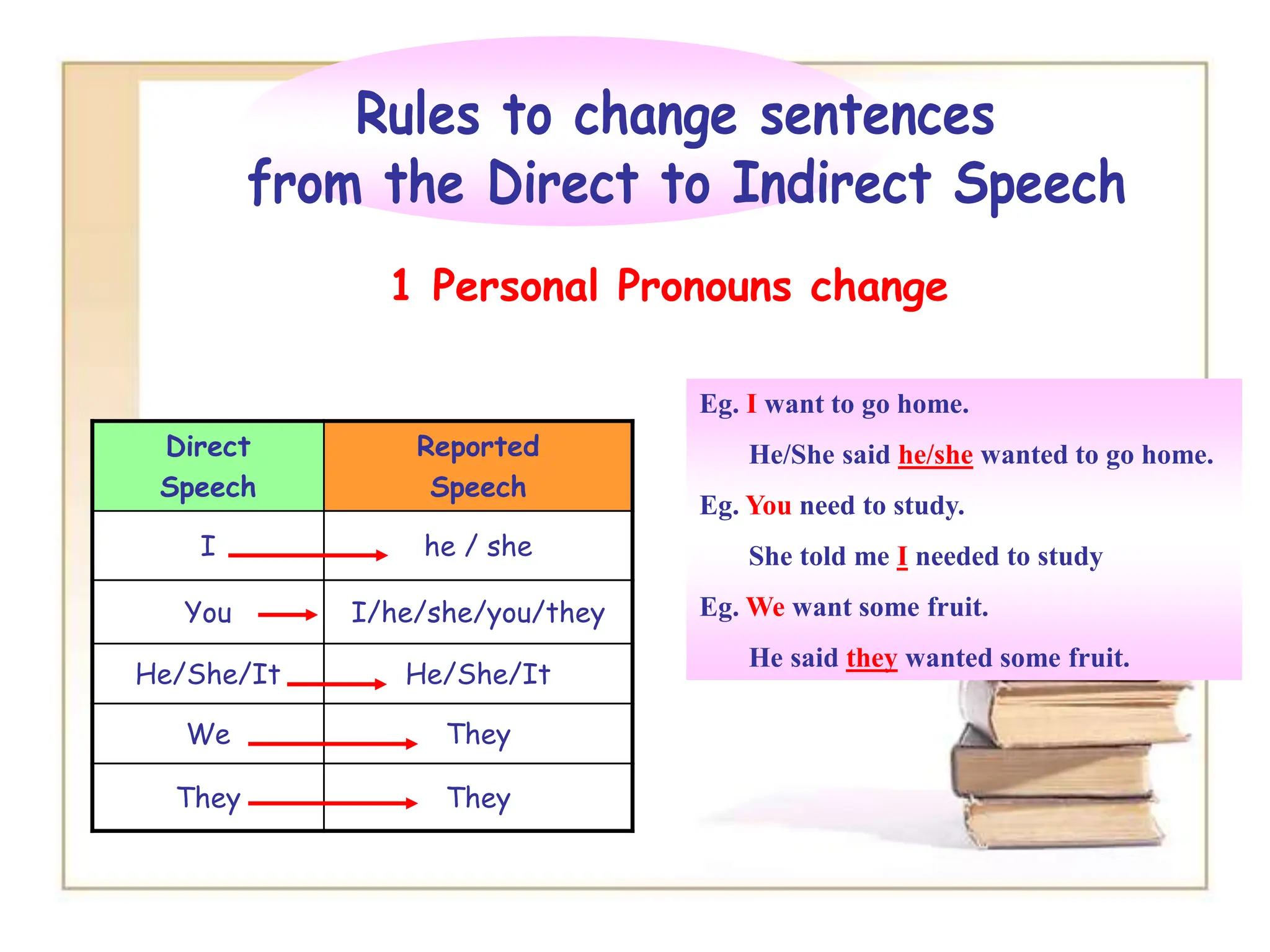
1 Personal Pronouns change
Direct
Speech
Reported
Speech
I he / she
You I/he/she/you/they
He/She/It He/She/It
We They
They They
Eg. I want to go home.
He/She said he/she wanted to go home.
Eg. You need to study.
She told me I needed to study
Eg. We want some fruit.
He said they wanted some fruit.
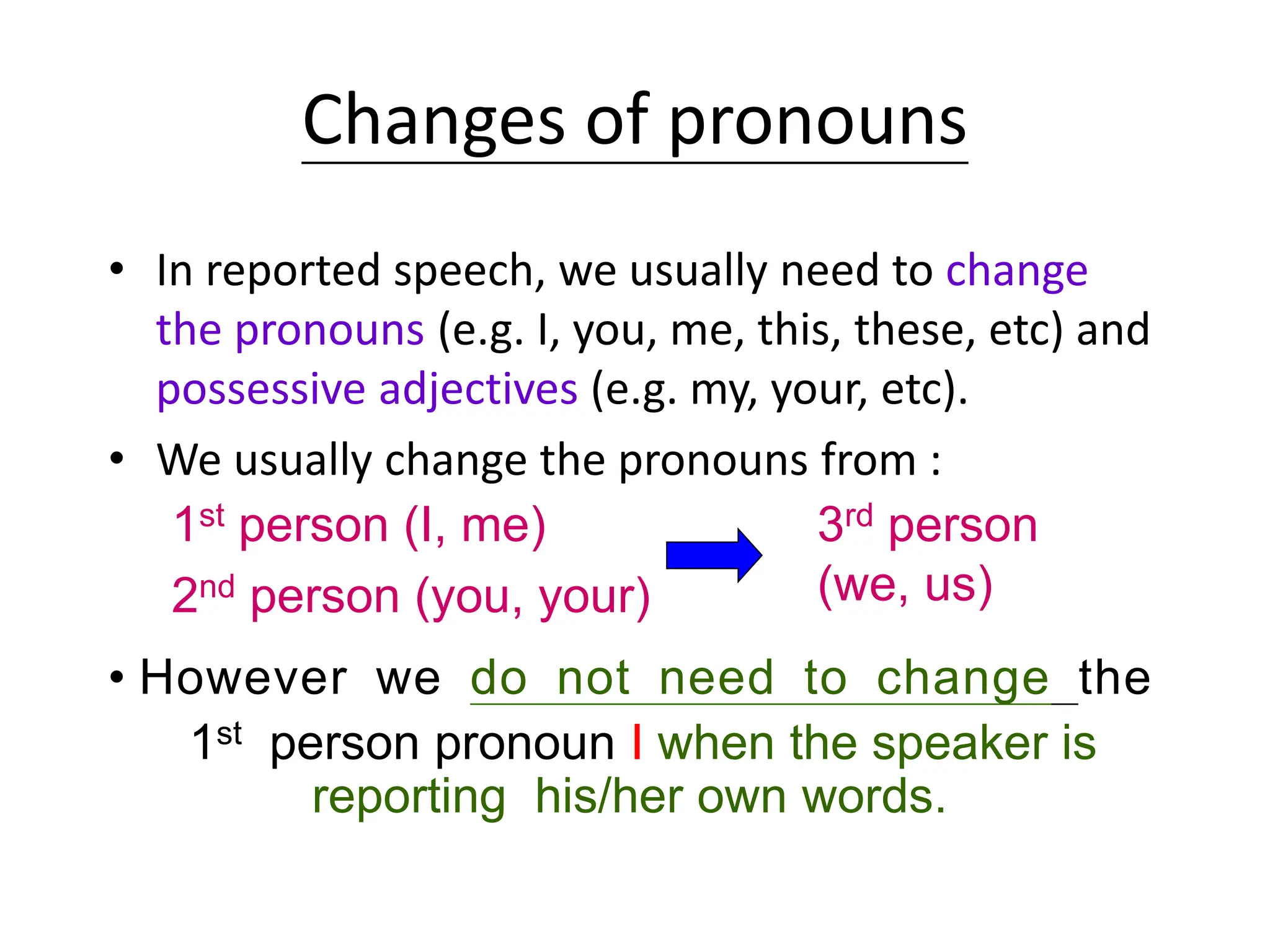
Changes of pronouns
• In reported speech, we usually need to change
the pronouns (e.g. I, you, me, this, these, etc) and
possessive adjectives (e.g. my, your, etc).
• We usually change the pronouns from :
• However we do not need to change the
1st person pronoun I when the speaker is
reporting his/her own words.
1st person (I, me)
2nd person (you, your)
3rd person
(we, us)
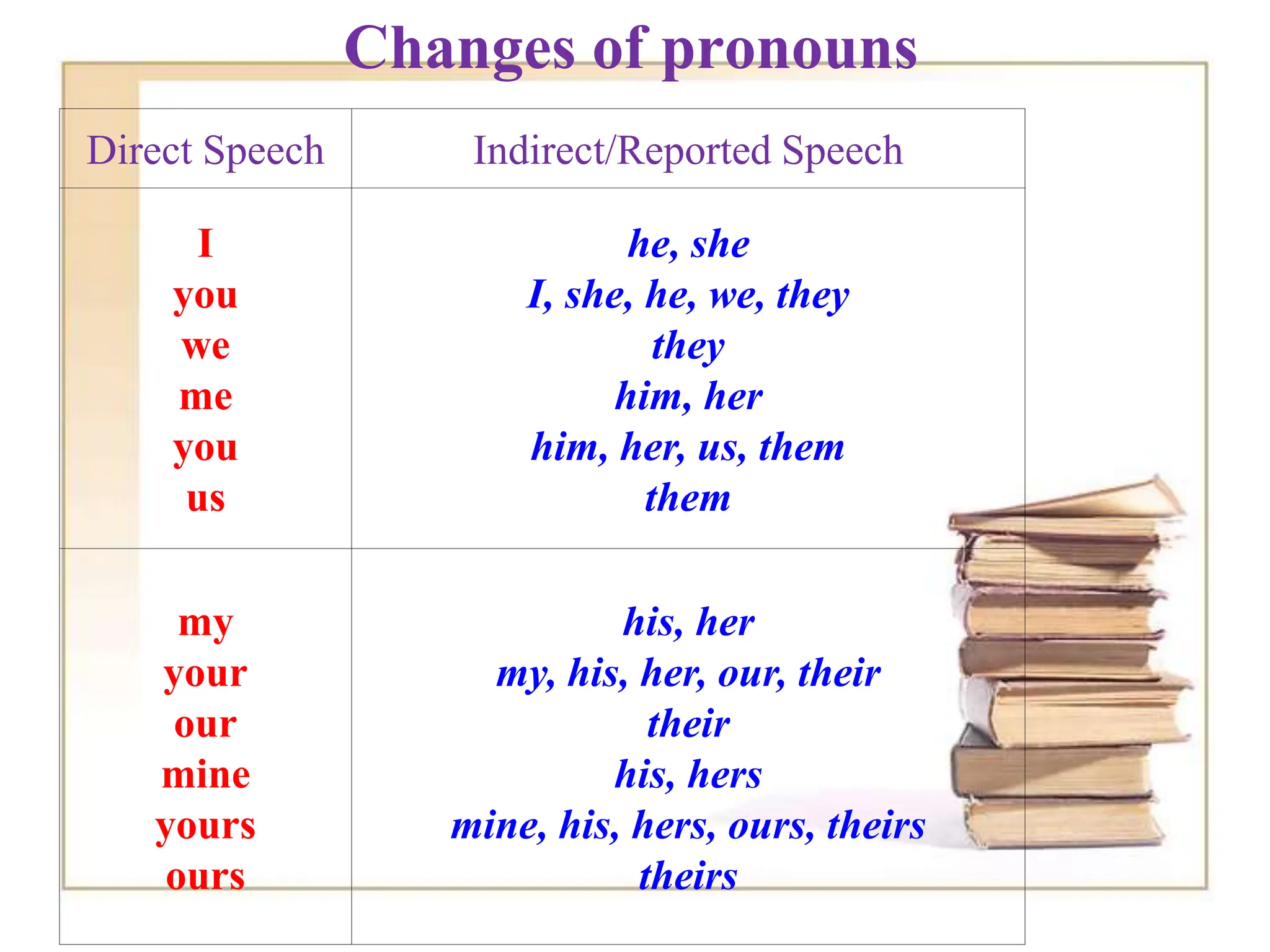
Direct Speech Indirect/Reported Speech
I
you
we
me
you
us
he, she
I, she, he, we, they
they
him, her
him, her, us, them
them
my
your
our
mine
yours
ours
his, her
my, his, her, our, their
their
his, hers
mine, his, hers, ours, theirs
theirs
Changes of pronouns
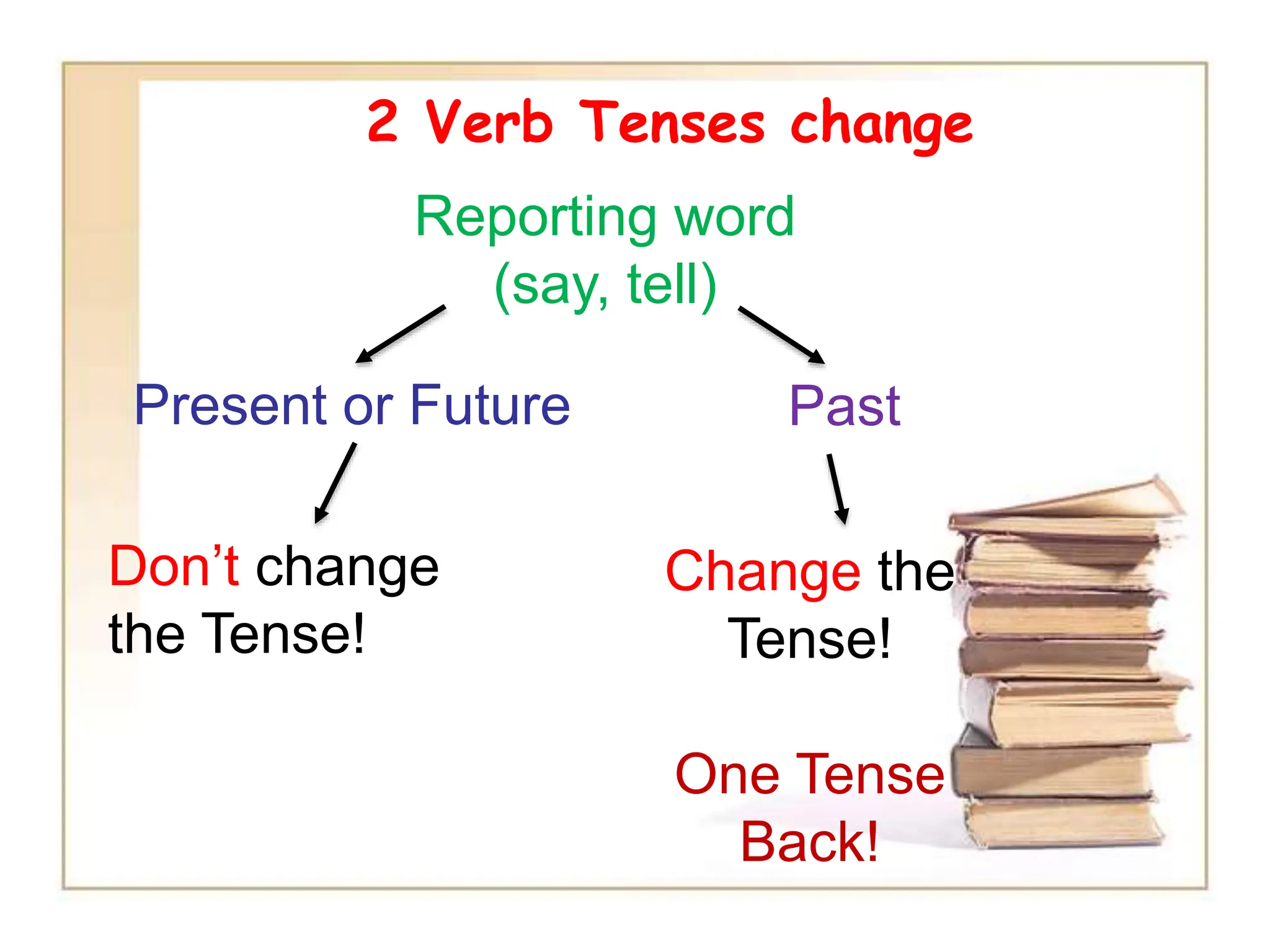
2 Verb Tenses change
Reporting word
(say, tell)
Present or Future Past
Don’t change
the Tense!
Change the
Tense!
One Tense
Back!
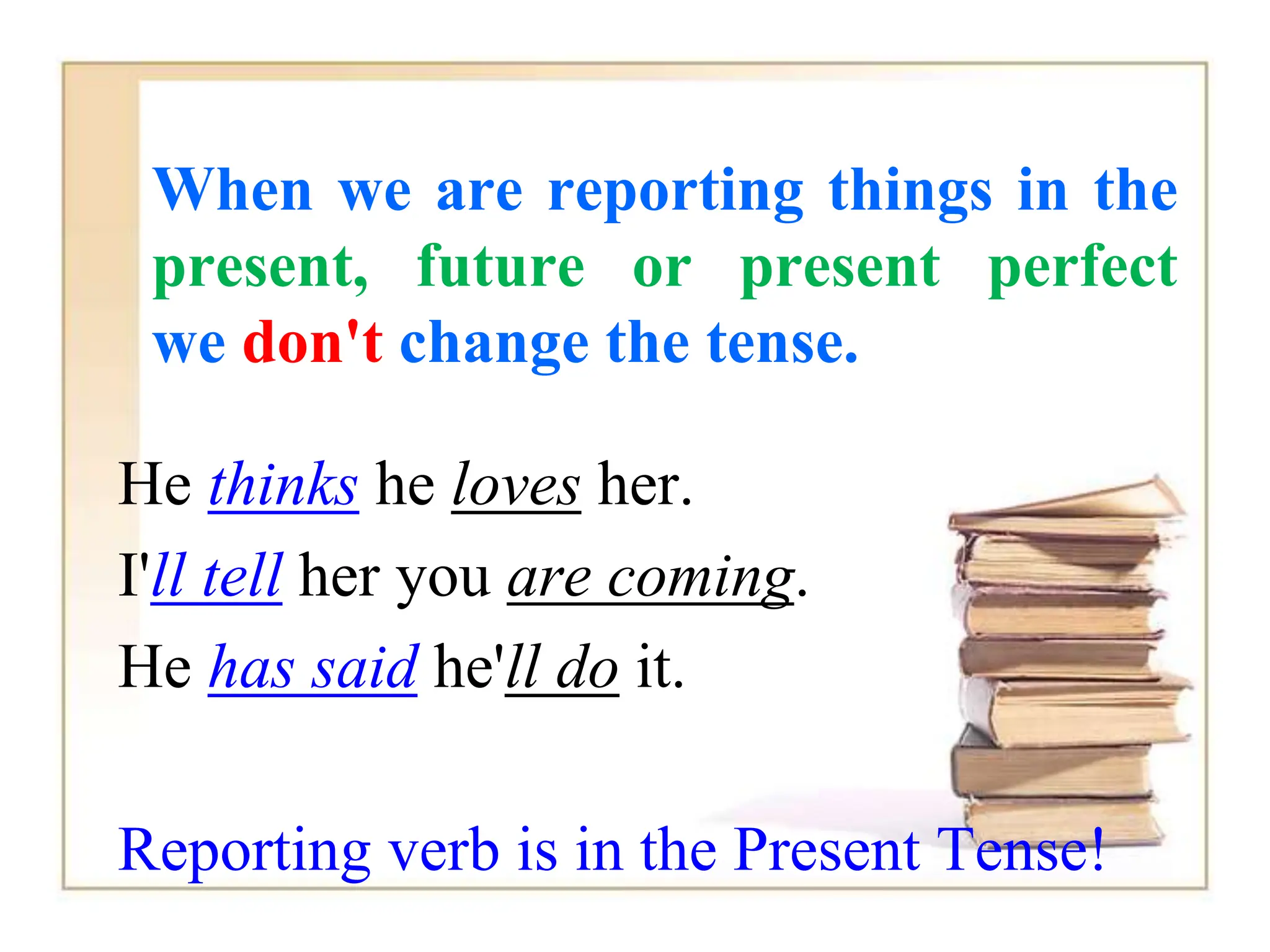
When we are reporting things in the
present, future or present perfect
we don't change the tense.
He thinks he loves her.
I'll tell her you are coming.
He has said he'll do it.
Reporting verb is in the Present Tense!
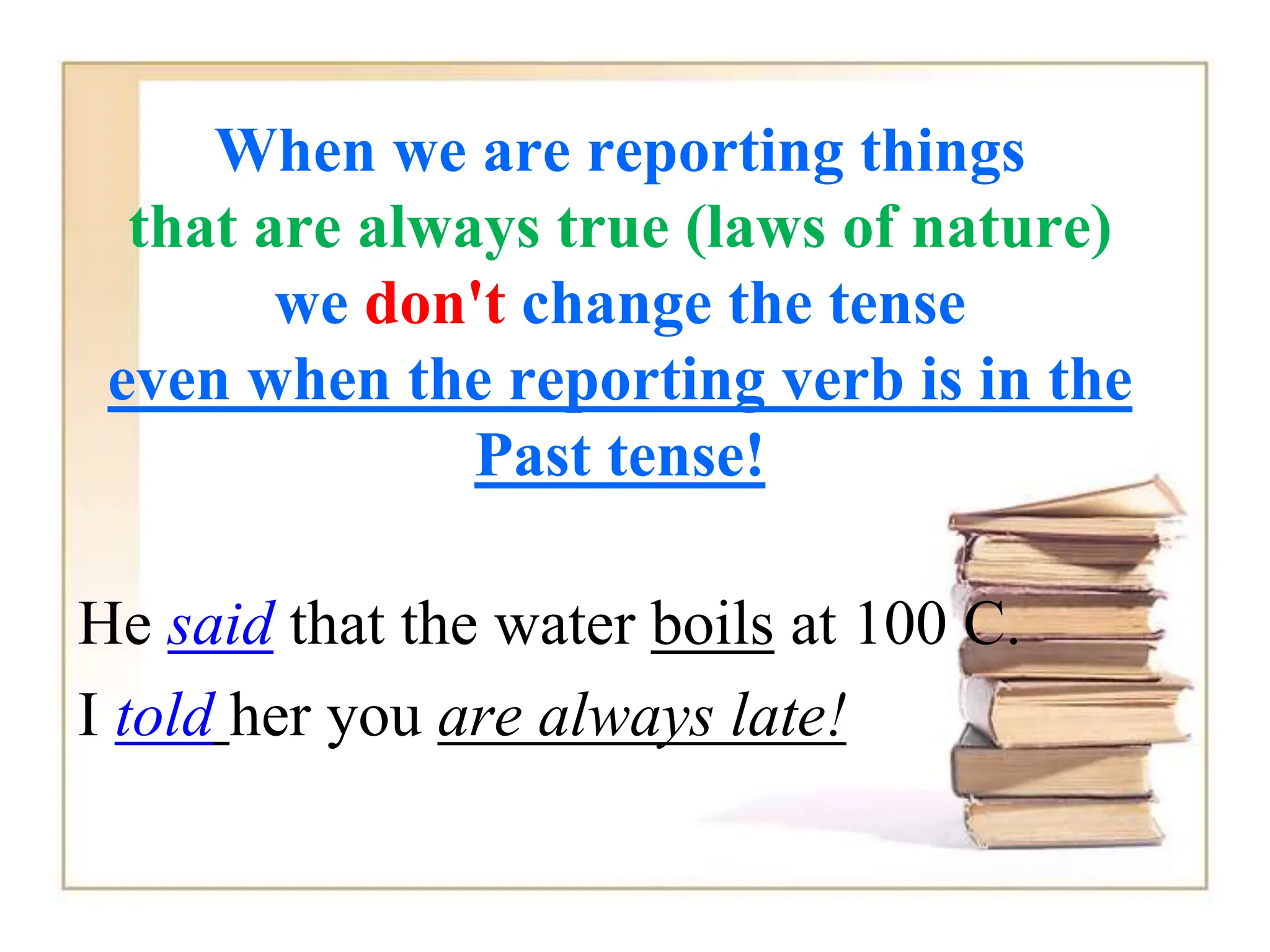
When we are reporting things
that are always true (laws of nature)
we don't change the tense
even when the reporting verb is in the
Past tense!
He said that the water boils at 100 C.
I told her you are always late!
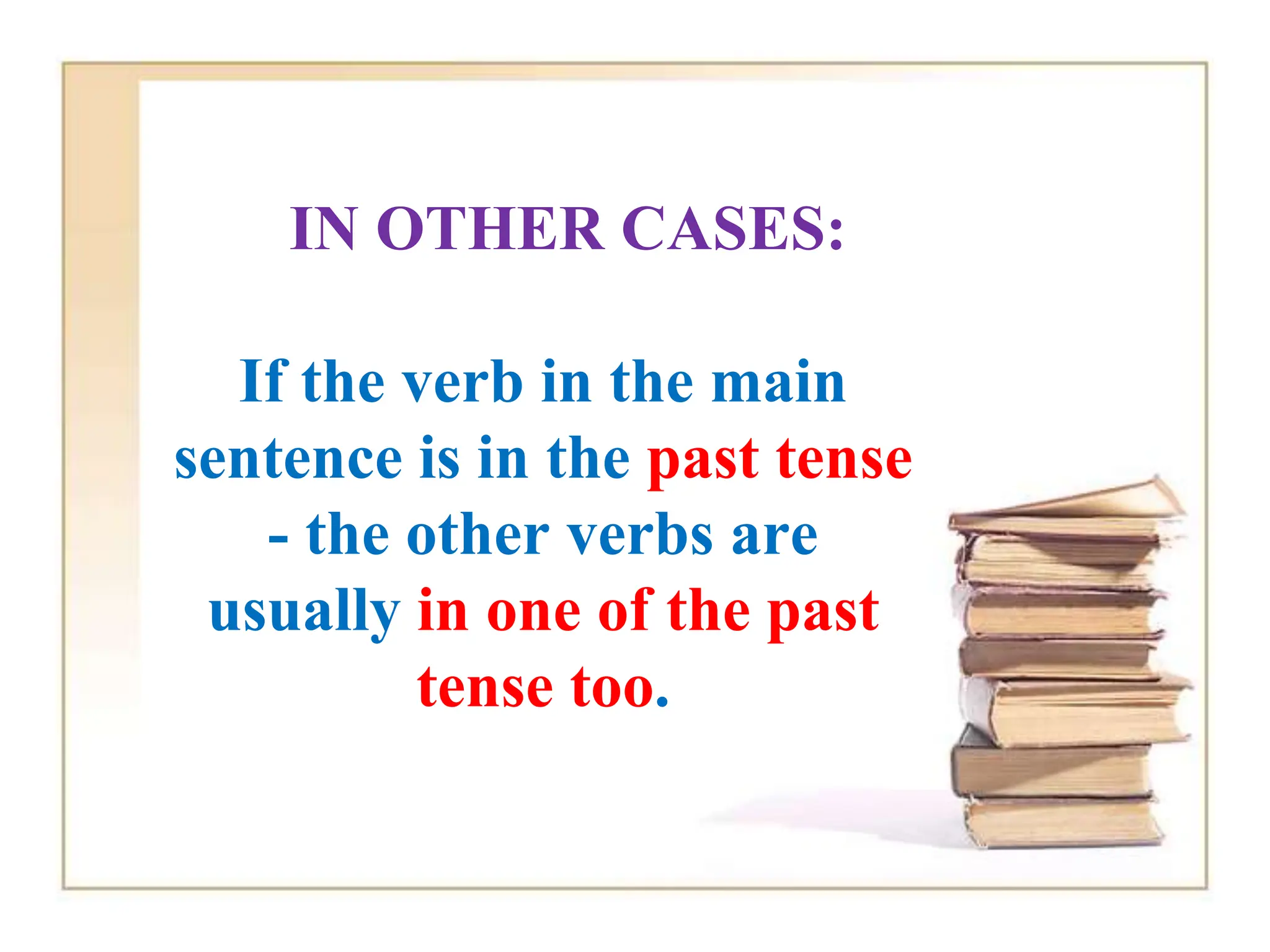
IN OTHER CASES:
If the verb in the main
sentence is in the past tense
- the other verbs are
usually in one of the past
tense too.
Direct Speech Indirect Speech
• Present Simple
• Present Continuous
• Present Perfect
• Past Simple
• Past Continuous
• Past Perfect
• Past Simple • Past Simple/Perfect
• Future Will • Would + Bare Infinitive
• Can
• Shall
• Must
• Could
• Should
• Had to
2 Verb Tenses change
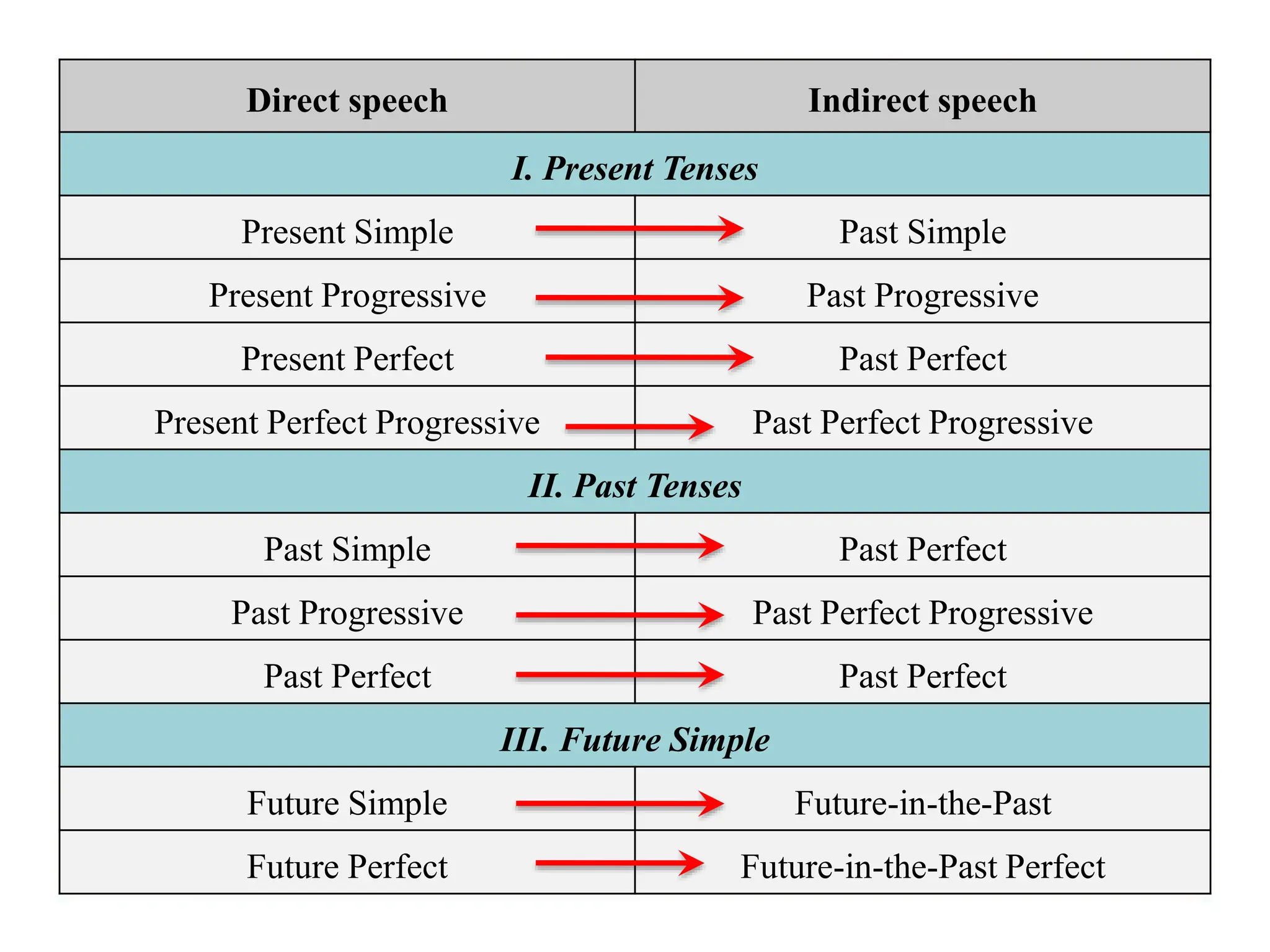
Direct speech Indirect speech
I. Present Tenses
Present Simple Past Simple
Present Progressive Past Progressive
Present Perfect Past Perfect
Present Perfect Progressive Past Perfect Progressive
II. Past Tenses
Past Simple Past Perfect
Past Progressive Past Perfect Progressive
Past Perfect Past Perfect
III. Future Simple
Future Simple Future-in-the-Past
Future Perfect Future-in-the-Past Perfect
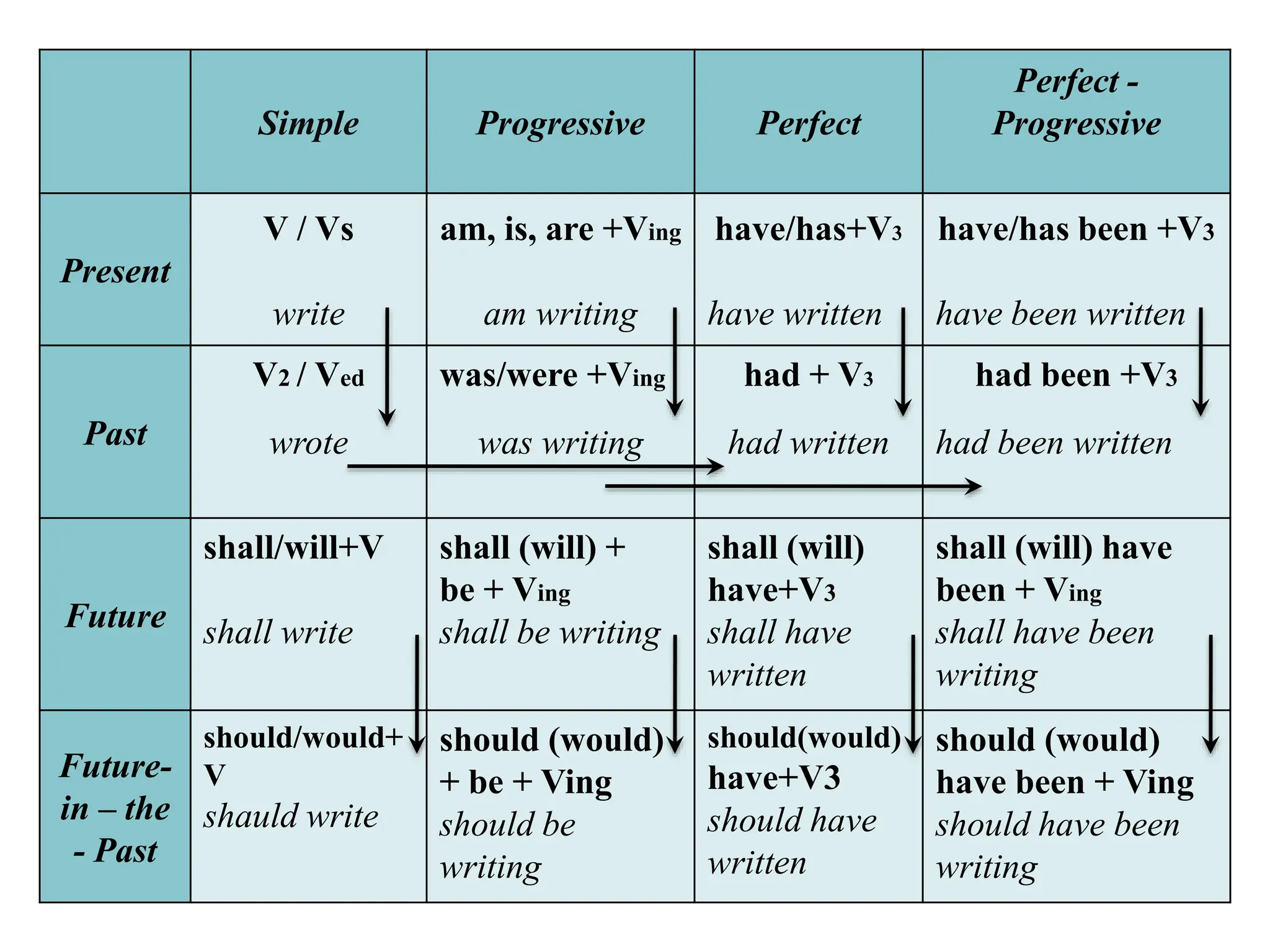
Simple Progressive Perfect
Perfect -
Progressive
Present
V / Vs
write
am, is, are +Ving
am writing
have/has+V3
have written
have/has been +V3
have been written
Past
V2 / Ved
wrote
was/were +Ving
was writing
had + V3
had written
had been +V3
had been written
Future
shall/will+V
shall write
shall (will) +
be + Ving
shall be writing
shall (will)
have+V3
shall have
written
shall (will) have
been + Ving
shall have been
writing
Future-
in – the
- Past
should/would+
V
shauld write
should (would)
+ be + Ving
should be
writing
should(would)
have+V3
should have
written
should (would)
have been + Ving
should have been
writing
Present Simple
I phone my friends every
day.”
Past Simple
She told him (that) she phoned her
friends every day
Present Progressive
I'm waiting for Kate.
Past Progressive
He said (that) he was waiting for
Kate.
Past Simple
I made it yesterday.
Past Perfect
He said (that) he made it yesterday.
Future Simple
I will study better.
Future-in-the-Past
He said (that) he would study better.
Present Perfect
I've been to France three
times.
Past Perfect
He said (that) he had been to France
three times.
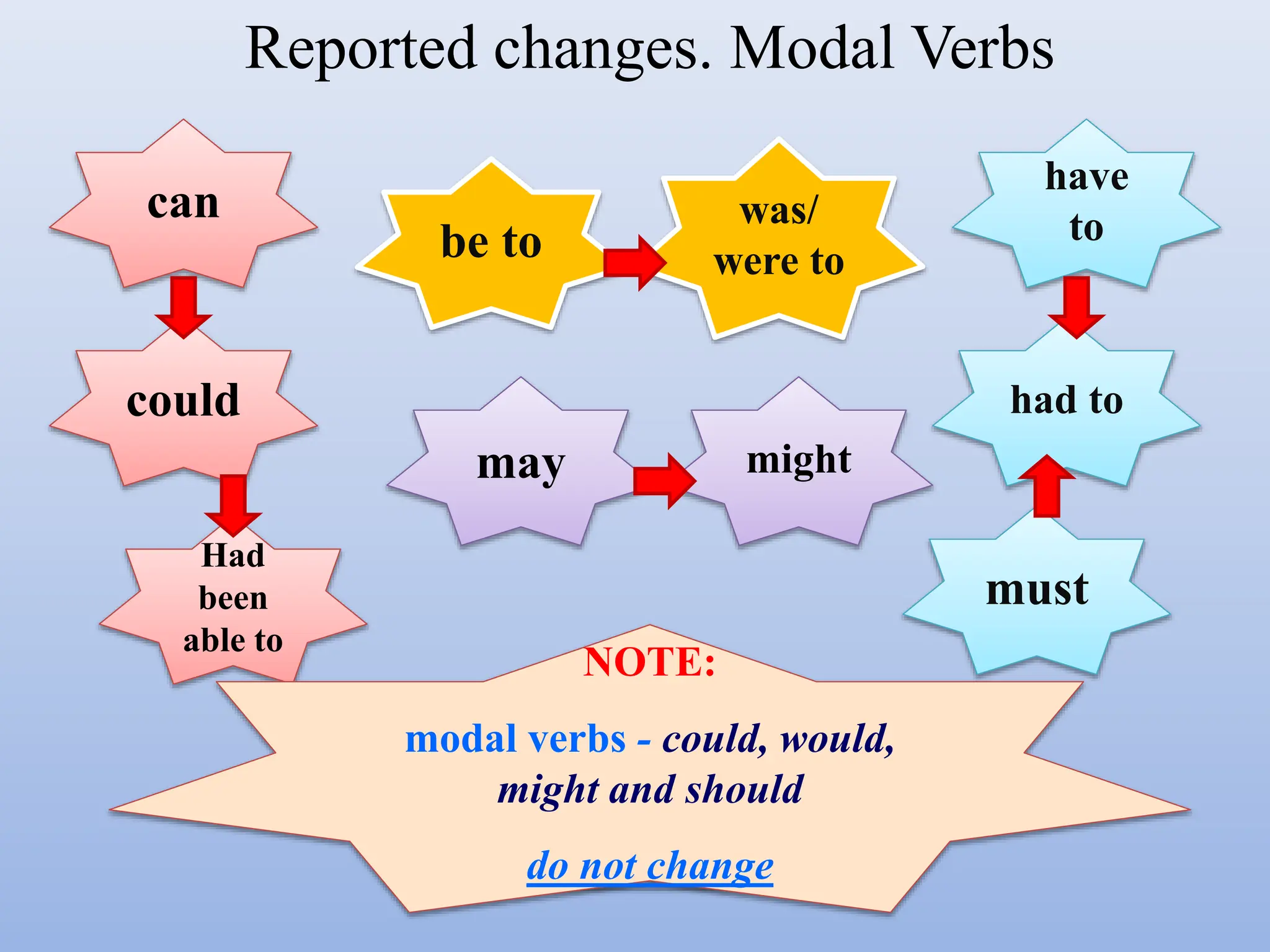
Reported changes. Modal Verbs
can
could
might
may
Had
been
able to
had to
must
have
to
was/
were to
be to
NOTE:
modal verbs - could, would,
might and should
do not change
the day
after
tomorrow
then
now
those
these
that
this
two days
later,
in two
days’ time
that day
today
yesterday
the day
before
ago before
next year
the
following
year
the
previous
week
here
last week
there
the next
day
tomorrow
3. Changes of time words
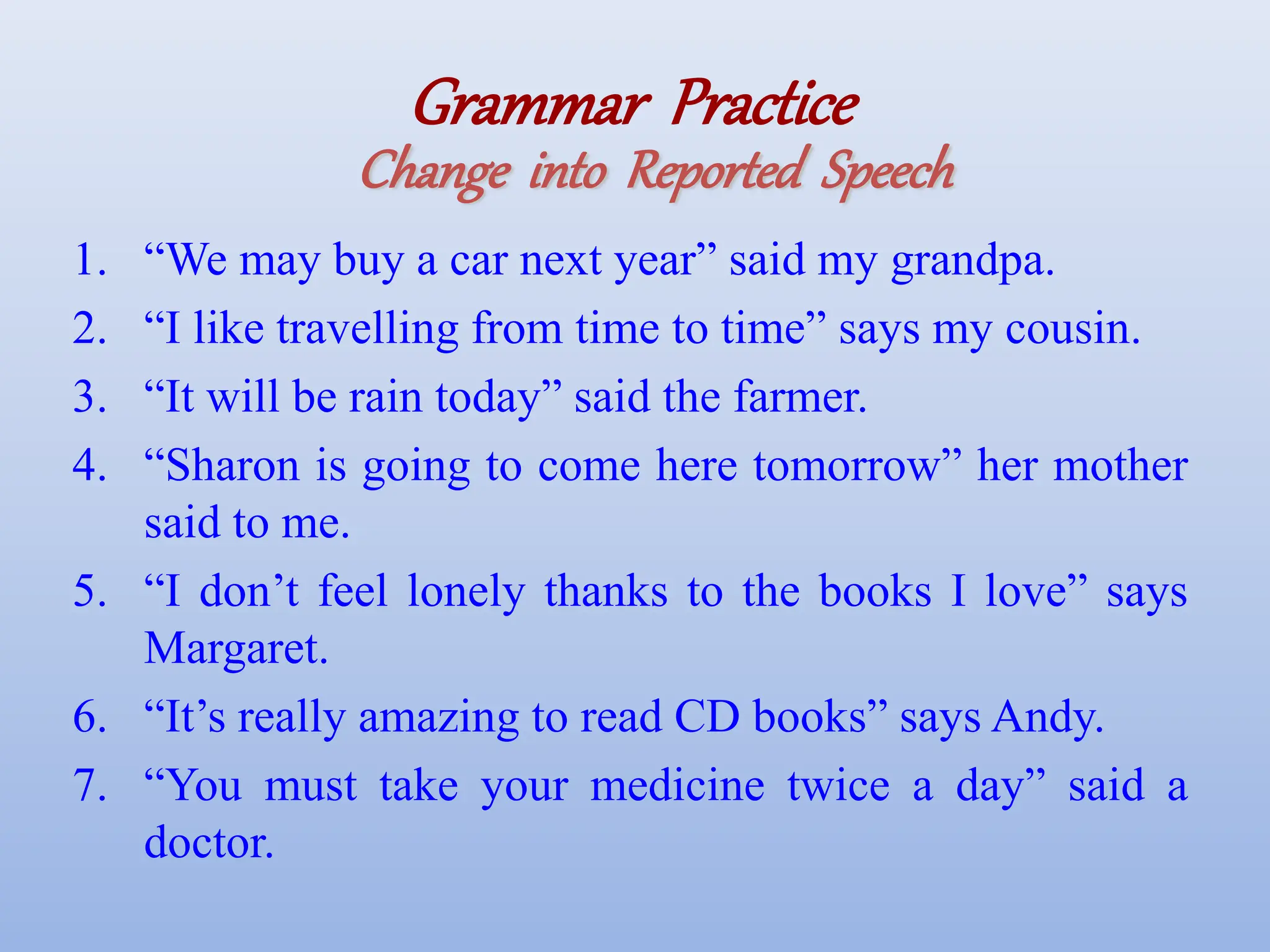
Grammar Practice
Change into Reported Speech
1. “We may buy a car next year” said my grandpa.
2. “I like travelling from time to time” says my cousin.
3. “It will be rain today” said the farmer.
4. “Sharon is going to come here tomorrow” her mother
said to me.
5. “I don’t feel lonely thanks to the books I love” says
Margaret.
6. “It’s really amazing to read CD books” says Andy.
7. “You must take your medicine twice a day” said a
doctor.
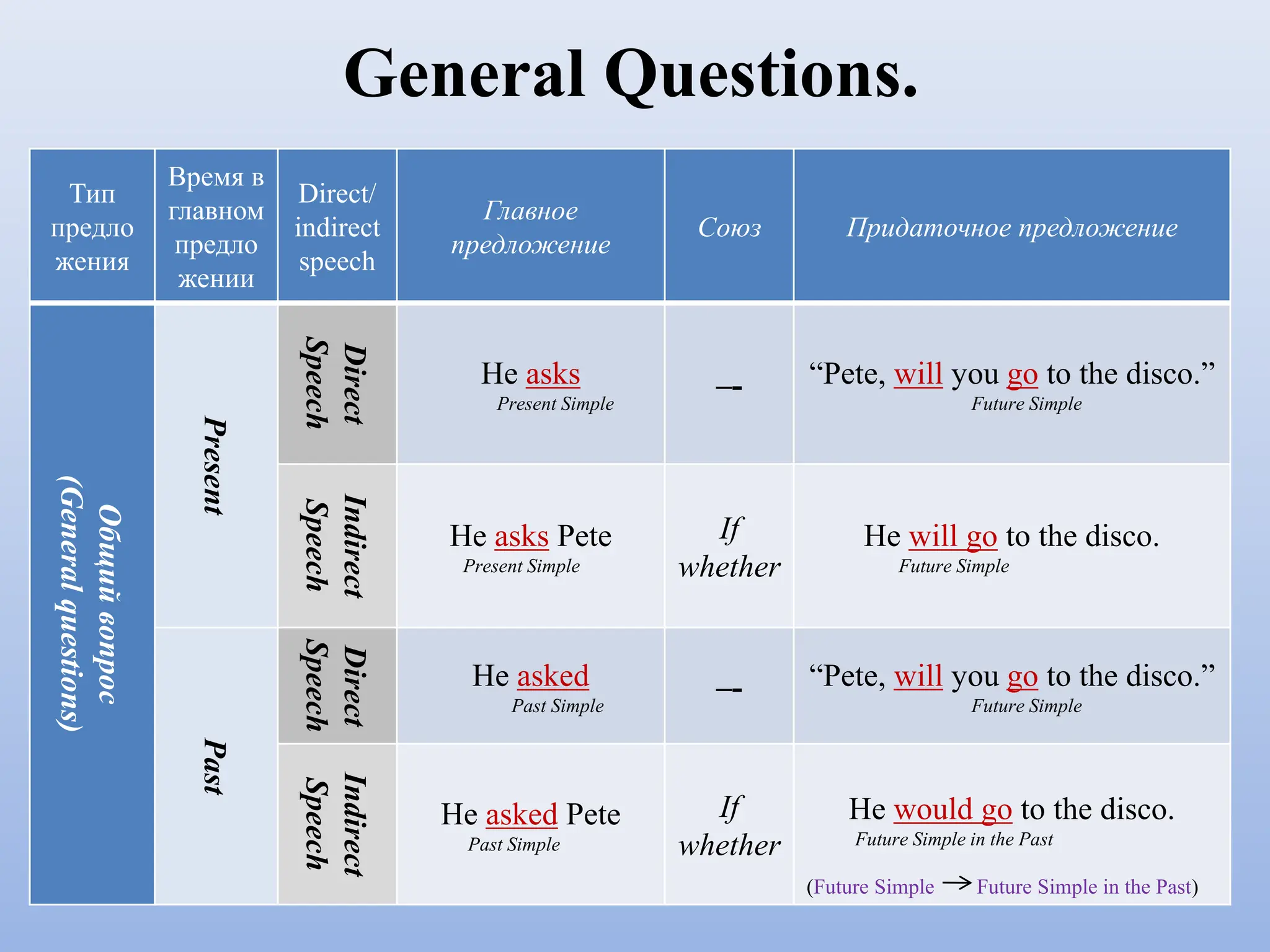
General Questions.
Тип
предло
жения
Время в
главном
предло
жении
Direct/
indirect
speech
Главное
предложение
Союз Придаточное предложение
Общий
вопрос
(General
questions)
Present
Direct
Speech
He asks
Present Simple
–- “Pete, will you go to the disco.”
Future Simple
Indirect
Speech
He asks Pete
Present Simple
If
whether
He will go to the disco.
Future Simple
Past
Direct
Speech
He asked
Past Simple
–- “Pete, will you go to the disco.”
Future Simple
Indirect
Speech
He asked Pete
Past Simple
If
whether
He would go to the disco.
Future Simple in the Past
(Future Simple Future Simple in the Past)
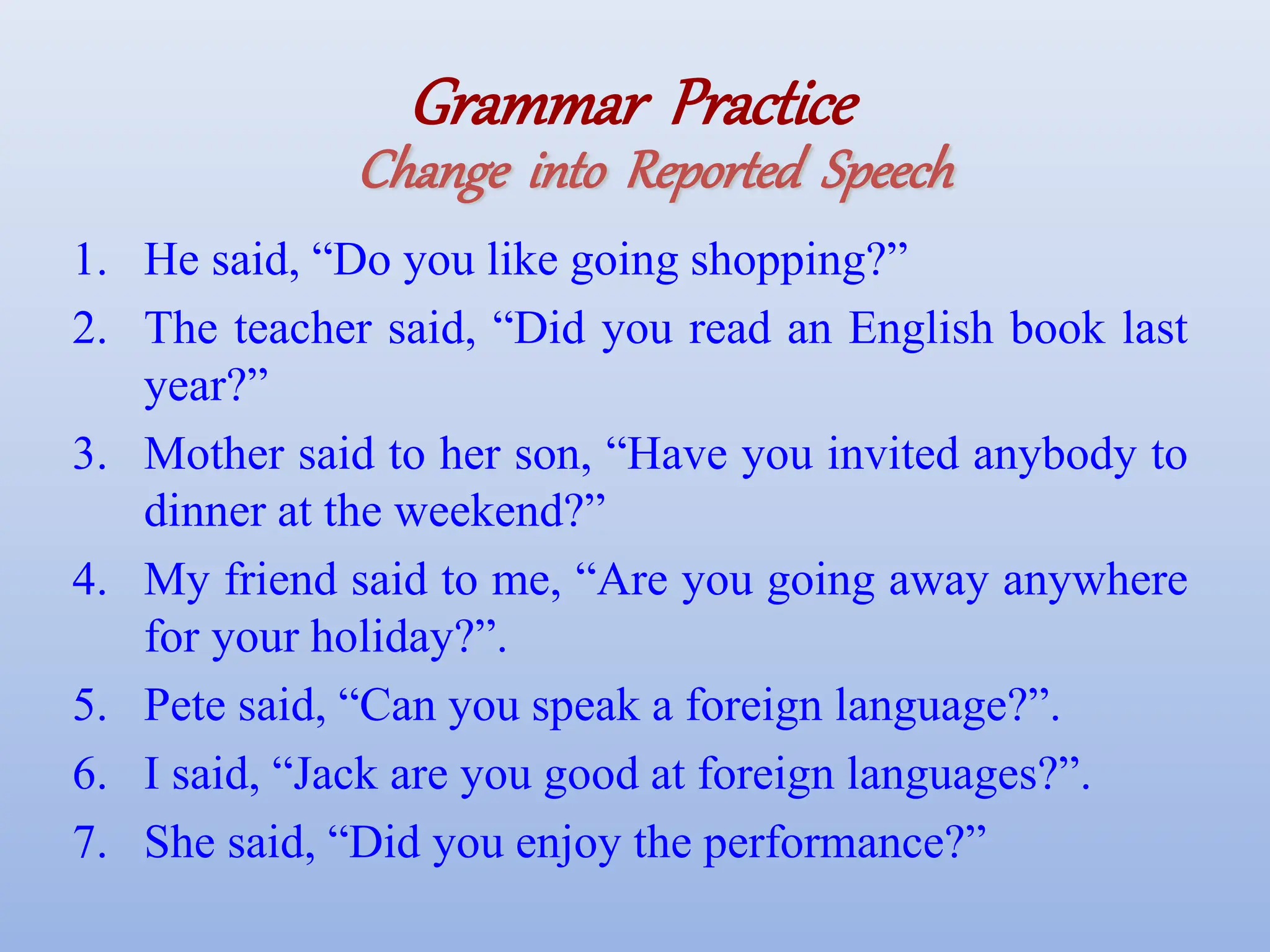
Grammar Practice
Change into Reported Speech
1. He said, “Do you like going shopping?”
2. The teacher said, “Did you read an English book last
year?”
3. Mother said to her son, “Have you invited anybody to
dinner at the weekend?”
4. My friend said to me, “Are you going away anywhere
for your holiday?”.
5. Pete said, “Can you speak a foreign language?”.
6. I said, “Jack are you good at foreign languages?”.
7. She said, “Did you enjoy the performance?”
Special Wh - Questions.
Тип
предло
жения
Время в
главном
предло
жении
Direct/
indirect
speech
Главное
предложение
Союз Придаточное предложение
Специальный
вопрос
к
вопросительным
членам
Present
Direct
Speech
He asks
Present Simple
–- “Where do you go every day, Pete?”
Present Simple
Indirect
Speech
He asks Pete
Present Simple
where he goes every day.
Present Simple
Past
Direct
Speech
He asked
Past Simple
–- “Where do you go every day, Pete?”
Present Simple
Indirect
Speech
He asked Pete
Past Simple
where
he went every day.
Past Simple
(Present Simple Past Simple)
Special Wh - Questions.
Тип
предло
жения
Время в
главном
предло
жении
Direct/
indirect
speech
Главное
предложение
Союз Придаточное предложение
Специальный
вопрос
к
подлежащему
Present
Direct
Speech
He asks
Present Simple
–- “Who is that man?”
Present Simple
Indirect
Speech
He asks
Present Simple
–-
who is that man.
Present Simple
who that man is
Present Simple
Past
Direct
Speech
He asked
Past Simple
–- “Who is that man?”
Present Simple
Indirect
Speech
He asked
Past Simple
–-
who was that man.
Past Simple
who that man was
Past Simple
(Present Simple Past Simple)
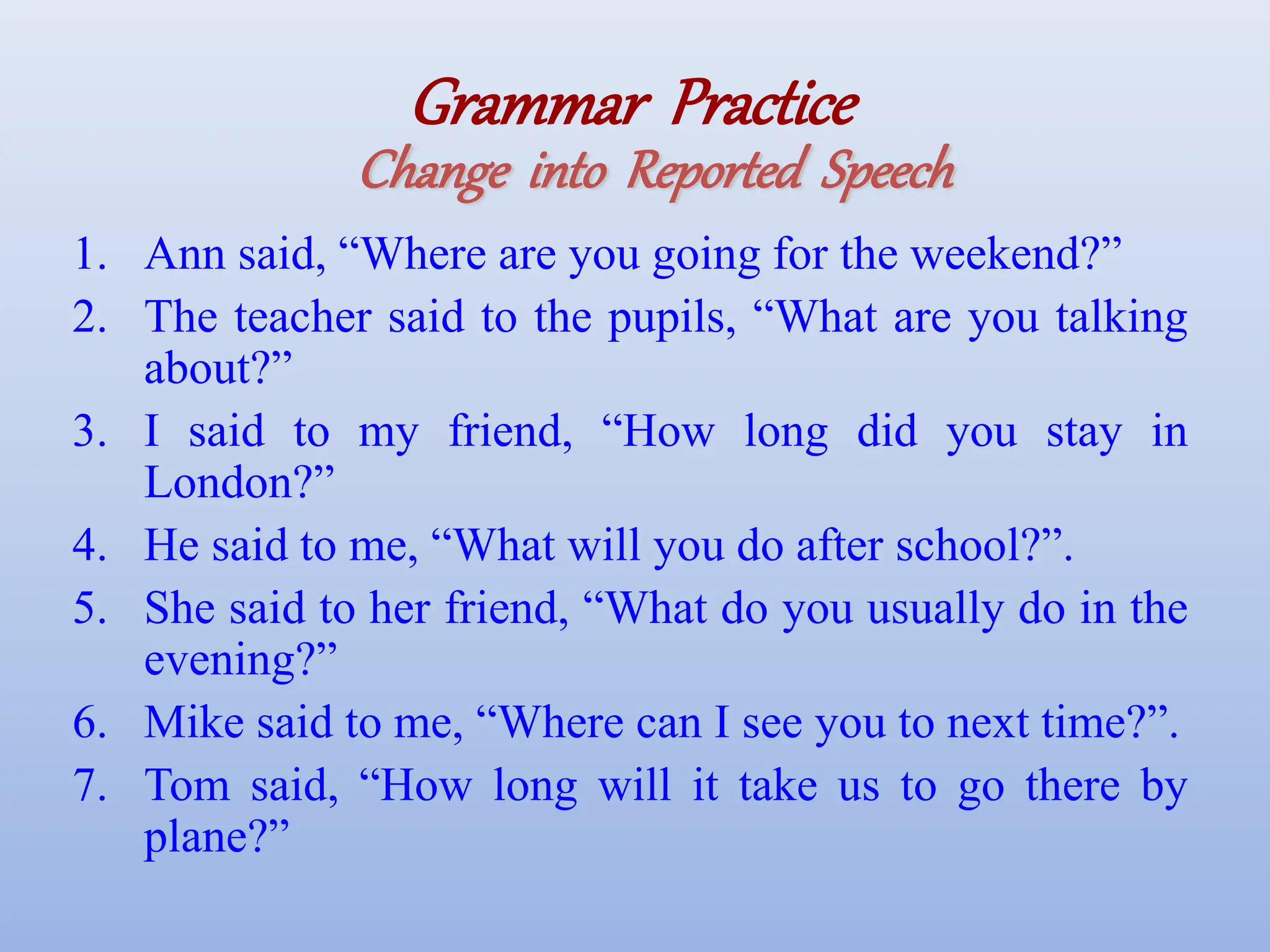
Grammar Practice
Change into Reported Speech
1. Ann said, “Where are you going for the weekend?”
2. The teacher said to the pupils, “What are you talking
about?”
3. I said to my friend, “How long did you stay in
London?”
4. He said to me, “What will you do after school?”.
5. She said to her friend, “What do you usually do in the
evening?”
6. Mike said to me, “Where can I see you to next time?”.
7. Tom said, “How long will it take us to go there by
plane?”
Tense Changes. Commands.
Тип
предло
жения
Время в
главно
м
предло
жении
Direct/
indirect
speech
Главное
предложение
Союз Придаточное предложение
Специальный
вопрос
к
подлежащему
Present
Direct
Speech
He says
Present Simple
–-
1. “Go to the shop please”
положительная просьба
2. “Don’t go to the shop ”
отрицательная просьба
Indirect
Speech
He asks / tells
Present Simple
–-
1. to go to the shop
положительная просьба
2. not to go to the shop ”
отрицательная просьба
Past
Direct
Speech
He asked
Past Simple
–-
1. “Go to the shop please”
положительная просьба
2. “Don’t go to the shop ”
отрицательная просьба
Indirect
Speech
He asked / told
Past Simple
–-
1. to go to the shop
положительная просьба
2. not to go to the shop ”
отрицательная просьба
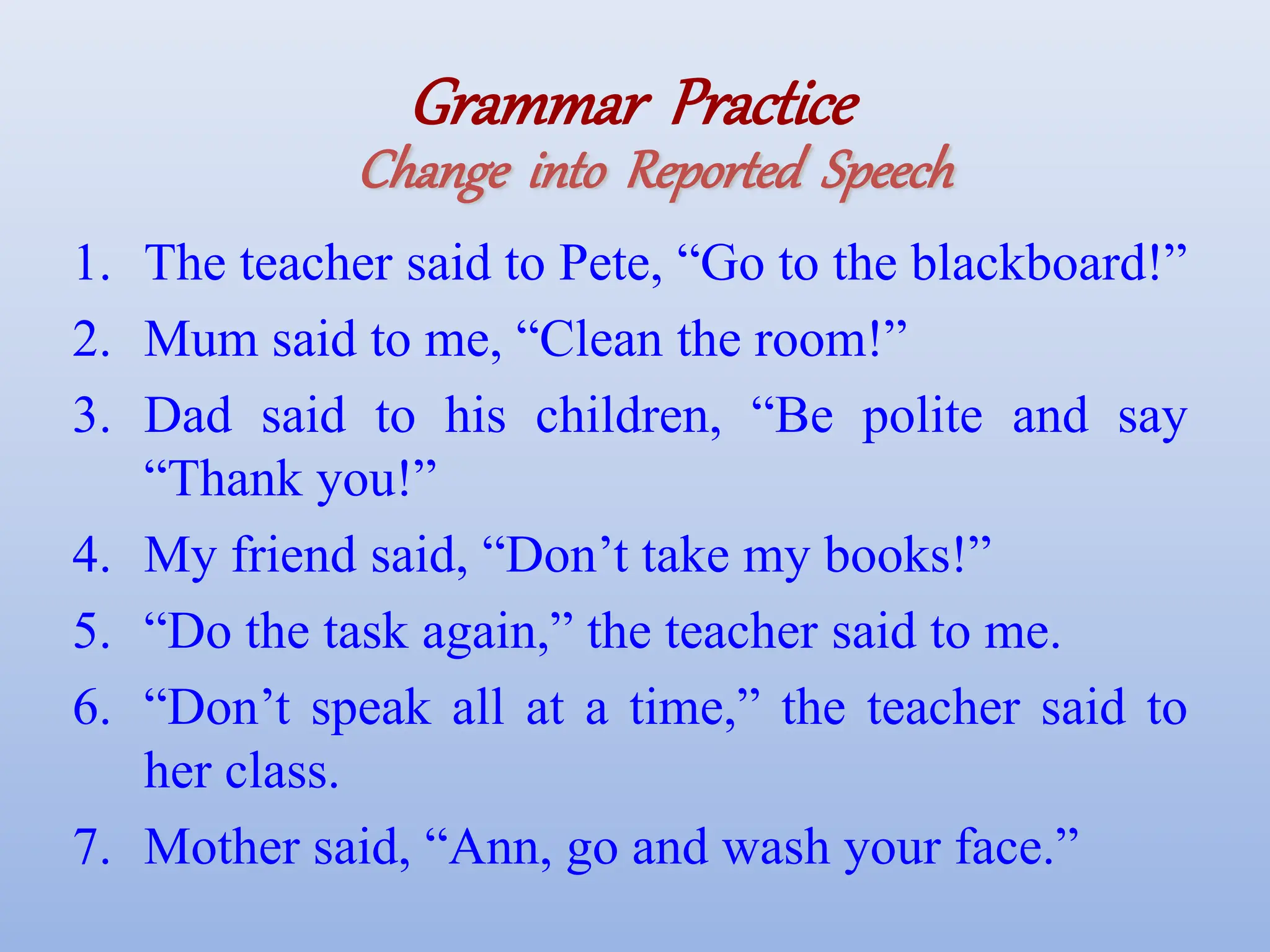
Grammar Practice
Change into Reported Speech
1. The teacher said to Pete, “Go to the blackboard!”
2. Mum said to me, “Clean the room!”
3. Dad said to his children, “Be polite and say
“Thank you!”
4. My friend said, “Don’t take my books!”
5. “Do the task again,” the teacher said to me.
6. “Don’t speak all at a time,” the teacher said to
her class.
7. Mother said, “Ann, go and wash your face.”
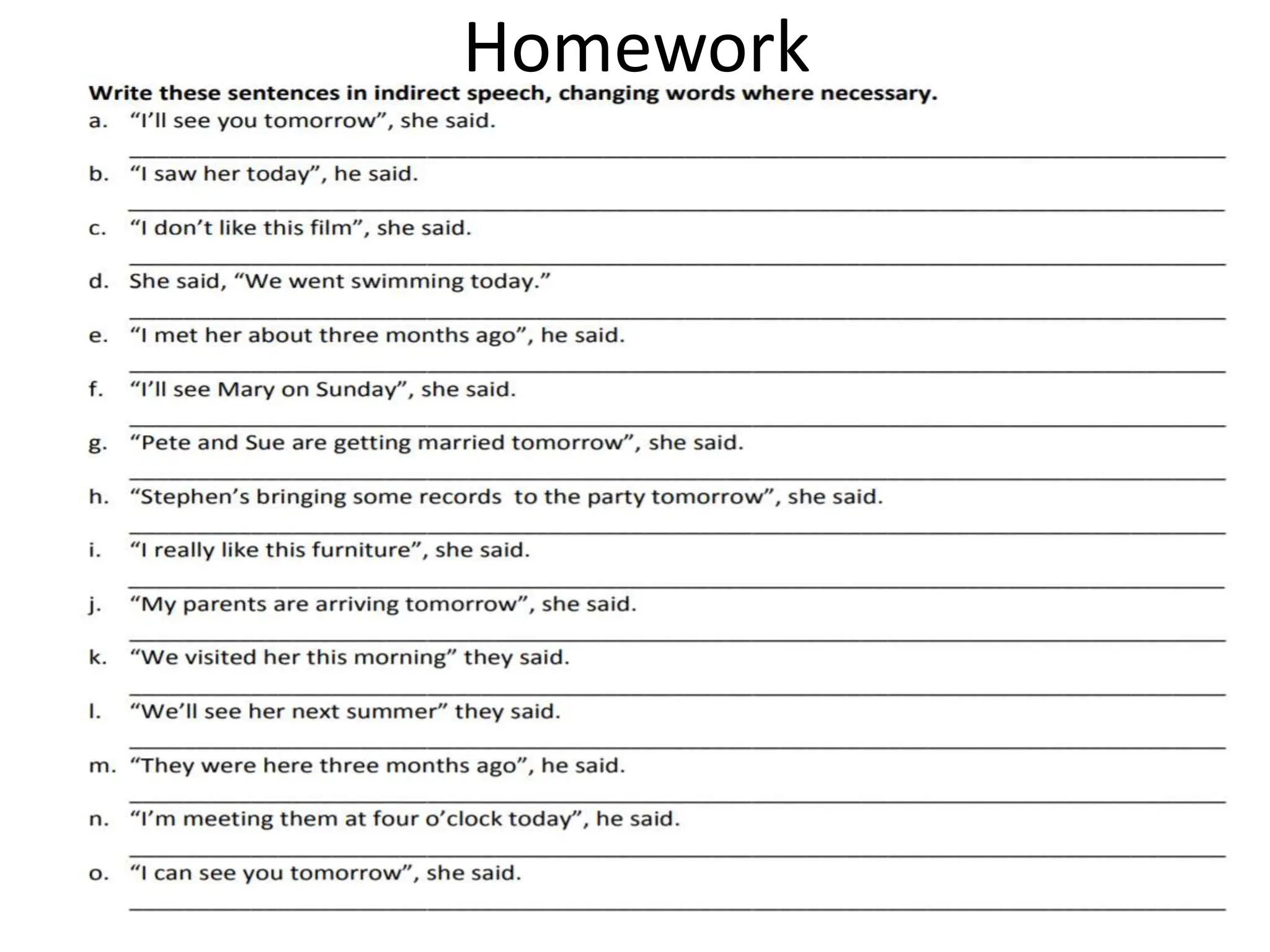
Homework

Reported speech

  • 2.
    We use reportedspeech when we are saying what other people say, think or believe. “I’m tired!”, Helen said. Helen said (that) she was tired.
  • 3.
    We usually usea 'reporting verb' like 'say' or 'tell‘. The Reported Speech… For example: He said (that) he wanted to marry me. He said to me (that) he wanted to marry me. But: He told me (that) he loved me.
  • 4.
    Reporting Verbs… Say& Tell  With ‘tell' we NEED to use the direct object ('me‘, ‘you’, ‘us’). John told me (that) he was going to be late.  With 'say' we CAN or CAN’T use the direct object. John said (that) he would be late. John said to me (that) he would be late.
  • 5.
    Example of otherReporting Verbs… • He decided …. • He affirmed … • He exclaimed … • He explained … • He confessed … • He asked… • He questioned… • He wondered… • He inquired…
  • 6.
    1 Personal Pronounschange Direct Speech Reported Speech I he / she You I/he/she/you/they He/She/It He/She/It We They They They Eg. I want to go home. He/She said he/she wanted to go home. Eg. You need to study. She told me I needed to study Eg. We want some fruit. He said they wanted some fruit.
  • 7.
    Changes of pronouns •In reported speech, we usually need to change the pronouns (e.g. I, you, me, this, these, etc) and possessive adjectives (e.g. my, your, etc). • We usually change the pronouns from : • However we do not need to change the 1st person pronoun I when the speaker is reporting his/her own words. 1st person (I, me) 2nd person (you, your) 3rd person (we, us)
  • 8.
    Direct Speech Indirect/ReportedSpeech I you we me you us he, she I, she, he, we, they they him, her him, her, us, them them my your our mine yours ours his, her my, his, her, our, their their his, hers mine, his, hers, ours, theirs theirs Changes of pronouns
  • 9.
    2 Verb Tenseschange Reporting word (say, tell) Present or Future Past Don’t change the Tense! Change the Tense! One Tense Back!
  • 10.
    When we arereporting things in the present, future or present perfect we don't change the tense. He thinks he loves her. I'll tell her you are coming. He has said he'll do it. Reporting verb is in the Present Tense!
  • 11.
    When we arereporting things that are always true (laws of nature) we don't change the tense even when the reporting verb is in the Past tense! He said that the water boils at 100 C. I told her you are always late!
  • 12.
    IN OTHER CASES: Ifthe verb in the main sentence is in the past tense - the other verbs are usually in one of the past tense too.
  • 13.
    Direct Speech IndirectSpeech • Present Simple • Present Continuous • Present Perfect • Past Simple • Past Continuous • Past Perfect • Past Simple • Past Simple/Perfect • Future Will • Would + Bare Infinitive • Can • Shall • Must • Could • Should • Had to 2 Verb Tenses change
  • 14.
    Direct speech Indirectspeech I. Present Tenses Present Simple Past Simple Present Progressive Past Progressive Present Perfect Past Perfect Present Perfect Progressive Past Perfect Progressive II. Past Tenses Past Simple Past Perfect Past Progressive Past Perfect Progressive Past Perfect Past Perfect III. Future Simple Future Simple Future-in-the-Past Future Perfect Future-in-the-Past Perfect
  • 15.
    Simple Progressive Perfect Perfect- Progressive Present V / Vs write am, is, are +Ving am writing have/has+V3 have written have/has been +V3 have been written Past V2 / Ved wrote was/were +Ving was writing had + V3 had written had been +V3 had been written Future shall/will+V shall write shall (will) + be + Ving shall be writing shall (will) have+V3 shall have written shall (will) have been + Ving shall have been writing Future- in – the - Past should/would+ V shauld write should (would) + be + Ving should be writing should(would) have+V3 should have written should (would) have been + Ving should have been writing
  • 16.
    Present Simple I phonemy friends every day.” Past Simple She told him (that) she phoned her friends every day Present Progressive I'm waiting for Kate. Past Progressive He said (that) he was waiting for Kate. Past Simple I made it yesterday. Past Perfect He said (that) he made it yesterday. Future Simple I will study better. Future-in-the-Past He said (that) he would study better. Present Perfect I've been to France three times. Past Perfect He said (that) he had been to France three times.
  • 17.
    Reported changes. ModalVerbs can could might may Had been able to had to must have to was/ were to be to NOTE: modal verbs - could, would, might and should do not change
  • 18.
    the day after tomorrow then now those these that this two days later, intwo days’ time that day today yesterday the day before ago before next year the following year the previous week here last week there the next day tomorrow 3. Changes of time words
  • 19.
    Grammar Practice Change intoReported Speech 1. “We may buy a car next year” said my grandpa. 2. “I like travelling from time to time” says my cousin. 3. “It will be rain today” said the farmer. 4. “Sharon is going to come here tomorrow” her mother said to me. 5. “I don’t feel lonely thanks to the books I love” says Margaret. 6. “It’s really amazing to read CD books” says Andy. 7. “You must take your medicine twice a day” said a doctor.
  • 20.
    General Questions. Тип предло жения Время в главном предло жении Direct/ indirect speech Главное предложение СоюзПридаточное предложение Общий вопрос (General questions) Present Direct Speech He asks Present Simple –- “Pete, will you go to the disco.” Future Simple Indirect Speech He asks Pete Present Simple If whether He will go to the disco. Future Simple Past Direct Speech He asked Past Simple –- “Pete, will you go to the disco.” Future Simple Indirect Speech He asked Pete Past Simple If whether He would go to the disco. Future Simple in the Past (Future Simple Future Simple in the Past)
  • 21.
    Grammar Practice Change intoReported Speech 1. He said, “Do you like going shopping?” 2. The teacher said, “Did you read an English book last year?” 3. Mother said to her son, “Have you invited anybody to dinner at the weekend?” 4. My friend said to me, “Are you going away anywhere for your holiday?”. 5. Pete said, “Can you speak a foreign language?”. 6. I said, “Jack are you good at foreign languages?”. 7. She said, “Did you enjoy the performance?”
  • 22.
    Special Wh -Questions. Тип предло жения Время в главном предло жении Direct/ indirect speech Главное предложение Союз Придаточное предложение Специальный вопрос к вопросительным членам Present Direct Speech He asks Present Simple –- “Where do you go every day, Pete?” Present Simple Indirect Speech He asks Pete Present Simple where he goes every day. Present Simple Past Direct Speech He asked Past Simple –- “Where do you go every day, Pete?” Present Simple Indirect Speech He asked Pete Past Simple where he went every day. Past Simple (Present Simple Past Simple)
  • 23.
    Special Wh -Questions. Тип предло жения Время в главном предло жении Direct/ indirect speech Главное предложение Союз Придаточное предложение Специальный вопрос к подлежащему Present Direct Speech He asks Present Simple –- “Who is that man?” Present Simple Indirect Speech He asks Present Simple –- who is that man. Present Simple who that man is Present Simple Past Direct Speech He asked Past Simple –- “Who is that man?” Present Simple Indirect Speech He asked Past Simple –- who was that man. Past Simple who that man was Past Simple (Present Simple Past Simple)
  • 24.
    Grammar Practice Change intoReported Speech 1. Ann said, “Where are you going for the weekend?” 2. The teacher said to the pupils, “What are you talking about?” 3. I said to my friend, “How long did you stay in London?” 4. He said to me, “What will you do after school?”. 5. She said to her friend, “What do you usually do in the evening?” 6. Mike said to me, “Where can I see you to next time?”. 7. Tom said, “How long will it take us to go there by plane?”
  • 25.
    Tense Changes. Commands. Тип предло жения Времяв главно м предло жении Direct/ indirect speech Главное предложение Союз Придаточное предложение Специальный вопрос к подлежащему Present Direct Speech He says Present Simple –- 1. “Go to the shop please” положительная просьба 2. “Don’t go to the shop ” отрицательная просьба Indirect Speech He asks / tells Present Simple –- 1. to go to the shop положительная просьба 2. not to go to the shop ” отрицательная просьба Past Direct Speech He asked Past Simple –- 1. “Go to the shop please” положительная просьба 2. “Don’t go to the shop ” отрицательная просьба Indirect Speech He asked / told Past Simple –- 1. to go to the shop положительная просьба 2. not to go to the shop ” отрицательная просьба
  • 26.
    Grammar Practice Change intoReported Speech 1. The teacher said to Pete, “Go to the blackboard!” 2. Mum said to me, “Clean the room!” 3. Dad said to his children, “Be polite and say “Thank you!” 4. My friend said, “Don’t take my books!” 5. “Do the task again,” the teacher said to me. 6. “Don’t speak all at a time,” the teacher said to her class. 7. Mother said, “Ann, go and wash your face.”
  • 27.