By
Shah Fahad
English Language Teacher
At
Sarhad computer College
Direct and indirect
Narration
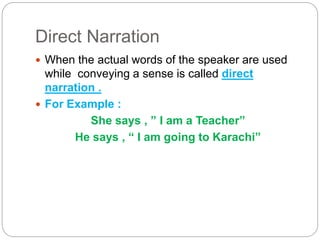
Direct Narration
 When the actual words of the speaker are used
while conveying a sense is called direct
narration .
 For Example :
She says , ” I am a Teacher”
He says , “ I am going to Karachi”
Indirect Narration
 It is not the actual words of the speaker but it only
conveys the full sense of what he / she has said.
 For Example :
She says that she is a teacher.
He said that he is going to Karachi.
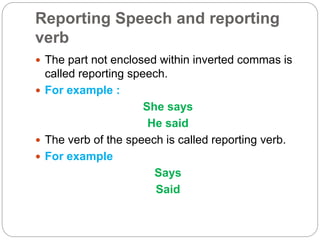
Reporting Speech and reporting
verb
 The part not enclosed within inverted commas is
called reporting speech.
 For example :
She says
He said
 The verb of the speech is called reporting verb.
 For example
Says
Said
Conversion of direct into indirect
 Methods :
 The commas between the reporting speech and
the reported speech is completely disappear.
 That is often used between reporting and
reported speech .
 For Example :
 She says , “I am a teacher” ( Direct )
 She says that she is a teacher .(indirect)
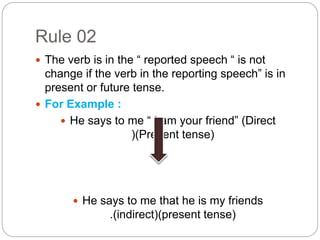
Rule 02
 The verb is in the “ reported speech “ is not
change if the verb in the reporting speech” is in
present or future tense.
 For Example :
 He says to me “ I am your friend” (Direct
)(Present tense)
 He says to me that he is my friends
.(indirect)(present tense)
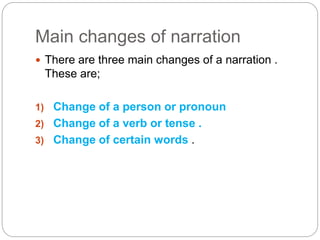
Main changes of narration
 There are three main changes of a narration .
These are;
1) Change of a person or pronoun
2) Change of a verb or tense .
3) Change of certain words .
Change of a person or pronoun
 All Persons of “ first person” will be changed
according to the subject of the “ reporting
Speech” or “reporting verb”.
 All pronouns of “ 2nd person” will be according to
the object of the “ reporting Speech” or “reporting
verb”.
 All pronouns of “ third person” remained
unchanged.
Note :
 The following table is necessary to learn
about the kinds and cases of pronoun.
Pronoun Table
Persons
Subjectiv
e Case
Passive
Case
Objective
Case
Ist person I , We My , Our Me , us
2nd
person You Your You
3rd
person
He , She , It
, They
His , Her,
Their , Its
Him , Her ,
Them ,iT
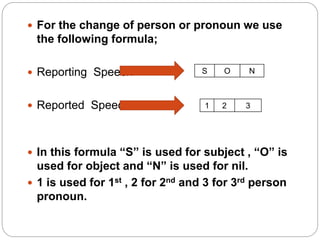
 For the change of person or pronoun we use
the following formula;
 Reporting Speech
 Reported Speech
 In this formula “S” is used for subject , “O” is
used for object and “N” is used for nil.
 1 is used for 1st , 2 for 2nd and 3 for 3rd person
pronoun.
S O N
1 2 3
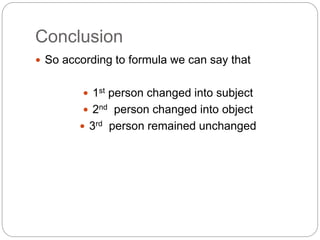
Conclusion
 So according to formula we can say that
 1st person changed into subject
 2nd person changed into object
 3rd person remained unchanged
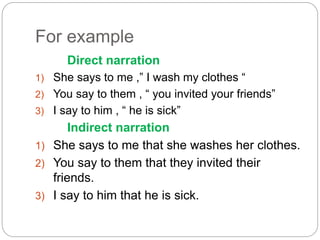
For example
Direct narration
1) She says to me ,” I wash my clothes “
2) You say to them , “ you invited your friends”
3) I say to him , “ he is sick”
Indirect narration
1) She says to me that she washes her clothes.
2) You say to them that they invited their
friends.
3) I say to him that he is sick.
Change of a verb or tense .
 If we have a past tense “ Reporting Speech” then
the verb or tense will be changed.
Present Indefinite Tense Past Indefinite Tense
I’m a teacher He said he was a teacher
Present Continues tense Past Continues Tense
Present Perfect
Continues tense
Past Perfect Continues
Tense
Past Indefinite Tense Past Perfect Tense
Past Perfect Tense
Past Perfect Continues
Tense
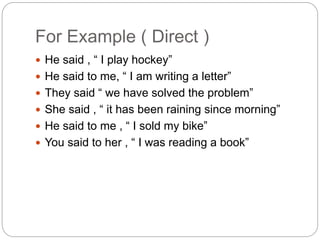
For Example ( Direct )
 He said , “ I play hockey”
 He said to me, “ I am writing a letter”
 They said “ we have solved the problem”
 She said , “ it has been raining since morning”
 He said to me , “ I sold my bike”
 You said to her , “ I was reading a book”
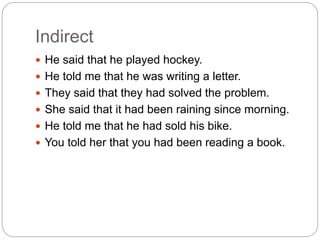
Indirect
 He said that he played hockey.
 He told me that he was writing a letter.
 They said that they had solved the problem.
 She said that it had been raining since morning.
 He told me that he had sold his bike.
 You told her that you had been reading a book.
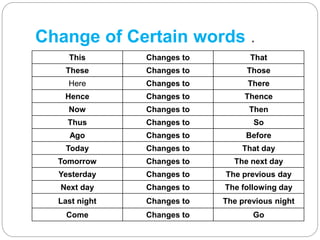
Change of Certain words .
This Changes to That
These Changes to Those
Here Changes to There
Hence Changes to Thence
Now Changes to Then
Thus Changes to So
Ago Changes to Before
Today Changes to That day
Tomorrow Changes to The next day
Yesterday Changes to The previous day
Next day Changes to The following day
Last night Changes to The previous night
Come Changes to Go
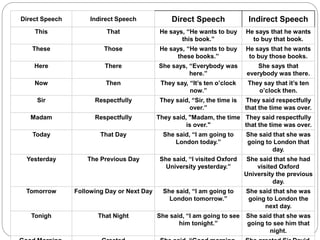
Direct Speech Indirect Speech Direct Speech Indirect Speech
This That He says, “He wants to buy
this book.”
He says that he wants
to buy that book.
These Those He says, “He wants to buy
these books.”
He says that he wants
to buy those books.
Here There She says, “Everybody was
here.”
She says that
everybody was there.
Now Then They say, “It’s ten o’clock
now.”
They say that it’s ten
o’clock then.
Sir Respectfully They said, “Sir, the time is
over.”
They said respectfully
that the time was over.
Madam Respectfully They said, "Madam, the time
is over."
They said respectfully
that the time was over.
Today That Day She said, “I am going to
London today.”
She said that she was
going to London that
day.
Yesterday The Previous Day She said, “I visited Oxford
University yesterday.”
She said that she had
visited Oxford
University the previous
day.
Tomorrow Following Day or Next Day She said, “I am going to
London tomorrow.”
She said that she was
going to London the
next day.
Tonigh That Night She said, “I am going to see
him tonight.”
She said that she was
going to see him that
night.
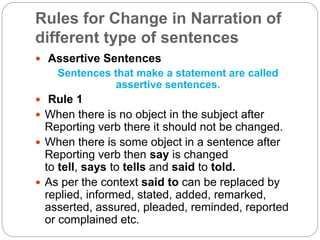
Rules for Change in Narration of
different type of sentences
 Assertive Sentences
Sentences that make a statement are called
assertive sentences.
 Rule 1
 When there is no object in the subject after
Reporting verb there it should not be changed.
 When there is some object in a sentence after
Reporting verb then say is changed
to tell, says to tells and said to told.
 As per the context said to can be replaced by
replied, informed, stated, added, remarked,
asserted, assured, pleaded, reminded, reported
or complained etc.
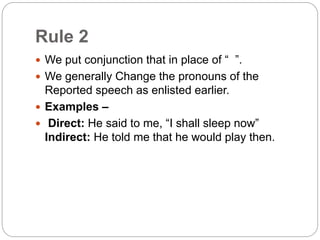
Rule 2
 We put conjunction that in place of “ ”.
 We generally Change the pronouns of the
Reported speech as enlisted earlier.
 Examples –
 Direct: He said to me, “I shall sleep now”
Indirect: He told me that he would play then.
Interrogative Sentences
 Rule 1
 When an interrogative sentence is meant to ask
questions, then reporting verb said/said to is
changed to asked.
 We change Said to into enquired or demanded
Rule 2
 When a question is formed with the help of any of
the helping verbs like is/are/am, was/were,
has/have, do/does, will/would etc then “ __” are
to be replaced by if or whether
 When the question is formed with the help of
words starting with “Wh” like who, whose, what,
whom, when etc (also known as W family) or How
then to replace “___” no conjunction is used.
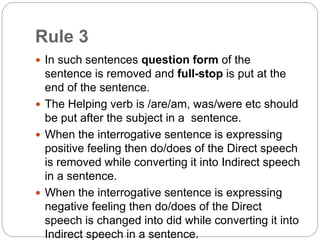
Rule 3
 In such sentences question form of the
sentence is removed and full-stop is put at the
end of the sentence.
 The Helping verb is /are/am, was/were etc should
be put after the subject in a sentence.
 When the interrogative sentence is expressing
positive feeling then do/does of the Direct speech
is removed while converting it into Indirect speech
in a sentence.
 When the interrogative sentence is expressing
negative feeling then do/does of the Direct
speech is changed into did while converting it into
Indirect speech in a sentence.

Direct and indirect

  • 1.
    By Shah Fahad English LanguageTeacher At Sarhad computer College Direct and indirect Narration
  • 2.
    Direct Narration  Whenthe actual words of the speaker are used while conveying a sense is called direct narration .  For Example : She says , ” I am a Teacher” He says , “ I am going to Karachi”
  • 3.
    Indirect Narration  Itis not the actual words of the speaker but it only conveys the full sense of what he / she has said.  For Example : She says that she is a teacher. He said that he is going to Karachi.
  • 4.
    Reporting Speech andreporting verb  The part not enclosed within inverted commas is called reporting speech.  For example : She says He said  The verb of the speech is called reporting verb.  For example Says Said
  • 5.
    Conversion of directinto indirect  Methods :  The commas between the reporting speech and the reported speech is completely disappear.  That is often used between reporting and reported speech .  For Example :  She says , “I am a teacher” ( Direct )  She says that she is a teacher .(indirect)
  • 6.
    Rule 02  Theverb is in the “ reported speech “ is not change if the verb in the reporting speech” is in present or future tense.  For Example :  He says to me “ I am your friend” (Direct )(Present tense)  He says to me that he is my friends .(indirect)(present tense)
  • 7.
    Main changes ofnarration  There are three main changes of a narration . These are; 1) Change of a person or pronoun 2) Change of a verb or tense . 3) Change of certain words .
  • 8.
    Change of aperson or pronoun  All Persons of “ first person” will be changed according to the subject of the “ reporting Speech” or “reporting verb”.  All pronouns of “ 2nd person” will be according to the object of the “ reporting Speech” or “reporting verb”.  All pronouns of “ third person” remained unchanged. Note :  The following table is necessary to learn about the kinds and cases of pronoun.
  • 9.
    Pronoun Table Persons Subjectiv e Case Passive Case Objective Case Istperson I , We My , Our Me , us 2nd person You Your You 3rd person He , She , It , They His , Her, Their , Its Him , Her , Them ,iT
  • 10.
     For thechange of person or pronoun we use the following formula;  Reporting Speech  Reported Speech  In this formula “S” is used for subject , “O” is used for object and “N” is used for nil.  1 is used for 1st , 2 for 2nd and 3 for 3rd person pronoun. S O N 1 2 3
  • 11.
    Conclusion  So accordingto formula we can say that  1st person changed into subject  2nd person changed into object  3rd person remained unchanged
  • 12.
    For example Direct narration 1)She says to me ,” I wash my clothes “ 2) You say to them , “ you invited your friends” 3) I say to him , “ he is sick” Indirect narration 1) She says to me that she washes her clothes. 2) You say to them that they invited their friends. 3) I say to him that he is sick.
  • 13.
    Change of averb or tense .  If we have a past tense “ Reporting Speech” then the verb or tense will be changed. Present Indefinite Tense Past Indefinite Tense I’m a teacher He said he was a teacher Present Continues tense Past Continues Tense Present Perfect Continues tense Past Perfect Continues Tense Past Indefinite Tense Past Perfect Tense Past Perfect Tense Past Perfect Continues Tense
  • 14.
    For Example (Direct )  He said , “ I play hockey”  He said to me, “ I am writing a letter”  They said “ we have solved the problem”  She said , “ it has been raining since morning”  He said to me , “ I sold my bike”  You said to her , “ I was reading a book”
  • 15.
    Indirect  He saidthat he played hockey.  He told me that he was writing a letter.  They said that they had solved the problem.  She said that it had been raining since morning.  He told me that he had sold his bike.  You told her that you had been reading a book.
  • 16.
    Change of Certainwords . This Changes to That These Changes to Those Here Changes to There Hence Changes to Thence Now Changes to Then Thus Changes to So Ago Changes to Before Today Changes to That day Tomorrow Changes to The next day Yesterday Changes to The previous day Next day Changes to The following day Last night Changes to The previous night Come Changes to Go
  • 17.
    Direct Speech IndirectSpeech Direct Speech Indirect Speech This That He says, “He wants to buy this book.” He says that he wants to buy that book. These Those He says, “He wants to buy these books.” He says that he wants to buy those books. Here There She says, “Everybody was here.” She says that everybody was there. Now Then They say, “It’s ten o’clock now.” They say that it’s ten o’clock then. Sir Respectfully They said, “Sir, the time is over.” They said respectfully that the time was over. Madam Respectfully They said, "Madam, the time is over." They said respectfully that the time was over. Today That Day She said, “I am going to London today.” She said that she was going to London that day. Yesterday The Previous Day She said, “I visited Oxford University yesterday.” She said that she had visited Oxford University the previous day. Tomorrow Following Day or Next Day She said, “I am going to London tomorrow.” She said that she was going to London the next day. Tonigh That Night She said, “I am going to see him tonight.” She said that she was going to see him that night.
  • 18.
    Rules for Changein Narration of different type of sentences  Assertive Sentences Sentences that make a statement are called assertive sentences.  Rule 1  When there is no object in the subject after Reporting verb there it should not be changed.  When there is some object in a sentence after Reporting verb then say is changed to tell, says to tells and said to told.  As per the context said to can be replaced by replied, informed, stated, added, remarked, asserted, assured, pleaded, reminded, reported or complained etc.
  • 19.
    Rule 2  Weput conjunction that in place of “ ”.  We generally Change the pronouns of the Reported speech as enlisted earlier.  Examples –  Direct: He said to me, “I shall sleep now” Indirect: He told me that he would play then.
  • 20.
    Interrogative Sentences  Rule1  When an interrogative sentence is meant to ask questions, then reporting verb said/said to is changed to asked.  We change Said to into enquired or demanded
  • 21.
    Rule 2  Whena question is formed with the help of any of the helping verbs like is/are/am, was/were, has/have, do/does, will/would etc then “ __” are to be replaced by if or whether  When the question is formed with the help of words starting with “Wh” like who, whose, what, whom, when etc (also known as W family) or How then to replace “___” no conjunction is used.
  • 22.
    Rule 3  Insuch sentences question form of the sentence is removed and full-stop is put at the end of the sentence.  The Helping verb is /are/am, was/were etc should be put after the subject in a sentence.  When the interrogative sentence is expressing positive feeling then do/does of the Direct speech is removed while converting it into Indirect speech in a sentence.  When the interrogative sentence is expressing negative feeling then do/does of the Direct speech is changed into did while converting it into Indirect speech in a sentence.