“The“
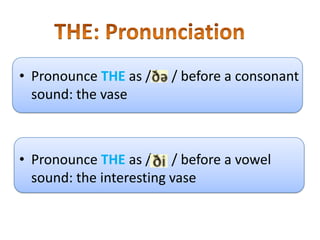
• Pronounce THE as / / before a consonant
sound: the vase
• Pronounce THE as / / before a vowel
sound: the interesting vase
Indefinite
• A and An are indefinite articles. We often use
them before a singular noun the first time we
mention it.
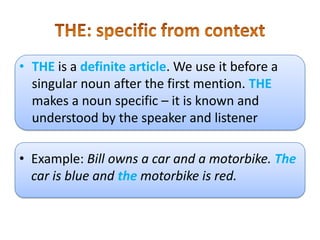
• THE is a definite article. We use it before a
singular noun after the first mention. THE
makes a noun specific – it is known and
understood by the speaker and listener
• Example: Bill owns a car and a motorbike. The
car is blue and the motorbike is red.
Zero Article
• The Zero article means that no article is used.
No article is needed:
1) before uncountable nouns (general reference)
Coffee is vey popular drink.
2) Before plural nouns (general reference)
Dogs are much friendlier than cats.
• A proper noun is the name of a particular
person, place, or thing. A proper noun begins
with a capital letter.
• The ZERO article is often used before proper
nouns: Naran, YouTube, Mongolia
THE for specific
or unique nouns
• Some words make a non specific or unique. If
the noun is specific or unique, we use the
definite article THE.
Examples:
What is on the desk? What is the most
interesting places?
nouns that are unique
Example: the sun, the Earth, etc
the names of newspapers
Example: the Mongol Messenger
cinemas , theatres - the Rex, Opera and Ballet
Theater
theatres museums/art
galleries
- the Louvre
ships the Titanic
organisations the United Nations
• the names of rivers (the Thames),
• groups of islands (the Bahamas),
• mountain ranges (the Alps),
• deserts (the Sahara),
• oceans (the Atlantic),
• canals (the Panama canal),
• countries when they include words such as
States, Kingdom, Republic (the United States of
America),
• names or nouns with of (the Houses of
Parliament), and in geographical terms such as
the Antarctic/Arctic/ equator, the North of
Germany, the North/East/South/West.
• the names of musical instruments and dances
(the guitar, the salsa).
• the names of families (the Jones) and
nationalities ending in -sh, -ch or -ese
• (the Chinese). Other nationalities can be used
with or without the (the Egyptians/Egyptians).
• titles (the Ambassador, the President) but not
with titles including a proper name (Prince
Charles).
• adjectives/adverbs in the superlative form
(the best film I have ever seen) but when most
is followed by a noun
instead of an adjective it doesn't take the.
Most people enjoy going to the theatre.
• the words day, morning, afternoon and
evening.
It was early in the morning and the sun was
starting to rise.
• BUT: at night, at noon, at midnight, by
day/night historical periods/events (the last
Ice Age, the Vietnam War).
• BUT: World War II
• station, cinema, theatre, library, shop, coast,
sea(side), beach, city, country(side), jungle,
world, ground, weather.
They went to the cinema.
Thank you

Definite article the

  • 1.
  • 2.
    • Pronounce THEas / / before a consonant sound: the vase • Pronounce THE as / / before a vowel sound: the interesting vase
  • 3.
    Indefinite • A andAn are indefinite articles. We often use them before a singular noun the first time we mention it.
  • 4.
    • THE isa definite article. We use it before a singular noun after the first mention. THE makes a noun specific – it is known and understood by the speaker and listener • Example: Bill owns a car and a motorbike. The car is blue and the motorbike is red.
  • 5.
  • 6.
    • The Zeroarticle means that no article is used. No article is needed: 1) before uncountable nouns (general reference) Coffee is vey popular drink. 2) Before plural nouns (general reference) Dogs are much friendlier than cats.
  • 7.
    • A propernoun is the name of a particular person, place, or thing. A proper noun begins with a capital letter. • The ZERO article is often used before proper nouns: Naran, YouTube, Mongolia
  • 8.
    THE for specific orunique nouns
  • 9.
    • Some wordsmake a non specific or unique. If the noun is specific or unique, we use the definite article THE. Examples: What is on the desk? What is the most interesting places?
  • 10.
    nouns that areunique Example: the sun, the Earth, etc the names of newspapers Example: the Mongol Messenger cinemas , theatres - the Rex, Opera and Ballet Theater theatres museums/art galleries - the Louvre ships the Titanic organisations the United Nations
  • 11.
    • the namesof rivers (the Thames), • groups of islands (the Bahamas), • mountain ranges (the Alps), • deserts (the Sahara), • oceans (the Atlantic), • canals (the Panama canal), • countries when they include words such as States, Kingdom, Republic (the United States of America),
  • 12.
    • names ornouns with of (the Houses of Parliament), and in geographical terms such as the Antarctic/Arctic/ equator, the North of Germany, the North/East/South/West. • the names of musical instruments and dances (the guitar, the salsa). • the names of families (the Jones) and nationalities ending in -sh, -ch or -ese • (the Chinese). Other nationalities can be used with or without the (the Egyptians/Egyptians).
  • 13.
    • titles (theAmbassador, the President) but not with titles including a proper name (Prince Charles). • adjectives/adverbs in the superlative form (the best film I have ever seen) but when most is followed by a noun instead of an adjective it doesn't take the. Most people enjoy going to the theatre.
  • 14.
    • the wordsday, morning, afternoon and evening. It was early in the morning and the sun was starting to rise.
  • 15.
    • BUT: atnight, at noon, at midnight, by day/night historical periods/events (the last Ice Age, the Vietnam War). • BUT: World War II • station, cinema, theatre, library, shop, coast, sea(side), beach, city, country(side), jungle, world, ground, weather. They went to the cinema.
  • 16.