BACTERIAL
PHARYNGITIS
DIPHTHERIA
2
INTRODUCTION
 Diphtheria - highly infectious childhood disease caused by -
Corynebacterium diphtheria.
 Primarily infects - throat and produces toxin (diphtheria toxin) -
causes an exudative pharyngitis and membranous tonsillitis.
3
INTRODUCTION (CONT..)
 Genus Corynebacterium - gram-
positive, noncapsulated, non-
sporing, non-motile bacillus.
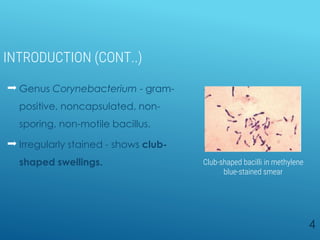
 Irregularly stained - shows club-
shaped swellings.
4
A B
Club-shaped bacilli in methylene
blue-stained smear
INTRODUCTION (CONT..)
 1. Chinese letter or cuneiform
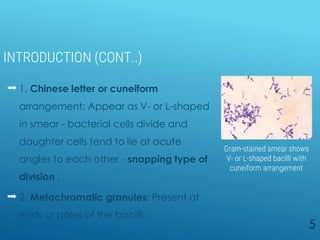
arrangement: Appear as V- or L-shaped
in smear - bacterial cells divide and
daughter cells tend to lie at acute
angles to each other - snapping type of
division .
 2. Metachromatic granules: Present at
ends or poles of the bacilli.
5
A B C
Gram-stained smear shows
V- or L-shaped bacilli with
cuneiform arrangement
METACHROMATIC GRANULES
 Also called polar bodies or Babes–Ernst bodies or volutin
granules).
 Storage granules of the organism, composed of
polymetaphosphates
 Granules - stained strongly gram-positive compared to
remaining part of the bacilli.
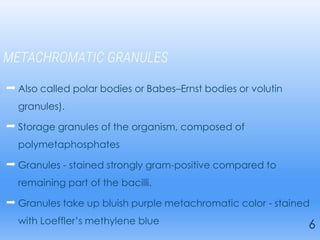
 Granules take up bluish purple metachromatic color - stained
with Loeffler’s methylene blue 6
METACHROMATIC GRANULES (CONT..)
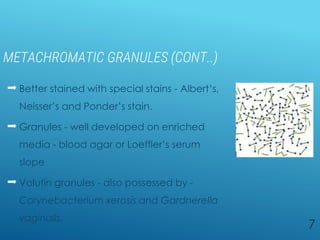
 Better stained with special stains - Albert’s,
Neisser’s and Ponder’s stain.
 Granules - well developed on enriched
media - blood agar or Loeffler’s serum
slope
 Volutin granules - also possessed by -
Corynebacterium xerosis and Gardnerella
vaginalis.
7
A B C
HISTORY
 Ancient disease, known since the time of Hippocrates.
 First recognized by Pierre Bretonneau (1826) - (Greek word
diphtheros— meaning leather like) - leathery
pseudomembrane formation over the tonsil
 First observed by Klebs (1883)
 First cultivated by Loeffler (1884) - Klebs-Loeffler bacillus.
8
VIRULENCE FACTORS (DIPHTHERIA
TOXIN)
 Toxin -polypeptide chain, comprises of two fragments—A
(active) and B (binding)
 Fragment B binds to the host cell receptors - helps in entry of
fragment A
9
MECHANISM OF DIPHTHERIA TOXIN (DT )
 Fragment A -active fragment - causes ADP ribosylation of
elongation factor 2 (EF-2) → leads to inhibition of EF-2 → leads
to inhibition of translation step of protein synthesis.
10
FACTORS REGULATING TOXIN
PRODUCTION
 Phage coded: β-corynephage - carrying tox gene.
 Iron concentration: 0.1 mg per liter
 Other species: Also produced by C. ulcerans and C.
pseudotuberculosis.
11
TOXOID IS USED FOR VACCINATION
 Antigenic and antitoxins are protective in nature. However, as
 It is virulent - cannot be given directly for vaccination.
 Toxin - converted to toxoid - used for vaccination.
 Toxoid - form of toxin – virulence is lost, retaining its antigenicity
12
TOXOID IS USED FOR VACCINATION
(CONT..)
 Toxoid formation - promoted by formalin, acidic pH and
prolonged storage
 Park William 8 strain - preparation of vaccine
 LF unit - Limit of flocculation (Lf) unit.
13
PATHOGENICITY AND CLINICAL
MANIFESTATIONS
 Diphtheria is toxemia but never a bacteremia
 Bacilli are noninvasive - secrete the toxin - spreads via
bloodstream to various organs
 Toxin responsible for all types of manifestations - local
(respiratory) and systemic complications
14
RESPIRATORY DIPHTHERIA
 Most common form of diphtheria.
 Tonsil and pharynx (faucial diphtheria) - most common sites
followed by nose and larynx.
 Incubation period - 3–4 days.
15
RESPIRATORY DIPHTHERIA (CONT..)
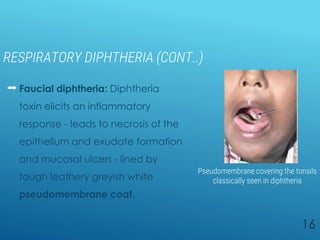
 Faucial diphtheria: Diphtheria
toxin elicits an inflammatory
response - leads to necrosis of the
epithelium and exudate formation
and mucosal ulcers - lined by
tough leathery greyish white
pseudomembrane coat.
16
A B
Pseudomembrane covering the tonsils
classically seen in diphtheria
RESPIRATORY DIPHTHERIA (CONT..)
 Extension of pseudomembrane -
into the larynx and bronchial
airways - asphyxia.
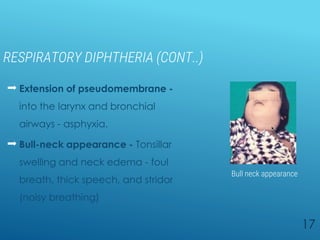
 Bull-neck appearance - Tonsillar
swelling and neck edema - foul
breath, thick speech, and stridor
(noisy breathing)
17
A B
Bull neck appearance
CUTANEOUS DIPHTHERIA
 Punched-out ulcerative lesions with necrosis, due to the
organism itself and is not toxin-mediated.
 Also - caused by nontoxigenic strains.
 Increasing incidence, especially in vaccinated children.
18
SYSTEMIC COMPLICATIONS
 Neurologic manifestations -Toxin mediated non-inflammatory
demyelinating disorder presented with:
 Cranial nerve involvement & Peripheral neuropathy
 Ciliary paralysis
 Myocarditis
 Typically associated with arrhythmias and dilated
cardiomyopathy.
19
LABORATORY DIAGNOSIS OF DIPHTHERIA
 Specimen: Throat swab and a portion of pseudomembrane
 Direct smear
 Gram stain: Club shaped gram-positive bacilli with Chinese
letter arrangement
 Albert’s stain: Green bacilli with bluish black
metachromatic granules
20
LABORATORY DIAGNOSIS OF DIPHTHERIA
(CONT..)
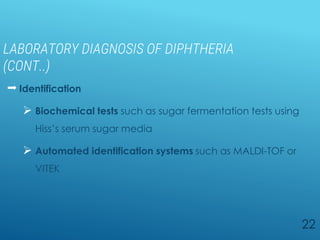
 Culture media
 Enriched medium: Blood
agar, chocolate agar and
Loeffler’s serum slope
 Selective medium: Potassium
tellurite agar and Tinsdale
medium, produces black
colonies
21
A B
A. Loeffler’s serum slope;
B. Potassium tellurite agar shows black
colonies.
LABORATORY DIAGNOSIS OF DIPHTHERIA
(CONT..)
 Identification
 Biochemical tests such as sugar fermentation tests using
Hiss’s serum sugar media
 Automated identification systems such as MALDI-TOF or
VITEK
22
LABORATORY DIAGNOSIS OF DIPHTHERIA
(CONT..)
Diphtheria toxin demonstration
 In vivo tests (Guinea pig inoculation): Subcutaneous and
intracutaneous tests
 In vitro tests:
 Elek’s gel precipitation test
 Detection of tox gene-by PCR
 Detection of toxin-by ELISA or ICT
 Cytotoxicity on cell lines.
23
LABORATORY DIAGNOSIS OF DIPHTHERIA
(CONT..)
Diphtheria toxin demonstration
 In vivo tests (Guinea pig inoculation): Subcutaneous and
intracutaneous tests
 In vitro tests:
 Elek’s gel precipitation test
 Detection of tox gene-by PCR
 Detection of toxin-by ELISA or ICT
 Cytotoxicity on cell lines.
24
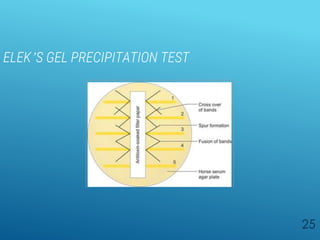
ELEK’S GEL PRECIPITATION TEST
25
ELEK’S GEL PRECIPITATION TEST
(CONT..)
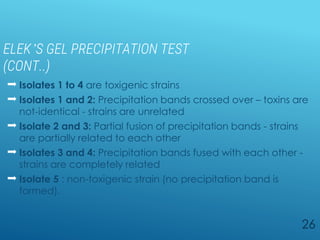
 Isolates 1 to 4 are toxigenic strains
 Isolates 1 and 2: Precipitation bands crossed over – toxins are
not-identical - strains are unrelated
 Isolate 2 and 3: Partial fusion of precipitation bands - strains
are partially related to each other
 Isolates 3 and 4: Precipitation bands fused with each other -
strains are completely related
 Isolate 5 : non-toxigenic strain (no precipitation band is
formed).
26
TYPING OF C. DIPHTHERIAE
 Useful for epidemiological studies, to know the relatedness
between the isolates.
 Biotyping - use in the past - four biotypes —gravis, intermedius,
mitis and belfanti.
 Vary in virulence and toxin production -gravis100% toxigenic
and more virulent.
27
EPIDEMIOLOGY
 Incidence decreasing – widespread vaccination coverage
 Source of infection - Carriers (95%) & cases (5%)
 Carriers (0.1% to 5%)
 Temporary (persist for a month) or chronic (persist for a
year).
 Nasal carriers (more dangerous - frequent shedding) &
throat carriers
28
EPIDEMIOLOGY (CONT..)
 Transmission - respiratory droplets or rarely by contact with
infected skin
 Reservoir - Humans are the only reservoir
 Age - Common age affected - 1–5 years.
 Shift from preschool to school age with immunization
 Newborns - maternal antibodies protective
 Global situation - Due to wide spread immunization, cases
were drastically declined by >95% over last 3 decades.
29
EPIDEMIOLOGY (CONT..)
 Resurgence of diphtheria
 In 2019, outbreaks – Tamil Nadu, Kerala and Karnataka and
few other states
 Majority (>70%) of cases - children 5–10 years or more - low
coverage of diphtheria vaccine especially the booster doses -
primary cause of its resurgence
 Waning immunity in adults - minor cause contributes to adult
diphtheria.
30
TREATMENT OF DIPHTHERIA
 Treatment - started immediately on clinical suspicion of
diphtheria.
 Antidiphtheritic serum or ADS (antitoxin): Passive immunization
- antidiphtheritic horse serum - neutralizes the toxin.
 A test dose should be given to check for hypersensitivity
 It is given either IM or IV and the dose depends on stage of
illness:
31
TREATMENT OF DIPHTHERIA (CONT..)
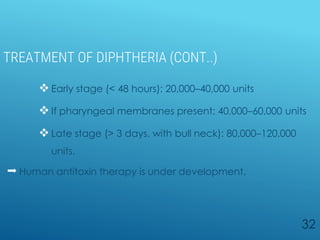
 Early stage (< 48 hours): 20,000–40,000 units
 If pharyngeal membranes present: 40,000–60,000 units
 Late stage (> 3 days, with bull neck): 80,000–120,000
units.
 Human antitoxin therapy is under development.
32
TREATMENT OF DIPHTHERIA (CONT..)
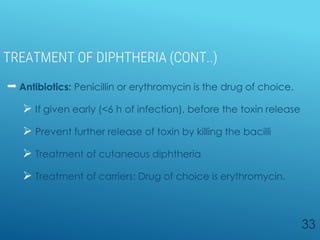
 Antibiotics: Penicillin or erythromycin is the drug of choice.
 If given early (<6 h of infection), before the toxin release
 Prevent further release of toxin by killing the bacilli
 Treatment of cutaneous diphtheria
 Treatment of carriers: Drug of choice is erythromycin.
33
PROPHYLAXIS - POST-EXPOSURE
PROPHYLAXIS
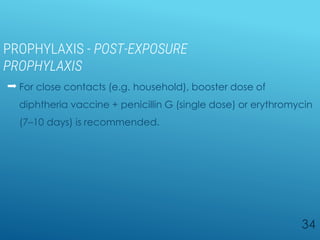
 For close contacts (e.g. household), booster dose of
diphtheria vaccine + penicillin G (single dose) or erythromycin
(7–10 days) is recommended.
34
PROPHYLAXIS - VACCINATION
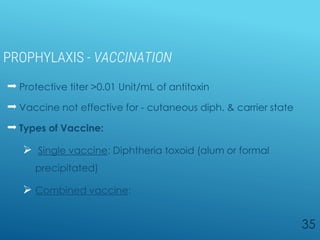
 Protective titer >0.01 Unit/mL of antitoxin
 Vaccine not effective for - cutaneous diph. & carrier state
 Types of Vaccine:
 Single vaccine: Diphtheria toxoid (alum or formal
precipitated)
 Combined vaccine:
35
PROPHYLAXIS – VACCINATION (CONT..)
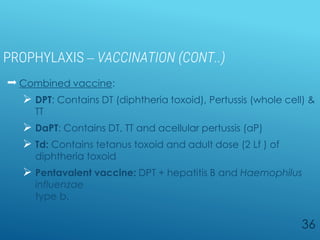
 Combined vaccine:
 DPT: Contains DT (diphtheria toxoid), Pertussis (whole cell) &
TT
 DaPT: Contains DT, TT and acellular pertussis (aP)
 Td: Contains tetanus toxoid and adult dose (2 Lf ) of
diphtheria toxoid
 Pentavalent vaccine: DPT + hepatitis B and Haemophilus
influenzae
type b.
36
PROPHYLAXIS – VACCINATION (CONT..)
 Administration of Diphtheria Vaccine:
 Schedule: Under National Immunization Schedule (NIS) of
India 2020 (Chapter 20, Table 20.4):
 Children: Total seven doses are given.
 Three doses at 6, 10 and 14 weeks of birth
 Booster doses at 16–24 months & 5 years
37
PROPHYLAXIS – VACCINATION (CONT..)
 Site: deep intramuscularly (IM) at anterolateral aspect of thigh
 Thiomersal (0.01%) - preservative
 Storage: - kept at 2–8oC; if accidentally frozen - discarded
 Dose: The usual dose (given to children) - 25 Lf units, adult
dose - 2 Lf units
38
PROPHYLAXIS – VACCINATION (CONT..)
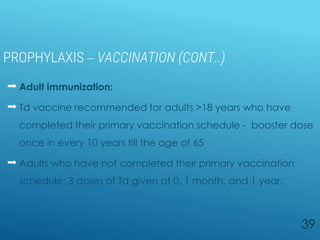
 Adult immunization:
 Td vaccine recommended for adults >18 years who have
completed their primary vaccination schedule - booster dose
once in every 10 years till the age of 65
 Adults who have not completed their primary vaccination
schedule: 3 doses of Td given at 0, 1 month, and 1 year.
39
ADVERSE REACTIONS FOLLOWING DPT
ADMINISTRATION
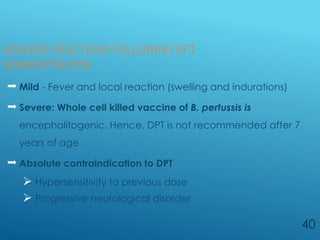
 Mild - Fever and local reaction (swelling and indurations)
 Severe: Whole cell killed vaccine of B. pertussis is
encephalitogenic. Hence, DPT is not recommended after 7
years of age
 Absolute contraindication to DPT
 Hypersensitivity to previous dose
 Progressive neurological disorder
40
DIPHTHEROIDS
41
DIPHTHEROIDS
 Also called – Coryneform bacteria
 Nondiphtherial corynebacteria
 Normal commensals in throat, skin, conjunctiva
 Invasive disease in immunocompromised patients
42
DIPHTHEROIDS (CONT..)
 Differentiated from C. diphtheriae by many
features:
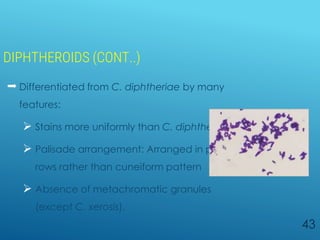
 Stains more uniformly than C. diphtheriae
 Palisade arrangement: Arranged in parallel
rows rather than cuneiform pattern
 Absence of metachromatic granules
(except C. xerosis).
43
DIPHTHEROIDS (CONT..)
Coryneforms that are rarely pathogenic to man are:
 C. ulcerans and C.pseudotuberculosis produce diphtheria
toxin and cause localized ulcerations in throat
 C. ulcerans causes infections in cows. Human infections
may occur through cow's milk
 C. pseudotuberculosis (Preisz–Nocard bacillus) – Animal
pathogen. Human infection very rare.
44
DIPHTHEROIDS (CONT..)
Coryneforms that are rarely pathogenic to man are (Cont..):
 C. Minutissimum:
 Localized infection of skin (axilla and groin) ‘erythrasma’
 Wood’s lamp - emit coral red color
45
DIPHTHEROIDS (CONT..)
Coryneforms that are rarely pathogenic to man are (Cont..):
 C. Jeikeium:
 Lipophilic, colonizes skin of hospitalized patients
 Can cause bacteremia, endocarditis and meningitis,
especially in immunocompromized
 Usually multidrug resistant, responds only to vancomycin
46
DIPHTHEROIDS (CONT..)
Coryneforms that are rarely pathogenic to man are (Cont..):
 C. Urealyticum
 Skin commensal, rarely causes urinary tract infection
(pyelonephritis) & alkaline encrusted cystitis (struvite stones
in alkaline urine) in immunocompromized
47

Diphtheria Bacterial pharyngitis.pptx

  • 1.
  • 2.
  • 3.
    INTRODUCTION  Diphtheria -highly infectious childhood disease caused by - Corynebacterium diphtheria.  Primarily infects - throat and produces toxin (diphtheria toxin) - causes an exudative pharyngitis and membranous tonsillitis. 3
  • 4.
    INTRODUCTION (CONT..)  GenusCorynebacterium - gram- positive, noncapsulated, non- sporing, non-motile bacillus.  Irregularly stained - shows club- shaped swellings. 4 A B Club-shaped bacilli in methylene blue-stained smear
  • 5.
    INTRODUCTION (CONT..)  1.Chinese letter or cuneiform arrangement: Appear as V- or L-shaped in smear - bacterial cells divide and daughter cells tend to lie at acute angles to each other - snapping type of division .  2. Metachromatic granules: Present at ends or poles of the bacilli. 5 A B C Gram-stained smear shows V- or L-shaped bacilli with cuneiform arrangement
  • 6.
    METACHROMATIC GRANULES  Alsocalled polar bodies or Babes–Ernst bodies or volutin granules).  Storage granules of the organism, composed of polymetaphosphates  Granules - stained strongly gram-positive compared to remaining part of the bacilli.  Granules take up bluish purple metachromatic color - stained with Loeffler’s methylene blue 6
  • 7.
    METACHROMATIC GRANULES (CONT..) Better stained with special stains - Albert’s, Neisser’s and Ponder’s stain.  Granules - well developed on enriched media - blood agar or Loeffler’s serum slope  Volutin granules - also possessed by - Corynebacterium xerosis and Gardnerella vaginalis. 7 A B C
  • 8.
    HISTORY  Ancient disease,known since the time of Hippocrates.  First recognized by Pierre Bretonneau (1826) - (Greek word diphtheros— meaning leather like) - leathery pseudomembrane formation over the tonsil  First observed by Klebs (1883)  First cultivated by Loeffler (1884) - Klebs-Loeffler bacillus. 8
  • 9.
    VIRULENCE FACTORS (DIPHTHERIA TOXIN) Toxin -polypeptide chain, comprises of two fragments—A (active) and B (binding)  Fragment B binds to the host cell receptors - helps in entry of fragment A 9
  • 10.
    MECHANISM OF DIPHTHERIATOXIN (DT )  Fragment A -active fragment - causes ADP ribosylation of elongation factor 2 (EF-2) → leads to inhibition of EF-2 → leads to inhibition of translation step of protein synthesis. 10
  • 11.
    FACTORS REGULATING TOXIN PRODUCTION Phage coded: β-corynephage - carrying tox gene.  Iron concentration: 0.1 mg per liter  Other species: Also produced by C. ulcerans and C. pseudotuberculosis. 11
  • 12.
    TOXOID IS USEDFOR VACCINATION  Antigenic and antitoxins are protective in nature. However, as  It is virulent - cannot be given directly for vaccination.  Toxin - converted to toxoid - used for vaccination.  Toxoid - form of toxin – virulence is lost, retaining its antigenicity 12
  • 13.
    TOXOID IS USEDFOR VACCINATION (CONT..)  Toxoid formation - promoted by formalin, acidic pH and prolonged storage  Park William 8 strain - preparation of vaccine  LF unit - Limit of flocculation (Lf) unit. 13
  • 14.
    PATHOGENICITY AND CLINICAL MANIFESTATIONS Diphtheria is toxemia but never a bacteremia  Bacilli are noninvasive - secrete the toxin - spreads via bloodstream to various organs  Toxin responsible for all types of manifestations - local (respiratory) and systemic complications 14
  • 15.
    RESPIRATORY DIPHTHERIA  Mostcommon form of diphtheria.  Tonsil and pharynx (faucial diphtheria) - most common sites followed by nose and larynx.  Incubation period - 3–4 days. 15
  • 16.
    RESPIRATORY DIPHTHERIA (CONT..) Faucial diphtheria: Diphtheria toxin elicits an inflammatory response - leads to necrosis of the epithelium and exudate formation and mucosal ulcers - lined by tough leathery greyish white pseudomembrane coat. 16 A B Pseudomembrane covering the tonsils classically seen in diphtheria
  • 17.
    RESPIRATORY DIPHTHERIA (CONT..) Extension of pseudomembrane - into the larynx and bronchial airways - asphyxia.  Bull-neck appearance - Tonsillar swelling and neck edema - foul breath, thick speech, and stridor (noisy breathing) 17 A B Bull neck appearance
  • 18.
    CUTANEOUS DIPHTHERIA  Punched-outulcerative lesions with necrosis, due to the organism itself and is not toxin-mediated.  Also - caused by nontoxigenic strains.  Increasing incidence, especially in vaccinated children. 18
  • 19.
    SYSTEMIC COMPLICATIONS  Neurologicmanifestations -Toxin mediated non-inflammatory demyelinating disorder presented with:  Cranial nerve involvement & Peripheral neuropathy  Ciliary paralysis  Myocarditis  Typically associated with arrhythmias and dilated cardiomyopathy. 19
  • 20.
    LABORATORY DIAGNOSIS OFDIPHTHERIA  Specimen: Throat swab and a portion of pseudomembrane  Direct smear  Gram stain: Club shaped gram-positive bacilli with Chinese letter arrangement  Albert’s stain: Green bacilli with bluish black metachromatic granules 20
  • 21.
    LABORATORY DIAGNOSIS OFDIPHTHERIA (CONT..)  Culture media  Enriched medium: Blood agar, chocolate agar and Loeffler’s serum slope  Selective medium: Potassium tellurite agar and Tinsdale medium, produces black colonies 21 A B A. Loeffler’s serum slope; B. Potassium tellurite agar shows black colonies.
  • 22.
    LABORATORY DIAGNOSIS OFDIPHTHERIA (CONT..)  Identification  Biochemical tests such as sugar fermentation tests using Hiss’s serum sugar media  Automated identification systems such as MALDI-TOF or VITEK 22
  • 23.
    LABORATORY DIAGNOSIS OFDIPHTHERIA (CONT..) Diphtheria toxin demonstration  In vivo tests (Guinea pig inoculation): Subcutaneous and intracutaneous tests  In vitro tests:  Elek’s gel precipitation test  Detection of tox gene-by PCR  Detection of toxin-by ELISA or ICT  Cytotoxicity on cell lines. 23
  • 24.
    LABORATORY DIAGNOSIS OFDIPHTHERIA (CONT..) Diphtheria toxin demonstration  In vivo tests (Guinea pig inoculation): Subcutaneous and intracutaneous tests  In vitro tests:  Elek’s gel precipitation test  Detection of tox gene-by PCR  Detection of toxin-by ELISA or ICT  Cytotoxicity on cell lines. 24
  • 25.
  • 26.
    ELEK’S GEL PRECIPITATIONTEST (CONT..)  Isolates 1 to 4 are toxigenic strains  Isolates 1 and 2: Precipitation bands crossed over – toxins are not-identical - strains are unrelated  Isolate 2 and 3: Partial fusion of precipitation bands - strains are partially related to each other  Isolates 3 and 4: Precipitation bands fused with each other - strains are completely related  Isolate 5 : non-toxigenic strain (no precipitation band is formed). 26
  • 27.
    TYPING OF C.DIPHTHERIAE  Useful for epidemiological studies, to know the relatedness between the isolates.  Biotyping - use in the past - four biotypes —gravis, intermedius, mitis and belfanti.  Vary in virulence and toxin production -gravis100% toxigenic and more virulent. 27
  • 28.
    EPIDEMIOLOGY  Incidence decreasing– widespread vaccination coverage  Source of infection - Carriers (95%) & cases (5%)  Carriers (0.1% to 5%)  Temporary (persist for a month) or chronic (persist for a year).  Nasal carriers (more dangerous - frequent shedding) & throat carriers 28
  • 29.
    EPIDEMIOLOGY (CONT..)  Transmission- respiratory droplets or rarely by contact with infected skin  Reservoir - Humans are the only reservoir  Age - Common age affected - 1–5 years.  Shift from preschool to school age with immunization  Newborns - maternal antibodies protective  Global situation - Due to wide spread immunization, cases were drastically declined by >95% over last 3 decades. 29
  • 30.
    EPIDEMIOLOGY (CONT..)  Resurgenceof diphtheria  In 2019, outbreaks – Tamil Nadu, Kerala and Karnataka and few other states  Majority (>70%) of cases - children 5–10 years or more - low coverage of diphtheria vaccine especially the booster doses - primary cause of its resurgence  Waning immunity in adults - minor cause contributes to adult diphtheria. 30
  • 31.
    TREATMENT OF DIPHTHERIA Treatment - started immediately on clinical suspicion of diphtheria.  Antidiphtheritic serum or ADS (antitoxin): Passive immunization - antidiphtheritic horse serum - neutralizes the toxin.  A test dose should be given to check for hypersensitivity  It is given either IM or IV and the dose depends on stage of illness: 31
  • 32.
    TREATMENT OF DIPHTHERIA(CONT..)  Early stage (< 48 hours): 20,000–40,000 units  If pharyngeal membranes present: 40,000–60,000 units  Late stage (> 3 days, with bull neck): 80,000–120,000 units.  Human antitoxin therapy is under development. 32
  • 33.
    TREATMENT OF DIPHTHERIA(CONT..)  Antibiotics: Penicillin or erythromycin is the drug of choice.  If given early (<6 h of infection), before the toxin release  Prevent further release of toxin by killing the bacilli  Treatment of cutaneous diphtheria  Treatment of carriers: Drug of choice is erythromycin. 33
  • 34.
    PROPHYLAXIS - POST-EXPOSURE PROPHYLAXIS For close contacts (e.g. household), booster dose of diphtheria vaccine + penicillin G (single dose) or erythromycin (7–10 days) is recommended. 34
  • 35.
    PROPHYLAXIS - VACCINATION Protective titer >0.01 Unit/mL of antitoxin  Vaccine not effective for - cutaneous diph. & carrier state  Types of Vaccine:  Single vaccine: Diphtheria toxoid (alum or formal precipitated)  Combined vaccine: 35
  • 36.
    PROPHYLAXIS – VACCINATION(CONT..)  Combined vaccine:  DPT: Contains DT (diphtheria toxoid), Pertussis (whole cell) & TT  DaPT: Contains DT, TT and acellular pertussis (aP)  Td: Contains tetanus toxoid and adult dose (2 Lf ) of diphtheria toxoid  Pentavalent vaccine: DPT + hepatitis B and Haemophilus influenzae type b. 36
  • 37.
    PROPHYLAXIS – VACCINATION(CONT..)  Administration of Diphtheria Vaccine:  Schedule: Under National Immunization Schedule (NIS) of India 2020 (Chapter 20, Table 20.4):  Children: Total seven doses are given.  Three doses at 6, 10 and 14 weeks of birth  Booster doses at 16–24 months & 5 years 37
  • 38.
    PROPHYLAXIS – VACCINATION(CONT..)  Site: deep intramuscularly (IM) at anterolateral aspect of thigh  Thiomersal (0.01%) - preservative  Storage: - kept at 2–8oC; if accidentally frozen - discarded  Dose: The usual dose (given to children) - 25 Lf units, adult dose - 2 Lf units 38
  • 39.
    PROPHYLAXIS – VACCINATION(CONT..)  Adult immunization:  Td vaccine recommended for adults >18 years who have completed their primary vaccination schedule - booster dose once in every 10 years till the age of 65  Adults who have not completed their primary vaccination schedule: 3 doses of Td given at 0, 1 month, and 1 year. 39
  • 40.
    ADVERSE REACTIONS FOLLOWINGDPT ADMINISTRATION  Mild - Fever and local reaction (swelling and indurations)  Severe: Whole cell killed vaccine of B. pertussis is encephalitogenic. Hence, DPT is not recommended after 7 years of age  Absolute contraindication to DPT  Hypersensitivity to previous dose  Progressive neurological disorder 40
  • 41.
  • 42.
    DIPHTHEROIDS  Also called– Coryneform bacteria  Nondiphtherial corynebacteria  Normal commensals in throat, skin, conjunctiva  Invasive disease in immunocompromised patients 42
  • 43.
    DIPHTHEROIDS (CONT..)  Differentiatedfrom C. diphtheriae by many features:  Stains more uniformly than C. diphtheriae  Palisade arrangement: Arranged in parallel rows rather than cuneiform pattern  Absence of metachromatic granules (except C. xerosis). 43
  • 44.
    DIPHTHEROIDS (CONT..) Coryneforms thatare rarely pathogenic to man are:  C. ulcerans and C.pseudotuberculosis produce diphtheria toxin and cause localized ulcerations in throat  C. ulcerans causes infections in cows. Human infections may occur through cow's milk  C. pseudotuberculosis (Preisz–Nocard bacillus) – Animal pathogen. Human infection very rare. 44
  • 45.
    DIPHTHEROIDS (CONT..) Coryneforms thatare rarely pathogenic to man are (Cont..):  C. Minutissimum:  Localized infection of skin (axilla and groin) ‘erythrasma’  Wood’s lamp - emit coral red color 45
  • 46.
    DIPHTHEROIDS (CONT..) Coryneforms thatare rarely pathogenic to man are (Cont..):  C. Jeikeium:  Lipophilic, colonizes skin of hospitalized patients  Can cause bacteremia, endocarditis and meningitis, especially in immunocompromized  Usually multidrug resistant, responds only to vancomycin 46
  • 47.
    DIPHTHEROIDS (CONT..) Coryneforms thatare rarely pathogenic to man are (Cont..):  C. Urealyticum  Skin commensal, rarely causes urinary tract infection (pyelonephritis) & alkaline encrusted cystitis (struvite stones in alkaline urine) in immunocompromized 47