BACILLUS
Bikram Kumar Das
Systematic Bacteriology
Saturday, May 17, 2014
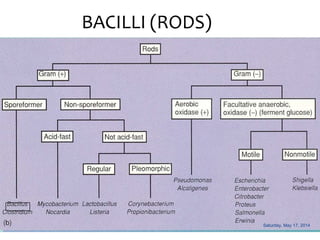
BACILLI (RODS)
Saturday, May 17, 2014
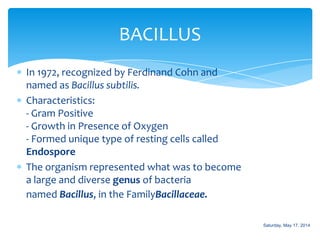
In 1972, recognized by Ferdinand Cohn and
named as Bacillus subtilis.
Characteristics:
- Gram Positive
- Growth in Presence of Oxygen
- Formed unique type of resting cells called
Endospore
The organism represented what was to become
a large and diverse genus of bacteria
named Bacillus, in the FamilyBacillaceae.
BACILLUS
Saturday, May 17, 2014
BACILLUS
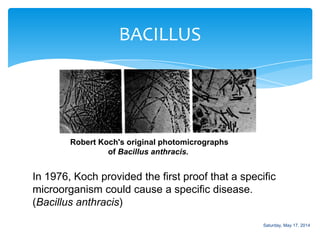
Robert Koch's original photomicrographs
of Bacillus anthracis.
In 1976, Koch provided the first proof that a specific
microorganism could cause a specific disease.
(Bacillus anthracis)
Saturday, May 17, 2014
Introduction
Classification
Structure
Physiology & Pathogenesis and Medical
Importance
Overview
Saturday, May 17, 2014
General Characteristics:
• Strict Aerobic
• Spore forming (Central, Sub - terminal of Terminal)
• Capsulated
• 1 X (3-4) µ in size
• Arranged in long chains
• Spores are resistant to heat.
Introduction
Saturday, May 17, 2014
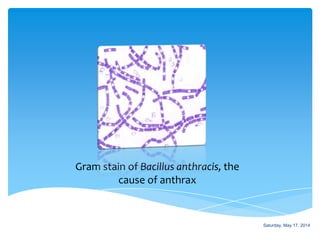
Gram stain of Bacillus anthracis, the
cause of anthrax
Saturday, May 17, 2014
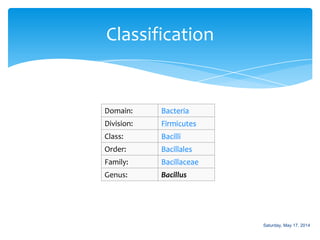
Domain: Bacteria
Division: Firmicutes
Class: Bacilli
Order: Bacillales
Family: Bacillaceae
Genus: Bacillus
Classification
Saturday, May 17, 2014
Early attempts at classification of Bacillus species were
based on two characteristics:
- aerobic growth and
- endospore formation.
Resulted in tethering together many bacteria possessing
different kinds of physiology and occupying a variety of
habitats.
Hence, the heterogeneity in physiology, ecology, and
genetics, made it difficult to categorize the
genus Bacillus or to make generalizations about it.
Classification
Saturday, May 17, 2014
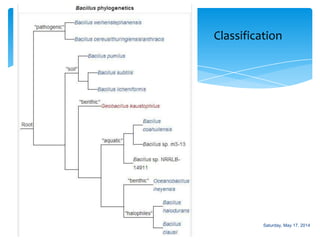
Bacilli includes the Order Bacillales and the
Family Bacillaceae.In this family there 37 new genera on
the level with Bacillus.
The phylogenetic approach to Bacillus taxonomy has been
accomplished largely by analysis of 16S rRNA molecules by
oligonucleotide sequencing.
Surprisingly, Bacillus species showed a kinship with certain
nonsporeforming species, including Enterococcus,
Lactobacillus, and Streptococcus at the Order level, and
Listeria and Staphylococcus at the Family level.
Classification
Saturday, May 17, 2014
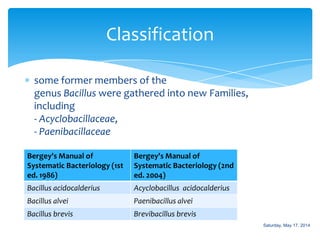
some former members of the
genus Bacillus were gathered into new Families,
including
- Acyclobacillaceae,
- Paenibacillaceae
Classification
Bergey's Manual of
Systematic Bacteriology (1st
ed. 1986)
Bergey's Manual of
Systematic Bacteriology (2nd
ed. 2004)
Bacillus acidocalderius Acyclobacillus acidocalderius
Bacillus alvei Paenibacillus alvei
Bacillus brevis Brevibacillus brevis
Saturday, May 17, 2014
Classification
Saturday, May 17, 2014
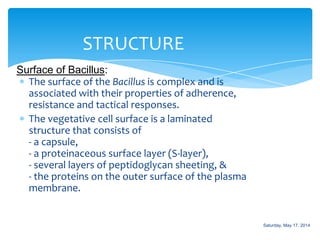
The surface of the Bacillus is complex and is
associated with their properties of adherence,
resistance and tactical responses.
The vegetative cell surface is a laminated
structure that consists of
- a capsule,
- a proteinaceous surface layer (S-layer),
- several layers of peptidoglycan sheeting, &
- the proteins on the outer surface of the plasma
membrane.
STRUCTURE
Surface of Bacillus:
Saturday, May 17, 2014
STRUCTURE
Surface of Bacillus:
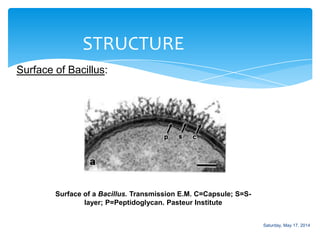
Surface of a Bacillus. Transmission E.M. C=Capsule; S=S-
layer; P=Peptidoglycan. Pasteur Institute
Saturday, May 17, 2014
Crystalline surface layers of protein or glycoprotein
subunits.
As with S-layers of other bacteria, their function in Bacillus is
unknown, but they have been presumed to be involved in
adherence.
It has been demonstrated that the S-layer can physically
mask the negatively charged peptidoglycan sheet in some
Gram-positive bacteria and prevent autoagglutination.
It has also been proposed that the layer may play some role
in bacteria-metal interactions.
STRUCTURE
S-Layer:
Saturday, May 17, 2014
The capsules of many bacilli, including B. anthracis, B.
subtilis, B. megaterium,and B. licheniformis, contain poly-D-
or L-glutamic acid.
Other Bacillus species, e.g., B. circulans, B. megaterium, B.
mycoides and B. pumilus, produce carbohydrate capsules.
Dextran and levan are common, but more complex
polysaccharides are produced, as well.
STRUCTURE
Capsule:
Saturday, May 17, 2014
STRUCTURE
Capsule:
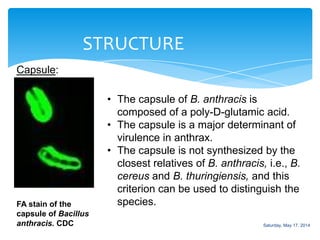
FA stain of the
capsule of Bacillus
anthracis. CDC
• The capsule of B. anthracis is
composed of a poly-D-glutamic acid.
• The capsule is a major determinant of
virulence in anthrax.
• The capsule is not synthesized by the
closest relatives of B. anthracis, i.e., B.
cereus and B. thuringiensis, and this
criterion can be used to distinguish the
species.
Saturday, May 17, 2014
The vegetative cell wall of almost all
Bacillus species is made up of a peptidoglycan
containing meso-diaminopimelic acid (DAP).
(The cell walls of Sporosarcina pasteurii and S.
globisporus, contain lysine in the place of DAP.)
STRUCTURE
Cell wall:
Saturday, May 17, 2014
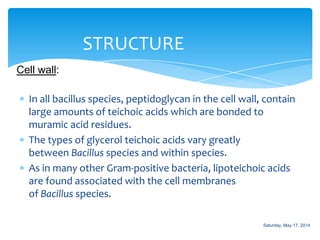
In all bacillus species, peptidoglycan in the cell wall, contain
large amounts of teichoic acids which are bonded to
muramic acid residues.
The types of glycerol teichoic acids vary greatly
between Bacillus species and within species.
As in many other Gram-positive bacteria, lipoteichoic acids
are found associated with the cell membranes
of Bacillus species.
STRUCTURE
Cell wall:
Saturday, May 17, 2014
STRUCTURE
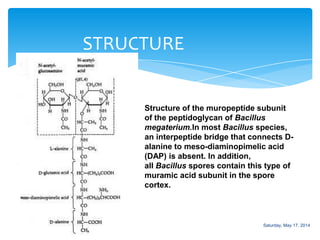
Structure of the muropeptide subunit
of the peptidoglycan of Bacillus
megaterium.In most Bacillus species,
an interpeptide bridge that connects D-
alanine to meso-diaminopimelic acid
(DAP) is absent. In addition,
all Bacillus spores contain this type of
muramic acid subunit in the spore
cortex.
Saturday, May 17, 2014
STRUCTURE
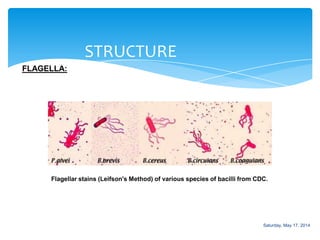
FLAGELLA:
Flagellar stains (Leifson's Method) of various species of bacilli from CDC.
Saturday, May 17, 2014
STRUCTURE
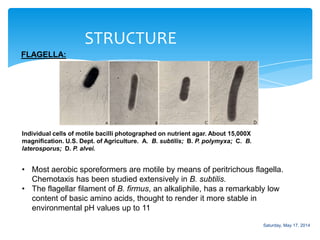
FLAGELLA:
Individual cells of motile bacilli photographed on nutrient agar. About 15,000X
magnification. U.S. Dept. of Agriculture. A. B. subtilis; B. P. polymyxa; C. B.
laterosporus; D. P. alvei.
• Most aerobic sporeformers are motile by means of peritrichous flagella.
Chemotaxis has been studied extensively in B. subtilis.
• The flagellar filament of B. firmus, an alkaliphile, has a remarkably low
content of basic amino acids, thought to render it more stable in
environmental pH values up to 11
Saturday, May 17, 2014
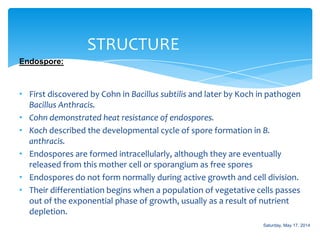
• First discovered by Cohn in Bacillus subtilis and later by Koch in pathogen
Bacillus Anthracis.
• Cohn demonstrated heat resistance of endospores.
• Koch described the developmental cycle of spore formation in B.
anthracis.
• Endospores are formed intracellularly, although they are eventually
released from this mother cell or sporangium as free spores
• Endospores do not form normally during active growth and cell division.
• Their differentiation begins when a population of vegetative cells passes
out of the exponential phase of growth, usually as a result of nutrient
depletion.
STRUCTURE
Endospore:
Saturday, May 17, 2014
Endospores have proven to be the
most durable type of cell found in
Nature, and
In their cryptobiotic state of
dormancy they can remain viable for
extremely long periods of time,
perhaps millions of years
STRUCTURE
Endospore:
Saturday, May 17, 2014
STRUCTURE
Endospore:
Staining:
• When viewed unstained, endospores of living bacilli appear edged in
black and are very bright and refractile.
• Endospores strongly resist application of simple stains or dyes and
hence appear as non-staining entities in Gram-stain preparations.
• Once stained, endospores are quite resistant to decolorization.
• This is the basis of several spore stains such as the Schaeffer-Fulton
staining method which also differentiates the spores from sporangia
and vegetative cells.
Saturday, May 17, 2014
STRUCTURE
Endospore:
Staining:
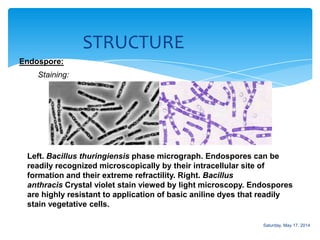
Left. Bacillus thuringiensis phase micrograph. Endospores can be
readily recognized microscopically by their intracellular site of
formation and their extreme refractility. Right. Bacillus
anthracis Crystal violet stain viewed by light microscopy. Endospores
are highly resistant to application of basic aniline dyes that readily
stain vegetative cells.
Saturday, May 17, 2014
STRUCTURE
Endospore:
Staining:
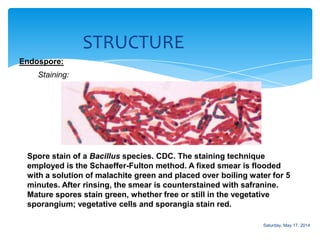
Spore stain of a Bacillus species. CDC. The staining technique
employed is the Schaeffer-Fulton method. A fixed smear is flooded
with a solution of malachite green and placed over boiling water for 5
minutes. After rinsing, the smear is counterstained with safranine.
Mature spores stain green, whether free or still in the vegetative
sporangium; vegetative cells and sporangia stain red.
Saturday, May 17, 2014
STRUCTUREEndospore:
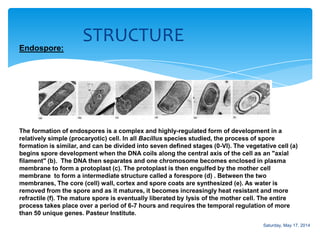
The formation of endospores is a complex and highly-regulated form of development in a
relatively simple (procaryotic) cell. In all Bacillus species studied, the process of spore
formation is similar, and can be divided into seven defined stages (0-VI). The vegetative cell (a)
begins spore development when the DNA coils along the central axis of the cell as an "axial
filament" (b). The DNA then separates and one chromosome becomes enclosed in plasma
membrane to form a protoplast (c). The protoplast is then engulfed by the mother cell
membrane to form a intermediate structure called a forespore (d) . Between the two
membranes, The core (cell) wall, cortex and spore coats are synthesized (e). As water is
removed from the spore and as it matures, it becomes increasingly heat resistant and more
refractile (f). The mature spore is eventually liberated by lysis of the mother cell. The entire
process takes place over a period of 6-7 hours and requires the temporal regulation of more
than 50 unique genes. Pasteur Institute.
Saturday, May 17, 2014
CRYPTOBIOTIC…???
Hint: Mature spores have no detectable metabolism.
Answer: Cryptobiosis is an ametabolic state of life entered by an
organism in response to adverse environmental conditions such as
desiccation, freezing, and oxygen deficiency.
They are highly resistant to environmental stresses such as high
temperature (some endospores can be boiled for several hours and
retain their viability), irradiation, strong acids, disinfectants, etc.
Although cryptobiotic, they retain viability indefinitely such that under
appropriate environmental conditions, they germinate into vegetative
cells.
STRUCTUREEndospore:
Saturday, May 17, 2014
STRUCTURE
Endospore:
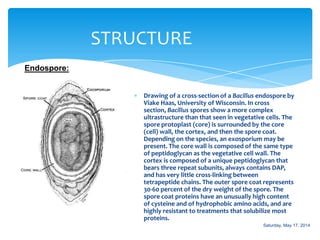
Drawing of a cross-section of a Bacillus endospore by
Viake Haas, University of Wisconsin. In cross
section, Bacillus spores show a more complex
ultrastructure than that seen in vegetative cells. The
spore protoplast (core) is surrounded by the core
(cell) wall, the cortex, and then the spore coat.
Depending on the species, an exosporium may be
present. The core wall is composed of the same type
of peptidoglycan as the vegetative cell wall. The
cortex is composed of a unique peptidoglycan that
bears three repeat subunits, always contains DAP,
and has very little cross-linking between
tetrapeptide chains. The outer spore coat represents
30-60 percent of the dry weight of the spore. The
spore coat proteins have an unusually high content
of cysteine and of hydrophobic amino acids, and are
highly resistant to treatments that solubilize most
proteins.
Saturday, May 17, 2014
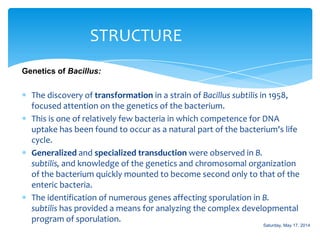
The discovery of transformation in a strain of Bacillus subtilis in 1958,
focused attention on the genetics of the bacterium.
This is one of relatively few bacteria in which competence for DNA
uptake has been found to occur as a natural part of the bacterium's life
cycle.
Generalized and specialized transduction were observed in B.
subtilis, and knowledge of the genetics and chromosomal organization
of the bacterium quickly mounted to become second only to that of the
enteric bacteria.
The identification of numerous genes affecting sporulation in B.
subtilis has provided a means for analyzing the complex developmental
program of sporulation.
STRUCTURE
Genetics of Bacillus:
Saturday, May 17, 2014
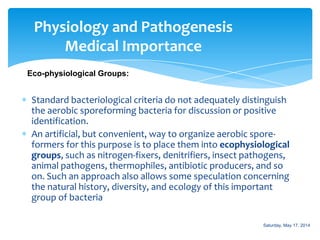
Standard bacteriological criteria do not adequately distinguish
the aerobic sporeforming bacteria for discussion or positive
identification.
An artificial, but convenient, way to organize aerobic spore-
formers for this purpose is to place them into ecophysiological
groups, such as nitrogen-fixers, denitrifiers, insect pathogens,
animal pathogens, thermophiles, antibiotic producers, and so
on. Such an approach also allows some speculation concerning
the natural history, diversity, and ecology of this important
group of bacteria
Physiology and Pathogenesis
Medical Importance
Eco-physiological Groups:
Saturday, May 17, 2014
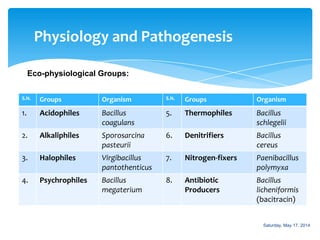
S.N. Groups Organism S.N. Groups Organism
1. Acidophiles Bacillus
coagulans
5. Thermophiles Bacillus
schlegelii
2. Alkaliphiles Sporosarcina
pasteurii
6. Denitrifiers Bacillus
cereus
3. Halophiles Virgibacillus
pantothenticus
7. Nitrogen-fixers Paenibacillus
polymyxa
4. Psychrophiles Bacillus
megaterium
8. Antibiotic
Producers
Bacillus
licheniformis
(bacitracin)
Physiology and Pathogenesis
Eco-physiological Groups:
Saturday, May 17, 2014
Physiology and Pathogenesis
Pathogens of Insects:
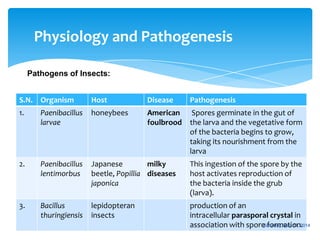
S.N. Organism Host Disease Pathogenesis
1. Paenibacillus
larvae
honeybees American
foulbrood
Spores germinate in the gut of
the larva and the vegetative form
of the bacteria begins to grow,
taking its nourishment from the
larva
2. Paenibacillus
lentimorbus
Japanese
beetle, Popillia
japonica
milky
diseases
This ingestion of the spore by the
host activates reproduction of
the bacteria inside the grub
(larva).
3. Bacillus
thuringiensis
lepidopteran
insects
production of an
intracellular parasporal crystal in
association with spore formation.Saturday, May 17, 2014
Physiology and Pathogenesis
Pathogens of Insects:
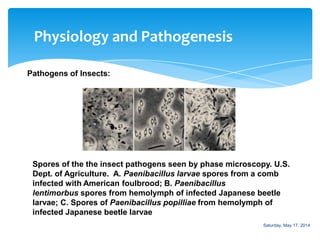
Spores of the the insect pathogens seen by phase microscopy. U.S.
Dept. of Agriculture. A. Paenibacillus larvae spores from a comb
infected with American foulbrood; B. Paenibacillus
lentimorbus spores from hemolymph of infected Japanese beetle
larvae; C. Spores of Paenibacillus popilliae from hemolymph of
infected Japanese beetle larvae
Saturday, May 17, 2014
Physiology and Pathogenesis
Pathogens of Animals & Human:
Bacillus anthracis and B. cereus are the predominant pathogens
of medical importance.
Paenibacillus alvei, B. megaterium, B. coagulans, Brevibacillus
laterosporus, B. subtilis, B. sphaericus, B. circulans, Brevibacillus
brevis, B. licheniformis, P. macerans, B. pumilus and B.
thuringiensis have been occasionally isolated from human
infections.
B. anthracis is the causative agent of anthrax, and B.
cereus causes food poisoning.
Nonanthrax Bacillus species can also cause a wide variety of
other infections, and they are being recognized with increasing
frequency as pathogens in humans. Saturday, May 17, 2014
Physiology and Pathogenesis
Anthrax
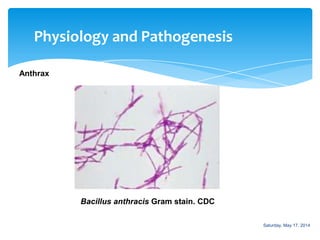
Bacillus anthracis Gram stain. CDC
Saturday, May 17, 2014
Physiology and Pathogenesis
Anthrax
The pathology of anthrax is mediated by two primary
determinants of bacterial virulence: presence of an
anti-phagoytic capsule, which promotes bacterial
invasion, and production of a powerful lethal toxin,
the anthrax toxin.
Bacillus anthracis:
- Non Motile
- Catalase Positive
- Indole Negative
- Endospores are ellipsoidal shaped and located
centrally in the sporangium
Saturday, May 17, 2014
Physiology and Pathogenesis
Anthrax
Anthrax is primarily a disease of domesticated and wild
animals, particularly herbivorous animals, such as cattle,
sheep, horses, mules and goats.
Humans become infected incidentally when brought into
contact with diseased animals, which includes their flesh,
bones, hides, hair and excrement.
In the United States, the incidence of naturally-acquired
anthrax is extremely rare (1-2 cases of cutaneous disease
per year).
Worldwide, the incidence is unknown, although B.
anthracis is present in most of the world's soils.
Saturday, May 17, 2014
Physiology and Pathogenesis
Anthrax
The most common form of the disease in humans is cutaneous anthrax,
which is usually acquired via injured skin or mucous membranes.
A minor scratch or abrasion, usually on an exposed area of the face or
neck or arms, is inoculated by spores from the soil or a contaminated
animal or carcass.
a characteristic gelatinous edema develops at the site
This develops into papule within 12-36 hours after infection
The papule changes rapidly to a vesicle, then to a pustule (malignant
pustule), and finally into a necrotic ulcer, from which infection may
disseminate, giving rise to septicemia.
Lymphatic swelling also occurs within seven days. In severe cases,
where the blood stream is eventually invaded, the disease is frequently
fatal.
Cutaneous Anthrax:
Saturday, May 17, 2014
Physiology and Pathogenesis
Anthrax
results most commonly from inhalation of spore-
containing dust where animal hair or hides are being
handled.
The disease begins abruptly with high fever and chest
pain. It progresses rapidly to a systemic hemorrhagic
pathology and is often fatal if treatment cannot stop
the invasive aspect of the infection.
Inhalation anthrax (woolsorters' disease)
Saturday, May 17, 2014
Physiology and Pathogenesis
Anthrax
This disease is analogous to cutaneous anthrax but occurs on the
intestinal mucosa.
The organisms probably invade the mucosa through a
preexisting lesion.
The bacteria spread from the mucosal lesion to the lymphatic
system
Intestinal anthrax results from the ingestion of poorly cooked
meat from infected animals. Gastrointestinal anthrax is rare but
may occur as explosive outbreaks associated with ingestion of
infected animals
Gastrointestinal anthrax
Saturday, May 17, 2014
Physiology and Pathogenesis
Anthrax
Specimen
Aspirate or swab from cutaneous lesion
Blood culture
Sputum, Fluid, pus.
Laboratory investigation
Gram stain
Culture
Identification of isolate
Diagnosis:
Saturday, May 17, 2014
Physiology and Pathogenesis
Anthrax
• Gram Stained smears from the local lesion or of blood from dead
animals often show chains of large gram-positive rods.
• Anthrax can be identified in dried smears by immunofluorescence
staining techniques. (Spores not seen in smears of exudate).
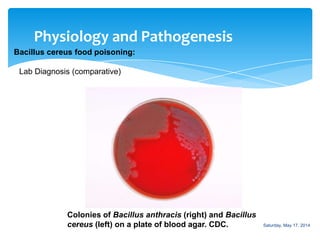
• When grown on blood agar plates, the organisms produce non-
hemolytic gray to white colonies with a rough texture and a ground-
glass appearance.
• Comma-shaped outgrowths (Medusa head) may project from the
colony.
Diagnosis:
Saturday, May 17, 2014
Physiology and Pathogenesis
Anthrax
• Demonstration of capsule requires growth on
bicarbonate-containing medium in 5–7% carbon dioxide.
• An enzyme-linked immunoassay (ELISA) has been
developed to measure antibodies against edema and
lethal toxins, but the test has not been extensively
studied.
• Negative on Gelation hydrolysis, where as other Bacillus
sps are positive.
Diagnosis:
Saturday, May 17, 2014
Physiology and Pathogenesis
Bacillus cereus food poisoning:
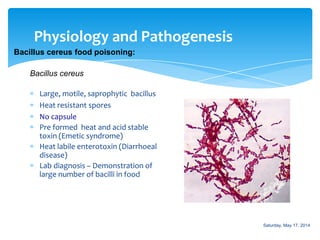
Large, motile, saprophytic bacillus
Heat resistant spores
No capsule
Pre formed heat and acid stable
toxin (Emetic syndrome)
Heat labile enterotoxin (Diarrhoeal
disease)
Lab diagnosis – Demonstration of
large number of bacilli in food
Bacillus cereus
Saturday, May 17, 2014
Physiology and Pathogenesis
Bacillus cereus food poisoning:
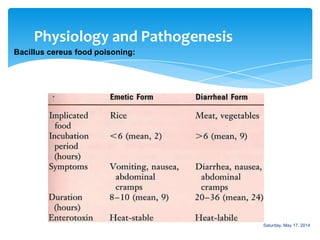
• Bacillus cereus causes two types of food-borne intoxications.
• Emetic Form:
- Characterized by nausea and vomiting and abdominal cramps and has
an incubation period of 1 to 6 hours.
- Resembles Staphylococcus aureus food poisoning in its symptoms and
incubation period (short).
• Diarrheal Form:
- Manifested primarily by abdominal cramps and diarrhea with an
incubation period of 8 to 16 hours.
- Diarrhea may be a small volume or profuse and watery.
- It resembles more food poisoning caused by Clostridium perfringens.
Saturday, May 17, 2014
Physiology and Pathogenesis
Bacillus cereus food poisoning:
Saturday, May 17, 2014
Physiology and Pathogenesis
Bacillus cereus food poisoning:
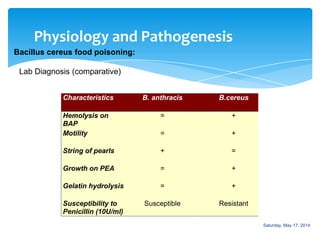
Lab Diagnosis (comparative)
Characteristics B. anthracis B.cereus
Hemolysis on
BAP
= +
Motility = +
String of pearls + =
Growth on PEA = +
Gelatin hydrolysis = +
Susceptibility to
Penicillin (10U/ml)
Susceptible Resistant
Saturday, May 17, 2014
Physiology and Pathogenesis
Bacillus cereus food poisoning:
Lab Diagnosis (comparative)
Colonies of Bacillus anthracis (right) and Bacillus
cereus (left) on a plate of blood agar. CDC. Saturday, May 17, 2014
http://textbookofbacteriology.net/
Slideshare
Google
Wikipedia
References
Saturday, May 17, 2014

Bacteriology: Bacillus

  • 1.
    BACILLUS Bikram Kumar Das SystematicBacteriology Saturday, May 17, 2014
  • 2.
  • 3.
    In 1972, recognizedby Ferdinand Cohn and named as Bacillus subtilis. Characteristics: - Gram Positive - Growth in Presence of Oxygen - Formed unique type of resting cells called Endospore The organism represented what was to become a large and diverse genus of bacteria named Bacillus, in the FamilyBacillaceae. BACILLUS Saturday, May 17, 2014
  • 4.
    BACILLUS Robert Koch's originalphotomicrographs of Bacillus anthracis. In 1976, Koch provided the first proof that a specific microorganism could cause a specific disease. (Bacillus anthracis) Saturday, May 17, 2014
  • 5.
    Introduction Classification Structure Physiology & Pathogenesisand Medical Importance Overview Saturday, May 17, 2014
  • 6.
    General Characteristics: • StrictAerobic • Spore forming (Central, Sub - terminal of Terminal) • Capsulated • 1 X (3-4) µ in size • Arranged in long chains • Spores are resistant to heat. Introduction Saturday, May 17, 2014
  • 7.
    Gram stain ofBacillus anthracis, the cause of anthrax Saturday, May 17, 2014
  • 8.
    Domain: Bacteria Division: Firmicutes Class:Bacilli Order: Bacillales Family: Bacillaceae Genus: Bacillus Classification Saturday, May 17, 2014
  • 9.
    Early attempts atclassification of Bacillus species were based on two characteristics: - aerobic growth and - endospore formation. Resulted in tethering together many bacteria possessing different kinds of physiology and occupying a variety of habitats. Hence, the heterogeneity in physiology, ecology, and genetics, made it difficult to categorize the genus Bacillus or to make generalizations about it. Classification Saturday, May 17, 2014
  • 10.
    Bacilli includes theOrder Bacillales and the Family Bacillaceae.In this family there 37 new genera on the level with Bacillus. The phylogenetic approach to Bacillus taxonomy has been accomplished largely by analysis of 16S rRNA molecules by oligonucleotide sequencing. Surprisingly, Bacillus species showed a kinship with certain nonsporeforming species, including Enterococcus, Lactobacillus, and Streptococcus at the Order level, and Listeria and Staphylococcus at the Family level. Classification Saturday, May 17, 2014
  • 11.
    some former membersof the genus Bacillus were gathered into new Families, including - Acyclobacillaceae, - Paenibacillaceae Classification Bergey's Manual of Systematic Bacteriology (1st ed. 1986) Bergey's Manual of Systematic Bacteriology (2nd ed. 2004) Bacillus acidocalderius Acyclobacillus acidocalderius Bacillus alvei Paenibacillus alvei Bacillus brevis Brevibacillus brevis Saturday, May 17, 2014
  • 12.
  • 13.
    The surface ofthe Bacillus is complex and is associated with their properties of adherence, resistance and tactical responses. The vegetative cell surface is a laminated structure that consists of - a capsule, - a proteinaceous surface layer (S-layer), - several layers of peptidoglycan sheeting, & - the proteins on the outer surface of the plasma membrane. STRUCTURE Surface of Bacillus: Saturday, May 17, 2014
  • 14.
    STRUCTURE Surface of Bacillus: Surfaceof a Bacillus. Transmission E.M. C=Capsule; S=S- layer; P=Peptidoglycan. Pasteur Institute Saturday, May 17, 2014
  • 15.
    Crystalline surface layersof protein or glycoprotein subunits. As with S-layers of other bacteria, their function in Bacillus is unknown, but they have been presumed to be involved in adherence. It has been demonstrated that the S-layer can physically mask the negatively charged peptidoglycan sheet in some Gram-positive bacteria and prevent autoagglutination. It has also been proposed that the layer may play some role in bacteria-metal interactions. STRUCTURE S-Layer: Saturday, May 17, 2014
  • 16.
    The capsules ofmany bacilli, including B. anthracis, B. subtilis, B. megaterium,and B. licheniformis, contain poly-D- or L-glutamic acid. Other Bacillus species, e.g., B. circulans, B. megaterium, B. mycoides and B. pumilus, produce carbohydrate capsules. Dextran and levan are common, but more complex polysaccharides are produced, as well. STRUCTURE Capsule: Saturday, May 17, 2014
  • 17.
    STRUCTURE Capsule: FA stain ofthe capsule of Bacillus anthracis. CDC • The capsule of B. anthracis is composed of a poly-D-glutamic acid. • The capsule is a major determinant of virulence in anthrax. • The capsule is not synthesized by the closest relatives of B. anthracis, i.e., B. cereus and B. thuringiensis, and this criterion can be used to distinguish the species. Saturday, May 17, 2014
  • 18.
    The vegetative cellwall of almost all Bacillus species is made up of a peptidoglycan containing meso-diaminopimelic acid (DAP). (The cell walls of Sporosarcina pasteurii and S. globisporus, contain lysine in the place of DAP.) STRUCTURE Cell wall: Saturday, May 17, 2014
  • 19.
    In all bacillusspecies, peptidoglycan in the cell wall, contain large amounts of teichoic acids which are bonded to muramic acid residues. The types of glycerol teichoic acids vary greatly between Bacillus species and within species. As in many other Gram-positive bacteria, lipoteichoic acids are found associated with the cell membranes of Bacillus species. STRUCTURE Cell wall: Saturday, May 17, 2014
  • 20.
    STRUCTURE Structure of themuropeptide subunit of the peptidoglycan of Bacillus megaterium.In most Bacillus species, an interpeptide bridge that connects D- alanine to meso-diaminopimelic acid (DAP) is absent. In addition, all Bacillus spores contain this type of muramic acid subunit in the spore cortex. Saturday, May 17, 2014
  • 21.
    STRUCTURE FLAGELLA: Flagellar stains (Leifson'sMethod) of various species of bacilli from CDC. Saturday, May 17, 2014
  • 22.
    STRUCTURE FLAGELLA: Individual cells ofmotile bacilli photographed on nutrient agar. About 15,000X magnification. U.S. Dept. of Agriculture. A. B. subtilis; B. P. polymyxa; C. B. laterosporus; D. P. alvei. • Most aerobic sporeformers are motile by means of peritrichous flagella. Chemotaxis has been studied extensively in B. subtilis. • The flagellar filament of B. firmus, an alkaliphile, has a remarkably low content of basic amino acids, thought to render it more stable in environmental pH values up to 11 Saturday, May 17, 2014
  • 23.
    • First discoveredby Cohn in Bacillus subtilis and later by Koch in pathogen Bacillus Anthracis. • Cohn demonstrated heat resistance of endospores. • Koch described the developmental cycle of spore formation in B. anthracis. • Endospores are formed intracellularly, although they are eventually released from this mother cell or sporangium as free spores • Endospores do not form normally during active growth and cell division. • Their differentiation begins when a population of vegetative cells passes out of the exponential phase of growth, usually as a result of nutrient depletion. STRUCTURE Endospore: Saturday, May 17, 2014
  • 24.
    Endospores have provento be the most durable type of cell found in Nature, and In their cryptobiotic state of dormancy they can remain viable for extremely long periods of time, perhaps millions of years STRUCTURE Endospore: Saturday, May 17, 2014
  • 25.
    STRUCTURE Endospore: Staining: • When viewedunstained, endospores of living bacilli appear edged in black and are very bright and refractile. • Endospores strongly resist application of simple stains or dyes and hence appear as non-staining entities in Gram-stain preparations. • Once stained, endospores are quite resistant to decolorization. • This is the basis of several spore stains such as the Schaeffer-Fulton staining method which also differentiates the spores from sporangia and vegetative cells. Saturday, May 17, 2014
  • 26.
    STRUCTURE Endospore: Staining: Left. Bacillus thuringiensisphase micrograph. Endospores can be readily recognized microscopically by their intracellular site of formation and their extreme refractility. Right. Bacillus anthracis Crystal violet stain viewed by light microscopy. Endospores are highly resistant to application of basic aniline dyes that readily stain vegetative cells. Saturday, May 17, 2014
  • 27.
    STRUCTURE Endospore: Staining: Spore stain ofa Bacillus species. CDC. The staining technique employed is the Schaeffer-Fulton method. A fixed smear is flooded with a solution of malachite green and placed over boiling water for 5 minutes. After rinsing, the smear is counterstained with safranine. Mature spores stain green, whether free or still in the vegetative sporangium; vegetative cells and sporangia stain red. Saturday, May 17, 2014
  • 28.
    STRUCTUREEndospore: The formation ofendospores is a complex and highly-regulated form of development in a relatively simple (procaryotic) cell. In all Bacillus species studied, the process of spore formation is similar, and can be divided into seven defined stages (0-VI). The vegetative cell (a) begins spore development when the DNA coils along the central axis of the cell as an "axial filament" (b). The DNA then separates and one chromosome becomes enclosed in plasma membrane to form a protoplast (c). The protoplast is then engulfed by the mother cell membrane to form a intermediate structure called a forespore (d) . Between the two membranes, The core (cell) wall, cortex and spore coats are synthesized (e). As water is removed from the spore and as it matures, it becomes increasingly heat resistant and more refractile (f). The mature spore is eventually liberated by lysis of the mother cell. The entire process takes place over a period of 6-7 hours and requires the temporal regulation of more than 50 unique genes. Pasteur Institute. Saturday, May 17, 2014
  • 29.
    CRYPTOBIOTIC…??? Hint: Mature sporeshave no detectable metabolism. Answer: Cryptobiosis is an ametabolic state of life entered by an organism in response to adverse environmental conditions such as desiccation, freezing, and oxygen deficiency. They are highly resistant to environmental stresses such as high temperature (some endospores can be boiled for several hours and retain their viability), irradiation, strong acids, disinfectants, etc. Although cryptobiotic, they retain viability indefinitely such that under appropriate environmental conditions, they germinate into vegetative cells. STRUCTUREEndospore: Saturday, May 17, 2014
  • 30.
    STRUCTURE Endospore: Drawing of across-section of a Bacillus endospore by Viake Haas, University of Wisconsin. In cross section, Bacillus spores show a more complex ultrastructure than that seen in vegetative cells. The spore protoplast (core) is surrounded by the core (cell) wall, the cortex, and then the spore coat. Depending on the species, an exosporium may be present. The core wall is composed of the same type of peptidoglycan as the vegetative cell wall. The cortex is composed of a unique peptidoglycan that bears three repeat subunits, always contains DAP, and has very little cross-linking between tetrapeptide chains. The outer spore coat represents 30-60 percent of the dry weight of the spore. The spore coat proteins have an unusually high content of cysteine and of hydrophobic amino acids, and are highly resistant to treatments that solubilize most proteins. Saturday, May 17, 2014
  • 31.
    The discovery oftransformation in a strain of Bacillus subtilis in 1958, focused attention on the genetics of the bacterium. This is one of relatively few bacteria in which competence for DNA uptake has been found to occur as a natural part of the bacterium's life cycle. Generalized and specialized transduction were observed in B. subtilis, and knowledge of the genetics and chromosomal organization of the bacterium quickly mounted to become second only to that of the enteric bacteria. The identification of numerous genes affecting sporulation in B. subtilis has provided a means for analyzing the complex developmental program of sporulation. STRUCTURE Genetics of Bacillus: Saturday, May 17, 2014
  • 32.
    Standard bacteriological criteriado not adequately distinguish the aerobic sporeforming bacteria for discussion or positive identification. An artificial, but convenient, way to organize aerobic spore- formers for this purpose is to place them into ecophysiological groups, such as nitrogen-fixers, denitrifiers, insect pathogens, animal pathogens, thermophiles, antibiotic producers, and so on. Such an approach also allows some speculation concerning the natural history, diversity, and ecology of this important group of bacteria Physiology and Pathogenesis Medical Importance Eco-physiological Groups: Saturday, May 17, 2014
  • 33.
    S.N. Groups OrganismS.N. Groups Organism 1. Acidophiles Bacillus coagulans 5. Thermophiles Bacillus schlegelii 2. Alkaliphiles Sporosarcina pasteurii 6. Denitrifiers Bacillus cereus 3. Halophiles Virgibacillus pantothenticus 7. Nitrogen-fixers Paenibacillus polymyxa 4. Psychrophiles Bacillus megaterium 8. Antibiotic Producers Bacillus licheniformis (bacitracin) Physiology and Pathogenesis Eco-physiological Groups: Saturday, May 17, 2014
  • 34.
    Physiology and Pathogenesis Pathogensof Insects: S.N. Organism Host Disease Pathogenesis 1. Paenibacillus larvae honeybees American foulbrood Spores germinate in the gut of the larva and the vegetative form of the bacteria begins to grow, taking its nourishment from the larva 2. Paenibacillus lentimorbus Japanese beetle, Popillia japonica milky diseases This ingestion of the spore by the host activates reproduction of the bacteria inside the grub (larva). 3. Bacillus thuringiensis lepidopteran insects production of an intracellular parasporal crystal in association with spore formation.Saturday, May 17, 2014
  • 35.
    Physiology and Pathogenesis Pathogensof Insects: Spores of the the insect pathogens seen by phase microscopy. U.S. Dept. of Agriculture. A. Paenibacillus larvae spores from a comb infected with American foulbrood; B. Paenibacillus lentimorbus spores from hemolymph of infected Japanese beetle larvae; C. Spores of Paenibacillus popilliae from hemolymph of infected Japanese beetle larvae Saturday, May 17, 2014
  • 36.
    Physiology and Pathogenesis Pathogensof Animals & Human: Bacillus anthracis and B. cereus are the predominant pathogens of medical importance. Paenibacillus alvei, B. megaterium, B. coagulans, Brevibacillus laterosporus, B. subtilis, B. sphaericus, B. circulans, Brevibacillus brevis, B. licheniformis, P. macerans, B. pumilus and B. thuringiensis have been occasionally isolated from human infections. B. anthracis is the causative agent of anthrax, and B. cereus causes food poisoning. Nonanthrax Bacillus species can also cause a wide variety of other infections, and they are being recognized with increasing frequency as pathogens in humans. Saturday, May 17, 2014
  • 37.
    Physiology and Pathogenesis Anthrax Bacillusanthracis Gram stain. CDC Saturday, May 17, 2014
  • 38.
    Physiology and Pathogenesis Anthrax Thepathology of anthrax is mediated by two primary determinants of bacterial virulence: presence of an anti-phagoytic capsule, which promotes bacterial invasion, and production of a powerful lethal toxin, the anthrax toxin. Bacillus anthracis: - Non Motile - Catalase Positive - Indole Negative - Endospores are ellipsoidal shaped and located centrally in the sporangium Saturday, May 17, 2014
  • 39.
    Physiology and Pathogenesis Anthrax Anthraxis primarily a disease of domesticated and wild animals, particularly herbivorous animals, such as cattle, sheep, horses, mules and goats. Humans become infected incidentally when brought into contact with diseased animals, which includes their flesh, bones, hides, hair and excrement. In the United States, the incidence of naturally-acquired anthrax is extremely rare (1-2 cases of cutaneous disease per year). Worldwide, the incidence is unknown, although B. anthracis is present in most of the world's soils. Saturday, May 17, 2014
  • 40.
    Physiology and Pathogenesis Anthrax Themost common form of the disease in humans is cutaneous anthrax, which is usually acquired via injured skin or mucous membranes. A minor scratch or abrasion, usually on an exposed area of the face or neck or arms, is inoculated by spores from the soil or a contaminated animal or carcass. a characteristic gelatinous edema develops at the site This develops into papule within 12-36 hours after infection The papule changes rapidly to a vesicle, then to a pustule (malignant pustule), and finally into a necrotic ulcer, from which infection may disseminate, giving rise to septicemia. Lymphatic swelling also occurs within seven days. In severe cases, where the blood stream is eventually invaded, the disease is frequently fatal. Cutaneous Anthrax: Saturday, May 17, 2014
  • 41.
    Physiology and Pathogenesis Anthrax resultsmost commonly from inhalation of spore- containing dust where animal hair or hides are being handled. The disease begins abruptly with high fever and chest pain. It progresses rapidly to a systemic hemorrhagic pathology and is often fatal if treatment cannot stop the invasive aspect of the infection. Inhalation anthrax (woolsorters' disease) Saturday, May 17, 2014
  • 42.
    Physiology and Pathogenesis Anthrax Thisdisease is analogous to cutaneous anthrax but occurs on the intestinal mucosa. The organisms probably invade the mucosa through a preexisting lesion. The bacteria spread from the mucosal lesion to the lymphatic system Intestinal anthrax results from the ingestion of poorly cooked meat from infected animals. Gastrointestinal anthrax is rare but may occur as explosive outbreaks associated with ingestion of infected animals Gastrointestinal anthrax Saturday, May 17, 2014
  • 43.
    Physiology and Pathogenesis Anthrax Specimen Aspirateor swab from cutaneous lesion Blood culture Sputum, Fluid, pus. Laboratory investigation Gram stain Culture Identification of isolate Diagnosis: Saturday, May 17, 2014
  • 44.
    Physiology and Pathogenesis Anthrax •Gram Stained smears from the local lesion or of blood from dead animals often show chains of large gram-positive rods. • Anthrax can be identified in dried smears by immunofluorescence staining techniques. (Spores not seen in smears of exudate). • When grown on blood agar plates, the organisms produce non- hemolytic gray to white colonies with a rough texture and a ground- glass appearance. • Comma-shaped outgrowths (Medusa head) may project from the colony. Diagnosis: Saturday, May 17, 2014
  • 45.
    Physiology and Pathogenesis Anthrax •Demonstration of capsule requires growth on bicarbonate-containing medium in 5–7% carbon dioxide. • An enzyme-linked immunoassay (ELISA) has been developed to measure antibodies against edema and lethal toxins, but the test has not been extensively studied. • Negative on Gelation hydrolysis, where as other Bacillus sps are positive. Diagnosis: Saturday, May 17, 2014
  • 46.
    Physiology and Pathogenesis Bacilluscereus food poisoning: Large, motile, saprophytic bacillus Heat resistant spores No capsule Pre formed heat and acid stable toxin (Emetic syndrome) Heat labile enterotoxin (Diarrhoeal disease) Lab diagnosis – Demonstration of large number of bacilli in food Bacillus cereus Saturday, May 17, 2014
  • 47.
    Physiology and Pathogenesis Bacilluscereus food poisoning: • Bacillus cereus causes two types of food-borne intoxications. • Emetic Form: - Characterized by nausea and vomiting and abdominal cramps and has an incubation period of 1 to 6 hours. - Resembles Staphylococcus aureus food poisoning in its symptoms and incubation period (short). • Diarrheal Form: - Manifested primarily by abdominal cramps and diarrhea with an incubation period of 8 to 16 hours. - Diarrhea may be a small volume or profuse and watery. - It resembles more food poisoning caused by Clostridium perfringens. Saturday, May 17, 2014
  • 48.
    Physiology and Pathogenesis Bacilluscereus food poisoning: Saturday, May 17, 2014
  • 49.
    Physiology and Pathogenesis Bacilluscereus food poisoning: Lab Diagnosis (comparative) Characteristics B. anthracis B.cereus Hemolysis on BAP = + Motility = + String of pearls + = Growth on PEA = + Gelatin hydrolysis = + Susceptibility to Penicillin (10U/ml) Susceptible Resistant Saturday, May 17, 2014
  • 50.
    Physiology and Pathogenesis Bacilluscereus food poisoning: Lab Diagnosis (comparative) Colonies of Bacillus anthracis (right) and Bacillus cereus (left) on a plate of blood agar. CDC. Saturday, May 17, 2014
  • 51.