Chapter- 2
Digital Image Fundamentals
Motilal Nehru National Institute of Technology
Allahabad
1
Dr.Basant Kumar
Motilal Nehru National Institute of Technology, Allahabad
Digital Image Processing, 3rd ed.
Gonzalez & Woods
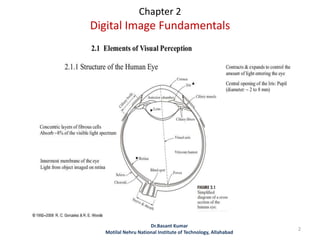
Chapter 2
Digital Image Fundamentals
Dr.Basant Kumar
Motilal Nehru National Institute of Technology, Allahabad
2
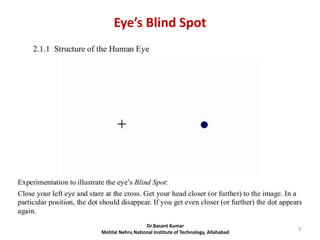
Eye’s Blind Spot
Dr.Basant Kumar
Motilal Nehru National Institute of Technology, Allahabad
3
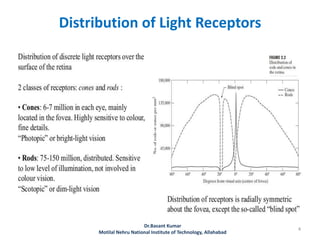
Distribution of Light Receptors
Dr.Basant Kumar
Motilal Nehru National Institute of Technology, Allahabad
4
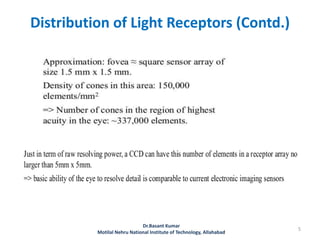
Distribution of Light Receptors (Contd.)
Dr.Basant Kumar
Motilal Nehru National Institute of Technology, Allahabad
5
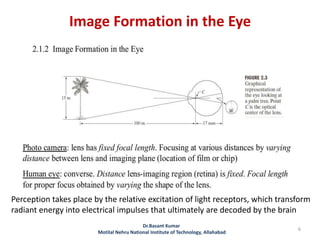
Image Formation in the Eye
Dr.Basant Kumar
Motilal Nehru National Institute of Technology, Allahabad
6
Perception takes place by the relative excitation of light receptors, which transform
radiant energy into electrical impulses that ultimately are decoded by the brain
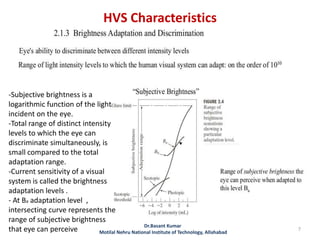
HVS Characteristics
Dr.Basant Kumar
Motilal Nehru National Institute of Technology, Allahabad
7
-Subjective brightness is a
logarithmic function of the light
incident on the eye.
-Total range of distinct intensity
levels to which the eye can
discriminate simultaneously, is
small compared to the total
adaptation range.
-Current sensitivity of a visual
system is called the brightness
adaptation levels .
- At Ba adaptation level ,
intersecting curve represents the
range of subjective brightness
that eye can perceive
Brightness Discrimination
Dr.Basant Kumar
Motilal Nehru National Institute of Technology, Allahabad
8
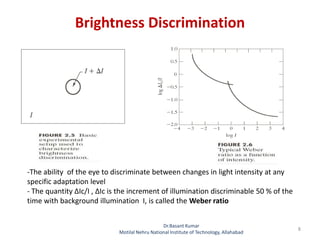
-The ability of the eye to discriminate between changes in light intensity at any
specific adaptation level
- The quantity ∆Ic/I , ∆Ic is the increment of illumination discriminable 50 % of the
time with background illumination I, is called the Weber ratio
Brightness Discrimination
Dr.Basant Kumar
Motilal Nehru National Institute of Technology, Allahabad 9
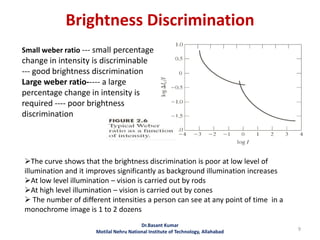
Small weber ratio --- small percentage
change in intensity is discriminable
--- good brightness discrimination
Large weber ratio----- a large
percentage change in intensity is
required ---- poor brightness
discrimination
The curve shows that the brightness discrimination is poor at low level of
illumination and it improves significantly as background illumination increases
At low level illumination – vision is carried out by rods
At high level illumination – vision is carried out by cones
 The number of different intensities a person can see at any point of time in a
monochrome image is 1 to 2 dozens
Visual Perception
Perceived brightness is not a simple function of intensity
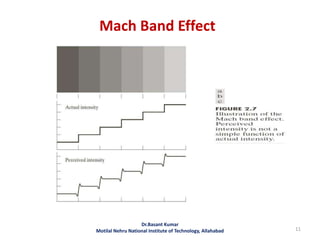
• Mach bands: visual system tends to undershoot or
overshoot around the boundary of regions of
different intensities
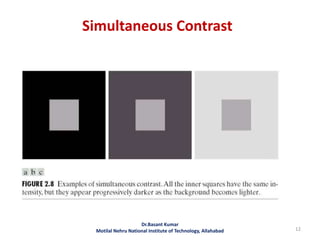
• Simultaneous contrast: region’s perceived
brightness does not depend on its intensity
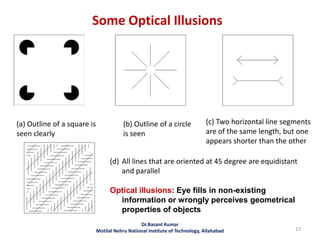
• Optical illusions: eye fills in non-existing information
or wrongly perceives geometrical properties of
objects
10
Dr.Basant Kumar
Motilal Nehru National Institute of Technology, Allahabad
Mach Band Effect
11
Dr.Basant Kumar
Motilal Nehru National Institute of Technology, Allahabad
Simultaneous Contrast
12
Dr.Basant Kumar
Motilal Nehru National Institute of Technology, Allahabad
Some Optical Illusions
13
Dr.Basant Kumar
Motilal Nehru National Institute of Technology, Allahabad
(a) Outline of a square is
seen clearly
(c) Two horizontal line segments
are of the same length, but one
appears shorter than the other
(b) Outline of a circle
is seen
(d) All lines that are oriented at 45 degree are equidistant
and parallel
Optical illusions: Eye fills in non-existing
information or wrongly perceives geometrical
properties of objects
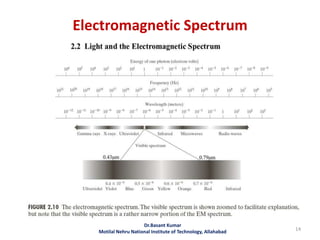
Electromagnetic Spectrum
Dr.Basant Kumar
Motilal Nehru National Institute of Technology, Allahabad 14
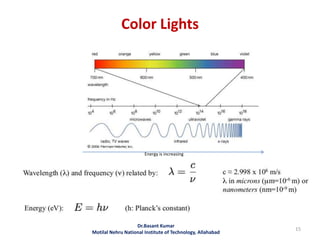
Color Lights
Dr.Basant Kumar
Motilal Nehru National Institute of Technology, Allahabad
15
Energy is increasing
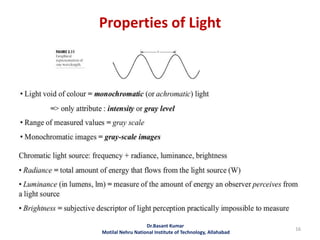
Properties of Light
Dr.Basant Kumar
Motilal Nehru National Institute of Technology, Allahabad
16
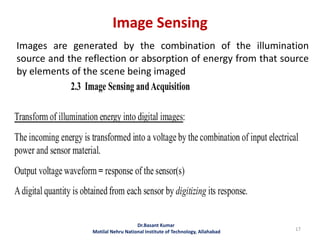
Image Sensing
Dr.Basant Kumar
Motilal Nehru National Institute of Technology, Allahabad 17
Images are generated by the combination of the illumination
source and the reflection or absorption of energy from that source
by elements of the scene being imaged
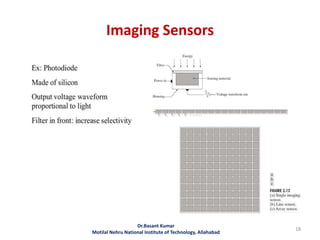
Imaging Sensors
Dr.Basant Kumar
Motilal Nehru National Institute of Technology, Allahabad
18
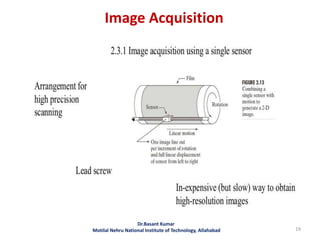
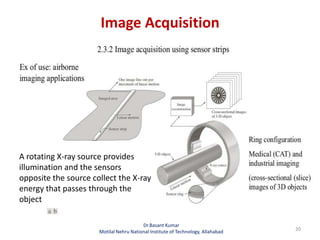
Image Acquisition
Dr.Basant Kumar
Motilal Nehru National Institute of Technology, Allahabad 19
Image Acquisition
Dr.Basant Kumar
Motilal Nehru National Institute of Technology, Allahabad 20
A rotating X-ray source provides
illumination and the sensors
opposite the source collect the X-ray
energy that passes through the
object
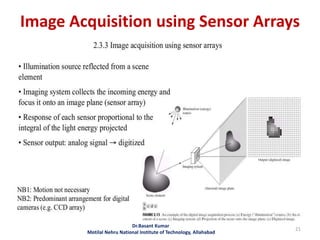
Image Acquisition using Sensor Arrays
Dr.Basant Kumar
Motilal Nehru National Institute of Technology, Allahabad
21
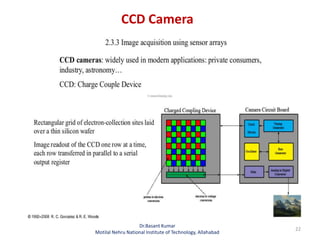
CCD Camera
Dr.Basant Kumar
Motilal Nehru National Institute of Technology, Allahabad
22
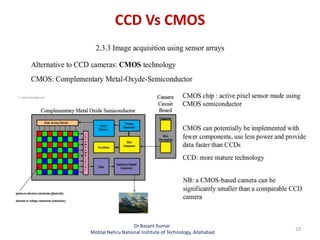
CCD Vs CMOS
Dr.Basant Kumar
Motilal Nehru National Institute of Technology, Allahabad
23
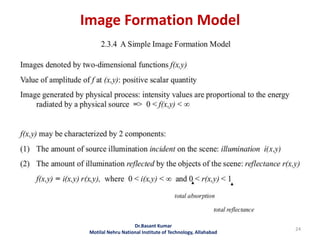
Image Formation Model
Dr.Basant Kumar
Motilal Nehru National Institute of Technology, Allahabad
24
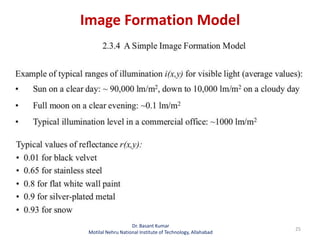
Image Formation Model
Dr. Basant Kumar
Motilal Nehru National Institute of Technology, Allahabad
25
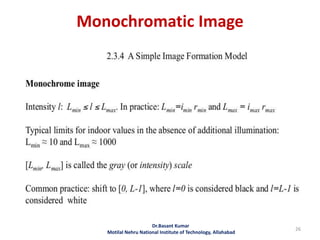
Monochromatic Image
Dr.Basant Kumar
Motilal Nehru National Institute of Technology, Allahabad
26
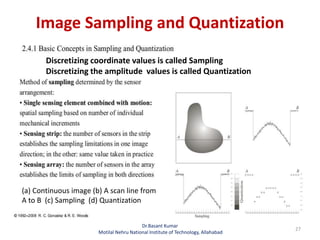
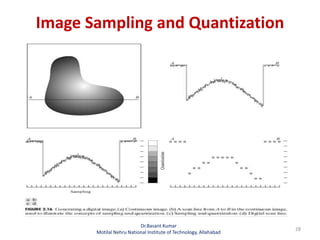
Image Sampling and Quantization
Dr.Basant Kumar
Motilal Nehru National Institute of Technology, Allahabad
27
(a) Continuous image (b) A scan line from
A to B (c) Sampling (d) Quantization
Discretizing coordinate values is called Sampling
Discretizing the amplitude values is called Quantization
Image Sampling and Quantization
Dr.Basant Kumar
Motilal Nehru National Institute of Technology, Allahabad
28
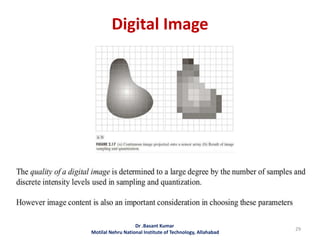
Digital Image
Dr .Basant Kumar
Motilal Nehru National Institute of Technology, Allahabad
29
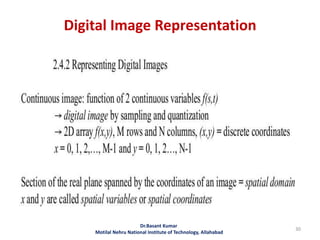
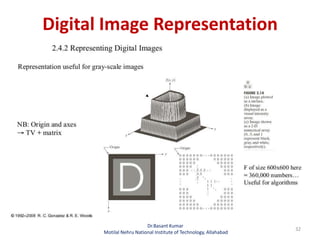
Digital Image Representation
Dr.Basant Kumar
Motilal Nehru National Institute of Technology, Allahabad
30
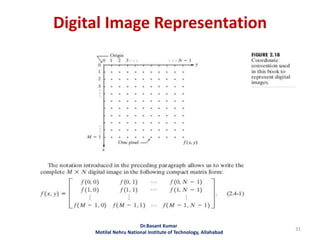
Digital Image Representation
Dr.Basant Kumar
Motilal Nehru National Institute of Technology, Allahabad
31
Digital Image Representation
Dr.Basant Kumar
Motilal Nehru National Institute of Technology, Allahabad
32
Representing Digital Images
• Digital image
– M  N array
– L discrete intensities – power of 2
• L = 2k
• Integers in the interval [0, L - 1]
• Dynamic range: ratio of maximum / minimum
intensity
– Low: image has a dull, washed-out gray look
• Contrast: difference between highest and lowest
intensity
– High: image have high contrast
33
Dr.Basant Kumar
Motilal Nehru National Institute of Technology, Allahabad
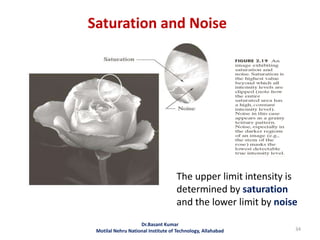
Saturation and Noise
34
Dr.Basant Kumar
Motilal Nehru National Institute of Technology, Allahabad
The upper limit intensity is
determined by saturation
and the lower limit by noise
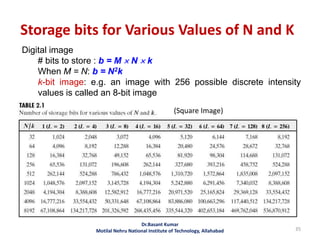
Storage bits for Various Values of N and K
35
Dr.Basant Kumar
Motilal Nehru National Institute of Technology, Allahabad
Digital image
# bits to store : b = M  N  k
When M = N: b = N2k
k-bit image: e.g. an image with 256 possible discrete intensity
values is called an 8-bit image
(Square Image)
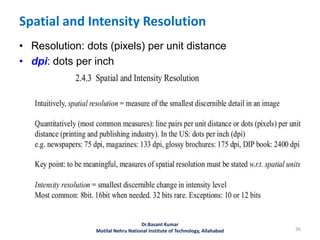
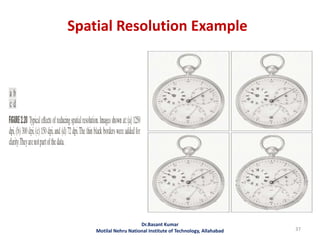
Spatial and Intensity Resolution
• Resolution: dots (pixels) per unit distance
• dpi: dots per inch
36
Dr.Basant Kumar
Motilal Nehru National Institute of Technology, Allahabad
Spatial Resolution Example
37
Dr.Basant Kumar
Motilal Nehru National Institute of Technology, Allahabad
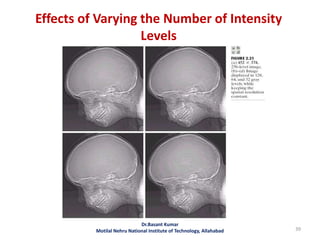
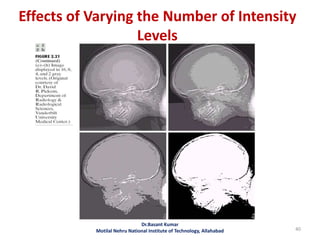
Variation of Number of Intensity Levels
• Reducing the number of bits from k=7 to k=1
while keeping the image size constant
• Insufficient number of intensity levels in smooth
areas of digital image leads to false contouring
38
Dr.Basant Kumar
Motilal Nehru National Institute of Technology, Allahabad
Effects of Varying the Number of Intensity
Levels
39
Dr.Basant Kumar
Motilal Nehru National Institute of Technology, Allahabad
Effects of Varying the Number of Intensity
Levels
40
Dr.Basant Kumar
Motilal Nehru National Institute of Technology, Allahabad
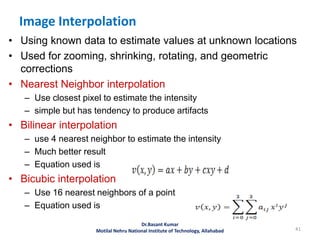
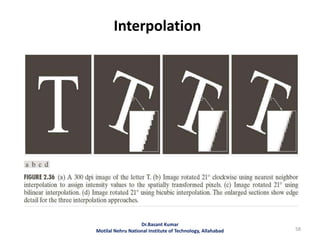
Image Interpolation
• Using known data to estimate values at unknown locations
• Used for zooming, shrinking, rotating, and geometric
corrections
• Nearest Neighbor interpolation
– Use closest pixel to estimate the intensity
– simple but has tendency to produce artifacts
• Bilinear interpolation
– use 4 nearest neighbor to estimate the intensity
– Much better result
– Equation used is
• Bicubic interpolation
– Use 16 nearest neighbors of a point
– Equation used is
41
Dr.Basant Kumar
Motilal Nehru National Institute of Technology, Allahabad
42
Dr.Basant Kumar
Motilal Nehru National Institute of Technology, Allahabad
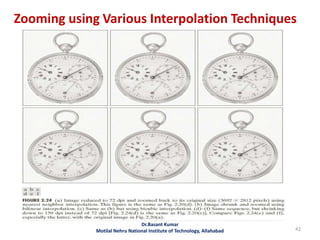
Zooming using Various Interpolation Techniques
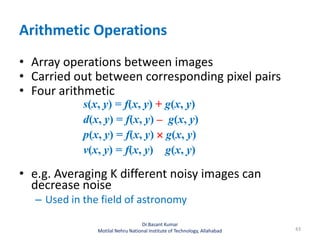
Arithmetic Operations
• Array operations between images
• Carried out between corresponding pixel pairs
• Four arithmetic
s(x, y) = f(x, y) + g(x, y)
d(x, y) = f(x, y) – g(x, y)
p(x, y) = f(x, y)  g(x, y)
v(x, y) = f(x, y) g(x, y)
• e.g. Averaging K different noisy images can
decrease noise
– Used in the field of astronomy
43
Dr.Basant Kumar
Motilal Nehru National Institute of Technology, Allahabad
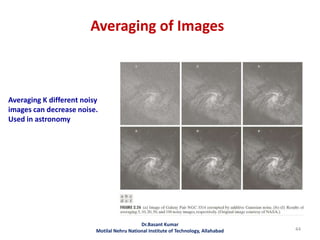
Averaging of Images
44
Averaging K different noisy
images can decrease noise.
Used in astronomy
Dr.Basant Kumar
Motilal Nehru National Institute of Technology, Allahabad
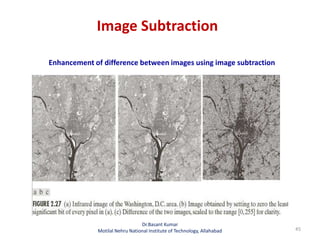
Image Subtraction
45
Enhancement of difference between images using image subtraction
Dr.Basant Kumar
Motilal Nehru National Institute of Technology, Allahabad
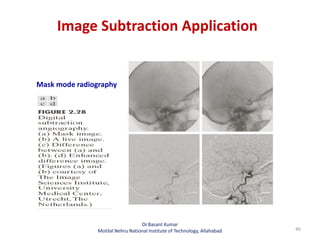
Image Subtraction Application
46
Mask mode radiography
Dr.Basant Kumar
Motilal Nehru National Institute of Technology, Allahabad
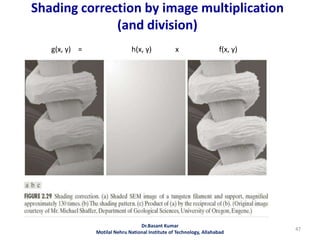
Shading correction by image multiplication
(and division)
47
Dr.Basant Kumar
Motilal Nehru National Institute of Technology, Allahabad
g(x, y) = h(x, y) x f(x, y)
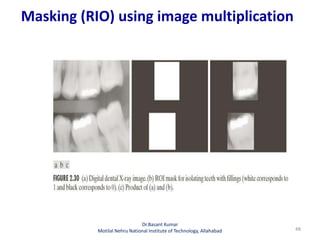
Masking (RIO) using image multiplication
48
Dr.Basant Kumar
Motilal Nehru National Institute of Technology, Allahabad
Arithmetic Operations
• To guarantee that the full range of an arithmetic operation
between images is captured into a fixed number of bits, the
following approach is performed on image f
fm = f – min(f)
which creates an image whose minimum value is 0. Then the
scaled image is
fs = K [ fm / max(fm)]
whose value is in the range [0, K]
Example- for 8-bit image , setting K=255 gives scaled image
whose intensities span from 0 to 255
49
Dr.Basant Kumar
Motilal Nehru National Institute of Technology, Allahabad
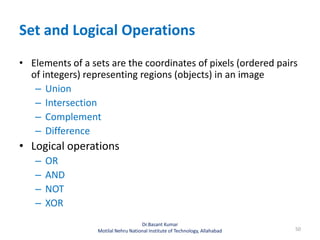
Set and Logical Operations
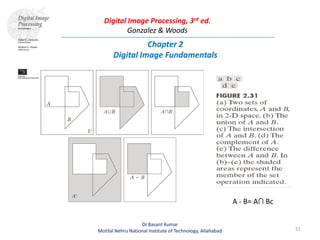
• Elements of a sets are the coordinates of pixels (ordered pairs
of integers) representing regions (objects) in an image
– Union
– Intersection
– Complement
– Difference
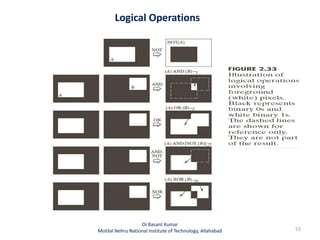
• Logical operations
– OR
– AND
– NOT
– XOR
50
Dr.Basant Kumar
Motilal Nehru National Institute of Technology, Allahabad
Digital Image Processing, 3rd ed.
Gonzalez & Woods
Chapter 2
Digital Image Fundamentals
51
Dr.Basant Kumar
Motilal Nehru National Institute of Technology, Allahabad
A - B= A∩ Bc
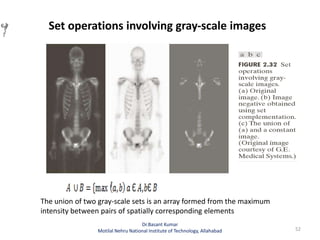
Set operations involving gray-scale images
52
Dr.Basant Kumar
Motilal Nehru National Institute of Technology, Allahabad
, b
}
b
}
The union of two gray-scale sets is an array formed from the maximum
intensity between pairs of spatially corresponding elements
Logical Operations
53
Dr.Basant Kumar
Motilal Nehru National Institute of Technology, Allahabad
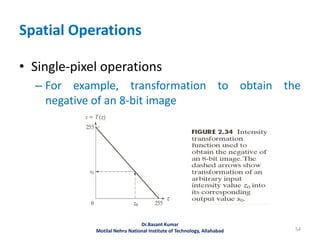
Spatial Operations
• Single-pixel operations
– For example, transformation to obtain the
negative of an 8-bit image
54
Dr.Basant Kumar
Motilal Nehru National Institute of Technology, Allahabad
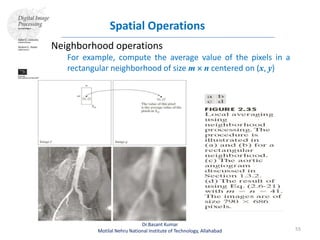
Spatial Operations
55
Dr.Basant Kumar
Motilal Nehru National Institute of Technology, Allahabad
Neighborhood operations
For example, compute the average value of the pixels in a
rectangular neighborhood of size m  n centered on (x, y)
Spatial Operations
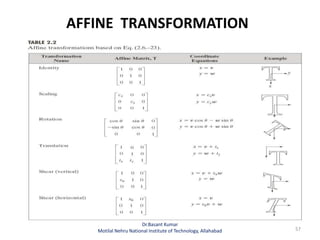
• Geometric spatial transformations
– Called rubber-sheet transformations
– Consists of two operations
• Spatial transformation of coordinates
e.g. (x, y) = T { ( v, w) } = ( v/2, w/2)
– Affine transform: scale, rotate, transform, or sheer a set of
points
• Intensity interpolation
• Affine transform
[x y 1]= [v w 1] [Affine Matrix, T]
56
Dr.Basant Kumar
Motilal Nehru National Institute of Technology, Allahabad
AFFINE TRANSFORMATION
57
Dr.Basant Kumar
Motilal Nehru National Institute of Technology, Allahabad
Interpolation
58
Dr.Basant Kumar
Motilal Nehru National Institute of Technology, Allahabad
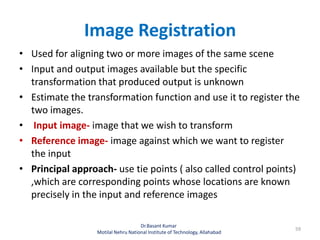
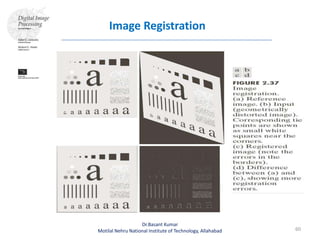
Image Registration
• Used for aligning two or more images of the same scene
• Input and output images available but the specific
transformation that produced output is unknown
• Estimate the transformation function and use it to register the
two images.
• Input image- image that we wish to transform
• Reference image- image against which we want to register
the input
• Principal approach- use tie points ( also called control points)
,which are corresponding points whose locations are known
precisely in the input and reference images
Dr.Basant Kumar
Motilal Nehru National Institute of Technology, Allahabad
59
Image Registration
60
Dr.Basant Kumar
Motilal Nehru National Institute of Technology, Allahabad
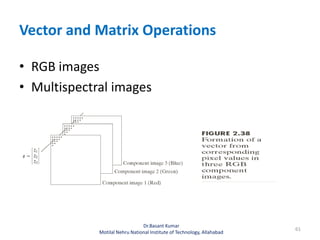
Vector and Matrix Operations
• RGB images
• Multispectral images
Dr.Basant Kumar
Motilal Nehru National Institute of Technology, Allahabad
61
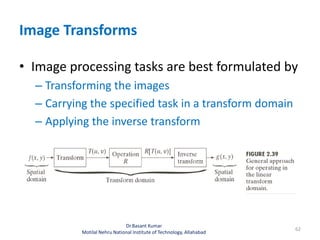
Image Transforms
• Image processing tasks are best formulated by
– Transforming the images
– Carrying the specified task in a transform domain
– Applying the inverse transform
Dr.Basant Kumar
Motilal Nehru National Institute of Technology, Allahabad
62
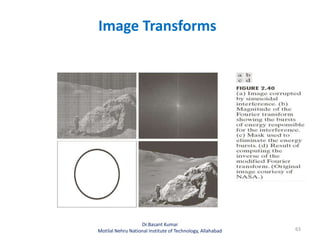
Image Transforms
63
Dr.Basant Kumar
Motilal Nehru National Institute of Technology, Allahabad

Dip chapter 2

  • 1.
    Chapter- 2 Digital ImageFundamentals Motilal Nehru National Institute of Technology Allahabad 1 Dr.Basant Kumar Motilal Nehru National Institute of Technology, Allahabad Digital Image Processing, 3rd ed. Gonzalez & Woods
  • 2.
    Chapter 2 Digital ImageFundamentals Dr.Basant Kumar Motilal Nehru National Institute of Technology, Allahabad 2
  • 3.
    Eye’s Blind Spot Dr.BasantKumar Motilal Nehru National Institute of Technology, Allahabad 3
  • 4.
    Distribution of LightReceptors Dr.Basant Kumar Motilal Nehru National Institute of Technology, Allahabad 4
  • 5.
    Distribution of LightReceptors (Contd.) Dr.Basant Kumar Motilal Nehru National Institute of Technology, Allahabad 5
  • 6.
    Image Formation inthe Eye Dr.Basant Kumar Motilal Nehru National Institute of Technology, Allahabad 6 Perception takes place by the relative excitation of light receptors, which transform radiant energy into electrical impulses that ultimately are decoded by the brain
  • 7.
    HVS Characteristics Dr.Basant Kumar MotilalNehru National Institute of Technology, Allahabad 7 -Subjective brightness is a logarithmic function of the light incident on the eye. -Total range of distinct intensity levels to which the eye can discriminate simultaneously, is small compared to the total adaptation range. -Current sensitivity of a visual system is called the brightness adaptation levels . - At Ba adaptation level , intersecting curve represents the range of subjective brightness that eye can perceive
  • 8.
    Brightness Discrimination Dr.Basant Kumar MotilalNehru National Institute of Technology, Allahabad 8 -The ability of the eye to discriminate between changes in light intensity at any specific adaptation level - The quantity ∆Ic/I , ∆Ic is the increment of illumination discriminable 50 % of the time with background illumination I, is called the Weber ratio
  • 9.
    Brightness Discrimination Dr.Basant Kumar MotilalNehru National Institute of Technology, Allahabad 9 Small weber ratio --- small percentage change in intensity is discriminable --- good brightness discrimination Large weber ratio----- a large percentage change in intensity is required ---- poor brightness discrimination The curve shows that the brightness discrimination is poor at low level of illumination and it improves significantly as background illumination increases At low level illumination – vision is carried out by rods At high level illumination – vision is carried out by cones  The number of different intensities a person can see at any point of time in a monochrome image is 1 to 2 dozens
  • 10.
    Visual Perception Perceived brightnessis not a simple function of intensity • Mach bands: visual system tends to undershoot or overshoot around the boundary of regions of different intensities • Simultaneous contrast: region’s perceived brightness does not depend on its intensity • Optical illusions: eye fills in non-existing information or wrongly perceives geometrical properties of objects 10 Dr.Basant Kumar Motilal Nehru National Institute of Technology, Allahabad
  • 11.
    Mach Band Effect 11 Dr.BasantKumar Motilal Nehru National Institute of Technology, Allahabad
  • 12.
    Simultaneous Contrast 12 Dr.Basant Kumar MotilalNehru National Institute of Technology, Allahabad
  • 13.
    Some Optical Illusions 13 Dr.BasantKumar Motilal Nehru National Institute of Technology, Allahabad (a) Outline of a square is seen clearly (c) Two horizontal line segments are of the same length, but one appears shorter than the other (b) Outline of a circle is seen (d) All lines that are oriented at 45 degree are equidistant and parallel Optical illusions: Eye fills in non-existing information or wrongly perceives geometrical properties of objects
  • 14.
    Electromagnetic Spectrum Dr.Basant Kumar MotilalNehru National Institute of Technology, Allahabad 14
  • 15.
    Color Lights Dr.Basant Kumar MotilalNehru National Institute of Technology, Allahabad 15 Energy is increasing
  • 16.
    Properties of Light Dr.BasantKumar Motilal Nehru National Institute of Technology, Allahabad 16
  • 17.
    Image Sensing Dr.Basant Kumar MotilalNehru National Institute of Technology, Allahabad 17 Images are generated by the combination of the illumination source and the reflection or absorption of energy from that source by elements of the scene being imaged
  • 18.
    Imaging Sensors Dr.Basant Kumar MotilalNehru National Institute of Technology, Allahabad 18
  • 19.
    Image Acquisition Dr.Basant Kumar MotilalNehru National Institute of Technology, Allahabad 19
  • 20.
    Image Acquisition Dr.Basant Kumar MotilalNehru National Institute of Technology, Allahabad 20 A rotating X-ray source provides illumination and the sensors opposite the source collect the X-ray energy that passes through the object
  • 21.
    Image Acquisition usingSensor Arrays Dr.Basant Kumar Motilal Nehru National Institute of Technology, Allahabad 21
  • 22.
    CCD Camera Dr.Basant Kumar MotilalNehru National Institute of Technology, Allahabad 22
  • 23.
    CCD Vs CMOS Dr.BasantKumar Motilal Nehru National Institute of Technology, Allahabad 23
  • 24.
    Image Formation Model Dr.BasantKumar Motilal Nehru National Institute of Technology, Allahabad 24
  • 25.
    Image Formation Model Dr.Basant Kumar Motilal Nehru National Institute of Technology, Allahabad 25
  • 26.
    Monochromatic Image Dr.Basant Kumar MotilalNehru National Institute of Technology, Allahabad 26
  • 27.
    Image Sampling andQuantization Dr.Basant Kumar Motilal Nehru National Institute of Technology, Allahabad 27 (a) Continuous image (b) A scan line from A to B (c) Sampling (d) Quantization Discretizing coordinate values is called Sampling Discretizing the amplitude values is called Quantization
  • 28.
    Image Sampling andQuantization Dr.Basant Kumar Motilal Nehru National Institute of Technology, Allahabad 28
  • 29.
    Digital Image Dr .BasantKumar Motilal Nehru National Institute of Technology, Allahabad 29
  • 30.
    Digital Image Representation Dr.BasantKumar Motilal Nehru National Institute of Technology, Allahabad 30
  • 31.
    Digital Image Representation Dr.BasantKumar Motilal Nehru National Institute of Technology, Allahabad 31
  • 32.
    Digital Image Representation Dr.BasantKumar Motilal Nehru National Institute of Technology, Allahabad 32
  • 33.
    Representing Digital Images •Digital image – M  N array – L discrete intensities – power of 2 • L = 2k • Integers in the interval [0, L - 1] • Dynamic range: ratio of maximum / minimum intensity – Low: image has a dull, washed-out gray look • Contrast: difference between highest and lowest intensity – High: image have high contrast 33 Dr.Basant Kumar Motilal Nehru National Institute of Technology, Allahabad
  • 34.
    Saturation and Noise 34 Dr.BasantKumar Motilal Nehru National Institute of Technology, Allahabad The upper limit intensity is determined by saturation and the lower limit by noise
  • 35.
    Storage bits forVarious Values of N and K 35 Dr.Basant Kumar Motilal Nehru National Institute of Technology, Allahabad Digital image # bits to store : b = M  N  k When M = N: b = N2k k-bit image: e.g. an image with 256 possible discrete intensity values is called an 8-bit image (Square Image)
  • 36.
    Spatial and IntensityResolution • Resolution: dots (pixels) per unit distance • dpi: dots per inch 36 Dr.Basant Kumar Motilal Nehru National Institute of Technology, Allahabad
  • 37.
    Spatial Resolution Example 37 Dr.BasantKumar Motilal Nehru National Institute of Technology, Allahabad
  • 38.
    Variation of Numberof Intensity Levels • Reducing the number of bits from k=7 to k=1 while keeping the image size constant • Insufficient number of intensity levels in smooth areas of digital image leads to false contouring 38 Dr.Basant Kumar Motilal Nehru National Institute of Technology, Allahabad
  • 39.
    Effects of Varyingthe Number of Intensity Levels 39 Dr.Basant Kumar Motilal Nehru National Institute of Technology, Allahabad
  • 40.
    Effects of Varyingthe Number of Intensity Levels 40 Dr.Basant Kumar Motilal Nehru National Institute of Technology, Allahabad
  • 41.
    Image Interpolation • Usingknown data to estimate values at unknown locations • Used for zooming, shrinking, rotating, and geometric corrections • Nearest Neighbor interpolation – Use closest pixel to estimate the intensity – simple but has tendency to produce artifacts • Bilinear interpolation – use 4 nearest neighbor to estimate the intensity – Much better result – Equation used is • Bicubic interpolation – Use 16 nearest neighbors of a point – Equation used is 41 Dr.Basant Kumar Motilal Nehru National Institute of Technology, Allahabad
  • 42.
    42 Dr.Basant Kumar Motilal NehruNational Institute of Technology, Allahabad Zooming using Various Interpolation Techniques
  • 43.
    Arithmetic Operations • Arrayoperations between images • Carried out between corresponding pixel pairs • Four arithmetic s(x, y) = f(x, y) + g(x, y) d(x, y) = f(x, y) – g(x, y) p(x, y) = f(x, y)  g(x, y) v(x, y) = f(x, y) g(x, y) • e.g. Averaging K different noisy images can decrease noise – Used in the field of astronomy 43 Dr.Basant Kumar Motilal Nehru National Institute of Technology, Allahabad
  • 44.
    Averaging of Images 44 AveragingK different noisy images can decrease noise. Used in astronomy Dr.Basant Kumar Motilal Nehru National Institute of Technology, Allahabad
  • 45.
    Image Subtraction 45 Enhancement ofdifference between images using image subtraction Dr.Basant Kumar Motilal Nehru National Institute of Technology, Allahabad
  • 46.
    Image Subtraction Application 46 Maskmode radiography Dr.Basant Kumar Motilal Nehru National Institute of Technology, Allahabad
  • 47.
    Shading correction byimage multiplication (and division) 47 Dr.Basant Kumar Motilal Nehru National Institute of Technology, Allahabad g(x, y) = h(x, y) x f(x, y)
  • 48.
    Masking (RIO) usingimage multiplication 48 Dr.Basant Kumar Motilal Nehru National Institute of Technology, Allahabad
  • 49.
    Arithmetic Operations • Toguarantee that the full range of an arithmetic operation between images is captured into a fixed number of bits, the following approach is performed on image f fm = f – min(f) which creates an image whose minimum value is 0. Then the scaled image is fs = K [ fm / max(fm)] whose value is in the range [0, K] Example- for 8-bit image , setting K=255 gives scaled image whose intensities span from 0 to 255 49 Dr.Basant Kumar Motilal Nehru National Institute of Technology, Allahabad
  • 50.
    Set and LogicalOperations • Elements of a sets are the coordinates of pixels (ordered pairs of integers) representing regions (objects) in an image – Union – Intersection – Complement – Difference • Logical operations – OR – AND – NOT – XOR 50 Dr.Basant Kumar Motilal Nehru National Institute of Technology, Allahabad
  • 51.
    Digital Image Processing,3rd ed. Gonzalez & Woods Chapter 2 Digital Image Fundamentals 51 Dr.Basant Kumar Motilal Nehru National Institute of Technology, Allahabad A - B= A∩ Bc
  • 52.
    Set operations involvinggray-scale images 52 Dr.Basant Kumar Motilal Nehru National Institute of Technology, Allahabad , b } b } The union of two gray-scale sets is an array formed from the maximum intensity between pairs of spatially corresponding elements
  • 53.
    Logical Operations 53 Dr.Basant Kumar MotilalNehru National Institute of Technology, Allahabad
  • 54.
    Spatial Operations • Single-pixeloperations – For example, transformation to obtain the negative of an 8-bit image 54 Dr.Basant Kumar Motilal Nehru National Institute of Technology, Allahabad
  • 55.
    Spatial Operations 55 Dr.Basant Kumar MotilalNehru National Institute of Technology, Allahabad Neighborhood operations For example, compute the average value of the pixels in a rectangular neighborhood of size m  n centered on (x, y)
  • 56.
    Spatial Operations • Geometricspatial transformations – Called rubber-sheet transformations – Consists of two operations • Spatial transformation of coordinates e.g. (x, y) = T { ( v, w) } = ( v/2, w/2) – Affine transform: scale, rotate, transform, or sheer a set of points • Intensity interpolation • Affine transform [x y 1]= [v w 1] [Affine Matrix, T] 56 Dr.Basant Kumar Motilal Nehru National Institute of Technology, Allahabad
  • 57.
    AFFINE TRANSFORMATION 57 Dr.Basant Kumar MotilalNehru National Institute of Technology, Allahabad
  • 58.
    Interpolation 58 Dr.Basant Kumar Motilal NehruNational Institute of Technology, Allahabad
  • 59.
    Image Registration • Usedfor aligning two or more images of the same scene • Input and output images available but the specific transformation that produced output is unknown • Estimate the transformation function and use it to register the two images. • Input image- image that we wish to transform • Reference image- image against which we want to register the input • Principal approach- use tie points ( also called control points) ,which are corresponding points whose locations are known precisely in the input and reference images Dr.Basant Kumar Motilal Nehru National Institute of Technology, Allahabad 59
  • 60.
    Image Registration 60 Dr.Basant Kumar MotilalNehru National Institute of Technology, Allahabad
  • 61.
    Vector and MatrixOperations • RGB images • Multispectral images Dr.Basant Kumar Motilal Nehru National Institute of Technology, Allahabad 61
  • 62.
    Image Transforms • Imageprocessing tasks are best formulated by – Transforming the images – Carrying the specified task in a transform domain – Applying the inverse transform Dr.Basant Kumar Motilal Nehru National Institute of Technology, Allahabad 62
  • 63.
    Image Transforms 63 Dr.Basant Kumar MotilalNehru National Institute of Technology, Allahabad