Photochemistry
Introduction
History
Laws of Photochemistry
Photochemical Process
Applications of photochemistry
Effects of Photochemistry
1
Submitted to:
Dr.Areeba Farooq
Submitted by:
M.Phil. Analytical
Chemistry Semester 1st
& 2nd
2
Participants:
Group (II) Girls
3
Introduction
 Deals with
photochemical reactions.
 Caused by the
absorption of light
radiations from visible
and ultraviolet region.
4
Introduction
5
Definition of Photochemistry:
 The study of chemical reactions,
isomerization and physical behavior that may
occur under the influence of visible and/or
ultraviolet light is called Photochemistry.
 It deals with photochemical reactions caused
by the absorption of light radiations from
visible and ultraviolet region.
6
Milestones of Photochemistry:
 1886: First organic photochemical reaction by Giacomo
Luigi Ciamician
 Early 1900’s: Grotthus- Draper law
 1905: Quantum theory of radiation (Einstein).
 1909: Wave-particle duality (Einstein)
 1912: Stark-Einstein law
 1916: Concept of spontaneous absorption and
emission (Einstein)
 1921: Nobel Prize: Einstein: Photoelectric effect
7
8
Laws of Photochemistry:
 The Grotthuss-
Draper Law
 Only light that is
absorbed can produce
photochemical change
 It is the basis for
performing
photochemical and
photobiological
experiments correctly.
 The Stark-Einstein
Law
 A molecule absorbs a
single quantum of light is
becoming excited.
 For each photon of light
absorbed by a chemical
system, only one
molecule is activated for
a photochemical reaction.
9
Laws of Photochemistry:
 The Grotthuss-
Draper Law
 If light of a particular
wavelength is not
absorbed by a system,
no photochemistry will
occur, and no
photobiological effects
will be observed, no
matter how long one
irradiates with that
wavelength of light.
 The Stark-Einstein
Law
 This law is true for
ordinary light intensities,
however, with high-
powered lasers, two-
photon reactions can
occur, i.e., the molecule
is raised to a higher
energy state than
produced by single-
photon absorption.
10
Photochemical Process:
 All the photochemical reactions proceed at
the two stages.
1.Primary process:
 The reacting molecules undergo activation by
absorption of light.
2.Secondary process:
 The activated molecules undergo
photochemical change.
11
Photochemical Process:
Physical Quenchig:
 Loss of energy to another molecule or atom (M)
by physical quenching, followed by dissipation of
the energy as heat
O2* + M O2 + M
Dissociation Reaction:
 Dissociation of the excited molecule (the process
responsible for the predominance of atomic
oxygen in the upper atmosphere)
O2* O + O
12
Direct Reaction:
 Direct reaction with another species without
any intermediate product.
O2* + O3 2O2+ O
Luminescence
 Luminescence consisting of loss of energy by
the emission of electromagnetic radiation
NO2
* NO2 + hν
13
Chemiluminescence:
 When the excited species (such as NO2 *
below) is formed by a chemical process:
O3 + NO NO2
* + O2
Intermolecular Energy Transfer:
 Excited species transfers energy to another
species which then becomes excited.
14
PhotoIonization:
 Photoionization through loss of an electron
N2
* N2
+ + e-
15
Types of Photochemical
Reactions:
 Rearrangement reactions (substituents move
from one atom to another in the same
molecule)
 Addition reaction (combination of molecules to
form larger molecules with no side products)
16
Types of Photochemical
Reactions:
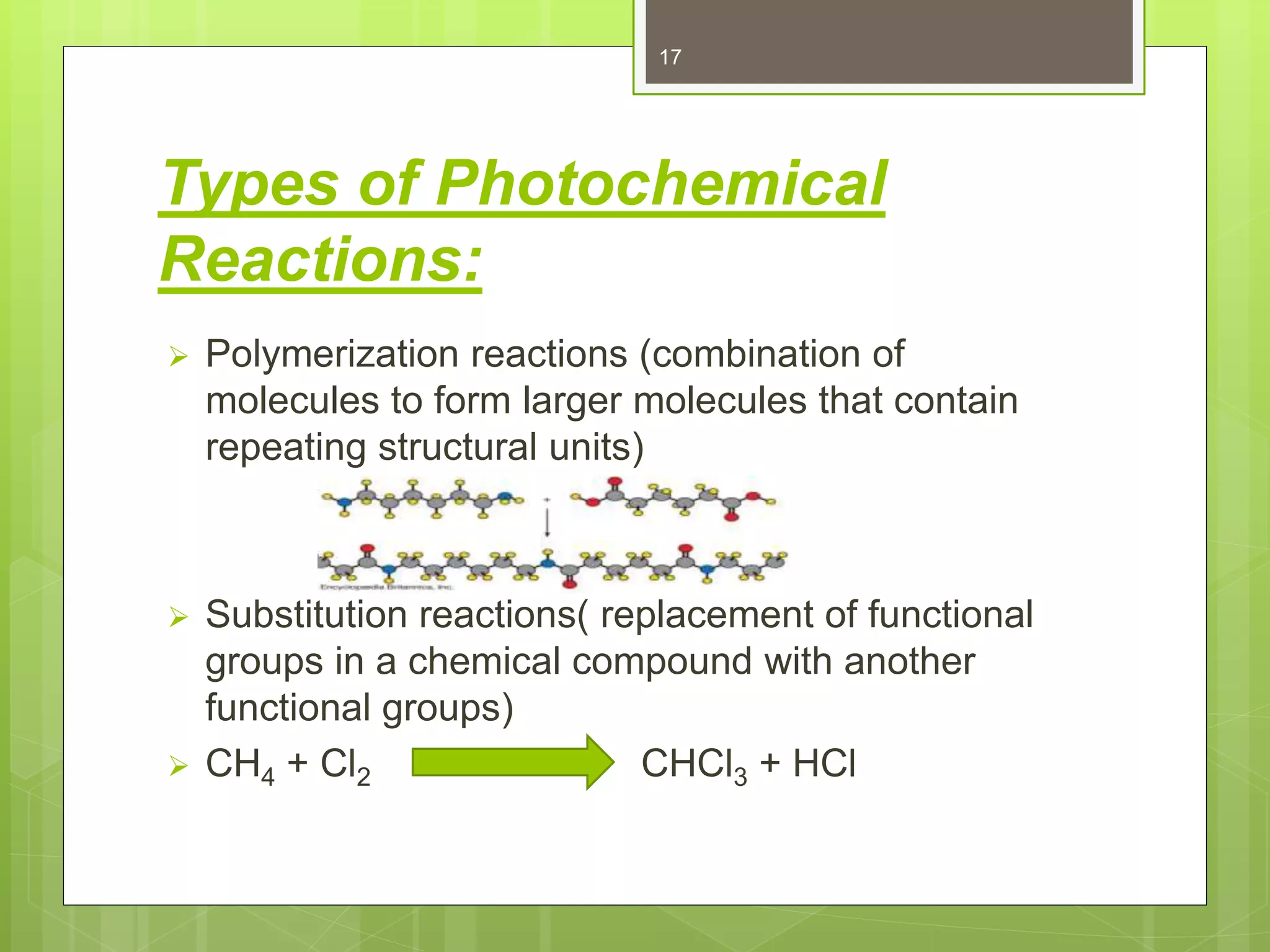
 Polymerization reactions (combination of
molecules to form larger molecules that contain
repeating structural units)
 Substitution reactions( replacement of functional
groups in a chemical compound with another
functional groups)
 CH4 + Cl2 CHCl3 + HCl
17
Types of Photochemical
Reactions:
 Combination reactions ( combination of two or
more reactants to synthesize single product)
A + B C
 Decomposition reactions (splitting of single
chemical entity into two or more fragments)
AB A + B
18
1. Photosynthesis:
Plants use solar energy to convert carbon dioxide and
water into glucose and oxygen.
Applications of Photochemistry:
19
The carbohydrates so form have been forming the basis
of life on earth.
20
21
2. Formation of Vitamin D
 Human rely on photochemistry for the formation
of vitamin D.
22
3.Bioluminescence:
 Bios – Living and Lumen – Light.
 It is a naturally occurring form of chemi-
luminescence where energy is released by a
chemical reaction in the form of light
emission.
 Production and emission of light by living
organism is called bioluminescence
 In fireflies, an enzyme in the abdomen
catalyzes a reaction that produced light.
23
Bioluminescence:
24
Applications of Photochemistry:
4. Vision is initiated by a photochemical reaction
of rhodopsin.
25
5. Ozone Formation:
 Mechanism of photochemistry also involve in
ozone formation.
 Ozone is the important species in the stratosphere,
acting as the protective radiation shield for living
organisms on earth.
 The maximum ozone concentration is around
10ppm in the stratosphere at an altitude of 25-
30km.
26
 Ozone is formed by the photochemical reaction,
followed by:
27
8.Carbon Cycle:
28
How it is applied to
atmosphere?
 In the atmosphere primary pollutants are
involved in different reactions which lead to
secondary pollutants.
 Photochemical reactions in the atmosphere -
a source of secondary pollutants like Ozone,
Acid rain, etc.
 These reactions occur in the atmosphere and
they generate photochemical smog.
29
Photochemical Smog:
 Photochemical smog is a type
of smog produced when ultraviolet light from
the sun reacts with nitrogen oxides in
the atmosphere.
 It is visible as a brown haze, and is most
prominent during the morning and afternoon,
especially in densely populated, warm cities.
30
31
Effects of Photochemistry:
 Photochemical smog has many adverse effects.
 When combined with hydrocarbons, the chemicals
contained within it form molecules that cause eye
irritation.
 Radicals in the air interfere with the nitrogen cycle
by preventing the destruction of ground level
ozone.
 Other effects include reduced visibility and
respiratory ailments.
32
33

Photochemistry

  • 1.
    Photochemistry Introduction History Laws of Photochemistry PhotochemicalProcess Applications of photochemistry Effects of Photochemistry 1
  • 2.
    Submitted to: Dr.Areeba Farooq Submittedby: M.Phil. Analytical Chemistry Semester 1st & 2nd 2
  • 3.
  • 4.
    Introduction  Deals with photochemicalreactions.  Caused by the absorption of light radiations from visible and ultraviolet region. 4
  • 5.
  • 6.
    Definition of Photochemistry: The study of chemical reactions, isomerization and physical behavior that may occur under the influence of visible and/or ultraviolet light is called Photochemistry.  It deals with photochemical reactions caused by the absorption of light radiations from visible and ultraviolet region. 6
  • 7.
    Milestones of Photochemistry: 1886: First organic photochemical reaction by Giacomo Luigi Ciamician  Early 1900’s: Grotthus- Draper law  1905: Quantum theory of radiation (Einstein).  1909: Wave-particle duality (Einstein)  1912: Stark-Einstein law  1916: Concept of spontaneous absorption and emission (Einstein)  1921: Nobel Prize: Einstein: Photoelectric effect 7
  • 8.
  • 9.
    Laws of Photochemistry: The Grotthuss- Draper Law  Only light that is absorbed can produce photochemical change  It is the basis for performing photochemical and photobiological experiments correctly.  The Stark-Einstein Law  A molecule absorbs a single quantum of light is becoming excited.  For each photon of light absorbed by a chemical system, only one molecule is activated for a photochemical reaction. 9
  • 10.
    Laws of Photochemistry: The Grotthuss- Draper Law  If light of a particular wavelength is not absorbed by a system, no photochemistry will occur, and no photobiological effects will be observed, no matter how long one irradiates with that wavelength of light.  The Stark-Einstein Law  This law is true for ordinary light intensities, however, with high- powered lasers, two- photon reactions can occur, i.e., the molecule is raised to a higher energy state than produced by single- photon absorption. 10
  • 11.
    Photochemical Process:  Allthe photochemical reactions proceed at the two stages. 1.Primary process:  The reacting molecules undergo activation by absorption of light. 2.Secondary process:  The activated molecules undergo photochemical change. 11
  • 12.
    Photochemical Process: Physical Quenchig: Loss of energy to another molecule or atom (M) by physical quenching, followed by dissipation of the energy as heat O2* + M O2 + M Dissociation Reaction:  Dissociation of the excited molecule (the process responsible for the predominance of atomic oxygen in the upper atmosphere) O2* O + O 12
  • 13.
    Direct Reaction:  Directreaction with another species without any intermediate product. O2* + O3 2O2+ O Luminescence  Luminescence consisting of loss of energy by the emission of electromagnetic radiation NO2 * NO2 + hν 13
  • 14.
    Chemiluminescence:  When theexcited species (such as NO2 * below) is formed by a chemical process: O3 + NO NO2 * + O2 Intermolecular Energy Transfer:  Excited species transfers energy to another species which then becomes excited. 14
  • 15.
    PhotoIonization:  Photoionization throughloss of an electron N2 * N2 + + e- 15
  • 16.
    Types of Photochemical Reactions: Rearrangement reactions (substituents move from one atom to another in the same molecule)  Addition reaction (combination of molecules to form larger molecules with no side products) 16
  • 17.
    Types of Photochemical Reactions: Polymerization reactions (combination of molecules to form larger molecules that contain repeating structural units)  Substitution reactions( replacement of functional groups in a chemical compound with another functional groups)  CH4 + Cl2 CHCl3 + HCl 17
  • 18.
    Types of Photochemical Reactions: Combination reactions ( combination of two or more reactants to synthesize single product) A + B C  Decomposition reactions (splitting of single chemical entity into two or more fragments) AB A + B 18
  • 19.
    1. Photosynthesis: Plants usesolar energy to convert carbon dioxide and water into glucose and oxygen. Applications of Photochemistry: 19
  • 20.
    The carbohydrates soform have been forming the basis of life on earth. 20
  • 21.
  • 22.
    2. Formation ofVitamin D  Human rely on photochemistry for the formation of vitamin D. 22
  • 23.
    3.Bioluminescence:  Bios –Living and Lumen – Light.  It is a naturally occurring form of chemi- luminescence where energy is released by a chemical reaction in the form of light emission.  Production and emission of light by living organism is called bioluminescence  In fireflies, an enzyme in the abdomen catalyzes a reaction that produced light. 23
  • 24.
  • 25.
    Applications of Photochemistry: 4.Vision is initiated by a photochemical reaction of rhodopsin. 25
  • 26.
    5. Ozone Formation: Mechanism of photochemistry also involve in ozone formation.  Ozone is the important species in the stratosphere, acting as the protective radiation shield for living organisms on earth.  The maximum ozone concentration is around 10ppm in the stratosphere at an altitude of 25- 30km. 26
  • 27.
     Ozone isformed by the photochemical reaction, followed by: 27
  • 28.
  • 29.
    How it isapplied to atmosphere?  In the atmosphere primary pollutants are involved in different reactions which lead to secondary pollutants.  Photochemical reactions in the atmosphere - a source of secondary pollutants like Ozone, Acid rain, etc.  These reactions occur in the atmosphere and they generate photochemical smog. 29
  • 30.
    Photochemical Smog:  Photochemicalsmog is a type of smog produced when ultraviolet light from the sun reacts with nitrogen oxides in the atmosphere.  It is visible as a brown haze, and is most prominent during the morning and afternoon, especially in densely populated, warm cities. 30
  • 31.
  • 32.
    Effects of Photochemistry: Photochemical smog has many adverse effects.  When combined with hydrocarbons, the chemicals contained within it form molecules that cause eye irritation.  Radicals in the air interfere with the nitrogen cycle by preventing the destruction of ground level ozone.  Other effects include reduced visibility and respiratory ailments. 32
  • 33.