DIJKSTRA'S ALGORITHM
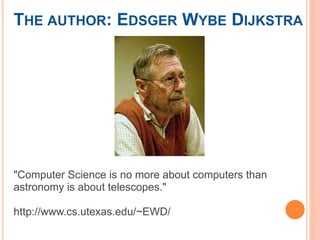
THE AUTHOR: EDSGER WYBE DIJKSTRA
"Computer Science is no more about computers than
astronomy is about telescopes."
http://www.cs.utexas.edu/~EWD/
SINGLE-SOURCE SHORTEST PATH PROBLEM
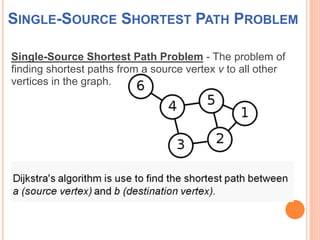
Single-Source Shortest Path Problem - The problem of
finding shortest paths from a source vertex v to all other
vertices in the graph.
DIJKSTRA'S ALGORITHM
Dijkstra's algorithm - is a solution to the single-source
shortest path problem in graph theory.
Works on both directed and undirected graphs. However, all
edges must have nonnegative weights.
Approach: Greedy
Input: Weighted graph G={E,V} and source vertex v∈V, such
that all edge weights are nonnegative
Output: Lengths of shortest paths (or the shortest paths
themselves) from a given source vertex v∈V to all other
vertices
DIJKSTRA'S ALGORITHM - WHY IT WORKS
 As with all greedy algorithms, we need to make sure that it
is a correct algorithm (e.g., it always returns the right solution
if it is given correct input).
 As mentioned, Dijkstra’s algorithm calculates the
shortest path to every vertex.
 However, it is about as computationally expensive
to calculate the shortest path from vertex u to
every vertex using Dijkstra’s as it is to calculate the
shortest path to some particular vertex v.
 Therefore, anytime we want to know the optimal
path to some other vertex from a determined
origin, we can use Dijkstra’s algorithm.
DIJKSTRA'S ALGORITHM - WHY USE IT?
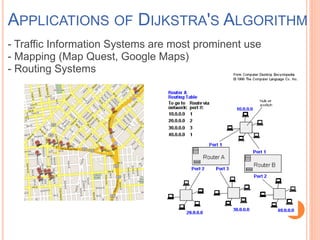
APPLICATIONS OF DIJKSTRA'S ALGORITHM
- Traffic Information Systems are most prominent use
- Mapping (Map Quest, Google Maps)
- Routing Systems
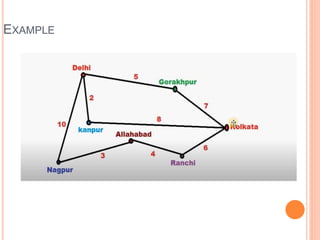
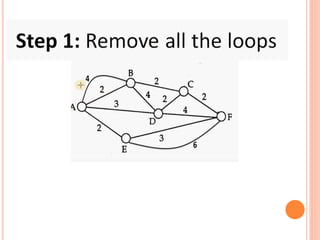
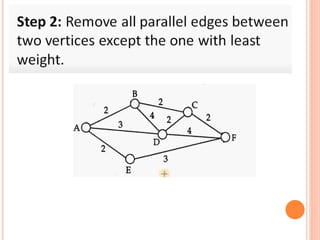
EXAMPLE
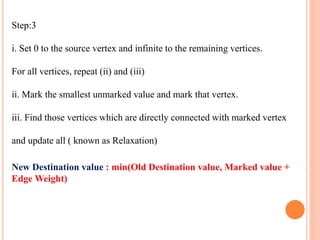
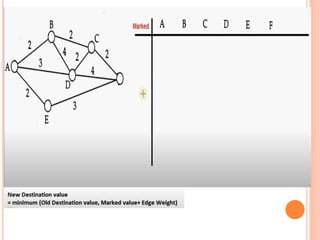
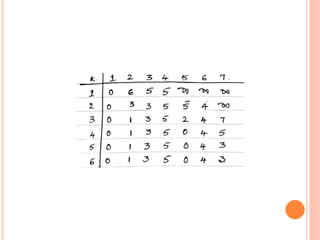
Step:3
i. Set 0 to the source vertex and infinite to the remaining vertices.
For all vertices, repeat (ii) and (iii)
ii. Mark the smallest unmarked value and mark that vertex.
iii. Find those vertices which are directly connected with marked vertex
and update all ( known as Relaxation)
New Destination value : min(Old Destination value, Marked value +
Edge Weight)
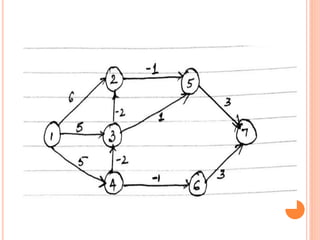
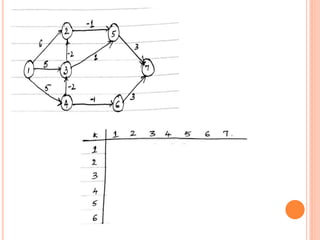
BELLMAN FORD ALGORITHM
(Distance Vector)
If the weighted graph contains the negative weight values, then the
Dijkstra algorithm does not confirm whether it produces the correct
answer or not. In contrast to Dijkstra algorithm, bellman ford
algorithm guarantees the correct answer even if the weighted graph
contains the negative weight values.
dijkstra algo.ppt
dijkstra algo.ppt
dijkstra algo.ppt

dijkstra algo.ppt

  • 1.
  • 2.
    THE AUTHOR: EDSGERWYBE DIJKSTRA "Computer Science is no more about computers than astronomy is about telescopes." http://www.cs.utexas.edu/~EWD/
  • 3.
    SINGLE-SOURCE SHORTEST PATHPROBLEM Single-Source Shortest Path Problem - The problem of finding shortest paths from a source vertex v to all other vertices in the graph.
  • 4.
    DIJKSTRA'S ALGORITHM Dijkstra's algorithm- is a solution to the single-source shortest path problem in graph theory. Works on both directed and undirected graphs. However, all edges must have nonnegative weights. Approach: Greedy Input: Weighted graph G={E,V} and source vertex v∈V, such that all edge weights are nonnegative Output: Lengths of shortest paths (or the shortest paths themselves) from a given source vertex v∈V to all other vertices
  • 5.
    DIJKSTRA'S ALGORITHM -WHY IT WORKS  As with all greedy algorithms, we need to make sure that it is a correct algorithm (e.g., it always returns the right solution if it is given correct input).
  • 6.
     As mentioned,Dijkstra’s algorithm calculates the shortest path to every vertex.  However, it is about as computationally expensive to calculate the shortest path from vertex u to every vertex using Dijkstra’s as it is to calculate the shortest path to some particular vertex v.  Therefore, anytime we want to know the optimal path to some other vertex from a determined origin, we can use Dijkstra’s algorithm. DIJKSTRA'S ALGORITHM - WHY USE IT?
  • 7.
    APPLICATIONS OF DIJKSTRA'SALGORITHM - Traffic Information Systems are most prominent use - Mapping (Map Quest, Google Maps) - Routing Systems
  • 8.
  • 15.
    Step:3 i. Set 0to the source vertex and infinite to the remaining vertices. For all vertices, repeat (ii) and (iii) ii. Mark the smallest unmarked value and mark that vertex. iii. Find those vertices which are directly connected with marked vertex and update all ( known as Relaxation) New Destination value : min(Old Destination value, Marked value + Edge Weight)
  • 20.
    BELLMAN FORD ALGORITHM (DistanceVector) If the weighted graph contains the negative weight values, then the Dijkstra algorithm does not confirm whether it produces the correct answer or not. In contrast to Dijkstra algorithm, bellman ford algorithm guarantees the correct answer even if the weighted graph contains the negative weight values.