Digital Watermarking
By,
Ankush K R
ankush.k.r.007@gmail.com
+91-9739317537
INTRODUCTION
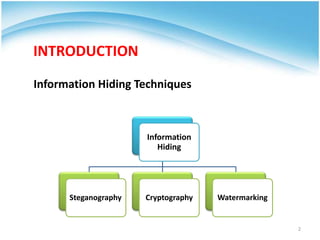
Information Hiding Techniques
Information
Hiding
Steganography Cryptography Watermarking
2
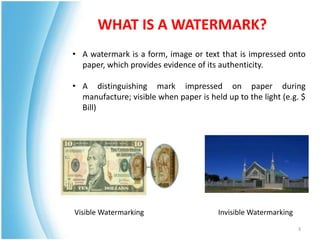
WHAT IS A WATERMARK?
• A watermark is a form, image or text that is impressed onto
paper, which provides evidence of its authenticity.
• A distinguishing mark impressed on paper during
manufacture; visible when paper is held up to the light (e.g. $
Bill)
Visible Watermarking Invisible Watermarking
3
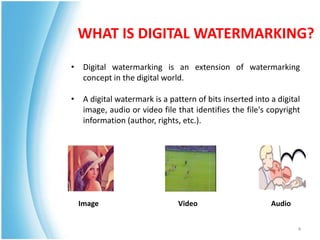
• Digital watermarking is an extension of watermarking
concept in the digital world.
• A digital watermark is a pattern of bits inserted into a digital
image, audio or video file that identifies the file's copyright
information (author, rights, etc.).
WHAT IS DIGITAL WATERMARKING?
Image Video Audio
4
How Watermarking is Different from
Steganography and Cryptography.
Steganography vs. Watermarking
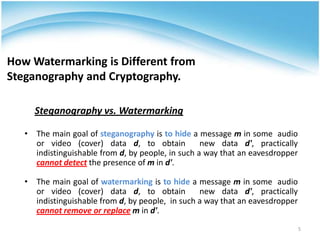
• The main goal of steganography is to hide a message m in some audio
or video (cover) data d, to obtain new data d', practically
indistinguishable from d, by people, in such a way that an eavesdropper
cannot detect the presence of m in d'.
• The main goal of watermarking is to hide a message m in some audio
or video (cover) data d, to obtain new data d', practically
indistinguishable from d, by people, in such a way that an eavesdropper
cannot remove or replace m in d'.
5
Cryptography vs. Watermarking
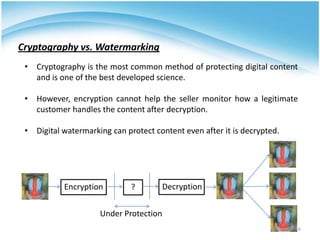
• Cryptography is the most common method of protecting digital content
and is one of the best developed science.
• However, encryption cannot help the seller monitor how a legitimate
customer handles the content after decryption.
• Digital watermarking can protect content even after it is decrypted.
Encryption ? Decryption
Under Protection
6
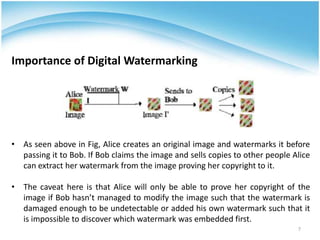
• As seen above in Fig, Alice creates an original image and watermarks it before
passing it to Bob. If Bob claims the image and sells copies to other people Alice
can extract her watermark from the image proving her copyright to it.
• The caveat here is that Alice will only be able to prove her copyright of the
image if Bob hasn’t managed to modify the image such that the watermark is
damaged enough to be undetectable or added his own watermark such that it
is impossible to discover which watermark was embedded first.
Importance of Digital Watermarking
7
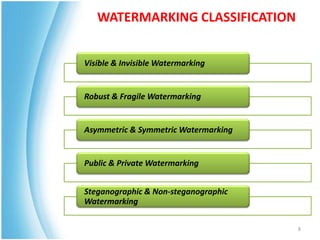
WATERMARKING CLASSIFICATION
Visible & Invisible Watermarking
Robust & Fragile Watermarking
Asymmetric & Symmetric Watermarking
Public & Private Watermarking
Steganographic & Non-steganographic
Watermarking
8
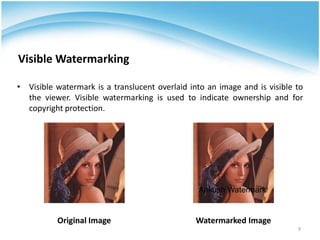
Visible Watermarking
• Visible watermark is a translucent overlaid into an image and is visible to
the viewer. Visible watermarking is used to indicate ownership and for
copyright protection.
Ankush Watermark
Original Image Watermarked Image
9
Invisible Watermarking
• Invisible watermark is embedded into the data in such a way that the changes
made to the pixel values are perceptually not noticed. Invisible watermark is
used as evidence of ownership and to detect misappropriated images.
Original Image Watermarked Image
Dual Watermarking
• Dual watermark is the combination of visible and invisible watermark. An
invisible watermark is used as a backup for the visible watermark. 10
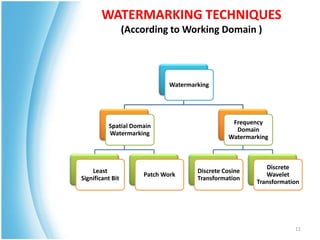
WATERMARKING TECHNIQUES
(According to Working Domain )
Watermarking
Spatial Domain
Watermarking
Least
Significant Bit
Patch Work
Frequency
Domain
Watermarking
Discrete Cosine
Transformation
Discrete
Wavelet
Transformation
11
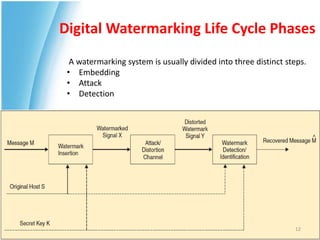
Digital Watermarking Life Cycle Phases
A watermarking system is usually divided into three distinct steps.
• Embedding
• Attack
• Detection
12
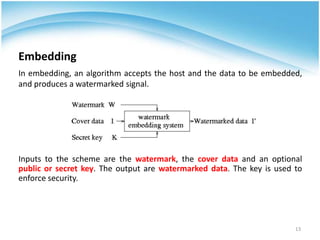
Embedding
In embedding, an algorithm accepts the host and the data to be embedded,
and produces a watermarked signal.
Inputs to the scheme are the watermark, the cover data and an optional
public or secret key. The output are watermarked data. The key is used to
enforce security.
13
Attacks
The watermarked digital signal is transmitted or stored, usually transmitted to
another person. If this person makes a modification, this is called an attack.
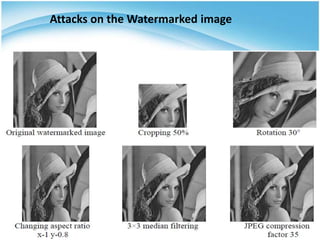
• Robustness attacks :Which are intended to remove the watermark such as…
JPEG compression, cropping, etc.
• Presentation Attacks :Under watermark detection failure they come into play.
Geometric transformation, rotation, scaling, translation, change aspect ratio,
affine transformation etc.
• Counterfeiting attacks :Rendering the original image, generate fake original.
Few Possible Attacks
14
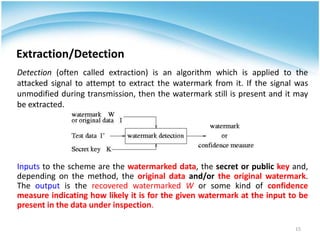
Extraction/Detection
Detection (often called extraction) is an algorithm which is applied to the
attacked signal to attempt to extract the watermark from it. If the signal was
unmodified during transmission, then the watermark still is present and it may
be extracted.
Inputs to the scheme are the watermarked data, the secret or public key and,
depending on the method, the original data and/or the original watermark.
The output is the recovered watermarked W or some kind of confidence
measure indicating how likely it is for the given watermark at the input to be
present in the data under inspection.
15
ALGORITHM
FAST HADAMARD TRANSFORM(FHT)
Advantages of FHT
• Shorter processing time
• Invisibility of the watermark guaranteed
• Increased watermark energy leads to higher robustness
16
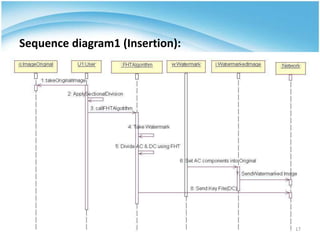
Sequence diagram1 (Insertion):
17
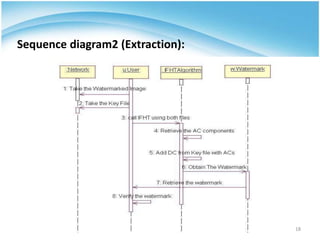
Sequence diagram2 (Extraction):
18
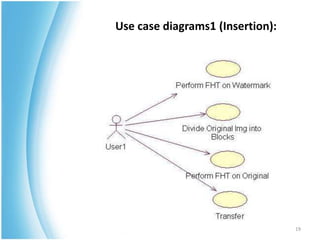
Use case diagrams1 (Insertion):
19
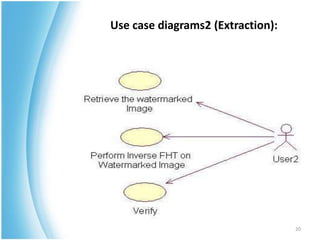
Use case diagrams2 (Extraction):
20
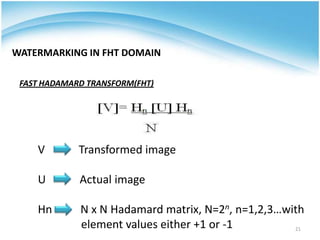
WATERMARKING IN FHT DOMAIN
V Transformed image
U Actual image
Hn N x N Hadamard matrix, N=2n, n=1,2,3…with
element values either +1 or -1
FAST HADAMARD TRANSFORM(FHT)
21
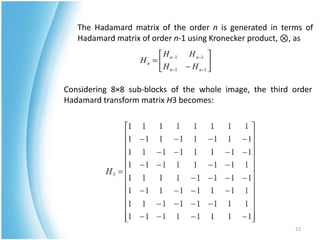
The Hadamard matrix of the order n is generated in terms of
Hadamard matrix of order n-1 using Kronecker product, ⊗, as
Considering 8×8 sub-blocks of the whole image, the third order
Hadamard transform matrix H3 becomes:
22
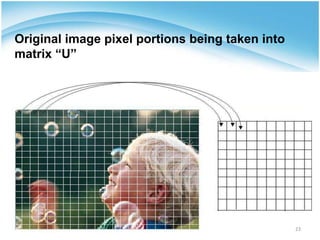
Original image pixel portions being taken into
matrix “U”
23
24
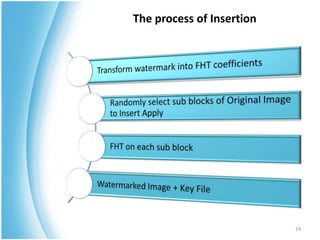
The process of Insertion
25
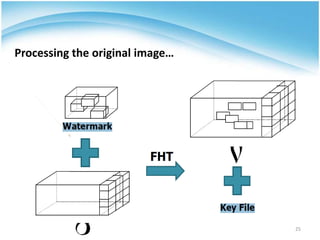
Processing the original image…
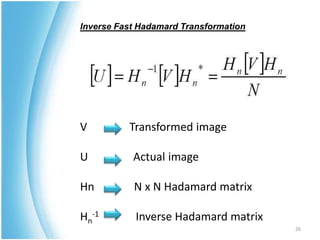
Inverse Fast Hadamard Transformation
V Transformed image
U Actual image
Hn N x N Hadamard matrix
Hn
-1 Inverse Hadamard matrix
26
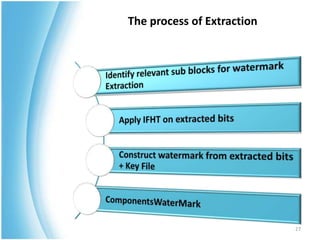
The process of Extraction
27
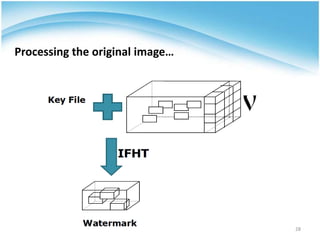
28
Processing the original image…
29
Attacks on the Watermarked image
30
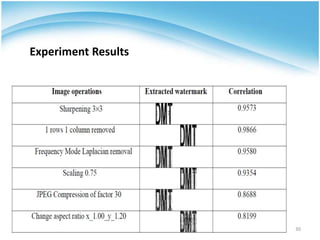
Experiment Results
• The experimental results show that the proposed method is robust
against approximately 70% of attacks.
• For sure when compared with previous, it is found to be more robust
against various attacks. It also refers significant advantage in terms of
shorter processing time and the ease of hardware implementation than
many common transform techniques.
Conclusion
31
32
REFERENCES
[1] M. Swanson, B. Zhu, A. Tewfik, and L. Boney, “Robust audio watermarking
using perceptual masking,” Signal Process., Special Issue on Watermarking,
1997, pp. 337-355.
[2] L. Boney, A. Tewfik, and K. Hamdy, “Digital watermarks for audio signals,” in
IEEE Proc. Multimedia, 1996, pp. 473-480.
[5] Keshav S Rawat, Dheerendra S Tomar, “Digital watermarking schemes for
authorization Against copying or piracy of color images” in IEEE, Vol. 1 No. 4
295-300
[6] Anthony T.S.Ho, Jun Shen, Soon Hie Tan “A Robust Digital Image-in-Image
Watermarking Algorithm Using the Fast Hadamard Transform” Proceedings of
SPIE Vol. 4793 (2003) © 2003 SPIE · 0277-786X/03/$15.00
33
34
Any Queries

digitalwatermarking-121202063739-phpapp01.pdf

  • 1.
    Digital Watermarking By, Ankush KR ankush.k.r.007@gmail.com +91-9739317537
  • 2.
  • 3.
    WHAT IS AWATERMARK? • A watermark is a form, image or text that is impressed onto paper, which provides evidence of its authenticity. • A distinguishing mark impressed on paper during manufacture; visible when paper is held up to the light (e.g. $ Bill) Visible Watermarking Invisible Watermarking 3
  • 4.
    • Digital watermarkingis an extension of watermarking concept in the digital world. • A digital watermark is a pattern of bits inserted into a digital image, audio or video file that identifies the file's copyright information (author, rights, etc.). WHAT IS DIGITAL WATERMARKING? Image Video Audio 4
  • 5.
    How Watermarking isDifferent from Steganography and Cryptography. Steganography vs. Watermarking • The main goal of steganography is to hide a message m in some audio or video (cover) data d, to obtain new data d', practically indistinguishable from d, by people, in such a way that an eavesdropper cannot detect the presence of m in d'. • The main goal of watermarking is to hide a message m in some audio or video (cover) data d, to obtain new data d', practically indistinguishable from d, by people, in such a way that an eavesdropper cannot remove or replace m in d'. 5
  • 6.
    Cryptography vs. Watermarking •Cryptography is the most common method of protecting digital content and is one of the best developed science. • However, encryption cannot help the seller monitor how a legitimate customer handles the content after decryption. • Digital watermarking can protect content even after it is decrypted. Encryption ? Decryption Under Protection 6
  • 7.
    • As seenabove in Fig, Alice creates an original image and watermarks it before passing it to Bob. If Bob claims the image and sells copies to other people Alice can extract her watermark from the image proving her copyright to it. • The caveat here is that Alice will only be able to prove her copyright of the image if Bob hasn’t managed to modify the image such that the watermark is damaged enough to be undetectable or added his own watermark such that it is impossible to discover which watermark was embedded first. Importance of Digital Watermarking 7
  • 8.
    WATERMARKING CLASSIFICATION Visible &Invisible Watermarking Robust & Fragile Watermarking Asymmetric & Symmetric Watermarking Public & Private Watermarking Steganographic & Non-steganographic Watermarking 8
  • 9.
    Visible Watermarking • Visiblewatermark is a translucent overlaid into an image and is visible to the viewer. Visible watermarking is used to indicate ownership and for copyright protection. Ankush Watermark Original Image Watermarked Image 9
  • 10.
    Invisible Watermarking • Invisiblewatermark is embedded into the data in such a way that the changes made to the pixel values are perceptually not noticed. Invisible watermark is used as evidence of ownership and to detect misappropriated images. Original Image Watermarked Image Dual Watermarking • Dual watermark is the combination of visible and invisible watermark. An invisible watermark is used as a backup for the visible watermark. 10
  • 11.
    WATERMARKING TECHNIQUES (According toWorking Domain ) Watermarking Spatial Domain Watermarking Least Significant Bit Patch Work Frequency Domain Watermarking Discrete Cosine Transformation Discrete Wavelet Transformation 11
  • 12.
    Digital Watermarking LifeCycle Phases A watermarking system is usually divided into three distinct steps. • Embedding • Attack • Detection 12
  • 13.
    Embedding In embedding, analgorithm accepts the host and the data to be embedded, and produces a watermarked signal. Inputs to the scheme are the watermark, the cover data and an optional public or secret key. The output are watermarked data. The key is used to enforce security. 13
  • 14.
    Attacks The watermarked digitalsignal is transmitted or stored, usually transmitted to another person. If this person makes a modification, this is called an attack. • Robustness attacks :Which are intended to remove the watermark such as… JPEG compression, cropping, etc. • Presentation Attacks :Under watermark detection failure they come into play. Geometric transformation, rotation, scaling, translation, change aspect ratio, affine transformation etc. • Counterfeiting attacks :Rendering the original image, generate fake original. Few Possible Attacks 14
  • 15.
    Extraction/Detection Detection (often calledextraction) is an algorithm which is applied to the attacked signal to attempt to extract the watermark from it. If the signal was unmodified during transmission, then the watermark still is present and it may be extracted. Inputs to the scheme are the watermarked data, the secret or public key and, depending on the method, the original data and/or the original watermark. The output is the recovered watermarked W or some kind of confidence measure indicating how likely it is for the given watermark at the input to be present in the data under inspection. 15
  • 16.
    ALGORITHM FAST HADAMARD TRANSFORM(FHT) Advantagesof FHT • Shorter processing time • Invisibility of the watermark guaranteed • Increased watermark energy leads to higher robustness 16
  • 17.
  • 18.
  • 19.
    Use case diagrams1(Insertion): 19
  • 20.
    Use case diagrams2(Extraction): 20
  • 21.
    WATERMARKING IN FHTDOMAIN V Transformed image U Actual image Hn N x N Hadamard matrix, N=2n, n=1,2,3…with element values either +1 or -1 FAST HADAMARD TRANSFORM(FHT) 21
  • 22.
    The Hadamard matrixof the order n is generated in terms of Hadamard matrix of order n-1 using Kronecker product, ⊗, as Considering 8×8 sub-blocks of the whole image, the third order Hadamard transform matrix H3 becomes: 22
  • 23.
    Original image pixelportions being taken into matrix “U” 23
  • 24.
  • 25.
  • 26.
    Inverse Fast HadamardTransformation V Transformed image U Actual image Hn N x N Hadamard matrix Hn -1 Inverse Hadamard matrix 26
  • 27.
    The process ofExtraction 27
  • 28.
  • 29.
    29 Attacks on theWatermarked image
  • 30.
  • 31.
    • The experimentalresults show that the proposed method is robust against approximately 70% of attacks. • For sure when compared with previous, it is found to be more robust against various attacks. It also refers significant advantage in terms of shorter processing time and the ease of hardware implementation than many common transform techniques. Conclusion 31
  • 32.
    32 REFERENCES [1] M. Swanson,B. Zhu, A. Tewfik, and L. Boney, “Robust audio watermarking using perceptual masking,” Signal Process., Special Issue on Watermarking, 1997, pp. 337-355. [2] L. Boney, A. Tewfik, and K. Hamdy, “Digital watermarks for audio signals,” in IEEE Proc. Multimedia, 1996, pp. 473-480. [5] Keshav S Rawat, Dheerendra S Tomar, “Digital watermarking schemes for authorization Against copying or piracy of color images” in IEEE, Vol. 1 No. 4 295-300 [6] Anthony T.S.Ho, Jun Shen, Soon Hie Tan “A Robust Digital Image-in-Image Watermarking Algorithm Using the Fast Hadamard Transform” Proceedings of SPIE Vol. 4793 (2003) © 2003 SPIE · 0277-786X/03/$15.00
  • 33.
  • 34.