Digital watermarking techniques for
security applications
Technical seminar on
Overview
• Abstract
• What is Digital Watermarking?
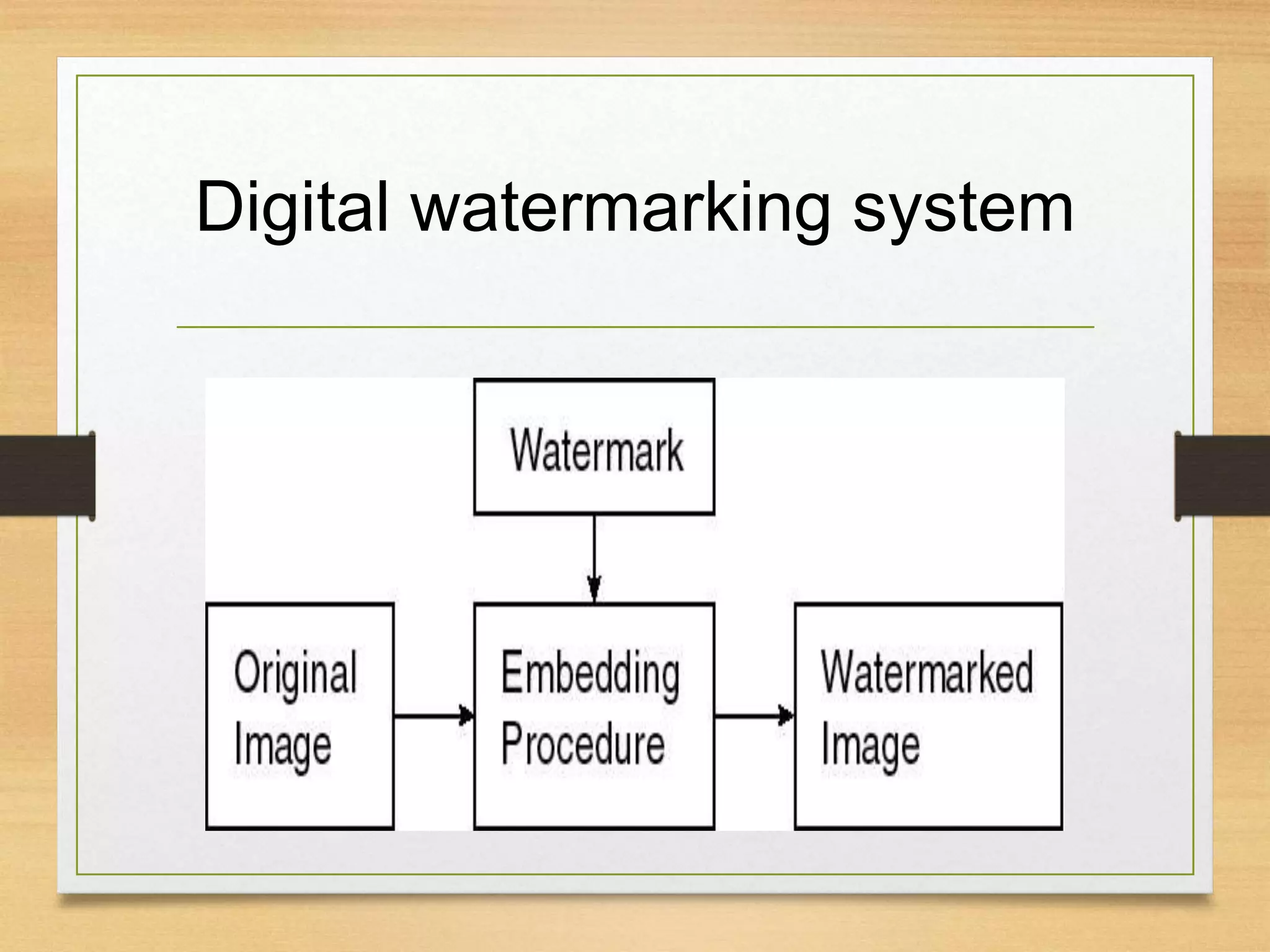
• Digital watermarking system
• Qualities of Digital Watermarking
• Types of Watermarking Techniques
• Applications of Digital Watermarking
• Watermarking Attacks
Abstract
• Nowadays, the success of internet technology, made our life
very much easy and convenient. But the major problem is to
secure the data from duplication and unauthorized use. So
the digital watermarking is used. With this technology, we
embed the secret information into the actual information for
protecting it from unauthorized use. By using this technique
only authorized user can access the data. It may be classified
into two domains that are spatial domain and frequency
domain. In this paper, we have briefly discussed about these
technologies and their pros and cons.
What is Digital Watermarking?
 Digital watermarking is that technology which is used for
protection of digital media such as video, audio and image.
 In this technique, watermark i.e. secret information is embedded in
digital media using some algorithms and the watermarked media is
processed. After that, watermark i.e. secret information is extracted
using the particular algorithm.
 This technique, i.e. digital watermarking is used for authentication
of data and protection of copyright. Here two phases are used
which are embedding of the watermark and detection and
extraction of watermark
Digital watermarking system
Qualities of Digital Watermarking
 Robustness: When we transmit a watermarked data, then there are
various attacks on that and that information may undergo different
types of operations. So in these conditions, watermark must not degrade
its quality
 Security: It means that, the watermark must be such that only
authorized users can access it. If any user has no embedding
information, he must be unable to detect the watermark. This is termed
as security of watermark
 Computational Cost: It depends on the method which is used for
watermarking. If the watermarking method is more complex, then it
contains complex algorithm, requirement of more software and
hardware, so computational cost increases and vice versa.
Types of Watermarking Techniques
 spatial domain watermarking
 frequency domain watermarking
Spatial Domain Watermarking
 In the spatial domain techniques, we embed the watermark
by modifying the pixel values.
 We know that the image is made up of pixels.
 In this method of watermarking, we embed the watermark
in some specific pixels of image.
 In the extraction phase, we extract the watermark from
these specific pixels.
 This technique is very much easy to use, less complex and
also takes less time.
 But on the other hand, it is not robust for various types of
attacks.
Transform Domain Watermarking
 The transform domain watermarking is better as
compared to the spatial domain watermarking.
 The image is represented in the form of frequency in the
transform domain watermarking.
 In the transform domain watermarking techniques, firstly
conversion of the original image is done by a predefined
transformation.
 Then we embed the watermark in the transform image or
in the transformation coefficients.
 Finally, we take the inverse transform to get the
watermarked image.
Applications of Digital Watermarking
Copyright Protection: Digital watermarking is used to identify and
protect copyright ownership. Digital data is embedded with watermarks to
identify the copyright owners
Medical Application: For any treatment, medical reports are very much
important. If the reports get mixed, it proves very much dangerous for the
patients. So by using digital watermarking, we embed the name of the
patients on the reports such as an MRI scan and X-Ray reports .
Annotation and Privacy Control: To annotate an image multi-bit
watermarking can be used. For example, imaging details and patient
records related to a medical image can be carefully embedded into the
image.
Watermarking Attacks
• Removal Attack: In this, the unauthorized user tries to remove
the watermark i.e. secret information from the watermarked data
• Interference Attack: In these types of attacks, the noise is
inserted to the watermarked media. Some examples of this
category are averaging, quantization, compression etc.
• Active Attack: It is the most important attack. Here the
unauthorized user tries to extract the watermark or simply makes
the watermark such that it cannot be detected by any operation.
• Passive Attacks: In this type of attack, unauthorized user
simply tries to find out that the particular data contain the
watermark or not
• Image Degradation: In these types of attacks, the parts of
the image are removed, resulting in damage of robust
watermarks. Examples of these attacks are partial cropping,
row removal and column removal, insertion of Gaussian
noise.
Thank you

Digital watermarking techniques for security applications

  • 1.
    Digital watermarking techniquesfor security applications Technical seminar on
  • 2.
    Overview • Abstract • Whatis Digital Watermarking? • Digital watermarking system • Qualities of Digital Watermarking • Types of Watermarking Techniques • Applications of Digital Watermarking • Watermarking Attacks
  • 3.
    Abstract • Nowadays, thesuccess of internet technology, made our life very much easy and convenient. But the major problem is to secure the data from duplication and unauthorized use. So the digital watermarking is used. With this technology, we embed the secret information into the actual information for protecting it from unauthorized use. By using this technique only authorized user can access the data. It may be classified into two domains that are spatial domain and frequency domain. In this paper, we have briefly discussed about these technologies and their pros and cons.
  • 4.
    What is DigitalWatermarking?  Digital watermarking is that technology which is used for protection of digital media such as video, audio and image.  In this technique, watermark i.e. secret information is embedded in digital media using some algorithms and the watermarked media is processed. After that, watermark i.e. secret information is extracted using the particular algorithm.  This technique, i.e. digital watermarking is used for authentication of data and protection of copyright. Here two phases are used which are embedding of the watermark and detection and extraction of watermark
  • 5.
  • 6.
    Qualities of DigitalWatermarking  Robustness: When we transmit a watermarked data, then there are various attacks on that and that information may undergo different types of operations. So in these conditions, watermark must not degrade its quality  Security: It means that, the watermark must be such that only authorized users can access it. If any user has no embedding information, he must be unable to detect the watermark. This is termed as security of watermark  Computational Cost: It depends on the method which is used for watermarking. If the watermarking method is more complex, then it contains complex algorithm, requirement of more software and hardware, so computational cost increases and vice versa.
  • 7.
    Types of WatermarkingTechniques  spatial domain watermarking  frequency domain watermarking
  • 8.
    Spatial Domain Watermarking In the spatial domain techniques, we embed the watermark by modifying the pixel values.  We know that the image is made up of pixels.  In this method of watermarking, we embed the watermark in some specific pixels of image.  In the extraction phase, we extract the watermark from these specific pixels.  This technique is very much easy to use, less complex and also takes less time.  But on the other hand, it is not robust for various types of attacks.
  • 9.
    Transform Domain Watermarking The transform domain watermarking is better as compared to the spatial domain watermarking.  The image is represented in the form of frequency in the transform domain watermarking.  In the transform domain watermarking techniques, firstly conversion of the original image is done by a predefined transformation.  Then we embed the watermark in the transform image or in the transformation coefficients.  Finally, we take the inverse transform to get the watermarked image.
  • 10.
    Applications of DigitalWatermarking Copyright Protection: Digital watermarking is used to identify and protect copyright ownership. Digital data is embedded with watermarks to identify the copyright owners Medical Application: For any treatment, medical reports are very much important. If the reports get mixed, it proves very much dangerous for the patients. So by using digital watermarking, we embed the name of the patients on the reports such as an MRI scan and X-Ray reports . Annotation and Privacy Control: To annotate an image multi-bit watermarking can be used. For example, imaging details and patient records related to a medical image can be carefully embedded into the image.
  • 11.
    Watermarking Attacks • RemovalAttack: In this, the unauthorized user tries to remove the watermark i.e. secret information from the watermarked data • Interference Attack: In these types of attacks, the noise is inserted to the watermarked media. Some examples of this category are averaging, quantization, compression etc. • Active Attack: It is the most important attack. Here the unauthorized user tries to extract the watermark or simply makes the watermark such that it cannot be detected by any operation.
  • 12.
    • Passive Attacks:In this type of attack, unauthorized user simply tries to find out that the particular data contain the watermark or not • Image Degradation: In these types of attacks, the parts of the image are removed, resulting in damage of robust watermarks. Examples of these attacks are partial cropping, row removal and column removal, insertion of Gaussian noise.
  • 13.