Copyright Protection of Digital Image
Contents Introduction Generic Watermarking Scheme and Purpose Watermarking  Requirements Watermarking Properties and Techniques Attacks of Watermarked Image Application Field of Watermarking Image Watermarking Techniques Summary
Introduction(1) Digital technologies present  new threats  for Intellectual properties and contents : Easy access to information Modification/falsification facilities Redistribution facilities Perfect copies Methods that prevent unauthorized access  to copyrighted digital contents are required in wide ranges of applications
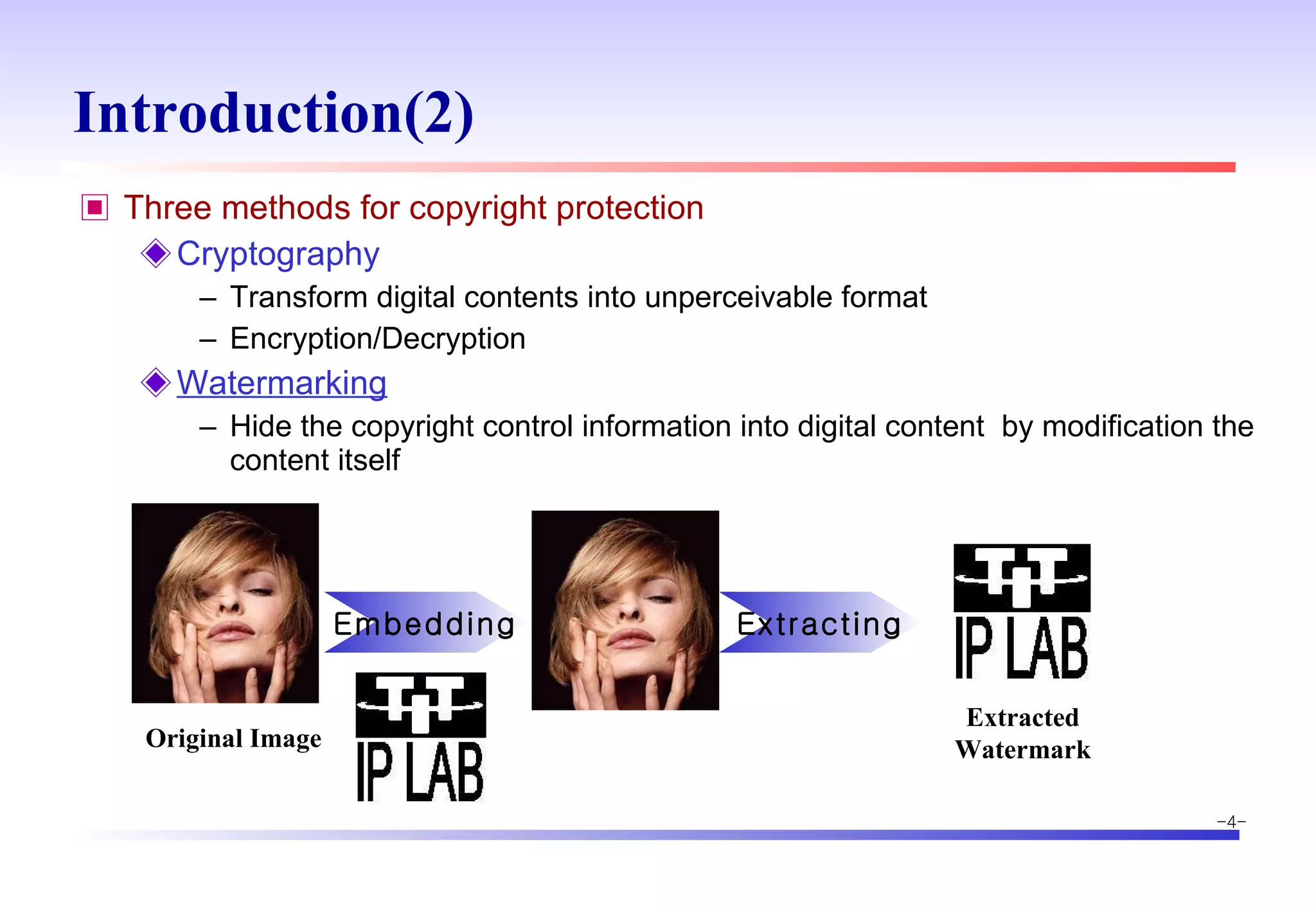
Introduction(2) Three methods for copyright protection Cryptography Transform digital contents into unperceivable format Encryption/Decryption Watermarking Hide the copyright control information into digital content  by modification the content itself Original Image Embedding Extracting Extracted Watermark
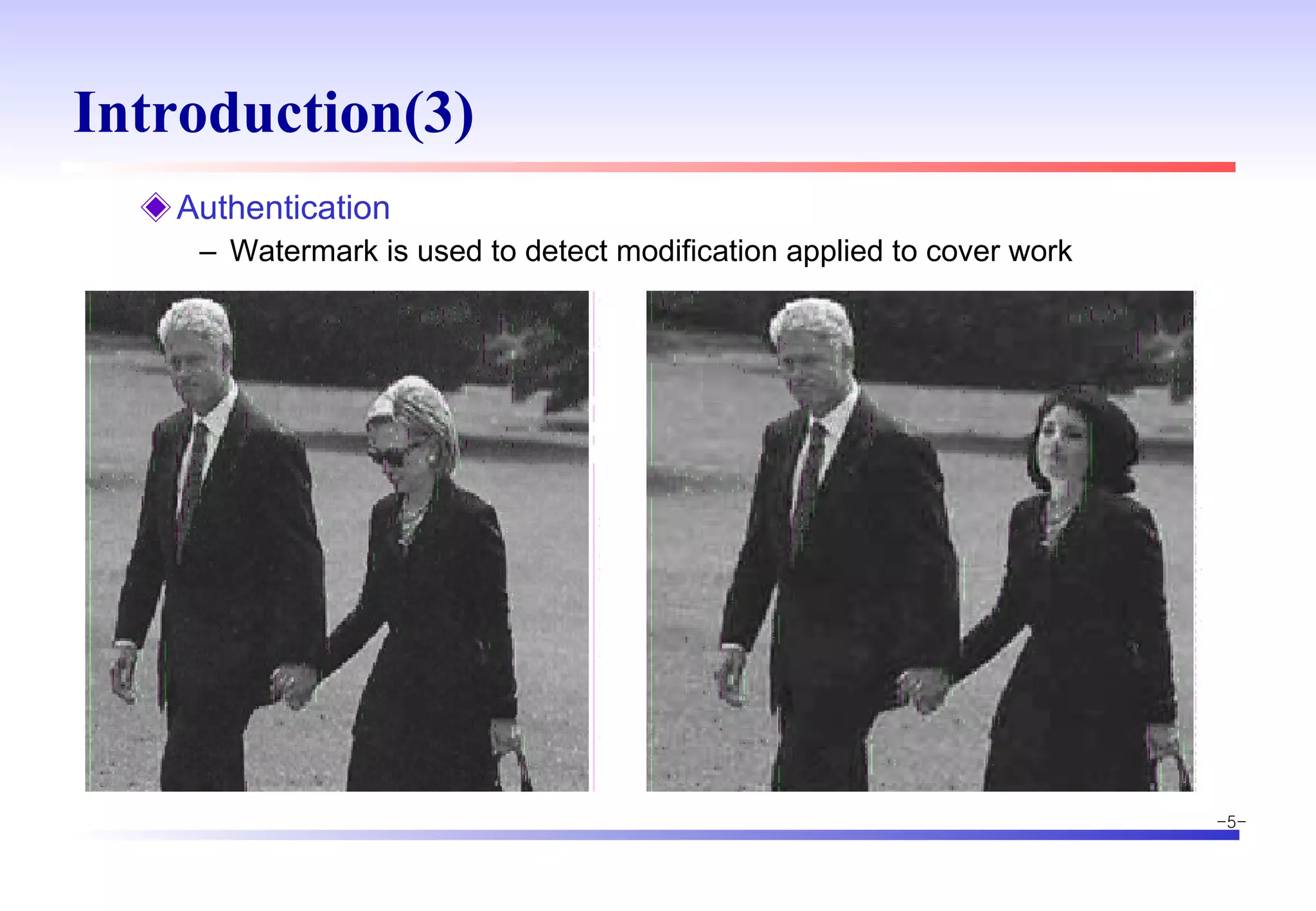
Introduction(3) Authentication Watermark is used to detect modification applied to cover work
Introduction(4) Steganography vs. Watermarking  Steganography  Covert point-to-point communication  between two parties Interpreted to  means of  information hiding  in other information Example : sending a message to a spy by marking certain letters in a newspapers using invisible ink Watermarking Has the  additional requirement of robustness  against possible attacks
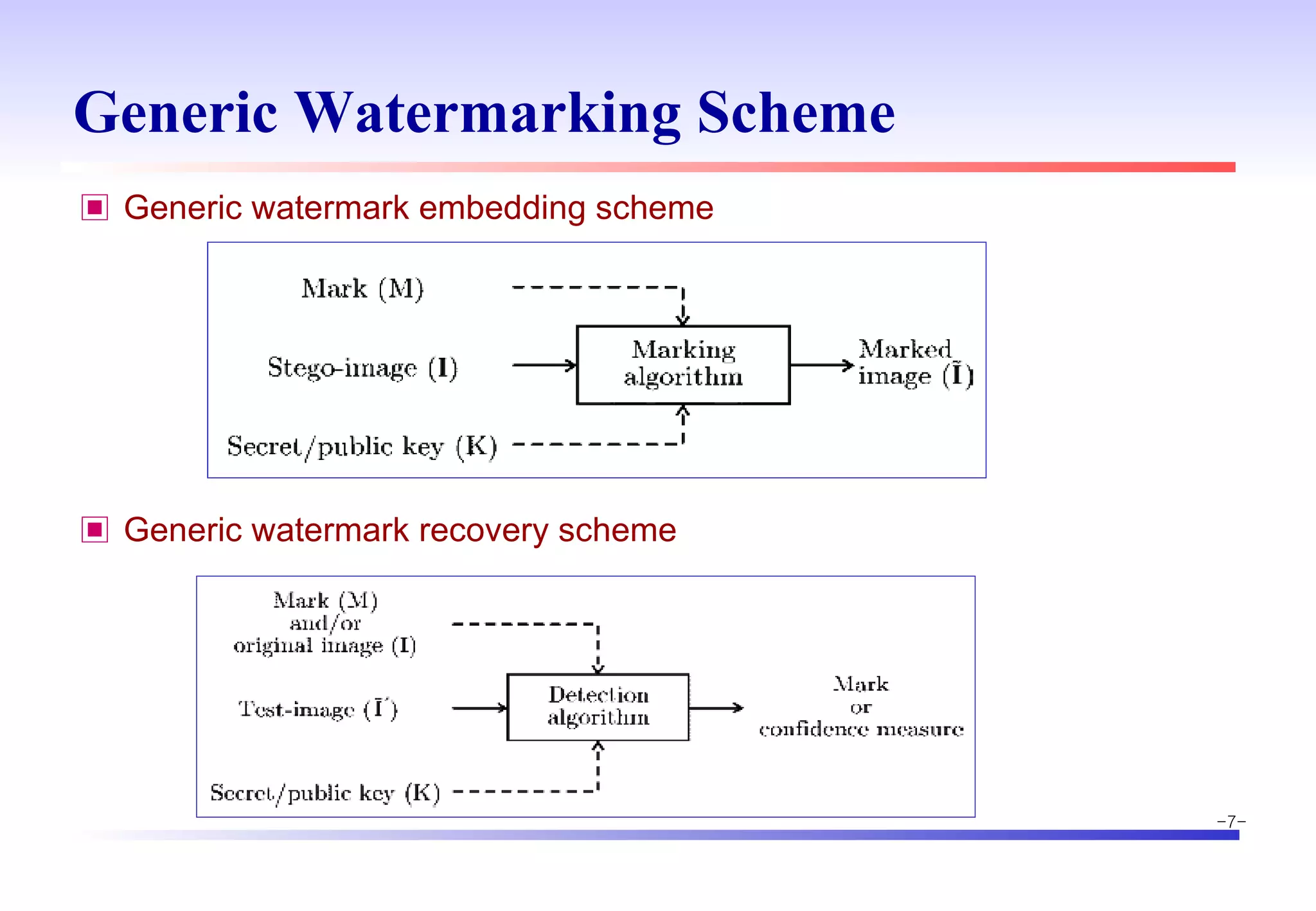
Generic Watermarking Scheme Generic watermark embedding scheme Generic watermark recovery scheme
Watermarking History Watermarks are used to keep track of paper provenance and thus format and quality identification in the art of handmade papermaking nearly 700 years ago 1993 First use of the term “Watermark” Tirkel  et al .,“Electronic watermark”, DICTA 1993 1993-1994 First papers on digital watermarking 1995 First special session on image watermarking at NSIP’95, Neos Marmaras, Greece. 1995 One of the first image watermarking algorithms “ Patchwork algorithm”, Kaskalis, Pitas, Bender  et al
Purpose of Watermarking  Copyright Protection Copyright owner wants to check for illegal copies of her works Fingerprinting Hidden serial numbers. It enable the intellectual  property owner to identify which customer broke his license agreement . Copy Control Copyright owner wants to control the terms of use of her work Example : DVD protection(Copy once, Copy many, No copy) Broadcast Monitoring Monitor when and whether content is transmitted over broadcast channels, such as TV or radio(Verify advertising broadcasts, Verify royalty payments, Catching instances of piracy) Data Authentication Watermark is used to detect modification applied to cover work  Example : Checking for fraud passport photographs
Watermarking Requirements(1) Perceptual transparency Watermarked content has the same subjective quality as the original contents Robustness Nobody is able to remove, alter, or damage the watermark without a secret key Security Secret key determines the value of watermark and the locations where the watermark is embedded Payload of the watermark Amount of information to be embedded Capacity Multiple watermark can be embedded/extracted
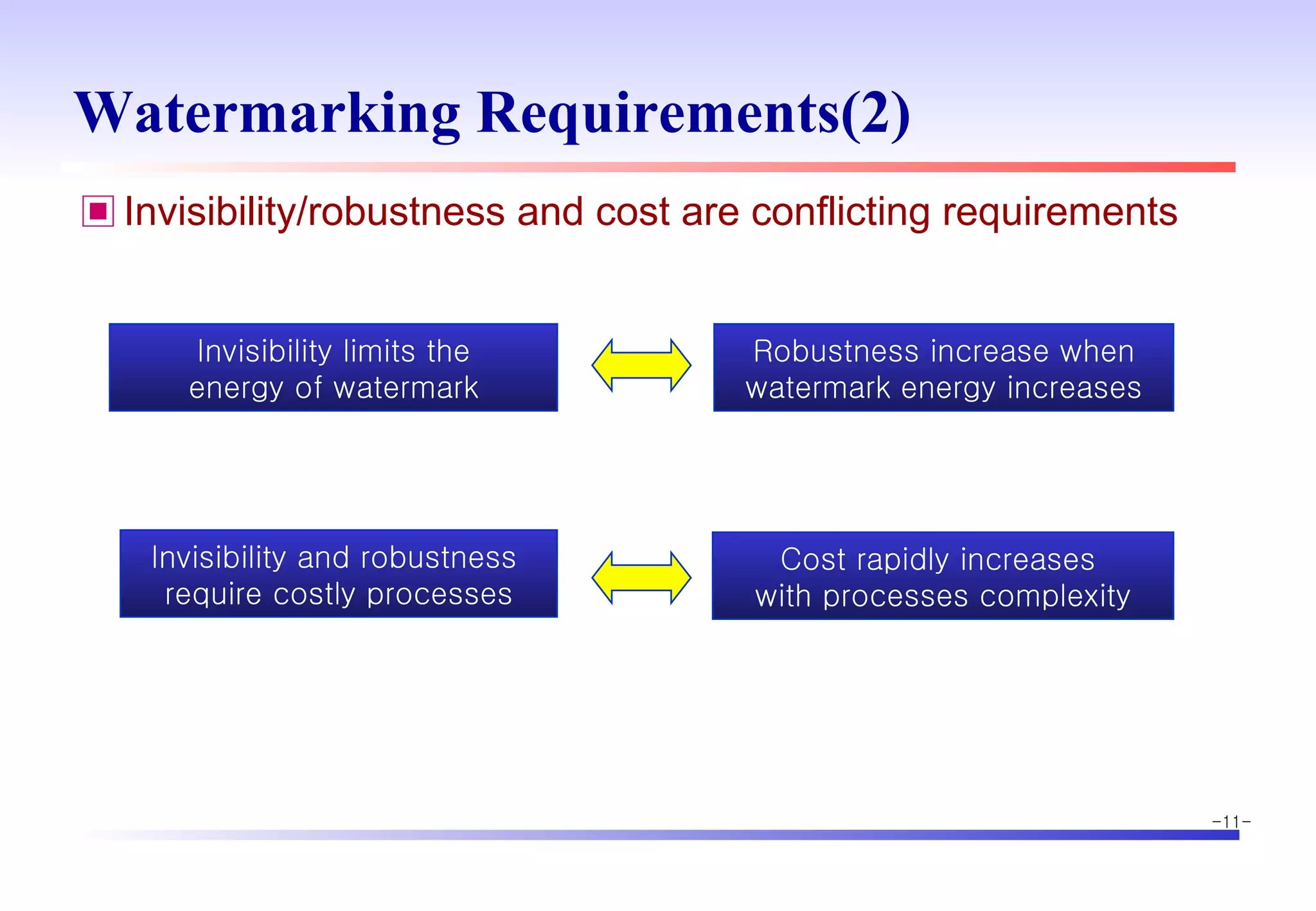
Watermarking Requirements(2) Invisibility/robustness and cost are conflicting requirements Invisibility limits the energy of watermark Robustness increase when watermark energy increases Invisibility and robustness  require costly processes Cost rapidly increases  with processes complexity
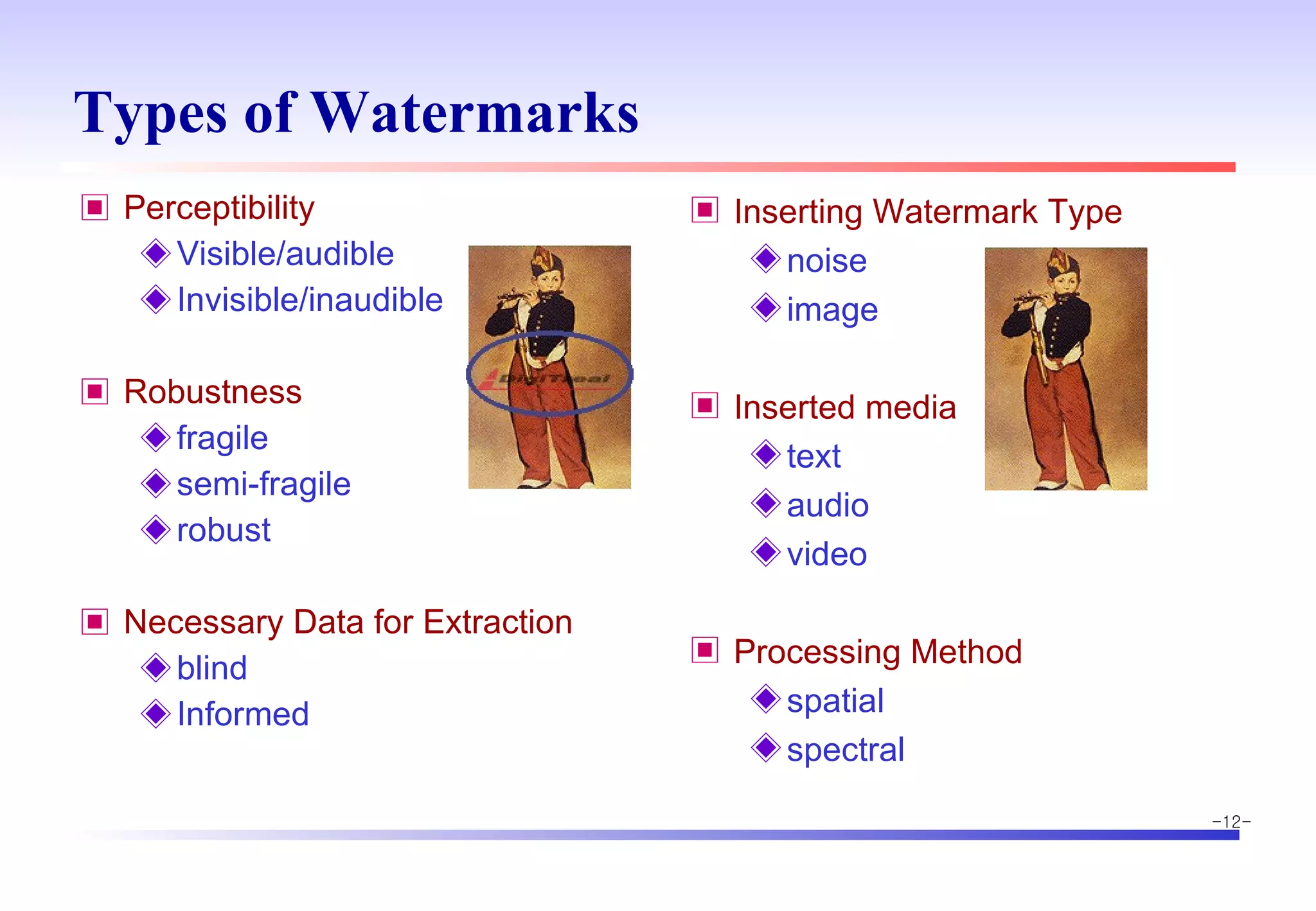
Types of Watermarks Perceptibility Visible/audible Invisible/inaudible Robustness fragile semi-fragile robust Necessary Data for Extraction blind Informed Inserting Watermark Type noise image Inserted media text audio video Processing Method spatial spectral
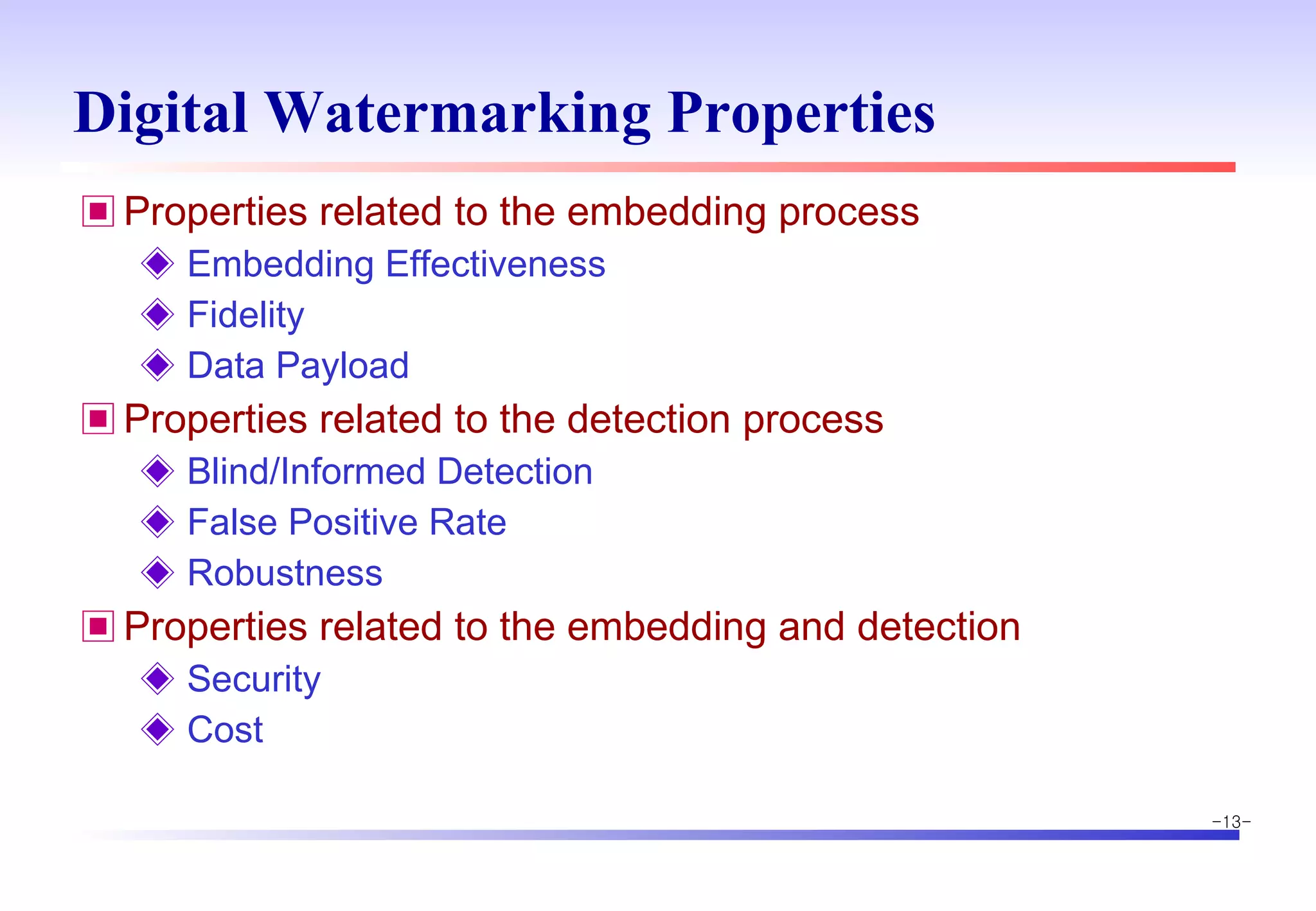
Digital Watermarking Properties Properties related to the embedding process Embedding Effectiveness Fidelity Data Payload Properties related to the detection process Blind/Informed Detection False Positive Rate Robustness Properties related to the embedding and detection  Security Cost
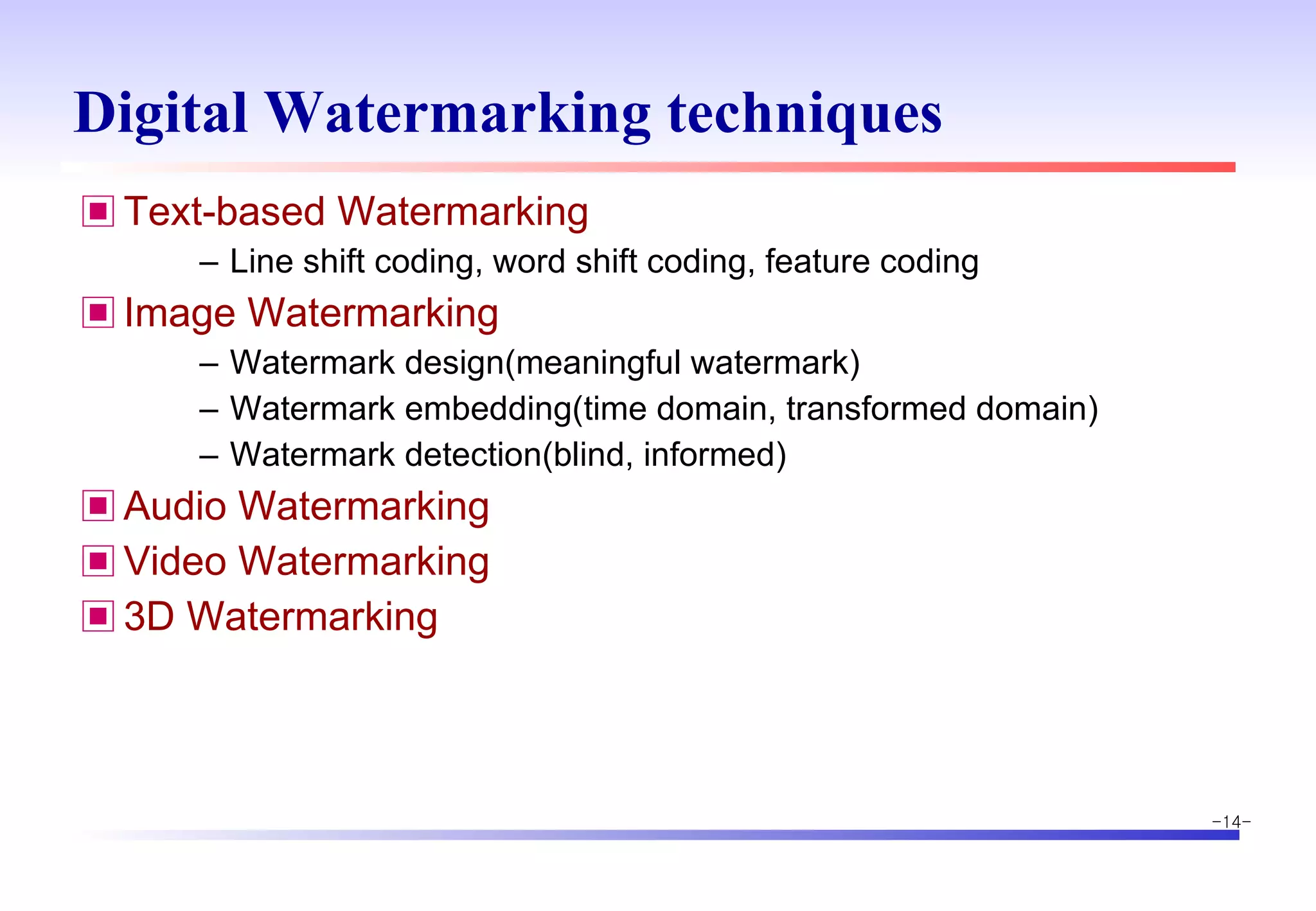
Digital Watermarking techniques Text-based Watermarking Line shift coding, word shift coding, feature coding Image Watermarking Watermark design(meaningful watermark) Watermark embedding(time domain, transformed domain) Watermark detection(blind, informed)  Audio Watermarking Video Watermarking 3D Watermarking
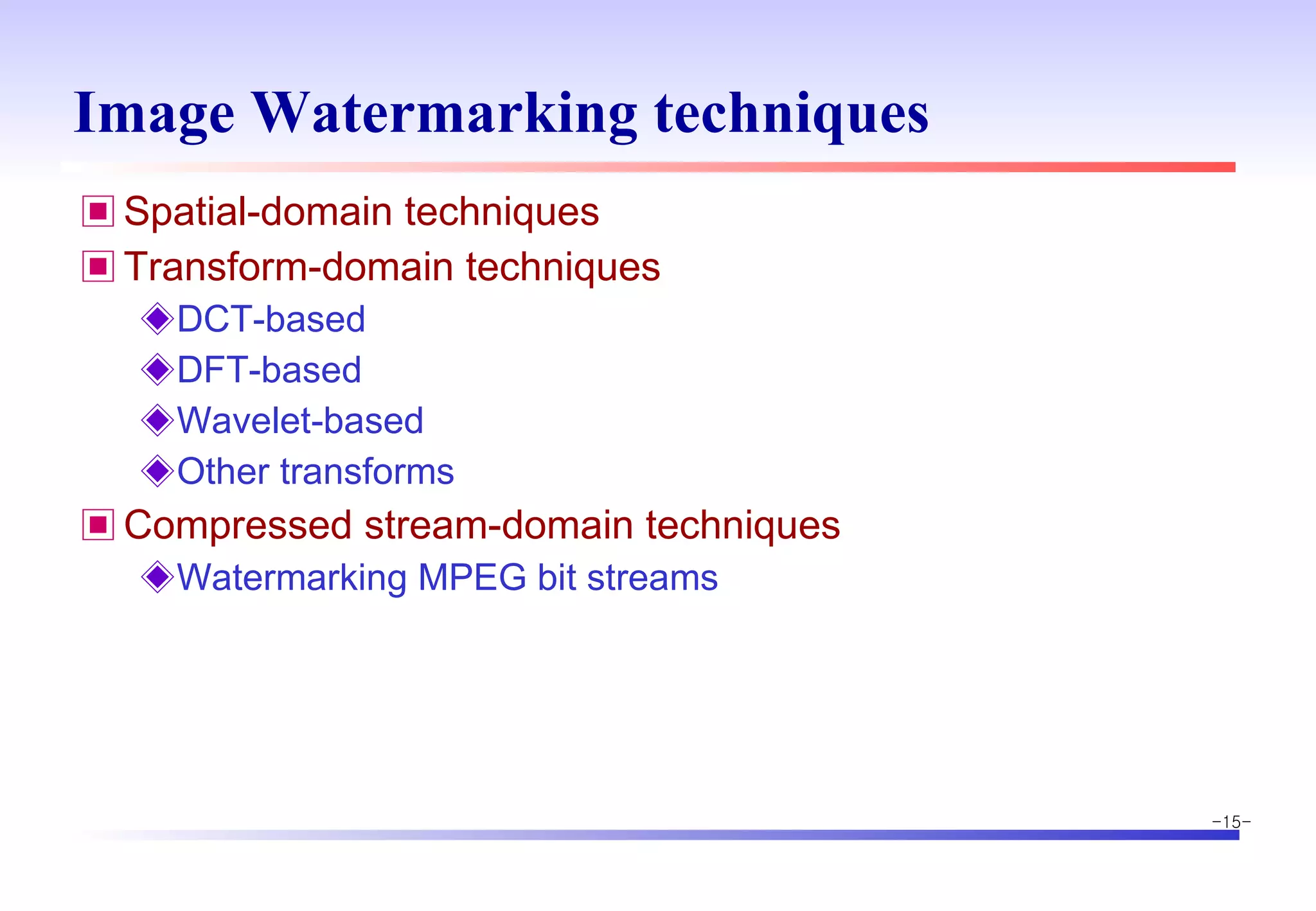
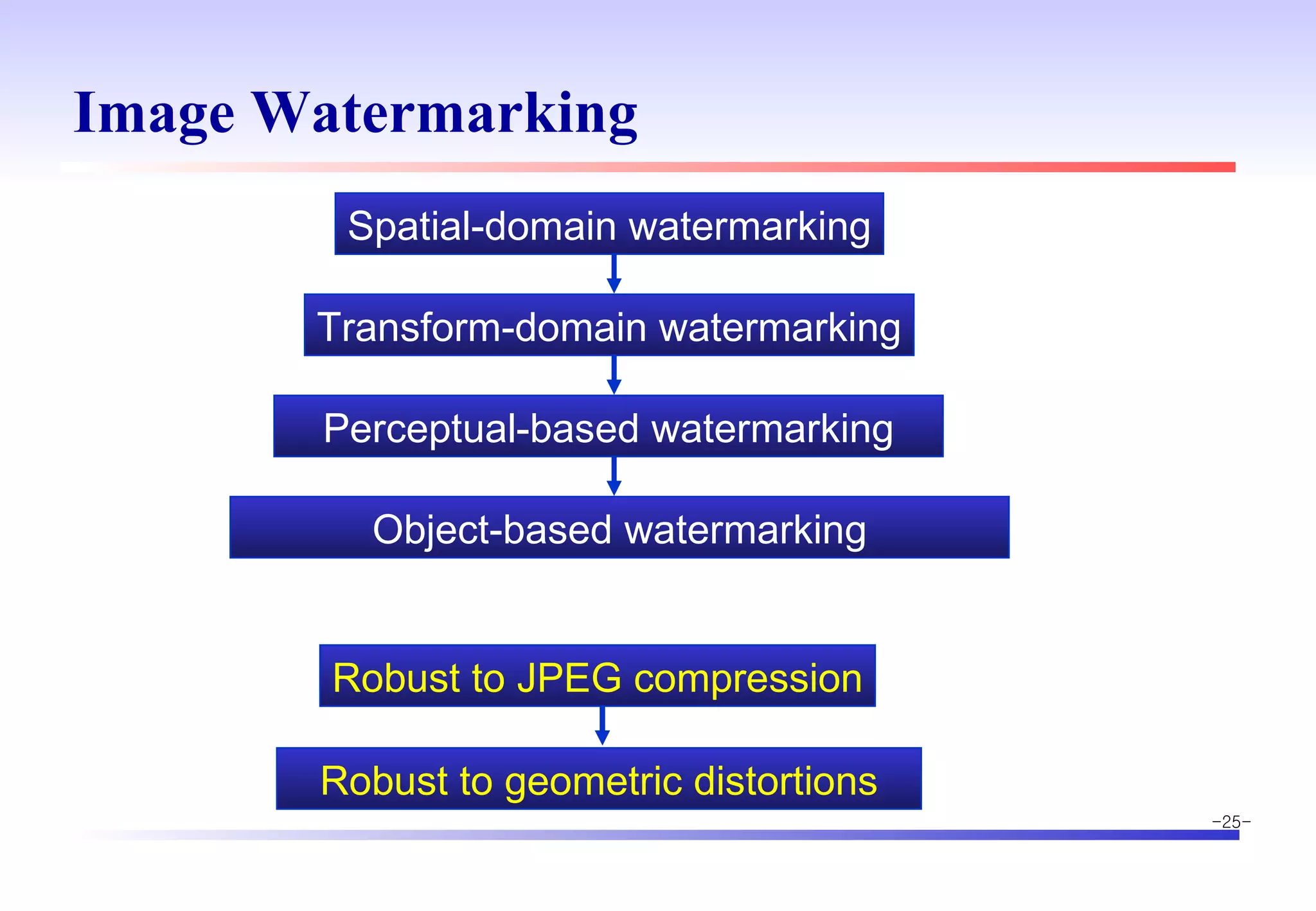
Image Watermarking techniques Spatial-domain techniques Transform-domain techniques DCT-based DFT-based Wavelet-based Other transforms Compressed stream-domain techniques Watermarking MPEG bit streams
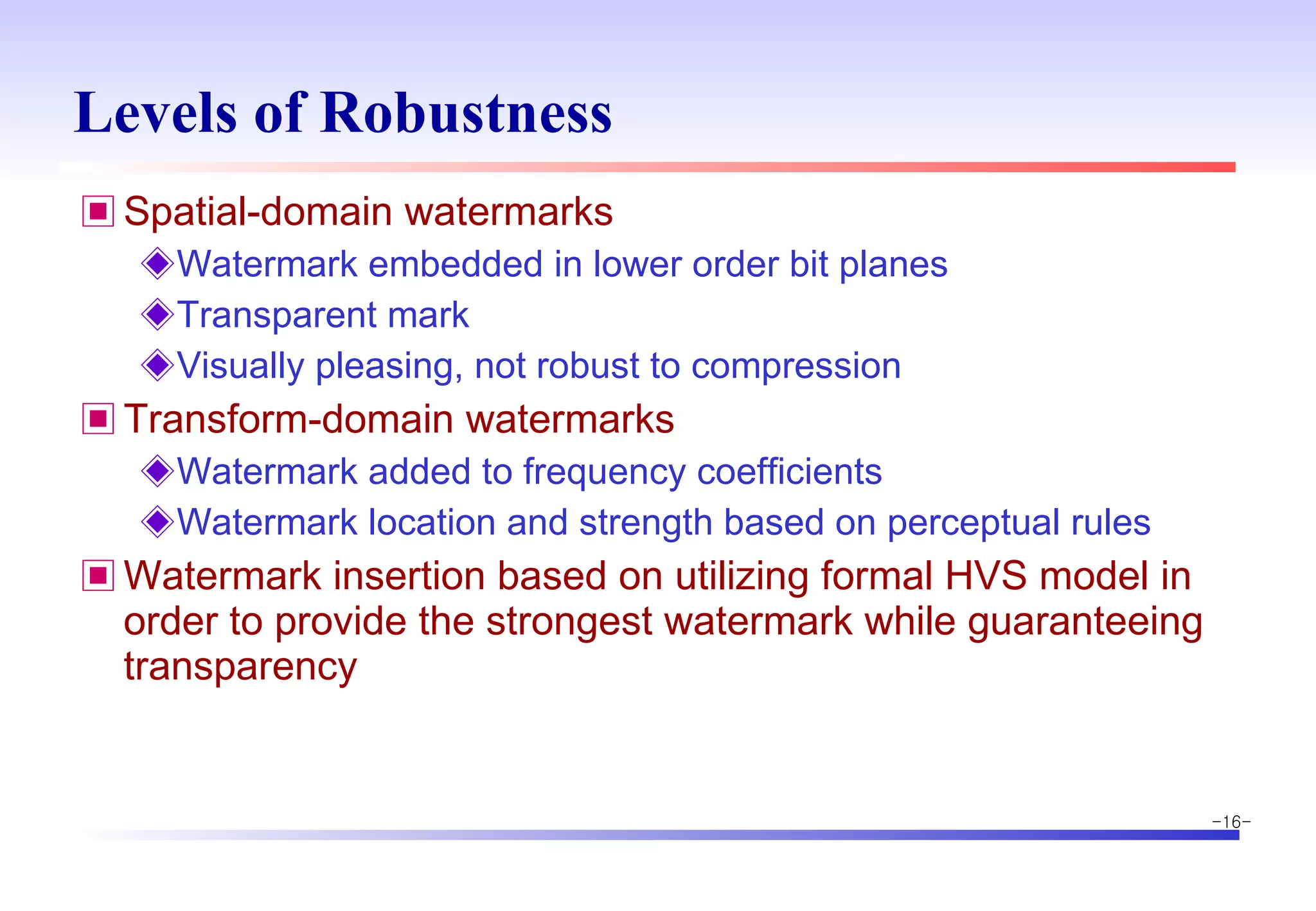
Levels of Robustness Spatial-domain watermarks Watermark embedded in lower order bit planes Transparent mark Visually pleasing, not robust to compression Transform-domain watermarks Watermark added to frequency coefficients Watermark location and strength based on perceptual rules Watermark insertion based on utilizing formal HVS model in order to provide the strongest watermark while guaranteeing transparency
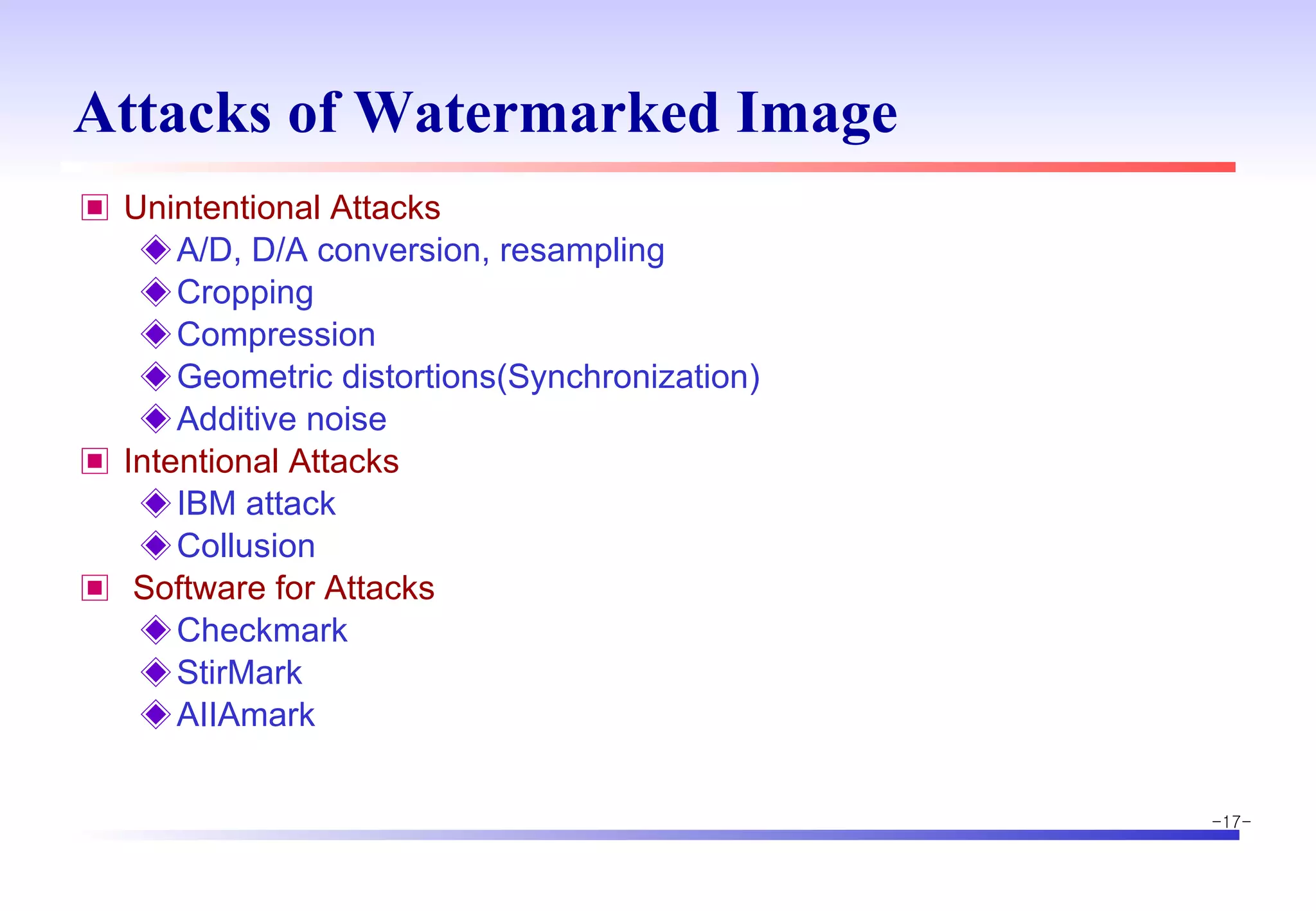
Attacks of Watermarked Image Unintentional Attacks A/D, D/A conversion, resampling Cropping Compression Geometric distortions(Synchronization) Additive noise Intentional Attacks IBM attack Collusion Software for Attacks Checkmark StirMark AIIAmark
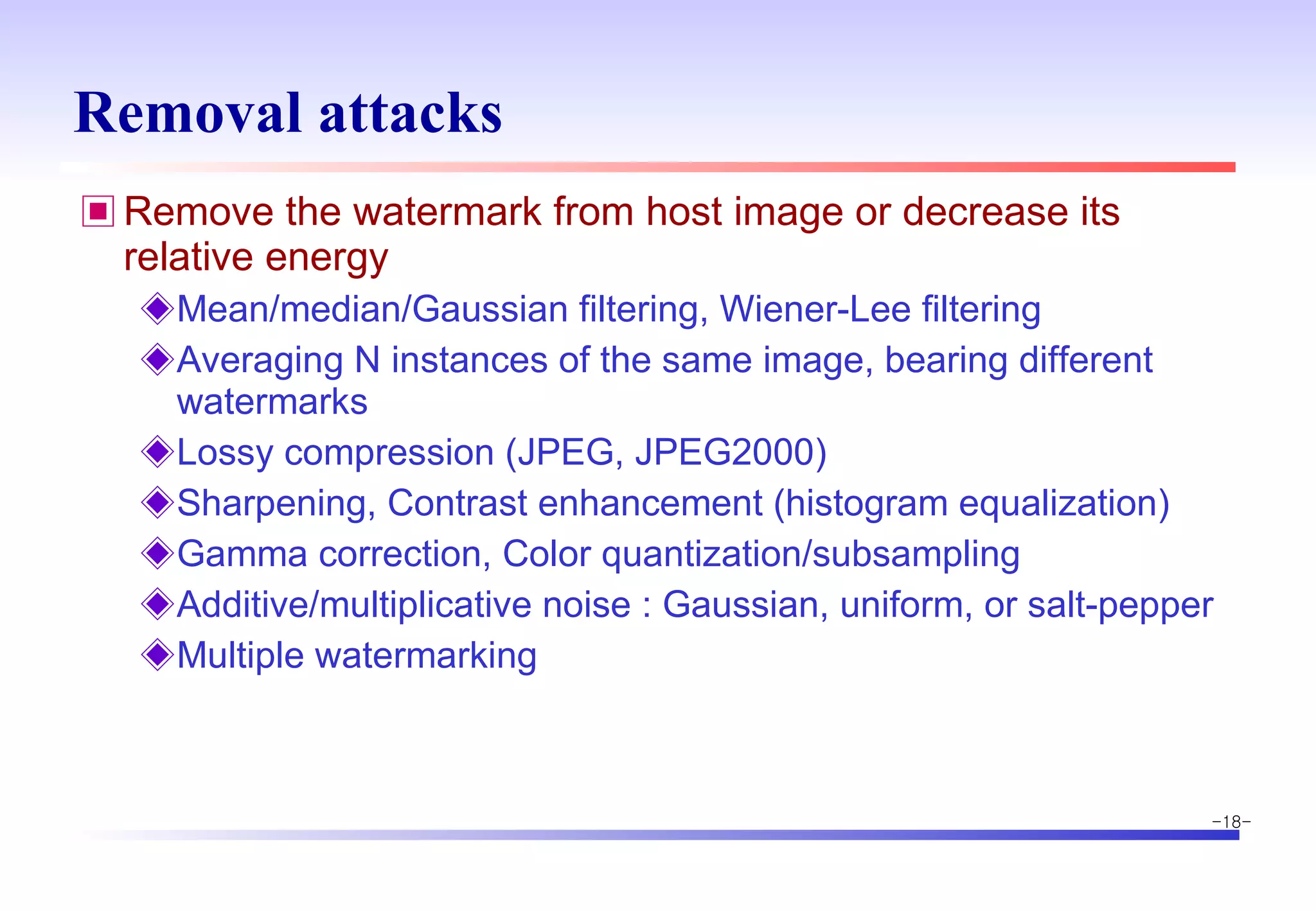
Removal attacks Remove the watermark from host image or decrease its relative energy Mean/median/Gaussian filtering, Wiener-Lee filtering Averaging N instances of the same image, bearing different watermarks Lossy compression (JPEG, JPEG2000) Sharpening, Contrast enhancement (histogram equalization) Gamma correction, Color quantization/subsampling Additive/multiplicative noise : Gaussian, uniform, or salt-pepper Multiple watermarking
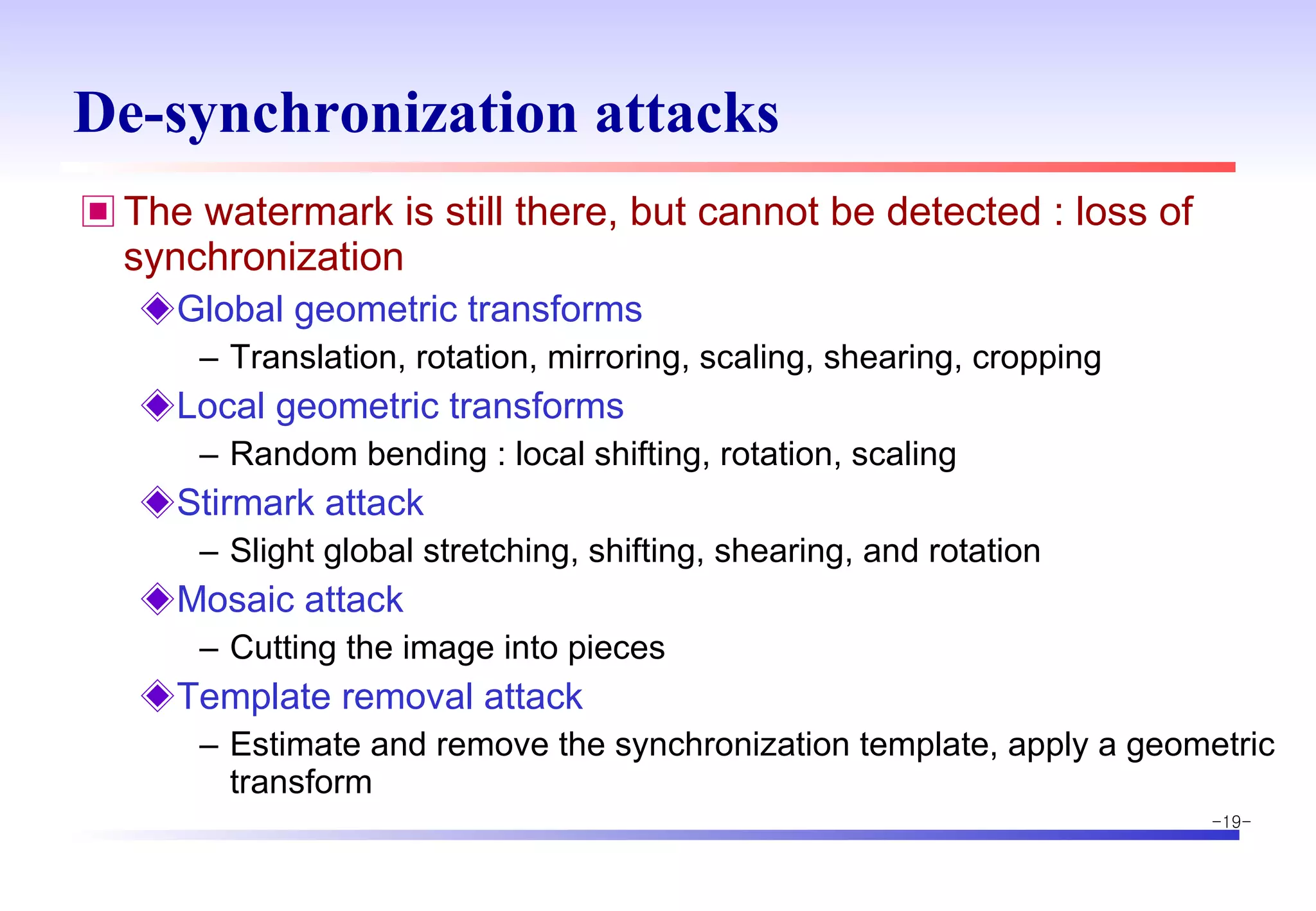
De-synchronization attacks The watermark is still there, but cannot be detected : loss of synchronization Global geometric transforms Translation, rotation, mirroring, scaling, shearing, cropping Local geometric transforms Random bending : local shifting, rotation, scaling Stirmark attack Slight global stretching, shifting, shearing, and rotation Mosaic attack Cutting the image into pieces Template removal attack Estimate and remove the synchronization template, apply a geometric transform
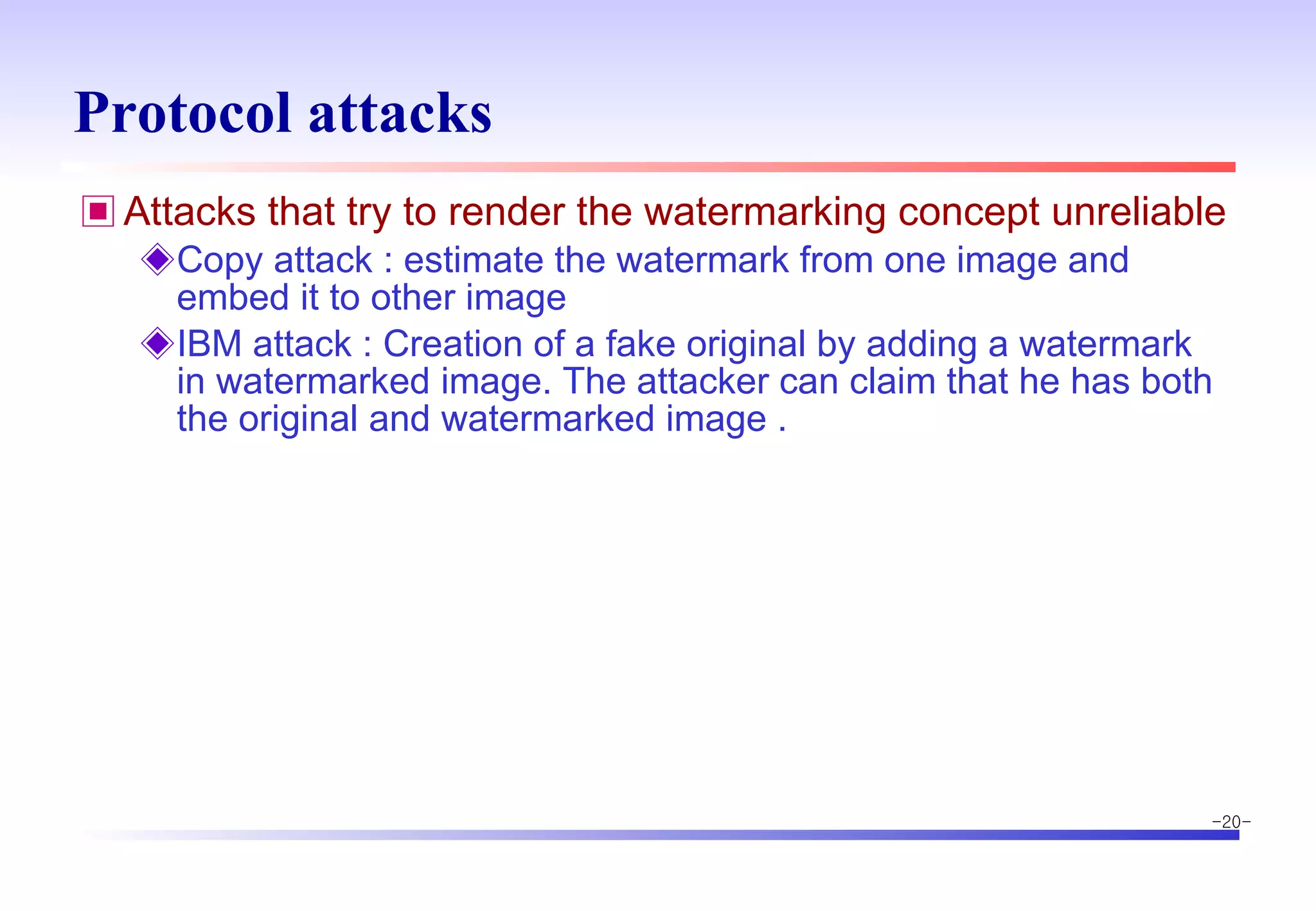
Protocol attacks Attacks that try to render the watermarking concept unreliable Copy attack : estimate the watermark from one image and embed it to other image IBM attack : Creation of a fake original by adding a watermark in watermarked image. The attacker can claim that he has both the original and watermarked image .
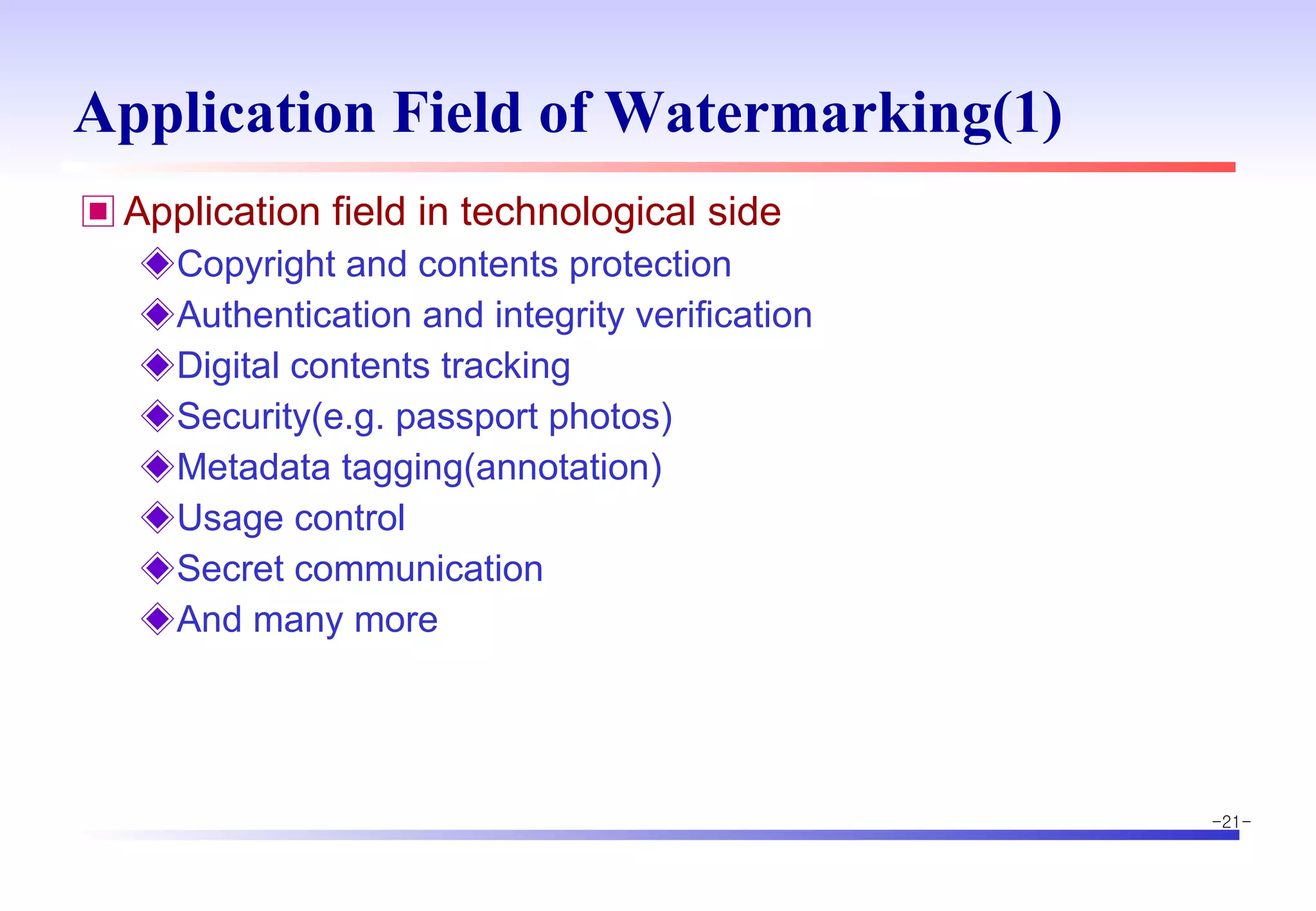
Application Field of Watermarking(1) Application field in technological side Copyright and contents protection Authentication and integrity verification Digital contents tracking Security(e.g. passport photos) Metadata tagging(annotation) Usage control Secret communication And many more
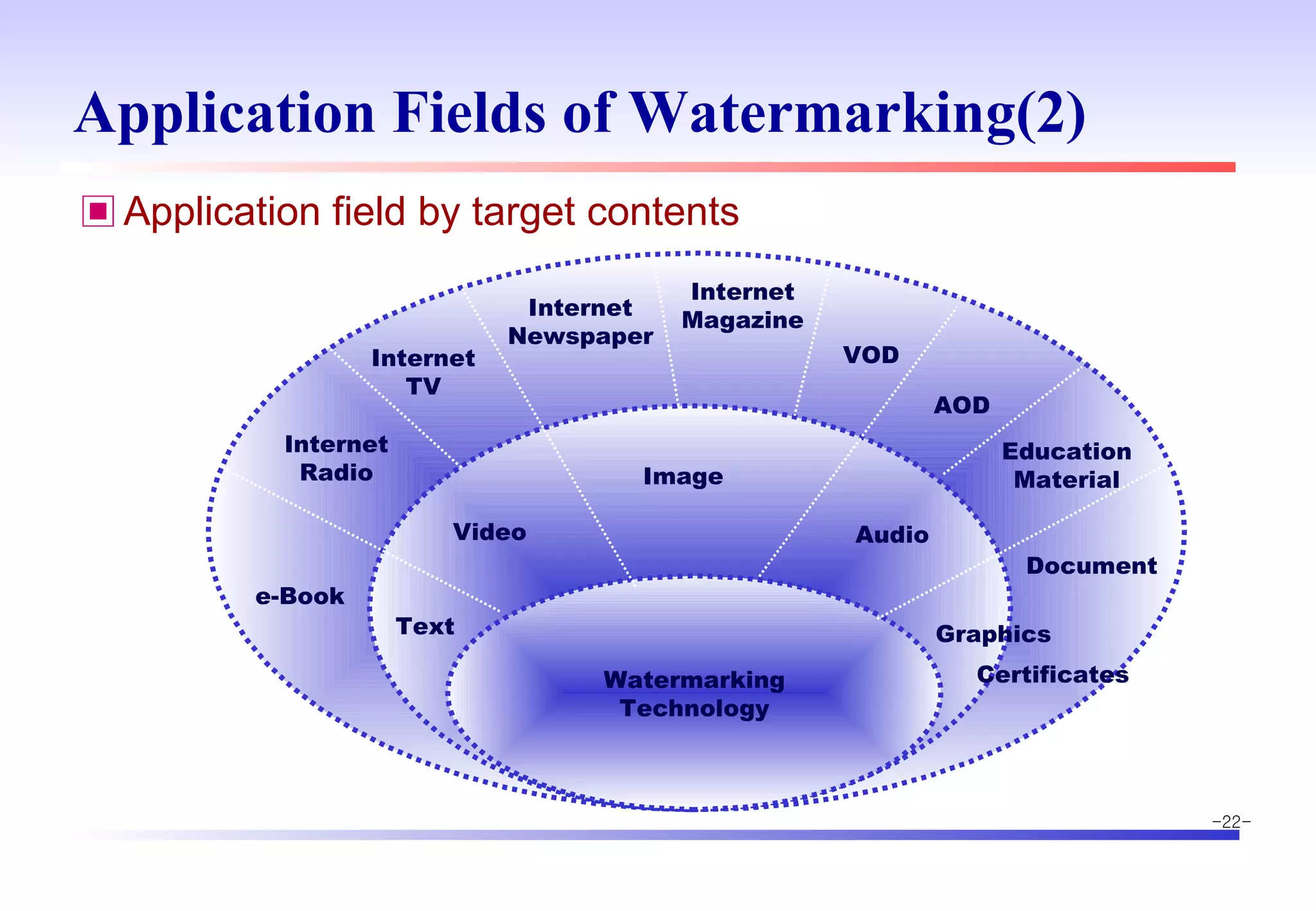
Application Fields of Watermarking(2) Application field by target contents Document Watermarking Technology VOD Graphics Audio Image Video Text Internet Magazine Internet Newspaper Internet TV Internet Radio Education Material AOD Certificates e-Book
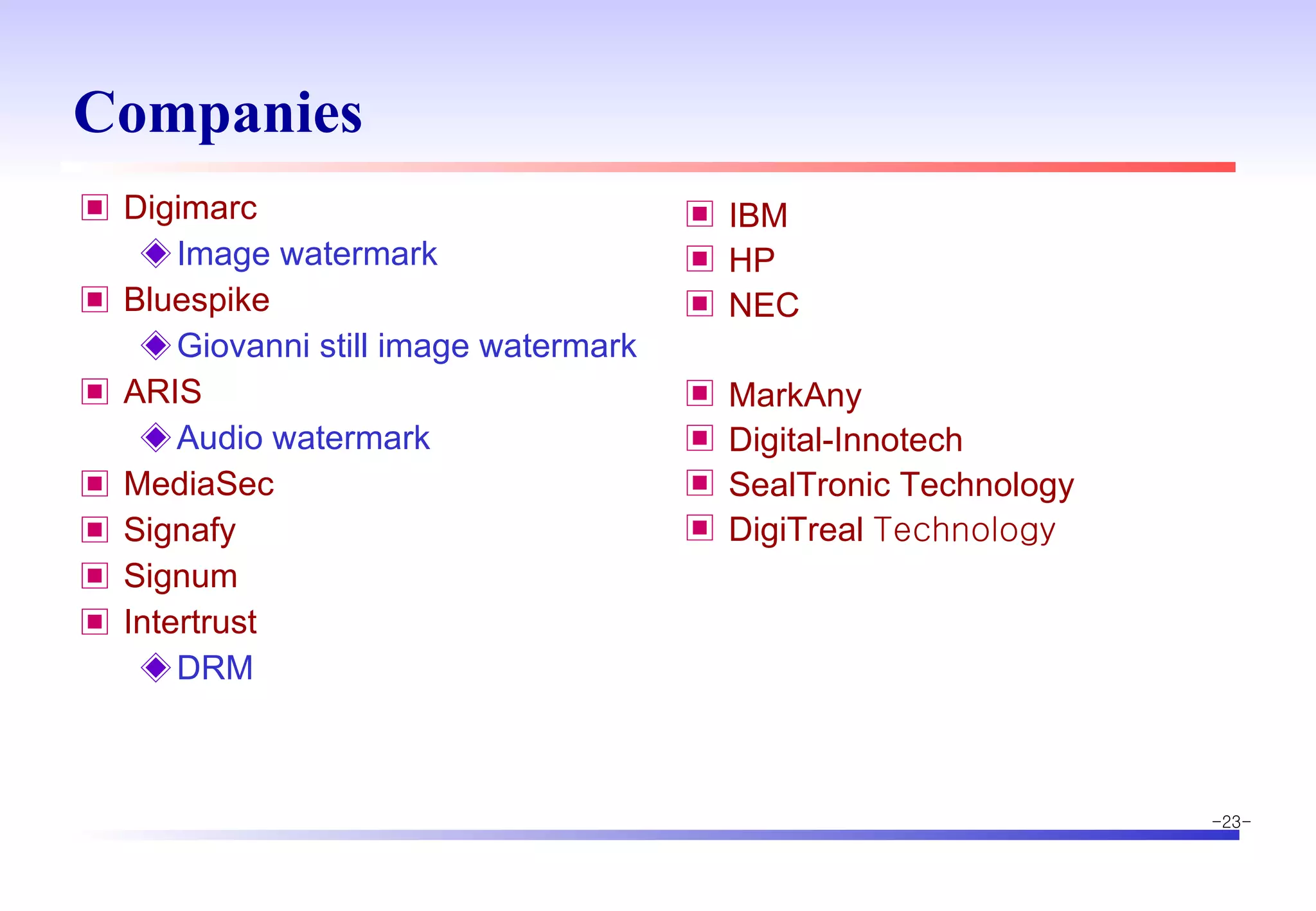
Companies Digimarc Image watermark Bluespike  Giovanni still image watermark ARIS Audio watermark MediaSec Signafy Signum Intertrust DRM IBM HP NEC MarkAny Digital-Innotech SealTronic Technology DigiTreal  Technology
Related Sites Watermarking and data hiding http://www-nt.e-technik.uni-erlangen.de/~hartung/watermarkinglinks.html WatermarkingWorld http://www.watermarkingworld.org/ Digital Copyright Protection & Digital Watermarking Technology http://www-sal.cs.uiuc.edu/~l-qiao/watermarking.html Imprimatur http://www.imprimatur.net Digimarc’s extractor http://www.digimarc.com KAIST’s KAIMark http://www.digital-innotech.com MarkAny’s MAIM http://www.markany.com
Image Watermarking Spatial-domain watermarking Transform-domain watermarking Perceptual-based watermarking Object-based watermarking Robust to JPEG compression Robust to geometric distortions
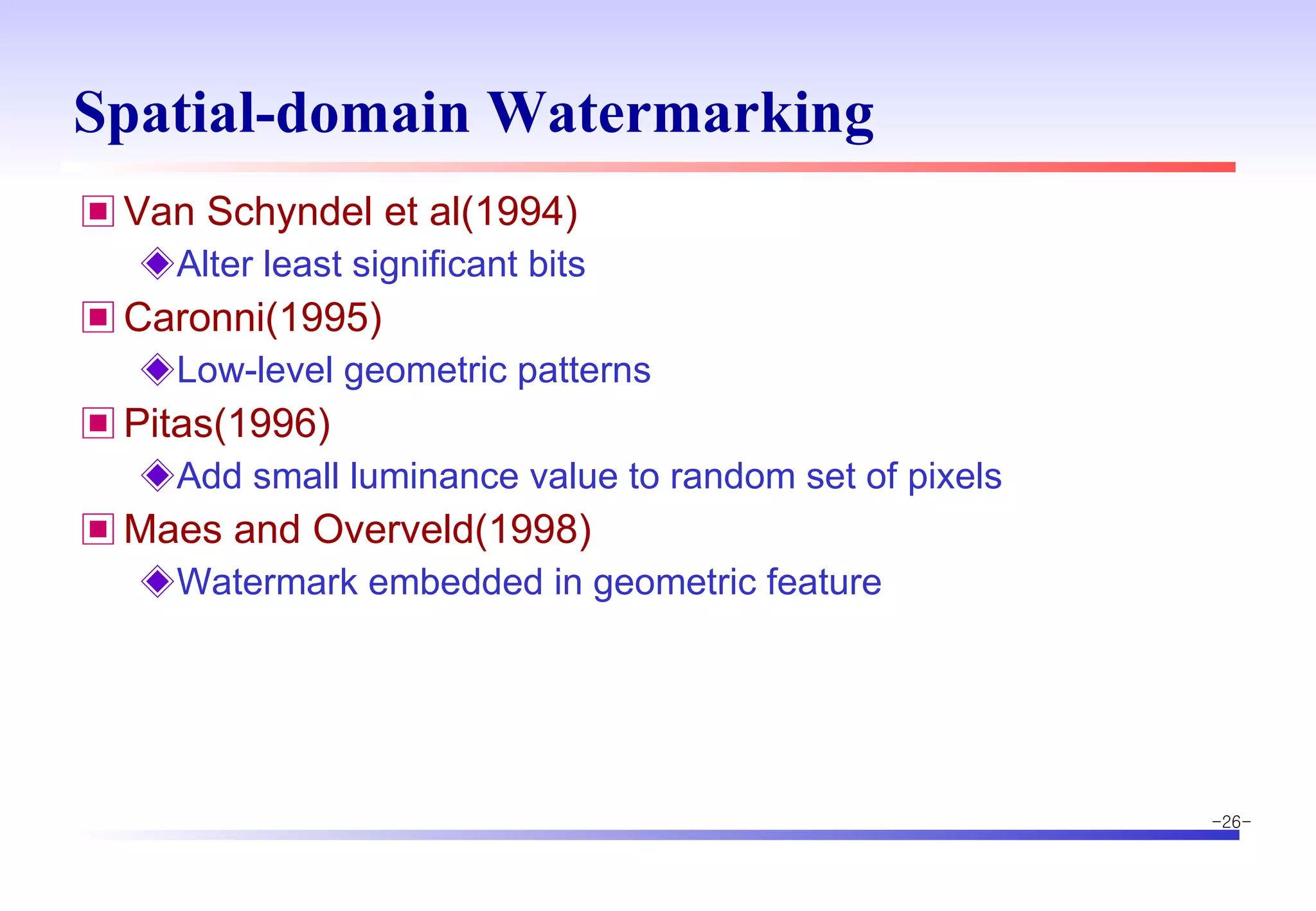
Spatial-domain Watermarking Van Schyndel et al(1994) Alter least significant bits Caronni(1995) Low-level geometric patterns Pitas(1996) Add small luminance value to random set of pixels Maes and Overveld(1998) Watermark embedded in geometric feature
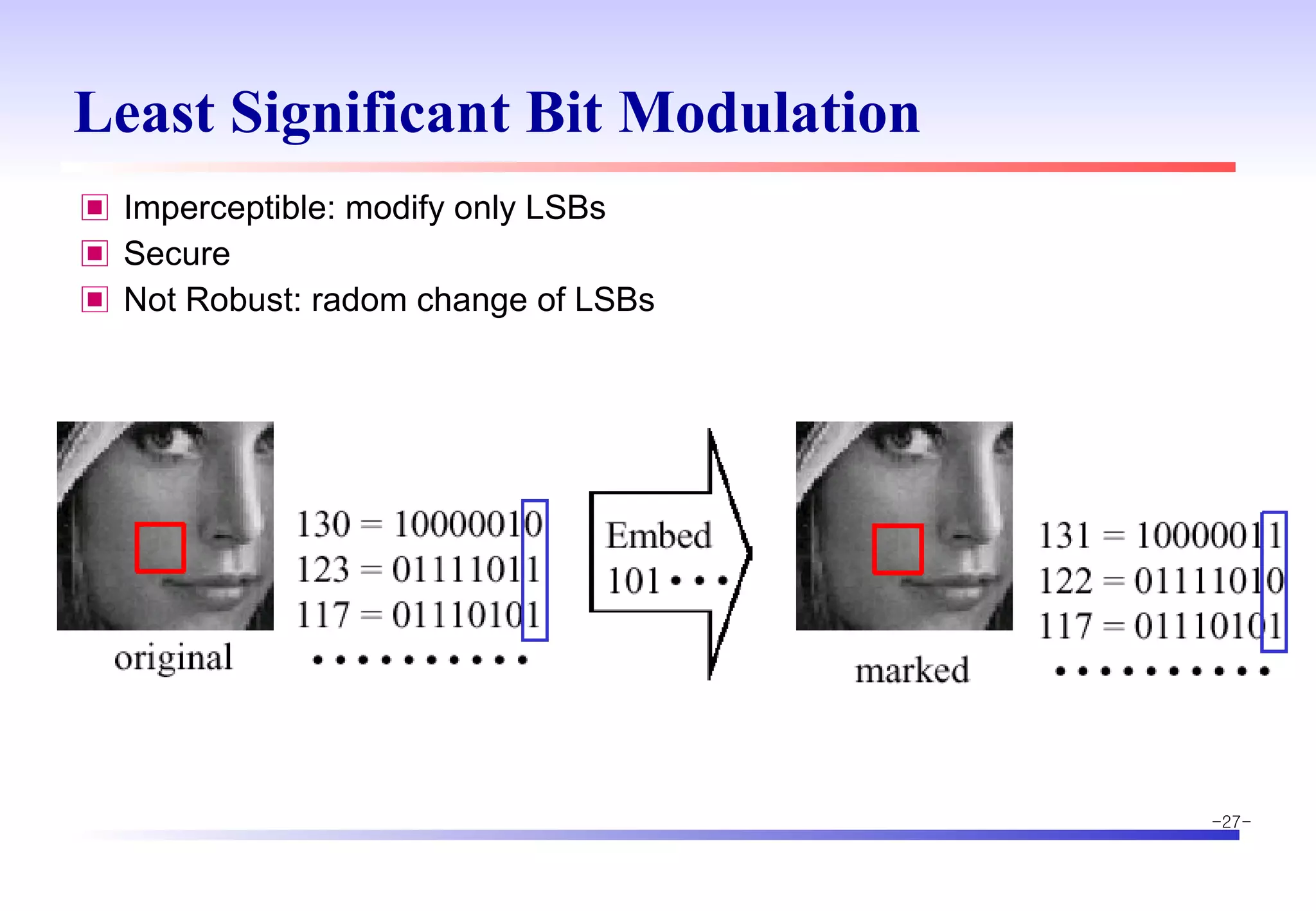
Least Significant Bit Modulation Imperceptible: modify only LSBs Secure Not Robust: radom change of LSBs
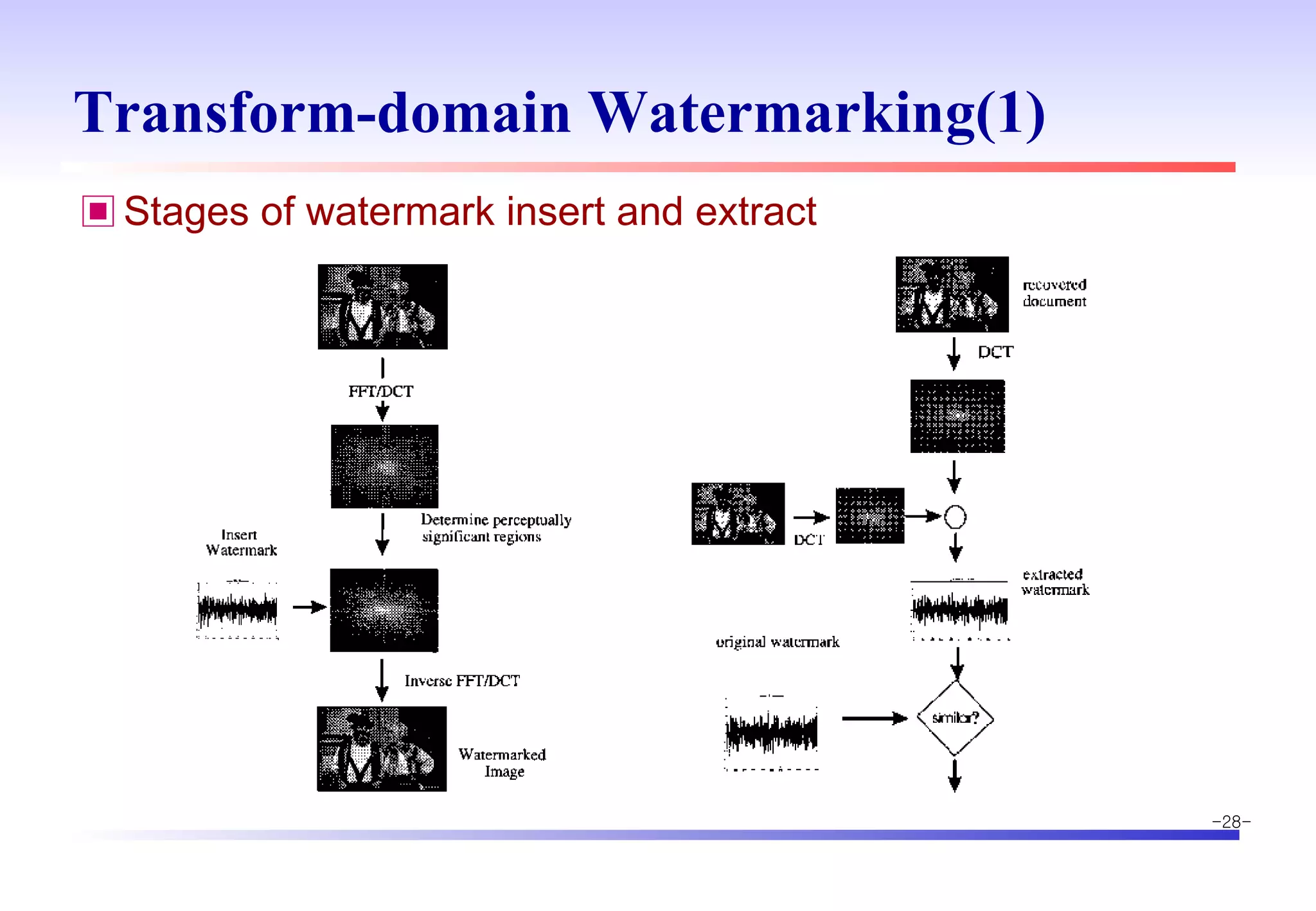
Transform-domain Watermarking(1) Stages of watermark insert and extract
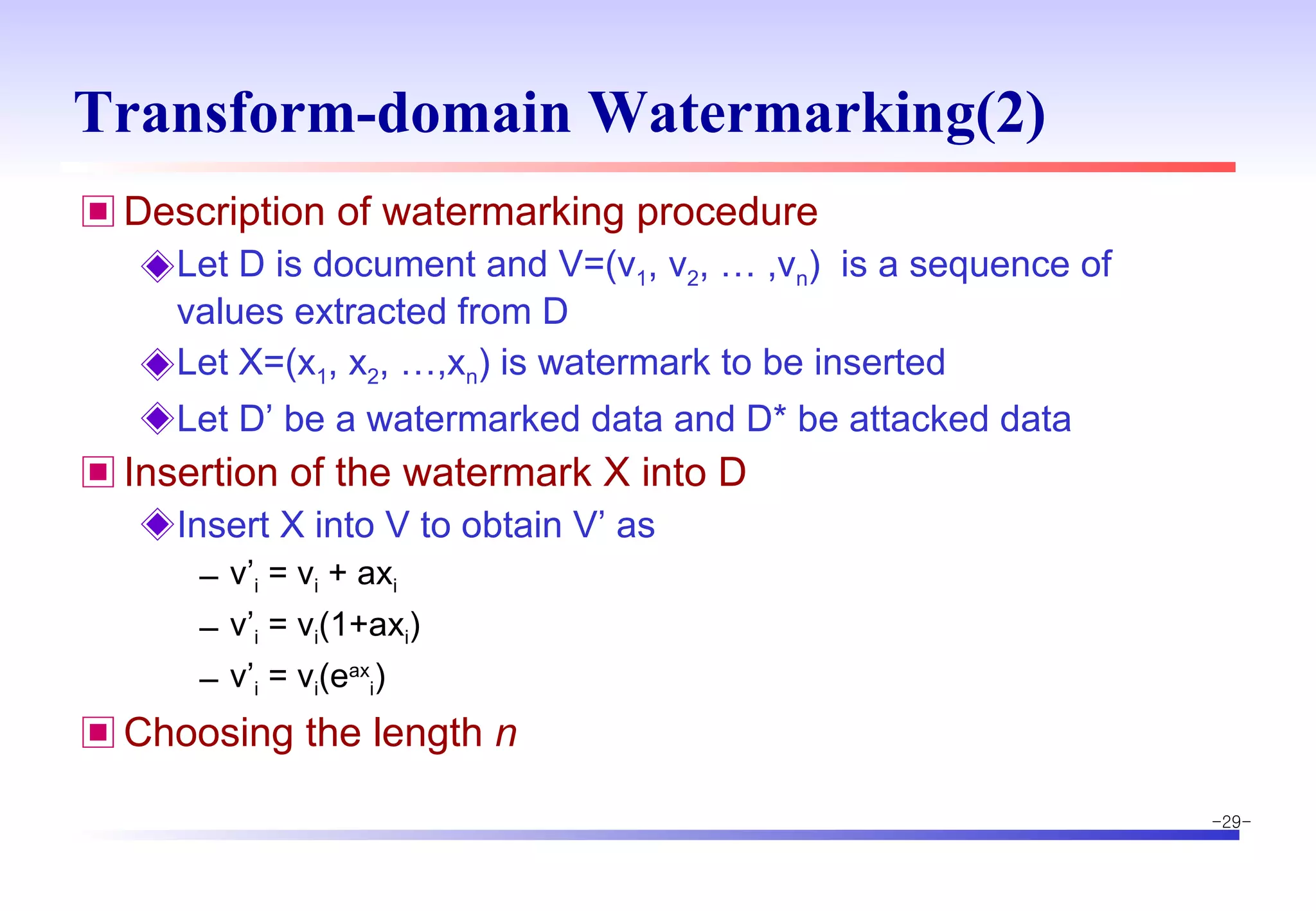
Transform-domain Watermarking(2) Description of watermarking procedure Let D is document and V=(v 1 , v 2 , … ,v n )  is a sequence of values extracted from D Let X=(x 1 , x 2 , …,x n ) is watermark to be inserted Let D’ be a watermarked data and D* be attacked data Insertion of the watermark X into D Insert X into V to obtain V’ as  v’ i  = v i  + ax i v’ i  = v i (1+ax i ) v’ i  = v i (e ax i ) Choosing the length  n
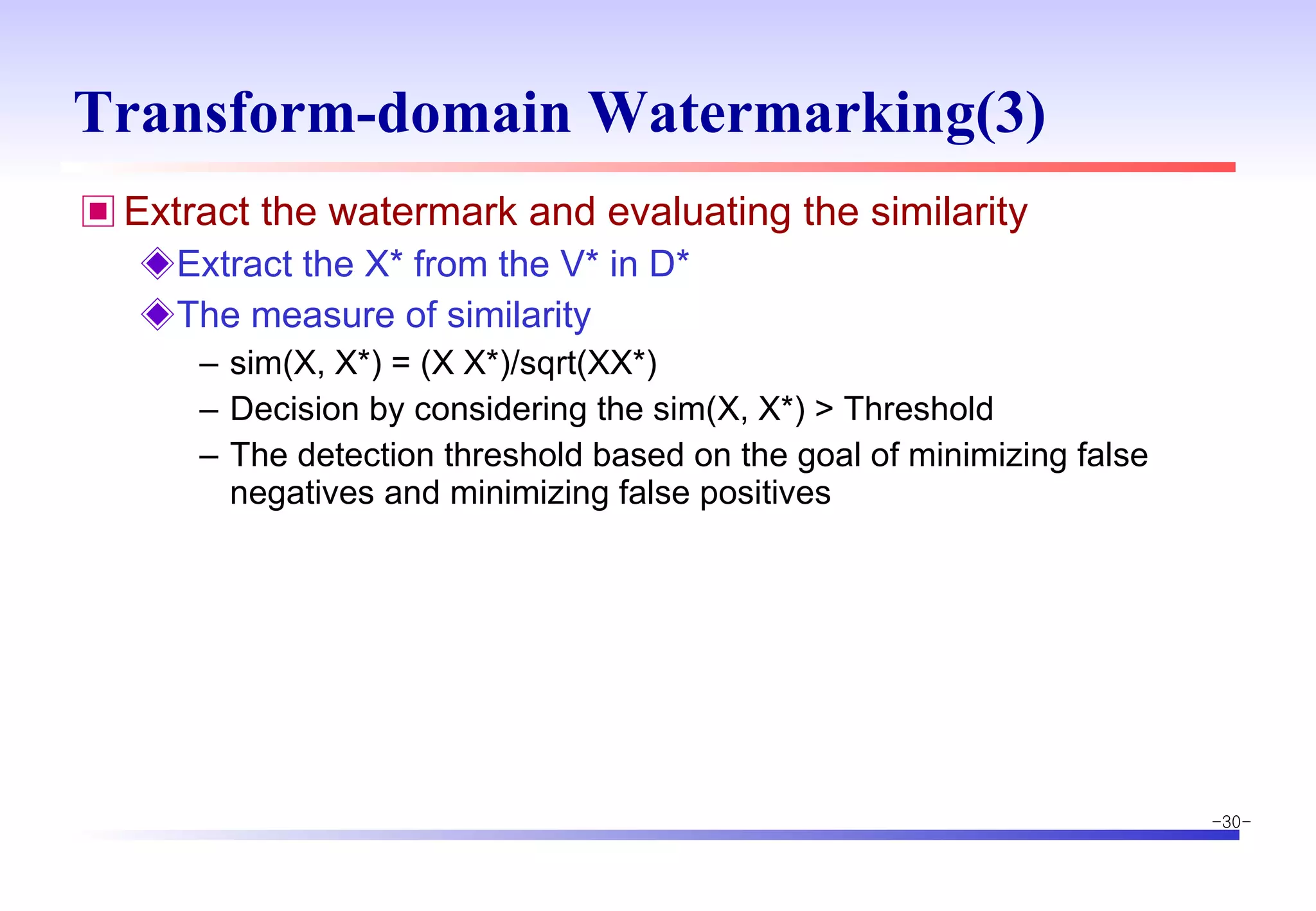
Transform-domain Watermarking(3) Extract the watermark and evaluating the similarity Extract the X* from the V* in D* The measure of similarity sim(X, X*) = (X X*)/sqrt(XX*) Decision by considering the sim(X, X*) > Threshold The detection threshold based on the goal of minimizing false negatives and minimizing false positives
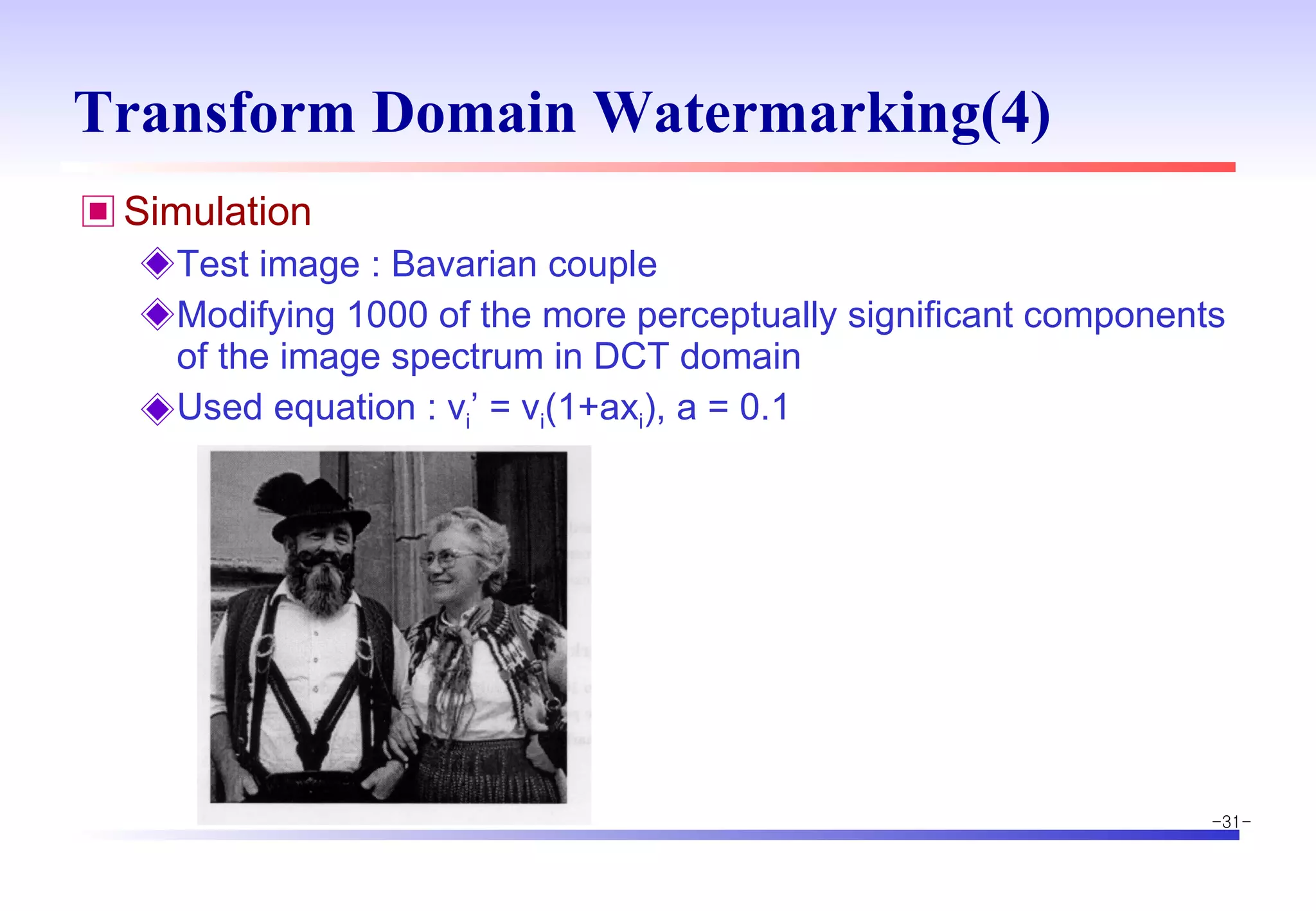
Transform Domain Watermarking(4) Simulation Test image : Bavarian couple Modifying 1000 of the more perceptually significant components of the image spectrum in DCT domain  Used equation : v i ’ = v i (1+ax i ), a = 0.1
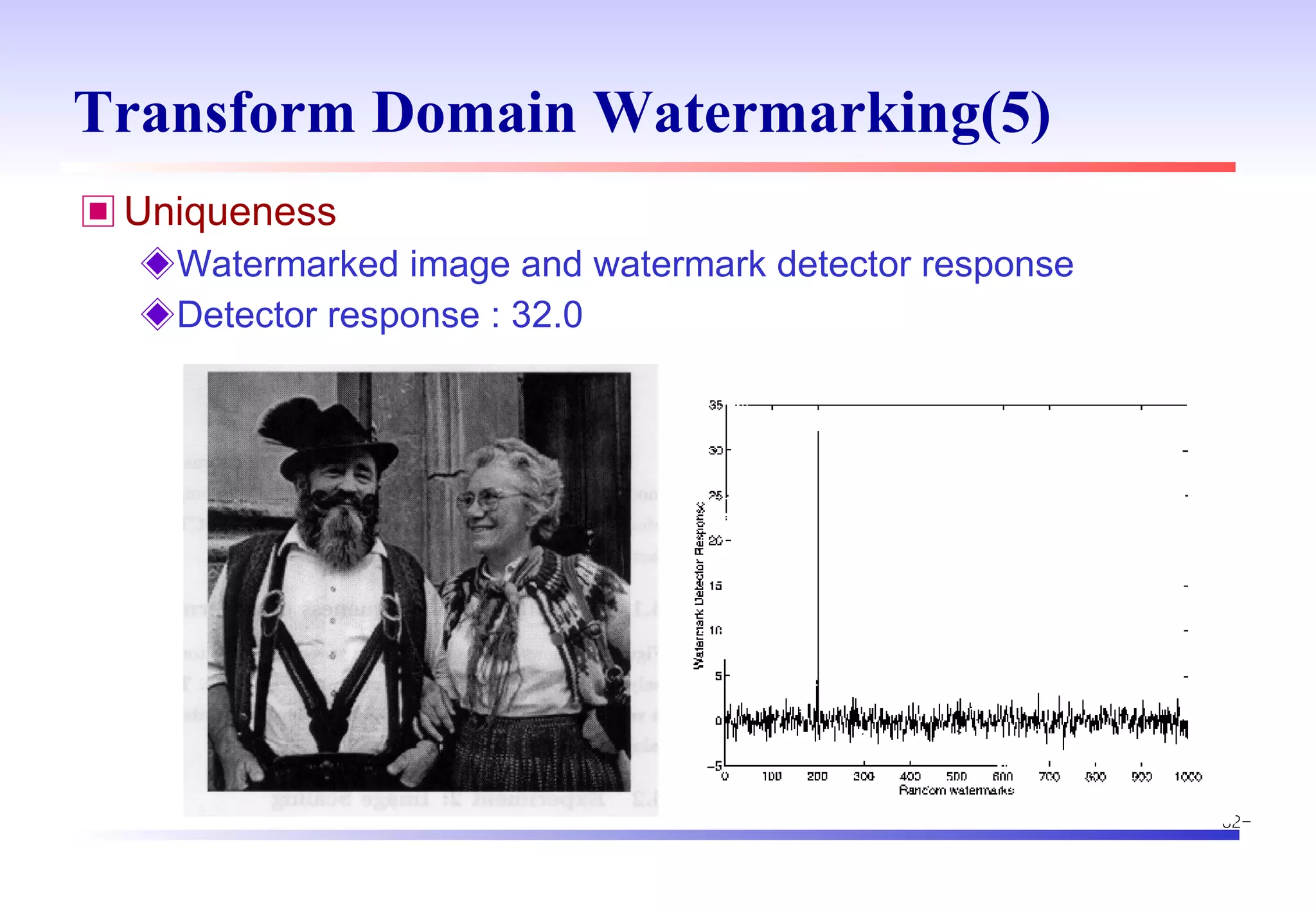
Transform Domain Watermarking(5) Uniqueness  Watermarked image and watermark detector response  Detector response : 32.0
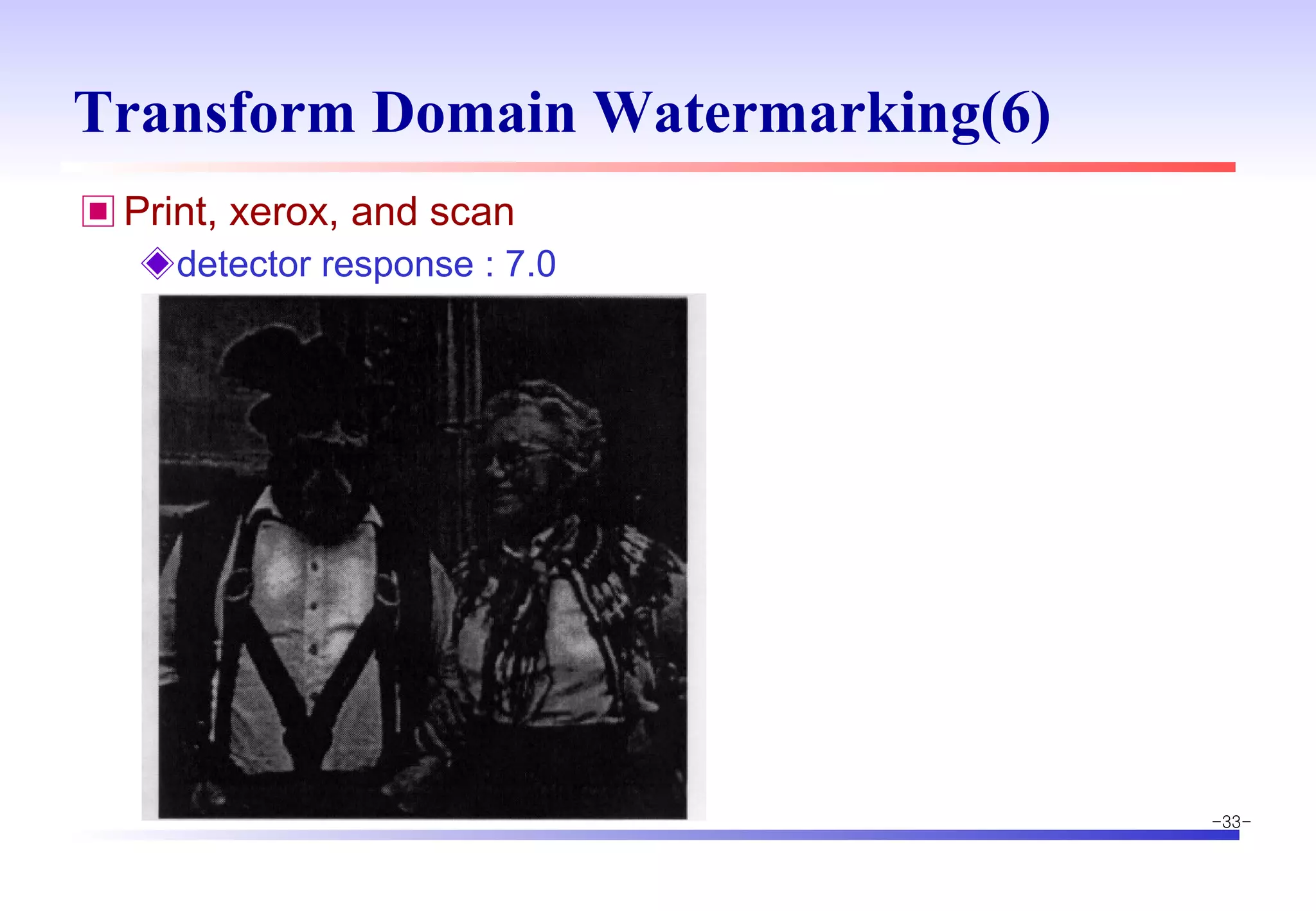
Transform Domain Watermarking(6) Print, xerox, and scan detector response : 7.0
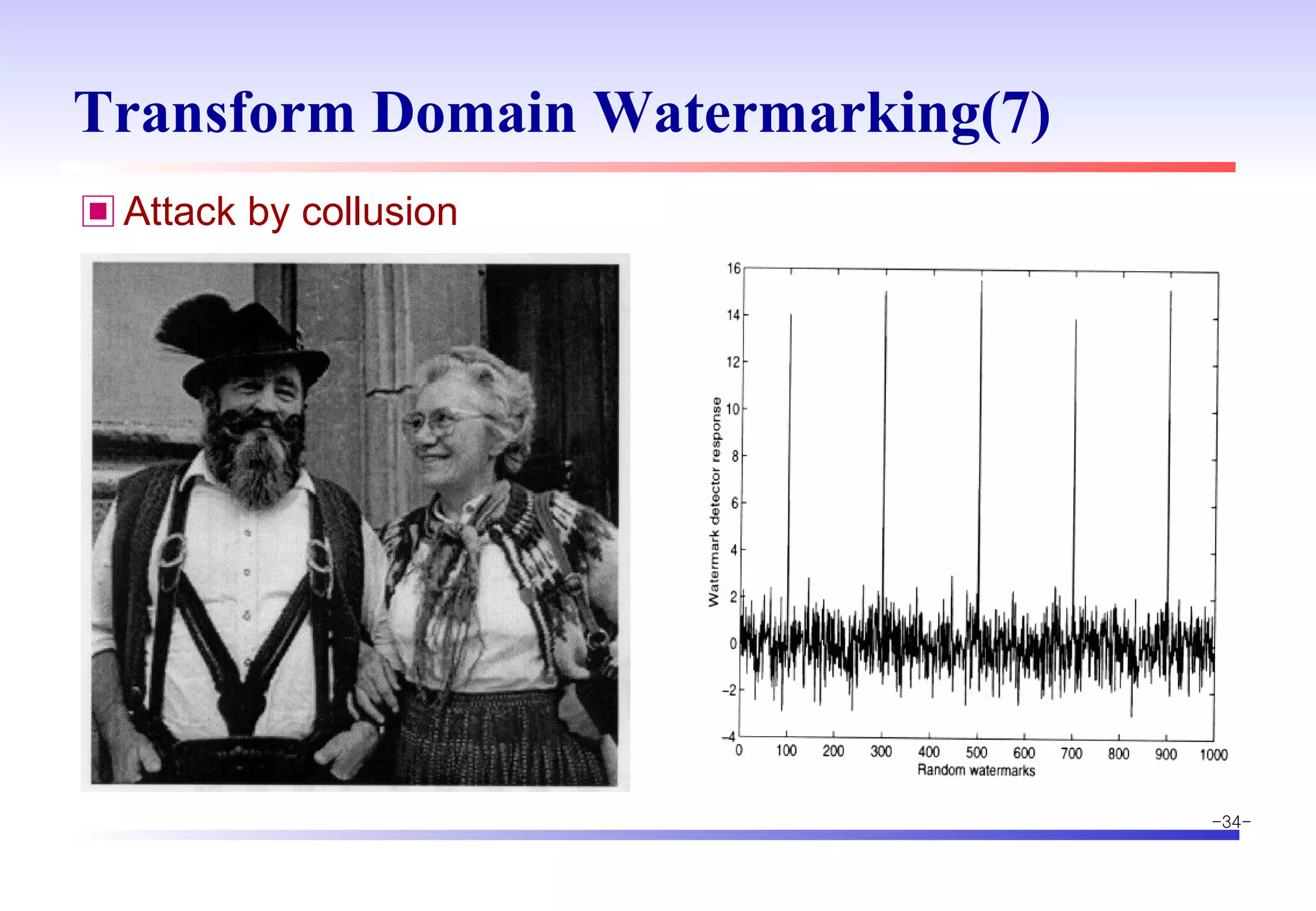
Transform Domain Watermarking(7) Attack by collusion
Summary Open problems Is digital watermarking the solution for copyright protection?  Since no watermarking algorithm resists all the attacks Is there a better way to solve the problem of intellectual property protection of digital contents?  Nothing  But many research areas related to watermarking must be studied

Intro Watermarking

  • 1.
  • 2.
    Contents Introduction GenericWatermarking Scheme and Purpose Watermarking Requirements Watermarking Properties and Techniques Attacks of Watermarked Image Application Field of Watermarking Image Watermarking Techniques Summary
  • 3.
    Introduction(1) Digital technologiespresent new threats for Intellectual properties and contents : Easy access to information Modification/falsification facilities Redistribution facilities Perfect copies Methods that prevent unauthorized access to copyrighted digital contents are required in wide ranges of applications
  • 4.
    Introduction(2) Three methodsfor copyright protection Cryptography Transform digital contents into unperceivable format Encryption/Decryption Watermarking Hide the copyright control information into digital content by modification the content itself Original Image Embedding Extracting Extracted Watermark
  • 5.
    Introduction(3) Authentication Watermarkis used to detect modification applied to cover work
  • 6.
    Introduction(4) Steganography vs.Watermarking Steganography Covert point-to-point communication between two parties Interpreted to means of information hiding in other information Example : sending a message to a spy by marking certain letters in a newspapers using invisible ink Watermarking Has the additional requirement of robustness against possible attacks
  • 7.
    Generic Watermarking SchemeGeneric watermark embedding scheme Generic watermark recovery scheme
  • 8.
    Watermarking History Watermarksare used to keep track of paper provenance and thus format and quality identification in the art of handmade papermaking nearly 700 years ago 1993 First use of the term “Watermark” Tirkel et al .,“Electronic watermark”, DICTA 1993 1993-1994 First papers on digital watermarking 1995 First special session on image watermarking at NSIP’95, Neos Marmaras, Greece. 1995 One of the first image watermarking algorithms “ Patchwork algorithm”, Kaskalis, Pitas, Bender et al
  • 9.
    Purpose of Watermarking Copyright Protection Copyright owner wants to check for illegal copies of her works Fingerprinting Hidden serial numbers. It enable the intellectual property owner to identify which customer broke his license agreement . Copy Control Copyright owner wants to control the terms of use of her work Example : DVD protection(Copy once, Copy many, No copy) Broadcast Monitoring Monitor when and whether content is transmitted over broadcast channels, such as TV or radio(Verify advertising broadcasts, Verify royalty payments, Catching instances of piracy) Data Authentication Watermark is used to detect modification applied to cover work Example : Checking for fraud passport photographs
  • 10.
    Watermarking Requirements(1) Perceptualtransparency Watermarked content has the same subjective quality as the original contents Robustness Nobody is able to remove, alter, or damage the watermark without a secret key Security Secret key determines the value of watermark and the locations where the watermark is embedded Payload of the watermark Amount of information to be embedded Capacity Multiple watermark can be embedded/extracted
  • 11.
    Watermarking Requirements(2) Invisibility/robustnessand cost are conflicting requirements Invisibility limits the energy of watermark Robustness increase when watermark energy increases Invisibility and robustness require costly processes Cost rapidly increases with processes complexity
  • 12.
    Types of WatermarksPerceptibility Visible/audible Invisible/inaudible Robustness fragile semi-fragile robust Necessary Data for Extraction blind Informed Inserting Watermark Type noise image Inserted media text audio video Processing Method spatial spectral
  • 13.
    Digital Watermarking PropertiesProperties related to the embedding process Embedding Effectiveness Fidelity Data Payload Properties related to the detection process Blind/Informed Detection False Positive Rate Robustness Properties related to the embedding and detection Security Cost
  • 14.
    Digital Watermarking techniquesText-based Watermarking Line shift coding, word shift coding, feature coding Image Watermarking Watermark design(meaningful watermark) Watermark embedding(time domain, transformed domain) Watermark detection(blind, informed) Audio Watermarking Video Watermarking 3D Watermarking
  • 15.
    Image Watermarking techniquesSpatial-domain techniques Transform-domain techniques DCT-based DFT-based Wavelet-based Other transforms Compressed stream-domain techniques Watermarking MPEG bit streams
  • 16.
    Levels of RobustnessSpatial-domain watermarks Watermark embedded in lower order bit planes Transparent mark Visually pleasing, not robust to compression Transform-domain watermarks Watermark added to frequency coefficients Watermark location and strength based on perceptual rules Watermark insertion based on utilizing formal HVS model in order to provide the strongest watermark while guaranteeing transparency
  • 17.
    Attacks of WatermarkedImage Unintentional Attacks A/D, D/A conversion, resampling Cropping Compression Geometric distortions(Synchronization) Additive noise Intentional Attacks IBM attack Collusion Software for Attacks Checkmark StirMark AIIAmark
  • 18.
    Removal attacks Removethe watermark from host image or decrease its relative energy Mean/median/Gaussian filtering, Wiener-Lee filtering Averaging N instances of the same image, bearing different watermarks Lossy compression (JPEG, JPEG2000) Sharpening, Contrast enhancement (histogram equalization) Gamma correction, Color quantization/subsampling Additive/multiplicative noise : Gaussian, uniform, or salt-pepper Multiple watermarking
  • 19.
    De-synchronization attacks Thewatermark is still there, but cannot be detected : loss of synchronization Global geometric transforms Translation, rotation, mirroring, scaling, shearing, cropping Local geometric transforms Random bending : local shifting, rotation, scaling Stirmark attack Slight global stretching, shifting, shearing, and rotation Mosaic attack Cutting the image into pieces Template removal attack Estimate and remove the synchronization template, apply a geometric transform
  • 20.
    Protocol attacks Attacksthat try to render the watermarking concept unreliable Copy attack : estimate the watermark from one image and embed it to other image IBM attack : Creation of a fake original by adding a watermark in watermarked image. The attacker can claim that he has both the original and watermarked image .
  • 21.
    Application Field ofWatermarking(1) Application field in technological side Copyright and contents protection Authentication and integrity verification Digital contents tracking Security(e.g. passport photos) Metadata tagging(annotation) Usage control Secret communication And many more
  • 22.
    Application Fields ofWatermarking(2) Application field by target contents Document Watermarking Technology VOD Graphics Audio Image Video Text Internet Magazine Internet Newspaper Internet TV Internet Radio Education Material AOD Certificates e-Book
  • 23.
    Companies Digimarc Imagewatermark Bluespike Giovanni still image watermark ARIS Audio watermark MediaSec Signafy Signum Intertrust DRM IBM HP NEC MarkAny Digital-Innotech SealTronic Technology DigiTreal Technology
  • 24.
    Related Sites Watermarkingand data hiding http://www-nt.e-technik.uni-erlangen.de/~hartung/watermarkinglinks.html WatermarkingWorld http://www.watermarkingworld.org/ Digital Copyright Protection & Digital Watermarking Technology http://www-sal.cs.uiuc.edu/~l-qiao/watermarking.html Imprimatur http://www.imprimatur.net Digimarc’s extractor http://www.digimarc.com KAIST’s KAIMark http://www.digital-innotech.com MarkAny’s MAIM http://www.markany.com
  • 25.
    Image Watermarking Spatial-domainwatermarking Transform-domain watermarking Perceptual-based watermarking Object-based watermarking Robust to JPEG compression Robust to geometric distortions
  • 26.
    Spatial-domain Watermarking VanSchyndel et al(1994) Alter least significant bits Caronni(1995) Low-level geometric patterns Pitas(1996) Add small luminance value to random set of pixels Maes and Overveld(1998) Watermark embedded in geometric feature
  • 27.
    Least Significant BitModulation Imperceptible: modify only LSBs Secure Not Robust: radom change of LSBs
  • 28.
    Transform-domain Watermarking(1) Stagesof watermark insert and extract
  • 29.
    Transform-domain Watermarking(2) Descriptionof watermarking procedure Let D is document and V=(v 1 , v 2 , … ,v n ) is a sequence of values extracted from D Let X=(x 1 , x 2 , …,x n ) is watermark to be inserted Let D’ be a watermarked data and D* be attacked data Insertion of the watermark X into D Insert X into V to obtain V’ as v’ i = v i + ax i v’ i = v i (1+ax i ) v’ i = v i (e ax i ) Choosing the length n
  • 30.
    Transform-domain Watermarking(3) Extractthe watermark and evaluating the similarity Extract the X* from the V* in D* The measure of similarity sim(X, X*) = (X X*)/sqrt(XX*) Decision by considering the sim(X, X*) > Threshold The detection threshold based on the goal of minimizing false negatives and minimizing false positives
  • 31.
    Transform Domain Watermarking(4)Simulation Test image : Bavarian couple Modifying 1000 of the more perceptually significant components of the image spectrum in DCT domain Used equation : v i ’ = v i (1+ax i ), a = 0.1
  • 32.
    Transform Domain Watermarking(5)Uniqueness Watermarked image and watermark detector response Detector response : 32.0
  • 33.
    Transform Domain Watermarking(6)Print, xerox, and scan detector response : 7.0
  • 34.
  • 35.
    Summary Open problemsIs digital watermarking the solution for copyright protection?  Since no watermarking algorithm resists all the attacks Is there a better way to solve the problem of intellectual property protection of digital contents?  Nothing  But many research areas related to watermarking must be studied