DIGITAL

WATERMARKING
Contents

   What is DWM ?

   Applications

   Classification

   Working

   Attacks

   Advantages and Disadvantages

   Techniques
Digital Watermarking

   We add ‘Visible’ or ‘Invisible’ structure called ‘Watermarks’
    to digital media. The process of adding watermarks is called
    ‘Digital Watermarking’.

   Adaptation of Paper Watermarks.

   Describes methods and technologies that allow to hide/embed
    various types of information to digital document.

   In general Digital Watermarking means “Author Signature”.
Applications

   Copyright Protection

   Owner Identification

   Content Authentification

   Proof of Ownership
Classification

   Perceptible Watermarks and Imperceptible Watermarks

   Robust Watermarks and Fragile Watermarks

   Private Watermarks and Public Watermarks
Classification (contd.)

   Perceptible Watermarks and Imperceptible Watermarks

   Perceptible Watermarks are visible to human eye

   Useful for primary Applications.
       E.g. of watermark in a video
       E.g.. Of watermark in a image

   Imperceptible watermarks are Invisible to human eye.

   Used in the places where the content being watermarked must
    appear in unchanged form.

   Remains hidden in content and can be detected only by authorized
    agencies.
Classification (contd.)

   Robust Watermarks and Fragile Watermarks

   Degree to which watermarks can withstand any modification of any
    type (Accidental or Intentional ).

   Robust Watermarks are difficult to remove from the object in which
    they are embedded.

   Perceptible Watermarks are more Robust.

   Fragile Watermarks can be easily destroyed by any attempt to
    temper with them.
Classification (contd.)

   Private Watermarks and Public Watermarks

   Private Watermark requires at least original data to recover
    watermark.

   They are also known as ‘Secure Watermarks’.

   Public Watermark requires neither original data nor embedded
    watermark to recover watermark information.
Working

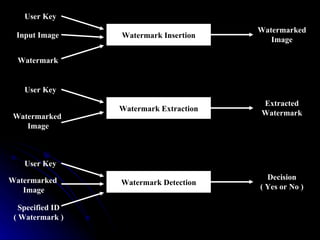
   Typical DWM system consists of mainly 3 parts / process

   Watermark Insertion
   Watermark Extraction
   Watermark Detection
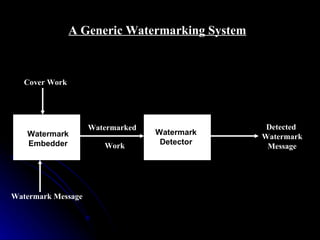
A Generic Watermarking System


   Cover Work


                    Watermarked                  Detected
   Watermark                      Watermark
                                                Watermark
   Embedder            Work        Detector
                                                 Message


Watermark Message
User Key
                                         Watermarked
 Input Image      Watermark Insertion
                                            Image

  Watermark


    User Key
                                         Extracted
                  Watermark Extraction
 Watermarked                             Watermark
    Image


    User Key

Watermarked                                Decision
                  Watermark Detection
   Image                                 ( Yes or No )

   Specified ID
 ( Watermark )
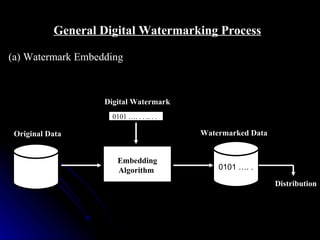
General Digital Watermarking Process

(a) Watermark Embedding


                   Digital Watermark
                     0101 …. . . .. . .

 Original Data                            Watermarked Data


                       Embedding
                       Algorithm              0101 …. .

                                                             Distribution
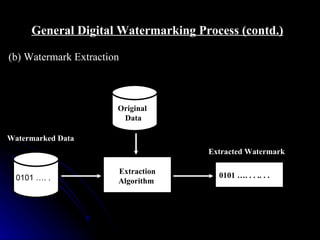
General Digital Watermarking Process (contd.)

(b) Watermark Extraction


                       Original
                        Data

Watermarked Data
                                     Extracted Watermark

                       Extraction
  0101 …. .                            0101 …. . . .. . .
                       Algorithm
Attacks

   Mosaic Attack

   Stir mark Attack

   Geometric Attack
       Subtractive
       Distortive

   Forgery Attack
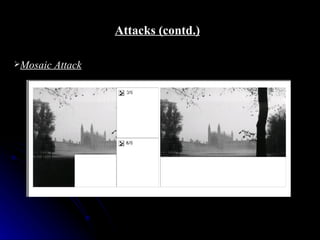
Attacks (contd.)

Mosaic Attack
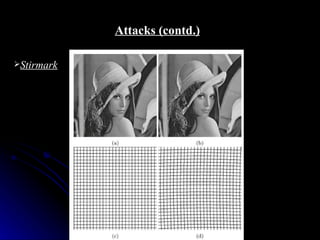
Attacks (contd.)

Stirmark
Attacks (contd.)

   Geometric Attack

   Subtractive Attack involves ‘removing’ the mark by cropping or
    digital editing.

   Distortive Attack attempts to make some ‘uniform distortive
    changes’ in the image such that mark becomes ‘unrecognizable’.
Attacks (contd.)

   Forgery Attack

   Also known as ‘Additive Attack’.

   The attacker include his/her own watermark overlaying the original
    image and marking the content as their own.
Advantages

   Uniquely identifies the author of copyrighted work.

   Implementation on PC platform is possible.

   Embedding watermark is easy

   Image Tampering Detection
Disadvantages

   Watermarking doesn’t prevent image copying but we can track
    down and detect ownership of copied images.

   Watermarks vanishes if someone manipulates the image.

   Resizing, compressing images from one file type to another
    may diminish the watermark and it becomes unreadable.
DWM Techniques

   Image Domain Encoding

   Also known as Least Significant Bit (LSB).

   LSB works by reducing the no of colors used by image itself and
    uses the rest of the palette to encode the information.

   If the colors in an image are less then more information can be
    stored without quality loss.
Thank you


 Question ??

Digital Watermarking

  • 1.
  • 2.
    Contents  What is DWM ?  Applications  Classification  Working  Attacks  Advantages and Disadvantages  Techniques
  • 3.
    Digital Watermarking  We add ‘Visible’ or ‘Invisible’ structure called ‘Watermarks’ to digital media. The process of adding watermarks is called ‘Digital Watermarking’.  Adaptation of Paper Watermarks.  Describes methods and technologies that allow to hide/embed various types of information to digital document.  In general Digital Watermarking means “Author Signature”.
  • 4.
    Applications  Copyright Protection  Owner Identification  Content Authentification  Proof of Ownership
  • 5.
    Classification  Perceptible Watermarks and Imperceptible Watermarks  Robust Watermarks and Fragile Watermarks  Private Watermarks and Public Watermarks
  • 6.
    Classification (contd.)  Perceptible Watermarks and Imperceptible Watermarks  Perceptible Watermarks are visible to human eye  Useful for primary Applications. E.g. of watermark in a video E.g.. Of watermark in a image  Imperceptible watermarks are Invisible to human eye.  Used in the places where the content being watermarked must appear in unchanged form.  Remains hidden in content and can be detected only by authorized agencies.
  • 7.
    Classification (contd.)  Robust Watermarks and Fragile Watermarks  Degree to which watermarks can withstand any modification of any type (Accidental or Intentional ).  Robust Watermarks are difficult to remove from the object in which they are embedded.  Perceptible Watermarks are more Robust.  Fragile Watermarks can be easily destroyed by any attempt to temper with them.
  • 8.
    Classification (contd.)  Private Watermarks and Public Watermarks  Private Watermark requires at least original data to recover watermark.  They are also known as ‘Secure Watermarks’.  Public Watermark requires neither original data nor embedded watermark to recover watermark information.
  • 9.
    Working  Typical DWM system consists of mainly 3 parts / process  Watermark Insertion  Watermark Extraction  Watermark Detection
  • 10.
    A Generic WatermarkingSystem Cover Work Watermarked Detected Watermark Watermark Watermark Embedder Work Detector Message Watermark Message
  • 11.
    User Key Watermarked Input Image Watermark Insertion Image Watermark User Key Extracted Watermark Extraction Watermarked Watermark Image User Key Watermarked Decision Watermark Detection Image ( Yes or No ) Specified ID ( Watermark )
  • 12.
    General Digital WatermarkingProcess (a) Watermark Embedding Digital Watermark 0101 …. . . .. . . Original Data Watermarked Data Embedding Algorithm 0101 …. . Distribution
  • 13.
    General Digital WatermarkingProcess (contd.) (b) Watermark Extraction Original Data Watermarked Data Extracted Watermark Extraction 0101 …. . 0101 …. . . .. . . Algorithm
  • 14.
    Attacks  Mosaic Attack  Stir mark Attack  Geometric Attack  Subtractive  Distortive  Forgery Attack
  • 15.
  • 16.
  • 17.
    Attacks (contd.)  Geometric Attack  Subtractive Attack involves ‘removing’ the mark by cropping or digital editing.  Distortive Attack attempts to make some ‘uniform distortive changes’ in the image such that mark becomes ‘unrecognizable’.
  • 18.
    Attacks (contd.)  Forgery Attack  Also known as ‘Additive Attack’.  The attacker include his/her own watermark overlaying the original image and marking the content as their own.
  • 19.
    Advantages  Uniquely identifies the author of copyrighted work.  Implementation on PC platform is possible.  Embedding watermark is easy  Image Tampering Detection
  • 20.
    Disadvantages  Watermarking doesn’t prevent image copying but we can track down and detect ownership of copied images.  Watermarks vanishes if someone manipulates the image.  Resizing, compressing images from one file type to another may diminish the watermark and it becomes unreadable.
  • 21.
    DWM Techniques  Image Domain Encoding  Also known as Least Significant Bit (LSB).  LSB works by reducing the no of colors used by image itself and uses the rest of the palette to encode the information.  If the colors in an image are less then more information can be stored without quality loss.
  • 22.