DIGITAL WATERMARKING1
INTRODUCTION:-			Think of a multimedia data that is being  distributed over the Internet.			Someone downloads it , claims it that he has the copyright, and sells it. In these kinds of situations, digital watermarking  techniques  can be used for establishing ownership rights, ensuring authorized access, preventing illegal reapplication and facilitating content authentication.2
“Digital watermarking is the process of embedding information into a digital signal in a way that is difficult to remove.” 		The signal may be audio, pictures or video, for example. If the signal is copied, then the information is also carried in the copy. A signal may carry several different watermarks at the same time.3
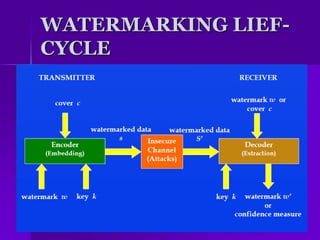
General Procedure for Digital Watermarking:4
WATERMARKING LIEF-CYCLE5
ATTACKS:-		Attacks on watermark may not necessarily remove the watermark, but disable its readability. Image processing and transforms are commonly employed to create and apply watermarks. 		These same techniques can also be used to disable or overwrite watermarks. Multiple watermarks can be placed in an image and one cannot determine which one is valid. Currently watermark registration service is "first come, first served." Someone other than the rightful owner may attempt to register a copyright first.6
TYPES OF ATTACKS ON WATERMARKSRemoval attacksGeometrical attacksCryptographic attacks Protocol attacks7
TYPES OF WATERMARK:(1)ROBUST WATERMARK:     A robust watermark is a watermark that is difficult to remove from the object inwhich it is embedded.(2)FRAGILE WATERMARK:      A fragile watermark is destroyed if anybody attempts to tamper with the object inwhich it is embedded.(3)VISIBLE WATERMARK:       A visible watermark is immediately perceptible and clearly identifies the cover object as copyright-protected material, much like the copyright symbols ã, â, and ä (4)INVISIBLE WATERMARK:      An invisible watermark is not normally perceptible, but can still be used by the rightful owner as evidence of data authenticity in a court of law.8
Important ParametersTransparency Robustness SecurityCapacityInvertibility (reversibility)  Complexity Possibility of verification9
Common watermarking techniques             Choice of Watermark ObjectTime domain-LSB Modification
Frequency Domain
Wavelet Domain10
APPLICATION Owner identification and proof of ownership11
Broadcast monitoring

Digital watermarking

  • 1.
  • 2.
    INTRODUCTION:- Think of amultimedia data that is being distributed over the Internet. Someone downloads it , claims it that he has the copyright, and sells it. In these kinds of situations, digital watermarking techniques can be used for establishing ownership rights, ensuring authorized access, preventing illegal reapplication and facilitating content authentication.2
  • 3.
    “Digital watermarking isthe process of embedding information into a digital signal in a way that is difficult to remove.” The signal may be audio, pictures or video, for example. If the signal is copied, then the information is also carried in the copy. A signal may carry several different watermarks at the same time.3
  • 4.
    General Procedure forDigital Watermarking:4
  • 5.
  • 6.
    ATTACKS:- Attacks on watermarkmay not necessarily remove the watermark, but disable its readability. Image processing and transforms are commonly employed to create and apply watermarks. These same techniques can also be used to disable or overwrite watermarks. Multiple watermarks can be placed in an image and one cannot determine which one is valid. Currently watermark registration service is "first come, first served." Someone other than the rightful owner may attempt to register a copyright first.6
  • 7.
    TYPES OF ATTACKSON WATERMARKSRemoval attacksGeometrical attacksCryptographic attacks Protocol attacks7
  • 8.
    TYPES OF WATERMARK:(1)ROBUSTWATERMARK: A robust watermark is a watermark that is difficult to remove from the object inwhich it is embedded.(2)FRAGILE WATERMARK: A fragile watermark is destroyed if anybody attempts to tamper with the object inwhich it is embedded.(3)VISIBLE WATERMARK: A visible watermark is immediately perceptible and clearly identifies the cover object as copyright-protected material, much like the copyright symbols ã, â, and ä (4)INVISIBLE WATERMARK: An invisible watermark is not normally perceptible, but can still be used by the rightful owner as evidence of data authenticity in a court of law.8
  • 9.
    Important ParametersTransparency RobustnessSecurityCapacityInvertibility (reversibility) Complexity Possibility of verification9
  • 10.
    Common watermarking techniques Choice of Watermark ObjectTime domain-LSB Modification
  • 11.
  • 12.
  • 13.
    APPLICATION Owner identificationand proof of ownership11
  • 14.