Digital WatermarkingDigital Watermarking
Guided by:
Prof. M.M Goyani
Department of Computer Engineering
Government Engineering College, Modasa
Presented by:
Nazeerah A. Sheth
Enrolment no. :160160702006
Department of Computer Engineering
Government Engineering College, Modasa
OutlineOutline
Introduction
Applications
Classification
Features of Digital Watermarking
Architecture
Digital Watermarking Techniques
Comparison of Different Techniques
Watermarking Attacks
Conclusion
References
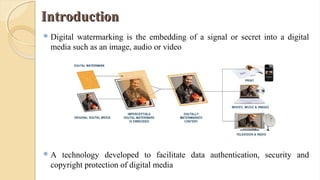
Digital watermarking is the embedding of a signal or secret into a digital
media such as an image, audio or video
A technology developed to facilitate data authentication, security and
copyright protection of digital media
IntroductionIntroduction
Related TermsRelated Terms
ApplicationsApplications
o Copyright Protection
o Tamper Proofing
o Broadcast Monitoring
o Content Authentication
o Annotation and Privacy Control
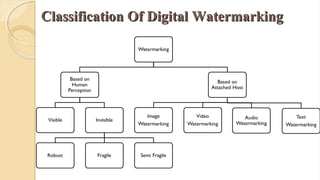
Classification Of Digital WatermarkingClassification Of Digital Watermarking
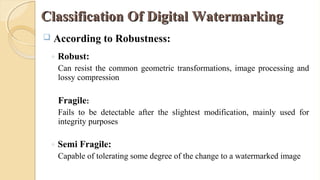
◦ Robust:
Can resist the common geometric transformations, image processing and
lossy compression
Fragile:
Fails to be detectable after the slightest modification, mainly used for
integrity purposes
◦ Semi Fragile:
Capable of tolerating some degree of the change to a watermarked image
Classification Of Digital WatermarkingClassification Of Digital Watermarking
 According to Robustness:
Classification Of Digital WatermarkingClassification Of Digital Watermarking
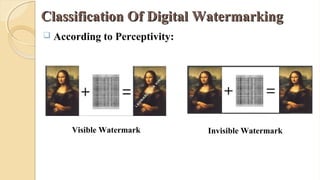
 According to Perceptivity:
Visible Watermark Invisible Watermark
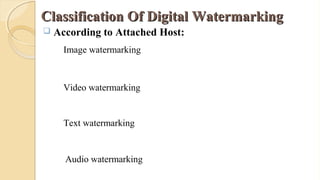
Image watermarking
Classification Of Digital WatermarkingClassification Of Digital Watermarking
 According to Attached Host:
Video watermarking
Audio watermarking
Text watermarking
Features of Digital WatermarkingFeatures of Digital Watermarking
o Robustness
o Imperceptibility
o Security
o Verifiability
o Capacity and Data Payload
o Computational Cost
Basic Watermarking ArchitectureBasic Watermarking Architecture
Digital Watermarking TechniquesDigital Watermarking Techniques
Spatial Domain Watermarking TechniquesSpatial Domain Watermarking Techniques
o Least Significant Bit
130 - 10000010
123 - 01111011
117 - 01110101
Embed
101
10000011 - 131
01111010 - 122
01110101 - 117
Cover Image Watermarked Image
Watermark
Spatial Domain Watermarking TechniquesSpatial Domain Watermarking Techniques
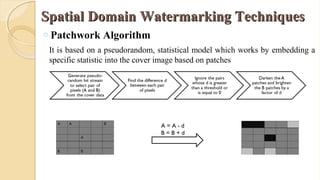
o Patchwork Algorithm
It is based on a pseudorandom, statistical model which works by embedding a
specific statistic into the cover image based on patches
A = A - d
B = B + d
Spatial Domain Watermarking TechniquesSpatial Domain Watermarking Techniques
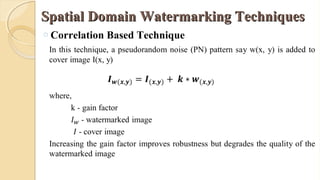
o Correlation Based Technique
Frequency Domain TechniquesFrequency Domain Techniques
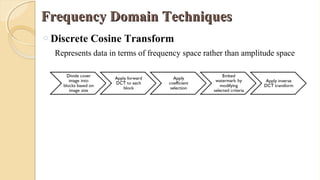
o Discrete Cosine Transform
Represents data in terms of frequency space rather than amplitude space
Frequency Domain TechniquesFrequency Domain Techniques
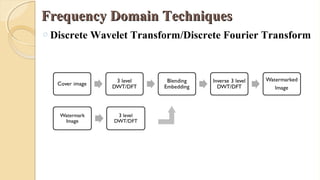
o Discrete Wavelet Transform/Discrete Fourier Transform
Frequency Domain TechniquesFrequency Domain Techniques
o Discrete Wavelet Transform
The DWT decomposes a signal into a set of basis functions called wavelets
which analysis the signal at multi resolution and frequencies
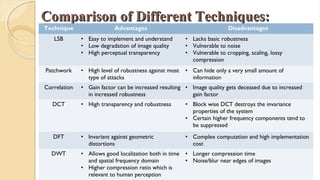
Comparison of Different Techniques:Comparison of Different Techniques:
Technique Advantages Disadvantages
LSB • Easy to implement and understand
• Low degradation of image quality
• High perceptual transparency
• Lacks basic robustness
• Vulnerable to noise
• Vulnerable to cropping, scaling, lossy
compression
Patchwork • High level of robustness against most
type of attacks
• Can hide only a very small amount of
information
Correlation • Gain factor can be increased resulting
in increased robustness
• Image quality gets deceased due to increased
gain factor
DCT • High transparency and robustness • Block wise DCT destroys the invariance
properties of the system
• Certain higher frequency components tend to
be suppressed
DFT • Invariant against geometric
distortions
• Complex computation and high implementation
cost
DWT • Allows good localization both in time
and spatial frequency domain
• Higher compression ratio which is
relevant to human perception
• Longer compression time
• Noise/blur near edges of images
Attacks On WatermarksAttacks On Watermarks
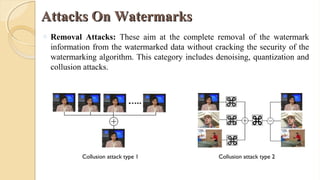
o Removal Attacks: These aim at the complete removal of the watermark
information from the watermarked data without cracking the security of the
watermarking algorithm. This category includes denoising, quantization and
collusion attacks.
Collusion attack type 1 Collusion attack type 2
Attacks On WatermarksAttacks On Watermarks
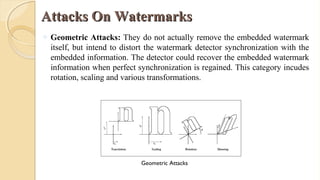
o Geometric Attacks: They do not actually remove the embedded watermark
itself, but intend to distort the watermark detector synchronization with the
embedded information. The detector could recover the embedded watermark
information when perfect synchronization is regained. This category incudes
rotation, scaling and various transformations.
Geometric Attacks
Attacks On WatermarksAttacks On Watermarks
oCryptographic Attacks: Cryptographic attacks aim at
cracking the security methods in watermarking schemes
and thus finding a way to remove the embedded watermark
information or to embed misleading watermarks.
Techniques used can vary from brute-force to oracle attack.
oProtocol Attacks: Protocol attacks aim at attacking the
entire concept of the watermarking application. This can
include invertible watermarks or copy attacks.
ConclusionsConclusions
o Digital watermarking technology can provide a new way to protect the
copyright of multimedia information and to ensure its safe use
o Attacks on digital watermarks must consider both watermark survival and the
distortion of the attacked document
o A truly robust, transparent and secure watermarking technique should be
focused to ensure complete security
Thank youThank you
[1] P. Singh and R. S. Chadha, “A Survey of Digital Watermarking Techniques, Applications and
Attacks,” International Journal of Engineering and Innovative Technology, vol. 2, no. 9, pp. 165-
175, 2013
[2] Voloshynovskiy, Sviatolsav, et al. "Attacks on digital watermarks: classification, estimation based
attacks, and benchmarks." IEEE communications Magazine 39.8 (2001): 118-126
[3] Potdar, Vidyasagar M., Song Han, and Elizabeth Chang. "A survey of digital image watermarking
techniques." Industrial Informatics, 2005. INDIN'05. 2005 3rd IEEE International Conference on.
IEEE, 2005
[4] Liu, Tong, and Zheng-ding Qiu. "The survey of digital watermarking-based image authentication
techniques." Signal Processing, 2002 6th International Conference on. Vol. 2. IEEE, 2002
[5] Lee, Sin-Joo, and Sung-Hwan Jung. "A survey of watermarking techniques applied to
multimedia." Industrial Electronics, 2001. Proceedings. ISIE 2001. IEEE International
Symposium on. Vol. 1. IEEE, 2001.
ReferencesReferences

Digital watermarking Techniques

  • 1.
    Digital WatermarkingDigital Watermarking Guidedby: Prof. M.M Goyani Department of Computer Engineering Government Engineering College, Modasa Presented by: Nazeerah A. Sheth Enrolment no. :160160702006 Department of Computer Engineering Government Engineering College, Modasa
  • 2.
    OutlineOutline Introduction Applications Classification Features of DigitalWatermarking Architecture Digital Watermarking Techniques Comparison of Different Techniques Watermarking Attacks Conclusion References
  • 3.
    Digital watermarking isthe embedding of a signal or secret into a digital media such as an image, audio or video A technology developed to facilitate data authentication, security and copyright protection of digital media IntroductionIntroduction
  • 4.
  • 5.
    ApplicationsApplications o Copyright Protection oTamper Proofing o Broadcast Monitoring o Content Authentication o Annotation and Privacy Control
  • 6.
    Classification Of DigitalWatermarkingClassification Of Digital Watermarking
  • 7.
    ◦ Robust: Can resistthe common geometric transformations, image processing and lossy compression Fragile: Fails to be detectable after the slightest modification, mainly used for integrity purposes ◦ Semi Fragile: Capable of tolerating some degree of the change to a watermarked image Classification Of Digital WatermarkingClassification Of Digital Watermarking  According to Robustness:
  • 8.
    Classification Of DigitalWatermarkingClassification Of Digital Watermarking  According to Perceptivity: Visible Watermark Invisible Watermark
  • 9.
    Image watermarking Classification OfDigital WatermarkingClassification Of Digital Watermarking  According to Attached Host: Video watermarking Audio watermarking Text watermarking
  • 10.
    Features of DigitalWatermarkingFeatures of Digital Watermarking o Robustness o Imperceptibility o Security o Verifiability o Capacity and Data Payload o Computational Cost
  • 11.
    Basic Watermarking ArchitectureBasicWatermarking Architecture
  • 12.
  • 13.
    Spatial Domain WatermarkingTechniquesSpatial Domain Watermarking Techniques o Least Significant Bit 130 - 10000010 123 - 01111011 117 - 01110101 Embed 101 10000011 - 131 01111010 - 122 01110101 - 117 Cover Image Watermarked Image Watermark
  • 14.
    Spatial Domain WatermarkingTechniquesSpatial Domain Watermarking Techniques o Patchwork Algorithm It is based on a pseudorandom, statistical model which works by embedding a specific statistic into the cover image based on patches A = A - d B = B + d
  • 15.
    Spatial Domain WatermarkingTechniquesSpatial Domain Watermarking Techniques o Correlation Based Technique
  • 16.
    Frequency Domain TechniquesFrequencyDomain Techniques o Discrete Cosine Transform Represents data in terms of frequency space rather than amplitude space
  • 17.
    Frequency Domain TechniquesFrequencyDomain Techniques o Discrete Wavelet Transform/Discrete Fourier Transform
  • 18.
    Frequency Domain TechniquesFrequencyDomain Techniques o Discrete Wavelet Transform The DWT decomposes a signal into a set of basis functions called wavelets which analysis the signal at multi resolution and frequencies
  • 19.
    Comparison of DifferentTechniques:Comparison of Different Techniques: Technique Advantages Disadvantages LSB • Easy to implement and understand • Low degradation of image quality • High perceptual transparency • Lacks basic robustness • Vulnerable to noise • Vulnerable to cropping, scaling, lossy compression Patchwork • High level of robustness against most type of attacks • Can hide only a very small amount of information Correlation • Gain factor can be increased resulting in increased robustness • Image quality gets deceased due to increased gain factor DCT • High transparency and robustness • Block wise DCT destroys the invariance properties of the system • Certain higher frequency components tend to be suppressed DFT • Invariant against geometric distortions • Complex computation and high implementation cost DWT • Allows good localization both in time and spatial frequency domain • Higher compression ratio which is relevant to human perception • Longer compression time • Noise/blur near edges of images
  • 20.
    Attacks On WatermarksAttacksOn Watermarks o Removal Attacks: These aim at the complete removal of the watermark information from the watermarked data without cracking the security of the watermarking algorithm. This category includes denoising, quantization and collusion attacks. Collusion attack type 1 Collusion attack type 2
  • 21.
    Attacks On WatermarksAttacksOn Watermarks o Geometric Attacks: They do not actually remove the embedded watermark itself, but intend to distort the watermark detector synchronization with the embedded information. The detector could recover the embedded watermark information when perfect synchronization is regained. This category incudes rotation, scaling and various transformations. Geometric Attacks
  • 22.
    Attacks On WatermarksAttacksOn Watermarks oCryptographic Attacks: Cryptographic attacks aim at cracking the security methods in watermarking schemes and thus finding a way to remove the embedded watermark information or to embed misleading watermarks. Techniques used can vary from brute-force to oracle attack. oProtocol Attacks: Protocol attacks aim at attacking the entire concept of the watermarking application. This can include invertible watermarks or copy attacks.
  • 23.
    ConclusionsConclusions o Digital watermarkingtechnology can provide a new way to protect the copyright of multimedia information and to ensure its safe use o Attacks on digital watermarks must consider both watermark survival and the distortion of the attacked document o A truly robust, transparent and secure watermarking technique should be focused to ensure complete security
  • 24.
  • 25.
    [1] P. Singhand R. S. Chadha, “A Survey of Digital Watermarking Techniques, Applications and Attacks,” International Journal of Engineering and Innovative Technology, vol. 2, no. 9, pp. 165- 175, 2013 [2] Voloshynovskiy, Sviatolsav, et al. "Attacks on digital watermarks: classification, estimation based attacks, and benchmarks." IEEE communications Magazine 39.8 (2001): 118-126 [3] Potdar, Vidyasagar M., Song Han, and Elizabeth Chang. "A survey of digital image watermarking techniques." Industrial Informatics, 2005. INDIN'05. 2005 3rd IEEE International Conference on. IEEE, 2005 [4] Liu, Tong, and Zheng-ding Qiu. "The survey of digital watermarking-based image authentication techniques." Signal Processing, 2002 6th International Conference on. Vol. 2. IEEE, 2002 [5] Lee, Sin-Joo, and Sung-Hwan Jung. "A survey of watermarking techniques applied to multimedia." Industrial Electronics, 2001. Proceedings. ISIE 2001. IEEE International Symposium on. Vol. 1. IEEE, 2001. ReferencesReferences