DIGITAL WATER
MARKING FOR VIDEO
PIRACY DETECTION
               BY,
        NCCT
ABSTRACT
    Piracy is an important issue as far as the
manufacturers are concerned as it can result in a huge
revenue loss.The reason behind the practice of full-
scale piracy is mainly due to the difficulty involved in
tracking the source responsible for the piracy.

    The goal of this project is to use digital
watermarking techniques to detect video piracy.A
digital watermark is a distinguishing piece of
information that is adhered to the data that it is
intended to protect.

    The information watermarked includes owner,
recipient and/or distributor details, transaction dates,
serial numbers, etc, which play an important role in
determining the source of piracy.
CONTENTS
DIGITAL WATER MARKING
   GENERAL FEATURES
   STRUCTURE OF A TYPICAL WATER MARKING
   SYSTEM
     WATER MARK INSERTION UNIT
     WATER MARK EXTRACTION AND DETECTION UNIT
APPLICATIONS
EXISTING SYSTEM
PROPOSED SYSTEM
BLOCK DIAGRAM OF THE PROPOSED
SYSTEM
MODULE DESCRIPTION
CONCLUSION
DIGITAL WATER
   MARKING
Digital watermarking is a technology for
embedding various types of information in
digital content. In general, information for
protecting copyrights and proving the validity
of data is embedded as a watermark.

    Since watermarking can be applied to
various types of data, the imperceptibility
constraint will take different forms, depending
on the properties of the recipient (i.e., the
human senses in most practical cases).
The watermark should be resilient to
standard manipulations of unintentional as
well as intentional nature.

     It should be statistically irremovable, that
is, a statistical analysis should not produce any
advantage from the attacking point of view.

   The watermark should withstand multiple
watermarking to facilitate traitor tracing.
Embedding a watermark should not result
in a significant increase or reduction in the
original data.

    Digital watermarks are added to images or
audio data in such a way that they are invisible
or inaudible and unidentifiable by human eye
or ear.
GENERAL FEATURES
1.Elements of digital content can be directly
   manipulated and information can be
   embedded in them.

2.Deterioration of the quality of digital content is
   minimized.

3.Watermarks are retained and detectable after
   the digital content is edited, compressed, or
   converted.

4.The structure of a watermark makes it difficult
   to detect or overwrite (alter) the embedded
   information (watermark contents).
5.Processing required for watermarking and
detection is simple.


6.Embedded watermark information cannot be
eliminated without diminishing the quality of the
digital content that carries the watermark.


7.The watermark information embedded in
digital content can be detected as required.
STRUCTURE OF A
 TYPICAL WATER
MARKING SYSTEM
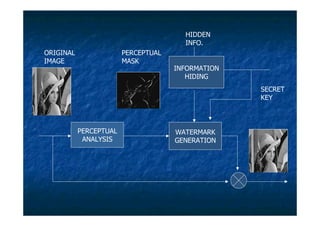
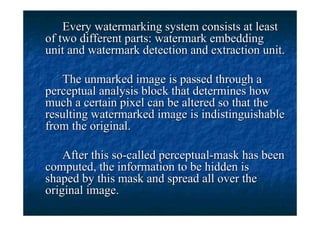
WATER MARK
INSERTION UNIT
HIDDEN
                                       INFO.
ORIGINAL                PERCEPTUAL
IMAGE                   MASK
                                     INFORMATION
                                        HIDING
                                                   SECRET
                                                   KEY


           PERCEPTUAL                WATERMARK
            ANALYSIS                 GENERATION
Every watermarking system consists at least
of two different parts: watermark embedding
unit and watermark detection and extraction unit.

   The unmarked image is passed through a
perceptual analysis block that determines how
much a certain pixel can be altered so that the
resulting watermarked image is indistinguishable
from the original.

    After this so-called perceptual-mask has been
computed, the information to be hidden is
shaped by this mask and spread all over the
original image.
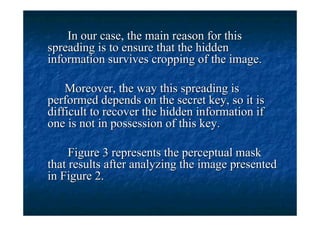
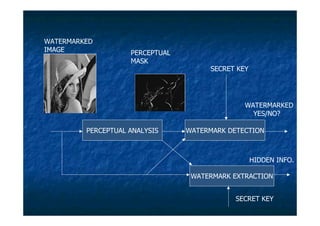
Fig 2 .ORIGINAL FABRIC   Fig 3. PERCEPTUAL MASK
         IMAGE
In our case, the main reason for this
spreading is to ensure that the hidden
information survives cropping of the image.

    Moreover, the way this spreading is
performed depends on the secret key, so it is
difficult to recover the hidden information if
one is not in possession of this key.

     Figure 3 represents the perceptual mask
that results after analyzing the image presented
in Figure 2.
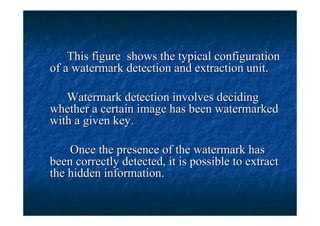
WATER MARK
DETECTION AND
 EXTRACTION
    UNIT
WATERMARKED
IMAGE               PERCEPTUAL
                    MASK
                                       SECRET KEY


                                                WATERMARKED
                                                  YES/NO?

         PERCEPTUAL ANALYSIS     WATERMARK DETECTION


                                                    HIDDEN INFO.

                                  WATERMARK EXTRACTION


                                             SECRET KEY
This figure shows the typical configuration
of a watermark detection and extraction unit.

   Watermark detection involves deciding
whether a certain image has been watermarked
with a given key.

    Once the presence of the watermark has
been correctly detected, it is possible to extract
the hidden information.
Since digital copies are inherently exact
replicas of the original, there will be no way to
tell them apart.
     Therein lies the authorship/ownership
problem due to the likeness of the original and
the copy.
     Digital watermarks can be used to show
proof of ownership by having your mark put
into the file, so even if both images are the
same, if they contain your mark then you have
a much stronger case for copyright or
ownership disputes.
Watermarks can be visible or invisible
depending on the luminance in the mask. The
higher the luminance, the greater the visibility
of the watermark.

    Attackers can use different types of image
processing to remove or degrade the
watermark until it is illegible .
APPLICATIONS
The various applications are as follows:
    VIDEO WATER MARKING
    AUDIO WATER MARKING
    TEXT WATERMARKING
    LABELLING
    FINGERPRINTING
    AUTHENTICATION
    COPY AND PLAYBACK CONTROL
In this case, most considerations made in previous
sections hold. However, now the temporal axis can be
exploited to increase the redundancy of the watermark. As
in the still images case, watermarks can be created either in
the spatial or in the DCT domains. In the latter, the results
can be directly extrapolated to MPEG-2 sequences,
although different actions must be taken for I, P and B
frames. Note that perhaps the set of attacks that can be
performed intentionally is not smaller but definitely more
expensive than for still images.
Again, previous considerations are valid. In this case,
time and frequency masking properties of the human ear are
used to conceal the watermark and make it inaudible. The
greatest difficulty lies in synchronizing the watermark and
the watermarked audio file, but techniques that overcome
this problem have been proposed.
This problem, which in fact was one of the first that
was studied within the information hiding area can be
solved at two levels. At the printout level, information can
be encoded in the way the text lines or words are separated
(this facilitates the survival of the watermark even to
photocopying). At the semantic level (necessary when raw
text files are provided), equivalences between words or
expressions can be used, although special care has to be
taken not to destruct the possible intention of the author.
The hidden message could also contain labels
that allow for example to annotate images or audio.
Of course, the annotation may also been included in
a separate file, but with watermarking it results
more difficult to destroy or loose this label, since it
becomes closely tied to the object that annotates.
This is especially useful in medical applications
since it prevents dangerous errors.
This is similar to the previous application and allows
acquisition devices (such as video cameras, audio recorders,
etc) to insert information about the specific device (e.g., an
ID number) and date of creation. This can also be done with
conventional digital signature techniques but with
watermarking it becomes considerably more difficult to
excise or alter the signature. Some digital cameras already
include this feature.
This is a variant of the previous application, in an area
where cryptographic techniques have already made their
way. However, there are two significant benefits that arise
from using watermarking: first, as in the previous case, the
signature becomes embedded in the message, second, it is
possible to create ‘soft authentication’ algorithms that offer
a multi valued ‘perceptual closeness’ measure that accounts
for different unintentional transformations that the data may
have suffered (an example is image compression with
different levels), instead of the classical yes/no answer given
by cryptography-based authentication. Unfortunately, the
major drawback of watermarking-based authentication is the
lack of public key algorithms that force either to put secret
keys in risk or to resort to trusted parties.
The message carried by the watermark may also
contain information regarding copy and display
permissions. Then, a secure module can be added in copy or
playback equipment to automatically extract this permission
information and block further processing if required. In
order to be effective, this protection approach requires
agreements between content providers and consumer
electronics manufacturers to introduce compliant watermark
detectors in their video players and recorders. This approach
is being taken in Digital Video Disc (DVD).
EXISTING SYSTEM
The existing systems that employ digital
watermarking for video piracy detection are
inviting to the hackers as the watermark is
visible.
    The watermark is concentrated in a
particular area, thus through statistical analysis
the approximate location of the watermark can
be identified. This enables the hackers to
overwrite the copyright information with their
own information.
   As the watermark is concentrated, the
chances of it being prone to damages due to
compression etc are more.
PROPOSED SYSTEM
In the proposed system the video file is
watermarked with the copyright information.
The copyright information includes data about
the vendor, buyer, a serial number and other
information.

    When it is detected that the video is
pirated, it is possible to dewater mark the file
to retrieve the copyright information. With this
information we can trace back to the sources of
piracy.
In the proposed system the watermark is
made invisible.

      The watermark is spread throughout the
image, so it’s location cannot be traced easily.
The spreading of the watermark also prevents
data loss from manipulations like compression
etc.
Apart from these advantages, the
digital watermark in the proposed system can't
be erased or overwritten.
      It is also robust and completely unaffected
by common audio or video processing
operations.
      It combines enormous versatility with ease
of installation, integration and operation. It offers
wide range of applications, including audio and
video copyright control.
BLOCK DIAGRAM
COPYRIGHT
              WATERMARKING     WATER MARKED
INFORMATION
                                  IMAGE


 VIDEO FILE                     RETRIEVED
INFORMATION   DEWATERMARKING
                                COPYRIGHT
                               INFORMATION
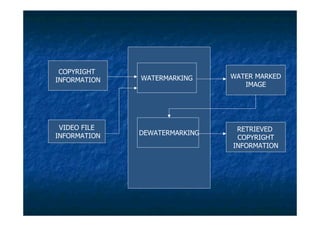
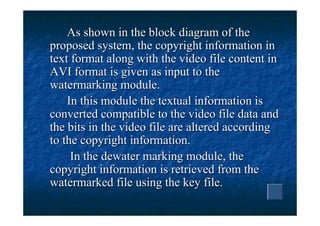
As shown in the block diagram of the
proposed system, the copyright information in
text format along with the video file content in
AVI format is given as input to the
watermarking module.
    In this module the textual information is
converted compatible to the video file data and
the bits in the video file are altered according
to the copyright information.
     In the dewater marking module, the
copyright information is retrieved from the
watermarked file using the key file.
MODULE DESCRIPTION
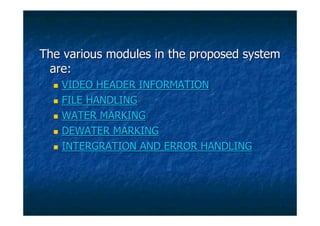
The various modules in the proposed system
 are:
   VIDEO HEADER INFORMATION
   FILE HANDLING
   WATER MARKING
   DEWATER MARKING
   INTERGRATION AND ERROR HANDLING
VIDEO HEADER INFORMATION

     The video information is stored in AVI
 RIFF format. The various headers and chunks
 are identified and declared.

     Thus by identifying the header information
 the location of the data is found.
FILE HANDLING
    The information about the owner,
recipient/distributor, serial number and other
copyright related data is stored in a text file.
This information is read from the text file.

    The header information is read from the
video file and is written into the key file and
the temporary file. The file-handling module is
carried out both during watermarking and
dewater marking.
WATERMARKING
    The image is watermarked with the
copyright information in such a way that the
video information does not lose its property.

    Changing a few data bits of the video file
depending on the copyright information does
this. The key file generated in this process
should be kept secret and should be protected
from any corruption.
DEWATERMARKING

    The data from the watermarked video file
is fetched during check for piracy. Using the
key file the copyright information is extracted
from the watermarked data.
    From the copyright information it is
possible to find the source of piracy and thus
necessary action can be taken.
ERROR HANDLING AND
      INTEGRATION

    Errors in each of the modules are handled
separately. Once this is done, the various
modules are integrated and the errors that
follow are handled
CONCLUSION
Though there are several other techniques
available for copyright protection and several
other similar issues, digital watermarking is
the only preferred algorithm because of its
basic advantages like being robust, fragile and
imperceptible.
    Several proposals have been made to
exploit the benefits of this algorithm for video
piracy detection, but the problem is still far off
from a solution.
The proposed system in this project has
used digital watermarking technique to detect
video piracy and has overcome most of the
major shortcomings of the existing systems.
The proposed system has several advantages
when compared to existing system.

  Though this system is competent enough to
be used in the market there are few
challenges yet to be solved. Few among them
are as follows:
The proposed system works for only
those video images which are in the AVI
RIFF format.
        This software helps to detect the
source of piracy, when the video is
distributed through compact discs. However
with a few changes to the software it is
possible to distribute the video file through
the Internet.
        Despite the various ways in which the
software can be enhanced, the proposed
system is no less competitive and its
efficiency is beyond question
Digital Water Marking For Video Piracy Detection

Digital Water Marking For Video Piracy Detection

  • 1.
    DIGITAL WATER MARKING FORVIDEO PIRACY DETECTION BY, NCCT
  • 2.
    ABSTRACT Piracy is an important issue as far as the manufacturers are concerned as it can result in a huge revenue loss.The reason behind the practice of full- scale piracy is mainly due to the difficulty involved in tracking the source responsible for the piracy. The goal of this project is to use digital watermarking techniques to detect video piracy.A digital watermark is a distinguishing piece of information that is adhered to the data that it is intended to protect. The information watermarked includes owner, recipient and/or distributor details, transaction dates, serial numbers, etc, which play an important role in determining the source of piracy.
  • 3.
    CONTENTS DIGITAL WATER MARKING GENERAL FEATURES STRUCTURE OF A TYPICAL WATER MARKING SYSTEM WATER MARK INSERTION UNIT WATER MARK EXTRACTION AND DETECTION UNIT
  • 4.
    APPLICATIONS EXISTING SYSTEM PROPOSED SYSTEM BLOCKDIAGRAM OF THE PROPOSED SYSTEM MODULE DESCRIPTION CONCLUSION
  • 5.
  • 6.
    Digital watermarking isa technology for embedding various types of information in digital content. In general, information for protecting copyrights and proving the validity of data is embedded as a watermark. Since watermarking can be applied to various types of data, the imperceptibility constraint will take different forms, depending on the properties of the recipient (i.e., the human senses in most practical cases).
  • 7.
    The watermark shouldbe resilient to standard manipulations of unintentional as well as intentional nature. It should be statistically irremovable, that is, a statistical analysis should not produce any advantage from the attacking point of view. The watermark should withstand multiple watermarking to facilitate traitor tracing.
  • 8.
    Embedding a watermarkshould not result in a significant increase or reduction in the original data. Digital watermarks are added to images or audio data in such a way that they are invisible or inaudible and unidentifiable by human eye or ear.
  • 9.
  • 10.
    1.Elements of digitalcontent can be directly manipulated and information can be embedded in them. 2.Deterioration of the quality of digital content is minimized. 3.Watermarks are retained and detectable after the digital content is edited, compressed, or converted. 4.The structure of a watermark makes it difficult to detect or overwrite (alter) the embedded information (watermark contents).
  • 11.
    5.Processing required forwatermarking and detection is simple. 6.Embedded watermark information cannot be eliminated without diminishing the quality of the digital content that carries the watermark. 7.The watermark information embedded in digital content can be detected as required.
  • 12.
    STRUCTURE OF A TYPICAL WATER MARKING SYSTEM
  • 13.
  • 14.
    HIDDEN INFO. ORIGINAL PERCEPTUAL IMAGE MASK INFORMATION HIDING SECRET KEY PERCEPTUAL WATERMARK ANALYSIS GENERATION
  • 15.
    Every watermarking systemconsists at least of two different parts: watermark embedding unit and watermark detection and extraction unit. The unmarked image is passed through a perceptual analysis block that determines how much a certain pixel can be altered so that the resulting watermarked image is indistinguishable from the original. After this so-called perceptual-mask has been computed, the information to be hidden is shaped by this mask and spread all over the original image.
  • 16.
    Fig 2 .ORIGINALFABRIC Fig 3. PERCEPTUAL MASK IMAGE
  • 17.
    In our case,the main reason for this spreading is to ensure that the hidden information survives cropping of the image. Moreover, the way this spreading is performed depends on the secret key, so it is difficult to recover the hidden information if one is not in possession of this key. Figure 3 represents the perceptual mask that results after analyzing the image presented in Figure 2.
  • 18.
  • 19.
    WATERMARKED IMAGE PERCEPTUAL MASK SECRET KEY WATERMARKED YES/NO? PERCEPTUAL ANALYSIS WATERMARK DETECTION HIDDEN INFO. WATERMARK EXTRACTION SECRET KEY
  • 20.
    This figure showsthe typical configuration of a watermark detection and extraction unit. Watermark detection involves deciding whether a certain image has been watermarked with a given key. Once the presence of the watermark has been correctly detected, it is possible to extract the hidden information.
  • 21.
    Since digital copiesare inherently exact replicas of the original, there will be no way to tell them apart. Therein lies the authorship/ownership problem due to the likeness of the original and the copy. Digital watermarks can be used to show proof of ownership by having your mark put into the file, so even if both images are the same, if they contain your mark then you have a much stronger case for copyright or ownership disputes.
  • 22.
    Watermarks can bevisible or invisible depending on the luminance in the mask. The higher the luminance, the greater the visibility of the watermark. Attackers can use different types of image processing to remove or degrade the watermark until it is illegible .
  • 23.
  • 24.
    The various applicationsare as follows: VIDEO WATER MARKING AUDIO WATER MARKING TEXT WATERMARKING LABELLING FINGERPRINTING AUTHENTICATION COPY AND PLAYBACK CONTROL
  • 25.
    In this case,most considerations made in previous sections hold. However, now the temporal axis can be exploited to increase the redundancy of the watermark. As in the still images case, watermarks can be created either in the spatial or in the DCT domains. In the latter, the results can be directly extrapolated to MPEG-2 sequences, although different actions must be taken for I, P and B frames. Note that perhaps the set of attacks that can be performed intentionally is not smaller but definitely more expensive than for still images.
  • 26.
    Again, previous considerationsare valid. In this case, time and frequency masking properties of the human ear are used to conceal the watermark and make it inaudible. The greatest difficulty lies in synchronizing the watermark and the watermarked audio file, but techniques that overcome this problem have been proposed.
  • 27.
    This problem, whichin fact was one of the first that was studied within the information hiding area can be solved at two levels. At the printout level, information can be encoded in the way the text lines or words are separated (this facilitates the survival of the watermark even to photocopying). At the semantic level (necessary when raw text files are provided), equivalences between words or expressions can be used, although special care has to be taken not to destruct the possible intention of the author.
  • 28.
    The hidden messagecould also contain labels that allow for example to annotate images or audio. Of course, the annotation may also been included in a separate file, but with watermarking it results more difficult to destroy or loose this label, since it becomes closely tied to the object that annotates. This is especially useful in medical applications since it prevents dangerous errors.
  • 29.
    This is similarto the previous application and allows acquisition devices (such as video cameras, audio recorders, etc) to insert information about the specific device (e.g., an ID number) and date of creation. This can also be done with conventional digital signature techniques but with watermarking it becomes considerably more difficult to excise or alter the signature. Some digital cameras already include this feature.
  • 30.
    This is avariant of the previous application, in an area where cryptographic techniques have already made their way. However, there are two significant benefits that arise from using watermarking: first, as in the previous case, the signature becomes embedded in the message, second, it is possible to create ‘soft authentication’ algorithms that offer a multi valued ‘perceptual closeness’ measure that accounts for different unintentional transformations that the data may have suffered (an example is image compression with different levels), instead of the classical yes/no answer given by cryptography-based authentication. Unfortunately, the major drawback of watermarking-based authentication is the lack of public key algorithms that force either to put secret keys in risk or to resort to trusted parties.
  • 31.
    The message carriedby the watermark may also contain information regarding copy and display permissions. Then, a secure module can be added in copy or playback equipment to automatically extract this permission information and block further processing if required. In order to be effective, this protection approach requires agreements between content providers and consumer electronics manufacturers to introduce compliant watermark detectors in their video players and recorders. This approach is being taken in Digital Video Disc (DVD).
  • 32.
  • 33.
    The existing systemsthat employ digital watermarking for video piracy detection are inviting to the hackers as the watermark is visible. The watermark is concentrated in a particular area, thus through statistical analysis the approximate location of the watermark can be identified. This enables the hackers to overwrite the copyright information with their own information. As the watermark is concentrated, the chances of it being prone to damages due to compression etc are more.
  • 34.
  • 35.
    In the proposedsystem the video file is watermarked with the copyright information. The copyright information includes data about the vendor, buyer, a serial number and other information. When it is detected that the video is pirated, it is possible to dewater mark the file to retrieve the copyright information. With this information we can trace back to the sources of piracy.
  • 36.
    In the proposedsystem the watermark is made invisible. The watermark is spread throughout the image, so it’s location cannot be traced easily. The spreading of the watermark also prevents data loss from manipulations like compression etc.
  • 37.
    Apart from theseadvantages, the digital watermark in the proposed system can't be erased or overwritten. It is also robust and completely unaffected by common audio or video processing operations. It combines enormous versatility with ease of installation, integration and operation. It offers wide range of applications, including audio and video copyright control.
  • 38.
  • 39.
    COPYRIGHT WATERMARKING WATER MARKED INFORMATION IMAGE VIDEO FILE RETRIEVED INFORMATION DEWATERMARKING COPYRIGHT INFORMATION
  • 40.
    As shown inthe block diagram of the proposed system, the copyright information in text format along with the video file content in AVI format is given as input to the watermarking module. In this module the textual information is converted compatible to the video file data and the bits in the video file are altered according to the copyright information. In the dewater marking module, the copyright information is retrieved from the watermarked file using the key file.
  • 41.
  • 42.
    The various modulesin the proposed system are: VIDEO HEADER INFORMATION FILE HANDLING WATER MARKING DEWATER MARKING INTERGRATION AND ERROR HANDLING
  • 43.
    VIDEO HEADER INFORMATION The video information is stored in AVI RIFF format. The various headers and chunks are identified and declared. Thus by identifying the header information the location of the data is found.
  • 44.
    FILE HANDLING The information about the owner, recipient/distributor, serial number and other copyright related data is stored in a text file. This information is read from the text file. The header information is read from the video file and is written into the key file and the temporary file. The file-handling module is carried out both during watermarking and dewater marking.
  • 45.
    WATERMARKING The image is watermarked with the copyright information in such a way that the video information does not lose its property. Changing a few data bits of the video file depending on the copyright information does this. The key file generated in this process should be kept secret and should be protected from any corruption.
  • 46.
    DEWATERMARKING The data from the watermarked video file is fetched during check for piracy. Using the key file the copyright information is extracted from the watermarked data. From the copyright information it is possible to find the source of piracy and thus necessary action can be taken.
  • 47.
    ERROR HANDLING AND INTEGRATION Errors in each of the modules are handled separately. Once this is done, the various modules are integrated and the errors that follow are handled
  • 48.
  • 49.
    Though there areseveral other techniques available for copyright protection and several other similar issues, digital watermarking is the only preferred algorithm because of its basic advantages like being robust, fragile and imperceptible. Several proposals have been made to exploit the benefits of this algorithm for video piracy detection, but the problem is still far off from a solution.
  • 50.
    The proposed systemin this project has used digital watermarking technique to detect video piracy and has overcome most of the major shortcomings of the existing systems. The proposed system has several advantages when compared to existing system. Though this system is competent enough to be used in the market there are few challenges yet to be solved. Few among them are as follows:
  • 51.
    The proposed systemworks for only those video images which are in the AVI RIFF format. This software helps to detect the source of piracy, when the video is distributed through compact discs. However with a few changes to the software it is possible to distribute the video file through the Internet. Despite the various ways in which the software can be enhanced, the proposed system is no less competitive and its efficiency is beyond question