CONTENTS
Background
Terminology
Characteristics
Applications
Techniques
References
Information Hiding
Information Hiding…..started with

Steganography (art of hidden writing):
The art and science of writing hidden messages in
such a way that no one apart from the intended
recipient knows of the existence of the message.
The existence of information is secret.
What is a watermark ?
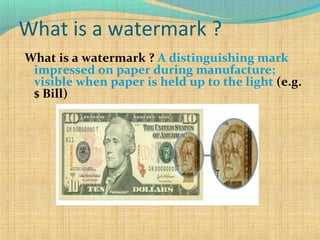
What is a watermark ? A distinguishing mark
impressed on paper during manufacture;
visible when paper is held up to the light (e.g.
$ Bill)
What is a watermark ?
Digital Watermarking: Application of Information
hiding (Hiding Watermarks in digital Media, such
as images,audio file)
Digital Watermarking is a process of embedding
digital signals or pattern into a multimedia object
without affecting in any way the quality of the
original file.
CHARACTERISTICS


Transparency: watermark is not detectable



Robustness: survives digital processing (e.g., compression) and
malicious analytical attacks.



Efficiency: low cost implementation using minimal resources



Independence: of both the type and format of multimedia data (e.g.,
music, speech, video, sample rates, coding scheme, ...)
Applications
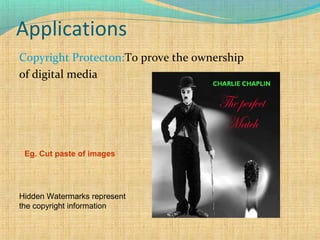
Copyright Protecton:To prove the ownership
of digital media

Eg. Cut paste of images

Hidden Watermarks represent
the copyright information
Applications
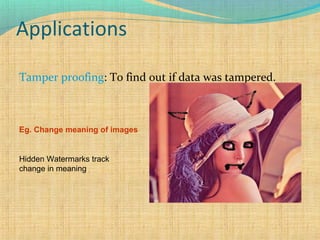
Tamper proofing: To find out if data was tampered.

Eg. Change meaning of images

Hidden Watermarks track
change in meaning
Applications
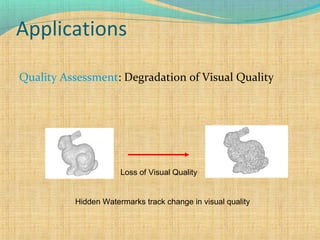
Quality Assessment: Degradation of Visual Quality

Loss of Visual Quality

Hidden Watermarks track change in visual quality
Watermarking Process
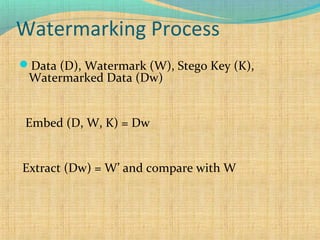
Data (D), Watermark (W), Stego Key (K),

Watermarked Data (Dw)

Embed (D, W, K) = Dw
Extract (Dw) = W’ and compare with W
Watermarking Process
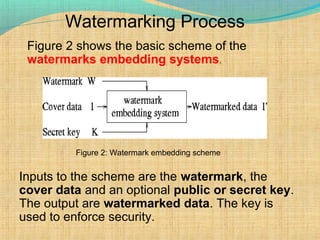
Figure 2 shows the basic scheme of the
watermarks embedding systems.

Figure 2: Watermark embedding scheme

Inputs to the scheme are the watermark, the
cover data and an optional public or secret key.
The output are watermarked data. The key is
used to enforce security.
Watermarking Process
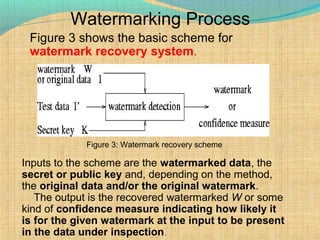
Figure 3 shows the basic scheme for
watermark recovery system.

Figure 3: Watermark recovery scheme

Inputs to the scheme are the watermarked data, the
secret or public key and, depending on the method,
the original data and/or the original watermark.
The output is the recovered watermarked W or some
kind of confidence measure indicating how likely it
is for the given watermark at the input to be present
in the data under inspection.
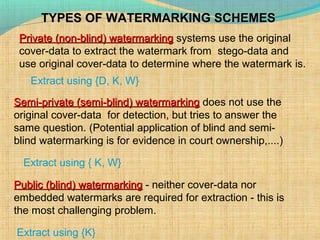
TYPES OF WATERMARKING SCHEMES
Private (non-blind) watermarking systems use the original
cover-data to extract the watermark from stego-data and
use original cover-data to determine where the watermark is.
Extract using {D, K, W}
Semi-private (semi-blind) watermarking does not use the
original cover-data for detection, but tries to answer the
same question. (Potential application of blind and semiblind watermarking is for evidence in court ownership,....)
Extract using { K, W}
Public (blind) watermarking - neither cover-data nor
embedded watermarks are required for extraction - this is
the most challenging problem.
Extract using {K}
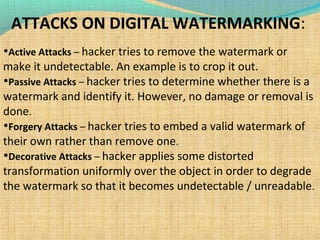
ATTACKS ON DIGITAL WATERMARKING:
•Active Attacks – hacker tries to remove the watermark or

make it undetectable. An example is to crop it out.
•Passive Attacks – hacker tries to determine whether there is a
watermark and identify it. However, no damage or removal is
done.
•Forgery Attacks – hacker tries to embed a valid watermark of
their own rather than remove one.
•Decorative Attacks – hacker applies some distorted
transformation uniformly over the object in order to degrade
the watermark so that it becomes undetectable / unreadable.
Security
In case the key used during watermark is lost anyone

can read the watermark and remove it.

In case the watermark is public, it can be encoded

and copyright information is lost.
References
http://en.wikipedia.org/wiki/Steganography

http://en.wikipedia.org/wiki/Digital_watermark

http://www.cypak.com/pictures/med/Cypak
Digital watermarking

Digital watermarking

  • 2.
  • 3.
    Information Hiding Information Hiding…..startedwith Steganography (art of hidden writing): The art and science of writing hidden messages in such a way that no one apart from the intended recipient knows of the existence of the message. The existence of information is secret.
  • 4.
    What is awatermark ? What is a watermark ? A distinguishing mark impressed on paper during manufacture; visible when paper is held up to the light (e.g. $ Bill)
  • 5.
    What is awatermark ? Digital Watermarking: Application of Information hiding (Hiding Watermarks in digital Media, such as images,audio file) Digital Watermarking is a process of embedding digital signals or pattern into a multimedia object without affecting in any way the quality of the original file.
  • 6.
    CHARACTERISTICS  Transparency: watermark isnot detectable  Robustness: survives digital processing (e.g., compression) and malicious analytical attacks.  Efficiency: low cost implementation using minimal resources  Independence: of both the type and format of multimedia data (e.g., music, speech, video, sample rates, coding scheme, ...)
  • 7.
    Applications Copyright Protecton:To provethe ownership of digital media Eg. Cut paste of images Hidden Watermarks represent the copyright information
  • 8.
    Applications Tamper proofing: Tofind out if data was tampered. Eg. Change meaning of images Hidden Watermarks track change in meaning
  • 9.
    Applications Quality Assessment: Degradationof Visual Quality Loss of Visual Quality Hidden Watermarks track change in visual quality
  • 10.
    Watermarking Process Data (D),Watermark (W), Stego Key (K), Watermarked Data (Dw) Embed (D, W, K) = Dw Extract (Dw) = W’ and compare with W
  • 11.
    Watermarking Process Figure 2shows the basic scheme of the watermarks embedding systems. Figure 2: Watermark embedding scheme Inputs to the scheme are the watermark, the cover data and an optional public or secret key. The output are watermarked data. The key is used to enforce security.
  • 12.
    Watermarking Process Figure 3shows the basic scheme for watermark recovery system. Figure 3: Watermark recovery scheme Inputs to the scheme are the watermarked data, the secret or public key and, depending on the method, the original data and/or the original watermark. The output is the recovered watermarked W or some kind of confidence measure indicating how likely it is for the given watermark at the input to be present in the data under inspection.
  • 13.
    TYPES OF WATERMARKINGSCHEMES Private (non-blind) watermarking systems use the original cover-data to extract the watermark from stego-data and use original cover-data to determine where the watermark is. Extract using {D, K, W} Semi-private (semi-blind) watermarking does not use the original cover-data for detection, but tries to answer the same question. (Potential application of blind and semiblind watermarking is for evidence in court ownership,....) Extract using { K, W} Public (blind) watermarking - neither cover-data nor embedded watermarks are required for extraction - this is the most challenging problem. Extract using {K}
  • 14.
    ATTACKS ON DIGITALWATERMARKING: •Active Attacks – hacker tries to remove the watermark or make it undetectable. An example is to crop it out. •Passive Attacks – hacker tries to determine whether there is a watermark and identify it. However, no damage or removal is done. •Forgery Attacks – hacker tries to embed a valid watermark of their own rather than remove one. •Decorative Attacks – hacker applies some distorted transformation uniformly over the object in order to degrade the watermark so that it becomes undetectable / unreadable.
  • 15.
    Security In case thekey used during watermark is lost anyone can read the watermark and remove it. In case the watermark is public, it can be encoded and copyright information is lost.
  • 16.