




Imagine Better:
Human-Centered Design
Workshop
Digital Innovation Class, March 21-26, 2016
Dr. Michelle Ferrier
Associate Dean for Innovation
Our Agenda
• Entrepreneurship: Why I Care
• Human-Centered Design Principles:
Introduction
• HCD/Design Thinking Practices
• Next Steps: Business Model Canvas
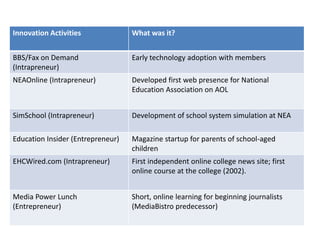
Innovation Activities What was it?
BBS/Fax on Demand
(Intrapreneur)
Early technology adoption with members
NEAOnline (Intrapreneur) Developed first web presence for National
Education Association on AOL
SimSchool (Intrapreneur) Development of school system simulation at NEA
Education Insider (Entrepreneur) Magazine startup for parents of school-aged
children
EHCWired.com (Intrapreneur) First independent online college news site; first
online course at the college (2002).
Media Power Lunch
(Entrepreneur)
Short, online learning for beginning journalists
(MediaBistro predecessor)
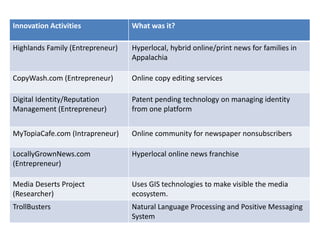
Innovation Activities What was it?
Highlands Family (Entrepreneur) Hyperlocal, hybrid online/print news for families in
Appalachia
CopyWash.com (Entrepreneur) Online copy editing services
Digital Identity/Reputation
Management (Entrepreneur)
Patent pending technology on managing identity
from one platform
MyTopiaCafe.com (Intrapreneur) Online community for newspaper nonsubscribers
LocallyGrownNews.com
(Entrepreneur)
Hyperlocal online news franchise
Media Deserts Project
(Researcher)
Uses GIS technologies to make visible the media
ecosystem.
TrollBusters Natural Language Processing and Positive Messaging
System
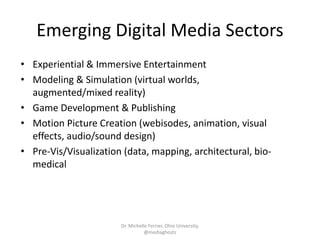
Emerging Digital Media Sectors
• Experiential & Immersive Entertainment
• Modeling & Simulation (virtual worlds,
augmented/mixed reality)
• Game Development & Publishing
• Motion Picture Creation (webisodes, animation, visual
effects, audio/sound design)
• Pre-Vis/Visualization (data, mapping, architectural, bio-
medical
Dr. Michelle Ferrier, Ohio University,
@mediaghosts
Emerging Digital Media Sectors
• Mobile Media
• eLearning
• Interactive Marketing & Advertising (social media, online
ads, in-game ad placement
• Content Aggregation & Distribution (niche portals)
• Internet A/V Content Distribution (streaming media)
• Web Content & Application Development
Dr. Michelle Ferrier, Ohio University,
@mediaghosts
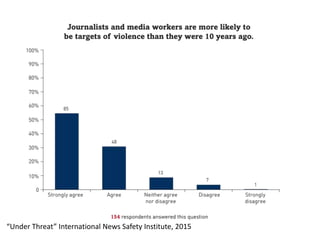
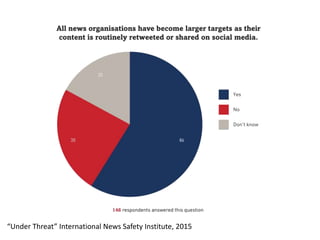
“Under Threat” International News Safety Institute, 2015
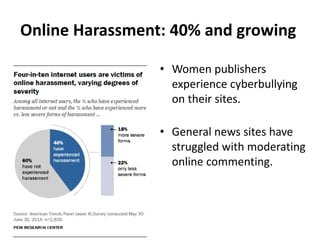
Online Harassment: 40% and growing
• Women publishers
experience cyberbullying
on their sites.
• General news sites have
struggled with moderating
online commenting.
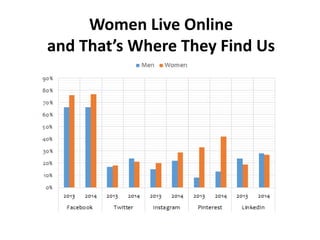
Women Live Online
and That’s Where They Find Us
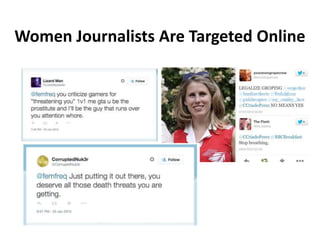
Women Journalists Are Targeted Online
Our Solution
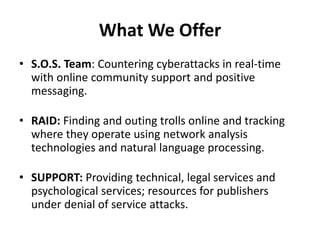
What We Offer
• S.O.S. Team: Countering cyberattacks in real-time
with online community support and positive
messaging.
• RAID: Finding and outing trolls online and tracking
where they operate using network analysis
technologies and natural language processing.
• SUPPORT: Providing technical, legal services and
psychological services; resources for publishers
under denial of service attacks.
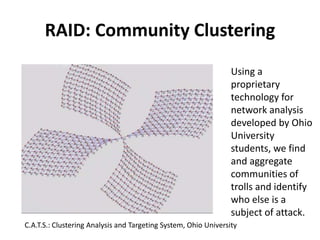
RAID: Community Clustering
Using a
proprietary
technology for
network analysis
developed by Ohio
University
students, we find
and aggregate
communities of
trolls and identify
who else is a
subject of attack.
C.A.T.S.: Clustering Analysis and Targeting System, Ohio University
Our Goal: Fighting Hate with <3
TrollBusters provides just-in-time rescue
services for women journalists, bloggers
and publishers who experience online
harassment.
We use our virtual S.O.S. team to send
positive messages into online streams
at the point of attack. We dilute the stings
of trolls and other online pests to support
you, your voice, your business and your
reputation.
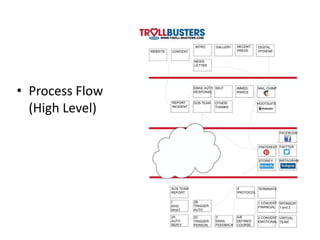
• Process Flow
(High Level)
Student Skills and Knowledge
1. Construct and deliver a pitch.
2. Conduct market research.
3. Conduct audience analysis.
4. Understand the entrepreneurial landscape/startup culture.
5. Conduct a competitive analysis.
6. Create a minimum viable product.
7. Read, understand and create financial statements.
Ferrier, Michelle Barrett. “Media Entrepreneurship: Curriculum Development and Faculty Perceptions of
What Students Should Know,” Journalism & Mass Communication Educator, Sept. 2013, Vol 68, Issue 3, p.
222.
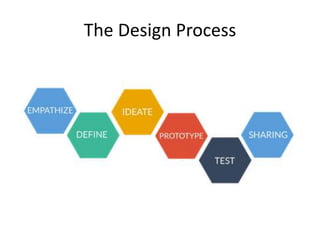
The Design Process
Imagine Better
Intrapreneur
Entrepreneur
Innovating for People: Luma Institute
Human-Centered Design: The
discipline of developing solutions in
the service of people. Every story of
a good innovation--whether it's a
new product, a new service, a new
business model or a new form of
governance-- begins and ends with
people. It starts with careful
discernment of human needs, and
concludes with solutions that meet
or exceed personal expectations.
http://www.luma-institute.com/
Human-Centered Design
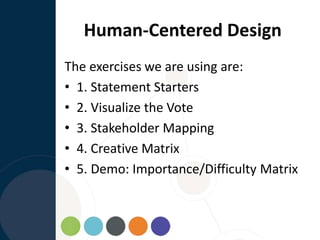
The exercises we are using are:
• 1. Statement Starters
• 2. Visualize the Vote
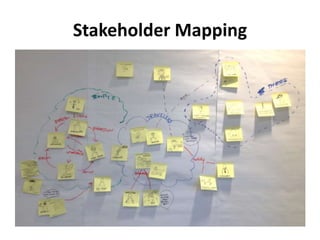
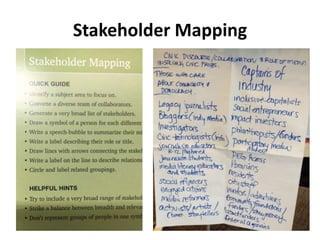
• 3. Stakeholder Mapping
• 4. Creative Matrix
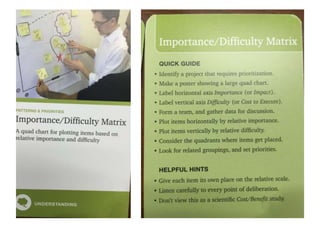
• 5. Demo: Importance/Difficulty Matrix
Clearly Define the Problem
You need to clearly define the
problem. Who is experiencing the
problem? Who else is involved?
Where does the problem take
place?
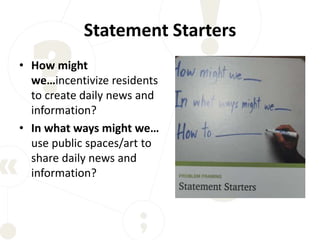
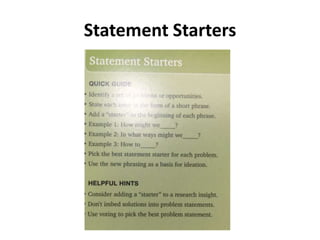
Statement Starters
• How might
we…incentivize residents
to create daily news and
information?
• In what ways might we…
use public spaces/art to
share daily news and
information?
Statement Starters
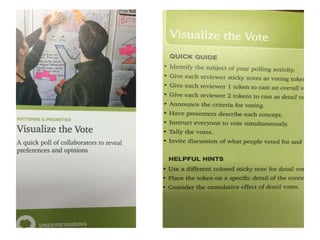
Visualize the Vote: Results
• What ideas rise overall in the imagination of
the group? Why? What is appealing? Get
feedback from group.
• Detail Vote (Use different color): What details
were selected? What is it about the detail that
is attractive? Is it a bud that could become its
own idea?
Human-Centered Design
The exercises we are using are:
• 1. Statement Starters
• 2. Visualize the Vote
• 3. Stakeholder Mapping
• 3. Creative Matrix
• 4. Demo: Importance/Difficulty Matrix
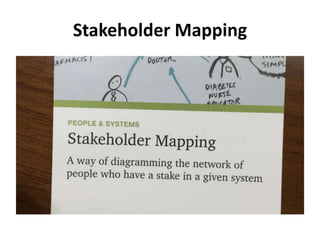
Stakeholder Mapping
Stakeholder Mapping
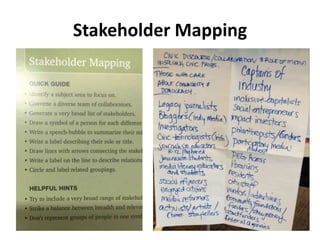
Stakeholder Mapping
Stakeholder Mapping
Stakeholder Mapping: Results
• What are some of the “unusual suspects” you
included in your map? Why?
• Look at other maps. Who do you see on other
maps that aren’t on yours? Who has
stakeholders that are alike?
Human-Centered Design
The exercises we are using are:
• 1. Statement Starters
• 2. Visualize the Vote
• 3. Stakeholder Mapping
• 3. Creative Matrix
• 4. Demo: Importance/Difficulty Matrix
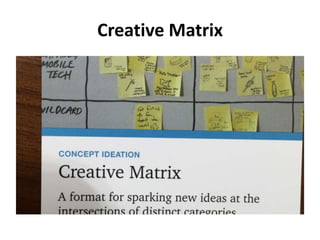
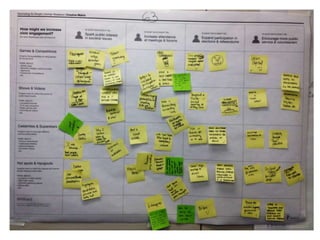
Creative Matrix
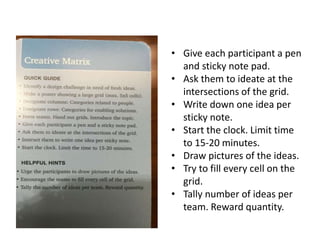
• Give each participant a pen
and sticky note pad.
• Ask them to ideate at the
intersections of the grid.
• Write down one idea per
sticky note.
• Start the clock. Limit time
to 15-20 minutes.
• Draw pictures of the ideas.
• Try to fill every cell on the
grid.
• Tally number of ideas per
team. Reward quantity.
Human-Centered Design
The exercises we are using are:
• 1. Statement Starters
• 2. Dot Voting
• 3. Stakeholder Mapping
• 3. Creative Matrix
• 4. Demo: Importance/Difficulty Matrix
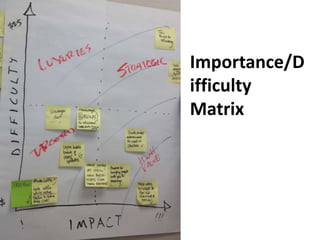
Importance/D
ifficulty
Matrix
Human-Centered Design
The exercises we are using are:
• 1. Statement Starters
• 2. Visualize the Vote
• 3. Stakeholder Mapping
• 3. Creative Matrix
• 4. Demo: Importance/Difficulty Matrix
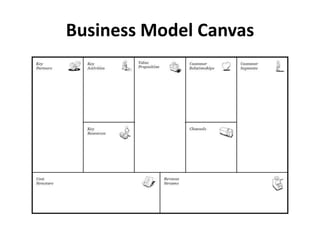
Business Model Canvas
Resources
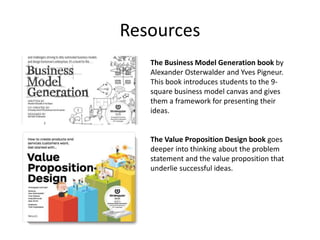
The Business Model Generation book by
Alexander Osterwalder and Yves Pigneur.
This book introduces students to the 9-
square business model canvas and gives
them a framework for presenting their
ideas.
The Value Proposition Design book goes
deeper into thinking about the problem
statement and the value proposition that
underlie successful ideas.
Resources
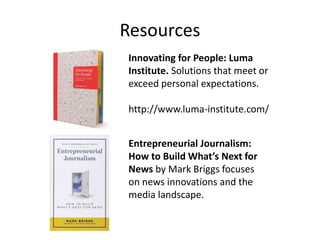
Innovating for People: Luma
Institute. Solutions that meet or
exceed personal expectations.
http://www.luma-institute.com/
Entrepreneurial Journalism:
How to Build What’s Next for
News by Mark Briggs focuses
on news innovations and the
media landscape.
Thank You!
• Dr. Michelle Ferrier
• ferrierm@ohio.edu
• @mediaghosts
• www.troll-
busters.com
• @yoursosteam

Digital innovation and human-centered design - 032016

  • 1.
    Imagine Better: Human-Centered Design Workshop DigitalInnovation Class, March 21-26, 2016 Dr. Michelle Ferrier Associate Dean for Innovation
  • 2.
    Our Agenda • Entrepreneurship:Why I Care • Human-Centered Design Principles: Introduction • HCD/Design Thinking Practices • Next Steps: Business Model Canvas
  • 3.
    Innovation Activities Whatwas it? BBS/Fax on Demand (Intrapreneur) Early technology adoption with members NEAOnline (Intrapreneur) Developed first web presence for National Education Association on AOL SimSchool (Intrapreneur) Development of school system simulation at NEA Education Insider (Entrepreneur) Magazine startup for parents of school-aged children EHCWired.com (Intrapreneur) First independent online college news site; first online course at the college (2002). Media Power Lunch (Entrepreneur) Short, online learning for beginning journalists (MediaBistro predecessor)
  • 4.
    Innovation Activities Whatwas it? Highlands Family (Entrepreneur) Hyperlocal, hybrid online/print news for families in Appalachia CopyWash.com (Entrepreneur) Online copy editing services Digital Identity/Reputation Management (Entrepreneur) Patent pending technology on managing identity from one platform MyTopiaCafe.com (Intrapreneur) Online community for newspaper nonsubscribers LocallyGrownNews.com (Entrepreneur) Hyperlocal online news franchise Media Deserts Project (Researcher) Uses GIS technologies to make visible the media ecosystem. TrollBusters Natural Language Processing and Positive Messaging System
  • 5.
    Emerging Digital MediaSectors • Experiential & Immersive Entertainment • Modeling & Simulation (virtual worlds, augmented/mixed reality) • Game Development & Publishing • Motion Picture Creation (webisodes, animation, visual effects, audio/sound design) • Pre-Vis/Visualization (data, mapping, architectural, bio- medical Dr. Michelle Ferrier, Ohio University, @mediaghosts
  • 6.
    Emerging Digital MediaSectors • Mobile Media • eLearning • Interactive Marketing & Advertising (social media, online ads, in-game ad placement • Content Aggregation & Distribution (niche portals) • Internet A/V Content Distribution (streaming media) • Web Content & Application Development Dr. Michelle Ferrier, Ohio University, @mediaghosts
  • 8.
    “Under Threat” InternationalNews Safety Institute, 2015
  • 9.
    “Under Threat” InternationalNews Safety Institute, 2015
  • 10.
    Online Harassment: 40%and growing • Women publishers experience cyberbullying on their sites. • General news sites have struggled with moderating online commenting.
  • 11.
    Women Live Online andThat’s Where They Find Us
  • 12.
    Women Journalists AreTargeted Online
  • 13.
  • 14.
    What We Offer •S.O.S. Team: Countering cyberattacks in real-time with online community support and positive messaging. • RAID: Finding and outing trolls online and tracking where they operate using network analysis technologies and natural language processing. • SUPPORT: Providing technical, legal services and psychological services; resources for publishers under denial of service attacks.
  • 15.
    RAID: Community Clustering Usinga proprietary technology for network analysis developed by Ohio University students, we find and aggregate communities of trolls and identify who else is a subject of attack. C.A.T.S.: Clustering Analysis and Targeting System, Ohio University
  • 16.
    Our Goal: FightingHate with <3 TrollBusters provides just-in-time rescue services for women journalists, bloggers and publishers who experience online harassment. We use our virtual S.O.S. team to send positive messages into online streams at the point of attack. We dilute the stings of trolls and other online pests to support you, your voice, your business and your reputation.
  • 17.
  • 18.
    Student Skills andKnowledge 1. Construct and deliver a pitch. 2. Conduct market research. 3. Conduct audience analysis. 4. Understand the entrepreneurial landscape/startup culture. 5. Conduct a competitive analysis. 6. Create a minimum viable product. 7. Read, understand and create financial statements. Ferrier, Michelle Barrett. “Media Entrepreneurship: Curriculum Development and Faculty Perceptions of What Students Should Know,” Journalism & Mass Communication Educator, Sept. 2013, Vol 68, Issue 3, p. 222.
  • 20.
  • 21.
  • 22.
    Innovating for People:Luma Institute Human-Centered Design: The discipline of developing solutions in the service of people. Every story of a good innovation--whether it's a new product, a new service, a new business model or a new form of governance-- begins and ends with people. It starts with careful discernment of human needs, and concludes with solutions that meet or exceed personal expectations. http://www.luma-institute.com/
  • 23.
    Human-Centered Design The exerciseswe are using are: • 1. Statement Starters • 2. Visualize the Vote • 3. Stakeholder Mapping • 4. Creative Matrix • 5. Demo: Importance/Difficulty Matrix
  • 24.
    Clearly Define theProblem You need to clearly define the problem. Who is experiencing the problem? Who else is involved? Where does the problem take place?
  • 25.
    Statement Starters • Howmight we…incentivize residents to create daily news and information? • In what ways might we… use public spaces/art to share daily news and information?
  • 26.
  • 28.
    Visualize the Vote:Results • What ideas rise overall in the imagination of the group? Why? What is appealing? Get feedback from group. • Detail Vote (Use different color): What details were selected? What is it about the detail that is attractive? Is it a bud that could become its own idea?
  • 29.
    Human-Centered Design The exerciseswe are using are: • 1. Statement Starters • 2. Visualize the Vote • 3. Stakeholder Mapping • 3. Creative Matrix • 4. Demo: Importance/Difficulty Matrix
  • 30.
  • 31.
  • 32.
  • 33.
  • 34.
    Stakeholder Mapping: Results •What are some of the “unusual suspects” you included in your map? Why? • Look at other maps. Who do you see on other maps that aren’t on yours? Who has stakeholders that are alike?
  • 35.
    Human-Centered Design The exerciseswe are using are: • 1. Statement Starters • 2. Visualize the Vote • 3. Stakeholder Mapping • 3. Creative Matrix • 4. Demo: Importance/Difficulty Matrix
  • 36.
  • 37.
    • Give eachparticipant a pen and sticky note pad. • Ask them to ideate at the intersections of the grid. • Write down one idea per sticky note. • Start the clock. Limit time to 15-20 minutes. • Draw pictures of the ideas. • Try to fill every cell on the grid. • Tally number of ideas per team. Reward quantity.
  • 39.
    Human-Centered Design The exerciseswe are using are: • 1. Statement Starters • 2. Dot Voting • 3. Stakeholder Mapping • 3. Creative Matrix • 4. Demo: Importance/Difficulty Matrix
  • 41.
  • 42.
    Human-Centered Design The exerciseswe are using are: • 1. Statement Starters • 2. Visualize the Vote • 3. Stakeholder Mapping • 3. Creative Matrix • 4. Demo: Importance/Difficulty Matrix
  • 43.
  • 44.
    Resources The Business ModelGeneration book by Alexander Osterwalder and Yves Pigneur. This book introduces students to the 9- square business model canvas and gives them a framework for presenting their ideas. The Value Proposition Design book goes deeper into thinking about the problem statement and the value proposition that underlie successful ideas.
  • 45.
    Resources Innovating for People:Luma Institute. Solutions that meet or exceed personal expectations. http://www.luma-institute.com/ Entrepreneurial Journalism: How to Build What’s Next for News by Mark Briggs focuses on news innovations and the media landscape.
  • 46.
    Thank You! • Dr.Michelle Ferrier • ferrierm@ohio.edu • @mediaghosts • www.troll- busters.com • @yoursosteam

Editor's Notes

  • #24 What You’ll Need: 30 minutes Large Post-It Notes Markers
  • #27 Large Post-It Notes Markers Gather best statements onto large butcher paper. Use to populate Creative Matrix
  • #30 What You’ll Need: 15-20 minutes Yellow Post-It Notes (Square) Sharpie Markers Large paper on wall Colored Markers
  • #32 What You’ll Need Yellow Post-It Notes (Square) Sharpie Markers Large paper on wall Colored Markers
  • #36 What You’ll Need: 15-20 minutes Yellow Post-It Notes (Square) Sharpie Markers Large paper on wall Colored Markers
  • #40 What You’ll Need: 15-20 minutes Yellow Post-It Notes (Square) Sharpie Markers Large paper on wall Colored Markers
  • #43 What You’ll Need: 15-20 minutes Yellow Post-It Notes (Square) Sharpie Markers Large paper on wall Colored Markers