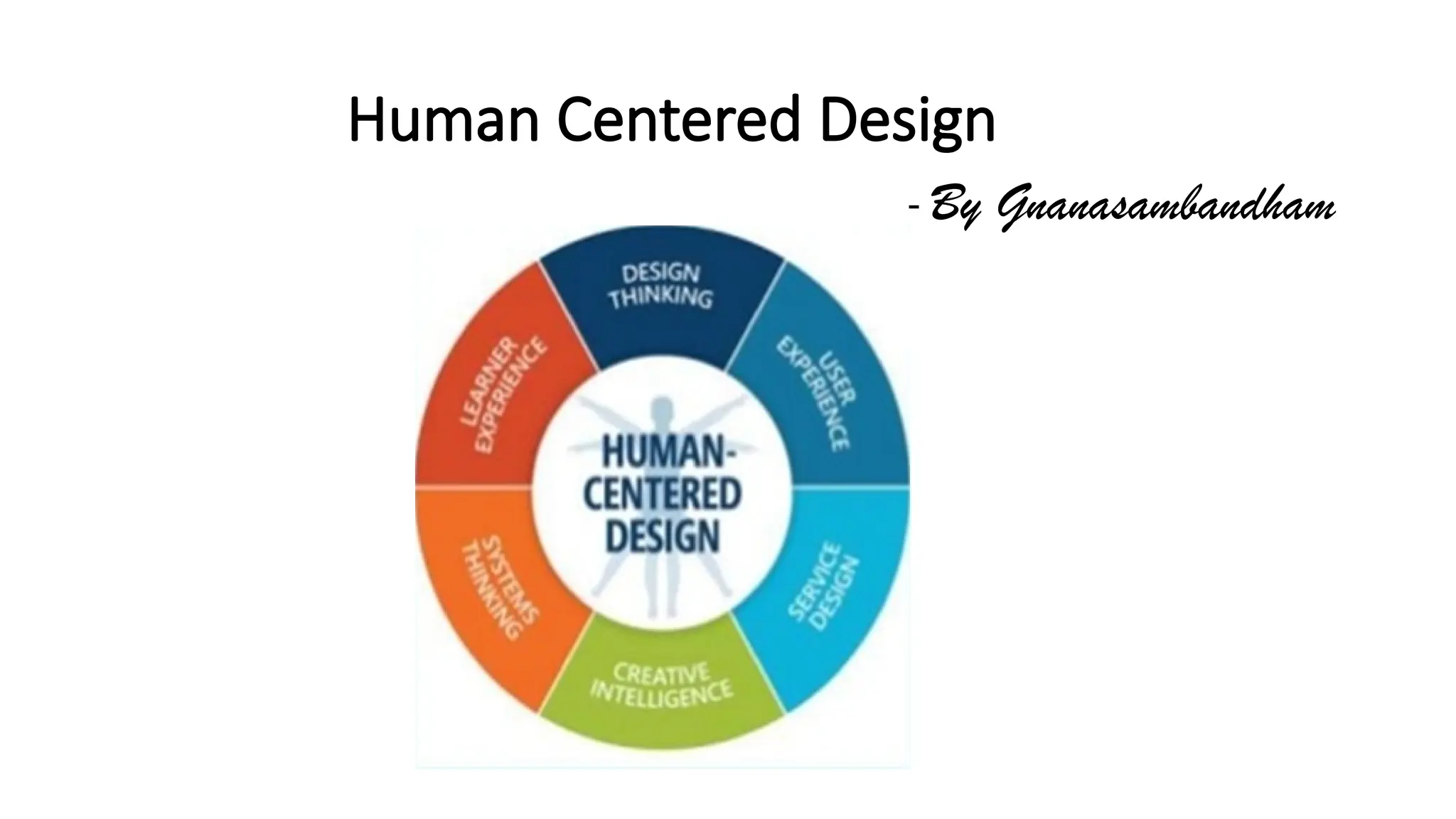
Human Centered Design
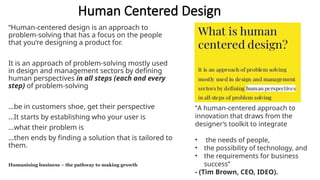
“Human-centereddesign is an approach to
problem-solving that has a focus on the people
that you’re designing a product for.
It is an approach of problem-solving mostly used
in design and management sectors by defining
human perspectives in all steps (each and every
step) of problem-solving
…be in customers shoe, get their perspective
…It starts by establishing who your user is
…what their problem is
…then ends by finding a solution that is tailored to
them.
Humanising business – the pathway to making growth
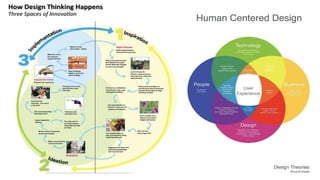
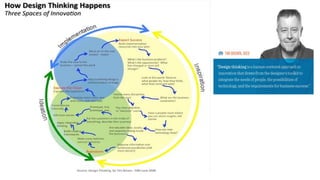
“A human-centered approach to
innovation that draws from the
designer’s toolkit to integrate
• the needs of people,
• the possibility of technology, and
• the requirements for business
success”
- (Tim Brown, CEO, IDEO).
3.
Human Centered Design
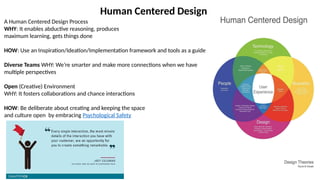
AHuman Centered Design Process
WHY: It enables abductive reasoning, produces
maximum learning, gets things done
HOW: Use an Inspiration/Ideation/Implementation framework and tools as a guide
Diverse Teams WHY: We’re smarter and make more connections when we have
multiple perspectives
Open (Creative) Environment
WHY: It fosters collaborations and chance interactions
HOW: Be deliberate about creating and keeping the space
and culture open by embracing Psychological Safety
4.
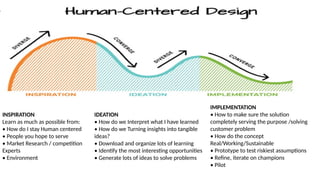
INSPIRATION
Learn as muchas possible from:
• How do I stay Human centered
• People you hope to serve
• Market Research / competition
Experts
• Environment
IDEATION
• How do we Interpret what I have learned
• How do we Turning insights into tangible
ideas?
• Download and organize lots of learning
• Identify the most interesting opportunities
• Generate lots of ideas to solve problems
IMPLEMENTATION
• How to make sure the solution
completely serving the purpose /solving
customer problem
• How do the concept
Real/Working/Sustainable
• Prototype to test riskiest assumptions
• Refine, iterate on champions
• Pilot
5.
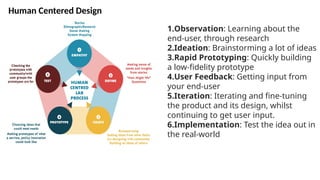
Human Centered Design
1.Observation:Learning about the
end-user, through research
2.Ideation: Brainstorming a lot of ideas
3.Rapid Prototyping: Quickly building
a low-fidelity prototype
4.User Feedback: Getting input from
your end-user
5.Iteration: Iterating and fine-tuning
the product and its design, whilst
continuing to get user input.
6.Implementation: Test the idea out in
the real-world
6.
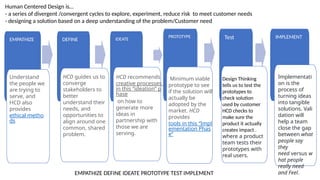
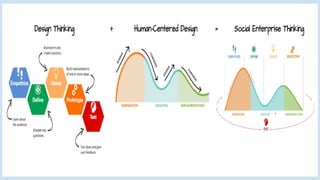
EMPATHIZE DEFINE IDEATEPROTOTYPE TEST IMPLEMENT
EMPATHIZE DEFINE IDEATE
PROTOTYPE Test IMPLEMENT
Human Centered Design is…
- a series of divergent /convergent cycles to explore, experiment, reduce risk to meet customer needs
- designing a solution based on a deep understanding of the problem/Customer need
Understand
the people we
are trying to
serve, and
HCD also
provides
ethical metho
ds
HCD guides us to
converge
stakeholders to
better
understand their
needs, and
opportunities to
align around one
common, shared
problem.
HCD recommends
creative processes
in this “ideation” p
hase
on how to
generate more
ideas in
partnership with
those we are
serving.
Minimum viable
prototype to see
if the solution will
actually be
adopted by the
market. HCD
provides
tools in this “Impl
ementation Phas
e”
Design Thinking
tells us to test the
prototypes to
check solution
used by customer
HCD checks to
make sure the
product it actually
creates impact .
where a product
team tests their
prototypes with
real users.
Implementati
on is the
process of
turning ideas
into tangible
solutions. Vali
dation will
help a team
close the gap
between what
people say
they
need versus w
hat people
really need
and Feel.
8.
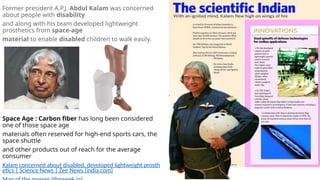
Former president A.P.J.Abdul Kalam was concerned
about people with disability
and along with his team developed lightweight
prosthetics from space-age
material to enable disabled children to walk easily.
Space Age : Carbon fiber has long been considered
one of those space age
materials often reserved for high-end sports cars, the
space shuttle
and other products out of reach for the average
consumer
Kalam concerned about disabled, developed lightweight prosth
etics | Science News | Zee News (india.com)
9.
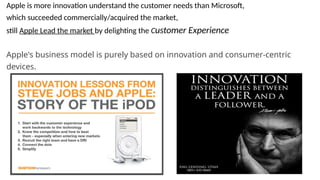
Apple is moreinnovation understand the customer needs than Microsoft,
which succeeded commercially/acquired the market,
still Apple Lead the market by delighting the Customer Experience
Apple's business model is purely based on innovation and consumer-centric
devices.
10.
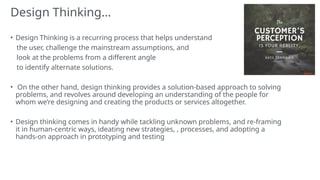
Design Thinking…
• DesignThinking is a recurring process that helps understand
the user, challenge the mainstream assumptions, and
look at the problems from a different angle
to identify alternate solutions.
• On the other hand, design thinking provides a solution-based approach to solving
problems, and revolves around developing an understanding of the people for
whom we’re designing and creating the products or services altogether.
• Design thinking comes in handy while tackling unknown problems, and re-framing
it in human-centric ways, ideating new strategies, , processes, and adopting a
hands-on approach in prototyping and testing
11.
Empathetically Define andRigorously Measure the Customer
Value you Deliver
Business success is directly proportional to the customer
value you deliver through your solutions (product, service,
process).
Yet, very few organizations accurately measure customer
value throughout the creation process because of a
limited understanding of how customers derive value,
flawed metrics &/or lack of a holistic view of the customer.
Start by determining how customers define success - why they
choose you over competitive solutions. Work those metrics into
your organisations' operating mechanisms, share them widely
throughout your organization and make sure we provide
solution which is valuable to the customer.
All while being extra careful to not let 'vanity metrics' creep in
i.e. those metrics that make the organization feel good about
the solution but not valuable to the customer.
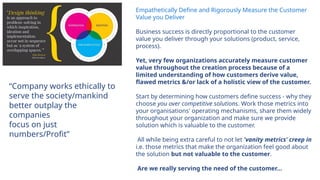
Are we really serving the need of the customer…
“Company works ethically to
serve the society/mankind
better outplay the
companies
focus on just
numbers/Profit”
12.
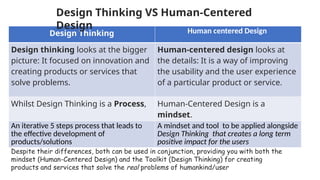
Design Thinking Humancentered Design
Design thinking looks at the bigger
picture: It focused on innovation and
creating products or services that
solve problems.
Human-centered design looks at
the details: It is a way of improving
the usability and the user experience
of a particular product or service.
Whilst Design Thinking is a Process, Human-Centered Design is a
mindset.
An iterative 5 steps process that leads to
the effective development of
products/solutions
A mindset and tool to be applied alongside
Design Thinking that creates a long term
positive impact for the users
Design Thinking VS Human-Centered
Design
Despite their differences, both can be used in conjunction, providing you with both the
mindset (Human-Centered Design) and the Toolkit (Design Thinking) for creating
products and services that solve the real problems of humankind/user
Editor's Notes
#2 Human-centered design explained with examples | by Cibin K.S | UX Collective (uxdesign.cc)
#4 Reference:
Divergent and Convergent Design Thinking | Think Company
Design thinking a very brief primer (cardinalhealth.com)
https://wind4change.com/4-stages-psychological-safety-timothaay-clark-inclusion-learner-contributor-challenger/#:~:text=1%20The%204%20Stages%20of%20Psychological%20Safety%20Model.,of%20Psychological%20Safety%20is%20the%20Challenger%20Safety.%20
#5 Design Thinking Vs Human-Centred Design: What’s the difference? | by Bethany | Snap Out | SnapOut | Medium
Edmonton Shift Lab - Skills Society
#8 54ThescientificIndian.jpg (975×670) (theweek.in)
Man of the masses (theweek.in)
#12 Human-Centered Design vs. Design-Thinking: How They’re Different and How to Use Them Together to Create Lasting Change (movingworlds.org)




![Getting Started with Apache Spark: Big Data Made Simple [Free Meetup]](https://cdn.slidesharecdn.com/ss_thumbnails/apachesparkgettingstarted-260203175547-8361bcc3-thumbnail.jpg?width=640&height=640&fit=bounds)


