




Seminar at
                                                              ISCRAM
                                                              Summerschool
                                                              2012


  DESINGNING WHAT
   AND FOR WHOM?
Social Media
Human Centered Design
Crisis Response
                                         Jonas Landgren (PhD)
                                           Crisis Response Lab
                                     Interaction Design Division
                                       Department of Applied IT
     Chalmers University of Technology & Gothenburg University
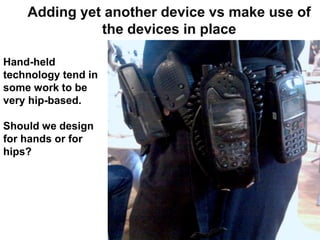
Adding yet another device vs make use of
              the devices in place

Hand-held
technology tend in
some work to be
very hip-based.

Should we design
for hands or for
hips?
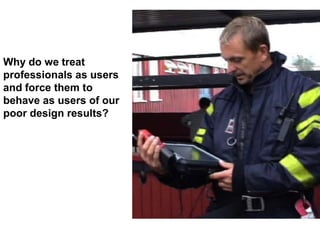
Why do we treat
professionals as users
and force them to
behave as users of our
poor design results?
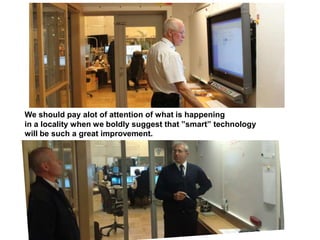
We should pay alot of attention of what is happening
in a locality when we boldly suggest that ”smart” technology
will be such a great improvement.
Concrete Advice
• Make sure part of your team spend time with the people
  you intend to design for.
   – Dayshifts, Nightshifts, Weekend shifts


• Make sure you listen to the young, old, romantic as well
  as the skeptical individuals.

• Never design what someone tell you to do, but listen to
  what they say and then craft the design choices in an
  explorative journey with these individuals.
WE ARE DESIGNERS
So lets be serious about it.
“Social Media is all about
      information!”

  “Eh…absolutely not!”
So what is so f***ing social
           with

Social Media?
              Discuss this in pairs for three minutes
Power-hungry people will always try
to convince you that it is a bad idea.
1. No it will not work, listen I have been
   working with this for 20 years….
2. In 2002…we tried it but it failed….
3. When I send my men into a situation they
   must have the best tools…..
4. When we help people…
Too many myths are
         restricting our thinking.
1. You must understand every disaster is
   unique.
2. People affected by a disaster are victims.
3. Rapid Information sharing is important.
4. Mobile phone systems are unreliable.
5. We always lack information.
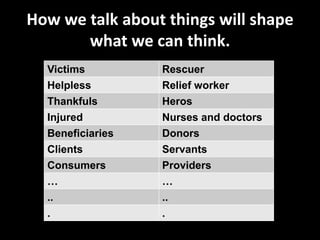
How we talk about things will shape
       what we can think.
  Victims         Rescuer
  Helpless        Relief worker
  Thankfuls       Heros
  Injured         Nurses and doctors
  Beneficiaries   Donors
  Clients         Servants
  Consumers       Providers
  …               …
  ..              ..
  .               .
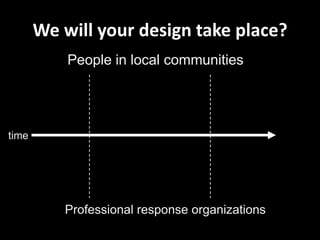
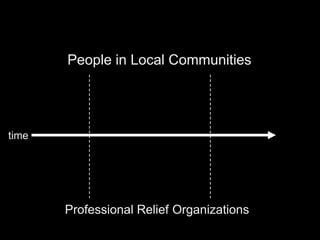
We will your design take place?
           People in local communities


time


          Professional response organizations
HUMAN CENTRED DESIGN
•   Action research
•   Collaborative research
•   Technology-centric design
•   Ethnography & workplace studies
•   End-user involvement
•   Participatory design
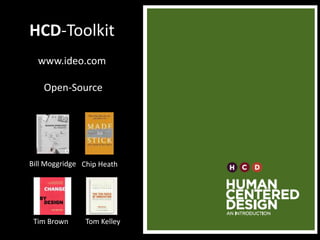
HCD-Toolkit
  www.ideo.com

    Open-Source


Bill Moggridge Chip Heath


 Tim Brown     Tom Kelley
Disclaimer
  THE HCD-toolkit is
NOT perfect nor complete.
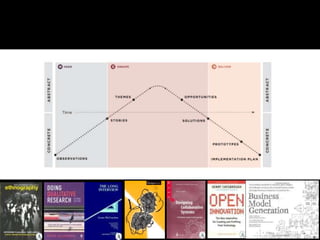
Human-Centered Design (HCD) is a
process and a set of techniques used to
create new solutions for the world.

“human-centered” because it starts with the
people we are designing for and with.
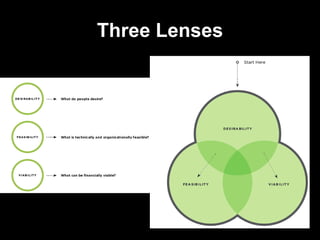
Three Lenses
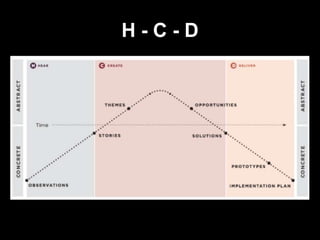
H-C-D
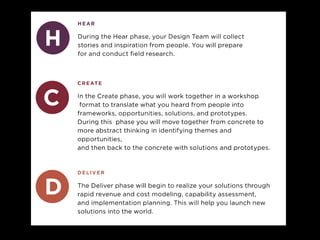
HEAR
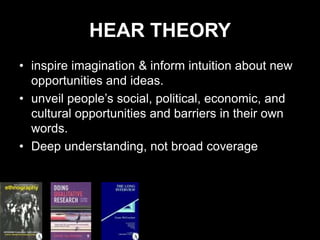
HEAR THEORY
• inspire imagination & inform intuition about new
  opportunities and ideas.
• unveil people’s social, political, economic, and
  cultural opportunities and barriers in their own
  words.
• Deep understanding, not broad coverage
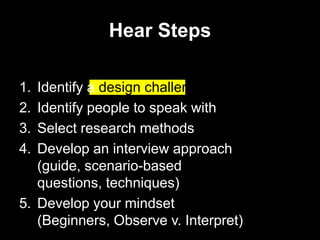
Hear Steps

1. Identify a design challenge
2. Identify people to speak with
3. Select research methods
4. Develop an interview approach
   (guide, scenario-based
   questions, techniques)
5. Develop your mindset
   (Beginners, Observe v. Interpret)
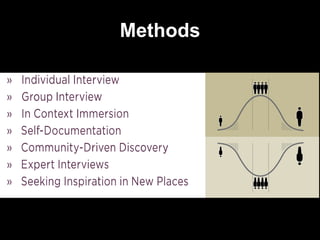
Methods
Identify a Design Challenge
» Framed in human terms (rather than
  technology, product, or service
  functionality)
» Broad enough to discover the areas of
  unexpected value
» Narrow enough to be manageable
Advice when identifying your
            challenges
Look for clichés / stereotypes

Invert, Deny, Scale,

Formulate hypothesis: What if ….
CREATE
CREATE
• To move from research to real-world
  solutions.

• This is the most abstract point of the
  process where concrete needs of
  individuals are transformed into high-level
  insights about the larger population and
  system frameworks are created.
• During this phase, solutions are created
  with only the Desirability filter in mind.
CREATE THEORY
• Synthesis takes us from inspiration to
  ideas, from stories to solutions.
• Brainstorming makes us think expansively
  and without constraints.

• Prototyping is about building to think.
Create Steps

1. Share Stories
2. Identify Patterns (Extract Key
   Insights, Find Themes, Create
   Frameworks)
3. Create Opportunity Areas
4. Brainstorm New Solutions
5. Make Ideas Tangible
6. Gather Feedback
MAKE IDEAS TANGIBLE
Prototyping is about buiding to think - whatever it takes to
communicate the idea. Prototyping allows you to quickly and
cheaply make ideas tangible so they can be tested and
evaluated by others - before you’ve had time to fall in love with
them.


BUILD TO THINK : ROUGH, RAPID, RIGHT: ANSWERING
  QUESTIONS
GATHER FEEDBACK
A great way to get honest feedback is to
  take several concepts or versions out to
  meet people.
When there is only one concept
  available, people may be reluctant to
  criticize.
However, when allowed to compare and
  contrast, people tend to speak more
  honestly.
DELIVER
Deliver
Once the design team has created many
desirable solutions, it is time to consider how to
make these feasible and viable. The Deliver
phase will catapult the top ideas toward
implementation.
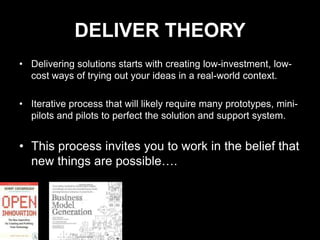
DELIVER THEORY
• Delivering solutions starts with creating low-investment, low-
  cost ways of trying out your ideas in a real-world context.

• Iterative process that will likely require many prototypes, mini-
  pilots and pilots to perfect the solution and support system.


• This process invites you to work in the belief that
  new things are possible….
Deliver Steps

1. Generate several business models for
   your solutions.
2. Identify Capabilities Required for
   Delivering Solutions
   (Distribution, Requirements v.
   Capabilities, Potential Partners)
3. Plan a Pipeline of Solutions
PLAN MINI-PILOTS & ITERATION

For each solution in your pipeline, it is important to identify
  simple, low-investment next steps to keep the ideas
  alive. One way to keep iterating and learning is to plan
  mini-pilots before large-scale pilots or full-scale
  implementation.

For each mini-pilot, ask three questions:
» What resources will I need to test out this idea?
» What key questions does this mini-pilot need to answer?
» How will we measure the success of this mini-pilot?
People in Local Communities


time


       Professional Relief Organizations
www.jonaslandgren.com

Human centered design and Social media

  • 1.
    Seminar at ISCRAM Summerschool 2012 DESINGNING WHAT AND FOR WHOM? Social Media Human Centered Design Crisis Response Jonas Landgren (PhD) Crisis Response Lab Interaction Design Division Department of Applied IT Chalmers University of Technology & Gothenburg University
  • 2.
    Adding yet anotherdevice vs make use of the devices in place Hand-held technology tend in some work to be very hip-based. Should we design for hands or for hips?
  • 3.
    Why do wetreat professionals as users and force them to behave as users of our poor design results?
  • 4.
    We should payalot of attention of what is happening in a locality when we boldly suggest that ”smart” technology will be such a great improvement.
  • 5.
    Concrete Advice • Makesure part of your team spend time with the people you intend to design for. – Dayshifts, Nightshifts, Weekend shifts • Make sure you listen to the young, old, romantic as well as the skeptical individuals. • Never design what someone tell you to do, but listen to what they say and then craft the design choices in an explorative journey with these individuals.
  • 6.
    WE ARE DESIGNERS Solets be serious about it.
  • 7.
    “Social Media isall about information!” “Eh…absolutely not!”
  • 8.
    So what isso f***ing social with Social Media? Discuss this in pairs for three minutes
  • 9.
    Power-hungry people willalways try to convince you that it is a bad idea. 1. No it will not work, listen I have been working with this for 20 years…. 2. In 2002…we tried it but it failed…. 3. When I send my men into a situation they must have the best tools….. 4. When we help people…
  • 10.
    Too many mythsare restricting our thinking. 1. You must understand every disaster is unique. 2. People affected by a disaster are victims. 3. Rapid Information sharing is important. 4. Mobile phone systems are unreliable. 5. We always lack information.
  • 11.
    How we talkabout things will shape what we can think. Victims Rescuer Helpless Relief worker Thankfuls Heros Injured Nurses and doctors Beneficiaries Donors Clients Servants Consumers Providers … … .. .. . .
  • 12.
    We will yourdesign take place? People in local communities time Professional response organizations
  • 13.
  • 14.
    Action research • Collaborative research • Technology-centric design • Ethnography & workplace studies • End-user involvement • Participatory design
  • 15.
    HCD-Toolkit www.ideo.com Open-Source Bill Moggridge Chip Heath Tim Brown Tom Kelley
  • 16.
    Disclaimer THEHCD-toolkit is NOT perfect nor complete.
  • 17.
    Human-Centered Design (HCD)is a process and a set of techniques used to create new solutions for the world. “human-centered” because it starts with the people we are designing for and with.
  • 18.
  • 20.
  • 21.
  • 22.
    HEAR THEORY • inspireimagination & inform intuition about new opportunities and ideas. • unveil people’s social, political, economic, and cultural opportunities and barriers in their own words. • Deep understanding, not broad coverage
  • 23.
    Hear Steps 1. Identifya design challenge 2. Identify people to speak with 3. Select research methods 4. Develop an interview approach (guide, scenario-based questions, techniques) 5. Develop your mindset (Beginners, Observe v. Interpret)
  • 24.
  • 25.
    Identify a DesignChallenge » Framed in human terms (rather than technology, product, or service functionality) » Broad enough to discover the areas of unexpected value » Narrow enough to be manageable
  • 26.
    Advice when identifyingyour challenges Look for clichés / stereotypes Invert, Deny, Scale, Formulate hypothesis: What if ….
  • 27.
  • 28.
    CREATE • To movefrom research to real-world solutions. • This is the most abstract point of the process where concrete needs of individuals are transformed into high-level insights about the larger population and system frameworks are created. • During this phase, solutions are created with only the Desirability filter in mind.
  • 29.
    CREATE THEORY • Synthesistakes us from inspiration to ideas, from stories to solutions. • Brainstorming makes us think expansively and without constraints. • Prototyping is about building to think.
  • 30.
    Create Steps 1. ShareStories 2. Identify Patterns (Extract Key Insights, Find Themes, Create Frameworks) 3. Create Opportunity Areas 4. Brainstorm New Solutions 5. Make Ideas Tangible 6. Gather Feedback
  • 31.
    MAKE IDEAS TANGIBLE Prototypingis about buiding to think - whatever it takes to communicate the idea. Prototyping allows you to quickly and cheaply make ideas tangible so they can be tested and evaluated by others - before you’ve had time to fall in love with them. BUILD TO THINK : ROUGH, RAPID, RIGHT: ANSWERING QUESTIONS
  • 32.
    GATHER FEEDBACK A greatway to get honest feedback is to take several concepts or versions out to meet people. When there is only one concept available, people may be reluctant to criticize. However, when allowed to compare and contrast, people tend to speak more honestly.
  • 33.
  • 34.
    Deliver Once the designteam has created many desirable solutions, it is time to consider how to make these feasible and viable. The Deliver phase will catapult the top ideas toward implementation.
  • 35.
    DELIVER THEORY • Deliveringsolutions starts with creating low-investment, low- cost ways of trying out your ideas in a real-world context. • Iterative process that will likely require many prototypes, mini- pilots and pilots to perfect the solution and support system. • This process invites you to work in the belief that new things are possible….
  • 36.
    Deliver Steps 1. Generateseveral business models for your solutions. 2. Identify Capabilities Required for Delivering Solutions (Distribution, Requirements v. Capabilities, Potential Partners) 3. Plan a Pipeline of Solutions
  • 37.
    PLAN MINI-PILOTS &ITERATION For each solution in your pipeline, it is important to identify simple, low-investment next steps to keep the ideas alive. One way to keep iterating and learning is to plan mini-pilots before large-scale pilots or full-scale implementation. For each mini-pilot, ask three questions: » What resources will I need to test out this idea? » What key questions does this mini-pilot need to answer? » How will we measure the success of this mini-pilot?
  • 39.
    People in LocalCommunities time Professional Relief Organizations
  • 40.