Differential pulse-code
modulation
By:-
•Dharit Unadkat -130870111039
Guided By:-
•Prof.Bharat Tank
•Prof.Ketan Goswami
Class:-
EC-6th sem,
Parul Institute of Technology,
Limda.
Digital Communication
Introduction
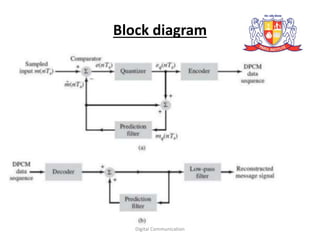
• Differential pulse-code modulation (DPCM) is a signal
encoder that uses the baseline of pulse-code modulation
(PCM) but adds some functionalities based on the prediction
of the samples of the signal. The input can be an analog signal
or a digital signal.
• If the input is a continuous-time analog signal, it needs to
be sampled first so that a discrete-time signal is the input to the
DPCM encoder.
Digital Communication
• Option 1: take the values of two consecutive samples; if
they are analog samples, quantize them; calculate the
difference between the first one and the next; the output is
the difference, and it can be further entropy coded.
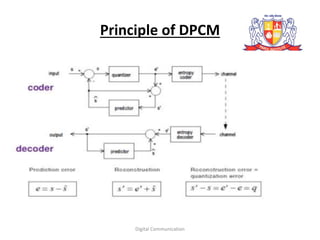
• Option 2: instead of taking a difference relative to a
previous input sample, take the difference relative to the
output of a local model of the decoder process; in this
option, the difference can be quantized, which allows a
good way to incorporate a controlled loss in the encoding.
Digital Communication
Block diagram
Digital Communication
Principle of DPCM
Digital Communication
Adaptive delta modulation
• Adaptive delta modulation or [continuously variable slope
delta modulation] (CVSD) is a modification of DM in
which the step size is not fixed. Rather, when several
consecutive bits have the same direction value, the encoder
and decoder assume that slope overload is occurring, and
the step size becomes progressively larger.
• Otherwise, the step size becomes gradually smaller over
time. ADM reduces slope error, at the expense of increasing
quantizing error.This error can be reduced by using a low-
pass filter. ADM provides robust performance in the
presence of bit errors meaning error detection and
correction are not typically used in an ADM radio design,
this allows for a reduction in host processor workload
(allowing a low-cost processor to be used).
Digital Communication
ANALYSIS OF DPCM
• Consider a signal x(t) that is sampled to obtain the
samples x(kTs), where Ts is the sampling period
and k is an integer representing the sample number.
For simplicity, the samples can be written in the
form x[k], where the sample period Ts is implied.
Assume that the signal x(t) is sampled at a very
high sampling rate. We can define d[k] to be the
difference between the present sample of a signal
and the previous sample, or
d [k ] = x [k ]− x [k −1].
Digital Communication
• Now this signal d[k] can be quantized instead of x[k] to
give the quantized signal dq[k].
As mentioned above, for signals x(t) that are sampled at a
rate much higher than the Nyquist rate, the range of values
of d[k] will be less than the range of values of x[k].
After the transmission of the quatized signal dq[k],
theoretically we can reconstruct the original signal by doing
an operation that is the inverse of the above operation. So,
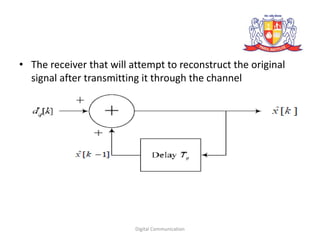
we can Obtain an approximation of x[k] using
x^[k]=dq[k]+x^[k-1]
Digital Communication
So, if dq[k] is close to d[k], it appears from the above
equation that obtained xˆ[k ] will be close to d[k].
Digital Communication
• The receiver that will attempt to reconstruct the original
signal after transmitting it through the channel
Digital Communication
• Because we are quantizing a difference signal and
transmitting that difference over the channel, the
reconstructed signal may suffer from one or two possible
problems
Digital Communication
NYQUIST’S SAMPLING THEOREM
• According to the Nyquist sampling criterion, a signal must
be sampled at a sampling rate that is at least twice the
highest frequency in the signal to be able to reconstruct it
without aliasing.
• If g(t) is a continuous time signal with bandwidth B Hz
then it can be reconstructed exactly by its samples as long
as the sampling frequency is greater than 2B Hz.
Digital Communication
• The minimum sampling rate fs = 2B Hz required to
recover g(t) from its samples is called NYQUIST RATE
of sampling.
• The corresponding sampling interval
Ts = 1/22B
is called NYQUIST INTERVAL for g(t).
Digital Communication
Thank You
Digital Communication

Dcom ppt(en.39) dpcm

  • 1.
    Differential pulse-code modulation By:- •Dharit Unadkat-130870111039 Guided By:- •Prof.Bharat Tank •Prof.Ketan Goswami Class:- EC-6th sem, Parul Institute of Technology, Limda. Digital Communication
  • 2.
    Introduction • Differential pulse-codemodulation (DPCM) is a signal encoder that uses the baseline of pulse-code modulation (PCM) but adds some functionalities based on the prediction of the samples of the signal. The input can be an analog signal or a digital signal. • If the input is a continuous-time analog signal, it needs to be sampled first so that a discrete-time signal is the input to the DPCM encoder. Digital Communication
  • 3.
    • Option 1:take the values of two consecutive samples; if they are analog samples, quantize them; calculate the difference between the first one and the next; the output is the difference, and it can be further entropy coded. • Option 2: instead of taking a difference relative to a previous input sample, take the difference relative to the output of a local model of the decoder process; in this option, the difference can be quantized, which allows a good way to incorporate a controlled loss in the encoding. Digital Communication
  • 4.
  • 5.
  • 6.
    Adaptive delta modulation •Adaptive delta modulation or [continuously variable slope delta modulation] (CVSD) is a modification of DM in which the step size is not fixed. Rather, when several consecutive bits have the same direction value, the encoder and decoder assume that slope overload is occurring, and the step size becomes progressively larger. • Otherwise, the step size becomes gradually smaller over time. ADM reduces slope error, at the expense of increasing quantizing error.This error can be reduced by using a low- pass filter. ADM provides robust performance in the presence of bit errors meaning error detection and correction are not typically used in an ADM radio design, this allows for a reduction in host processor workload (allowing a low-cost processor to be used). Digital Communication
  • 7.
    ANALYSIS OF DPCM •Consider a signal x(t) that is sampled to obtain the samples x(kTs), where Ts is the sampling period and k is an integer representing the sample number. For simplicity, the samples can be written in the form x[k], where the sample period Ts is implied. Assume that the signal x(t) is sampled at a very high sampling rate. We can define d[k] to be the difference between the present sample of a signal and the previous sample, or d [k ] = x [k ]− x [k −1]. Digital Communication
  • 8.
    • Now thissignal d[k] can be quantized instead of x[k] to give the quantized signal dq[k]. As mentioned above, for signals x(t) that are sampled at a rate much higher than the Nyquist rate, the range of values of d[k] will be less than the range of values of x[k]. After the transmission of the quatized signal dq[k], theoretically we can reconstruct the original signal by doing an operation that is the inverse of the above operation. So, we can Obtain an approximation of x[k] using x^[k]=dq[k]+x^[k-1] Digital Communication
  • 9.
    So, if dq[k]is close to d[k], it appears from the above equation that obtained xˆ[k ] will be close to d[k]. Digital Communication
  • 10.
    • The receiverthat will attempt to reconstruct the original signal after transmitting it through the channel Digital Communication
  • 11.
    • Because weare quantizing a difference signal and transmitting that difference over the channel, the reconstructed signal may suffer from one or two possible problems Digital Communication
  • 12.
    NYQUIST’S SAMPLING THEOREM •According to the Nyquist sampling criterion, a signal must be sampled at a sampling rate that is at least twice the highest frequency in the signal to be able to reconstruct it without aliasing. • If g(t) is a continuous time signal with bandwidth B Hz then it can be reconstructed exactly by its samples as long as the sampling frequency is greater than 2B Hz. Digital Communication
  • 13.
    • The minimumsampling rate fs = 2B Hz required to recover g(t) from its samples is called NYQUIST RATE of sampling. • The corresponding sampling interval Ts = 1/22B is called NYQUIST INTERVAL for g(t). Digital Communication
  • 14.