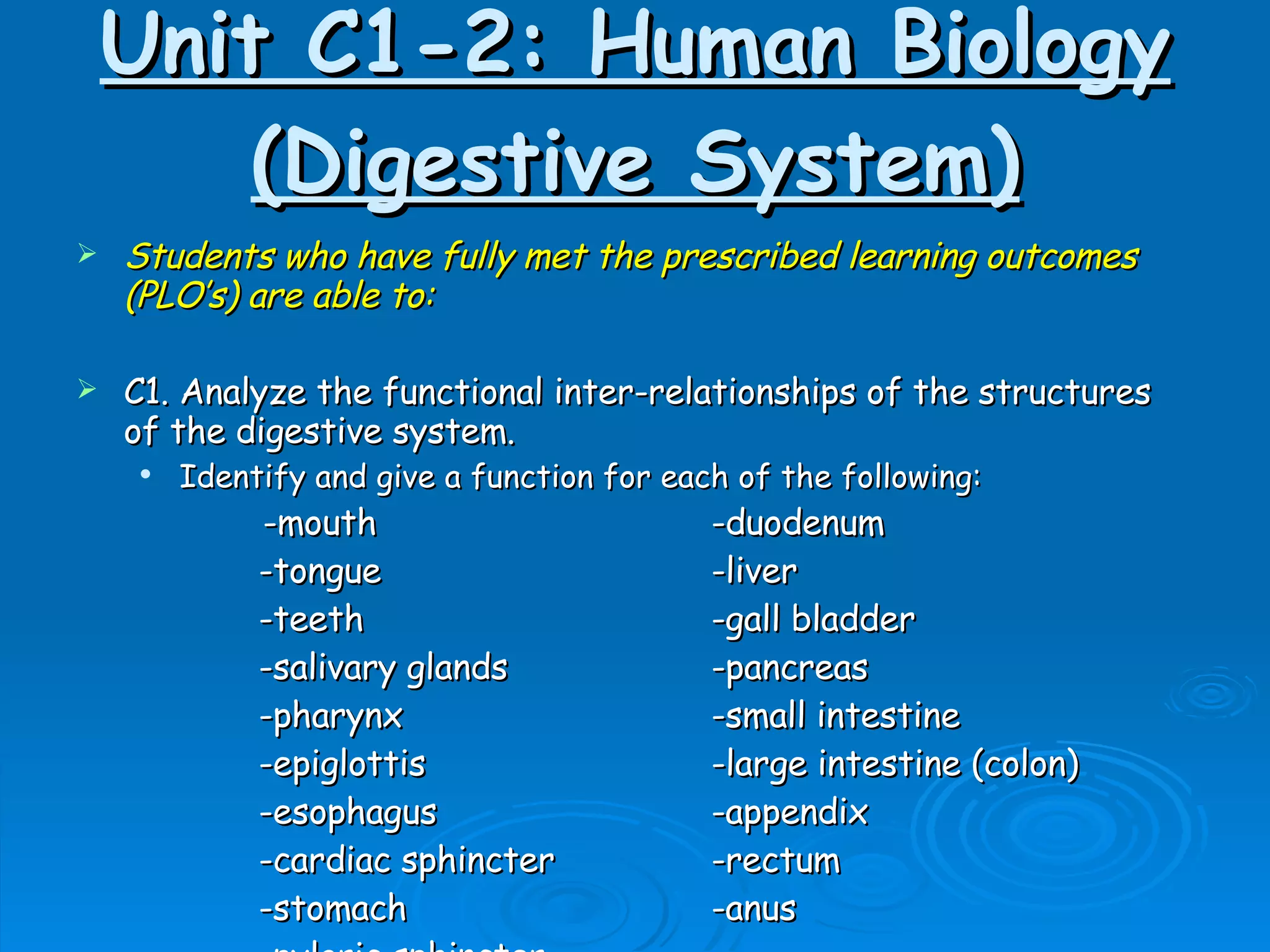
Unit C1-2: Human Biology (Digestive System) Students who have fully met the prescribed learning outcomes (PLO’s) are able to: C1. Analyze the functional inter-relationships of the structures of the digestive system. Identify and give a function for each of the following: -mouth -duodenum   -tongue -liver   -teeth -gall bladder   -salivary glands -pancreas   -pharynx -small intestine   -epiglottis -large intestine (colon)   -esophagus -appendix   -cardiac sphincter -rectum   -stomach -anus   -pyloric sphincter
Digestion PLO’s Describe swallowing and peristalsis. Identify the pancreas as the source gland for insulin, and describe the function of insulin in maintaining blood sugar levels. List at least six major functions of the liver. Explain the role of bile in the emulsification of fats.
Digestion PLO’s Describe how the small intestine is specialized for chemical and physical digestion and absorption. Describe the structure of the villus, including microvilli, and explain the functions of the capillaries and lacteals within it. Describe the functions of anaerobic bacteria in the colon. Demonstrate the correct use of the dissection microscope to examine the various structures of the digestive system .
Digestion PLO’s (Last set!) Describe the role of sodium bicarbonate in pancreatic juice. Describe the role of hydrochloric acid (HCl) in gastric juice. Describe the role of mucus in gastric juice. Describe the importance of the pH level in various regions of the digestive tract.
C1 – Organs and Their Functions :
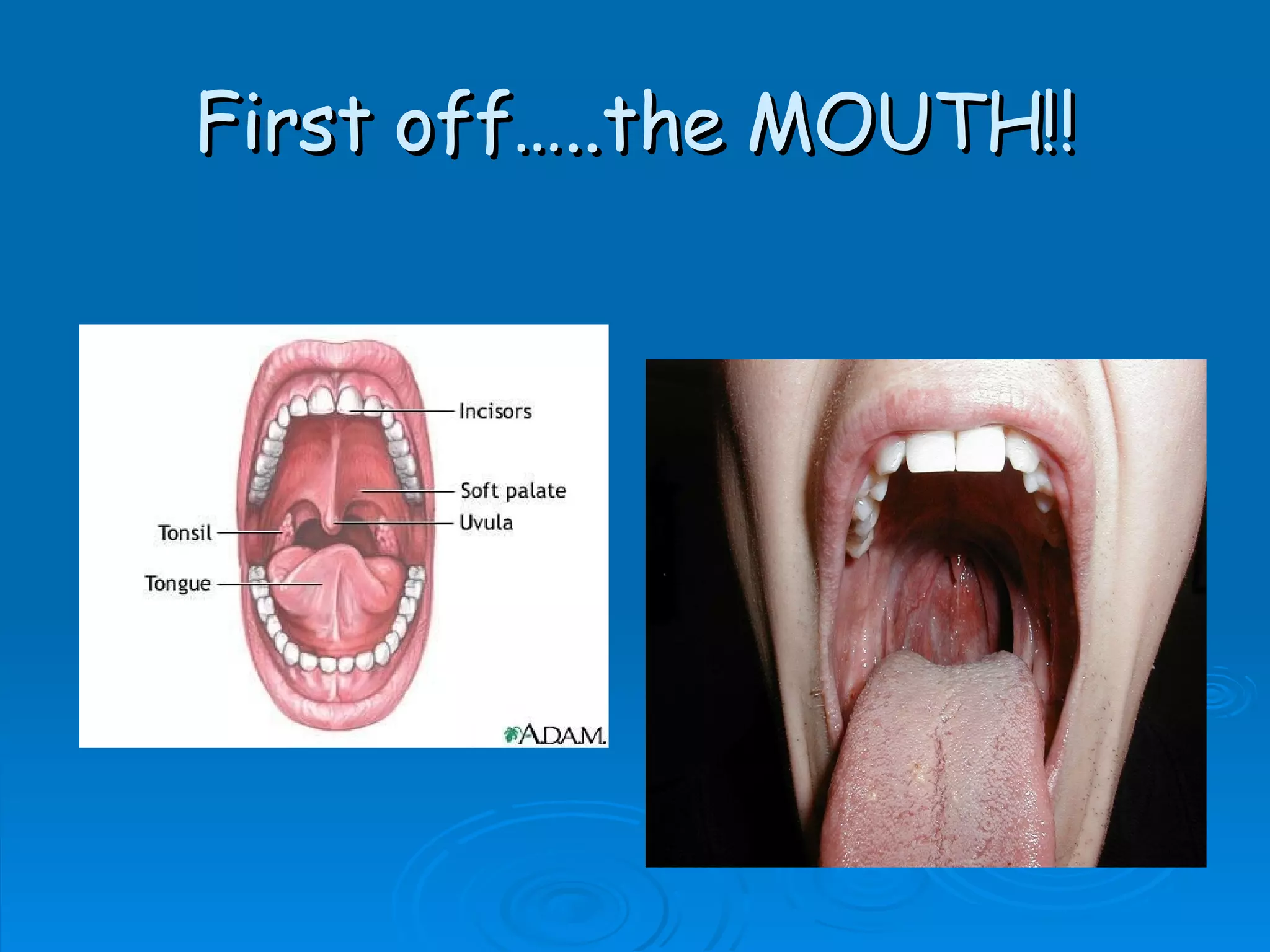
First off…..the MOUTH!!
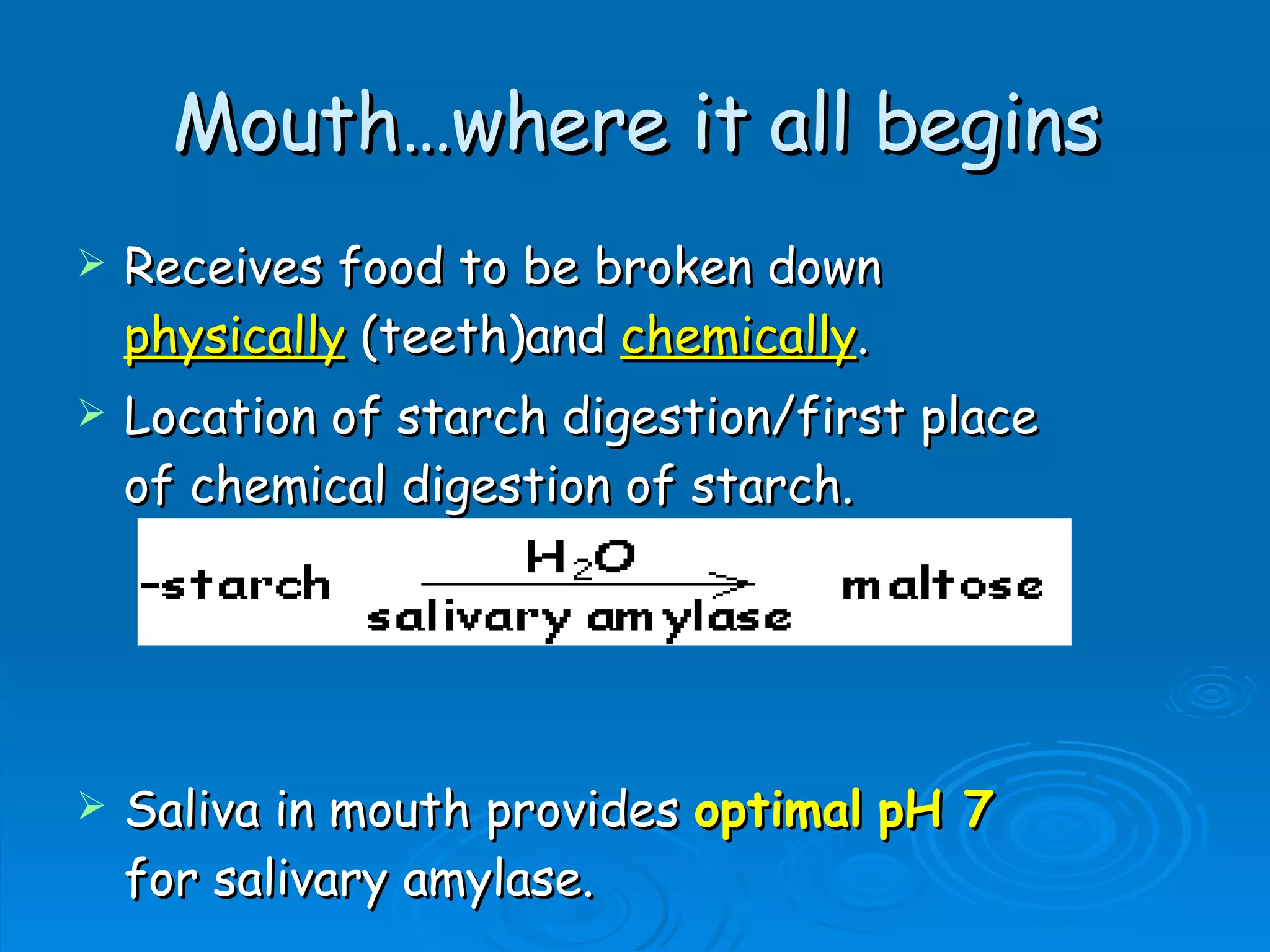
Mouth…where it all begins Receives food to be broken down  physically  (teeth)and  chemically . Location of starch digestion/first place of chemical digestion of starch.  Saliva in mouth provides  optimal   pH 7  for salivary amylase.
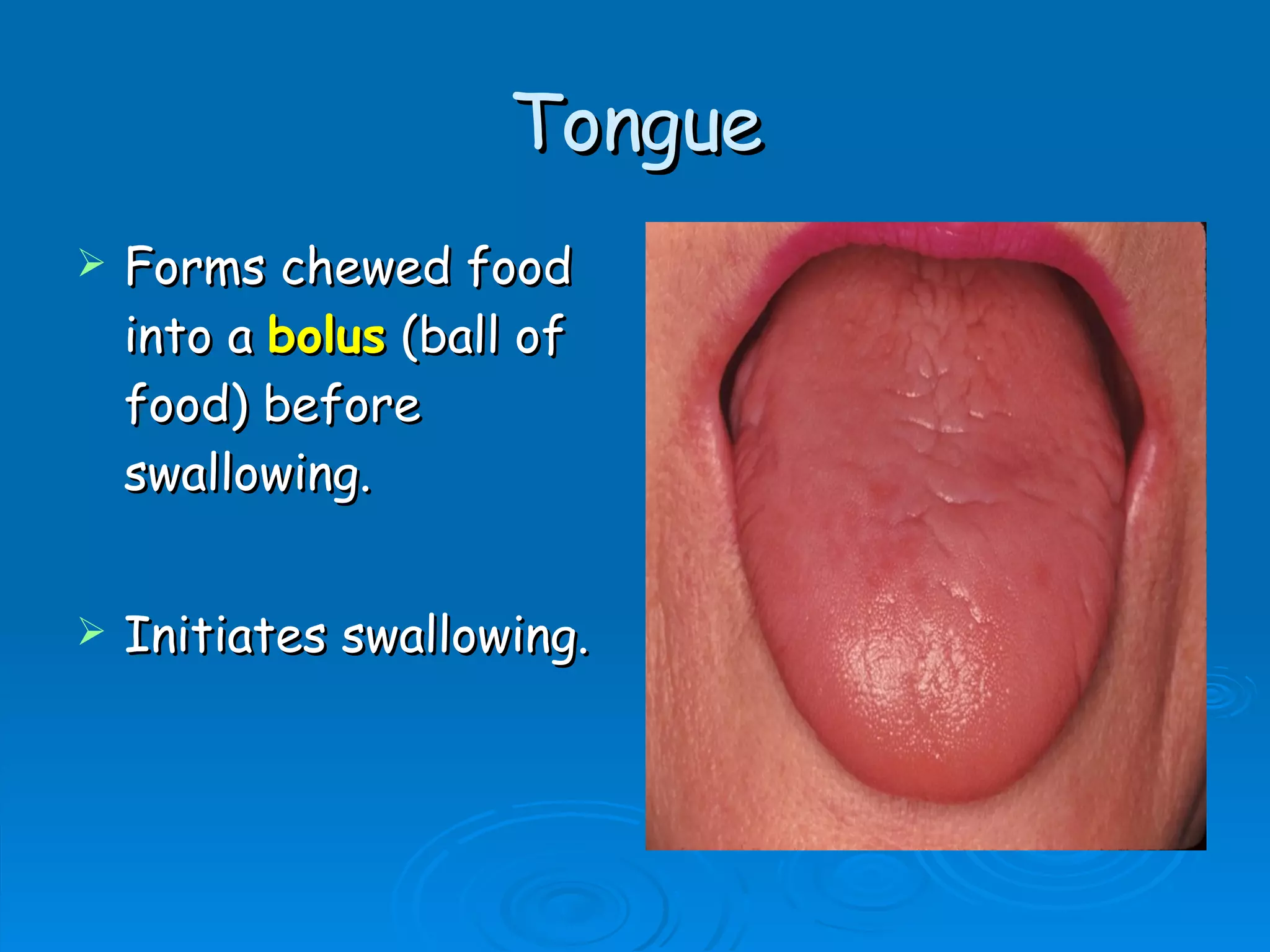
Tongue Forms chewed food into a   bolus  (ball of food) before swallowing. Initiates swallowing.
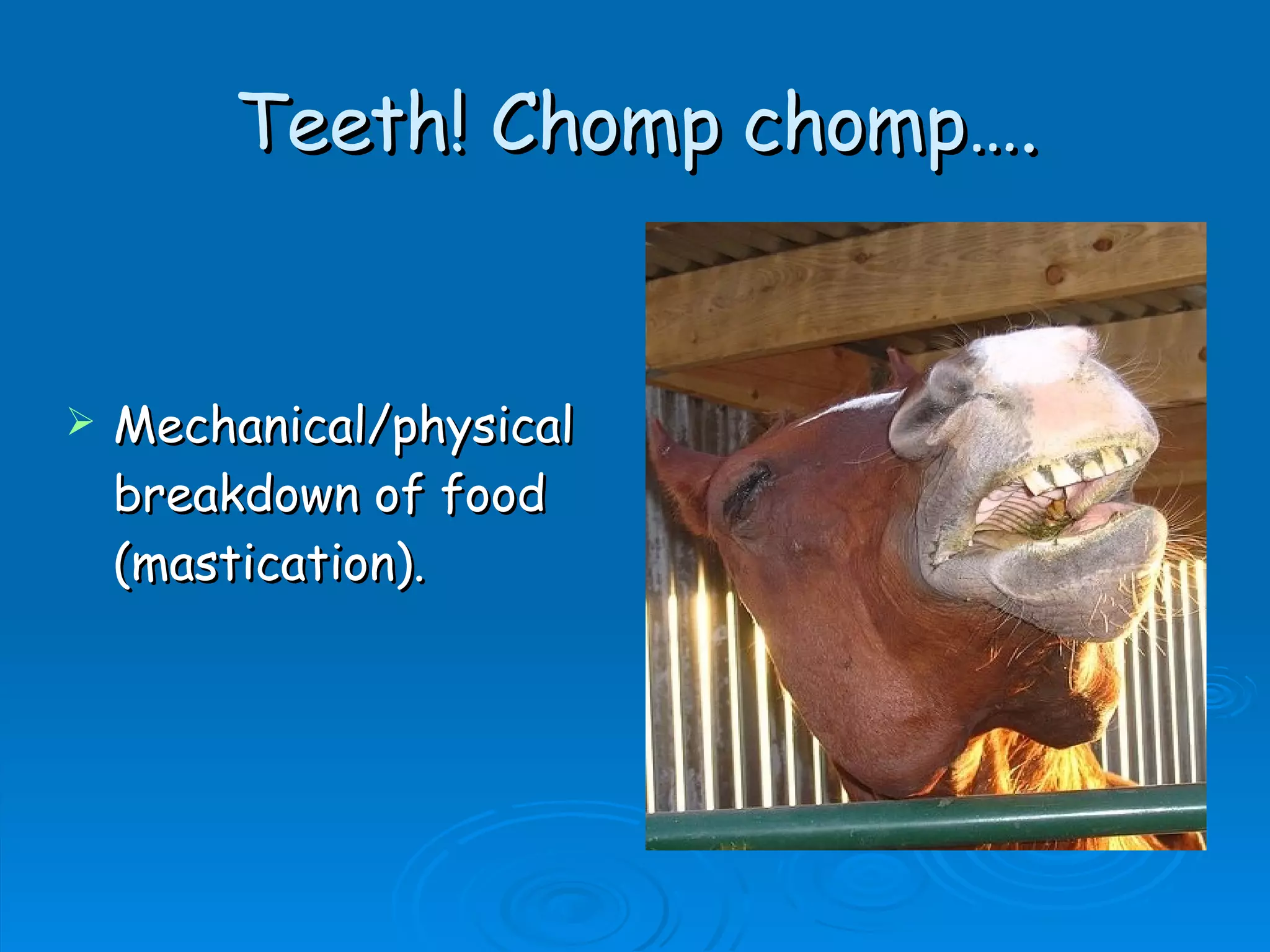
Teeth! Chomp chomp…. Mechanical/physical breakdown of food (mastication).
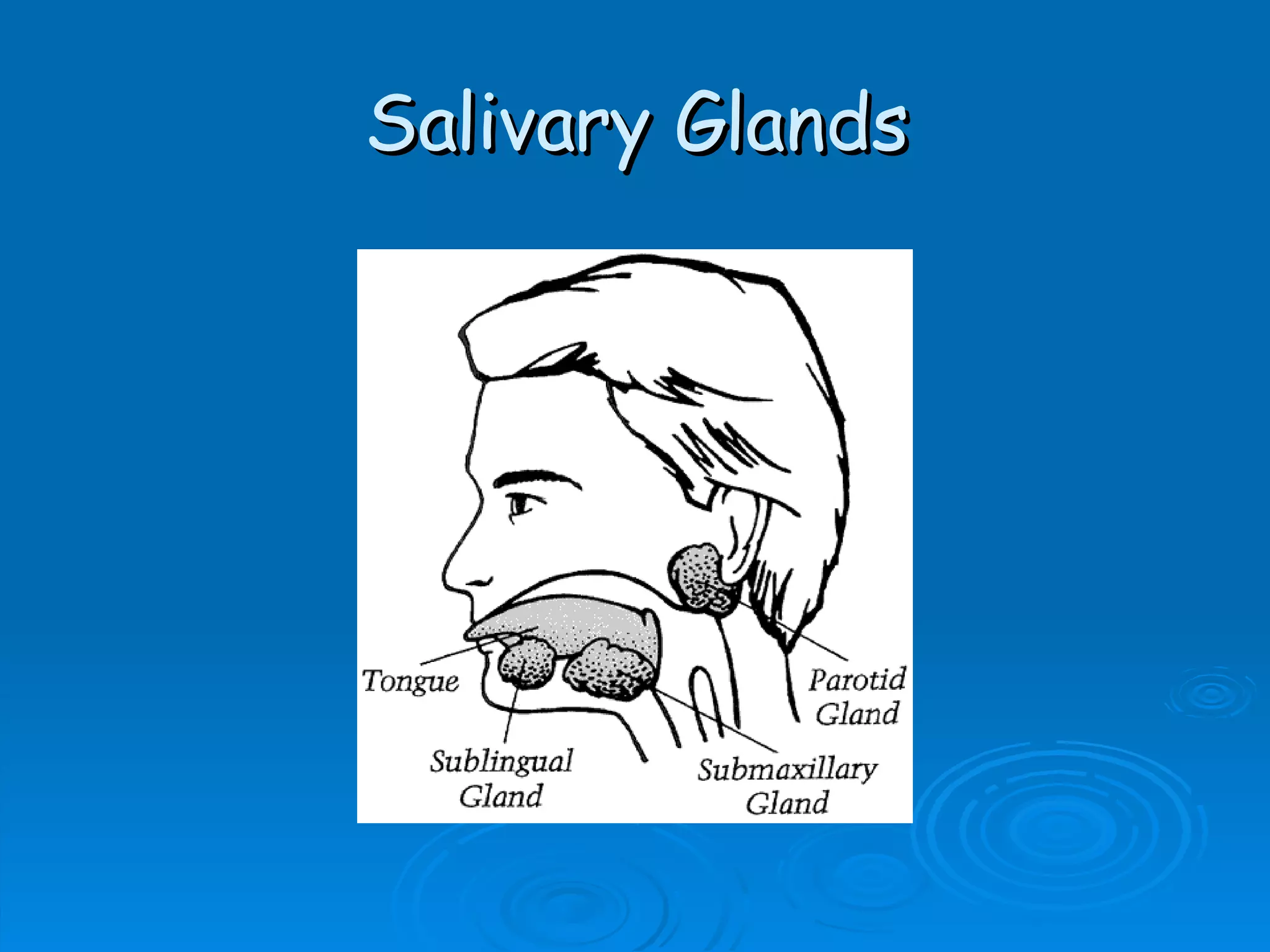
Salivary Glands Three pairs of glands that secrete saliva into the mouth via ducts. Produces  saliva   containing  water, mucus ,  salivary amylase   and  buffers  which, lubricate food, and breakdown starch into maltose. (It also contains the enzyme, lysozyme that lyses oral bacteria).
Salivary Glands
Pharynx  A region between the mouth, esophagus, and trachea. Passageway for food, water, air, and for the reflex action of swallowing as it enters the esophagus.
Epiglottis…so you don’t choke! A flap of tissue that covers the  glottis   (opening of the trachea). Prevents food from entering the trachea when swallowing.
Esophagus Transfers the bolus from the mouth to the stomach by  peristalsis  (rhythmic smooth muscle contractions). Secretes  mucus  for lubrication
Cardiac Sphincter Circular muscle at the junction of the esophagus and stomach. Relaxation of sphincter allows bolus to enter stomach and contraction prevents stomach chyme from re-entering the esophagus.
Stomach J-shaped muscular and glandular organ on the left side of body below the diaphragm. Stomach wall contains deep folds ( rugae ) which provide a greater surface area for food and fluids. Storage of food
Stomach continued Mechanical churning of food into  chyme   by smooth muscle fibres. Secrete  mucus  for protection and lubrication by goblet cells. Secretes  HCl  and  pepsinogen  (inactive form of  pepsin ) by gastric glands. Secretes  gastric juice  produced by gastric glands containing H 2 O, HCl, pepsinogen (pepsin), and mucus.  HCl provides  optimal   pH 2-3  for pepsin.
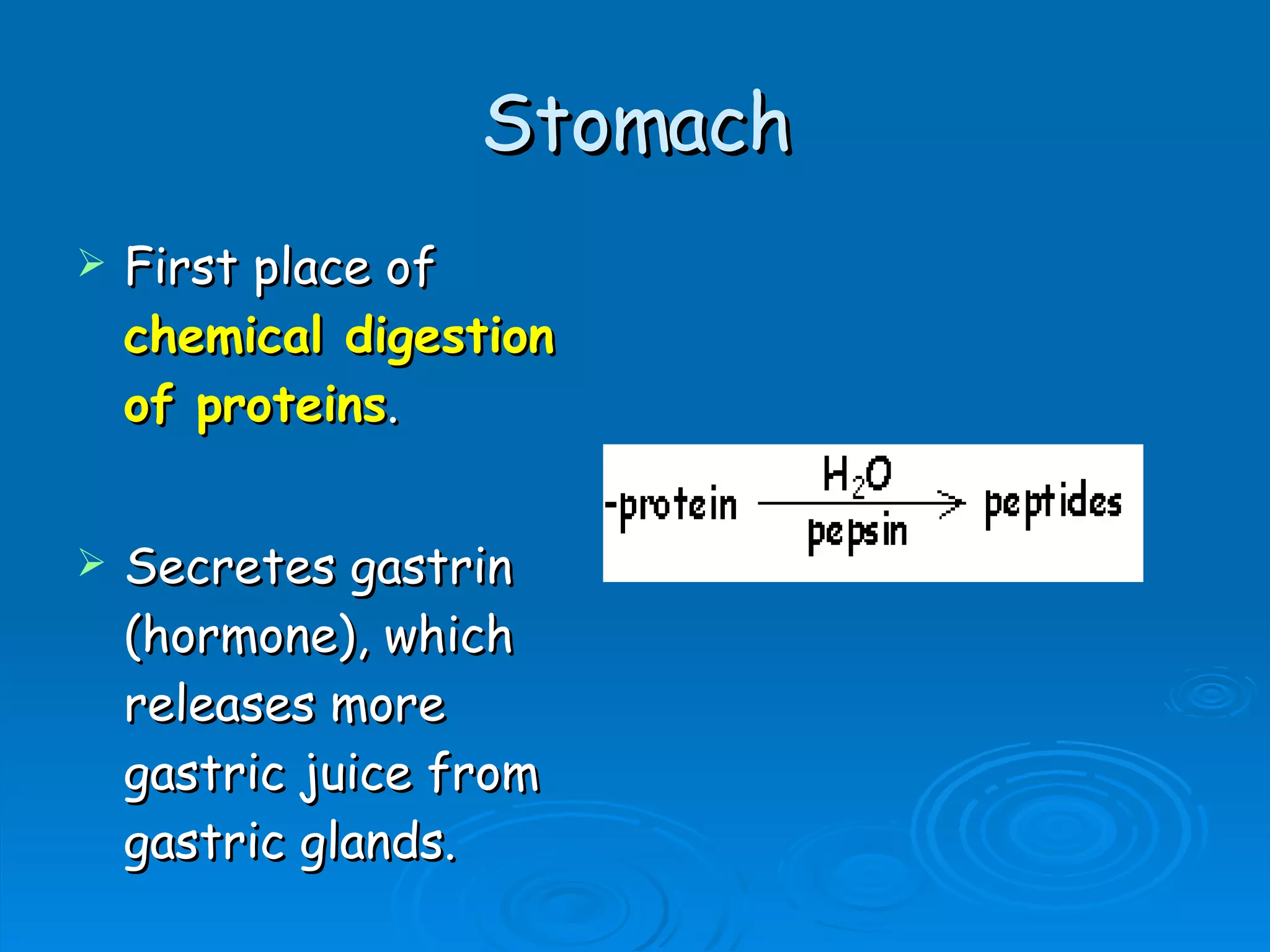
Stomach First place of  chemical digestion of proteins . Secretes gastrin (hormone), which releases more gastric juice from gastric glands.
Pyloric Sphincter A circular ring of muscle at the junction of the stomach and duodenum. Relaxation of the sphincter allows acid chyme to enter the duodenum,  i.e. controls the amount of chyme entering the duodenum and contraction keeps chyme within the stomach.
Duodenum First 30cm of the small intestine. Receives acid chyme from stomach, pancreatic juice from pancreas, and bile from gall bladder; peristalsis occurs here. Bile begins its first emulsification of lipids here, i.e. lipids physically broken down into lipid droplets.
Duodenum
Duodenum Continued Majority of chemical digestion (see below) and the first neutralization (via NaHCO 3 ) of acidic chyme occur here.  NaHCO 3  provides  optimal   pH 8-9   for pancreatic amylase, lipase, trypsin, intestinal & pancreatic nuclease, peptidase and maltase.
Enzymes at work H 2 O starch  maltose pancreatic amylases H 2 O maltose  glucose maltase   H 2 O proteins  peptides   trypsin
More enzymes H2O peptides  amino acids peptidase H2O nucleic acids  nucleotides pancreatic & intestinal nucleases H2O lipid droplets  glycerol &  lipase   fatty acids
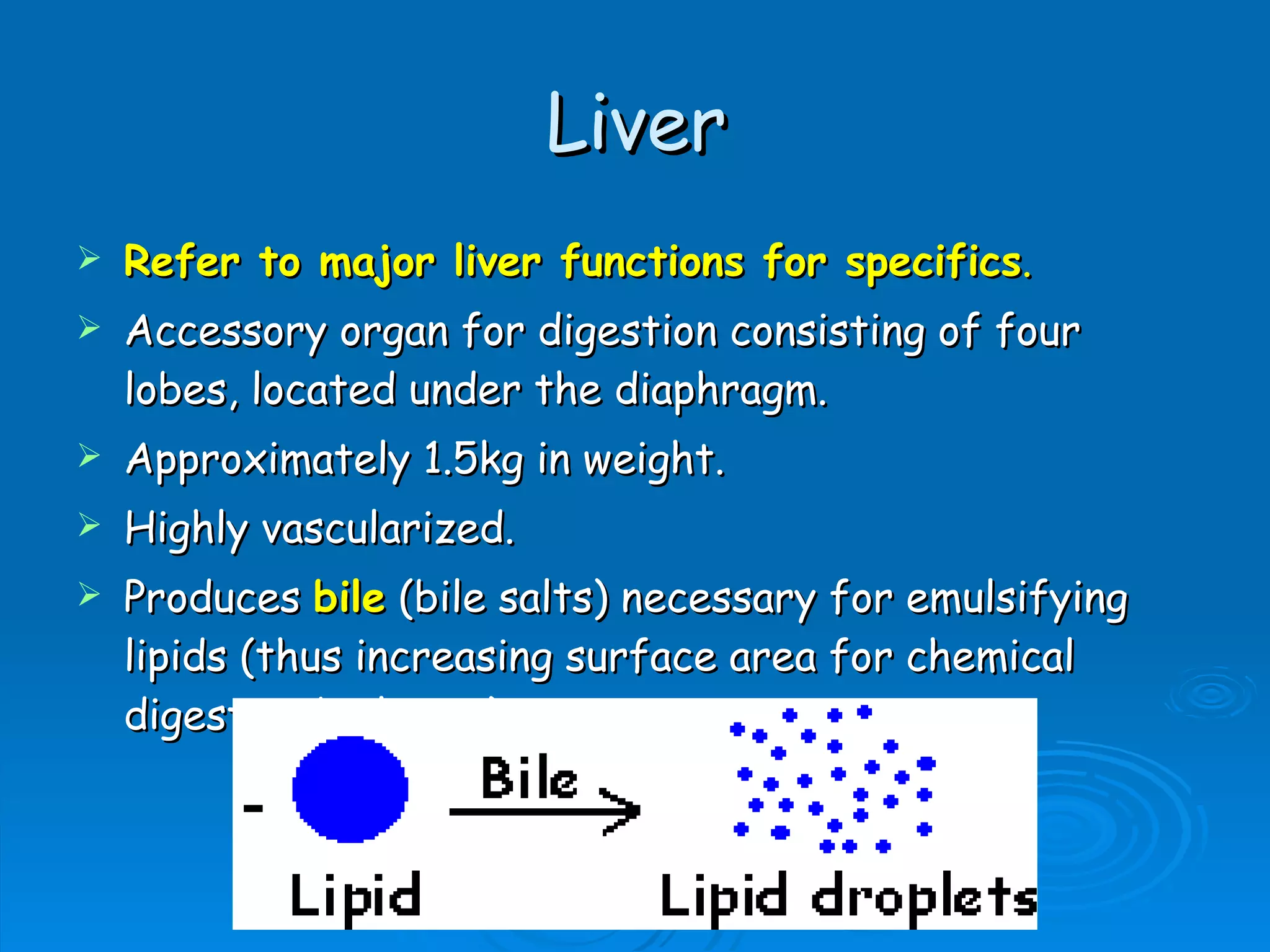
Liver Refer to major liver functions for specifics . Accessory organ for digestion consisting of four lobes, located under the diaphragm. Approximately 1.5kg in weight. Highly vascularized. Produces  bile  (bile salts) necessary for emulsifying lipids (thus increasing surface area for chemical digestion by lip ase ).
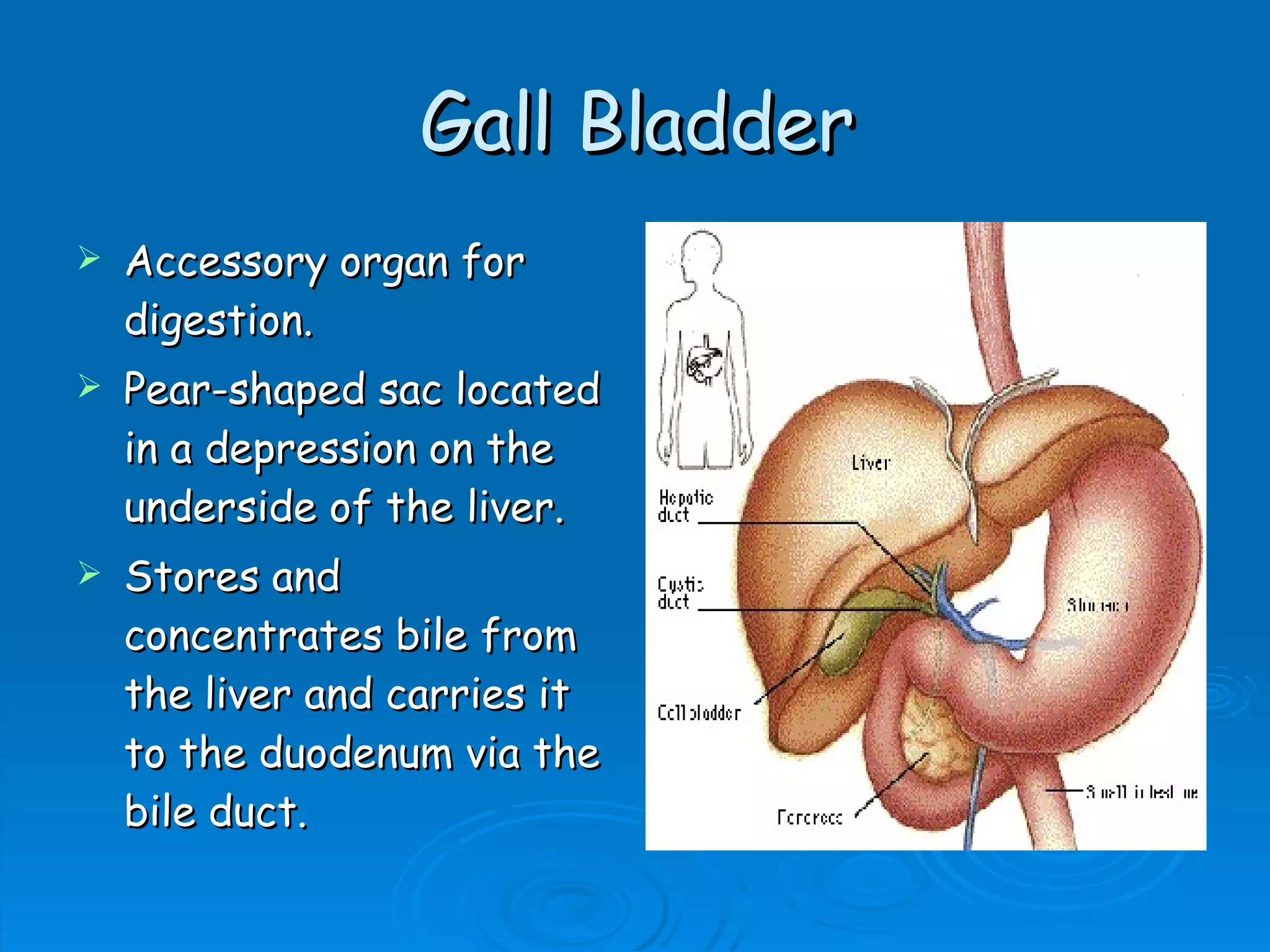
Gall Bladder Accessory organ for digestion. Pear-shaped sac located in a depression on the underside of the liver. Stores and concentrates bile from the liver and carries it to the duodenum via the bile duct.
Pancreas Refer to function of insulin for specifics . Accessory organ for digestion. Oblong gland, approximately 12.5cm, which lies behind the stomach and made up of clusters of glandular cells.
Pancreas Secretes  pancreatic juice  containing H 2 O, NaHCO 3 ,   pancreatic amylase ,  lipase ,  trypsin  and  pancreatic nuclease . Secretes  pancreatic juice  for further digestion of starch, lipid droplets, proteins and nucleic acids, which is delivered to the duodenum via the pancreatic duct. Neutralizes   acid chyme by producing  NaHCO 3 . Secretes enzymes for chemical digestion of all biological molecules.
Small Intestine Up to seven meters in length and 2.5cm in diameter. Divided into three sections; the first 30 cm is the  duodenum . Walls of the small intestine are covered in  villi   (small finger-like projections), smooth muscle fibers, pits containing  intestinal glands  secreting enzymes,  goblet cells  secreting mucus, epithelial cells contain  microvilli , and many  folds  which increase the surface area for chemical digestion and absorption.
Small Intestine
Small Intestine Produces  intestinal juice  containing H 2 O, mucus,  maltase ,  peptidase   and   intestinal nuclease . Provides  optimal   pH 8-9   for intestinal nuclease, peptidase and maltase, pancreatic amylase and nuclease, lipase, trypsin.  Complete digestion of carbs, proteins, nucleic acids, and lipids.
Enzymes at work H 2 O starch  maltose pancreatic amylases H 2 O maltose  glucose maltase   H 2 O proteins  peptides   trypsin
More enzymes H2O peptides  amino acids peptidase H2O nucleic acids  nucleotides pancreatic & intestinal nucleases H2O lipid droplets  glycerol &  lipase   fatty acids
Small Intestine Cont. Absorption of all nutrients/monomers into the villi. Receives acid chyme from stomach, secretions from the gall bladder, and pancreas. Undigested material is transported to the large intestine by  peristalsis . Long length allows time for enzymatic reactions to occur and increases absorptive area for monomers/nutrients. Increased surface area of intestinal cells by  microvilli  further increases absorption of monomers/nutrients.
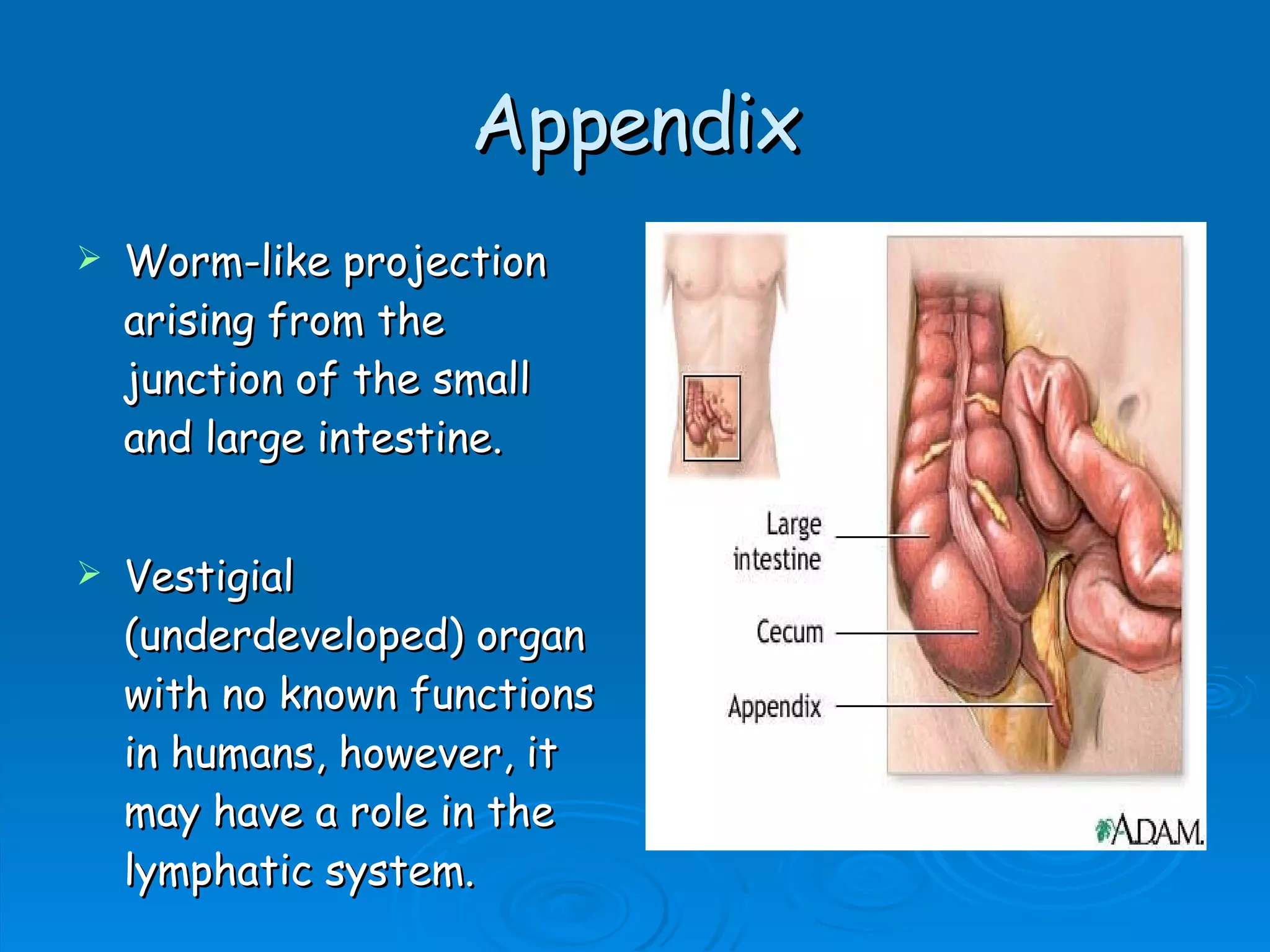
Appendix Worm-like projection arising from the junction of the small and large intestine. Vestigial (underdeveloped) organ with no known functions in humans, however, it may have a role in the lymphatic system.
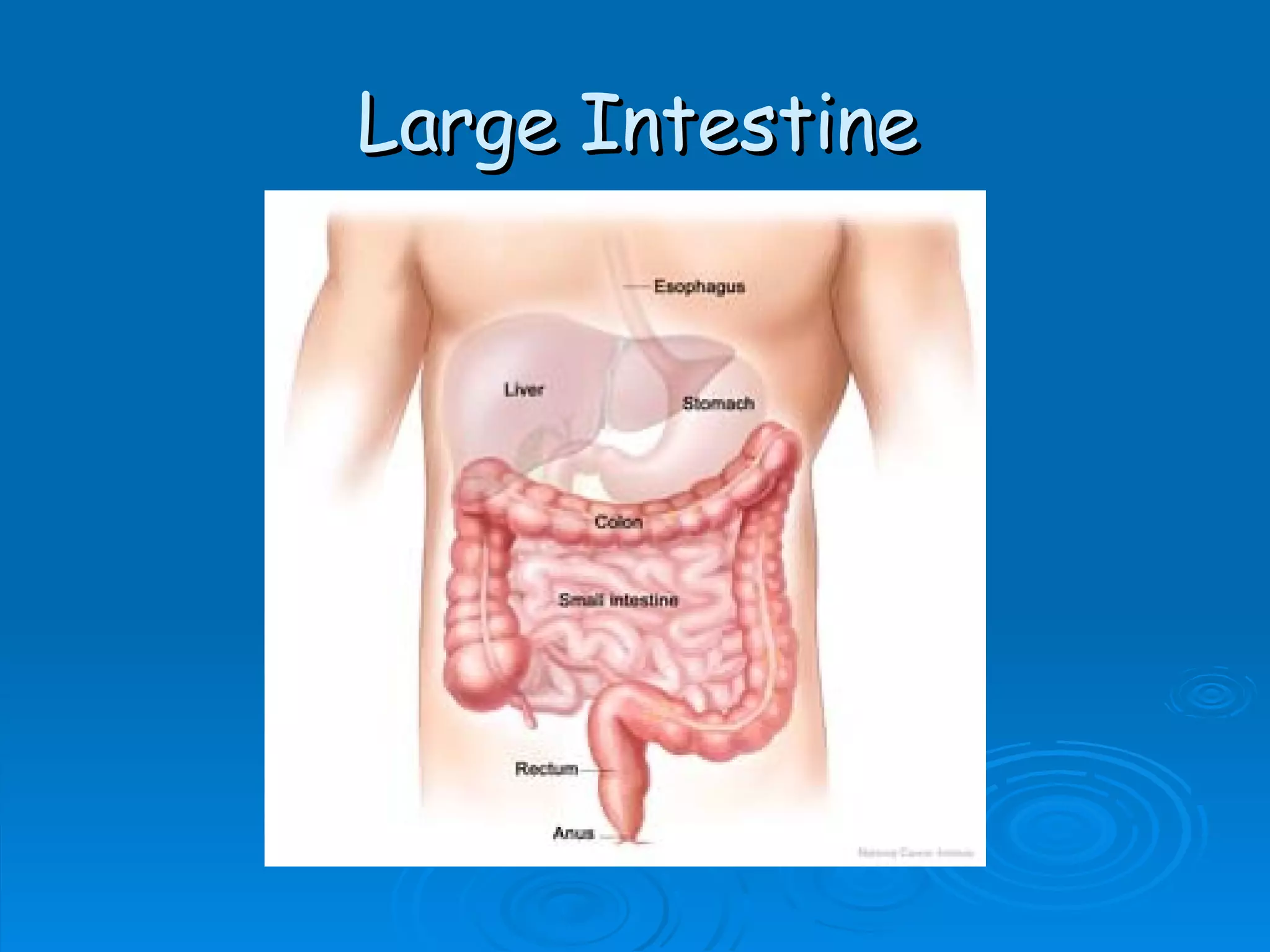
Large Intestine (colon) Up to 1.5 meters long and 7.5 centimeters wide. Contains a series of pouches that have a puckered appearance and also contains smooth muscle fibers for  peristalsis . Houses anaerobic bacteria called  E. coli ,  which synthesizes vitamins B ,  and K, growth factors, amino acids, and further breaks down undigested materials by fermentation.
Large Intestine
Large Intestine (colon) Absorption of H 2 O from feces and salts, e.g. high [solute] of the feces will cause watery feces/diarrhea (recall B10, hypertonic). Secretes mucus for lubrication.
Rectum Last 20 cm of large intestine (colon), controlled by a sphincter muscle. Compacts/stores feces and opens into anus.
Anus Opening of rectum, surrounded by sphincter muscles. Controls opening of rectum. Elimination of feces (defecation) by relaxing sphincter muscles.
Swallowing and Peristalsis Swallowing  is a  reflex action   (automatic )  triggered when the  bolus  is pushed upwards by the tongue against the soft palate and back towards the  pharynx . The  larynx   elevates, bends the  epiglottis , which covers the  glottis  in the trachea, to prevent food from entering the lungs.
Peristalsis Peristalsis  is the alternating  contracting  and  relaxing  of  smooth muscles .  It occurs in the  esophagus   moving the bolus to the stomach and provides movement of chyme in the  small intestine  and undigested material in the  large intestine .
Pancreas and Insulin An accessory organ of digestion (exocrine gland), which produces  pancreatic juice   (H2O, NaHCO 3 , pancreatic amylase, lipase, trypsin, and pancreatic nuclease)  and empties into the duodenum via pancreatic duct.
Insulin Also produces a  hormone  called  insulin  (from the islets of Langerhans) (endocrine gland) which is secreted into the bloodstream and has the following effects when the concentration of  glucose in the blood/blood glucose is high : i)   Stimulates   cells permeability to C 6 H 12 O 6   ; stimulates liver, fat, and muscle cells to metabolize C 6 H 12 O 6 . ii)  Stimulates  liver and muscle cells to store excess C 6 H 12 O 6  as  glycogen . iii)  Promotes   the buildup of fats and proteins, and inhibits their use as an energy source.
Six Major Functions of the Liver Digestive System Produces   bile  (which is stored in the gall bladder) to emulsify lipids. Stores   excess glucose as  glycogen  to maintain glucose levels. Circulatory System Produces   blood proteins/plasma proteins  from the amino acids (e.g. albumin, gamma-globulin, fibrinogen). Detoxifies  blood by removing alcohol, drugs, and other poisonous materials. Converts   Hb from worn out RBCs for the production of bile.
Functions of Liver (5 and 6) Excretory System Produces   urea  from the breakdown of amino acids and excretes it as a N-waste. Metabolizes  ammonia (N-waste) to urea and excretes it in the urine.
C2 – Enzymes and Digestive Reactions They Promote Introduction   Enzymes are  hydrolytic , that is, adding  H 2 O  breaks bonds. 1.) Carbohydrates (a)  Salivary amylase , produced in the salivary glands;  optimal   pH  7 . (b)   Pancreatic amylase ,   produced in the pancreas;  optimal   pH  8-9 . (c)  Maltase , produced in the small intestine (intestinal glands);  optimal   pH  8-9 .
Enzymes cont. 2.) Proteins (a)  Pepsin , produced in the stomach (gastric glands);  optimal   pH  2-3 . (b)  Trypsin , produced in the pancreas;  optimal   pH  8-9 . (c)  Peptidase , produced in the small intestine (intestinal glands);  optimal   pH  8-9 . NOTE :  pepsin, inactive pepsinogen and trypsin are examples of enzymes called  proteases .
Enzymes cont. 3.) Lipids Lipase , produced in the pancreas;  optimal   pH 8-9 . 4.) Nucleic acids/nucleotides (a)  Pancreatic   nuclease , produced in the pancreas;  optimal   pH  8-9 . (b)  Intestinal nuclease , produced in the small intestine (intestinal glands);  optimal pH  8-9 .
C2 – Components of Digestive Secretions NOTE:  * = Enzyme. Saliva Produced by cells of three pairs of salivary glands located in the head, secreted into ducts which then enters the mouth. Composed of: H2O Mucus Buffers Salivary amylase*
Gastric Juice Produced by gastric glands and mucus cells in the stomach. Composed of: H 2 O Mucus HCl Pepsin*
Pancreatic Juice Produced by cells of the pancreas, travels to the pancreatic duct and then to the duodenum. Composed of: H 2 O NaHCO 3   Pancreatic amylase* Lipase* Trypsin* Pancreatic nuclease*
Intestinal Juice Produced by intestinal glands and mucus cells in the small intestine. Composed of: H 2 O Mucus Peptidase* Maltase* Intestinal nuclease*
Summary of Enzymes and Chemicals/Molecules   1.)   Salivary amylase  (mouth); breaks down starch + H 2 O    maltose. 2.)  Pancreatic amylase  (pancreas to the duodenum); breaks down starch + H 2 O    maltose. 3.)  Maltas e  (small intestine); breaks down maltose + H 2 O    glucose. Carbohydrates
Proteins 1.)  Pepsin   (stomach); breaks down proteins + H 2 O    peptides. 2.)  Trypsin   (pancreas to the duodenum); breaks down protein + H 2 O    peptides. 3.)  Peptidase  (small intestine); breaks down peptides + H 2 O    amino acids.
Nucleic Acids 1.)  Pancreatic nuclease  (pancreas); breaks down nucleic acids + H 2 O    nucleotides. 2.)  Intestinal nuclease  (small intestine); breaks down nucleic acids + H 2 O    nucleotides.
Lipids 1.)  Lipase  (pancreas to the duodenum); breaks down  lipid   droplets  + H 2 O    glycerol + fatty acids.
Bile (Produced in the liver, stored in the gall bladder, empties into the duodenum via ducts.) NOT  an enzyme; (a complex fluid containing H 2 O, electrolytes, bile acids, cholesterol, phospholipids and bilirubin.) Emulsifies  fats ( physical breakdown ) into fat/lipid droplets, which increases the surface area for chemical digestion by lipase.
NaHCO 3  ( Sodium Bicarbonate) Produced in the pancreas, empties into duodenum via ducts. Neutralizes   acid chyme from the stomach.
HCl (Hydrochloric Acid) Produced in the stomach. Converts  pepsinogen  (inactive)  to  pepsin   (active). Kills bacteria and micro-organisms.
H 2 O (water….in case you forgot) Acts as a solvent. Hydrolyzes enzymes. Lubricates (aids in movement).
Mucus Produced in goblets cells of the stomach and cells of small and large intestine. Lubricates the digestive tract. Protection from acid chyme in stomach and small and large intestine.
Cross-section of a Villus:   (See following diagram) Villus: ‘ Finger-like’ projections found on the inner wall of the  small intestine   and extend into the intestinal lumen.  Villi (plural) increase the surface area for enzymatic reactions and absorption of monomers/nutrients in the small intestine.
 
NOTE:   The following are examples of how  structures  of the  small intestine  are   related   to its function. The  numerous villi  increase the surface area for absorption of all nutrients. The inside of each villus contains a  capillary bed  to absorb nutrients. The inside of each villus contains a  lacteal  to absorb glycerol and fatty acids.
More examples The small intestine also contains  microvilli   (“brush border”).  They are located on  epithelial cells .  This also increases the surface area for absorption of monomers/nutrients. Epithelial cells  are thin, moist and warm which speeds up diffusion/absorption.  Numerous  mitochondria  in epithelial cells provide ATP for active transport of nutrients.
And more…. The walls of the small intestine contain  smooth muscle cells  that provide movement of chyme throughout the entire length.  This movement is known as  peristalsis .  Peristalsis  also increases the surface area of the food.  The walls of the small intestine contain  goblet cells  that produce  mucus , which aids in lubrication and movement.
A few more examples The walls of the small intestine also contain many  folds , which increase the surfaces area for absorption of monomers/nutrients. The  length  of the small intestine increases the surface are for absorption and chemical digestion of food.
Much of absorption includes  active transport , but  passive transport  also occurs. Each villus (and therefore microvillus) contains: Epithelial cell s . Mucus (goblet cells). Lacteal (lymphatic vessel). Capillary bed/network. They allow for absorption of H 2 O, ions, minerals, and  monomers .
Processes of monomers and water entering intestinal epithelial cells Lipids : Glycerol  and  fatty acid   monomers  diffuse  across the epithelial cells and then  diffuse  into the  lacteal vessel .  These monomers will form triglycerides as they enter the  lymphatic system     enters heart and general circulation.
Carbs and Proteins Glucose  and  amino acid  monomers move by  active transport  into  epithelial cells , and then  diffuse  into  capillary bed / network .  Glucose and amino acid monomers then enter the bloodstream to the liver via  hepatic portal vein ,  exits liver via   hepatic vein  to the heart, which then pumps C 6 H 12 O 6  and amino acids throughout the body. Now the liver can store excess C 6 H 12 O 6  as  glycogen  and use the amino acids to make proteins.
Nucleic Acids: Nucleotides   diffuse  into  epithelial cells , and then  diffuse   into  capillary   bed/network     enter the bloodstream    liver via  hepatic portal vein      hepatic vein     heart    body cells.
H 2 O: Enters  epithelial cells  by  osmosis  and into the  capillary bed/network     enters bloodstream.

Digestion!

  • 1.
    Unit C1-2: HumanBiology (Digestive System) Students who have fully met the prescribed learning outcomes (PLO’s) are able to: C1. Analyze the functional inter-relationships of the structures of the digestive system. Identify and give a function for each of the following: -mouth -duodenum -tongue -liver -teeth -gall bladder -salivary glands -pancreas -pharynx -small intestine -epiglottis -large intestine (colon) -esophagus -appendix -cardiac sphincter -rectum -stomach -anus -pyloric sphincter
  • 2.
    Digestion PLO’s Describeswallowing and peristalsis. Identify the pancreas as the source gland for insulin, and describe the function of insulin in maintaining blood sugar levels. List at least six major functions of the liver. Explain the role of bile in the emulsification of fats.
  • 3.
    Digestion PLO’s Describehow the small intestine is specialized for chemical and physical digestion and absorption. Describe the structure of the villus, including microvilli, and explain the functions of the capillaries and lacteals within it. Describe the functions of anaerobic bacteria in the colon. Demonstrate the correct use of the dissection microscope to examine the various structures of the digestive system .
  • 4.
    Digestion PLO’s (Lastset!) Describe the role of sodium bicarbonate in pancreatic juice. Describe the role of hydrochloric acid (HCl) in gastric juice. Describe the role of mucus in gastric juice. Describe the importance of the pH level in various regions of the digestive tract.
  • 5.
    C1 – Organsand Their Functions :
  • 6.
  • 7.
    Mouth…where it allbegins Receives food to be broken down physically (teeth)and chemically . Location of starch digestion/first place of chemical digestion of starch. Saliva in mouth provides optimal pH 7 for salivary amylase.
  • 8.
    Tongue Forms chewedfood into a bolus (ball of food) before swallowing. Initiates swallowing.
  • 9.
    Teeth! Chomp chomp….Mechanical/physical breakdown of food (mastication).
  • 10.
    Salivary Glands Threepairs of glands that secrete saliva into the mouth via ducts. Produces saliva containing water, mucus , salivary amylase and buffers which, lubricate food, and breakdown starch into maltose. (It also contains the enzyme, lysozyme that lyses oral bacteria).
  • 11.
  • 12.
    Pharynx Aregion between the mouth, esophagus, and trachea. Passageway for food, water, air, and for the reflex action of swallowing as it enters the esophagus.
  • 13.
    Epiglottis…so you don’tchoke! A flap of tissue that covers the glottis (opening of the trachea). Prevents food from entering the trachea when swallowing.
  • 14.
    Esophagus Transfers thebolus from the mouth to the stomach by peristalsis (rhythmic smooth muscle contractions). Secretes mucus for lubrication
  • 15.
    Cardiac Sphincter Circularmuscle at the junction of the esophagus and stomach. Relaxation of sphincter allows bolus to enter stomach and contraction prevents stomach chyme from re-entering the esophagus.
  • 16.
    Stomach J-shaped muscularand glandular organ on the left side of body below the diaphragm. Stomach wall contains deep folds ( rugae ) which provide a greater surface area for food and fluids. Storage of food
  • 17.
    Stomach continued Mechanicalchurning of food into chyme by smooth muscle fibres. Secrete mucus for protection and lubrication by goblet cells. Secretes HCl and pepsinogen (inactive form of pepsin ) by gastric glands. Secretes gastric juice produced by gastric glands containing H 2 O, HCl, pepsinogen (pepsin), and mucus. HCl provides optimal pH 2-3 for pepsin.
  • 18.
    Stomach First placeof chemical digestion of proteins . Secretes gastrin (hormone), which releases more gastric juice from gastric glands.
  • 19.
    Pyloric Sphincter Acircular ring of muscle at the junction of the stomach and duodenum. Relaxation of the sphincter allows acid chyme to enter the duodenum, i.e. controls the amount of chyme entering the duodenum and contraction keeps chyme within the stomach.
  • 20.
    Duodenum First 30cmof the small intestine. Receives acid chyme from stomach, pancreatic juice from pancreas, and bile from gall bladder; peristalsis occurs here. Bile begins its first emulsification of lipids here, i.e. lipids physically broken down into lipid droplets.
  • 21.
  • 22.
    Duodenum Continued Majorityof chemical digestion (see below) and the first neutralization (via NaHCO 3 ) of acidic chyme occur here. NaHCO 3 provides optimal pH 8-9 for pancreatic amylase, lipase, trypsin, intestinal & pancreatic nuclease, peptidase and maltase.
  • 23.
    Enzymes at workH 2 O starch maltose pancreatic amylases H 2 O maltose glucose maltase H 2 O proteins peptides trypsin
  • 24.
    More enzymes H2Opeptides amino acids peptidase H2O nucleic acids nucleotides pancreatic & intestinal nucleases H2O lipid droplets glycerol & lipase fatty acids
  • 25.
    Liver Refer tomajor liver functions for specifics . Accessory organ for digestion consisting of four lobes, located under the diaphragm. Approximately 1.5kg in weight. Highly vascularized. Produces bile (bile salts) necessary for emulsifying lipids (thus increasing surface area for chemical digestion by lip ase ).
  • 26.
    Gall Bladder Accessoryorgan for digestion. Pear-shaped sac located in a depression on the underside of the liver. Stores and concentrates bile from the liver and carries it to the duodenum via the bile duct.
  • 27.
    Pancreas Refer tofunction of insulin for specifics . Accessory organ for digestion. Oblong gland, approximately 12.5cm, which lies behind the stomach and made up of clusters of glandular cells.
  • 28.
    Pancreas Secretes pancreatic juice containing H 2 O, NaHCO 3 , pancreatic amylase , lipase , trypsin and pancreatic nuclease . Secretes pancreatic juice for further digestion of starch, lipid droplets, proteins and nucleic acids, which is delivered to the duodenum via the pancreatic duct. Neutralizes acid chyme by producing NaHCO 3 . Secretes enzymes for chemical digestion of all biological molecules.
  • 29.
    Small Intestine Upto seven meters in length and 2.5cm in diameter. Divided into three sections; the first 30 cm is the duodenum . Walls of the small intestine are covered in villi (small finger-like projections), smooth muscle fibers, pits containing intestinal glands secreting enzymes, goblet cells secreting mucus, epithelial cells contain microvilli , and many folds which increase the surface area for chemical digestion and absorption.
  • 30.
  • 31.
    Small Intestine Produces intestinal juice containing H 2 O, mucus, maltase , peptidase and intestinal nuclease . Provides optimal pH 8-9 for intestinal nuclease, peptidase and maltase, pancreatic amylase and nuclease, lipase, trypsin. Complete digestion of carbs, proteins, nucleic acids, and lipids.
  • 32.
    Enzymes at workH 2 O starch maltose pancreatic amylases H 2 O maltose glucose maltase H 2 O proteins peptides trypsin
  • 33.
    More enzymes H2Opeptides amino acids peptidase H2O nucleic acids nucleotides pancreatic & intestinal nucleases H2O lipid droplets glycerol & lipase fatty acids
  • 34.
    Small Intestine Cont.Absorption of all nutrients/monomers into the villi. Receives acid chyme from stomach, secretions from the gall bladder, and pancreas. Undigested material is transported to the large intestine by peristalsis . Long length allows time for enzymatic reactions to occur and increases absorptive area for monomers/nutrients. Increased surface area of intestinal cells by microvilli further increases absorption of monomers/nutrients.
  • 35.
    Appendix Worm-like projectionarising from the junction of the small and large intestine. Vestigial (underdeveloped) organ with no known functions in humans, however, it may have a role in the lymphatic system.
  • 36.
    Large Intestine (colon)Up to 1.5 meters long and 7.5 centimeters wide. Contains a series of pouches that have a puckered appearance and also contains smooth muscle fibers for peristalsis . Houses anaerobic bacteria called E. coli , which synthesizes vitamins B , and K, growth factors, amino acids, and further breaks down undigested materials by fermentation.
  • 37.
  • 38.
    Large Intestine (colon)Absorption of H 2 O from feces and salts, e.g. high [solute] of the feces will cause watery feces/diarrhea (recall B10, hypertonic). Secretes mucus for lubrication.
  • 39.
    Rectum Last 20cm of large intestine (colon), controlled by a sphincter muscle. Compacts/stores feces and opens into anus.
  • 40.
    Anus Opening ofrectum, surrounded by sphincter muscles. Controls opening of rectum. Elimination of feces (defecation) by relaxing sphincter muscles.
  • 41.
    Swallowing and PeristalsisSwallowing is a reflex action (automatic ) triggered when the bolus is pushed upwards by the tongue against the soft palate and back towards the pharynx . The larynx elevates, bends the epiglottis , which covers the glottis in the trachea, to prevent food from entering the lungs.
  • 42.
    Peristalsis Peristalsis is the alternating contracting and relaxing of smooth muscles . It occurs in the esophagus moving the bolus to the stomach and provides movement of chyme in the small intestine and undigested material in the large intestine .
  • 43.
    Pancreas and InsulinAn accessory organ of digestion (exocrine gland), which produces pancreatic juice (H2O, NaHCO 3 , pancreatic amylase, lipase, trypsin, and pancreatic nuclease) and empties into the duodenum via pancreatic duct.
  • 44.
    Insulin Also producesa hormone called insulin (from the islets of Langerhans) (endocrine gland) which is secreted into the bloodstream and has the following effects when the concentration of glucose in the blood/blood glucose is high : i) Stimulates cells permeability to C 6 H 12 O 6 ; stimulates liver, fat, and muscle cells to metabolize C 6 H 12 O 6 . ii) Stimulates liver and muscle cells to store excess C 6 H 12 O 6 as glycogen . iii) Promotes the buildup of fats and proteins, and inhibits their use as an energy source.
  • 45.
    Six Major Functionsof the Liver Digestive System Produces bile (which is stored in the gall bladder) to emulsify lipids. Stores excess glucose as glycogen to maintain glucose levels. Circulatory System Produces blood proteins/plasma proteins from the amino acids (e.g. albumin, gamma-globulin, fibrinogen). Detoxifies blood by removing alcohol, drugs, and other poisonous materials. Converts Hb from worn out RBCs for the production of bile.
  • 46.
    Functions of Liver(5 and 6) Excretory System Produces urea from the breakdown of amino acids and excretes it as a N-waste. Metabolizes ammonia (N-waste) to urea and excretes it in the urine.
  • 47.
    C2 – Enzymesand Digestive Reactions They Promote Introduction Enzymes are hydrolytic , that is, adding H 2 O breaks bonds. 1.) Carbohydrates (a) Salivary amylase , produced in the salivary glands; optimal pH 7 . (b) Pancreatic amylase , produced in the pancreas; optimal pH 8-9 . (c) Maltase , produced in the small intestine (intestinal glands); optimal pH 8-9 .
  • 48.
    Enzymes cont. 2.)Proteins (a) Pepsin , produced in the stomach (gastric glands); optimal pH 2-3 . (b) Trypsin , produced in the pancreas; optimal pH 8-9 . (c) Peptidase , produced in the small intestine (intestinal glands); optimal pH 8-9 . NOTE : pepsin, inactive pepsinogen and trypsin are examples of enzymes called proteases .
  • 49.
    Enzymes cont. 3.)Lipids Lipase , produced in the pancreas; optimal pH 8-9 . 4.) Nucleic acids/nucleotides (a) Pancreatic nuclease , produced in the pancreas; optimal pH 8-9 . (b) Intestinal nuclease , produced in the small intestine (intestinal glands); optimal pH 8-9 .
  • 50.
    C2 – Componentsof Digestive Secretions NOTE: * = Enzyme. Saliva Produced by cells of three pairs of salivary glands located in the head, secreted into ducts which then enters the mouth. Composed of: H2O Mucus Buffers Salivary amylase*
  • 51.
    Gastric Juice Producedby gastric glands and mucus cells in the stomach. Composed of: H 2 O Mucus HCl Pepsin*
  • 52.
    Pancreatic Juice Producedby cells of the pancreas, travels to the pancreatic duct and then to the duodenum. Composed of: H 2 O NaHCO 3 Pancreatic amylase* Lipase* Trypsin* Pancreatic nuclease*
  • 53.
    Intestinal Juice Producedby intestinal glands and mucus cells in the small intestine. Composed of: H 2 O Mucus Peptidase* Maltase* Intestinal nuclease*
  • 54.
    Summary of Enzymesand Chemicals/Molecules 1.) Salivary amylase (mouth); breaks down starch + H 2 O  maltose. 2.) Pancreatic amylase (pancreas to the duodenum); breaks down starch + H 2 O  maltose. 3.) Maltas e (small intestine); breaks down maltose + H 2 O  glucose. Carbohydrates
  • 55.
    Proteins 1.) Pepsin (stomach); breaks down proteins + H 2 O  peptides. 2.) Trypsin (pancreas to the duodenum); breaks down protein + H 2 O  peptides. 3.) Peptidase (small intestine); breaks down peptides + H 2 O  amino acids.
  • 56.
    Nucleic Acids 1.) Pancreatic nuclease (pancreas); breaks down nucleic acids + H 2 O  nucleotides. 2.) Intestinal nuclease (small intestine); breaks down nucleic acids + H 2 O  nucleotides.
  • 57.
    Lipids 1.) Lipase (pancreas to the duodenum); breaks down lipid droplets + H 2 O  glycerol + fatty acids.
  • 58.
    Bile (Produced inthe liver, stored in the gall bladder, empties into the duodenum via ducts.) NOT an enzyme; (a complex fluid containing H 2 O, electrolytes, bile acids, cholesterol, phospholipids and bilirubin.) Emulsifies fats ( physical breakdown ) into fat/lipid droplets, which increases the surface area for chemical digestion by lipase.
  • 59.
    NaHCO 3 ( Sodium Bicarbonate) Produced in the pancreas, empties into duodenum via ducts. Neutralizes acid chyme from the stomach.
  • 60.
    HCl (Hydrochloric Acid)Produced in the stomach. Converts pepsinogen (inactive) to pepsin (active). Kills bacteria and micro-organisms.
  • 61.
    H 2 O(water….in case you forgot) Acts as a solvent. Hydrolyzes enzymes. Lubricates (aids in movement).
  • 62.
    Mucus Produced ingoblets cells of the stomach and cells of small and large intestine. Lubricates the digestive tract. Protection from acid chyme in stomach and small and large intestine.
  • 63.
    Cross-section of aVillus: (See following diagram) Villus: ‘ Finger-like’ projections found on the inner wall of the small intestine and extend into the intestinal lumen. Villi (plural) increase the surface area for enzymatic reactions and absorption of monomers/nutrients in the small intestine.
  • 64.
  • 65.
    NOTE: The following are examples of how structures of the small intestine are related to its function. The numerous villi increase the surface area for absorption of all nutrients. The inside of each villus contains a capillary bed to absorb nutrients. The inside of each villus contains a lacteal to absorb glycerol and fatty acids.
  • 66.
    More examples Thesmall intestine also contains microvilli (“brush border”). They are located on epithelial cells . This also increases the surface area for absorption of monomers/nutrients. Epithelial cells are thin, moist and warm which speeds up diffusion/absorption. Numerous mitochondria in epithelial cells provide ATP for active transport of nutrients.
  • 67.
    And more…. Thewalls of the small intestine contain smooth muscle cells that provide movement of chyme throughout the entire length. This movement is known as peristalsis . Peristalsis also increases the surface area of the food. The walls of the small intestine contain goblet cells that produce mucus , which aids in lubrication and movement.
  • 68.
    A few moreexamples The walls of the small intestine also contain many folds , which increase the surfaces area for absorption of monomers/nutrients. The length of the small intestine increases the surface are for absorption and chemical digestion of food.
  • 69.
    Much of absorptionincludes active transport , but passive transport also occurs. Each villus (and therefore microvillus) contains: Epithelial cell s . Mucus (goblet cells). Lacteal (lymphatic vessel). Capillary bed/network. They allow for absorption of H 2 O, ions, minerals, and monomers .
  • 70.
    Processes of monomersand water entering intestinal epithelial cells Lipids : Glycerol and fatty acid monomers diffuse across the epithelial cells and then diffuse into the lacteal vessel . These monomers will form triglycerides as they enter the lymphatic system  enters heart and general circulation.
  • 71.
    Carbs and ProteinsGlucose and amino acid monomers move by active transport into epithelial cells , and then diffuse into capillary bed / network . Glucose and amino acid monomers then enter the bloodstream to the liver via hepatic portal vein , exits liver via hepatic vein to the heart, which then pumps C 6 H 12 O 6 and amino acids throughout the body. Now the liver can store excess C 6 H 12 O 6 as glycogen and use the amino acids to make proteins.
  • 72.
    Nucleic Acids: Nucleotides diffuse into epithelial cells , and then diffuse into capillary bed/network  enter the bloodstream  liver via hepatic portal vein  hepatic vein  heart  body cells.
  • 73.
    H 2 O:Enters epithelial cells by osmosis and into the capillary bed/network  enters bloodstream.