Unit B11: Cell Biology (Enzymes) Authored by Michelle Choma © Students who have fully met the prescribed learning outcomes (PLO’s) are able to: Analyze the roles of enzymes in biochemical reactions. explain the following terms:  metabolism, enzyme, substrate, coenzyme, activation energy. use graphs to identify the role of enzymes in lowering the activation energy of a biochemical reaction

PLO’s continued explain models of enzymatic action (e.g., induced fit). differentiate between the roles of enzymes and co-enzymes in biochemical reactions. identify the role of vitamins as coenzymes.
PLO’s continued apply knowledge of proteins to explain the effects on enzyme activity of pH, temperature, substrate concentration, enzyme concentration, competitive inhibitors, and non-competitive inhibitors including heavy metals. devise an experiment using the scientific method (e.g., to investigate the activity of enzymes).  Liver catalase experiment!
And lastly!! identify the thyroid the source gland for thyroxin and relate the function of thyroxin to metabolism
Terms to Know Metabolism: Describes the constantly occurring chemical reactions in a cell necessary for life.  E.g., the chemical reactions involved in the processes of cellular respiration, DNA replication, protein synthesis, dehydration synthesis and hydrolysis, chemical digestion, intracellular digestion, O 2 /CO 2   transport, etc. ALL require molecules called  enzymes .
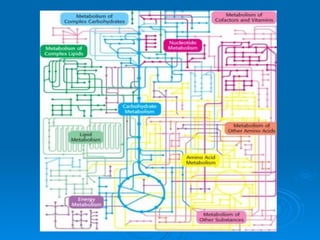
Metabolism In metabolism some substances are  broken down/hydrolyzed  to yield energy for vital processes while other substances, necessary for life, are  synthesized ---- this require  enzymes !
 
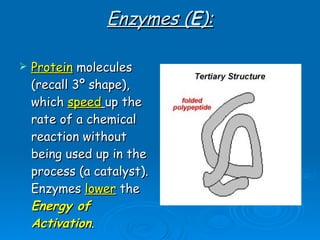
Enzymes ( E ): Protein  molecules (recall 3º shape), which  speed   up the rate of a chemical reaction without being used up in the process (a catalyst).  Enzymes  lower  the  Energy of Activation .
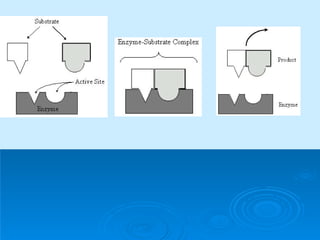
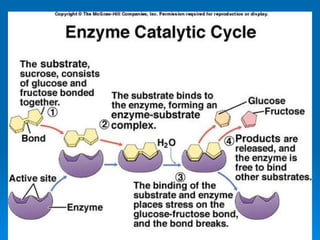
Enzymes Enzymes contain an  active site   which interacts with the substrate to produce the end products (see diagram, “induced fit” model).  With some exceptions, enzymes end in  “ ase ”  and are named according to the substrate they interact with,  e.g. malt ase  is the enzyme that breaks down the substrate maltose.
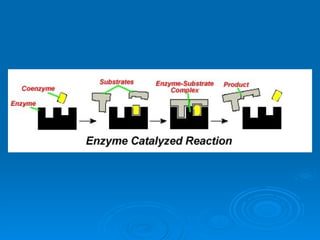
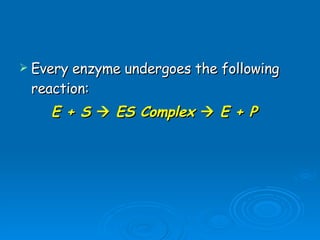
Enzymes Every reaction requires a  specific  enzyme and undergoes the following enzymatic reaction: E  +  S      ES Complex     E  +  P Enzyme + Substrate    Enzyme-Substrate Complex     Enzyme + Product http://www.bbc.co.uk/schools/gcsebitesize/teachers/biology/activities.shtml   (Animation of enzyme reaction)
 
 
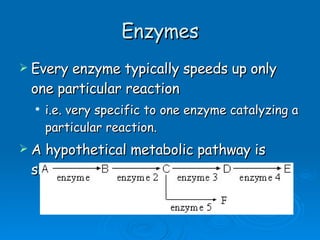
Enzymes Every enzyme typically speeds up only one particular reaction  i.e. very specific to one enzyme catalyzing a particular reaction. A hypothetical metabolic pathway is shown below:
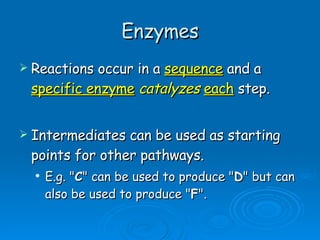
Enzymes Reactions occur in a  sequence  and a  specific enzyme   catalyzes   each  step. Intermediates can be used as starting points for other pathways.  E.g. " C " can be used to produce " D " but can also be used to produce " F ".
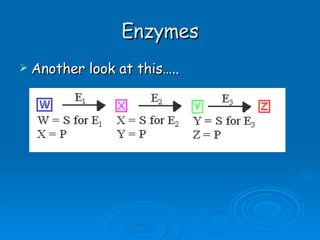
Enzymes Another look at this…..
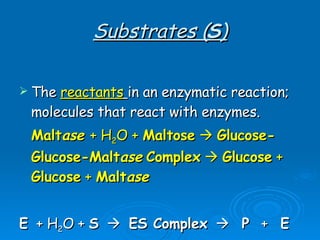
Substrates ( S ) The  reactants   in an enzymatic reaction; molecules that react with enzymes.  Malt ase   + H 2 O +  Maltose      Glucose-Glucose-Malt ase   Complex      Glucose  +  Glucose  +  Malt ase   E   + H 2 O +  S      ES Complex      P  +  E
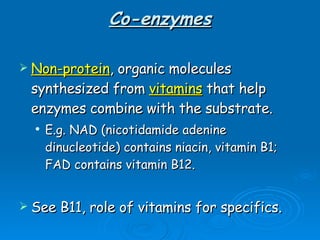
Co-enzymes Non-protein , organic molecules synthesized from  vitamins  that help enzymes combine with the substrate. E.g. NAD (nicotidamide adenine dinucleotide) contains niacin, vitamin B1; FAD contains vitamin B12. See B11, role of vitamins for specifics.
 
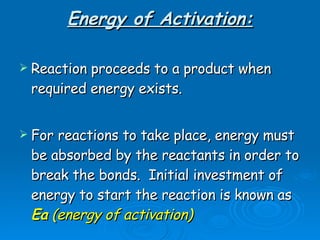
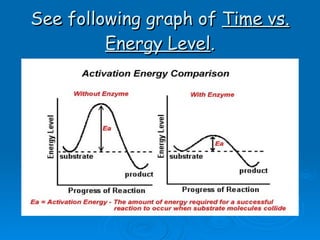
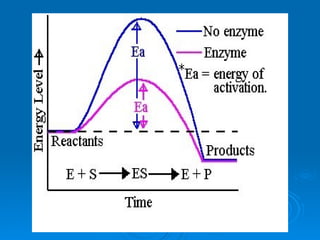
Energy of Activation: Reaction proceeds to a product when required energy exists. For reactions to take place, energy must be absorbed by the reactants in order to break the bonds.  Initial investment of energy to start the reaction is known as  Ea  (energy of   activation)
See following graph of  Time vs. Energy Level .
 
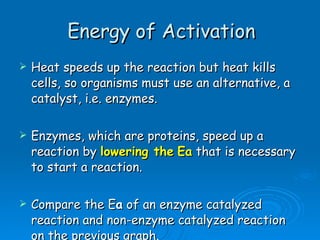
Energy of Activation Heat speeds up the reaction but heat kills cells, so organisms must use an alternative, a catalyst, i.e. enzymes. Enzymes, which are proteins, speed up a reaction by  lowering the   Ea  that is necessary to start a reaction.  Compare the E a  of an enzyme catalyzed reaction and non-enzyme catalyzed reaction on the previous graph.
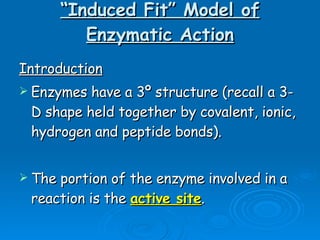
“ Induced Fit” Model of Enzymatic Action Introduction Enzymes have a 3º structure (recall a 3-D shape held together by covalent, ionic, hydrogen and peptide bonds). The portion of the enzyme involved in a reaction is the  active site .
Every enzyme undergoes the following reaction: E + S    ES Complex    E + P
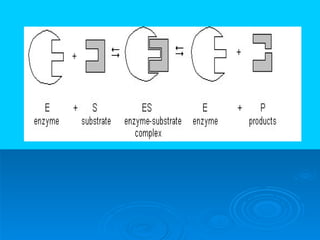
Induced Fit Theory Induced Fit theory explains how an enzyme must have the correct shape to fit substrate. A change in shape & temporary bonding occurs between the E & S.  After the reaction takes place, the product no longer fits on the enzyme, and is freed.  The enzyme returns to original shape so that it can be used again.
 
Steps of the Induced Fit Theory 1.)  Active site   of enzyme has a  unique shape  and is induced to undergo a slight alteration to fit tighter with the  substrate  and produce an  ES complex   2.) Changed shape of active site disrupts the temporary bonds, promotes the reaction, and the product no longer fits and is released.
Steps of the Induced Fit Theory 3.) Active site returns to its original state in order to lower the  energy of activation  and is ready to accept another substrate.
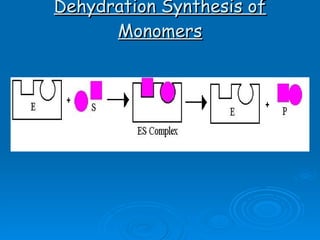
Dehydration Synthesis of Monomers
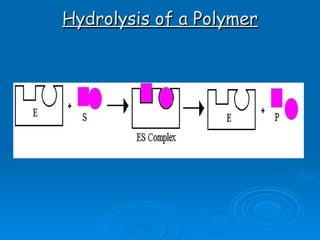
Hydrolysis of a Polymer
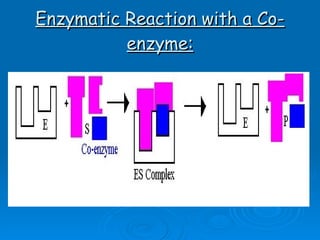
Co-enzymes and Vitamins Many reactions require a non-protein molecule or a metal ion to function properly. Co-enzymes are  non-protein , organic molecules that  bind  to enzymes to help enzymes combine with the substrate.
Co-enzymes/vitamins Co-enzymes are synthesized from  vitamins .  E.g.  Co-enzyme NAD contains niacin, vitamin B1.  (NAD+ functions in  cellular respiration  by carrying two  electrons  from one reaction site to another in the cytoplasm and mitochondria, i.e. NAD+ + 2H ® NADH + H+ )
Enzymatic Reaction with a Co-enzyme:
 
Effects on Enzyme Activity Introduction Enzyme action occurs when the enzyme and substrate collide.  During the collision the substrate slots into the active site of the enzyme. Collisions happen because of the rapid random movement of molecules in liquids.
Factors affecting the rate The following factors affect the  rate of enzyme activity  and therefore the amount of products produced:  pH temperature  [substrate]  [enzyme]  competitive inhibitors  non-competitive inhibitors, e.g. heavy metals
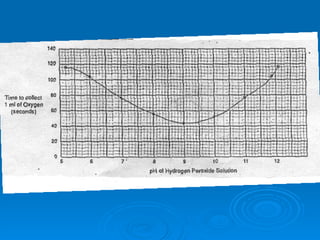
pH Each enzyme has an  optimum pH  that maintains the 3º shape (and its active site!). E.g.  Stomach pH ~ 2 - 3   Pepsinogen      Pepsin   (Inactive)   (Active)
More Examples of pH Small intestines pH ~ 8.5 – 9 Peptidase, lipase, maltase, trypsin,  pancreatic amylase  etc. Blood pH ~ 7.4  Carbonic anhydrase Mouth pH ~ 7 Salivary amylase
pH Deviations from optimum pH will  denature  the enzyme (destroy the H-bonds, 3º structure and active site).  Loss of 3º structure and ability of active site to bond with the substrate; enzyme is inactive.  (Note: Denaturation is not usually reversible.  Some denatured proteins do renature when their normal pH conditions are restored.)
 
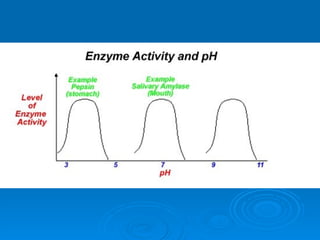
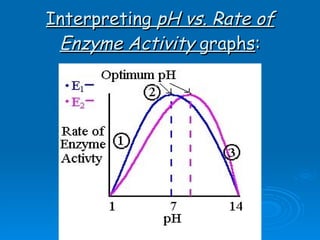
Interpreting  pH vs. Rate of Enzyme Activity  graphs :
Interpreting graph 1.) Enzyme activity increases with increasing pH until it reaches its  optimum pH . 2.) Optimum pH (‘ peak efficiency ’) helps to maintain 3º structure, i.e. H-bonds where the enzyme is  most active  and therefore maximum ES complexes, P’s and rate of enzyme activity.
Interpreting  pH vs. Rate of Enzyme Activity  graphs : 3.) Further increase of pH disrupts the H-bonds, changes the 3º structure, and  denaturation  occurs. Therefore fewer active sites are available for the reaction and fewer complexes are formed
 
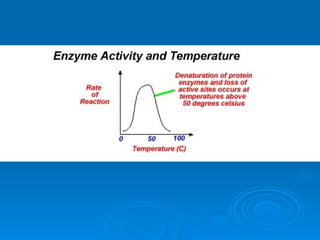
Temperature Each enzyme has an  optimum temperature  where maximum activity of ES complexes is achieved.  E.g. the body’s optimum temperature is  37ºC .  (Recall from way back: changes in Tº will cause the speed of molecules/ molecular movement to increase/decrease & therefore molecular collisions)
Temperature Deviations from optimum Tº will affect enzyme activity rate and alter its shape. Too high of a temperature will cause  denaturation  where H-bonds break, lose it’s 3º structure & changes the shape.  The enzyme no longer has an active site to bond with the substrate & is inactive.  (Note: Denaturation is not usually reversible.  Some denatured proteins do renature when their normal temperature conditions are restored.)
 
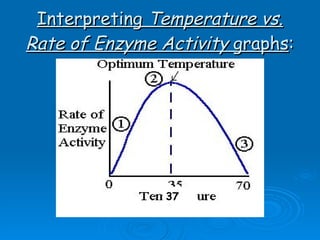
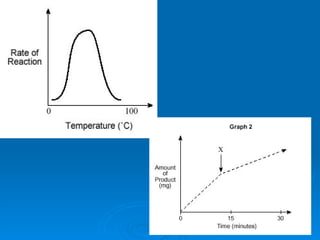
Interpreting  Temperature vs. Rate of Enzyme   Activity  graphs : 37
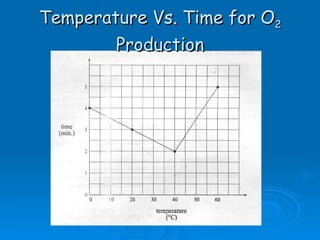
Temperature Vs. Time for O 2  Production
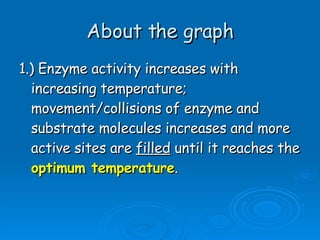
About the graph 1.) Enzyme activity increases with increasing temperature; movement/collisions of enzyme and substrate molecules increases and more active sites are  filled  until it reaches the  optimum temperature .
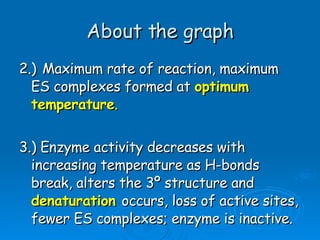
About the graph 2.)   Maximum rate of reaction, maximum ES complexes formed at  optimum temperature . 3.) Enzyme activity decreases with increasing temperature as H-bonds break, alters the 3º structure and  denaturation   occurs, loss of active sites, fewer ES complexes; enzyme is inactive.
[Substrate]
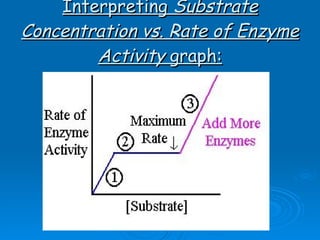
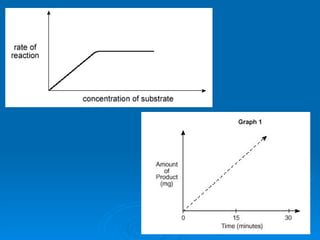
Interpreting  Substrate Concentration vs. Rate of Enzyme   Activity  graph:
About the  Substrate  graph 1.) Enzyme activity increases as  [substrate]  increases and reaction rate increases to a point. 2.) Enzyme activity slows down and levels off reaching the  maximum rate .  The substrate exceeds the number of enzymes and active sites are all  occupied . E.g. All maltase activity sites are in use. Note:  Adding more enzymes (see ‘3’ in graph above) will further increase the rate of enzyme activity as there are more available enzymes and active sites for the substrate.
[Enzyme]
About the  Enzyme  graph Reaction rate increases as [enzyme] increases (to the same increasing [substrate]). The same amount of products will be produced.
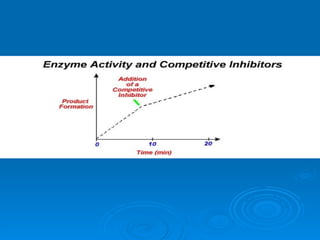
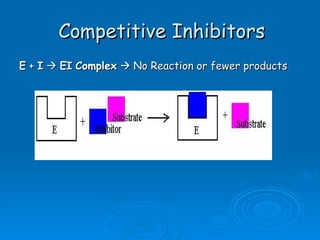
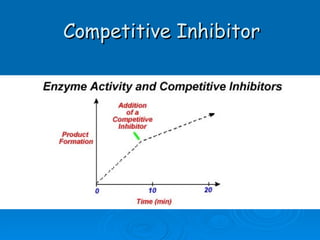
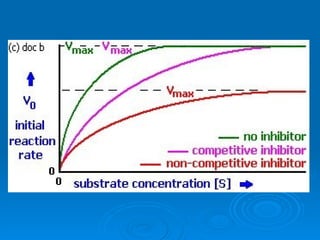
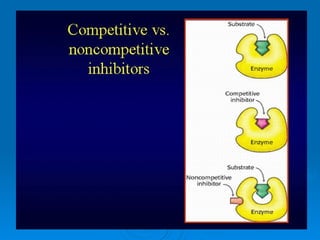
Competitive Inhibitor Chemicals that have the same shape as the substrate and will  compete  for the active site. Enzyme cannot react with the “look-a-like”.  This effectively reduces the [of available enzyme] and inhibits/decreases the reaction. The effect of competitive inhibitors can be overcome by increasing the [substrate].
Uses---the good, the bad & the ugly! Inhibitors are used by many metabolic pathways, for feedback inhibition of products on early stages of the pathway to modulate enzyme activity, e.g. cellular respiration in the mitochondria cristae (malonic acid competing for succinic dehydrogenase  Many medicines are enzyme inhibitors, e.g. sulfa drugs, penicillin to block metabolic pathways of pathogenic bacteria, kidney stone medication, anti-HIV drugs, cancer chemotherapy and even viagra! Others can be toxic & poisonous, e.g. deadly nerve gas, hydrogen cyanide (competes for cytochrome oxidase), insecticides (parathion, DFP)….
Competitive Inhibitors E  +  I      EI   Complex     No Reaction or fewer products
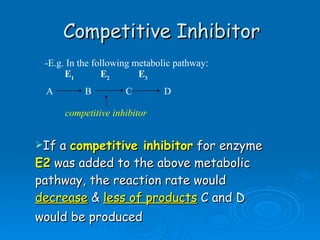
Competitive Inhibitor -E.g. In the following metabolic pathway:   E 1   E 2   E 3 A  B  C  D competitive inhibitor If a  competitive inhibitor  for enzyme  E2  was added to the above metabolic pathway, the reaction rate would  decrease  &  less of products  C and D would be produced
Competitive Inhibitor
Interesting tidbits Medical info for poisoning: Ethanol & bad methanol or bad ethanol glycol (antifreeze)’  E + Bad I   EI complex    E + formaldehyde = blindness or oxalic crystals in kidneys--ouch!  They all compete for alcohol dehydrogen ase.  Doctors give ethanol to methanol-poisoned or antifreeze victims---competes for active site blocking formaldehyde product or kidney tissue damage by oxalic crystals!
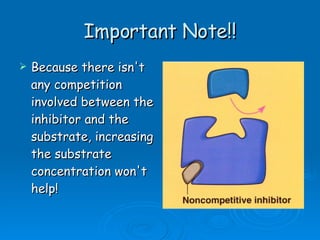
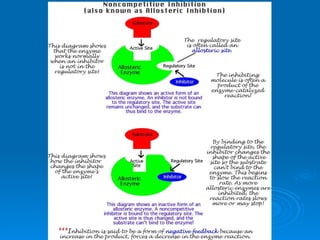
Non-Competitive Inhibitor Chemicals/inhibitors that bind to an enzyme at a place other than the active site, (i.e. ‘no competition at the active site’), which changes the active site so the substrate can’t bind and  slows  the reaction rate!  Less and  less product  produced.
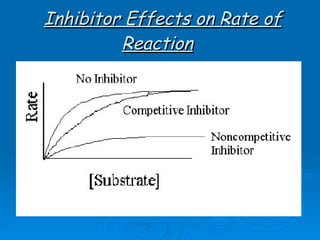
Important Note!! Because there isn't any competition involved between the inhibitor and the substrate, increasing the substrate concentration won't help!
Inhibitor Effects on Rate of Reaction


Heavy Metals Heavy metals, e.g. Mercury (Hg), Lead (Pb), Silver, Cadmium etc act like an “non- competitive inhibitor” and cause irreversible reactions. Hg and Pb will cause enzymes to  denature . Denaturation  alters the  3º shape , the  active site , the  formation of ES complexes  and the  amount of products  formed, and therefore will alter the function of enzyme. The  rate of rxn  will  decrease  and  less product  produced.
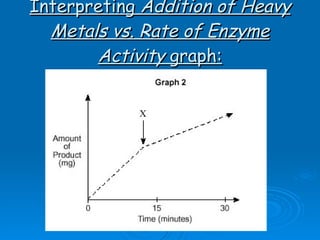
Interpreting  Addition of Heavy Metals vs. Rate of Enzyme   Activity  graph:
Temp Vs. Heavy Metal The graph above shows the addition of Hg or Pb  reduces  the amount of product produced over time; the rate slows, lowers, decreases etc. (Note: if the graph becomes less steep, fewer products are being produced per time unit)
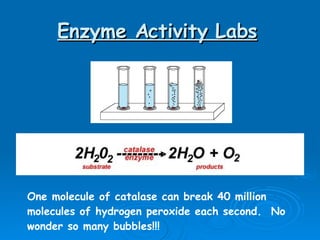
Enzyme Activity Labs   One molecule of catalase can break 40 million molecules of hydrogen peroxide each second.  No wonder so many bubbles!!!
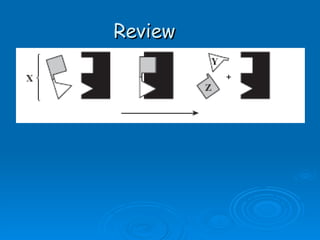
Review
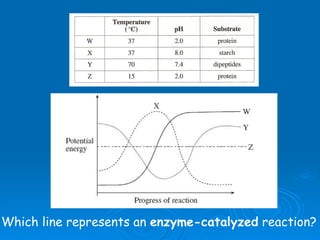
Which line represents an  enzyme-catalyzed  reaction?
 
 
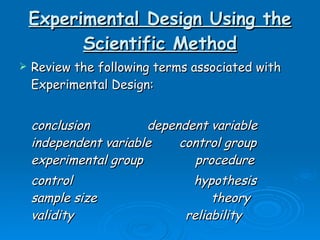
Experimental Design Using the Scientific Method Review the following terms associated with Experimental Design:  conclusion dependent variable independent variable control group experimental group  procedure control    hypothesis  sample size theory   validity  reliability
Experimental Design It is  important  you preview the “Experimental Design Question” at: http://www.bced.gov.bc.ca/exams/specs/grade12/bi/07_experimental_design.pdf
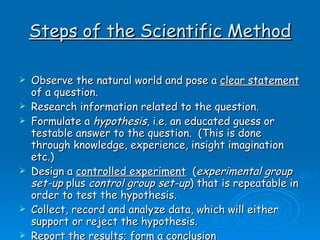
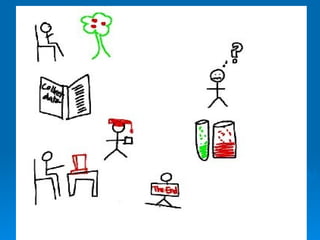
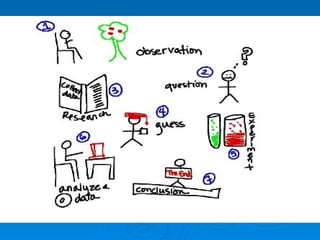
Steps of the Scientific Method Observe the natural world and pose a  clear statement  of a question.  Research information related to the question. Formulate a  hypothesis , i.e. an educated guess or testable answer to the question.  (This is done through knowledge, experience, insight imagination etc.)  Design a  controlled experiment   ( experimental group set-up  plus  control group set-up ) that is repeatable in order to test the hypothesis. Collect, record and analyze data, which will either support or reject the hypothesis. Report the results; form a conclusion
 
 
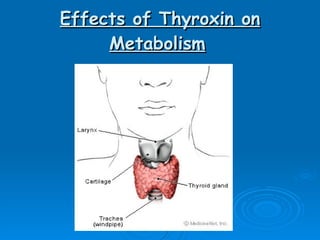
Effects of Thyroxin on Metabolism
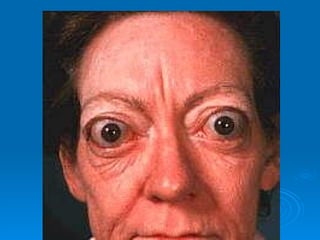
Thyroxin Thyroxin ( protein   hormone ) is produced by the  thyroid gland  that lies at the base of the neck on either side of the trachea.  Plays a role in regulating the body’s  metabolism   and influences heart rate, BP, body To, breathing rate, growth, development etc.
Thyroxin Thyroid gland accumulates  iodine  by  active transport  in order to produce  thyroxin   (Recall B9).  It is secreted into the blood stream and affects the rate of metabolism of the body cells by attaching to  receptor proteins  on the CM.
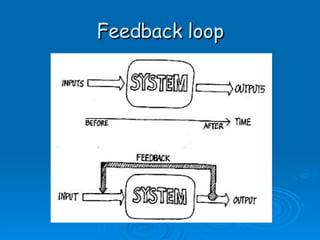
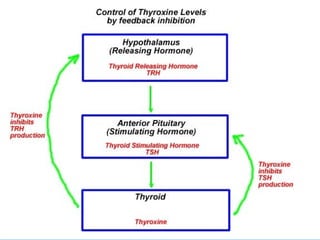
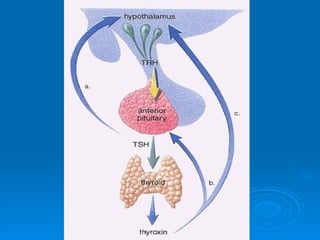
Thyroxin Thyroxin  secretion is regulated by the  hypothalamus  and  anterior pituitary  through a  negative feedback loop/ mechanism .   (Note:   Negative feedback  occurs when the hormone product of a gland affects the hypothalamus or pituitary gland in order to  inhibit  further release of a hormone.)  See flow diagram…
Feedback loop
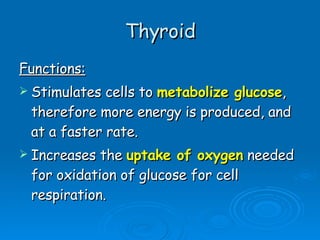
Thyroid Functions: Stimulates cells to  metabolize glucose , therefore more energy is produced, and at a faster rate. Increases the  uptake of oxygen  needed for oxidation of glucose for cell respiration.


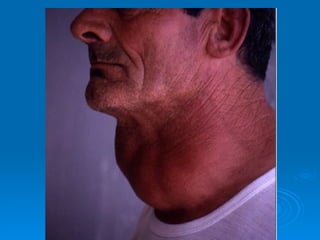
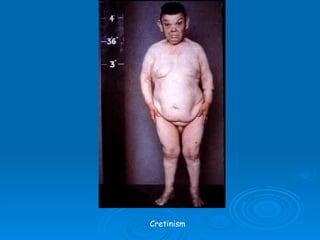
Cretinism
Websites http:// www.coolschool.ca /content/?op= simplelor&course =Biology%2012   (Unit 07) ☺ Scroll to  Lesson 01 – Lesson 05  (‘U07L01 – L05’) http://highered.mcgraw-hill.com/sites/0072421975/student_view0/chapter6/  (Mader’s Student Edition Website Support for Chapter 6; Essential Study Partner: Cells Unit/Metabolism/ Enzymes) or…  http://www.mhhe.com/biosci/genbio/espv2/data/cells/004/index.html   (Metabolism: Energy of Activation & Enzymes)
Websites http:// www.phschool.com/science/biology_place/index.html   (The Biology Place; Go to Lab Bench, click on ‘Lab 2: Enzyme Catalysis’) http://www.ekcsk12.org/science/aplabreview/lab02.htm  (Enzyme Catalysis Lab Review) http://www.bbc.co.uk/schools/gcsebitesize/biology/humansasorganisms/0nutritiondigestionrev6.shtml (Enzyme Review & Test) http://sps.k12.ar.us/massengale/pwpt_biology.htm (Terrific power points on  Scientific Method  and  Identifying Controls & Variables )
Websites http://waynesword.palomar.edu/molecu1.htm#lock   ☺ Check out the many topics & related articles.  http://science.nhmccd.edu/biol/ap1int.htm#biochem  ☺ Check out the many topics & related articles.  http://faculty.clintoncc.suny.edu/faculty/Michael.Gregory/files/Bio%20101/Bio%20101%20Lectures/Energy/energy.htm   Enzyme Lecture and an enzyme lab at… http://faculty.clintoncc.suny.edu/faculty/Michael.Gregory/files/Bio%20101/Bio%20101%20Laboratory/Enzymes/Enzymes.htm
Websites http://www.phschool.com/science/biology_place/labbench/lab2/intro.html http://www.bbc.co.uk/education/asguru/biology/02biologicalmolecules/01proteins/11enzymes/index.shtml http://www.lewport.wnyric.org/jwanamaker/animations/Enzyme%20activity.html  http://www.chemsoc.org/networks/learnnet/cfb/enzymes.htm http://glencoe.mcgrawhill.com/sites/0078695104/student_view0/brain_pop_movies.html  (A cutie animated video on Scientific Method; practice quiz)

B11 Enzymes

  • 1.
    Unit B11: CellBiology (Enzymes) Authored by Michelle Choma © Students who have fully met the prescribed learning outcomes (PLO’s) are able to: Analyze the roles of enzymes in biochemical reactions. explain the following terms: metabolism, enzyme, substrate, coenzyme, activation energy. use graphs to identify the role of enzymes in lowering the activation energy of a biochemical reaction
  • 2.
    PLO’s continued explainmodels of enzymatic action (e.g., induced fit). differentiate between the roles of enzymes and co-enzymes in biochemical reactions. identify the role of vitamins as coenzymes.
  • 3.
    PLO’s continued applyknowledge of proteins to explain the effects on enzyme activity of pH, temperature, substrate concentration, enzyme concentration, competitive inhibitors, and non-competitive inhibitors including heavy metals. devise an experiment using the scientific method (e.g., to investigate the activity of enzymes). Liver catalase experiment!
  • 4.
    And lastly!! identifythe thyroid the source gland for thyroxin and relate the function of thyroxin to metabolism
  • 5.
    Terms to KnowMetabolism: Describes the constantly occurring chemical reactions in a cell necessary for life. E.g., the chemical reactions involved in the processes of cellular respiration, DNA replication, protein synthesis, dehydration synthesis and hydrolysis, chemical digestion, intracellular digestion, O 2 /CO 2 transport, etc. ALL require molecules called enzymes .
  • 6.
    Metabolism In metabolismsome substances are broken down/hydrolyzed to yield energy for vital processes while other substances, necessary for life, are synthesized ---- this require enzymes !
  • 7.
  • 8.
    Enzymes ( E): Protein molecules (recall 3º shape), which speed up the rate of a chemical reaction without being used up in the process (a catalyst). Enzymes lower the Energy of Activation .
  • 9.
    Enzymes Enzymes containan active site which interacts with the substrate to produce the end products (see diagram, “induced fit” model). With some exceptions, enzymes end in “ ase ” and are named according to the substrate they interact with, e.g. malt ase is the enzyme that breaks down the substrate maltose.
  • 10.
    Enzymes Every reactionrequires a specific enzyme and undergoes the following enzymatic reaction: E + S  ES Complex  E + P Enzyme + Substrate  Enzyme-Substrate Complex  Enzyme + Product http://www.bbc.co.uk/schools/gcsebitesize/teachers/biology/activities.shtml (Animation of enzyme reaction)
  • 11.
  • 12.
  • 13.
    Enzymes Every enzymetypically speeds up only one particular reaction i.e. very specific to one enzyme catalyzing a particular reaction. A hypothetical metabolic pathway is shown below:
  • 14.
    Enzymes Reactions occurin a sequence and a specific enzyme catalyzes each step. Intermediates can be used as starting points for other pathways. E.g. " C " can be used to produce " D " but can also be used to produce " F ".
  • 15.
  • 16.
    Substrates ( S) The reactants in an enzymatic reaction; molecules that react with enzymes. Malt ase + H 2 O + Maltose  Glucose-Glucose-Malt ase Complex  Glucose + Glucose + Malt ase E + H 2 O + S  ES Complex  P + E
  • 17.
    Co-enzymes Non-protein ,organic molecules synthesized from vitamins that help enzymes combine with the substrate. E.g. NAD (nicotidamide adenine dinucleotide) contains niacin, vitamin B1; FAD contains vitamin B12. See B11, role of vitamins for specifics.
  • 18.
  • 19.
    Energy of Activation:Reaction proceeds to a product when required energy exists. For reactions to take place, energy must be absorbed by the reactants in order to break the bonds. Initial investment of energy to start the reaction is known as Ea (energy of activation)
  • 20.
    See following graphof Time vs. Energy Level .
  • 21.
  • 22.
    Energy of ActivationHeat speeds up the reaction but heat kills cells, so organisms must use an alternative, a catalyst, i.e. enzymes. Enzymes, which are proteins, speed up a reaction by lowering the Ea that is necessary to start a reaction. Compare the E a of an enzyme catalyzed reaction and non-enzyme catalyzed reaction on the previous graph.
  • 23.
    “ Induced Fit”Model of Enzymatic Action Introduction Enzymes have a 3º structure (recall a 3-D shape held together by covalent, ionic, hydrogen and peptide bonds). The portion of the enzyme involved in a reaction is the active site .
  • 24.
    Every enzyme undergoesthe following reaction: E + S  ES Complex  E + P
  • 25.
    Induced Fit TheoryInduced Fit theory explains how an enzyme must have the correct shape to fit substrate. A change in shape & temporary bonding occurs between the E & S. After the reaction takes place, the product no longer fits on the enzyme, and is freed. The enzyme returns to original shape so that it can be used again.
  • 26.
  • 27.
    Steps of theInduced Fit Theory 1.) Active site of enzyme has a unique shape and is induced to undergo a slight alteration to fit tighter with the substrate and produce an ES complex 2.) Changed shape of active site disrupts the temporary bonds, promotes the reaction, and the product no longer fits and is released.
  • 28.
    Steps of theInduced Fit Theory 3.) Active site returns to its original state in order to lower the energy of activation and is ready to accept another substrate.
  • 29.
  • 30.
  • 31.
    Co-enzymes and VitaminsMany reactions require a non-protein molecule or a metal ion to function properly. Co-enzymes are non-protein , organic molecules that bind to enzymes to help enzymes combine with the substrate.
  • 32.
    Co-enzymes/vitamins Co-enzymes aresynthesized from vitamins . E.g. Co-enzyme NAD contains niacin, vitamin B1. (NAD+ functions in cellular respiration by carrying two electrons from one reaction site to another in the cytoplasm and mitochondria, i.e. NAD+ + 2H ® NADH + H+ )
  • 33.
  • 34.
  • 35.
    Effects on EnzymeActivity Introduction Enzyme action occurs when the enzyme and substrate collide. During the collision the substrate slots into the active site of the enzyme. Collisions happen because of the rapid random movement of molecules in liquids.
  • 36.
    Factors affecting therate The following factors affect the rate of enzyme activity and therefore the amount of products produced: pH temperature [substrate] [enzyme] competitive inhibitors non-competitive inhibitors, e.g. heavy metals
  • 37.
    pH Each enzymehas an optimum pH that maintains the 3º shape (and its active site!). E.g. Stomach pH ~ 2 - 3 Pepsinogen  Pepsin (Inactive) (Active)
  • 38.
    More Examples ofpH Small intestines pH ~ 8.5 – 9 Peptidase, lipase, maltase, trypsin, pancreatic amylase etc. Blood pH ~ 7.4 Carbonic anhydrase Mouth pH ~ 7 Salivary amylase
  • 39.
    pH Deviations fromoptimum pH will denature the enzyme (destroy the H-bonds, 3º structure and active site). Loss of 3º structure and ability of active site to bond with the substrate; enzyme is inactive. (Note: Denaturation is not usually reversible. Some denatured proteins do renature when their normal pH conditions are restored.)
  • 40.
  • 41.
    Interpreting pHvs. Rate of Enzyme Activity graphs :
  • 42.
    Interpreting graph 1.)Enzyme activity increases with increasing pH until it reaches its optimum pH . 2.) Optimum pH (‘ peak efficiency ’) helps to maintain 3º structure, i.e. H-bonds where the enzyme is most active and therefore maximum ES complexes, P’s and rate of enzyme activity.
  • 43.
    Interpreting pHvs. Rate of Enzyme Activity graphs : 3.) Further increase of pH disrupts the H-bonds, changes the 3º structure, and denaturation occurs. Therefore fewer active sites are available for the reaction and fewer complexes are formed
  • 44.
  • 45.
    Temperature Each enzymehas an optimum temperature where maximum activity of ES complexes is achieved. E.g. the body’s optimum temperature is 37ºC . (Recall from way back: changes in Tº will cause the speed of molecules/ molecular movement to increase/decrease & therefore molecular collisions)
  • 46.
    Temperature Deviations fromoptimum Tº will affect enzyme activity rate and alter its shape. Too high of a temperature will cause denaturation where H-bonds break, lose it’s 3º structure & changes the shape. The enzyme no longer has an active site to bond with the substrate & is inactive. (Note: Denaturation is not usually reversible. Some denatured proteins do renature when their normal temperature conditions are restored.)
  • 47.
  • 48.
    Interpreting Temperaturevs. Rate of Enzyme Activity graphs : 37
  • 49.
    Temperature Vs. Timefor O 2 Production
  • 50.
    About the graph1.) Enzyme activity increases with increasing temperature; movement/collisions of enzyme and substrate molecules increases and more active sites are filled until it reaches the optimum temperature .
  • 51.
    About the graph2.) Maximum rate of reaction, maximum ES complexes formed at optimum temperature . 3.) Enzyme activity decreases with increasing temperature as H-bonds break, alters the 3º structure and denaturation occurs, loss of active sites, fewer ES complexes; enzyme is inactive.
  • 52.
  • 53.
    Interpreting SubstrateConcentration vs. Rate of Enzyme Activity graph:
  • 54.
    About the Substrate graph 1.) Enzyme activity increases as [substrate] increases and reaction rate increases to a point. 2.) Enzyme activity slows down and levels off reaching the maximum rate . The substrate exceeds the number of enzymes and active sites are all occupied . E.g. All maltase activity sites are in use. Note: Adding more enzymes (see ‘3’ in graph above) will further increase the rate of enzyme activity as there are more available enzymes and active sites for the substrate.
  • 55.
  • 56.
    About the Enzyme graph Reaction rate increases as [enzyme] increases (to the same increasing [substrate]). The same amount of products will be produced.
  • 57.
    Competitive Inhibitor Chemicalsthat have the same shape as the substrate and will compete for the active site. Enzyme cannot react with the “look-a-like”. This effectively reduces the [of available enzyme] and inhibits/decreases the reaction. The effect of competitive inhibitors can be overcome by increasing the [substrate].
  • 58.
    Uses---the good, thebad & the ugly! Inhibitors are used by many metabolic pathways, for feedback inhibition of products on early stages of the pathway to modulate enzyme activity, e.g. cellular respiration in the mitochondria cristae (malonic acid competing for succinic dehydrogenase Many medicines are enzyme inhibitors, e.g. sulfa drugs, penicillin to block metabolic pathways of pathogenic bacteria, kidney stone medication, anti-HIV drugs, cancer chemotherapy and even viagra! Others can be toxic & poisonous, e.g. deadly nerve gas, hydrogen cyanide (competes for cytochrome oxidase), insecticides (parathion, DFP)….
  • 59.
    Competitive Inhibitors E + I  EI Complex  No Reaction or fewer products
  • 60.
    Competitive Inhibitor -E.g.In the following metabolic pathway: E 1 E 2 E 3 A B C D competitive inhibitor If a competitive inhibitor for enzyme E2 was added to the above metabolic pathway, the reaction rate would decrease & less of products C and D would be produced
  • 61.
  • 62.
    Interesting tidbits Medicalinfo for poisoning: Ethanol & bad methanol or bad ethanol glycol (antifreeze)’ E + Bad I  EI complex  E + formaldehyde = blindness or oxalic crystals in kidneys--ouch! They all compete for alcohol dehydrogen ase. Doctors give ethanol to methanol-poisoned or antifreeze victims---competes for active site blocking formaldehyde product or kidney tissue damage by oxalic crystals!
  • 63.
    Non-Competitive Inhibitor Chemicals/inhibitorsthat bind to an enzyme at a place other than the active site, (i.e. ‘no competition at the active site’), which changes the active site so the substrate can’t bind and slows the reaction rate! Less and less product produced.
  • 64.
    Important Note!! Becausethere isn't any competition involved between the inhibitor and the substrate, increasing the substrate concentration won't help!
  • 65.
    Inhibitor Effects onRate of Reaction
  • 66.
  • 67.
  • 68.
  • 69.
    Heavy Metals Heavymetals, e.g. Mercury (Hg), Lead (Pb), Silver, Cadmium etc act like an “non- competitive inhibitor” and cause irreversible reactions. Hg and Pb will cause enzymes to denature . Denaturation alters the 3º shape , the active site , the formation of ES complexes and the amount of products formed, and therefore will alter the function of enzyme. The rate of rxn will decrease and less product produced.
  • 70.
    Interpreting Additionof Heavy Metals vs. Rate of Enzyme Activity graph:
  • 71.
    Temp Vs. HeavyMetal The graph above shows the addition of Hg or Pb reduces the amount of product produced over time; the rate slows, lowers, decreases etc. (Note: if the graph becomes less steep, fewer products are being produced per time unit)
  • 72.
    Enzyme Activity Labs One molecule of catalase can break 40 million molecules of hydrogen peroxide each second. No wonder so many bubbles!!!
  • 73.
  • 74.
    Which line representsan enzyme-catalyzed reaction?
  • 75.
  • 76.
  • 77.
    Experimental Design Usingthe Scientific Method Review the following terms associated with Experimental Design: conclusion dependent variable independent variable control group experimental group procedure control hypothesis sample size theory validity reliability
  • 78.
    Experimental Design Itis important you preview the “Experimental Design Question” at: http://www.bced.gov.bc.ca/exams/specs/grade12/bi/07_experimental_design.pdf
  • 79.
    Steps of theScientific Method Observe the natural world and pose a clear statement of a question. Research information related to the question. Formulate a hypothesis , i.e. an educated guess or testable answer to the question. (This is done through knowledge, experience, insight imagination etc.) Design a controlled experiment ( experimental group set-up plus control group set-up ) that is repeatable in order to test the hypothesis. Collect, record and analyze data, which will either support or reject the hypothesis. Report the results; form a conclusion
  • 80.
  • 81.
  • 82.
    Effects of Thyroxinon Metabolism
  • 83.
    Thyroxin Thyroxin (protein hormone ) is produced by the thyroid gland that lies at the base of the neck on either side of the trachea. Plays a role in regulating the body’s metabolism and influences heart rate, BP, body To, breathing rate, growth, development etc.
  • 84.
    Thyroxin Thyroid glandaccumulates iodine by active transport in order to produce thyroxin (Recall B9). It is secreted into the blood stream and affects the rate of metabolism of the body cells by attaching to receptor proteins on the CM.
  • 85.
    Thyroxin Thyroxin secretion is regulated by the hypothalamus and anterior pituitary through a negative feedback loop/ mechanism . (Note: Negative feedback occurs when the hormone product of a gland affects the hypothalamus or pituitary gland in order to inhibit further release of a hormone.) See flow diagram…
  • 86.
  • 87.
    Thyroid Functions: Stimulatescells to metabolize glucose , therefore more energy is produced, and at a faster rate. Increases the uptake of oxygen needed for oxidation of glucose for cell respiration.
  • 88.
  • 89.
  • 90.
  • 91.
  • 92.
  • 93.
    Websites http:// www.coolschool.ca/content/?op= simplelor&course =Biology%2012 (Unit 07) ☺ Scroll to Lesson 01 – Lesson 05 (‘U07L01 – L05’) http://highered.mcgraw-hill.com/sites/0072421975/student_view0/chapter6/ (Mader’s Student Edition Website Support for Chapter 6; Essential Study Partner: Cells Unit/Metabolism/ Enzymes) or… http://www.mhhe.com/biosci/genbio/espv2/data/cells/004/index.html (Metabolism: Energy of Activation & Enzymes)
  • 94.
    Websites http:// www.phschool.com/science/biology_place/index.html (The Biology Place; Go to Lab Bench, click on ‘Lab 2: Enzyme Catalysis’) http://www.ekcsk12.org/science/aplabreview/lab02.htm (Enzyme Catalysis Lab Review) http://www.bbc.co.uk/schools/gcsebitesize/biology/humansasorganisms/0nutritiondigestionrev6.shtml (Enzyme Review & Test) http://sps.k12.ar.us/massengale/pwpt_biology.htm (Terrific power points on Scientific Method and Identifying Controls & Variables )
  • 95.
    Websites http://waynesword.palomar.edu/molecu1.htm#lock ☺ Check out the many topics & related articles. http://science.nhmccd.edu/biol/ap1int.htm#biochem ☺ Check out the many topics & related articles. http://faculty.clintoncc.suny.edu/faculty/Michael.Gregory/files/Bio%20101/Bio%20101%20Lectures/Energy/energy.htm Enzyme Lecture and an enzyme lab at… http://faculty.clintoncc.suny.edu/faculty/Michael.Gregory/files/Bio%20101/Bio%20101%20Laboratory/Enzymes/Enzymes.htm
  • 96.
    Websites http://www.phschool.com/science/biology_place/labbench/lab2/intro.html http://www.bbc.co.uk/education/asguru/biology/02biologicalmolecules/01proteins/11enzymes/index.shtmlhttp://www.lewport.wnyric.org/jwanamaker/animations/Enzyme%20activity.html http://www.chemsoc.org/networks/learnnet/cfb/enzymes.htm http://glencoe.mcgrawhill.com/sites/0078695104/student_view0/brain_pop_movies.html (A cutie animated video on Scientific Method; practice quiz)