INTELLECTUAL PROPERTY:
DANIELLA ANNE M. PINOTE, LPT
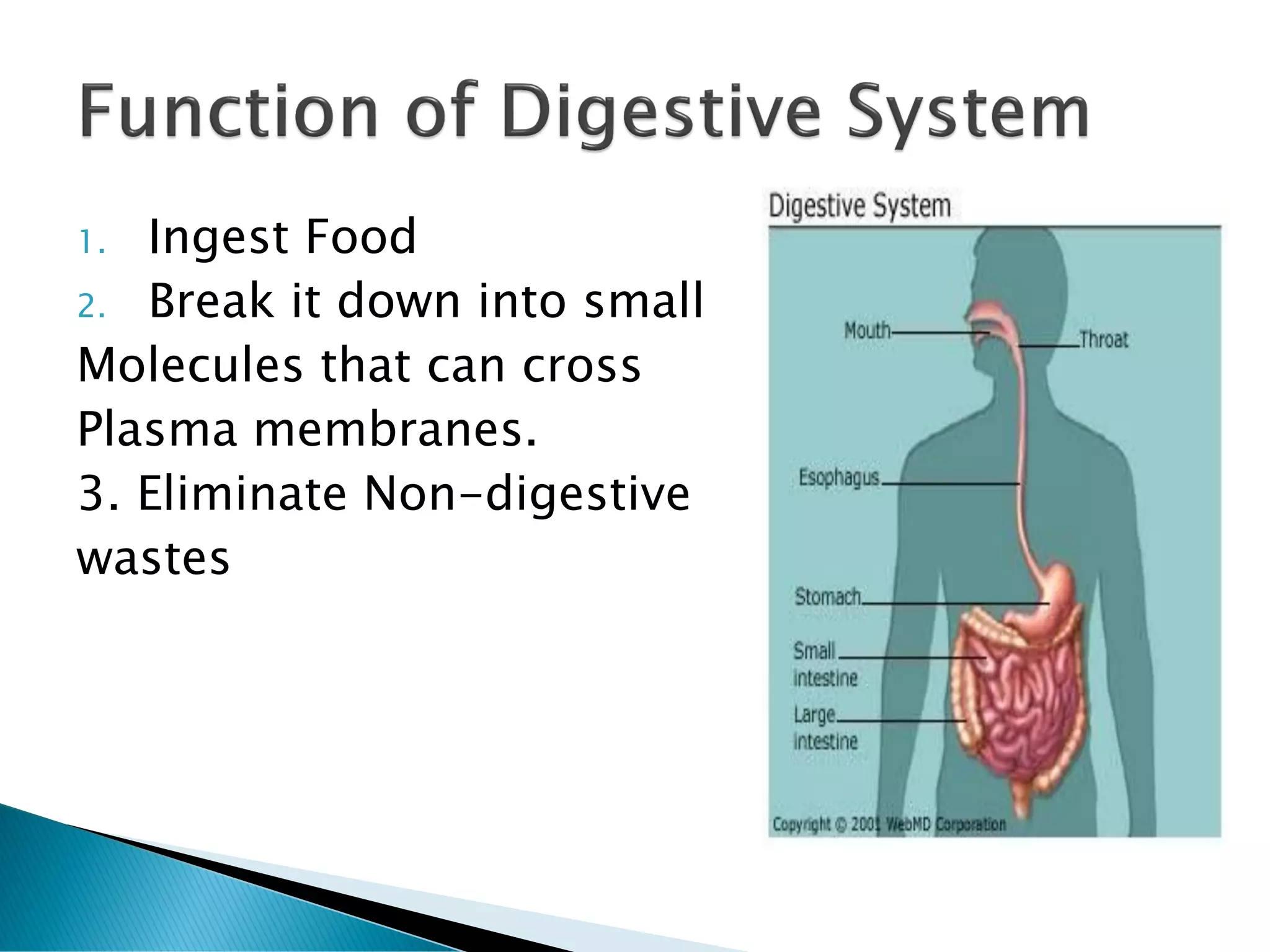
1. Ingest Food
2. Break it down into small
Molecules that can cross
Plasma membranes.
3. Eliminate Non-digestive
wastes
As of Action
1. Mechanical Digestion
- food is converted into small pieces by
physical means such as mastication by the
teeth
2. Chemical Digestion
- food is converted into simpler forms by the
action of enzymes.
As to Location
1. Intracellular Digestion
- inside the cell particularly in the
lysosomes, characteristics of unicellular
organisms.
2. Extracellular Digestion
- outside the cell
- inside the digestive tube
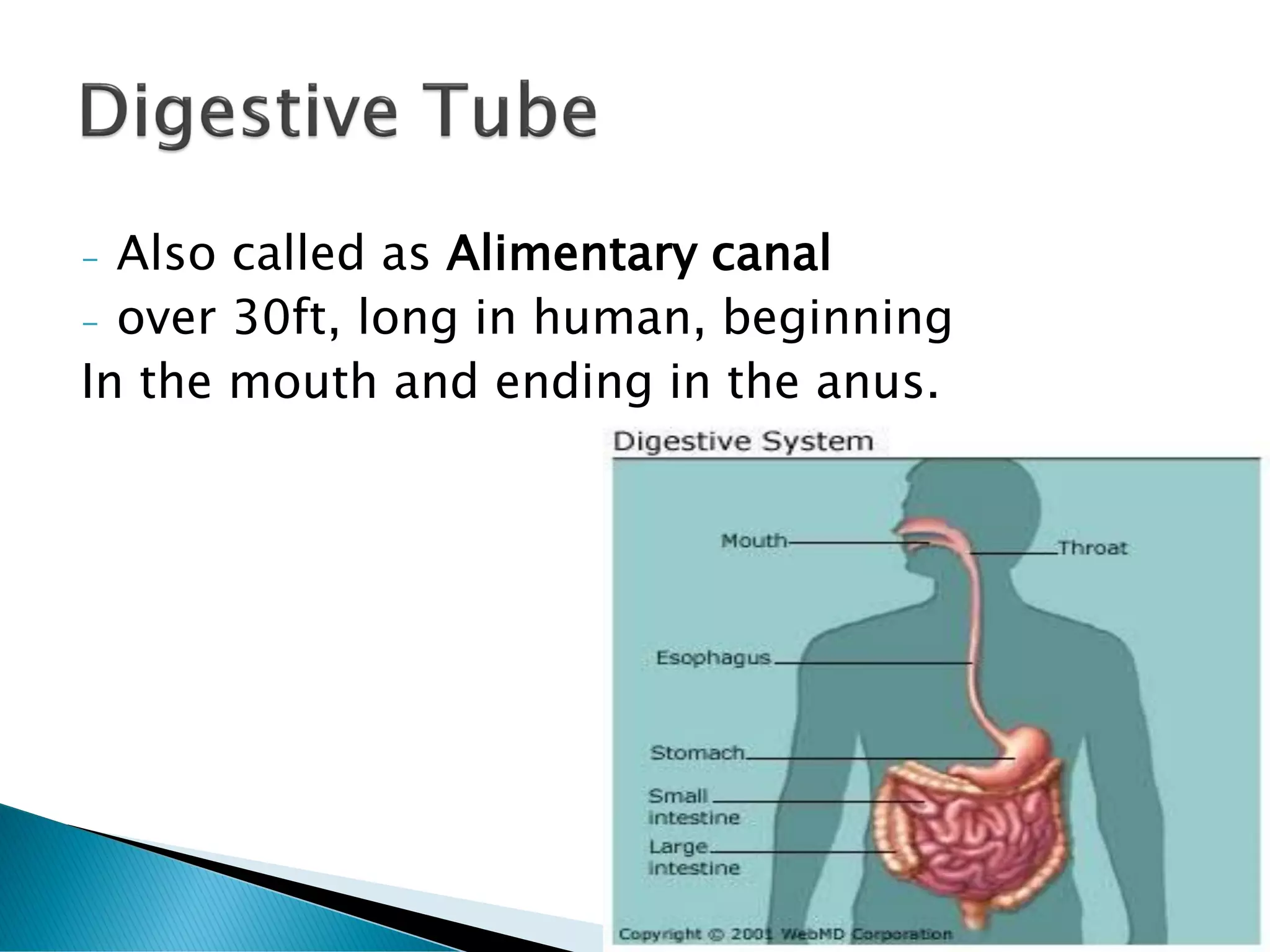
- Also called as Alimentary canal
- over 30ft, long in human, beginning
In the mouth and ending in the anus.
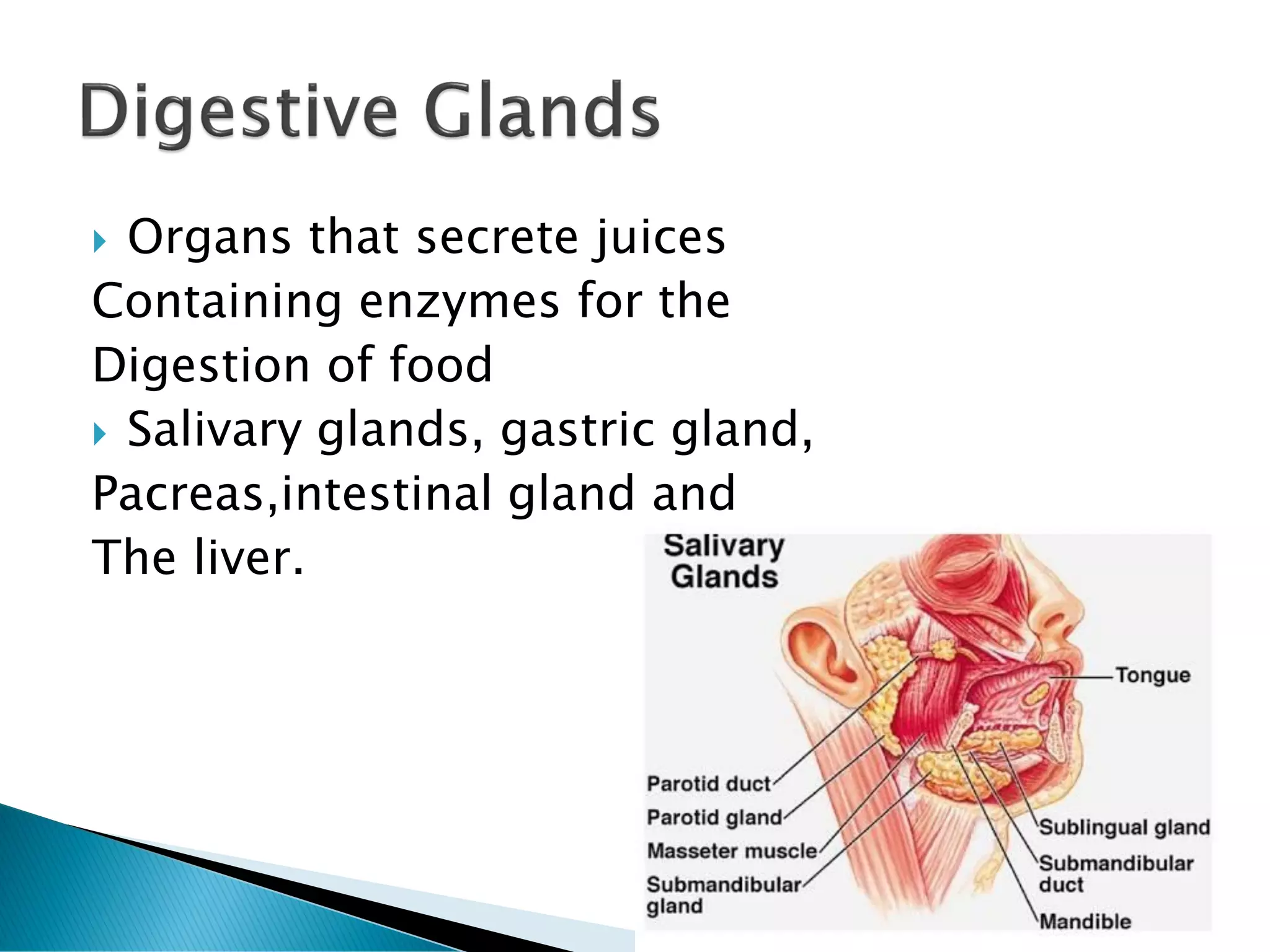
 Organs that secrete juices
Containing enzymes for the
Digestion of food
 Salivary glands, gastric gland,
Pacreas,intestinal gland and
The liver.
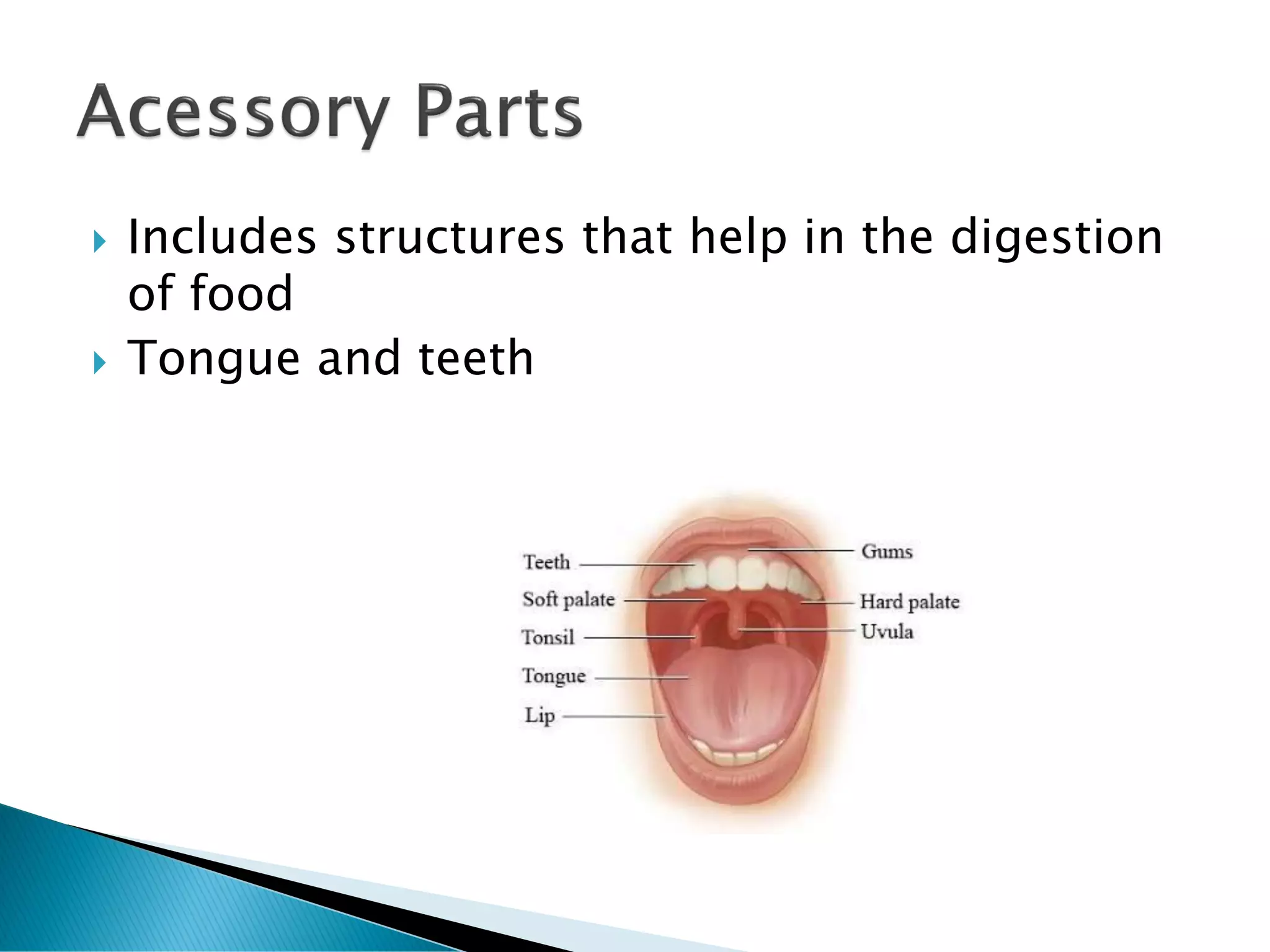
 Includes structures that help in the digestion
of food
 Tongue and teeth
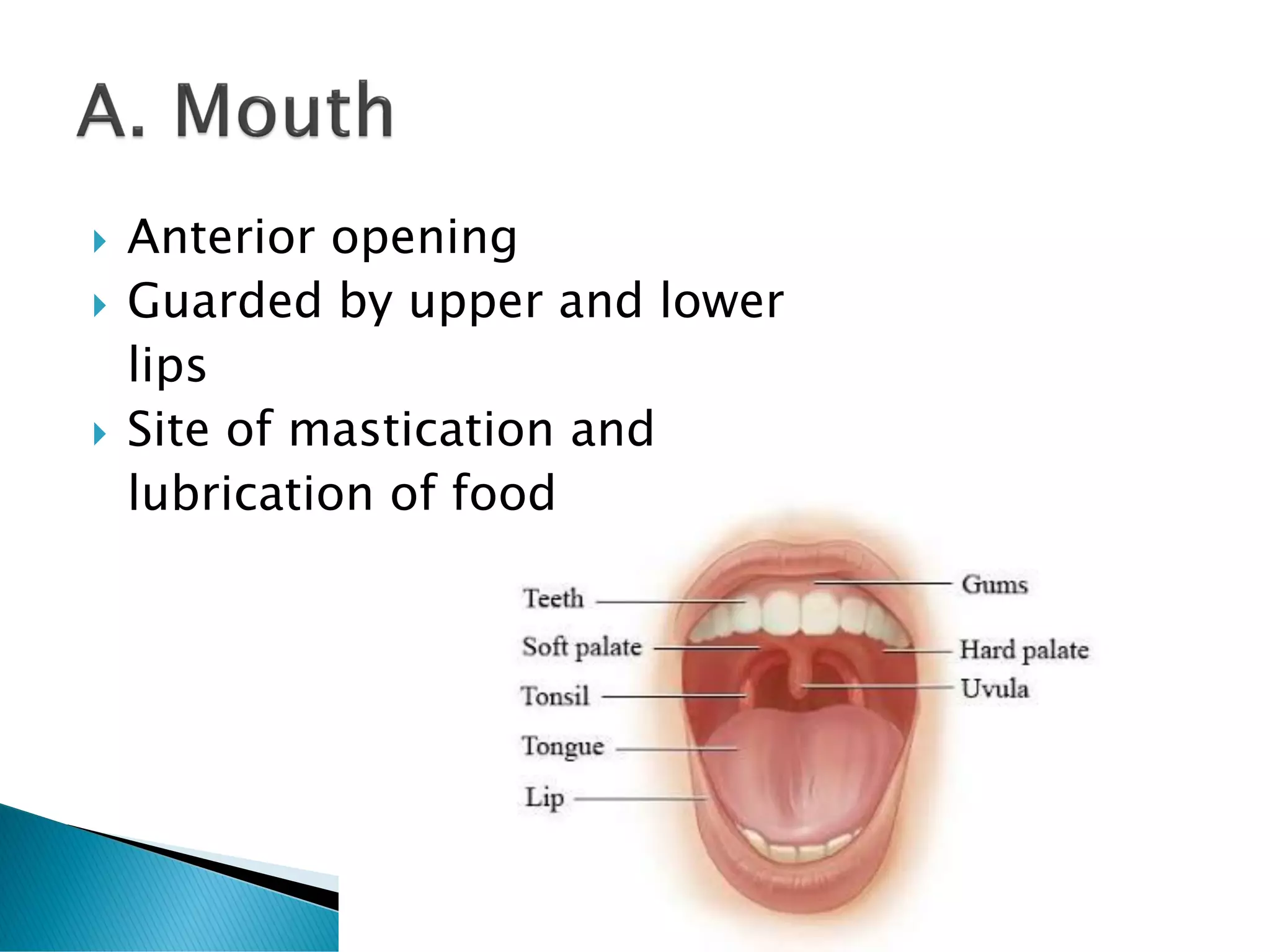
 Anterior opening
 Guarded by upper and lower
lips
 Site of mastication and
lubrication of food
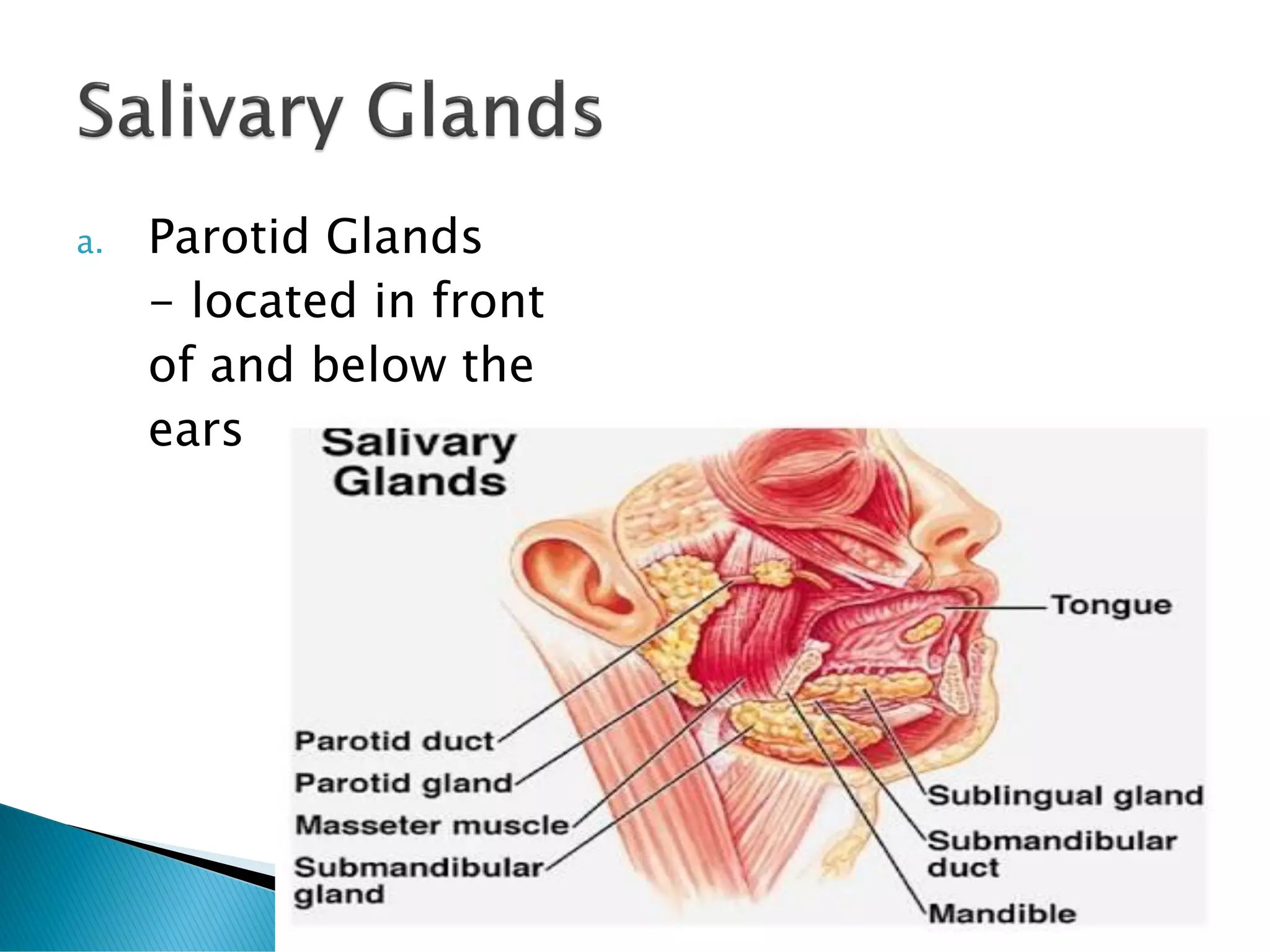
a. Parotid Glands
- located in front
of and below the
ears
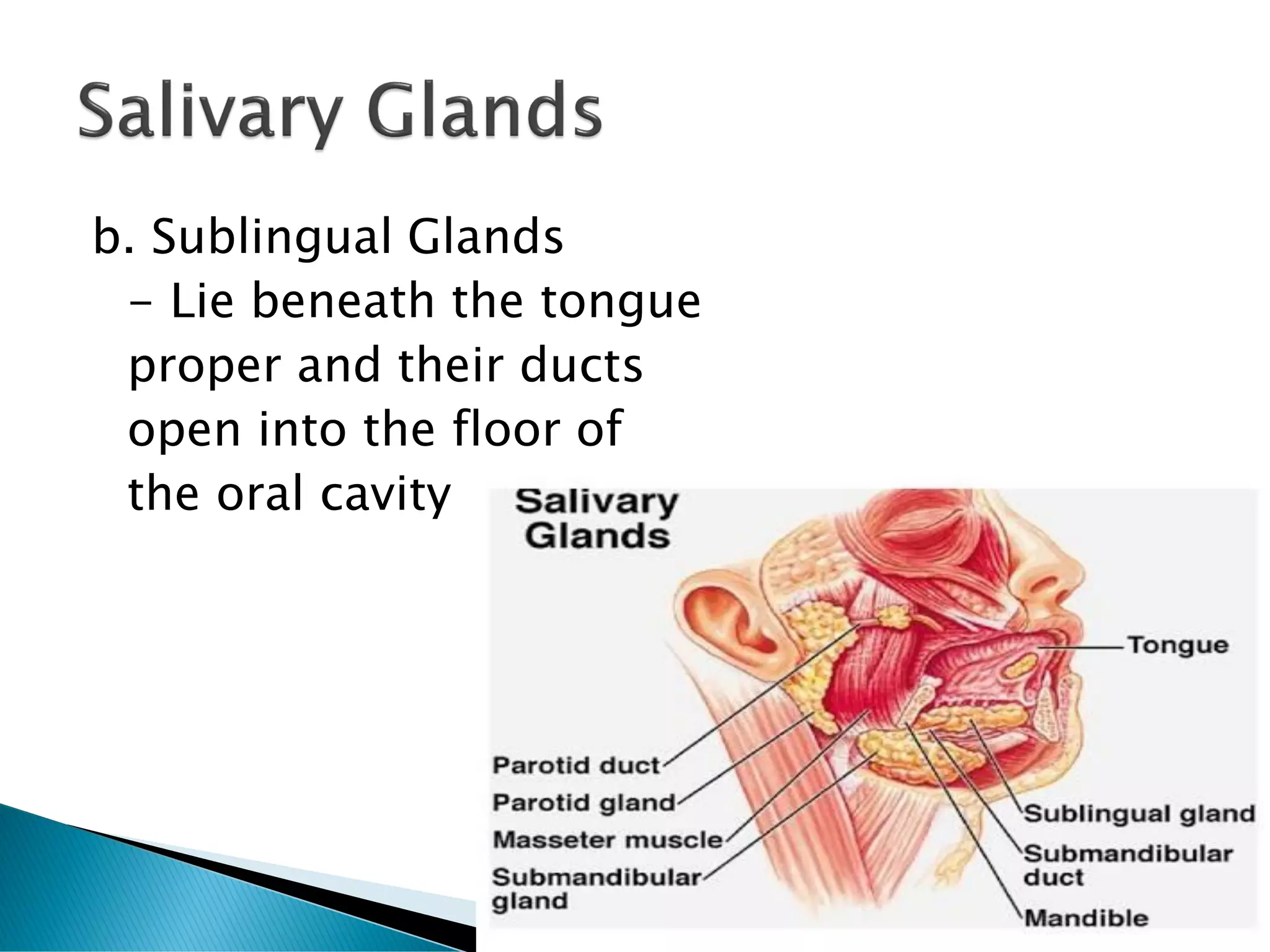
b. Sublingual Glands
- Lie beneath the tongue
proper and their ducts
open into the floor of
the oral cavity
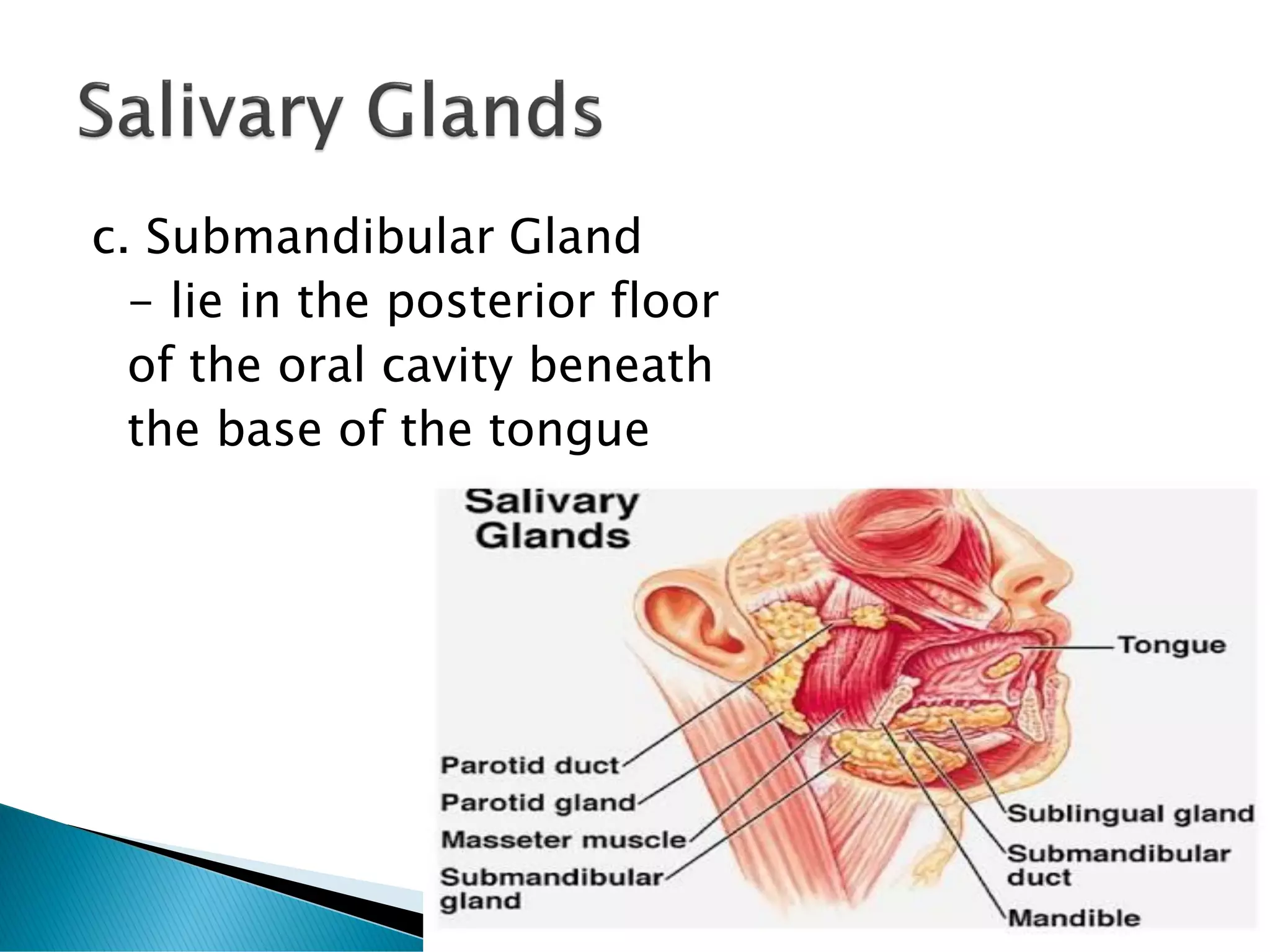
c. Submandibular Gland
- lie in the posterior floor
of the oral cavity beneath
the base of the tongue
 Produce about 1 liter of saliva a day
 Saliva contains mucus and a digestive
enzyme called salivary amylase.
 Teeth carry on mastication.
 Mastication breaks down food into smaller
portions.
 The tongue forms the chewed food into a
small mass called bolus for swallowing.
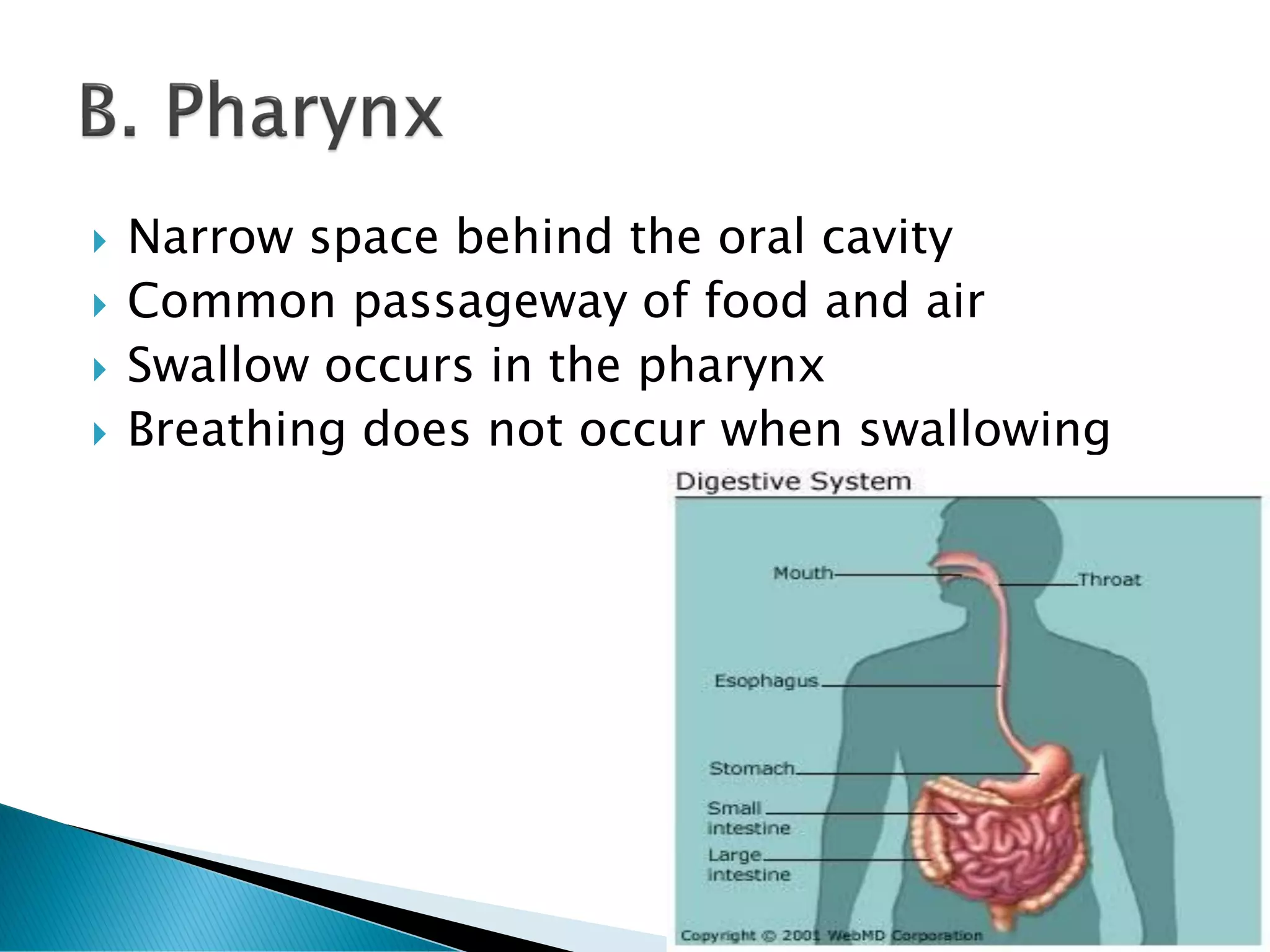
 Narrow space behind the oral cavity
 Common passageway of food and air
 Swallow occurs in the pharynx
 Breathing does not occur when swallowing
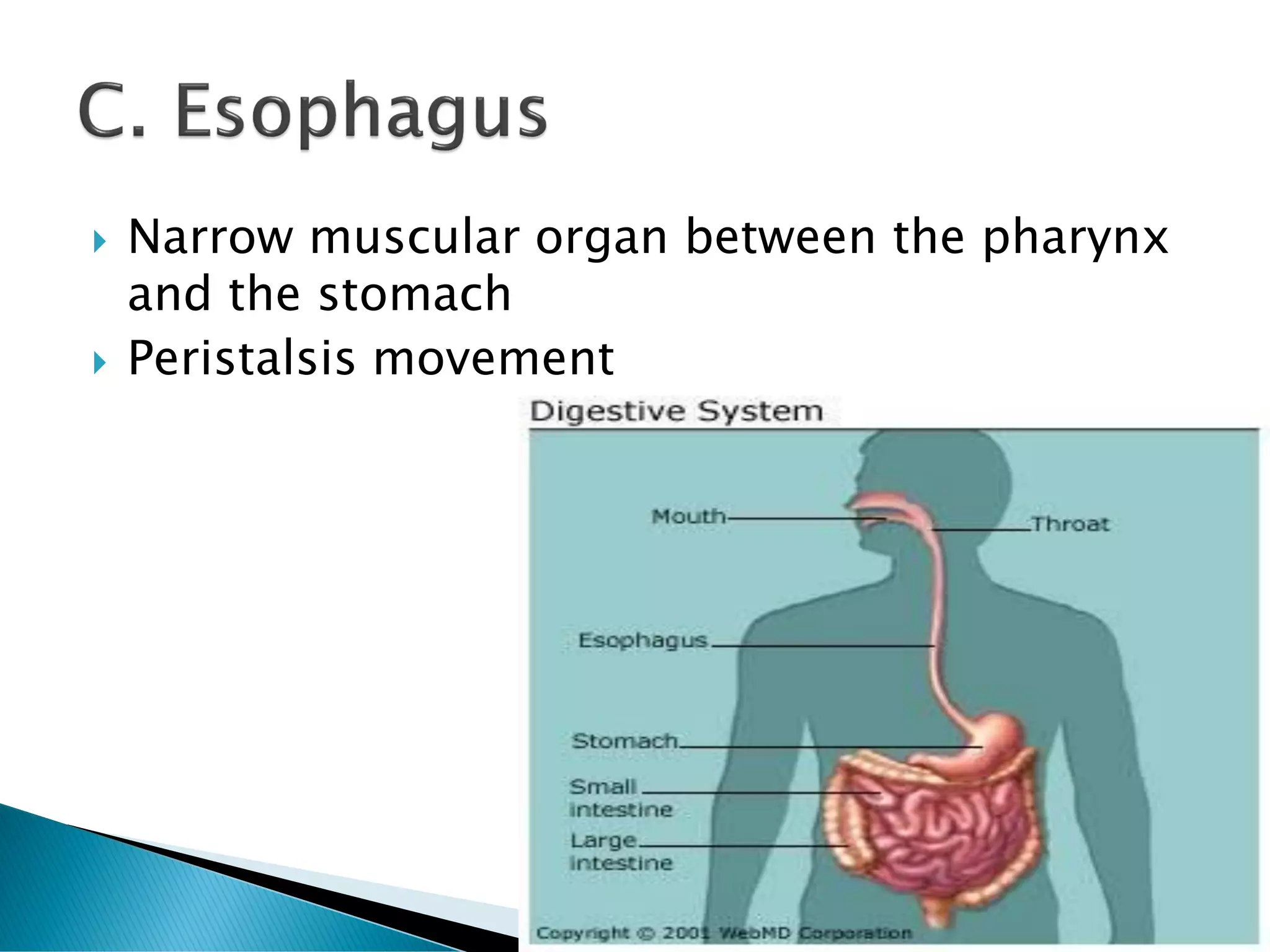
 Narrow muscular organ between the pharynx
and the stomach
 Peristalsis movement
 The largest and highly muscular part of the
digestive tube.
 Maximum capacity of 2.5 pints
 Food stays about 3 to 5 hours
 Churning movement
Cardiac Sphincter
- Anterior end
- prevents backward
movement of food
to the esophagus.
Fundus
-most expanded part
of the stomach.
Pyloric Sphincter
- posterior end
- regulates the
movement of food
to the small intestine
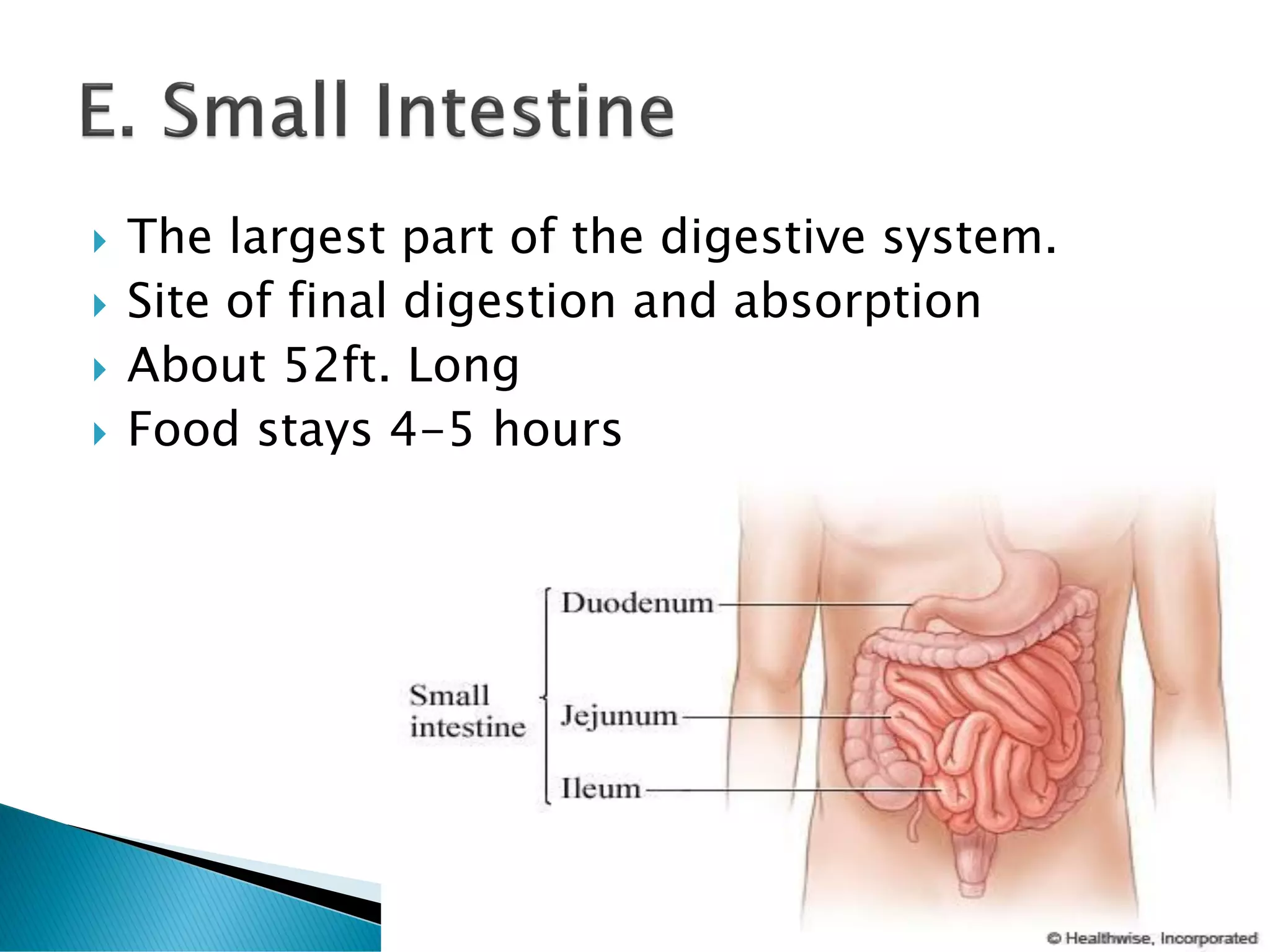
 The largest part of the digestive system.
 Site of final digestion and absorption
 About 52ft. Long
 Food stays 4-5 hours
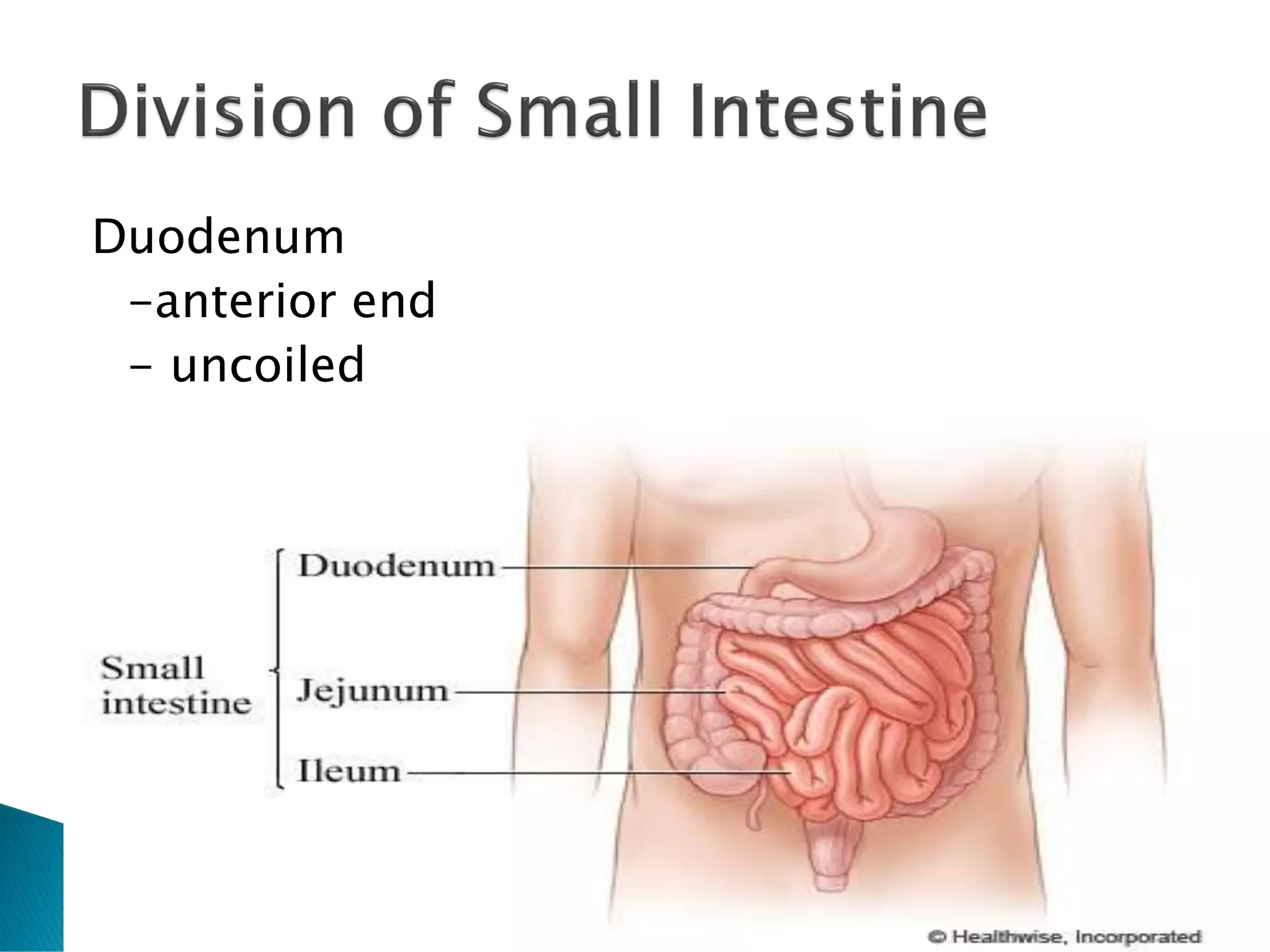
Duodenum
-anterior end
- uncoiled
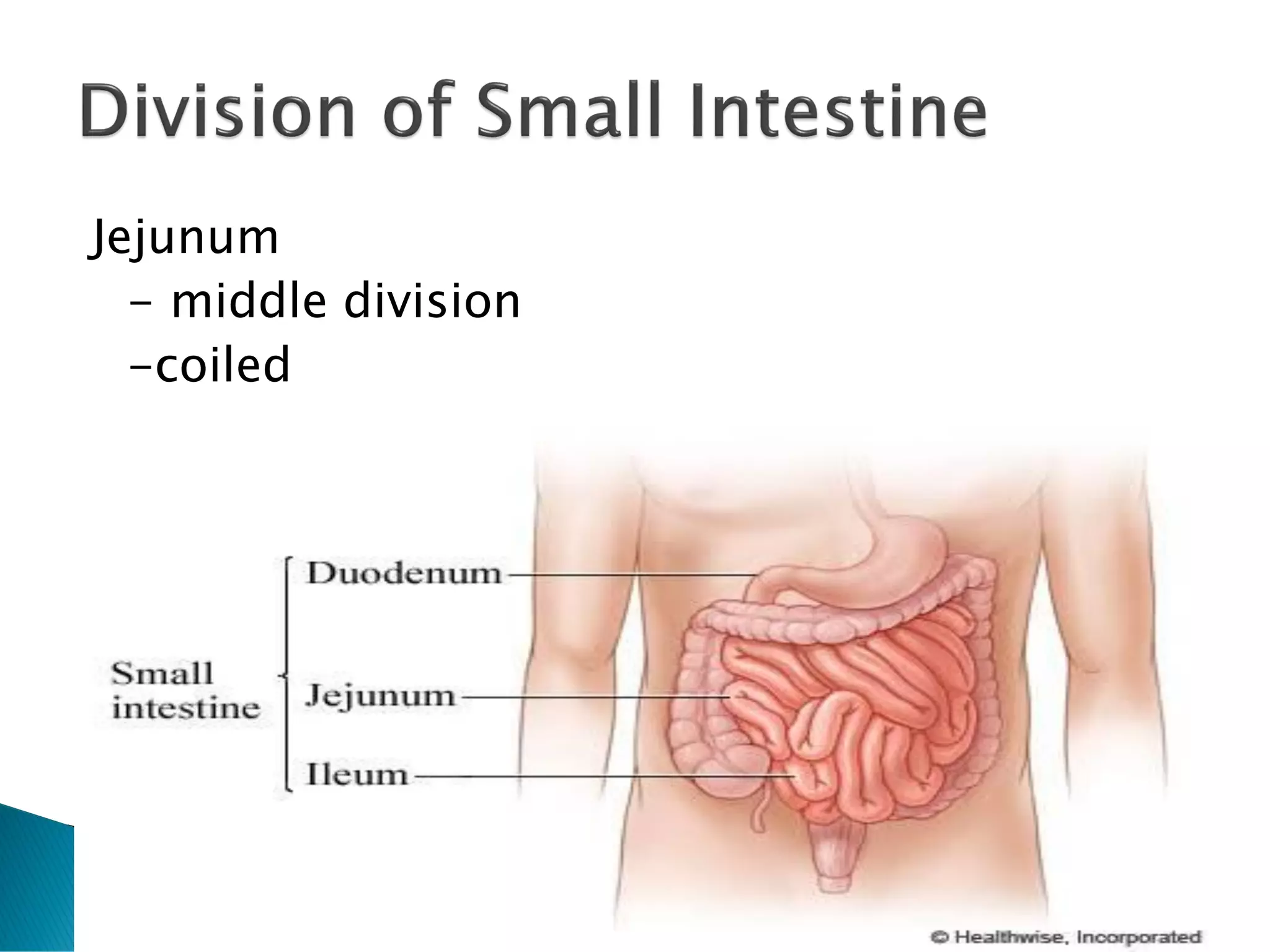
Jejunum
- middle division
-coiled
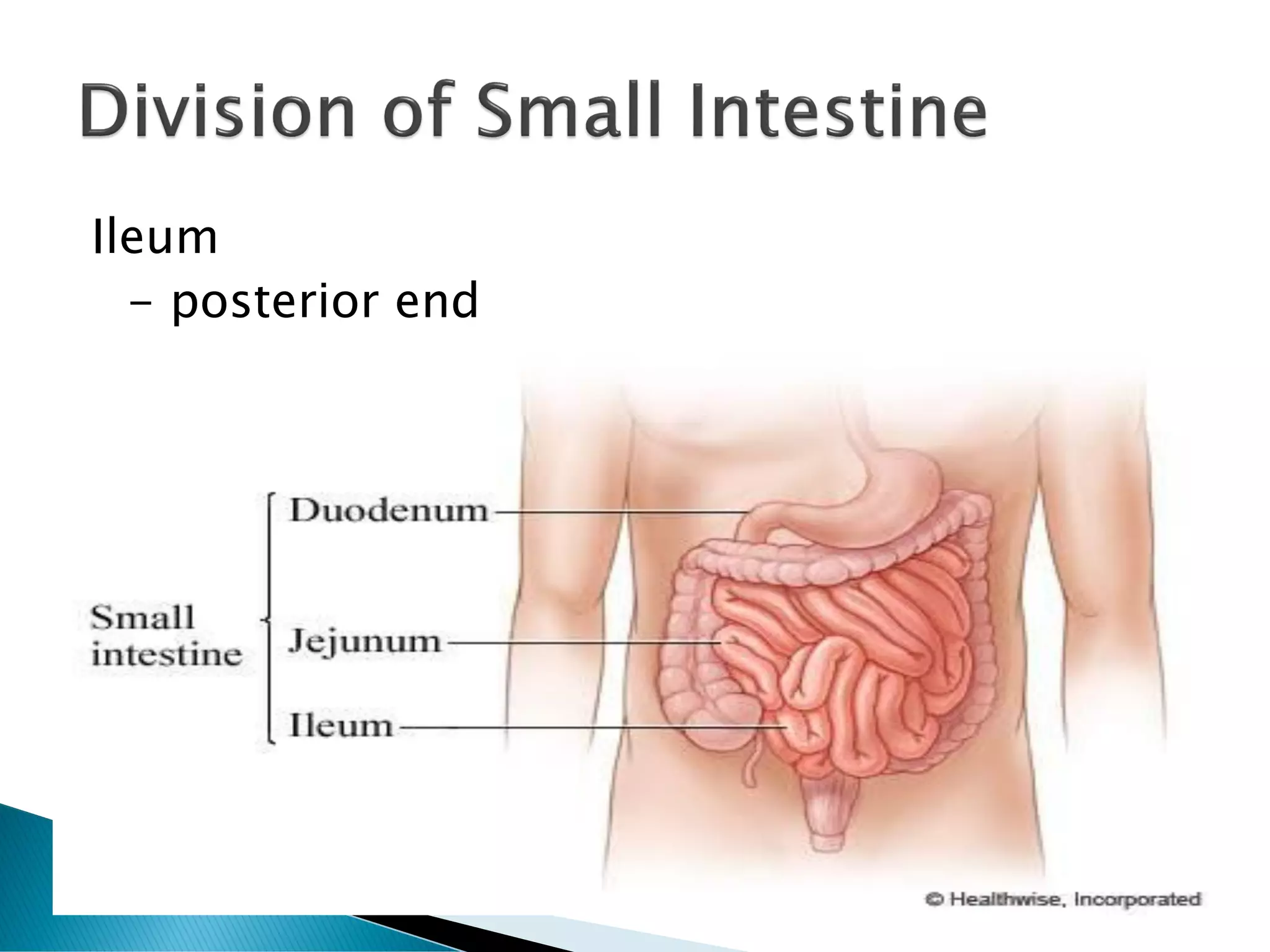
Ileum
- posterior end
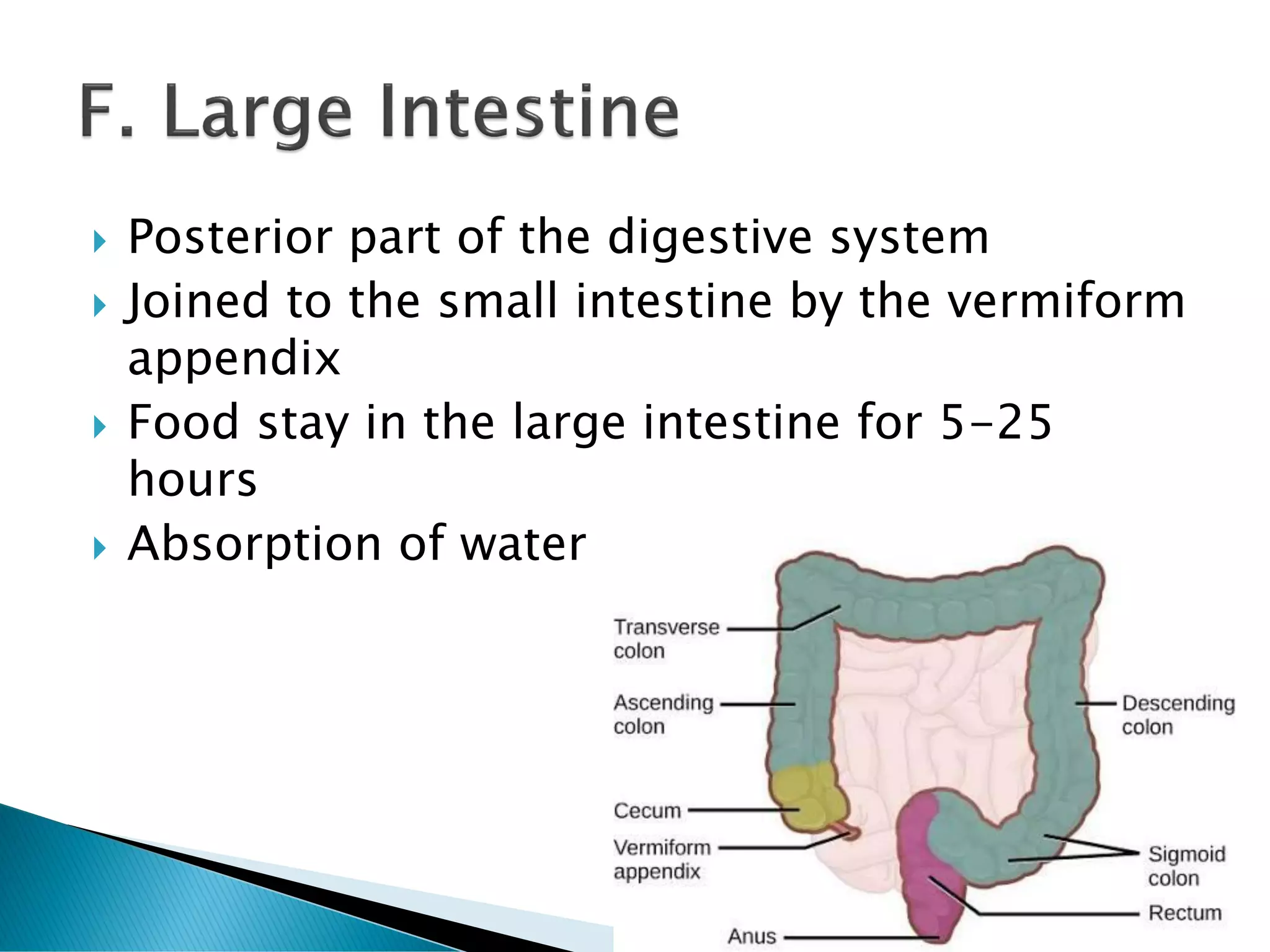
 Posterior part of the digestive system
 Joined to the small intestine by the vermiform
appendix
 Food stay in the large intestine for 5-25
hours
 Absorption of water
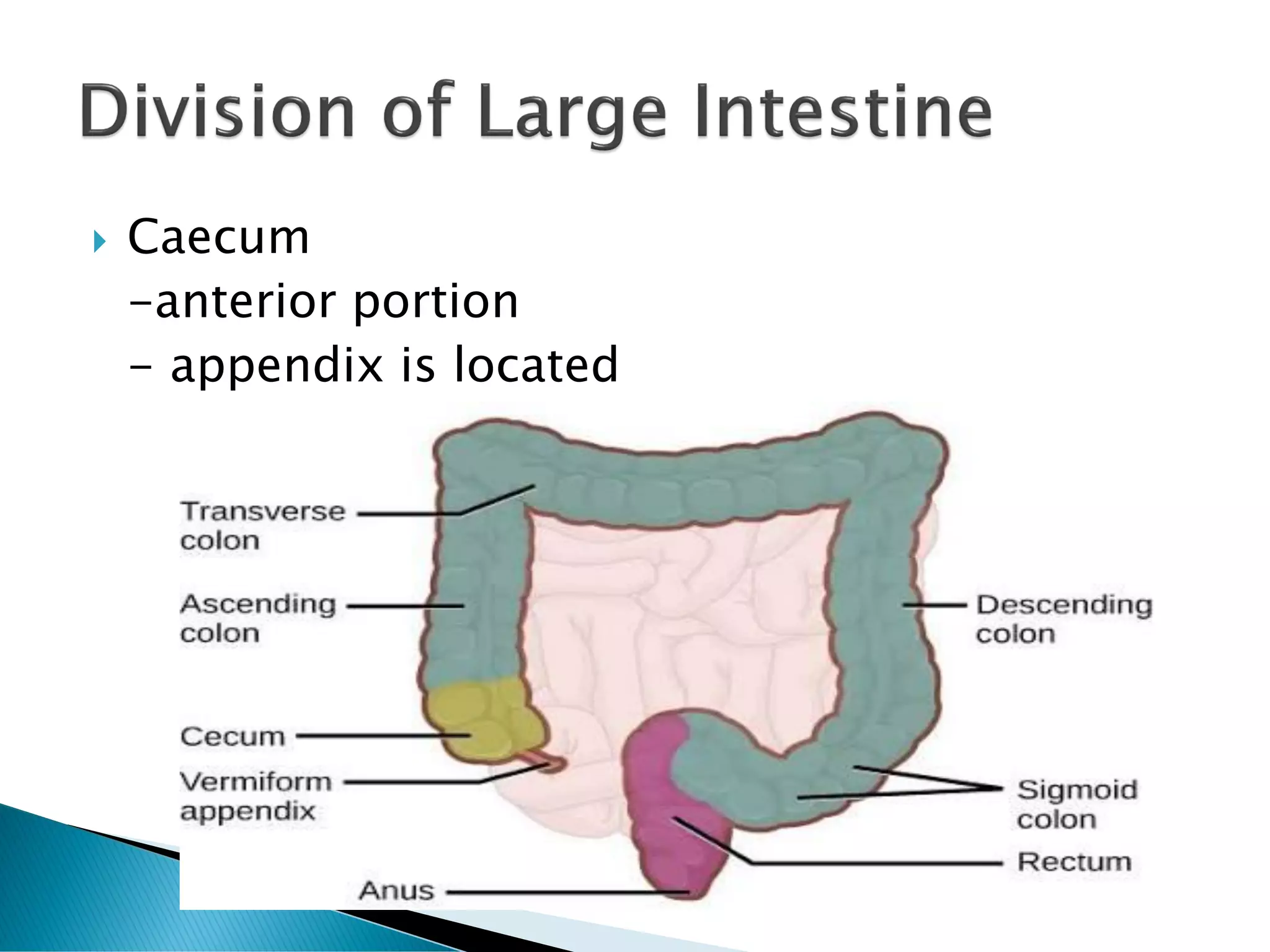
 Caecum
-anterior portion
- appendix is located
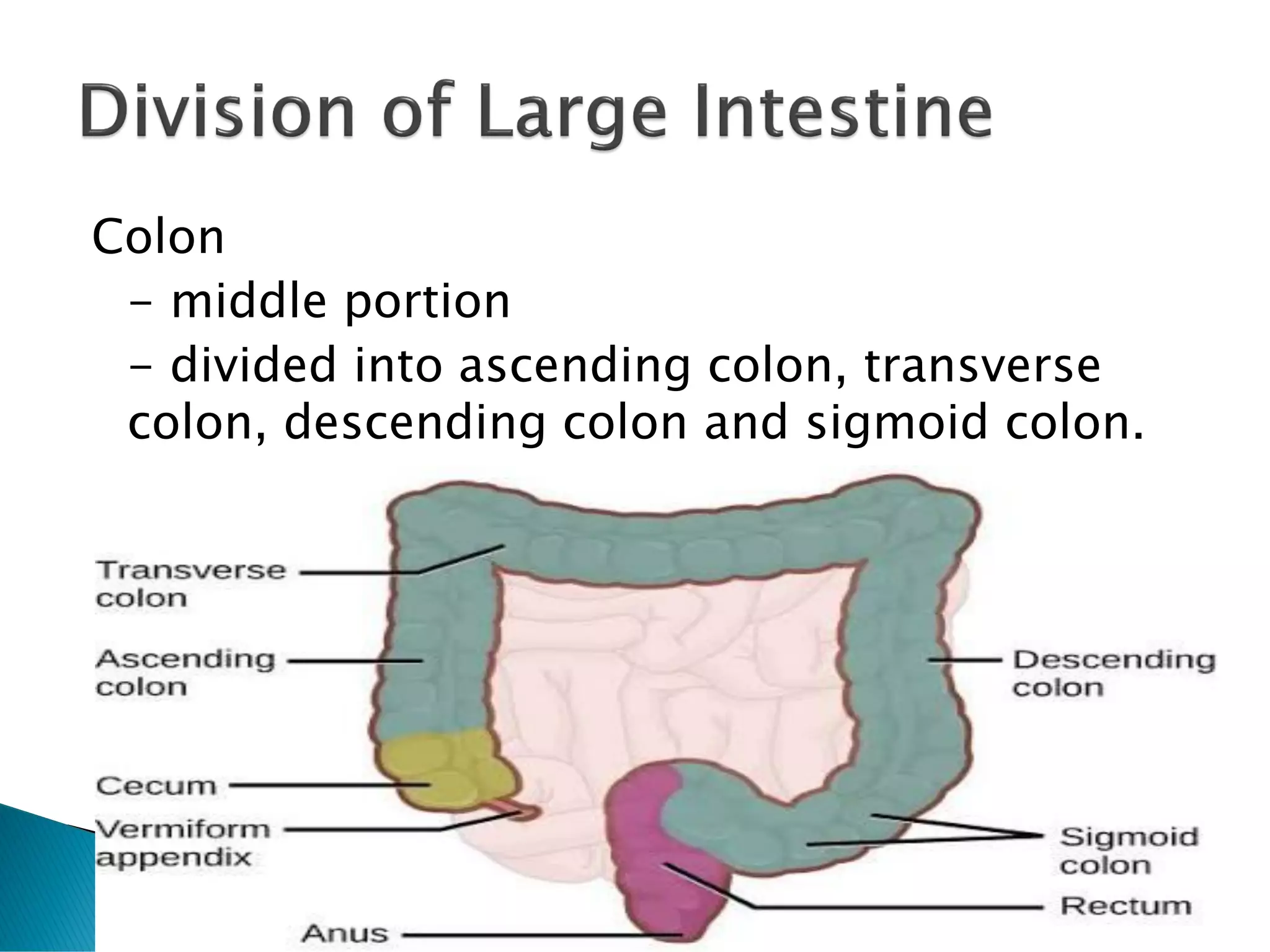
Colon
- middle portion
- divided into ascending colon, transverse
colon, descending colon and sigmoid colon.
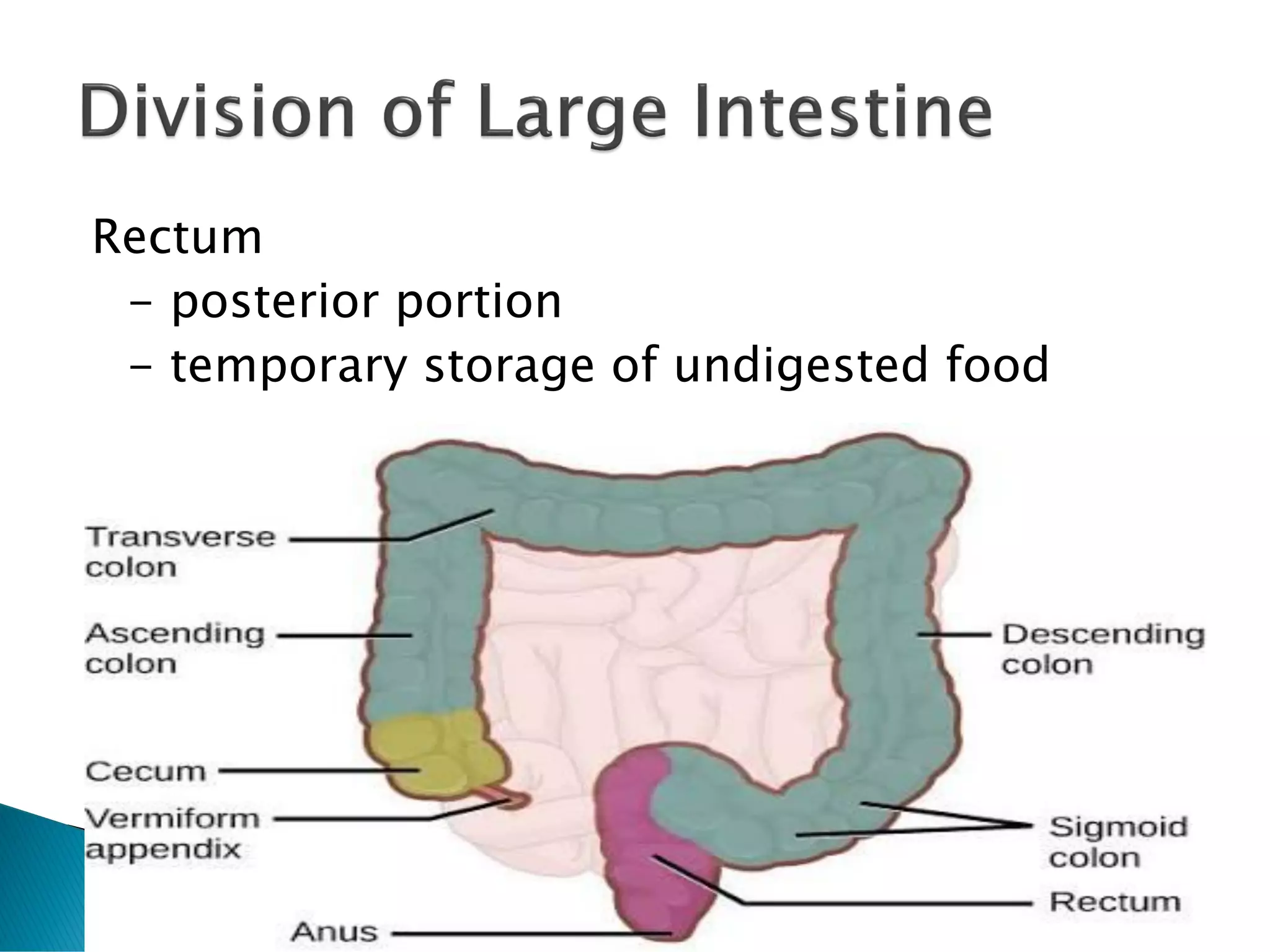
Rectum
- posterior portion
- temporary storage of undigested food
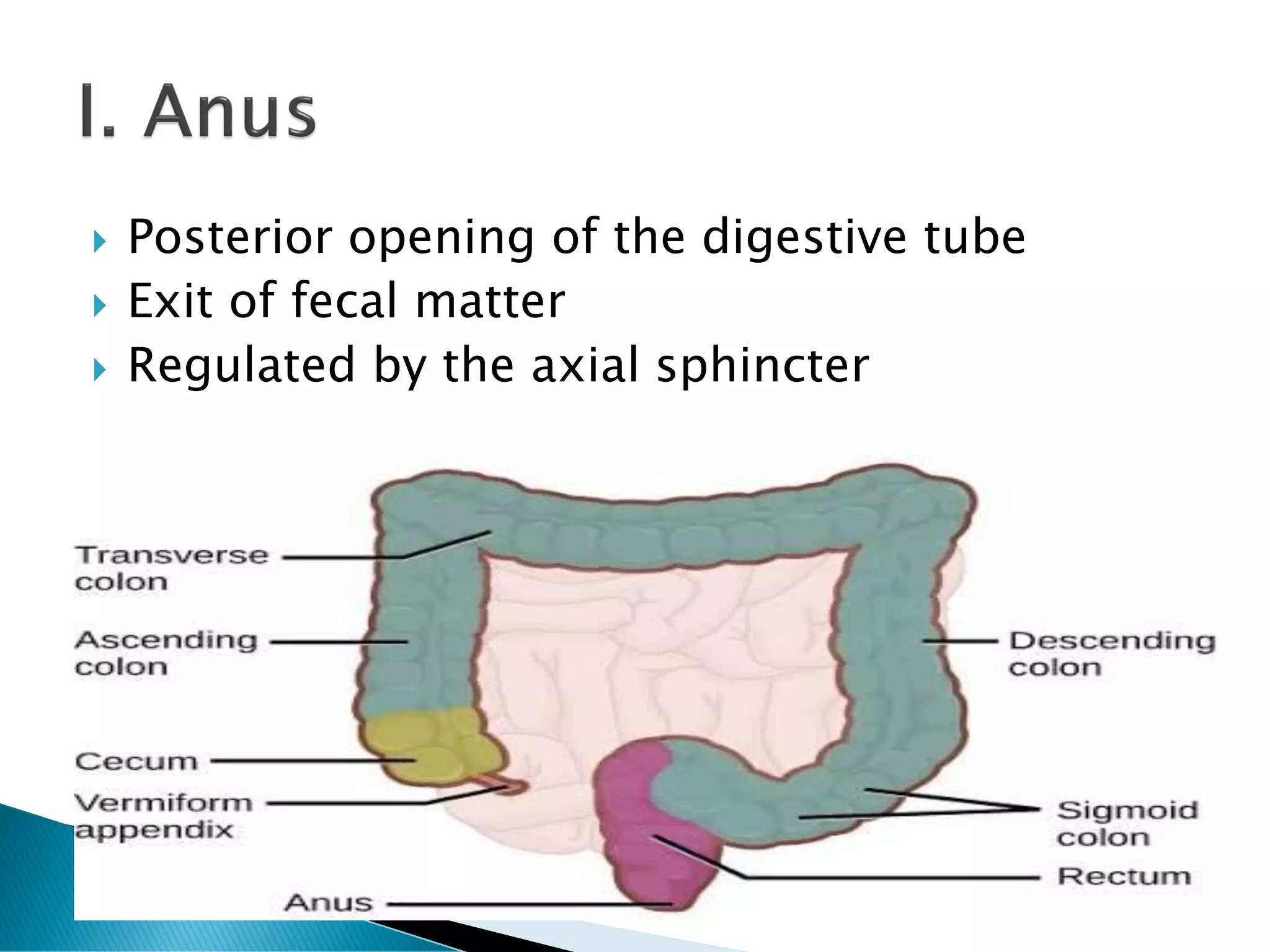
 Posterior opening of the digestive tube
 Exit of fecal matter
 Regulated by the axial sphincter
 Found in the oral cavity, esophagus and small
intestine and large intestine.
 Secrete mucin for lubrication of food.
 Found in the rugne of the stomach
 Secrete gastric juices
 Controlled by the medulla of the brain and by
the hormone gastrin.
Mucin- lubrication of food
HCl- coverts pepsinogen into pepsin
Pepsinogen- converted into pepsin by
HCl; digest protein into polypeptide
chains
Lipase- digests fat into fatty and
glycerol
 Found in the intestine
 Secrete intestinal juices
Mucin- lubrication of food
Enterokinase- activates trypsinogen to
trypsin
Nucleases- break nucleotides into
nitrogen bases, phosphoric acids and
pentoses.
 Found along the peripheral surface of the
duodenum
 Secretes pancreatic juice to the duodenum
through the pancreatic duct.
 The pancreas makes pancreatic juices and
hormones, including insulin.
 The pancreatic juices are enzymes that help
digest food in the small intestine.
 Insulin controls the amount of sugar in the
blood.
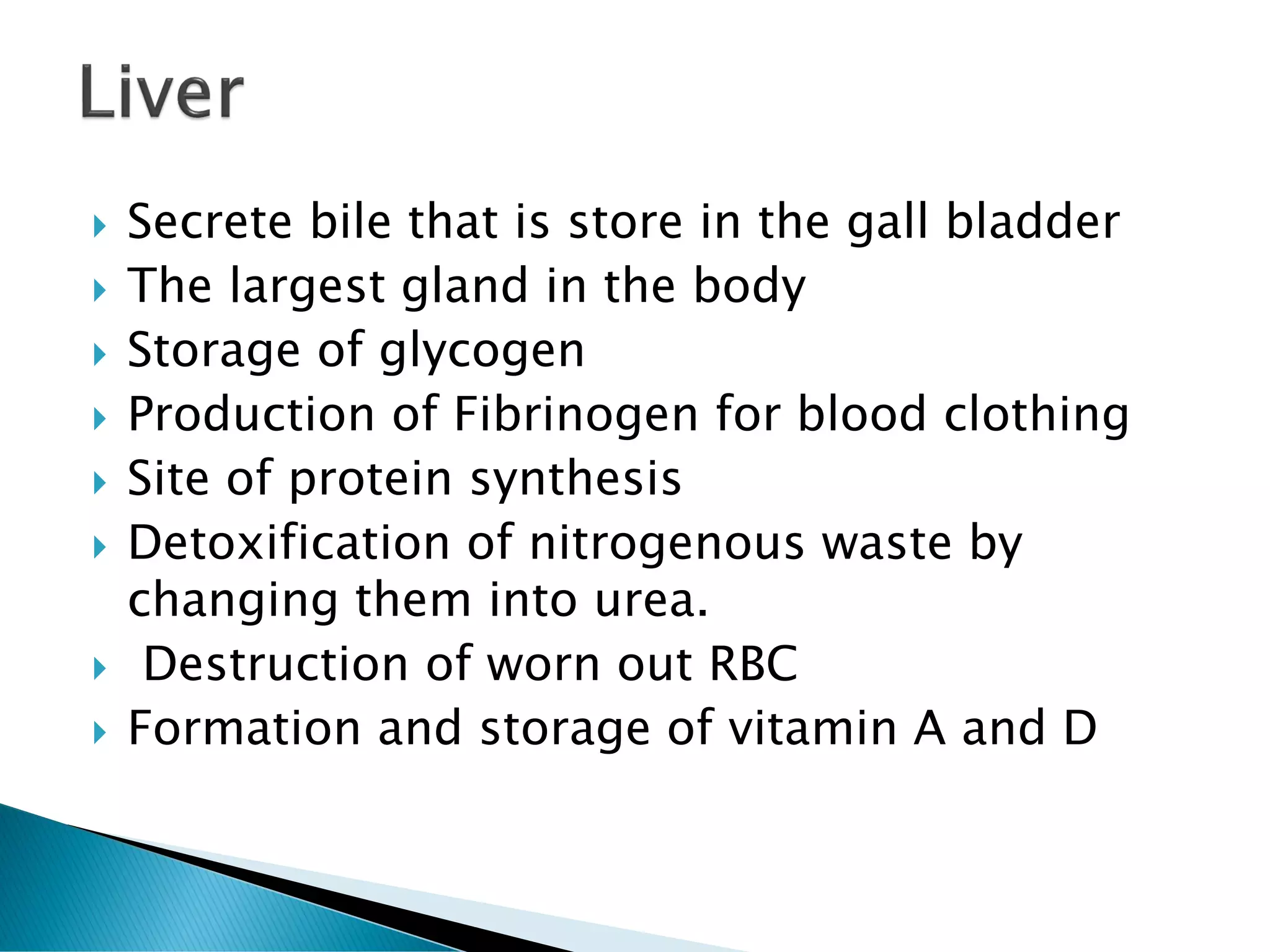
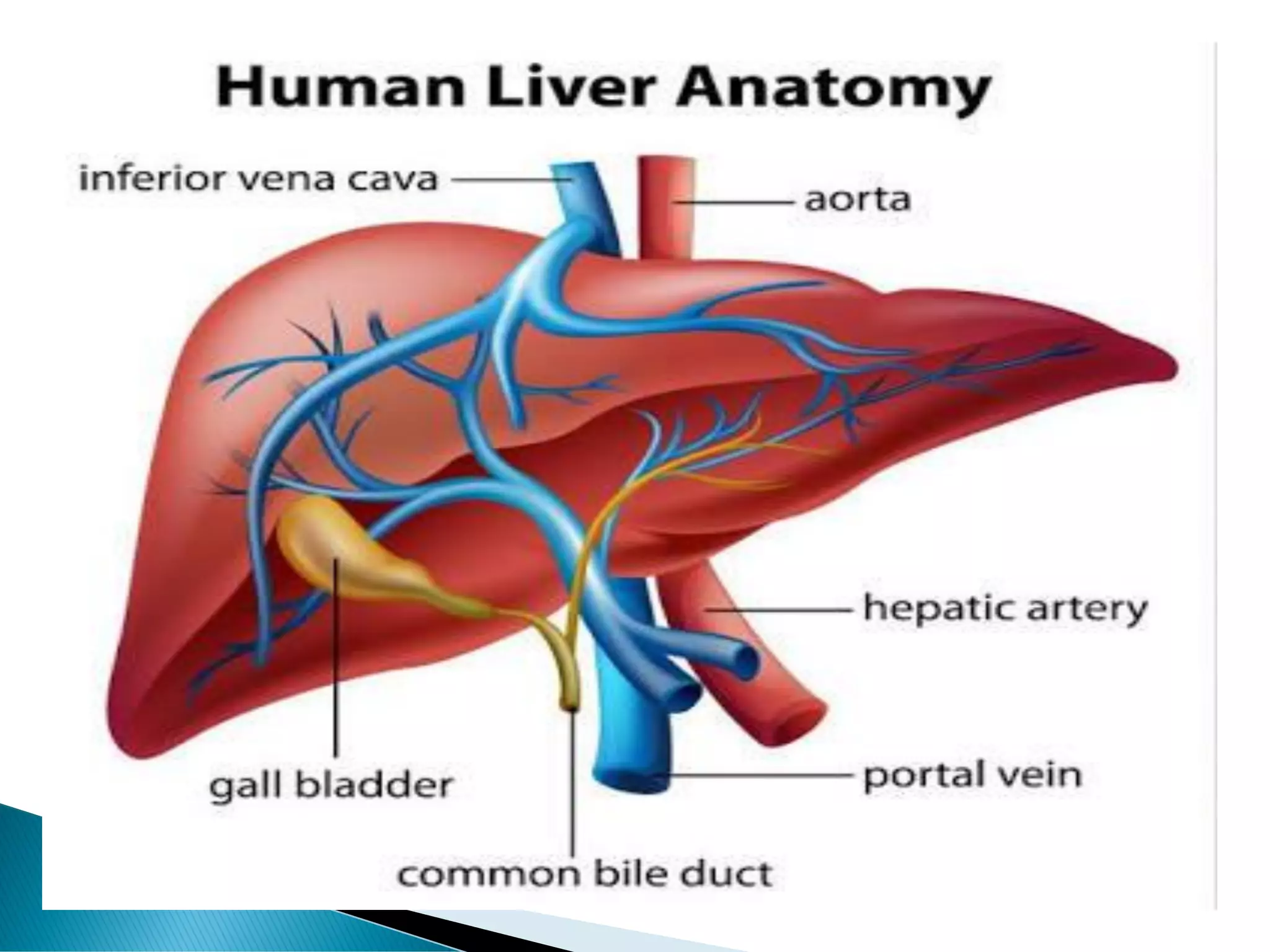
 Secrete bile that is store in the gall bladder
 The largest gland in the body
 Storage of glycogen
 Production of Fibrinogen for blood clothing
 Site of protein synthesis
 Detoxification of nitrogenous waste by
changing them into urea.
 Destruction of worn out RBC
 Formation and storage of vitamin A and D
 The primary function of the GI tract is to
move nutrients, water and electrolytes from
the external environment into the body’s
internal environment.
 The body meets physiological challenges by
coordinating the four basic processes of the
digestive system.
THE GI tract
- muscular alimentary canal
 Mouth
 Pharynx
 Esophagus
 Stomach
 Small intestine
 Large intestine
 Anus
The accessory digestive organs
-Supply secretions contributing to the
breakdown of food
 Teeth and tongue
 Liver
 Pancreas
 Gall Bladder
 Salivary Glands
1. Digestive
- the chemical and mechanical breakdown of
foods into smaller units that can be taken
across the internal epithelium unto the body.
2. Absorption
- The transfer of substances from the GI
tract to the extracellular fluid.
3. Motility
- movement of materials in the GI tract as
a result of muscle contraction
4. Secretion
- both the transepithelial transfer of water
and ions from extracellular fluid flood to the
digestive tract lumen and the release of
substances synthesized by GI cells.

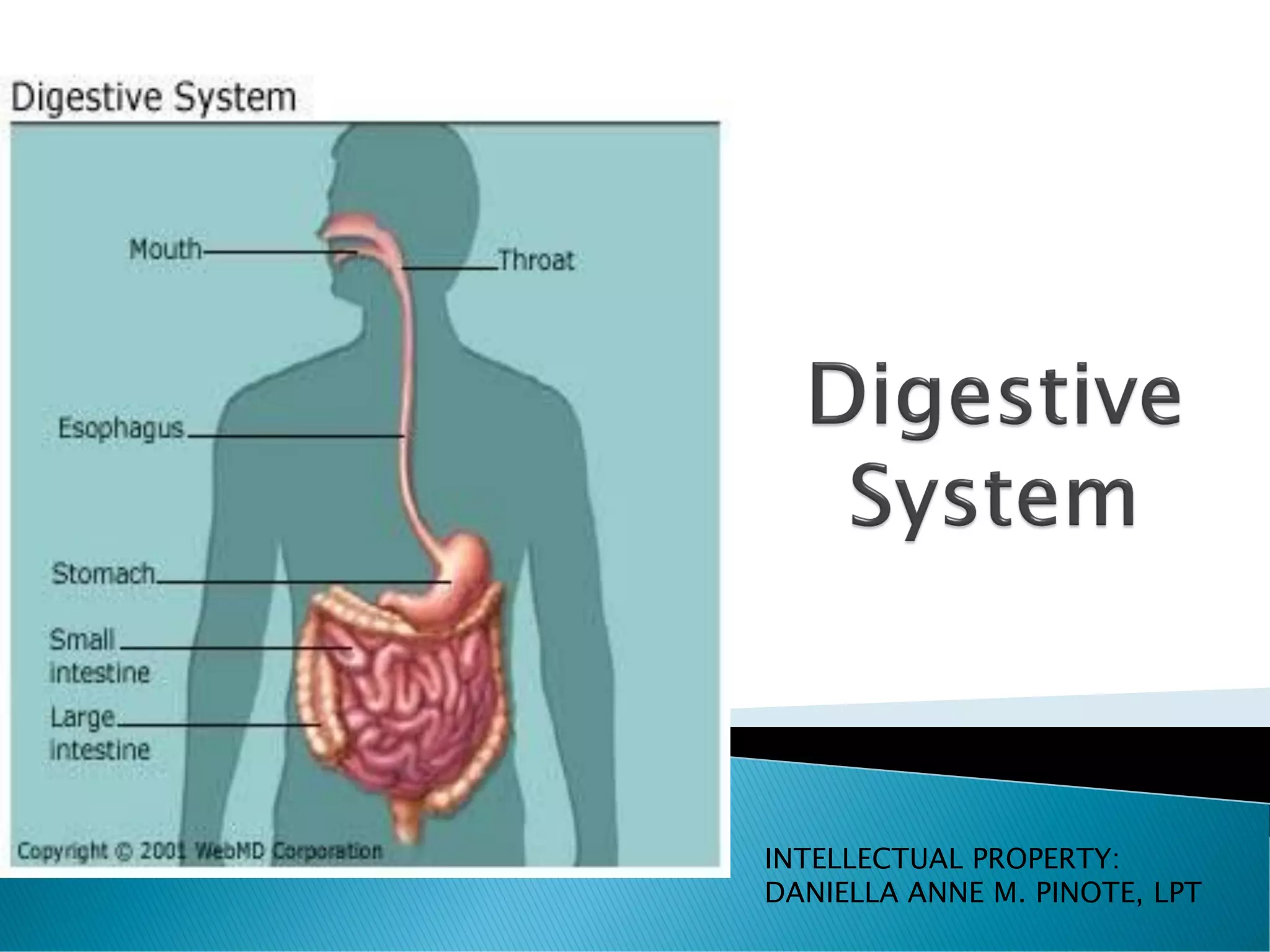
Digestive system

  • 1.
  • 2.
    1. Ingest Food 2.Break it down into small Molecules that can cross Plasma membranes. 3. Eliminate Non-digestive wastes
  • 3.
    As of Action 1.Mechanical Digestion - food is converted into small pieces by physical means such as mastication by the teeth 2. Chemical Digestion - food is converted into simpler forms by the action of enzymes.
  • 4.
    As to Location 1.Intracellular Digestion - inside the cell particularly in the lysosomes, characteristics of unicellular organisms. 2. Extracellular Digestion - outside the cell - inside the digestive tube
  • 5.
    - Also calledas Alimentary canal - over 30ft, long in human, beginning In the mouth and ending in the anus.
  • 6.
     Organs thatsecrete juices Containing enzymes for the Digestion of food  Salivary glands, gastric gland, Pacreas,intestinal gland and The liver.
  • 7.
     Includes structuresthat help in the digestion of food  Tongue and teeth
  • 9.
     Anterior opening Guarded by upper and lower lips  Site of mastication and lubrication of food
  • 10.
    a. Parotid Glands -located in front of and below the ears
  • 11.
    b. Sublingual Glands -Lie beneath the tongue proper and their ducts open into the floor of the oral cavity
  • 12.
    c. Submandibular Gland -lie in the posterior floor of the oral cavity beneath the base of the tongue
  • 13.
     Produce about1 liter of saliva a day  Saliva contains mucus and a digestive enzyme called salivary amylase.  Teeth carry on mastication.  Mastication breaks down food into smaller portions.  The tongue forms the chewed food into a small mass called bolus for swallowing.
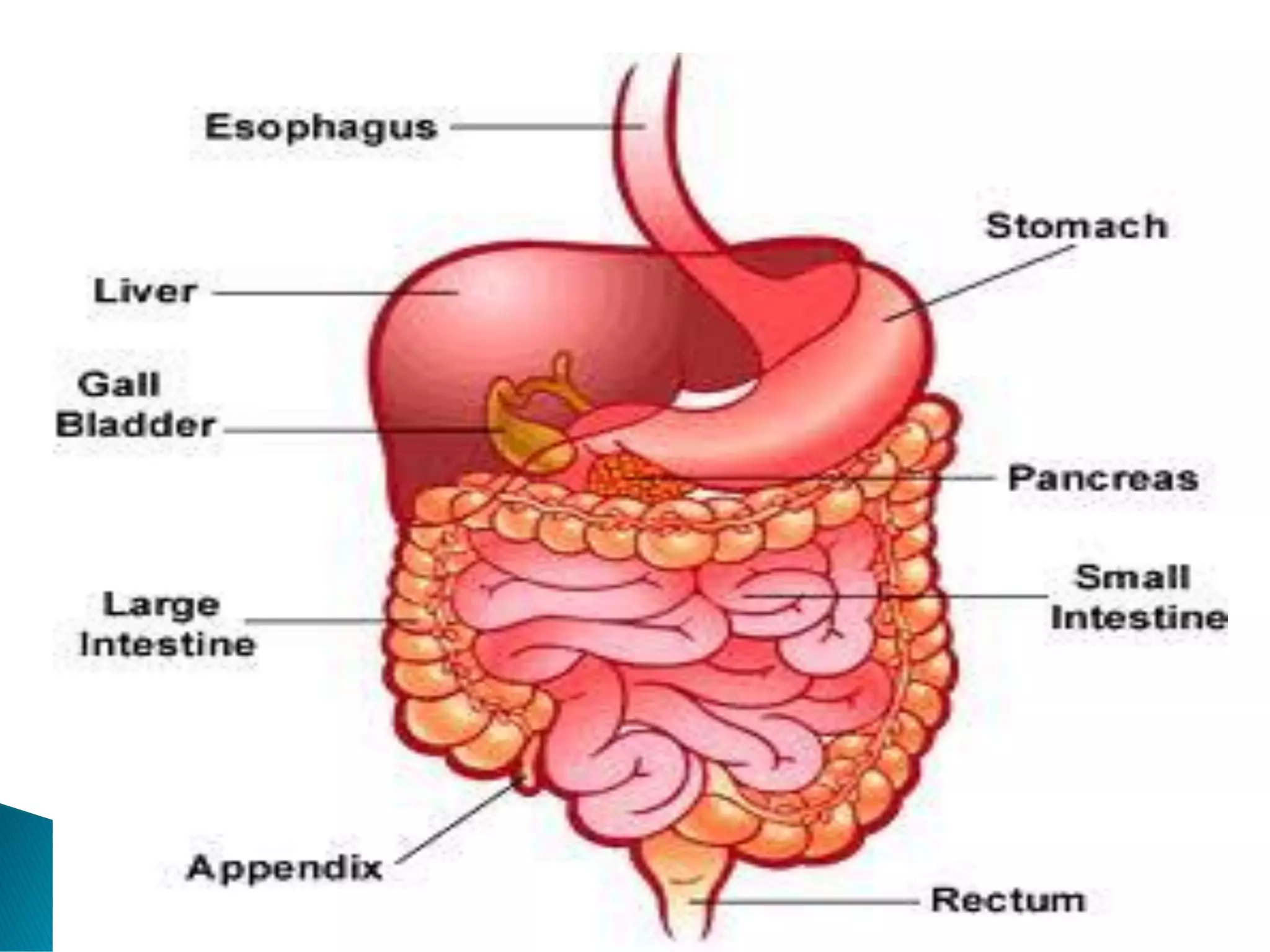
  • 14.
     Narrow spacebehind the oral cavity  Common passageway of food and air  Swallow occurs in the pharynx  Breathing does not occur when swallowing
  • 15.
     Narrow muscularorgan between the pharynx and the stomach  Peristalsis movement
  • 16.
     The largestand highly muscular part of the digestive tube.  Maximum capacity of 2.5 pints  Food stays about 3 to 5 hours  Churning movement
  • 17.
    Cardiac Sphincter - Anteriorend - prevents backward movement of food to the esophagus.
  • 18.
  • 19.
    Pyloric Sphincter - posteriorend - regulates the movement of food to the small intestine
  • 20.
     The largestpart of the digestive system.  Site of final digestion and absorption  About 52ft. Long  Food stays 4-5 hours
  • 21.
  • 22.
  • 23.
  • 24.
     Posterior partof the digestive system  Joined to the small intestine by the vermiform appendix  Food stay in the large intestine for 5-25 hours  Absorption of water
  • 25.
     Caecum -anterior portion -appendix is located
  • 26.
    Colon - middle portion -divided into ascending colon, transverse colon, descending colon and sigmoid colon.
  • 27.
    Rectum - posterior portion -temporary storage of undigested food
  • 28.
     Posterior openingof the digestive tube  Exit of fecal matter  Regulated by the axial sphincter
  • 30.
     Found inthe oral cavity, esophagus and small intestine and large intestine.  Secrete mucin for lubrication of food.
  • 31.
     Found inthe rugne of the stomach  Secrete gastric juices  Controlled by the medulla of the brain and by the hormone gastrin.
  • 32.
    Mucin- lubrication offood HCl- coverts pepsinogen into pepsin Pepsinogen- converted into pepsin by HCl; digest protein into polypeptide chains Lipase- digests fat into fatty and glycerol
  • 33.
     Found inthe intestine  Secrete intestinal juices
  • 34.
    Mucin- lubrication offood Enterokinase- activates trypsinogen to trypsin Nucleases- break nucleotides into nitrogen bases, phosphoric acids and pentoses.
  • 35.
     Found alongthe peripheral surface of the duodenum  Secretes pancreatic juice to the duodenum through the pancreatic duct.  The pancreas makes pancreatic juices and hormones, including insulin.  The pancreatic juices are enzymes that help digest food in the small intestine.  Insulin controls the amount of sugar in the blood.
  • 37.
     Secrete bilethat is store in the gall bladder  The largest gland in the body  Storage of glycogen  Production of Fibrinogen for blood clothing  Site of protein synthesis  Detoxification of nitrogenous waste by changing them into urea.  Destruction of worn out RBC  Formation and storage of vitamin A and D
  • 39.
     The primaryfunction of the GI tract is to move nutrients, water and electrolytes from the external environment into the body’s internal environment.  The body meets physiological challenges by coordinating the four basic processes of the digestive system.
  • 40.
    THE GI tract -muscular alimentary canal  Mouth  Pharynx  Esophagus  Stomach  Small intestine  Large intestine  Anus
  • 41.
    The accessory digestiveorgans -Supply secretions contributing to the breakdown of food  Teeth and tongue  Liver  Pancreas  Gall Bladder  Salivary Glands
  • 42.
    1. Digestive - thechemical and mechanical breakdown of foods into smaller units that can be taken across the internal epithelium unto the body. 2. Absorption - The transfer of substances from the GI tract to the extracellular fluid.
  • 43.
    3. Motility - movementof materials in the GI tract as a result of muscle contraction 4. Secretion - both the transepithelial transfer of water and ions from extracellular fluid flood to the digestive tract lumen and the release of substances synthesized by GI cells.