DIFFUSION OF INNOVATION
BY- VIJYATA || ASSISTANT PROFESSOR|| RANCHI WOMEN’S COLLEGE
Diffusion of innovation is
an area of research which
provides the framework for
exploring consumer
acceptance of any new
product, idea or event.
HOW ANY
INNOVATION GETS
ACCEPTED OR
REJECTED ??
DIFFUSION OF
INNOVATION
 DIFFUSION
PROCESS
 Diffusion is a macro process
concerned with the spread of
the new product (an
innovation) from its source to
the consuming public
 ADOPTION
PROCESS
 Adoption is a micro process
that focuses on the stages
through which an individual
consumer passes while
deciding to accept or reject
any new product.
THE DIFFUSION
PROCESS
Diffusion is the process by which the acceptance
of an innovation ( a new product, new service, new
idea, or new practice) is spread by communication
(mass media, salespeople, or informal
conversation) to the members of the social system
(a target market) over a period of time.
Elements of diffusion process includes
 The innovation
 The channel of communication
 The social system
 Time
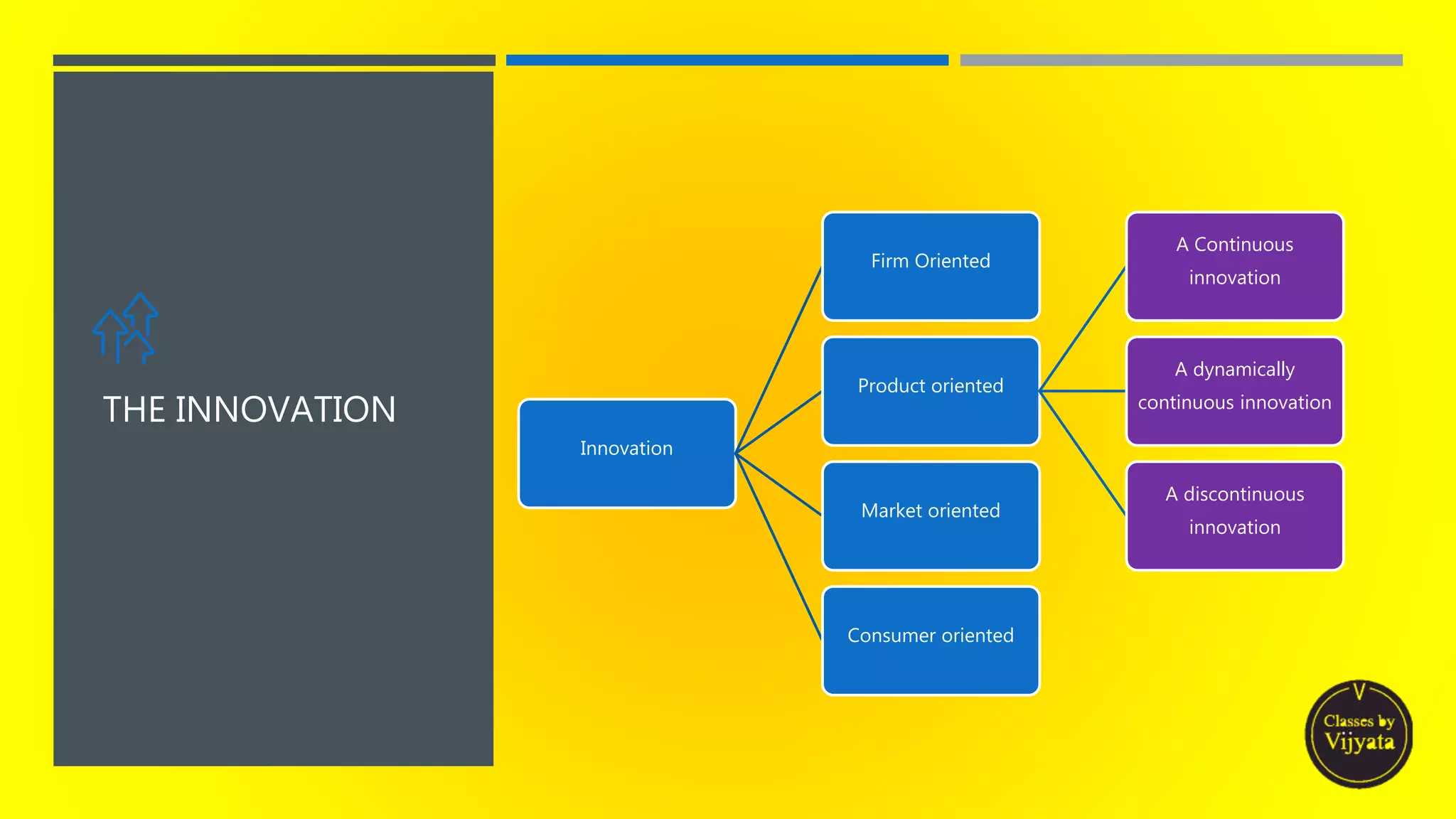
Innovation
Firm Oriented
Product oriented
A Continuous
innovation
A dynamically
continuous innovation
A discontinuous
innovation
Market oriented
Consumer oriented
THE INNOVATION
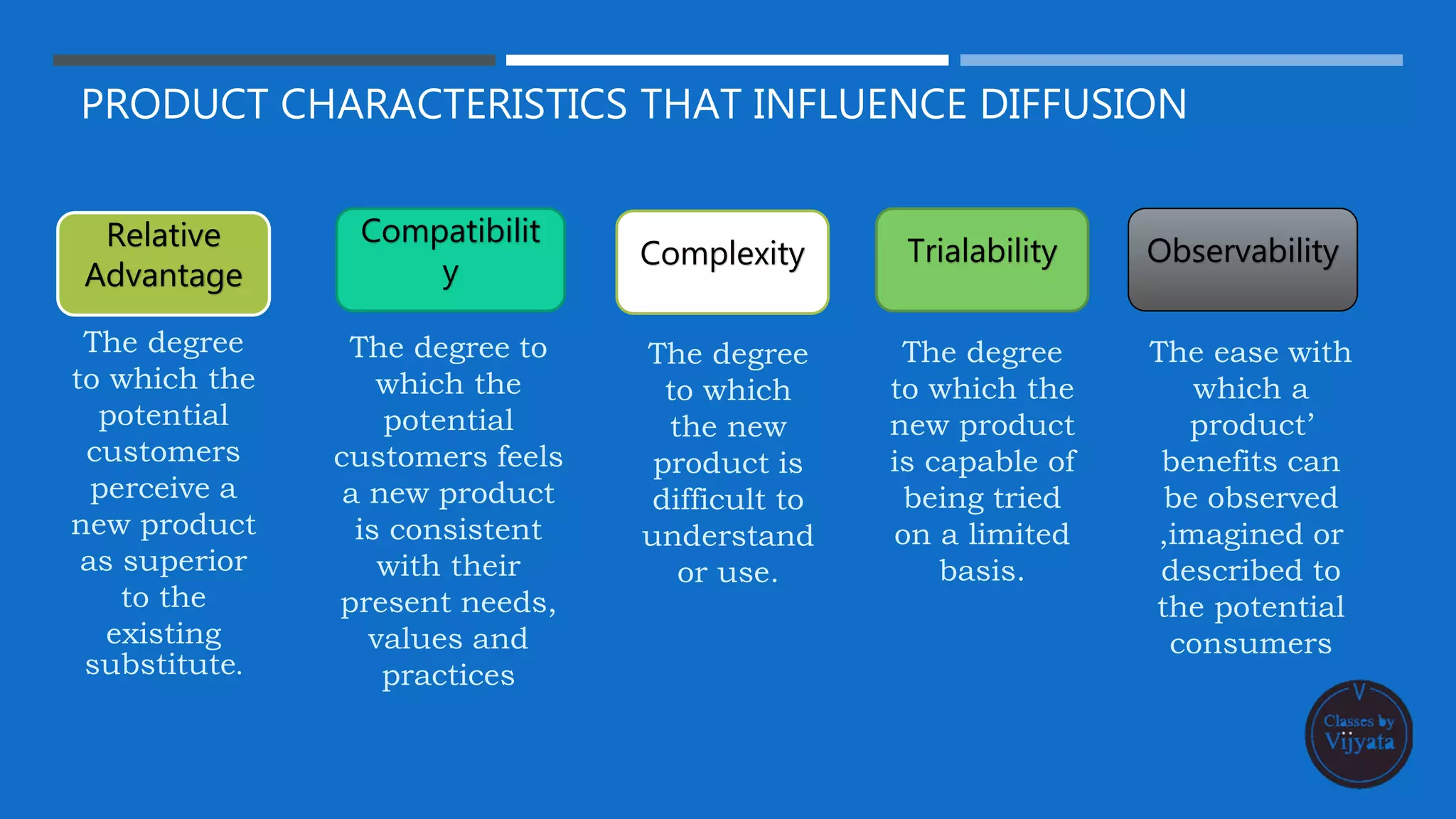
PRODUCT CHARACTERISTICS THAT INFLUENCE DIFFUSION
Relative
Advantage
Compatibilit
y
Complexity Trialability Observability
The degree
to which the
potential
customers
perceive a
new product
as superior
to the
existing
substitute.
The degree to
which the
potential
customers feels
a new product
is consistent
with their
present needs,
values and
practices
The degree
to which
the new
product is
difficult to
understand
or use.
The ease with
which a
product’
benefits can
be observed
,imagined or
described to
the potential
consumers
The degree
to which the
new product
is capable of
being tried
on a limited
basis.
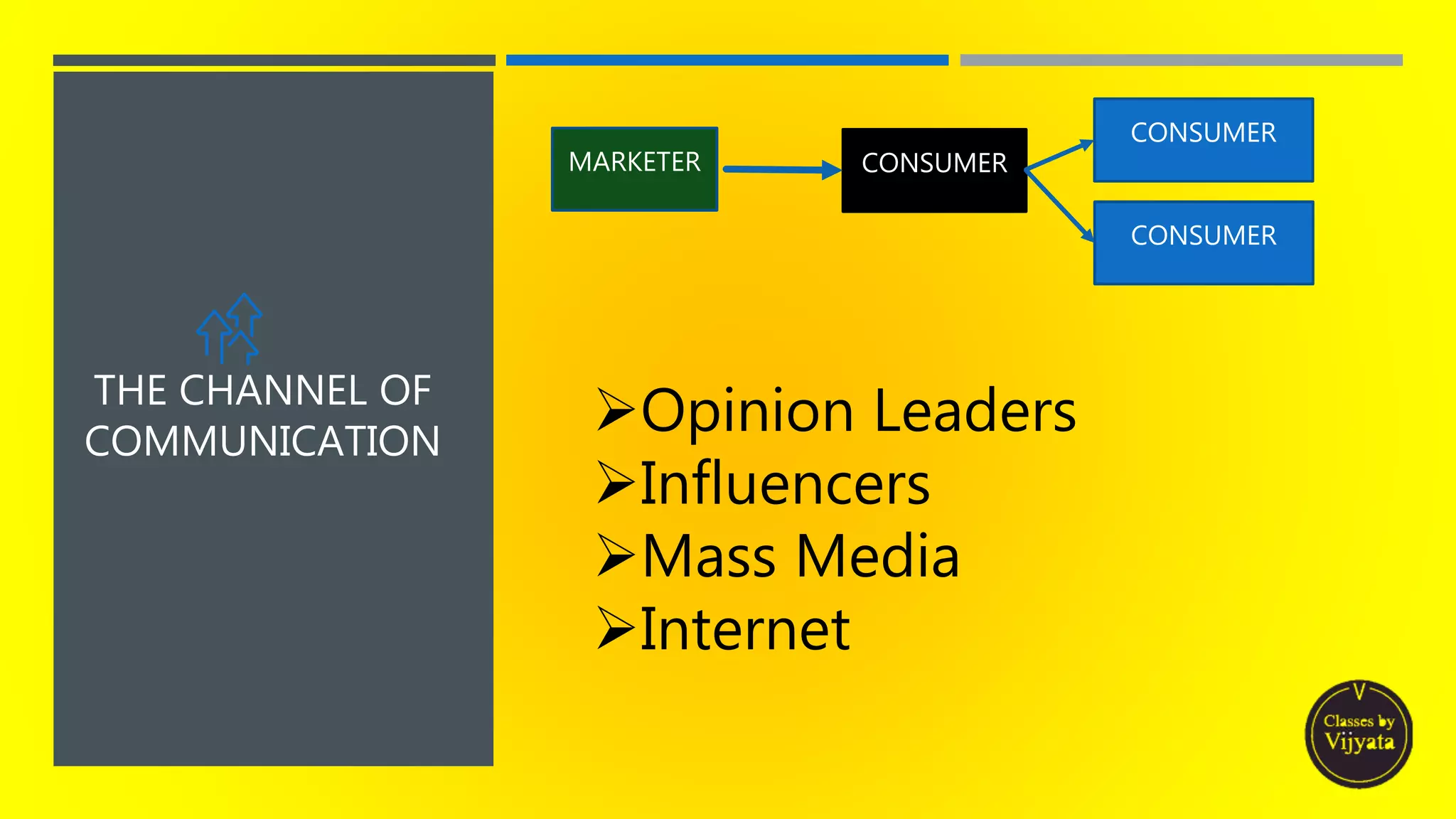
THE CHANNEL OF
COMMUNICATION
MARKETER
CONSUMER
CONSUMER
CONSUMER
Opinion Leaders
Influencers
Mass Media
Internet
THE SOCIAL
SYSTEM
A social system is the physical, social,
cultural environment to which people
belong and within which they function.
Marketers must operate in this social
system only to gain acceptance for
their new product.
- Market Segment
- Target Market
TIME
1. The amount of purchase time ( the amount
of time that elapses between consumers’
initial awareness of the new product and the
point at which they purchase or reject it.)
2. The identification of adopter categories
(classification of consumers relative to other
consumers in terms of adoption time)
3. The rate of adoption ( how long it takes it
takes a new product to get accepted by those
who will ultimately adopt it)
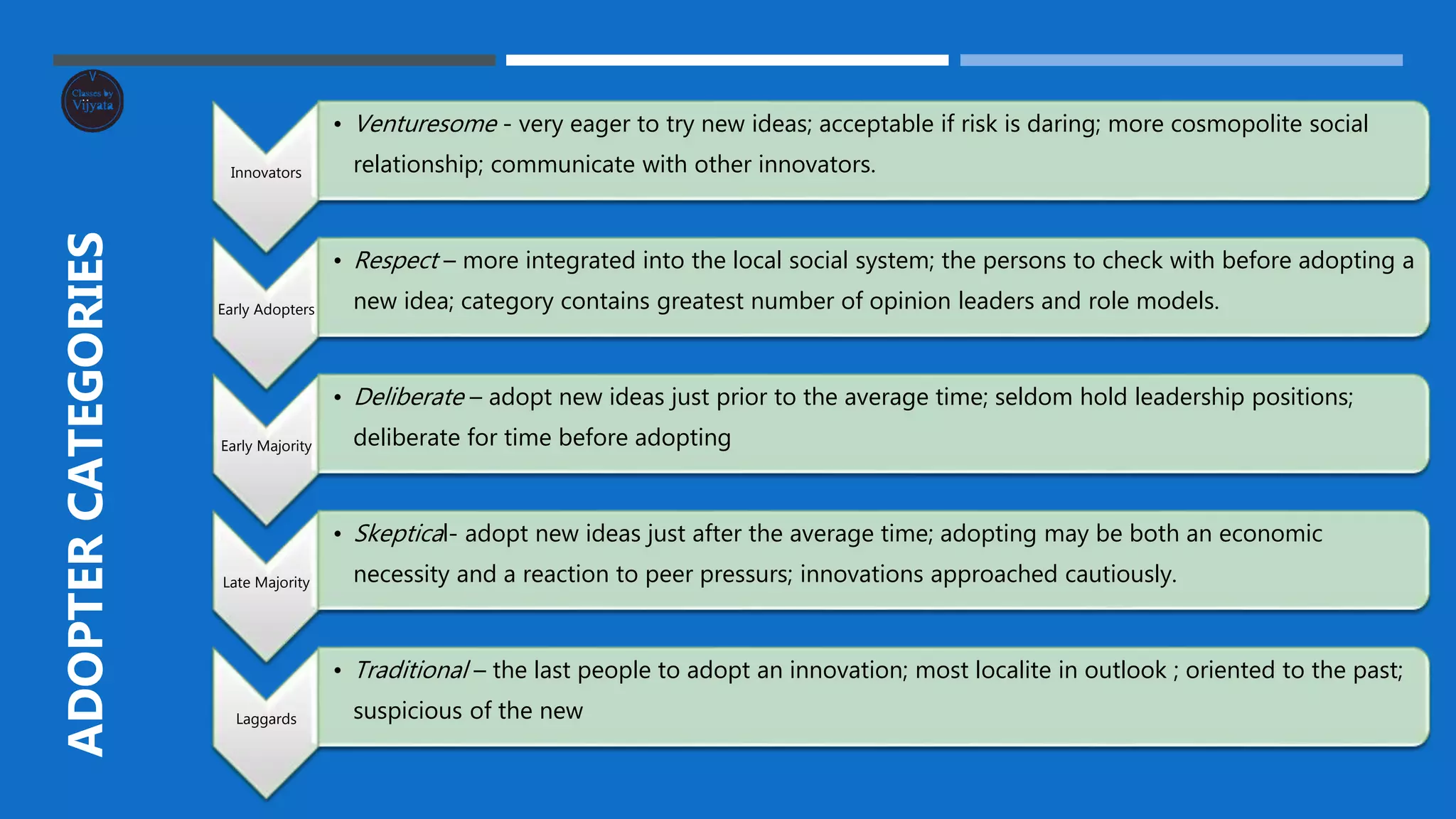
Innovators
• Venturesome - very eager to try new ideas; acceptable if risk is daring; more cosmopolite social
relationship; communicate with other innovators.
Early Adopters
• Respect – more integrated into the local social system; the persons to check with before adopting a
new idea; category contains greatest number of opinion leaders and role models.
Early Majority
• Deliberate – adopt new ideas just prior to the average time; seldom hold leadership positions;
deliberate for time before adopting
Late Majority
• Skeptical- adopt new ideas just after the average time; adopting may be both an economic
necessity and a reaction to peer pressurs; innovations approached cautiously.
Laggards
• Traditional – the last people to adopt an innovation; most localite in outlook ; oriented to the past;
suspicious of the new
ADOPTERCATEGORIES
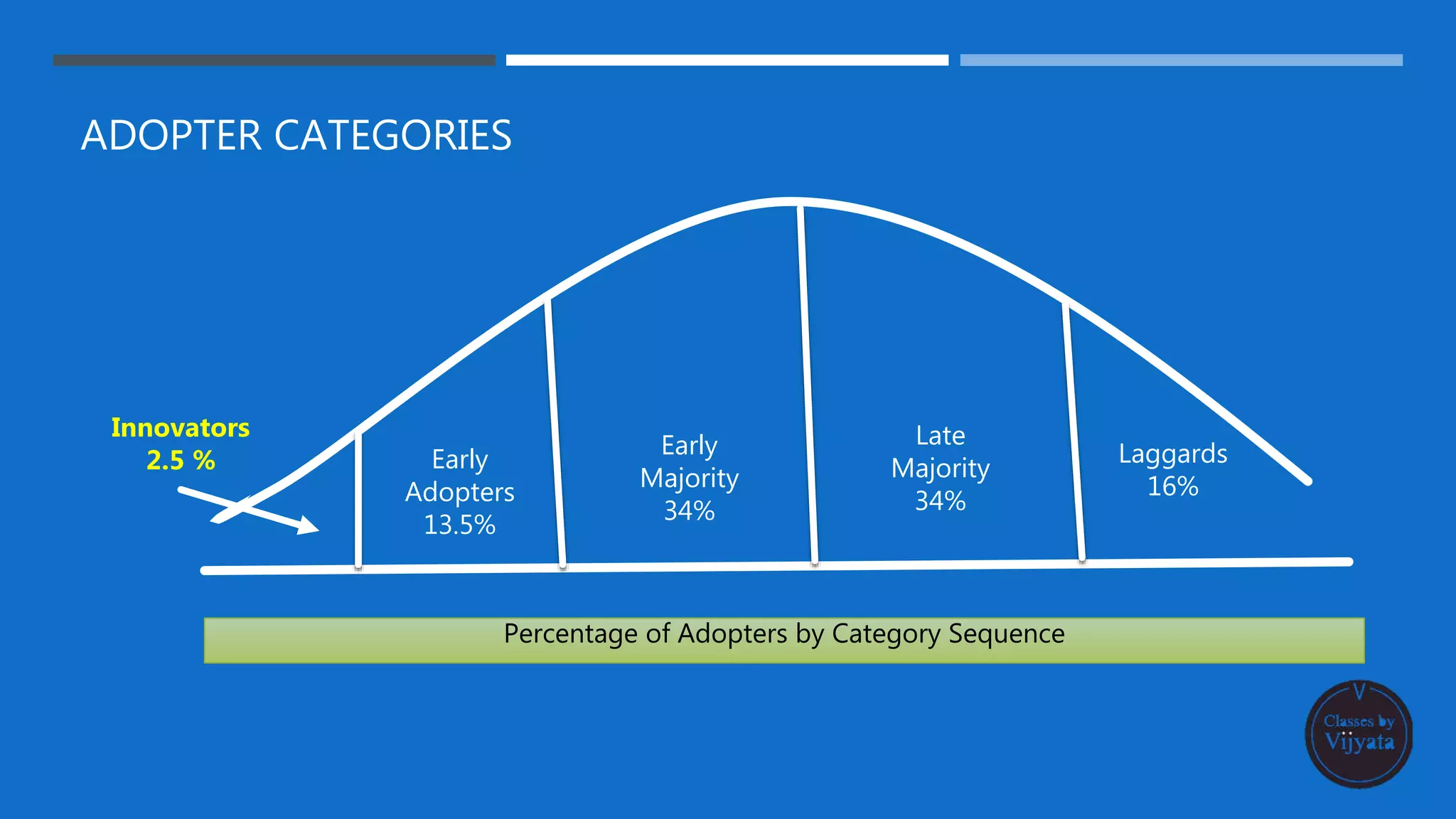
ADOPTER CATEGORIES
Percentage of Adopters by Category Sequence
Early
Adopters
13.5%
Early
Majority
34%
Late
Majority
34%
Laggards
16%
Innovators
2.5 %
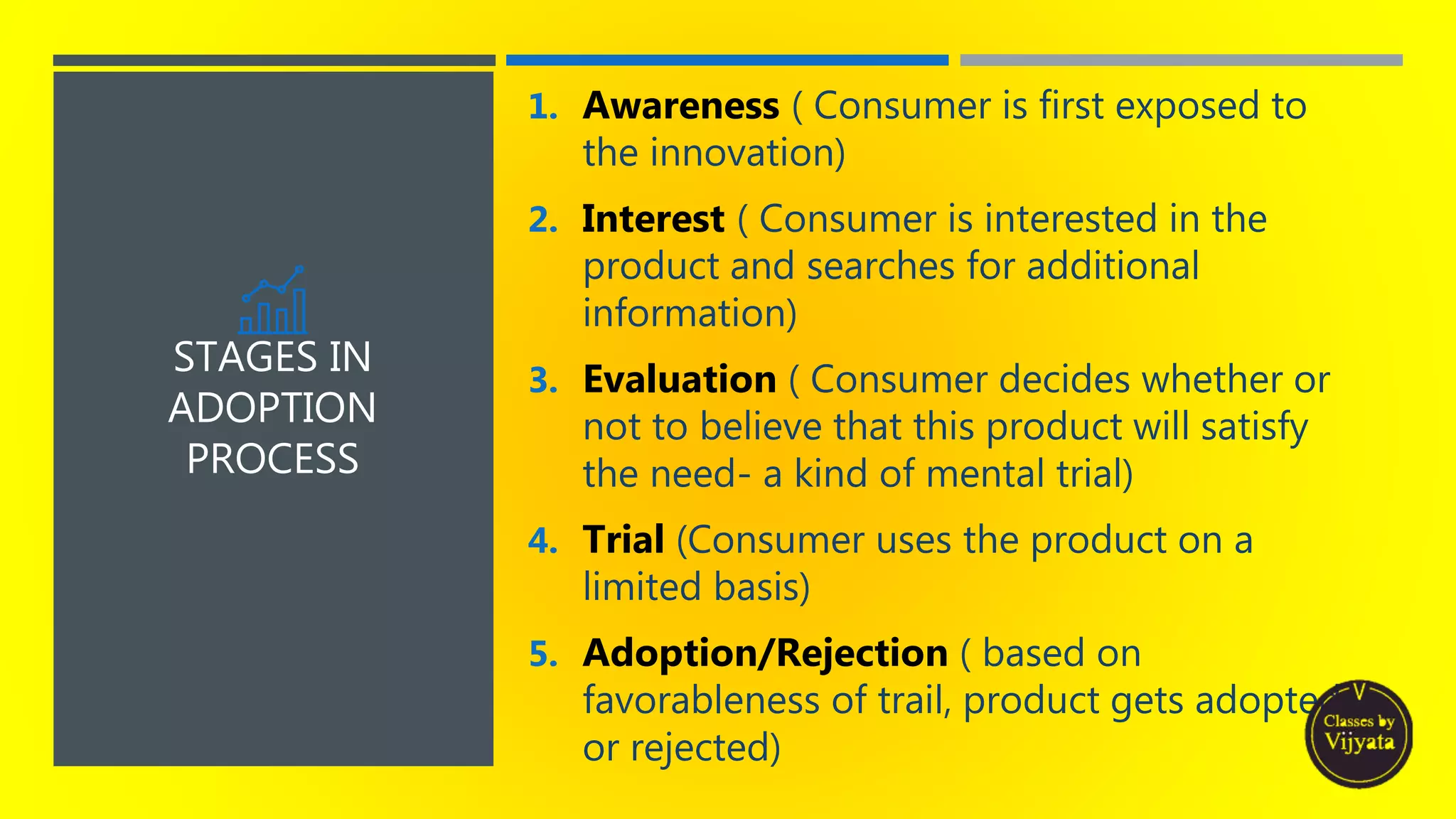
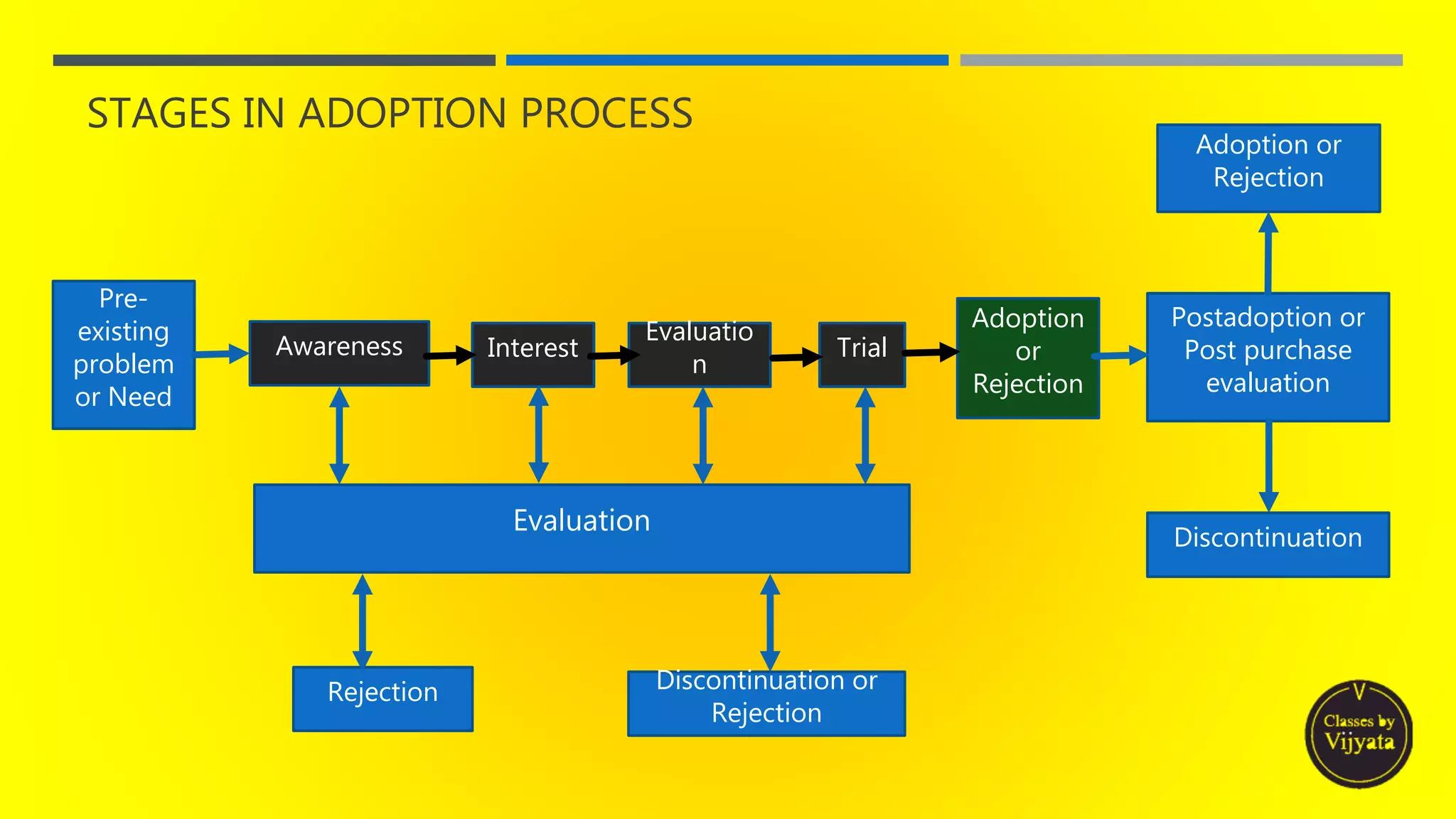
1. Awareness ( Consumer is first exposed to
the innovation)
2. Interest ( Consumer is interested in the
product and searches for additional
information)
3. Evaluation ( Consumer decides whether or
not to believe that this product will satisfy
the need- a kind of mental trial)
4. Trial (Consumer uses the product on a
limited basis)
5. Adoption/Rejection ( based on
favorableness of trail, product gets adopted
or rejected)
STAGES IN
ADOPTION
PROCESS
STAGES IN ADOPTION PROCESS
Pre-
existing
problem
or Need
Awareness Interest
Evaluatio
n
Trial
Adoption
or
Rejection
Postadoption or
Post purchase
evaluation
Discontinuation
Adoption or
Rejection
Evaluation
Rejection Discontinuation or
Rejection
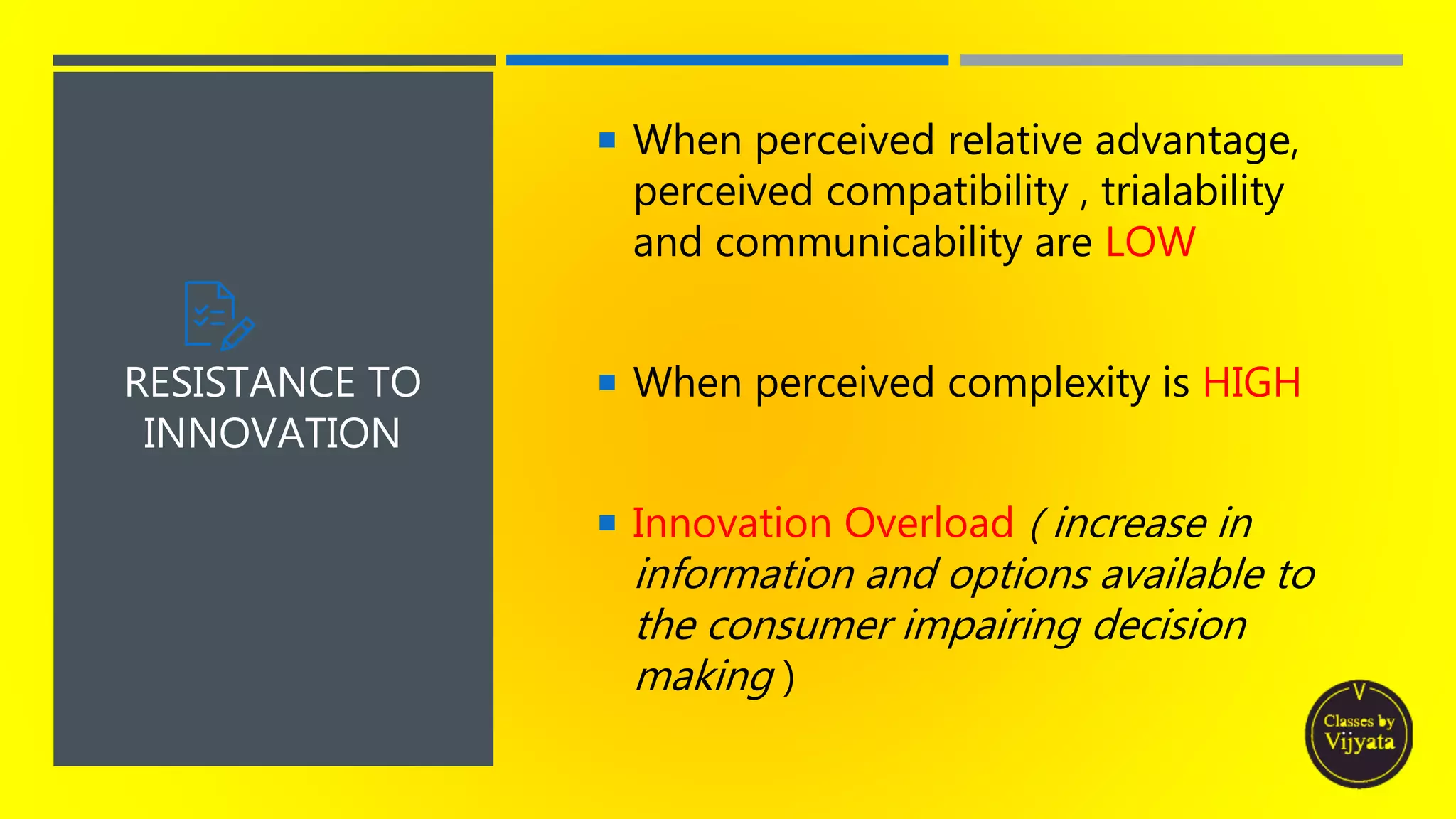
 When perceived relative advantage,
perceived compatibility , trialability
and communicability are LOW
 When perceived complexity is HIGH
 Innovation Overload ( increase in
information and options available to
the consumer impairing decision
making )
RESISTANCE TO
INNOVATION
THANK YOU!!
For any query or suggestion , write to
vijyata.rwc@gmail.com

Diffusion of innovation

  • 1.
    DIFFUSION OF INNOVATION BY-VIJYATA || ASSISTANT PROFESSOR|| RANCHI WOMEN’S COLLEGE
  • 2.
    Diffusion of innovationis an area of research which provides the framework for exploring consumer acceptance of any new product, idea or event. HOW ANY INNOVATION GETS ACCEPTED OR REJECTED ??
  • 3.
    DIFFUSION OF INNOVATION  DIFFUSION PROCESS Diffusion is a macro process concerned with the spread of the new product (an innovation) from its source to the consuming public  ADOPTION PROCESS  Adoption is a micro process that focuses on the stages through which an individual consumer passes while deciding to accept or reject any new product.
  • 4.
    THE DIFFUSION PROCESS Diffusion isthe process by which the acceptance of an innovation ( a new product, new service, new idea, or new practice) is spread by communication (mass media, salespeople, or informal conversation) to the members of the social system (a target market) over a period of time. Elements of diffusion process includes  The innovation  The channel of communication  The social system  Time
  • 5.
    Innovation Firm Oriented Product oriented AContinuous innovation A dynamically continuous innovation A discontinuous innovation Market oriented Consumer oriented THE INNOVATION
  • 6.
    PRODUCT CHARACTERISTICS THATINFLUENCE DIFFUSION Relative Advantage Compatibilit y Complexity Trialability Observability The degree to which the potential customers perceive a new product as superior to the existing substitute. The degree to which the potential customers feels a new product is consistent with their present needs, values and practices The degree to which the new product is difficult to understand or use. The ease with which a product’ benefits can be observed ,imagined or described to the potential consumers The degree to which the new product is capable of being tried on a limited basis.
  • 7.
  • 8.
    THE SOCIAL SYSTEM A socialsystem is the physical, social, cultural environment to which people belong and within which they function. Marketers must operate in this social system only to gain acceptance for their new product. - Market Segment - Target Market
  • 9.
    TIME 1. The amountof purchase time ( the amount of time that elapses between consumers’ initial awareness of the new product and the point at which they purchase or reject it.) 2. The identification of adopter categories (classification of consumers relative to other consumers in terms of adoption time) 3. The rate of adoption ( how long it takes it takes a new product to get accepted by those who will ultimately adopt it)
  • 10.
    Innovators • Venturesome -very eager to try new ideas; acceptable if risk is daring; more cosmopolite social relationship; communicate with other innovators. Early Adopters • Respect – more integrated into the local social system; the persons to check with before adopting a new idea; category contains greatest number of opinion leaders and role models. Early Majority • Deliberate – adopt new ideas just prior to the average time; seldom hold leadership positions; deliberate for time before adopting Late Majority • Skeptical- adopt new ideas just after the average time; adopting may be both an economic necessity and a reaction to peer pressurs; innovations approached cautiously. Laggards • Traditional – the last people to adopt an innovation; most localite in outlook ; oriented to the past; suspicious of the new ADOPTERCATEGORIES
  • 11.
    ADOPTER CATEGORIES Percentage ofAdopters by Category Sequence Early Adopters 13.5% Early Majority 34% Late Majority 34% Laggards 16% Innovators 2.5 %
  • 12.
    1. Awareness (Consumer is first exposed to the innovation) 2. Interest ( Consumer is interested in the product and searches for additional information) 3. Evaluation ( Consumer decides whether or not to believe that this product will satisfy the need- a kind of mental trial) 4. Trial (Consumer uses the product on a limited basis) 5. Adoption/Rejection ( based on favorableness of trail, product gets adopted or rejected) STAGES IN ADOPTION PROCESS
  • 13.
    STAGES IN ADOPTIONPROCESS Pre- existing problem or Need Awareness Interest Evaluatio n Trial Adoption or Rejection Postadoption or Post purchase evaluation Discontinuation Adoption or Rejection Evaluation Rejection Discontinuation or Rejection
  • 14.
     When perceivedrelative advantage, perceived compatibility , trialability and communicability are LOW  When perceived complexity is HIGH  Innovation Overload ( increase in information and options available to the consumer impairing decision making ) RESISTANCE TO INNOVATION
  • 15.
    THANK YOU!! For anyquery or suggestion , write to vijyata.rwc@gmail.com