
Priya , Assistant professor, Dept. of Commerce
DMM College, Kurukshetra
Meaning of consumer behaviour
Definition of consumer behaviour
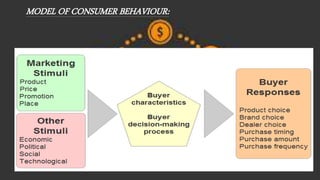
Model of consumer behaviour
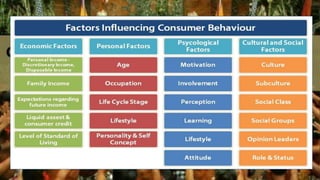
Factors affecting / determinants of consumer behaviour
Importance to study consumer behaviour
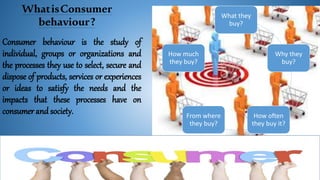
WhatisConsumer
behaviour?
Consumer behaviour is the study of
individual, groups or organizations and
the processes they use to select, secure and
dispose of products, services or experiences
or ideas to satisfy the needs and the
impacts that these processes have on
consumer and society.
What they
buy?
Why they
buy?
How often
they buy it?
From where
they buy?
How much
they buy?
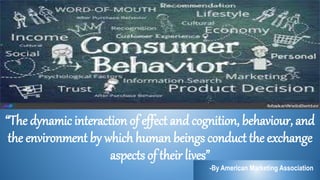
“The dynamic interaction of effect and cognition, behaviour, and
the environment by which human beings conduct the exchange
aspects of their lives”
-By American Marketing Association
MODEL OF CONSUMER BEHAVIOUR:
Economic factors that influence consumer behaviour
are:
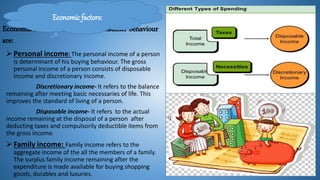
Personal income: The personal income of a person
is determinant of his buying behaviour. The gross
personal income of a person consists of disposable
income and discretionary income.
Discretionary income- It refers to the balance
remaining after meeting basic necessaries of life. This
improves the standard of living of a person.
Disposable income- It refers to the actual
income remaining at the disposal of a person after
deducting taxes and compulsorily deductible items from
the gross income.
Family income: Family income refers to the
aggregate income of the all the members of a family.
The surplus family income remaining after the
expenditure is made available for buying shopping
goods, durables and luxuries.
Economic factors:
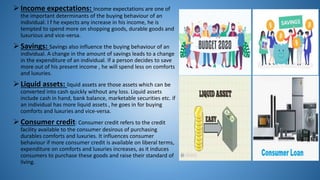
Income expectations: Income expectations are one of
the important determinants of the buying behaviour of an
individual. I f he expects any increase in his income, he is
tempted to spend more on shopping goods, durable goods and
luxurious and vice-versa.
Savings: Savings also influence the buying behaviour of an
individual. A change in the amount of savings leads to a change
in the expenditure of an individual. If a person decides to save
more out of his present income , he will spend less on comforts
and luxuries.
Liquid assets: liquid assets are those assets which can be
converted into cash quickly without any loss. Liquid assets
include cash in hand, bank balance, marketable securities etc. if
an individual has more liquid assets , he goes in for buying
comforts and luxuries and vice-versa.
Consumer credit: Consumer credit refers to the credit
facility available to the consumer desirous of purchasing
durables comforts and luxuries. It influences consumer
behaviour if more consumer credit is available on liberal terms,
expenditure on comforts and luxuries increases, as it induces
consumers to purchase these goods and raise their standard of
living.
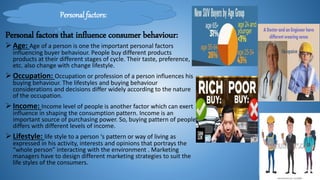
Personal factors that influence consumer behaviour:
Personal factors:
Age: Age of a person is one the important personal factors
influencing buyer behaviour. People buy different products
products at their different stages of cycle. Their taste, preference,
etc. also change with change lifestyle.
Occupation: Occupation or profession of a person influences his
buying behaviour. The lifestyles and buying behaviour
considerations and decisions differ widely according to the nature
of the occupation.
Income: Income level of people is another factor which can exert
influence in shaping the consumption pattern. Income is an
important source of purchasing power. So, buying pattern of people
differs with different levels of income.
Lifestyle: life style to a person ‘s pattern or way of living as
expressed in his activity, interests and opinions that portrays the
“whole person” interacting with the environment . Marketing
managers have to design different marketing strategies to suit the
life styles of the consumers.
Psychological factors that influence consumer
behaviour:
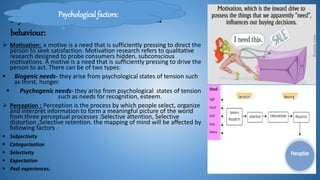
 Motivation: A motive is a need that is sufficiently pressing to direct the
person to seek satisfaction. Motivation research refers to qualitative
research designed to probe consumers hidden, subconscious
motivations. A motive is a need that is sufficiently pressing to drive the
person to act. There can be of two types:
 Biogenic needs- they arise from psychological states of tension such
as thirst, hunger.
 Psychogenic needs- they arise from psychological states of tension
such as needs for recognition, esteem.
 Perception : Perception is the process by which people select, organize
and interpret information to form a meaningful picture of the world
from three perceptual processes :Selective attention, Selective
distortion ,Selective retention. the mapping of mind will be affected by
following factors :
 Subjectivity
 Categorization
 Selectivity
 Expectation
 Past experiences.
Psychological factors:
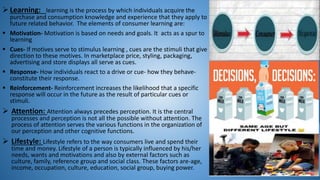
Learning: learning is the process by which individuals acquire the
purchase and consumption knowledge and experience that they apply to
future related behavior. The elements of consumer learning are:
 Motivation- Motivation is based on needs and goals. It acts as a spur to
learning
 Cues- If motives serve to stimulus learning , cues are the stimuli that give
direction to these motives. In marketplace price, styling, packaging,
advertising and store displays all serve as cues.
 Response- How individuals react to a drive or cue- how they behave-
constitute their response.
 Reinforcement- Reinforcement increases the likelihood that a specific
response will occur in the future as the result of particular cues or
stimuli.
 Attention: Attention always precedes perception. It is the central
processes and perception is not all the possible without attention. The
process of attention serves the various functions in the organization of
our perception and other cognitive functions.
 Lifestyle: Lifestyle refers to the way consumers live and spend their
time and money. Lifestyle of a person is typically influenced by his/her
needs, wants and motivations and also by external factors such as
culture, family, reference group and social class. These factors are-age,
income, occupation, culture, education, social group, buying power.
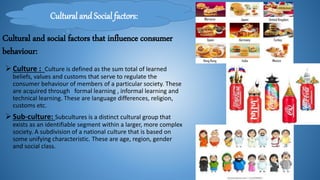
Cultural and social factors that influence consumer
behaviour:
Culture : Culture is defined as the sum total of learned
beliefs, values and customs that serve to regulate the
consumer behaviour of members of a particular society. These
are acquired through formal learning , informal learning and
technical learning. These are language differences, religion,
customs etc.
Sub-culture: Subcultures is a distinct cultural group that
exists as an identifiable segment within a larger, more complex
society. A subdivision of a national culture that is based on
some unifying characteristic. These are age, region, gender
and social class.
Cultural and Social factors:
 Social class: The division of members of society into
a hierarchy of distinct status classes, so that members of
each class have either higher or lower status than
members of other classes. These are wealth, power,
prestige.
 Reference groups: A reference group includes
individuals or groups that influence our opinions , beliefs,
attitudes and behaviors. They often serve as our role
models and inspiration. Marketers view reference groups
as important because they influence how consumers
interpret information and make purchasing decisions.
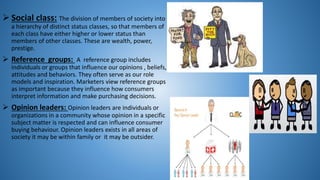
 Opinion leaders: Opinion leaders are individuals or
organizations in a community whose opinion in a specific
subject matter is respected and can influence consumer
buying behaviour. Opinion leaders exists in all areas of
society it may be within family or it may be outsider.
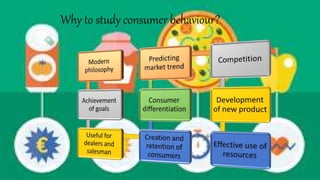
Why to study consumer behaviour?
Consumer  Behaviour introduction and Determinants

Consumer Behaviour introduction and Determinants

  • 1.
    Priya , Assistantprofessor, Dept. of Commerce DMM College, Kurukshetra
  • 2.
    Meaning of consumerbehaviour Definition of consumer behaviour Model of consumer behaviour Factors affecting / determinants of consumer behaviour Importance to study consumer behaviour
  • 3.
    WhatisConsumer behaviour? Consumer behaviour isthe study of individual, groups or organizations and the processes they use to select, secure and dispose of products, services or experiences or ideas to satisfy the needs and the impacts that these processes have on consumer and society. What they buy? Why they buy? How often they buy it? From where they buy? How much they buy?
  • 4.
    “The dynamic interactionof effect and cognition, behaviour, and the environment by which human beings conduct the exchange aspects of their lives” -By American Marketing Association
  • 5.
  • 7.
    Economic factors thatinfluence consumer behaviour are: Personal income: The personal income of a person is determinant of his buying behaviour. The gross personal income of a person consists of disposable income and discretionary income. Discretionary income- It refers to the balance remaining after meeting basic necessaries of life. This improves the standard of living of a person. Disposable income- It refers to the actual income remaining at the disposal of a person after deducting taxes and compulsorily deductible items from the gross income. Family income: Family income refers to the aggregate income of the all the members of a family. The surplus family income remaining after the expenditure is made available for buying shopping goods, durables and luxuries. Economic factors:
  • 8.
    Income expectations: Incomeexpectations are one of the important determinants of the buying behaviour of an individual. I f he expects any increase in his income, he is tempted to spend more on shopping goods, durable goods and luxurious and vice-versa. Savings: Savings also influence the buying behaviour of an individual. A change in the amount of savings leads to a change in the expenditure of an individual. If a person decides to save more out of his present income , he will spend less on comforts and luxuries. Liquid assets: liquid assets are those assets which can be converted into cash quickly without any loss. Liquid assets include cash in hand, bank balance, marketable securities etc. if an individual has more liquid assets , he goes in for buying comforts and luxuries and vice-versa. Consumer credit: Consumer credit refers to the credit facility available to the consumer desirous of purchasing durables comforts and luxuries. It influences consumer behaviour if more consumer credit is available on liberal terms, expenditure on comforts and luxuries increases, as it induces consumers to purchase these goods and raise their standard of living.
  • 9.
    Personal factors thatinfluence consumer behaviour: Personal factors: Age: Age of a person is one the important personal factors influencing buyer behaviour. People buy different products products at their different stages of cycle. Their taste, preference, etc. also change with change lifestyle. Occupation: Occupation or profession of a person influences his buying behaviour. The lifestyles and buying behaviour considerations and decisions differ widely according to the nature of the occupation. Income: Income level of people is another factor which can exert influence in shaping the consumption pattern. Income is an important source of purchasing power. So, buying pattern of people differs with different levels of income. Lifestyle: life style to a person ‘s pattern or way of living as expressed in his activity, interests and opinions that portrays the “whole person” interacting with the environment . Marketing managers have to design different marketing strategies to suit the life styles of the consumers.
  • 10.
    Psychological factors thatinfluence consumer behaviour:  Motivation: A motive is a need that is sufficiently pressing to direct the person to seek satisfaction. Motivation research refers to qualitative research designed to probe consumers hidden, subconscious motivations. A motive is a need that is sufficiently pressing to drive the person to act. There can be of two types:  Biogenic needs- they arise from psychological states of tension such as thirst, hunger.  Psychogenic needs- they arise from psychological states of tension such as needs for recognition, esteem.  Perception : Perception is the process by which people select, organize and interpret information to form a meaningful picture of the world from three perceptual processes :Selective attention, Selective distortion ,Selective retention. the mapping of mind will be affected by following factors :  Subjectivity  Categorization  Selectivity  Expectation  Past experiences. Psychological factors:
  • 11.
    Learning: learning isthe process by which individuals acquire the purchase and consumption knowledge and experience that they apply to future related behavior. The elements of consumer learning are:  Motivation- Motivation is based on needs and goals. It acts as a spur to learning  Cues- If motives serve to stimulus learning , cues are the stimuli that give direction to these motives. In marketplace price, styling, packaging, advertising and store displays all serve as cues.  Response- How individuals react to a drive or cue- how they behave- constitute their response.  Reinforcement- Reinforcement increases the likelihood that a specific response will occur in the future as the result of particular cues or stimuli.  Attention: Attention always precedes perception. It is the central processes and perception is not all the possible without attention. The process of attention serves the various functions in the organization of our perception and other cognitive functions.  Lifestyle: Lifestyle refers to the way consumers live and spend their time and money. Lifestyle of a person is typically influenced by his/her needs, wants and motivations and also by external factors such as culture, family, reference group and social class. These factors are-age, income, occupation, culture, education, social group, buying power.
  • 12.
    Cultural and socialfactors that influence consumer behaviour: Culture : Culture is defined as the sum total of learned beliefs, values and customs that serve to regulate the consumer behaviour of members of a particular society. These are acquired through formal learning , informal learning and technical learning. These are language differences, religion, customs etc. Sub-culture: Subcultures is a distinct cultural group that exists as an identifiable segment within a larger, more complex society. A subdivision of a national culture that is based on some unifying characteristic. These are age, region, gender and social class. Cultural and Social factors:
  • 13.
     Social class:The division of members of society into a hierarchy of distinct status classes, so that members of each class have either higher or lower status than members of other classes. These are wealth, power, prestige.  Reference groups: A reference group includes individuals or groups that influence our opinions , beliefs, attitudes and behaviors. They often serve as our role models and inspiration. Marketers view reference groups as important because they influence how consumers interpret information and make purchasing decisions.  Opinion leaders: Opinion leaders are individuals or organizations in a community whose opinion in a specific subject matter is respected and can influence consumer buying behaviour. Opinion leaders exists in all areas of society it may be within family or it may be outsider.
  • 14.
    Why to studyconsumer behaviour?