1
Of
2
3
HowHow Core Values AffectCore Values Affect
MarketingMarketing
Core values define
 How products are used in a society
 Acceptable market relationships
 Ethical behavior
4
What is Culture?What is Culture?
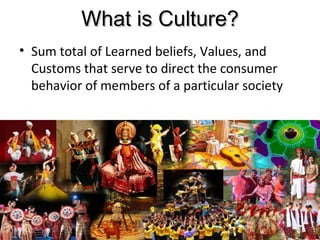
• Sum total of Learned beliefs, Values, and
Customs that serve to direct the consumer
behavior of members of a particular society
5
Characteristics of cultureCharacteristics of culture
 Learned response
 Social phenomenon
 Includes inculcated values
 Culture as gratifying responses
The Measurement of CultureThe Measurement of Culture
 Content Analysis
 Consumer Fieldwork
 Value Measurement Instruments
6
Adapting Strategies toAdapting Strategies to
Changing CulturesChanging Cultures
Culture is adaptive :-::-: Marketing strategies
must also be adaptive
Advertising and Marketing efforts have
difficulty changing behaviors or norms learned
early in life.
Marketers must address consumer attitudes
and behavior.
7
How Culture AffectsHow Culture Affects
Consumer BehaviorConsumer Behavior
 Pre-purchase and Purchase Activities
 Consumption and Divestment Activities
8
Influence on Pre-purchaseInfluence on Pre-purchase
and Purchase Activitiesand Purchase Activities
҉ Culture affects what consumers think theythey
need and what they perceiveneed and what they perceive
҉ Culture affects how consumers are likely to
search for informationsearch for information
҉ Culture affects the importance placedimportance placed on
certain attributes of alternatives
҉ Culture affects the amount of priceamount of price
negotiationnegotiation during the purchase process 9
Influence on ConsumptionInfluence on Consumption
Divestment ActivitiesDivestment Activities
‡ How consumers use or consume products?
‡ Consumers expectations about form and
function vary between cultures?
‡ How individuals dispose of products
‡ Reselling products after use
‡ Giving them to others for use
‡ Recycling them
10
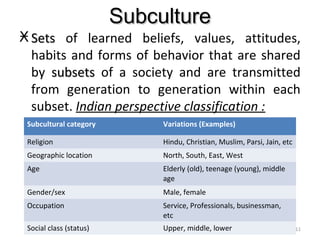
Ӿ SetsSets of learned beliefs, values, attitudes,
habits and forms of behavior that are shared
by subsetssubsets of a society and are transmitted
from generation to generation within each
subset. Indian perspective classification :
Subcultural category Variations (Examples)
Religion Hindu, Christian, Muslim, Parsi, Jain, etc
Geographic location North, South, East, West
Age Elderly (old), teenage (young), middle
age
Gender/sex Male, female
Occupation Service, Professionals, businessman,
etc
Social class (status) Upper, middle, lower
SubcultureSubculture
11
Sub Cultural division andSub Cultural division and
consumption pattern in Indiaconsumption pattern in India
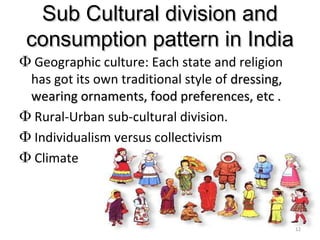
Φ Geographic culture: Each state and religion
has got its own traditional style of dressing,dressing,
wearing ornaments, food preferences, etc .wearing ornaments, food preferences, etc .
Φ Rural-Urban sub-cultural division.
Φ Individualism versus collectivism
Φ Climate
12
Social ClassSocial Class
€ The division of members of a society into a
hierarchy of distinct status classes:
o Upper classUpper class
o Middle classMiddle class
o Lower classLower class
so that members of each class have
relatively the same status and members of
all other classes have either more or less
status.
13
Characteristic Features OfCharacteristic Features Of
Social ClassSocial Class
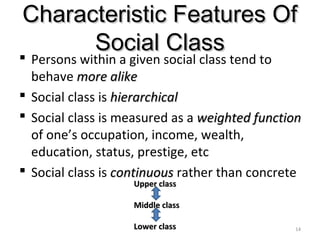
 Persons within a given social class tend to
behave more alikemore alike
 Social class is hierarchicalhierarchical
 Social class is measured as a weighted functionweighted function
of one’s occupation, income, wealth,
education, status, prestige, etc
 Social class is continuouscontinuous rather than concrete
Upper classUpper class
Middle classMiddle class
Lower classLower class 14
Factors responsible forFactors responsible for
Social StratificationSocial Stratification
a) Authority
b) Income
c) Occupation and achievement
d) Education
15
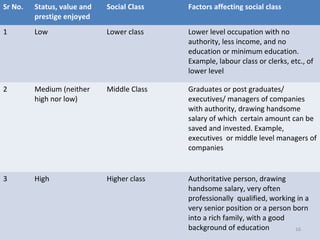
Sr No. Status, value and
prestige enjoyed
Social Class Factors affecting social class
1 Low Lower class Lower level occupation with no
authority, less income, and no
education or minimum education.
Example, labour class or clerks, etc., of
lower level
2 Medium (neither
high nor low)
Middle Class Graduates or post graduates/
executives/ managers of companies
with authority, drawing handsome
salary of which certain amount can be
saved and invested. Example,
executives or middle level managers of
companies
3 High Higher class Authoritative person, drawing
handsome salary, very often
professionally qualified, working in a
very senior position or a person born
into a rich family, with a good
background of education 16
Cross cultural marketingCross cultural marketing
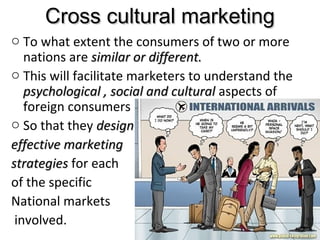
o To what extent the consumers of two or more
nations are similar or different.similar or different.
o This will facilitate marketers to understand the
psychological , social and culturalpsychological , social and cultural aspects of
foreign consumers
o So that they designdesign
effective marketingeffective marketing
strategiesstrategies for each
of the specific
National markets
involved. 17
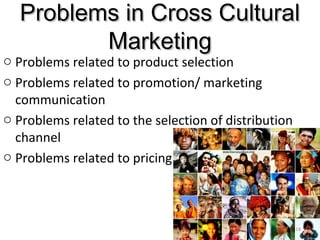
Problems in Cross CulturalProblems in Cross Cultural
MarketingMarketing
o Problems related to product selection
o Problems related to promotion/ marketing
communication
o Problems related to the selection of distribution
channel
o Problems related to pricing
18
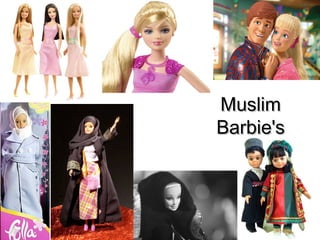
Influence of culture in globalInfluence of culture in global
businessbusiness
MuslimMuslim
Barbie'sBarbie's
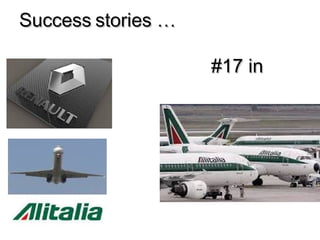
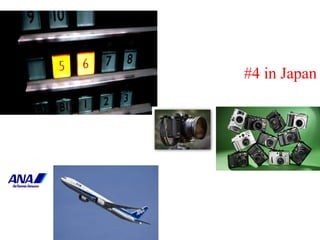
SuccessSuccess stories …stories …
#17 in#17 in
ItalyItaly
#4 in Japan
Mc Donald’sMc Donald’s
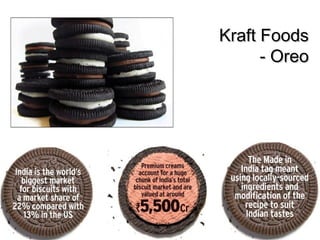
Kraft FoodsKraft Foods
- Oreo- Oreo
Summary & ConclusionSummary & Conclusion
Cultural factors have higher influence on CB
Know culture, subculture, social class, cross
culture to Enter or Survive in market.
Adaptability is MUST for Marketers.
Global exposure helps in knowing the market.
25
Thank youThank you
26

Culture and consumer behaviour

  • 1.
  • 2.
  • 3.
  • 4.
    HowHow Core ValuesAffectCore Values Affect MarketingMarketing Core values define  How products are used in a society  Acceptable market relationships  Ethical behavior 4
  • 5.
    What is Culture?Whatis Culture? • Sum total of Learned beliefs, Values, and Customs that serve to direct the consumer behavior of members of a particular society 5
  • 6.
    Characteristics of cultureCharacteristicsof culture  Learned response  Social phenomenon  Includes inculcated values  Culture as gratifying responses The Measurement of CultureThe Measurement of Culture  Content Analysis  Consumer Fieldwork  Value Measurement Instruments 6
  • 7.
    Adapting Strategies toAdaptingStrategies to Changing CulturesChanging Cultures Culture is adaptive :-::-: Marketing strategies must also be adaptive Advertising and Marketing efforts have difficulty changing behaviors or norms learned early in life. Marketers must address consumer attitudes and behavior. 7
  • 8.
    How Culture AffectsHowCulture Affects Consumer BehaviorConsumer Behavior  Pre-purchase and Purchase Activities  Consumption and Divestment Activities 8
  • 9.
    Influence on Pre-purchaseInfluenceon Pre-purchase and Purchase Activitiesand Purchase Activities ҉ Culture affects what consumers think theythey need and what they perceiveneed and what they perceive ҉ Culture affects how consumers are likely to search for informationsearch for information ҉ Culture affects the importance placedimportance placed on certain attributes of alternatives ҉ Culture affects the amount of priceamount of price negotiationnegotiation during the purchase process 9
  • 10.
    Influence on ConsumptionInfluenceon Consumption Divestment ActivitiesDivestment Activities ‡ How consumers use or consume products? ‡ Consumers expectations about form and function vary between cultures? ‡ How individuals dispose of products ‡ Reselling products after use ‡ Giving them to others for use ‡ Recycling them 10
  • 11.
    Ӿ SetsSets oflearned beliefs, values, attitudes, habits and forms of behavior that are shared by subsetssubsets of a society and are transmitted from generation to generation within each subset. Indian perspective classification : Subcultural category Variations (Examples) Religion Hindu, Christian, Muslim, Parsi, Jain, etc Geographic location North, South, East, West Age Elderly (old), teenage (young), middle age Gender/sex Male, female Occupation Service, Professionals, businessman, etc Social class (status) Upper, middle, lower SubcultureSubculture 11
  • 12.
    Sub Cultural divisionandSub Cultural division and consumption pattern in Indiaconsumption pattern in India Φ Geographic culture: Each state and religion has got its own traditional style of dressing,dressing, wearing ornaments, food preferences, etc .wearing ornaments, food preferences, etc . Φ Rural-Urban sub-cultural division. Φ Individualism versus collectivism Φ Climate 12
  • 13.
    Social ClassSocial Class €The division of members of a society into a hierarchy of distinct status classes: o Upper classUpper class o Middle classMiddle class o Lower classLower class so that members of each class have relatively the same status and members of all other classes have either more or less status. 13
  • 14.
    Characteristic Features OfCharacteristicFeatures Of Social ClassSocial Class  Persons within a given social class tend to behave more alikemore alike  Social class is hierarchicalhierarchical  Social class is measured as a weighted functionweighted function of one’s occupation, income, wealth, education, status, prestige, etc  Social class is continuouscontinuous rather than concrete Upper classUpper class Middle classMiddle class Lower classLower class 14
  • 15.
    Factors responsible forFactorsresponsible for Social StratificationSocial Stratification a) Authority b) Income c) Occupation and achievement d) Education 15
  • 16.
    Sr No. Status,value and prestige enjoyed Social Class Factors affecting social class 1 Low Lower class Lower level occupation with no authority, less income, and no education or minimum education. Example, labour class or clerks, etc., of lower level 2 Medium (neither high nor low) Middle Class Graduates or post graduates/ executives/ managers of companies with authority, drawing handsome salary of which certain amount can be saved and invested. Example, executives or middle level managers of companies 3 High Higher class Authoritative person, drawing handsome salary, very often professionally qualified, working in a very senior position or a person born into a rich family, with a good background of education 16
  • 17.
    Cross cultural marketingCrosscultural marketing o To what extent the consumers of two or more nations are similar or different.similar or different. o This will facilitate marketers to understand the psychological , social and culturalpsychological , social and cultural aspects of foreign consumers o So that they designdesign effective marketingeffective marketing strategiesstrategies for each of the specific National markets involved. 17
  • 18.
    Problems in CrossCulturalProblems in Cross Cultural MarketingMarketing o Problems related to product selection o Problems related to promotion/ marketing communication o Problems related to the selection of distribution channel o Problems related to pricing 18
  • 19.
    Influence of culturein globalInfluence of culture in global businessbusiness
  • 20.
  • 21.
    SuccessSuccess stories …stories… #17 in#17 in ItalyItaly
  • 22.
  • 23.
  • 24.
  • 25.
    Summary & ConclusionSummary& Conclusion Cultural factors have higher influence on CB Know culture, subculture, social class, cross culture to Enter or Survive in market. Adaptability is MUST for Marketers. Global exposure helps in knowing the market. 25
  • 26.