DiffusionDiffusion
of Innovationsof Innovations
Diffusion of Innovations
1
 In consumer behavior terms, refers to research on
the consumer acceptance of new products and
services
 Involves understanding two closely related
processes:
 Diffusion: a macro process concerned with the
spread of a new product--an innovation--from its
source to the consuming public
 Adoption: the micro process concerned with the
stages the consumer goes through in deciding to
accept or reject a new product
2
 Diffusion is the process by which
 the acceptance of an innovation--a new product,
service, idea or practice
is spread by communication--mass media, salespeople,
or word-of-mouth
 to members of a social system--target market
 over a period of time
3
 Four basic elements of the diffusion process:
1. The innovation
2. The channel of communication
3. The social system
4. Time
4
 Innovation takes many forms
 There is no universally accepted definition of the terms
product innovation or new product
 Instead, approaches to define the term have taken place
within certain contexts:
 Firm-oriented definitions
 Market-oriented definitions
 Consumer-oriented definitions
 Product-oriented definitions
5
 This approach focuses on the features inherent
in the product itself and the effects of these
features are likely to have on consumers’
established usage patterns
 Robertson identified three types of product
innovations:
 Continuous innovation
 Dynamically continuous innovation
 Discontinuous innovation
6
 Introduction of a modified product rather than a
totally new product
 Little or no change in technology
 Has the least disruptive(Interrupt )influence on
established usage patterns
 Symbolic innovations tend to be continuous
7
 May involve a new product or modification of an
existing product
 Some technical advances
 Still does not disrupt or alter consumer buying and
usage patterns
8
 Introduction of a pioneering product
 Involves a major technological advance
 Consumers must learn new behavior patterns
 May be difficult to market initially
 Is rare
9
 Not all new products meet with immediate success
 No precise formula marketers can use to predict how
consumers will react to their products
10
1. Relative advantage
2. Compatibility
3. Complexity
4. Trialability
5. Observability
11
 The degree to which potential consumers perceive
a new product is superior to existing substitutes
12
 The degree to which potential consumers feel a
new product is consistent with their present needs,
values and practices
13
 The degree to which a new product is difficult to
understand or use
14
 The degree to which a new product is capable of
being tried on a limited basis
15
 The ease with which a product’s benefits or
attributes can be observed, imagined or described
to potential consumers
16
 Speed with which an innovation spreads through
the market depends in great part on
communications
 Between the marketer and consumer
 Between consumers (word-of-mouth)
 In recent years a number of new channels of
communication have been developed
17
 The physical, social, or cultural environment to which
people belong and within which they function
 Members of a social system have at least one
characteristic in common that makes them potential
buyers of a particular product
 The values and norms of a social system will influence the
acceptance or rejection of new products
18
 Three characteristics of a social system
influence spread of new products
1. The degree of compatibility between innovation and
values of members
2. Homogeneity of members
3. Across cultures, depends on social similarity of the
cultures
19
 Time relates to diffusion in three ways:
1. Amount of purchase time
2. Adopter categories
3. Rate of adoption
20
 Refers to the amount of time that elapses(passes)
between a consumer’s initial awareness of a new
product or service and the point at which he or she
purchases or rejects it
 Important because is a predictor of the overall
length of time it will take for the product to
achieve widespread adoption
21
 Involve a classification scheme that indicates
where a consumer stands relative to other
consumers in terms of when they adopt a new
product (i.e., time)
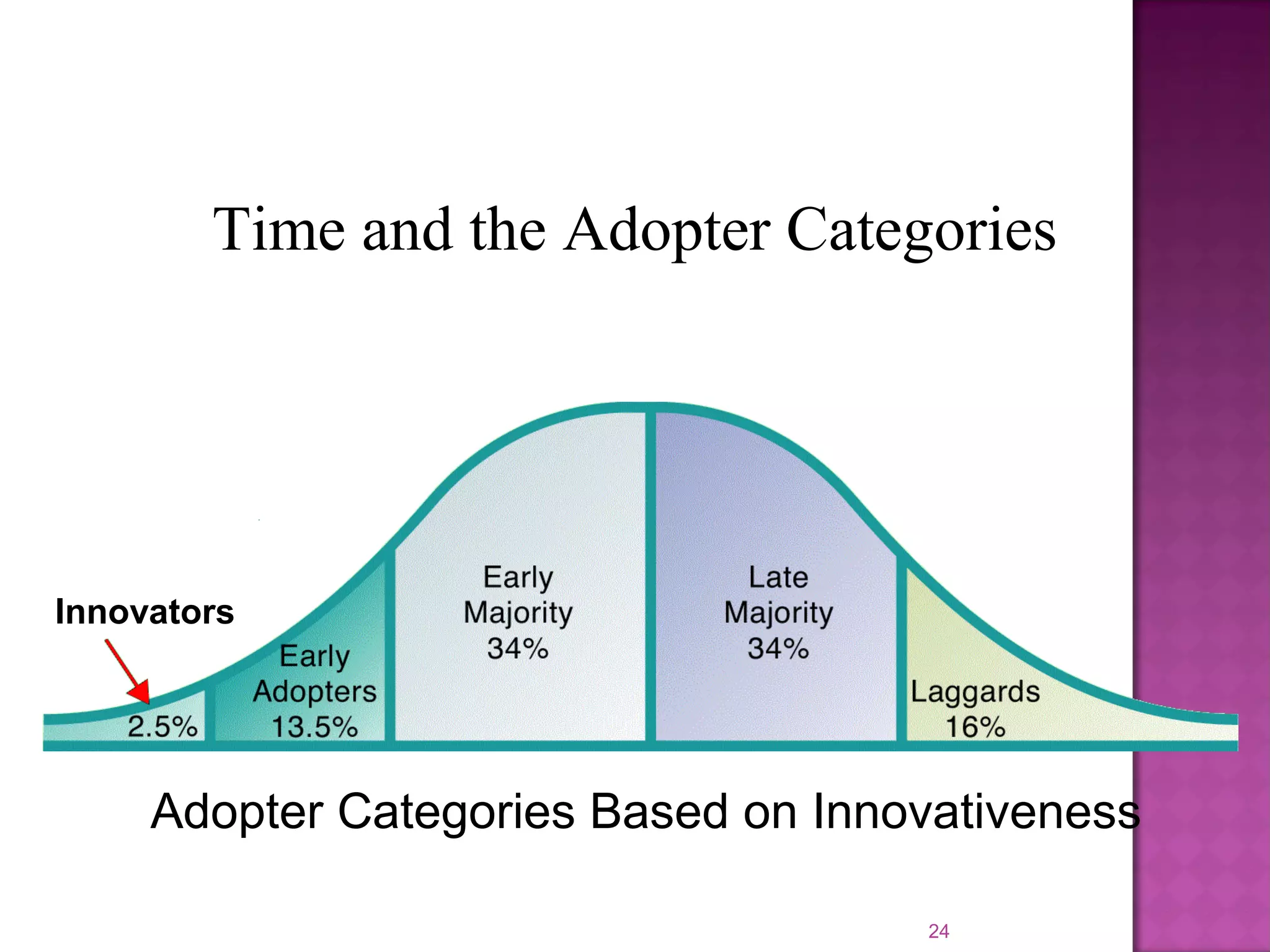
 Five categories identified in research:
1. Innovators
2. Early adopters
3. Early majority
4. Late majority
5. Laggards
22
 Opinion leaders are most likely to be found among the
early adopters category
 Opinion leadership is the process by which one person--
the opinion leader--informally influences the actions or
attitudes of others
 The key characteristic is that it takes place between two
individuals, neither of whom represents a commercial
selling source and is thus considered more reliable
23
Time and the Adopter Categories
24
Adopter Categories Based on Innovativeness
Innovators
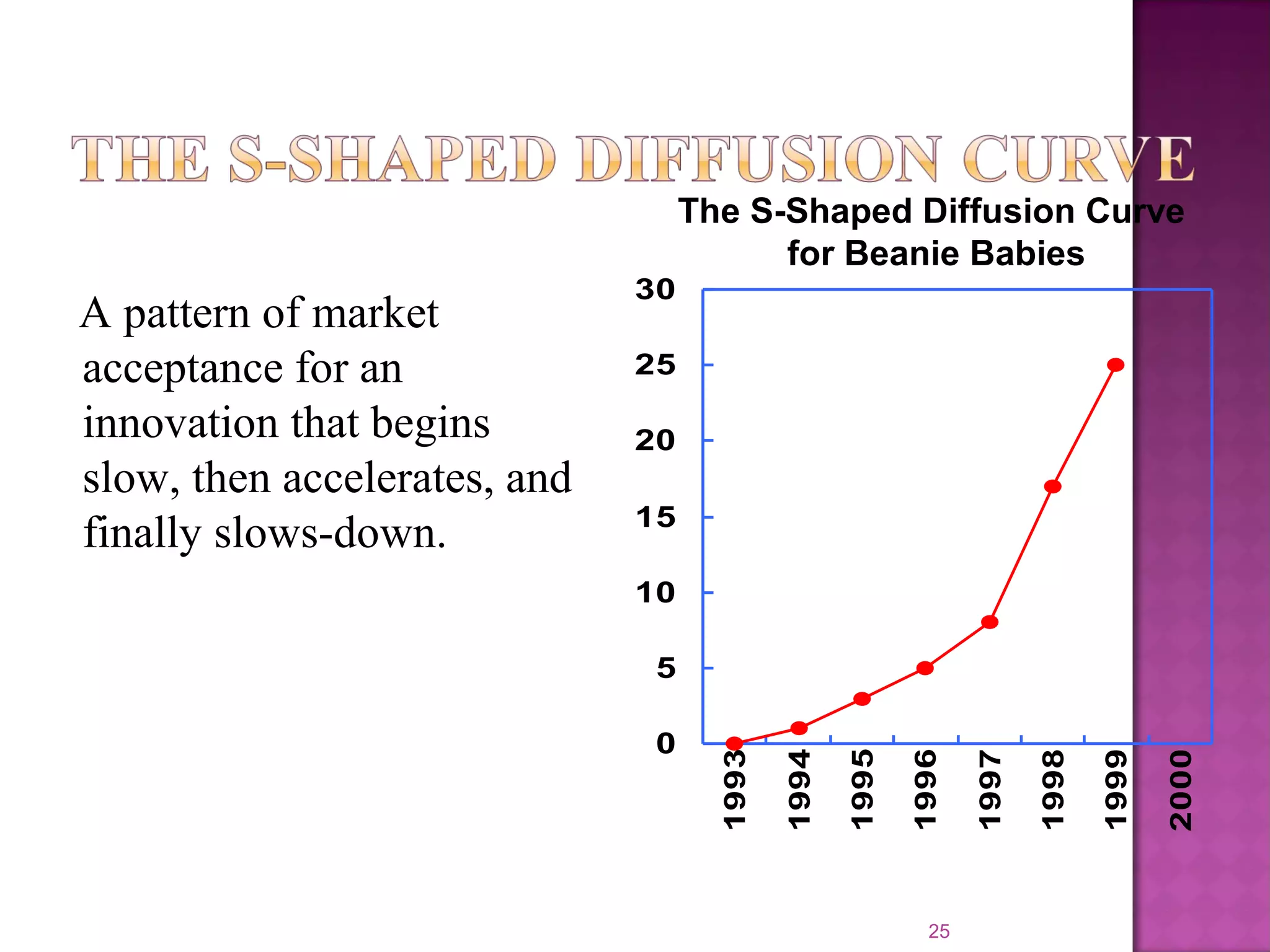
A pattern of market
acceptance for an
innovation that begins
slow, then accelerates, and
finally slows-down.
25
The S-Shaped Diffusion Curve
for Beanie Babies
0
5
10
15
20
25
30
1993
1994
1995
1996
1997
1998
1999
2000
 How long it takes a new product or service to be
adopted by members of a social system
 Rate of adoption generally is becoming faster
 Diffusion of products worldwide is becoming more
rapid as well
 Marketers generally desire as fast a rate of
adoption as possible in order to dominate a market
before competitors enter
26
 Sometimes marketers don’t seek a rapid rate of
adoption
 Making the product available at a very high price
to consumers who are willing to pay top dollar,
then gradually lowering the price over time for
additional segments of the market
 Permits manufacturers to recover development
costs more quickly
27
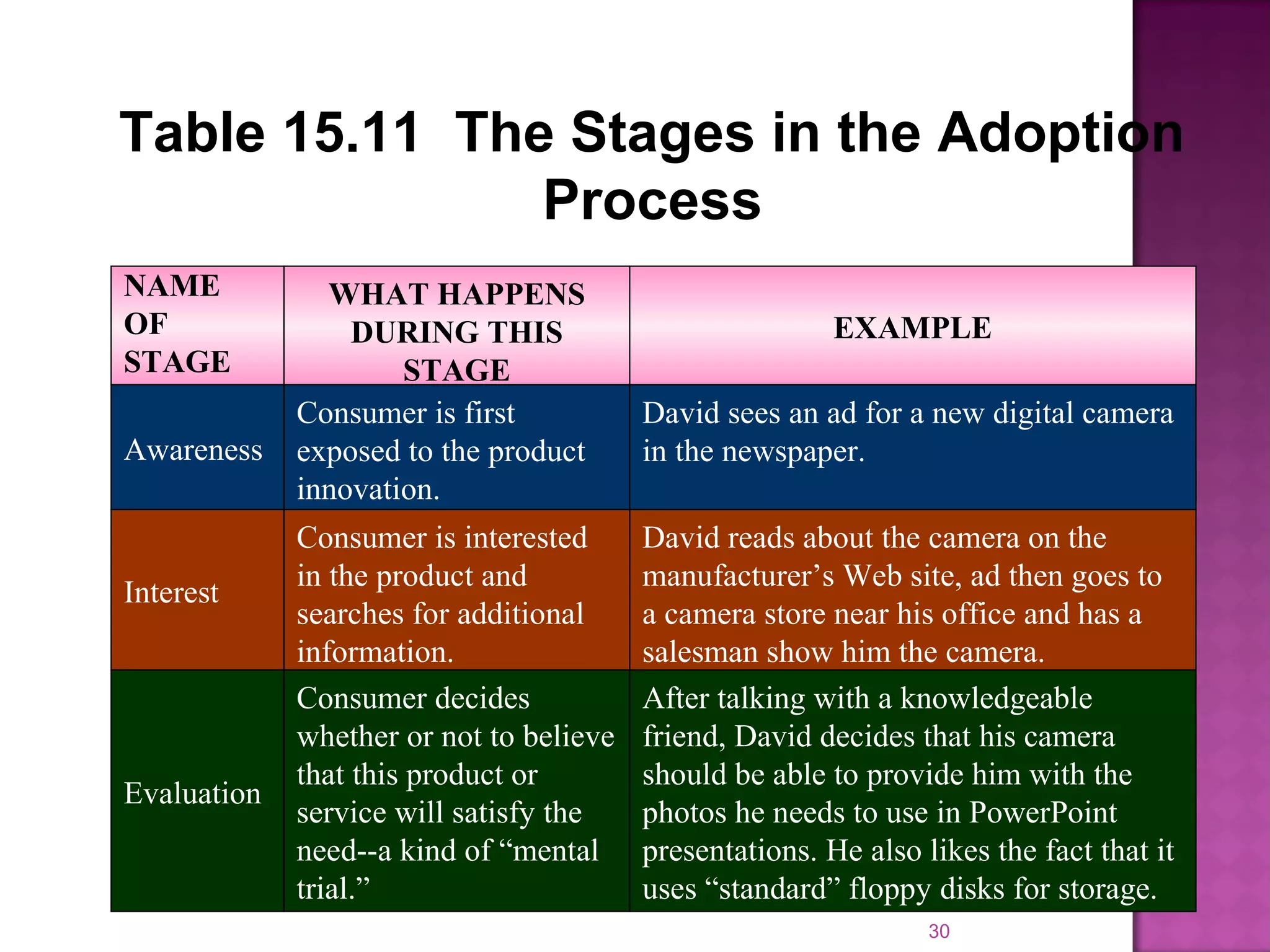
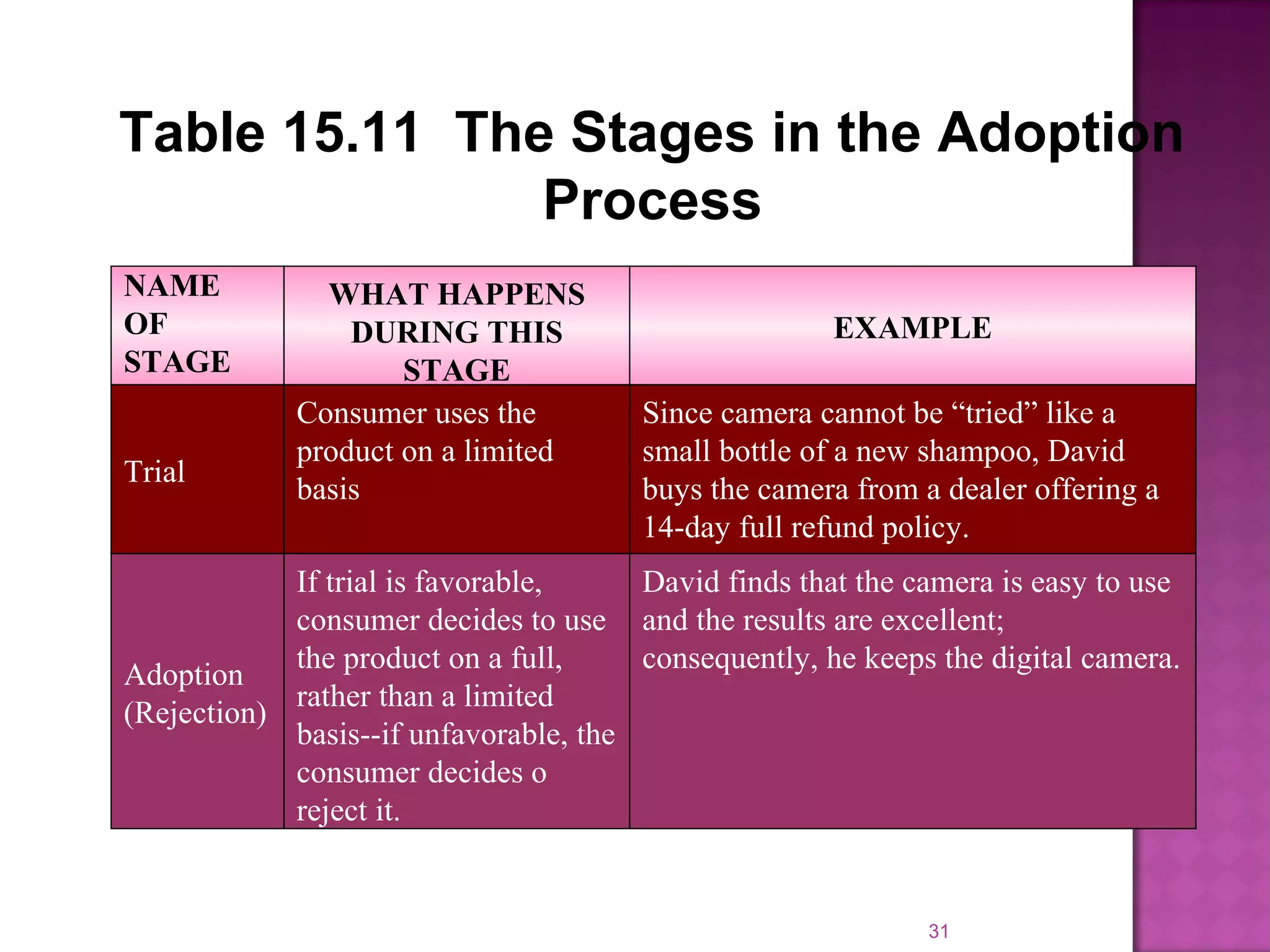
 Series of stages the consumer moves through in
arriving at a decision to purchase or reject a new
product
 Five stages include
1. Knowledge/awareness
2. Persuasion/interest
3. Decision/evaluation
4. Implementation/trial
5. Confirmation/adoption (rejection)
28
 Researchers have identified five factors that may
result in consumers’ failure to adopt a new
product
1. Value barriers
2. Usage barriers
3. Risk barriers
4. Tradition barriers
5. Image barriers
29
Table 15.11 The Stages in the Adoption
Process
NAME
OF
STAGE
WHAT HAPPENS
DURING THIS
STAGE
EXAMPLE
Awareness
Consumer is first
exposed to the product
innovation.
David sees an ad for a new digital camera
in the newspaper.
Interest
Consumer is interested
in the product and
searches for additional
information.
David reads about the camera on the
manufacturer’s Web site, ad then goes to
a camera store near his office and has a
salesman show him the camera.
Evaluation
Consumer decides
whether or not to believe
that this product or
service will satisfy the
need--a kind of “mental
trial.”
After talking with a knowledgeable
friend, David decides that his camera
should be able to provide him with the
photos he needs to use in PowerPoint
presentations. He also likes the fact that it
uses “standard” floppy disks for storage.
30
Table 15.11 The Stages in the Adoption
Process
Trial
Consumer uses the
product on a limited
basis
Since camera cannot be “tried” like a
small bottle of a new shampoo, David
buys the camera from a dealer offering a
14-day full refund policy.
Adoption
(Rejection)
If trial is favorable,
consumer decides to use
the product on a full,
rather than a limited
basis--if unfavorable, the
consumer decides o
reject it.
David finds that the camera is easy to use
and the results are excellent;
consequently, he keeps the digital camera.
NAME
OF
STAGE
WHAT HAPPENS
DURING THIS
STAGE
EXAMPLE
31

Diffusion

  • 1.
  • 2.
     In consumerbehavior terms, refers to research on the consumer acceptance of new products and services  Involves understanding two closely related processes:  Diffusion: a macro process concerned with the spread of a new product--an innovation--from its source to the consuming public  Adoption: the micro process concerned with the stages the consumer goes through in deciding to accept or reject a new product 2
  • 3.
     Diffusion isthe process by which  the acceptance of an innovation--a new product, service, idea or practice is spread by communication--mass media, salespeople, or word-of-mouth  to members of a social system--target market  over a period of time 3
  • 4.
     Four basicelements of the diffusion process: 1. The innovation 2. The channel of communication 3. The social system 4. Time 4
  • 5.
     Innovation takesmany forms  There is no universally accepted definition of the terms product innovation or new product  Instead, approaches to define the term have taken place within certain contexts:  Firm-oriented definitions  Market-oriented definitions  Consumer-oriented definitions  Product-oriented definitions 5
  • 6.
     This approachfocuses on the features inherent in the product itself and the effects of these features are likely to have on consumers’ established usage patterns  Robertson identified three types of product innovations:  Continuous innovation  Dynamically continuous innovation  Discontinuous innovation 6
  • 7.
     Introduction ofa modified product rather than a totally new product  Little or no change in technology  Has the least disruptive(Interrupt )influence on established usage patterns  Symbolic innovations tend to be continuous 7
  • 8.
     May involvea new product or modification of an existing product  Some technical advances  Still does not disrupt or alter consumer buying and usage patterns 8
  • 9.
     Introduction ofa pioneering product  Involves a major technological advance  Consumers must learn new behavior patterns  May be difficult to market initially  Is rare 9
  • 10.
     Not allnew products meet with immediate success  No precise formula marketers can use to predict how consumers will react to their products 10
  • 11.
    1. Relative advantage 2.Compatibility 3. Complexity 4. Trialability 5. Observability 11
  • 12.
     The degreeto which potential consumers perceive a new product is superior to existing substitutes 12
  • 13.
     The degreeto which potential consumers feel a new product is consistent with their present needs, values and practices 13
  • 14.
     The degreeto which a new product is difficult to understand or use 14
  • 15.
     The degreeto which a new product is capable of being tried on a limited basis 15
  • 16.
     The easewith which a product’s benefits or attributes can be observed, imagined or described to potential consumers 16
  • 17.
     Speed withwhich an innovation spreads through the market depends in great part on communications  Between the marketer and consumer  Between consumers (word-of-mouth)  In recent years a number of new channels of communication have been developed 17
  • 18.
     The physical,social, or cultural environment to which people belong and within which they function  Members of a social system have at least one characteristic in common that makes them potential buyers of a particular product  The values and norms of a social system will influence the acceptance or rejection of new products 18
  • 19.
     Three characteristicsof a social system influence spread of new products 1. The degree of compatibility between innovation and values of members 2. Homogeneity of members 3. Across cultures, depends on social similarity of the cultures 19
  • 20.
     Time relatesto diffusion in three ways: 1. Amount of purchase time 2. Adopter categories 3. Rate of adoption 20
  • 21.
     Refers tothe amount of time that elapses(passes) between a consumer’s initial awareness of a new product or service and the point at which he or she purchases or rejects it  Important because is a predictor of the overall length of time it will take for the product to achieve widespread adoption 21
  • 22.
     Involve aclassification scheme that indicates where a consumer stands relative to other consumers in terms of when they adopt a new product (i.e., time)  Five categories identified in research: 1. Innovators 2. Early adopters 3. Early majority 4. Late majority 5. Laggards 22
  • 23.
     Opinion leadersare most likely to be found among the early adopters category  Opinion leadership is the process by which one person-- the opinion leader--informally influences the actions or attitudes of others  The key characteristic is that it takes place between two individuals, neither of whom represents a commercial selling source and is thus considered more reliable 23
  • 24.
    Time and theAdopter Categories 24 Adopter Categories Based on Innovativeness Innovators
  • 25.
    A pattern ofmarket acceptance for an innovation that begins slow, then accelerates, and finally slows-down. 25 The S-Shaped Diffusion Curve for Beanie Babies 0 5 10 15 20 25 30 1993 1994 1995 1996 1997 1998 1999 2000
  • 26.
     How longit takes a new product or service to be adopted by members of a social system  Rate of adoption generally is becoming faster  Diffusion of products worldwide is becoming more rapid as well  Marketers generally desire as fast a rate of adoption as possible in order to dominate a market before competitors enter 26
  • 27.
     Sometimes marketersdon’t seek a rapid rate of adoption  Making the product available at a very high price to consumers who are willing to pay top dollar, then gradually lowering the price over time for additional segments of the market  Permits manufacturers to recover development costs more quickly 27
  • 28.
     Series ofstages the consumer moves through in arriving at a decision to purchase or reject a new product  Five stages include 1. Knowledge/awareness 2. Persuasion/interest 3. Decision/evaluation 4. Implementation/trial 5. Confirmation/adoption (rejection) 28
  • 29.
     Researchers haveidentified five factors that may result in consumers’ failure to adopt a new product 1. Value barriers 2. Usage barriers 3. Risk barriers 4. Tradition barriers 5. Image barriers 29
  • 30.
    Table 15.11 TheStages in the Adoption Process NAME OF STAGE WHAT HAPPENS DURING THIS STAGE EXAMPLE Awareness Consumer is first exposed to the product innovation. David sees an ad for a new digital camera in the newspaper. Interest Consumer is interested in the product and searches for additional information. David reads about the camera on the manufacturer’s Web site, ad then goes to a camera store near his office and has a salesman show him the camera. Evaluation Consumer decides whether or not to believe that this product or service will satisfy the need--a kind of “mental trial.” After talking with a knowledgeable friend, David decides that his camera should be able to provide him with the photos he needs to use in PowerPoint presentations. He also likes the fact that it uses “standard” floppy disks for storage. 30
  • 31.
    Table 15.11 TheStages in the Adoption Process Trial Consumer uses the product on a limited basis Since camera cannot be “tried” like a small bottle of a new shampoo, David buys the camera from a dealer offering a 14-day full refund policy. Adoption (Rejection) If trial is favorable, consumer decides to use the product on a full, rather than a limited basis--if unfavorable, the consumer decides o reject it. David finds that the camera is easy to use and the results are excellent; consequently, he keeps the digital camera. NAME OF STAGE WHAT HAPPENS DURING THIS STAGE EXAMPLE 31

Editor's Notes

  • #3 Derived from the Latin for “spread out”
  • #4 Examples? Laser eye surgery
  • #6 Start by citing stats and examples in book (p. 353-4) of how businesses must continue to innovate or fail What is innovation? Examples of forms? In the computer industry, we have: Completely new technology (pc); changes to existing products (laptop); symbolic changes (shape of the iMac)
  • #8 What is it? Examples? Redesigned automobile (new Beetle) Latest version of software program low-fat version of food product What are “symbolic innovations”? Symbolic innovations convey new social or psychological meanings Examples? designer jeans, skin care products for men, specialty coffees
  • #9 What is it? Examples? What about cell phones?
  • #10 What is it? Examples? Airplanes; cars; home computer; fax machines; VCRs; internet Cell phone?
  • #11 Examples of those? Apple’s Newton Electric cars (book); trash compactors; composting toilets Examples of those that have succeeded? nutrasweet; disposable diapers (book); cordless phones
  • #13 What is it? Examples? Cell phone over pager; fax machine over delivery services; Vinyl records to cassette to CD Floppy disks to CD’s
  • #14 What does it mean? Examples? Gillette’s Mach 3 razor has become very popular… But unlikely men will accept a depilatory cream designed to remove facial hair (because incompatible with daily shaving practices) It is possible to make a very tiny phone, and they are popular in Japan, but Americans don’t like talking into space
  • #15 Obviously, the harder to understand, assemble or operate, the less its likelihood of being selected Examples? Cameras--drop-in film auto focus, built-in flash, etc. all added to make cameras easier to use VCR is an exception to this! Apple had a great ad a couple of years ago, comparing the size of the pile of documentation that came along with a new Windows-based computer and an Apple
  • #16 What does this mean? Examples? Free trial (samples) money-back guarantees--Total Gym (Chuck and Christie); America Online; Ron Popiel’s various products
  • #17 What is it? Examples? Fashions and jewelry (worn in public) vs. soap or deodorant Use of celebrities and athletes to wear/use products can enhance speed of adoption
  • #18 The second element in the diffusion process is the… Examples? Company web sites ask consumers if they want to receive e-mails, etc. about new products Companies use floppy disks or CD-ROMS to promote products
  • #19 The third element in diffusion is… What is it? Why does this matter? Examples? Religion will affect acceptance of a new birth control method Older generation’s acceptance of computers, cell phones, etc.
  • #20 Examples? Diet pills and sugar-free food appeal to American desire to eat as much as they want, not exercise Hair care product for African-Americans in New York City vs. whites in upstate New York Similar? US and UK. Dissimilar? Christian vs. Muslim; but halal v. kosher?
  • #21 Time is the final element in the diffusion process
  • #22 What does it mean? See Kanuk Table 15-8 p. 421 for time line for typical purchase In other words, when individual purchase time is short, a marketer can expect the overall rate of diffusion will be faster
  • #23 These are all explained well in reading, so won’t go into detail. However, worth mentioning that…
  • #24 We’ll see this again later under the heading of “word of mouth”
  • #25 Graphically, adopter categories looks something like this “ Average consumer” is right in the middle
  • #26 Graphically, diffusion looks something like this—an “S” shape Why does the curve ultimately flatten out? Because after a while most people who were going to purchase the innovation have already done so.
  • #27 The third time-related factor is… What is it? E.g., it took 12 years longer for black and white tvs to reach the same level of “penetration” in Europe and Japan as in US; for color TVs, 5 years in Japan and slightly longer in Europe; for VCR’s, 3-4 years (with the US lagging); for CD players, about 3 years.
  • #28 Skimming is a practice related to rate of adoption What is it and when might it be used? Examples? VCR’s originally sold for $700; now $100 for a better product (sometimes also the result of better technology, e.g., computers)
  • #29 Nicely covered in book, so won’t go into detail A simplistic model that doesn’t account for full complexity of consumer decision process, but is still useful Consumer is first exposed to the product innovation (e.g., an ad on television) Consumer is interested and seeks and obtains information about the product; develops a favorable or unfavorable attitude toward the product Consumer decides whether the product will meet his/her needs Consumer uses the product on a limited basis (e.g., a 14-day money-back guarantee) If trial is favorable, consumer decides to use the product on a full, rather than limited basis/or rejects it
  • #30 Again, these are explained well in text and will not cover in detail Focus on #4: Tradition barriers Language and cultural norms sometimes get in the way of adoption outside the U.S. Examples in book p. 378 Some famous instances of language barriers have turned out to be “urban legends” Chevy Nova Other examples (see web articles in file) Sometimes cultural differences can raise serious problems: Nestle/infant formula--not considering quality of water and mothers’ dilution of product due to low incomes